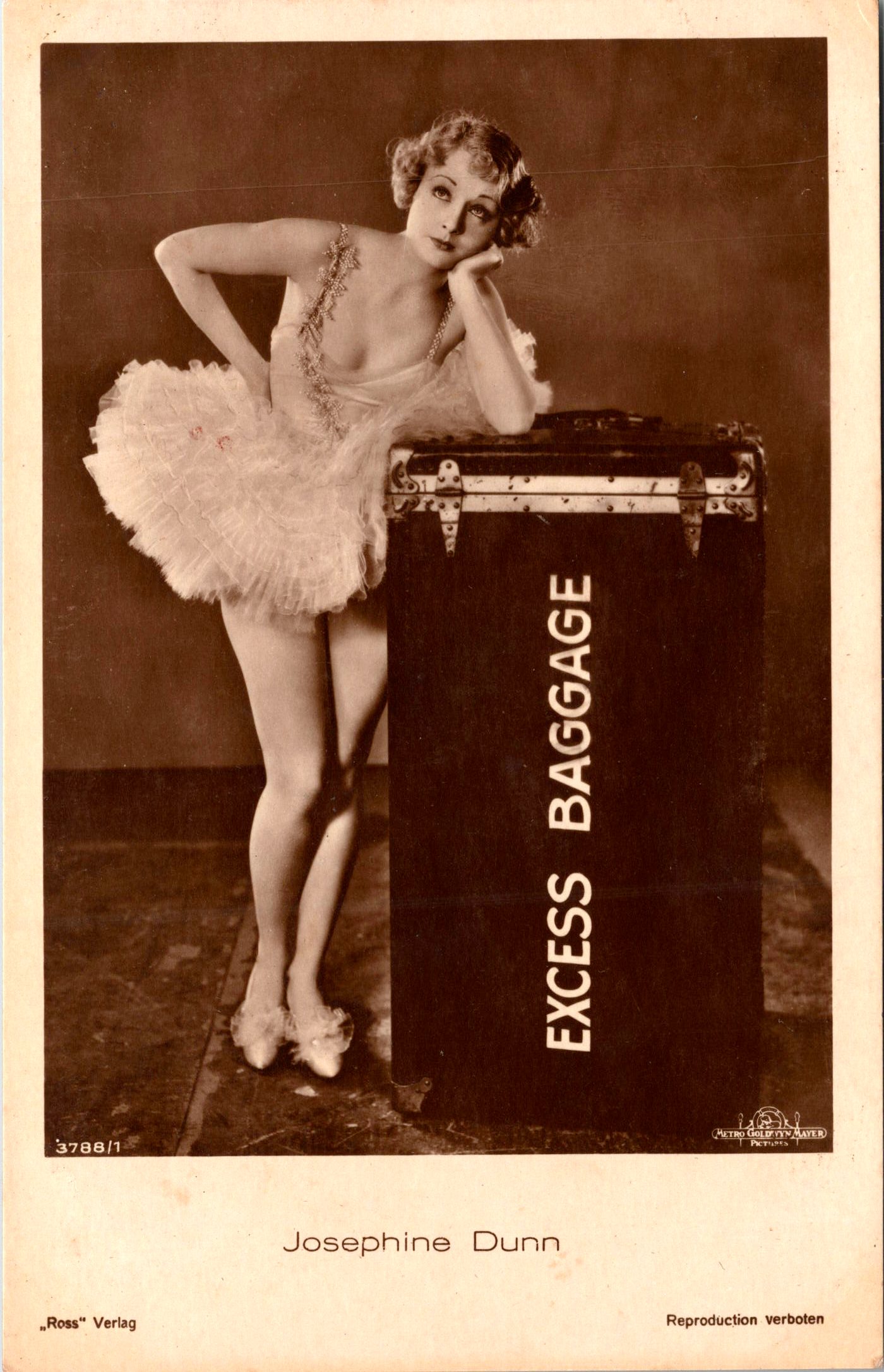
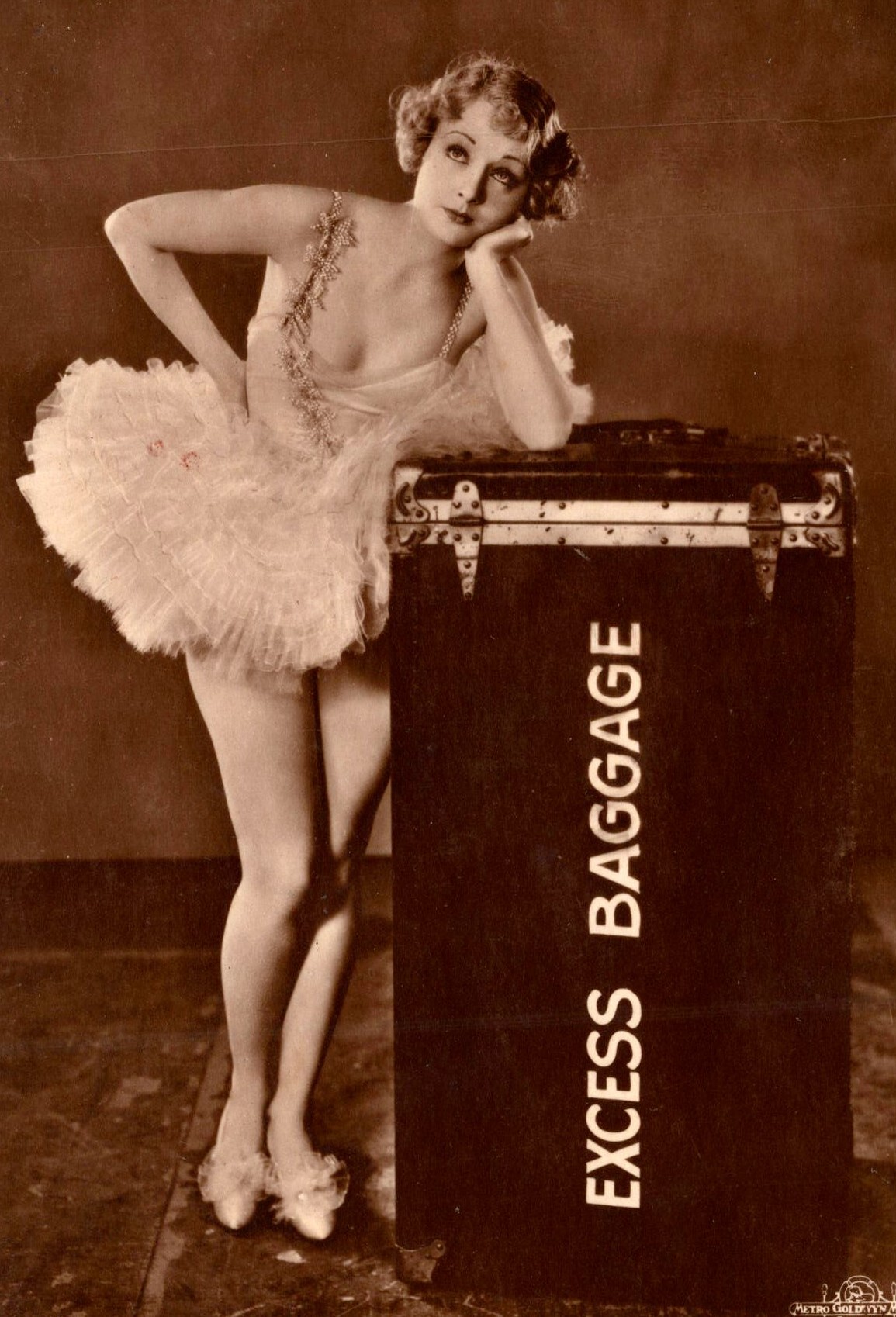
JOSEPHINE DUNN : IN “EXCESS BAGGAGE” : MGM SILENT FILM STAR : RISQUE RPPC 1928

Josephine Dunn (1906 –1983) was an American actress known primarily for her work in silent and early sound films during the late 1920s and early 1930s. She was a glamorous starlet of the Jazz Age, often cast in flapper and socialite roles. Josephine Dunn was born in New York City, where she was raised. Little is known about her early years, but she entered show business as a teenager, joining the world of vaudeville before making the transition to film. Her natural beauty, charisma, and fashionable style made her a popular choice for film producers during Hollywood’s silent era. Dunn made her film debut in 1926 and quickly became a sought-after actress, starring in a variety of silent and early talkie films. She was often cast as the “other woman” or as a carefree flapper, fitting the Roaring Twenties’ archetype of modern femininity. One of her most notable films was “Our Modern Maidens” (1929), in which she starred alongside Joan Crawford and Douglas Fairbanks Jr. She also appeared in: “Excess Baggage” (1928),”The Broadway Melody” (1929),  “Tanned Legs” (1929), and “Montana Moon” (1930). Her transition from silent films to talkies was fairly successful, though she never achieved the same level of fame as some of her contemporaries, such as Crawford or Norma Shearer. By the early 1930s, her film career began to slow down. While primarily a screen actress, Dunn had early experience in vaudeville and stage performances, though she never became a major Broadway star. She retired from acting in the mid-1930s and lived a largely private life afterward. Dunn was married multiple times, including to millionaire oil executive Carroll Case. Her personal life was often the subject of media gossip. Although she was never a top-tier star, Josephine Dunn was emblematic of 1920s and early 1930s Hollywood glamour. This postcard features Dunn in her starring role in the 1928 silent film, “Excess Baggage”. The romantic comedy film was produced by Metro-Goldwyn-Mayer (MGM). She played the role fo a glamourous and sophisticated young woman. Unfortunately, like many silent films of the era, Excess Baggage is considered lost, meaning no known copies are available today. In this image, Josephine Dunn is dressed in a delicate, ruffled ballet-style costume, with a short, voluminous tutu and an intricately adorned bodice. The dress features lace and embellishments, reflecting the flapper era’s fascination with femininity and luxury. Her feet are adorned with soft, ballet-like slippers, adding to the graceful, almost ethereal appearance of her outfit. Her pose is both playful and weary—leaning on the large travel trunk with one arm propped up and her hand resting gently against her face. Her expression is one of wistful contemplation, with her eyes gazing off to the side, giving a sense of melancholy or quiet amusement. This pose complements the humor suggested by the film’s title, Excess Baggage, possibly hinting at the idea of emotional or romantic burdens rather than just literal luggage. Her curled, short blonde hair, typical of the 1920s, frames her face beautifully, reinforcing her status as a Jazz Age beauty. This risque postcard was published by Berlin based, Ross Verlag. In the card’s lower right corner, we see the logo of MGM. This vintage real photo postcard was issued in 1928. (SOLD)
JULIA MARLOWE: ESTEEMED AMERICAN STAGE ACTRESS

CABINET CARD 1

   CABINET CARD 2   (SOLD)
CABINET CARD 3  (SOLD)
CABINET CARD 4

CABINET CARD 5

CABINETCARD 6CABINET CARD 7   (SOLD)

CABINET CARD 8

CABINET CARD 9

MARLOW8

CABINET CARD 10

MARLOWE IN INGAMAR_0003
SPIN MARLOWE_0002

CABINET CARD 11

CABINET CARD 12

BRANSCOMBE

CABINET CARD 13

This image has an empty alt attribute; its file name is julia-marlowe-falk.jpg

CABINET CARD 14   (SOLD)
JULIA MARLOWE: ESTEEMED STAGE ACTRESS : SARONY : CABINET CARD PORTRAIT  c1890 - Picture 1 of 3

CABINET CARD 15 (SOLD)
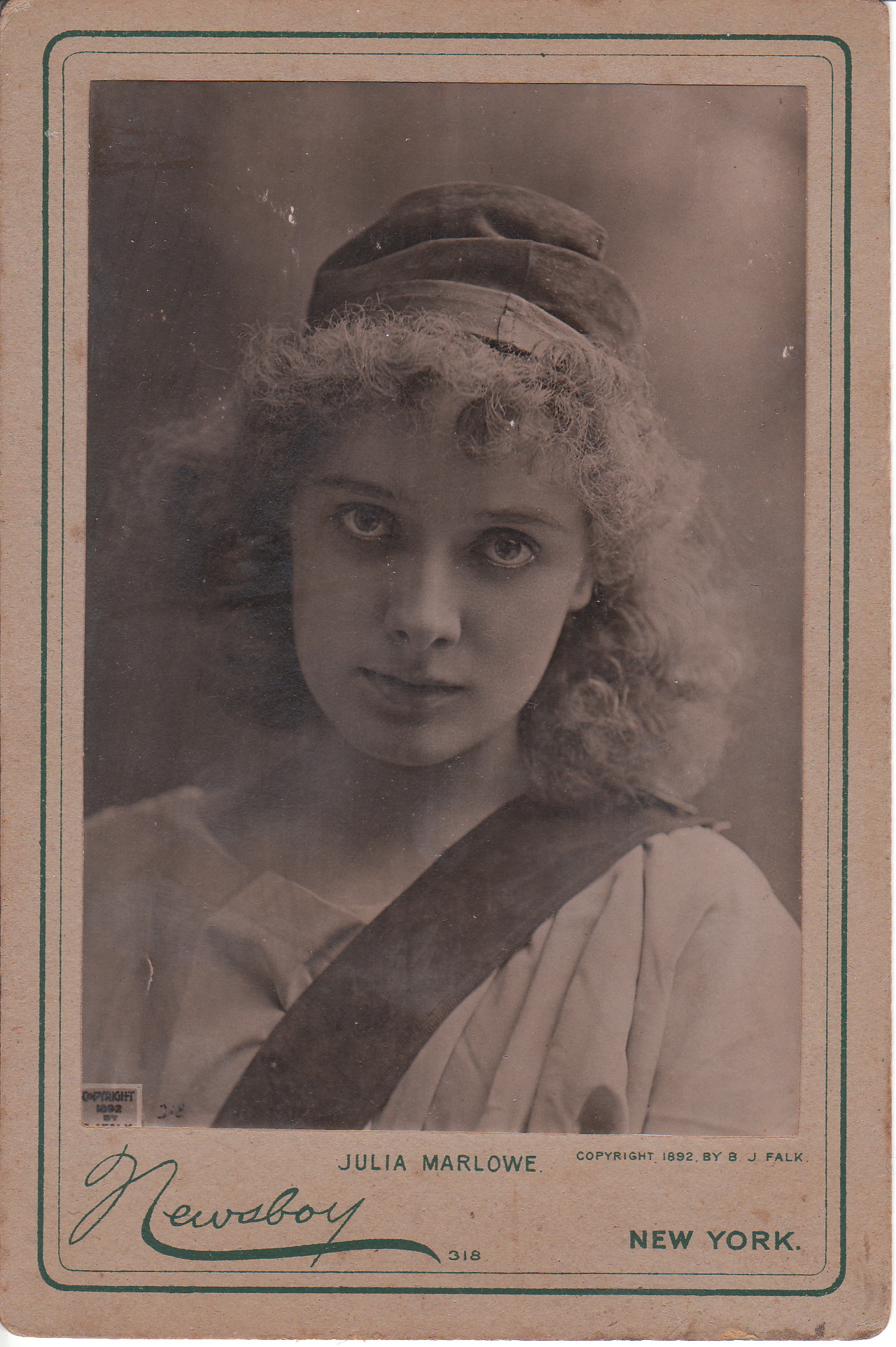
Julia Marlowe (1865-1950) was born in England and as a young child moved to the United States with her family. In her early teens she began her theatrical career with a juvenile opera company. She began playing Shakespeare in her home town of Cincinnati, Ohio. She made her Broadway debut in 1895 and by the end of her career, had appeared in more than 70 Broadway productions. Her first husband was actor, Robert Tabor. Their marriage lasted six years. In 1904 she appeared in “When Knighthood was in Flower”. Great success in this play brought her financial independence. Earlier, in 1903, she appeared in ‘The Cavalier” and “Ingomar”. The New York Sun wrote about her performance in “Ingomar”; “There is not a woman player in America or in England that is – attractively considered- fit to unlace her shoe”. In 1904 she began a partnership with actor E. H. Sothern. They toured the United States performing various plays of Shakespeare. They were managed by Charles Frohman and later, the Shubert brothers. They were considered to be among the major Shakespearian actors of the day. In 1906, Marlowe played in “Jeanne d’Arc” and also as Salome in “John the Baptist”. Later, Sothern and Marlowe played in London but were not terrific box office successes there. In 1911 Marlowe and Sothern married each other. In 1920 and 1921, they made eleven phonograph recordings for the Victor Company. The top Cabinet Card was produced by Newsboy as a premium for their tobacco products. The photographer was Falk and the image is from 1892.

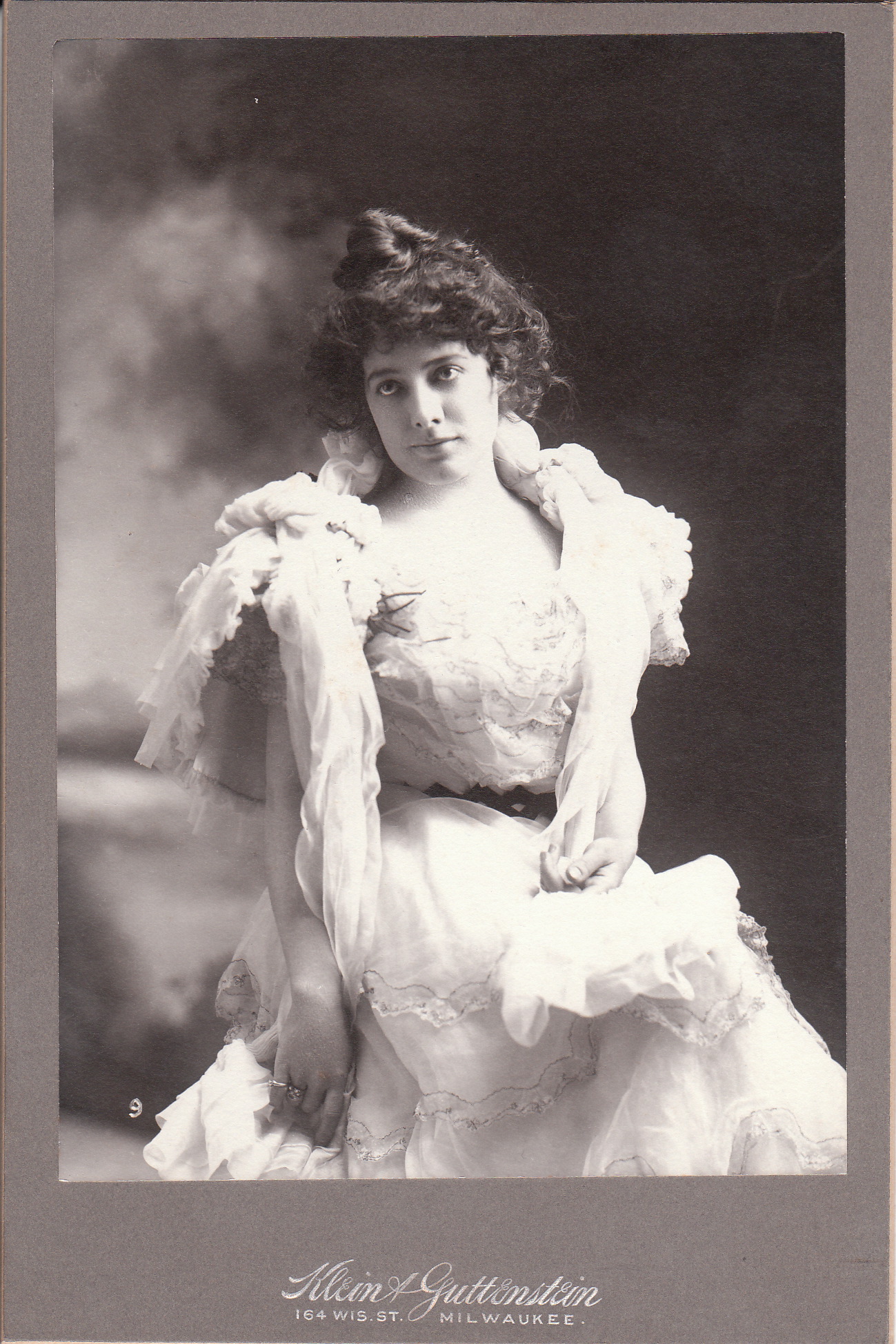
The second portrait of Julia Marlowe has a notation on the reverse of the card stating “Julia Marlowe Tabor”. Therefore, this photograph was likely taken during the time of her marriage to Tabor (1894-1900). The photographic studio that produced this portrait is  Klein & Guttenstein of 164 Wisconsin Street, in Milwaukee,  Wisconsin.  Klein and Guttenstein were leading photographers of their time. Wilson’s Photographic Magazine (1902) reveals that the two men  were very active in the Photographers Association of Wisconsin and other photography organizations. The photographers were considered part of a network of photographers skilled at producing publicity images of theatrical and vaudeville stars to be used in national magazines and other publications. The New York Public Library has a collection of portraits of actress Blanche Bates; produced by Klein & Guttenstein. The University of Pennsylvania Library has one of Klein & Guttenstein’s portraits of Julia Marlowe.  (SOLD)
The third portrait of Julia Marlowe in the cabinet card gallery collection is photographed by Sarony, the famed celebrity photographer located in New York City.  This cabinet card is signed by the actress and dated 1890. Additonal photographs by Sarony can be viewed by clicking on the category “Photographers: Sarony”.  SOLD

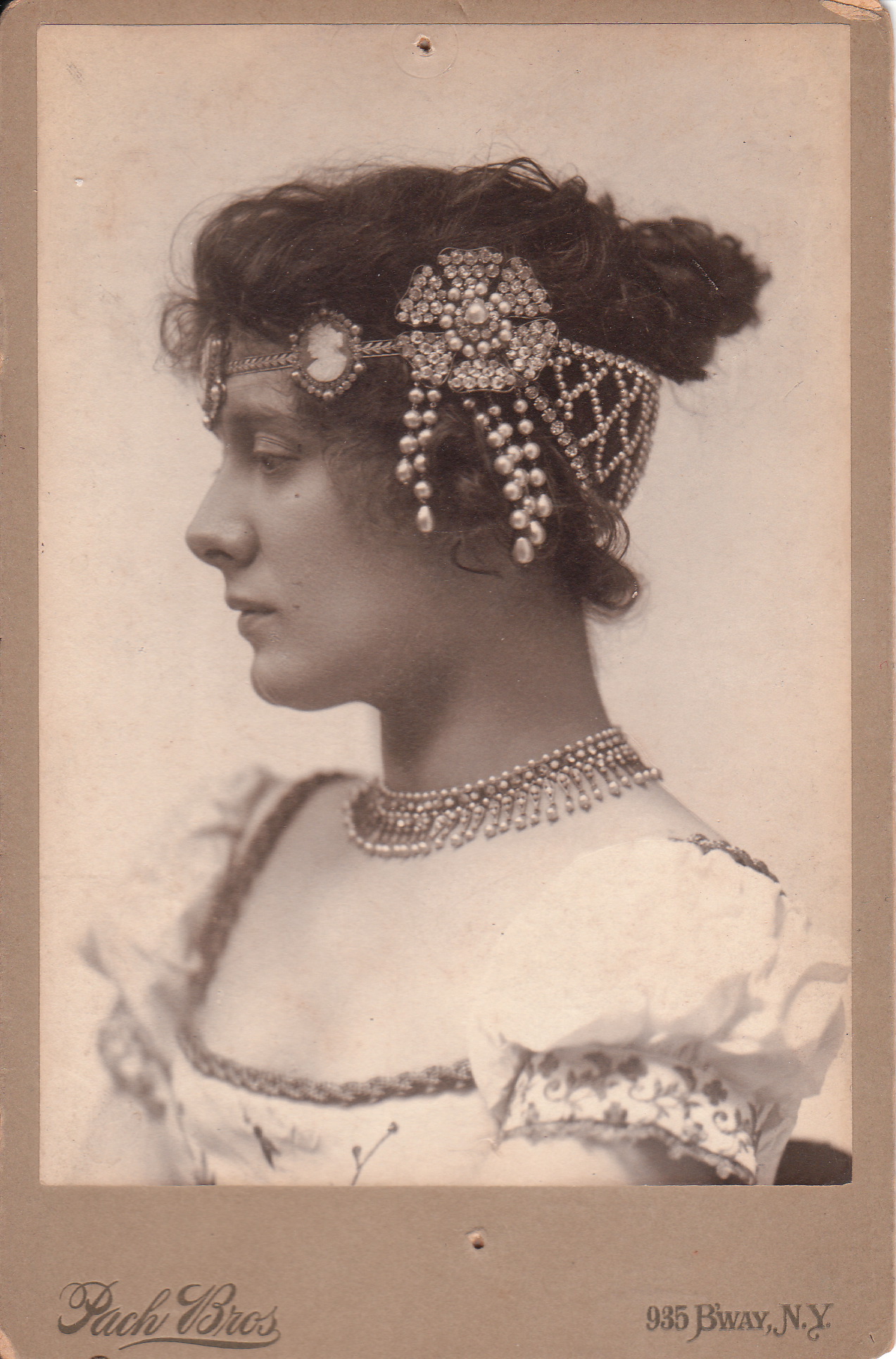
The fourth portrait of Miss Marlow features her in role in the production of “Countess Veleska”. The play was adapted for a German work, “The Tall Prussian”, by Rudolph Stratz. The play opened in New York in 1898 at the Knickerbocker Theatre. The review in the New York Times (1898) stated that the “drama was made wholly interesting by the personal charm and sincerity of Miss Marlowe”. In a sarcastic tone, the reviewer comments about Marlowe’s co star, Bassett Roe. The reviewer states that Roe has only two qualities of the man he was playing, “height and good looks”. The reviewer continues his scathing description of Roe; “The only time he actually warmed up was when he accidentally set his hair on fire. Even then he would have let it burn if Miss Marlowe had not gone to his rescue.” The photographic studio that produced the “Countess Veleska” cabinet card was Pach Brothers of New York City. Pach Brothers were photographers known for their photographs of celebrities of their era. To see additional photographs by the Pach Brothers, click on this site’s category of “Photographers: Pach Brothers”.

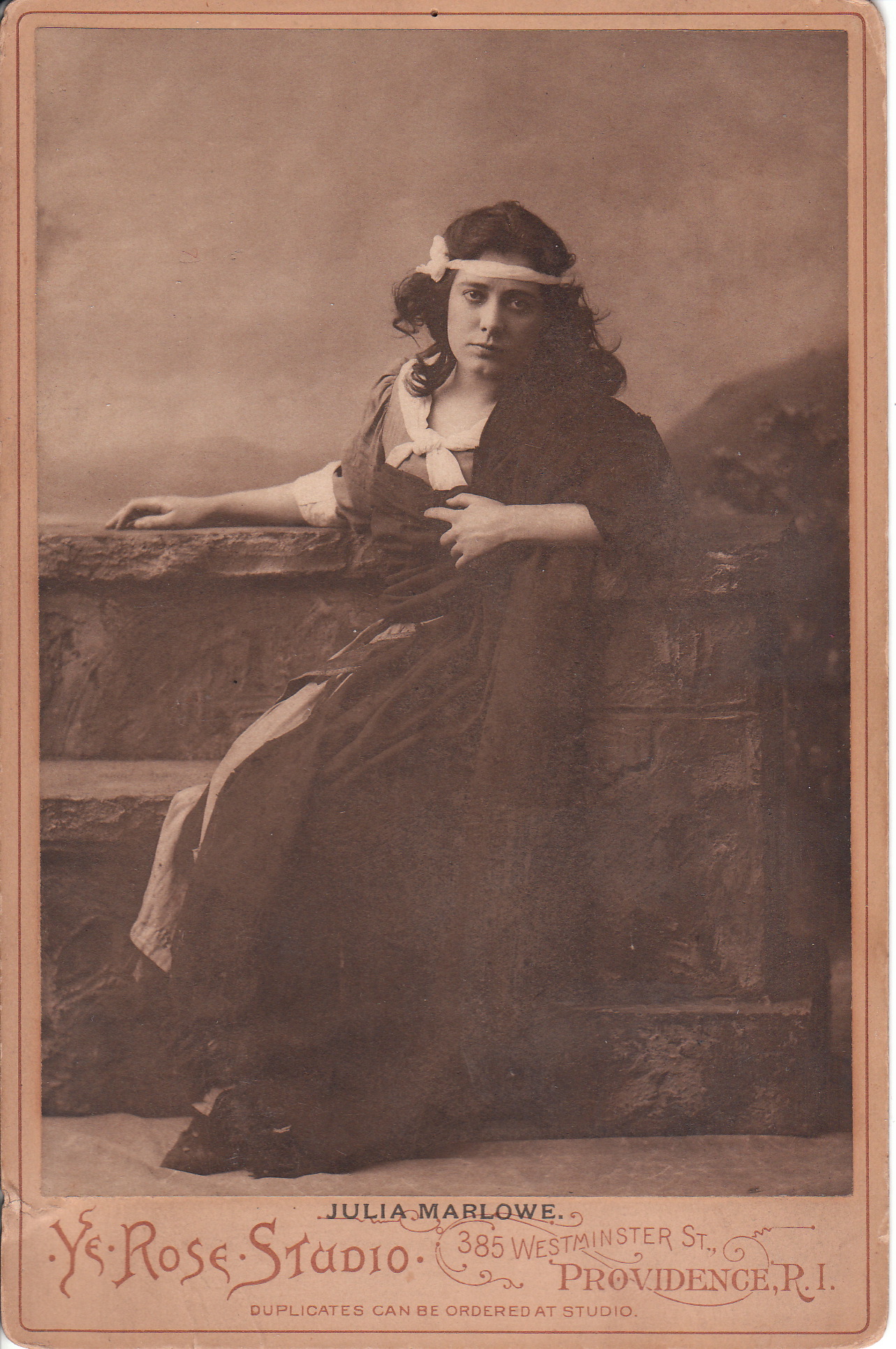
The fifth portrait of Julia Marlowe appears to be a photograph of the actress in costume for an unknown stage production. The image was photographed by Ye Rose Studio of Providence, Rhode Island. The reverse of the card indicated that the studio was opened in 1886. The studio was located in the Conrad building in downtown Providence. The building still exists. Other photographs by the Ye Rose Studio can be viewed by clicking on the category “Photographer: Ye Rose”.

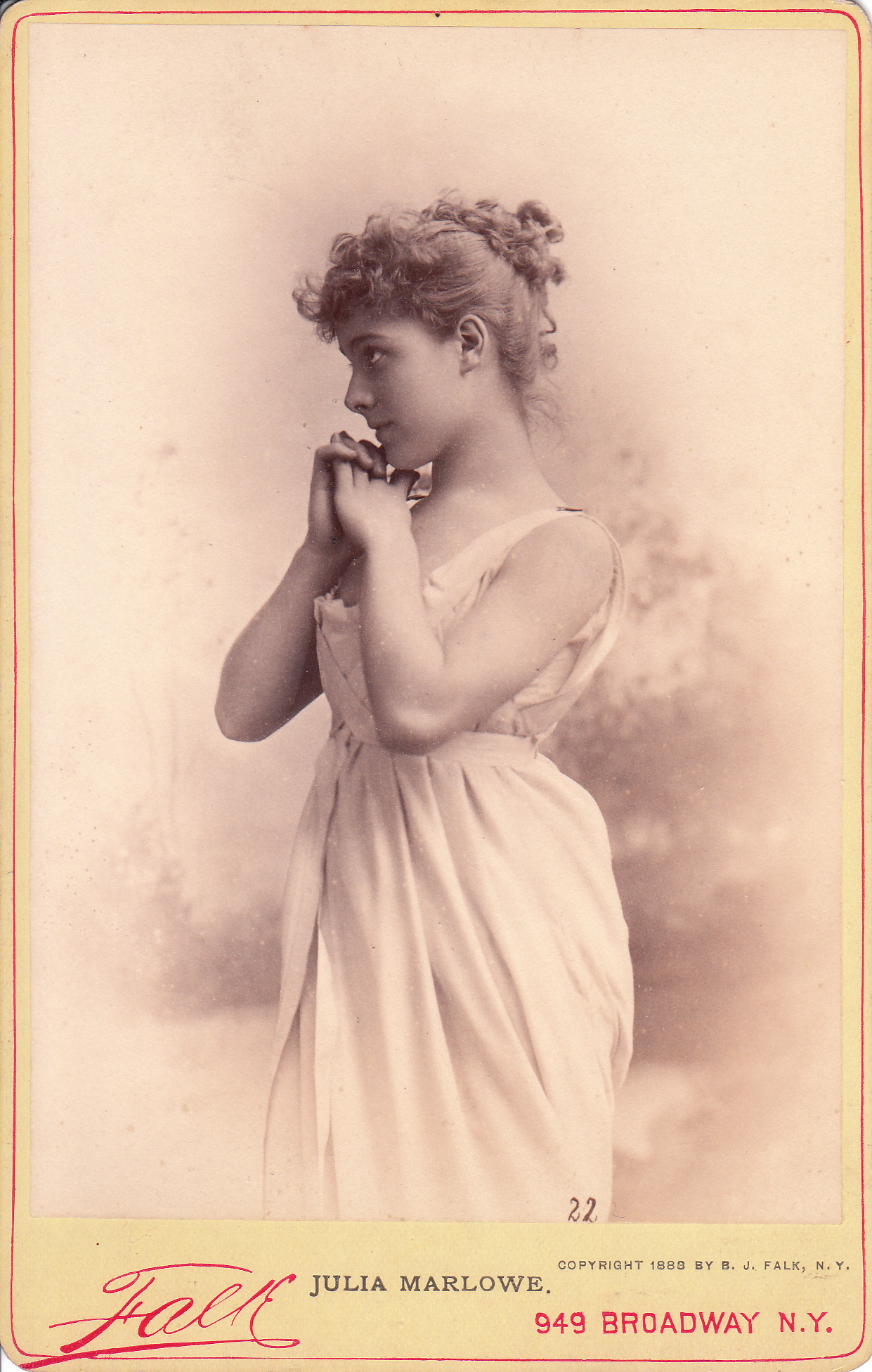
Portrait number six is an excellent example of the beauty of Julia Marlowe. This image, from 1888, captures Ms. Marlowe at the young age of twenty-three. The photographer of this portrait was B. J. Falk, a celebrity photographer located in New York City, New York. To view other photographs by Falk, click on the category “Photographer: Falk”.

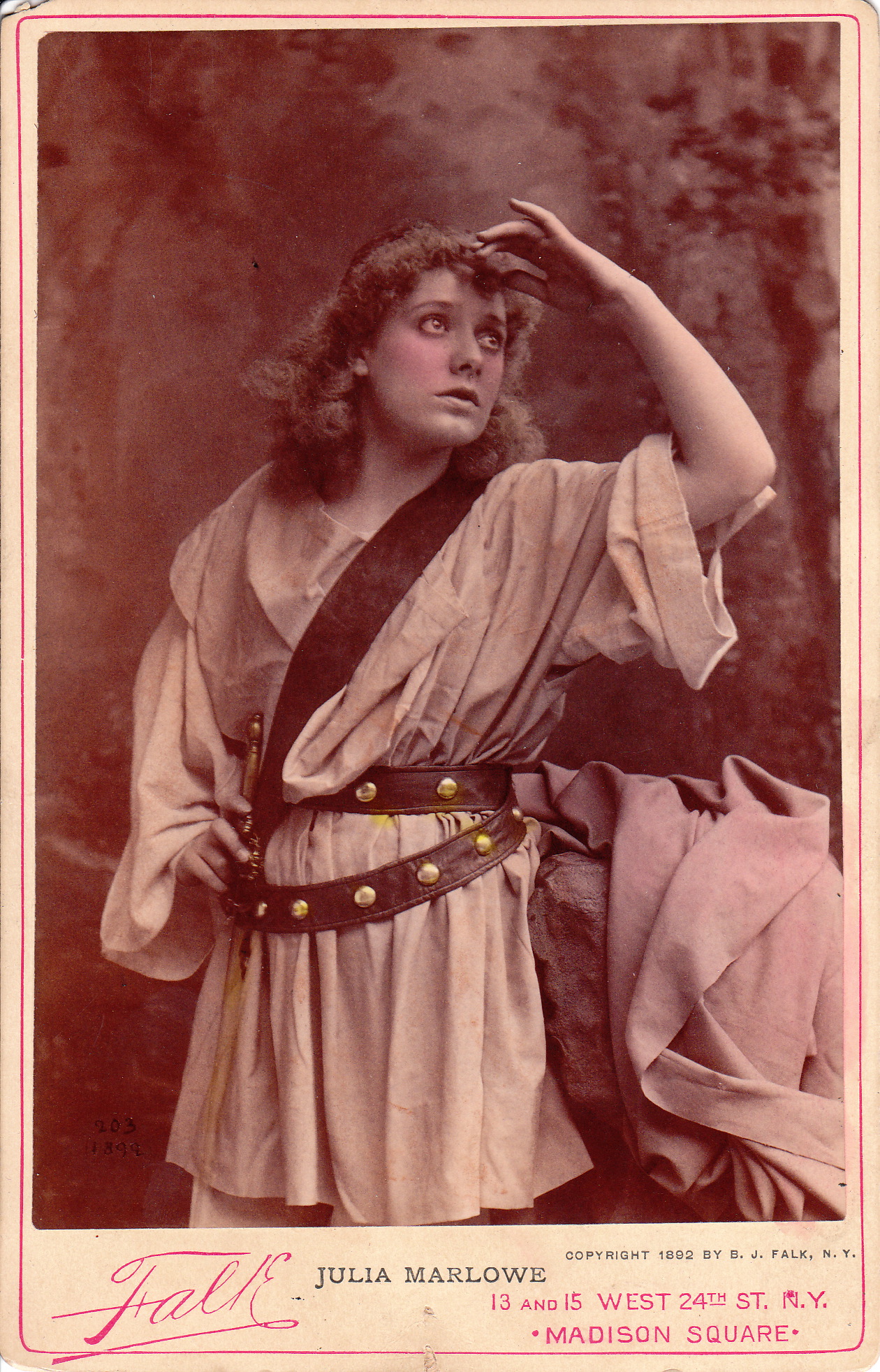
The seventh portrait is another example of a B. J. Falk image. The photograph features a costumed Julia Marlowe in the production of “Cymbeline“. Cymbeline is a play by William Shakespeare that was based on legends about the early Celtic British King,  Cunobelinus. The play deals with themes that include innocence and jealousy. Ms. Marlowe plays Imogen, the King’s daughter. Her expression in the photograph shows fear and concern as she looks at someone or something in the distance. Her left hand shades her eyes while her right hand clutches her belted dagger. A stamp on the reverse of  this cabinet card reveals that it was formerly owned by Culver Pictures of New York City, New York. Culver Pictures has been collecting photographs and illustrations from the 19th and first half of the 20th century, since 1926. These pictures are used in books, films, and other forms of media. At the time that this cabinet card was stamped by the company, Culver Pictures was located in New York City.  (SOLD)

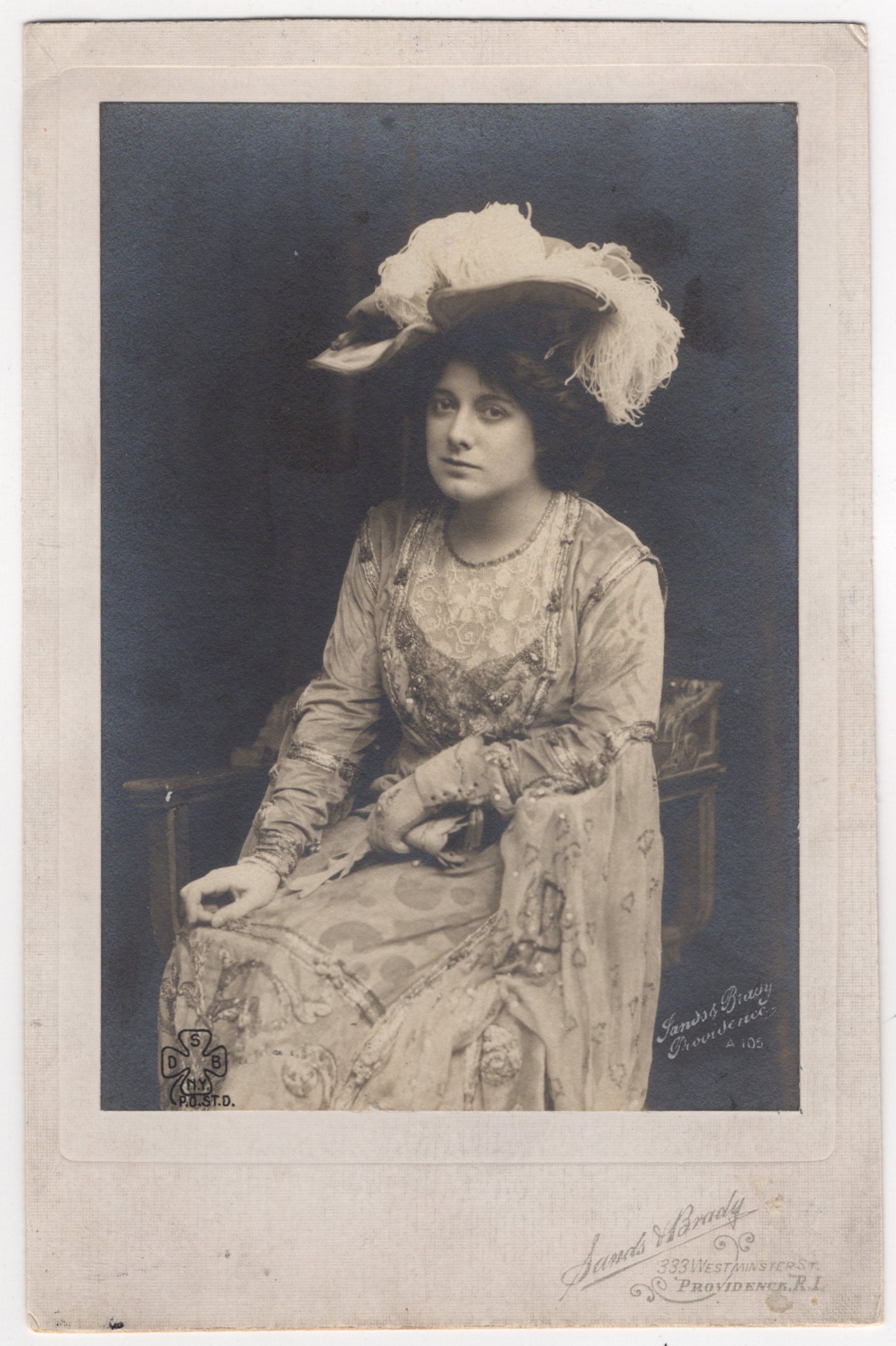
Portrait number eight is a close-up photograph of Miss Marlowe. The photographer of this cabinet card is the studio of Rose & Sands whose gallery was located in Providence, Rhode Island. Note that photograph number five also came from the Rose studio, but at that time, the gallery was called, the Ye Rose studio. The Wilson’s Photographic Magazine (1899) reports that Rose and Sands were the proprietors of Ye Rose. A humorous headline in a photography magazine stated “Providence Provides for All, And Rose Provides for Providence”.  Print on the reverse of this cabinet card reveals that the Rose & Sands studio was opened in 1886 and that it specialized in “High Class Portraits from Cabinet to Life Size”. Also of interest, like photograph number seven, there is a stamp on the reverse of the photograph with the name “Culver Pictures Inc”.

Photograph number nine features the beautiful Miss Marlowe displaying a mischievous smile. Note her engaging large eyes. She is wearing a somewhat revealing dress (for the cabinet card era) and has a wonderful hat atop her head. This cabinet card photograph was published in 1888 by Benjamin Falk of New York City.  The image is marked with the number sixty-nine.

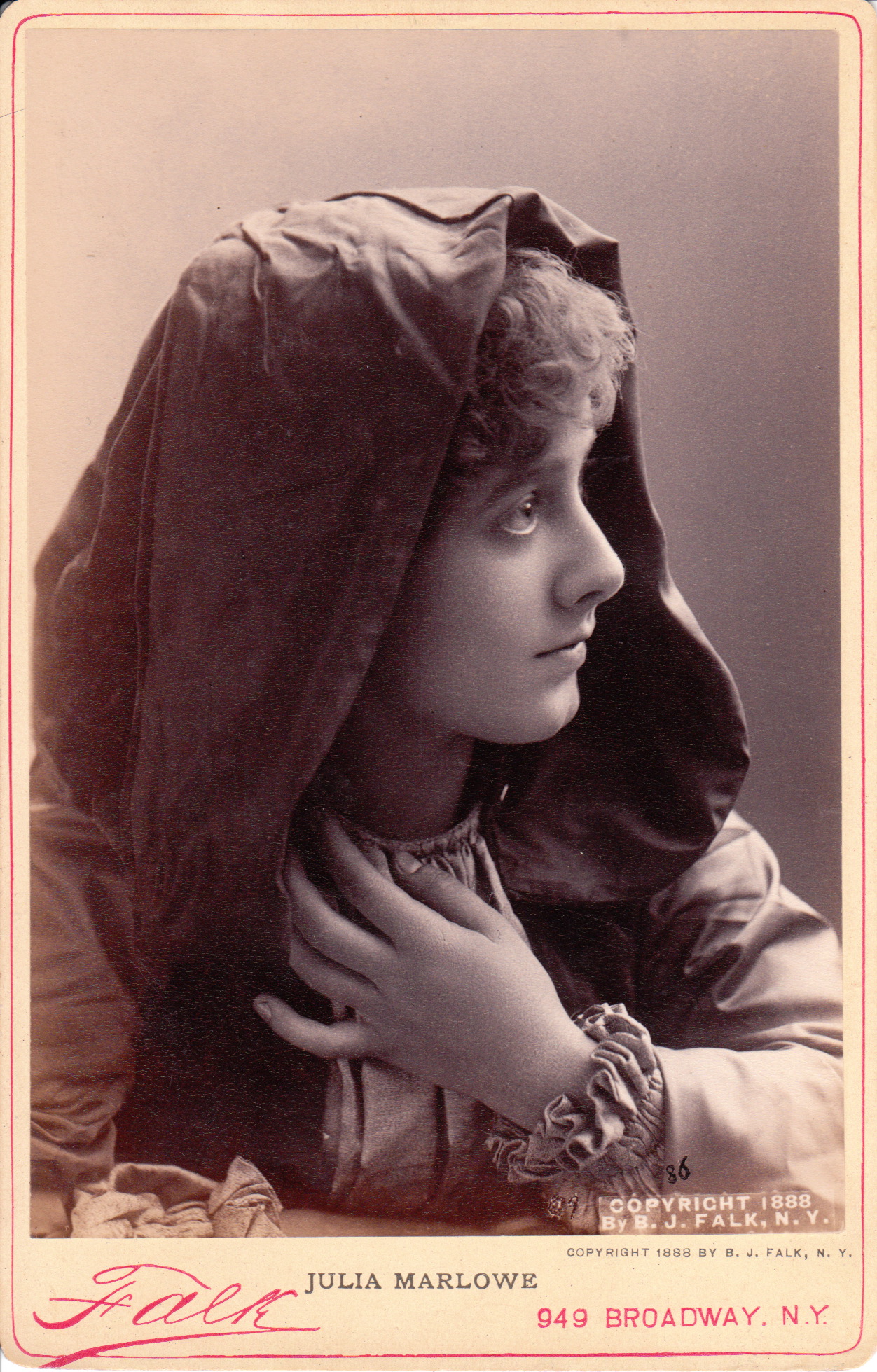
Portrait number ten is a closeup of Julia Marlowe with her head covered, but with her pretty face very visible. She is likely in costume for this photograph. The photograph is taken by B. J. Falk of New York City and has a copyright date of 1888. The cabinet card is marked number “86”.

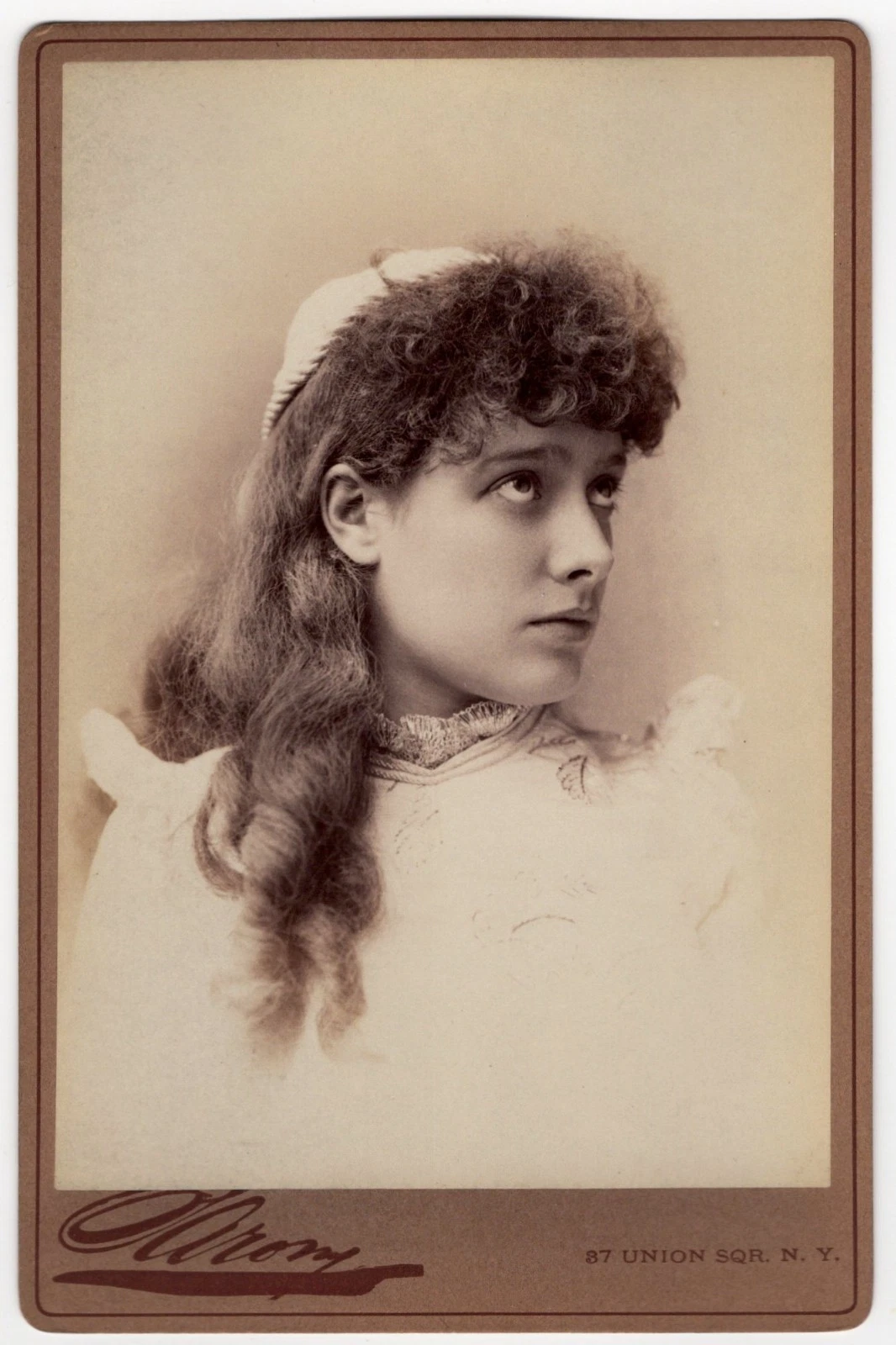
The eleventh photograph captures Miss Marlowe staring hypnotically at a flower. Someone, has written below her name that the image features her in the role of Parthenia in the production of “Ingomar”.  The New York Times (1904) reviews the play and Miss Marlowe’s performance on opening night at the Empire Theater in New York City. The newspaper reports that Frederick Halm’s play was “impossibly romantic and deliciously sentimental piece of old-fashioned theatrics. Tyrone Power played Ingomar and he was described as “vigourous and picturesque” but the article added that his voice was “not at its best”. The review pointed out that Marlowe’s appearance in this play was to be her last appearance as an independent star before joining E. H. Sothern’s Shakespearean repertory. In regard to Marlowe’s acting in this play, it was written that she played a “dear little prig – adorably dear” (prig can be defined as smug or arrogant) and she presented “a masterpiece of harmonious, modulated, and sustained acting”. The 1904 performance of Julia Marlowe in “Ingomar” marked a return performance for this accomplished actress. The New York Times (1888) wrote a very positive review of the opening night performance in Washington D.C.. The appreciative audience included three Supreme Court Justices and a number of members of the Chinese Embassy. This cabinet card was produced by the previously mentioned Ye Rose Studio of Providence, Rhode Island and it likely dates back to her 1888 performance in the role.

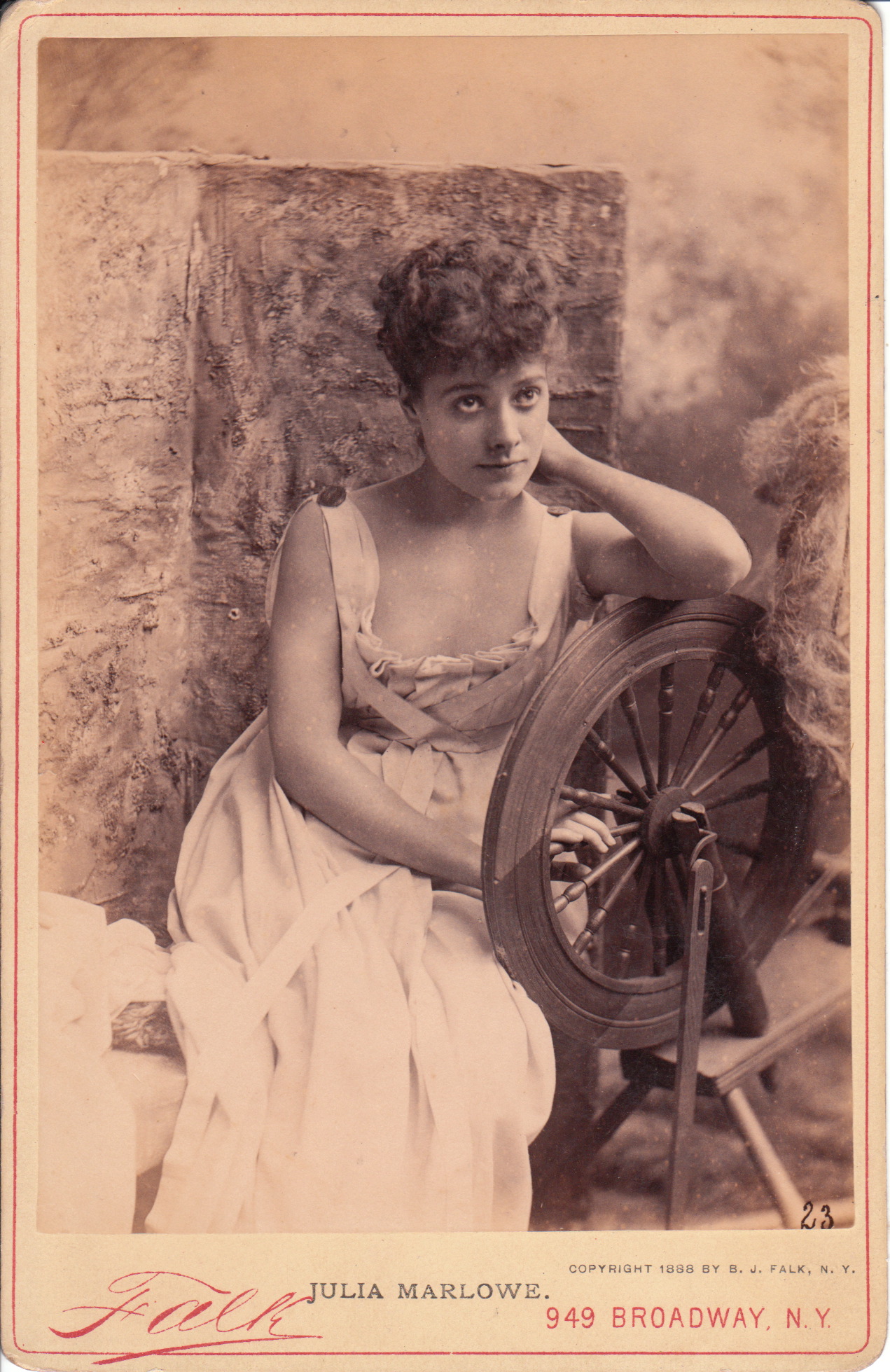
The twelfth cabinet card was produced by Benjamin Falk of New York City. He posed Miss Marlowe next to a spinning wheel. Her low cut dress makes this image a bit risque for the cabinet card era. If Falk or Miss Marlowe thought that looking up at the camera would create a “fetching appearance”, I would contend that their efforts failed. Rather than “fetching”, she appears dazed. The actress was a beautiful woman and provocativeness was not necessary to enhance her image. This photograph was produced in 1888 and was part of a series (#23).

Cabinet Card number thirteen is part of a series that includes Cabinet Card number ten. Both cards were photographed by Benjamin  Falk and have a copyright date of 1888. Both portraits are close-ups but this one is captures Marlowe looking at the camera while number ten offers a profile view. Falk really captured the actresses eyes. Her eyes are beautiful and they are haunting at the same time. This photograph is marked number number 83 of the series.

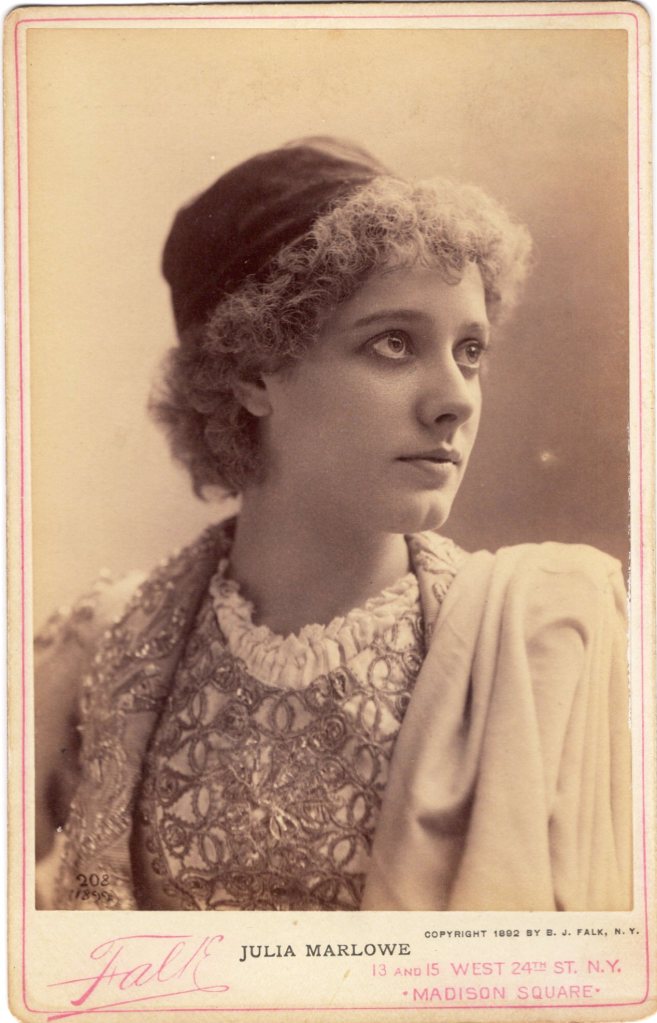
Cabinet Card fourteen features another beautiful portrait of Julia Marlowe. This photograph was taken by Benjamin Falk and was copyrighted in 1892. This cabinet card is uncommon, possibly rare.  (SOLD)

Cabinet Card 15 was photographed by Napoleon Sarony, the famed celebrity photographer located in New York City.  (SOLD)

MADAME LE GAI : PANTOMIMIST : VAUDEVILLE : PIN-UP : HOLLYWOOD PHOTO 1918

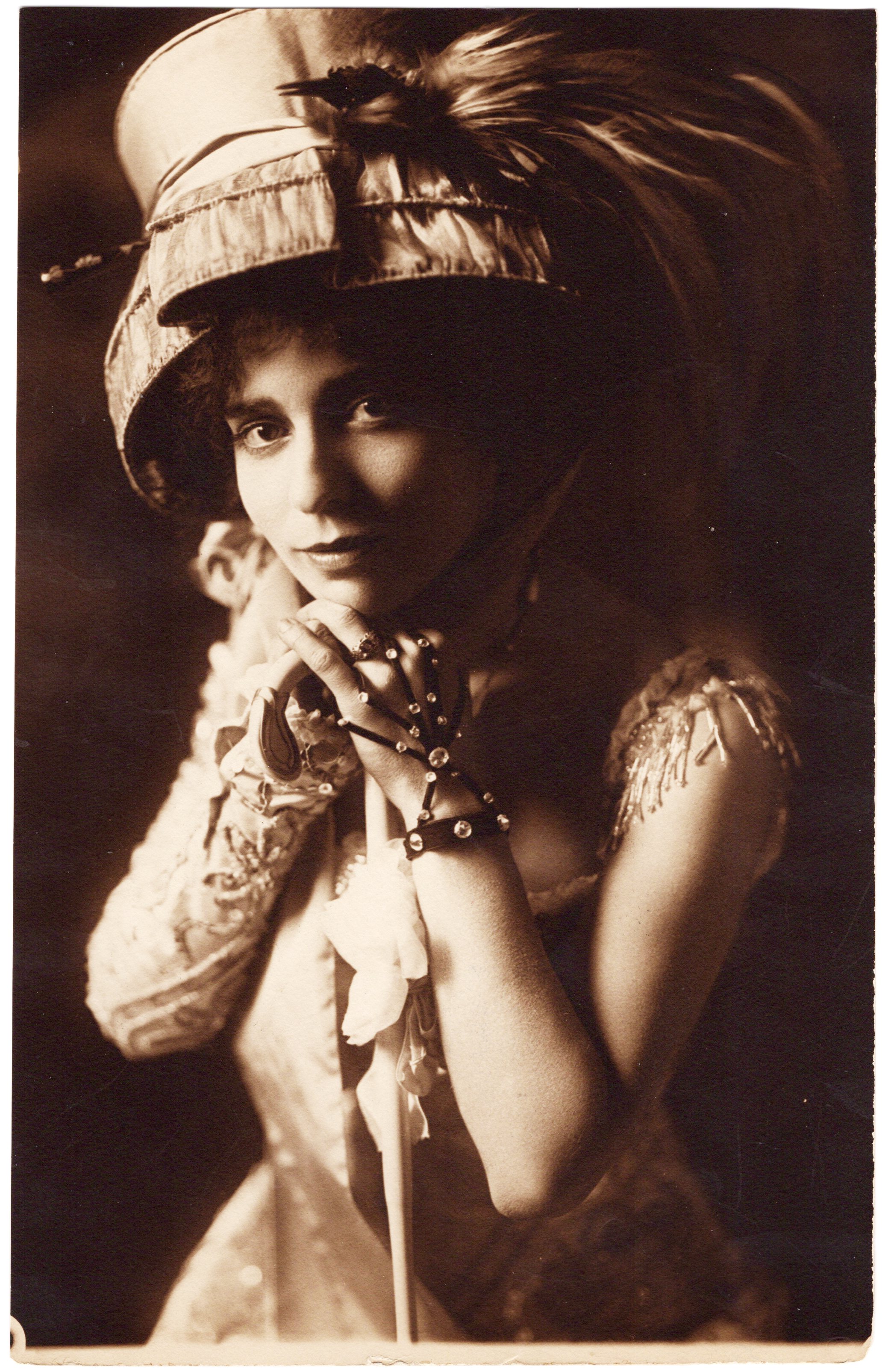
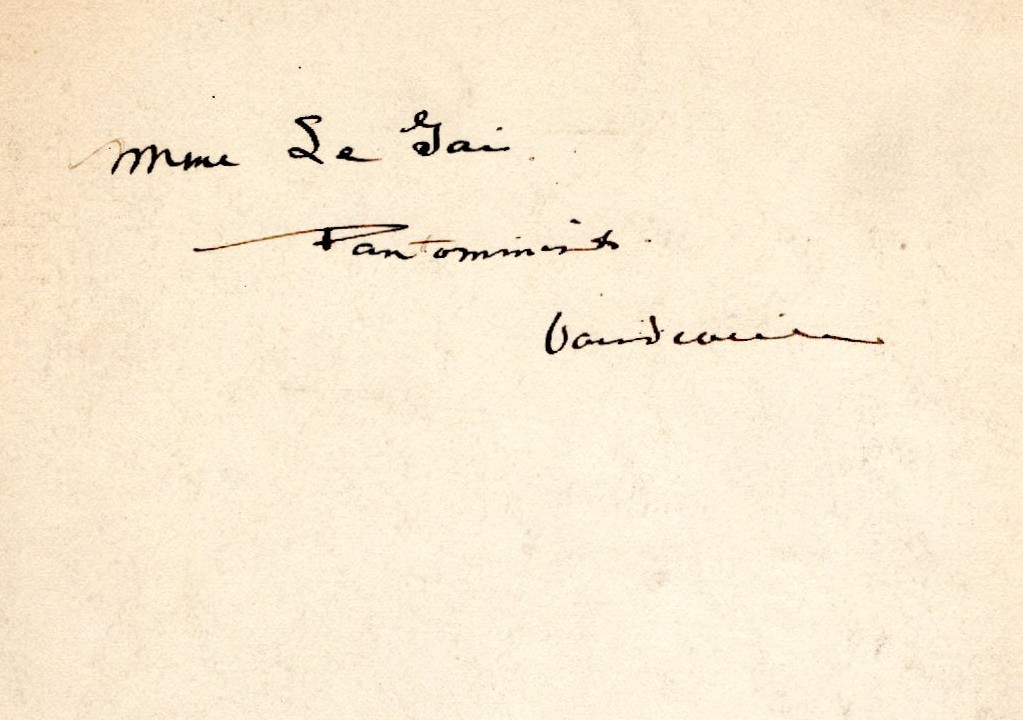
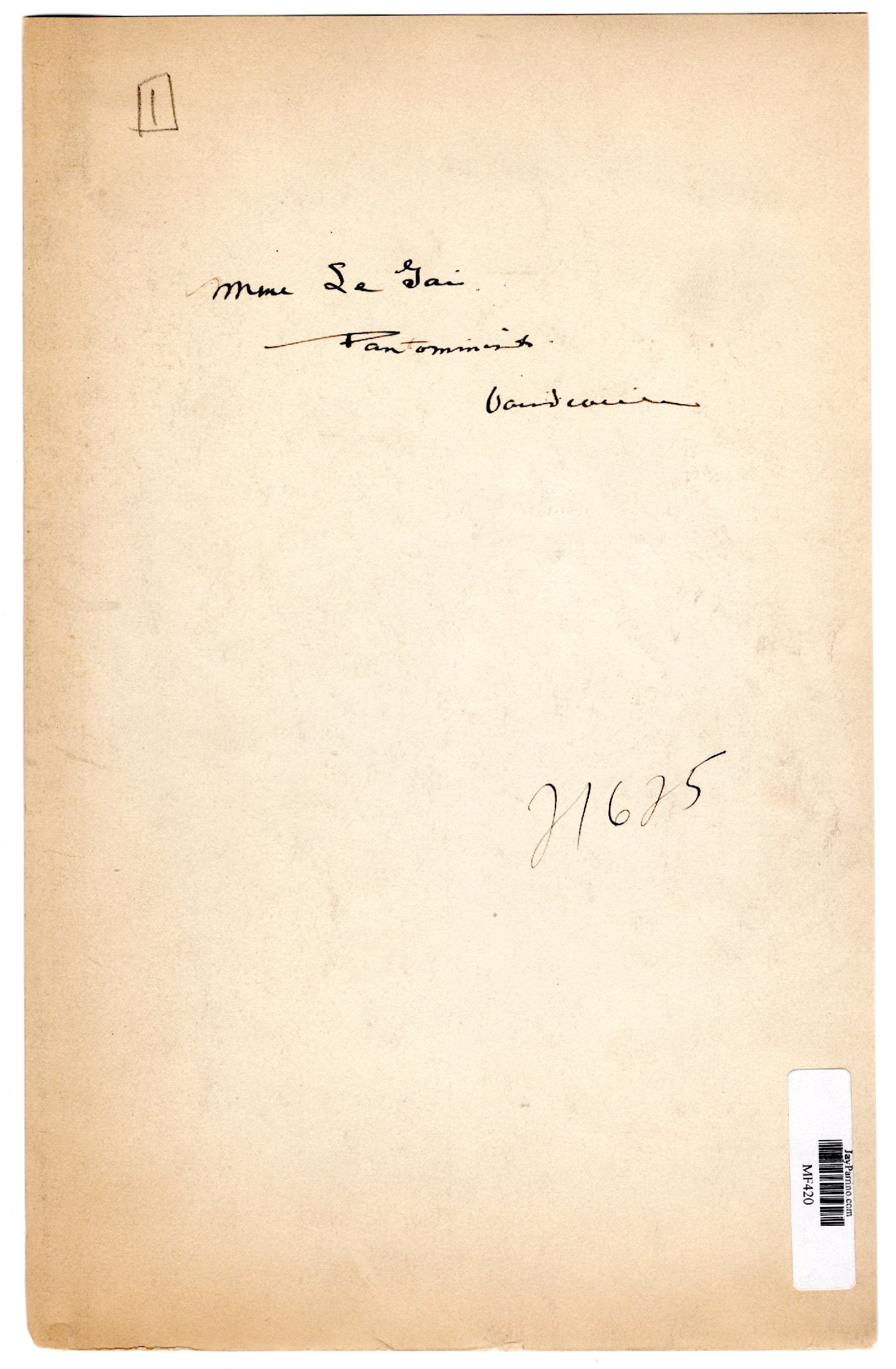
This is a stunning and rare sepia-tone glamour portrait of a woman identified as Mme Le Gai, described on the reverse as a “Pantomimist” and “Vaudevillian.” Believed to date from around 1918, this photograph showcases an elegant, mysterious woman in elaborate costume—perhaps a stage or cabaret performer—gazing confidently into the camera. She wears a richly adorned hat with plumes, a beaded glove-like bracelet, and a delicately embroidered gown with satin and lace textures. Her theatrical pose and sensual expression make this image a prime example of early Hollywood pin-up photography, though its style is also heavily influenced by European cabaret traditions. The handwritten inscription on the back appears to read: “Mme Le Gai / Pantomimist / Vaudevillian.” There is some ambiguity—“Mme” could stand for Madame or Mademoiselle, and the surname may also be interpreted as Le Gai or Le Gaï. The elegant script suggests a deliberate stage name, possibly borrowed from the famed Parisian pantomime houses of the same name. “Le Gai” (French for “the merry” or “joyful”) was also used in naming French performance venues such as Le Théâtre Gai or variations like Le Gai Paris. This connection strengthens the possibility that the subject either performed in or took inspiration from these Parisian theatrical traditions. Though solid biographical confirmation of Mme Le Gai has not yet been found, the visual evidence, style, and inscription point to her role as a vaudeville-era pantomime performer, likely active in the United States or France around World War I. Her alluring presence and costume are consistent with the kind of studio portraiture used for performer promotion, possibly circulated as publicity or collectible pin-up material during the silent film and vaudeville boom.  (SOLD)

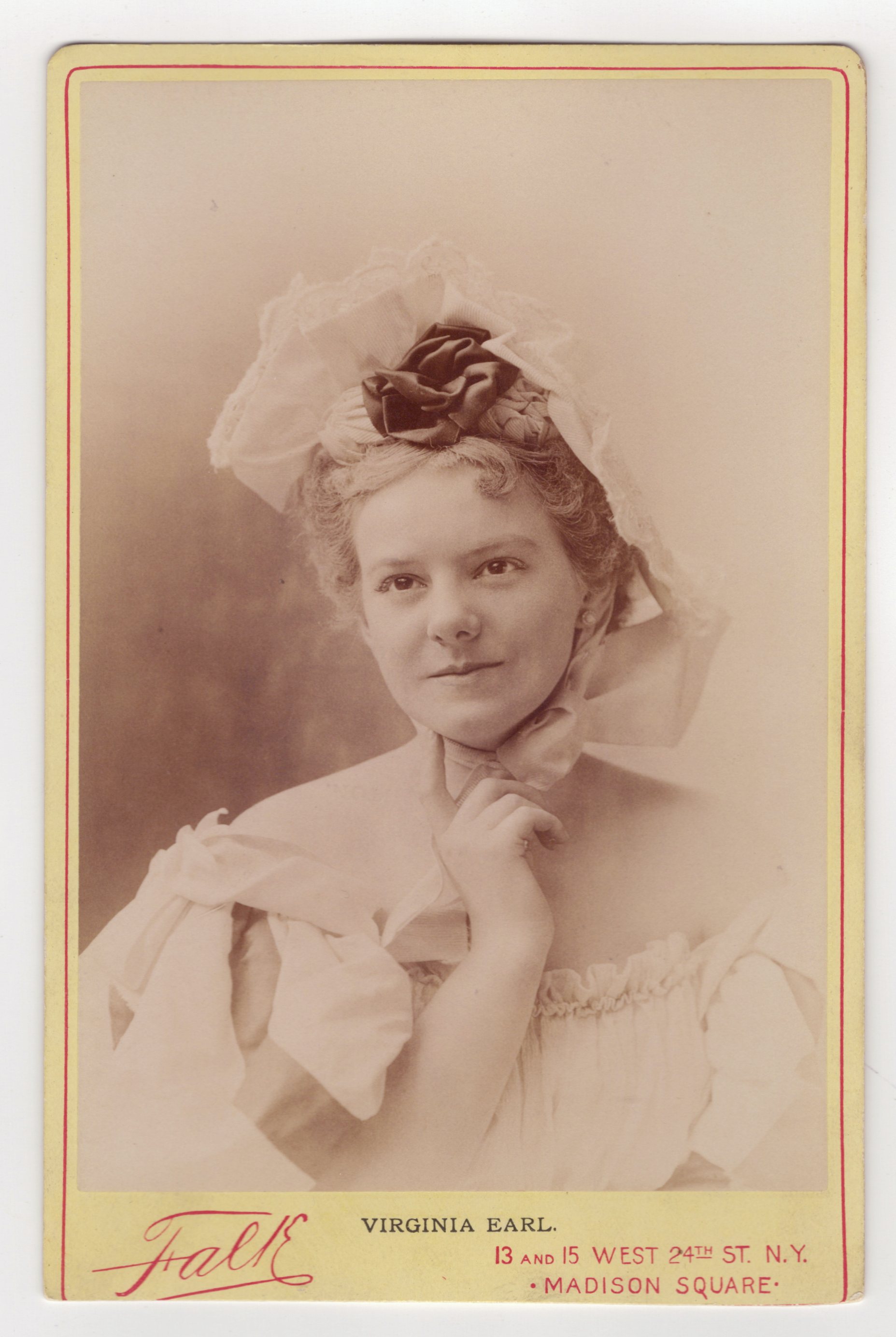
VIRGINIA EARL : STAGE ACTRESS : PROLIFIC ON BROADWAY : VAUDEVILLE : PHOTO BY BENJAMIN FALK : CABINET CARD

This cabinet card photograph features American stage actress, Virginia Earle (1873-1937). Much of her work was in light operas, musical comedies, and vaudeville. Earle was born in Cincinnati, Ohio. Her parents were Irish immigrants. She made her stage debut in 1887. She had a role in Gilbert and Sullivan’s “The Mikado” produced by the Juvenile Opera Company. She played in several of their productions. Earle then joined a touring company of the Pike Opera Company. When in San Francisco, she was hired by a vaudeville company where she performed for two seasons. She next went to Australia with a performing company. She was identified with Augustin Daly’s Edwardian musical comedies for many years. The musicals included “The Circus Girl” and “A Runaway Girl”.  Earle played in eleven Broadway production between 1899 and 1910. Earle was a “chronic” robbery victim. She captured one of the thieves. Earle was walking along Sixth Avenue (Manhattan) and saw a woman wearing one of the cloaks she wore in the production of “The Merry World”. Earle grabbed the woman and screamed for help. Eventually the woman was tried and acquitted. The woman’s husband claimed to have found the cloak and he was judged credible. In 1894, Earle married Frank Lawton, an actor and comedian. She divorced him in 1899. Earle’s photo portrait seen on this cabinet card, was taken by celebrity photographer, Benjamin Falk. Falk operated a studio in New York City. This photograph was likely taken in the late 1880’s or early 1890’s. The cabinet card has a slight curl and is in overall good condition. See Scans. 

6268

Buy this Cabinet Card Photograph (includes shipping within the US) #6268

To purchase this item, click on the Pay with PayPal button below

$39.95

6268

Buy this Vintage Original Cabinet Card (includes International shipping outside the US) #6268

To purchase this item, click on the Pay with PayPal button below

$49.95

KATHLEEN CLIFFORD : FRED HARTSOOK : MALE IMPERSONATOR : VAUDEVILLE : VINTAGE PHOTO

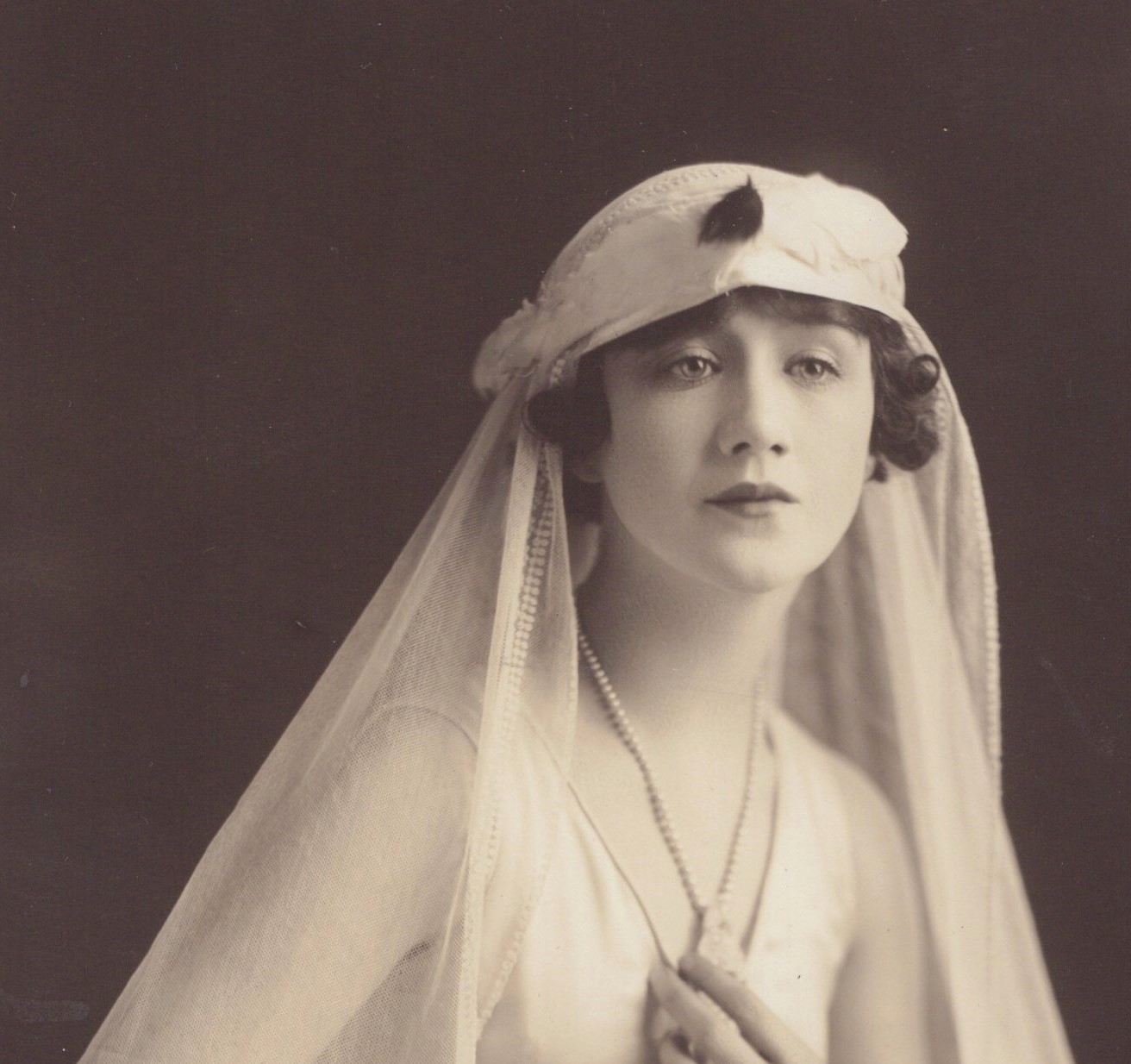
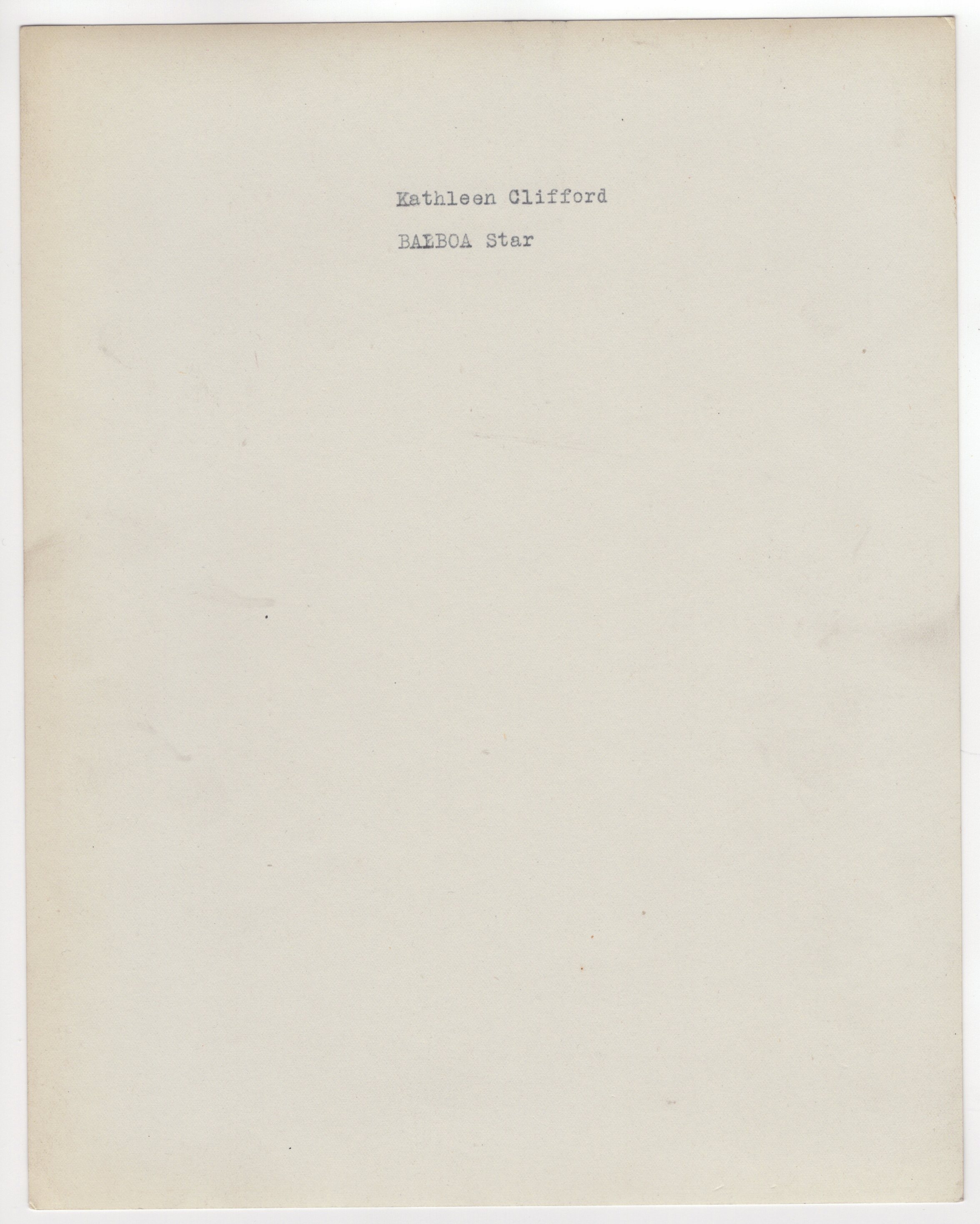
This vintage photograph features American stage and film actress, Kathleen Clifford (1887-1962). The IMDb credits her with 14 film credits between 1917 and 1932. She is known for “Richard the Lion-Hearted (1923)”, When the Clouds Roll by (1919)”, and “Who is Number One? (1917)”. She often played leading roles in her films for Paramount. During her film career, she worked alongside Douglas Fairbanks Sr., Betty Compson, and Wallace Beery. She appeared on the Broadway stage six times between 1909 and 1916. Clifford was famous as a Vaudeville comedienne and male impersonator. She was billed as “The Smartest Chap in Town”. At one point in her vaudeville career, she worked as a duo with female impersonator, Bothwell Browne. Like many movie performers, she left acting with the advent of sound films. During the early years of World War I, she served as a Red Cross Nurse with the British Army in France. Upon retirement, she became a business woman and owned “Broadway Florist” in Hollywood. Clifford also wrote a novel about her time in Hollywood. She was married to Miomir Peter Illitch for over 35 years. He was a banker. This original photographic portrait of Kathleen Clifford was taken by a highly talented and esteemed American photographer, Fred Hartsook (1876-1930). He owned a California studio chain that, at that time, was considered to be the largest photographic business in the world. His celebrity clients included President Woodrow Wilson, Henry Ford, Mary Pickford, and Charles Lindbergh. He also owned a resort and two ranches in Southern California where he raised Holstein cattle. He was married to Bess Hesby, queen of the San Francisco Pan-Pacific Exposition of 1915.  SOLD

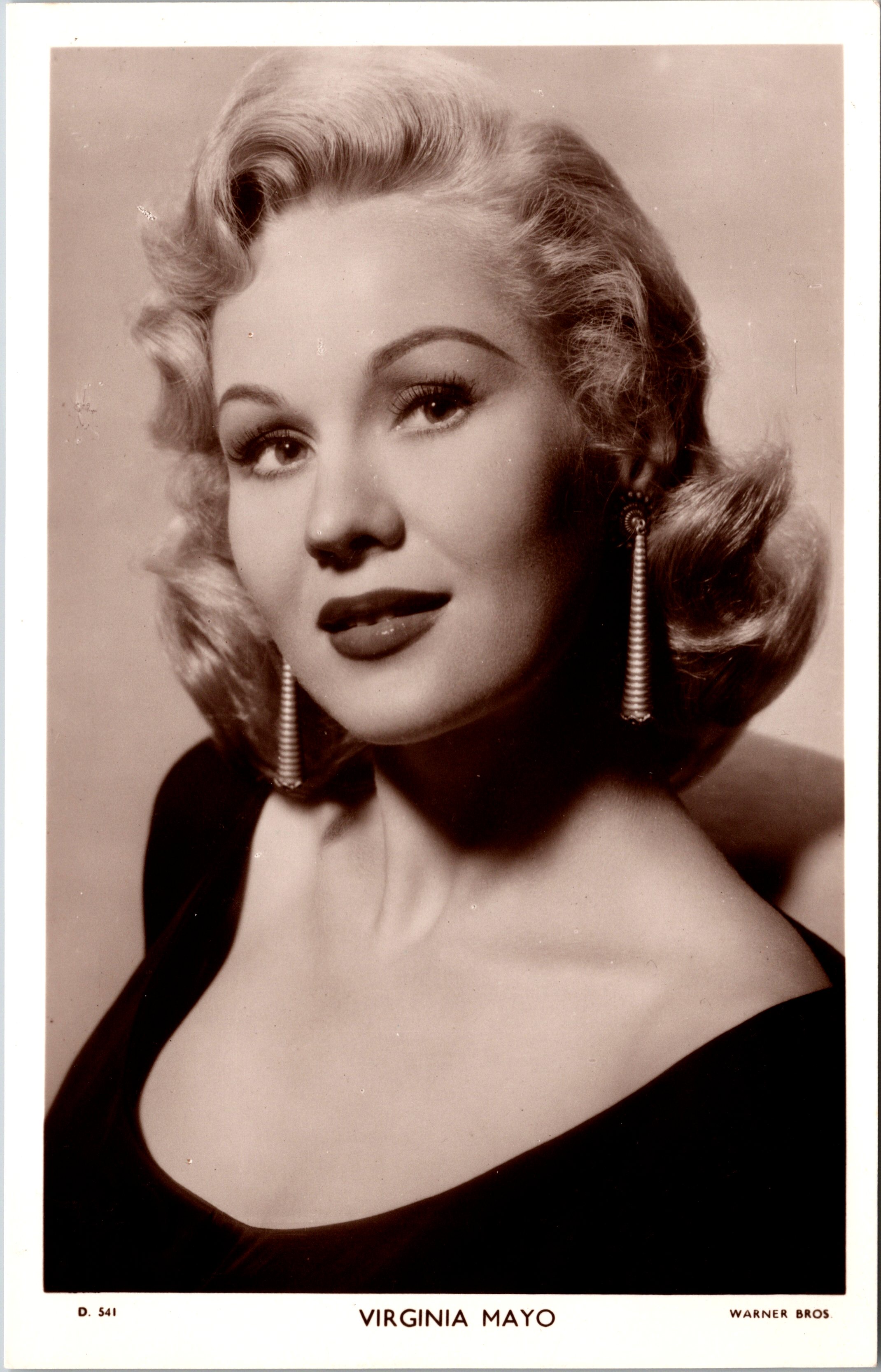
VIRGINIA MAYO : BEAUTIFUL ACTRESS : PICTUREGOER SERIES : WARNER BROTHERS

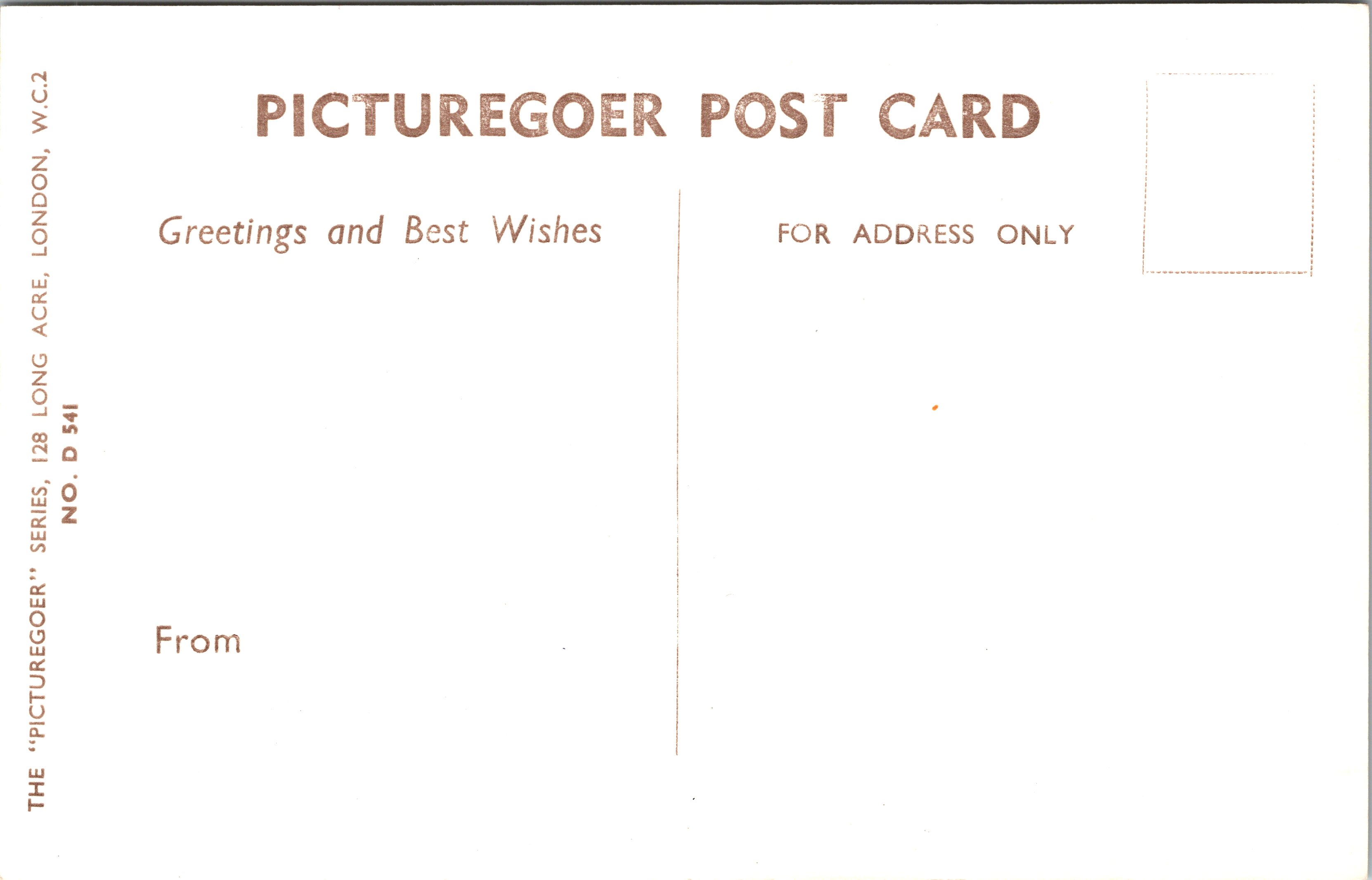
This vintage real photo postcard features American actress and dancer, Virginia Mayo (1920-2005). Virginia grew up in St. Louis. She began attending her Aunt’s acting school at age 6. She also took dancing lessons. She began her professional acting career after graduating high school. She began acting and dancing at the St. Louis Municipal Opera Theatre. She then toured the vaudeville circuit for three years. She appeared in some short films and then was “discovered” performing at a Broadway area night club, by Samuel Goldwyn. Goldwyn appreciated her for her talent as well as her beauty. He signed her to an acting contract with his company.  In 1941, she appeared on the Broadway stage with Eddie Cantor. Her first starring role occured in 1944 when she appeared in a film with Bob Hope. The IMDb reports that Mayo had 70 film credits between 1939 and 1997. She performed in one Broadway play (1941-1942). This vintage postcard is part of the “Picturegoer” series (No. D 541). She posed for the postcard’s portrait while under contract with Warner Brothers.  SOLD

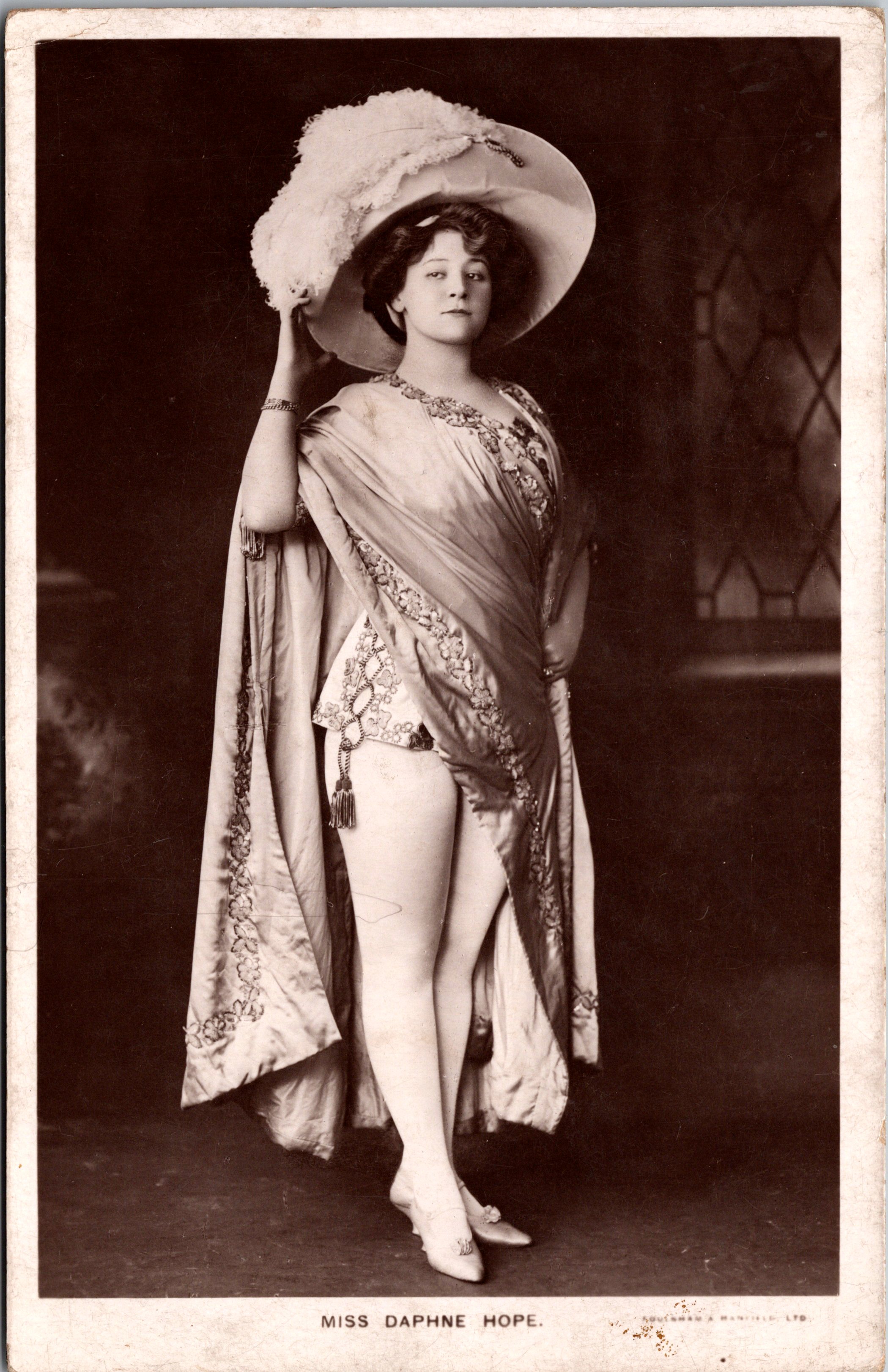
DAPHNE HOPE : ENGLISH MUSIC HALL ENTERTAINER : RISQUE : RARE RPPC

This very uncommon vintage real photo postcard features the pretty young actress and singer, Miss Daphne Hope. She is dressed and posed provocatively for this postcard portrait. Her legs are exposed and she is wearing a short top. Even though Daphne’s legs are covered with flesh colored stockings, this is a risque postcard for it’s era.. Daphne Hope postcards are rare. It is also difficult to find information about her. The website “Footlight Notes” reprinted a 1912 article about Daphne Hope and her performing partner, William Burr. The pair were English music hall entertainers that took their show on the road to New York’s Fifth Avenue Theater. The article states that their talking act and “double singing” was simply “delightful” and “unique”. Hope is described as a “comely blonde, of the robust type, with a very pleasant voice”. The reviewer enjoyed the humorous banter between Hope and Burr. The article described their act as a “sunbeam” compared to the “shadows” vaudeville has imported in the past. SOLD

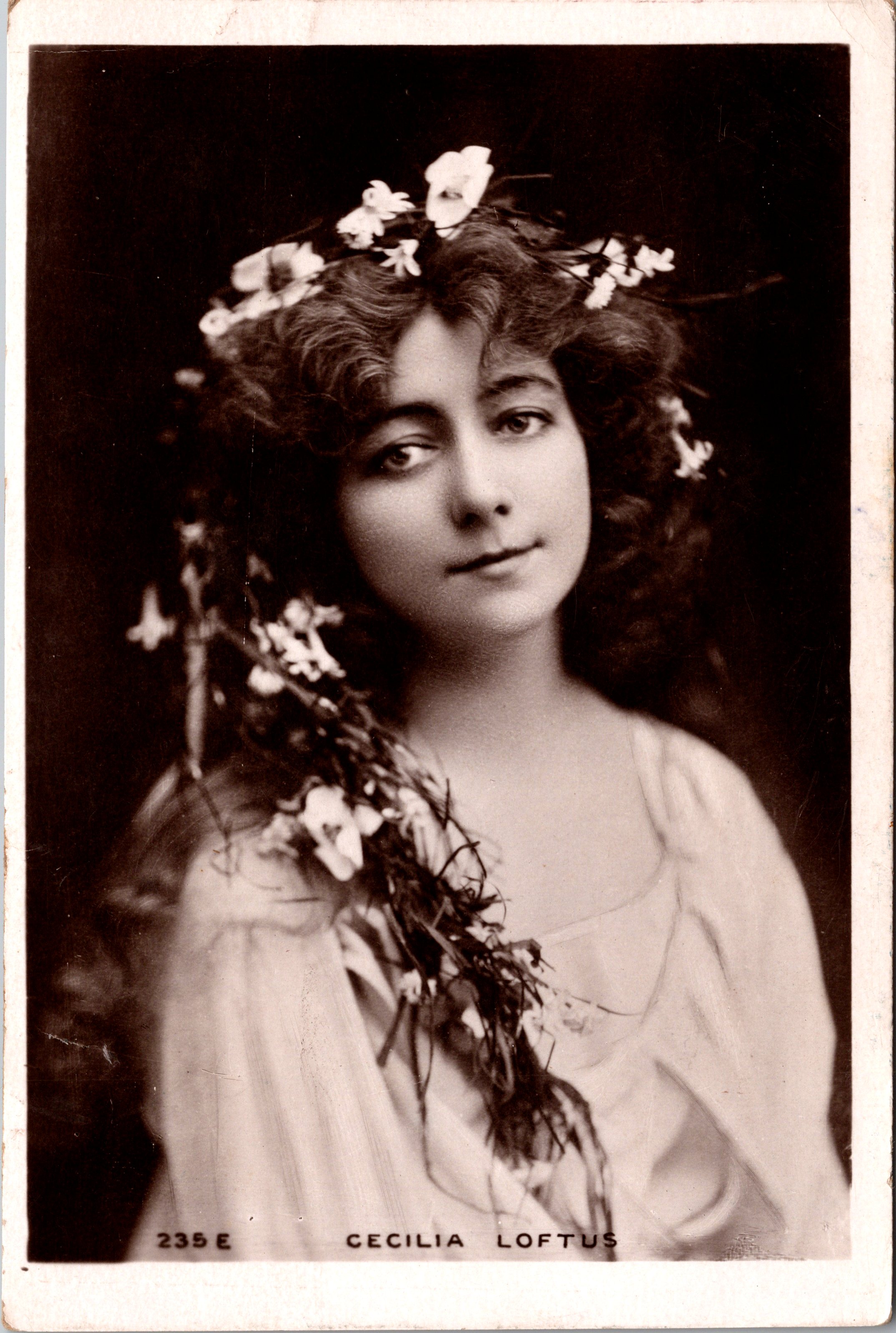
CECILIA LOFTUS : BROADWAY AND FILM ACTRESS : SHAKESPEARE : STAGE BEAUTY : RPPC

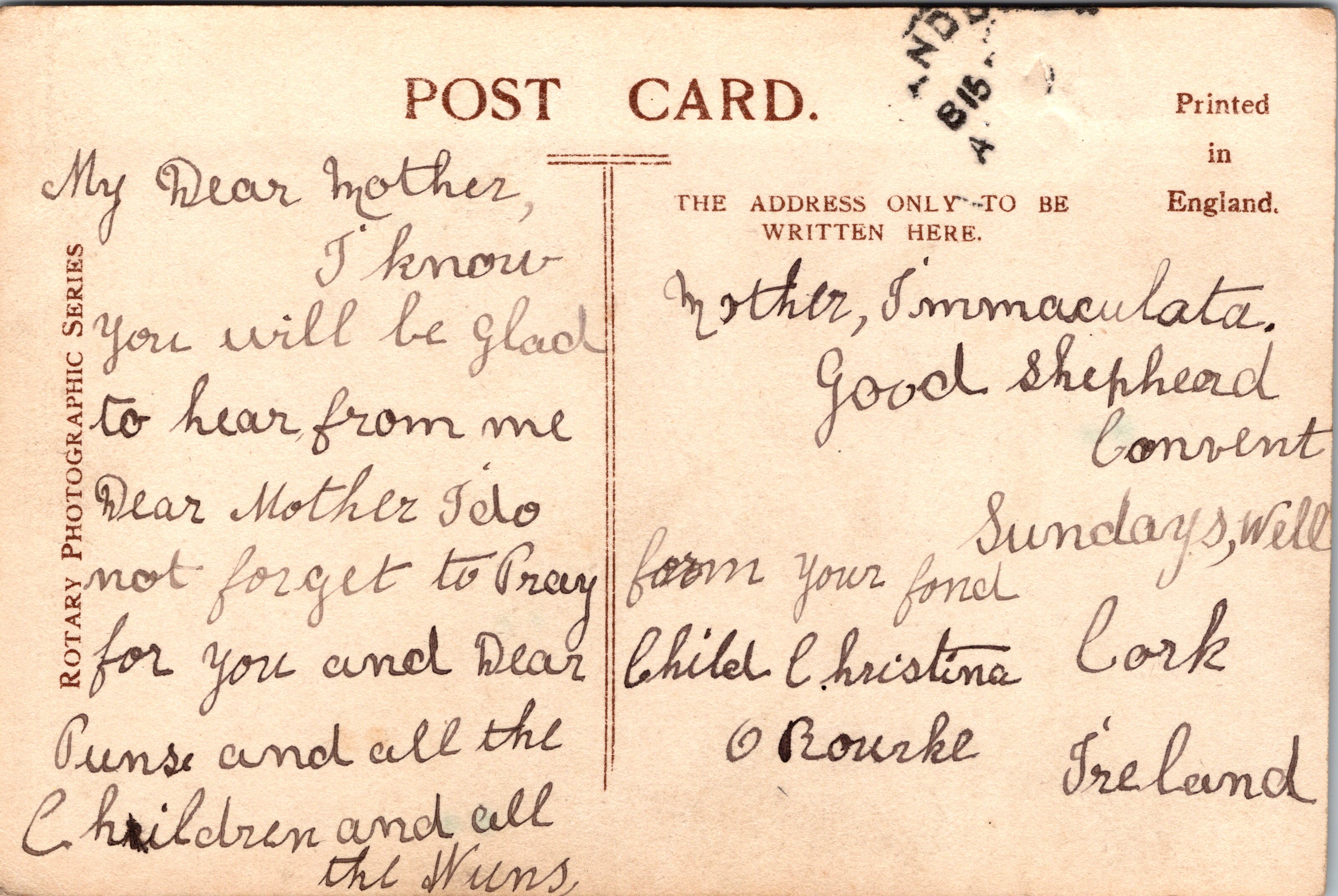
This vintage real photo postcard features a stage beauty named Cecilia Loftus (1876-1943). She was a Scottish actress, singer, mimic, vaudevillian, and music hall performer. Her career spanned the late 19th and early 20th centuries. She was a product of parents who were performers. Her father was a member of a successful variety group and her mother was an actress, music hall performer, and burlesque star. At age seventeen, Cecilia (Cissy) made her debut at the Oxford Music Hall in London. She began her career in Music Halls and then appered in musical comedy at the Gaiety Theatre. In 1894, she appeared in Vaudeville at the Lyceum Theatre in New York City. She joined the Ada Rehan Company, and then the Augustin Daly Company. In 1898, she began to appear in legitimate theatre. She toured with actor Sir Henry Irving. In 1905 she had success appearing in Henrik Ibsen’s “A Doll’s House”. Later that same year, she received much acclaim for her portrayal of Peter Pan. Loftus had a successful career in burlesque as well as on Broadway. The IBDb credits Loftus with appearing in 39 different Broadway productions between 1900 and 1941. Many of her roles were in Shakespeare plays. She also appeared in 14 films from the 1910’s to the 1940’s. Cecilia had a tumultous personal life. She eloped at 17 with an Irish writer, twice her age. The marriage failed. In 1908 she married an American doctor. Within six years, her marriage and health were in bad shape. She divorced her husband. Healthwise, she became dependent on alcohol and pain killers. In 1922, she was arrested for possession of morphine. She received probation from an English court and in 1923, she permanantly left Great Britain and returned to New York City to pursue her career on Broadway and in Hollywood.  The message on this postcard is very interesting. It is a note from a daughter to her mother. Although it is only a hypothesis, the daughter appears to be at the Good Shepherd Convent, in Cork, Ireland. This vintage postcard was published by the Rotary Photo Company as part of a series (no.235 E).  SOLD

1st DOROTHY IN WIZARD OF OZ : ANNA LAUGHLIN :AMERICAN STAGE & SILENT FILM STAR

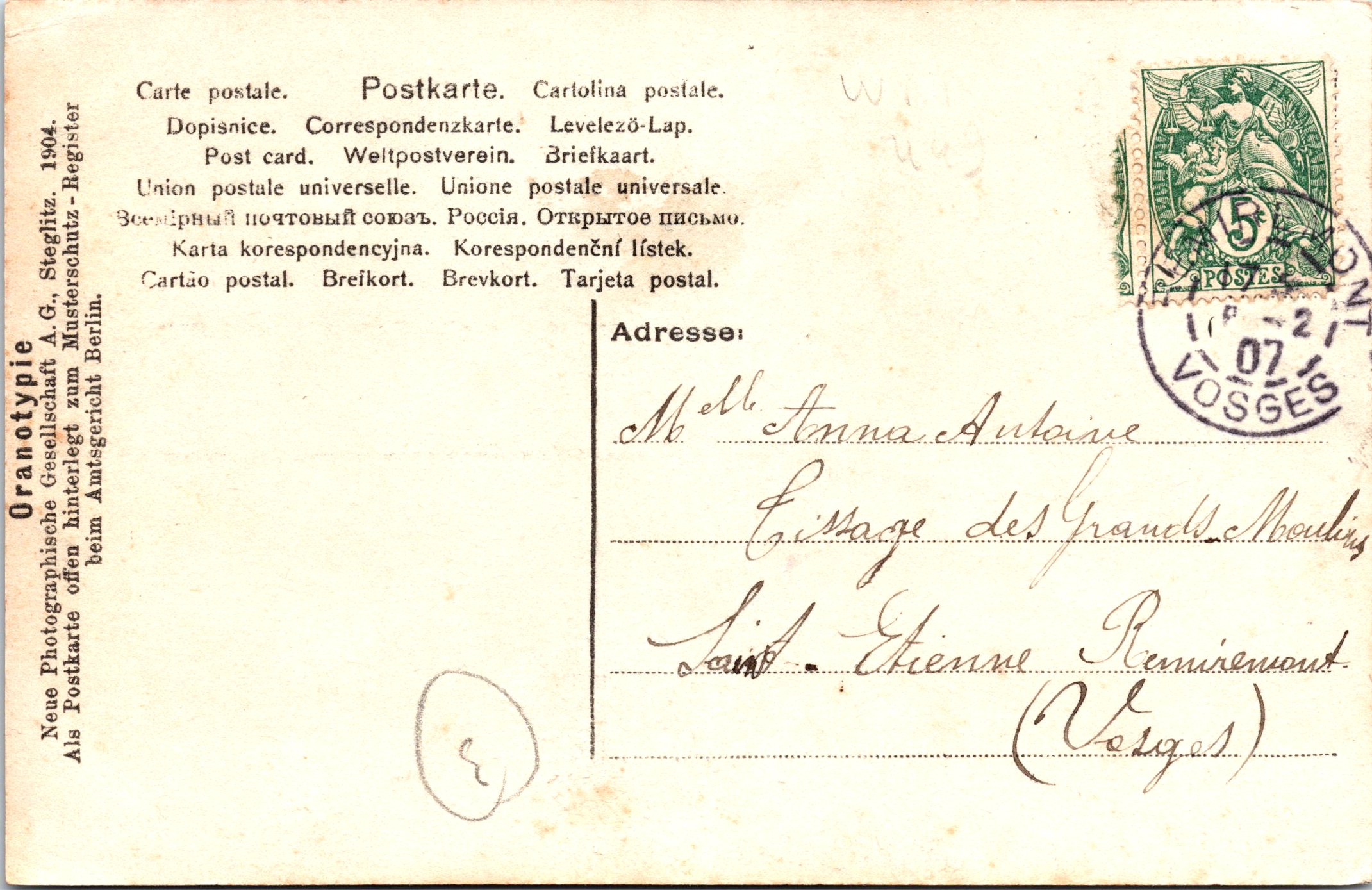
This vintage real photo postcard features American stage and silent film actress, Anna Laughlin (1885-1937). One of her major claims to fame is that she was the first actress to play Dorothy in the Wizard of Oz. She was born in California and began her stage career as a “child elocutionist” (public speaker). At age six, she started acting in vaudeville and later, in touring theater companies. When she was a young teenager, she began appearing on Broadway. In 1900, she was in the Belle of Bohemia and in 1903 she performed in the Wizard of Oz. According to the IBDb, Laughlin appeared in eight Broadway shows between 1900 and 1914. The IMDb reports that Laughlin acted in 14 silent films between 1913 and 1915. She is most well known for her roles in “Northern Lights” (1914), “The Greyhound” (1914), “The Amazing Mr. Fellman” (1915) and “What Happened to Father” (1915). She quit show business in 1915 to focus on raising her daughter. Laughlin was married in 1904 (age about 19) to a jeweler. She was widowed in 1925. Laughlin’s daughter became a noted singer. Anna Laughlin died by suicide in 1937. Her cause of death was gas poisoning. She turned the gas on in her apartment because she was very depressed about being estranged from her daughter. They had previously been very close. According to the IMDb, the following words were found in her three page suicide note. “This is good-bye. People are dreadful. I love my child. I have given all I have in the world to put her where she is now … Lucy is never coming back. I am so afraid. Where did I fail?” This postcard was published in Germany by NPG (Neue Photographische Gesellschaft) as part of a series (no.1098). A. G. Steglitz is also listed as a publisher. The postcard is an “Oranotypie” and was published in 1904. An oranotype is a trade name for a type of glossy real photo postcard published by NPG. The company was a leading bromide photo printing company for many years at the beginning of the 20th century. This card has a French stamp and was postmarked in 1907. SOLD

PHOTOGRAPH OF THE THEATER IN LAKEWOOD, MAINE

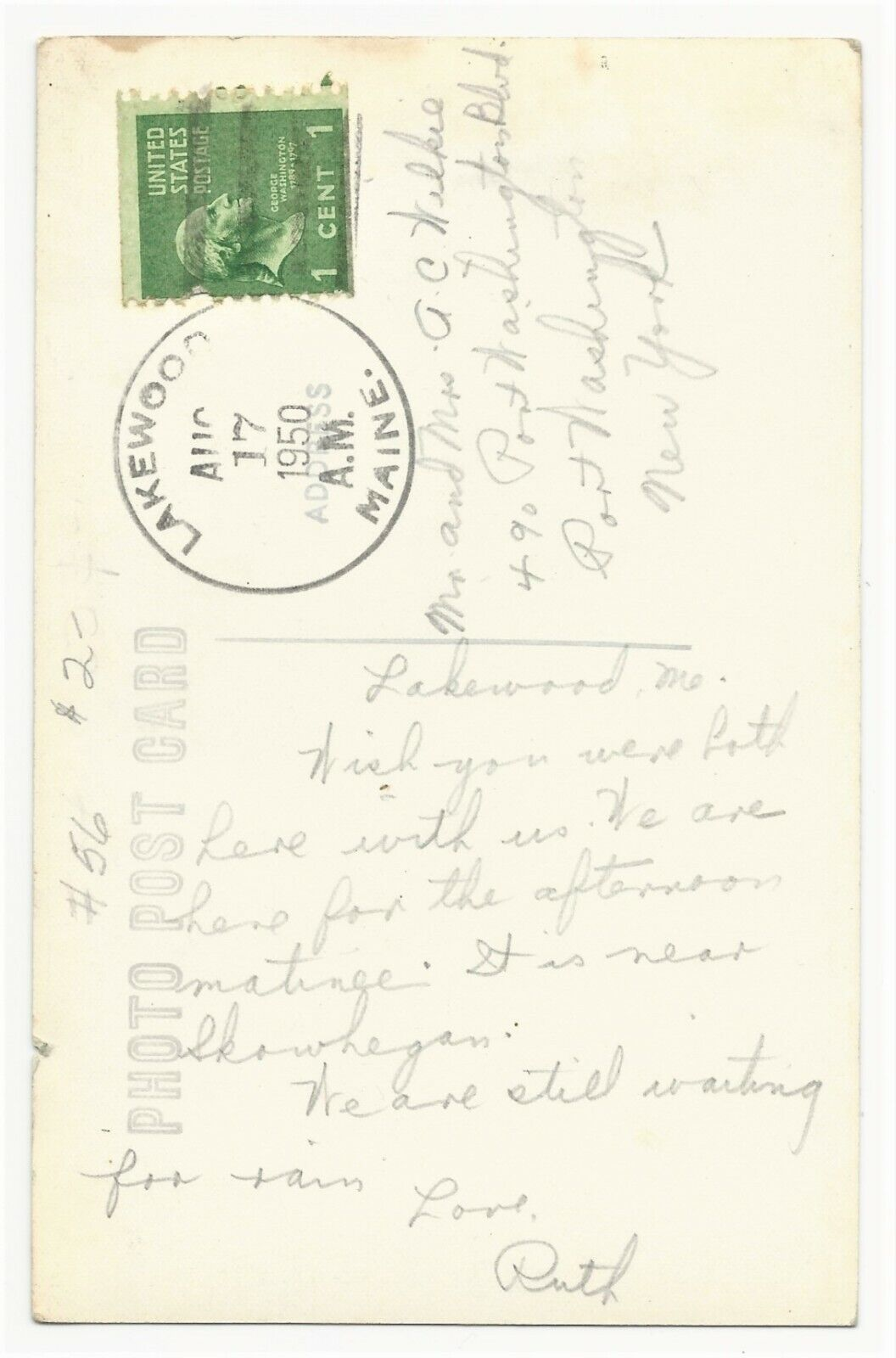
This vintage real photo postcard features the theater at Lakewood, Maine. The theater gives the appearance of a large colonial home. The marquee on the front porch is displaying the photograph of the actors and actresses appearing in the current show. Note the two 1940’s automobiles parked in front of the theater. The postcard’s message states that the writer is at the theater for an afternoon matinee. The postcard is addressed to a couple living in Port Washington (Long Island). New York. The card’s postmark reveals that it was mailed in 1950. The postcard has a small chip on the left side of the top border but is in otherwise good condition (see scans). The Lakewood theatre is the official state theater of Maine. It received that title in 1967 from the state legislature. Before that time, the theater was known as “Broadway in Maine”. It began as a vaudeville play house. It was originally built as a hall for Spiritualist Camp Association meetings. The building was built in 1882. In 1884 it was converted into a roller skating rink. In 1898, it became a theater. (SOLD)