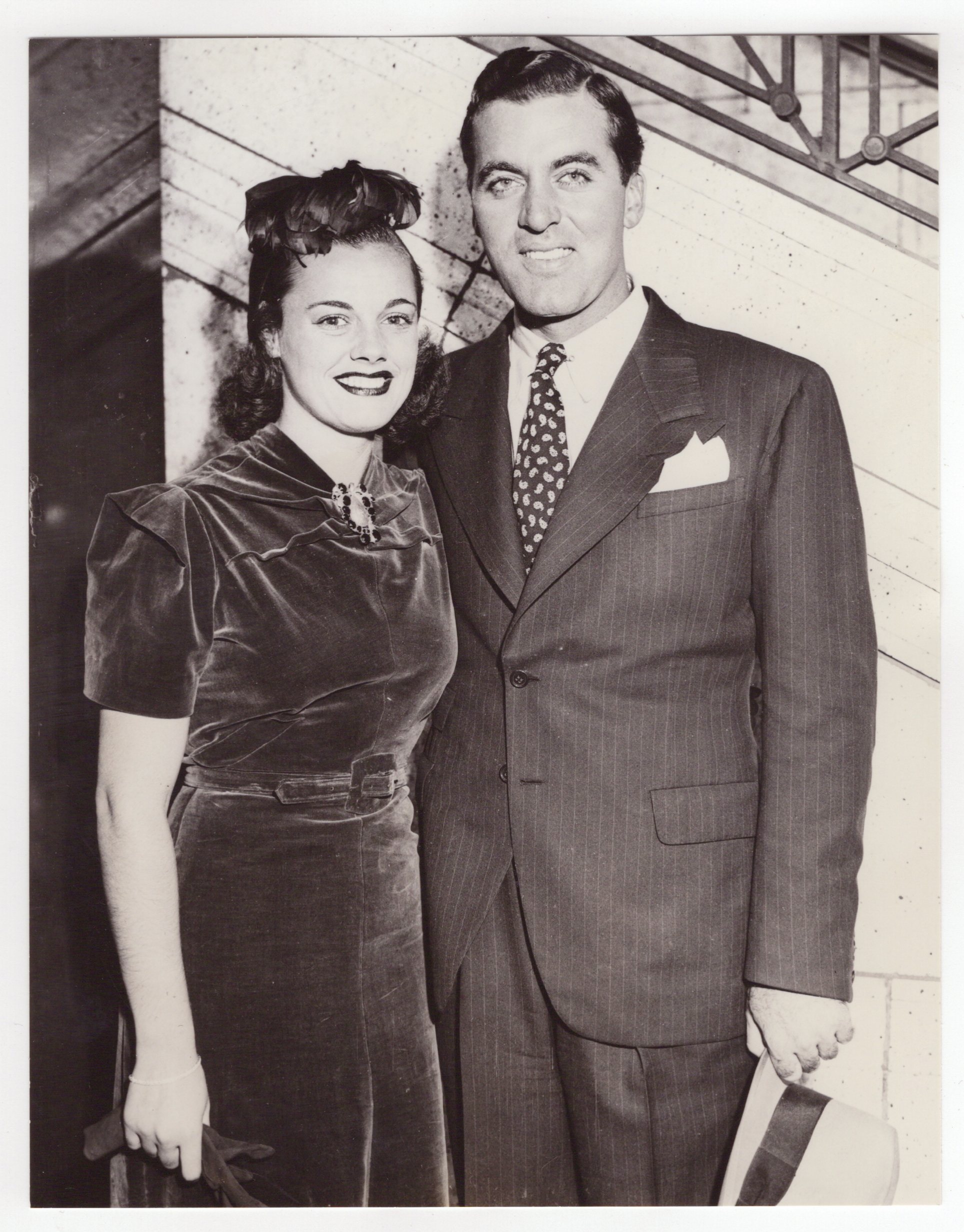
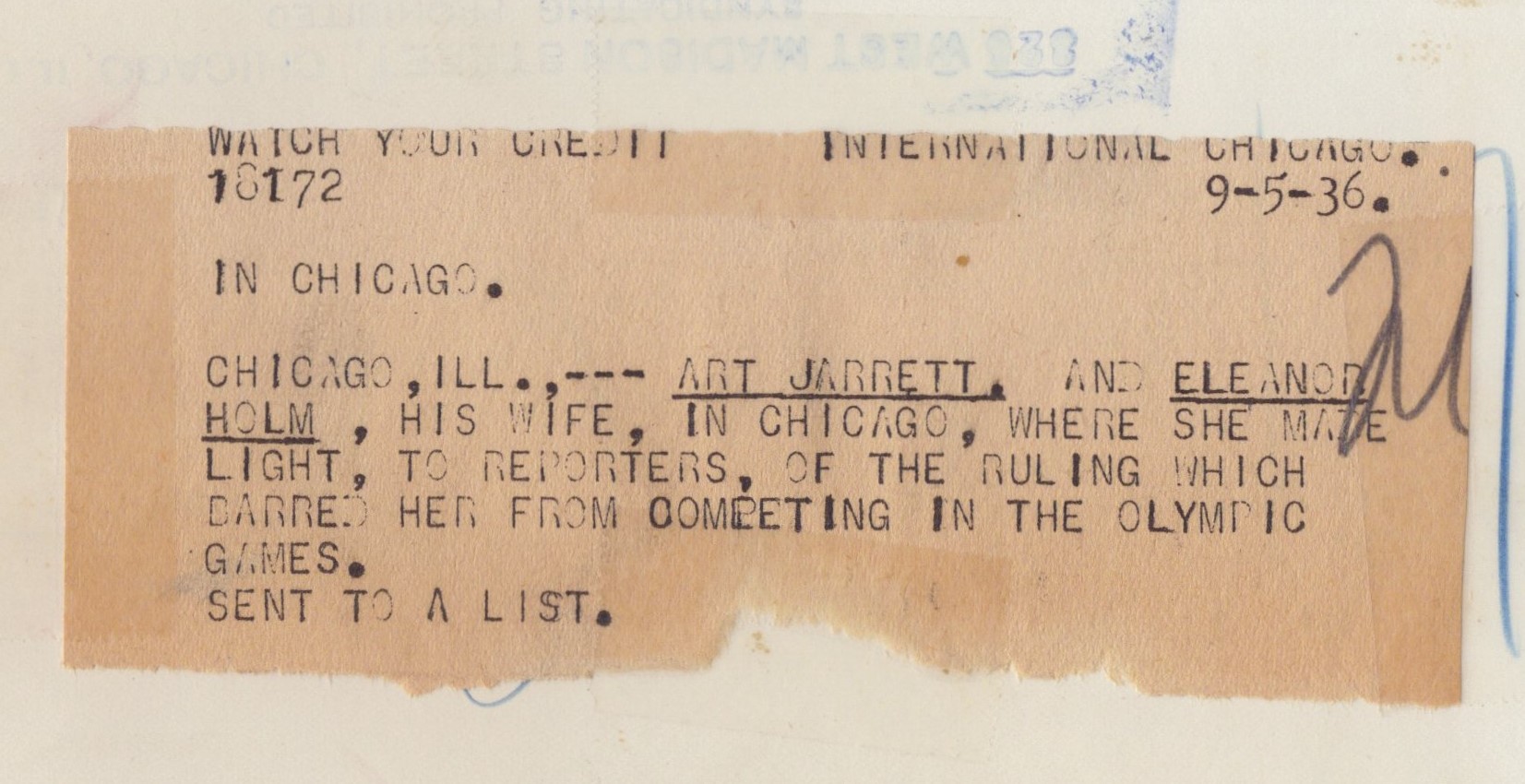
This vintage press photo (1936) features Eleanor Holm (1913-2004), an accomplished American swimmer and Olympian. She participated in the 1928 and 1932 Olympics. In 1932 she won a gold medal in the backstroke. She was selected to the 1936 Olympic team but was expelled from the team by Avery Brundage, President of the American Olympic Committee. On the way to the Olympics, Eleanor attended a drinking party aboard the ship that was taking her and her fellow athletes to Europe. Apparently she drank way too much. The team doctor found her in a near coma state. She also had been rude to a team chaperone. There were a number of charges; Eleanor did not deny them. Later in time, she stated that Brundage had a grudge against her because she had rejected him after he propositioned her. She ended up watching the swim events from the stands. Eleanor appears to have liked the limelight. In 1932, shortly after the Olympics, she had screen tests at a number of Hollywood’s major studios. That same year, she was named a WAMPAS baby star in the same class as Ginger Rogers. One of her first jobs with Warner Brothers involved barnstorming the country supporting both the movie “42nd Street” as well as the newly elected president, Franklin Roosevelt. In 1933 she married Art Jarrett (pictured in this photo), a singer and bandleader at the Cocoanut Grove nightclub. Holm appeared in four films playing herself and in one feature film, “Tarzan’s Revenge” (1938). Holm’s husband divorced her in 1938 1938. He stated he was humiliated by Holm’s expulsion from the Olympics as well as her having an affair. Holm married impresario Billy Rose in 1939. He had just divorced Fanny Brice. Also in 1939, Holm performed in Rose’s “Acquacade” at the World’s Fair. Holm’s marriage to Rose ended in 1954 in divorce. The divorce trial was sensational and was labelled “The War of the Roses”. Some months post divorce, Holm married again. Her new husband was an oil executive. SOLD
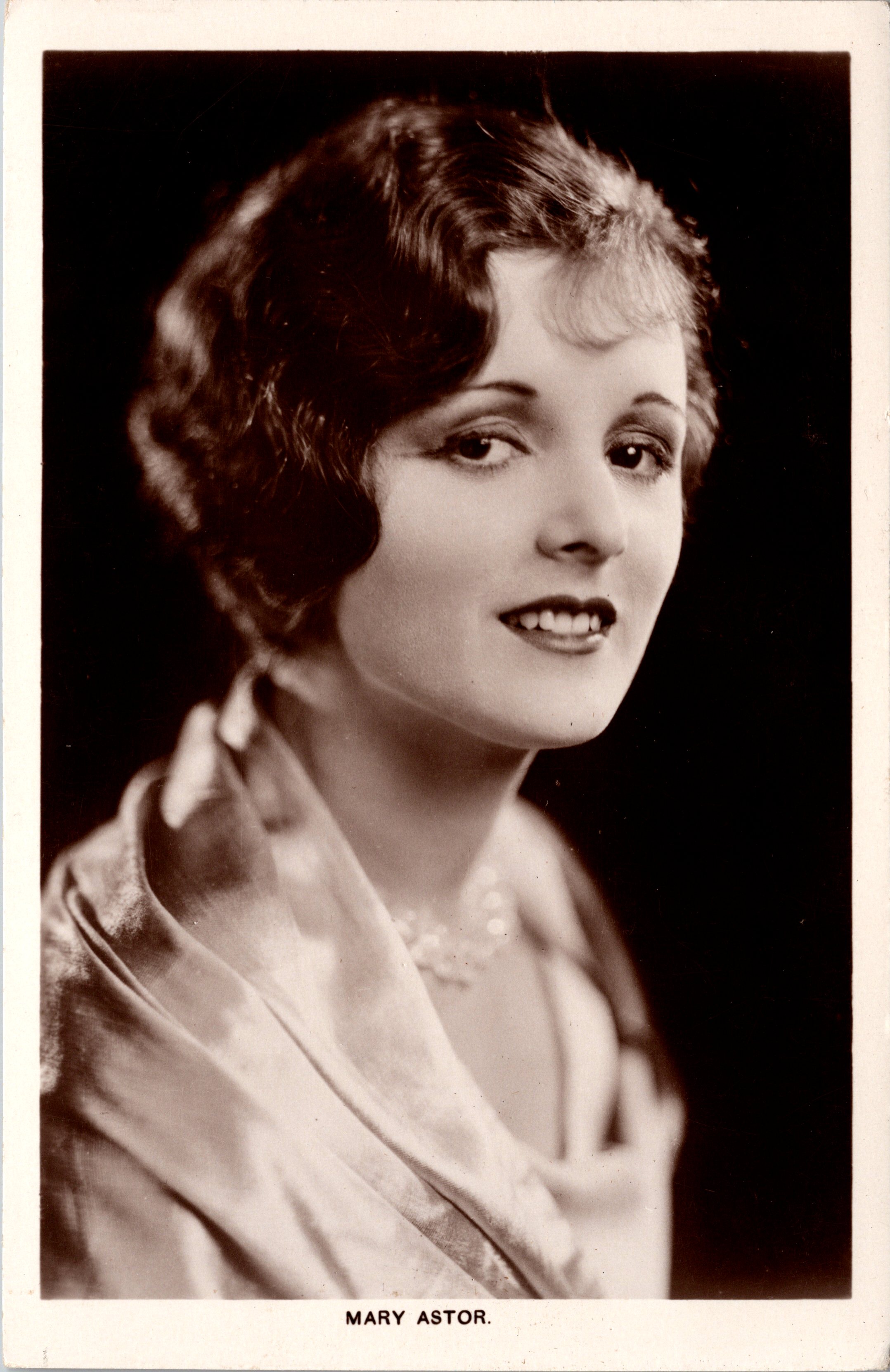
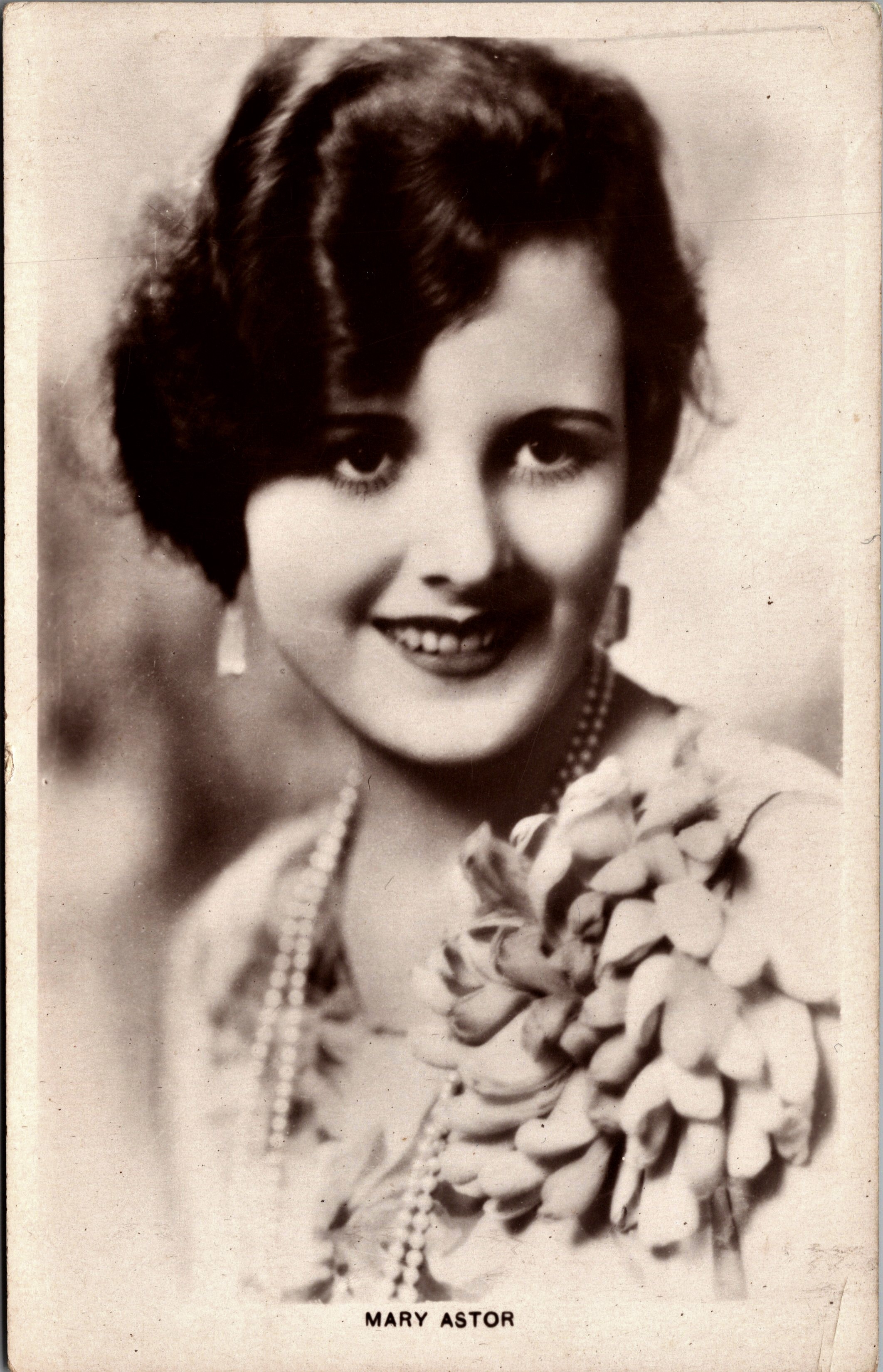
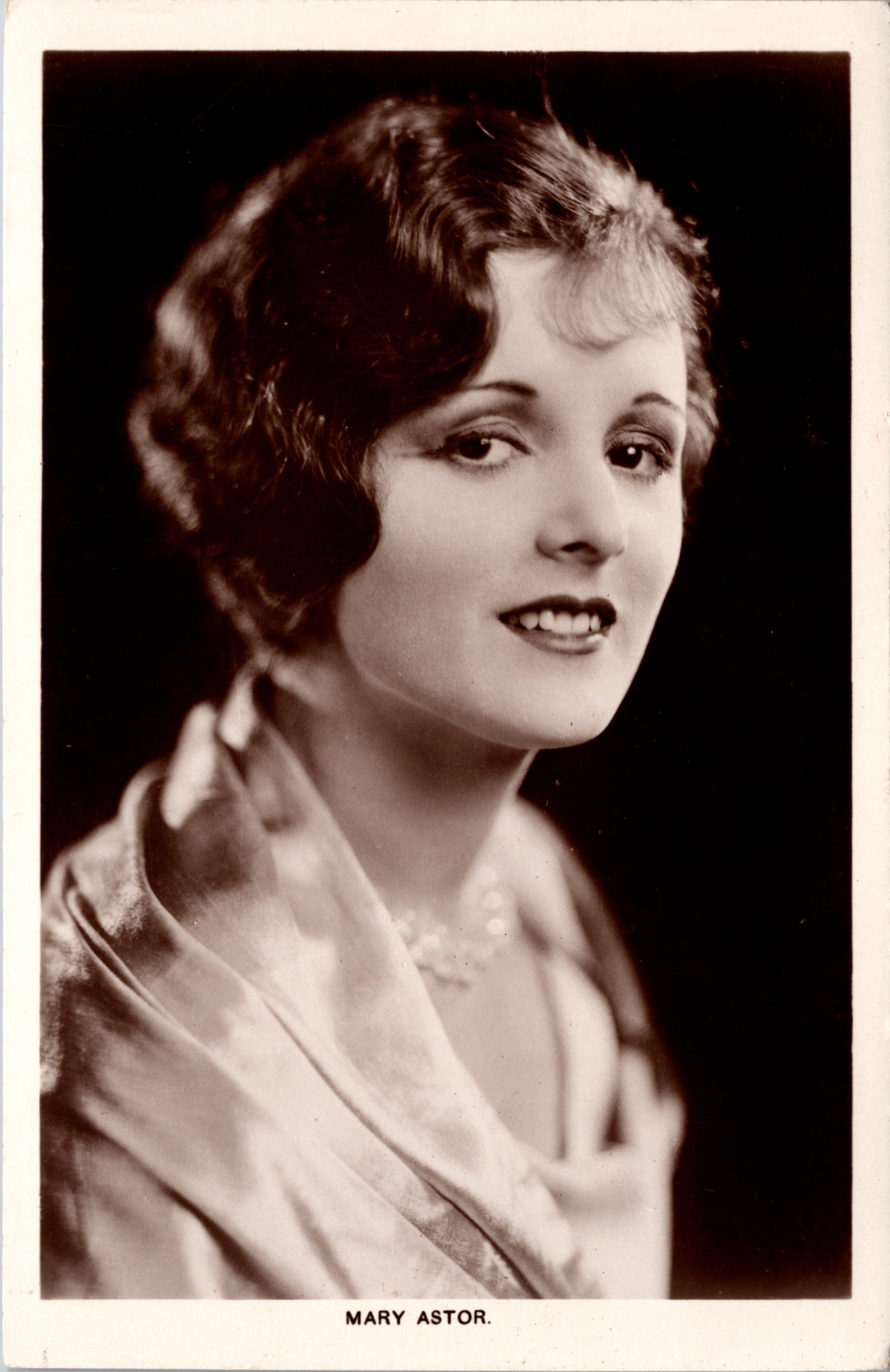
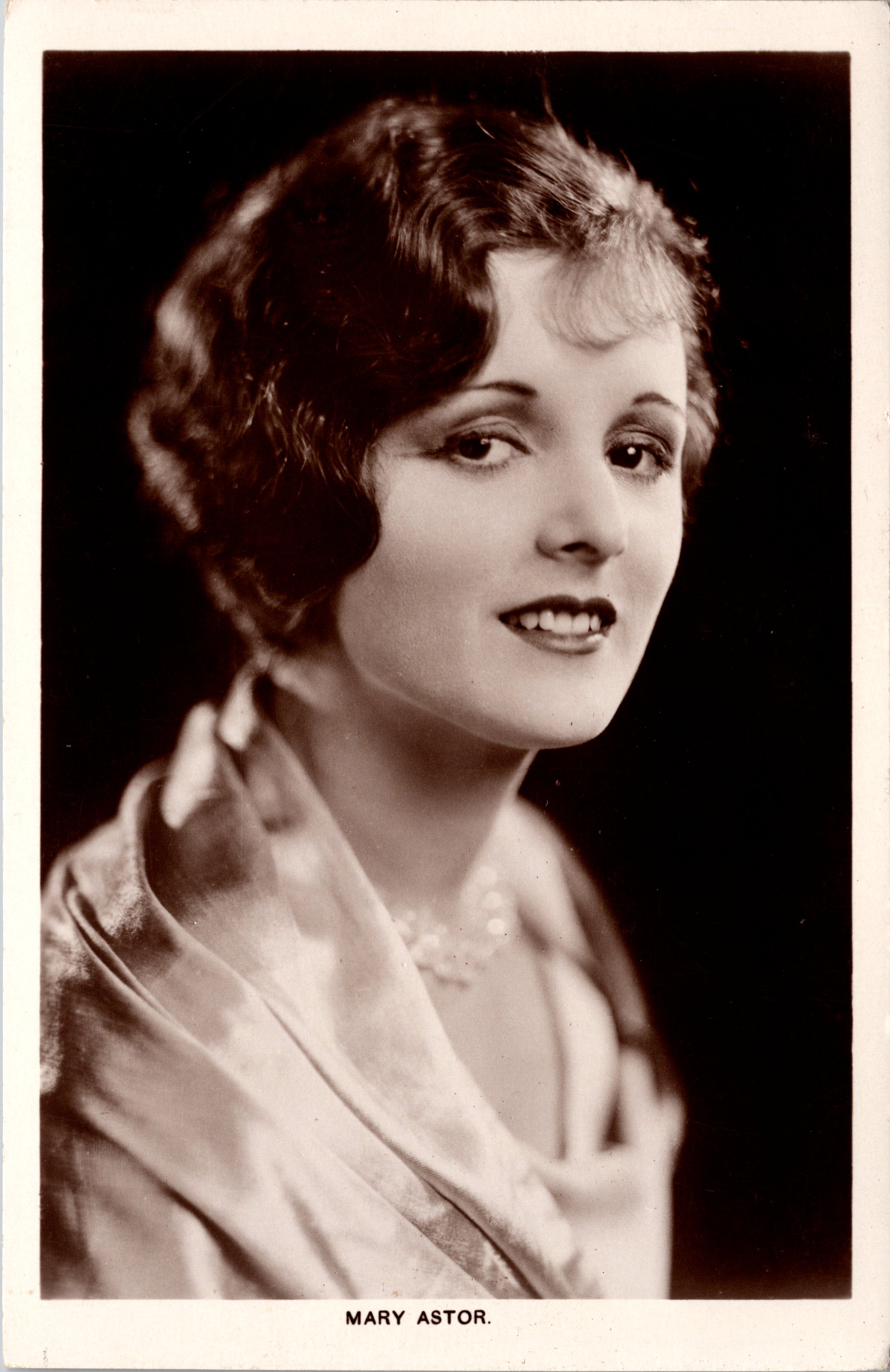
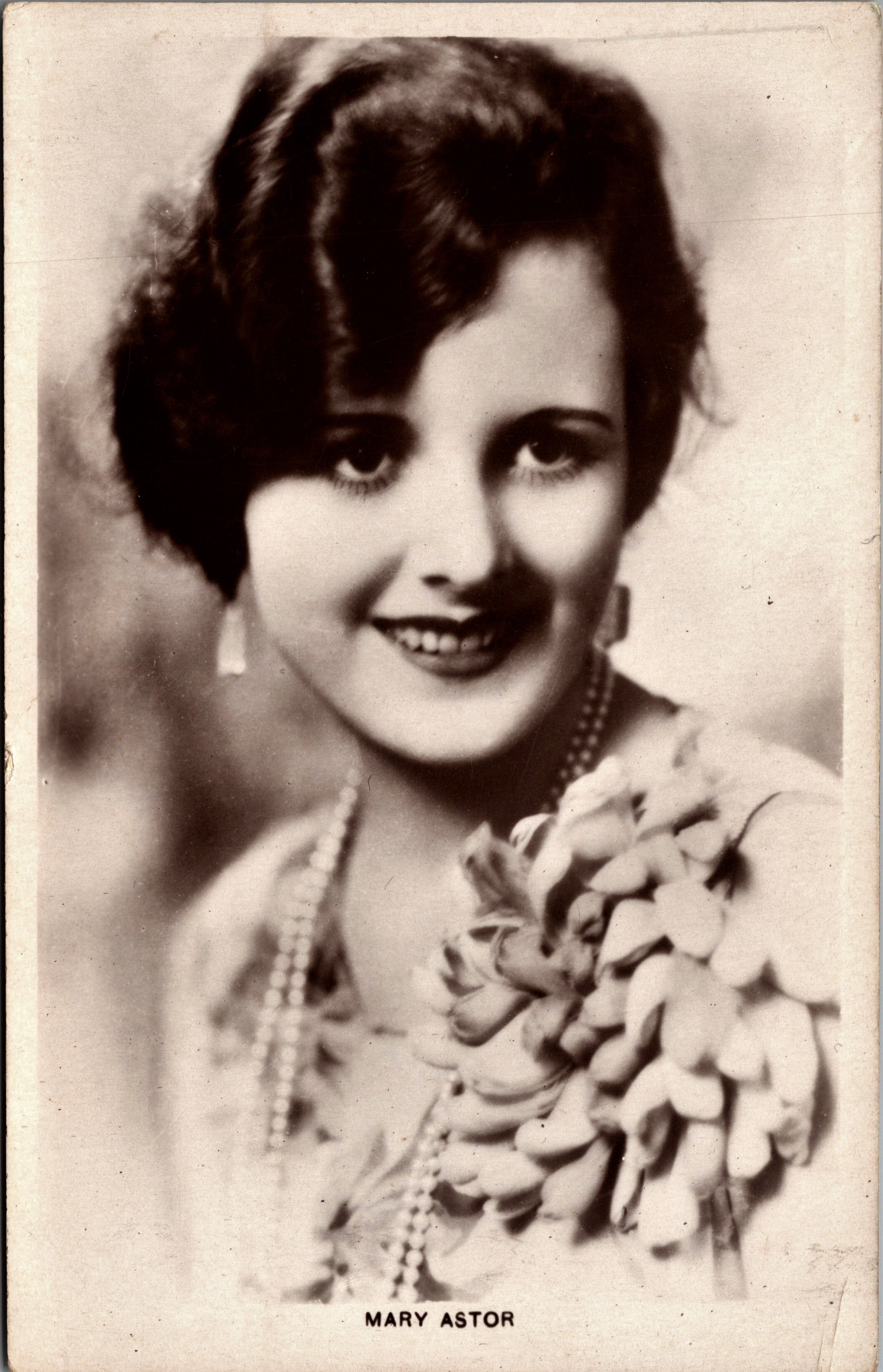
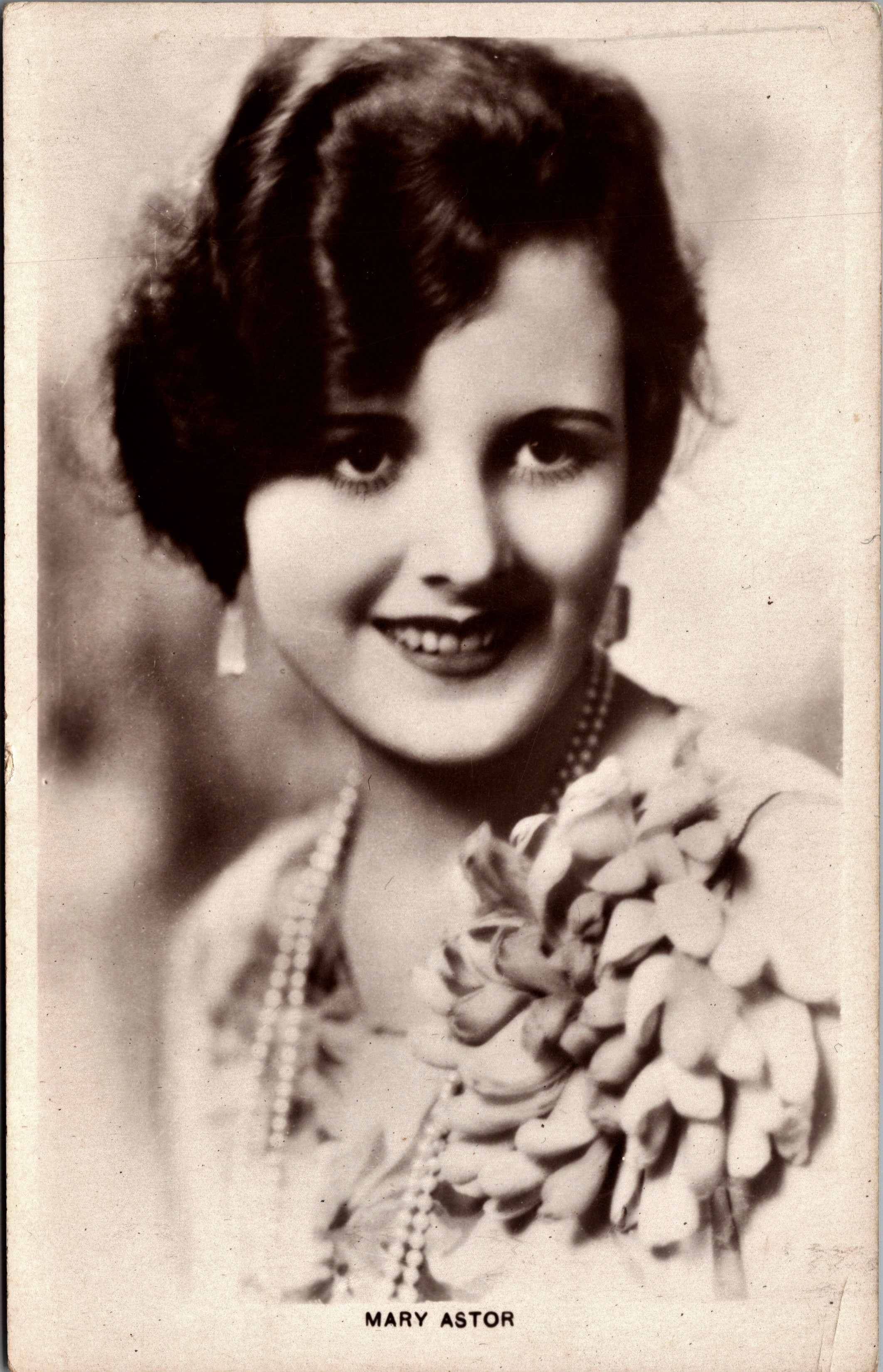
This vintage real photo postcard features American film, stage, and television actress and musician, Mary Astor (1906-1987). She played many memorable roles but she is most associated with her performance in “The Maltese Falcon” (1941). Astor also wrote five novels and an autobiography. She began her film career as a teenager by appearing in silent movies during the early 1920’s. Her career continued with the introduction of “talkies”. In 1936, Astor’s career was almost ruined by a scandal in which she had an affair with playwright George Kaufman. A custody fight with her ex-husband stigmatized her as being an adulterous wife. She managed to overcome the poor PR and in 1941, won an Academy Award fo Best Supporting Actress in “The Great Lie”. Astor was born in Quincy, Illinois. Her father was a German teacher and her mother taught drama and elocution. Astor was home schooled by her father who also taught her the piano. In 1919, she sent her photo to a beauty contest in Motion Picture Magazine. She was chosen as a semi finalist. When she was fifteen, she and her family moved to Chicago where she took drama lessons and performed on the stage. She and her family moved to New York City so she could act in motion pictures. A Manhattan photographer asked Astor to pose for him and the resulting photographs led her to be signed by Paramount pictures. In 1921, at age fourteen, she made her film debut. In 1923, she and her family moved to Hollywood. During the filming of one movie, the underage actress was wooed off set by the significantly older actor, John Barrymore. She became a “WAMPAS Baby Star” in 1926. In Hollywood, her controlling parents kept her a virtual prisoner and lived lavishly off her earnings. They gave her a five dollar a week allowance while she was earning 2500 dollars a week. Her father was emotionally and physically abusive. She did not gain control of her salary until she was 26 years old. However, this resulted in her parents suing her for financial support. In 1928 she married film director Kenneth Hawkes. In 1928, he was killed in a plane crash while filming sequences for a movie. After Astor appeared in a few more movies, she suffered a nervous breakdown related to the loss of her husband. She married the doctor who treated her for her psychiatric illness. By 1933, she had a child, and was seeking a divorce. Her personal life was coming apart at the seams. That is when the aforementioned scandal occurred. She continued to appear in films during the 1930’s but had entered the early stages of alcoholism. By 1949, she entered a sanitarium for alcoholics. In 1951, she experienced her third suicide attempt. Astor’s filmography credits her with 155 film appearances between 1921 and 1964. The IMDb reports that she appeared in two Broadway plays between 1945 and 1954. Astor was a very successful performer but was plagued by problems in her personal life.
Postcard 1 was published by Picturegoer as part of a series (no.240b). The firm was located in London, England. This postcard is in very good condition (see scans).
Postcard 2 was published by Picturegoer as part of a series (no.240a). The firm was located in London, England. This postcard is in very good condition (see scans).
Buy this Vintage Real Photo Postcard (includes shipping within the US) #3903
To purchase this item, click on the Pay with PayPal button below
$15.75
Buy this Vintage Real Photo Postcard (includes International shipping outside the US) #3903
To purchase this item, click on the Pay with PayPal button below
$25.00
Buy this Vintage Real Photo Postcard (includes shipping within the US) #5171
To purchase this item, click on the Pay with PayPal button below
$14.00
Buy this Vintage Real Photo Postcard (includes International shipping outside the US) #5171
To purchase this item, click on the Pay with PayPal button below
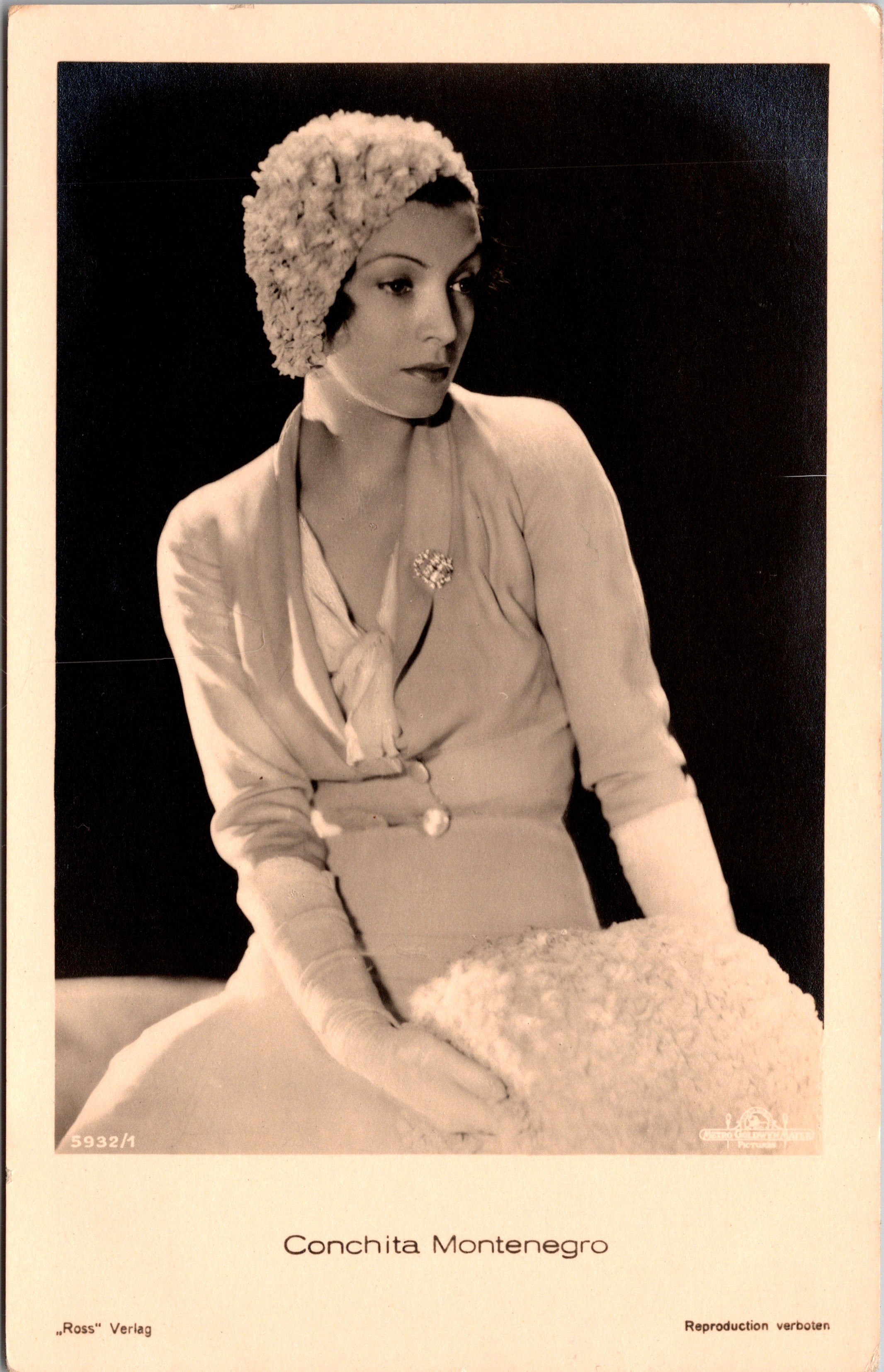
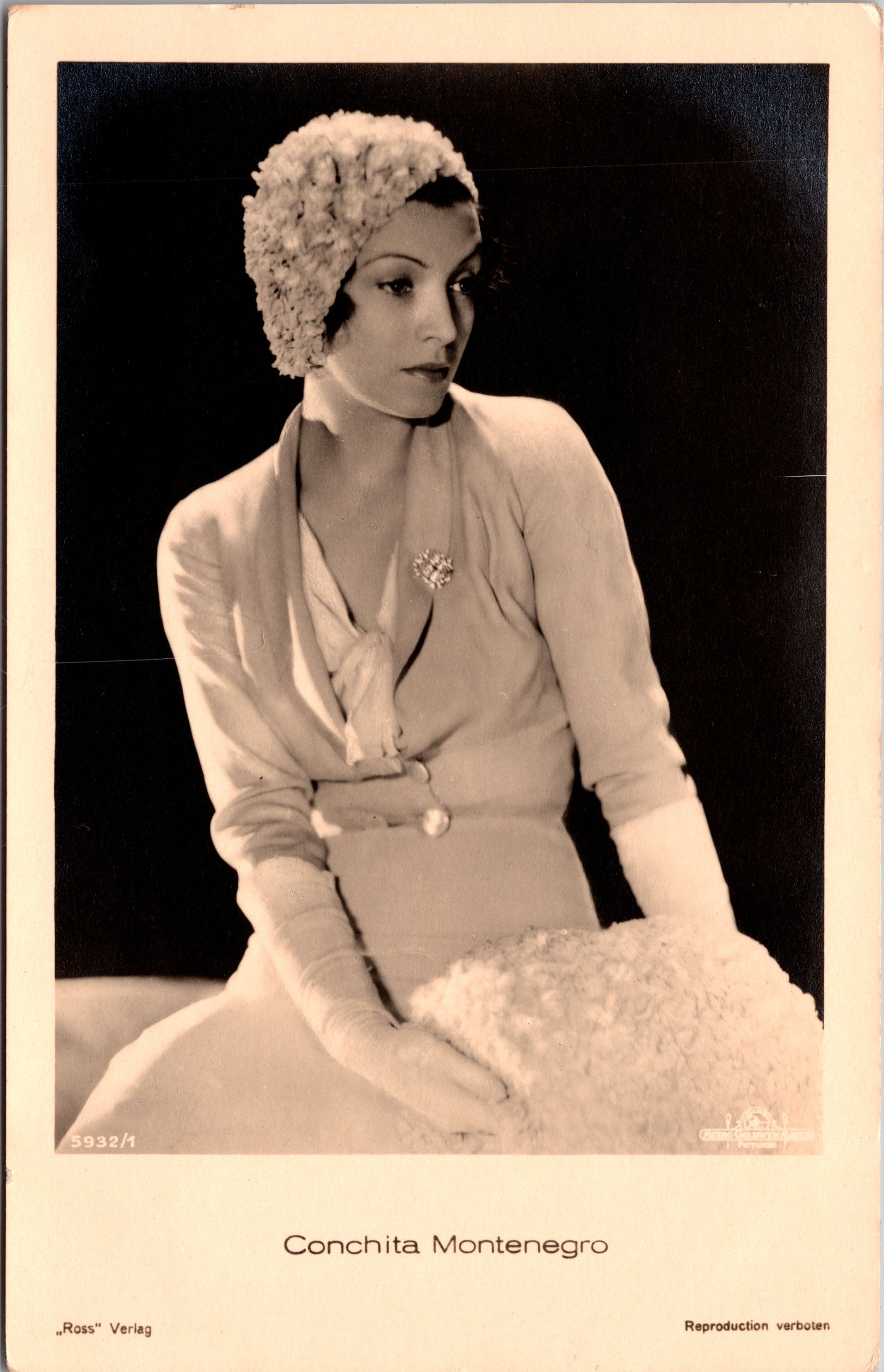
This vintage real photo postcard features Spanish model, dancer, and stage and screen actress, Conchita Montenegro (1911-2007). Montenegro learned classical and Spanish dance as a child. She is remembered for revolutionizing Spanish Dance. She transitioned to dramatic acting and starred in a number of productions. By the time she reached 13 years of age, she was famous in Hollywood, France, and Germany. She started in Hollywood with a contract with Metro Goldwyn Mayer. She began her film career in Spanish language versions of MGM movies. She quickly moved into American movies and her fame grew. In 1931, she left MGM for Fox Films. That same year, while on the way to shoot “The Cisco Kid” in Tucson, Arizona; she and many of the film crew and actors were involved in a serious train crash (derailment). In 1931, Fox named three of it’s actresses as “Fox debutante stars” and vowed to do so annually. Montenero, Helen Mack, and Linda Watkins were in the first trio that Fox honored as most likely to achieve stardom. Fox was competing with “WAMPAS Baby Stars” in forming this group of future stars. At times, Montenegro would perform at premiers of new films. She was able to showcase her multi talents, including vaudeville acts, at these shows. The IMDb credits Montenegro with 39 film appearances between 1927 and 1944. She played Lola Montes in the 1944 biopic. This vintage postcard was published by Ross Verlag as part of a series (No.5932/1). Note the logo for Metro Goldwyn Mayer in the bottom right hand corner of the image. Since Montenegro worked for MGM around 1930, she must have been around 19 years old when this photograph was taken. This postcard is in very good condition (see scans).
Buy this Vintage Real Photo Postcard (includes shipping within the US) #5106
To purchase this item, click on the Pay with PayPal button below
$14.00
Buy this Vintage Real Photo Postcard (includes International shipping outside the US) #5106
To purchase this item, click on the Pay with PayPal button below
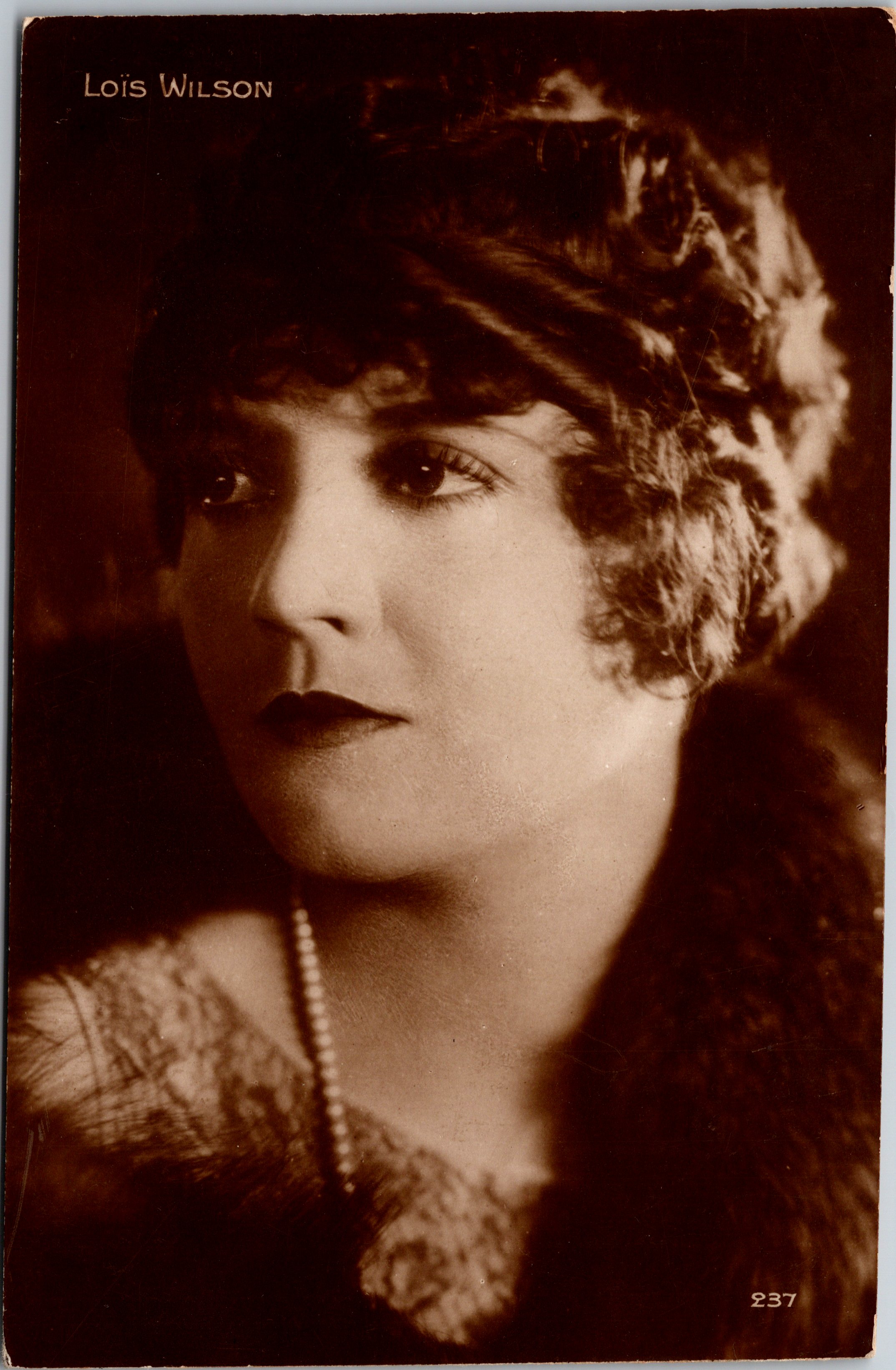
This vintage real photo postcard features American silent and sound film actress, Lois Wilson (1894-1988). She also directed two films and performed on the stage. She appeared on Broadway three times between 1937 and 1968. Her 1968 appearance was in “I Never Sang For My Father”. She was born in Pittsburgh, Pennsylvania but she and her family moved to Alabama when she was quite young. She graduated from Alabama Normal College and became a school teacher before venturing out to pursue a film career. In 1915, after winning the equivalant of the Miss Alabama beauty contest, she headed for Hollywood. She was quickly hired by Victor Film Company for a number of small roles. In 1916, she worked in a minor film role for female director Lois Weber. Weber took an interest in Wilson and began preparing her for future stardom. Wilson appeared in a number of films for various studios until she was signed by Paramount in 1919. She remained with the company until 1927. She was a WAMPAS Baby Star of 1922. WAMPAS Baby Stars were projected to become future major Hollywood stars. The IMDb credits Wilson with 159 screen appearances between 1915 and 1963. Her most noted roles were in “The Covered Wagon” (1923) and “The Great Gatsby (1926). She played opposite major leading men including Rudolph Valentino, John Gilbert and Ronald Reagon. She made a successful transition to sound movies. However, she became disappointed with many of the roles she played in the 1930’s, and retired in 1941. Wilson also performed on television and played roles in soap operas such as “The Guiding Light”, “The Secret Storm”, and the “Edge of Night”. Lois Wilson never married. This vintage postcard was published by Cinemagazine (Paris) as part of a series (No.237). SOLD
This postcard features a portrait of American film actress, Colleen Moore (1899-1988). She began her career in the silent film era. She was a fashionista and one of the highest paid stars of her time. She is also noted for popularizing the “dutchboy bobbed haircut”. Like many silent film stars, she was unable to adapt to “talkies” and decided to retire after just making a few sound films. Upon retirement, Moore focused on investing, and was quite talented in that realm. She became a partner at Merrill Lynch and wrote a book about how to invest in the stock market. One of her hobbies involved dollhouses. In the early 1950’s, she helped design and curate “The Colleen Moore Dollhouse” which is still exhibited at the Museum of Science and Industry, in Chicago, Illinois. The dollhouse is 9 square feet and worth millions of dollars and has been seen by millions of museum goers. Moore was born in Michigan and her family relocated to Atlanta around 1908.They then moved on to Pennsylvania and finally, Tampa, Florida. At fifteen years of age, Moore had a screen test with director D. W. Griffith. Griffith owed a debt to Moore’s uncle, a successful newspaper man in Chicago. Moore must have done well on the screen test since she soon found herself playing heroines in Westerns. She signed a contract with Triangle-Fine Arts and for the first few years she appeared in minor supporting roles. When the Triangle Company folded she signed with Selig Polyscope. She appeared in “A Hoosier Romance” and “Little Orphant Annie”. They were popular films and Moore achieved some celebrity. When Selig closed their doors, Moore went to work on films from various companies. Her star kept rising. In 1922, Moore was named a WAMPAS Baby Star (honor for actresses on the threshold of fame). The IMDb credits Moore with 65 film appearances between 1918 and 1934. At the height of her career, she was earning over twelve thousand dollars a week. This vintage portrait postcard features Colleen Moore with her trademark dutch boy bobbed haircut. The card was published by Ross Verlag. Note the logo for First National Pictures in the lower right hand corner of the image. The card has a 1926 postmark. Moore was about 27 years old when the photograph was taken. SOLD
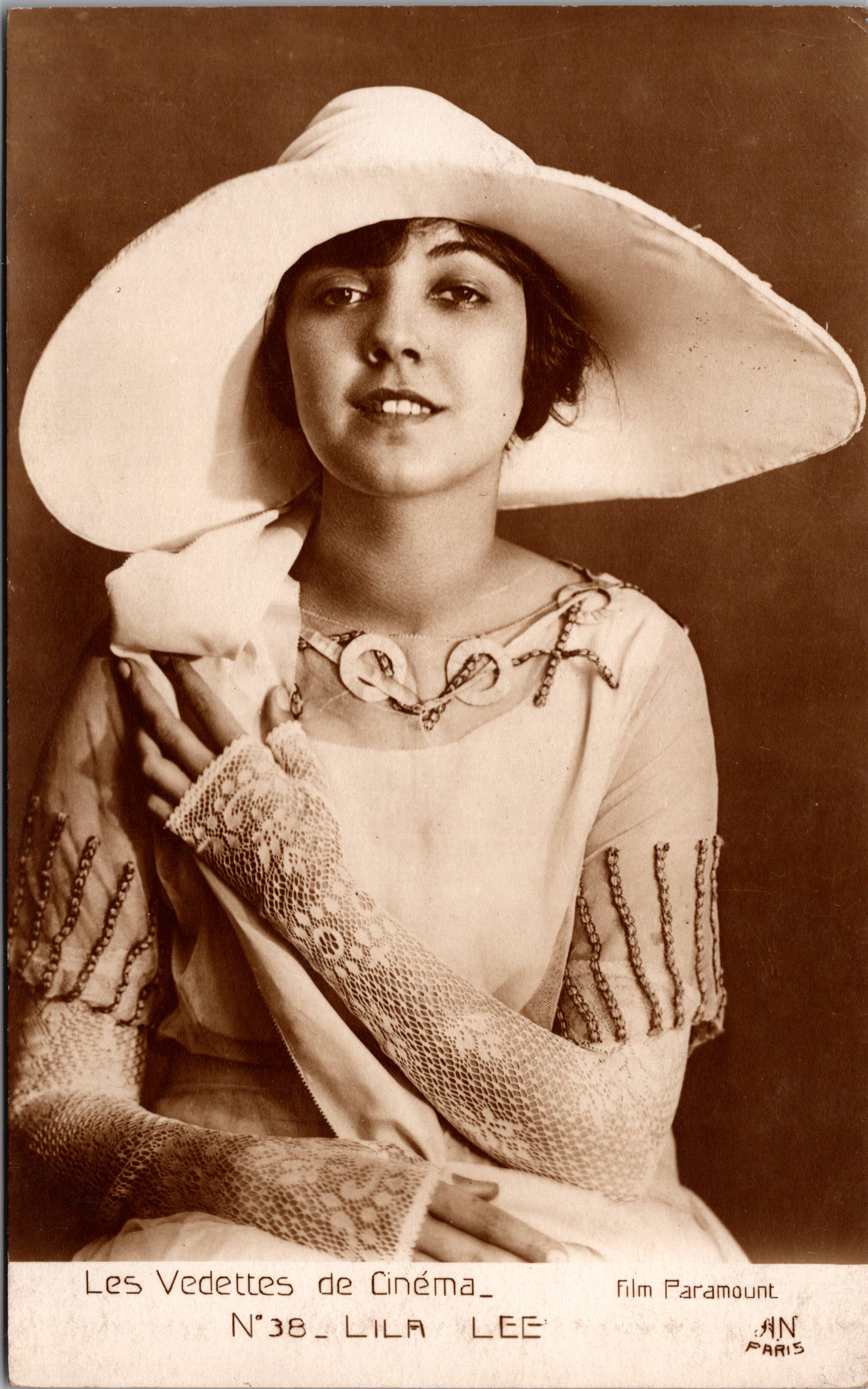
This vintage real photo postcard features leading lady screen actress, Lila Lee (1905-1973). She performed in both silent and early sound films. She was born in New Jersey and her family were German immigrants. The family relocated to New York City. Her family encouraged her participation in “kiddie review shows”. The energetic and outgoing child was given the nickname of “Cuddles”. The name stuck to her throughout her acting career. Her juvenile acting kept her quite busy and she required private tutors for her education. Lila acted in vaudeville fo an eight year period. In 1918 she was signed by Jesse Lasky (Famous Players) for a film contract. In a short time, the company became Paramount Pictures. Her first feature film performance received much public approval. She was just 13 years old at the time of her film debut. Lila quickly became a leading lady and starred with performers like Conrad Nagel, Gloria Swanson, and Rudolph Valentino. In 1922, she won the first WAMPAS Baby Star Award. Lila was a very popular leading lady during the 1920’s. Her films were popular with critics and audiences alike. She was one of the few stars that made a successful transition from silent to sound films. In the 1930’s she made some bad career decisions and had bouts of tuberculosis and alcoholism. As a result, her latter film roles were mostly in B movies. In 1936, her film career basically ended as the result of a scandal involving the sucide of a man that she was dating. Lila Lee lied to the District Attorney when she reported that the victim left no suicide note, when in fact she knew that he did. Lee’s personal life was unstable. She was married and divorced three times. Her son, James Kirkwood became a successful playwright and screenwriter. His credits include “A Chorus Line” and “P.S. Your Cat is Dead”. The IMDb lists 103 credits in Lee’s filmography (1918-1967). This vintage postcard was published by Alfred Noyer as part of the “Les Vedettes de Cinema” series. The postcard was released while she was employed by Paramount Pictures. The card is of French origin.(SOLD)
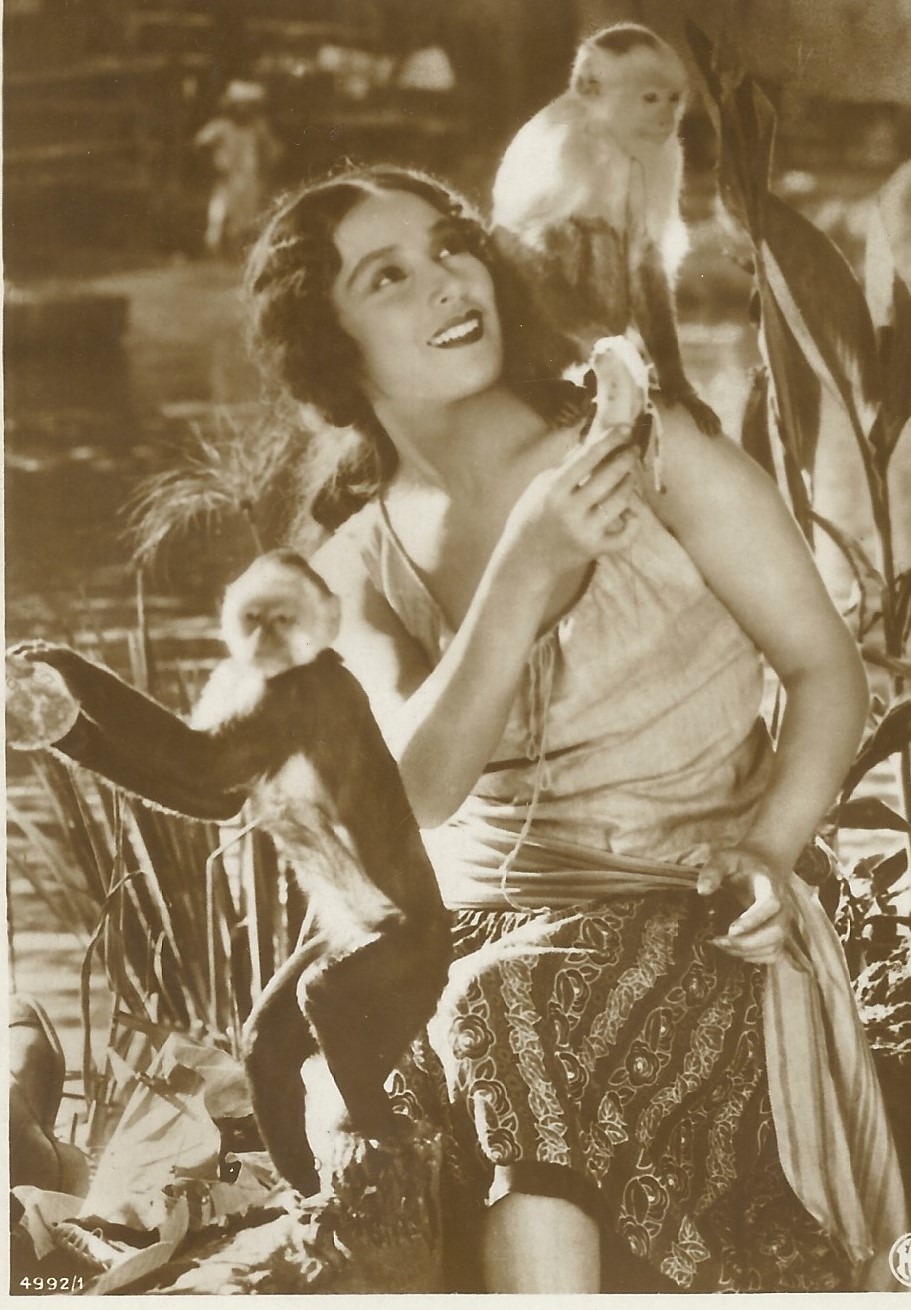
This vintage real photo postcard features Mexican actress, dancer, and singer; Dolores del Rio (1904-1983) and two unidentified capuchin monkeys. Del Rio’s performing career spanned more than half of a century. She was the first major Latin American actress to become an American film star (1920’s & 1930’s). Del Rio was also a major star in Mexican films. Dolores was known for her beauty as well as for her talent. She was discovered in Mexico and her Hollywood film career started in 1925. She began her career with a number of successful films, including “Ramona” (1928) and “Evangeline (1929). During the silent film era, she was considered the female version of “latin lover”, Rudolph Valentino. Del Rio was one of the fortunate actresses whose career was not destroyed by the advent of sound films. She acted in a wide range of film genres. “Bird of Paradise” (1932) and “Madame Du Barry” (1934) were among her successful films of the 1930’s. In the early 1940’s, her Hollywood career began to flounder sparking Del Rio to return to Mexico to become a major star of Mexican cinema. She continued acting in Mexican films through the 1950’s. Beginning 1960 she acted in both Mexican and Hollywood films. During the late 1950’s through the early 1970’s, Del Rio acted in theater and television. Dolores was born in Durango City, Mexico. Her parents were part of Mexican aristocracy whose lineage could be traced to Spain. Dolores was the cousin of actor Ramon Novarro (another silent film”latin lover”), and of Mexican cinema actress, Andrea Palma. During the Mexican Revolution (1910-1920), Dolores’s family lost its fortune. Her family felt threatened by Pancho Villa’s insurgence. It was time to “get out of town”. Her father fled to the United States while she and her mother escaped to Mexico City. Acting was an integral part of Dolores’s getaway. She and her mother felt compelled to dress as peasants to insure safe passage on the train to Mexico City. Her parents reunited there in 1912. Dolores attended a college in Mexico City operated by French nuns. After seeing Russian ballerina, Anna Pavlova perform; Dolores decided to become a dancer and took lessons from a well respected teacher. At age 17, Dolores married Jaime Martinez del Rio. He was from a wealthy family and was educated in England. The couple honeymooned in Europe for two years and Dolores formed close relationships with a number of members of European aristocracy. When the couple returned to Mexico, they settled in Mexico City. In 1925, Dolores met American filmmaker Edwin Carewe, and he was spellbound. He convinced Dolores and her husband to move to Hollywood where he promised to make Dolores a star. Her husband hoped to write screenplays there. When they arrived in Tinseltown, Carewe launched a public relations campaign to raise excitement about his beautiful find. He built up her aristocratic background by saying such gems as Dolores was “the first lady of high Mexican Society” and that she had come to Hollywood with a collection of shawls and combs valued at fifty thousand dollars. Dolores made her film debut in “Joanna” (1925), where she played a vamp of Spanish-Brazilian origin. Her first starring role was in the comedy “Pals First” (1926), directed by Carewe. That same year, Dolores appeared in the war film “What Price Glory?”. The movie was a huge financial success and helped Dolores become one of the “WAMPAS Baby Stars” of 1926. Other members of her “class” were Mary Astor, Joan Crawford, Janet Gaynor, and Fay Wray. By then, her film career was rocketing. Her role in Resurrection” (1927), a popular film based on a Tolstoy novel, further propelled her career. While her career was succeeding, her personal life was a “hot mess”. Her marriage to Del Rio ended in 1928. He had much difficulty being in the shadow of his famous and successful wife. Six months after Dolores filed for divorce, Del Rio died in Germany. While dealing with her grief, she had to deal with constant harassment from her discoverer, Edwin Carewe. He wanted to be more than her agent and her director since he had first launched her career. In 1929, Dolores announced to the press, that despite Carewe’s claims, the pair were just friends and business companions. She added that they had no plans for marriage. Soon thereafter, she cancelled her contract with him. The end result was a legal dispute that was settled out of court. Carewe’s anger did not end there. He disparaged her the press and refilmed “Resurrection” starring Lupe Velez, another popular Mexican film star. In 1930, Del Rio married MGM art director, Cedric Gibbons. They became one of Hollywood’s most followed couples of the early 1930’s. In 1932, the film, “Birds of Paradise”, was released to rave reviews. The film starred Del Rio and actor, Joel McCrea. The movie was a South Seas love story. A scandal arose from the film because of a scene featuring the pair swimming naked. Controversy continued in Del Rio’s appearance in “Flying Down to Rio” (1933). In this film, Del Rio was the first actress to wear a two piece bathing suit on screen. Fred Astaire and Ginger Rogers danced together for the first time on film, in this movie. Del Rio and Astaire also did an “intricate” dance number in the film. Del Rio found herself in political hot water when she and Ramona Novarro and Lupe Velez attended a special screening of a Mexican film which was accused of promoting Communism in California. Del Rio was accused of being a Communist for her attendance at the screening. In 1940, Del Rio began an affair with actor/filmmaker, Orson Welles. The dalliance resulted in Del Rio and Gibbons divorce. In 1954, Dolores was scheduled to co-star in a Spencer Tracy film, but the US government would not give her permission to work in the United States. The government believed she was sympathetic toward communism for attending the aforementioned film screening and for signing a petition supporting a world peace conference. After some time, she was able to remedy the problem by writing a persuasive letter to the US authorities. Later in life Del Rio did express some “political” beliefs. She stated that she wished she could play Mexican roles to show what life in Mexico was really like. She felt such an opportunity could help diminish the ugly stereotypes that existed about Mexicans in American society. She stated that it was her great wish to make fans realize the beauty, wonder, and greatness of Mexicans as a people. She asserted that the great majority of Americans view Mexicans as a “race of bandits, or laborers, dirty, unkempt, and uneducated”. Why do these false negative stereotypes sound so familiar? Del Rio wanted to show “the best that’s in my nation”. It has been pointed out by more than a few writers that Dolores del Rio was no “Latin bombshell”. Instead, she was noted for her elegance. The IMDb reports that Del Rio has 63 film credits ranging from 1925 through 1978. This vintage postcard was published by Ross Verlag as part of a series (no. 4992/1). The logo for Fox films can be seen in the lower right hand corner of the image. (SOLD)
Margaret Leahy (1902-1967) was a British actress. She was born in London. At the age of eighteen, she set up a costume shop and designed women’s clothing. She also modeled her designs for her customers. The story of how she got her start in acting is an interesting one. After winning a beauty contest, she seemed destined for stardom. Unfortunately, despite her rapid launch into filmdom, her career quickly crashed. She made only one film in her short-lived career. The beauty competition occurred in 1922. Actresses, Constance and Norma Talmadge, Joseph Schenck (film studio executive), and Edward Jose (film director) held a beauty contest in England. It’s purpose was to find a new leading lady. The “Daily Sketch”, an English newspaper, offered a starring role in a major Hollywood film to the winner of the contest. Eighty thousand women entered the contest and three girls were chosen to the final competition. The finals were held in Hollywood and Miss Leahy was the winner. Norma Talmadge described Leahy as “the most ravishing girl in England”. Leahy’s start in films was a disaster. She was dismissed from “Within the Law” (1923). The film’s director found her acting talent was nearly non-existent. He threatened to quit unless Leahy was terminated. The year 1923 wasn’t all bad for Miss Leahy. She was named one of thirteen WAMPAS Baby Stars. Evelyn Brent, Eleanor Boardman, and Laura La Plante were among the thirteen. All but Leahy became successful film actresses. Between 1922 and 1934, WAMPAS association supported a promotional campaign that named thirteen young actresses thought to be destined to become stars. Margaret’s next stop was an appearance in a Buster Keaton comedy, “Three Ages” (1923). Leahy received little attention for her role in the movie and her career was stopped in it’s tracks. Leahy did not return to England. Instead she got married and remained in California. She became an interior decorator and was known to despise the movie industry. In fact, she burned all her movie related scrap books. Sadly, Leahy committed suicide at the age of sixty-four in California. This vintage postcard was published by Rotary Photo and printed in England. The postcard is part of a series (no. 5.76.2). The postcard is in very good condition (see scans). SOLD
This vintage real photo postcard features American silent and sound film star, Virginia Brown Faire (1904-1980). She was born in Brooklyn, New York. In 1919, after being a winner of the Motion Picture Classic magazine’s “Fame and Fortune” contest, she went to Hollywood. At age 15, she was hired by Metro studio. She then appeared in movies for Fox, followed by Universal. Her first film “Runnin’ Straight” (1920) was a Hoot Gibson short western. She was the leading lady for John Gilbert in Monte Cristo (1922). She was chosen as one of the WAMPAS Baby Stars in 1923. Included in this group of beautiful actresses was Laura La Plante and Evelyn Brent. La Plante and Brent both had successful acting careers. She is most remembered for her role as Tinker Bell in Peter Pan (1924). Faire made a successful transition into sound films. Her first successful talkie was her role in Frank Capra’s “The Donovan Affair” (1929). She appeared in several westerns. Among the western stars that she played opposite to; was John Wayne,Hoot Gibson, and Buck Jones. In the late 1930’s she left Hollywood and moved to Chicago and worked in radio and industrial films. She retired in about 1935. According to the IMDb, she appeared in 74 films between 1920 and 1935. Faire had three marriages. The first, was to actor Jack Dougherty and the marriage lasted just over a year. She then married director Duke Worne, a film director. He died after three years and she then married William Bayer, a furniture manufacturer. She died of cancer in 1980. This vintage postcard was published by Ross Verlag of Berlin, Germany. It is part of a series (no, 736/1). SOLD
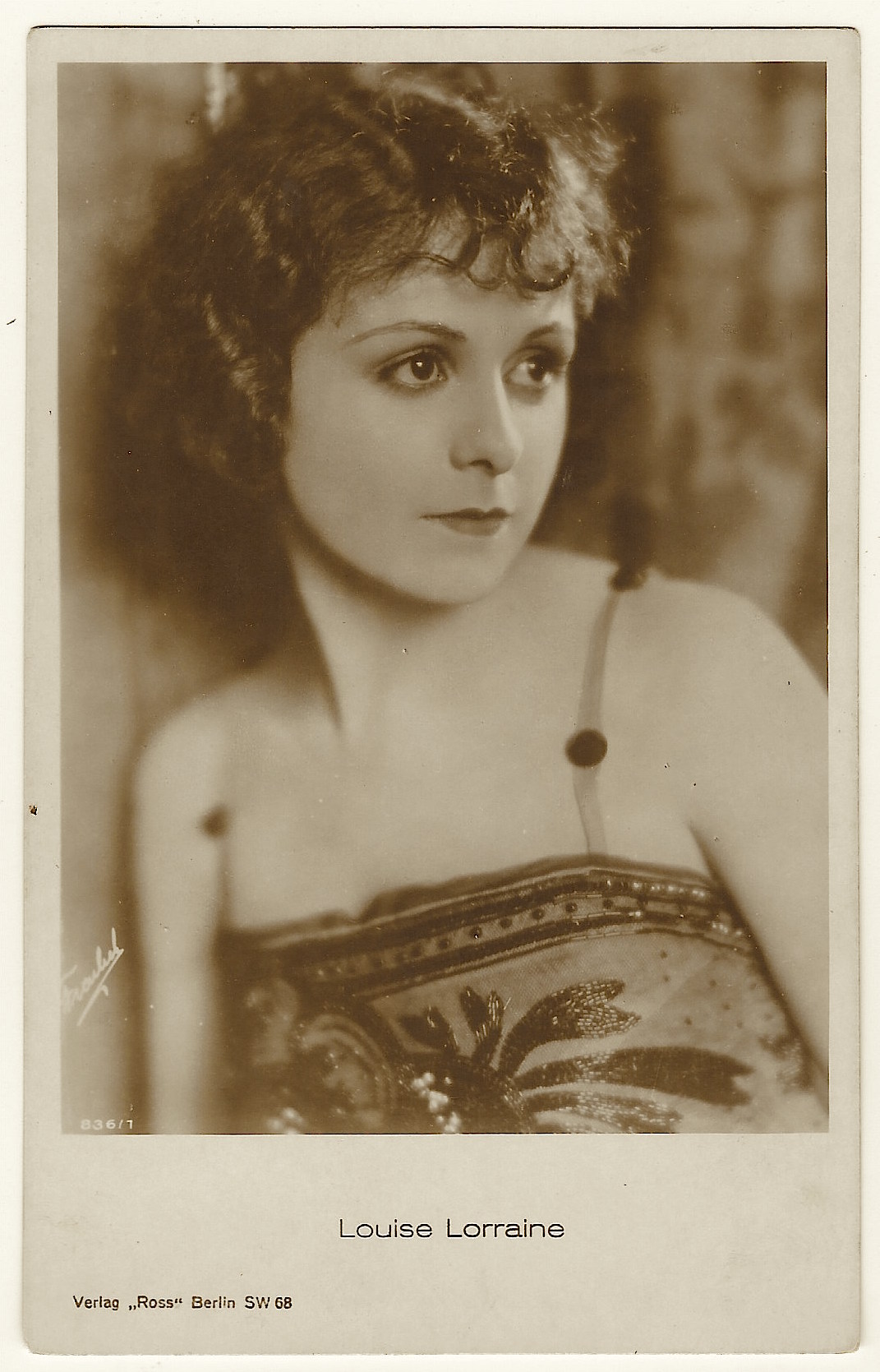
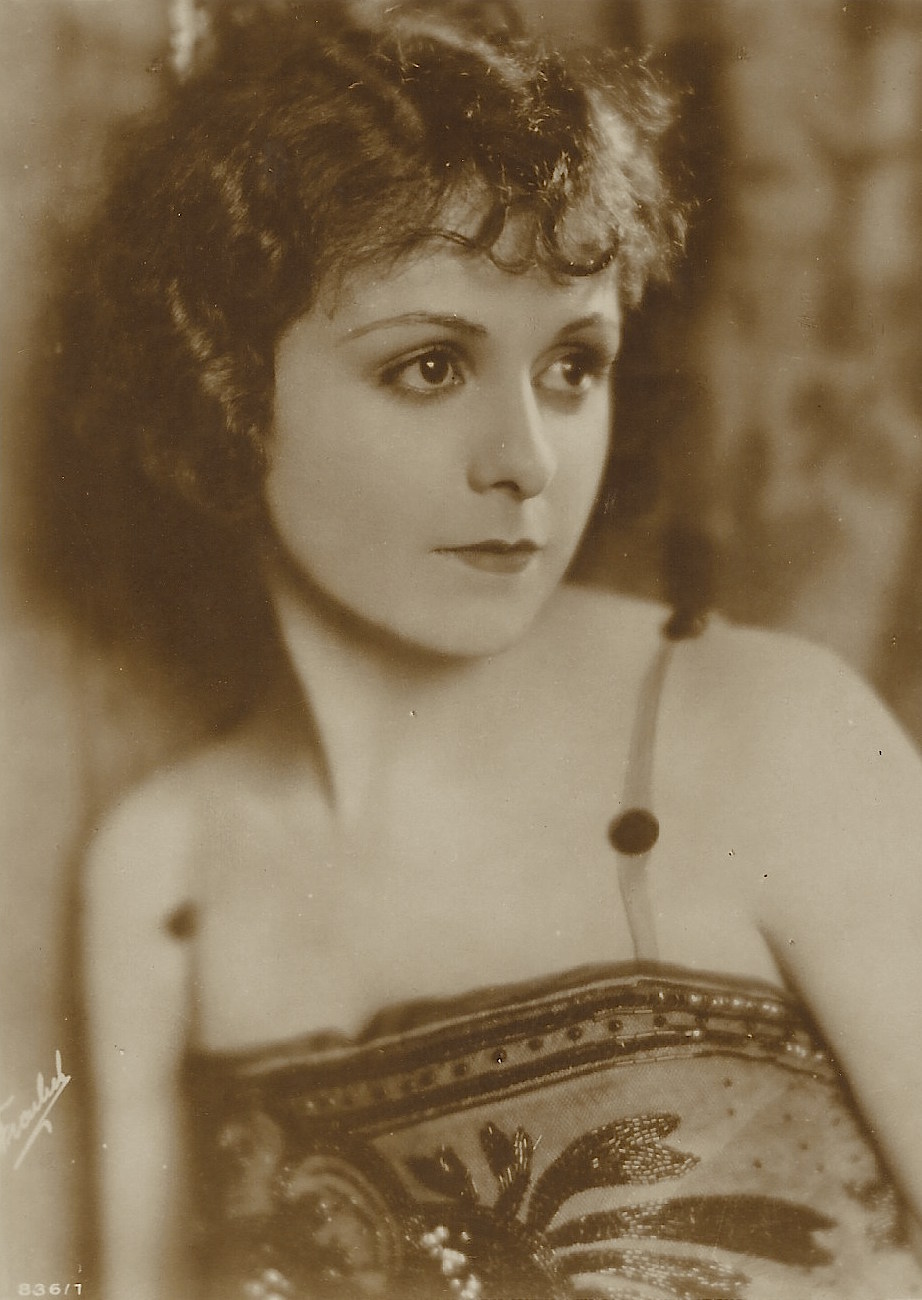
This vintage real photo postcard features beautiful American film actress, Louise Lorraine (1904-1981). She was born in San Francisco and was discovered by a photography salesman who had knocked at the door of her home and was met by Louise. The salesman was startled by her good looks and her winning personality He told Louise’s mother that her daughter should be in films. Her widowed mother had five other children and after some time, she agreed to allow Louise to investigate becoming an actress. The salesman used a contact, and before long, Louise was in independent two-reel comedies. That was followed by stints with MGM and Universal. She became very popular for her roles in action-packed serials such as “The Radio King” (1922) and “With Stanley in Africa” (1922). She starred in eleven serials and was known for her energy and charisma. Her small stature and delicate beauty were unlikely characteristics expected in a serial heroine. However, she starred these physically demanding serials. In 1921, she became the third actress to portray “Jane”. She starred in the movie serial “The Adventures of Tarzan’ (1921). She was selected as a “Wampas Baby Star” in 1922. The organization was very successful at identifying future stars. Among their “finds” was Clara Bow and Joan Crawford. She starred in only five talkies during her film career including “Near the Rainbow’s End’ (1930). After this film appearance, she retired to spend time with her husband and two children. The IMDb reports that Louise Lorraine appeared in 83 films between 1922 and 1930. Lorraine was married twice. Marriage number one was to actor Art Acord, Her second marriage was to Chester Hubbard. She had two children. This vintage postcard was published by Ross Verlag and was part of a series (no. 836/1). The photographer of this portrait was Roman Freulich (1898-1974). Freulich was born in Poland and immigrated to the United States at the age of 14. He learned his trade from New York photographer Samuel Lumiere. He moved to Hollywood in the mid 1920’s where his brother Jack was a portrait photographer at Universal Pictures. Roman became a still photographer for Universal and produced many portraits of their major stars. He stayed at Universal until 1944 when he moved to Republic Studios. After Republic stopped production, Freulich did much work for United Artists.The stamp box of this postcard has an interesting story. “NBC” (Neue Bromsilber Convention) was a price cartel established in 1909 that continued until the 1930’s. The purpose of the cartel was to ensure that the minimum price charged for postcards was kept at a sufficiently profitable level. A number of postcard publishing companies joined the cartel in an effort to stave off the effect of competition on the pricing of postcards. This postcard has excellent clarity and is in very good condition (see scans).
Buy this original Vintage Real Photo Postcard (includes shipping within the US) #2630
To purchase this item, click on the Pay with PayPal button below
$25.50
Buy this original Vintage Real Photo Postcard (includes international shipping outside the US) #2630
To purchase this item, click on the Pay with PayPal button below










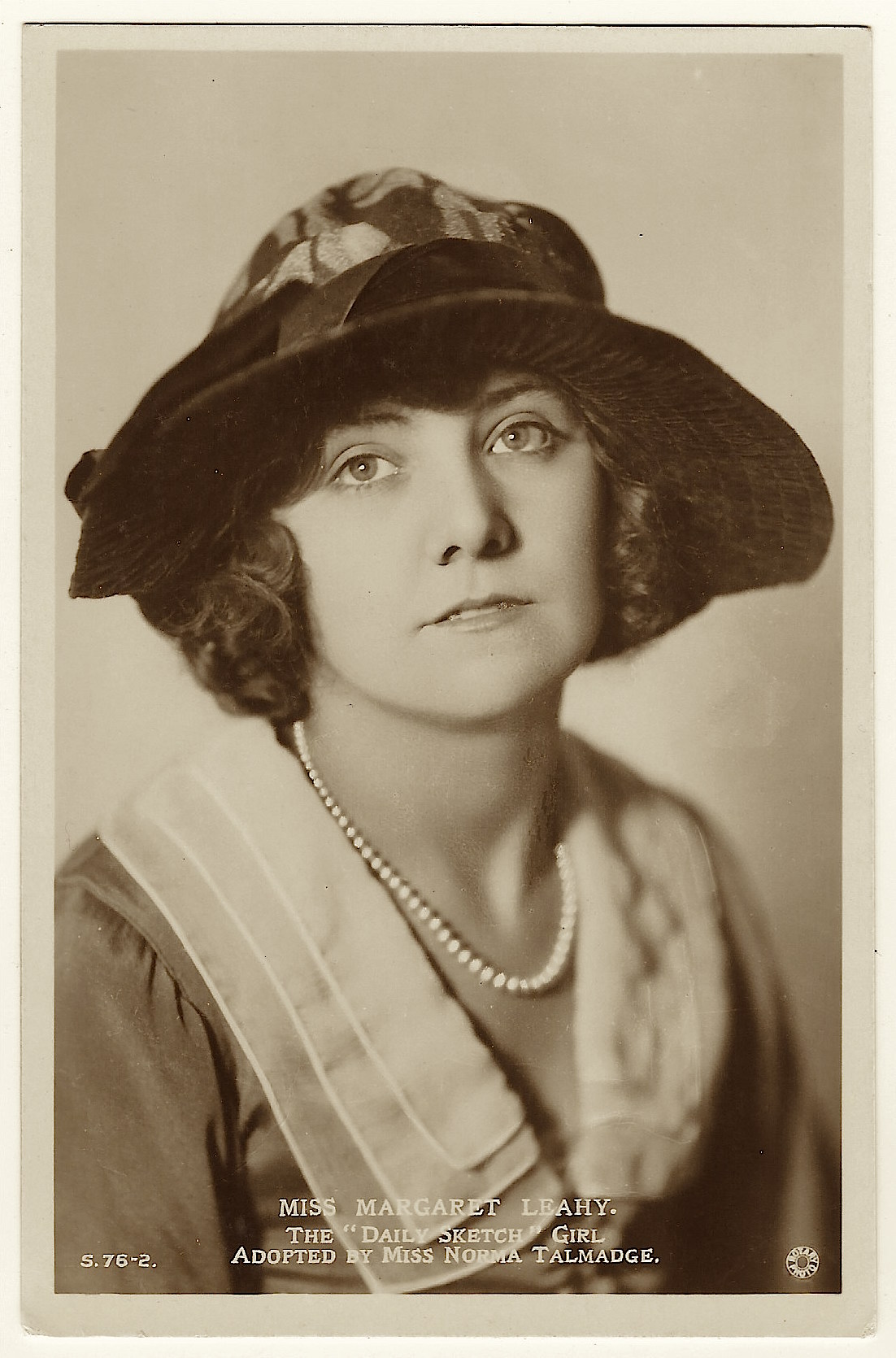 Margaret Leahy (1902-1967) was a British actress. She was born in London. At the age of eighteen, she set up a costume shop and designed women’s clothing. She also modeled her designs for her customers. The story of how she got her start in acting is an interesting one. After winning a beauty contest, she seemed destined for stardom. Unfortunately, despite her rapid launch into filmdom, her career quickly crashed. She made only one film in her short-lived career. The beauty competition occurred in 1922. Actresses, Constance and Norma Talmadge, Joseph Schenck (film studio executive), and Edward Jose (film director) held a beauty contest in England. It’s purpose was to find a new leading lady. The “Daily Sketch”, an English newspaper, offered a starring role in a major Hollywood film to the winner of the contest. Eighty thousand women entered the contest and three girls were chosen to the final competition. The finals were held in Hollywood and Miss Leahy was the winner. Norma Talmadge described Leahy as “the most ravishing girl in England”. Leahy’s start in films was a disaster. She was dismissed from “Within the Law” (1923). The film’s director found her acting talent was nearly non-existent. He threatened to quit unless Leahy was terminated. The year 1923 wasn’t all bad for Miss Leahy. She was named one of thirteen WAMPAS Baby Stars. Evelyn Brent, Eleanor Boardman, and Laura La Plante were among the thirteen. All but Leahy became successful film actresses. Between 1922 and 1934, WAMPAS association supported a promotional campaign that named thirteen young actresses thought to be destined to become stars. Margaret’s next stop was an appearance in a Buster Keaton comedy, “Three Ages” (1923). Leahy received little attention for her role in the movie and her career was stopped in it’s tracks. Leahy did not return to England. Instead she got married and remained in California. She became an interior decorator and was known to despise the movie industry. In fact, she burned all her movie related scrap books. Sadly, Leahy committed suicide at the age of sixty-four in California. This vintage postcard was published by Rotary Photo and printed in England. The postcard is part of a series (no. 5.76.2). The postcard is in very good condition (see scans). SOLD
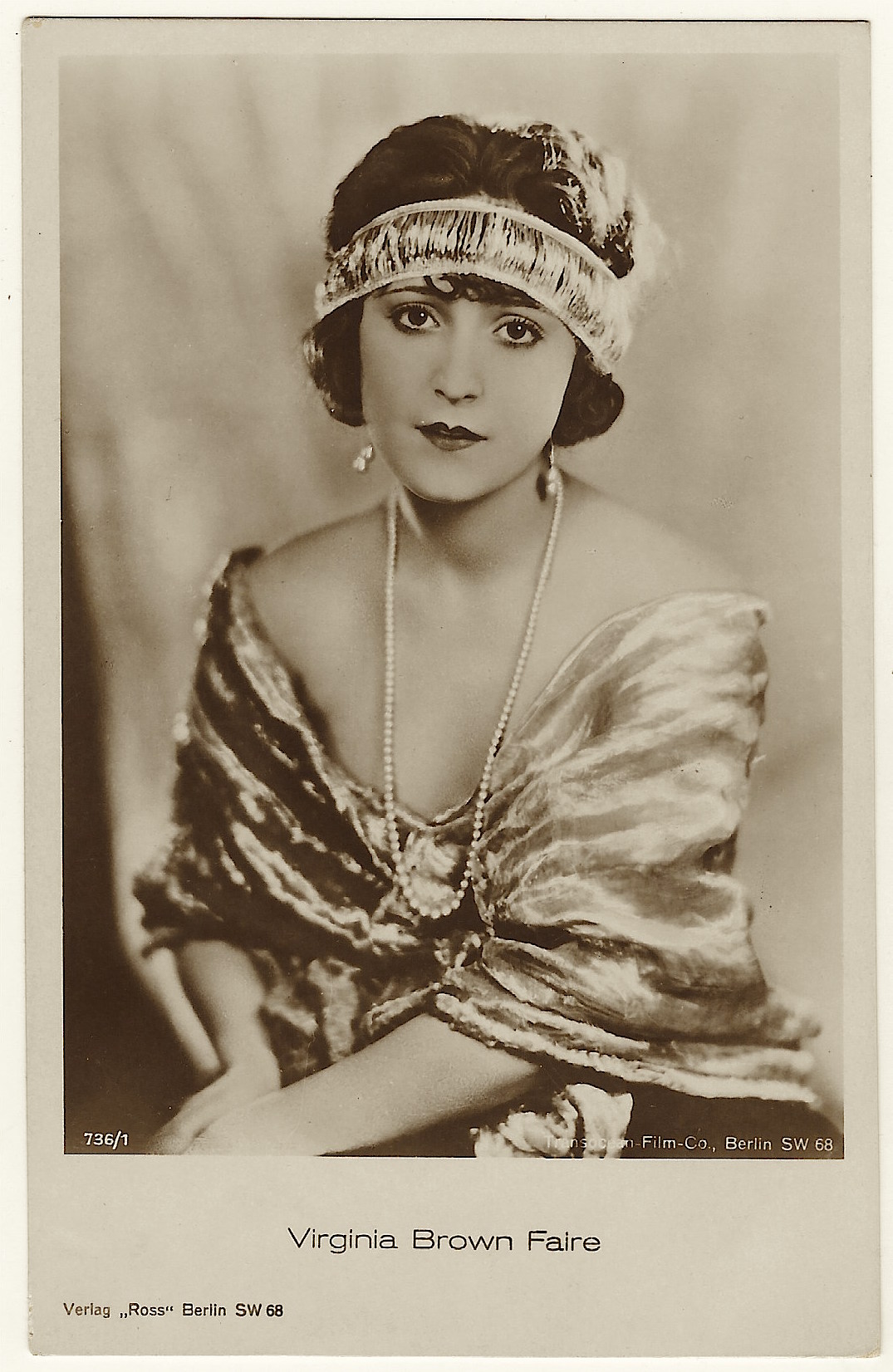
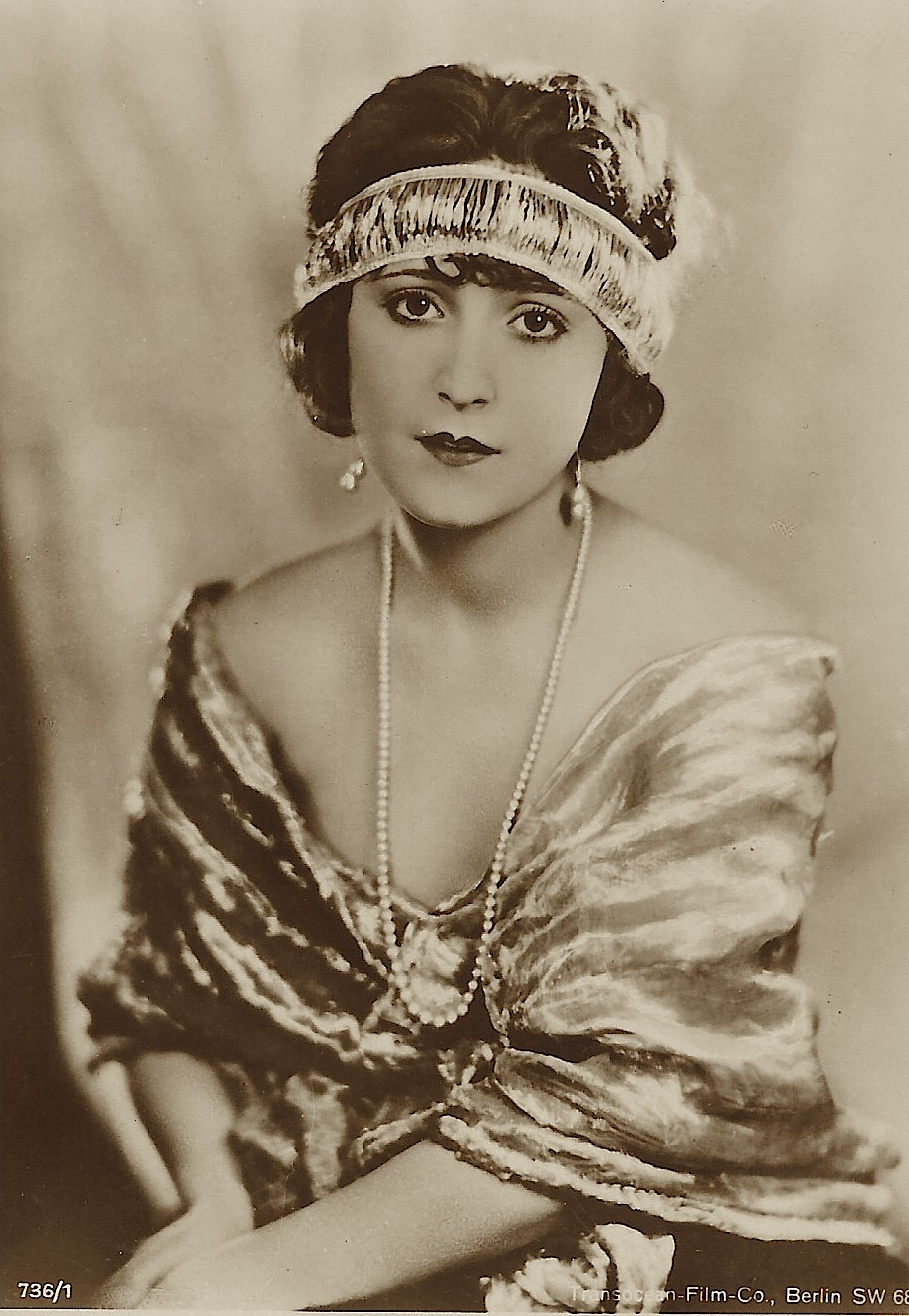 This vintage real photo postcard features American silent and sound film star, Virginia Brown Faire (1904-1980). She was born in Brooklyn, New York. In 1919, after being a winner of the Motion Picture Classic magazine’s “Fame and Fortune” contest, she went to Hollywood. At age 15, she was hired by Metro studio. She then appeared in movies for Fox, followed by Universal. Her first film “Runnin’ Straight” (1920) was a Hoot Gibson short western. She was the leading lady for John Gilbert in Monte Cristo (1922). She was chosen as one of the WAMPAS Baby Stars in 1923. Included in this group of beautiful actresses was Laura La Plante and Evelyn Brent. La Plante and Brent both had successful acting careers. She is most remembered for her role as Tinker Bell in Peter Pan (1924). Faire made a successful transition into sound films. Her first successful talkie was her role in Frank Capra’s “The Donovan Affair” (1929). She appeared in several westerns. Among the western stars that she played opposite to; was John Wayne,Hoot Gibson, and Buck Jones. In the late 1930’s she left Hollywood and moved to Chicago and worked in radio and industrial films. She retired in about 1935. According to the IMDb, she appeared in 74 films between 1920 and 1935. Faire had three marriages. The first, was to actor Jack Dougherty and the marriage lasted just over a year. She then married director Duke Worne, a film director. He died after three years and she then married William Bayer, a furniture manufacturer. She died of cancer in 1980. This vintage postcard was published by Ross Verlag of Berlin, Germany. It is part of a series (no, 736/1). SOLD



 THE CABINET CARD GALLERY