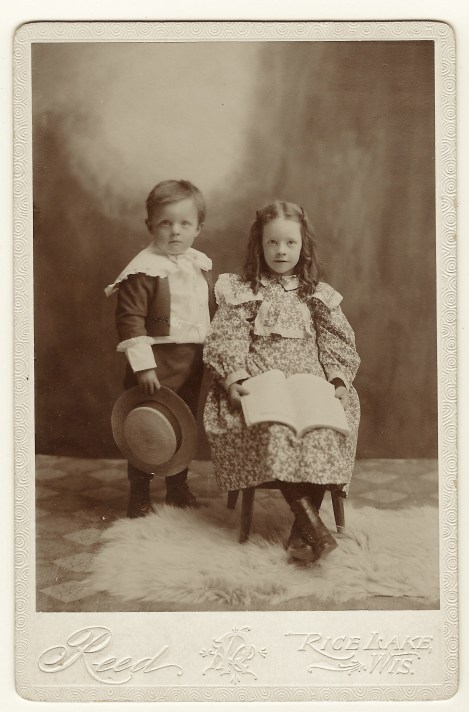
This cabinet card portrait features an adorable and well dressed brother and sister. The cute little girl sits in a chair holding an open book in her lap. Her younger brother stands beside her holding his hat by his side. The photographer of this fine image is Homer C. Reed. The “History of Baron County” (1922) reveals that Reed bought the Rice Lake studio of T. H. Webster in 1893. The Wisconsin Photographers Index, compiled by the Wisconsin Historical Society reports that Webster operated his Rice Lake studio until 1928. Homer Reed was born in Michigan and began his photography career in Forest City, Iowa. He married Adda A. Smith in 1895 and she served as an assistant in his photography studio. (SOLD)
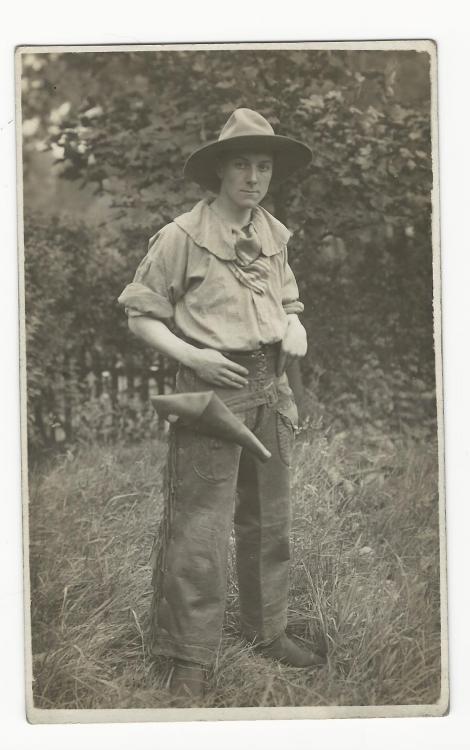
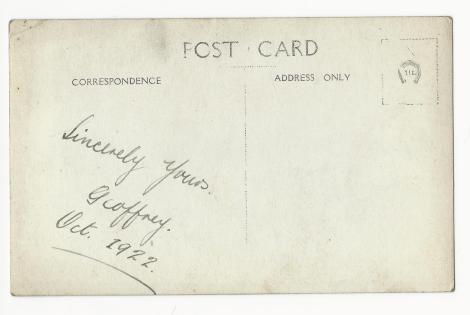
The reverse of this vintage real photo postcard indicates that the cowboy pictured on the front is named Geoffrey. My guess is that Geoffrey is a studio cowboy. His clothing, gun, holster, fringed chaps, and ten gallon hat were likely borrowed from a photography studio’s prop department. Geoffrey is not a convincing looking cowpoke or gunslinger. He has soft hands and a soft face. He certainly hasn’t been on too many cattle drives. However, this postcard is quite nice. The subject is well posed and the close-up perspective works well. An inscription on the card’s reverse reveals that he postcard photo was taken in 1922. The stamp box discloses that the publisher of the postcard stock was Vester & Company from Great Britain.
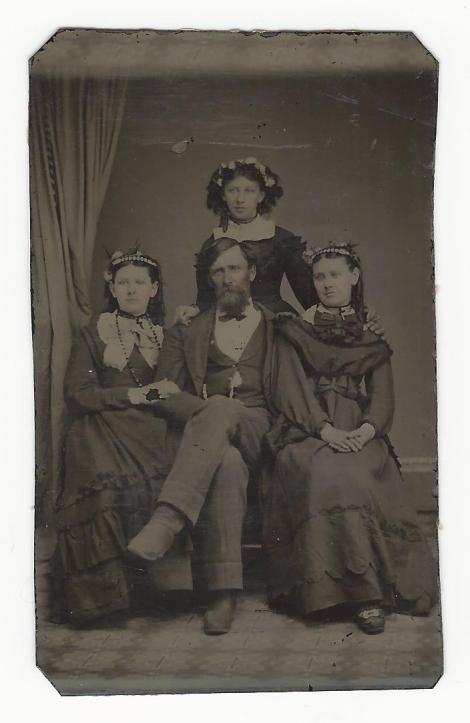
A well dressed middle aged man poses for his civil war era tintype portrait. He is accompanied in the image by three young women. The women are wearing dark dresses and each is adorned with a hair band. The woman standing behind the man is wearing her hair in a disheveled (natural?) style. One wonders what this man’s relationship is to the three women. Perhaps they are his daughters. Maybe one of the women is his wife (the woman holding his elbow?). One thing is for certain. This is an affectionate group. The foursome are sitting very close and there is a lot of touching going on. This image is the first tintype to appear in the Cabinet Card Gallery. A tintype, also known as ferrotype, is a photograph made on a thin sheet of metal coated with a dark lacquer or enamel. They were very popular during the 1860’s and 1870’s. SOLD
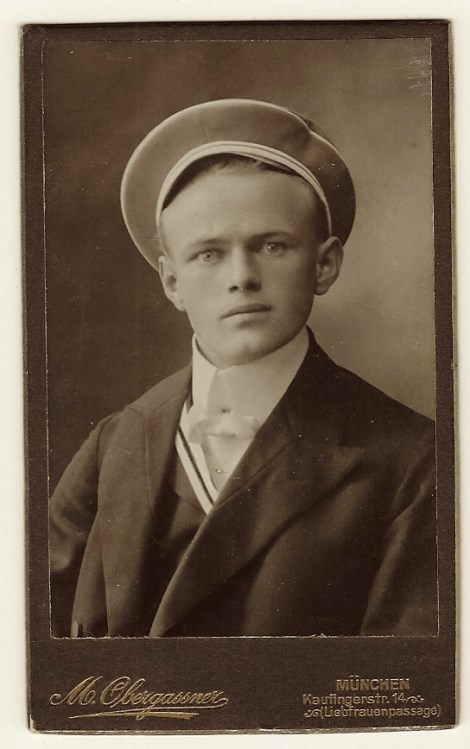
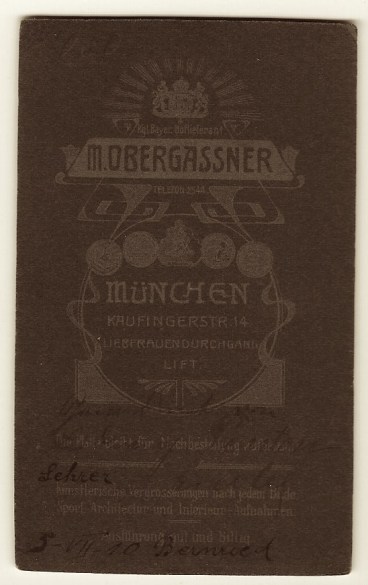
This cartes de visite (CDV) features a handsome young man wearing a university uniform. Note his standup collar, heavy pea coat, and wonderful cap. The photograph was taken at the M. Obergassner studio in Munich, Germany. Preliminary research reveals that Michael Obergassner had a second business besides working as a photographer. He operated a photo supply company which he established in 1889.
This is a wonderful cabinet card portrait of a pretty young woman. The photograph features a great deal of uncertainty. The individual who formerly owned this image claimed that the subject is African American. In my opinion, the claim is debatable. One of the issues relating to some cabinet card images of African Americans is this very question. Some collectors and dealers sincerely believe they possess a portrait of an African American while others dishonestly make the claim in order to increase the value of the photograph. This particular image presents another interesting and debatable subject. The previous owner also claimed that this photograph is a memorial cabinet card. In other words, the photograph was made in honor of this young woman upon her death (not a post-mortem photo). The placement of the woman’s image inside a scroll, or whatever the shape represents, is the alleged tip off that it is a memorial photograph. I have seen experts provide conflicting opinions about such claims. Lets talk about what we do know. This young and attractive woman is making an interesting fashion statement. Her dress has little squares of fabric attached to it in what appears to be a haphazard manner. She is wearing a horseshoe collar pin and a thin necklace. If this photo is a memorial cabinet card, then the horseshoe certainly didn’t provide her with good luck. She is wearing her hair up. The photographer of this cabinet card is William T. Ross (1861-1945) who operated a studio in Appleton, Wisconsin. Ross appears in “Wilson Photographic Magazine” (1898) in an article that reports that he was elected Treasurer of the Convention of Wisconsin Photographers. Ross has a presence in a number of Appleton city directories from 1889 through 1934. He was born in Syracuse, New York and was married to Ella A. Ross. The edges of this cabinet card are scalloped and gold gilded. The reverse of the cabinet card has a ghost image (see below). The image was likely formed by the rear of the cabinet card being pressed against the front of another image while occupying a frame or album. SOLD
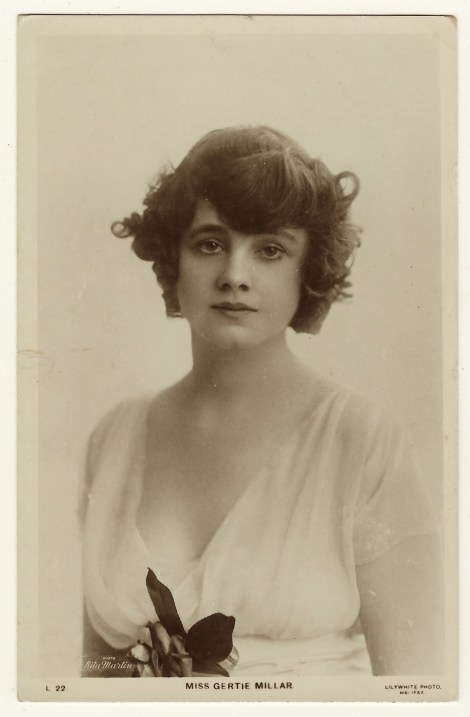
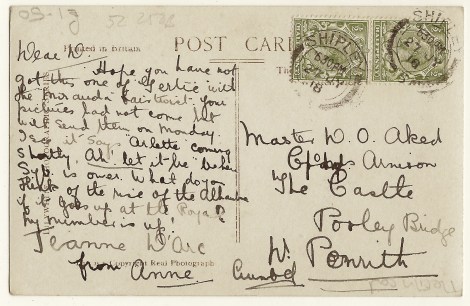
This vintage real photo postcard features beautiful English actress and singer Gertrude (Gertie) Millar (1879-1952). She was well known for her performances in Edwardian musical comedies. She began acting as a child (age 13) and was a well known star of musical comedies for two decades. Her first husband, Lionel Monckton, was the composer of many of her shows and songs. Monckton died in 1924 and Millar later married the 2nd Earl of Dudley, making her the Countess of Dudley. Some of Millar’s earlier appearances involved roles in “A Game of Cards” (1897), “Cinderella” (1899), “The Messenger Boy” (1900), and “The Toreador” (1901) at the Gaiety Theatre. By this time some of the songs she performedad become big hits. Gertie Millar was quite beautiful and was one of the most photographed women of the Edwardian period. Evidence of her popularity is the fact that there are 88 photographs of Miss Millar in England’s National Portrait Gallery. Many of these images appeared on postcards which became a popular collectors item.Gertie Millar was tall, thin and attractive with dark hair and large and very clear eyes. In addition she has been described as tough, determined and ambitious. Miss Millar appeared in many theatrical productions as the twentieth century progressed. In fact, between 1901 and 1910 Millar was the leading star of the Gaiety Theatre. Millar’s appearances included “The Orchid” (1903), “The Girls of Gottenberg” (1907), and “Our Miss Gibbs” (1909), “Gipsy Love” (1912). Gertie Millar went to the United States to star in the “Girls of Gottenberg” (1908) on Broadway. In 1914 she appeared in a film entitled “The House of Bondage”. After appearing in a number of less successful theatrical productions, Gertie Millar left the stage in 1918. Her husband died in 1924 and two months later she married the 2nd Earl of Dudley. The speed at which she remarried may reflect the unhappy state of her relationship with Mr. Monckton. The website “Stage Beauty” informs us that this theatrical couple had problems for many years. In fact the couple had unfortunate theatrics in their personal life. Mr Monckton was a jealous man and Miss Millar was a woman who attracted lots of male attention. This was a bad combination. A major dramatic incident occurred in 1905 when a young German nobleman who was infatuated with Gertie, broke into her marital residence and committed suicide by shooting himself in the head at her dressing table. Gertie denied any involvement with the obsessed man but her husband refused to believe her denial. In 1910 her romantic life was in the news again because of speculation about her involvement with the Duke of Westminister. This publicity was considered a major cause of the Duke’s estrangement from his wife. This postcard portrait was taken by celebrity photographer, Rita Martin. She is considered one of the best British photographers of her time. Rita had a specialty in photographing actresses. Her sister was celebrated society photographer Lallie Charles. To learn more about Rita Martin and to view more of her photographs, click on the category “Photographer: Rita Martin”. This postcard portrait is part of the “Lilywhite Series” (no. L 22). The postcard has a postmark from Shipley, England (1918) and is addressed to someone in Penrith, England. The postcard has an interesting message which includes the following first line; “Hope you have not got this one (postcard) of Gertie …..”. Click on the you tube video below to hear Gertie Millar sing “Moonstruck” from the musical comedy “Our Miss Gibbs” (1909). SOLD
As a collector of vintage photographs, once in a while I encounter a very special photograph. This image falls into the category of “special”. The photographer did an excellent job of capturing this well dressed elegant woman and her pet dog (border collie?). The woman and dog are well posed and their expressions are fabulous. The talented photographer who produced this image is H. G. Borgfeldt and his studio was located in Meriden, Connecticut. A light inscription on the reverse of this photograph indicates that the woman in the photo is Lina B. Letacher Bartlett and the dog’s name is Zemke. Preliminary research reveals that Lina Bartlett (age 24) appears in the 1900 US census. She lived in Meriden with her husband George A. Bartlett (age 36) and her father-in-law. The pair had married in 1892. Her husband was a farmer. Lina also appeared in the 1910 US census but her demographics had changed significantly. She still lived in Meriden but she had become head of her household after getting divorced. Her occupation was listed as “farmer”. She lived with two young men. At least one of them was her cousin. It was also found that Lina was born in Germany in 1876 and arrived in the United States in 1878. The talented photographer of this image is Henry G. Borgfeldt. Meriden business directories indicated that he ran a photography studio there at least between the years of 1902 and 1909.
This vintage real photo postcard features a pretty actress portraying “Joan of Arc”. She is wearing armor, and holding a flag in one hand and a shield in the other. Her medieval costume includes breastplates and a helmet. She has a sword hanging at her side and is wearing boots that almost look “space age”. Joan of Arc (1412-1431) was nick named “The Maid of Orleans” and is a heroine of France for her role in the Hundred Years’ War. She was canonized as a Roman Catholic saint. After being captured, she was tried and burned at the stake. The life of Joan of Arc became a popular subject in literature, theater, and film. Even Mark Twain wrote about her in the novel “Personal Recollections of Joan of Arc (1896) as did Sir Arthur Conan Doyle in “The Mystery of Joan of Arc” (1924).