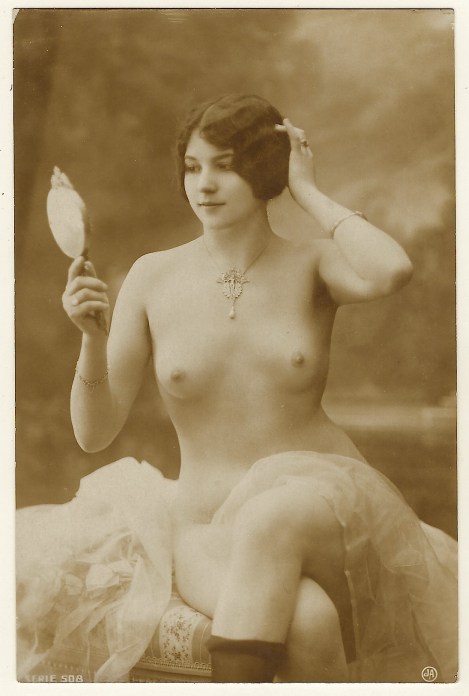
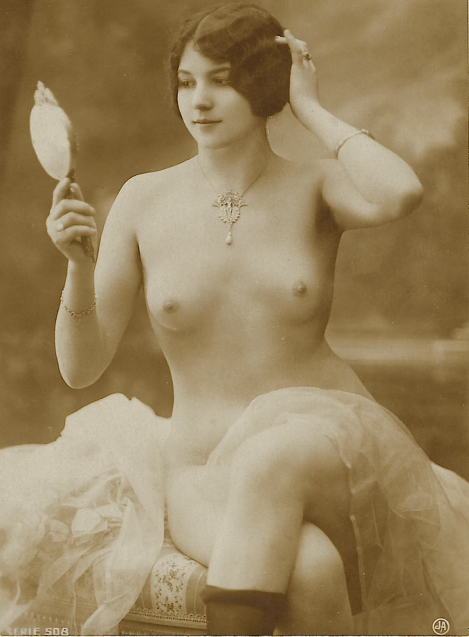
This vintage real photo postcard features a risque photograph of an unidentified model. The photo portrait was taken by the talented an esteemed French photographer, Jean Agelou (1878-1921).He was a photographer of the 1910’s and 1920’s and was well known for his erotic and nude photographs. He was born in Egypt and not much is known about his private life. Agelou generally used models between the age of 20 and 24 years-old. He had a favorite model. Her name was “Fernande” and in addition to modeling, she was Agelou’s lover. Her full name was Fernande Barrey (1893-1960) and she was a prostitute by trade. She also modeled for painters (Amadeo Modigliani and Chaim Soutine). Although the 1900’s was the “golden age” of erotic photograph, photographers who took such risque photos had to use discretion. As a result, Agelou signed his work “JA”. In 1908, nudity in photographs was banned in France and photographers needed to cover images of nude women with strategically placed undergarments or other materials. Nude images had to circulate on the down low. They were sent in the mail inside of envelopes. Jean Agelou died in 1921; the result of a car accident. His brother George, who managed Jean’s business, also was killed in the crash. This postcard is part of a series (508) . (SOLD)

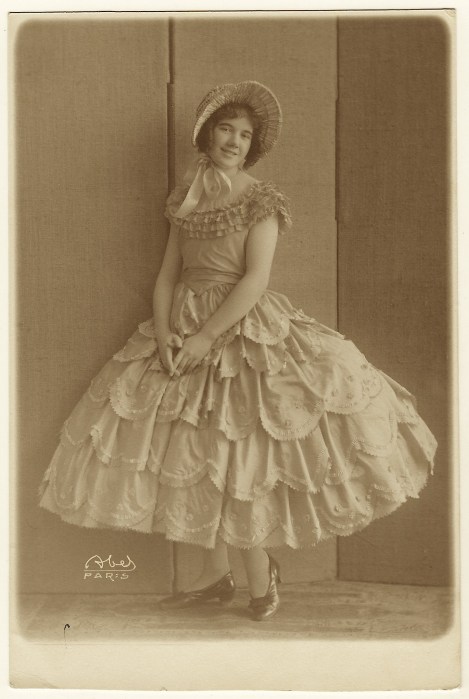


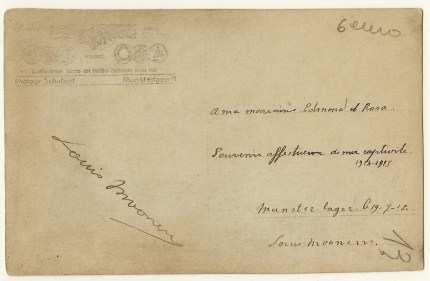
 This vintage real photo postcard features a handsome soldier. He is wearing a military uniform and cap. The pin on his hat indicates that he was a member of the 9th regiment of the infantry. I do not know the soldiers nationality. The message on this card includes the word “captivite”. Captivite, translated from the French means “captivate”. Was the writer of this postcard talking about capturing the town of Munsterlager, or was he referring to himself as being a prisoner of war? Perhaps a visitor to the cabinet card gallery will be able to translate the message for those of us with a French language deficit. This photo was taken in the mid 1910’s by the Schubert studio in Munsterlager. During the first World War (1916), the Breloh Camp was built in Munster by a regiment of gas warfare engineers. The next year there was construction of a facility for gas munitions. In all, three factories were built for the purpose of manufacturing chemical war material and related munitions. (SOLD)

 This vintage real photo postcard features German actress, Else Kupfer (1888-1974) as she appearss in Nestroy’s play, “Revolution im Krahwinkel” (1908) at the Deutsches Theater in Berlin, Germany. She is most known for her performance in “A Dangerous Woman” (1913). The IMDb lists this performance as her only film credit. This postcard portrait of Miss Kupfer presents her wearing a pretty dress and carrying a parasol. She looks adorable. Kupfe was married to Albert Arnold, brother of artist Karl Arnold. The Becker Maass studio photographed Else Kupfer for this postcard. The publisher of this card is Louis Blumenthal. His company operated in Berlin, Germany. (SOLD)
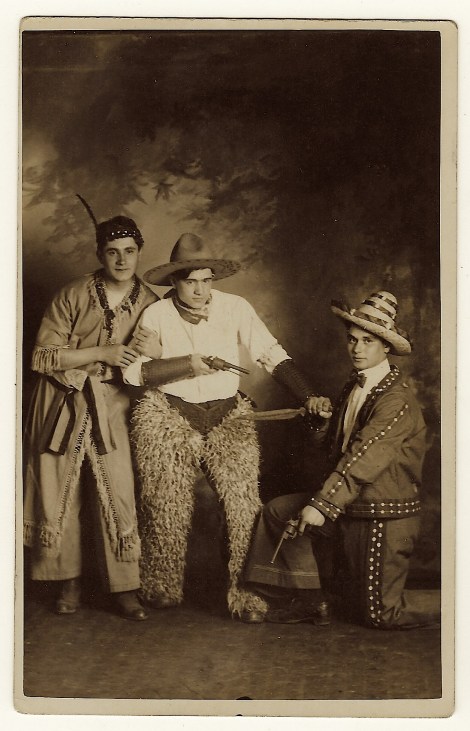
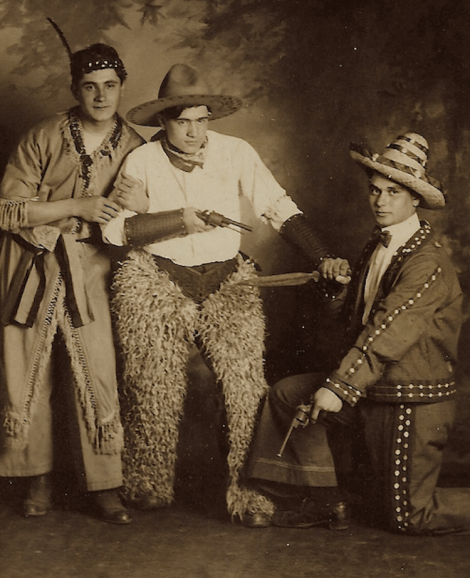
 This vintage real photo postcard features beautiful actress, Berthe Bady (1872-1921). She was born in Belgium but her nationality was French. Berthe Bady attended the Brussels Conservatory and was active on the stage between 1893 and 1913. She was a companion to both Lugne-Poe and Felix-Henri Bataille. Lugne-Poe was a French actor, theatrical director, and scenic designer. He and Bady were involved in symbolist movement of the arts. Bataille was a French dramatist and poet. A brief explanation of symbolism seems to be merited. In theatre, symbolism is a way to bring a greater meaning to something than is apparent at face value. The use of color, characters, movement, props and costumes are all methods of presenting symbolism. In 1897 Bady was the subject of a portrait by Toulouse Lautrec and her death was the subject of a poem by a leading French poet, Louis Aragon. In addition, playwright Fernand Crommelynck dedicated a play to her. Wikipedia credits her with sixteen “notable” play appearances between 1893 and 1913. She appeared in Ibsen’s “The Master Builder” on an international tour. The tour took her to London, Brussels, Amsterdam, Milan, and additional cities. In 1918 she appeared in her one and only film, “Ecce Homo”. This photo of Miss Bady was taken by the studio of Boyer & Bert. Paul Boyer (1861-1908) operated his studio in Paris. He was very talented and won many awards. He produced many portraits of theater performers as well as other celebrities. This postcard was published by F. C. & C. (Frederick Charles Cooper. The firm was located in Eastbourne, England. It was published circa 1905.This portrait postcard is in very good condition (see scans).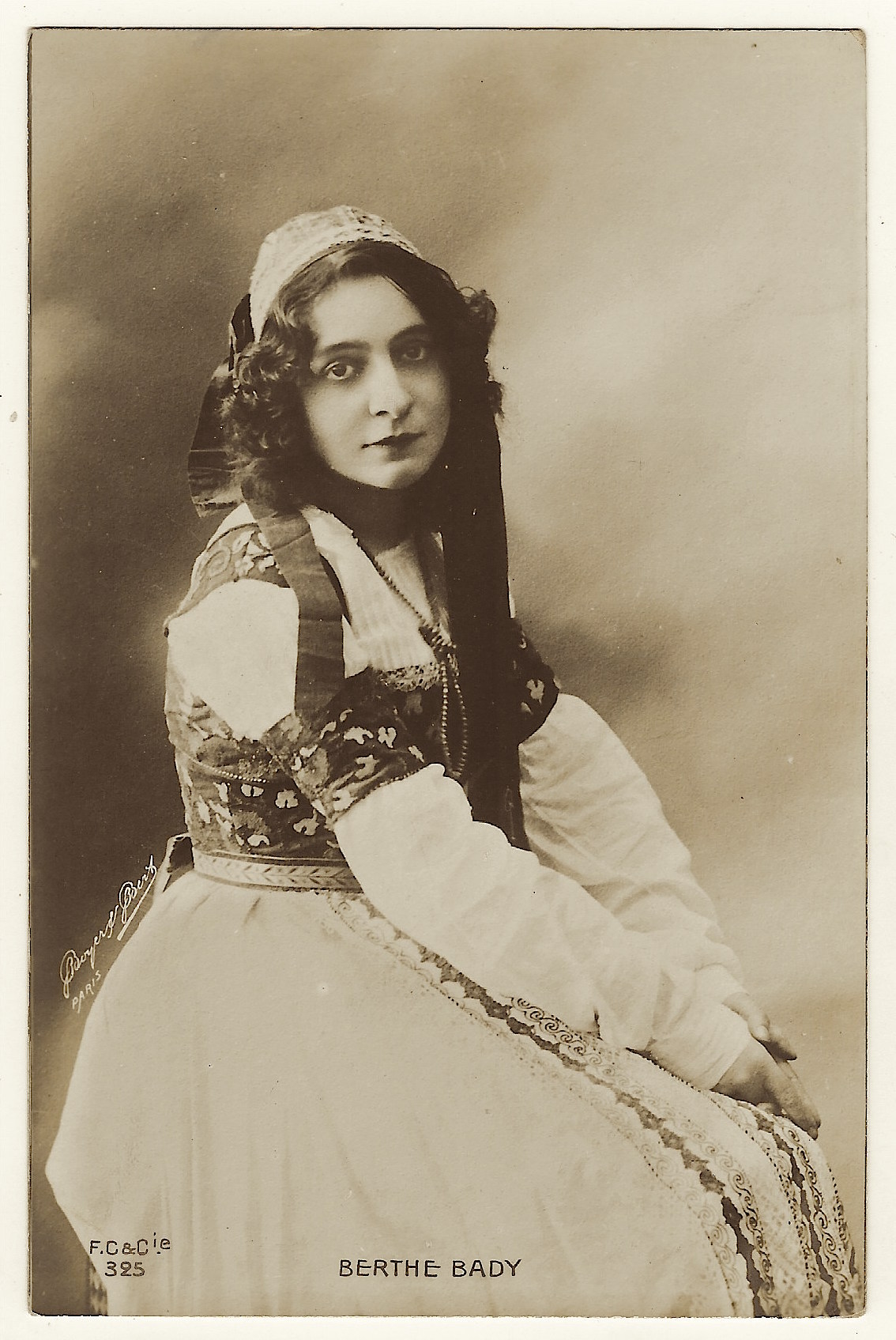




 THE CABINET CARD GALLERY