A pretty woman, wearing a fashionable, but unusual dress, poses for a photographer named Joseph G. Morris, in Pittsburgh, Pennsylvania. The studio was located at 16 Sixth Street, in Pittsburgh. She is wearing a collar pin. On the reverse of the photograph is the handwritten name, “Hillz”. One imagines that Hillz is the last name of the subject of this photograph. United States census data reveals some biographical information about the photographer of this cabinet card. Morris was located in the 1880 census. Morris was about 29 years old and he and his father (David Morris) were both working as photographer agents. In 1900, Morris and his 18 year old son, Harry, were boarders, and the older Morris was working as a photographer while the younger Morris was employed s a photographer apprentice. The 1910 U.S. Census finds Morris still working as a photographer and living with his wife, Mary P. Morris. SOLD
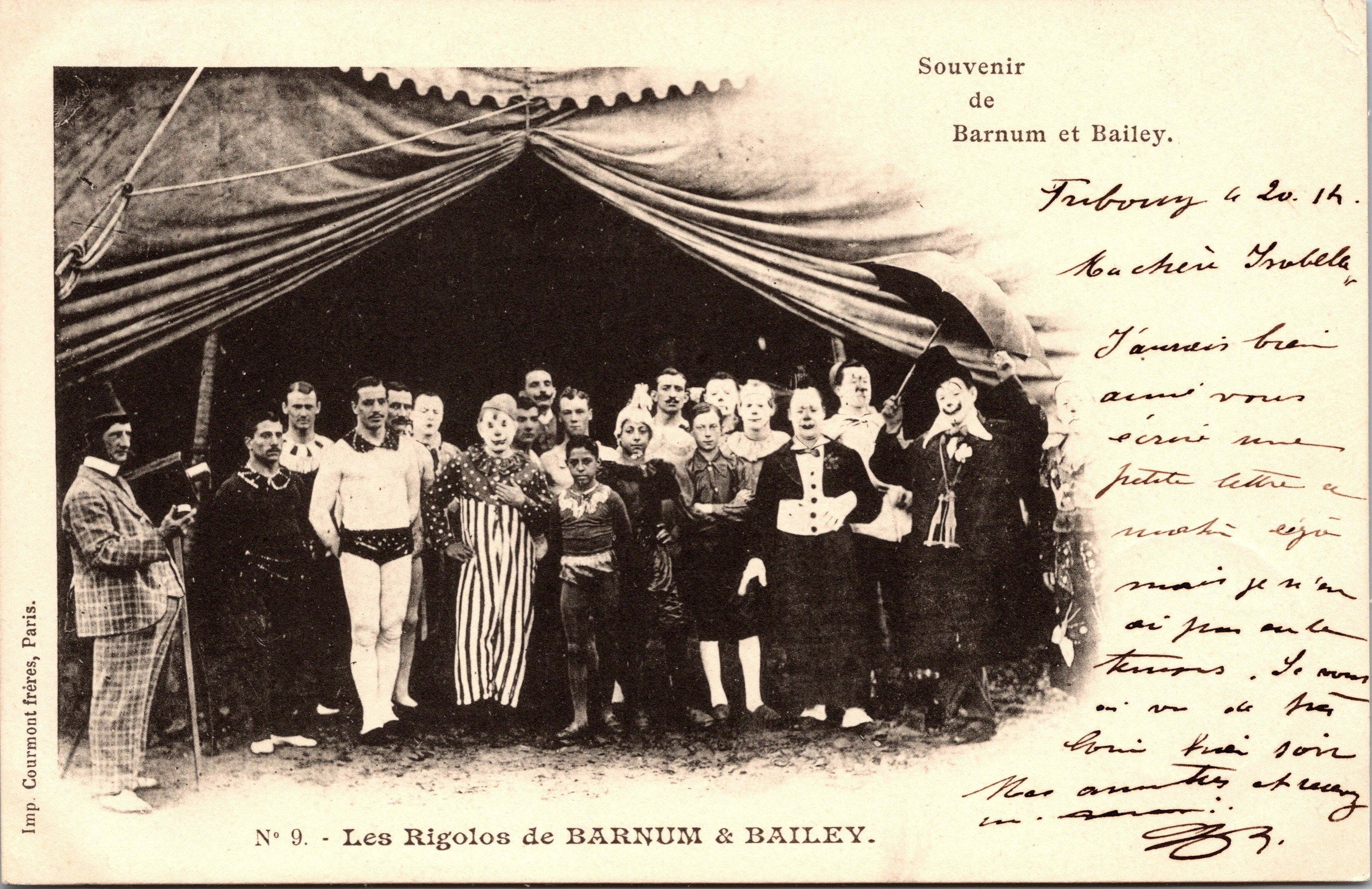
This undivided back his vintage real photo postcard features performers of the Barnum & Bailey Circus. A large group of clowns and acrobats stand under the Big Top for this group photograph.The postcard was souvenir of the cirucs and was published by Courmont freres of Paris, France. The postcard was postmarked in Romont and Fribourg, Switzerland, in 1902. The card has a Swiss stamp. This postcard is in excellent condition (see scans). SOLD
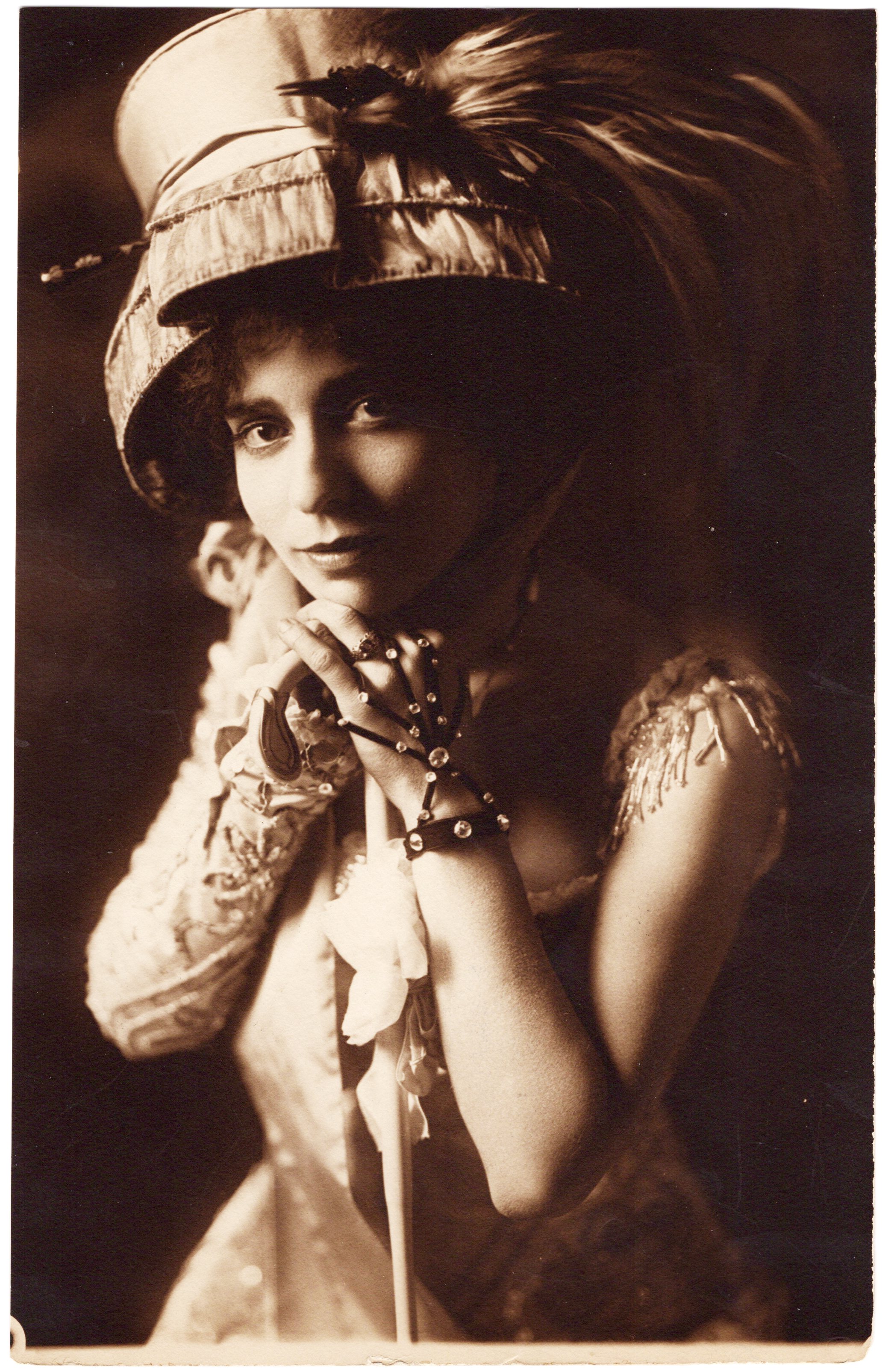
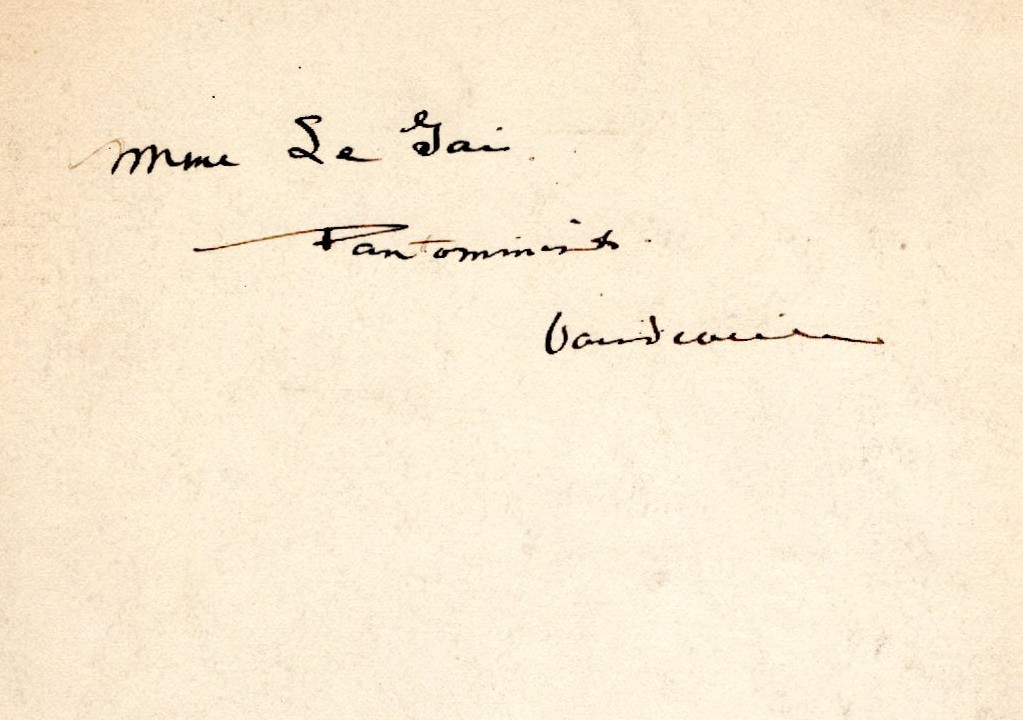
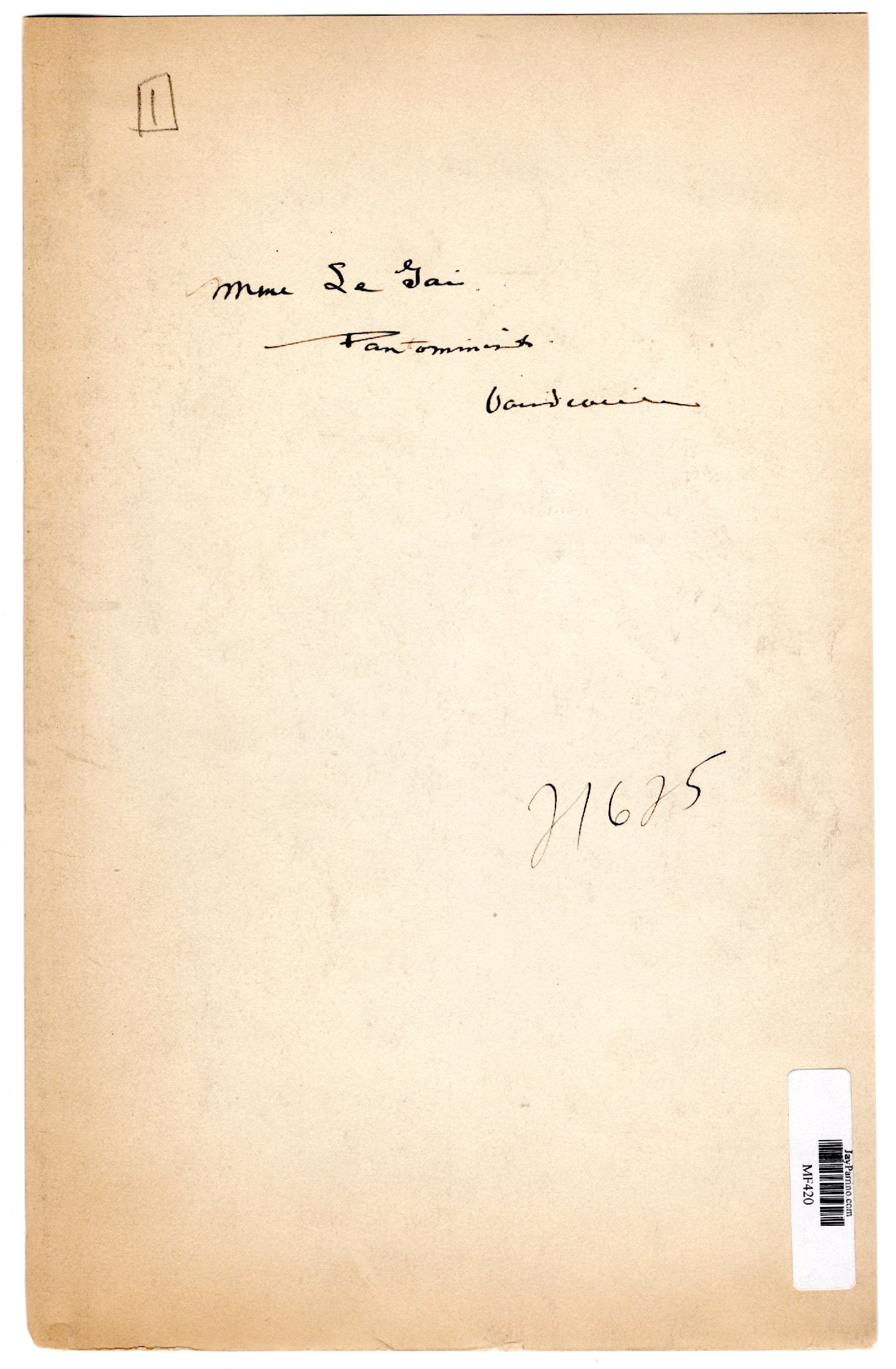
This is a stunning and rare sepia-tone glamour portrait of a woman identified as Mme Le Gai, described on the reverse as a “Pantomimist” and “Vaudevillian.” Believed to date from around 1918, this photograph showcases an elegant, mysterious woman in elaborate costume—perhaps a stage or cabaret performer—gazing confidently into the camera. She wears a richly adorned hat with plumes, a beaded glove-like bracelet, and a delicately embroidered gown with satin and lace textures. Her theatrical pose and sensual expression make this image a prime example of early Hollywood pin-up photography, though its style is also heavily influenced by European cabaret traditions. The handwritten inscription on the back appears to read: “Mme Le Gai / Pantomimist / Vaudevillian.” There is some ambiguity—“Mme” could stand for Madame or Mademoiselle, and the surname may also be interpreted as Le Gai or Le Gaï. The elegant script suggests a deliberate stage name, possibly borrowed from the famed Parisian pantomime houses of the same name. “Le Gai” (French for “the merry” or “joyful”) was also used in naming French performance venues such as Le Théâtre Gai or variations like Le Gai Paris. This connection strengthens the possibility that the subject either performed in or took inspiration from these Parisian theatrical traditions. Though solid biographical confirmation of Mme Le Gai has not yet been found, the visual evidence, style, and inscription point to her role as a vaudeville-era pantomime performer, likely active in the United States or France around World War I. Her alluring presence and costume are consistent with the kind of studio portraiture used for performer promotion, possibly circulated as publicity or collectible pin-up material during the silent film and vaudeville boom. (SOLD)
This vintage real photo postcard was mailed in 1903 and features Miss Alex, a lesser known actress or dancer of the Belle Epoque era. She was quite pretty. Many entertainers such as Miss Alex, were more or less prostitutes or “kept women”. Certainly, not all of these women were involved in such a lifestyle, and it is unknown how Miss Alex supported herself. The “Ambassadeurs”, a Paris music hall, is printed on the top right hand corner of the front of the postcard. Miss Alex was probably part of the Ambassadeur’s company of entertainers. This portrait postcard was photographed by Lucien Walery. He was a celebrated Paris photographer known for his portraits of artists and cabaret dancers from the city’s music halls. He is very well known for his portraits of Mata Hari and Josephine Baker. Walery did a lot of work in the genre of nude/erotic photography. He photographed the beautiful women of Paris between the early 1900’s and the 1920’s. This “risque” postcard is part of the Etoile 11 series. SOLD
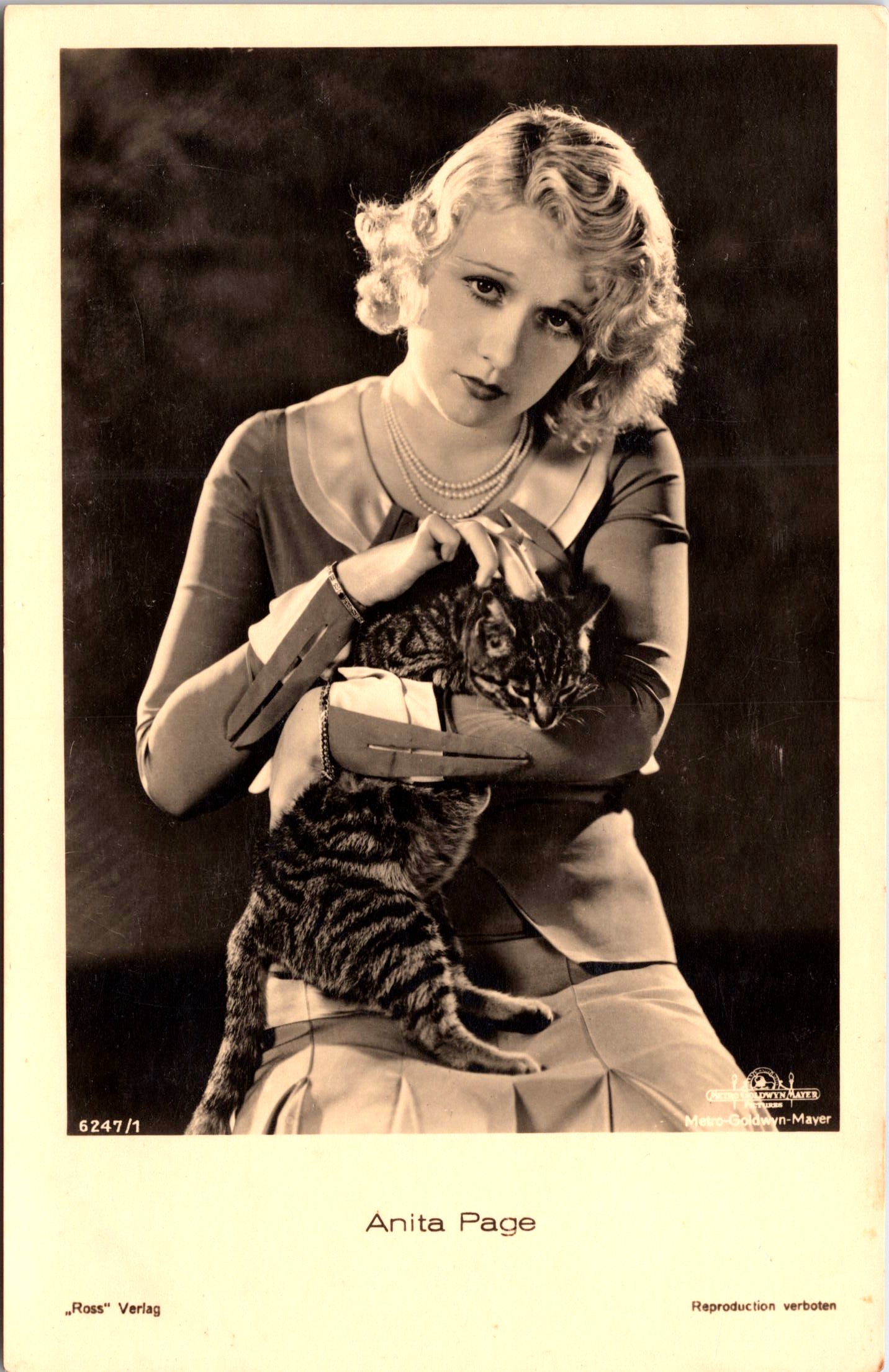
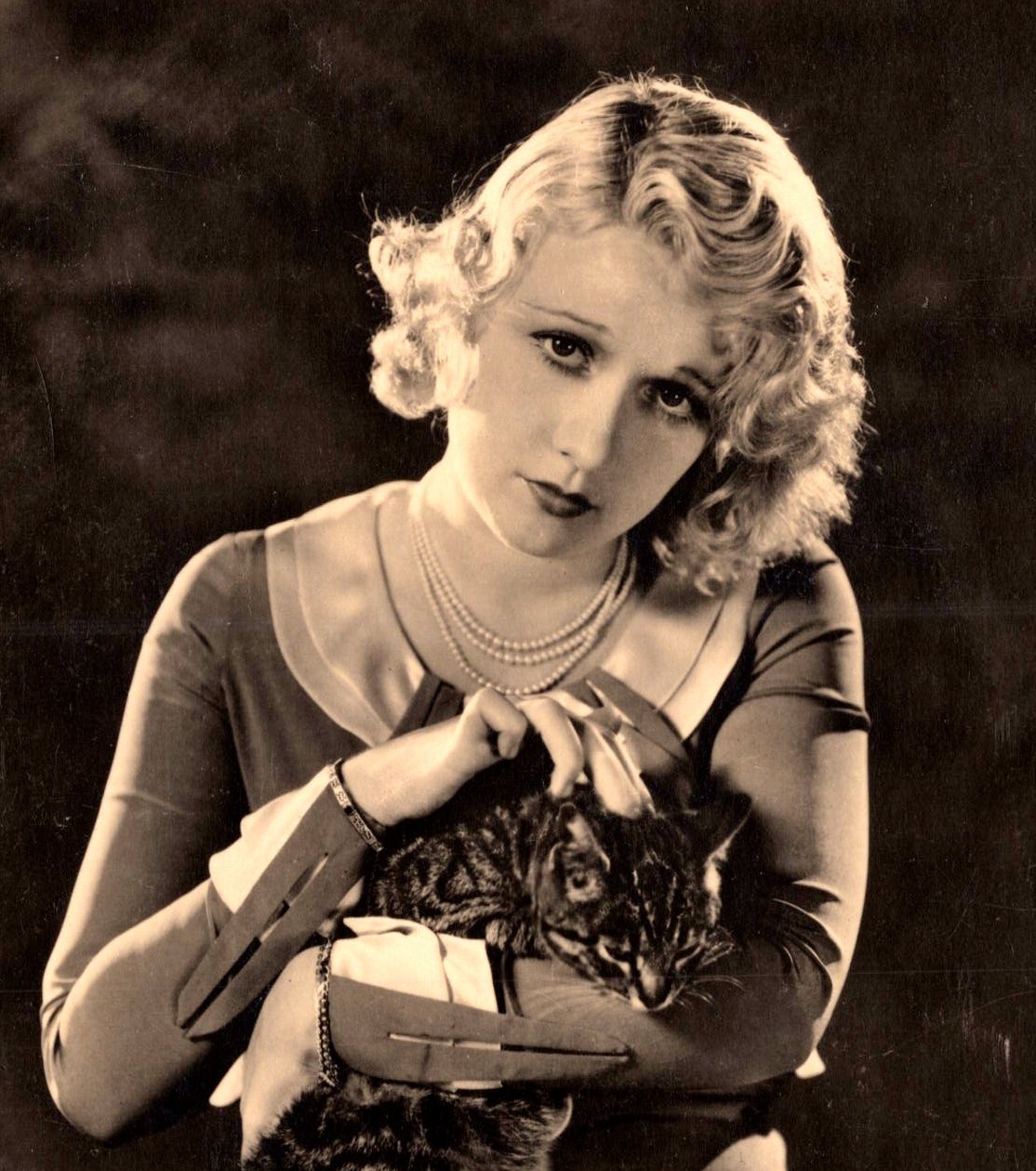
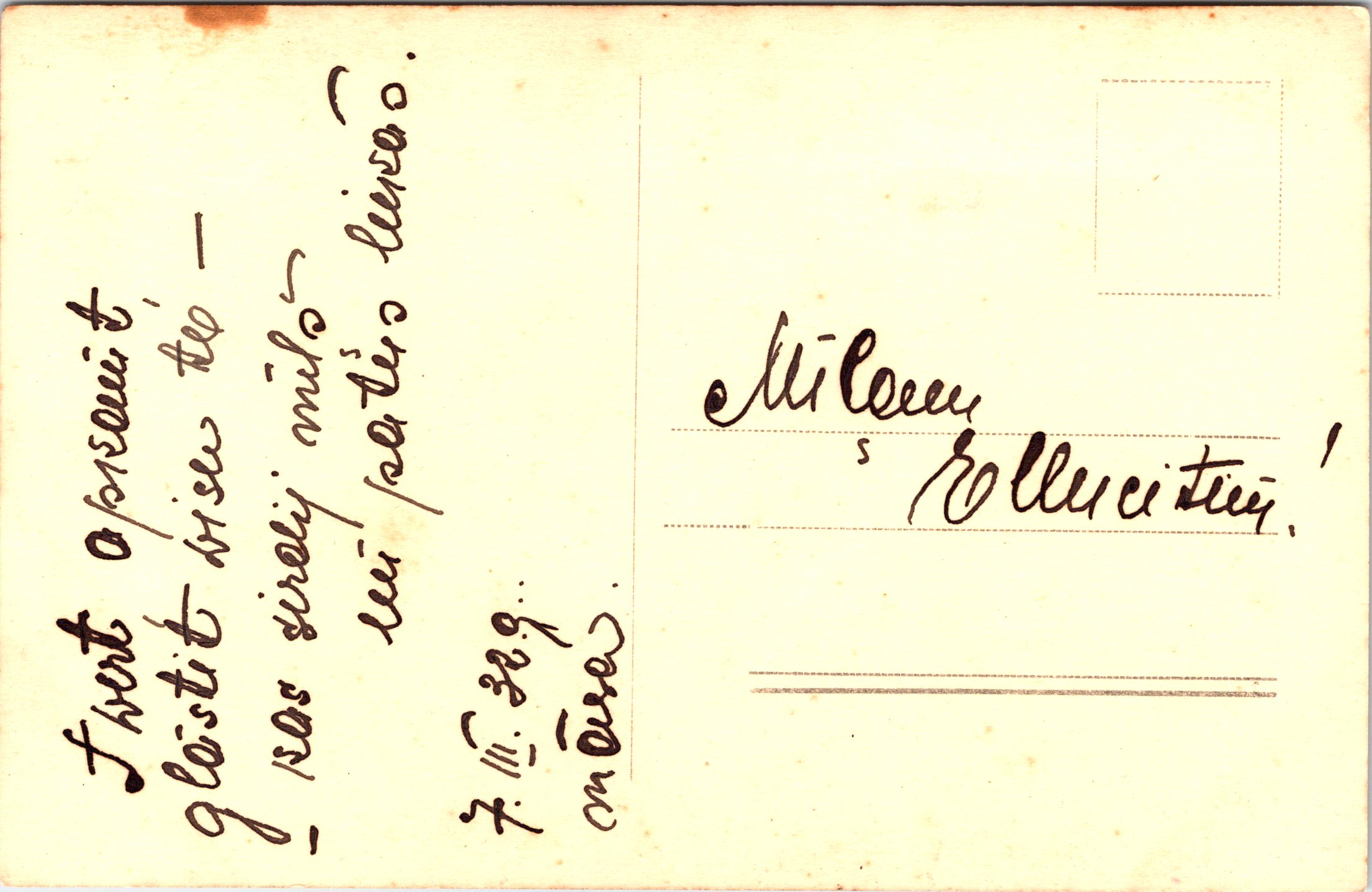
This sepia-toned publicity postcard features Anita Page (1910-2008), an iconic silent and early sound film actress, posing with a tabby cat. She cradles the cat gently in her lap, both arms encircling it protectively. The cat appears calm, eyes half-closed in contentment or sleep, nestled into Page’s arms. Anita is styled with soft, sculpted blonde curls typical of late 1920s-early 1930s glamour. She wears a tailored dress or top with a broad, satin-trimmed collar and decorative slashes on the cuffs, along with a double-stranded pearl necklace and a bracelet on one wrist. Her expression is wistful—perhaps intentionally melancholy or dreamy—a popular aesthetic in studio portraits of the era. Her makeup emphasizes the eyes with dark liner and curved brows, enhancing her expressive gaze. The presence of the cat lends the portrait an intimate and slightly whimsical tone, softening the glamorous studio setting and humanizing the star. It was not uncommon for stars to be photographed with animals to add charm or relatability. The publisher of this postcard is Ross Verlag, a German company based in Berlin. The card is identified as (No.6247/1). The circular logo in the bottom right corner of the card belongs to Metro-Goldwyn-Mayer (MGM), the major Hollywood studio with which Anita Page was under contract. The message on the reverse of the card is written in Czech (or possibly Slovak). A rough translation reads: “Your devoted, Wishes you everything good – Your dear Miloš, I send you this card for memory. The card is dated 1929. Anita Page was a major screen star in the late 1920s and early 1930s, often called “the girl with the most beautiful face in Hollywood.” She rose to fame starring alongside Joan Crawford in Our Dancing Daughters (1928) and appeared in The Broadway Melody (1929), which won the Academy Award for Best Picture. She retired young in the 1930s but returned sporadically to the screen in later years. She was one of the last surviving stars of the silent film era. (SOLD)
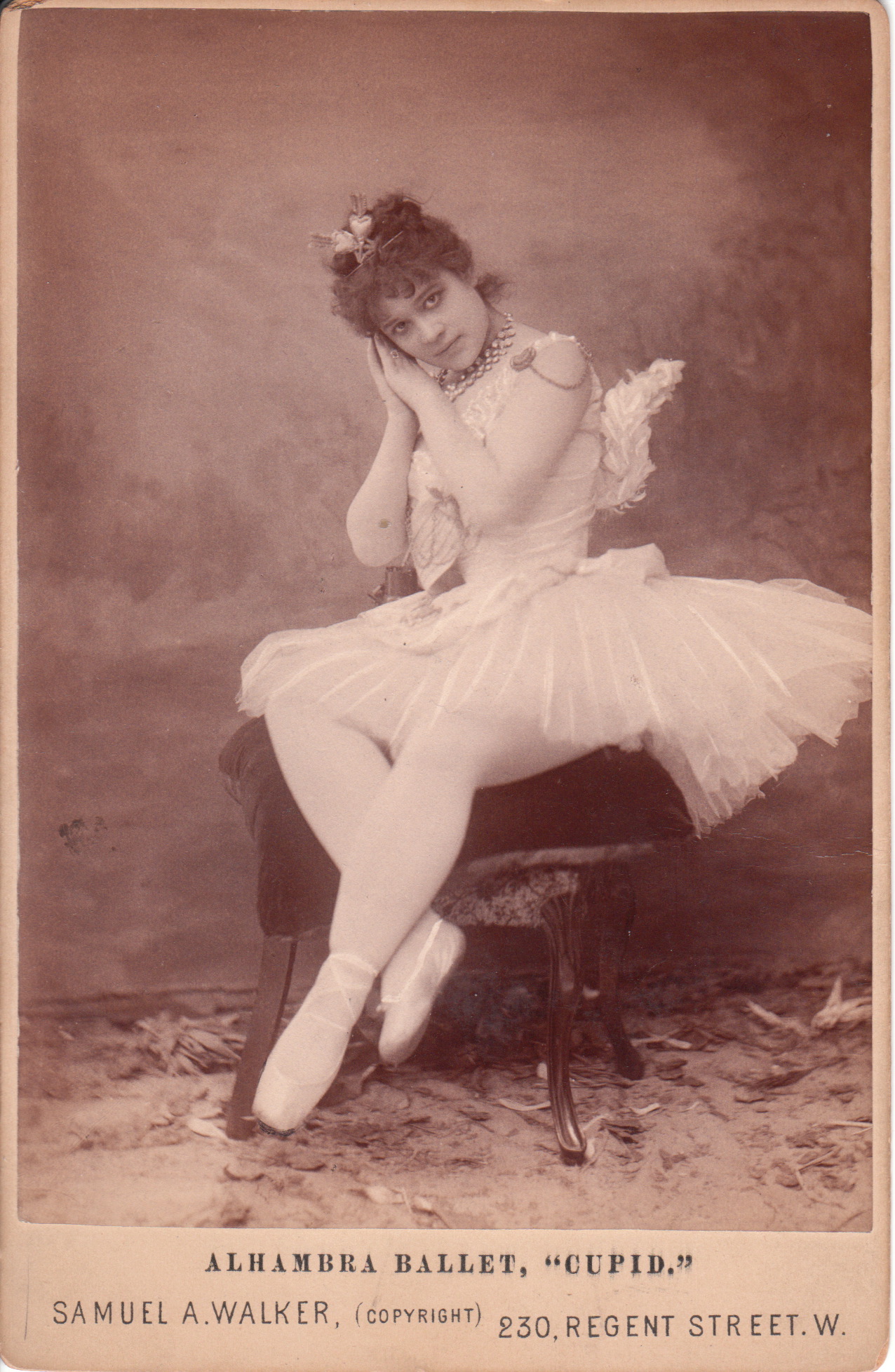
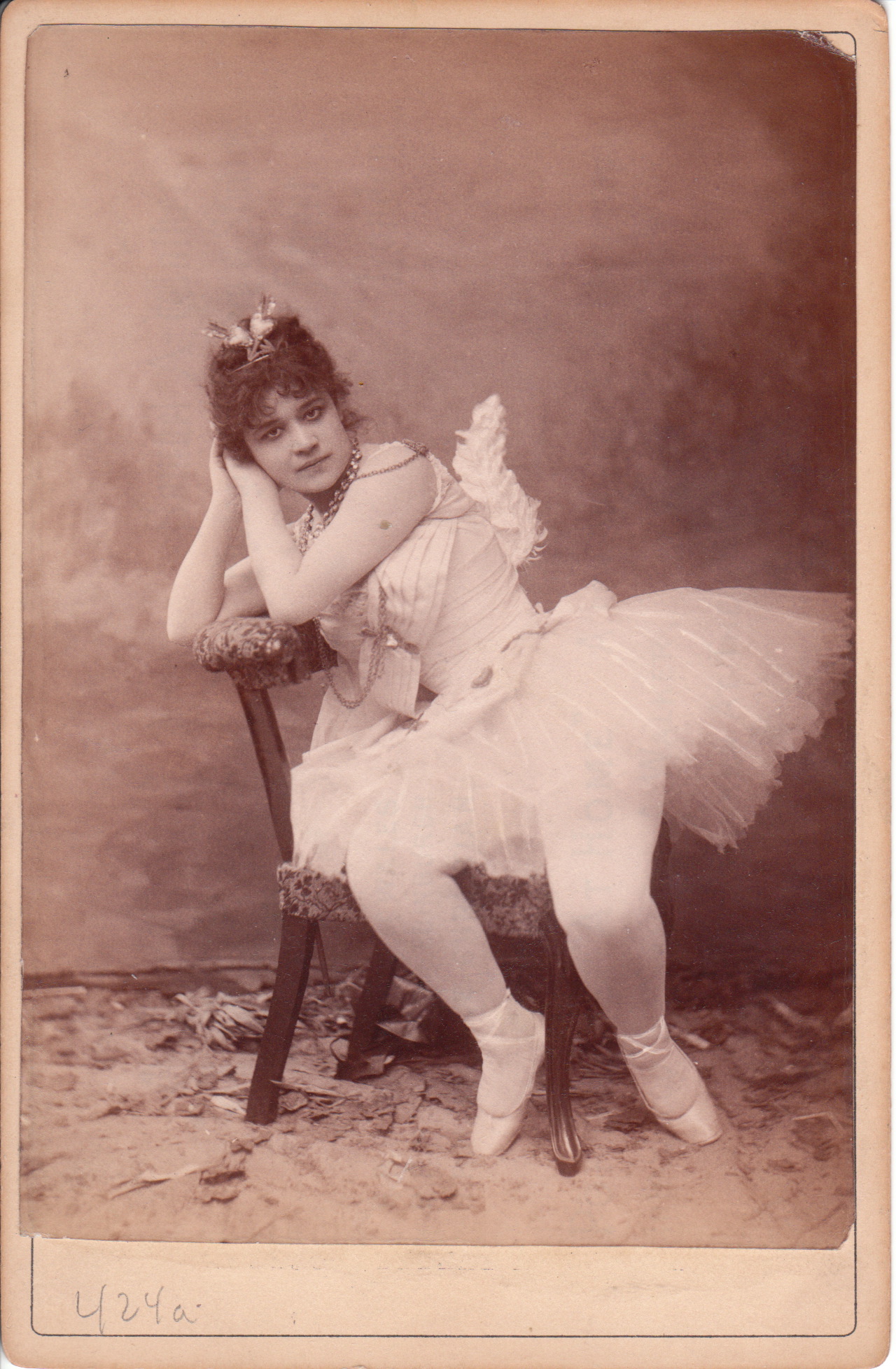
This cabinet card is quite unusual in that it has photographic images on both sides of the card. A very pretty ballet dancer is from the Alhambra Ballet production of Cupid is pictured in each image. In one photograph her legs are crossed while in the second photograph her legs are open and her undergarment is visible through her transparent tutu. The cabinet card is risque for it’s era. The Alhambra was a theatre in London, England. It was opened in 1854 as “The Royal Panopticon”. A circus ring was added and it was reopened in 1858 as the Alhambra. The theatre stage hosted music hall acts, aerial acts, ballet, light opera, and other events. The theatre was closed and demolished in 1936. This cabinet card features a dancer from the ballet, Cupid which opened at the Alhambra on 5/24/1886. The principal dancer in this production was Emma Bessone, and research reveals that the ballerina in this image is likely Emma Bessone. She was an Italian dancer who trained at La Scala and became prima ballerina for both the Maryinsky and Bolshoi companies in Russia. The photographer of this cabinet card was Samuel A. Walker whose studio was located in London. SOLD
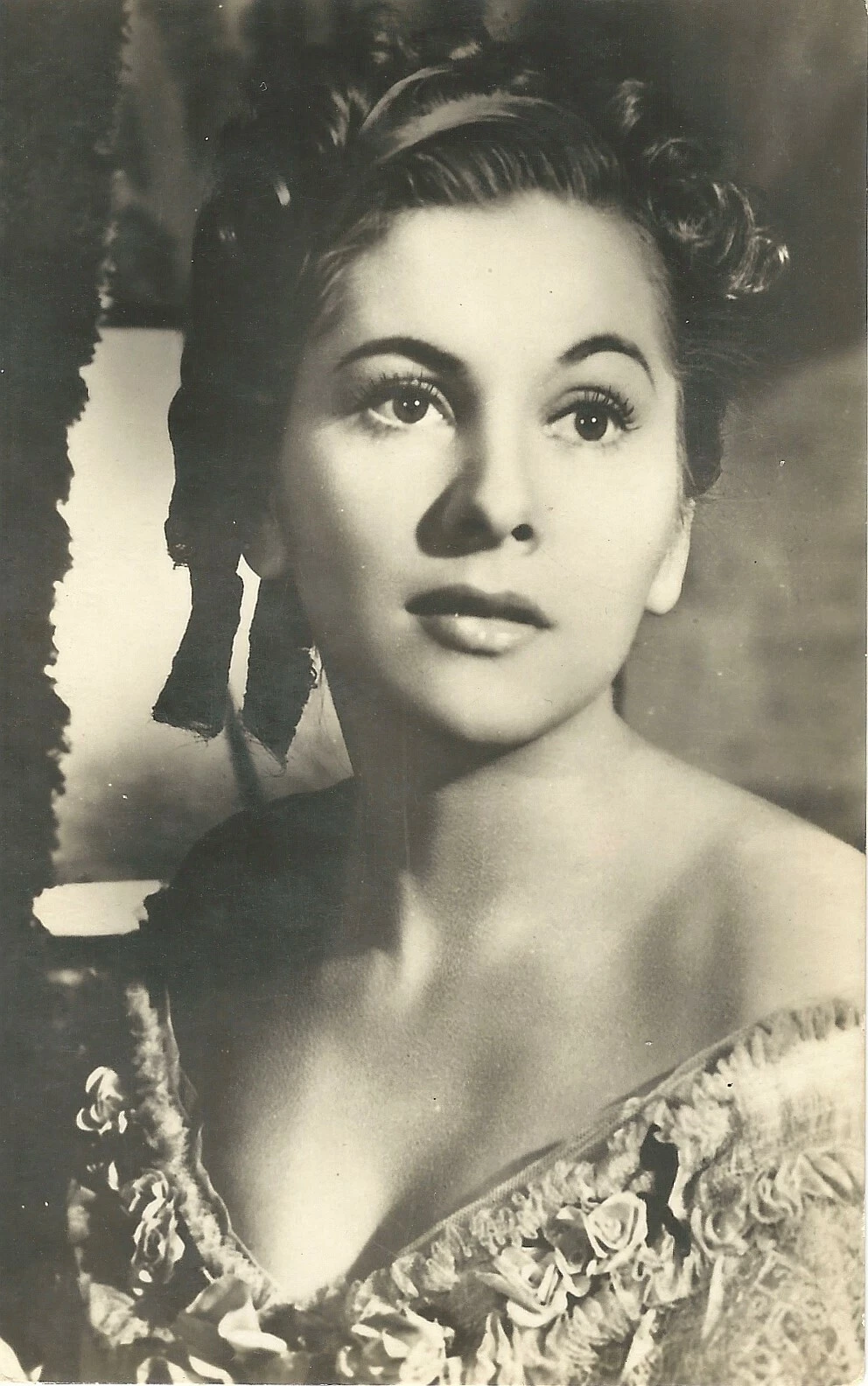
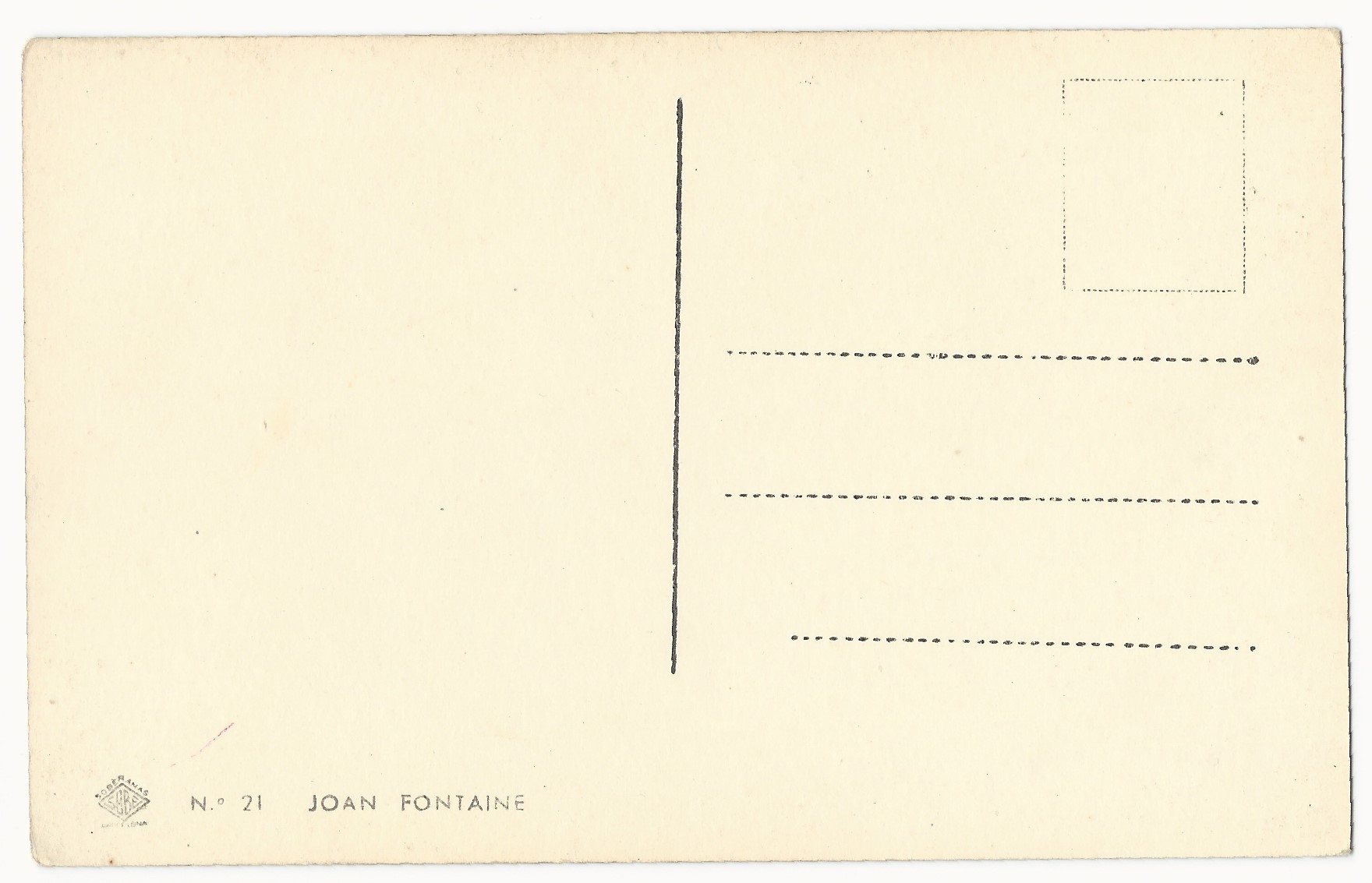
This vintage real photo postcard features a lovely portrait of Joan Fontaine (1917-2013). She was a British-American actress known for her starring roles during the Golden Age of Hollywood. She acted in more than 50 films and her career had a five decade duration. Fontaine’s older sister was the actress Olivia de Haviland, and the pair had a rivalry well covered by the press. In 1942, the sisters were both nominated for the Academy Awards “Best Actress” title. Joan won and reportedly rejected her sister’s congratulations. In commenting about their rivalry, Fontaine stated that she had both married and won an Oscar before her sister, and that she had little doubt that “if I die first, she’ll undoubtedly be livid because I beat her to it!”. Their competitive relationship began early. At the age of nine, sister Olivia wrote a will in which she stated, “I bequeath all my beauty to my younger sister Joan, since she has none”. Joan’s film career began in 1935. She was working for RKO pictures. Her first major role was in the film, “The Man Who Found Himself (1937). Also in 1937, she appeared alongside Fred Astaire in “A Damsel in Distress”. She followed that appearance with the female lead in “Gunga Din” (1939). The film was based on the work of Rudyard Kipling and it was an exciting adventure film. Some contemporary critics compare it to “Raiders of the Lost Ark” (1981). I recently viewed “Gunga Din” and it was an exciting film, but it unfortunately glorified colonialism. In 1940 Joan’s career was propelled by her appearance in Alfred Hitchcock’s “Rebecca”. This role resulted in an Academy Award nomination for “Best Actress”. In 1941 she won the “Best Actress” award for her appearance in Hitchcock’s “Suspicion”. In 1943 she received her third “Best Actress” nomination. Much of her acting in the 1940’s involved drama films. During the war, she worked on a limited basis as a nurse’s aide. In 1946, Fontaine established her own film company with her husband, William Dozier. The company was named Rampart Productions and she appeared in a number of the company’s films. In the early 1950’s her film career began to dwindle. She then took her talent to stage, radio, and television roles. She appeared in two Broadway theater productions (1955 and 1970). Her final film appearance was in 1966. She continued to act until 1994. Now, for some biographical facts. Fontaine was born in Tokyo, Japan, to English parents. Her father was an English professor and later became a patent attorney. Her mother was a stage actress until she moved with her husband to Tokyo. Her mom did return to the stage after her daughters became successful in the 1940’s. Fontaine’s parents separated in 1914, when Joan was just two years-old. It seems that Fontaine’s father enjoyed intimate relationships with some of the geishas of Tokyo. Joan’s mother decided to move with her two daughters to the United States on the advice of a doctor. Joan was a “sickly” child and a change of climate was advised. The family settled in California and Joan’s health normalized. Joan was married and divorced four times. Her first two marriages were to actors, the third was to a producer/writer, and the fourth to the golf editor at “Sports Illustrated”. She had personal relationships with Harry Belafonte and Presidential candidate, Adlai Stevenson. Fontaine was a citizen of both the United States and Great Britain. She had a pilot’s license, was an expert rider, and was an accomplished interior decorator and chef. In fact, she excelled at too many things to mention in this description. This vintage portrait postcard was published by Soberanas as part of a series (no.21). SOLD
The pretty actress featured in this vintage real photo postcard is film actress Marie Prevost (1896-1937). She was born in Canada and during her twenty-year career, she made 121 silent and talking movies. She was originally “discovered” by Mack Sennett who inked her to a film contract after she played a bit part in one of his movies. She was only on the set (Keystone Studios) because she was running an errand for the law firm where she was employed as a secretary. She became one of his Bathing Beauties in the late 1910’s. She appeared in dozens of Sennett’s short comedy films. Her first lead role was for Sennett in “Yankee Doodle in Berlin” (1919). She than began to make feature length films for Universal Studios, where she signed for $1,000.00 a week. In 1922 she moved to Warner Brothers where she became one of the studio’s leading ladies (her contract was for $1,500.00 per week). Her movie roles at Warner included “The Beautiful and Damned” (1922), “The Marriage Circle” (1924), and “Kiss Me Again” (1925). Warner Brothers dropped her in 1926 and her career began to diminish as she was offered primarily secondary roles. Her personal life also began to decline, if not plummet. Her mother died in 1926 and her second marriage, to actor Kenneth Harlan, fell apart in 1927. She became very depressed and her symptoms included alcohol abuse and binge eating. In 1928 she was cast in “The Racket” which was directed by Howard Hughes. The pair had a brief affair and when it ended, Prevost fell into an even deeper depression. It became increasingly difficult for her to obtain parts in films and her last film role was in 1936. At the age of 38, Marie Prevost died from acute alcoholism and malnutrition. Her estate was worth just three hundred dollars and her death helped prompt the creation of the Motion Picture & Television Country House and Hospital. The details of Prevost’s death have become a bit of Hollywood legend. She was found in her apartment two days after her death. Also at death scene were empty bottles of alcohol, a promissory note to Joan Crawford, and Prevost’s pet dachshund. She was discovered because neighbors had complained about her dog’s continued barking. The legend claims that by the time she was found, her corpse was half-eaten by Maxie, her dog. It was asserted that this of course was only because the dog was trying to awaken his deceased master. This story is not true, but it appeared in Kenneth Anger’s book “Hollywood Babylon” (1959) and in Nick Lowe’s song “Marie Provost” (1978). The lyrics from Lowe’s song include “She was the winner, That became the doggie’s dinner, She never meant that much to me, Woe, poor Marie”.
Postcard 1 was published by A.N. of Paris for Universal Films. It is part of as series entitled “Les Vedettes de Cinema” (The Stars of Cinema). This postcard is the first in the series (No. 1). SOLD
Arcade Card 1 This striking vintage arcade card features silent film star Marie Prevost, posed in an eye-catching beach setting as part of a Mack Sennett Comedies publicity series. The card is marked “Evans – L.A.”, identifying the work of a notable Hollywood photographer known for capturing many silent-era stars in playful and glamorous portraits that were mass-produced as postcards and arcade cards during the 1920s. Marie Prevost stands confidently on a wooden dock or boardwalk, with the sea or beach receding into the background. She is dressed in a bold, striped one-piece bathing costume, typical of the early 1920s, with black knee socks and classic lace-up shoes. She holds a whimsically oversized parasol — black and white with a bold pinwheel pattern — behind her shoulder, adding a splash of theatrical flair to the scene. Her expression is flirtatious and relaxed, with a subtle smile and a slight tilt of the head. A ribbon wraps around her short, styled hair, in keeping with the flapper aesthetic of the Jazz Age. At the bottom of the image, the words “Mack Sennett Comedies” are clearly printed, linking this photo to the famed Keystone-style slapstick studio that helped launch the careers of many silent film legends — including Marie Prevost. The signature “Evans – L.A.” refers to a Los Angeles-based photography studio active in the 1920s and 1930s that produced portraits of film stars for promotional use. Though not as well-documented as some Hollywood photographers, Evans specialized in theatrical and beach-themed photos of actresses for use in arcade cards, penny cards, and other mass-market prints that were sold in coin-operated machines or five-and-dime stores. These cards remain highly collectible today. This is a lithographed arcade card. SOLD
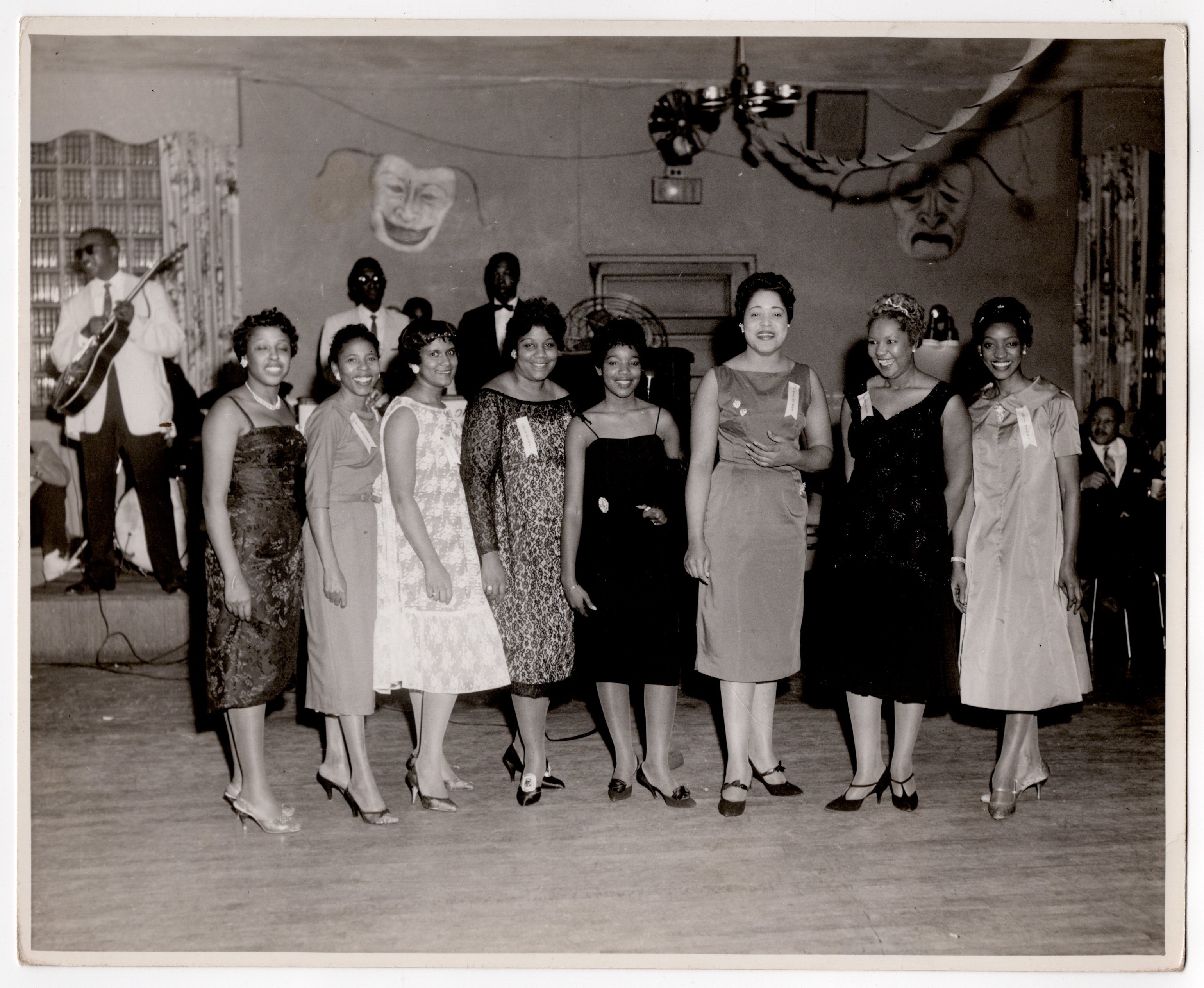
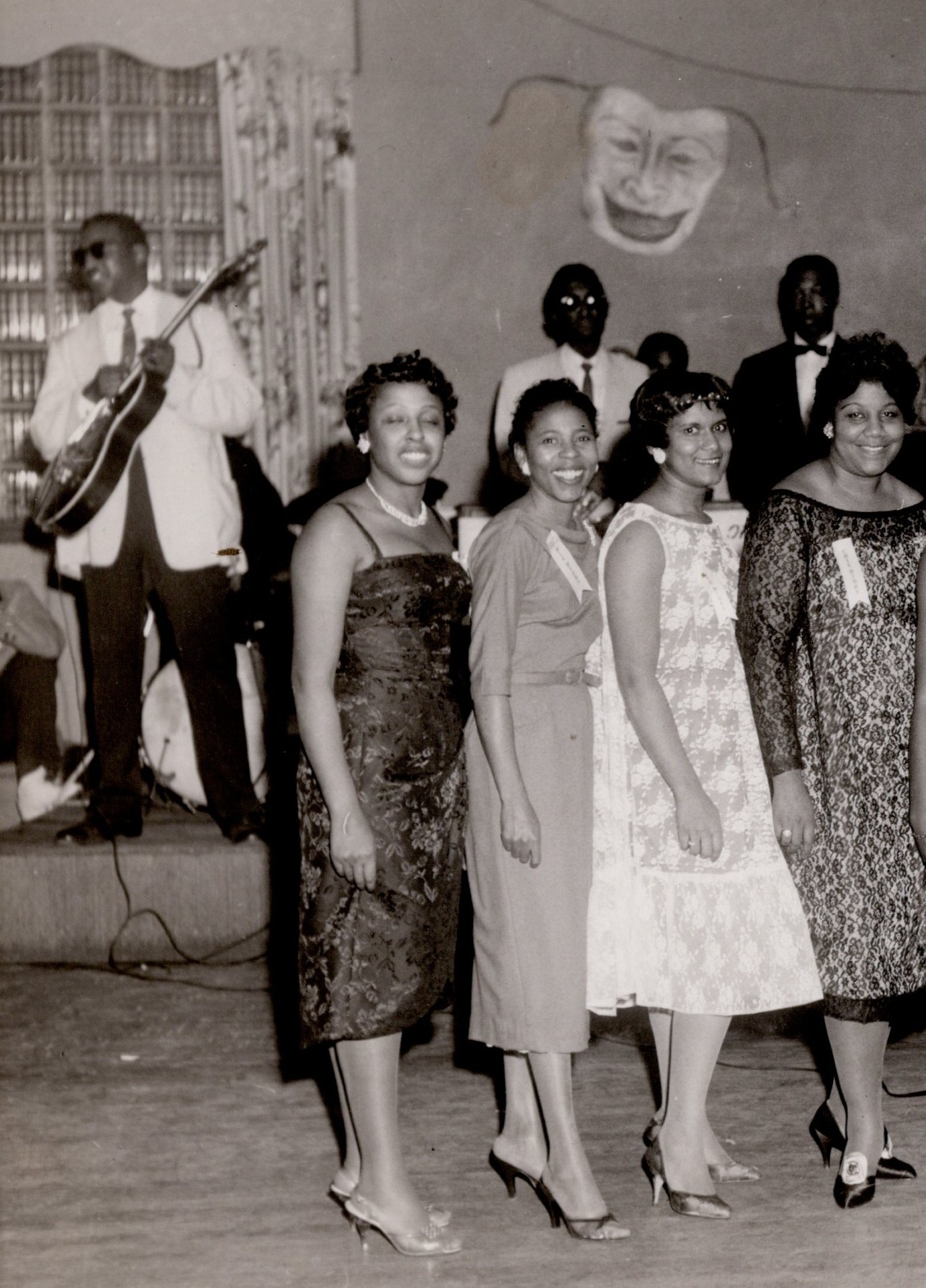
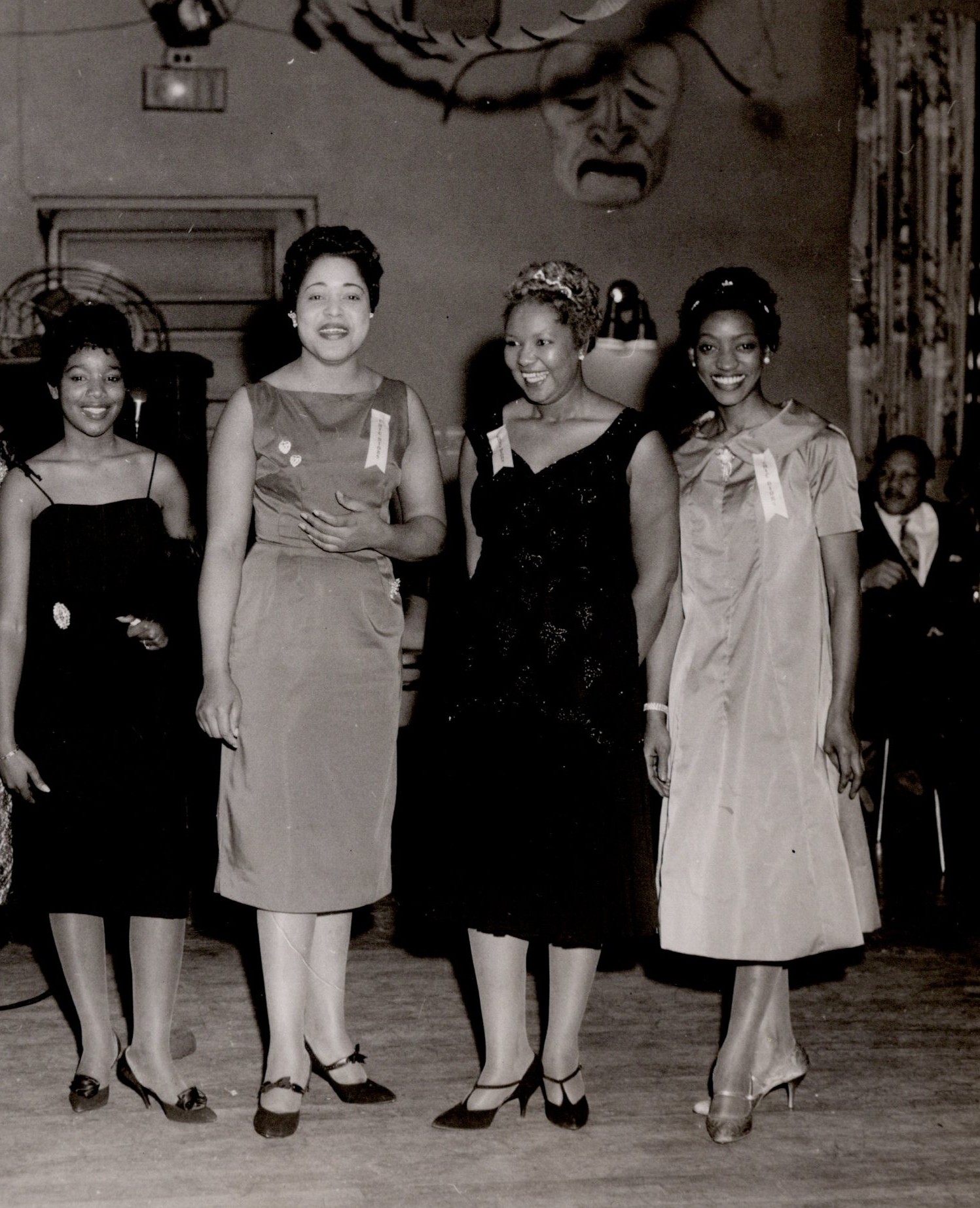
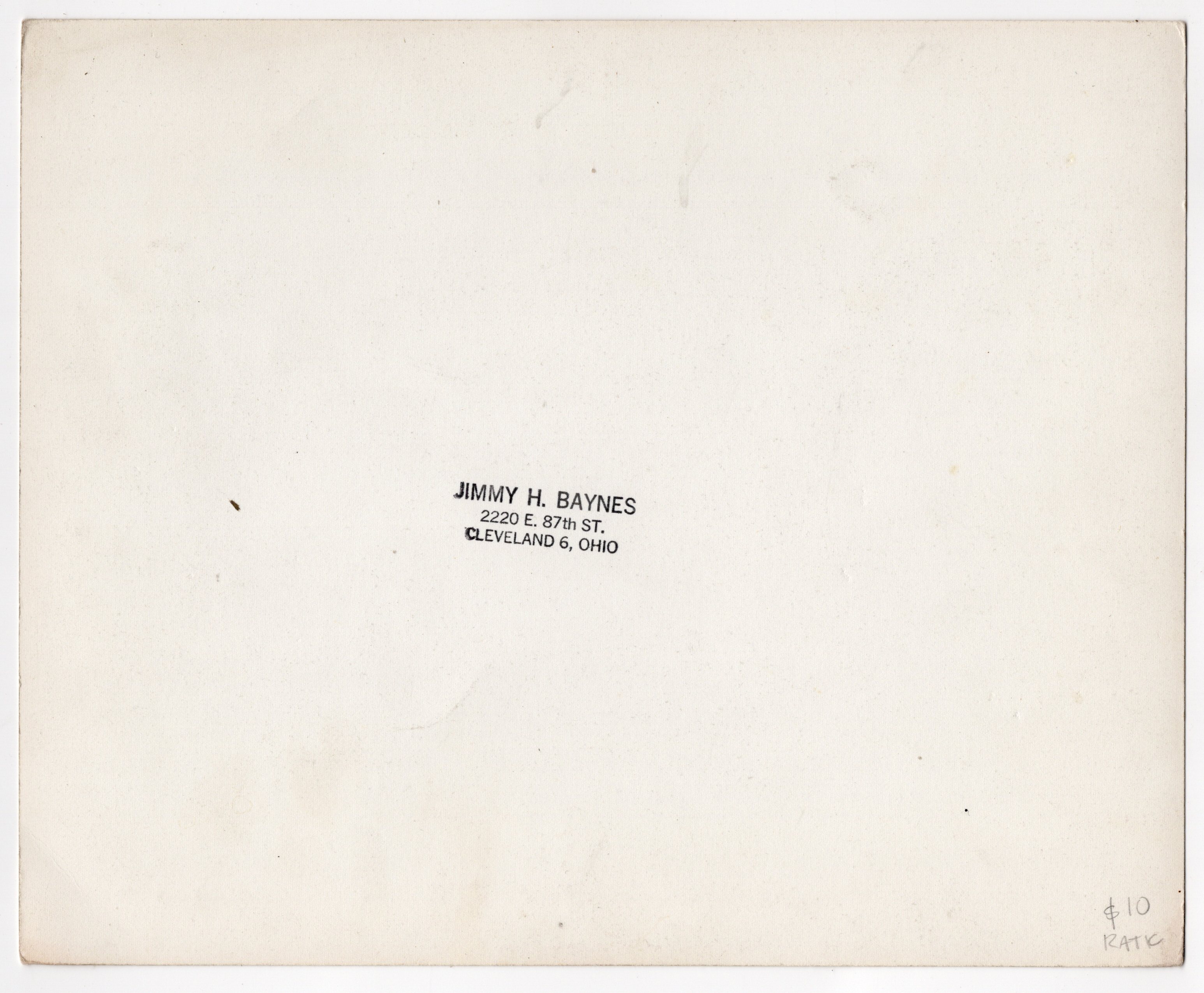
This dynamic vintage press photograph captures a joyous and stylish moment at what appears to be a mid-century African-American social event or pageant, photographed by Jimmy H. Baynes, a notable African-American photographer who was active in Cleveland, Ohio. The image dates likely to the late 1950s or early 1960s, an era when such gatherings were vital community affairs celebrating Black excellence, fashion, and music. The central focus is a beautifully posed group of eight African-American women, all elegantly dressed in cocktail or evening wear. Each woman wears a dress that reflects the fashion of the era—from sleek satin to lace, florals, and polished tailoring. Their heels, jewelry, and stylish hairdos speak to pride and sophistication. Several wear ribbons or corsages, suggesting this might be a pageant, cotillion, or civic recognition event. The women’s expressions range from warm smiles to dignified calm, exuding confidence and unity. In the background, we see a small jazz ensemble, including a guitarist in a white jacket and a saxophonist, adding to the lively, celebratory atmosphere. The wall décor includes two large theatrical masks (tragedy and comedy), enhancing the impression that this event took place at a community center, fraternal hall, or social club with cultural significance. The photograph is the work of Jimmy H. Baynes, a prominent African-American photographer who chronicled the Black social and cultural scene in Cleveland throughout the mid-20th century. His work often captured the heart of the community—beauty pageants, civic events, family milestones, and musical gatherings—preserving an important visual history that is increasingly recognized and appreciated by collectors and scholars. This original black-and-white photograph measures approximately 8 x 10 inches and is in very good condition with only minimal corner wear. The contrast is strong, the image is sharp, and all details are well preserved (see scans). The photographer of this photograph, Jimmy Baynes was known for his ability to capture the essence of African American life, culture, and entertainment from the 1950s through the 1980s. Originally a postal worker, Baynes pursued photography as a passion, ultimately founding Baynes Foto Service. His work chronicled the vibrancy of mid-century African American social life, from intimate gatherings and beauty contests to the pulsating energy of live music performances and political events. Baynes photographed some of the most iconic figures in entertainment history, including Aretha Franklin, Louis Armstrong, Count Basie, Mahalia Jackson, Louis Jordan, Jerry Lee Lewis, the Platters, and the Drifters. His ability to capture both candid and staged moments gave his work a lasting impact, preserving the rich history of Cleveland’s African American community. His legacy is recognized today by institutions such as the Rock and Roll Hall of Fame and Museum Library and Archives in Cleveland, which houses a collection of his photographs, primarily focusing on music and entertainment. In 2010, shortly before his passing, his work was featured in the “Polaroid: Instant Joy” exhibition in Brooklyn, New York, reaffirming his role as a visual storyteller of African American life in the mid-20th century. This photograph was taken in the 1950’s. SOLD
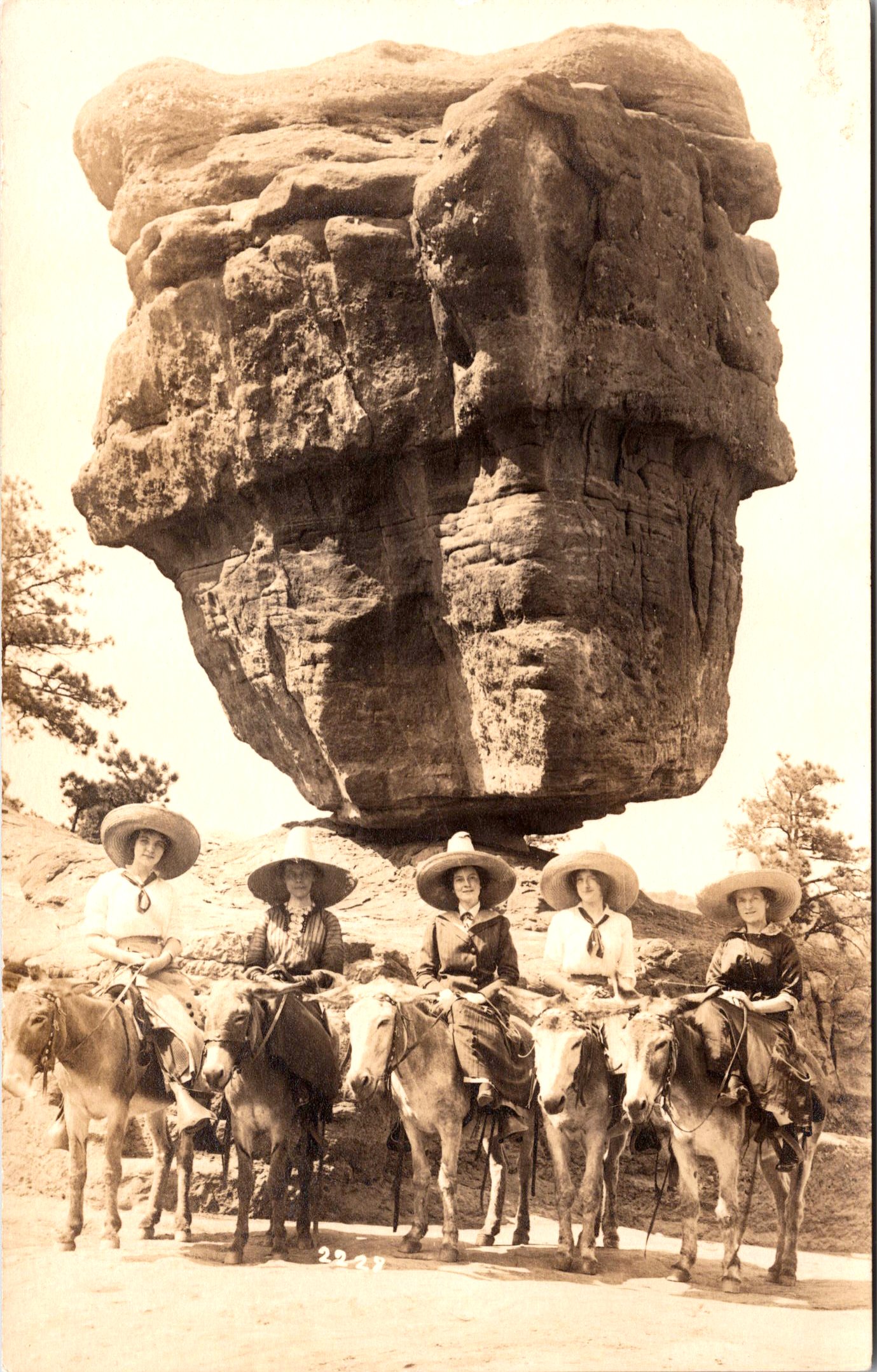
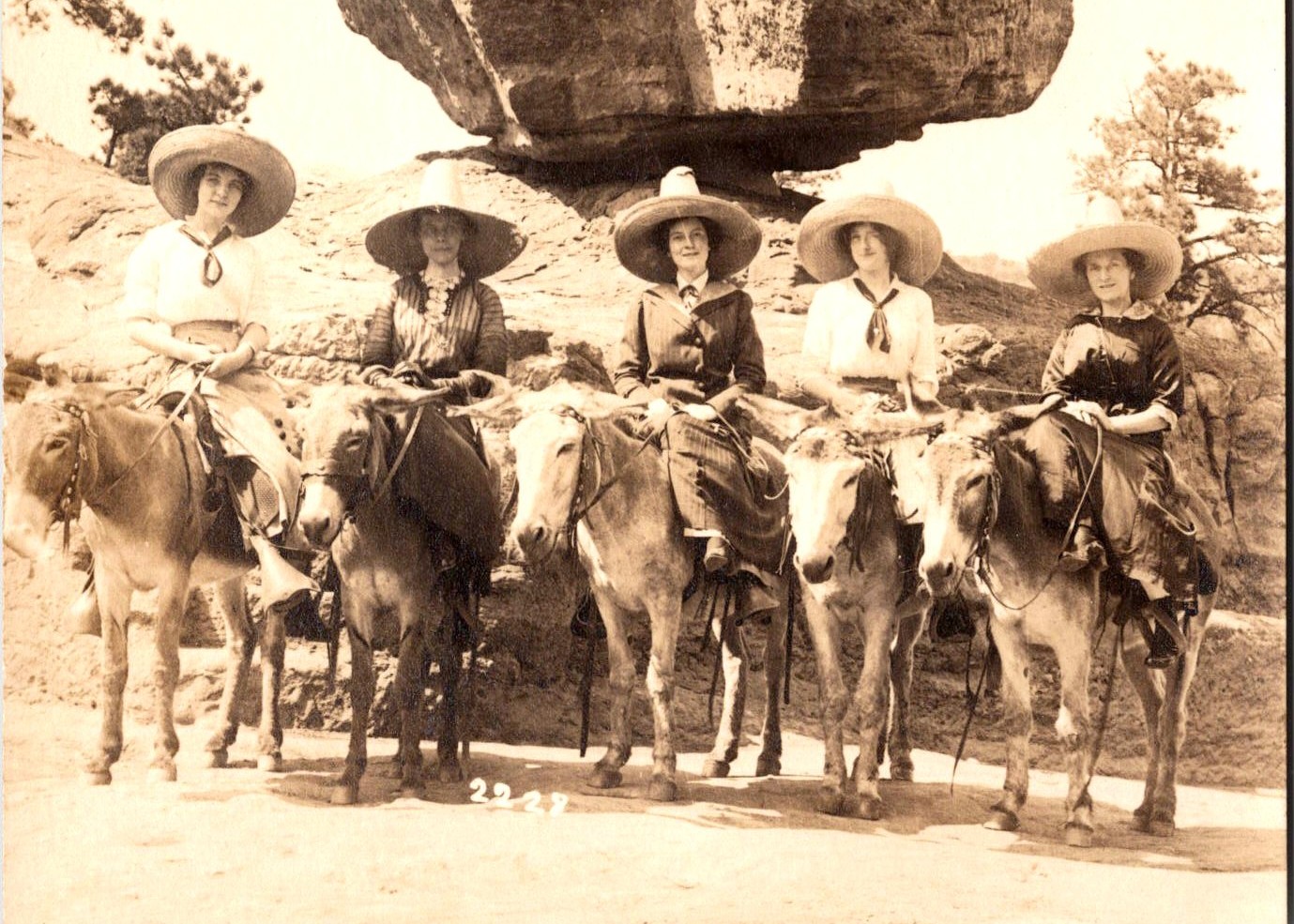
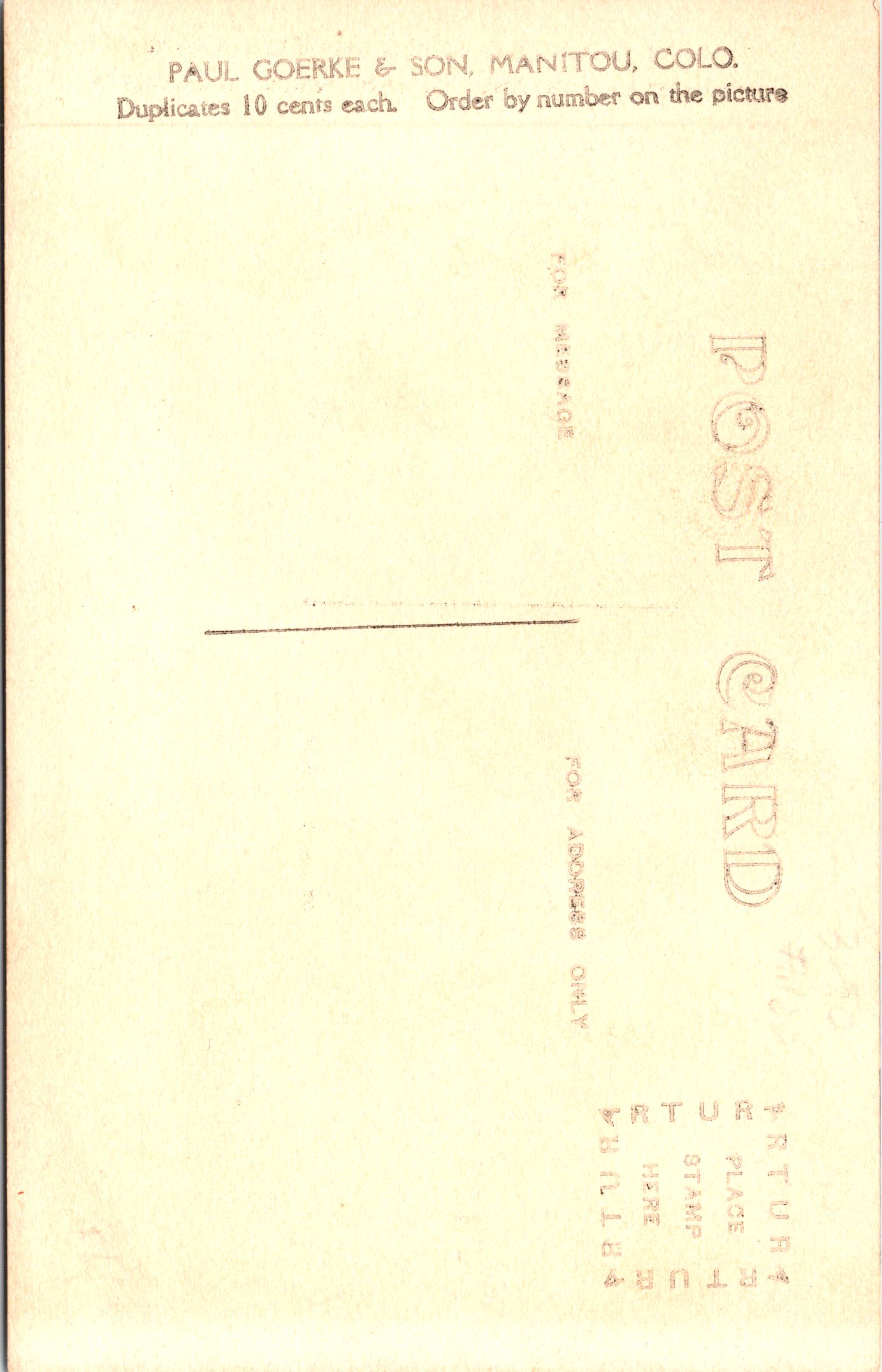
You’re looking at a charming early 20th-century real photo postcard taken at one of Colorado’s most iconic natural landmarks—Balanced Rock, located in the stunning Garden of the Gods park just outside Colorado Springs. This novelty photograph captures a group of five women posing proudly on donkeys in front of the massive, gravity-defying sandstone formation. The photograph radiates the playful spirit of early Western tourism. Five women sit astride small donkeys, all lined up neatly in front of the looming shadow of Balanced Rock. Their expressions vary from reserved amusement to open cheerfulness, suggesting they are enjoying a once-in-a-lifetime travel experience in the American West. Each woman wears a wide-brimmed sombrero-style hat, likely provided by the concession for a touch of “Wild West” flair. Their clothing is modest but stylish for the era—ankle-length skirts, blouses with sailor collars or lace trim, and fitted jackets give them a slightly adventurous, yet feminine look appropriate for tourists of the 1910s or early 1920s. Despite riding donkeys—often considered humble beasts of burden—the women’s confident postures and bemused smiles give the impression that they’re enjoying their frontier fantasy. Their donkeys stand calmly, reins held loosely in the women’s hands, adding to the relaxed, posed nature of the scene. The back of the card identifies the photographer as Paul Goerke & Son, who operated a thriving photography business in Manitou, Colorado. This firm set up a concession at Balanced Rock, one of the most photographed natural features in the West. Tourists could ride donkeys or burros up to the site, don hats, and pose for a souvenir photograph, which Goerke’s team would develop and print on postcard stock. (SOLD)
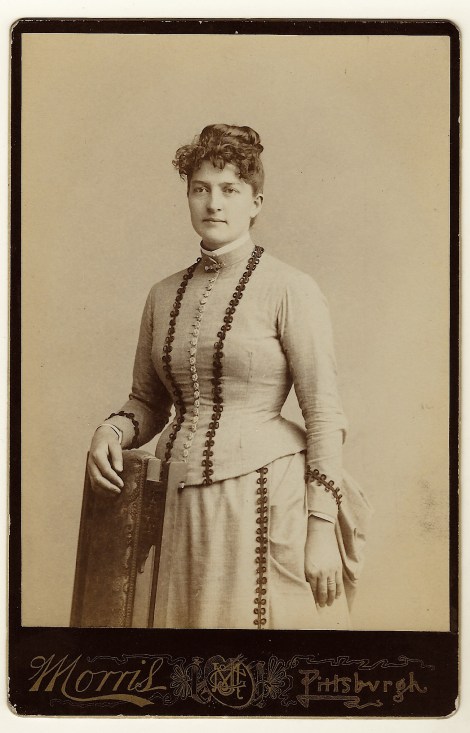
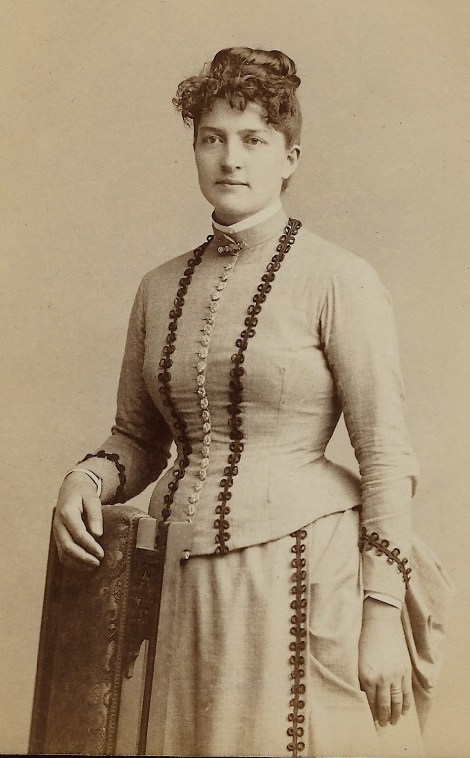 A pretty woman, wearing a fashionable, but unusual dress, poses for a photographer named Joseph G. Morris, in Pittsburgh, Pennsylvania. The studio was located at 16 Sixth Street, in Pittsburgh. She is wearing a collar pin. On the reverse of the photograph is the handwritten name, “Hillz”. One imagines that Hillz is the last name of the subject of this photograph. United States census data reveals some biographical information about the photographer of this cabinet card. Morris was located in the 1880 census. Morris was about 29 years old and he and his father (David Morris) were both working as photographer agents. In 1900, Morris and his 18 year old son, Harry, were boarders, and the older Morris was working as a photographer while the younger Morris was employed s a photographer apprentice. The 1910 U.S. Census finds Morris still working as a photographer and living with his wife, Mary P. Morris. SOLD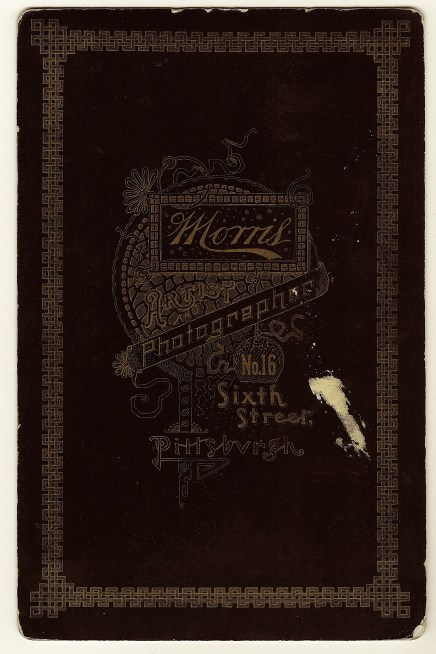



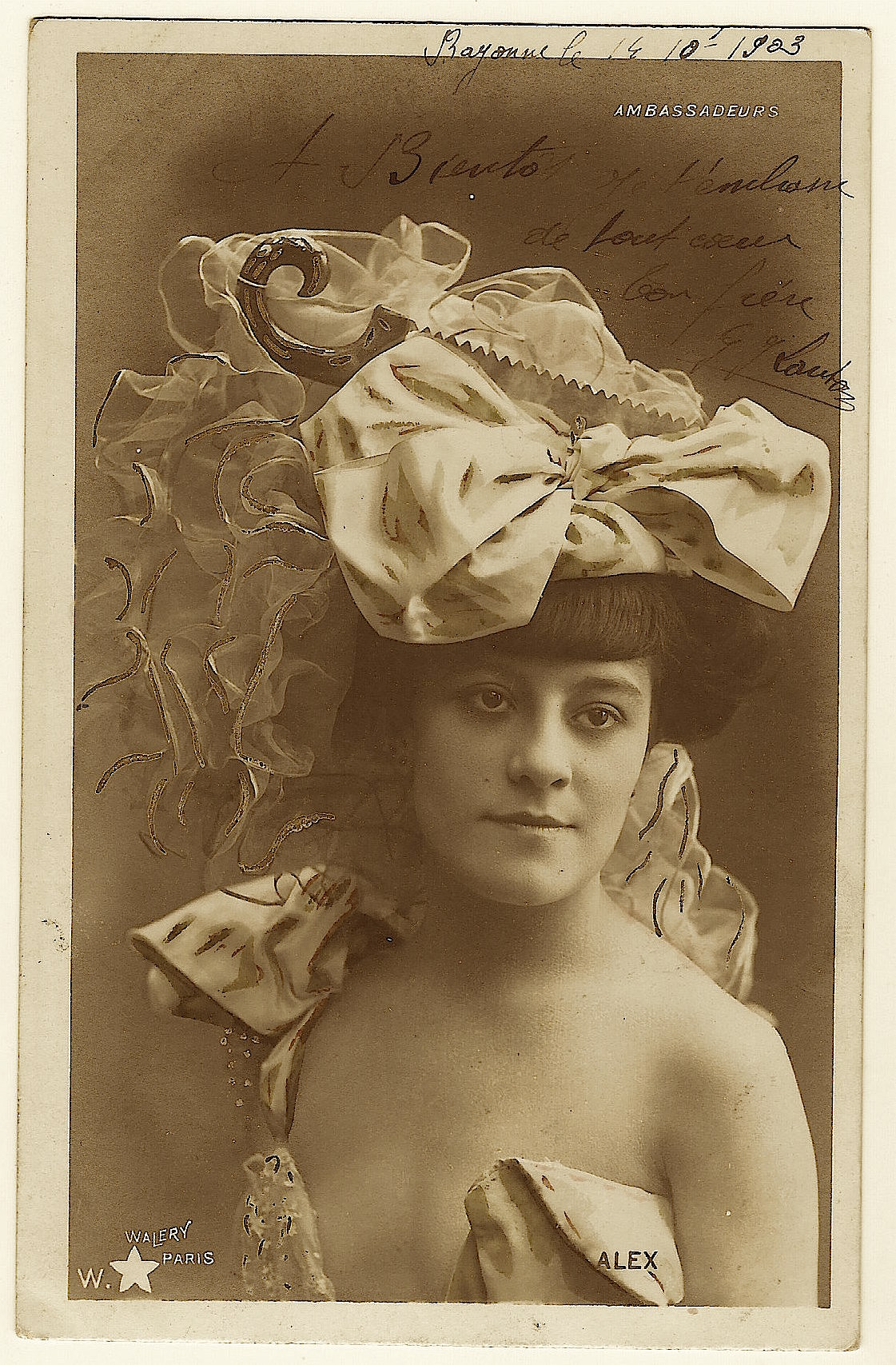 This vintage real photo postcard was mailed in 1903 and features Miss Alex, a lesser known actress or dancer of the Belle Epoque era. She was quite pretty. Many entertainers such as Miss Alex, were more or less prostitutes or “kept women”. Certainly, not all of these women were involved in such a lifestyle, and it is unknown how Miss Alex supported herself.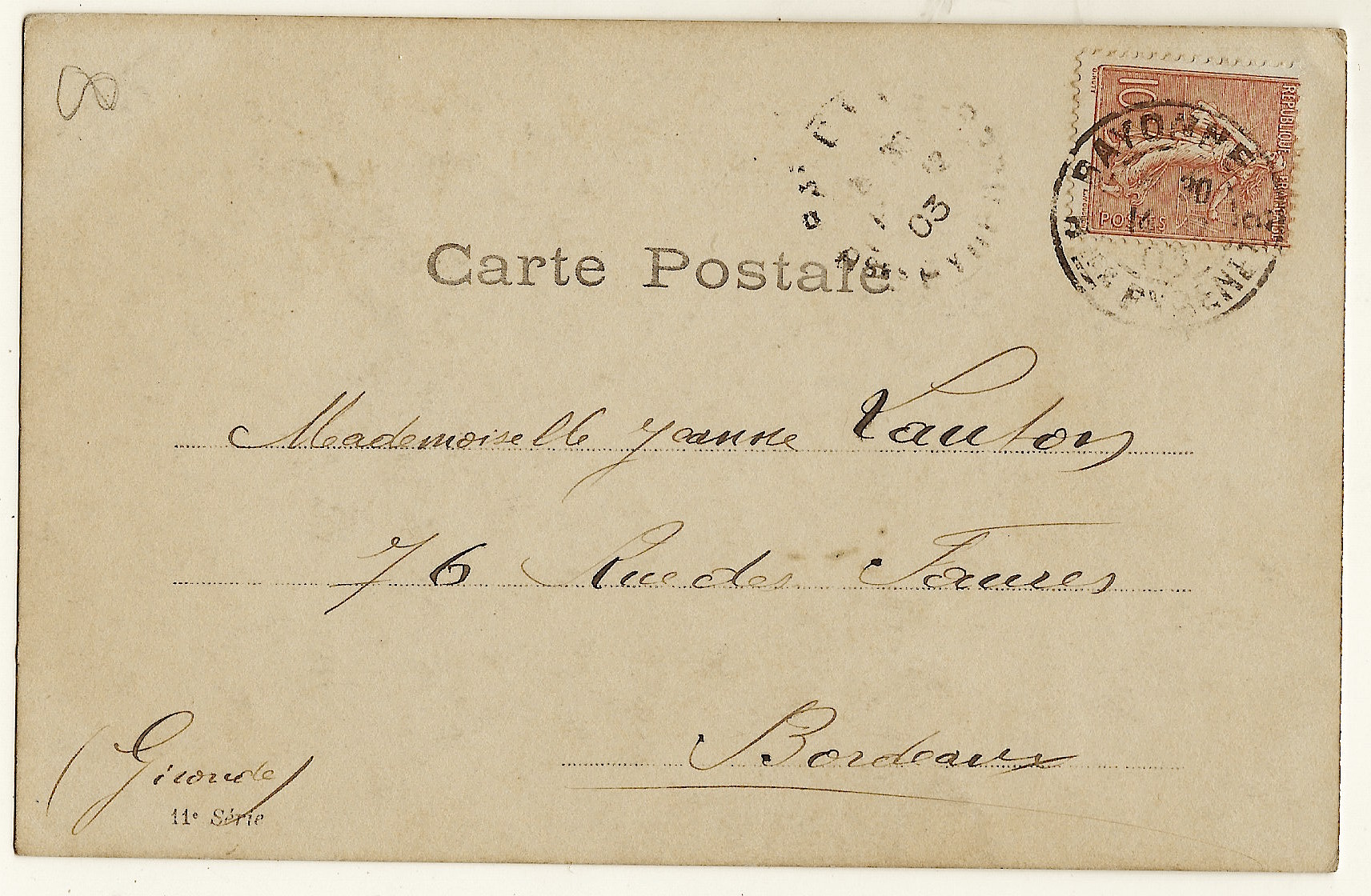

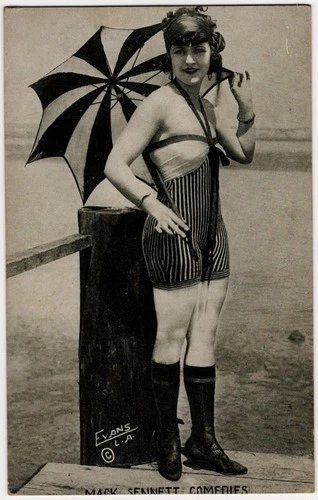 ARCADE CARD 1 (SOLD)
 POSTCARD 1


 THE CABINET CARD GALLERY