JEAN AYLWIN : SCOTTISH ACTRESS & SINGER : DOVER STREET STUDIOS : RPPC 1908

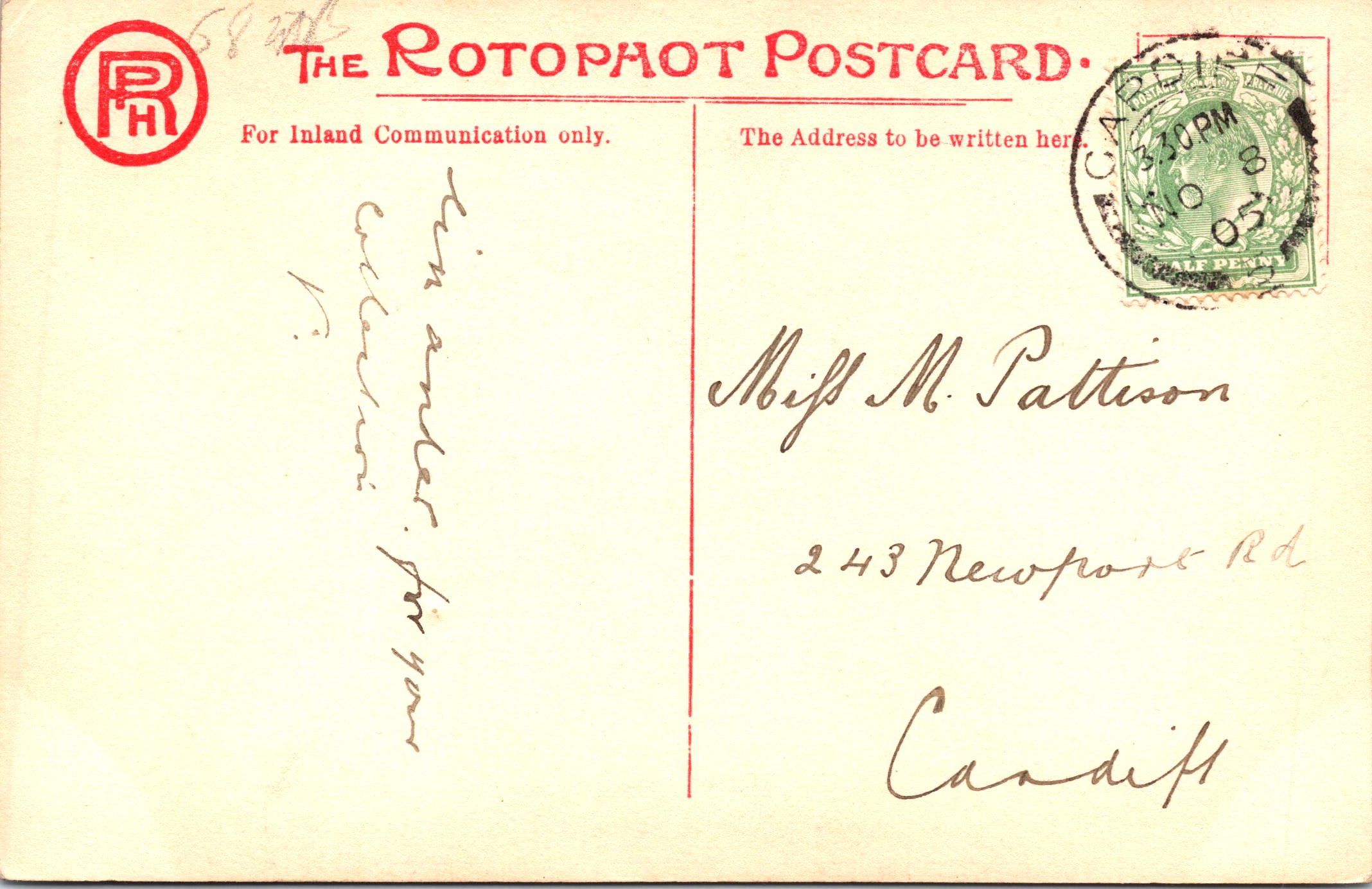
This vintage real photo postcard features a striking portrait of Jean Aylwin (1885-1964), a pretty British actress and singer from the early 20th century. She gained fame for her performances in musical comedies and plays in London and she also toured internationally. Aylwin was associated with the popular Gaiety Theater productions. She had notable performances in several successful productions including “The New Aladdin” (1906), “The Girls of Gottenberg” (1907) and “Our Miss Gibbs” (1909). Aylwin also appeared in two silent films. She married in 1913 but the marriage ended in divorce in 1924. She was accused of adultery with a noted composer of her time. After her divorce, her career declined. She later worked as a housekeeper. In 1926, she briefly worked as a BBC radio broadcaster.  Aylwin looks elegant in this dramatic studio pose. She stands three-quarter length with a thoughtful, hand-to-chin expression, the other hand set firmly at her hip. Aylwin wears a striking military-style costume—a fitted jacket heavily braided with ball buttons and tasselled cords, over a pleated skirt; a matching hat rests at her side. Her hair is dressed in full Edwardian waves, completing the theatrical look. Thd photographer of this portrait is the Dover Street Studios. The card was published by Rotary Photo as part of a series (no1898K). The postcard has a Wandsworth (London) postmark from 1908. The postcard is addressed to someone in West Australia. The message on the card is “This is rather a pretty girl. I have seen her in a piece called Havana. Jack.” The front of this card is has rich, sharp sepia tones. Holding the card at a certain angle, one can see dimples caused by the postmark. (SOLD) 

VALLI VALLI : PRETTY SILENT FILM & STAGE ACTRESS : RPPC 1908

POSTCARD 1 (SOLD)

POSTCARD 2 (SOLD)

POSTCARD 3 (SOLD)

These vintage real photo postcards feature British beauty and actress, Valli Valli (1882-1927). She was a British musical comedy actress and a silent film performer. She was born in Berlin but spent most of her life in England. Her sisters, Lulu and Ida Valli were both actresses. Her father was a merchant. She was educated in London and Paris. She made her stage debut in London at the age of twelve. At thirteen years of age she had a successful run in the musical comedy “Morocco Bound” in Berlin. The next year she performed at London’s Drury Lane Theatre in a pantomime version of Cinderella. As an adult, Valli was a beautiful woman. She performed mostly on the English stage but did tour the United States a number of times. These plays include “The Dollar Princess” and her final New York City performance in “Miss Millions” (1919). In all, she appeared in seven Broadway plays between 1905 and 1920. Valli appeared in four films during 1915 and 1916. These films included “The Turmoil” which was an adaptation of a Booth Tarkington novel. In 1917, she married Louis Dreyfus, head of a music publishing house, and later, a theatrical producer. Valli died from tuberculosis at the young age of forty-five.

Postcard 1 captures Valli, in a pensive, or possibly, dejected mood. The card was published by Rotary Photo as part of a series (No.1760G). Miss Valli was photographed by the Bassano studio. (SOLD)

Postcard 2 features Valli, in a pensive or imploring mood, identical to the mood she exhibits in postcard 1. This card was published by Rotary Photo as part of a series (No.11415A).  (SOLD)

Postcard 3 captures Valli in her role as “The Gipsy” in “Queen of Hearts” . The card was published by Rotary Photo as part of a series (No.11415A). (SOLD)

POSTCARD 1 (SOLD)

POSTCARD 2 (SOLD)

POSTCARD 3 (SOLD)

ENID LOWE : VINTAGE GLAMOUR PORTRAIT : BY GEORGE MANNELL : PRETTY ACTRESS : RARE

The photo postcard features Enid Lowe (1908-1994) in an elegant and theatrical pose. She was a British actress known for her work in television and theater, with notable appearances in productions such as “BBC Sunday-Night Theatre” (1950), “Educated Evans” (1957), and “Loot” (1970). In 1941, she performed in the musical “London Rhapsody” at The London Palladium. This postcard is a testament to Enid Lowe’s beauty. She is dressed in period-style attire. Her outfit includes a lavish gown with a soft, flowing texture, possibly made of silk or satin, adorned with delicate lace and ribbon details. The bodice has a gentle scalloped trim, and she wears long gloves, adding to the refinement of her look. Her accessories are striking—she wears an elaborate wide-brimmed hat with a voluminous, gathered crown, likely made of soft fabric. Her jewelry is ornate, consisting of large, dangling earrings with multiple tiers and a matching necklace of pearl-like beads. These accessories enhance the regal and theatrical nature of the portrait. Enid Lowe’s facial expression is poised and slightly enigmatic. Her dark, wavy hair is styled in an elegant, vintage fashion, framing her face beautifully. Her eyes, accentuated with dark makeup, have a confident and alluring gaze, and her lips are slightly parted, conveying a subtle yet engaging expression. The soft lighting highlights her delicate features, giving her a luminous and almost ethereal appearance. The photographer of this image, George Mannell, was based in London and was active in the early 20th century. He specialized in theatrical and celebrity portrait photography, producing high-quality postcards featuring actors and actresses of the time. His work captured the glamour and artistry of stage performers, often presenting them in elaborate costumes and dramatic poses to appeal to both fans and collectors. His work often appeared in publications such as the Picturegoer series, a popular British postcard collection featuring film stars and entertainers. SOLD

DOROTHY GISH : PRETTY SILENT FILM STAR : FASHIONISTA :PARAMOUNT : RPPC 1928

This vintage real photo postcard features actress, Dorothy Gish (1898–1968). She was a prominent American actress best known for her work in silent films and later in theater. She was also quite pretty which is apparent in this postcard portait. In addition, she was quite fashionable. She was born in Dayton, Ohio, into a family with roots in the performing arts. Dorothy and her older sister, Lillian Gish, are often remembered as significant figures in early American cinema, particularly for their work with director, D.W. Griffith. Dorothy and Lillian’s parents separated when they were young, leaving their mother to support the family. In 1902, the Gish family moved to New York City, where their mother sought work in the theater. Both sisters began acting on stage as children to help support their family. Dorothy made her stage debut at a young age, and by the time she was a teenager, she had already gained experience in theater. In 1912, Dorothy and Lillian were introduced to D.W. Griffith by their friend, actress Mary Pickford. Griffith immediately saw potential in the sisters and cast them in his films, launching their film careers. Dorothy’s early work with Griffith included supporting roles in films like The Musketeers of Pig Alley (1912) and The Birth of a Nation (1915). However, Dorothy’s specialty was comedy, and she developed a distinct, lively style that set her apart from her sister Lillian, who typically played more dramatic roles. Dorothy’s popularity rose as she starred in a series of comedic silent films, including Hearts of the World (1918) and Orphans of the Storm (1921), both of which also featured Lillian. While Lillian’s characters often embodied innocence and vulnerability, Dorothy’s roles allowed her to showcase a playful, often mischievous side, bringing her critical acclaim and a strong fan following. With the advent of sound films in the late 1920s, Dorothy, like many silent film stars, found it challenging to transition to “talkies.” She made a few sound films, but she gradually shifted her focus to theater, where she had always felt at home. Dorothy was well-suited to the stage, bringing her charm and humor to roles in productions such as Young Love (1928), which was a hit on Broadway, and The Chalk Garden (1956). Throughout the 1930s and 1940s, Dorothy toured in various plays and continued to appear in films occasionally. She remained active in theater well into the 1950s, and her stage career extended her professional life even as her work in film slowed. In contrast to her sister, who continued to receive accolades in film well into the sound era, Dorothy’s legacy was tied more to her stage performances and her beloved silent film roles. Dorothy was known for her wit, independence, and close bond with her sister Lillian. The two were inseparable and supported each other throughout their lives, both personally and professionally. In 1920, Dorothy married James Rennie, a Canadian-born actor. However, their marriage ended in divorce in 1935, and she did not remarry. After retiring from the stage, Dorothy lived a quiet life but remained connected to the arts and close to her sister. She passed away in 1968. This postcard was published by Ross Verlag as part of a series (No.3513/1). The card was published in 1928/1929. SOLD

THE STATUE AND IT’S MODEL : TONI SEVEN : AMERICAN COVER GIRL AND ACTRESS

The photographer of this press photo must have been in a playful and creative mood at the time that this photograph was taken. The image features a statue and its model, side by side, in identical poses. The caption of the photograph, affixed to the reverse, indicates that the model is “beautiful” Hollywood star, Toni Seven. It also states that she was the fiance of Senator Warren G Magnuson of Washington state. The photograph was taken in 1949. Toni Seven (1922-1991) was born as June Elizabeth Millarde. Her mother was noted stage and silent film actress, June Caprice. Caprice also worked as a model. Toni’s father, Harry F Millarde, was a film director. Toni’s father died when she was just 8 years old. She was orphaned at age 13 when her mother died. Her grandparents took on the responsibility of raising young Toni. She was raised in the town of Great Neck, located on Long Island in New York state. An article in Time Magazine (1949) indicates that she was financially secure. It was reported that she was a heiress to a fortune worth 3 million dollars. It appears that Toni Seven was genetically loaded to become a performer. As Toni Seven, she was a popular American cover girl and actress, In the early 1940’s she played minor roles in three films. One of these films was the well known “Yankee Doodle Dandy” (1942). She later appeared in two more films. When World War II began, she became a volunteer at the “Hollywood Canteen”, The canteen offered food, dancing and entertainment to servicemen, many of whom were preparing to go overseas. Everything at the canteen was free for uniformed servicemen and servicewomen, She was named pin-up of the year by US soldiers in the European theater in 1945. In 1944, she changed her name to Toni Seven. She thought it would be fun to sign her name “Toni 7”. When the first pin-up exhibition in the United States was held in 1944, Toni Seven was featured along with many other beautiful models, including Jane Russell. In 1946, Seven reclaimed her original name. In 1949, newspapers ran articles asserting that Toni was romantically involved with Washington US Senator, Warren Magnuson. Although the caption of this press photo states that she and Magnuson were engaged, the pair never married. However, the couple dated on and off between 1948 and 1953. Looking at Toni Seven’s biographical data, it is clear that her acting career was unremarkable. Toni appeared in only five films. Stellarstar writes in the blog “Those Obscure Objects of Desire” that “Toni Sevin is proof that a girl who lands in Hollywood, has money to burn, a great press agent and more than enough beauty, can still end up a complete unknown”. Toni was successful in other areas of her life. She was a great horsewoman, and also excelled at swimming and tennis. She despised gossip but created some when she dated Errol Flynn and other celebrities. This press photo belonged to the Intercontinental agency, located in Paris, France. An additional photograph of Miss Seven can be found below.  SOLD

PHOTO OF TONI SEVEN (NOT FOR SALE)

REVERSE OF PRESS PHOTO

VESTA TILLY : FAMOUS MUSIC HALL STAR & MALE IMPERSONATOR : VINTAGE RPPC POSTCARD

Vesta Tilly (1858-1952) was one of the most beloved and influential performers of the British music hall era. She was a groundbreaking male impersonator who captivated audiences for decades with her wit, charm, and powerful stage presence. Born into modest beginnings, she rose to become a symbol of British patriotism and a pioneer for women on the stage. Tilly was born in Worcester, England. She was the second of thirteen children born to Henry Powles, a self-employed musician and fiddler, and Matilda Powles. Her father, deeply involved in local musical performances, recognized Matilda’s precocious talent at an early age and began showcasing her on stage by the time she was just three years old. The Powles family moved to London when Matilda was a child, in pursuit of more lucrative theatrical opportunities. With her father acting as her manager, she began performing under the stage name “Little Tilly” in pantomimes and variety shows. Matilda’s first male impersonation was at the tender age of six. By her teenage years, she had taken the stage name Vesta Tilly, inspired by the Roman goddess of the hearth (Vesta) and a common nickname (Tilly). Her success as a “principal boy” in pantomime was soon eclipsed by her signature act: portraying men with startling authenticity and satirical flair. What set Tilly apart was her command of the stage and her uncanny ability to adopt male gestures, mannerisms, and vocal inflections. She didn’t just mimic men—she portrayed them with intelligence, humor, and often, social critique. She frequently played dapper young men, military officers, or swells (wealthy young men), sometimes poking fun at political figures or addressing social issues. She became one of the most highly paid and respected performers in the British music hall scene during the late Victorian and Edwardian periods. Her stage appearances were so convincing that many audience members did not initially realize she was a woman. Vesta Tilly’s career spanned over four decades, and she performed in countless popular songs and sketches. Some of her most iconic performances included: “Following in Father’s Footsteps”, “Burlington Berlie”, and “The Boy in the Gallery”. She was particularly popular among working-class audiences and soldiers. During World War I, Tilly took on a new patriotic role, performing in uniform to recruit young men to the military. She was so effective that she earned the nickname “England’s Greatest Recruiting Sergeant.” In 1890, Vesta Tilly married Walter de Frece, a theatrical impresario and songwriter. Their relationship was both romantic and professional—Walter became her manager and guided much of her career. He was instrumental in helping shape her brand and ensuring her continued success on the music hall circuit. After World War I, Walter was knighted and later became a Member of Parliament. This new political role brought Vesta into a more socially prominent world, and she gradually withdrew from the stage. Vesta Tilly gave her final performance in 1920 at the London Coliseum. Her retirement was widely publicized and emotional for her devoted fan base. After stepping away from the stage, she became Lady de Frece, supporting her husband’s political ambitions and engaging in charity work. The couple eventually moved to Monte Carlo, where they lived a quieter life. Walter de Frece died in 1935, and Vesta lived on until 1952. The postcard’s image shows Tilley in a fur-trimmed coat, accessorized with a hat adorned with feathers. The card has been hand-tinted, with touches of pink on her costume and hat and green on the tassels. The following is a transcription of the letter: “Dear Bess, Just a line to say we landed here quite safe. And are having a lovely time up to the present, only the weather isn’t up to the mark, it is a bit showery but not too bad. You might get a skirt ready to send me on Sunday. Will write and tell Hugh this aft to come round for it on Friday night so try and get it ready. Give my love to [all at home]. Joe” (Writer’s details also appear: No. 5 Company R.S. of Vols, Hightown, Nr. Liverpool.) This postcard was published by Philco as part of a series (No.3149D). (SOLD)

MEATY FLEURON : POSTCARD QUEEN : DANCE HALL STAR : PHOTO BY ORICELLY

This vintage real photo postcard features Meaty Fleuron, a dancehall artist from the Belle Epoque era. Meaty was a singer and a dancer. She was one of the “Postcard Queens” popular at the turn of the century. In other words, she was a prolific postcard model. She made her debut at the European Concert hall in 1895. She is noted for appearing in “swimsuit roles”. Her sister, Lise Fleuron was also a performer. This postcard was published by LF Co. which I believe, but am not certain, is Labouene Freres. Miss Fleuron was photographed by the Oricelly studio for this postcard. Oricelly was based in Paris, France. SOLD

JOSEPHINE DUNN : IN “EXCESS BAGGAGE” : MGM SILENT FILM STAR : RISQUE RPPC 1928

Josephine Dunn (1906 –1983) was an American actress known primarily for her work in silent and early sound films during the late 1920s and early 1930s. She was a glamorous starlet of the Jazz Age, often cast in flapper and socialite roles. Josephine Dunn was born in New York City, where she was raised. Little is known about her early years, but she entered show business as a teenager, joining the world of vaudeville before making the transition to film. Her natural beauty, charisma, and fashionable style made her a popular choice for film producers during Hollywood’s silent era. Dunn made her film debut in 1926 and quickly became a sought-after actress, starring in a variety of silent and early talkie films. She was often cast as the “other woman” or as a carefree flapper, fitting the Roaring Twenties’ archetype of modern femininity. One of her most notable films was “Our Modern Maidens” (1929), in which she starred alongside Joan Crawford and Douglas Fairbanks Jr. She also appeared in: “Excess Baggage” (1928),”The Broadway Melody” (1929),  “Tanned Legs” (1929), and “Montana Moon” (1930). Her transition from silent films to talkies was fairly successful, though she never achieved the same level of fame as some of her contemporaries, such as Crawford or Norma Shearer. By the early 1930s, her film career began to slow down. While primarily a screen actress, Dunn had early experience in vaudeville and stage performances, though she never became a major Broadway star. She retired from acting in the mid-1930s and lived a largely private life afterward. Dunn was married multiple times, including to millionaire oil executive Carroll Case. Her personal life was often the subject of media gossip. Although she was never a top-tier star, Josephine Dunn was emblematic of 1920s and early 1930s Hollywood glamour. This postcard features Dunn in her starring role in the 1928 silent film, “Excess Baggage”. The romantic comedy film was produced by Metro-Goldwyn-Mayer (MGM). She played the role fo a glamourous and sophisticated young woman. Unfortunately, like many silent films of the era, Excess Baggage is considered lost, meaning no known copies are available today. In this image, Josephine Dunn is dressed in a delicate, ruffled ballet-style costume, with a short, voluminous tutu and an intricately adorned bodice. The dress features lace and embellishments, reflecting the flapper era’s fascination with femininity and luxury. Her feet are adorned with soft, ballet-like slippers, adding to the graceful, almost ethereal appearance of her outfit. Her pose is both playful and weary—leaning on the large travel trunk with one arm propped up and her hand resting gently against her face. Her expression is one of wistful contemplation, with her eyes gazing off to the side, giving a sense of melancholy or quiet amusement. This pose complements the humor suggested by the film’s title, Excess Baggage, possibly hinting at the idea of emotional or romantic burdens rather than just literal luggage. Her curled, short blonde hair, typical of the 1920s, frames her face beautifully, reinforcing her status as a Jazz Age beauty. This risque postcard was published by Berlin based, Ross Verlag. In the card’s lower right corner, we see the logo of MGM. This vintage real photo postcard was issued in 1928. (SOLD)

BILLIE DOVE: BEAUTIFUL FILM ACTRESS, GIRLFRIEND OF FLORENZ ZIEGFELD : RPPC

POSTCARD 1 (SOLD)

POSTCARD 2 (SOLD)

POSTCARD 3 (SOLD)

These vintage real photo postcards feature actress Billie Dove. Billie Dove (1903-1997) was an American actress. Her parents were Swiss immigrants. During her teenage years, she worked as a model to support her family. Florenz Ziegfeld hired her as a teenager to appear in the Ziegfeld Follies Revue. She was not a particularly talented dancer or singer, her beauty and acting ability were her major assets. In the early 1920’s she moved to Hollywood and began appearing in silent films. It has been written that Ziegfeld’s wife, actress Billie Burke, helped facilitate Dove’s transition to films. Apparently, Burke was trying to separate Dove from her husband because the pair were having an affair. It did not take long for her to become one of the more popular actresses of the 1920’s. Among her better known films was “The Black Pirate” (1926) with Douglas Fairbanks, and “The American Beauty” (1927). Dove was a ravishing beauty and was very photogenic. She married director, Irvin Willat, in 1923. The marriage had a six year duration. She then had a three year romance with Howard Hughes. Dove’s other interests included being a pilot, painter, and poet. After her last film, “Blondie of the Follies” (1932), Dove retired from films. It is thought that she retired because she was distraught about her role in her last film being “trimmed” by her co-star’s (Marion Davies) influential boyfriend (William Randloph Hearst). Hearst was upset because Miss Davise’s acting was overshadowed by Dove’s acting. Mr Hearst owned Cosmopolitan Productions which produced the movie. After retirement, Dove married oil executive Robert Kenaston in 1933 and the couple remained together until Kenaston’s death in 1970. She had a brief third marriage to an architect. It is interesting to note that jazz singer, Billie Holiday, borrowed Billie Dove’s first name when picking out her own stage name. Miss Holiday was an admirer of Miss Dove. The IMDb lists 50 movie credits for Billie Dove between 1921 and 1962.

Postcard 1 is a profile portrait was published by Cinemagazine – Paris Edition (no.313). (SOLD)

Postcard 2 was published as by Ross Verlag as part of a series (No.3687/1).  Billie Dove looks beautiful in this portrait taken by Defina. The logo for First National Pictures can be seen in the image’s lower right corner.  (SOLD)

Postcard 3 features Billie Dove looking beautiful in this provocative portrait. The card is risque, considering Dove’s pose and revealing tight dress. Billie Doves portrait seen on this postcard was taken by Defina. This card was published by Ross Verlag’s Italian Edition (Bellerini & Fratini, Florence, Italy). Casa Editrice Bellerini & Fratini was one of the most renowned Italian publishers. The firm began publishing film postcards in the early 1920’s and later became a distributor for Ross Verlag. As of 1918, the firm was still in existence.  (SOLD)

POSTCARD 1

POSTCARD 2 (SOLD)

POSTCARD 3

VESTA TILLY : FAMOUS MUSIC HALL STAR & MALE IMPERSONATOR : VINTAGE RPPC POSTCARD

POSTCARD 1

POSTCARD 2
Vesta Tilly (1858-1952) was one of the most beloved and influential performers of the British music hall era. She was a groundbreaking male impersonator who captivated audiences for decades with her wit, charm, and powerful stage presence. Born into modest beginnings, she rose to become a symbol of British patriotism and a pioneer for women on the stage. Tilly was born in Worcester, England. She was the second of thirteen children born to Henry Powles, a self-employed musician and fiddler, and Matilda Powles. Her father, deeply involved in local musical performances, recognized Matilda’s precocious talent at an early age and began showcasing her on stage by the time she was just three years old. The Powles family moved to London when Matilda was a child, in pursuit of more lucrative theatrical opportunities. With her father acting as her manager, she began performing under the stage name “Little Tilly” in pantomimes and variety shows. Matilda’s first male impersonation was at the tender age of six. By her teenage years, she had taken the stage name Vesta Tilly, inspired by the Roman goddess of the hearth (Vesta) and a common nickname (Tilly). Her success as a “principal boy” in pantomime was soon eclipsed by her signature act: portraying men with startling authenticity and satirical flair. What set Tilly apart was her command of the stage and her uncanny ability to adopt male gestures, mannerisms, and vocal inflections. She didn’t just mimic men—she portrayed them with intelligence, humor, and often, social critique. She frequently played dapper young men, military officers, or swells (wealthy young men), sometimes poking fun at political figures or addressing social issues. She became one of the most highly paid and respected performers in the British music hall scene during the late Victorian and Edwardian periods. Her stage appearances were so convincing that many audience members did not initially realize she was a woman. Vesta Tilly’s career spanned over four decades, and she performed in countless popular songs and sketches. Some of her most iconic performances included: “Following in Father’s Footsteps”, “Burlington Berlie”, and “The Boy in the Gallery”. She was particularly popular among working-class audiences and soldiers. During World War I, Tilly took on a new patriotic role, performing in uniform to recruit young men to the military. She was so effective that she earned the nickname “England’s Greatest Recruiting Sergeant.” In 1890, Vesta Tilly married Walter de Frece, a theatrical impresario and songwriter. Their relationship was both romantic and professional—Walter became her manager and guided much of her career. He was instrumental in helping shape her brand and ensuring her continued success on the music hall circuit. After World War I, Walter was knighted and later became a Member of Parliament. This new political role brought Vesta into a more socially prominent world, and she gradually withdrew from the stage. Vesta Tilly gave her final performance in 1920 at the London Coliseum. Her retirement was widely publicized and emotional for her devoted fan base. After stepping away from the stage, she became Lady de Frece, supporting her husband’s political ambitions and engaging in charity work. The couple eventually moved to Monte Carlo, where they lived a quieter life. Walter de Frece died in 1935, and Vesta lived on until 1952.

Postcard 1 was published by Rotary Photo as part of a series (No.2007A).  (SOLD)

Postcard 2 captures Tilley in one of her male impersonator roles.