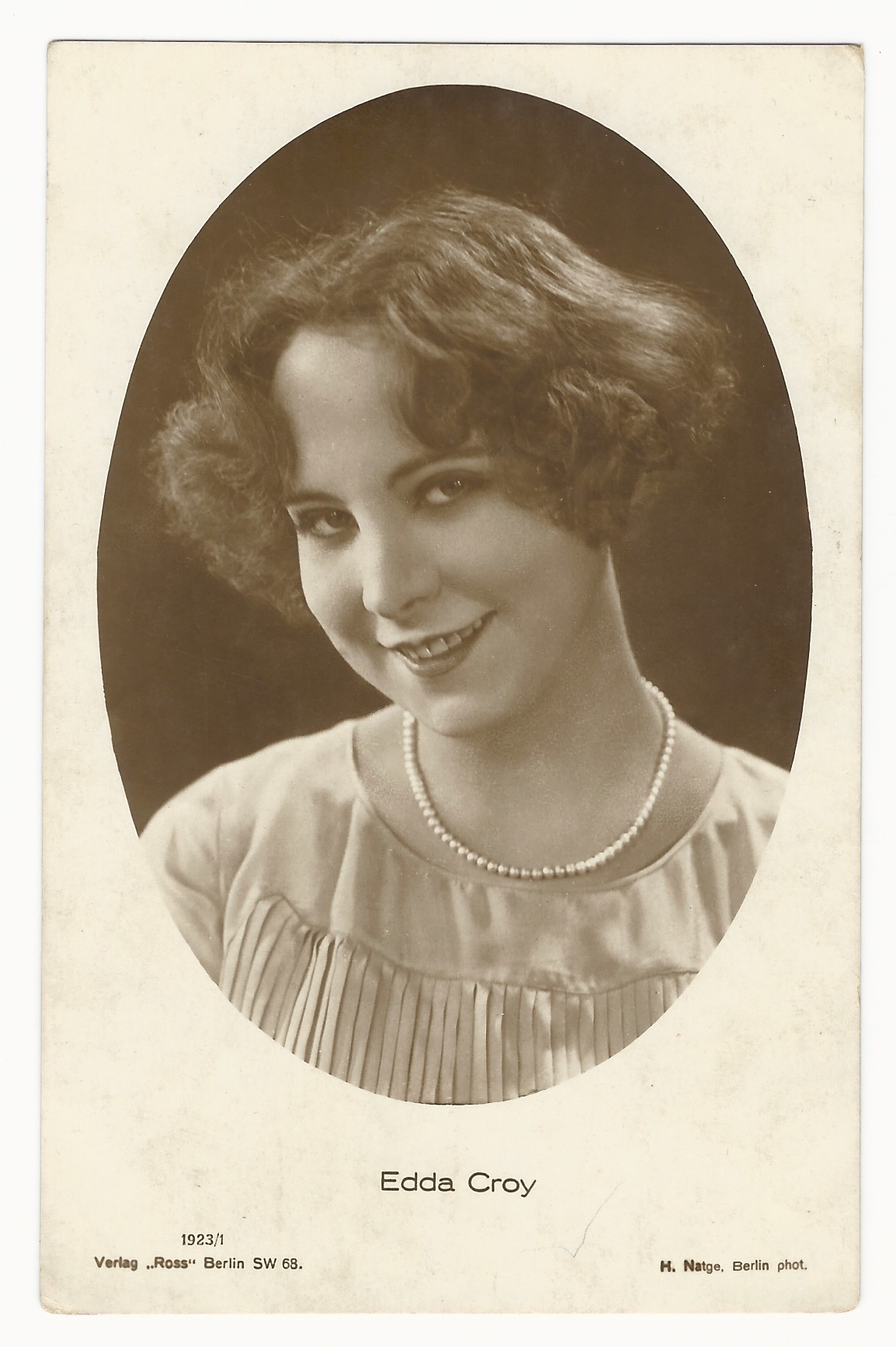
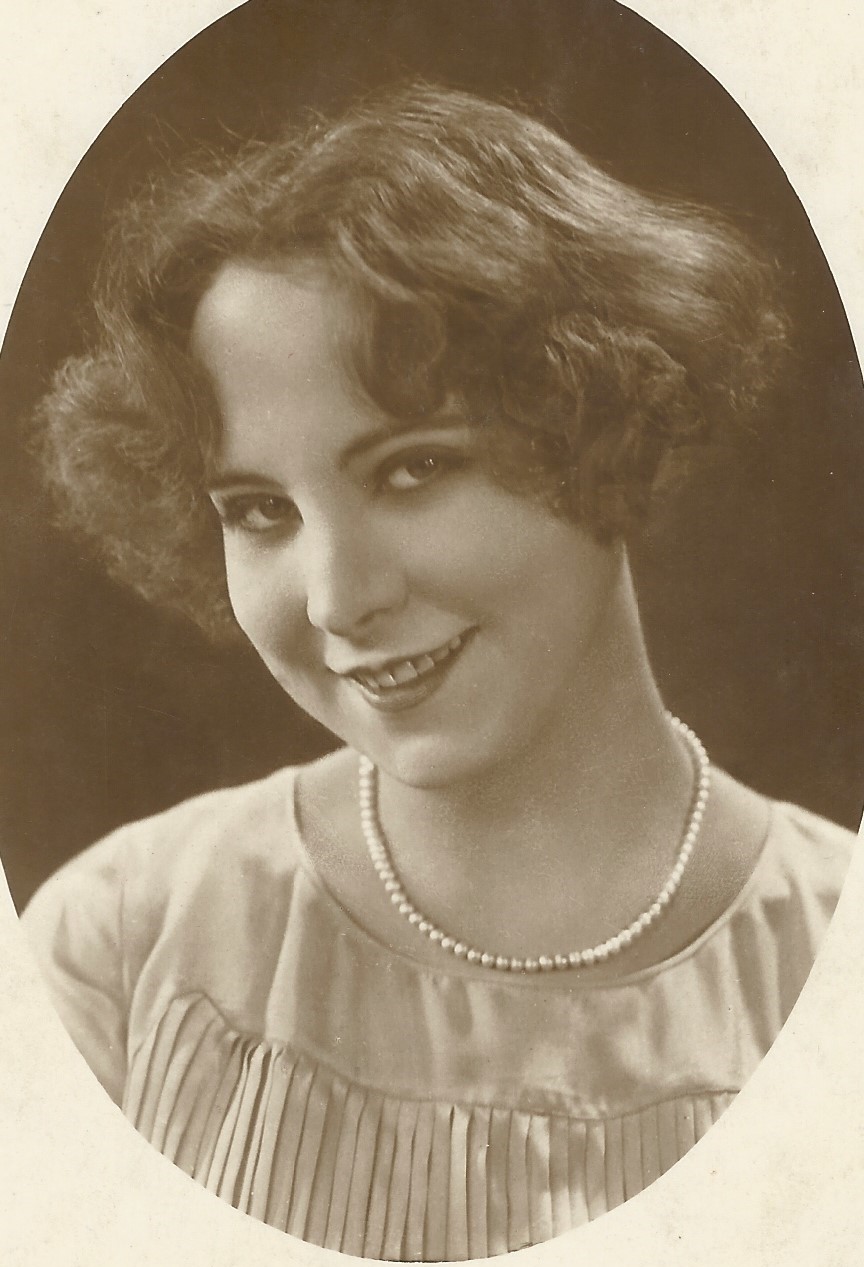
This vintage real photo postcard features silent film actress, Edda Croy. Edda has “the girl next door” look. Preliminary research uncovered little about her. Edda had a very short career. She played in three German silent films, all release in the same year (1927). One of these films was directed by Robert Wiene. He is well known for directing the silent film “The Cabinet of Dr. Caligari” (1920) and other expressionist films. Popular actor, Harry Liedtke, appeared in all three of her films. Actress Erna Morena, who’s photograph can be seen elsewhere in the Cabinet Card Gallery, apppeared in one of Edda’s films. This postcard was published by Ross Verlag (Berlin). It is part of a series (no.1923/1). Miss Croy’s photograph was taken by photographer Hans Natge. Natge was very involved in German film production. He played roles in the realm of cameras, directing and assistant directing. He was born in Berlin in 1893. His filmography on IMDb reports that he has 28 film credits between 1924 and 1949. Nineteen of these credits were for his role as the film’s “still photographer”. It is likely safe to assume that he took this photograph of Miss Croy in 1927. This vintage portrait postcard is rare and in very good condition (see scans).
Buy this original Vintage Real Photo Postcard (includes shipping within the US) #3218
To purchase this item, click on the Pay with PayPal button below
24.00 $
Buy this Vintage Real Photo Postcard (includes International shipping outside the US) 3218
To purchase this item, click on the Pay with PayPal button below
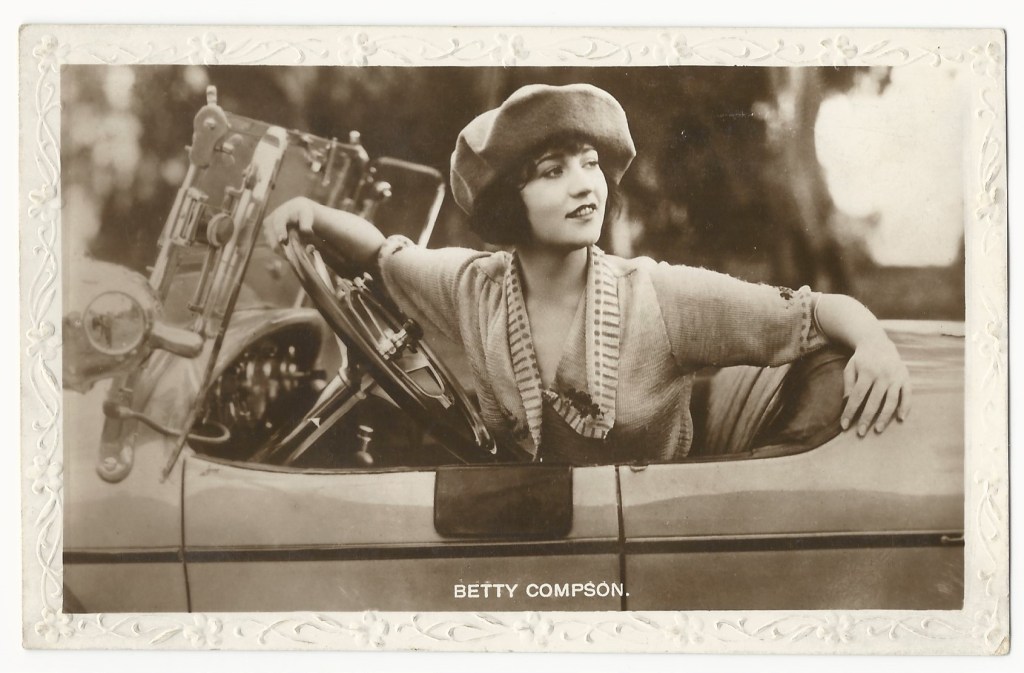
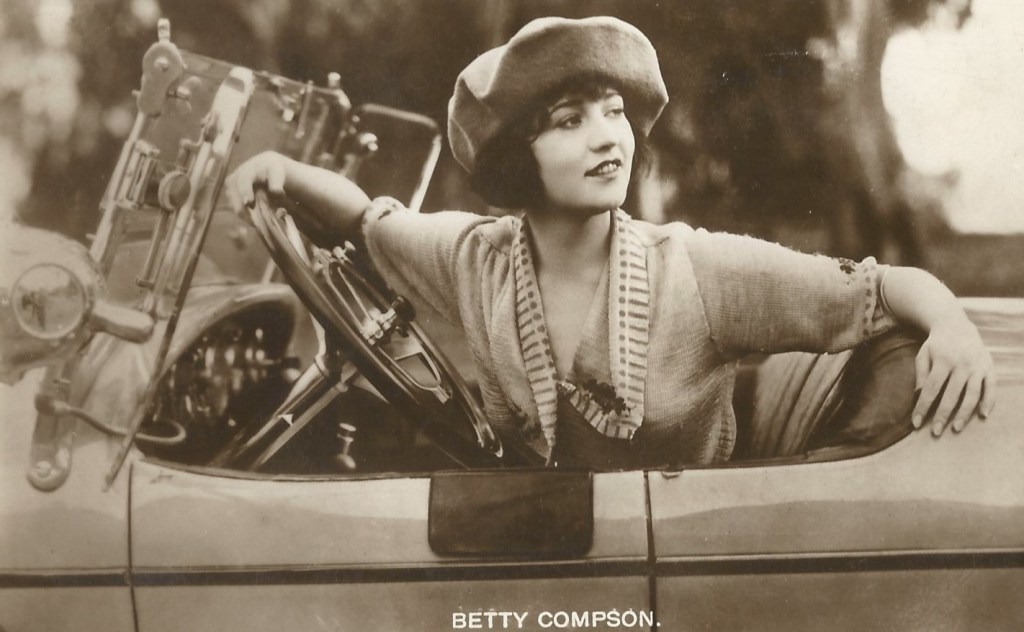
This vintage real photo postcard features American actress and film producer, Betty Compson (1897-1974). She was nicknamed “the prettiest girl in pictures”. Compson was born in a mining camp in Beaver, Utah. Her father was a mining engineer, a gold prospector, and grocery store owner. Her mother was a maid in hotels and private homes. Betty graduated from Salt Lake High School. She was hired as a violinist at age 16 in a theater in Salt Lake City. She then played in vaudeville touring companies and it was during this stint she was discovered by a film producer (Al Christie) who signed her to a contract. She began her career during Hollywoods’s silent film era. Her debut film was “Wanted, a Leading Lady” (1915). After this film, her career rocketed. She appeared in 25 film in 1916. All but one, were shorts. In 1918 she was offered a contract by studio head Mack Sennett. She rejected the offer because the salary was too low. She continued to make numerous short films until the middle of 1918. She was frequently paired with Roscoe “Fatty” Arbuckle. She started making only feature films. She became a rising star after appearing opposite Lon Chaney in “The Miracle Man” (1919). Paramount became interested in her and signed her to a five year contract. In 1921, Compson established her own production company in order to have creative control over screenplays and financing. The first movie she produced was “Prisoners of Love” (1921). After she completed acting in “The Woman With Four Faces” (1923), Paramount refused to give her a raise. She wanted an increase in her $2500 per week salary. Compson was angry enough at Paramount, to leave the company, and sign with a British film company. She made four films in England, two of them were films penned by Alfred Hitchcock. Paramount lured her back to Hollywood from England by offering her a top dollar contract. She then appeared in a movie by director, James Cruze. The pair married in 1924, but divorced four years later. The divorce from Cruze nearly ruined her financially because of debt accrued by Cruze. After Paramount did not offer her a contract renewal, she began freelancing in lower budget films. In 1928 she appeared in a “part talkie” called “The Barker”. She played a manipulative carnival girl. She was nominated for a “Best Actress” for this role by the Academy Awards. In 1929, she gained much recognition for her role in “The Docks of New York”. She played a suicidal prostitute. These two films resulted in her popularity returning to it’s previous high level. She appeared in many “talkie” films. Unlike a lot of silent film stars, Compson made a successful transition into sound films. In fact, she even appeared in a number of early musicals. When she played singing parts, her voice was dubbed. Her career flourished. In 1930, she appeared in 9 films. Her last “hit’ was in “The Spoilers”. Her costar was Gary Cooper. Her popularity waned and she only got roles in low budget, less successful studios. Her last film was in 1948. After retiring from her movie career, she started a cosmetic line and assisted her husband in a business named “Ashtrays Unlimited”. In total Compson was married three times. Her second marriage, to agent/producer Irving Weinberg ended in divorce after four years. Her third marriage was to a professional boxer. The marriage lasted 18 years and ended upon his death in 1962. She had no children. She died in 1974 after suffering a heart attack. She had much impact on the early movie industry. The IMDb reports 209 film credits between 1915 and 1948. This vintage postcard is in excellent condition (see scans). Take a look at the YouTube video below. The video features Betty Compson appearing in the silent film, “The Docks of New York” (1928). The music accompanying this video is obviously modern, but, in my opinion, it is excellent. Compson demonstrates incredible acting ability. Her facial expression and her eyes speak for her. SOLD
Betty Compson in “The Docks of New York” (1928) Music: “Marry Me” By Dave Pagett and Viv Jones (Sax)
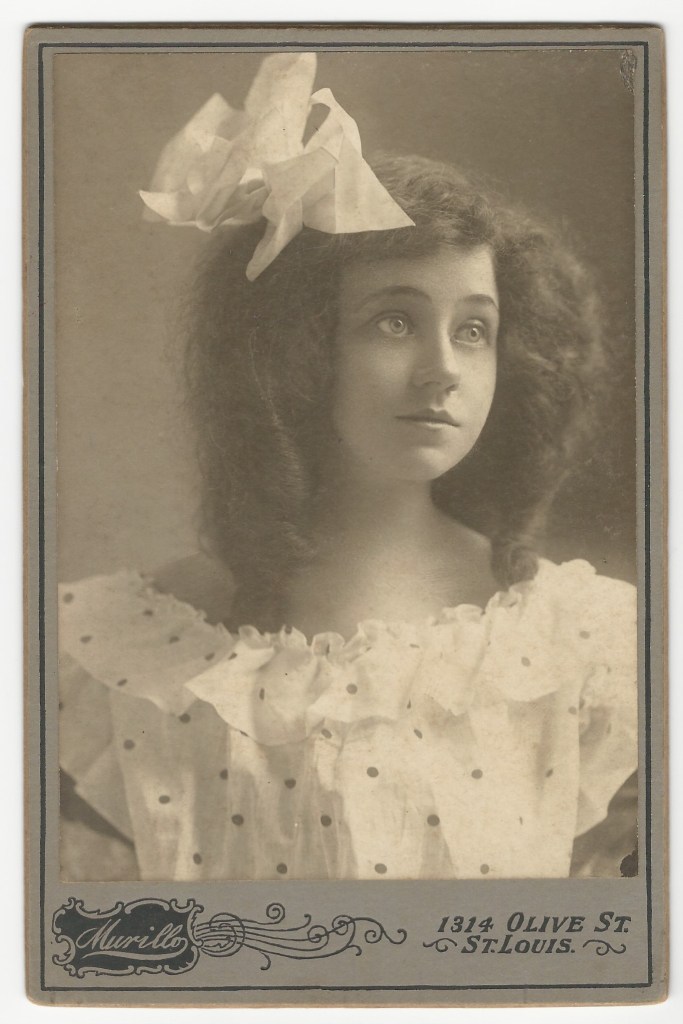
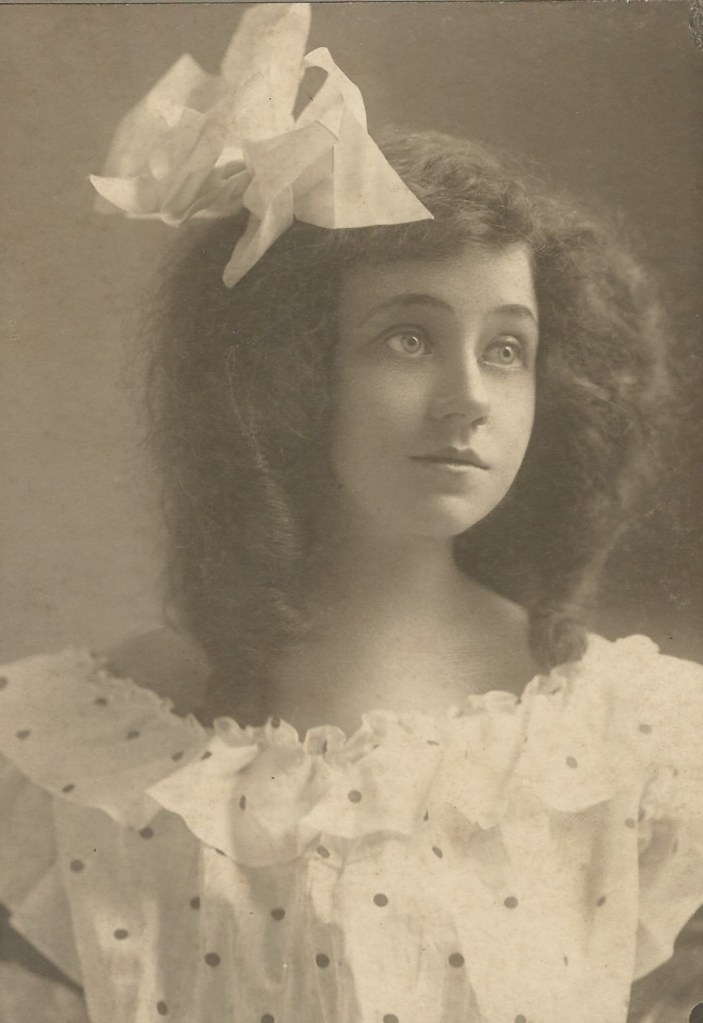
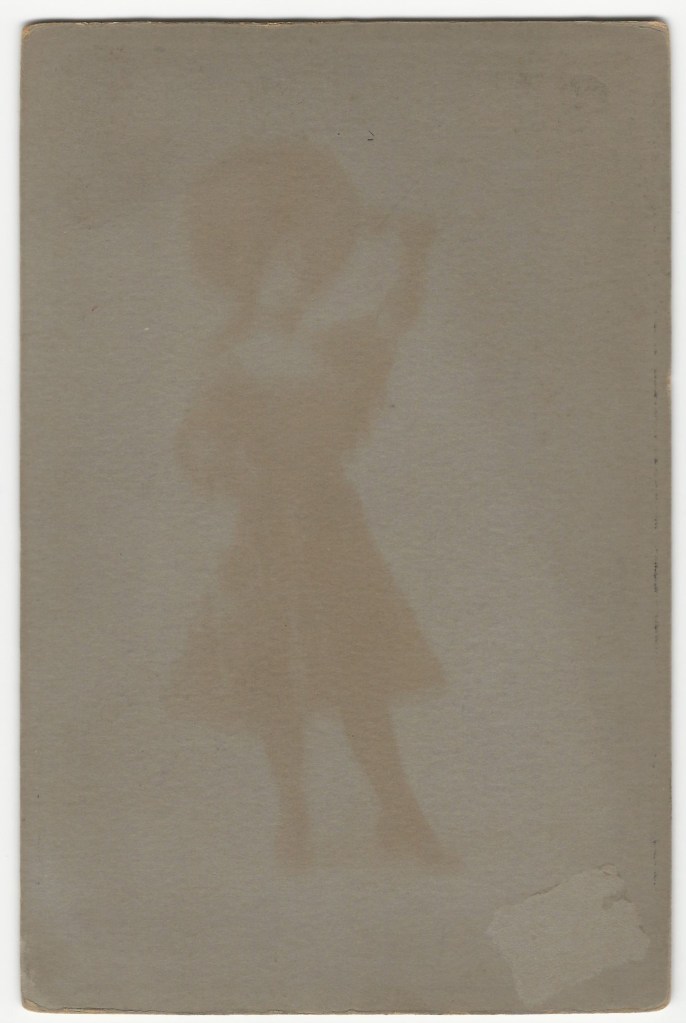
A pretty young actress with sad and haunting eyes and a polka dot dress poses for her portrait. She exudes a dramatic air and its likely no coincidence that this photograph was found in a collection of theatrical cabinet cards. The photographer of this image was the Murillo studio of St. Louis, Missouri. One source reports that the Murillo studio was operated by Jesse J Ferguson and existed at least between 1910 and 1919. To view other photographs by Murillo, click on the category “Photographer: Murillo”. Note the reverse of this photograph, seen below, because this is your opportunity to see a ghost. Well maybe not a ghost, but a ghost image for sure. I am guessing that the image formed by being pressed tightly against the front of another cabinet card creating the ghost like image. However, photography historians have written that some photographers purposely created ghost images for their clients. Why? Sometimes they were asked to, and sometimes they had their own nefarious reasons. SOLD
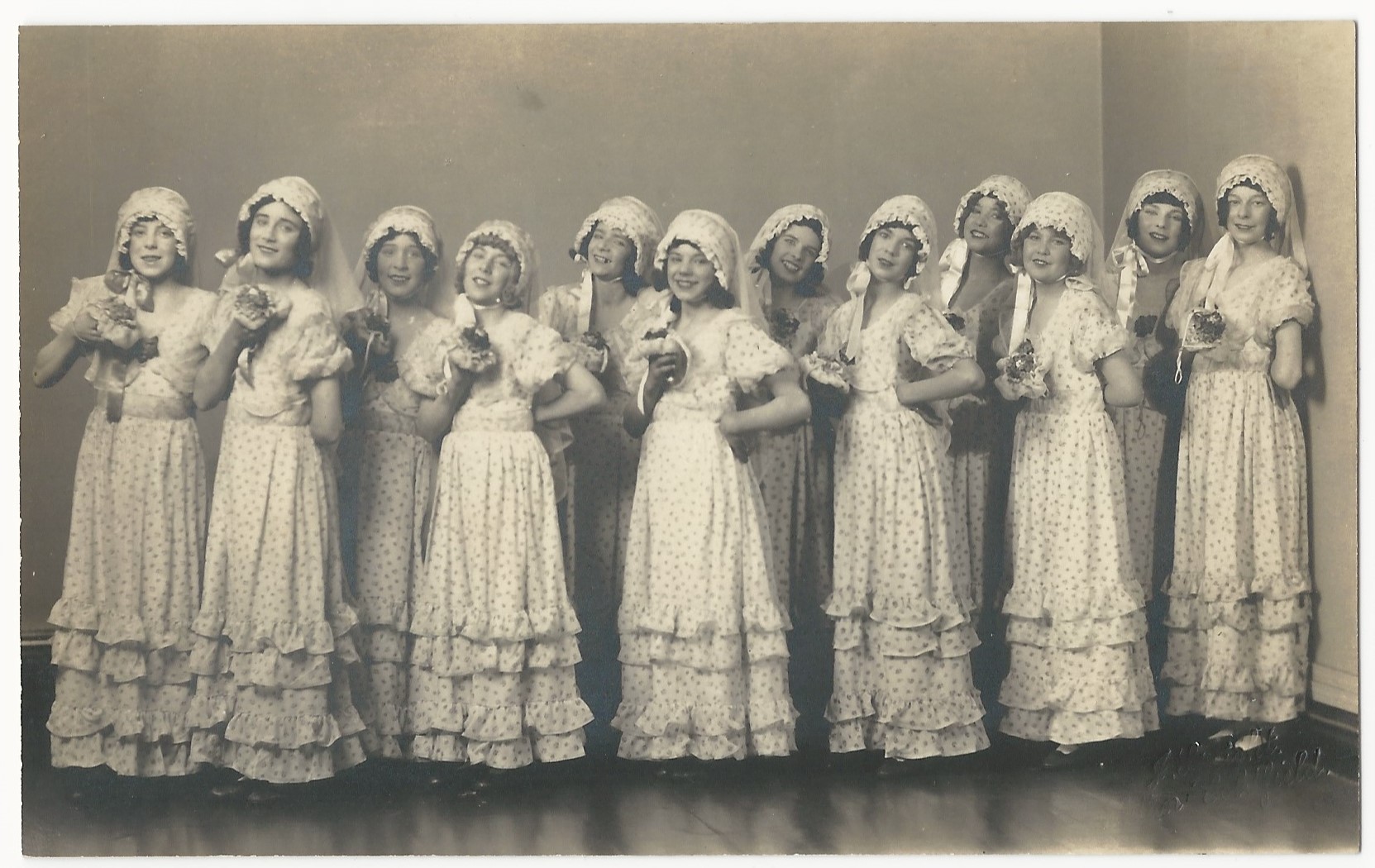
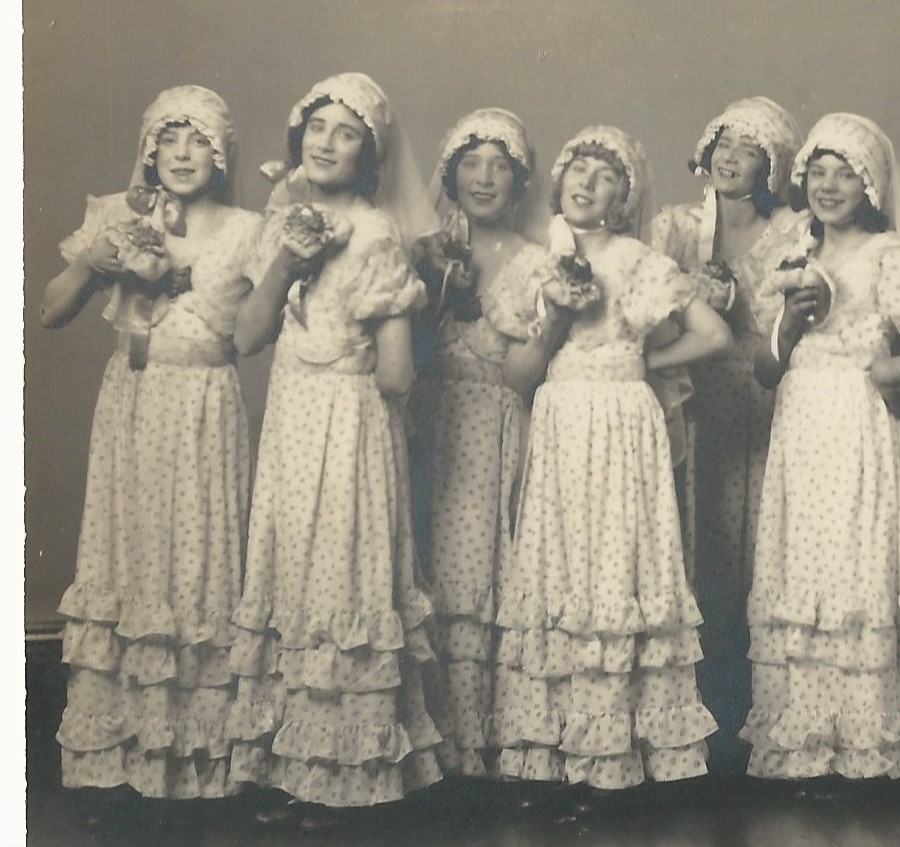
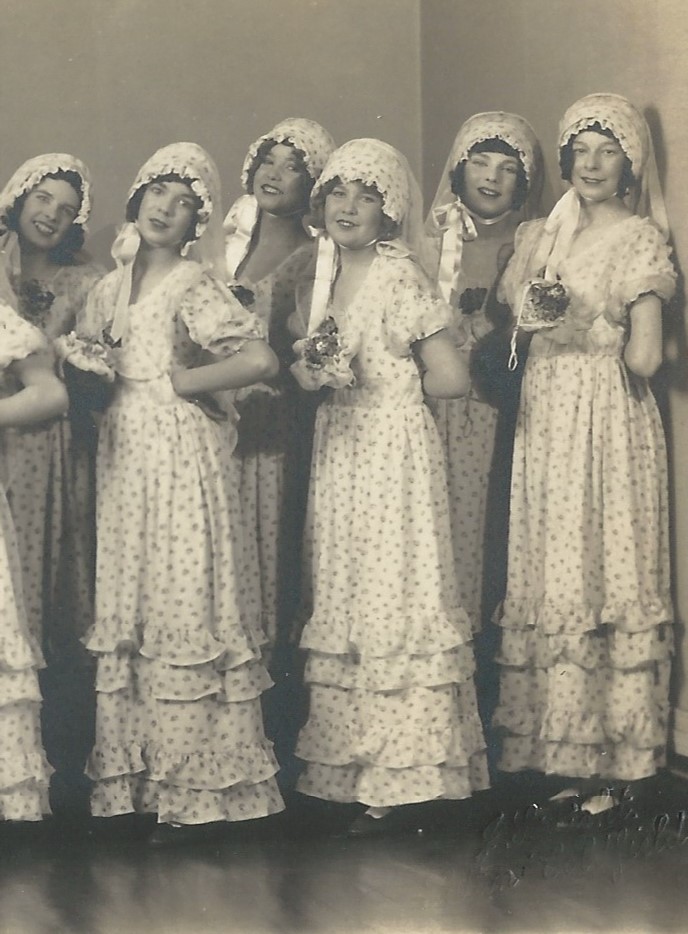
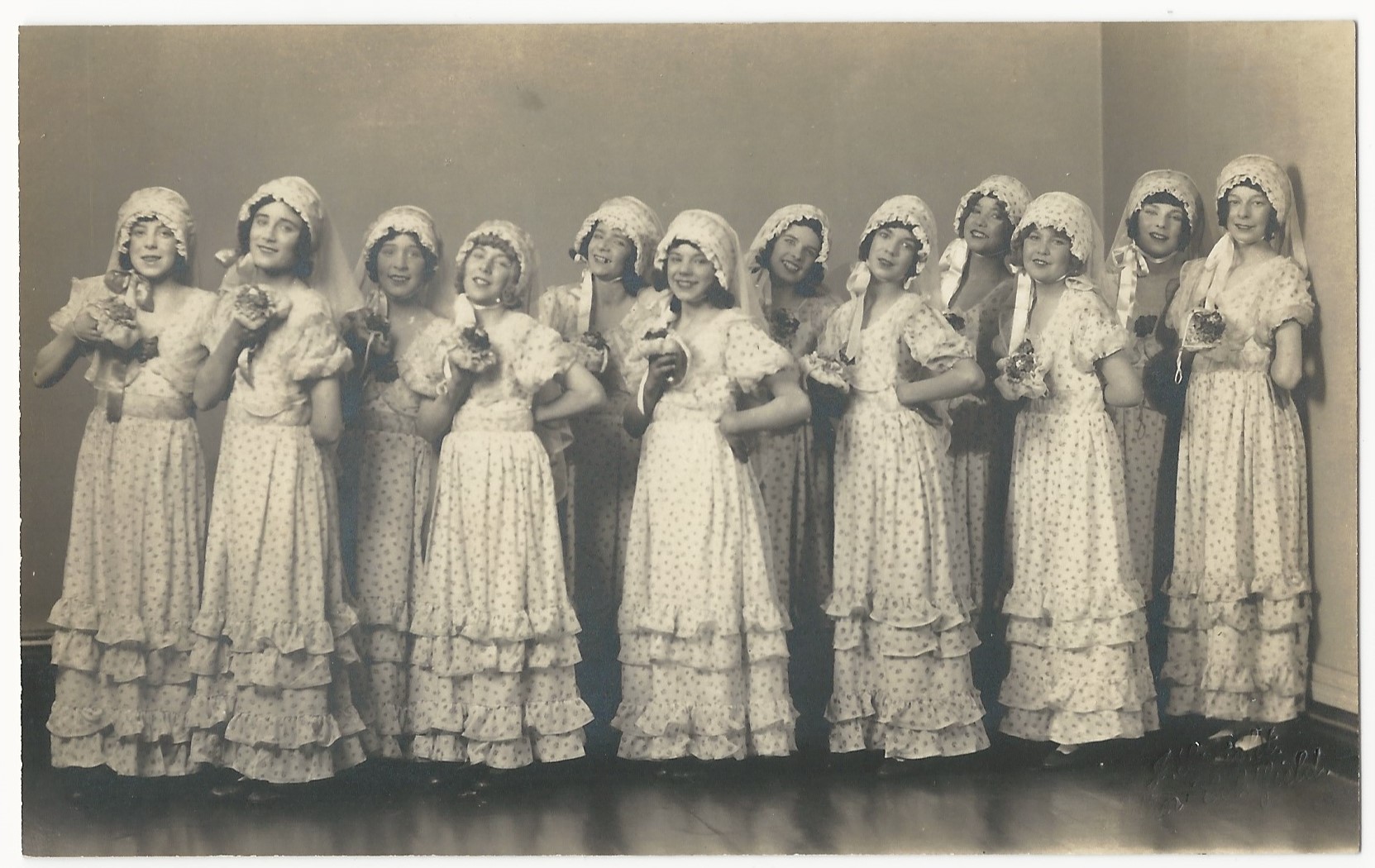
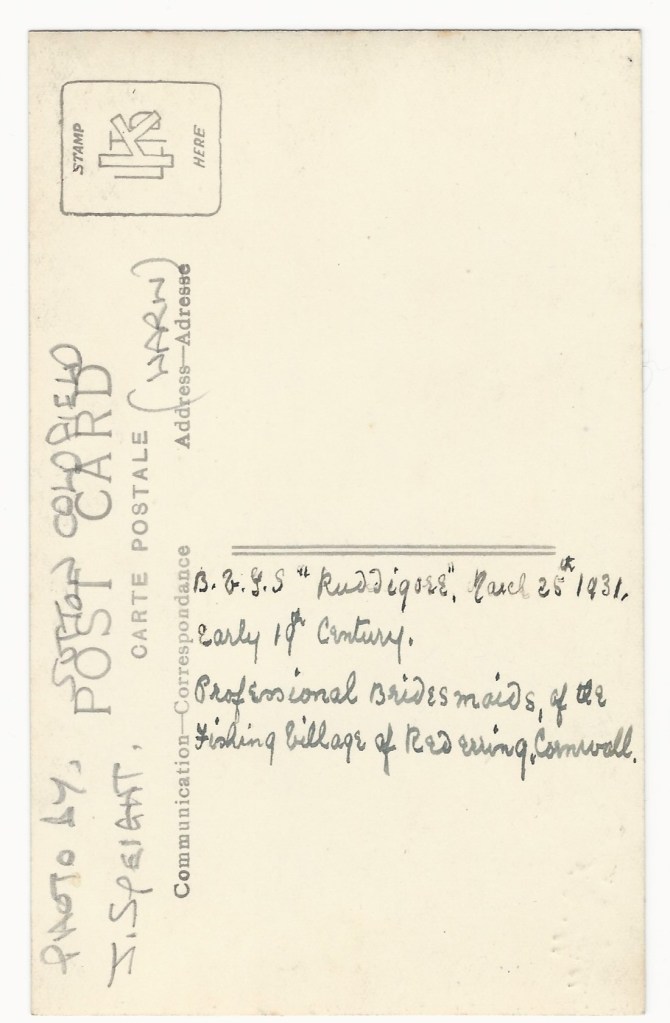
This vintage real photo postcard features twelve identically dressed bridesmaids standing in a row. These young women are not ordinary bridesmaids; they are professional bridesmaids. The women are professional bridesmaids. These professional bridal party stalwarts are for hire. This photo was taken in 1931 and the women resided in the fishing village of Redwing in Cornwell, England. In reality, the women in this photograph are actresses appearing as the bridesmaids chorus in the Gilbert and Sullivan comic opera, “Ruddigore”. The words “Sutton Coldfield” are written in pencil on the reverse of the postcard. Sutton Coldfield is a suburban town in Birmingham, England. Perhaps this is the venue where the comic opera appeared. A penciled inscription on the reverse of this postcard indicates that James Speight (1879-1977) is the photographer of this image. His father was the headmaster of a school in Rugby but later established a successful photography business. In 1897, at age 18, James went to work at H M Whitlock’s photography studio in West Bromwich. Speight’s interest in photography must have been in his genes. All 5 of his brothers became photographers. After working for a few more photographers, James decided to go to Paris for a few months, and once there, he worked for the celebrated photographer, Reutlinger. In his diary, James wrote that his retouching work for Reutlinger included making waists smaller. James returned to England and in around 1902, opened his Sutton Coldfield studio. He continued to operate the studio until he retired in 1950. This vintage postcard was published by K Ltd sometime between 1918 and 1936. This vintage postcard is in very good condition (see scans).
Buy this Vintage Real Photo Postcard (includes shipping within the US) #3200
To purchase this item, click on the Pay with PayPal button below
$38.50
Buy this Vintage Real Photo Postcard (includes International shipping outside the US) #3200
To purchase this item, click on the Pay with PayPal button below
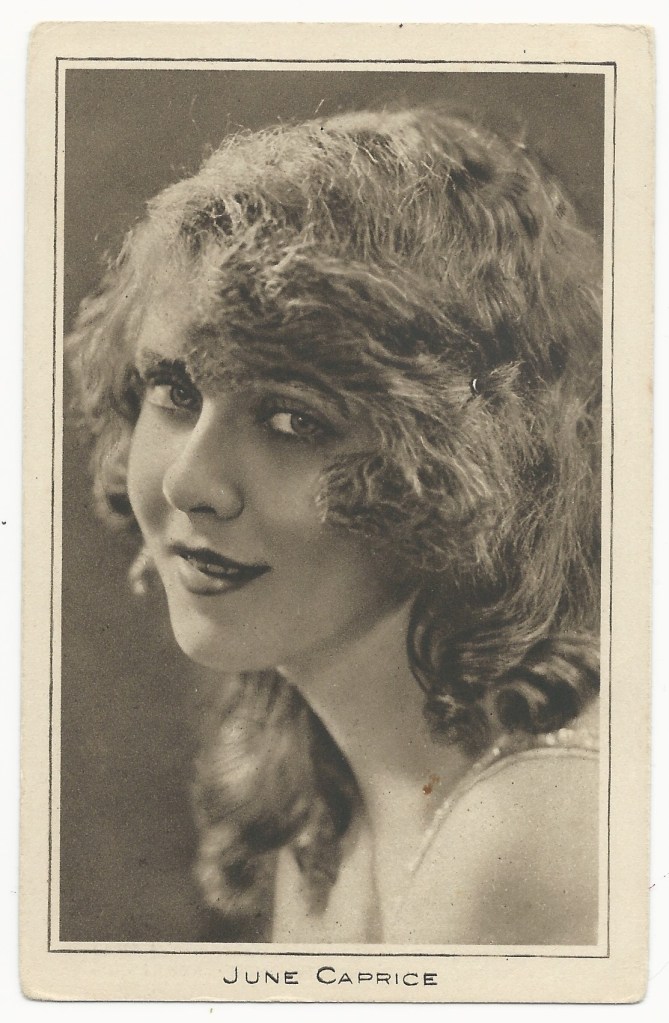
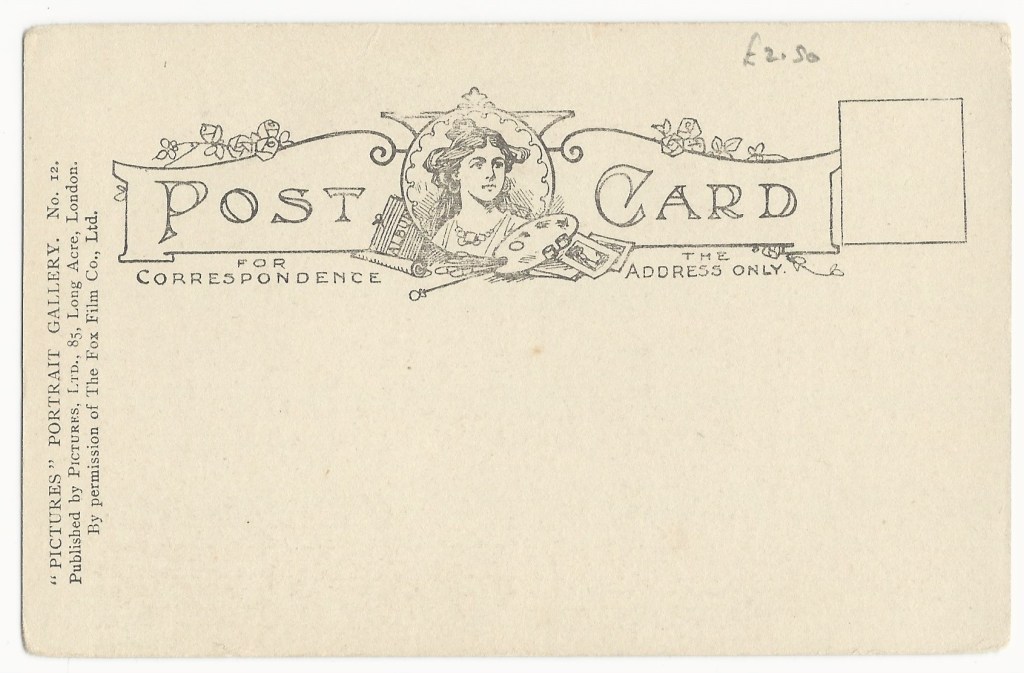
June Caprice started life named Helen Elizabeth Lawson. She was born in 1895 in Arlington, Massachusetts. June was a silent film actress. She attended school in Boston. Her acting career began on the stage. In 1916, she signed with the Fox Film Corporation to make films. William Fox had been searching for an actress to compete with Mary Pickford. Caprice had won a Boston Mary Pickford look-a-like contest. When he discovered Caprice, he boldly predicted that she would become the best known female on the screen within the upcoming six months. A press release introducing her to film fandom, stated that she was seventeen years of age. In fact, she was about twenty years old at the time. Caprice made her screen debut in a move entitled “Caprice of the Mountains” (1916). A film critic, writing in the New York Times described her as “young, pretty, graceful, petite, with an eloquence of gesture that augurs a bright future in the movies”. Her first film provided her with her stage name, “June Caprice”. June became quite popular. She received a lot of attention from fan magazines and was one of Fox’s most profitable stars toward the end of the 1910’s. She made sixteen films while with Fox. Her director for half of the movies was Harry F. Millarde. The pair began a relationship and eventually married. Caprice also worked at one time for Pathe studios. She left the film industry to begin a family and in 1922 she gave birth to a daughter. Caprice’s career took a downturn after World War I. The sweet, pure and innocent look lost popularity and was replaced by the jazz age flapper look. She later returned to working on stage and modelling. In 1931, her husband died at the young age of 46. Five years later, Caprice had a fatal heart attack while in Los Angeles. At the time, she also was suffering with cancer. She was just 40 years old at the time of her death. Caprice’s daughter was only aged 14 when she was orphaned. She was raised by her grandparents on Long Island, New York. She became a “cover girl” and actress. She used the name Toni Seven. Her photo and brief biography can be found elsewhere in the Cabinet Card Gallery. Seven inherited three million dollars from her family. The IMDb credits June Caprice with 22 film appearances between 1916 and 1921. This vintage real photo postcard was published by Pictures Ltd which was located in London, England. It was published with the perimission of the Fox Film Co. The card is part of a series (no.12) labeled “Pictures” Portrait Gallery. (SOLD)
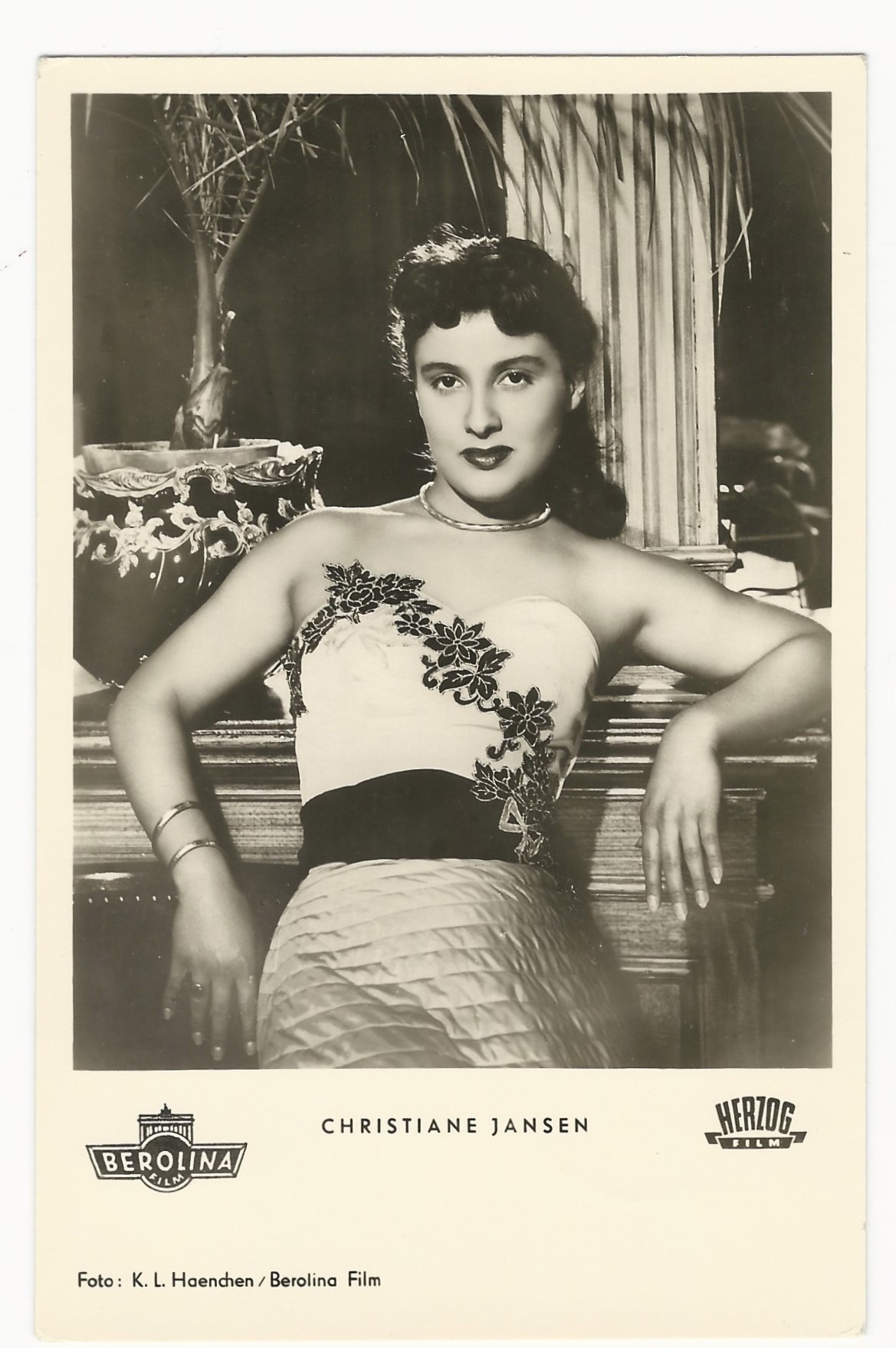
The pretty actress seen in this vintage real photo postcard is Christiane Jansen (1929-?). She was born in Germany. The IMDb credits her for 26 film performances between 1951 and 1972. Christiane appears very relaxed in this photograph. The logos from two film companies can be seen on the front of this card. “Berolina” was a film production company which operated in West Germany between 1948 and 1964. The second company is “Herzog Film”. Jansen was clearly employed by these conpanies at some point in her career. The photographer of this photo is K. L. Haenchen and it was taken while she was making “Mikosch Rockt Ein” (1952). The English translation of the movie title is “Mikosch Rocks On”. Christiane was 23 years of age when this photo was taken. The postcard was published by Kunst and Bild as part of a series (no.A636). This vintage postcard is in very good condition (see sans).
Buy this Vintage Real Photo Postcard (includes shipping within the US) #3195
To purchase this item, click on the Pay with PayPal button below
$4.50
Buy this Vintage Real Photo Postcard (includes International shipping outside the US) #3195
To purchase this item, click on the Pay with PayPal button below
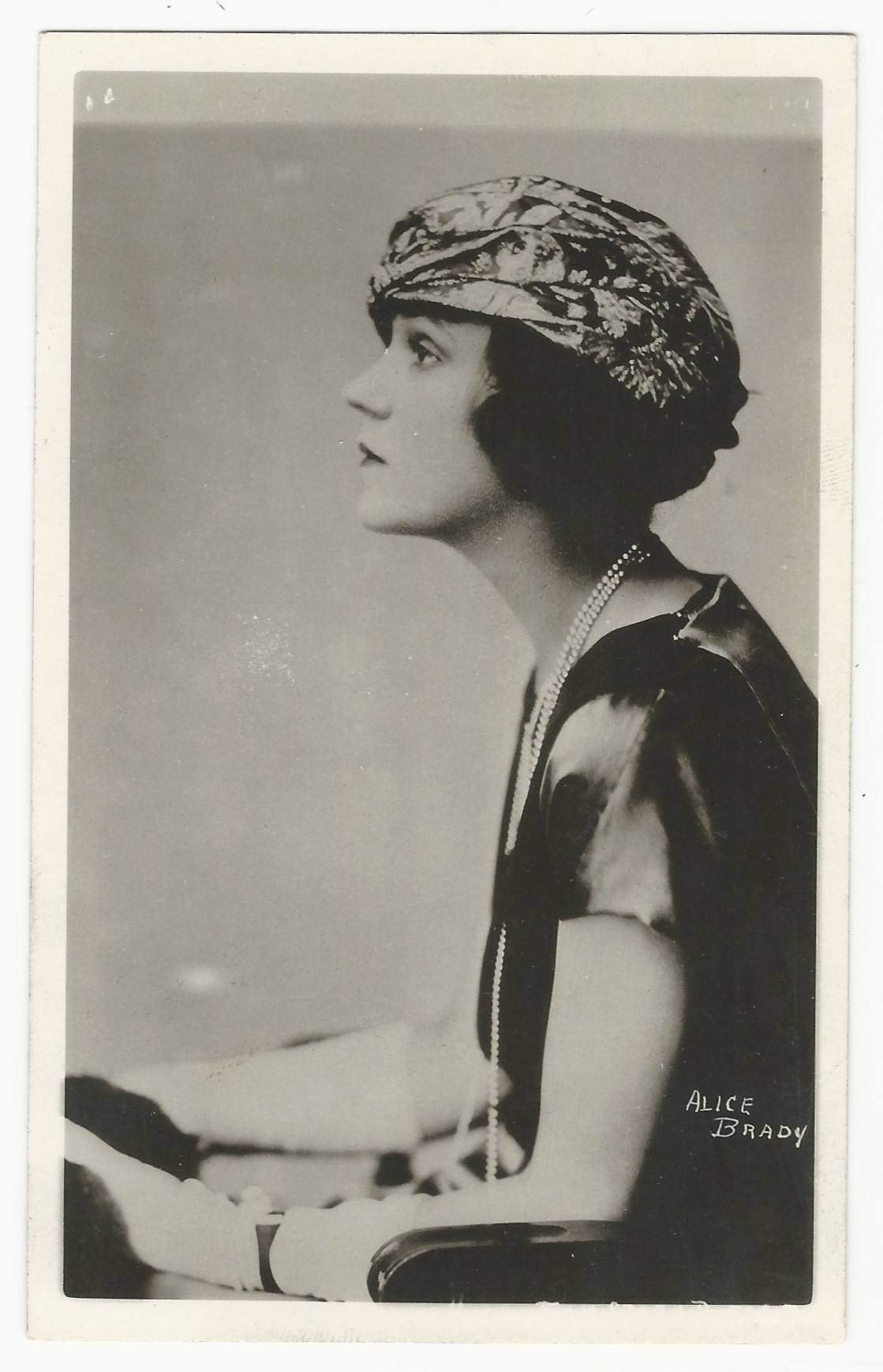
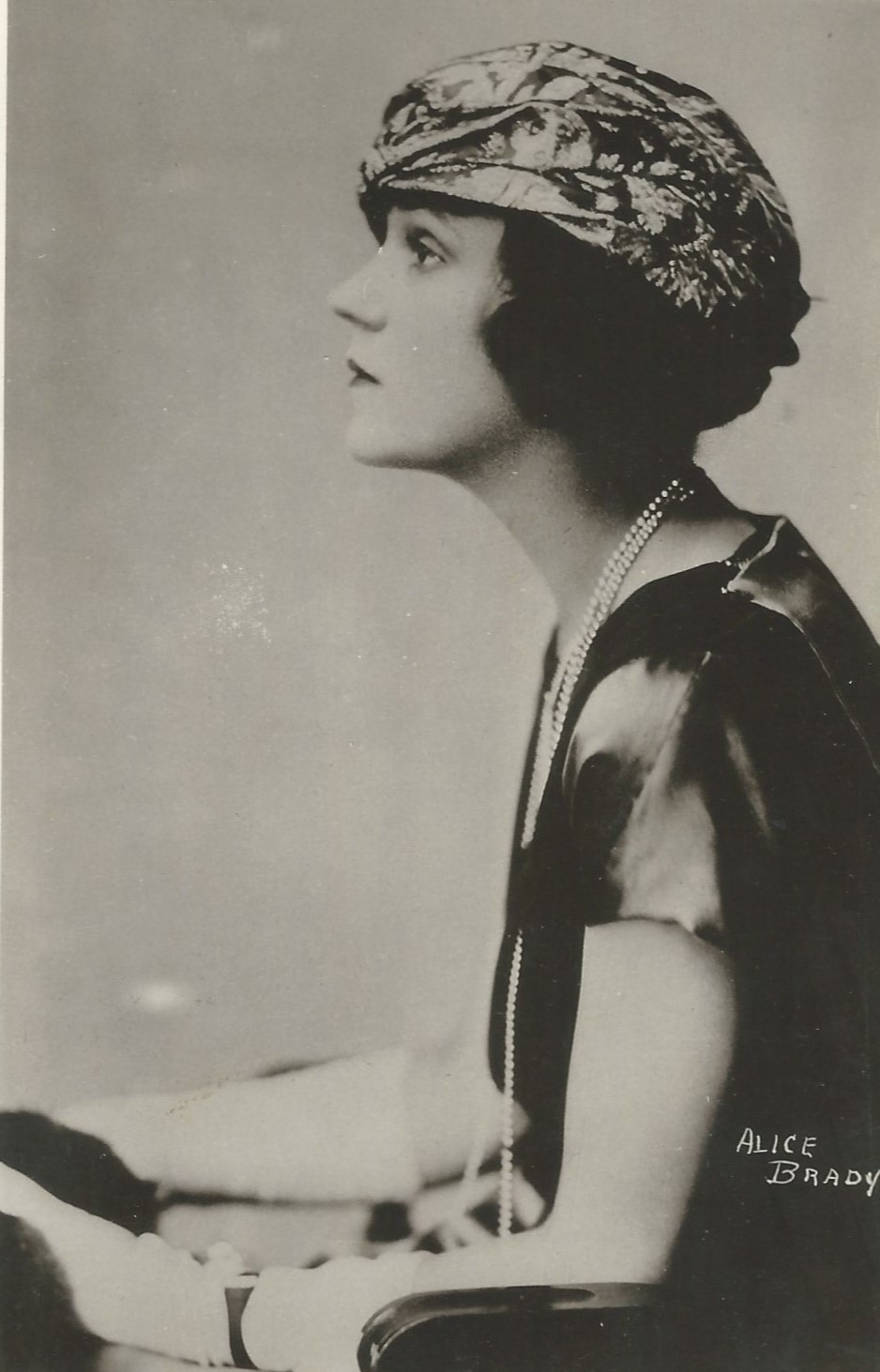
This vintage real photo postcard features film actress, Alice Brady (1892-1939). Brady was born in New York City into a theatrical family. Her father was a theatrical producer, and her mother was a French actress. When Alice was four years old, her mother died. Her father remarried and her step-mother was actress, Grace George. George (1879-1961) was a successful American stage actress. She had a long Broadway stage career and appeared in two films. Alice knew she wanted to be an actress, like her mother and step-mother, at an early age. Her first stage appearance was at the age of 14. Her first Broadway appearance was in 1911, at the age of 18. In 1913, she appeared with John Barrymore in “A Thief for The Night”. She performed on Broadway over a span of 22 years. She began her career during the silent film era and was one of the minority of actresses that successfully made the transition into sound movies. Brady’s films included “My Man Godfrey” (1936) and “In Old Chicago” (1937). Alice made her first silent feature appearance in 1914. She appeard in 53 films over the next ten years. Simultaneously, she continued to perf0orm on stage. In 1923, she took a ten year hiatus from the stage. In 1922 she made her first talkie, an MGM production. Over the next seven years, she made 25 more films. Her final film was “Young Mr. Lincoln” (1939). In 1937, Brady won the Academy Award for Best Supporting Actress for the film, “In Old Chicago”. She had been nominated for the same award the previous year. In all, Brady appeared in more than 80 films. It is important to mention Brady’s Broadway career. The IBDb reports that she appeared in over 40 Broadway productions. Some of the “Great White Way” productions (1911-1932) that included Brady were “H.M.S. Pinafore” (1911), “The Pirates of Penzance” (1912), “The Mikado” (1912), “The Yankee Princess” (1922), “A Most Immoral Lady” (1928), and “Morning Becomes Electra” (1931). Alice was married once. Her marriage to actor, James Crane, lasted from 1919 until they divorced in 1922. The marriage produced one son. Her life and career were cut short by her death from cancer just a day short of her 47th birthday. The “Cyko” stamp box on this postcard indicates that it was published between 1904 and the 1920’s. (SOLD)
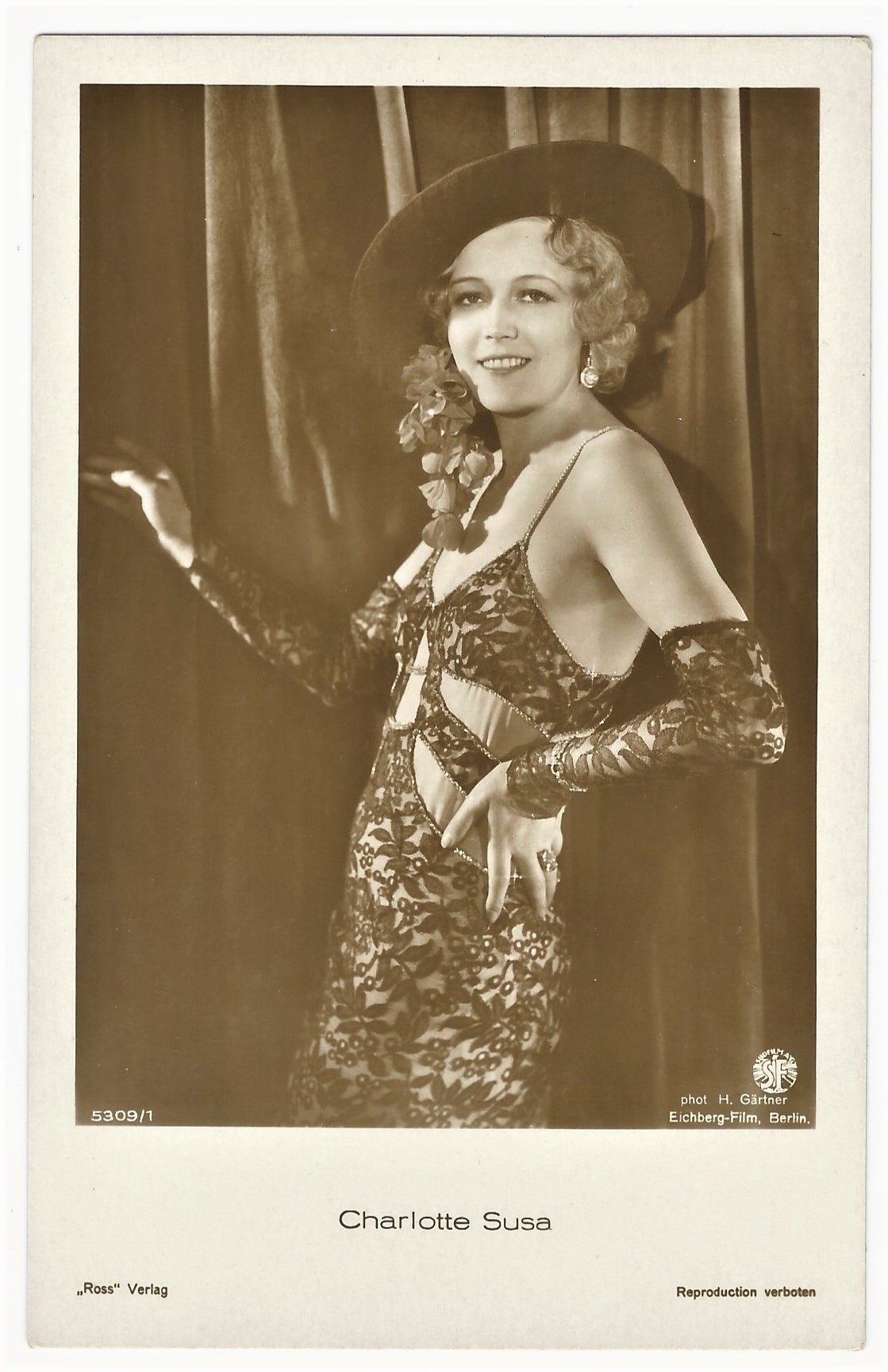
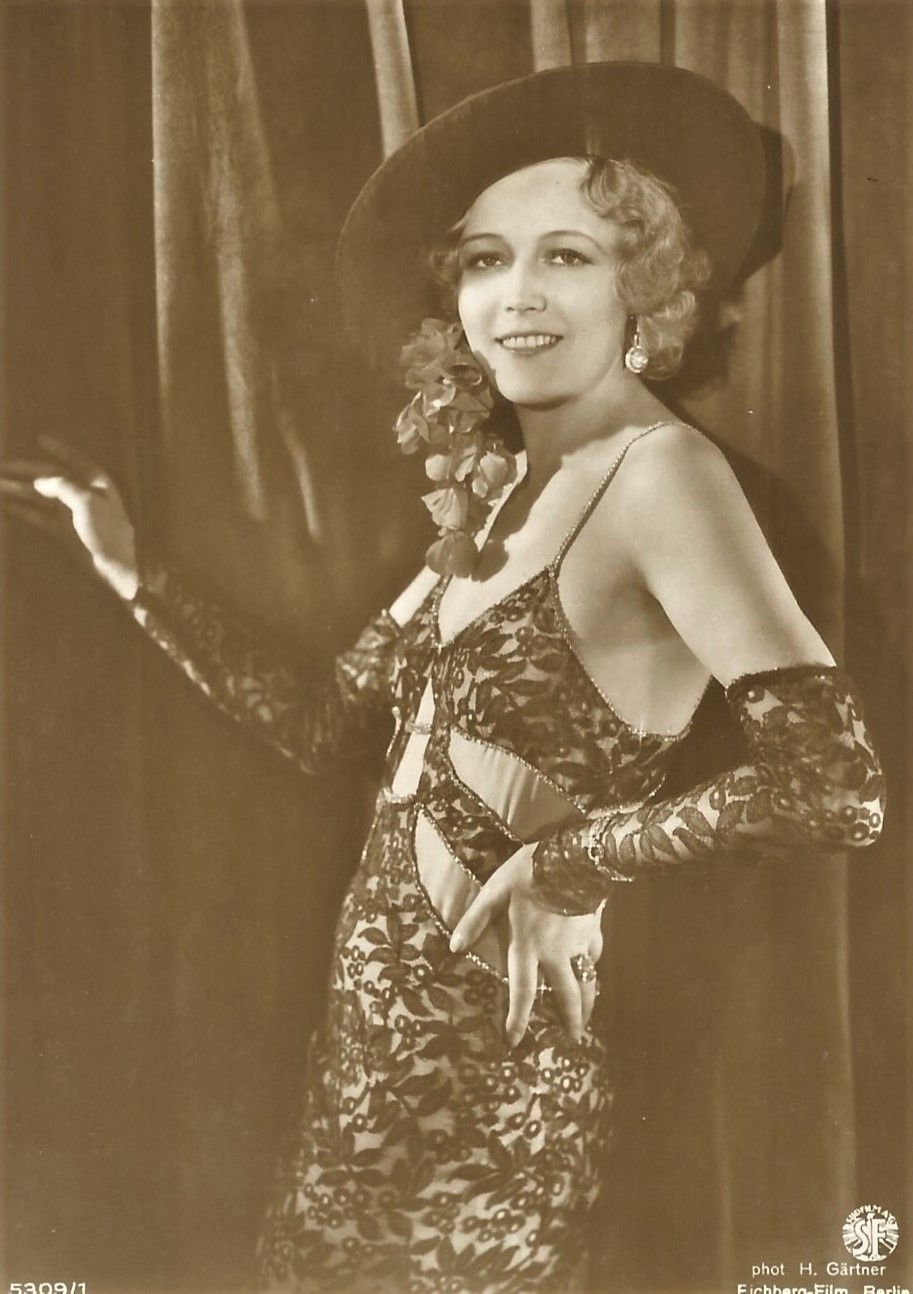
This vintage real photo postcard features German actress, Charlotte Susa (1898-1976). Sosa was very pretty and the “look” she gives the camera indicates that she knew it. She certainly has a sultry appearance in that dress. Susa was born in Memel, East Prussia. One of her parents was Italian and the other was Swiss. Her first stage appearance was in 1915. She began a successful career as both a singer and an actress. She played in a number of German opera and operetta venues. Her film debut occurred in 1926 with an appearance in a German silent movie. She became a popular actress and appeared in many femme fatale roles. After the advent of sound films, Susa began assuming leading roles. In 1932 she signed with MGM, relocated to the United States, and started an international film career. One newspaper columnist of the time wrote that Susa, Lilian Harvey, Anna Sten, and Henry Garat were all important “foreign talents” that were joining Hollywood pictures. Susa was projected to be a rival to Greta Garbo. Success in Hollywood did not come to fruition. She cancelled her contract in 1934. She stopped acting in films but returned to the stage after World War II. Susa, like many film stars, had multiple marriages. Susa stopped replacing husbands after her third marriage. Her third husband was Andrews Engelmann (1901-1992), a Russian born German actor. He appeared in German and British films during his career. Charlotte Susa died in Basel, Switzerland. The IMDb reports Susa had thirty-six film credits ranging from 1926 to 1941. This postcard portrait was photographed by H. Gartner and published by Ross Verlag as part of a series (no.5309/1). Eichberg Films is credited on this postcard. Richard Eichberg (1888-1952) began his career as an actor but became a succssful film director and producer in the German film industry. He directed 87 films and produced 77 films. At the time that Susa’s photograph was taken for this postcard, she was employed by Eichberg’s company. (SOLD)
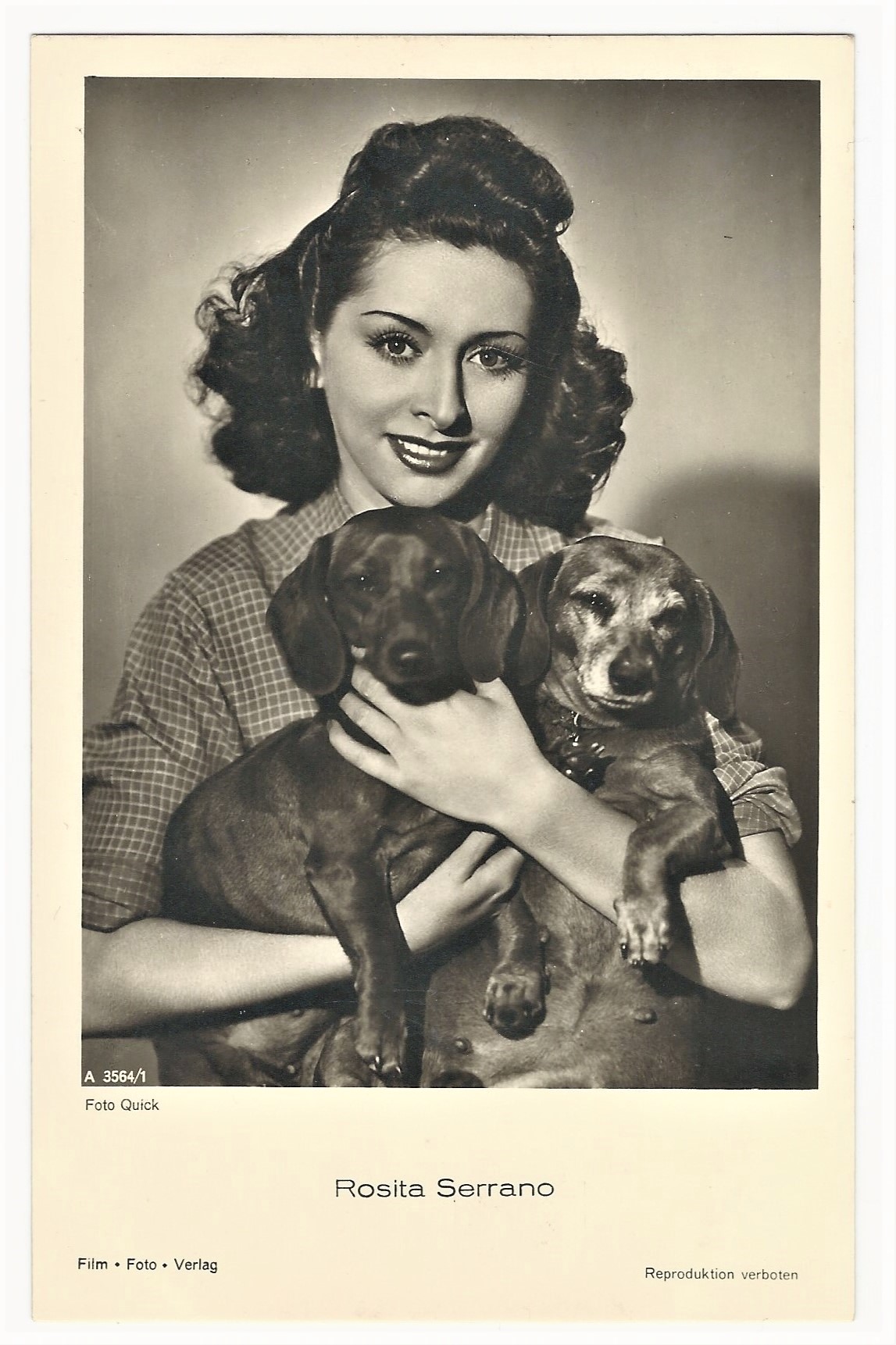
This vintage real photo postcard features pretty actress and singer, Rosita Serrano (1912-1997 . She is casually dressed and is holding two adorable dachshunds. This photo portrait displays Rosita’s lovely smile. Serrano was a Chilean singer who obtained her major success in Nazi Germany between the 1930’s and the early 1940’s. Her singing was known for her bell-like voice and her pitch-perfect whistling. She was known by her nickname as “The Chilean Nightingale”. Rosita was born in Chile. Her father was in the diplomatic corps and her mother was a popular opera singer. The family lived in Portugal and France . By 1936, the family moved to Berlin. Serrano’s initial success was in the Wintergarten and the Metropol Theater where she sang Chilean folk songs. This performance earned her a record contract. From that point, she performed in German. Many of her songs became very popular. In 1938, she began to appear in films. When she was between film roles, she toured with two popular dance orchestras. Minister Joseph Goebbels helped het her appearances on a Wehrmacht (military) radio show. In 1940, Serrano’s song “La Paloma”, became very popular throughout Germany. Serrano’s voice style is described as “coloratura soprano”. Her recordings were in German and Spanish. She sang songs in the folk and pop genre. Her songs included flamenco, rumba, tango and mambo. During a Swedish tour in 1943, she did a benefit concert for Jewish refugees. As a result of this performance, she was accused by Germany of being a spy. Rather than return to Germany and face possible arrest, she fled to Chile. Germany than banned her music. She went on tour to the United States but was not well received. It is conjectured that US citizens could not get enthusiastic about hearing Serrano’s German songs, so close to the end of World War II. She returned to West Germany to appear in films in 1951 and 1952. Besides those two movie roles, her German comeback was unsuccessful. She returned to Chile where she lived out her life. She was not welcomed upon her return to her native country. The public in Chile condemned her for performing in Nazi Germany. She died in poverty. It seems to me that Serrano had the unfortunate pattern of consistently being in the wrong place at the wrong time. Poor timing ruined this talented singer’s career. Serrano’s filmography includes 8 films between 1938 and 1952. This postcard was published by Film Foto Verlag, a subsidiary of UFA Universum Film AG. Note the company’s horse logo on the reverse of the card. The photo was taken by Foto Quick and the postcard is part of a series (no. A3564/1). Check out the video recording of Miss Serrano seen below. This real photo postcard is in very good condition.
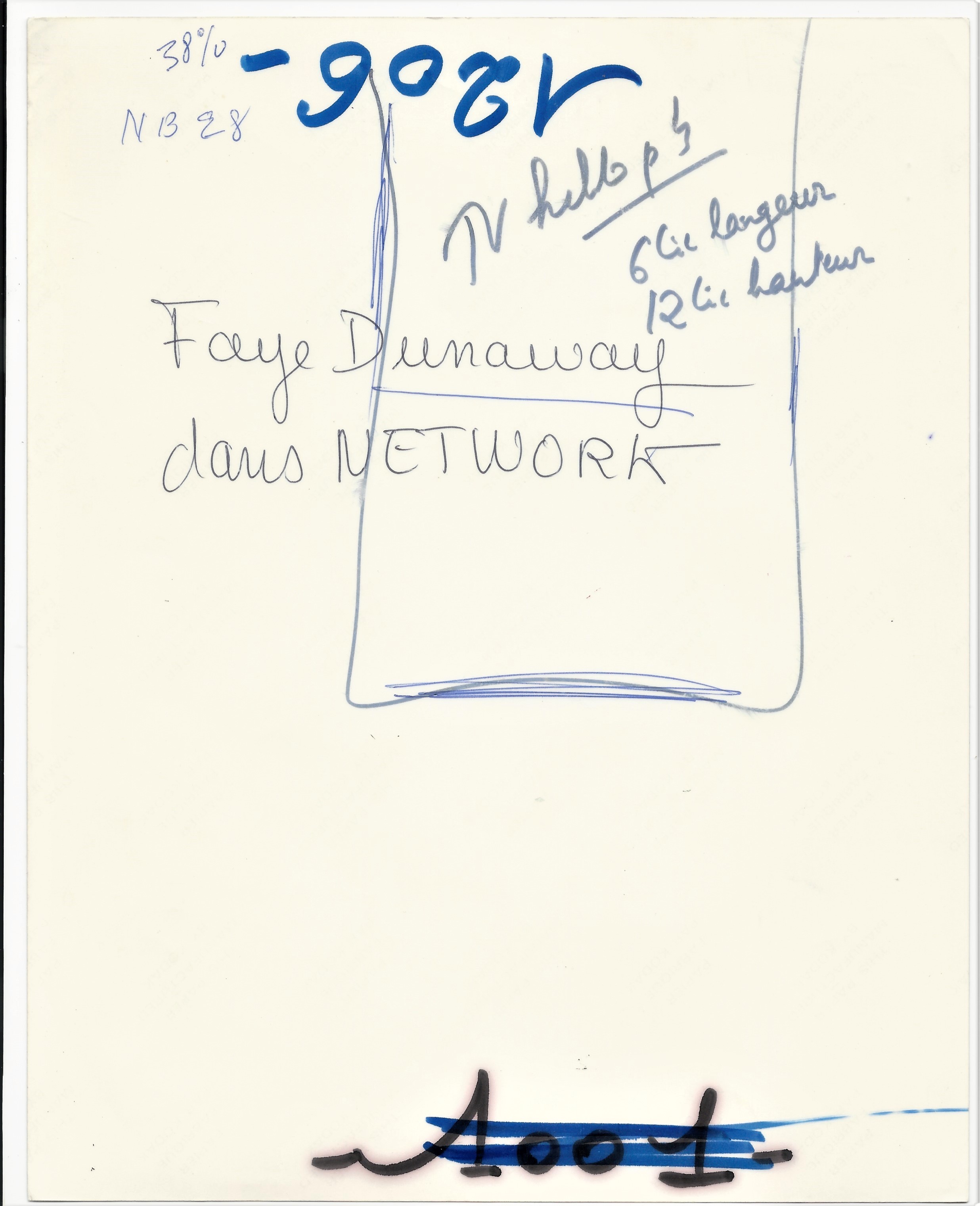
This vintage photograph is a portrait of actress, Faye Dunaway (1941-). The photo captures Dunaway in her role as a television executive in the film “Network”. Dunaway came away from the movie with an Academy Award (Best Actress). “Network” (1976) was a satirical drama. It was written by Paddy Chayefsky and directed by Sidney Lumet. Dunaway was born in Florida but because her father was an Army officer, she lived in a number of places in the US and in Europe. During her childhood she took dance, piano and singing lessons. She attended a number of colleges, but graduated from Boston University with a degree in theater. Soon after graduation, she appeared on Broaday in the drama “A Man for All Seasons”. She then appeared in a number of other theater productions. Her film debut was in “The Happening” (1967). She played the role of Bonnie Parker in the film, “Bonnie and Clyde” (1967). She got the role despite the initial objections of co-star Warren Beatty. She was nominated for “Best Actress” by the Academy Awards. The film made her into a star. Her next film “The Thomas Crown Affair” (1968) also was a hit. She received great reviews. Other film roles included “Little Big Man” (1970), “Chinatown” (1974), “The Towering Inferno” (1974). and “Mommie Dearest” (1981). The IMDb reports that Dunaway appeared in 115 television and film roles. The IBDb reveals that Dunaway appeared in five Broadway plays between 1961 and 1982. Dunaway’s personal life was somewhat unstable. Perhaps it was not more stable because of her many changes in residence during her father’s military career? In 1962 she had a year long relationship with comic Lenny Bruce. In 1968 she began a two year relationship with married actor Marcello Mastroianni. In 1974 she married Peter Wolf, the lead singer of “The J. Geils Band”. In 1977 she and Wolf were photographed by photographer Terry O’Neill who was working for People Magazine. O’Neill became her second husband in 1983. After her divorce from O’Neill, she had a number of other significant relationships. Interestingly, both of her marriages were of four years duration. This vintage photo was a press photo. It helped promote the film “Network. The photo is in excellent condition (see scans).
Buy this Vintage Press Photo (includes shipping within the US) #3152
To purchase this item, click on the Pay with PayPal button below
$24.00
Buy this Vintage Press Photo (includes International shipping outside the US) #3152
To purchase this item, click on the Pay with PayPal button below







 THE CABINET CARD GALLERY