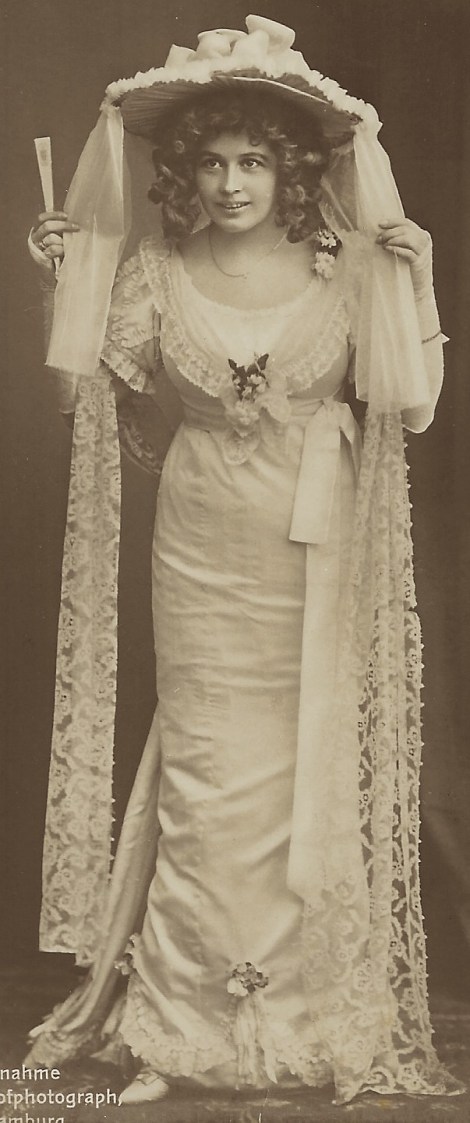
TWO PORTRAITS OF GERMAN ACTRESS VILMA VON MAYBURG (ONE PHOTO BY E. BIEBER)

mayburg

Postcard 1

veiled actress 4                                                                            Postcard 2


veiled actress 5                                                                        close up of postcard 2

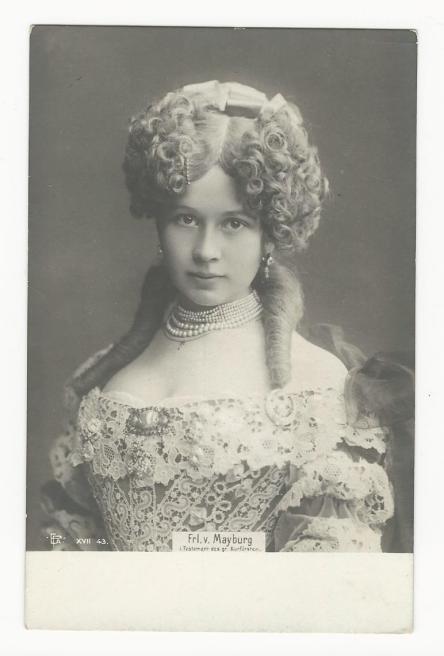
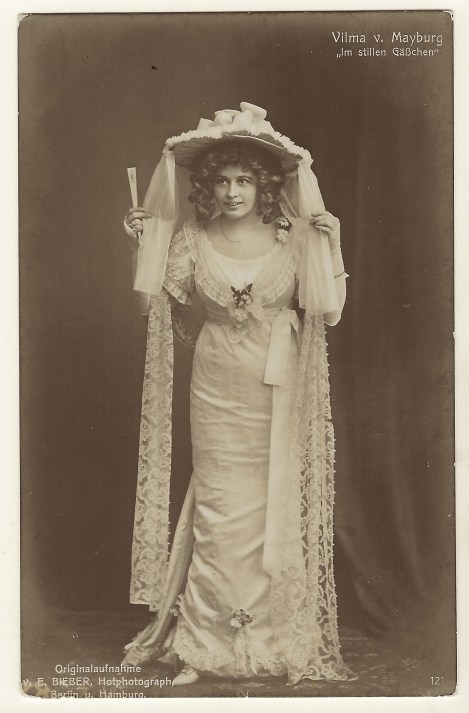
A costumed Vilma Von Mayburg poses for her portrait in the top vintage real photo postcard. The beautiful German stage and silent film actress is known for “Die Erbin des Grafen von Monte Christo (1919)”, Der siebente kub (1918)”, and  “Menschen in Ketten (1919)”. Her film career began in 1916.  This postcard was published by “EPA” which is the Albert Phototype Establishment. The company was located in Algers, Algeria.              The second photo postcard shows a standing Miss Mayburg. She is quite pretty and well dressed. She is adorned with flowers and holding a fan. After I purchased this photograph, I had a nice surprise. I realized that the photograph was taken by one of my favorite photographers, Emilie Bieber. She was quite successful and quite talented. Bieber had two studios in Germany; Berlin and Hamburg. The Hamburg studio operated from 1852 through 1872 when she was joined by her nephew, Leonard Berlin-Bieber, Emilie Bieber died in 1884. .

mayburg 1                                                            reverse of top postcard


veiled actress 3                                                  reverse of bottom postcard

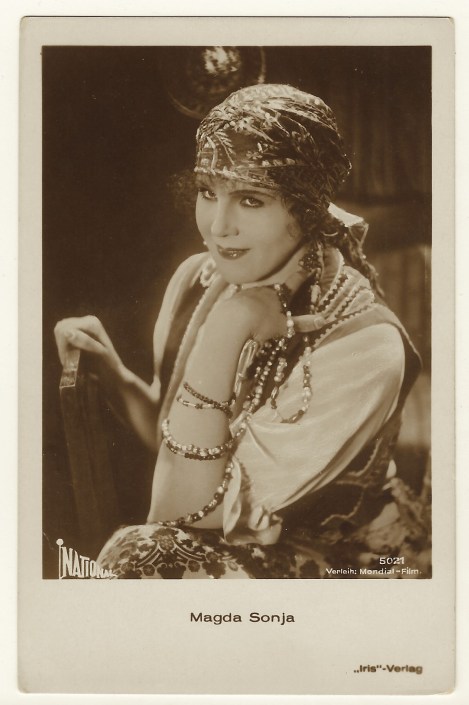
MAGDA SONJA: AUSTRIAN SILENT FILM ACTRESS

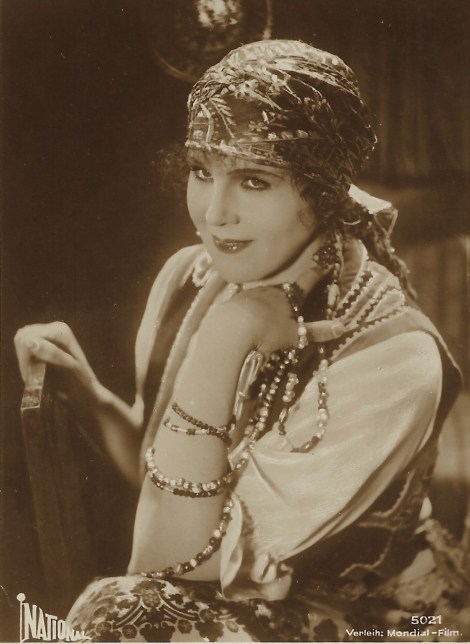
This vintage real photo postcard features Austrian actress Magda Sonja (1886-1974). She was married to film director Friedrich Feher. Her acting career began when she was twenty years of age when she appeared in a production in Vienna. She then appeared in a number of Cabaret performances. She began her silent film career in 1917 in the film “About A Woman”. By 1918 she was a star of Austrian silent films along with Liane Haid. In fact, Sonja was the actress with the most appearances for the very productive Sasch-Film company. Among her films were “The Other Me” (1918), “Don Juan’s Last Adventure” (1918), “The Venus” (1922), and “Drakula halala” (1923). She is considered to have reached the height of her career in (“Mata Hari, The Red Dancer”). The IMDb credits Sonja with appearing in 43 films between 1917 and 1937. Magda Sonja was another actress who’s career cooled off after the advent of sound movies. In 1933, she and her husband emigrated to England to avoid the persecution of Jews. In 1937 they moved to the United States. Sonja was the mother of actor Hans Feher. It is unfortunate that Sonja and her husband had no success in resuming their careers in Hollywood.  This postcard was published by Iris Verlag as part of a series (no, 5021). Logos for “National” and “Mondial-Film appears on the front of the postcard. Mondial-Film was a production company and a film distributor.

JACQUELINE LOGAN: BEAUTIFUL STAR OF FILM AND STAGE AND BIGAMIST

logan two

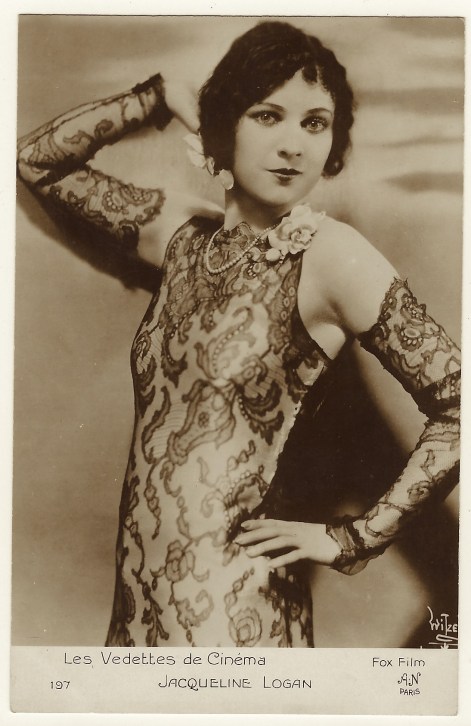
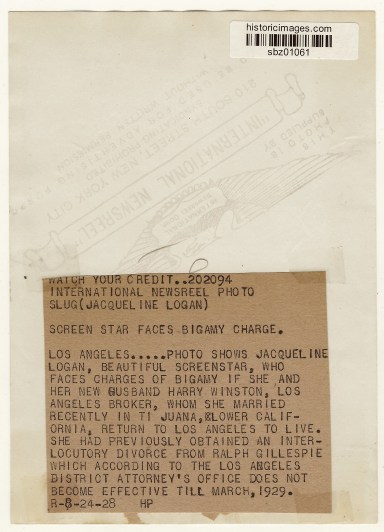
This vintage real photo postcard features silent film star Jacqueline Logan (1904-1983). Logan had auburn hair and green eyes. She was considered to be very beautiful. Logan was a “WAMPAS Baby Star” of 1922. The Western Association of Motion Picture Advertisers sponsored the WAMPAS promotional campaign. Each year between 1922 and 1934 the promotion honored 13-15 young actresses who were predicted to be on the cusp of movie stardom. Other honorees besides Logan included Clara Bow, Joan Crawford, Fay Wray, and Ginger Rogers. Jacqueline Logan was born in Corsicana, Texas and grew up in Nebraska. She worked briefly as a journalist in Scottsbluff, Nebraska and than went to Colorado Springs for health issues. She took a journalism course there and than moved to Chicago where she found a job dancing in a stage production. She had told her family she was going to Chicago to attend college. She then went of New York City with a theater troupe. While in New York, she received a small part in the Broadway musical “Florodora (1920). She was noticed by Flo Ziegfeld who hired her as a dancer. She also was selected to model in photographs by Alfred Cheney Johnston. By 1921, she began appearing in films. Her first role was in “The Perfect Crime”. Also featured in the film was Carole Lombard, who at the time, was a child actress. Cecile B. DeMille selected Logan to play Mary Magdalene in the film “King of Kings” (1927). The movie broke audience attendance records. With the advent of  “talkies”, Logan had less success. However, she did appear in “Show of Shows” (1929) in which she was a member of an all-star cast. Next, she went to England to do stage work. She received many good reviews. She was then hired by British International Pictures to write and direct films. She was successful in her writing and directing. When she returned to Hollywood she found that studios were not interested in hiring her for behind the camera work. Their resistance was likely predominately due to not wanting a female to direct films. Back in America, she appeared in several Broadway shows including “Merrily We Roll Along” and “Two Strange Women”. In 1934, after her marriage to an industrialist, she retired from films. The IMDB web site reports that Logan has 61 film credits between 1921 and 1931. The Internet Broadway Database lists 3 Broadway play credits for the actress between 1920 and 1935. In her later years, Logan became a conservative political activist and member of the John Birch Society. This real photo portrait postcard was produced in France. It was part of a series (no. 197) called “Les Vedettes de Cinema (Stars of the Cinema)”. The photograph was taken at the Alfred Noyer studio (AN) in Paris. The actual photographer may have been Witze. The postcard includes an advertisement for Fox Film, indicating Logan’s affiliation with the studio at the time of the photograph.  The second photograph of Miss Logan is a press photo from 1928. Judging by the title of the text on the reverse (see below), this image appeared in a newsreel. Jacquline Logan had made the news because she had committed bigamy. Apparently she married Larry Winston before her divorce from Ralph Gillespie had become finalized. It appears she was too impatient to wait for the ink to dry on her divorce decree.

 
                                                         REVERSE OF POSTCARD
logan two 1
                                                       REVERSE OF PRESS PHOTO


MISS PAULETTE: RISQUE PORTRAIT OF AN EXTREMELY BEAUTIFUL ACTRESS

beauty unknown

The beautiful woman seen on this vintage real photo postcard is Miss Paulette. I have been unable to find biographical information about her. The former owner of this photo postcard identified her as Miss Paulette and stated she performed in Paris at the Folies Bergere, a cabaret music hall established in 1869. This portrait of the actress is risque for it’s era but it is certainly tastefully done. In an attempt to identify this actress, I came across the five postcards seen below. I believe that the pretty woman seen in the postcard above is Paulette Del Baye although I lack any concrete convincing evidence. This postcard has a German stamp that is postmarked in Rixdorf (a neighborhood in Berlin). The card was postmarked 1912.  The postcard was published by Neue Photographische Gesellschaft (NPG) which was located in Berlin and Stuttgart, Germany.The company was in business between 1894 and 1948. It was founded by Arthur Black (1862-1943) and it became one of the most well known and largest companies involved in the production of postcards.   SOLD


Vintage French RPPC Postcard Artist Stage Star Miss Paulette   Paulette

Image result for postcard Miss paulette  Paulette

Image result for postcard Miss paulette  Paulette Del Baye

Image result for postcard Miss paulette  Paulette Del Baye

c-1907-French-Theater-Beauty-Mlle-DEBRIVES-fashion-tinted-photo-postcard  Paulette Debrives

Paulette Debrives

BEBE DANIELS: BEAUTIFUL AND MULTI TALENTED ACTRESS (VINTAGE REAL PHOTO POSTCARD)

daniels

POSTCARD 1 (SOLD)

                        daniels

POSTCARD 2

                        bebe-daniels-3

POSTCARD 3

                           Scan

POSTCARD 4   (SOLD)

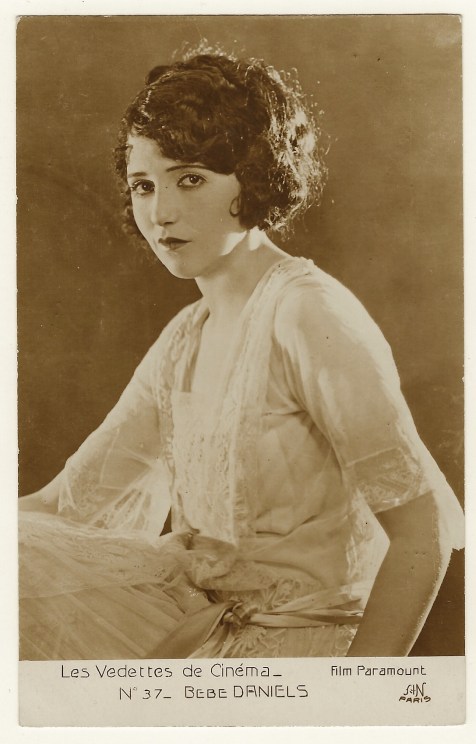
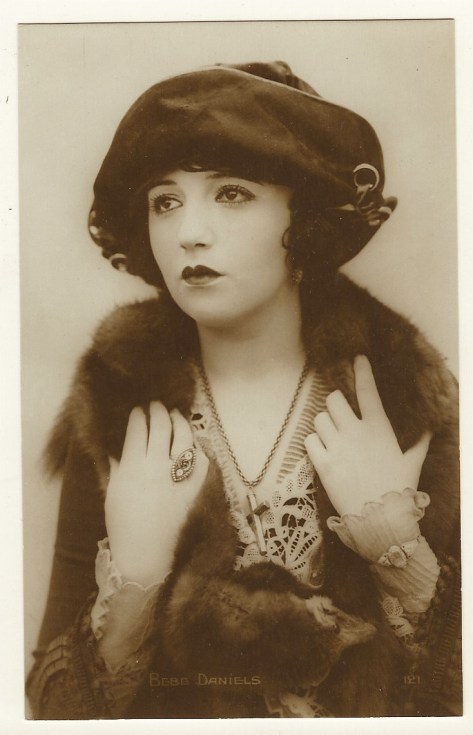
These vintage real photo postcards feature actress Bebe Daniels (1901-1971). The top postcard was published by Cinemagazine (Paris Edition) and is part of a series (no. 121?). Miss Daniels is absolutely beautiful. She is nicely dressed and her outfit includes furs. She is wearing a large ring and a necklace with a cross. Bebe Daniels was an American actress, singer, dancer, writer and producer. She was born in Dallas, Texas to show business parents. Her father was a theater manager and her mother was a stage actress. She started her career in Hollywood as a silent film child actress. She became a star in musicals such as “42nd Street”. She worked opposite Harold Lloyd and was under contract with Cecil B. DeMille.  She later became a popular radio and television actress in Great Britain. In the 1920’s she was under contract with Paramount Pictures and made the transition to adult roles. In 1924 she played opposite to Rudolph Valentino in “Monsieur Bearcaire”. She also recorded songs for RCA Victor. When talkies began, she was hired by RKO. While with RKO her movies included a number of musicals such as “Dixiana” (1930) and  “Love Comes Along” (1930). Over the course of her career, she appeared in 230 films. She retired from Hollywood in 1935. After World War II she was awarded the Medal of Freedom by President Truman for her service during the war. An interesting story concerning Miss Daniels is that while appearing in a Chicago hotel, several thousand dollars worth of her jewelry was stolen from her hotel room. Al Capone, the notorious gangster, was a longtime Daniels fan and put out an order that the thief had just 24 hours to return it “or else”. The jewelry was returned the following day.

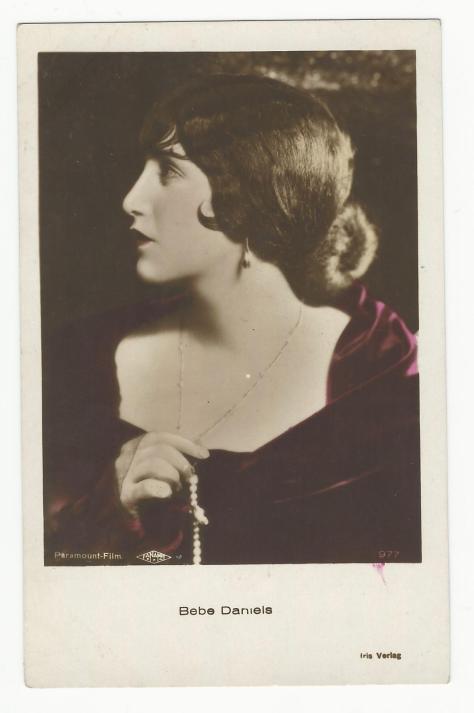
The second postcard of Miss Daniels was published by Iris Verlag for Paramount Films (Fanamet). Fanamet was an Austrian film distribution company. The postcard was part of a series (no. 977). This profile portrait also displays the beauty and appeal of Miss Daniels.Iris Verlag was the most important Austrian publisher of film star postcards. It operated from Vienna during the 1920’s and 1930’s. Iris Verlag was a different company than Germany’s Ross Verlag. Iris cards restricted itself to one postcard format and did not publish scene card series popularized by Ross. The early Iris cards had a sepia brown tone while the cards from the 1930’s were closer to “black and white”.

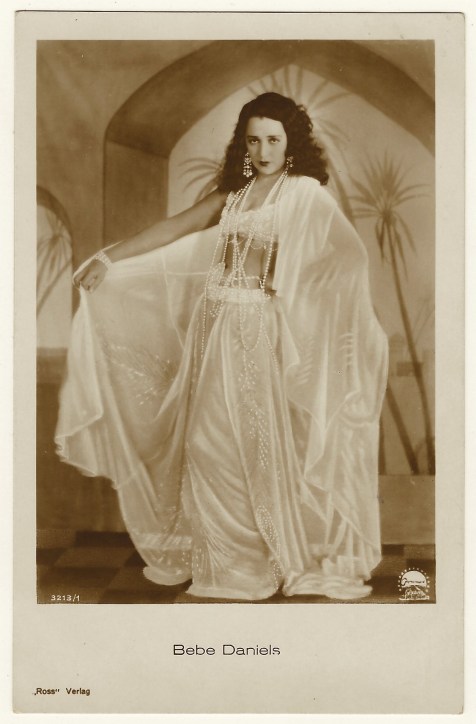
The third photo postcard features Bebe Daniels dressed as a “harem princess”. She is wearing a two piece dress with lots of see-through material. She is dressed and posed to look beautiful and sexy. I believe that the mission was accomplished. The postcard was published by Ross Verlag in Germany circa 1920’s. The postcard is part of a series (no. 3213/1) and Paramount Studio is credited. This postcard portrait of Miss Daniels is rare.

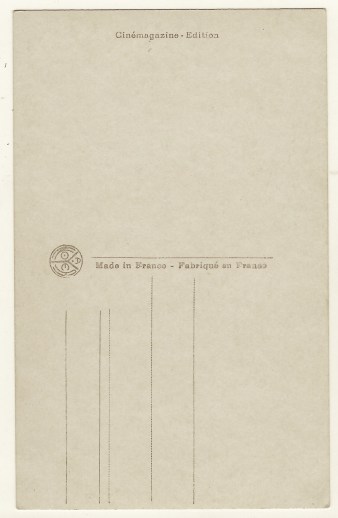
The fourth postcard portrait of Miss Daniels is from a series (No. 37) called “Les Vedettes de Cinema (Stars of the Cinema)”. The postcard includes the logo of Paramount Studios. This real photo postcard is published by Cinemagazine and was produced in France.


Scan 1

REVERSE OF FOURTH POSTCARD


SILENT FILM STAR SANDRA MILOVANOFF

This real photo vintage postcard features actress Sandra Milovanoff (1892-1957). Although she was Russian born, she was known for her roles in French cinema, particularly during the silent era. Milovanoff was very passionate about classical dance and attended a number of dance schools in St. Petersburg. She then joined the dance company of Anna Pavlova. She toured varied European cities but left Russia in 1917 in order to flee the Bolshevik Revolution. She went with her family to Monte Carlo where she played a small role in a film. She was noticed by French director Louis Feuillade who began using her in films. She had much success in film until the arrival of sound movies which basically destroyed her career. The IMDb credits her with 28 film roles between 1917 and 1950. Her films include “Les Miserables” (1925), “My Crimes After Mein Kampf” (1940), and “The Private Life of an Actor” (1948). A sample of her work can be seen in the video seen below (“In The Night” (1929) starring Sandra Milovanoff and Charles Vanel). This postcard was published by Cinemagazine in Paris, France and is part of a series (No. 114).

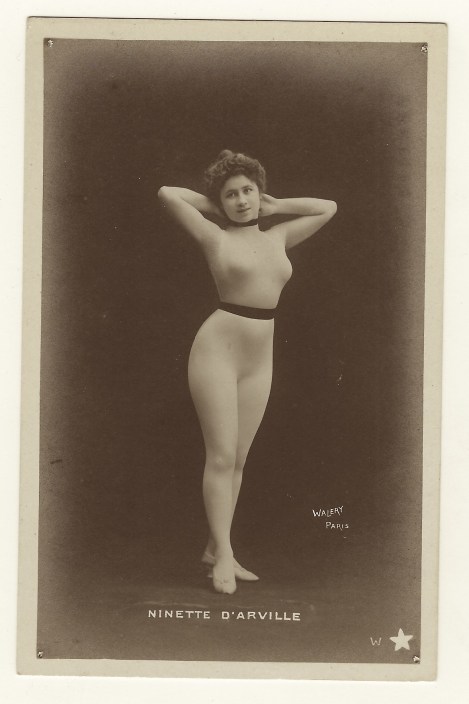
FAUX NUDE PORTRAIT OF CABARET ARTISTE NINETTE D’ARVILLE (PHOTO BY LUCIEN WALERY)

This vintage real photo postcard is racy for it’s time. The postcard features French cabaret artiste Ninette d’Arville. She is wearing a body stocking that is aimed at simulating nudity. Preliminary research found no biographical information about Miss D’arville. However, investigation did reveal that this postcard is part of a series that shows the actress in the same body stocking but assuming a number of different poses. The image utilized in this postcard was produced by photographer Lucien Walery. He was a celebrated Paris photographer known for his portraits of artists and cabaret dancers from the city’s music halls. He is very well known for his portraits of Mata Hari and Josephine Baker. Walery did a lot of work in the genre of nude/erotic photography. He photographed the beautiful women of Paris between the early 1900’s and the 1920’s.  Sold

Published in: on August 25, 2017 at 1:37 pm  Comments (1)  
Tags: ,

PORTRAIT OF FRENCH FILM STAR MLLE BARBIER (PHOTOGRAPHED BY LEOPOLD REUTLINGER)

This exceptional real photo postcard comes from the Paris studio of Leopold Reutlinger. His subject for this photograph is a beautiful theatrical actress, Mlle Barbier. The actress is spectacularly dressed and wearing hoop earrings in this color tinted photograph. The postcard is part of a series published by SIP (no. 1357). The home of SIP (Societe Industrielle de Photograpie) was Rueil, France. Research did not yield a firm identification of Mlle Barbier. A strong possibility is that the attractive actress photographed for this postcard was Charlotte Barbier-Krauss (1877-1938). The French actress was best known for appearing in “The Empty Cradle” (1910), “Le calvaire de Dona Pia” (1925), and “Poil de carotte” (1925). In 1914, she married director Henry Krauss. Mlle Barbier’s filmography includes about 34 films between 1909 and 1938. She is also credited with appearing in six plays between 1921 and 1937.

TWO PORTRAITS OF GERMAN FILM ACTRESS MARINA VON DITMAR

POSTCARD 1   (SOLD)

POSTCARD 2   (SOLD)
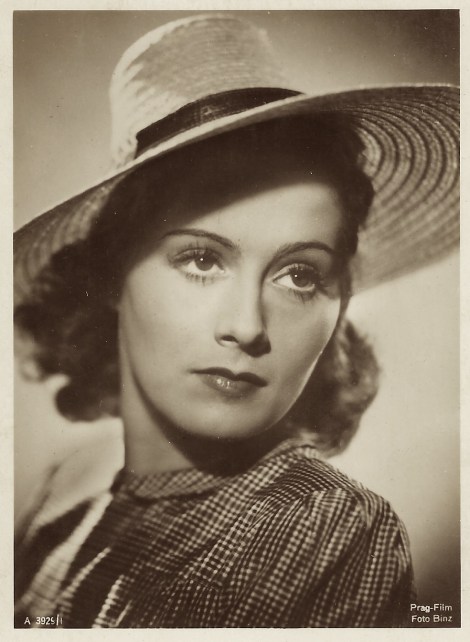
These two real photo postcards feature German film actress Marina von Ditmar (1914-2014), a leading lady of the 1930’s and 40’s. . She was born in the Russia Empire and was of Baltic German descent. When she moved to Germany she studied acting. Her first roles were appearances at Schauspielhaus, Bremen, and the Altes Theater (Leipzig). In 1937 she joined the ensemble at the Volksbuhne in Berlin and by 1940, she was a permanent actress at this venue. Her first major movie success was in “The Csardas Princess” (1934). In 1943, she starred in “Muchhausen”, a film that had great commercial success. Von Ditmar was also well known for her role in “The Big Shadow” (1942). She appeared in several Nazi propaganda film including Stukas (1941). She married D. Hans-Georg Dehnhardt (1913-2001), a leading physician and owner of a sanitarium,  Soon after her marriage, she retired from acting. The IMDB credits Miss von Ditmar with thirty film roles. The top postcard was published by Film-Forto-Verlag and was part of a series (A 2622/1). The photographer was Baumann and there is an advertising logo for the German film company UFA. The bottom postcard was also published by Film-Foto-Verlag and was part of a series (no. A 3926/1). The photographer was Binz and there is an advertising logo for Prag Films. The Prag company produced 14 films between 1943 and 1945. Many of the people employed to produce these films were Czechs who were forced by war time German authorities to produce these films. The photographer, Tita Binz (1903-1970), was German and she photographed many film stars of the Third Reich, She also made portraits of the soldiers who earned the Knight’s Cross (the highest military award in Nazi Germany). Binz began her career by apprenticing in Paris between 1928 and 1930. She was an apprentice for her uncle, the celebrated photographer, Leopold Reutlinger whose studio was opened in 1850 and became of the worlds most renowned studios. Binz settled in Berlin and worked for various photo studios until opening her own studio in 1938. She specialized in portrait photography and photographed actors, artists, politicians, and other celebrities. One of her clients was the publisher Film-Foto-Verlag (formerly Ross Verlag). The founder of the company, Heinrich Ross was forced out in 1937 by the National Socialists because he was Jewish and Jews were not allowed to own businesses. Ross Verlag retained it’s name until 1941. Film-Foto-Verlag became known for it’s postcard portraits of film stars of the German and Italian cinema. Today, many of Binz’s photo portraits can be found in the collection owned by the Deutsches Historisches Museum in Berlin.

                                                           REVERSE TOP POSTCARD

            REVERSE BOTTOM POSTCARD

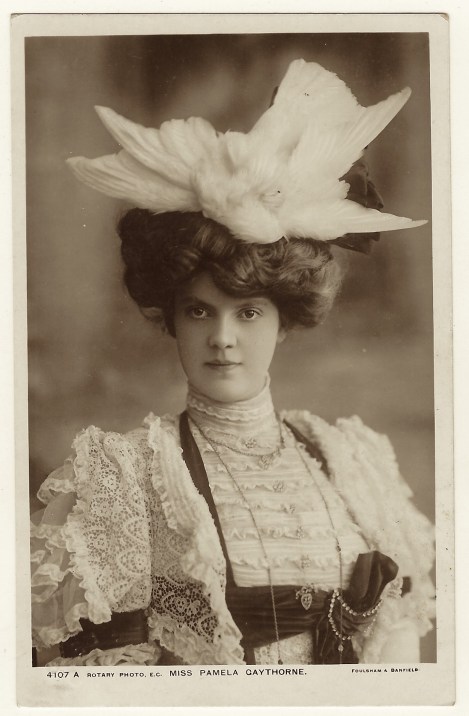
ENGLISH THEATRE ACTRESS PAMELA GAYTHORNE AND HER NOT SO SUBTLE HAT

This vintage real photo postcard features English stage actress Pamela Gaythorne. She is quite attractive and wearing much jewelry and lace. Note her not so subtle hat. It looks as if a seagull is resting on her head.  Miss Gaythorne is captured in this image as she appeared in “The Fascinating Mr. Vanderveldt. She appeared in this theatre production with Violet Vanbrugh and Arthur Bourchier. The IBDB reveals that Miss Gaythorne appeared in, and often starred in, 12 Broadway productions. Her Broadway career spanned from “Keeping Up Appearances” (1910) through “This Fine-Pretty World” (1923). The New York Times (2/14/1911) reviewed a play named “Nobody’s Daughter”. Gaythorne appeared in this play and in writing about her, the reviewer wrote that he “heartily commends” her performance. The article adds that she played her character with “delightful spontaneity, charm, variety, and suggested youth and spirit, while touching the more sentimental passages with manifest sincerity”. The photographers of this image was Foulsham and Banfield, a prolific celebrity postcard portrait studio. The postcard was produced by Rotary Photo and is part of a series (no. 4107 A). The message on this card is from Bob to Miss Marion Lipman and states “I will come in and see you when I go to the city”. Also written in the message section is what appears to be “The Empire Confectionary”. Perhaps a Cabinet Card Gallery visitor can throw some illumination on that term and also ascertain what nation the stamp of this postcard represents. The postcard is postmarked 1906.