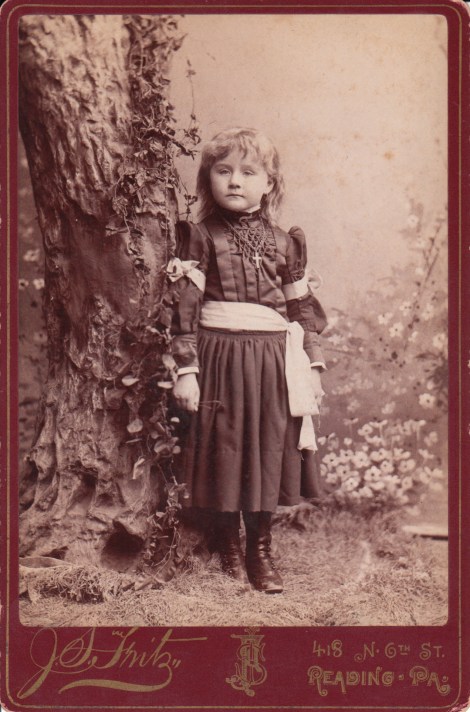
 An adorable little girl poses for her portrait at the studio of J. S. Fritz in Reading, Pennsylvania. Something is drastically wrong with this picture. The yellow ribbon is supposed to be tied around the old oak tree, not the girl’s waist and arms. Pardon my anachronism. The child in this photograph was likely told not to smile and she complied with the request. However, she is displaying an “all knowing” look. She is well dressed and wearing earrings and a cross. Note the unusual burgundy color of this cabinet card. To learn more about photographer John S. Fritz, click on the category “Photographer: Fritz (JS)”.
ADORABLE LITTLE GIRL GETS HER SIGNALS CROSSED IN READING, PENNSYLVANIA

SMALL BOY AND HIS BIG DOG IN NEW YORK CITY, NEW YORK.

A long haired and very well dressed young lad poses with his dog at the Rockwood studio in New York. The boy is wearing interesting leggings and a terrific hat. His dog appears to be a Burmese Mountain Dog but that is simply an uninformed guess. There is an unusual notation below the image; “Printed on N. P. S. extra brilliant albumen paper”. The photographer, George Rockwood of New York City was a noted celebrity photographer. It is possible that the boy featured in this image may have been a child actor. To learn more about the photographer, click on the category “Photographer: Rockwood”.
A BOY AND HIS DOG: BOY IDENTIFIED AS “ELDEN McFARLAND (I THINK)”
 A little curly haired boy in a rufflled shirt poses at the Twasaki studio along with his large white and black spotted dog. The boy is wearing a checkered bow tie. The dog appears to be resting comfortably as it sprawls on a rug in front of his young master. The boy has a sparkle in his eyes and his foot is resting lightly on the dog’s back.The reverse of the photograph has a handwritten inscription that identifies the child as “Elden McFarland (I think)”. The writer of the inscription was unusually honest about his lack of conviction in the identification. The dog pictured in this photograph is a St. Bernard (I think). If I am wrong, someone more informed than me about dog breeds will assuredly correct me via a comment.The photographer’s name on the bottom of this image is illegible. It appears to be Twasaki or Iwasaki but research was of no value in identifying the photographer or the location of his studio. The name Elden McFarland was too common to find biographical information about the subject. Knowing the location of the studio would have facilitated finding background information concerning young Master McFarland.
A PORTRAIT OF A BOY AND A CHAIR BY MISS LIBBY IN NORWAY, MAINE (NOTED FEMALE PHOTOGRAPHER)
 A young boy dressed in a double breasted jacket and wearing a tie poses for this portrait by Miss Libby of Norway, Maine. Minnie Libby (1863-1947) had a sixty year business career in Norway, Maine. She was a very able photographer and also an eccentric. She was the daughter of a Maine born blacksmith who was also a carriage maker and dealer. The 1880 census lists her at age sixteen as being an artist. She was sent to the Boston Museum of Fine Arts and developed an interest in photography. She worked as a studio photo retoucher while living in Boston. In 1882 she worked as a photo retoucher at the Anthony Crockett Picture Studio in Norway. In 1885 her father constructed a building to house her first studio. By the 1890’s Miss Libby was quite successful. In 1905 her father helped her buy a new studio which caused some controversy in the town of Norway. The seller of the building neglected to tell his tenant, a photographer, that the building was sold. The tenant photographer took ads out in the local paper denouncing the underhanded business practices of Miss Libby who ultimately occupied the building. Miss Libby’s response to the ads was to take out her own ads in which she said that she would use the advertising space to talk about her business, and not to make misleading statements about her competitors. In 1940, Life Magazine discovered Miss Libby. They did a feature on her life as a photographer, both past and present. Minnie Libby also produced oil paintings while working as a photographer. She was a talented artist and did many paintings of plants and flowers as well as landscapes. The Life Magazine article describes Miss Libby’s appearance. She most often wore knickers, men’s shirts, and a flowing bow tie. She was also described as a “first class photographer”. To view other photographs by Miss Libby, click on the category “Photographer: Libby”.
PENSIVE AND PRETTY GIRL WITH LONG HAIR IN LINCOLN, NEBRASKA
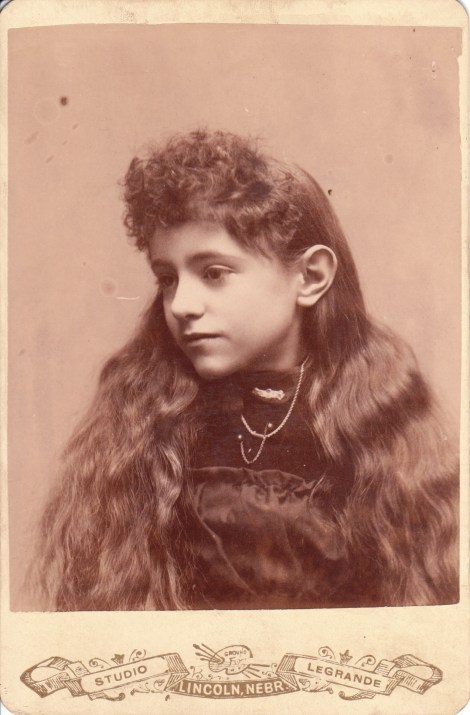
A pensive and pretty young girl with very long hair poses for her portrait at the LeGrande studio in Lincoln, Nebraska. She is wearing a necklace, a collar pin, and a dark dress. Resarch found information concerning the LeGrande Studio to be sparse. At one point in time, the studio was located at 1245 Twelfth Street in Lincoln and its proprietors were named Speake and Peirson. Jefferson Grant Speake (1863-?) was listed in the 1891 and 1893 Lincoln Business Directory. He was listed as a photographer and owned the LeGrande studio. He is noted in the 1900 US census, and both he and his wife of 13 years, Hattie E. Speake (1863-?) appear in the census as living in Omaha, Nebraska and both Jefferson and Hattie were reported to be photographers. The 1902 Omaha business directory also lists Jefferson Speake as a photographer. No information could be found about Mr. Peirson, Speake’s Lincoln business partner.
A BOY AND HIS DOG SHARE A COUCH IN ALMA, WISCONSIN
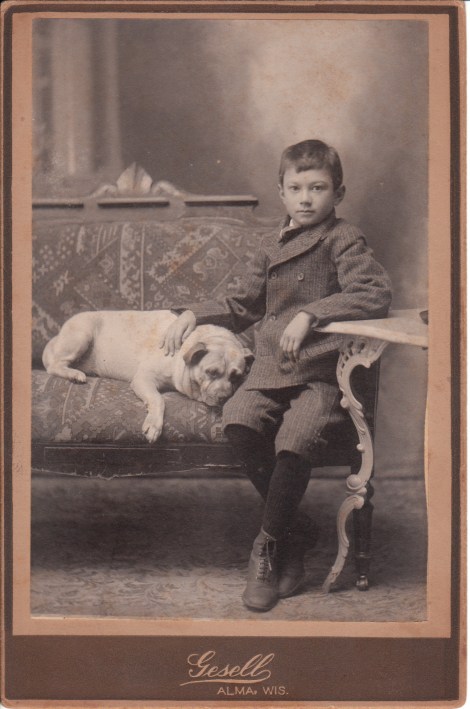 The Gesell studio of Alma, Wisconsin, produced this wonderful portrait of a boy and his dog. The boy’s love for his dog is apparent by his expression as well as by his resting his wrist and hand on the pooch’s neck. The dog appears quite tired in this photograph which certainly makes the photographer’s job easier. Photographing dogs required special talent and the photographer of this image certainly possessed that talent. The lad pictured in this photograph is identified on the reverse of the image as being named “Emil Bardil”. Emil Bardil (or Bardill) was born in 1893 in Alma, Wisconsin. His father was John Bardill and his mother was Katie Roffler. His parents were of Swiss extraction. The 1900 census finds seven year-old Emil living with a Katherine Bardill (age 54) and his two brothers John (age 11) and Eddie (age 9). The 1910 census reveals that Emil was a boarder in an Alma home and worked as an apprentice printer. The 1920 census discloses that Emil is living in Chico, California with his wife Alice, and working as a printer. The 1930 census indicates that Emil and his wife had taken a boarder into their Chico home and the boarder was employed as a school teacher. The 1940 census shows that Emil had become a foreman at a print shop and worked as a lineotype operator. Census data indicates in 1940, he remained in Chico. Two years later he registered for the draft. He lived a long life and died in California in 1985. The photographer of this portrait was Gerhard Gesell. He was an important figure in Wisconsin history and the Wisconsin Historical Society presents much biographical information about Mr Gesell. Gesell was born in Germany. He came to the United States and in 1863 he enlisted in the Army and served with “Brackett’s Battalion” of the Minnesota Cavalry on the western front. He entered the military as a private and was discharged as a saddler. After the war he returned to Reads Landing, Minnesota and worked as a saloon keeper until he entered the field of photography. He began his photography career in Reads Landing in 1873. In 1876 he relocated to Alma and opened a studio at 401 South Main Street. He operated his photography business in Alma for 30 years (he died in1906). Gesell is noted for his work of documenting the town, its people and culture, and its relationship to the Mississippi River. He took many photographs outside his studio capturing the Alma citizens in many of their activities. In 1879 he married Christine Giesen and they had five children. The couples oldest son, Arnold, became a pediatrician and well known psychologist. Arnold’s son also made a name for himself. Gerhard Gesell (named after his photographer grandfather) was a noted federal judge in Washington D.C. and he presided over many important cases including the Iran Contra Affair, the release of the Pentagon Papers., and the Watergate Scandal. How did this blog entry go from focusing on a little boy and his dog to the Watergate Scandal? Here is an answer to that question. Part of the beauty of cabinet card photography is that each image tells a story. When we look at a photograph, we use conjecture to create a story about the photograph. These created stories are based on our knowledge, as well as our psyche. A second story is created when we research the photographers, the subjects, the activities, and the times reflected in the photographs. That is the beauty of these photographs, we never know where viewing these turn of the century images will take us.
THREE PRECIOUS KIDS IN TEKAMAH, NEBRASKA

This cabinet card features three precious little children wearing adorable outfits. The child in the center of the image is holding a rake and wearing a large bow tie and a straw hat. The two girls are flanking the little boy in the middle and each girl is holding their hat. There is a basket of flowers on the floor in front of the trio of children. The photographer of this image is the Mathison studio in Tekamah, Nebraska. Ingbert L. Mathison (1868-1935) was born in Denmark in 1868. He came to America with his parents at the age of 2. He grew up in Iowa and came to Tekamah, Nebraska in 1891. He became a photographer and later added furniture sales to his business. The 1900 US census reveals that Mathison was married to Grace Theodoria Christy (1870-1902) and the couple had four children between the ages of 3 and 9. Two years after this census, Grace died, leaving Ingbert with four young children. Ingbert soon got remarried. His new bride was Mary Etta Slaughter (1873-1939). The Mathison family then moved to a community outside of Denver, Colorado. Ingbert worked as a farmer, and later, a grocer, in Colorado. He died in a Denver hospital in 1935 at the age of 67. The cause of death was hemorrhages of the stomach.
THIRTEEN TEENAGE GIRLS POSE AT PAJAMA PARTY? STAGE PRODUCTION? WEDDING? (DECIDE FOR YOURSELF)

What is happening in this unusual and interesting cabinet card photograph? Your guess is as good as mine. There are thirteen teenage girls in this image who seem to be celebrating something. The girl in the center of the photograph is wearing a crown or veil and is flanked by two girls pressing their hands up against each other as if to create a steeple.. Are they holding a train of a dress? The girl in the bottom row, second to the right, is also holding something, but what is it? Too many questions, and too few answers. Note the girls hairstyles, or lack of hair styles. Long and disheveled hair seems to be the fashion in this photograph. Do you think that this photograph captures a stage production? A Pajama Party? A Wedding? What is your best guess? This photograph was produced by the Bailey studio located at 86 North Third Street, in Columbia, Pennsylvania. Most likely, the photographer of this photograph is William Bailey (born about 1854). At some point in his career he operated a studio in Columbia. His father David Bailey (born about 1830) and his brother (born about 1861) were also both photographers. The 1880 census finds all three of these men living in Tamaqua, Pennsylvania which is located about 80 miles from Columbia. To view other photographs by William Bailey, click on the category “Photographer: Bailey”.
ADORABLE LITTLE GIRL IN OXFORD, INDIANA
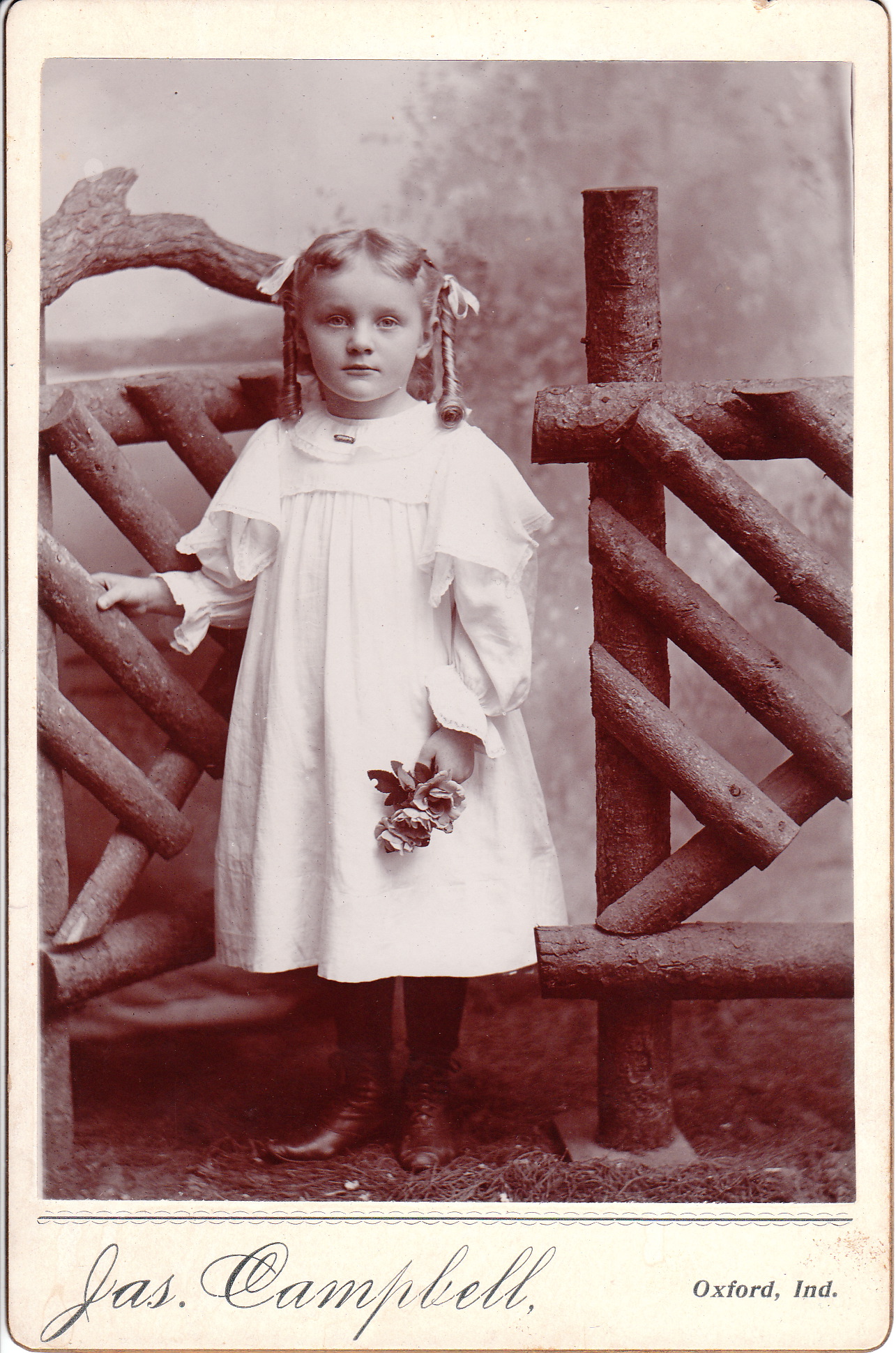 An adorable young girl poses by a wooden gate for photographer James Campbell in Oxford, Indiana. The little girl has terrific curls tied by bows and is holding flowers. The photographer of this cabinet card was a civil war veteran. The New History of the Ninety Ninth Indiana Infantry (1900) gives a brief biographical sketch of Campbell along with his photograph. James D. Campbell was born in 1845 in Fayette County, Indiana. He and his parents moved to Oxford in 1854. He was a well respected soldier in the civil war. He was a member of the 99th Indiana Infantry (Company C). He entered and left his regiment as a private. The book reports “He was one of those quiet faithful soldiers; always ready and always willing to do his duty”. His biography also describes him as married but having no children.
A YOUNG TOM SAWYER GOES FISHING IN HENDERSON, KENTUCKY
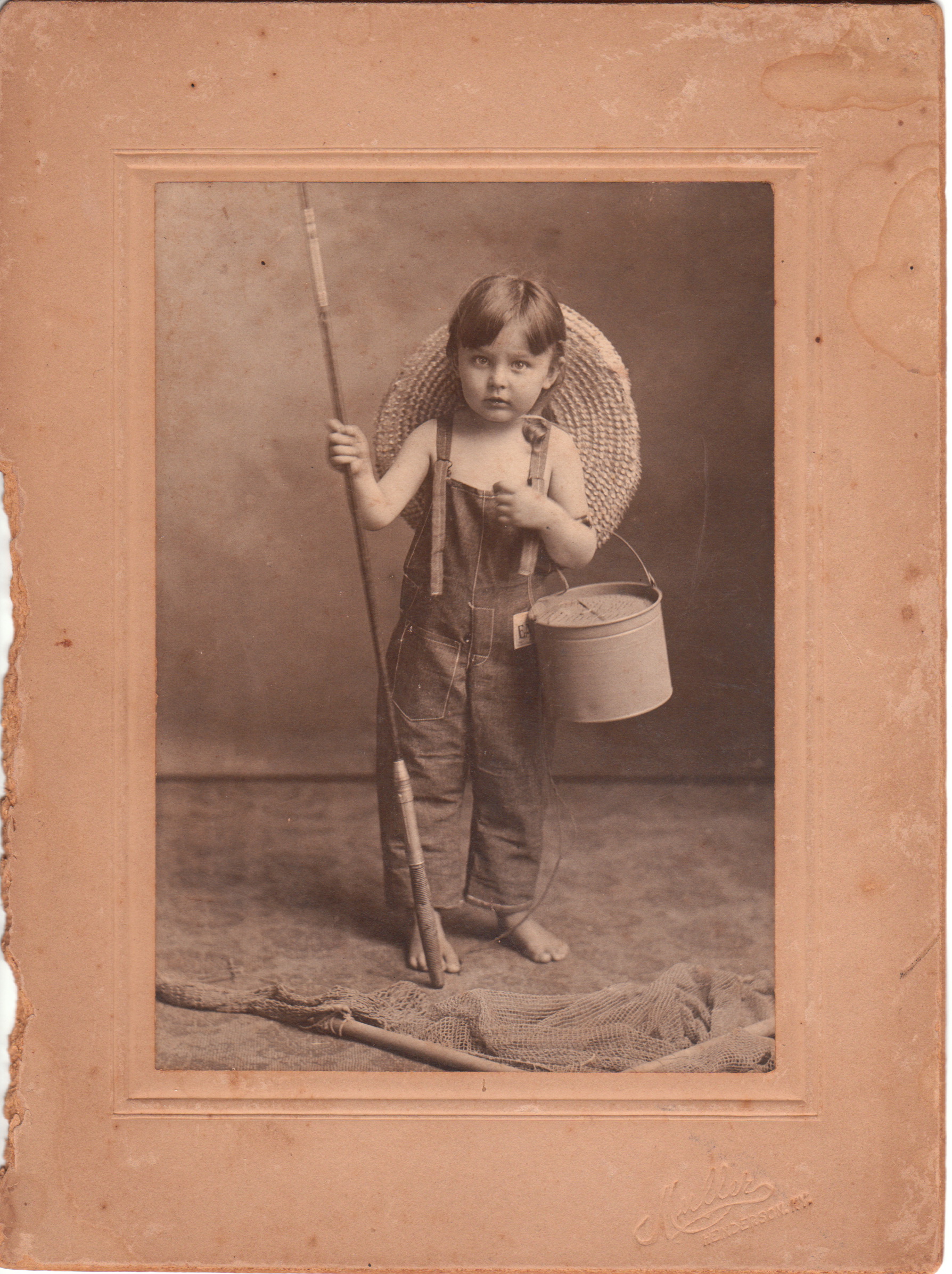
When I first viewed this photograph, I immediately thought about Tom Sawyer and Huck Finn. The barefoot little boy is wearing overalls sans shirt and a straw hat while holding a fishing rod and a pail for his catch. A fishing net lies on the floor in front of him. The young boy’s name is written on the reverse of the photograph. His name is “Ralph Griffith”. His story is tragic. He was born in 1899 in Henderson, Kentucky. He appears with his family in the 1900 US census. He lived in Henderson with his father H. E. Griffith (age 30), his mother Hattie (age 29), his sister Eugenia (age 4), and his maternal grandmother Josephine Dunning. His father is listed as a physician. The 1910 US census shows a newly constituted family constellation. Grandma Dunning was the new head of household and Ralph was also living with his mother, sister, and two lodgers. I was unable to determine what happened to Ralph’s father. In 19r14 Ralph died at the age of fourteen. His cause of death, listed on his death certificate, was diabetes mellitus. He was buried in Fernwood Cemetery. The 1920 census found Ralph’s mother living with his sister in Henderson. Hattie was working in the life insurance field while sister Eugenia was a public school teacher. The censuses tell the sad story of the dissolution of a family. This photograph was produced by the Muller studio in Henderson, Kentucky. George R. Muller was born in Ohio in 1853 and was of German extractiton. He and his family appear in the 1910 US census. He was married to Pauline Muller (age 52) and he and his wife lived with their daughter, Jessie Lee (age 19). The census listed his occupation as photographer. The Bulletin of Photography (1923) announced the sale of his studio in Henderson.


 THE CABINET CARD GALLERY