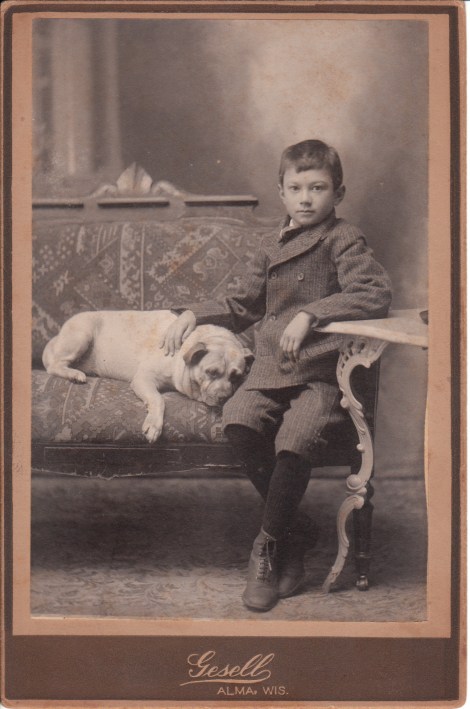
 The Gesell studio of Alma, Wisconsin, produced this wonderful portrait of a boy and his dog. The boy’s love for his dog is apparent by his expression as well as by his resting his wrist and hand on the pooch’s neck. The dog appears quite tired in this photograph which certainly makes the photographer’s job easier. Photographing dogs required special talent and the photographer of this image certainly possessed that talent. The lad pictured in this photograph is identified on the reverse of the image as being named “Emil Bardil”. Emil Bardil (or Bardill) was born in 1893 in Alma, Wisconsin. His father was John Bardill and his mother was Katie Roffler. His parents were of Swiss extraction. The 1900 census finds seven year-old Emil living with a Katherine Bardill (age 54) and his two brothers John (age 11) and Eddie (age 9). The 1910 census reveals that Emil was a boarder in an Alma home and worked as an apprentice printer. The 1920 census discloses that Emil is living in Chico, California with his wife Alice, and working as a printer. The 1930 census indicates that Emil and his wife had taken a boarder into their Chico home and the boarder was employed as a school teacher. The 1940 census shows that Emil had become a foreman at a print shop and worked as a lineotype operator. Census data indicates in 1940, he remained in Chico. Two years later he registered for the draft. He lived a long life and died in California in 1985. The photographer of this portrait was Gerhard Gesell. He was an important figure in Wisconsin history and the Wisconsin Historical Society presents much biographical information about Mr Gesell. Gesell was born in Germany. He came to the United States and in 1863 he enlisted in the Army and served with “Brackett’s Battalion” of the Minnesota Cavalry on the western front. He entered the military as a private and was discharged as a saddler. After the war he returned to Reads Landing, Minnesota and worked as a saloon keeper until he entered the field of photography. He began his photography career in Reads Landing in 1873. In 1876 he relocated to Alma and opened a studio at 401 South Main Street. He operated his photography business in Alma for 30 years (he died in1906). Gesell is noted for his work of documenting the town, its people and culture, and its relationship to the Mississippi River. He took many photographs outside his studio capturing the Alma citizens in many of their activities. In 1879 he married Christine Giesen and they had five children. The couples oldest son, Arnold, became a pediatrician and well known psychologist. Arnold’s son also made a name for himself. Gerhard Gesell (named after his photographer grandfather) was a noted federal judge in Washington D.C. and he presided over many important cases including the Iran Contra Affair, the release of the Pentagon Papers., and the Watergate Scandal. How did this blog entry go from focusing on a little boy and his dog to the Watergate Scandal? Here is an answer to that question. Part of the beauty of cabinet card photography is that each image tells a story. When we look at a photograph, we use conjecture to create a story about the photograph. These created stories are based on our knowledge, as well as our psyche. A second story is created when we research the photographers, the subjects, the activities, and the times reflected in the photographs. That is the beauty of these photographs, we never know where viewing these turn of the century images will take us.
 This Spanish American War era soldier is dressed, armed and ready to deploy. Note his long rifle and the bayonet he is wearing on his side. He is wearing two medals, one which the previous owner of the photograph identified as signifying that he was the son of a Union civil war veteran. This photograph was taken at Dempsie Portraits which was located at 316 Nicollet Avenue in Minneapolis, Minnesota. George M. Dempsie began operating in Minneapolis in about 1887 and worked until at least 1910. He was at the Nicollet Avenue address between 1889 and 1910. He operated under the names of Dempsie’s New Photographic Rooms, Dempsie Portraits, and Dempsie & Andrews. At various times he employed his sons George R. Dempsie and Guy C. Dempsie.




 THE CABINET CARD GALLERY