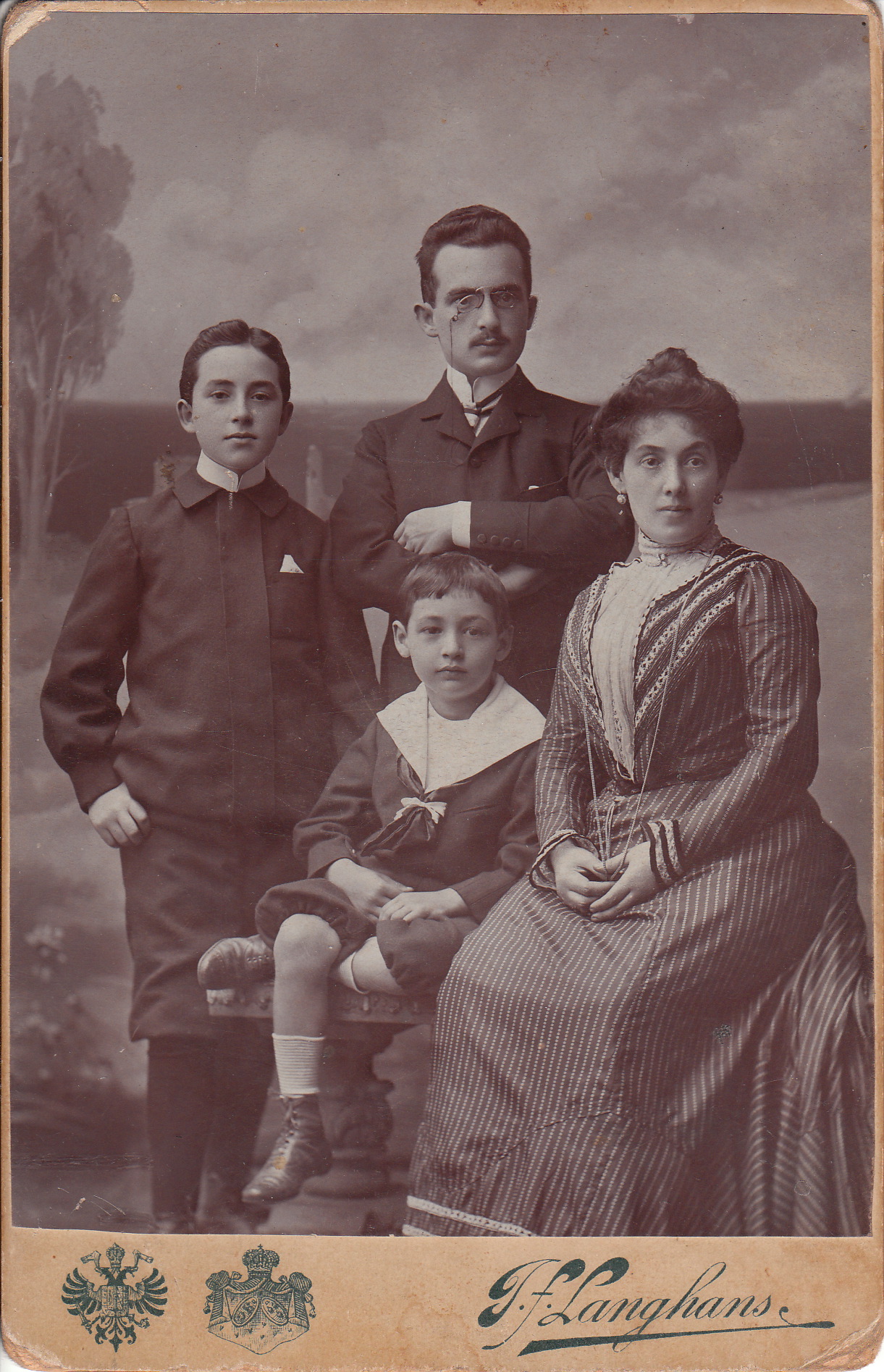
ATTRACTIVE FAMILY IN PRAGUE, CZECHOSLOVAKIA (PORTRAIT BY LANGHANS)

This cabinet card features an attractive family posing for their portrait at the studio of J. F. Langhans in Prague, Czechlosvakia. Mother, father, and their two sons are all beautifully dressed. Father appears to be small of stature and looks quite austere with his hands folded across his chest and his stern facial expression. The children in this photograph seem significantly more relaxed than their parents. Take note of the style of father’s eye glasses Jan Langhans (1851-1926) is the best known figure in Czech photography and his gallery is still in existence. There is a wealth of information about Langhans online at the  “Langhans Archive”. The site provides biographical and historical information as well as the “Gallery of Personalities”. The gallery has photographs of many prominent Czech citizens as well as well known visitors to Czechoslovakia.. These portraits date from 1890 through 1948. The studio was founded by Jan Langhans, who was a food chemist by training but developed a passion for photography. He opened his first studio in 1876 and was the preeminent portrait photographer of the region. He opened a number of branch studios throughout Czechoslovakia. He photographed many celebrities and aristocrats. After World War I the gallery possessed over a million negatives. He gave the studio to his daughter Marie and her husband Viktor Meisner.  After World War II, his grandson Viktor Meisner took over the studio. In 1948, soon after the Communist take-over, the studio was nationalized and most of the negatives were destroyed. Fortunately, more negatives were discovered and they comprise the Gallery’s current collection. To view other photographs by Langhans, click on the category “Photographer: Langhans”.

Published in: on April 22, 2012 at 12:01 am  Comments (1)  
Tags: , , ,

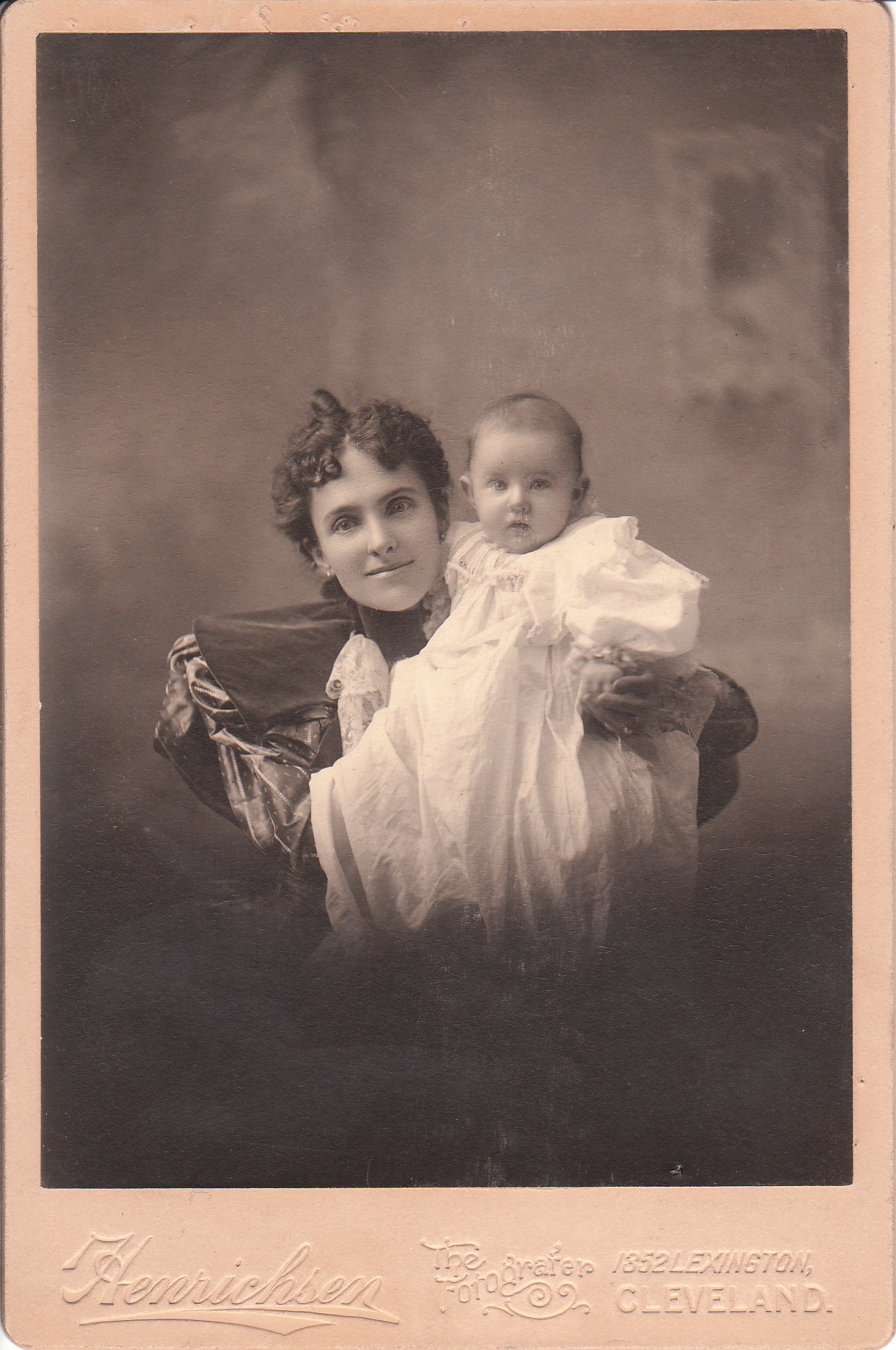
A JOYFUL MOM AND HER BABY IN CLEVELAND, OHIO

Film reviewers speak of a category of movies called “feel good” movies. It has been my observation that there is a category of cabinet cards that should be called “feel good” cabinet cards. This cabinet card, featuring a mother and her baby, falls into the “feel good” genre. This image exudes joy. Mom is smiling. It is important to note that smiling subjects are a rare occurrence in cabinet card photography. Mom’s eyes are smiling too; she just can’t contain her joy. Mom is beautiful, and of course, all babies are adorable. Does anyone wonder how mom was able to hold her baby in this pose for as long as it took to have the photograph taken? Mom likely had some invisible assistance. The child is likely sitting on a platform of some type that has been blocked out by the photographers “tricks” during the development process. This image was photographed by Henrichsen who’s studio was located at 1352 Lexington, in Cleveland, Ohio. John H. Henrichsen operated his studio in Cleveland between 1891 and 1897 and was located on Lexington from 1893 until 1894. These dates were found in the book, “Ohio Photographers 1839-1900” (1998). Henrichsen was also mentioned in Wilson’s Photographic Magazine (1896), as a competitor for prizes at a major photography exhibit.

Published in: on March 15, 2012 at 12:01 am  Comments (1)  
Tags: , , ,

STYLISH MOTHER AND SON MEET SAMSON IN DUISBURG, GERMANY

A stylish mother and son pose for a portrait at the studio of Samson & Company in Duisburg, Germany. Mom has an interesting beaded dress, and a pin on her collar. The son has perfectly combed hair, and is wearing a cute short suit. He seems to be a bit intimidated by his day at the photographer, and is likely happy to be standing so close to his mother. Duisburg is a city in Germany and is located in the western part of the Ruhr area. To view other photographs that may have been produced by this photographer, click on the category, “Photographer: Samson & Co.”. The tentativeness of the previous sentence is because the other Samson & Company photograph was not produced in Duisburg. In fact, the other photograph was created at a gallery in Karlsruhe, Germany. The different locations of the Samson galleries makes one wonder if both of these photographic studios were operated by the same photographer. The two galleries were located 187 miles (300.88 kms) apart.

Published in: on January 12, 2012 at 12:01 am  Comments (1)  
Tags: , , , ,

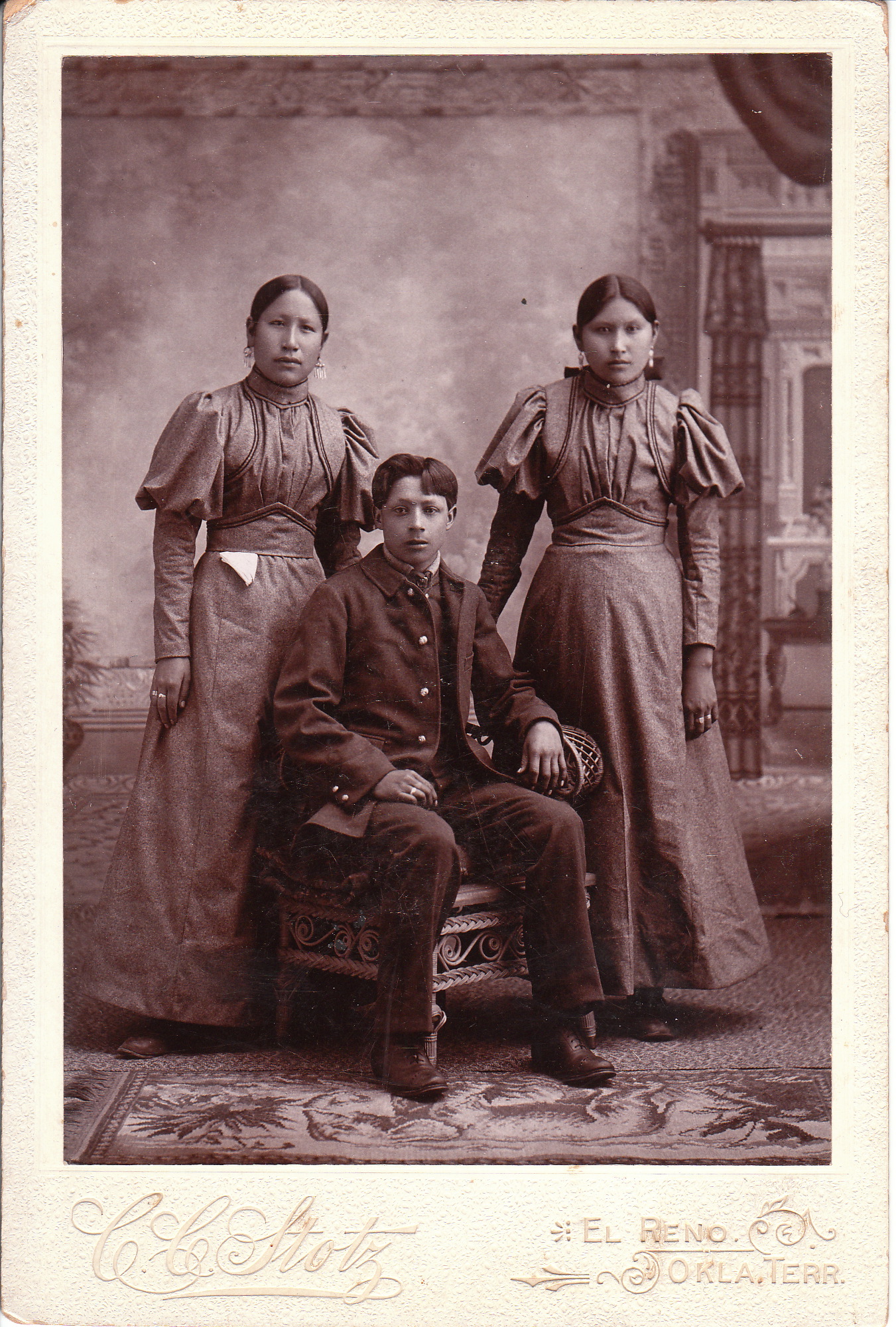
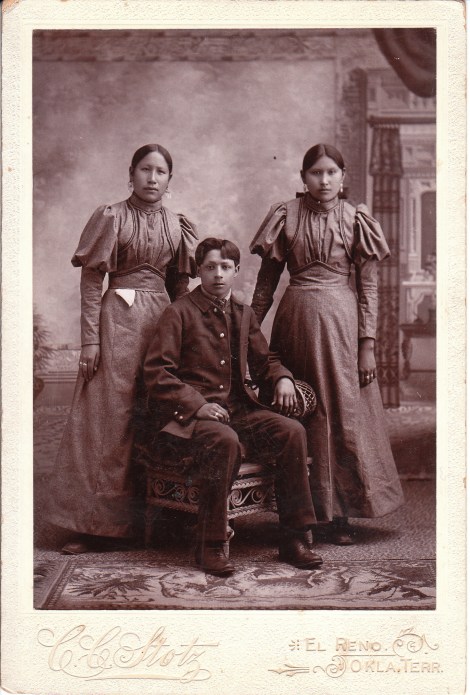
THREE NATIVE AMERICAN SIBLINGS IN EL RENO, OKLAHOMA TERRITORY (PHOTOGRAPHED BY STOTZ)

This cabinet card is chock full of history. The photograph features three young Native Americans posing for their portrait at the studio of Christopher Charles Stotz (1851-1932), in El Reno, Oklahoma Territory. The subjects of this image are likely siblings. The young women are wearing identical dresses and are adorned with rings and beautiful earrings. The specific Indian tribe that these three young people represent, is unknown. Oklahoma was the home of many Indian Tribes including Pawnee, Creek, Apache, Arapaho, Choctaw, and others. Many tribes were relocated there from other states. As mentioned earlier, the photographer of this cabinet card is C. C. Stotz and his studio was located in El Reno, Oklahoma Territory. Oklahoma became a state in 1907 which means that this photograph was taken before that year. El Reno is located in central Oklahoma, about 25 miles from Oklahoma City. Fort Reno was built in 1874 and it’s first commander was Civil War hero, General Philip Sheridan. Sheridan named the fort after his friend, General Jesse L. Reno, who was killed in the Civil War. The fort was near the Cheyenne-Arapaho reservation. One of the fort’s missions was to “protect” the “Five Civilized Tribes”. This group was comprised of the Cherokee, Chickasaw, Choctaw, Creek, and Seminole tribes. Employing the term “civilized tribe” was evidence of the special prejudice held against the tribes not among the designated five civilized tribes. Tribes described as civilized were tribes that had adopted many of the customs and values that were held by  European-Americans at the time.  Who was C. C. Stotz?  Stotz was born in Columbia, Pennsylvania.  He  established a studio in El Reno in 1889; the same year El Reno was founded. Therefore, this photograph was taken between 1889  (El Reno founded) and 1907 (Oklahoma statehood). During the 1880’s and 1890’s, he made field and studio photographs of Southern Plains Indians. Stotz is an acclaimed early photographer  of Native American’s and Native American life.
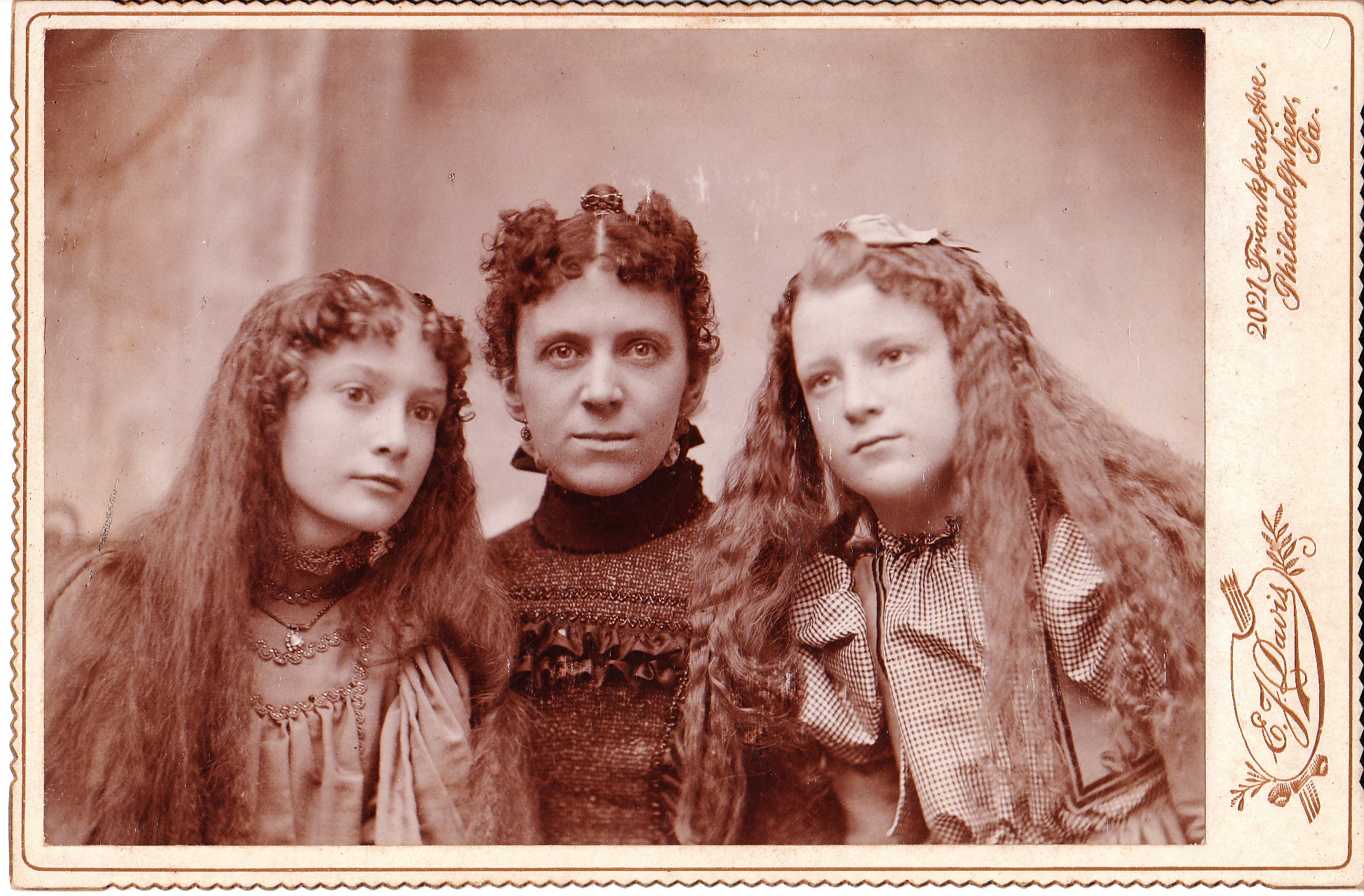
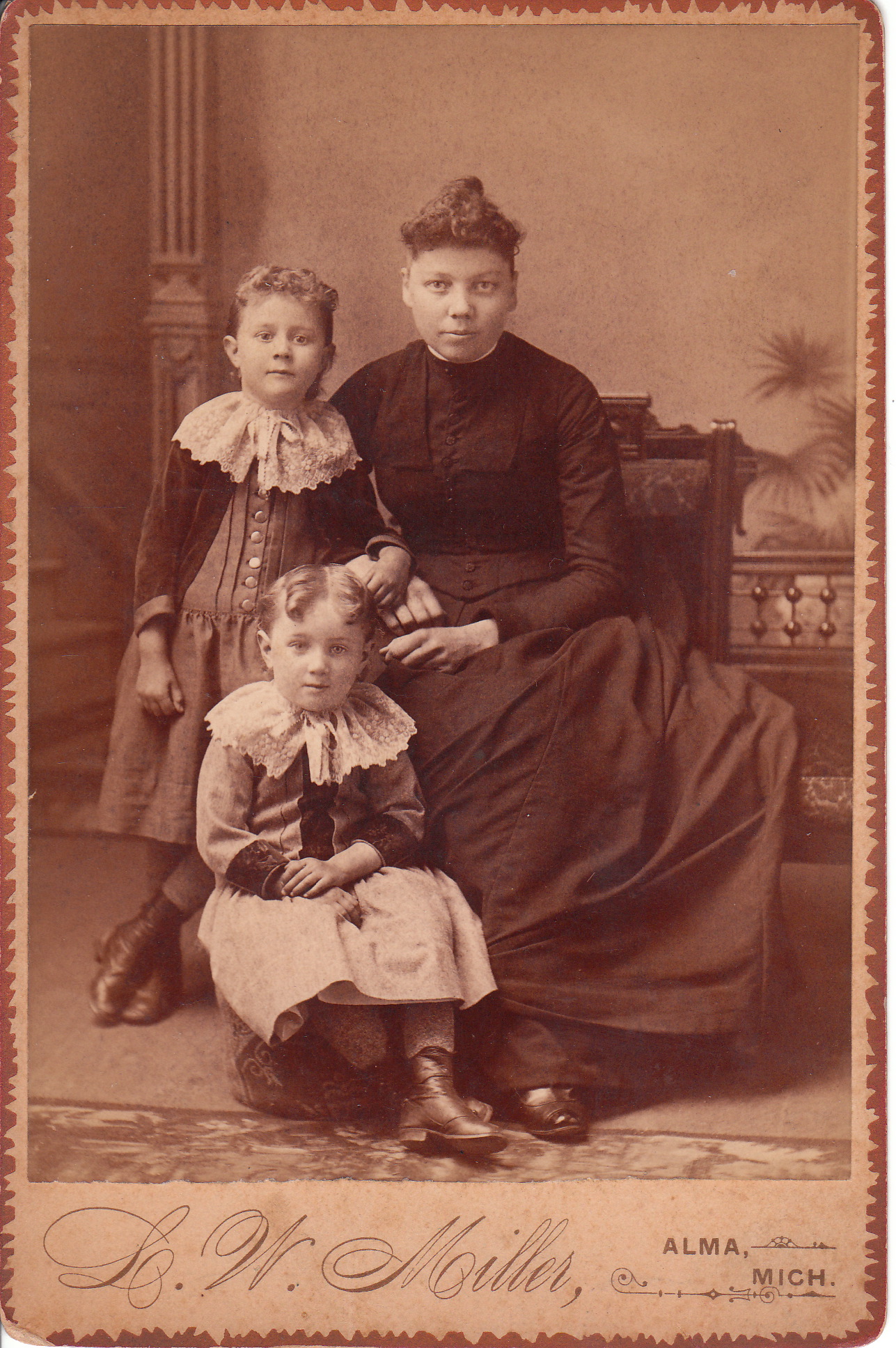
A MOTHER AND TWO DAUGHTERS IN ALMA, MICHIGAN

L. W. Miller is the photographer of this family portrait in Alma, Michigan. Two curly haired sisters, wearing lace collars and boots, pose with their mother. The girls couldn’t resist smiling for the photographer while their mother  kept her lips pursed and maintained a blank stare. The girls father is notably absent from this image.

Published in: on November 28, 2011 at 12:01 am  Comments (1)  
Tags: ,

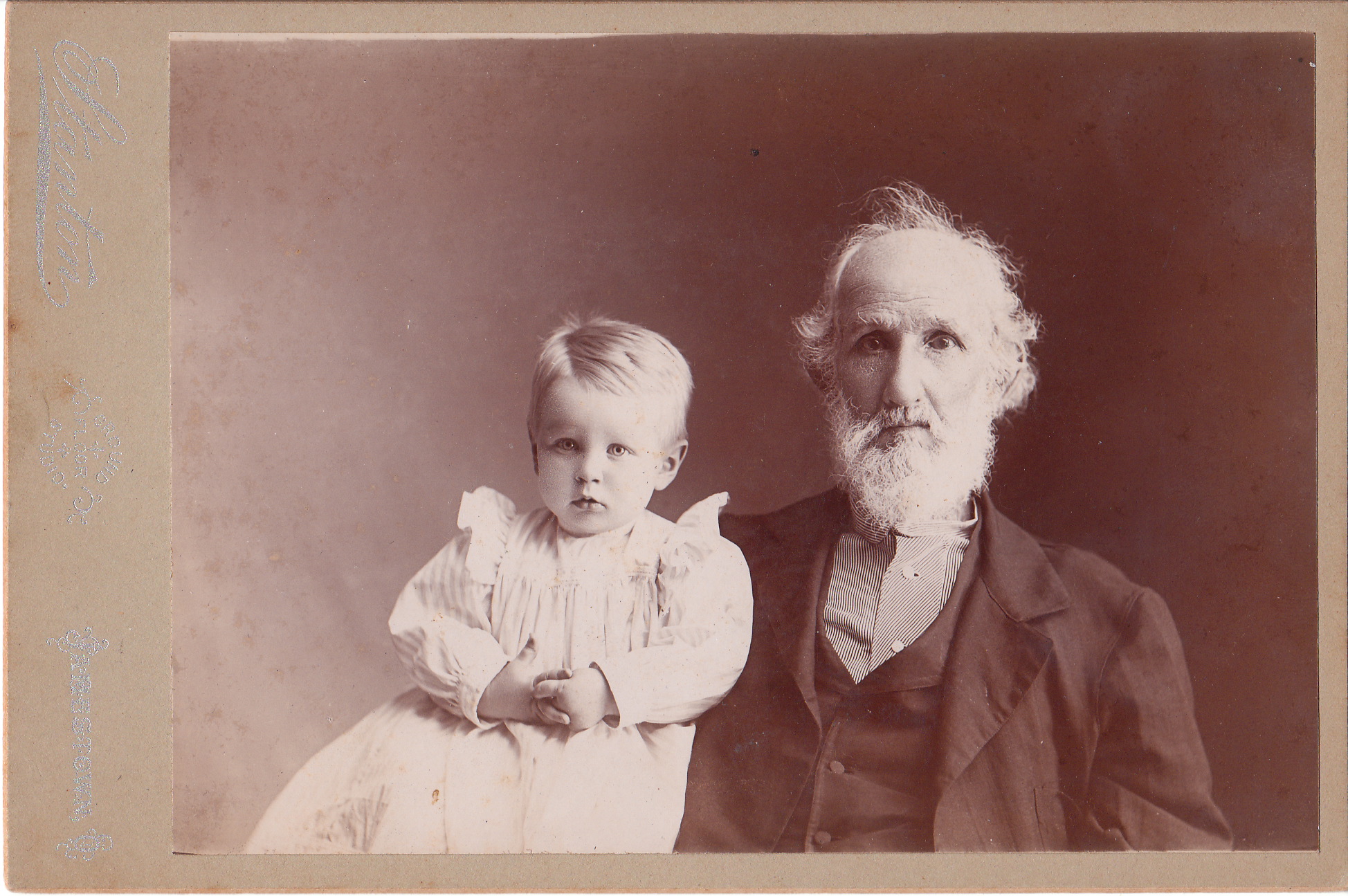
PORTRAIT OF A BEFUDDLED GRANDFATHER AND YOUNG GRANDCHILD IN JAMESTOWN

This photograph is likely a portrait of a grandfather and grandchild. “Generation Skipping” family photographs  were not at all unusual during the era of cabinet card photography. The white haired and bearded grandfather seems to have forgotten to attend to his grooming before sitting for this image. The old man and his grandchild both appear to be quite befuddled by their session with the photographer. This image was produced by the Stanton studio in Jamestown. There are a number of towns named Jamestown in the United States. It has been impossible, so far, to identify the state in which Stanton’s studio was located.

Published in: on November 21, 2011 at 12:01 am  Comments (1)  
Tags: , ,

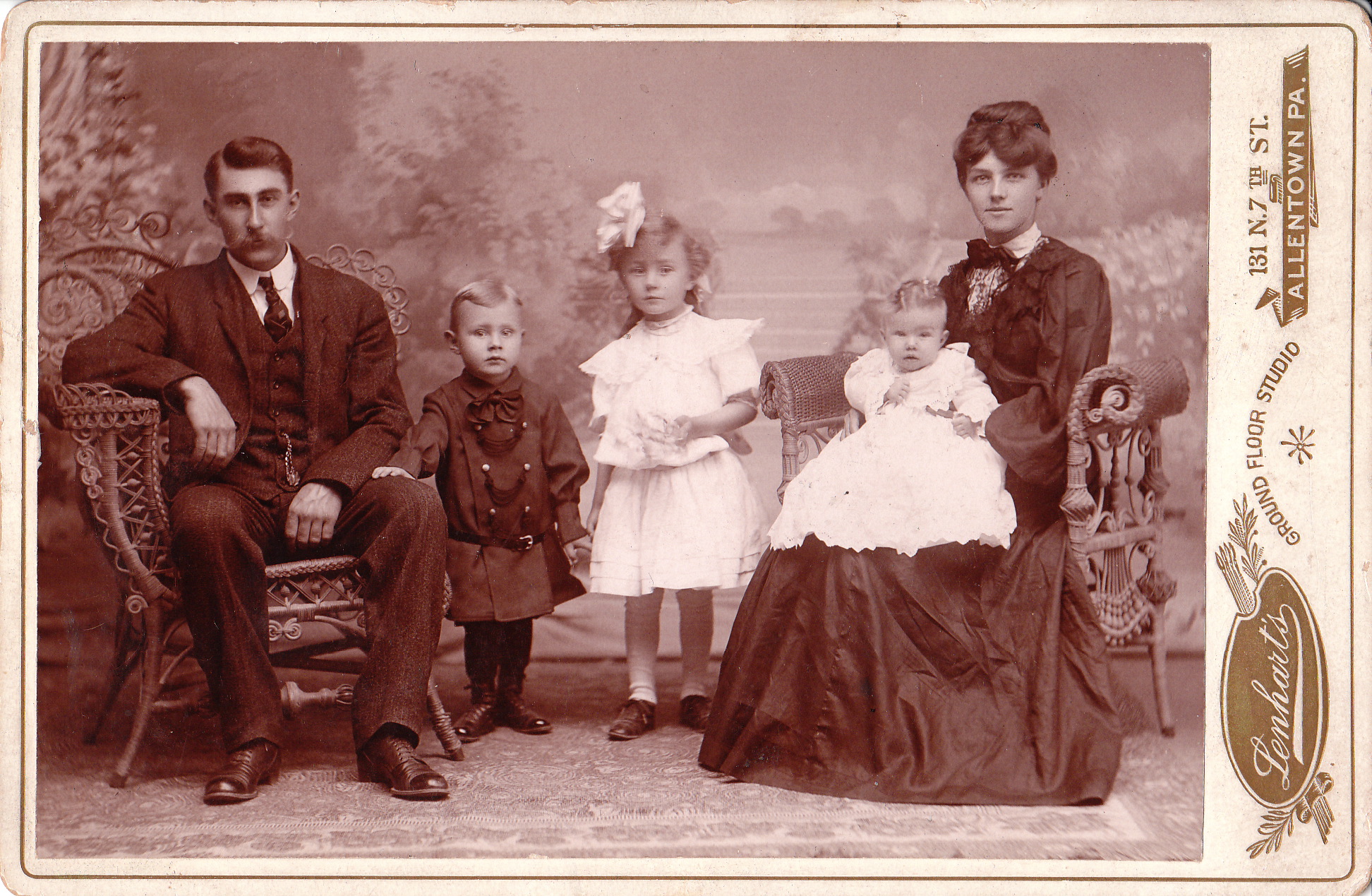
“AND WE’RE LIVING HERE IN ALLENTOWN” FAMILY PORTRAIT IN PENNSYLVANIA

This cabinet card features a family portrait taken at the Lenhart’s studio in Allentown, Pennsylvania. There is a real contrast of facial expressions between mother and father in this image. The mother of this family appears calm and bright eyed; and she has a pleasant smile. The father is looking quite haggard, depressed, and disoriented. Maybe he is finding the children exhausting, or perhaps; he has fallen upon hard economic times. Writing on the reverse of the photograph provides the answer. “Well I’m living here in Allentown. And it’s hard to keep a good man down. But I won’t be getting up today. And its getting very hard to stay. And we’re living here in Allentown”. Ok. These words are not really on the back of the image. The words are actually lyrics to Billy Joel’s hit song, “Allentown”. Sorry, I couldn’t resist the temptation. The photographer of this cabinet card is Thomas Lenhart. He was a talented photographer and one of his photographs is exhibited in the American Museum of Photography. The cabinet card displayed is a double self portrait. It is called a double self portrait because the image captures Lenhart taking a photograph of himself. In other words, he assumes two different poses in the same photograph. Lenhart is known to have operated in Allentown between 1894 and 1899. It is very possible that he was located there before and after those years; but no documentation for other years has been found. To view other photographs by Lenhart, click on cabinet card gallery’s category “Photographer: Lenhart”.


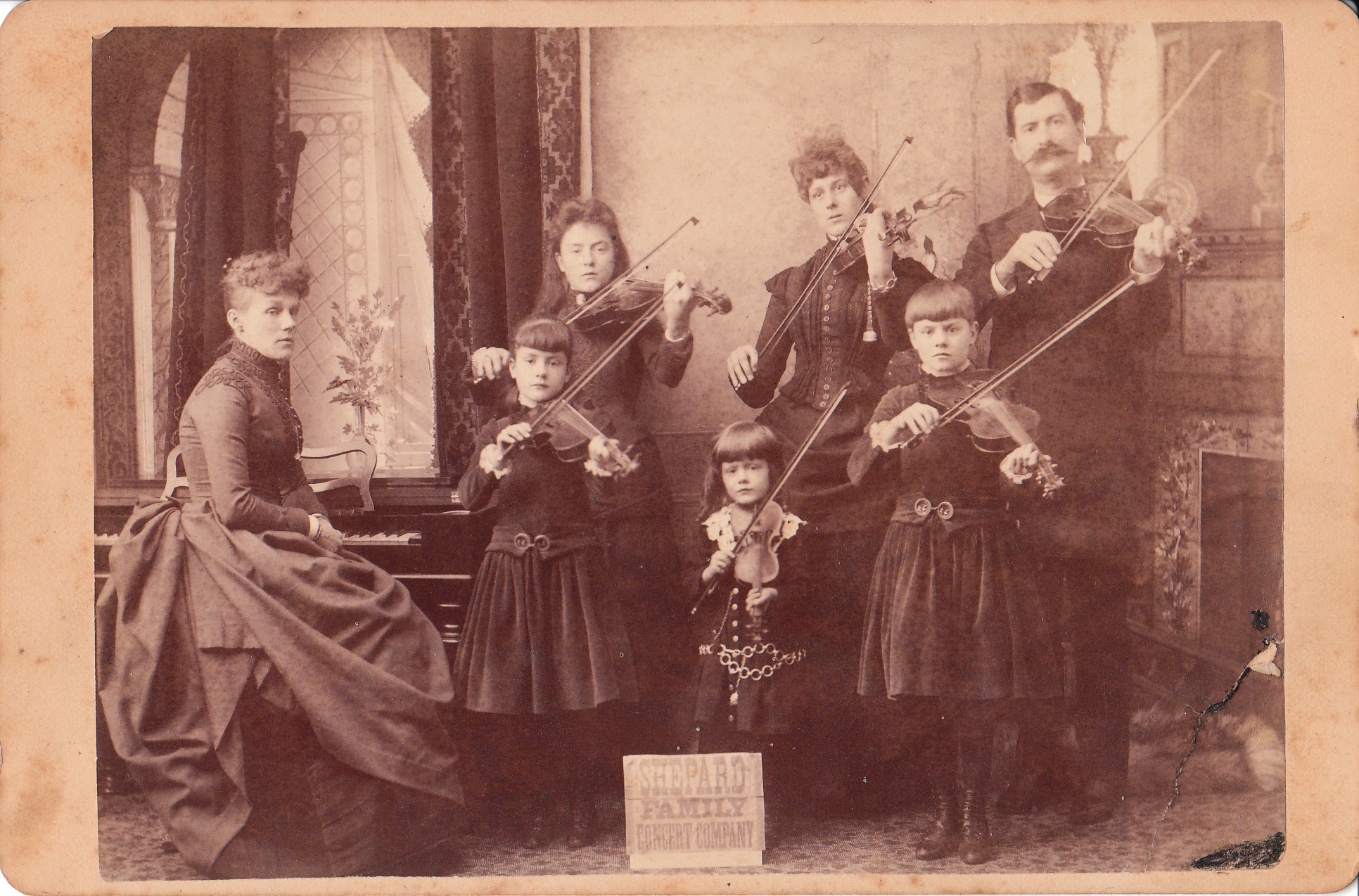
THE SHEPARD FAMILY CONCERT COMPANY

This cabinet card features a portrait of the Shepard Family Concert Company. In this photograph, mother is playing the piano (or organ) and the five children and their father are playing violins. The photographer of this cabinet card is unknown, as is the location of the studio. A photograph of the Shepard family and their instruments appears in The Henry Sheldon Museum of Vermont (located in Middlebury, Vermont). In addition, the museum possesses a “cigar ribbon quilt” serving as a piano cover. The quilt is made from silken advertising ribbons which cigar companies used to tie cigars together for packaging purposes. This particular quilt was made by Mary Emily Shepard (“Minnie”), the matriarch of the Shepard Family. The Shepard Family was Massachusetts based, and mostly toured upper New England. The musical group venues included the Town Hall Theatre, in Middlebury, Vermont. Family Musical Troupes were popular in the 1880’s and 1890’s.  Mr. and Mrs. J. M. Shepard  and their children, Kittie, Laura, Lessie, Georgie, and Burtin were regionally well known and appreciated in the late nineteenth century. Each family member were multi instrumentalists. The family could perform as a choral group, a brass band, or a violin ensemble with the mother playing the pump reed organ. In addition, sometimes, the children would perform as a banjo quintet.

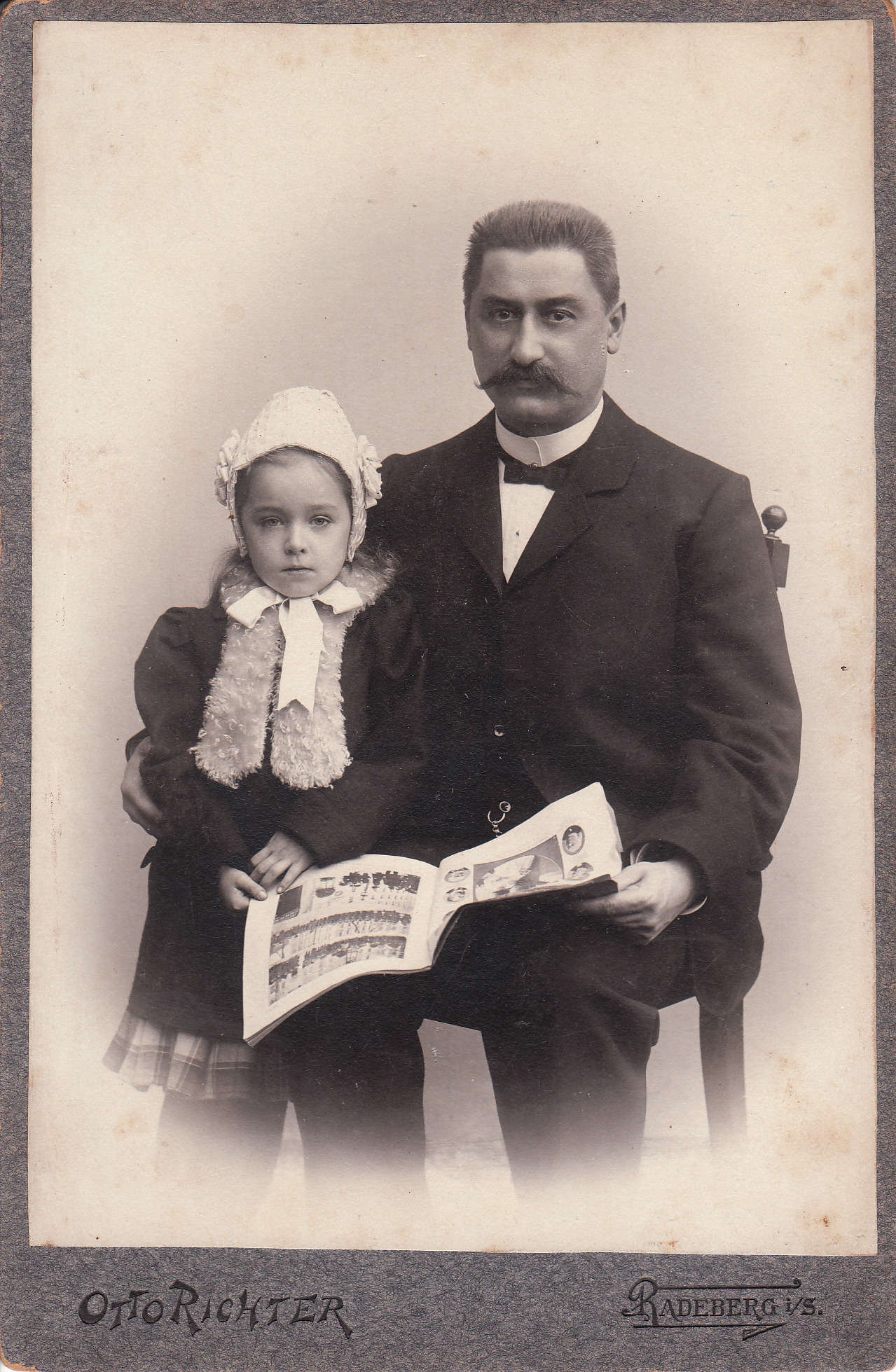
A WINTERS TALE: FATHER READS TO DAUGHTER IN RADEBERG, GERMANY

A proud papa reads to his young daughter as they pose for their portrait at the studio of Otto Richter, in Radeberg, Germany. The child does not seem to interested in the literary offering.  The book seems to be more of a historical picture book, or a pictorial magazine; rather than reading that would hold a child’s interest. Interestingly, the girl is bundled  in a winter coat and wearing a ski cap, while her father is wearing formal clothing. Radeberg is a small town located about 20 kilometers from Dresden, Germany. The town was started in 1872 after a brewery was established there. Today, Radeberger beer ranks as the ninth best selling beer among Germany’s breweries.

Published in: on October 30, 2011 at 12:01 am  Leave a Comment  
Tags: , , , , ,

INTENSE FAMILY PORTRAIT IN IMPERIAL RUSSIA

This cabinet card photograph captures a family in Imperial Russia. The father looks extremely intense and the mother is certainly not far behind the father in intensity level. The father actually appears angry. This couple has been very busy. They have six young children, all close in age. They must have faced a lot of  pressure to support such a large family. The photographer is Von Gotleb and the studio was located in Moscow.

Published in: on October 9, 2011 at 12:01 am  Leave a Comment