MISS PAULETTE: RISQUE PORTRAIT OF AN EXTREMELY BEAUTIFUL ACTRESS

beauty unknown

The beautiful woman seen on this vintage real photo postcard is Miss Paulette. I have been unable to find biographical information about her. The former owner of this photo postcard identified her as Miss Paulette and stated she performed in Paris at the Folies Bergere, a cabaret music hall established in 1869. This portrait of the actress is risque for it’s era but it is certainly tastefully done. In an attempt to identify this actress, I came across the five postcards seen below. I believe that the pretty woman seen in the postcard above is Paulette Del Baye although I lack any concrete convincing evidence. This postcard has a German stamp that is postmarked in Rixdorf (a neighborhood in Berlin). The card was postmarked 1912.  The postcard was published by Neue Photographische Gesellschaft (NPG) which was located in Berlin and Stuttgart, Germany.The company was in business between 1894 and 1948. It was founded by Arthur Black (1862-1943) and it became one of the most well known and largest companies involved in the production of postcards.   SOLD


Vintage French RPPC Postcard Artist Stage Star Miss Paulette   Paulette

Image result for postcard Miss paulette  Paulette

Image result for postcard Miss paulette  Paulette Del Baye

Image result for postcard Miss paulette  Paulette Del Baye

c-1907-French-Theater-Beauty-Mlle-DEBRIVES-fashion-tinted-photo-postcard  Paulette Debrives

Paulette Debrives

PORTRAIT OF A YOUNG MOTHER AND HER TWO CHILDREN IN DRESDEN, GERMANY

This carte de visite portrait features a pretty mother and her two adorable children. The older child, a boy, is wearing a nautical style outfit. The younger child, likely a girl, is wearing a necklace. The mother in this image is wearing a most interesting dress. The flower and large polka dot pattern is more “busy” than usually seen in photographs from this era. The photographer of this image is James Buchanan Aurig (1857-1935). He operated studios in Dresden, Germany. Aurig’s self portrait can be seen below. Aurig began working as a photographer at the age of 15 in Chemnitz. In 1878 he workied for photographer Johannes Schumacher in Dresden. He next worked with various Dresden photographers. He opened his first photographic studio in 1887. He photographed portraits, wedding photos, and current events. At the turn of the century he began to travel with his photographic equipment to the homes of famous Dresden residents to produce home portraits. He also was known for his architectural photographs. He was one of the most prominent photographers in Dresden at the turn of the century. One wonders if James Buchanon Aurig was named after the 15th US President, James Buchanan (1791-1868). Buchanan was the US President between 1857 and 1861. Aurig was born in 1857, the first year of Buchanan’s presidency. Based on the dates I just cited, it’s very likely the photographer was named after the President.   (SOLD)

Self Portrait of Photographer James B. Aurig

Published in: on September 1, 2017 at 12:45 pm  Comments (2)  
Tags: , ,

AIN’T SHE SWEET: PORTRAIT OF AN ADORABLE LITTLE GIRL IN KONIGSBERG, GERMANY

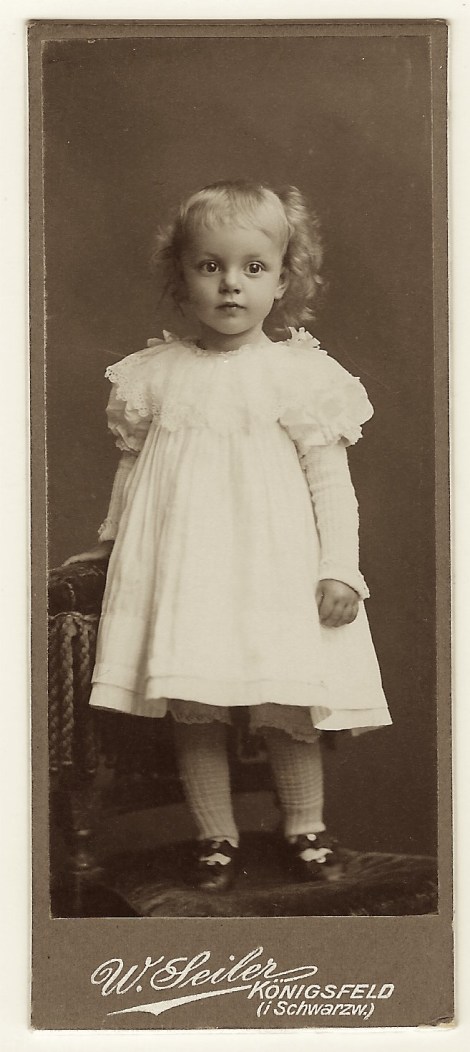
This fantastic carte de visite portrait features an adorable little girl with beautiful eyes. She is wearing a white ruffle dress with lace trim. The photographer of this cdv image is Wilhelm Seiler. He operated a studio in Konigsfeld im Schwarwald, a town in Germany. This cdv is an unusual size. It measures approximately 4 1/2″ x 2″.  (SOLD)

Published in: on August 29, 2017 at 4:16 pm  Comments (2)  
Tags: ,

INCREDIBLY ADORABLE AND FASHIONABLE CHILD IN OSCHATZ, GERMANY

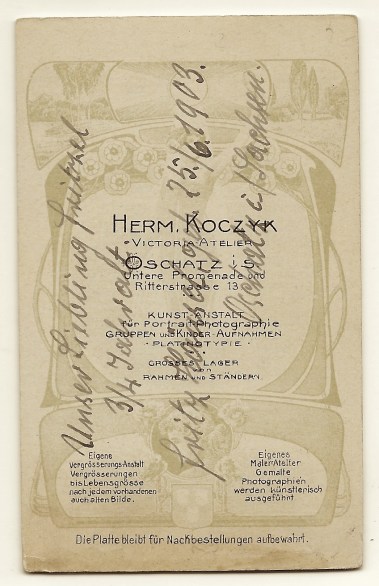
The young child seen in this carte de visite is both stylish and adorable. The photographer did an excellent job capturing the essence of this child. Kudos to mom for being an excellent fashion coordinator. The photographer of this cdv image is Herm. Kocxyk. He operated a studio in Oschatz, Germany which is a town located in the Free State of Saxony. An inscription on the reverse of the cdv reveals that the photograph was taken in 1903. I was unable to translate the rest of the inscription other than “Our favorite ………”. Perhaps a visitor to the Cabinet Card Gallery can complete the translation.

ADDENDUM: I HAVE BEEN OFFERED A TRANSLATION OF THE INSCRIPTION. SEE IT BELOW.

The back of this photo says:

“Our darling Fritzel (nickname for Fritz)
3/4 of a year old (9 months)
Fritz Hänsel born 25. June 1903
Oschatz in Saxony.”                                                                                                                                                                   SOLD

Published in: on August 21, 2017 at 3:03 pm  Leave a Comment  
Tags: , , ,

TWO PORTRAITS OF GERMAN FILM ACTRESS MARINA VON DITMAR

POSTCARD 1   (SOLD)

POSTCARD 2   (SOLD)

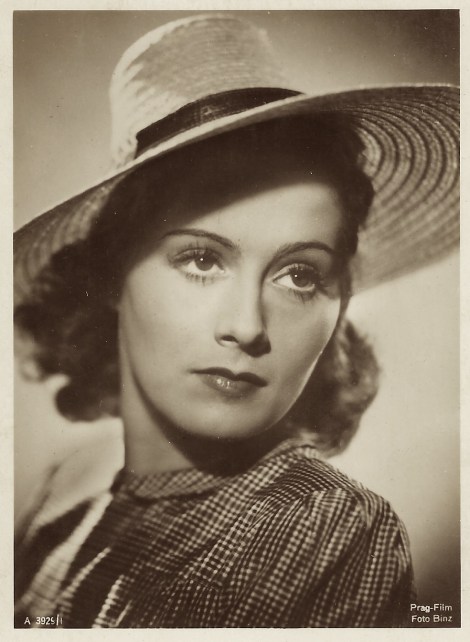
These two real photo postcards feature German film actress Marina von Ditmar (1914-2014), a leading lady of the 1930’s and 40’s. . She was born in the Russia Empire and was of Baltic German descent. When she moved to Germany she studied acting. Her first roles were appearances at Schauspielhaus, Bremen, and the Altes Theater (Leipzig). In 1937 she joined the ensemble at the Volksbuhne in Berlin and by 1940, she was a permanent actress at this venue. Her first major movie success was in “The Csardas Princess” (1934). In 1943, she starred in “Muchhausen”, a film that had great commercial success. Von Ditmar was also well known for her role in “The Big Shadow” (1942). She appeared in several Nazi propaganda film including Stukas (1941). She married D. Hans-Georg Dehnhardt (1913-2001), a leading physician and owner of a sanitarium,  Soon after her marriage, she retired from acting. The IMDB credits Miss von Ditmar with thirty film roles. The top postcard was published by Film-Forto-Verlag and was part of a series (A 2622/1). The photographer was Baumann and there is an advertising logo for the German film company UFA. The bottom postcard was also published by Film-Foto-Verlag and was part of a series (no. A 3926/1). The photographer was Binz and there is an advertising logo for Prag Films. The Prag company produced 14 films between 1943 and 1945. Many of the people employed to produce these films were Czechs who were forced by war time German authorities to produce these films. The photographer, Tita Binz (1903-1970), was German and she photographed many film stars of the Third Reich, She also made portraits of the soldiers who earned the Knight’s Cross (the highest military award in Nazi Germany). Binz began her career by apprenticing in Paris between 1928 and 1930. She was an apprentice for her uncle, the celebrated photographer, Leopold Reutlinger whose studio was opened in 1850 and became of the worlds most renowned studios. Binz settled in Berlin and worked for various photo studios until opening her own studio in 1938. She specialized in portrait photography and photographed actors, artists, politicians, and other celebrities. One of her clients was the publisher Film-Foto-Verlag (formerly Ross Verlag). The founder of the company, Heinrich Ross was forced out in 1937 by the National Socialists because he was Jewish and Jews were not allowed to own businesses. Ross Verlag retained it’s name until 1941. Film-Foto-Verlag became known for it’s postcard portraits of film stars of the German and Italian cinema. Today, many of Binz’s photo portraits can be found in the collection owned by the Deutsches Historisches Museum in Berlin.
                                                           REVERSE TOP POSTCARD

            REVERSE BOTTOM POSTCARD

PORTRAIT OF A CHARMING LITTLE GIRL AND HER DOLL

This vintage hand-colored real photo postcard features a charming little girl holding her doll. The child has a wonderful smile. She is wearing a fancy white lace dress, a necklace, and a hair bow. The postcard was published in 1904 by Neue Photographische Gesellschaft (NPG) which was located in Berlin and Stuttgart, Germany.The company was in business between 1894 and 1948. It was founded by Arthur Black (1862-1943) and it became one of the most well known and largest companies involved in the production of postcards.The postcard is an Oranotypie. An oranotype is a trade name for a type of glossy real photo postcard published by NPG at the beginning of the 20th century.The postcard was mailed to someone in Paris, France and is postmarked in either 1906 or 1908 (it is difficult to decipher which date).  (SOLD)

Published in: on July 14, 2017 at 5:43 pm  Comments (1)  
Tags: , ,

PORTRAIT OF A YOUNG GIRL WITH LONG HAIR IN BRUNN, GERMANY

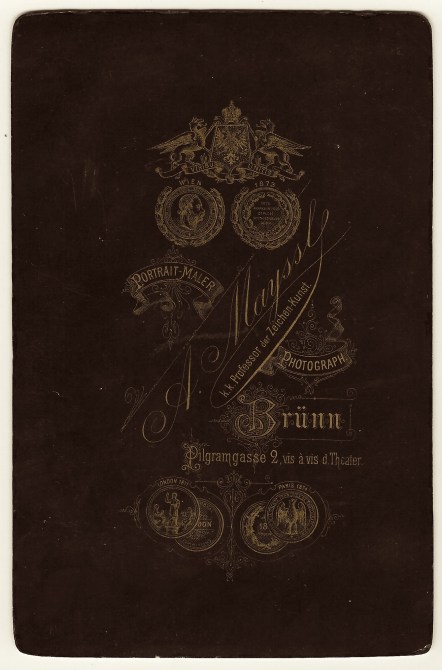
A solemn young girl poses for her portrait at the Mayssl studio in Brunn, Germany. The girl has very long hair. A name is written in the top right corner of the cabinet card. The name likely belongs to the child seen in this image. The photographer, Mayssl had advertising printed on the reverse of the cabinet card. Included in the advertising are drawings of six medals that he had won in various photographic exhibitions.Included are London (1871), Vienna (1873), Paris (1874). The dates of these awards indicate that this cabinet card is likely from the 1870’s. There is also a German phrase on the back of the cabinet card that roughly translates to “Professor of Characters Art” (thank you Google Translate). Perhaps Mayssle was a teacher of photography.

Published in: on June 14, 2017 at 12:00 pm  Leave a Comment  
Tags: ,

BEAUTIFUL GERMAN ACTRESS: HELI FINKENZELLER

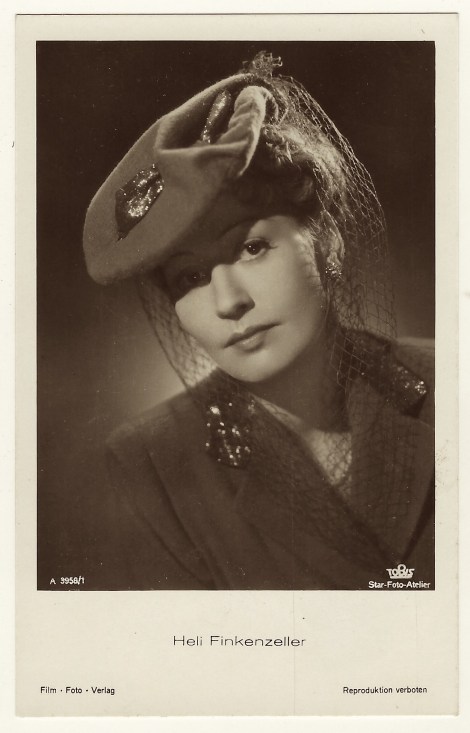
This vintage real photo postcard features pretty German film actress Heli Finkenzeller (1911-1991). During her career she appeared in more than 80 films and television shows between 1935 and 1991. Among her films, she was known for Emil un die Detektive (1954), Teorie und Praxis (1962), and Unser Pauker (1965). She was married twice, to an actor (Will Dohm) and than to a film director (Alfred Bittins).  She is the mother of Gaby Dohm, an Austrian actress. During Finkenzeller’s youth she hoped to become an opera singer. She had an excellent voice but it was too weak for opera. Instead she became an actress. She was discovered for film by director Karl Ritter in 1935. She was popular in films for UFA. a German film company. Later in her career she became active as a stage actress. This postcard was produced by Verlag and is part of a series (no. A 3958/1). The photographer was Star Foto. The logo for Tobis Film appears on the front of the postcard. Tobis was a German film production and distribution company founded n the late 1920’s. The company was discontinued in 1942 when the Nazi controlled government combined it with three other studios (Terra Film, Bavaria Films, UFA) to form a single state controlled film company.

The duet below is from Boccacio (1936) and it features Heli Finkenzeller and Willy Fritsch. One source states that Finkenzeller got “help” with the singing from Rosl Seegers.


Published in: on June 10, 2017 at 12:00 pm  Comments (1)  
Tags: , , , , ,

ESTHER RALSTON: TALENTED FILM AND EARLY TELEVISION ACTRESS

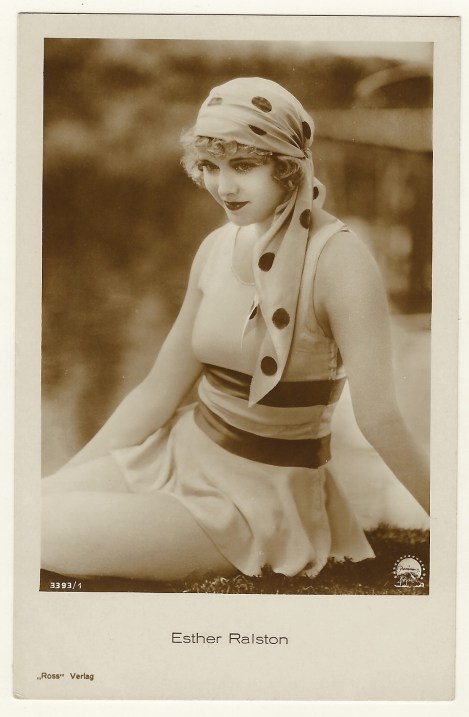
This vintage real photo postcard features beautiful actress Esther Ralston (1902-1994). She was born in Bar Harbor, Maine and was active in acting between 1915 an 1962. Her career started while she was still a child. She appeared in a family vaudeville act called “The Ralston Family with Baby Esther, America’s Youngest Juliet”. By the time she was 18, she was appearing in silent films including “Huckleberry Finn” (1920) and “Peter Pan” (1924). In the late 1920’s she appeared in many films for Paramount Pictures. She was successful enough to earn as much as eight thousand dollars per week Although she received good reviews for dramatic roles, Ralston primarily appeared in comedies, often in the role of spirited society girls. Esther’s image was initially “wholesome and fun-loving”. Florenz Ziegfeld Jr repackaged her as “The American Venus” after she appeared in the role of a beauty queen in the film, “American Venus” (1926). Miss Ralston made a successful transition to sound pictures but by the mid 1930’s she was usually appearing in supporting roles. Her final starring role was in “To the Last Man (1933) and her final film was “Tin Pan Alley (1940). That same year she retired from film and focused on stage and radio through the 1940’s. With the advent of television, Ralston spent time appearing in this new medium. Esther Ralston was married three times and divorced three times. All of her husbands worked in the entertainment industry. The imdb lists Ralston as having 108 credits as an actress. She certainly made an impact in the entertainment world and this is reflected by the fact that she has a star on the Hollywood Walk of Fame. Esther Ralston’s obituary can be found at the web site of  “The Independent”. The obituary states that she was a “captivating blond beauty with an engaging sense of humor”. The article tells the story of Ralston’s reaction to co-starring with Clara Bow and Gary Cooper in “Children of Divorce” (1927) while Bow and Cooper were having an affair. In regard to Clara Bow, Ralston stated “I didn’t really dislike her, but she was pretty loose and I’d been brought up differently”. This photo postcard was pubished by Ross Verlag, a postcard publishing company based in Berlin, Germany. The postcard was produced for Paramount Pictures and is part of a series (No. 3393/1).

HENNY PORTEN: MAJOR GERMAN FILM ACTRESS WITH ADMIRABLE PRINCIPLES (RESISTED THE NAZI GOVERNMENT)


Henny Porten (1890-1960) is the subject of this real photo postcard. Porten was a German actress and film producer of the silent era. She was Germany’s first major film star and appeared in more than 170 films produced between 1906 and 1955. Along with Asta Nielsen and Pola Negri, she was one of the three most popular German actresses. Her father was a film director and her sister was an actress/screenwriter. She began her film career without any stage experience which was an unusual phenomenon for German actresses. Porten was not well known outside of Germany. A large number of her early films were directed by her husband, Curt Stark. Stark died during World War I (1916) while serving on the Eastern Front. In 1921 she remarried a Jewish man named Wilhelm von Kaufmann. When the Nazis took power, she received much pressure to divorce her husband. She refused to comply and her career plummeted. She was denied a visa to emigrate. Her career blossomed again after World War II. The photograph of Miss Porten seen on this postcard is by the Becker & Maass studio of Berlin, Germany. The photographers were well known for portrait and fashion photography in the first decades of the twentieth century. They photographed dozens of German film stars for magazines and postcards. You can view more of this studios photographs by clicking on the category “Photographer: Becker & Maass”.  The postcard is published by Rotophot which began publishing “RPH” postcards in 1916. There were three different series: Buhnen-Sterne (stage star), Film Sterne (film star), and Film Sterne (displayed scenes). This postcard is from the Film Sterne series and was no. 216/3. The film star series ran from number 61 through number 224. The front of the Film Sterne cards included the name of the film studio represented. This card advertises Messter-Films of Berlin. These postcards were continued by the Ross Verlag company who’s origins can be traced back to the earlier Rotophot postcard company. The You Tube clip below presents Henny Porten in some scenes from “24 Hours from the Life of a Woman” (1931).