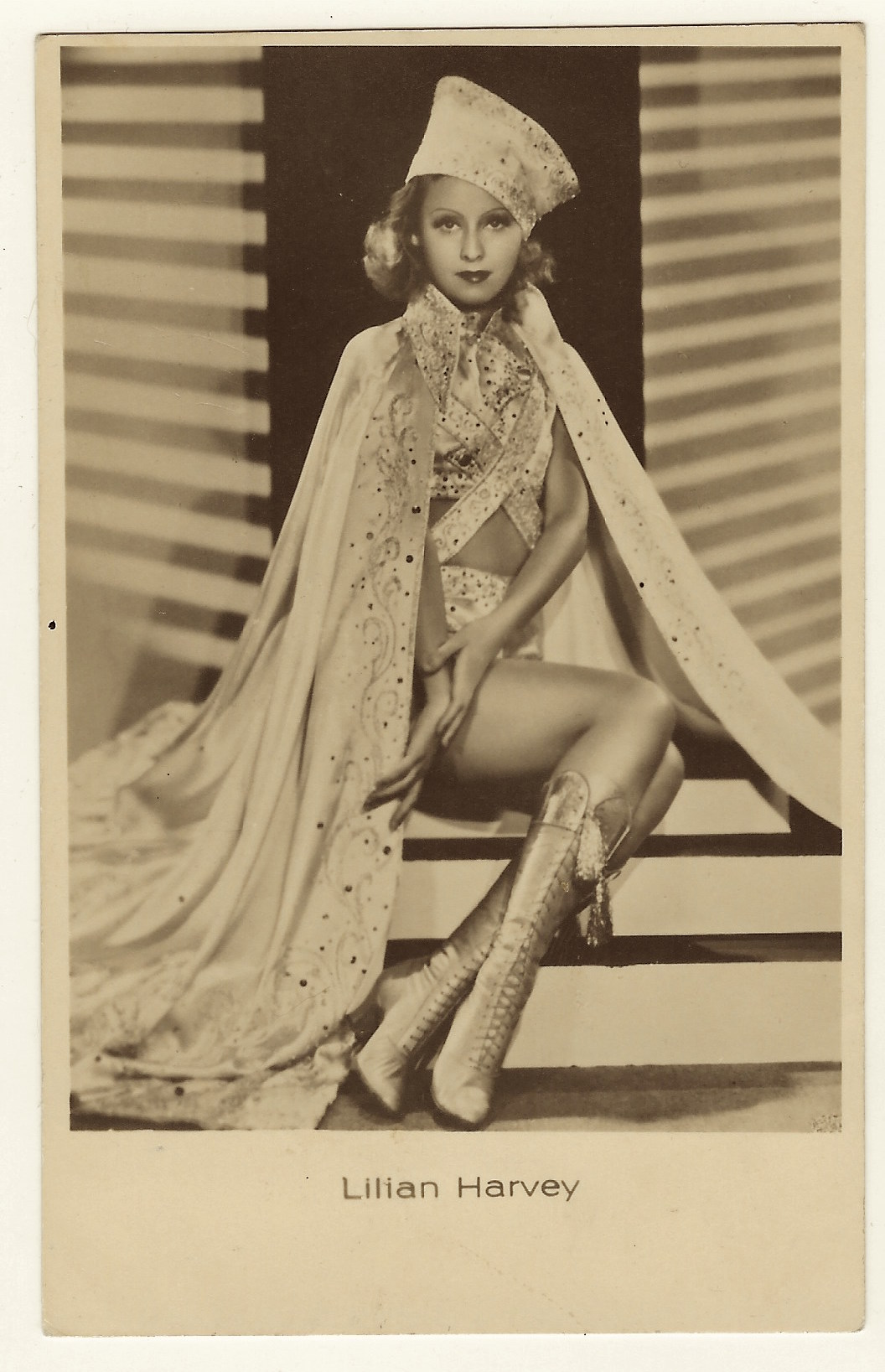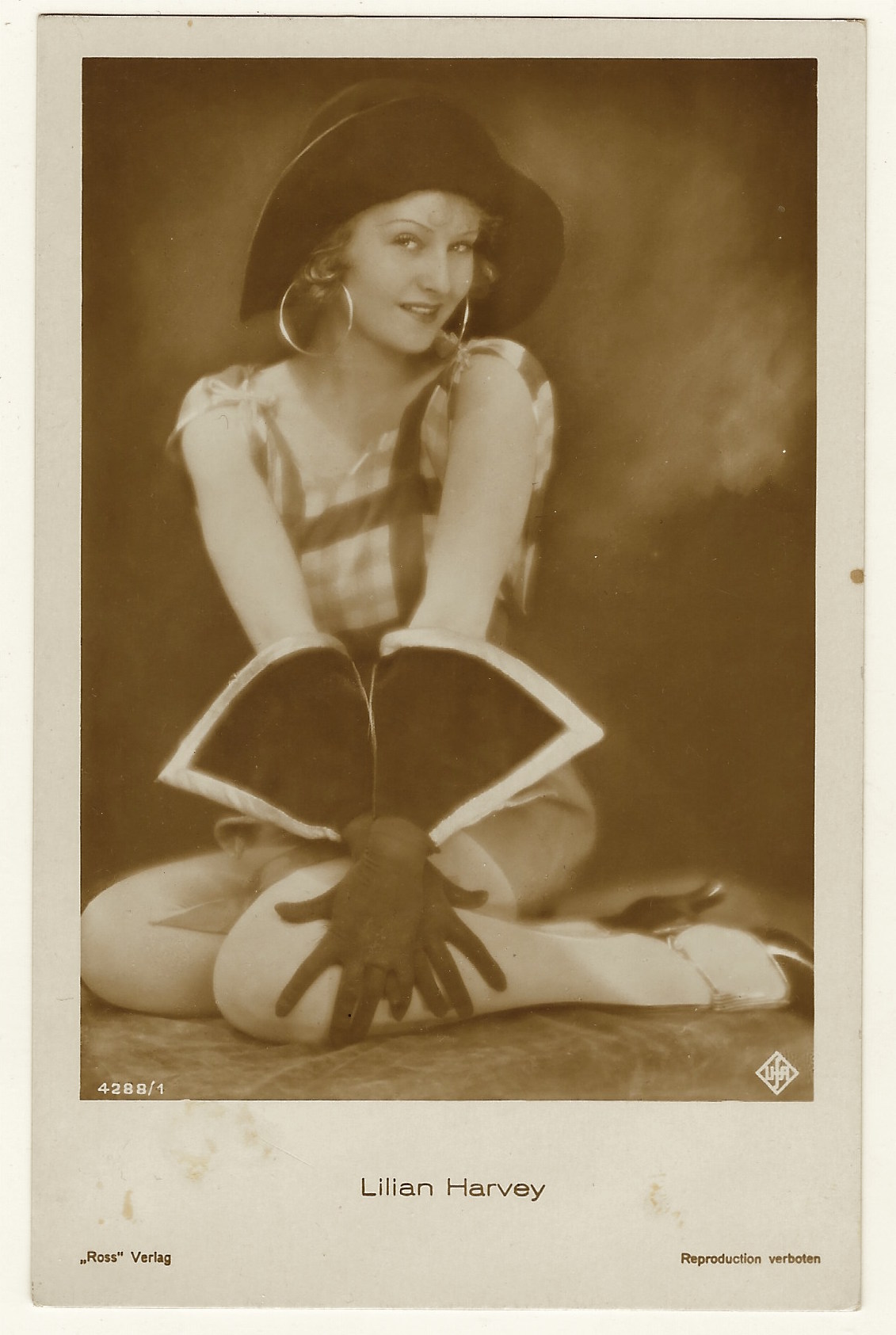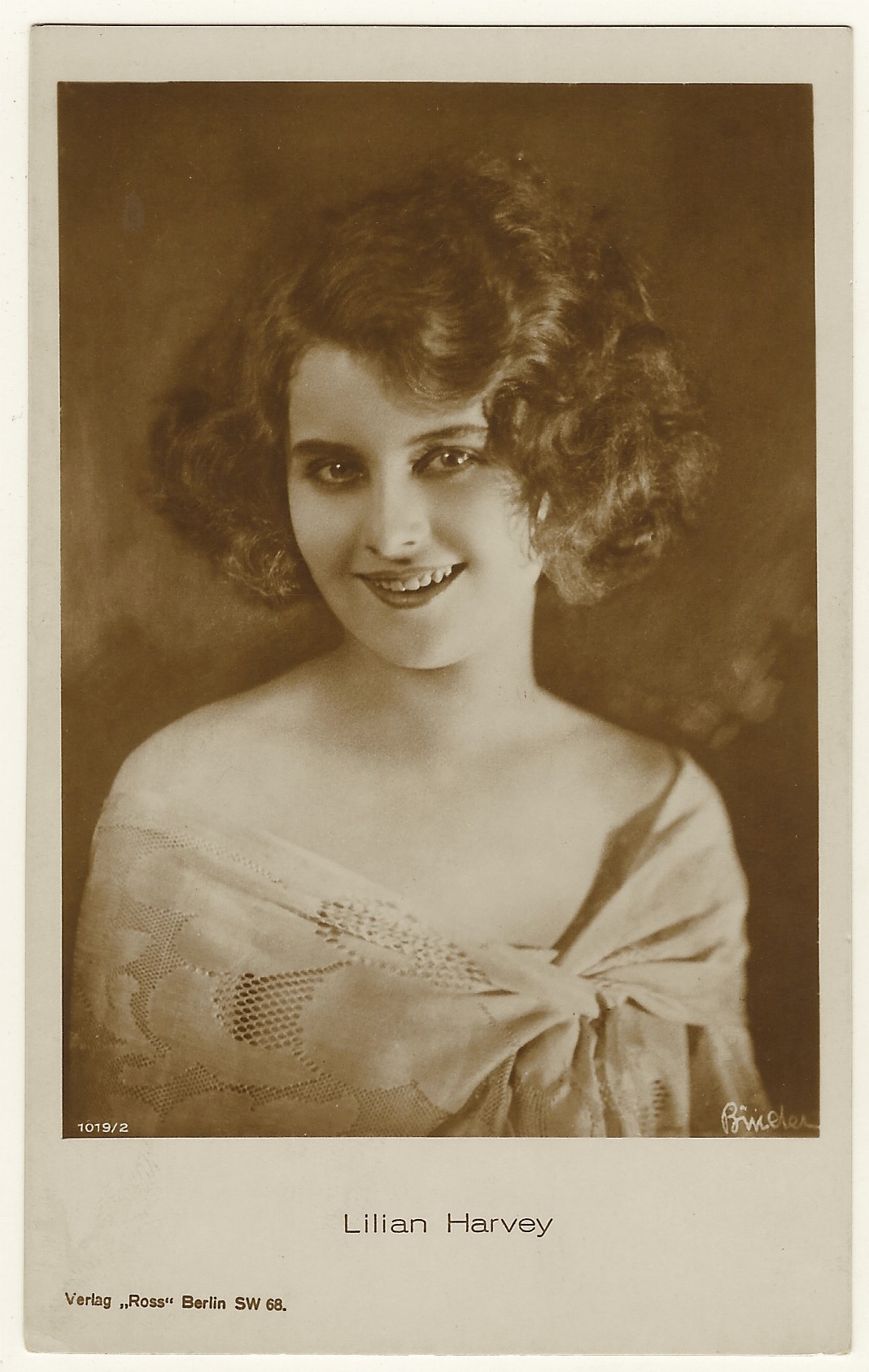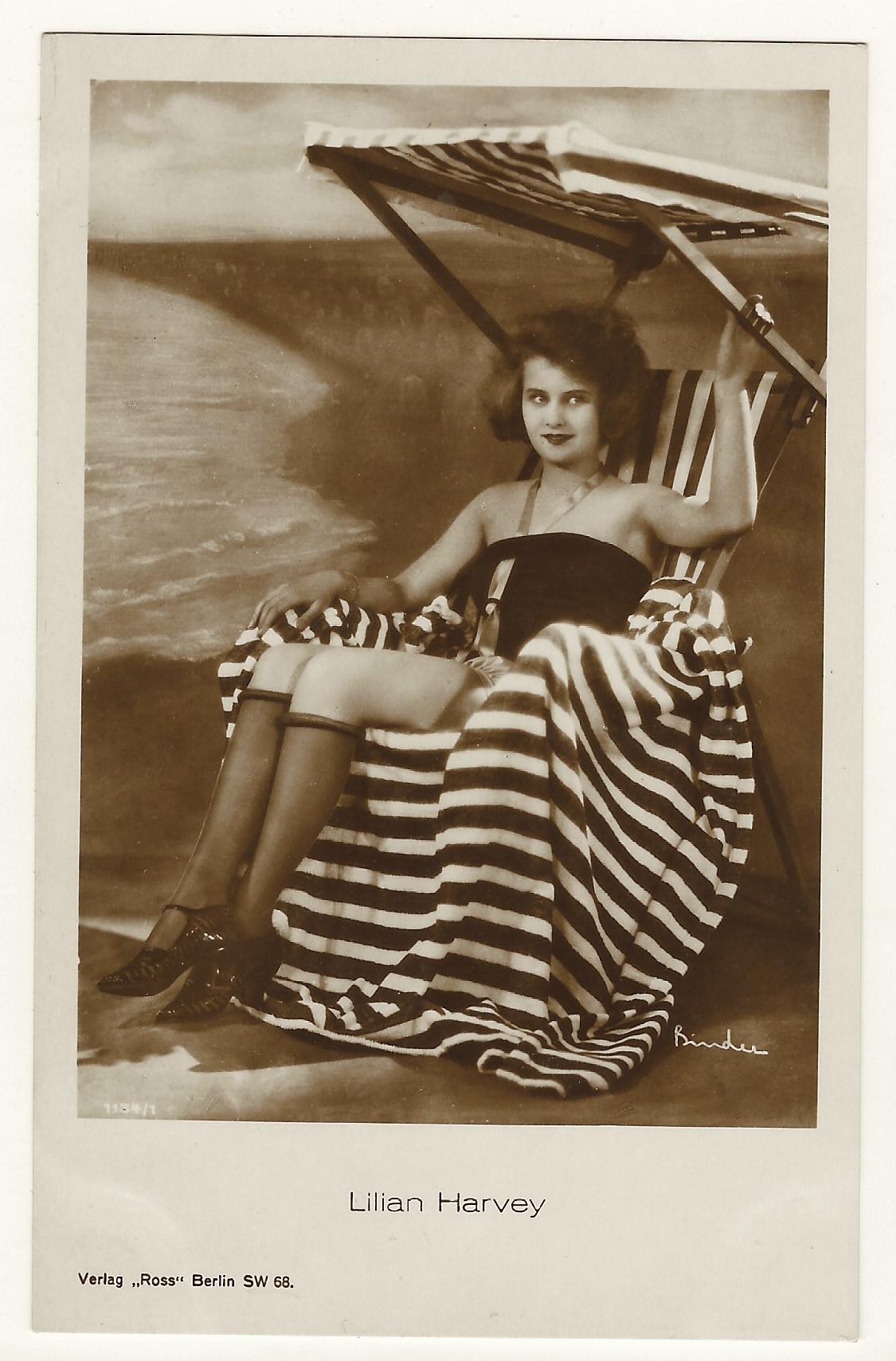
POSTCARD 1

POSTCARD 2

POSTCARD 1

POSTCARD 2

POSTCARD 3 (SOLD)

POSTCARD 4 (SOLD)

POSTCARD 5

POSTCARD 7 (SOLD)
POSTCARD 8 (SOLD)
POSTCARD 9 (SOLD)
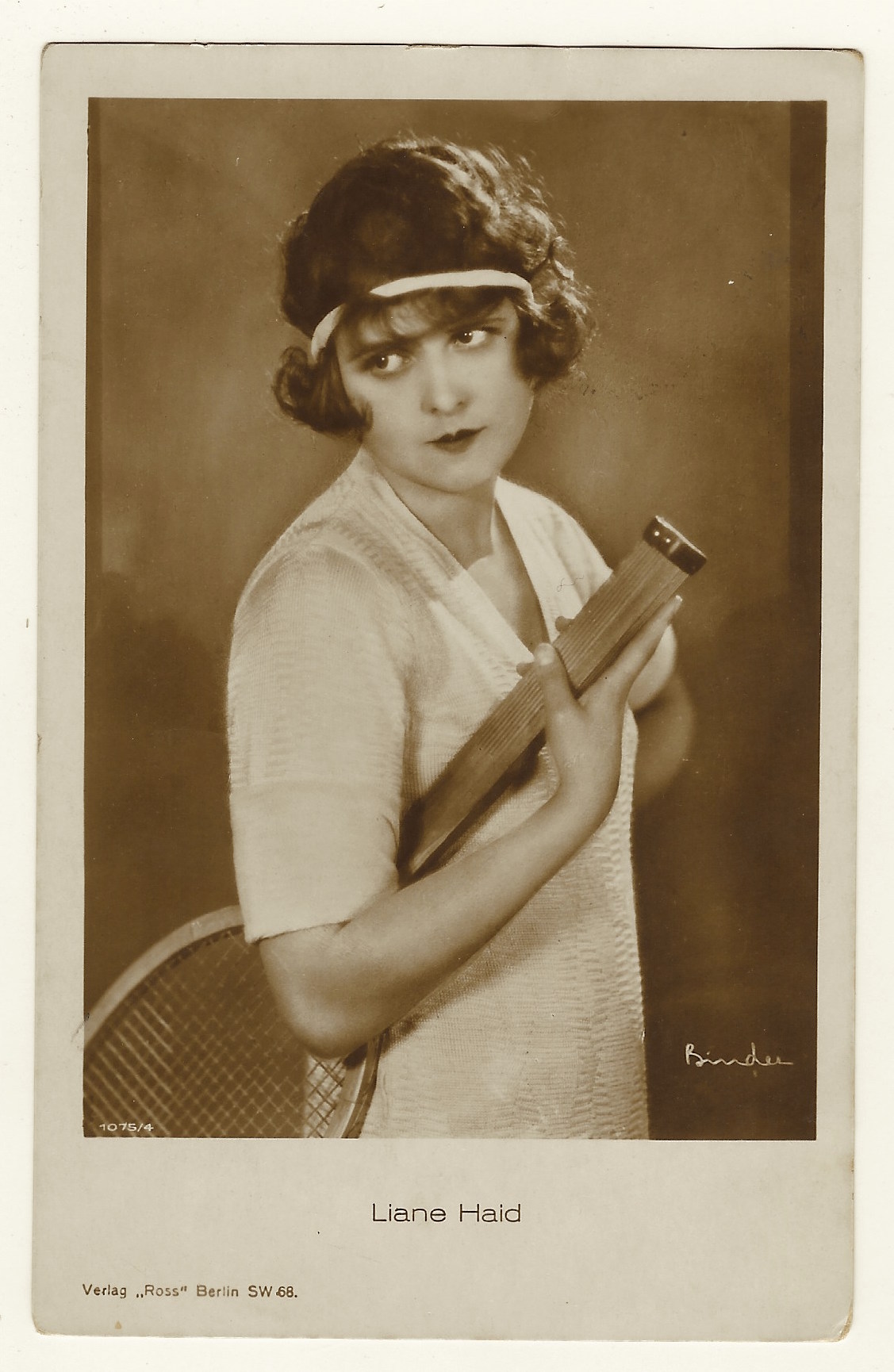
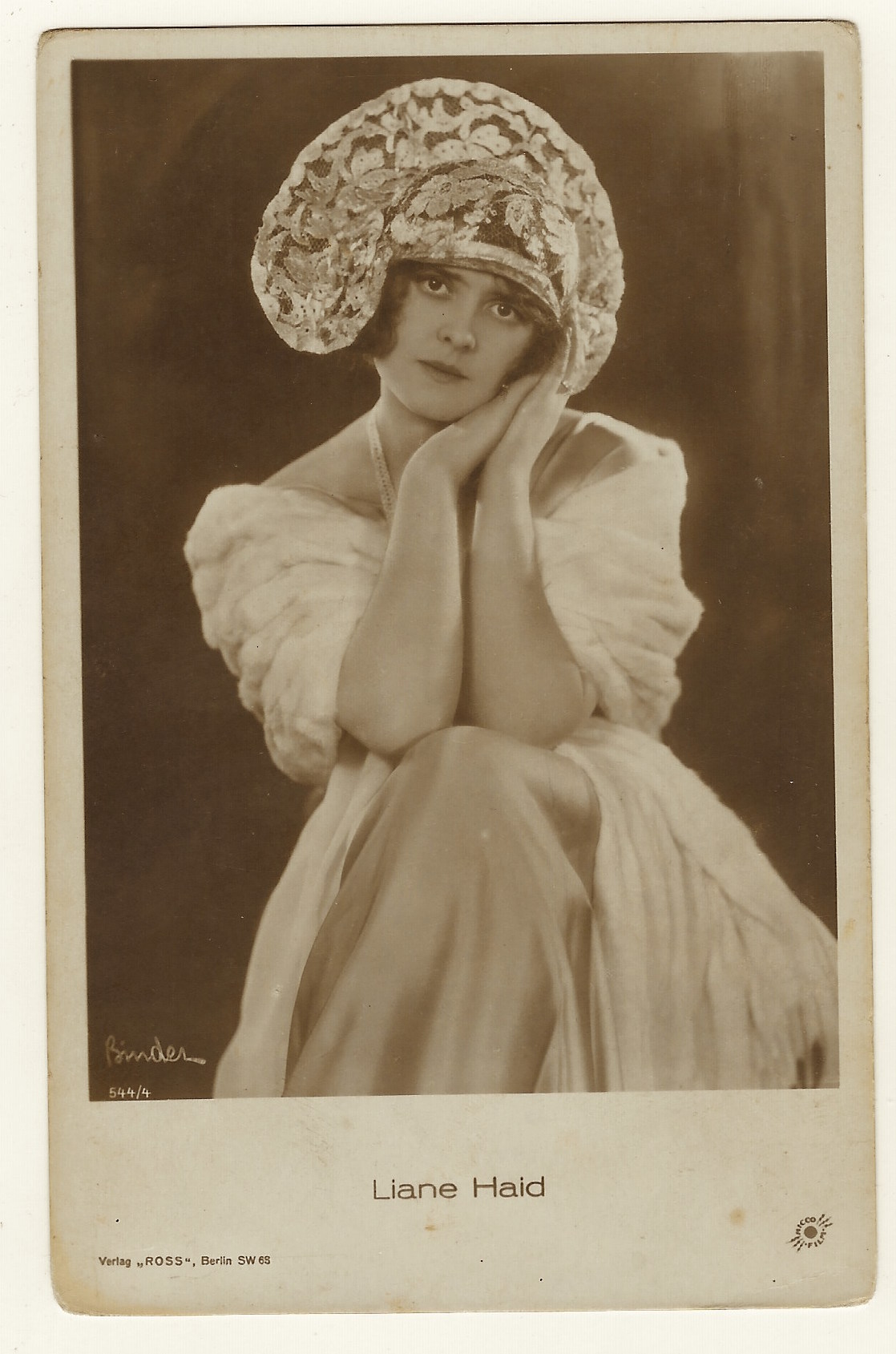
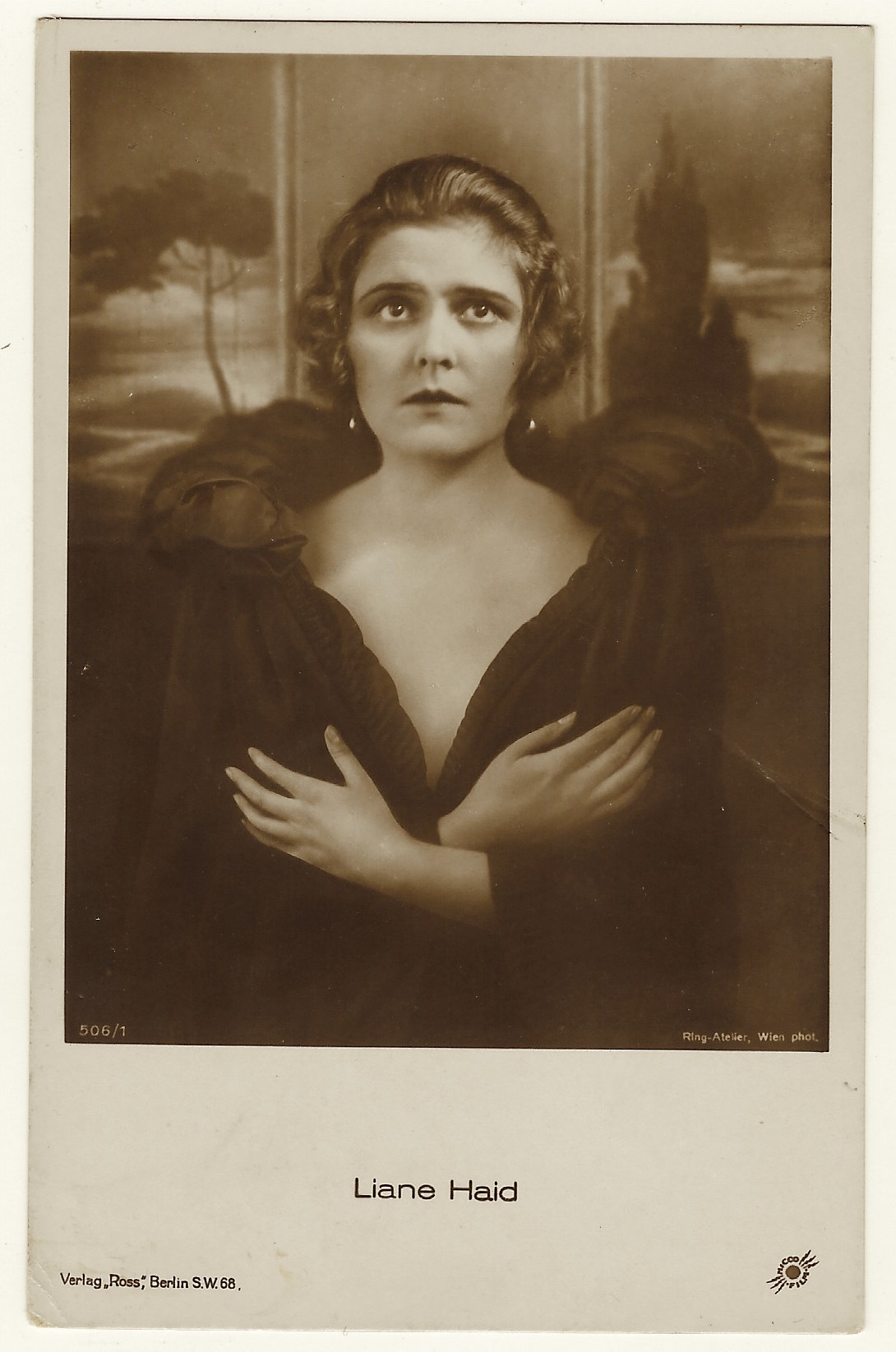
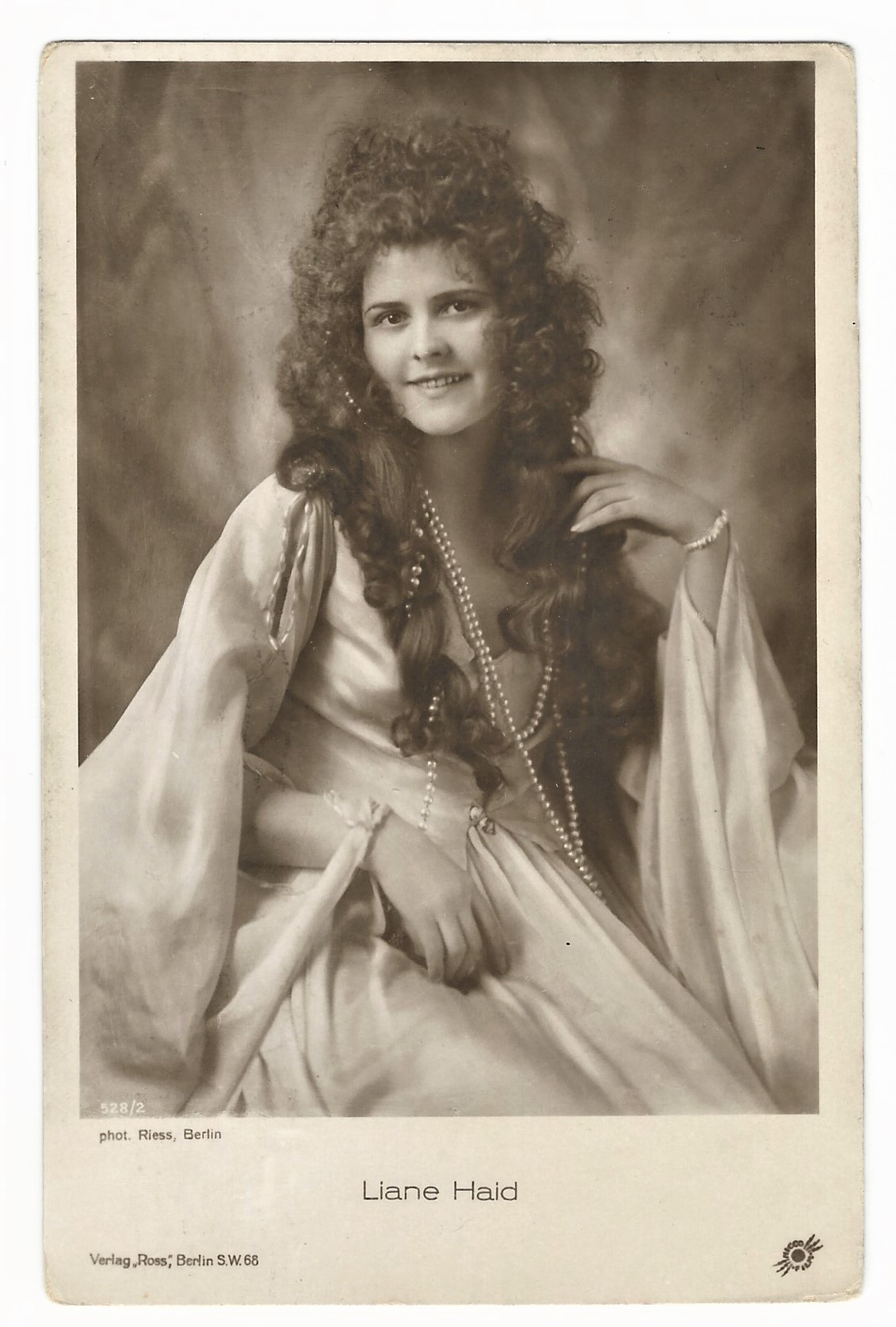
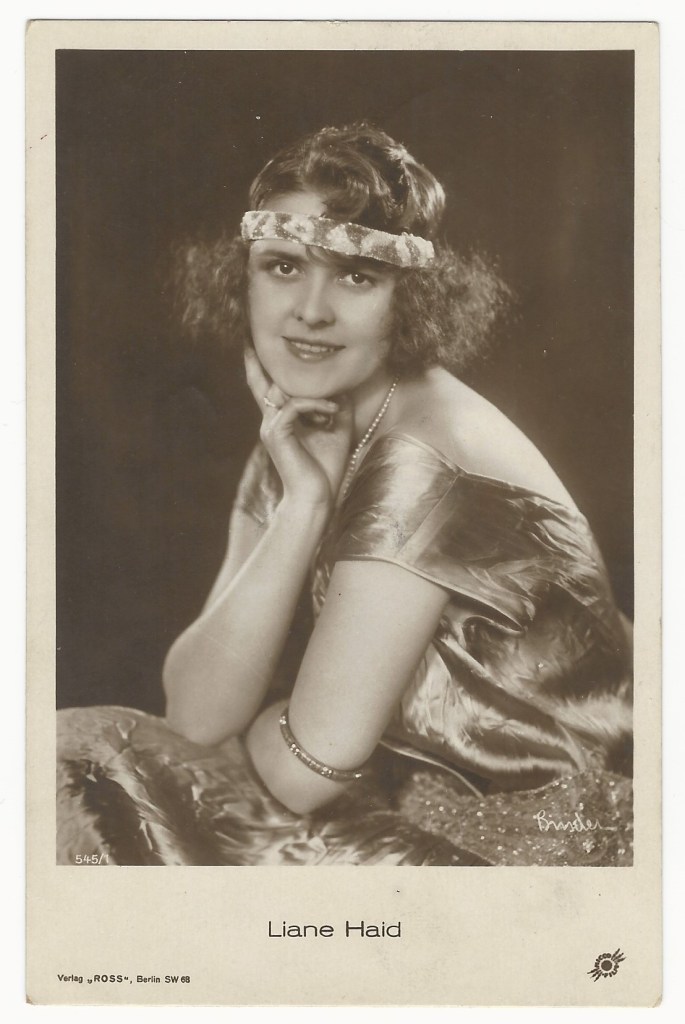
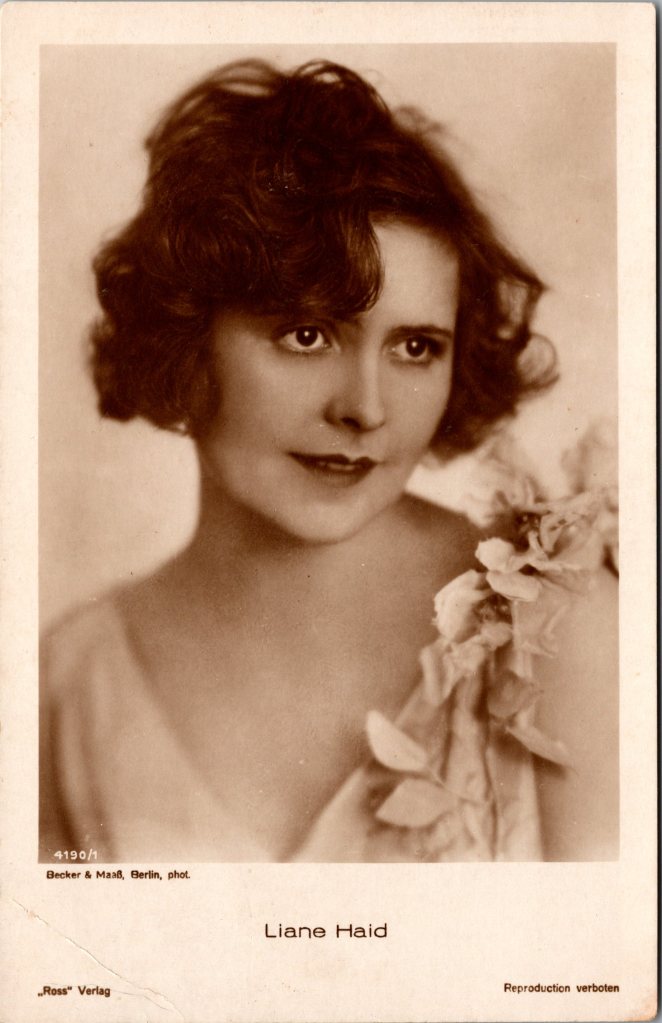
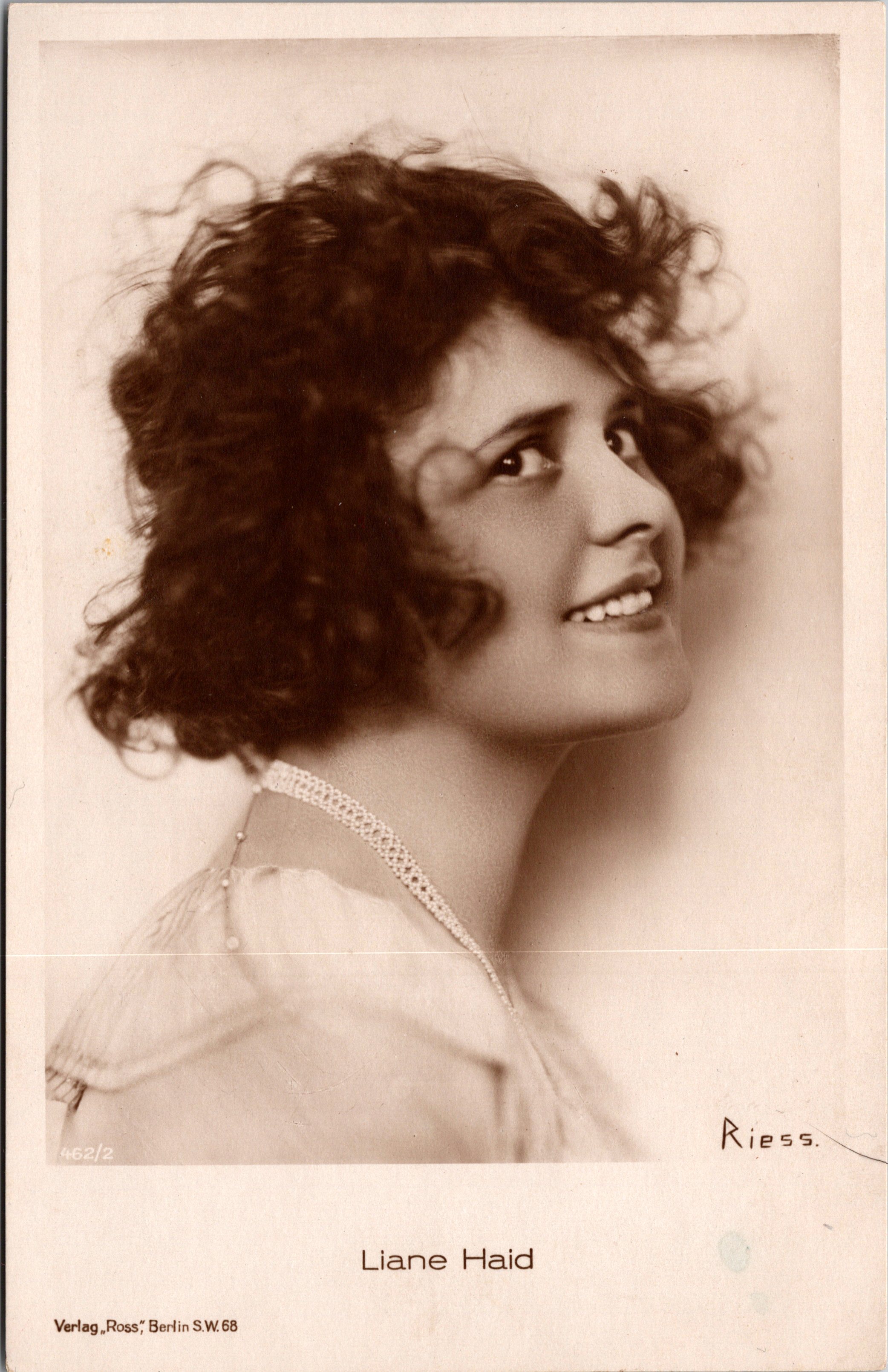
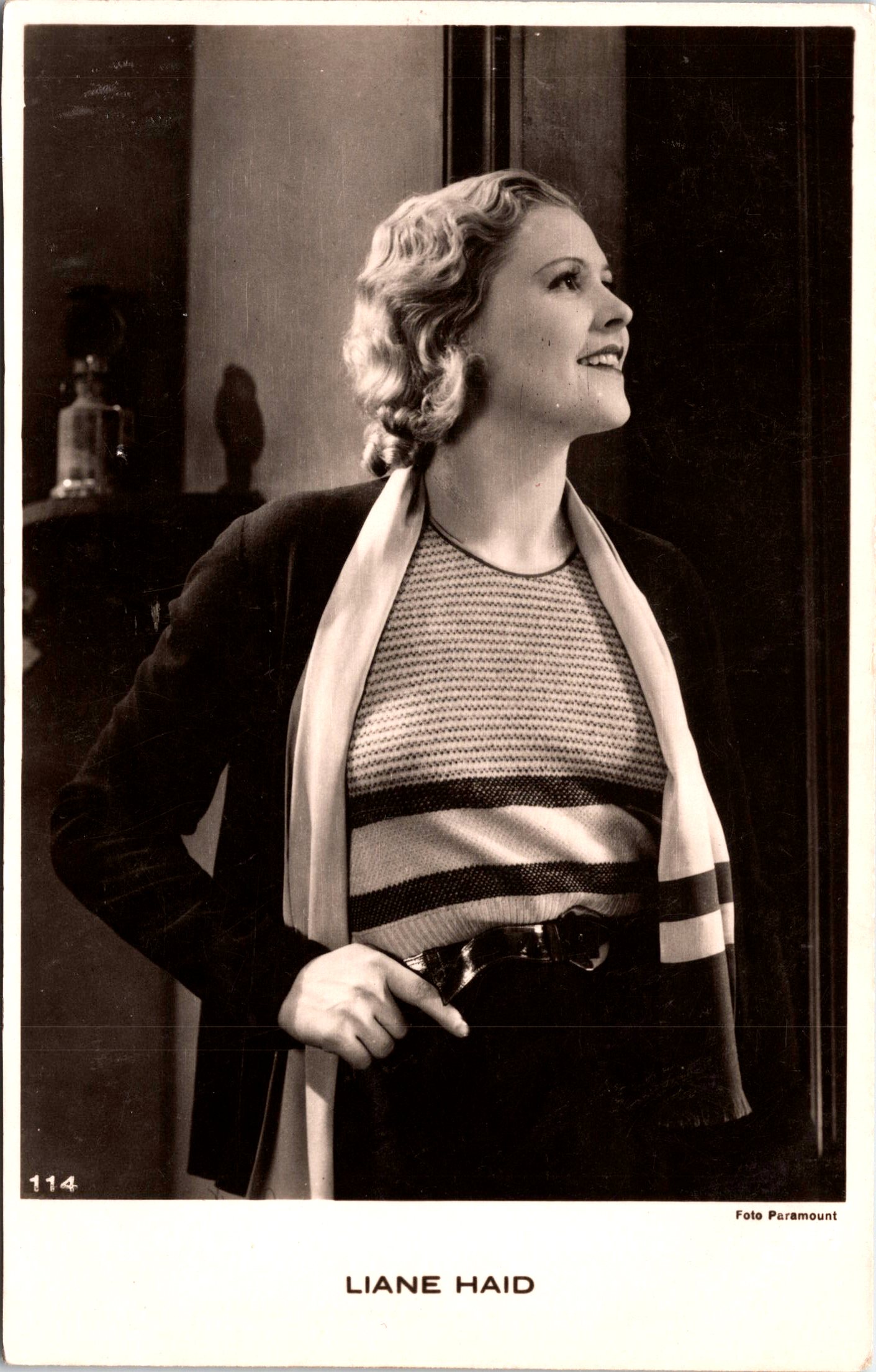
These vintage real photo postcards feature European film star Liane Haid (1895-2000). In the top postcard she poses holding a tennis racket and wearing a hair band to keep her hair out of her eyes. She is quite beautiful but how can we interpret her facial expression. To me, it looks like she is rolling her eyes as if she is bothered by something. Who is Liane Haid? She was born in Vienna, Austria and received training in both dance and singing. She gained the nickname of “Sweet Viennese Girl”. Haid was a prima ballerina, dancer, singer and stage actress. She worked in Budapest and Vienna as a dancer. Her stage career was mostly in Berlin and Vienna. She became a popular pin-up star through the 1920’s and 1930’s. Her first movie role was in a World War I propaganda film. She was employed by UFA and appeared in a number of comedy films alongside other movie stars including Willi Forst, Bruno Kastner, and Georg Alexander. UFA was a major German Film producer and distributor that operated between 1917 through the end of World War II. Liane Haid refused a number of Hollywood offers but in 1942, she escaped Nazi Germany and went to Switzerland according to Wikipedia, “because of the regime, because everything was bombed, and because all the good directors had left”. Soon thereafter she got married and retired from films. She was married three times. The IMDB web site states that she has 92 film credits from 1915 through 1953. Notable films include “Lady Hamilton” (1921), “Lucrezia Borgia” (1926), and “The Song is Ended” (1930). The photographer of this terrific image was Alexander Binder (1888-1929). He had the largest photo studio in Europe during the late 1920’s and the 1930’s. Many of his entertainment star portraits appear on Ross Verlag postards. It is thought that Binder was of Swiss origin. He was of the Jewish faith. He studied engineering but did not complete his studies. From 1908 to 1910 he studied photography at a school in Munich, Germany. After the completion of his photography studies, he went to Berlin and in 1913 opened his first photography studio. Before long, he became one of the premier photographers in Berlin. He primarily focussed on fashion and celebrity photography. Since Berlin was the capital of the European film industry, Binder photographed all the stars of the European film industry including, Lilian Harvey, Conrad Veidt, and Lya De Putti. Many of his images were used in popular film portrait postcards. His photographs could be seen in postcards published by Ross Verlag and Photochemie. Binder died in 1929 but new photo cards bearing his signature continued to be published until 1937. It is thought that the real photographer of these new postcards was Hubs Floeter (1910-1974) who was employed at the studio as an operator. The studio continued to be owned by Binder’s widow, Mrs. Binder Alleman and their two daughters. The studio was managed by the Jewish Elisabeth Baroness Vonhedlis Stengel who was later deported to the Theresienstadt concentration camp. In 1938 the Nazi’s closed Binder’s studio and it was later taken over by an Aryan photographer, Karl Ludwig Haenchen . Haenchen continued to produce celebrity portraits for postcards. His publishers included Film-Foto-Verlag. After World War II the studio was taken over by the Hasse und Wiese company.
Postcard 8 was published by Ross Verlag. The postcard is part of a series (No.1732/3). Note the logo for UFA, a German film company. (SOLD)
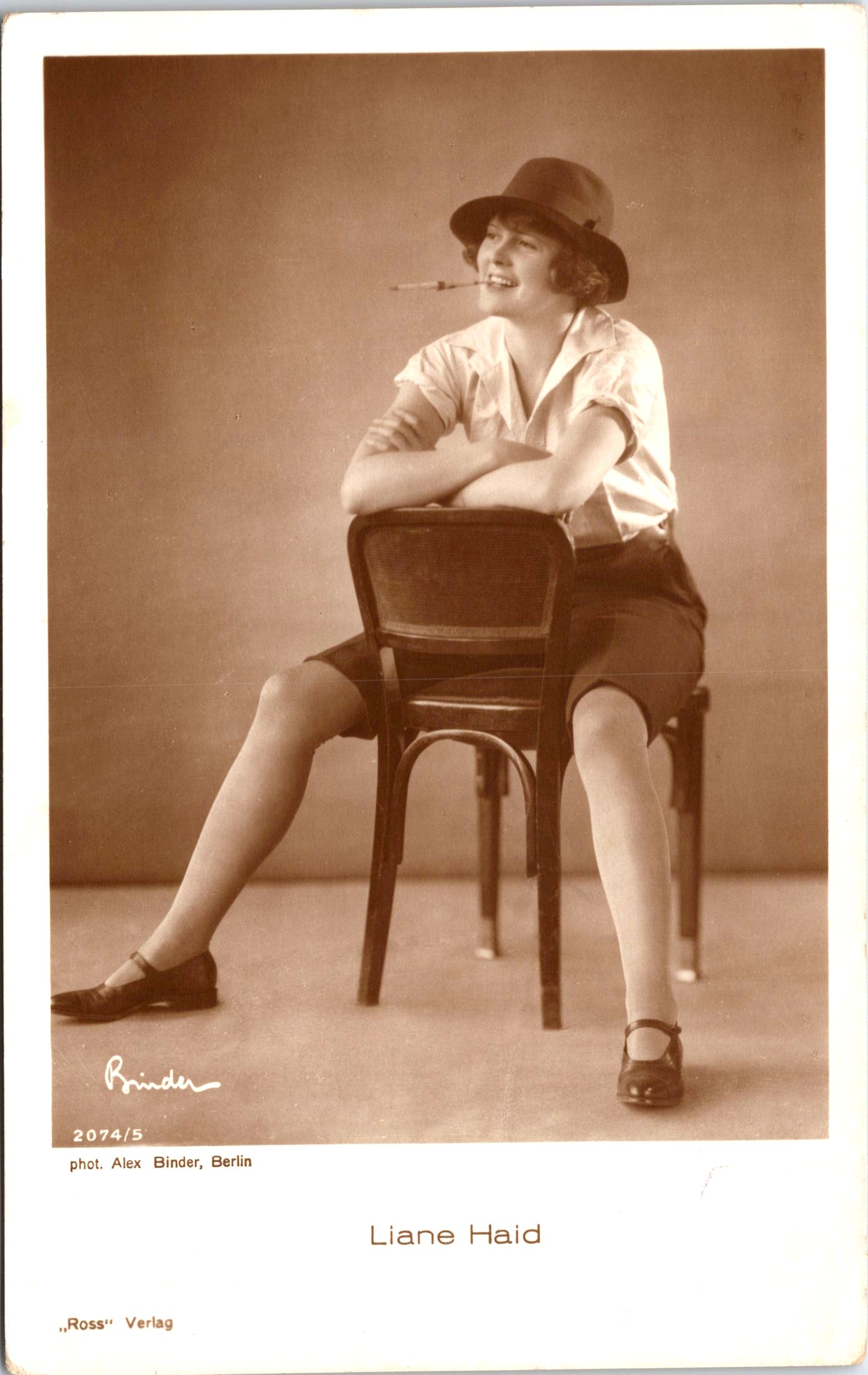
Postcard 9 features Haid sitting in a chair in a provocative manner and smoking a cigarette in a cigarette holder. This photograph portrays Haid as unconventional and seductive. The publisher of the card was Ross Verlag. The postcard is part of a series (No.2074/5). Miss Haid’s photograph appearing on this postcard was taken by Alexander Binder (Berlin, Germany). (SOLD)

POSTCARD 1 (SOLD)

POSTCARD 2 (SOLD)

POSTCARD 3 (SOLD)

POSTCARD 4

POSTCARD 5 (SOLD)

POSTCARD 6

POSTCARD 7
POSTCARD 8 (SOLD)
POSTCARD 9
POSTCARD 10
POSTCARD 11 (SOLD)

POSTCARD 12 (SOLD)

Buy this original Real Photo Postcard (includes shipping within the US) #2490
To purchase this item, click on the Pay with PayPal button below
$27.50

Buy this original Real Photo Postcard (includes International shipping outside the US) #2490
To purchase this item, click on the Pay with PayPal button below
$35.50

Buy this original Real Photo Postcard (includes shipping within the US) #2488
To purchase this item, click on the Pay with PayPal button below
$35.50

Buy this original Real Photo Postcard (includes International shipping outside the US) #2488
To purchase this item, click on the Pay with PayPal button below #2488
$43.50
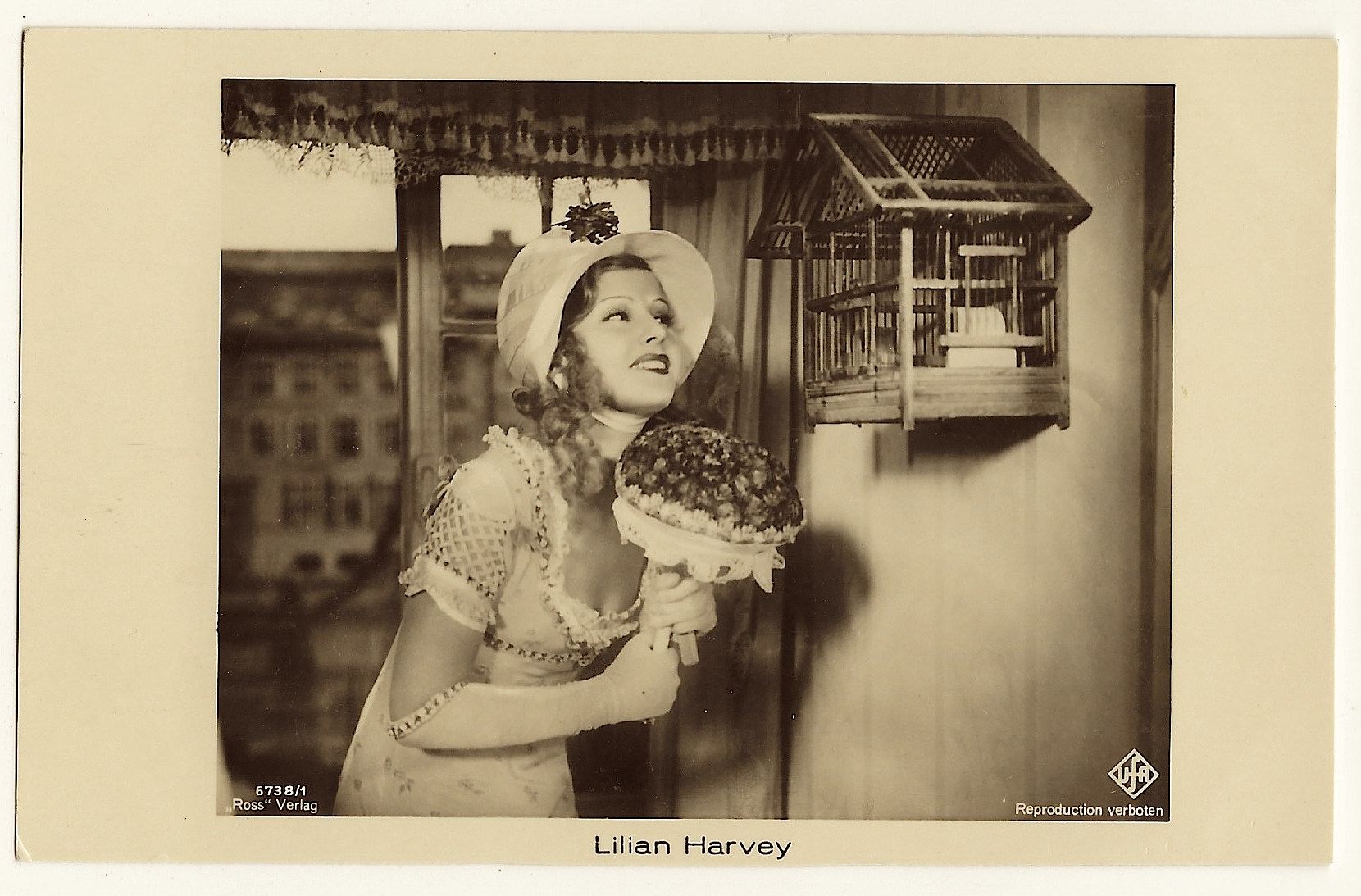
Postcard #7 features Lillian Harvey leaning forward as she looks into a hanging bird cage. The photographer likely chose this pose to inject some sexuality into the image. The pose reveals a small amount of the actress’s cleavage. She is wearing a relatively low-cut dress for this time period. Print on the reverse of the postcard reveals that the photograph of Miss Harvey comes from the film “Congress Dances” (1931). Her costar in the film was Willy Fritsch. The postcard was published by Ross Verlag and is part of a series (no. 6738/1). On the right hand bottom corner of the postcard is the logo for “UFA”, a German film company. This postcard is in excellent condition.
Buy this original Real Photo Postcard (includes shipping within the US) #2520
To purchase this item, click on the Pay with PayPal button below
$28.00
Buy this original Real Photo Postcard (includes International shipping outside the US) #2520
To purchase this item, click on the Pay with PayPal button below
$36.00
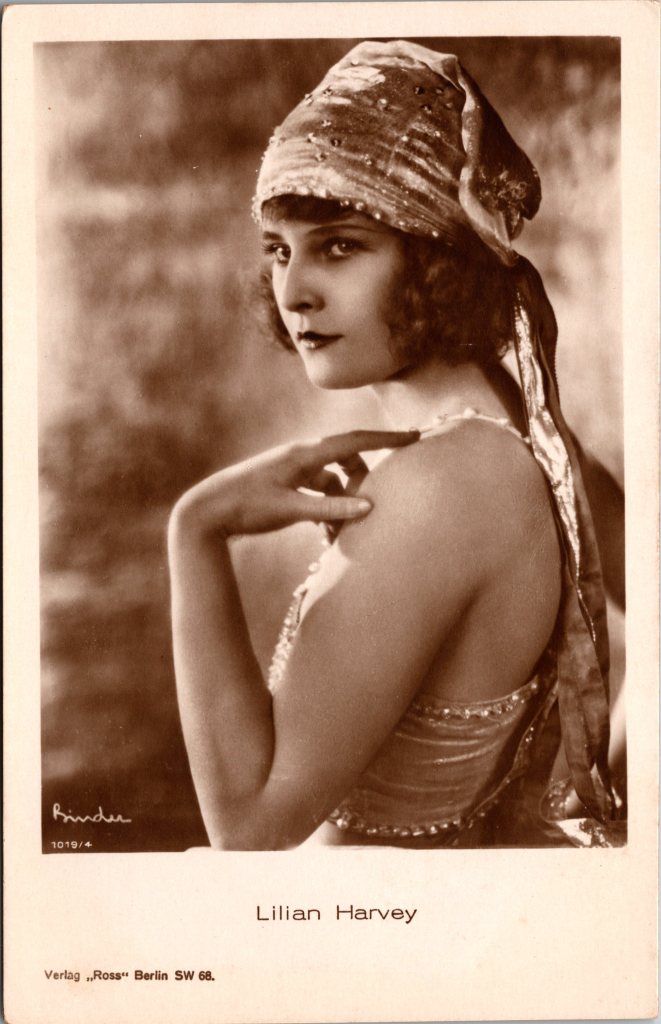
Postcard 8 was photographed by Alexander Binder and published by Ross Verlag as part of a series (no.1019/4). Ballerini & Fratini (Florence, Italy) are credited on the reverse of this postcard. (SOLD)
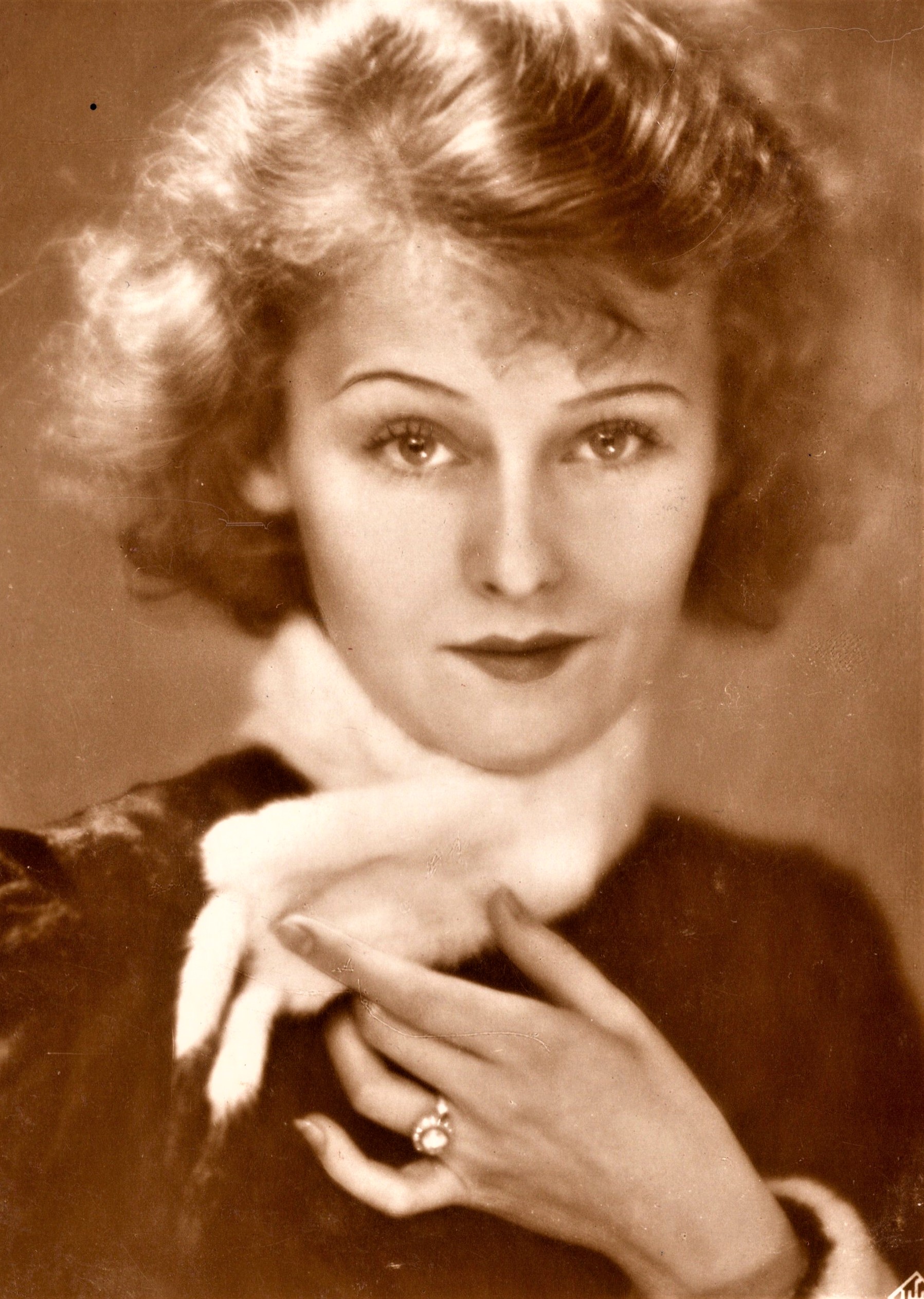
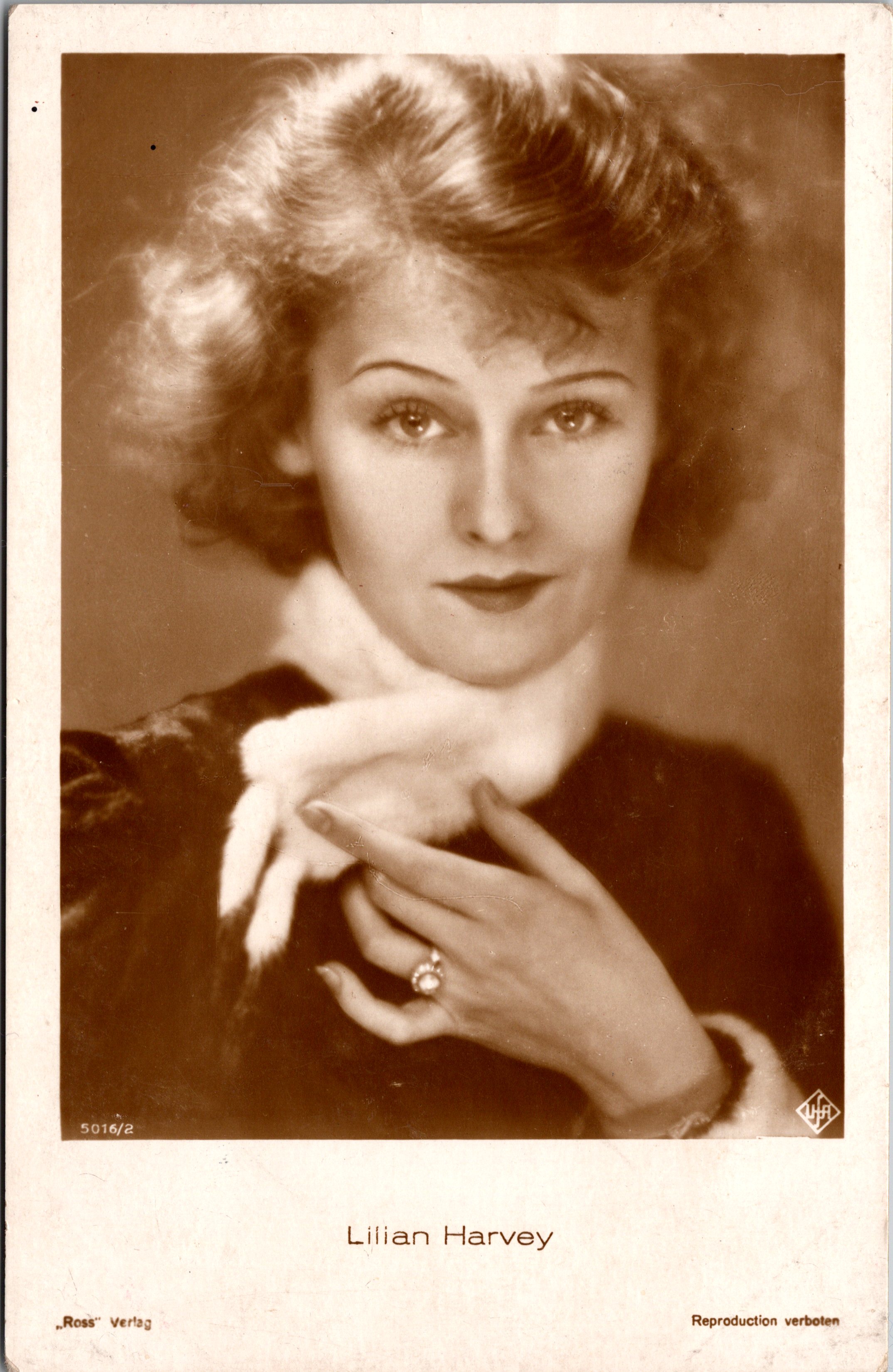
Postcard 9 offers a pretty portrait of Lilian Harvey that was published by Ross Verlag as part of a series (no.5016/2). Note the logo for UFA, the German film company, in the bottom right hand corner of the image. This vintage postcard is in very good conditon (see scans).
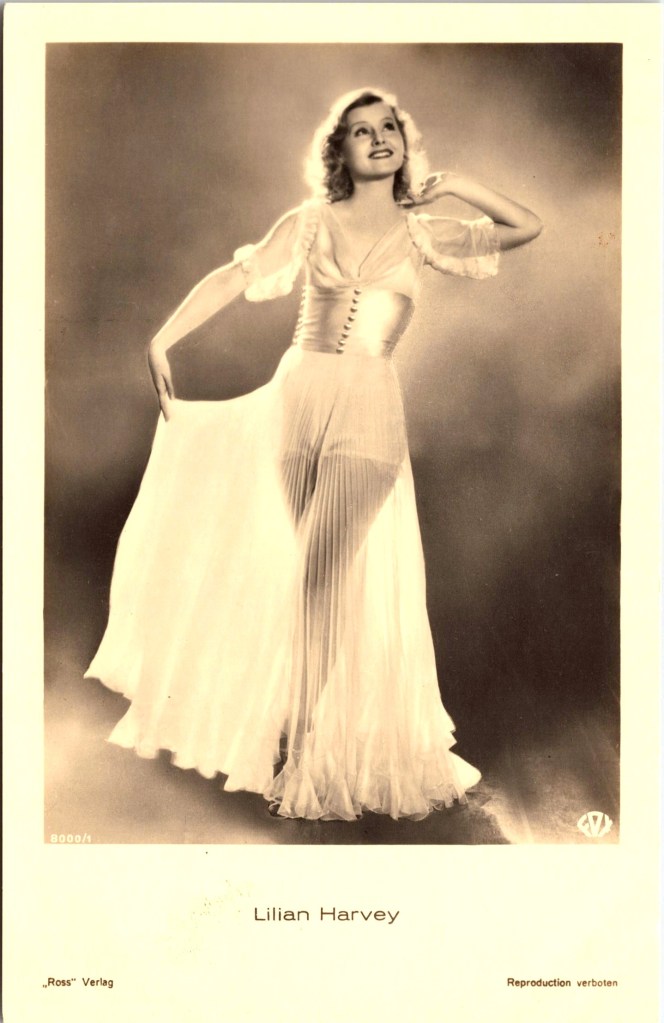
Postcard 10 is meant to be risque. Harvey is wearing a provocative dress and it is clear that the aim of the photographer is to emphasize Miss Harvey’s sexiness. The photographer and Miss Harvey succeeded in accomplishing this goal. This card has the logo of Fox Films. She made four films for the company beginning 1931. Lillian Harvey was a popular postcard model and there are many postcard images of her in existence. However, this particular card is very uncommon and one of the more suggestive photographs of Miss Harvey published on a postcard. This postcard portrait was published by Ross Verlag (Germany) as part of a series (No.8000/1). SOLD
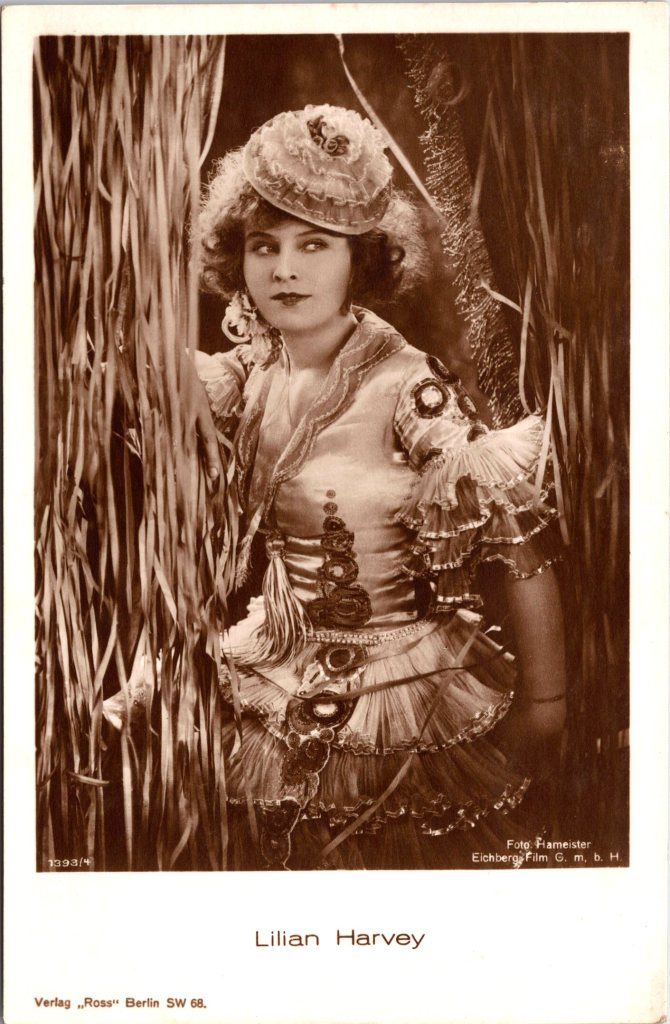
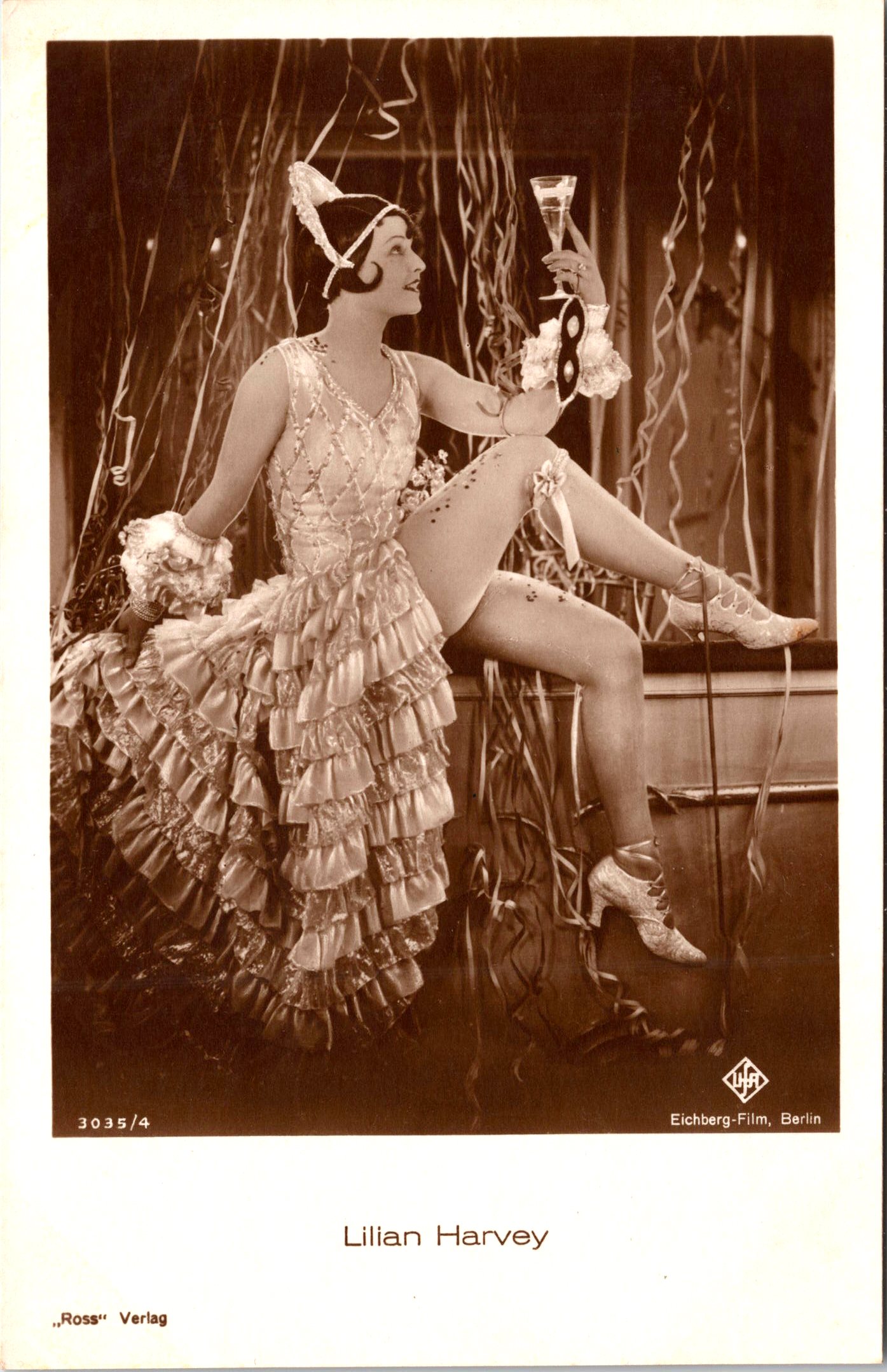
Postcard 11 was published by the German firm Ross Verlag and was part of a series (no. 1393/4). Eichberg Films is credited on the bottom right hand corner of the image. The company was located in Germany. Richard Eichberg was a moderately successful actor who became a director/producr in 1915. (SOLD)
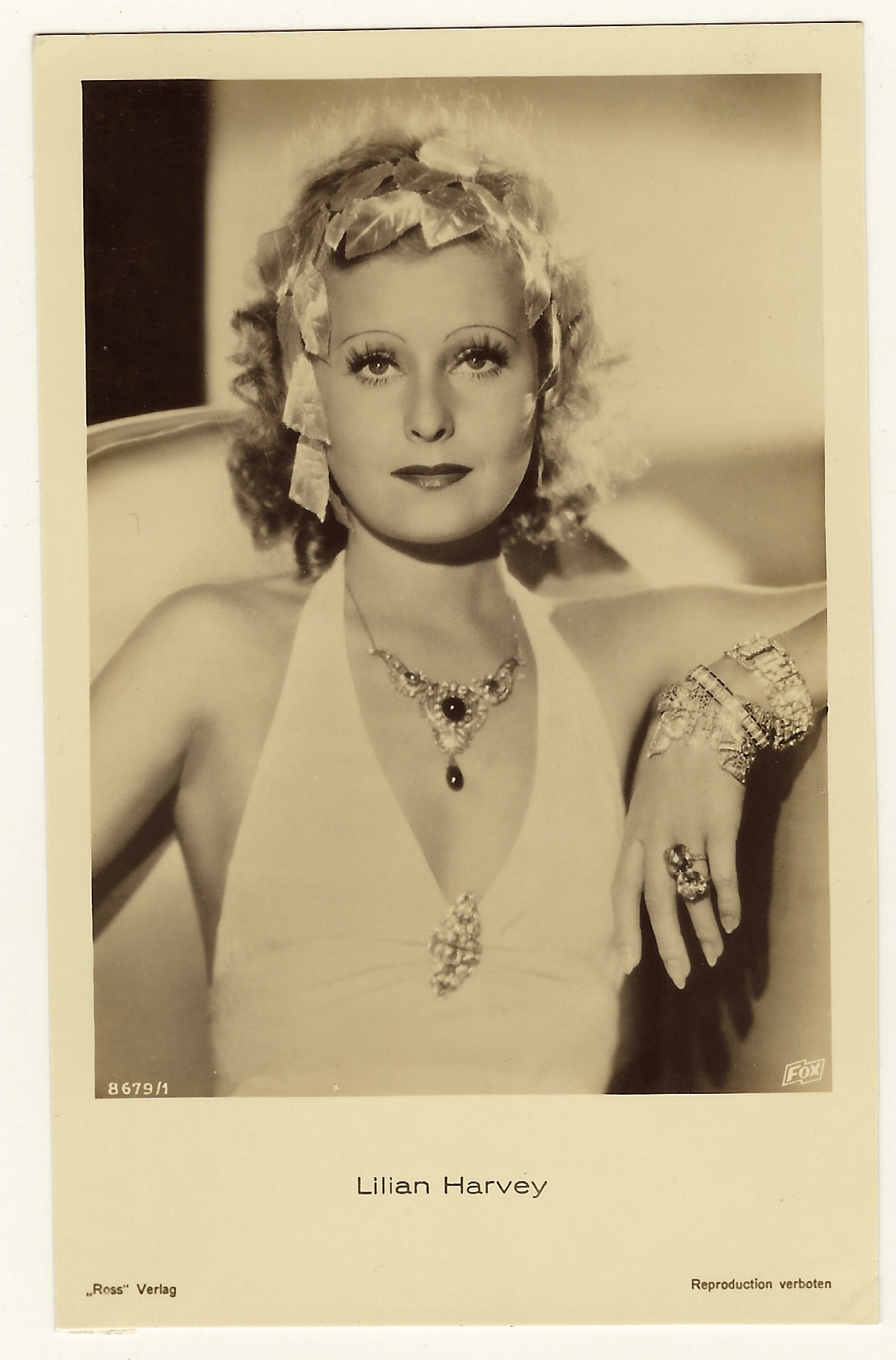
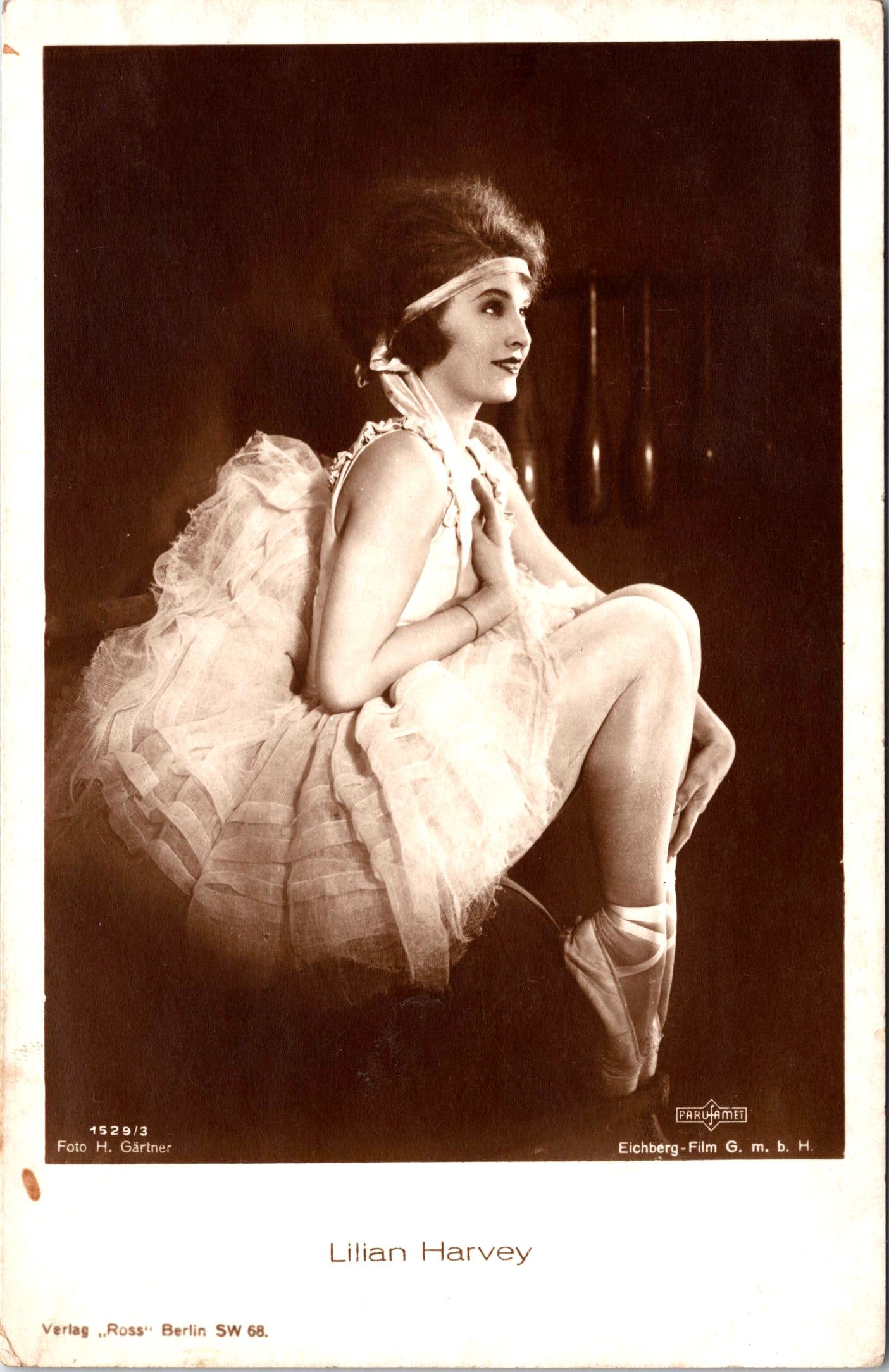
Postcard 12 was published by the German firm Ross Verlag and was part of a series (no. 8679/1). She is posed in a bit of a provocative pose and is smoking a pipe. This postcard portrait was photographed by H. Gartner and published by Ross Verlag as part of a series (no.1529/1). Eichberg Films is credited on this postcard. Richard Eichberg (1888-1952) began his career as an actor but became a succssful film director and producer in the German film industry. He directed 87 films and produced 77 films. (SOLD)

Buy this Real Photo Vintage Postcard (includes shipping within the US) #5112
To purchase this item, click on the Pay with PayPal button below
$15.79

Buy this Vintage Real Photo Postcard (includes International shipping outside the US) #5112
To purchase this item, click on the Pay with PayPal button below
$25.04
POSTCARD 13
POSTCARD 14 (SOLD)
POSTCARD 15 (SOLD)
POSTCARD 16 (SOLD)
Postcard 13 was published by Ross Verlag and features Miss Harvey posed in a provocative manner. This postcard has a French stamp and was postmarked in 1929 in Paris, France. (SOLD)
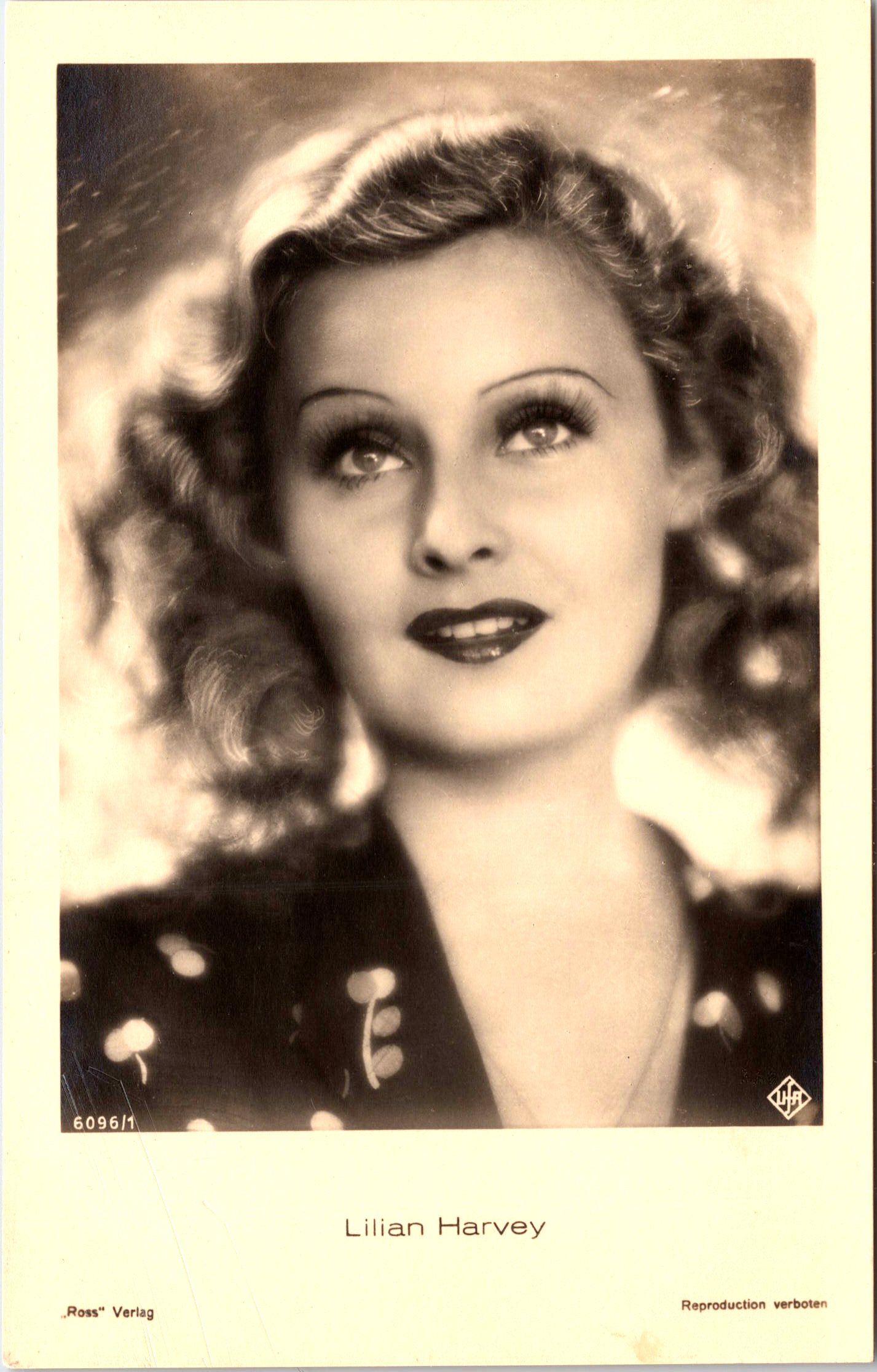
Postcard 14 was published by the German firm Ross Verlag and was part of a series (no. 6096/1). UFA Films is credited on the bottom right hand corner of the image. The company was located in Germany. SOLD
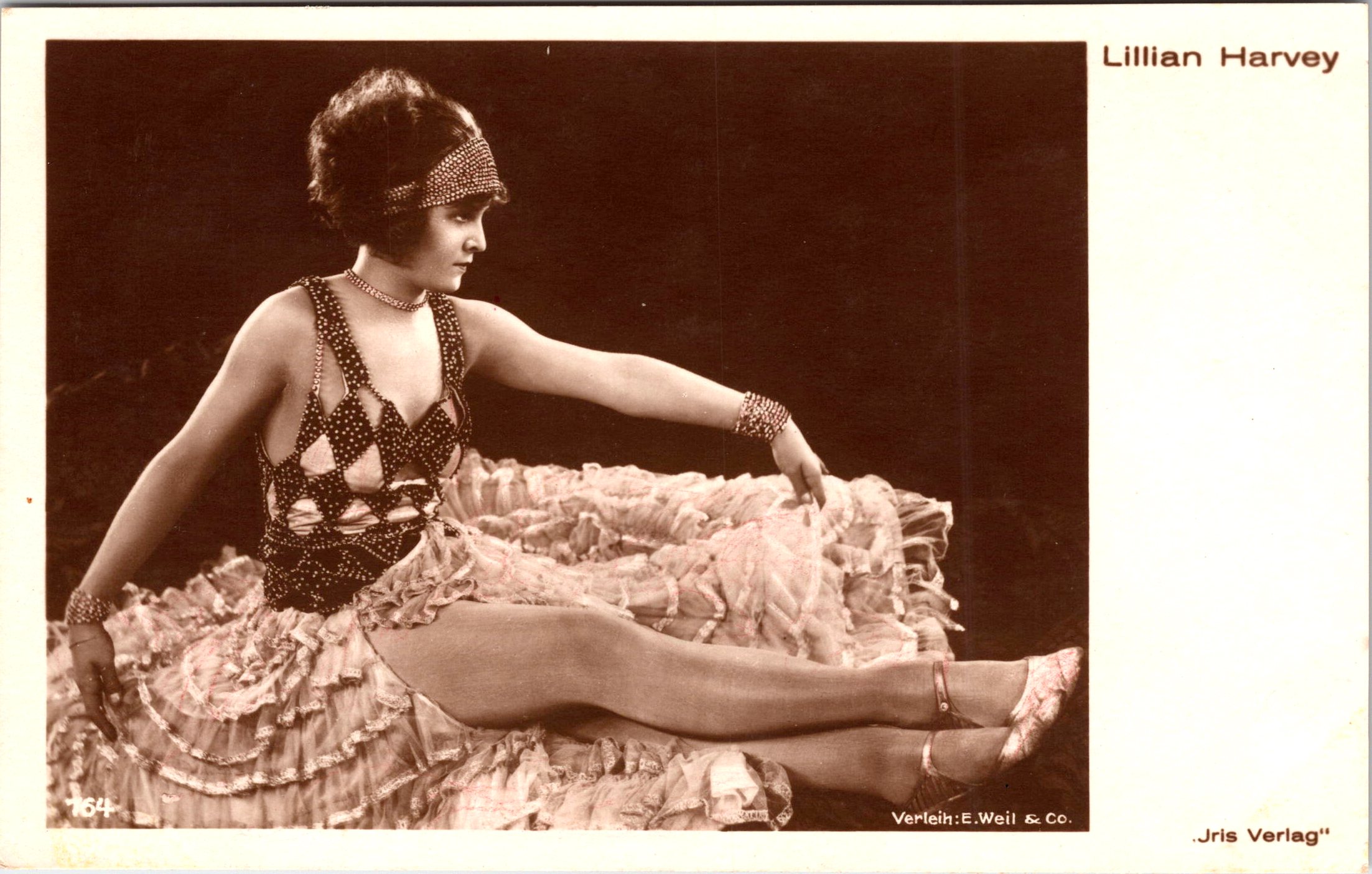
Postcard 15 shows Lillian Harvey wearing a ballerina costume and it is clear that the aim of the photographer is to emphasize Miss Harvey’s sexuality. The photographer and Miss Harvey succeeded in accomplishing this goal. The postcard was published by the Austrian firm Iris Verlag and was part of a series (no.764). Iris Verlag in Vienna was the most important Austrian publisher of film star postcards. The photographer of this portrait was E. Weil & Co. SOLD
Postcard 16 was published by Ross Verlag. It was part of a series (no.2033/1). The postcard has the logo of “Fanamet” in the lower right hand corner of the image. “Fanamet Films” was an Austrian film distribution company. The logo for “First National Pictures” is located on the bottom left hand corner of the image. First National Pictures was an American motion picture production and distribution company. The company was founded in 1917 as a theater chain. It then began distributing movies and in 1924 it began producing films. In 1929 the company was absorbed by Warner Brothers. (SOLD)
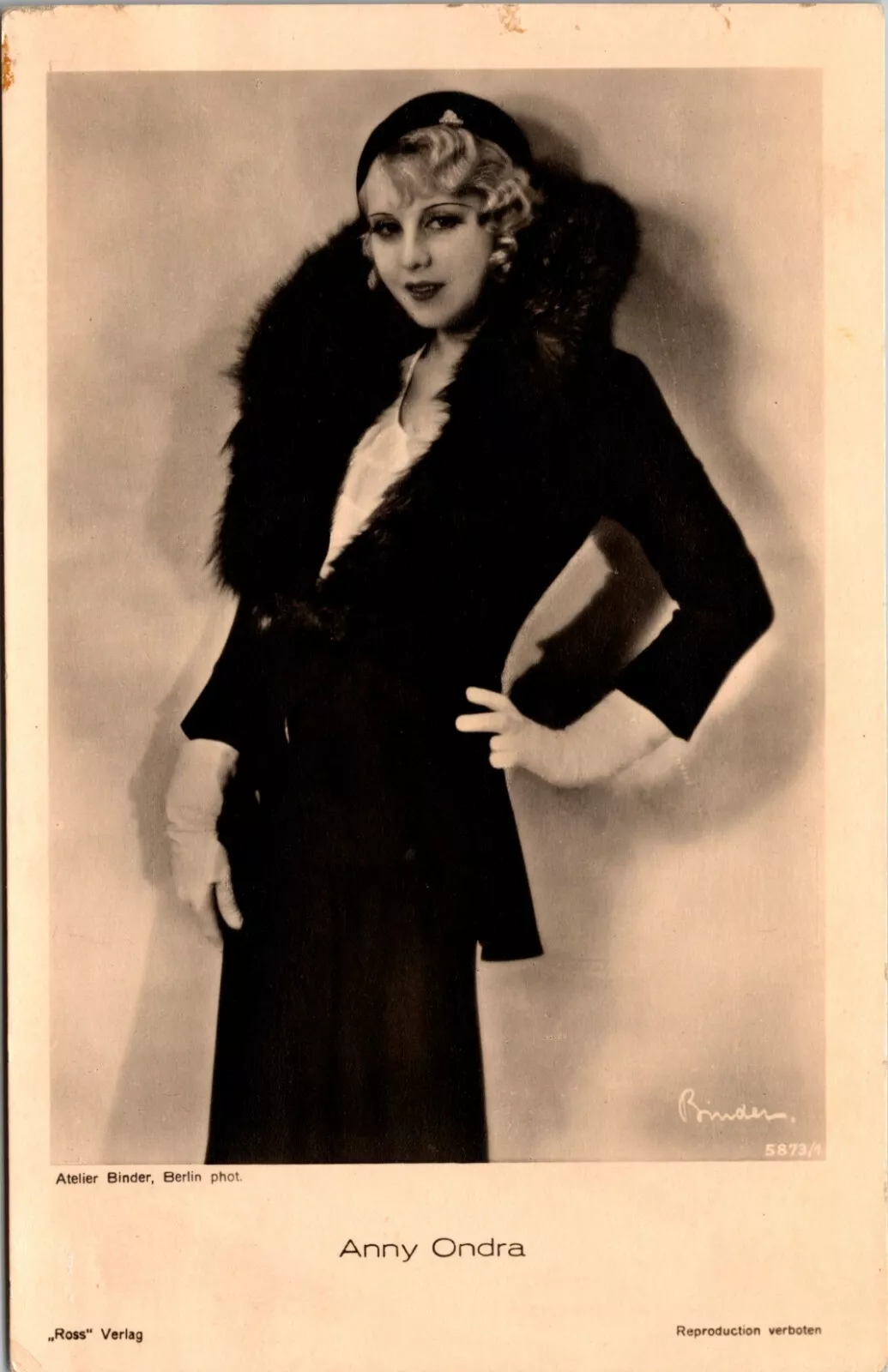
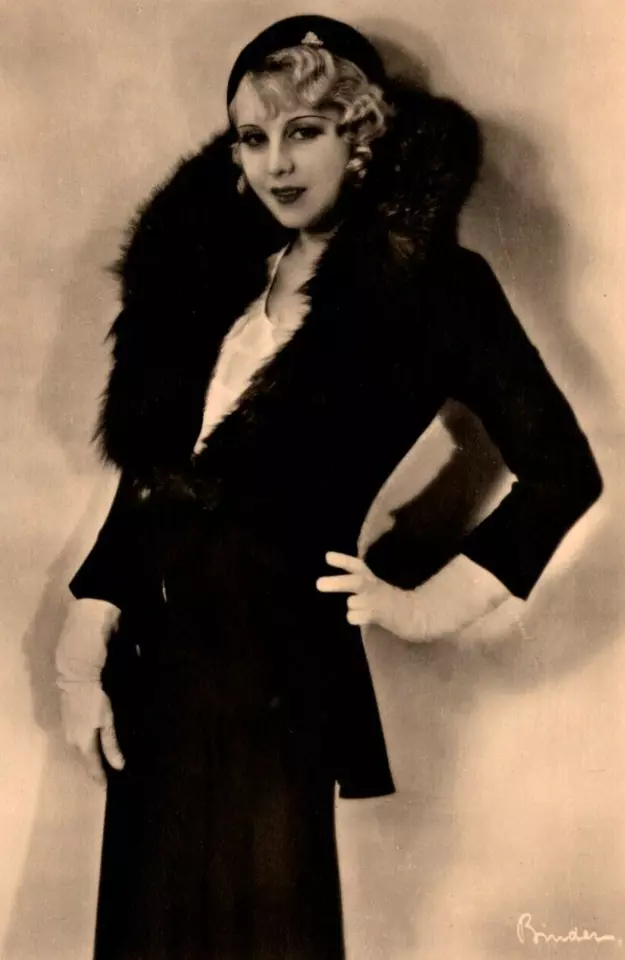
This vintage real photo postcard features actress Anny Ondra. The postcard was published by Ross Verlag. The photograph is by Alexander Binder. The postcard is part of a series (no. 5873/1). Anny Ondra (1903-1987) was a Czech film actress. She was born in Tarnow, Galicia, Austria-Hungary (now Poland). She was active in the movie industry between 1914 and 1957. She acted in Czech, Austrian, and German films in the 1920’s. She appeared in some British dramas, most notably, Alfred Hitchcock’s “The Manxman” (1929) and “Blackmail” (1929). The IMDb credits Ondra with over 90 acting credits between 1914 and 1957. She appeared in more than 40 films in the sound era. However, her career in British films was hurt by her thick accent. Check out the youtube video below. In this “test film”, Hitchcock “interviews” Ondra and makes her visibly uncomfortable and embarrassed by asking her very personal questions. She was married to German boxing champion Max Schmeling between 1933 and 1987. Schmeling was the world champion between 1930 and 1932. He is well known for his fights with African American fighter, Joe Lewis. Ondra’s father was a Czech, Austro-Hungarian military officer and she grew up in Tarnow, Pula, and Prague. At the early age of seventeen, she acted in the theater as well as in a film. When her family learned that she had acted in a film, they were extremely angry. In fact, she reported that she was given a beating by her father. Post World War I was a time, for many people, that being an actress was akin to being a prostitute. Ondra began to live with her boyfriend (her debut film’s director) but after some time, the relationship ended because she wanted a family and he wanted nothing to do with marriage. In 1933, after a three year romance, Anny married Max Schmeling. She had been in a film with the boxer (“Knock-Out”, 1935). It was a “happy” marriage and the couple remained together until her death in 1987. Ondra and Schmeling were hot names in Nazi Germany. German fascists tried to exploit them in order to popularize their movement. Schmeling was seen as a German superman while Ondra represented the blonde Aryan type. The two celebrities refused to collaborate. Schmeling turned down honors and even helped hide two Jewish children, saving their lives. However, because of Nazi propoganda, many believed that the couple had collaborated. As a result, Schmeling and Ondra suffered financially for their fictional cooperation with the Nazis. Ondra was portrayed in two modern day movies, “Ring of Passion” (1978) and Joe and Max (2002). Miss Ondra appears quite thin in this postcards’s photo. Note her fur collared jacket. SOLD

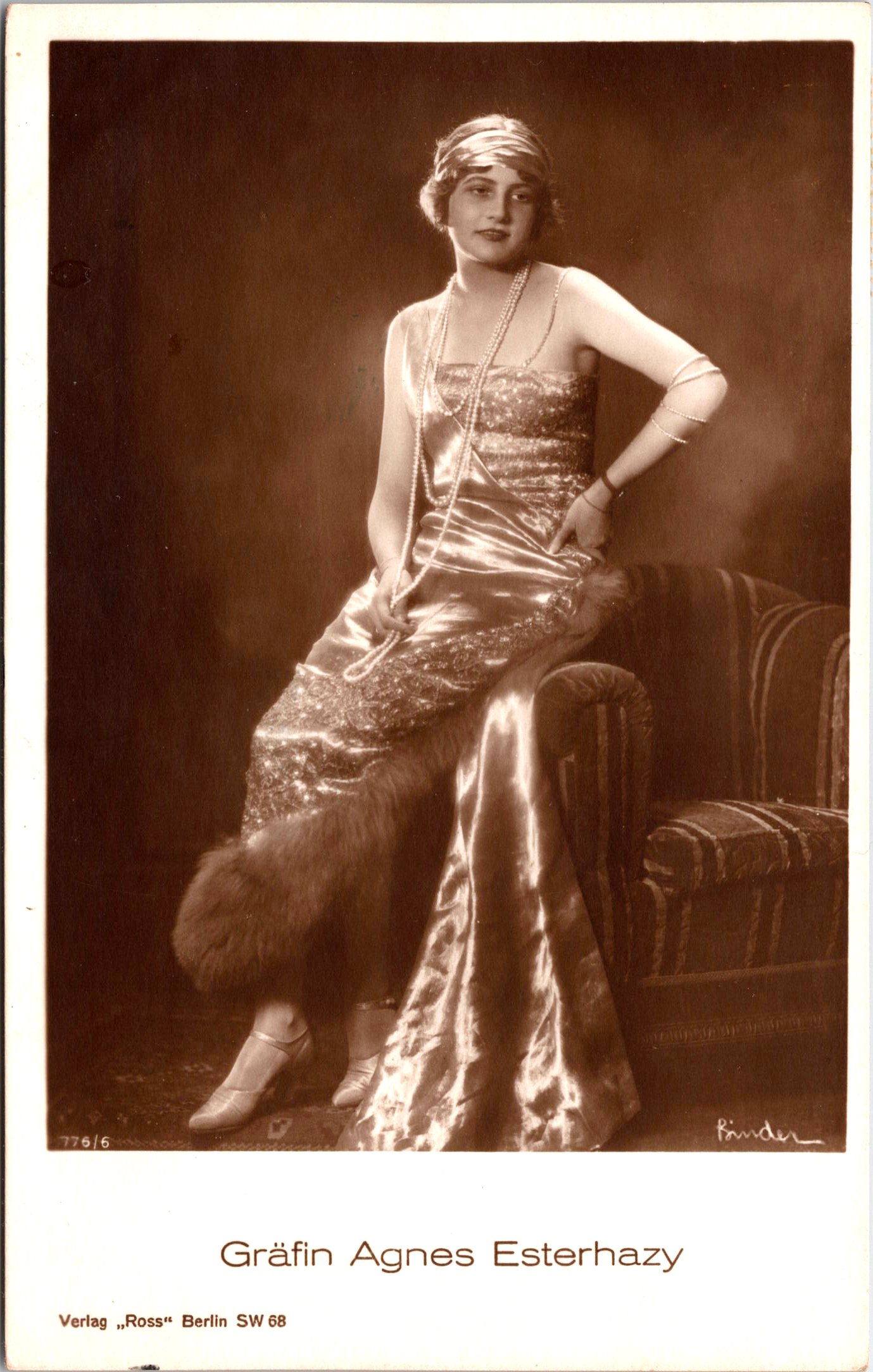
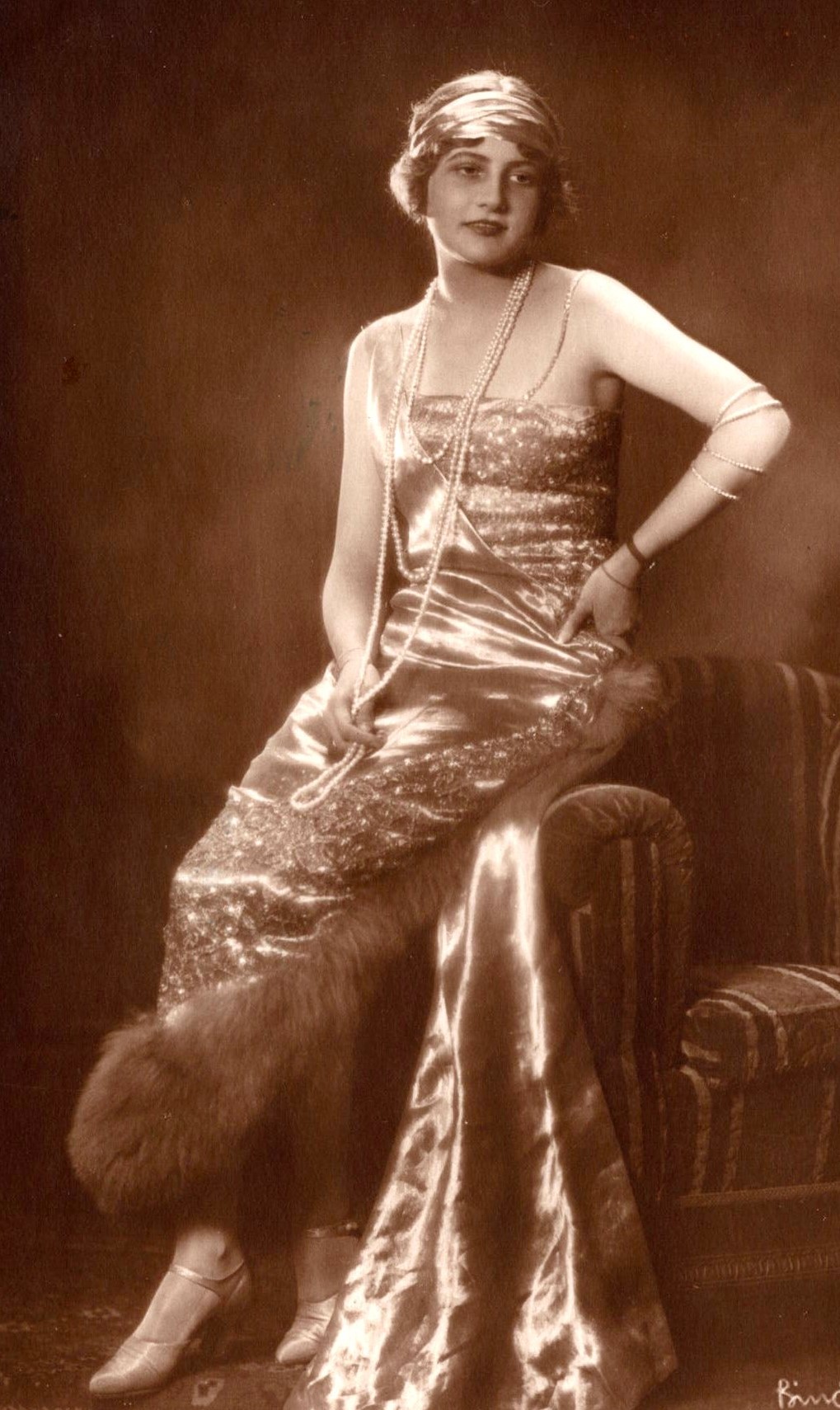
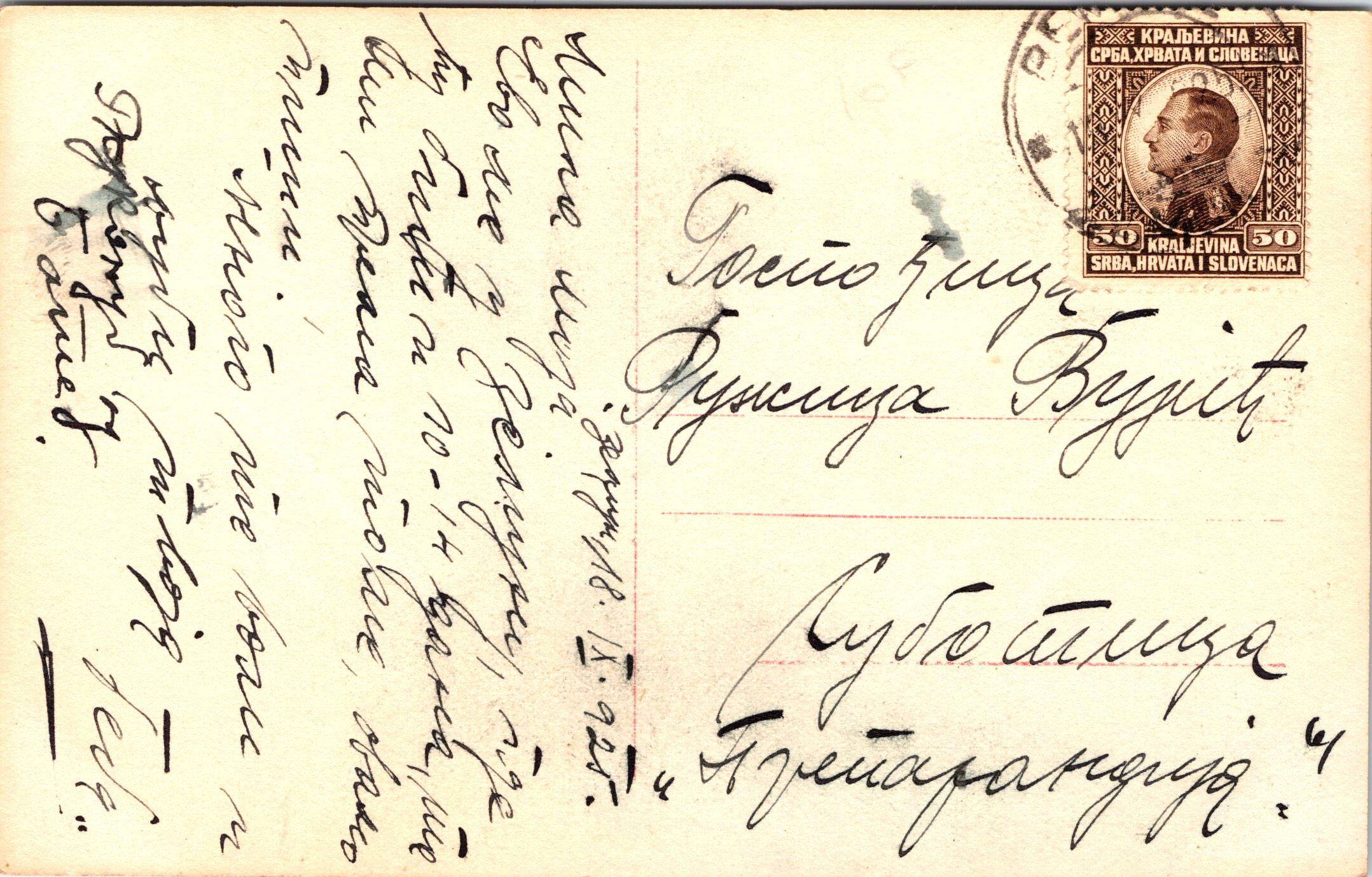
This vintage real photo postcard features Hungarian film actress Agnes Esterhazy (1891-1956). She is quite pretty and is dressed in flapper fashion. Esterhazy predominately appeared in Austrian and German films. In total, her IMDb filmography includes 32 films between 1918 and 1943. Her parents were a Count and Countess. She married actor Fritz Schulz in 1910. He was 14 years old and she was 19 years of age. I am sure there is an interesting story there and a lot of material for armchair psychologists to hypothesize about. After World War I, the pair lived in Budapest and Agnes began acting lessons. She made her film debut in 1918 and many more roles followed. During her career she acted alongside Harry Liedtke, Hanni Weisse, Asta Nielsen and Greta Garbo. Agnes mostly played supporting roles but she also played some leading roles. Esterhazy’s career virtually ended with the arrival of sound films. After her retirement from film, she she acted at various theaters, many of which were in Ostrava (Czech Republic). Esterhazy’s husband (Fritz Schulz) was arrested by the Nazis and held in a Vienna prison. His crime was that he was Jewish. Esterhazy was able to get him released in the Spring of 1938. This portrait postcard was published by Ross Verlag (Berlin). The postcard is part of a series (no.776/6). Esterhazy’s photograph was taken by celebrity photographer, Alex Binder (Berlin). The card is posted and has a stamp that was issued by Yugoslavia in 1921. The message on the postcard is dated 1925. (SOLD)
POSTCARD 3 (SOLD)
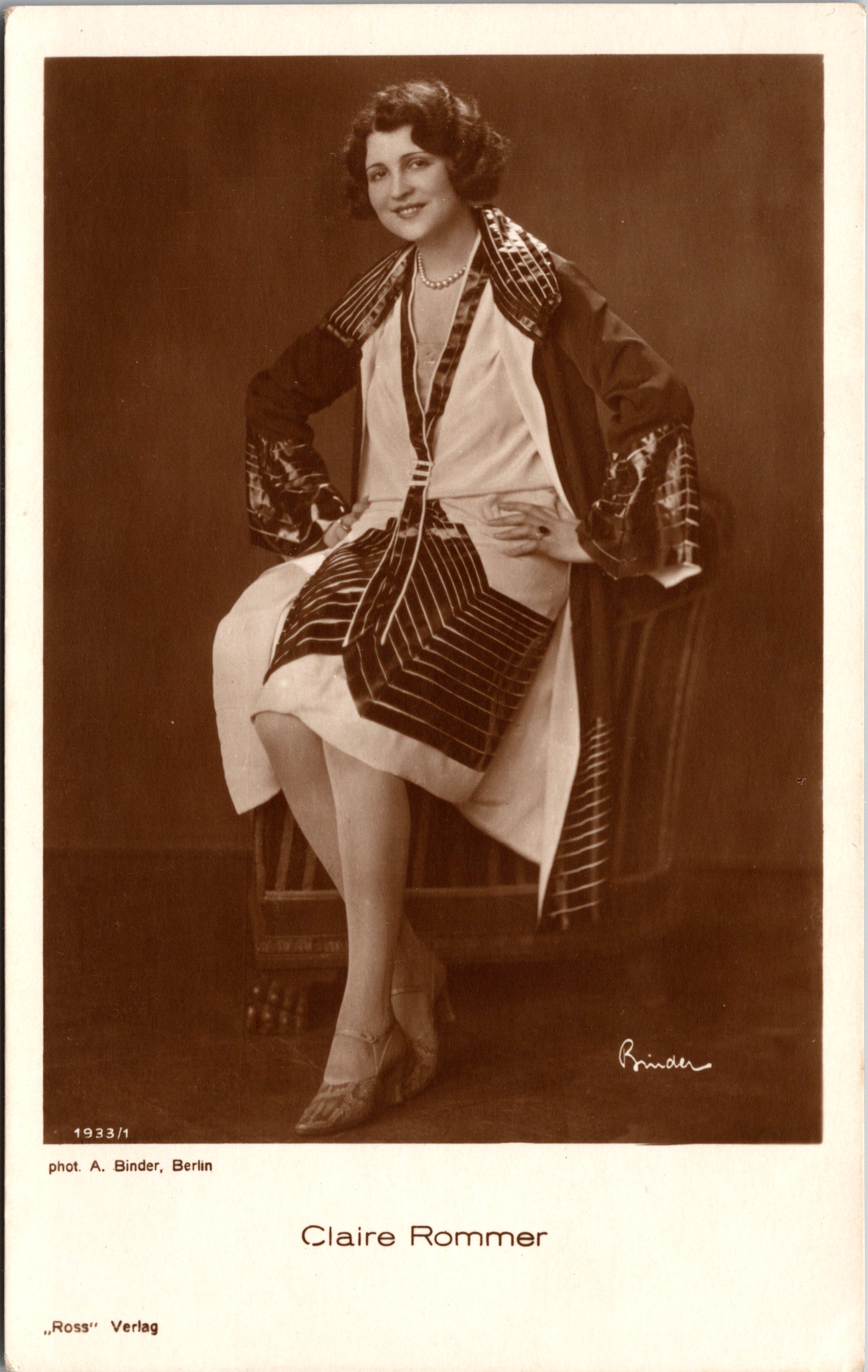
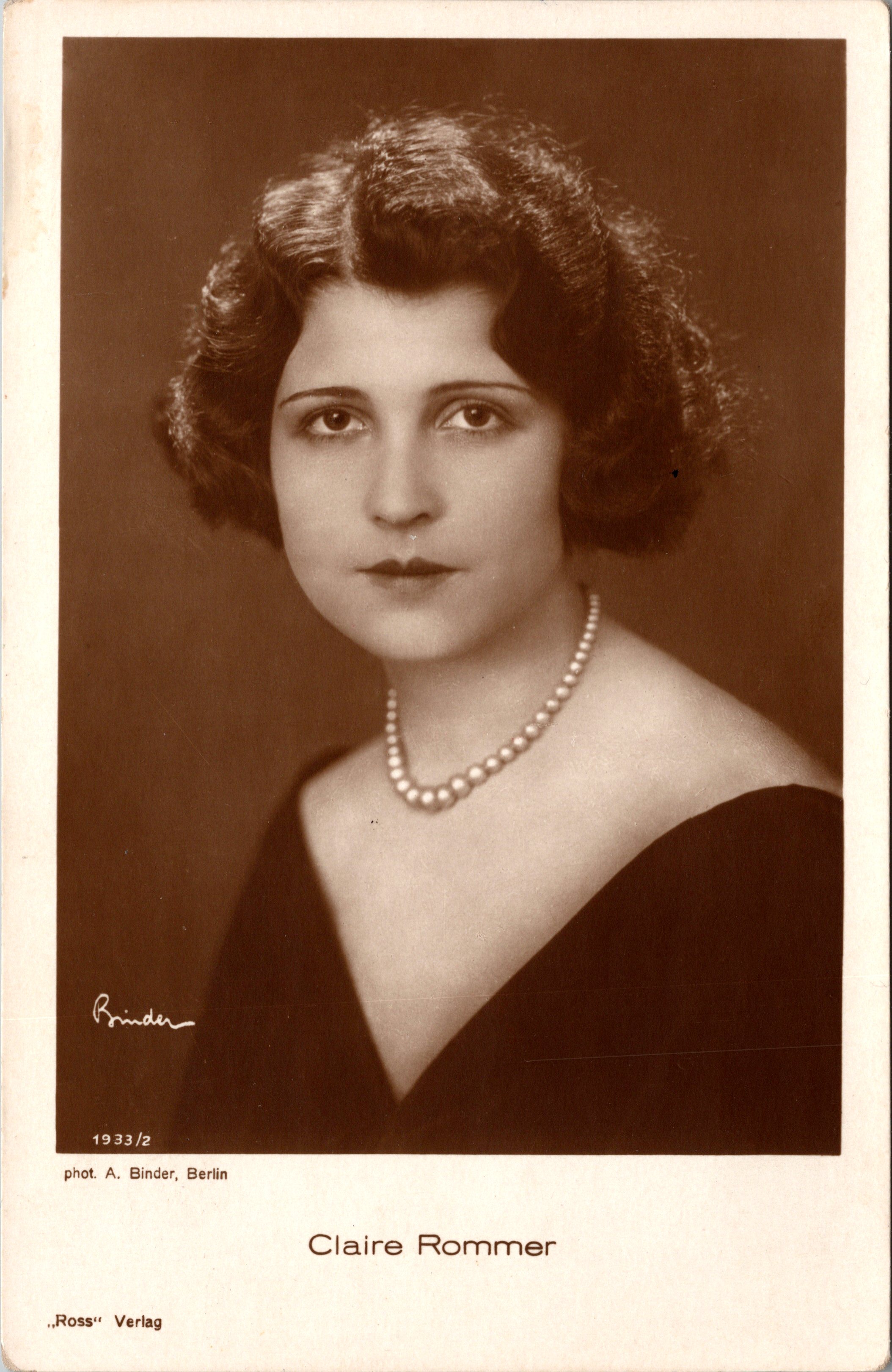
These vintage real photo postcards feature German film actress, Claire Rommer (1904-1996). Her filmography on IMDb credits her with 49 film appearances between 1922 and 1934. She made her film debut at the age of eighteen. She also began her career as a soubrette appearing in operettas and comedies on the Berlin stage. However, her fame came from her film work. She played both leading and supportive roles. She played in silent films and made a successful transition to sound films. She even sang in some of her talkies. She was married to a prosperous Jewih man, named Adolf Strenger. Because of her marriage, in 1938 she was banned from any participation in the German film industry. It was thought that she was probably not Aryan like her husband. The rise of the Nazis forced the couple to leave Germany and emigrate to the United States via Portugal.The pair left Europe with the assistance of Aristedes de Sousa Mendes. He was a Portuguese Consular stationed in France. Mendes defied orders from his government and issued thousands of visas to Jews, allowing them to escape with their families and their lives. He was a hero for his work as a Holocaust rescuer. Ultimately, Mendes was severely punished for his defiance. After leaving Germany, Rommer’s film career ended. In the US, she divorced her husband and married a meat industry multi-millionaire.
Postcard 1 was published by Ross Verlag as part of a series (No.1933/1). Claire Rommer’s photo portrait was taken by celebrity photographer, Alexander Binder. This vintage photo postcard is in excellent condition (see scans). (SOLD)
Postcard 2 was published by Ross Verlag as part of a series (No.1933/2). Claire Rommer’s photo portrait was taken by celebrity photographer, Alexander Binder. This vintage photo postcard is in very good condition (see scans). (SOLD)
Postcard 3 was published by Ross Verlag as part of a series (no.3010/1). Miss Rommer’s portrait was taken by famed celebrity photographer Alex Binder, who operated his studio in Berlin. The postcard was postmarked in 1928. (SOLD)
POSTCARD 1
POSTCARD 2 (SOLD)
POSTCARD 3 (SOLD)
POSTCARD 4 (SOLD)
The beautiful actress seen in the top vintage real photo postcard is named Ossi Oswalda (1897-1947). She was born in Germany and appeared predominately in silent films. She was a leading lady, popular comedienne, dancer, and singer. Due to her popularity, she was known as “the German Mary Pickford”. Ossi began her career as a ballerina and she danced in a chorus line for a theater in Berlin. She made her film debute in “Night of Horrors” (1916) and was noticed by actor/screenwriter Hanns Kraly, who introduced her to director Ernst Lubitsch. Oswalda’s early career began with appearances in several Lubitsch films. In 1921, she and her husband started a film production company that produced four films over four years, all starring Miss Oswalda. After 1925, she was under contract to UFA, a German film company. After the transition to “talkies”, Oswalda joined the ranks of actresses and actors, who’s career took a nose dive. She only acted in two sound films. Her final screen appearance was in “The Star of Valencia”. She then began acting on the stage. She appeared in operettas in Germany and Vienna. When the National Socialists took power in Germany, she emigrated to Prague with her “Jewish life partner”, Julius Aubenberg. In 1943, she wrote a story for a Czechoslovakian film. In summarizing Ossi’s career, the IMDb credits her with 51 film appearances, producing 5 films, and 1 screen writing credit. It is reported that she frequently played child-like spoiled women. She appeared in drag in at least one film. Oswalda’s first marriage (1919-1925) was to a Hungarian baron. After her divorce, the actress began a highly publicized romantic relationship with Crown Prince Willhelm (1882-1951). Simultaneously, the actress Lily Damita, was having an affair with the Prince’s son. The royal family put a kibosh to both “inappropriate” relationships. In 1947, she died in Prague at age 48, bankrupt and suffering from multiple health problems. This German real photo postcard is published by Ross Verlag soemetime between 1919 and 1924. The photograph of Miss Oswalda was taken by Becker & Maass of Berlin. Note her pretty hat and fan. Hopefully, she wasn’t allergic to feathers. Oswalda was young when this photograph was taken. She was beautiful and no older than 27 years of age.
Postcard 2 features Miss Oswalda in a very skimpy costume. Her feathered hat is quite showy . She has a wonderful smile and pretty eyes. This risque postcard was part of a series (no. 1050/2) and published by Ross Verlag of Berlin, Germany. The logo of UFA, a German film company, appears on the lower right hand corner of the postcard. The reverse of the postcard reveals that that the photographer is Strobl J. Nandor of Budapest, Hungary. (SOLD)
Postcard 3 is a German real photo postcard that was published by Ross Verlag. Miss Oswalda’s photo was taken by celebrity photographer Alex Binder. (SOLD)
Postcard 4 captures Miss Oswalda looking amused. She is flashing a wonderful smile. This postcard was published by Ross Verlag of Berlin, Germany (no.474/2). (SOLD)

POSTCARD 3
POSTCARD 4
POSTCARD 2
POSTCARD 3
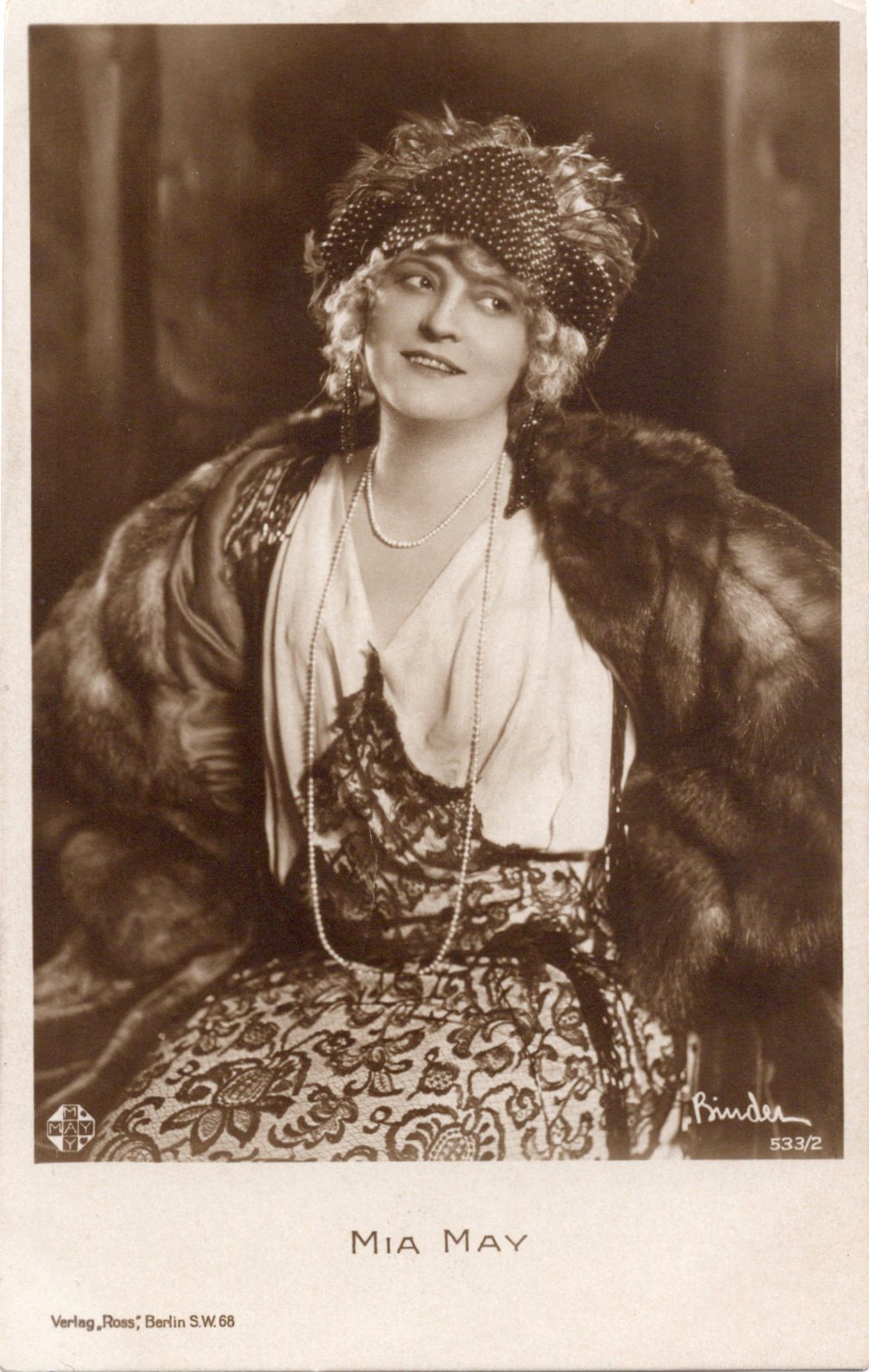
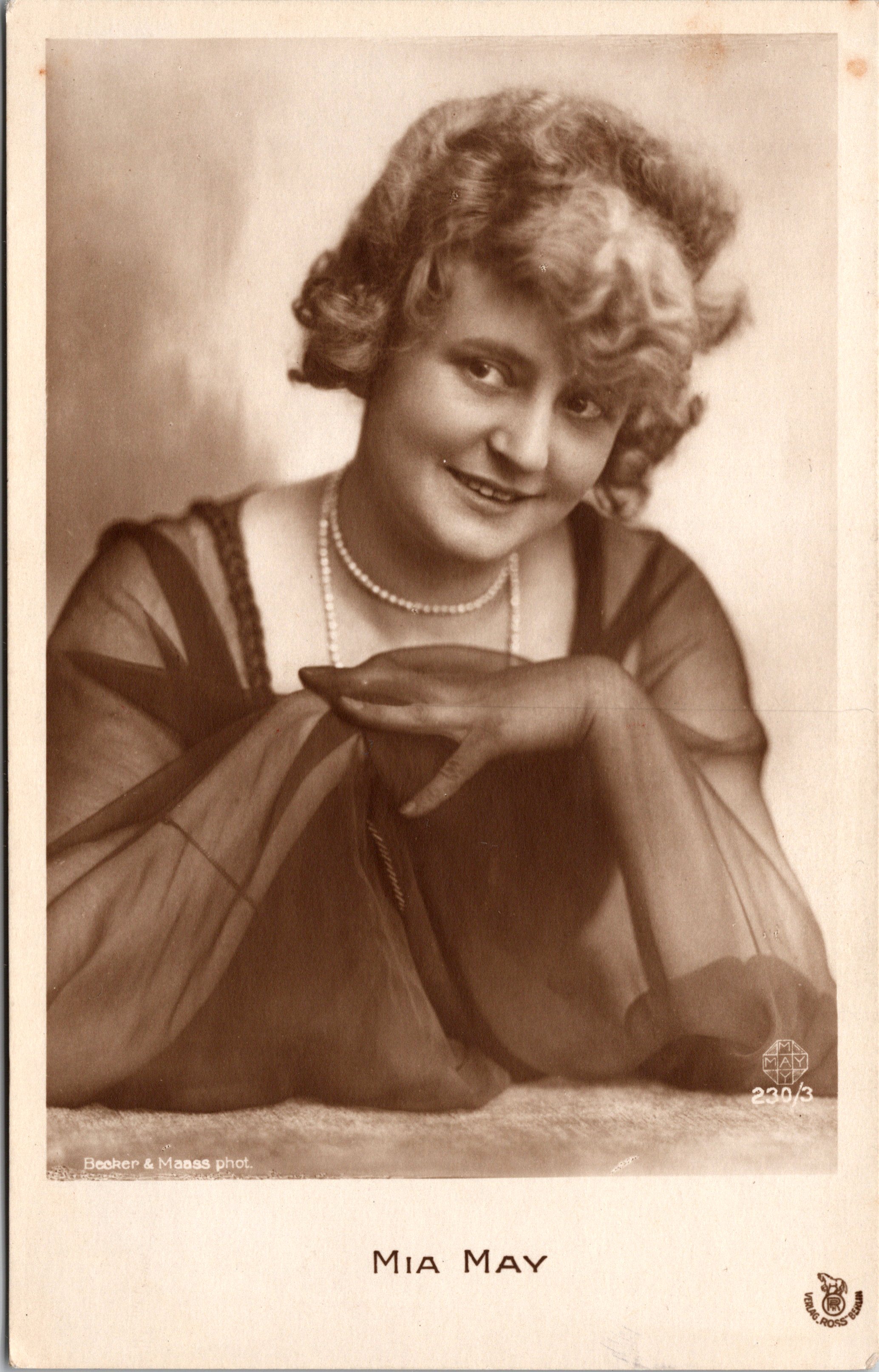
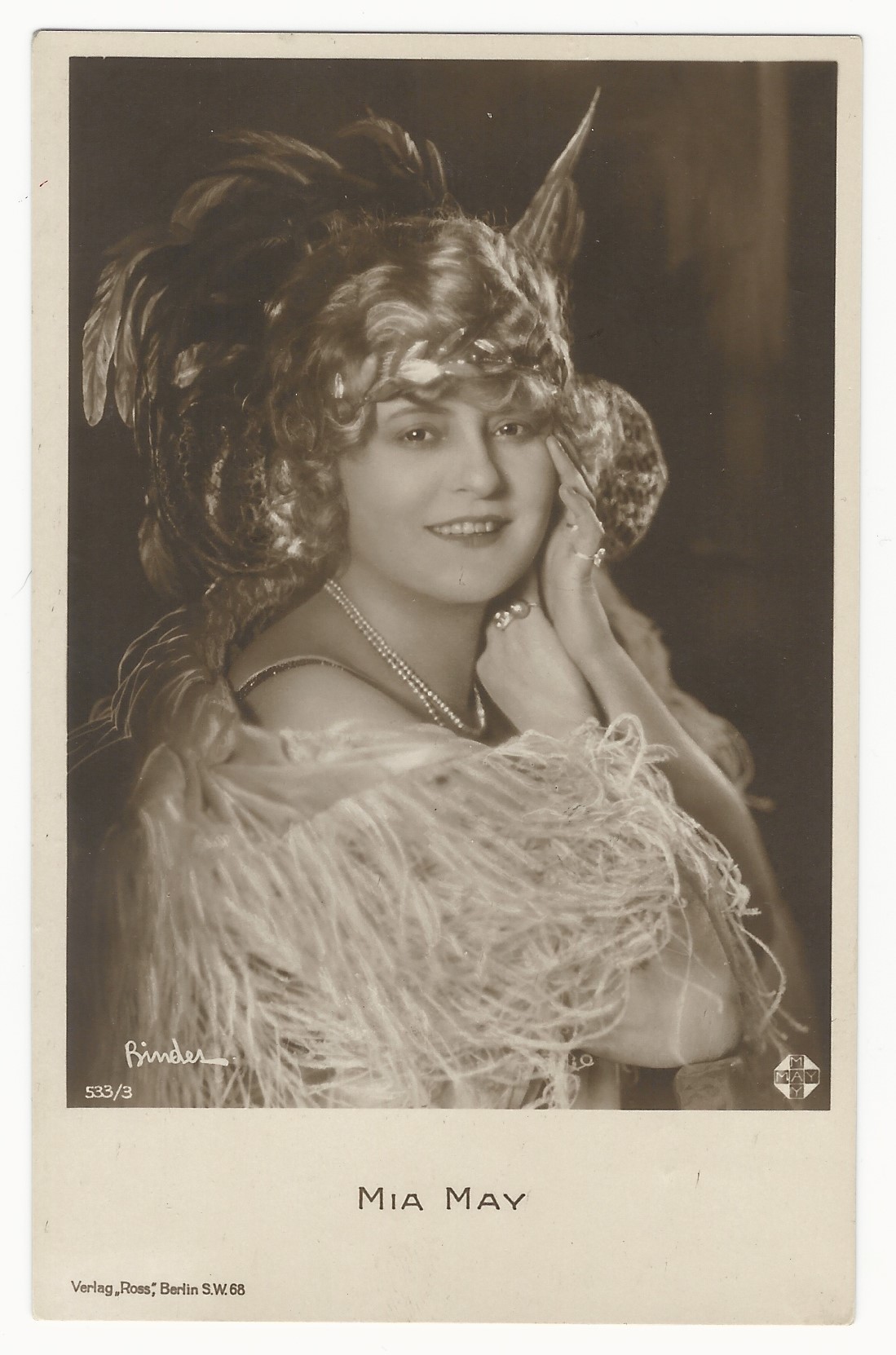
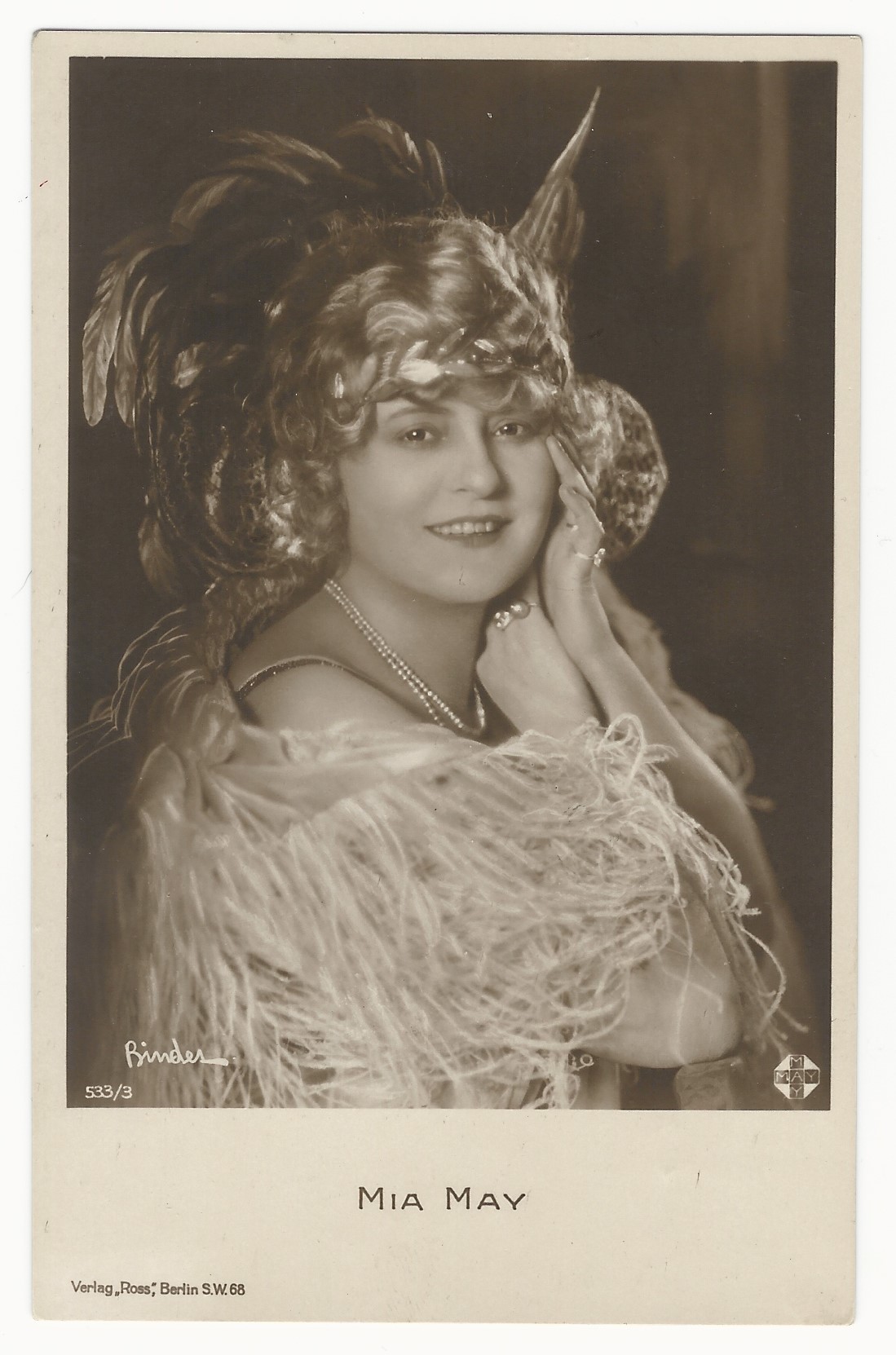
These vintage real photo postcards feature pretty Austrian actress Mia May (1884-1980). She was born in Vienna, the daughter of a baker. Her older sister was Mitzi Telmont (1879-1958), also an actress. Mia’s stage debut was when she was five years old. She played child roles until reaching age fourteen. As a teenager she appeared as Herma Angelot and performed as an actress and singer. While a high school student, she took ballet lessons. At age 18, she married Austrian, Julius Otto Mandl. The couple’s baby (Eva Maria Mandl) was born seven weeks later. Mia’s husband changed his name to Joe May, upon his entry into the film business. He became a successful film producer and director. This is how Eva adopted her performer name. She appeared in 44 films between 1912 and 1924. Mia’s daughter, Eva May, also became an actress. In 1912, Joe, Mia, and Eva moved to Berlin, where Joe worked as a film director. In 1912 he directed Mia in a film that launched her acting career. By 1914, little Eva May made her screen debut. Joe began his own film company, May-Film Gmb, in 1915. Mia took the position of Managing Director. In 1918, Mia wrote a screen play for “Your Big Secret”. Her movie career flourished in the 1910’s and early 1920’s. From 1919 to 1920 she was the star of an eight part film series (serial) called “Mistress of the World”. Mia reached a level of popularity equivalant to Asta Nielsen, Pola Negri, and Henny Porten. In 1923, she appeared in a film with a young Marlene Dietrich. Mia stated that Marlene Dietrich was “funny and engaging, attractive and original.” She added, “no man could resist her”. Mia May’s last film appearance was in “The Love Letters of Baroness S” (1924). She retired that same year after her daughter Eva committed suicide. In 1933, after seeing the Nazis gaining power, Mia and Joe May fled to America. The couple opened a restaurant (Blue Danube) in Los Angeles but it failed.
The photo portrait of Eva May seen Postcard 1 was taken by Alexander Binder. The photographer of this terrific image was Alexander Binder (1888-1929). He had the largest photo studio in Europe during the late 1920’s and the 1930’s. Many of his entertainment star portraits appear on Ross Verlag postards. It is thought that Binder was of Swiss origin. He was of the Jewish faith. He studied engineering but did not complete his studies. From 1908 to 1910 he studied photography at a school in Munich, Germany. After the completion of his photography studies, he went to Berlin and in 1913 opened his first photography studio. Before long, he became one of the premier photographers in Berlin. He primarily focused on fashion and celebrity photography. Since Berlin was the capital of the European film industry, Binder photographed all the stars of the European film industry including, Lilian Harvey, Conrad Veidt, and Lya De Putti. Many of his images were used in popular film portrait postcards. His photographs could be seen in postcards published by Ross Verlag and Photochemie. Binder died in 1929 but new photo cards bearing his signature continued to be published until 1937. It is thought that the real photographer of these new postcards was Hubs Floeter (1910-1974) who was employed at the studio as an operator. The studio continued to be owned by Binder’s widow, Mrs. Binder Alleman and their two daughters. The studio was managed by the Jewish Elisabeth Baroness Vonhedlis Stengel who was later deported to the Theresienstadt concentration camp. In 1938 the Nazi’s closed Binder’s studio and it was later taken over by an Aryan photographer, Karl Ludwig Haenchen . The postcard was published by Ross Verlag (Berlin) as part of a series (no533/3). Note the “May” logo in the lower right corner of the image. Miss May was working for May-Film at the time this photograph was taken. The stamp box seen on the reverse of this postcard has an interesting story attached to it. “NBC” (Neue Bromsilber Convention) was a price cartel established in 1909 that continued until the 1930’s. The purpose of the cartel was to ensure that the minimum price charged for postcards was kept at a sufficiently profitable level. A number of postcard publishing companies joined the cartel in an effort to stave off the effect of competition on the pricing of postcards. This vintage real photo portrait postcard has excellent clarity and is in very good condition (see scans).
Postcard 2 was also published by Ross Verlag. Once again, the photographer is Alex Binder. The postcard is part of the same series (533/2) as Postcard 1. The “May” logo can be seen on the bottom left corner of the image. This unposted postcard is in good condition (see scans).
Postcard 3 was published by Ross Verlag (Berlin) as part of a series (no230/3). Note the “May” logo in the lower right corner of the image. Miss May was working for May-Film at the time this photograph was taken. This vintage real photo portrait postcard has excellent clarity. The postcard has small stains in it’s top right corner. Overall, the postcard is in Good Condition (see scans)

Buy this original Vintage Real Photo Postcard (includes shipping within the US) #3356
To purchase this item, click on the Pay with PayPal button below
$20.00

Buy this Vintage Real Photo Postcard (includes International shipping outside the US) 3356
To purchase this item, click on the Pay with PayPal button below
$29.00

Buy this Vintage Real Photo Postcard (includes shipping within the US) #3715
To purchase this item, click on the Pay with PayPal button below
$13.39

Buy this Vintage Real Photo Postcard (includes International shipping outside the US) 3715
To purchase this item, click on the Pay with PayPal button below
$22.39

Buy this Vintage Real Photo Postcard (includes shipping within the US) #5113
To purchase this item, click on the Pay with PayPal button below
$13.74

Buy this Vintage Real Photo Postcard (includes International shipping outside the US) 5113
To purchase this item, click on the Pay with PayPal button below
$31.50
POSTCARD 3
POSTCARD 2 (SOLD)
POSTCARD 3 (SOLD)

POSTCARD 4 (SOLD)
Postcard 2
Postcard 3
POSTCARD 1
POSTCARD 1 (CLOSE-UP)
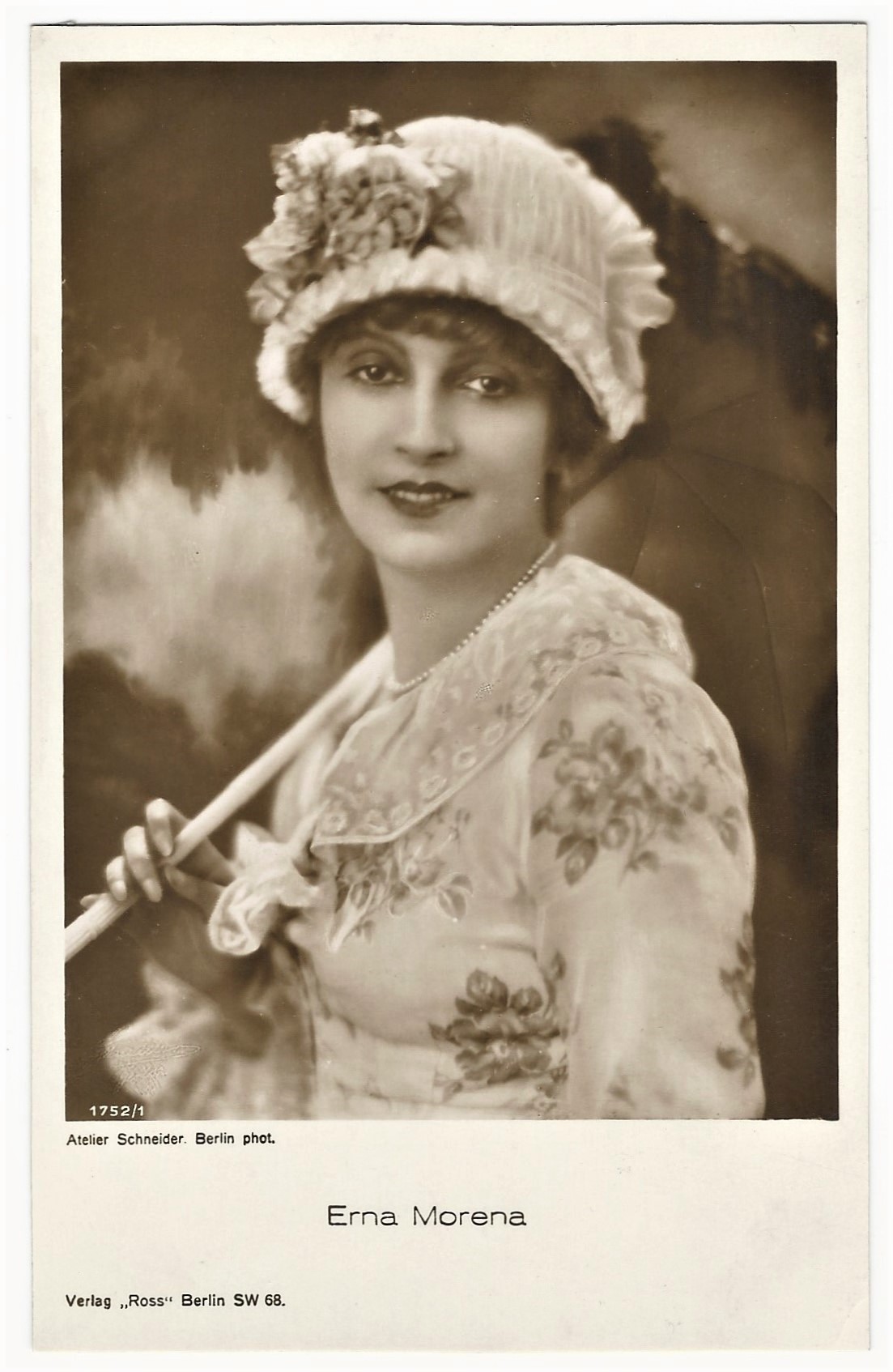
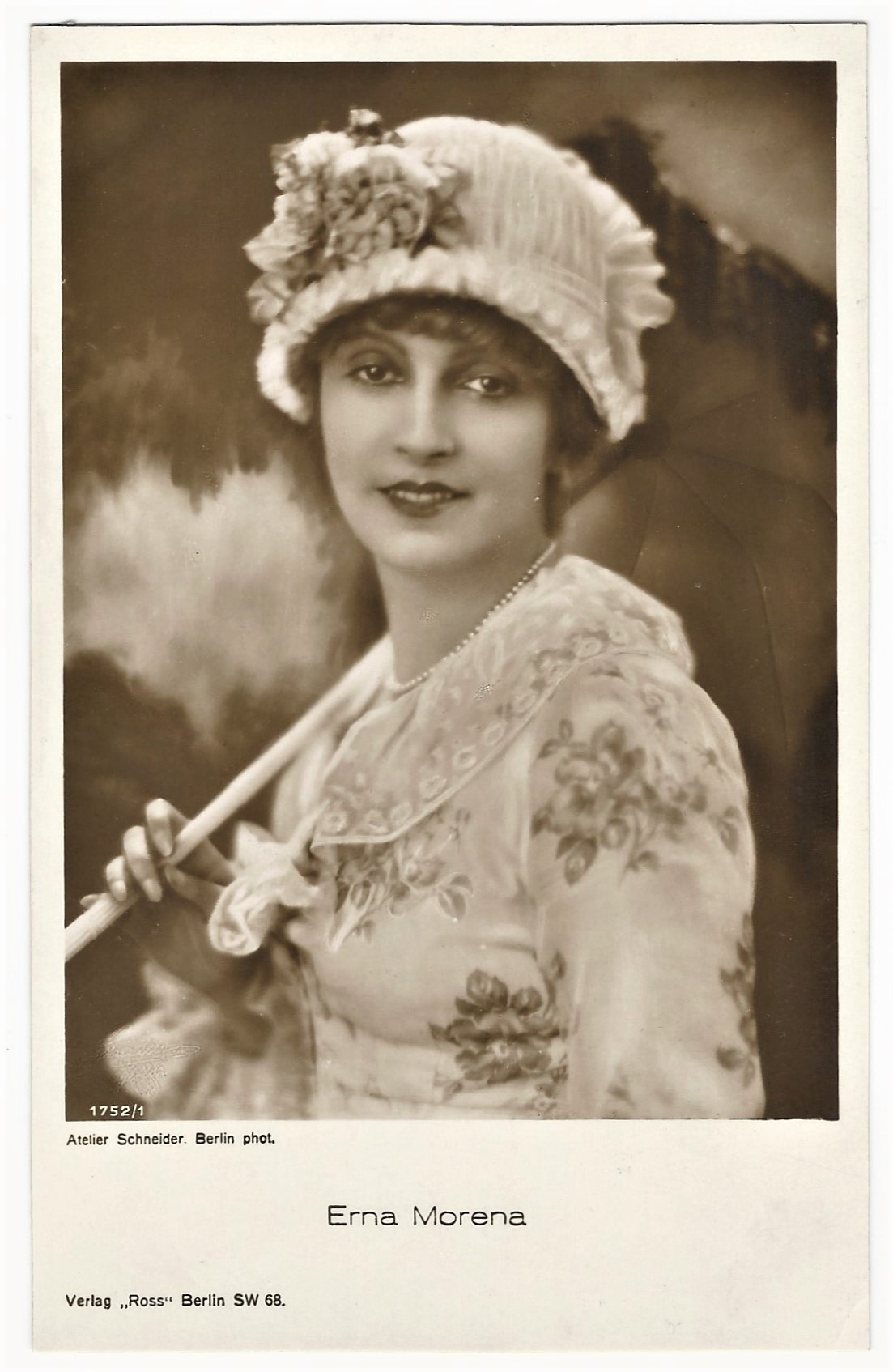
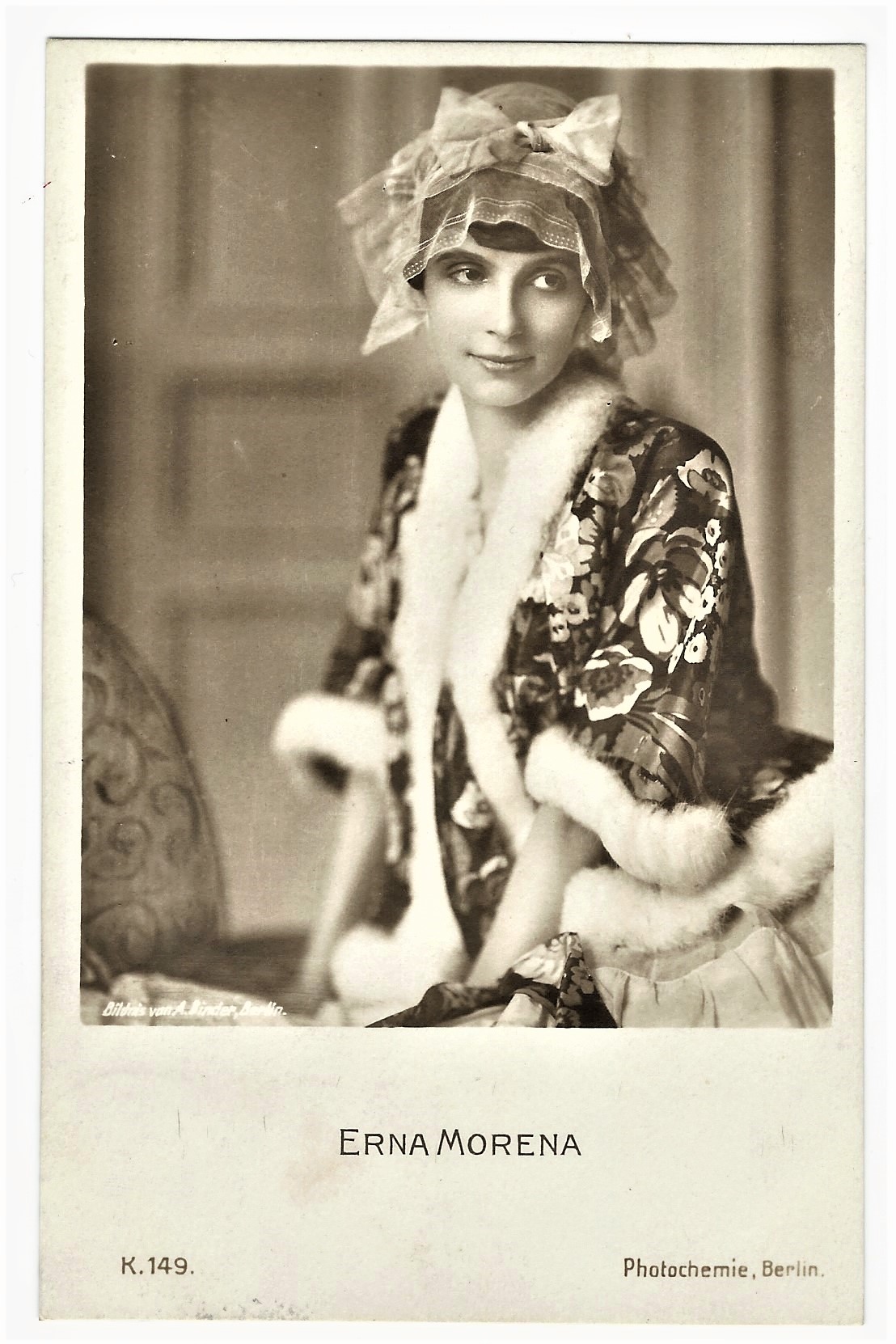
This vintage real photo postcard (Postcard 1) features pretty German film actress, Erna Morena (1885-1962). In addition to being a performer, she was also a film producer and screen writer during the silent era. The IMDb reports that Morena appeared in 122 films between 1913 and 1951. Morena grew up in a middle-class family in Bavaria. At age 17, she attended applied art school in Munich. In 1909, after a short stint in Paris, she moved to Berlin where she worked as a nurse. She became a student at the German Theater’s drama school and in 1910 was hired as an actress by Max Reinhardt, Austrian-born theater and film director. She played a number of small theater roles and in 1913, Morena made her film debut in “The Sphinx”, produced by Leteraria Film. She was a “big time” actress. She worked under many well known directors and with some of the most well known actors in German film. Morena made a bid to become a film producer and formed her own film company which produced films in 1918 and in 1920. By the mid 1920’s, she was considered one of the biggest stars in German films. With the advent of talkies, her career declined. However, she did appear in supporting roles during the 1930’s. Between 1915 and 1921, Morena was married to the German writer, Wilhelm Herzog. He was a historian of literature and culture, a dramatist, the author of an encyclopedia, and a well known pacifist. Their marriage ended in divorce. Morena appeared in the 1940 film “Jud SuB”. The movie was a Nazi Germany historical drama propaganda film. The film was produced on the order of Joseph Goebbels, the Nazi politician and trusted aide to Adolph Hitler. The movie is considered one of the most anti-semitic films of all time. Postcard 1 was published by Ross Verlag and is part of a series (no.1752/1). The company was located in Berlin, Germany. Morena was photographed by the German photographer, Ernst Schneider. Research about Mr Schneider yielded a great deal of information. He was considered to be one of the most celebrated studio photographers in Berlin during three decades (1900’s, 1910’s, 1920’s. He photographed many celebrities from the world of theater, opera, circuses, and film. He was also one of the most prominent fashion photographers in Berlin. In addition, he was well known for his nude photography and he published books showcasing his work in this domain. Sometime around 1908 Schneider began working with postcard publishers “Rotophot” and “Neue Photographische Gesellschaft” (NPG). In 1919 he began working with Ross Verlag. This postcard, a former resident of a postcard album, is in very good condition (see scans below).

Buy this Vintage Real Photo Postcard (includes shipping within the US) #3173
To purchase this item, click on the Pay with PayPal button below
$25.50

Buy this Vintage Real Photo Postcard (includes International shipping outside the US) #3173
To purchase this item, click on the Pay with PayPal button below
$34.00


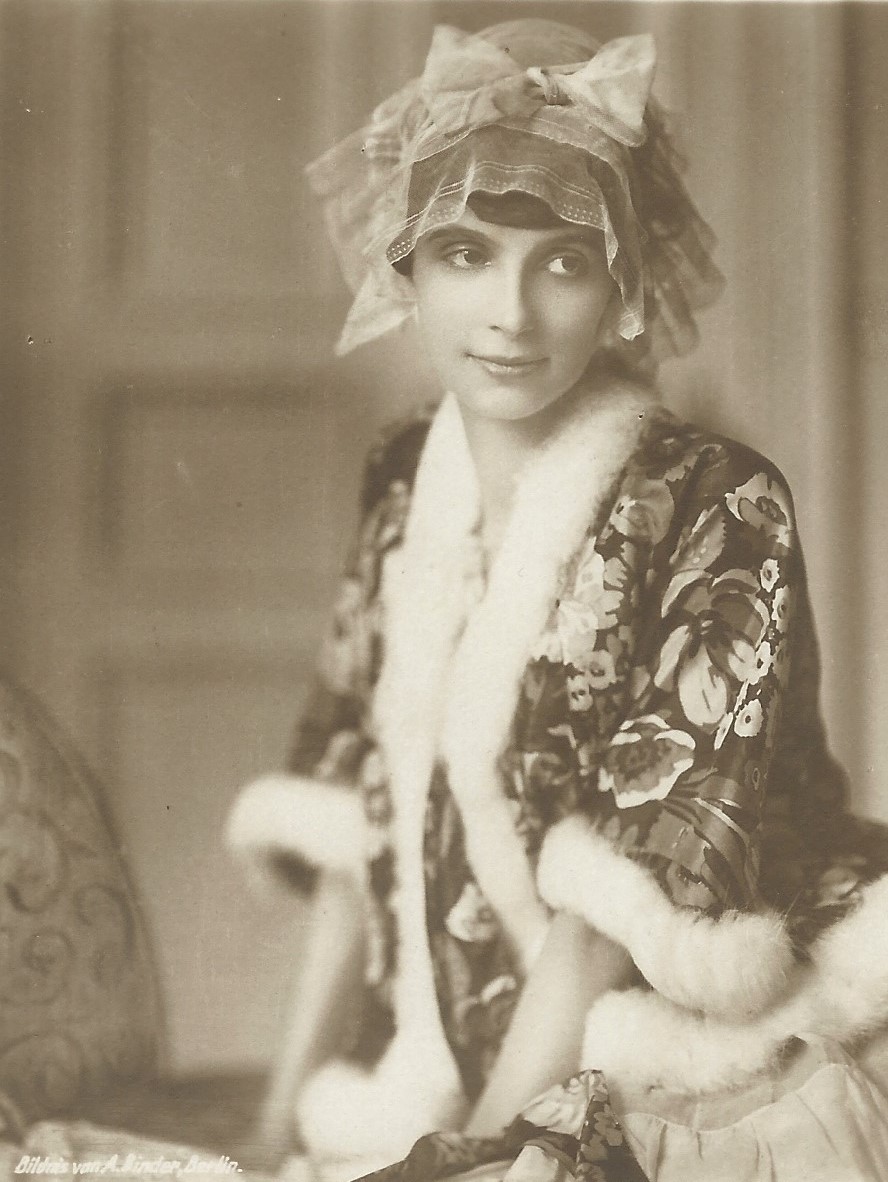
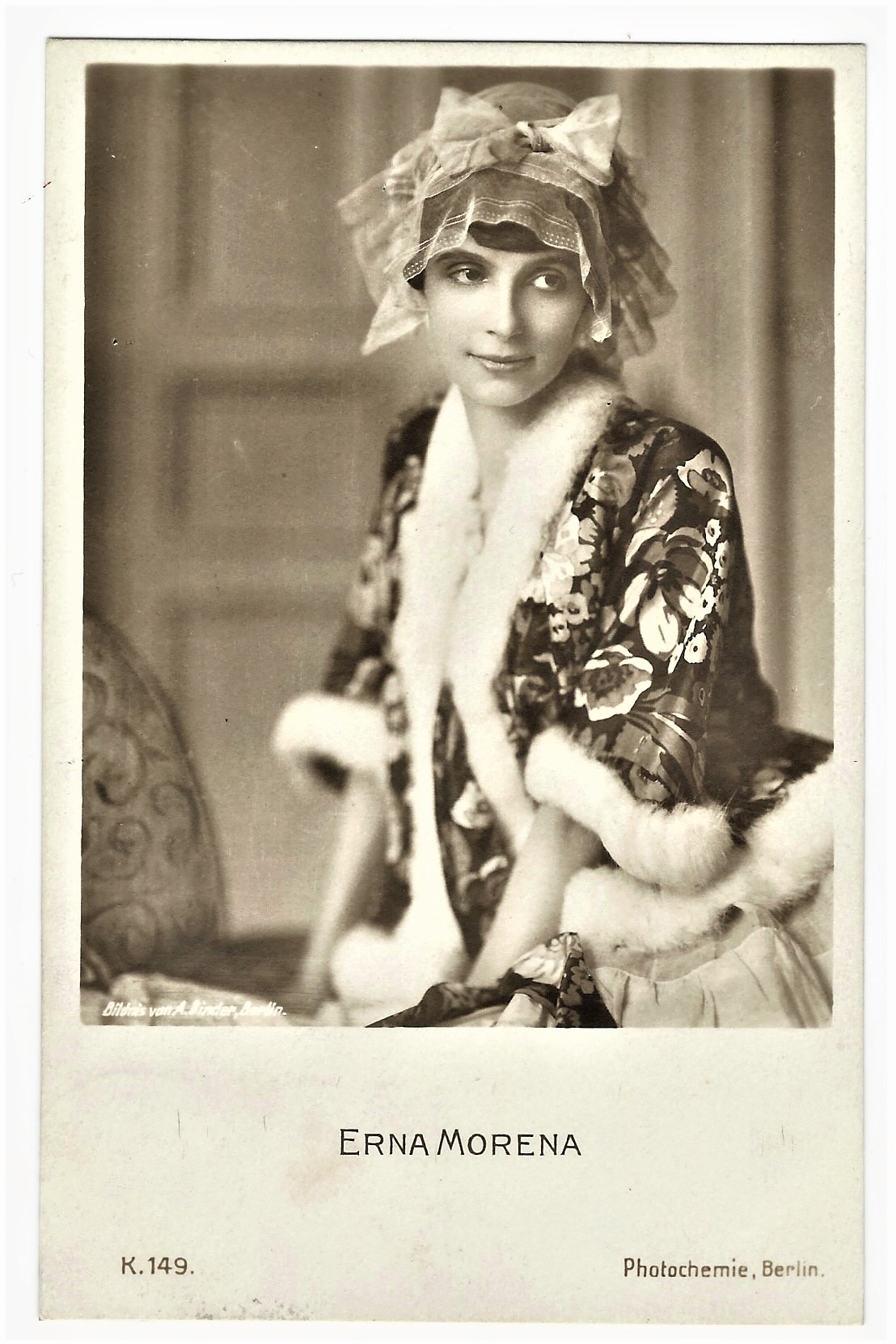
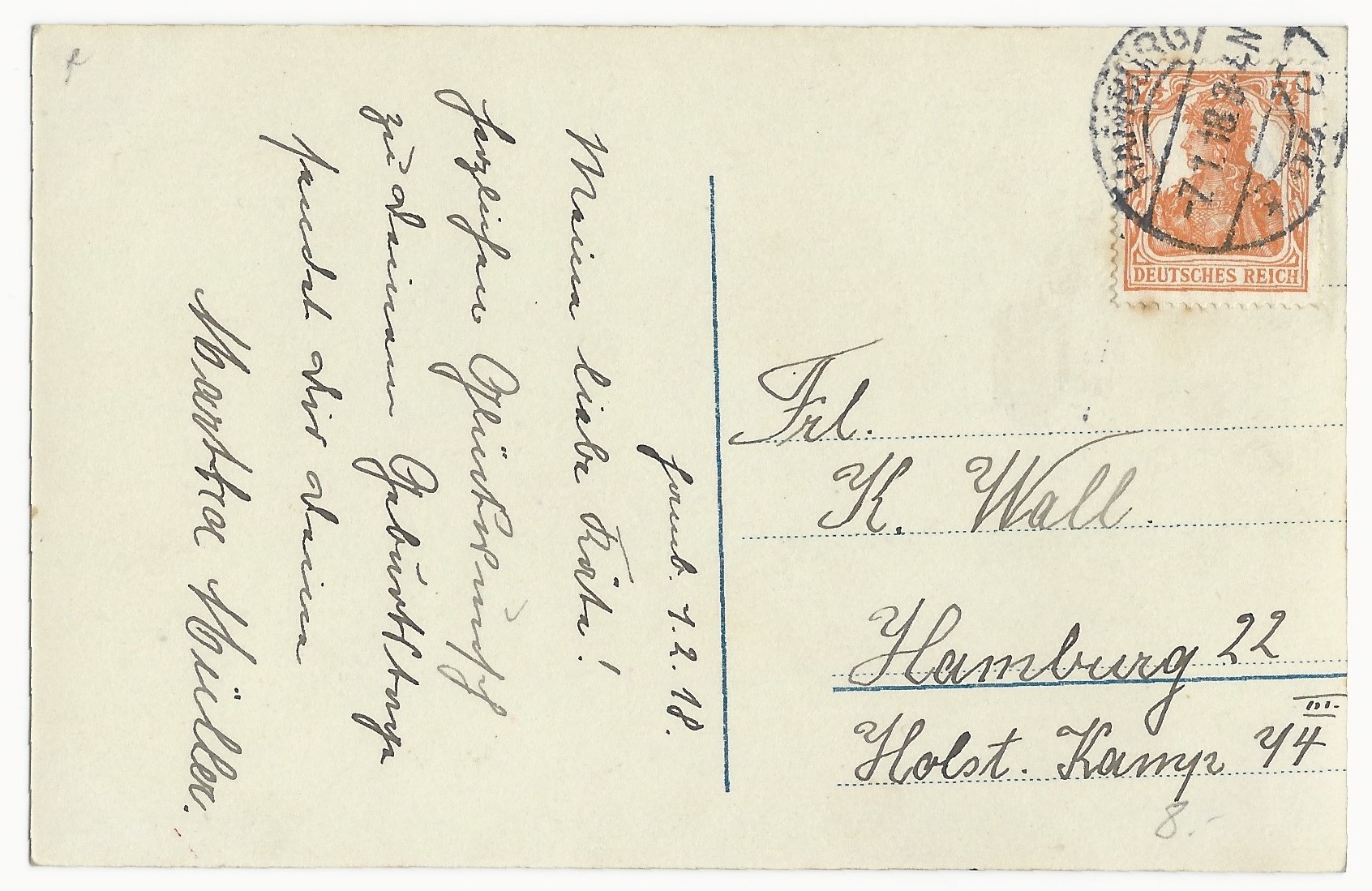
Postcard 2 also features the lovely Miss Morena. This postcard was published by Photochemie, located in Berlin, Germany. The card is part of a series (no.k149). Photochemie published postcards of only German film stars or European performers performing in German films. The postcards were published between 1914 and 1919. The firm also produced postcards of other subjects. The photographer of this terrific image was Alexander Binder (1888-1929). He had the largest photo studio in Europe during the late 1920’s and the 1930’s. Many of his entertainment star portraits appear on Ross Verlag postards. It is thought that Binder was of Swiss origin. He was of the Jewish faith. He studied engineering but did not complete his studies. From 1908 to 1910 he studied photography at a school in Munich, Germany. After the completion of his photography studies, he went to Berlin and in 1913 opened his first photography studio. Before long, he became one of the premier photographers in Berlin. He primarily focussed on fashion and celebrity photography. Since Berlin was the capital of the European film industry, Binder photographed all the stars of the European film industry including, Lilian Harvey, Conrad Veidt, and Lya De Putti. Many of his images were used in popular film portrait postcards. His photographs could be seen in postcards published by Ross Verlag and Photochemie. Binder died in 1929 but new photo cards bearing his signature continued to be published until 1937. It is thought that the real photographer of these new postcards was Hubs Floeter (1910-1974) who was employed at the studio as an operator. The studio continued to be owned by Binder’s widow, Mrs. Binder Alleman and their two daughters. The studio was managed by the Jewish Elisabeth Baroness Vonhedlis Stengel who was later deported to the Theresienstadt concentration camp. In 1938 the Nazi’s closed Binder’s studio and it was later taken over by an Aryan photographer, Karl Ludwig Haenchen . Haenchen continued to produce celebrity portraits for postcards. His publishers included Film-Foto-Verlag. After World War II the studio was taken over by the Hasse und Wiese company. This postcard has a Hamburg, Germany postmark and is dated 1918. The postcard is in very good condition (see scans)

Buy this Vintage Real Photo Postcard (includes shipping within the US) #3253
To purchase this item, click on the Pay with PayPal button below
$19.50

Buy this Vintage Real Photo Postcard (includes International shipping outside the US) #3253
To purchase this item, click on the Pay with PayPal button below
$28.00


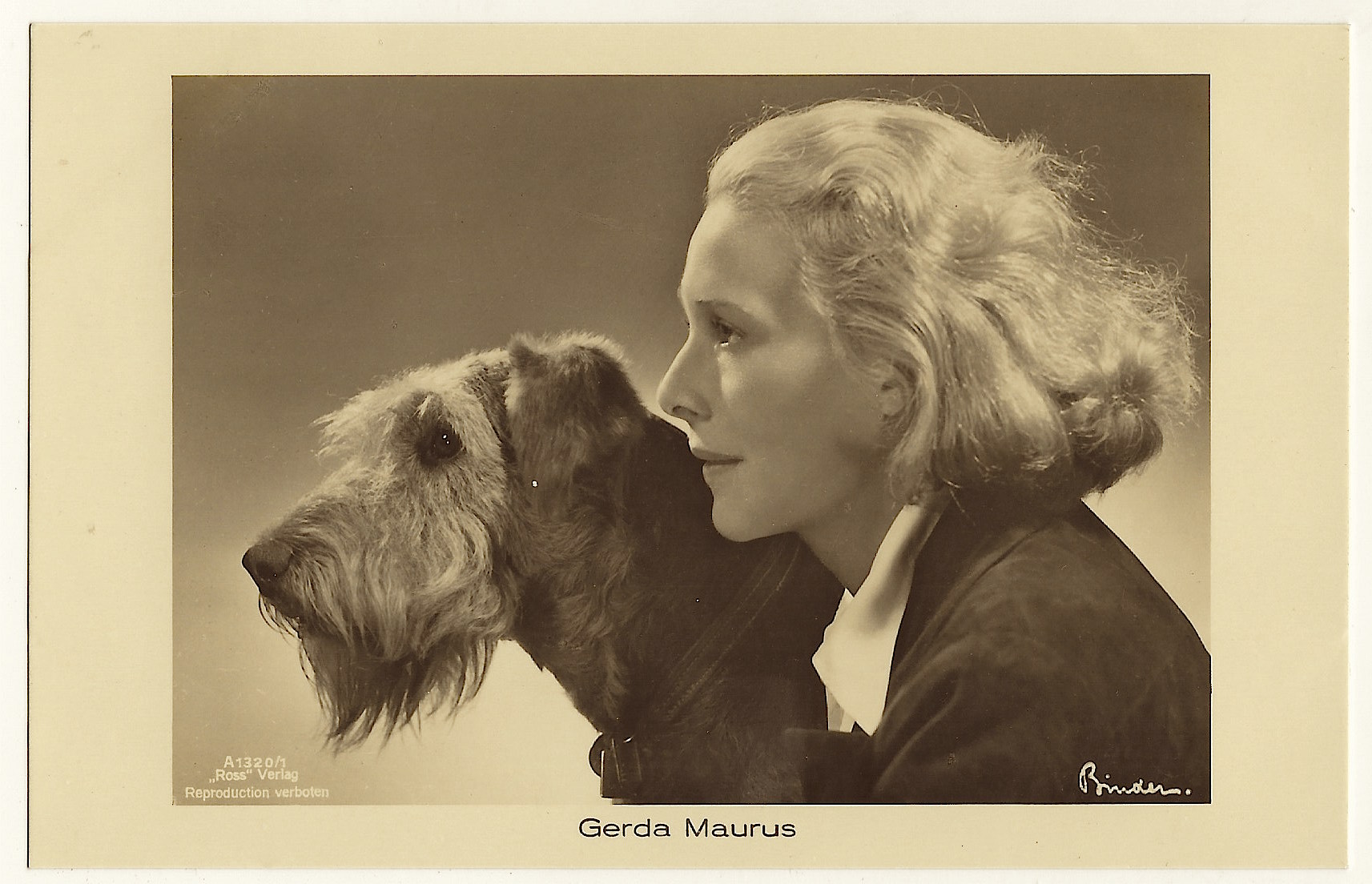
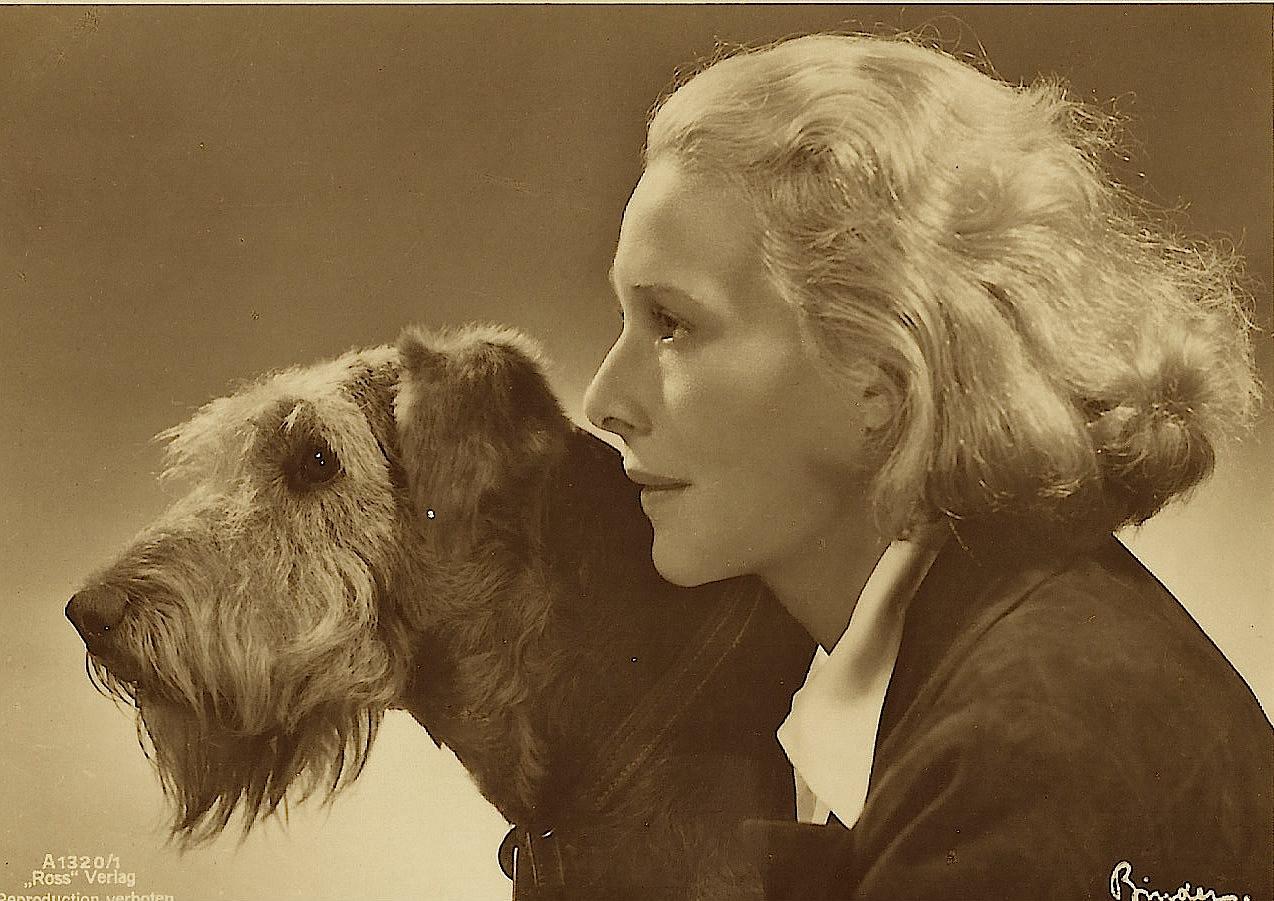
The lovely actress seen in this vintage real photo postcard is named Gerda Maurus (1903-1968). She is posed next to a beautiful Airedale terrier. This unusual profile photograph was taken by celebrity photographer Alex Binder. His studio was located in Berlin, Germany. Maurus was active in film and television between 1928 and 1968. She was an Austrian actress of Croatian descent. Maurus was the daughter of an engineer/inventor. She grew up in Vienna and received training as a singer and dancer. She hit the stage at age fifteen. The IMDb biography of Maurus describes her as ” a strikingly beautiful blonde with high cheekbones an expressive blue eyes”. She began her career on the stages of Vienna. She was “discovered” by director Fritz Lang and he cast her in the female lead in the silent film “Spione” (1928). Lang was smitten by maurus and his marriage was destroyed. She then appeared in a number of German films during the Weimar and Nazi eras. Maurus married director Robert A. Stemmie in 1937. He directed her in “Daphne and the Diplomat” (1937). Like many actresses of her time, her acting career was hurt by the introduction of “talkies”. Further complicating matters was her nebulous association with Nazi propaganda minister Joseph Goebbels. This relationship had negative impact on her career after World War II. Due to lack of film offers, Maurus retreated to the German stage. The IMDb filmography of Gerda Maurus lists 33 credits. Here is a side note about Airedales. The first World War increased the popularity of Airedales because they became famous for their bravery on the battlefield. In the US, Presidents Theodore Roosevelt, Calvin Coolidge, and Warren Harding all owned Airedales. In the 1920’s, Airedales became the most popular dog in the US. This postcard was published by Ross Verlag and is part of a series (no. A1320/1). (SOLD)