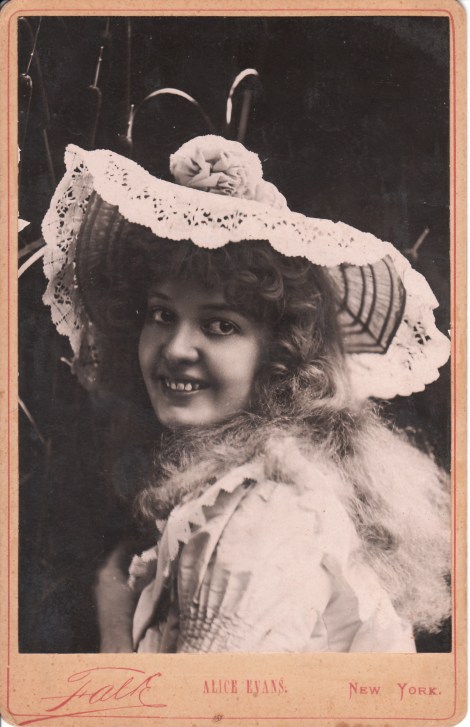
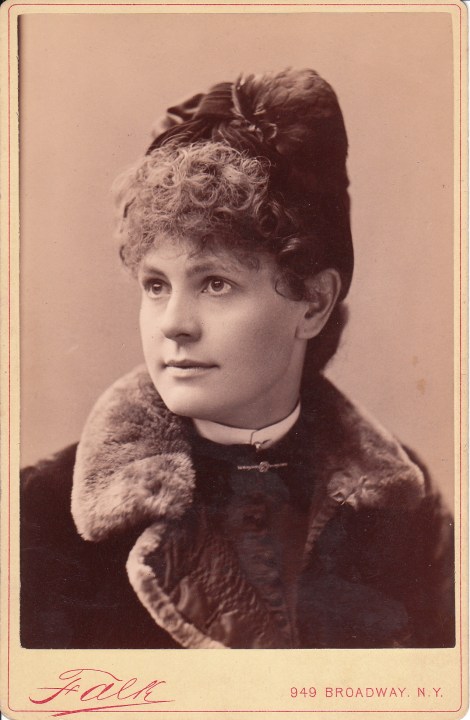
Marion Manola (1865-1914) is the subject of this cabinet card photograph by celebrity photographer, Benjamin Falk. Manola was born in Cleveland, Ohio. She was a popular comic opera star during the late 1880’s and 1890’s. The New York Times (1894) featured a headline stating “A Brilliant Future Sacrificed for a Life of Excitement” referring to Ms. Manola. The newspaper reported that the theatrical community was upset by the actress’s “insanity”. She was described as one of the more popular singer/actresses on American stage. She was known to be a bit eccentric but she was “heartily liked by everybody”. She was described as light hearted, having a joyous nature, and as vivacious. She was discovered by Colonel John A. McCaull, who cast her in a comic opera company. She aggressively pursued her career and had “late suppers”, “early rehearsals”, and worked hard. The stress of her theatrical life caused her to become irritable, fretful and difficult to manage. When her theatre company dissolved, she joined De Wolff Hopper’s company where she became the prima donna. After about a year she lost her job because of difficulty with a manager. She then went to Europe where she played the role of Maid Marion in “Robin Hood”. While in Europe she met her soon to be second husband, John Mason. Mason had his own personal problems including a great deal of debt. They joined a comic opera company in Boston but they quickly lost their jobs due to problems getting along with management. They organized their own company but it went bust. Manola’s mind began to fail and it became known that she had a opium habit. The press had a field day covering Ms. Manola’s psychiatric and substance abuse difficulties, as well as her entry into a rehab facility. Does any of this sound familiar? Think about the press coverage of Lindsay Lohan or a number of other celebrities of today who experience emotional or addiction problems. Manola also made her mark in the courts. In fact, Judge Louis Brandeis, one of America’s great Justices, was involved in an interesting and important case Manola brought to the legal system. The actress brought suit against a theatre manager and a photographer because she was photographed on the stage, without permission, while wearing an outfit (tights) she felt were too immodest to be photographed in. After being photographed, she ran off the stage in distress. The court supported Ms Manola’s suit and forbid the photographs from being distributed. The court took the position of there being a need for morality in the press. Some skeptics felt that the actresses real issue with the photographs had more to do with her not getting financially compensated for the photographs, rather than her claims that her privacy was violated. To view other photographs by Benjamin Falk, click on the category “Photographer: Falk”.


 This is an image of a beautiful actress posing for her portrait holding a stringed instrument. Note her fashionable appearance highlighted by a terrific hat. The image comes from a collection of theatrical actresses. The photographer is Falk, famed theatrical photographer, of New York City. Perhaps a visitor to this blog will know this actresses last name. Her first name is Gladys. In addition, it is hoped that someone may be able to identify the type of stringed instrument she is holding.
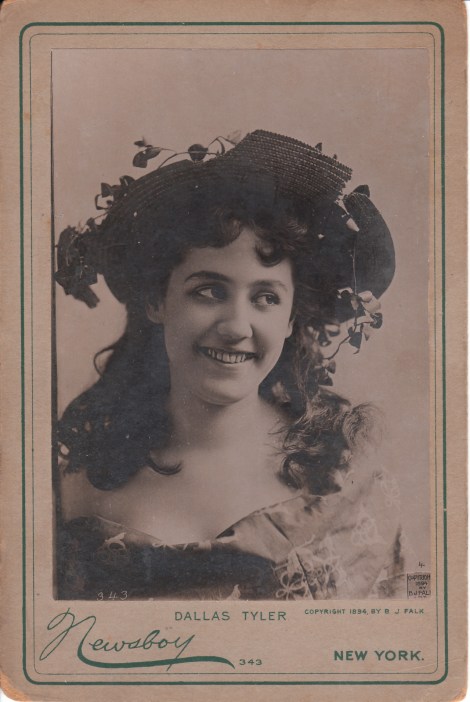 Theater and film actress, Dallas Tyler is seen in this Cabinet card by Newsboy of New York. She is quite beautiful and has remarkably expressive eyes. The photograph is copyrighted by B. Falk in 1894. Dallas Tyler (1880-1953) was a theater and film actress. She appeared in seven films between 1914 and 1916 including Jane Eyre (1914). She also wrote the film, The Devils Playground (1917). The New York Times reported in April, 1896 that Ms Tyler’s husband, actor George Bethel, fired four shots at her at the hotel she was residing in while performing in Hartford, Connecticut. Fortunately, he was quite intoxicated and all four shots missed their target. The actor denied trying to kill his wife. He stated that he was despondent about the breakup of his marriage and blamed his mother-in-law for marital interference.