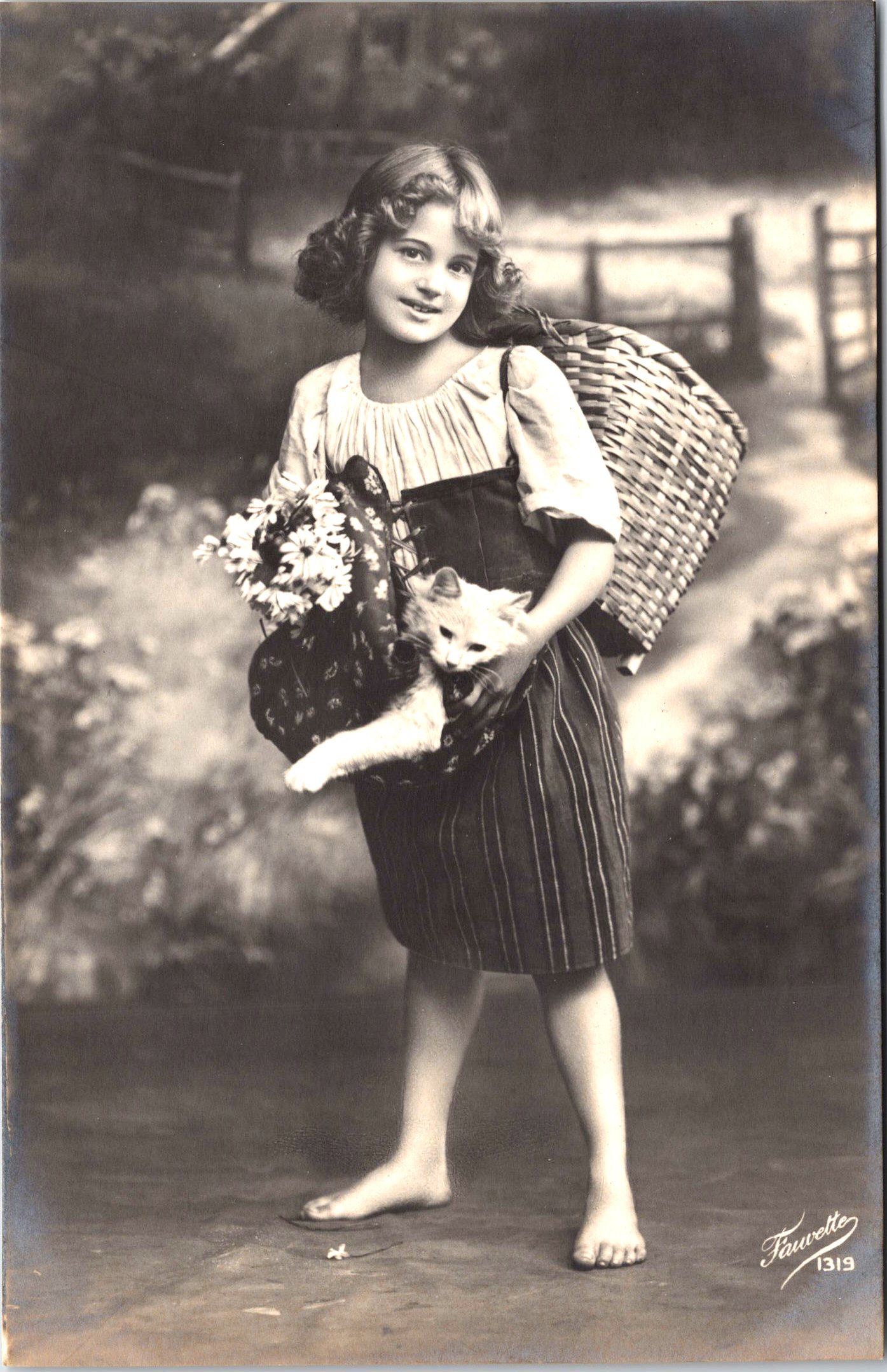
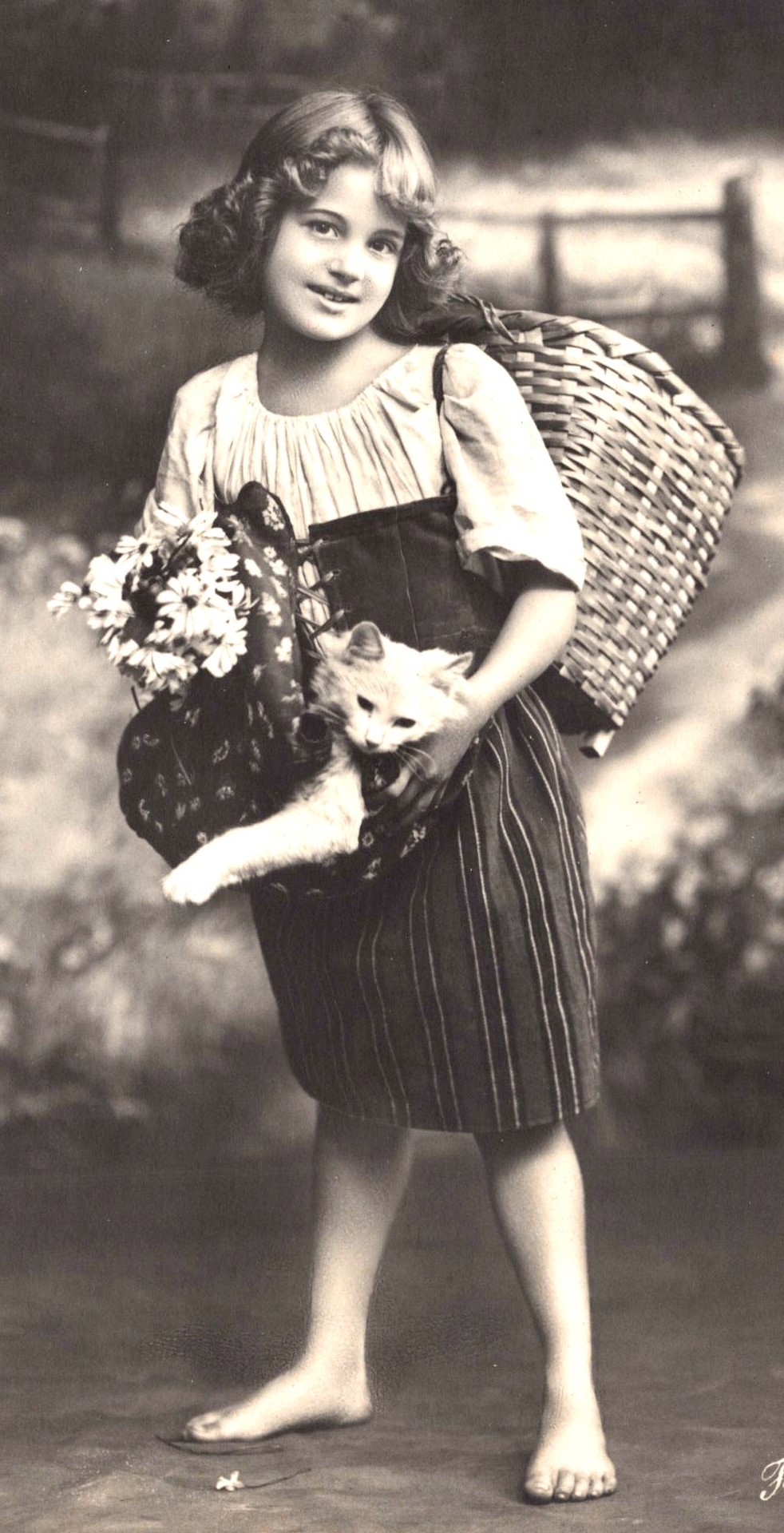
This color tinted vintage real photo postcard features a barefoot adorable little girl and her white cat that she is carrying in a cloth bag. She is also carrying a bouquet of flowers and has a basket on her back. The model seen in this postcard photo is most likely, Hani Reinwald, sister of popular postcard model, Grete Reinwald. Both girls became stage and film actresses. I own another postcard from the same series as this postcard. That postcard is postmarked 1913, indicating that this postcard also dates back to that year. This French postcard was published by Fauvette as part of a series (No.1319). SOLD
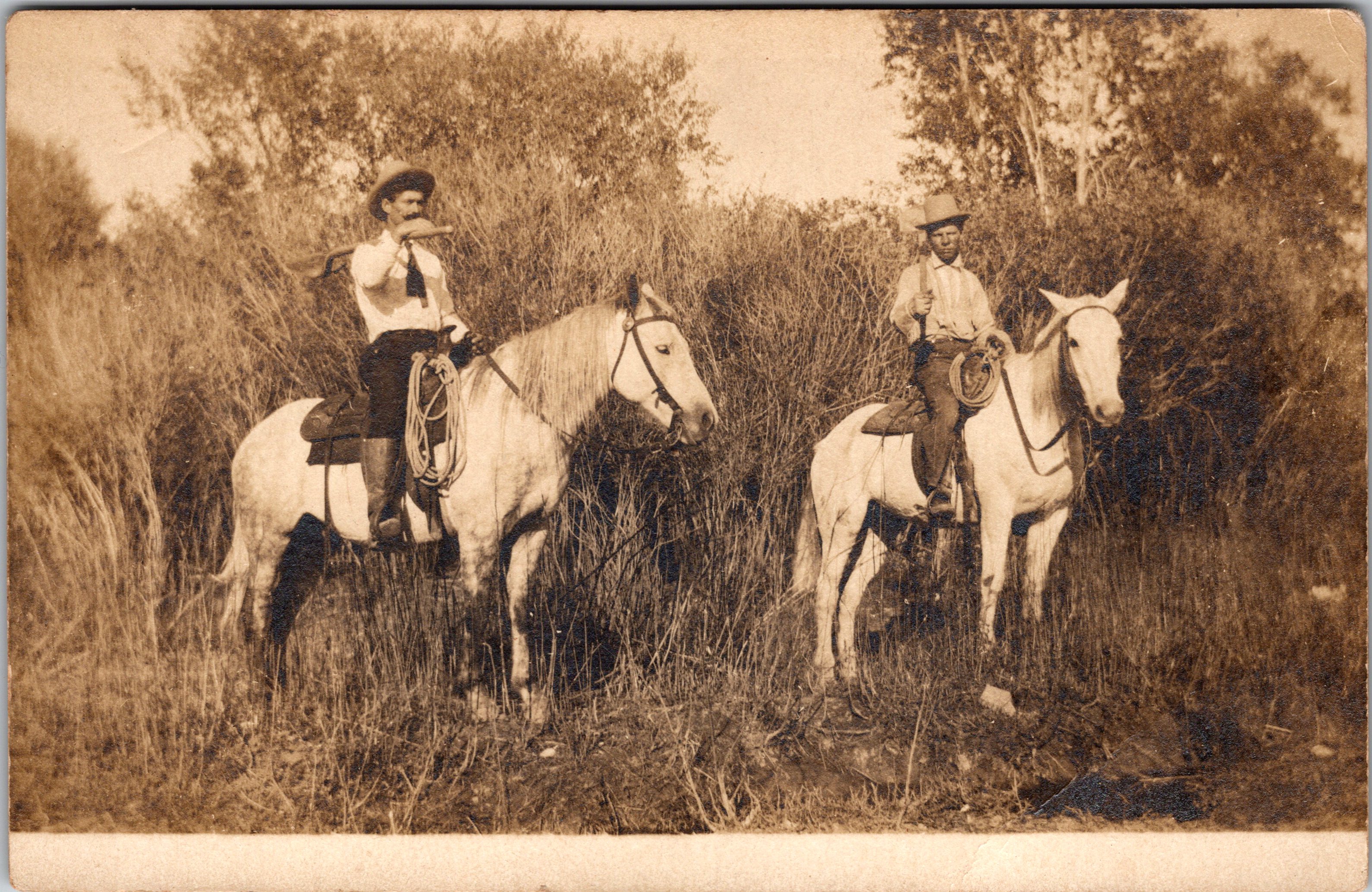
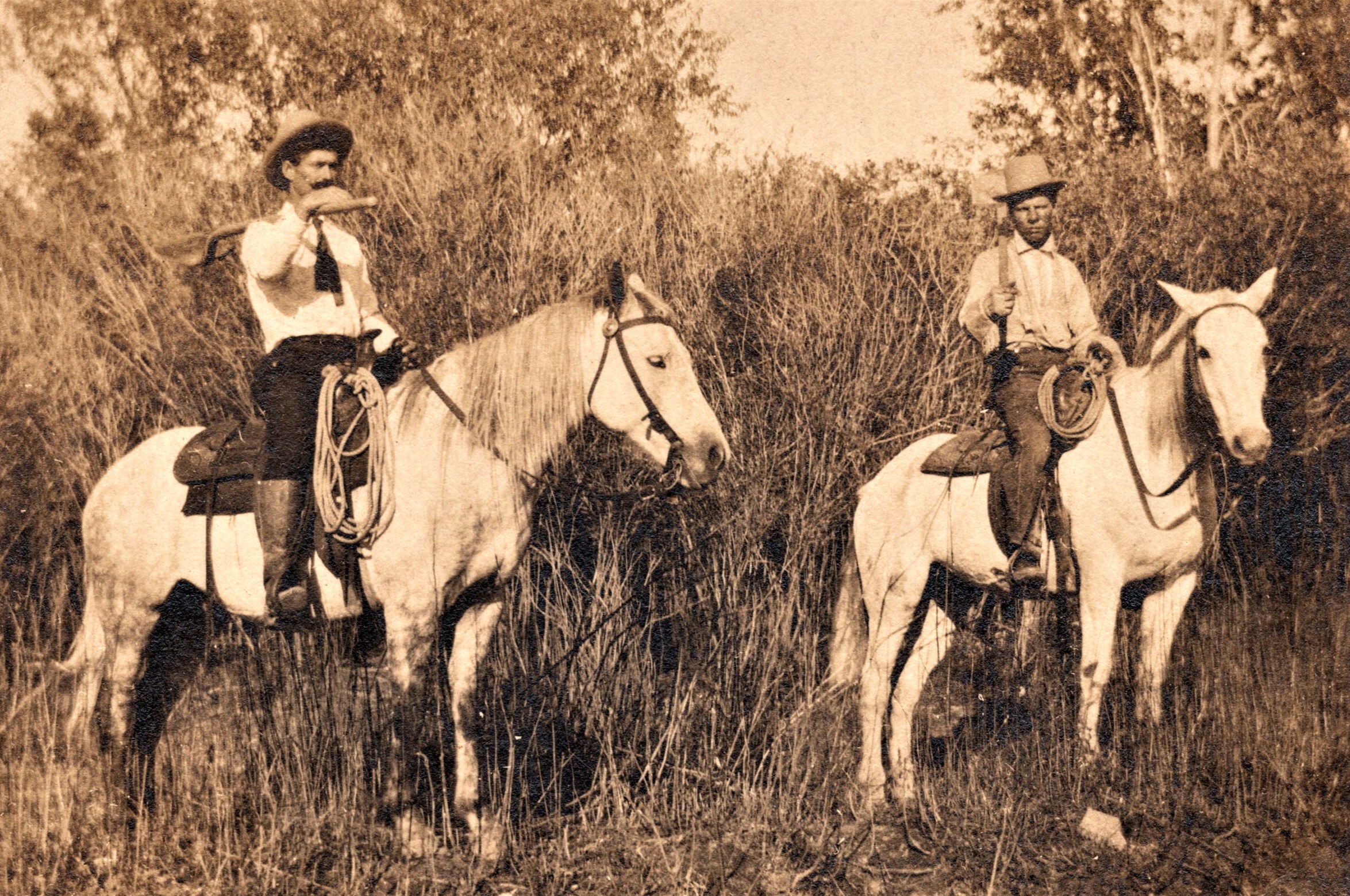
This vintage real photo postcard features two men on horseback. They are carrying tools. The tools appear to be shovels or spades. One rider has coiled rope hanging from his saddle. Is it a lasso. Are these men cowboys? Prospectors? Ranch hands? This postcard has a Velox stamp box indicating it dates back to sometime between 1907 and 1914. SOLD
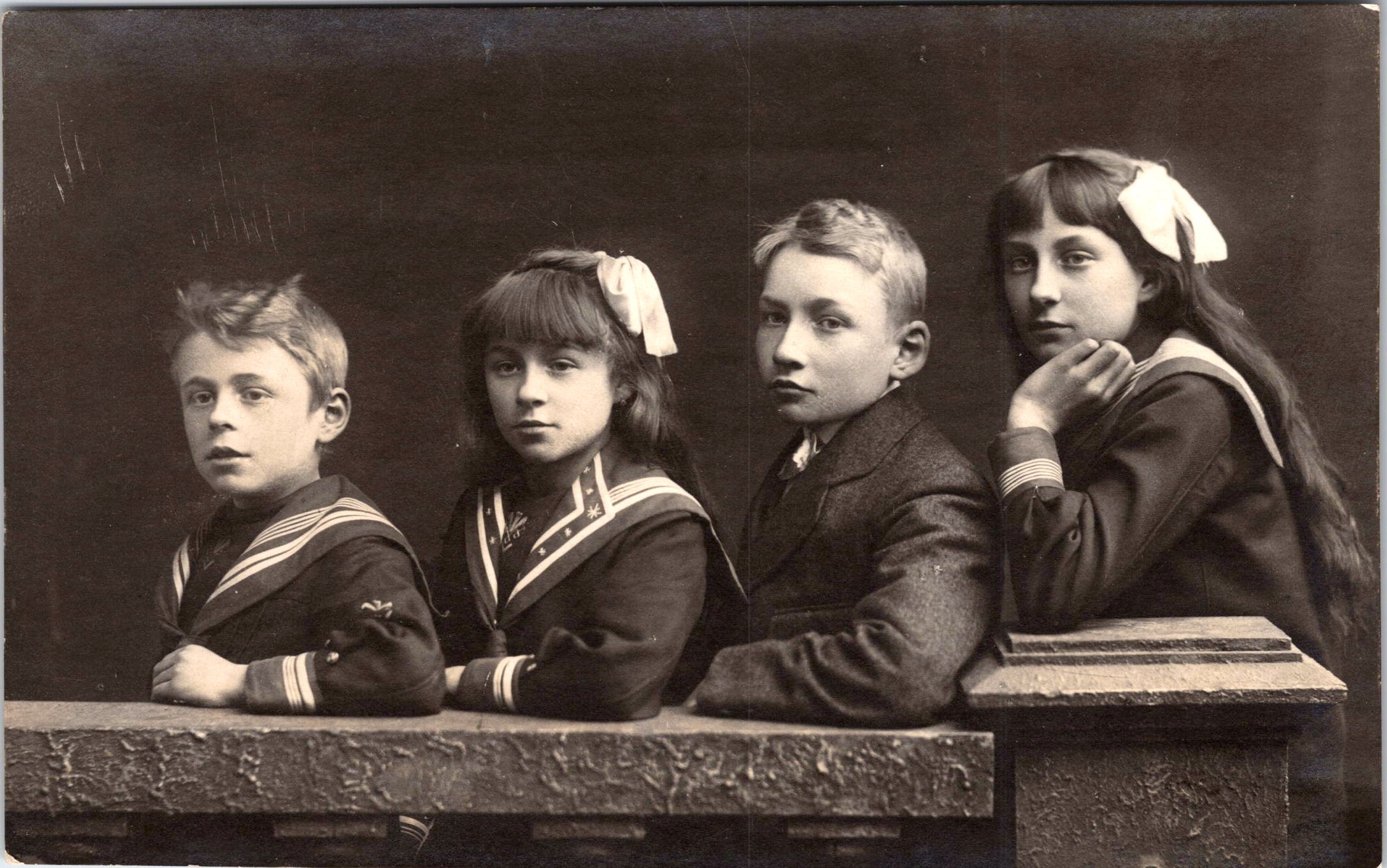
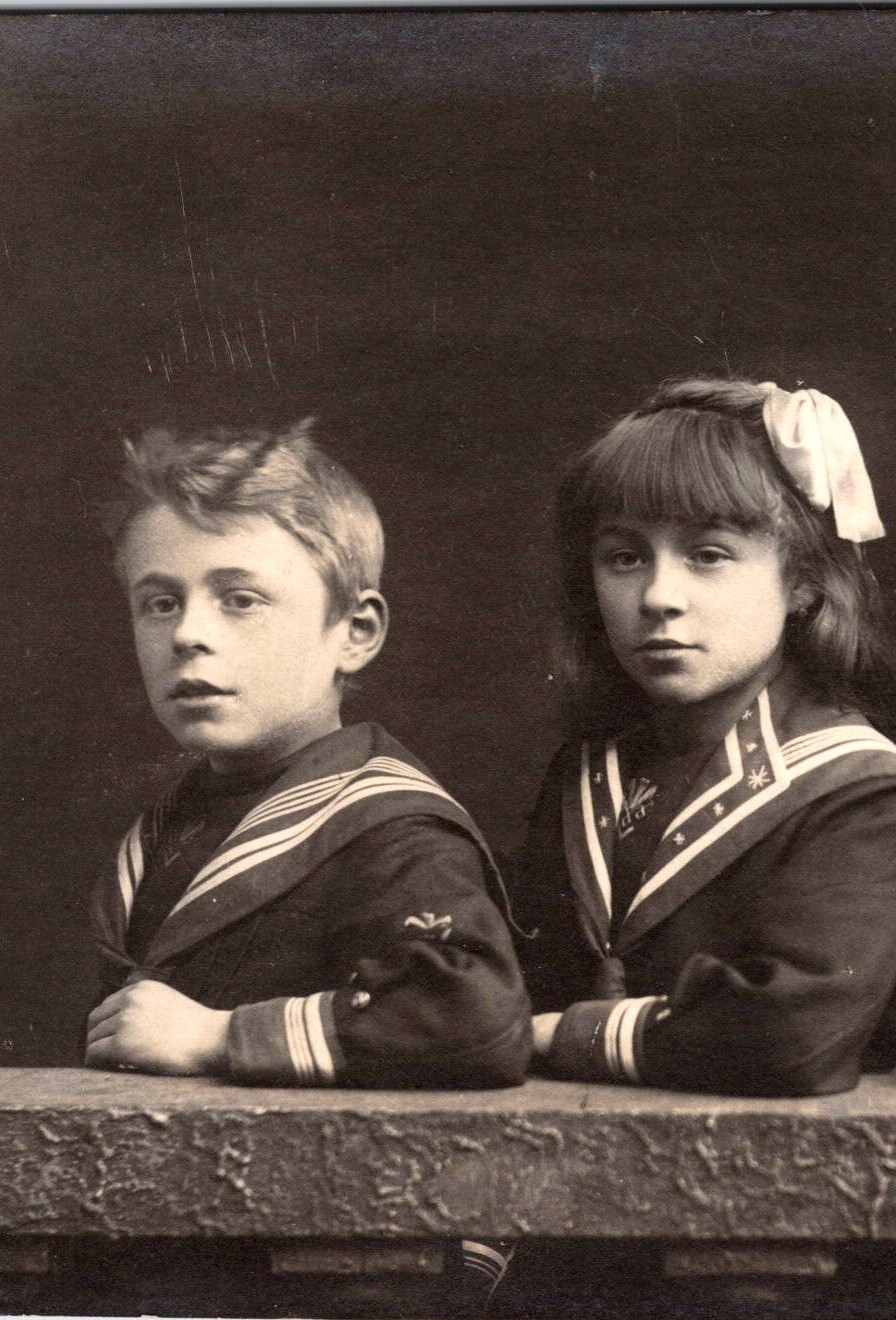
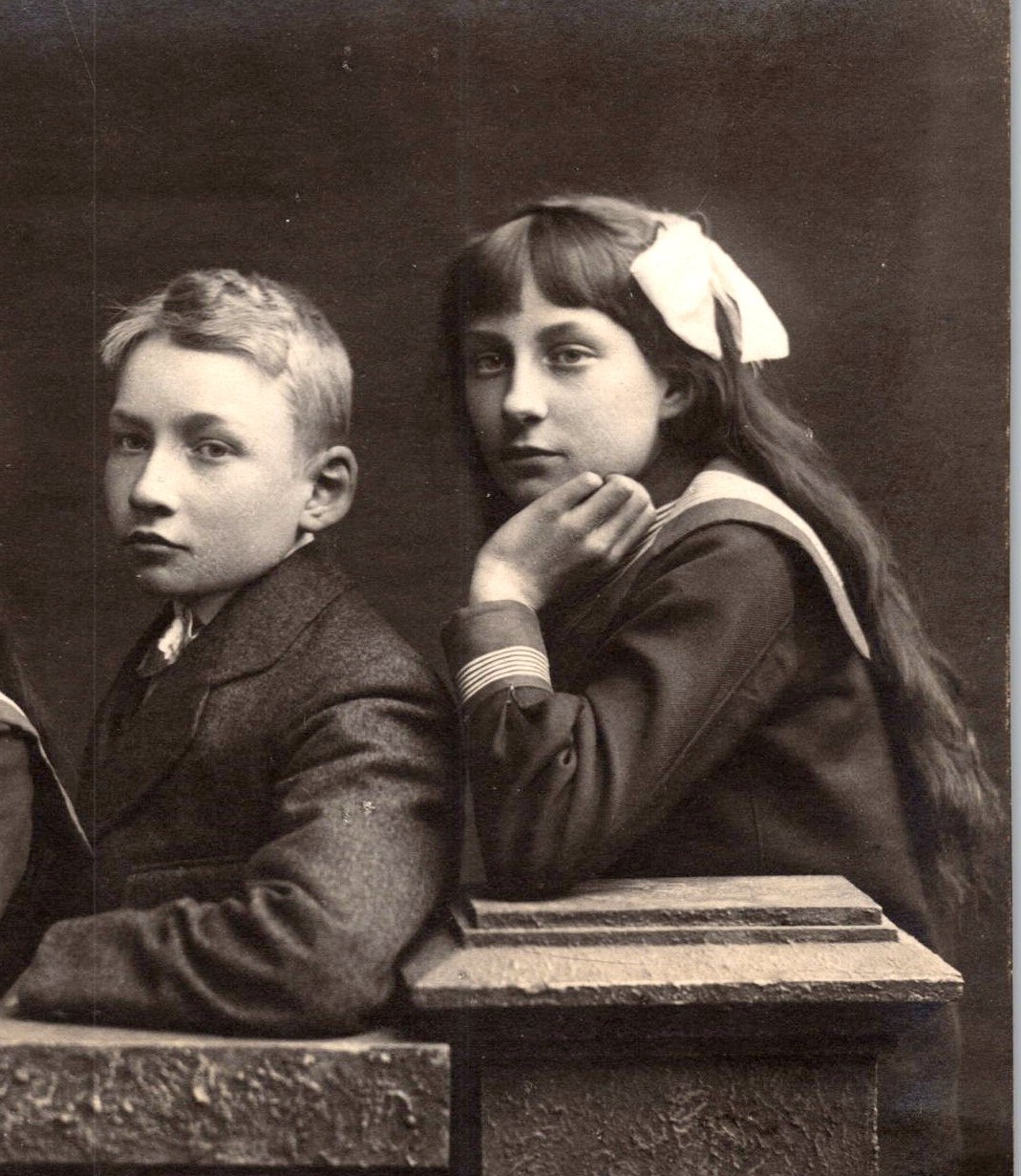
This vintage real photo postcard features a portrait of four young siblings. The children are adorable. Note that three of the four children in the image are wearing sailor suits. This photo was taken at a time that the “nautical look” was in vogue. SOLD
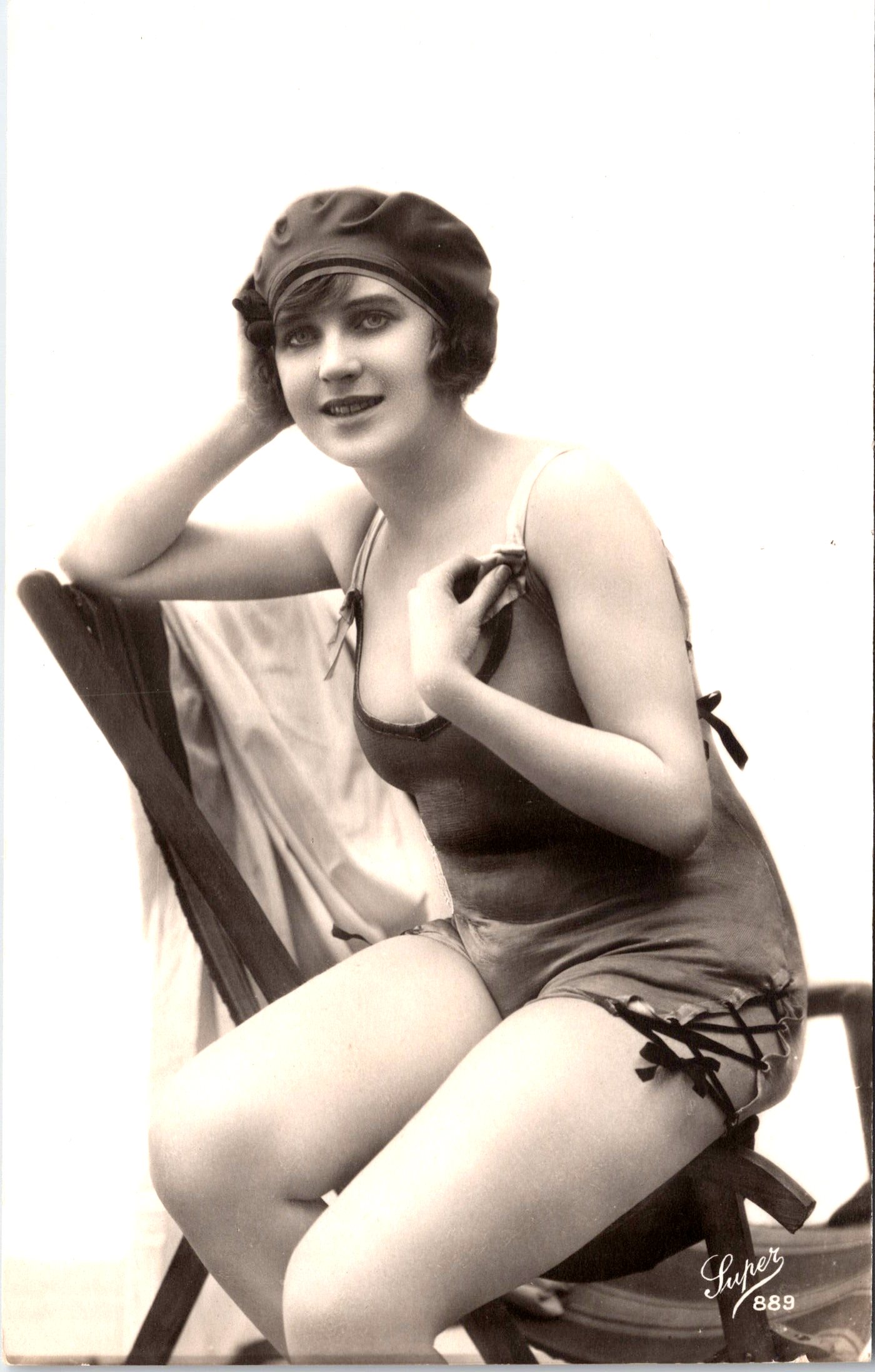
This French vintage risque real photo postcard features a pretty young woman modeling for a photographer. This photograph is meant to titillate. The bathing beauty is scantily dressed in her bathing suit. More of her body is exposed than covered. Her bathing suit is low cut and her legs are exposed. “Super” is the firm that published this postcard. The card was part of a series (No.883). SOLD
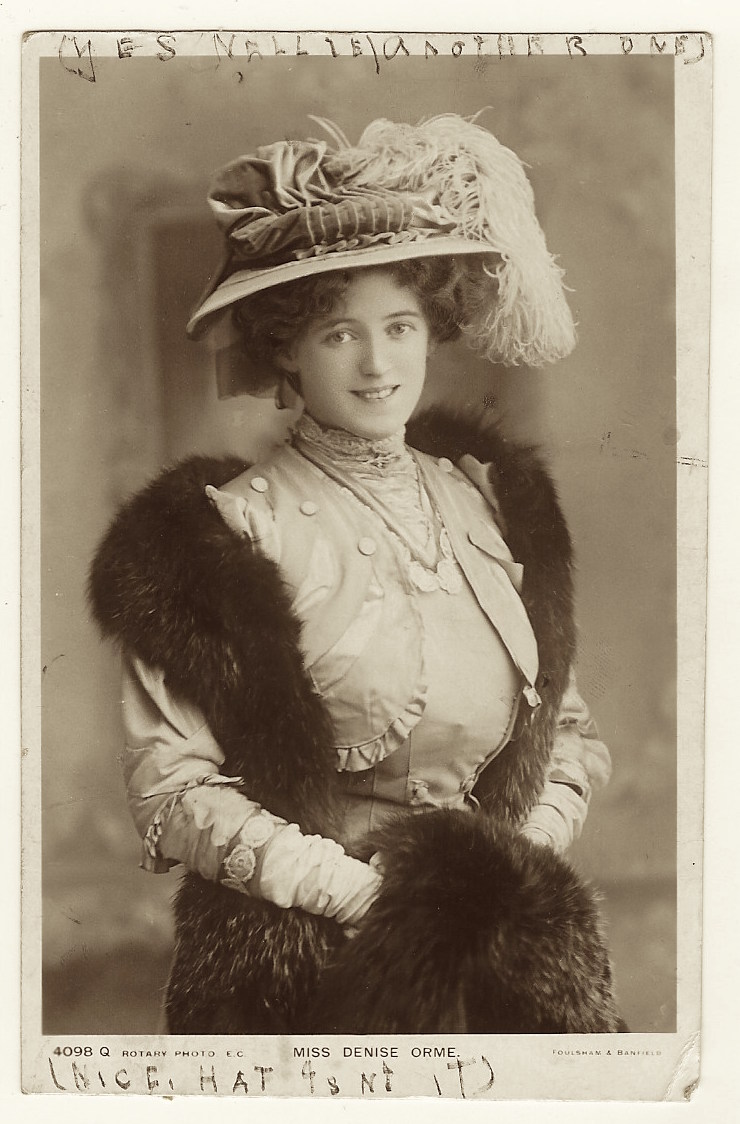
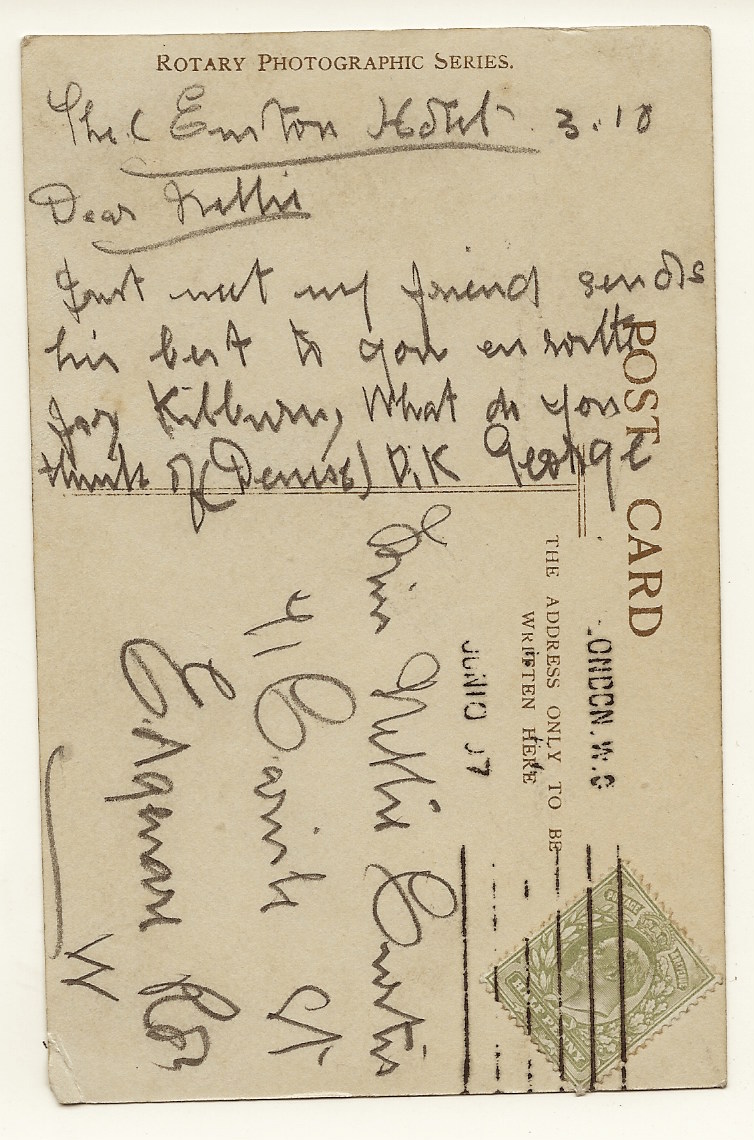
Postcard 1 features stage actress Miss Denise Orme. She is very attractive and beautifully dressed. She is wearing a fur stole and and fur muffs. She has a lovely hat and wonderful smile. Miss Orme’s given name was Jessie Smither, and was later known as Duchess of Leinster. Denise Orme (1885-1960) was an English music hall singer, actress and musician who was a regular performeer at the Alhambra and Gaiety Theatres in London during the early years of the twentieth century. Her mother was a professor of music. She trained for her theatrical career at the Royal Academy of Music and the Royal College of Music. Her stage debut was in 1906 in the chorus at Daly’s Theatre in London. Later that same year she appeared in the title role of “See See” at the Prince of Wales Theatre. In 1906 she participated in gramophone recordings of Gilbert and Sullivan’s “The Mikado”. Her marital history reveals that she had a predilection to choosing husbands that were “rich and famous”. She was married to an English Baron, A Danish millionaire, and an Irish duke. She was the maternal grandmother of Aga Khan IV.who is the current Imam of Nizari Ismailism which is a denomination of of Ismailism within Shia Islam with 15 million adherents. He is also a British business magnate. Miss Orme’s photographic portrait was taken by the Foulsham and Banfield Studio. Foulsham & Banfield were well known celebrity photographers. Frank Foulsham and A. C. Banfield operated a studio in the 1900’s through the 1920’s. The postcard was published by Rotary Photo and is part of the Rotary Photographic Series (#4098 Q). The postcard has a postmark from London, England, and dated 1907. The postmark date reveals that this portrait of Miss Orme was taken at the beginning of her stage career. In the message section of the postcard, the sender asks the receiver, “What do you think of Denise?”. In addition, the sender asserts on the front of the postcard “Nice hat, isn’t it?”. I have to agree; not only is Miss Orme lovely, so is her hat…….
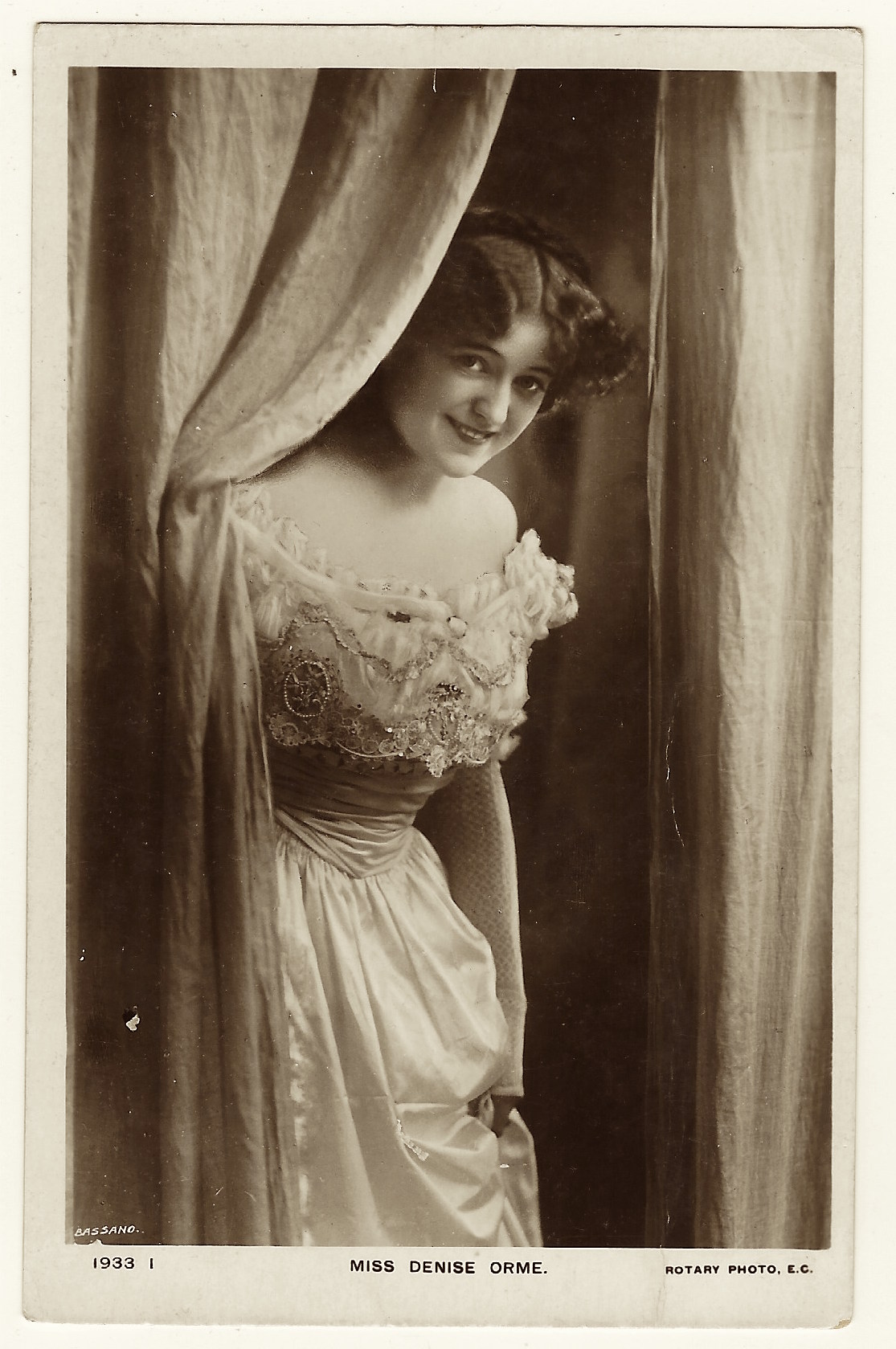
Postcard 2 shows the beautiful and well dressed Miss Orme peeking out from behind a curtain. The photographer is Alexander Bassano (1829-1913) who was a leading royal and high society photographer located in London. This postcard, like the first was published by Rotary Photo and is part of the Rotary Photographic Series (no. 1933 I).
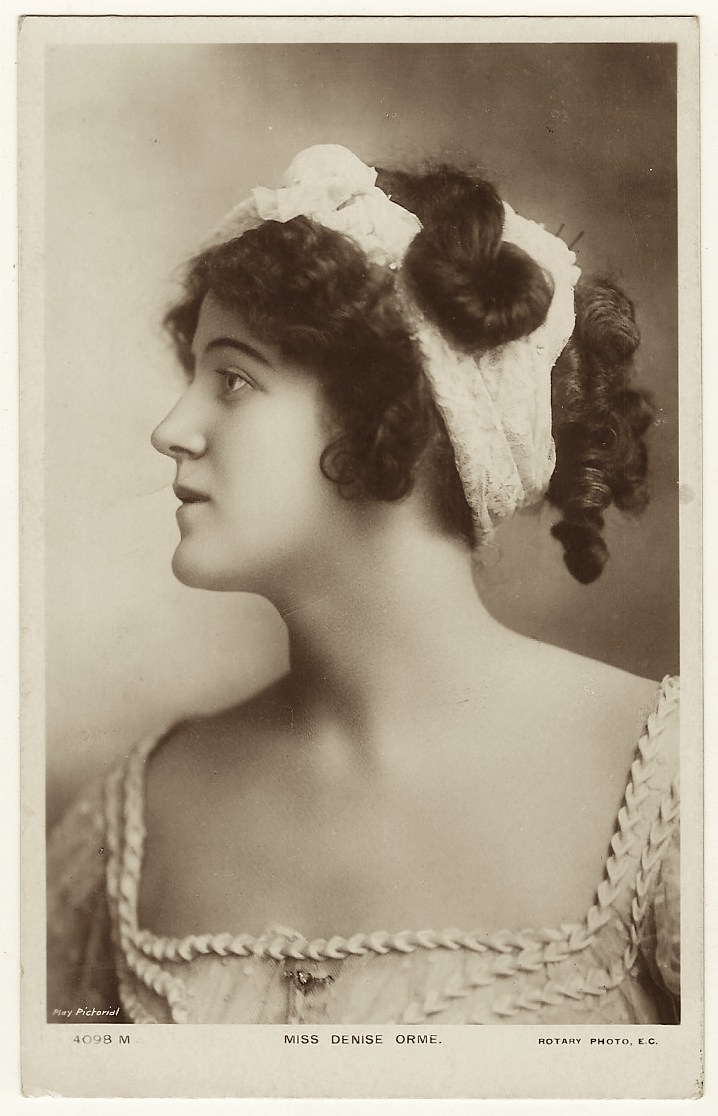
Postcard 3 presents a close-up profile view of this stunningly pretty young actress. Like the first two photo postcards, this one is also published by the Rotary Photo company and is part of the Rotary Photographic Series (no. 4098 M). The photograph was taken by “Play Pictorial” which was an English theatre magazine published in London between 1902 and 1939. The publication provided a pictorial presentation of West End theatrical productions with each issue focusing on just one play. (SOLD)
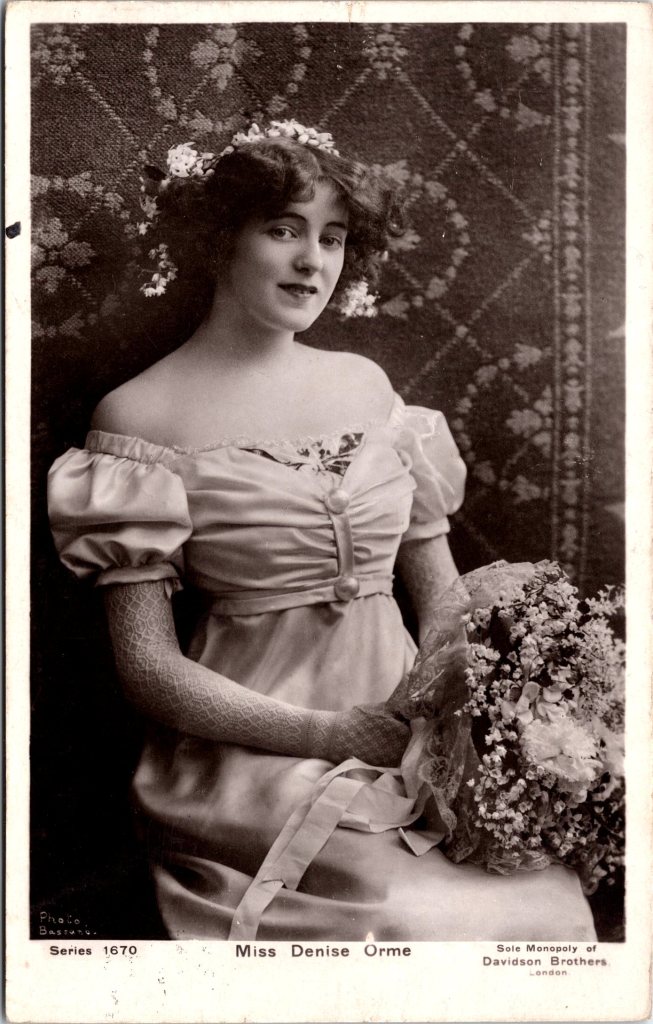
Postcard 4 presents a close-up profile view of this stunningly pretty young actress. It is published by the Davidson Brothers and is part of the Real Photographic Series (no.1670). The photograph was taken by Alexander Bassano. Bassano (1829 –1913) was a leading royal and high society photographer in Victorian London. (SOLD)
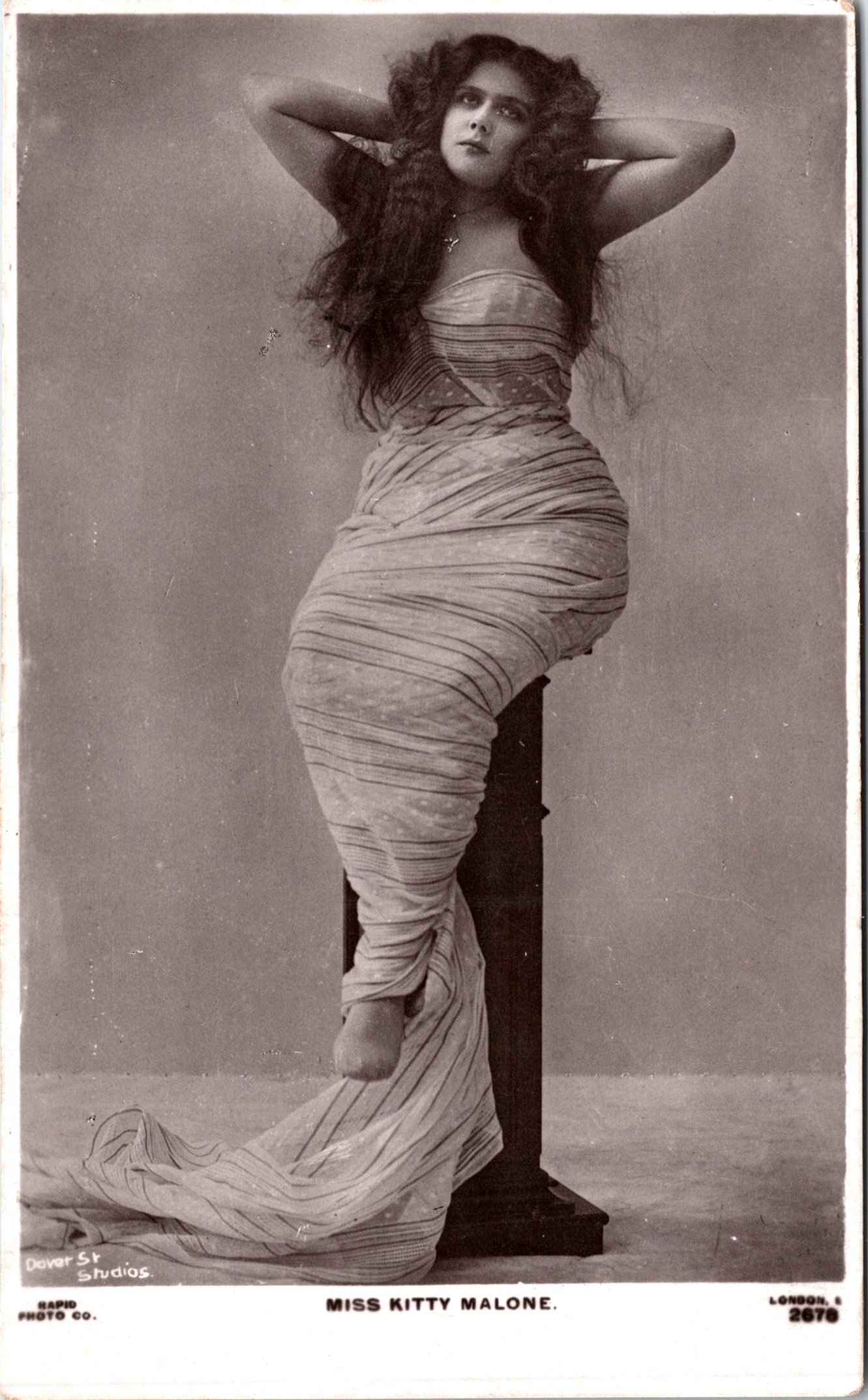
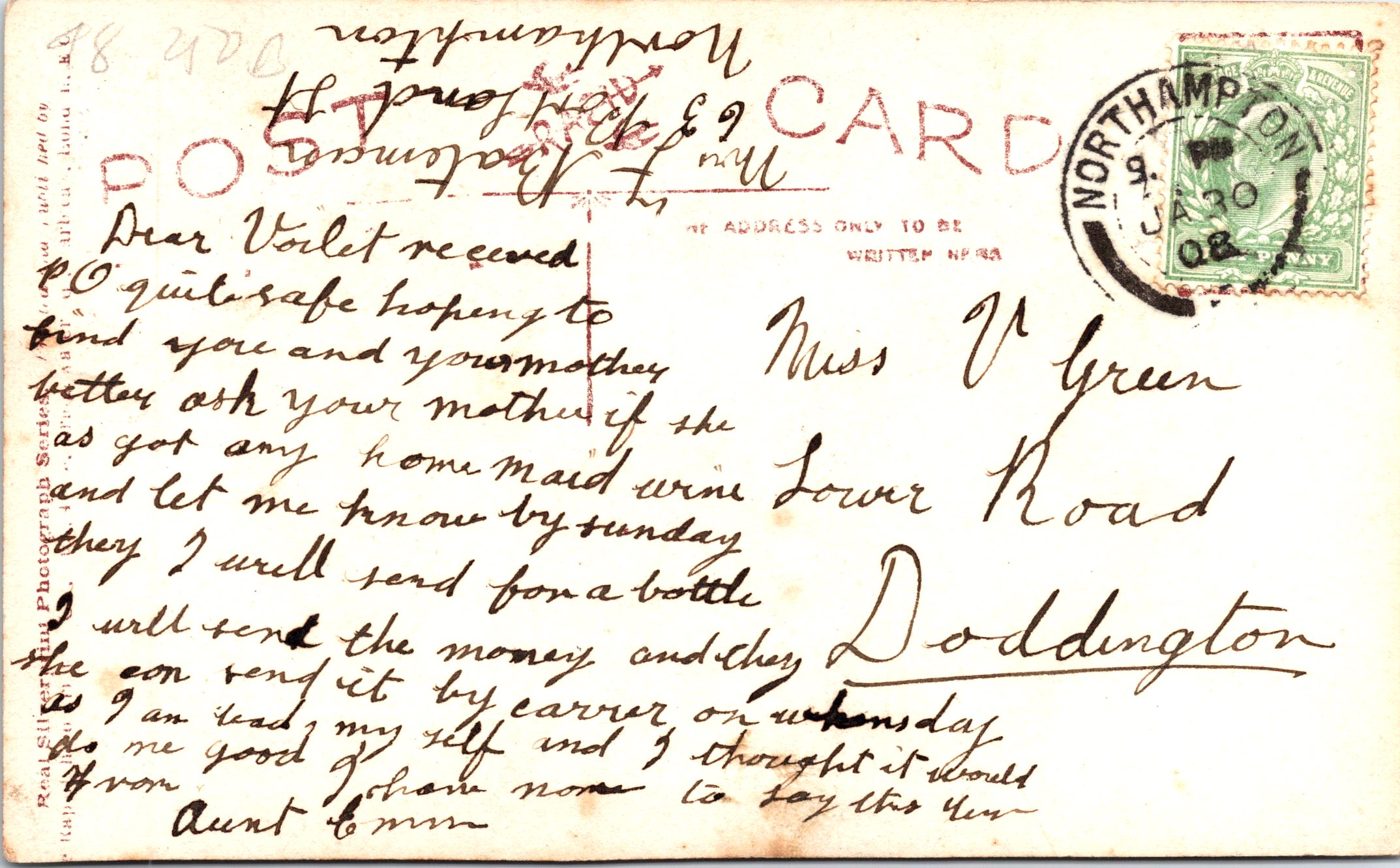
Postcard 1 is a risque original real photo postcard (RPPC) featuring Miss Kitty Malone, an early 20th-century stage performer or model. Malone is wrapped in a tight gown that accentuates all of her curves. The postcard was produced by Rapid Photo Co. in London, with the photograph taken at Dover St. Studios. In the image, Miss Kitty Malone strikes a dramatic pose, wrapped in a flowing, textured gown reminiscent of Grecian or theatrical costume styles. Her long, voluminous dark hair cascades down her shoulders, framing her striking face. She gazes directly at the camera with an intense and almost mysterious expression, her lips slightly parted. Her arms are lifted behind her head, adding to the dramatic, posed aesthetic that was characteristic of early Edwardian stage and artistic photography. This postcard is part of a series and numbered 2676 . This antique real photo postcard (RPPC) was postally used and sent in 1908. It features a green half-penny King Edward VII postage stamp, which was commonly used in the early 20th century for domestic postcards. The handwritten message is addressed to Miss V. Green and is written in black ink in elegant cursive handwriting. The sender, signed as “Aunt Emma”, writes to Violet, mentioning that she has received a postal order (P.O.) safely and hopes Violet and her mother are doing well. She asks if Violet’s mother has any homemade wine available and requests that she let her know by Sunday so she can send for a bottle. Aunt Emma also states that she will send money so it can be delivered by carrier on Wednesday, mentioning that she finds it beneficial for herself and thought Violet’s mother might feel the same. SOLD
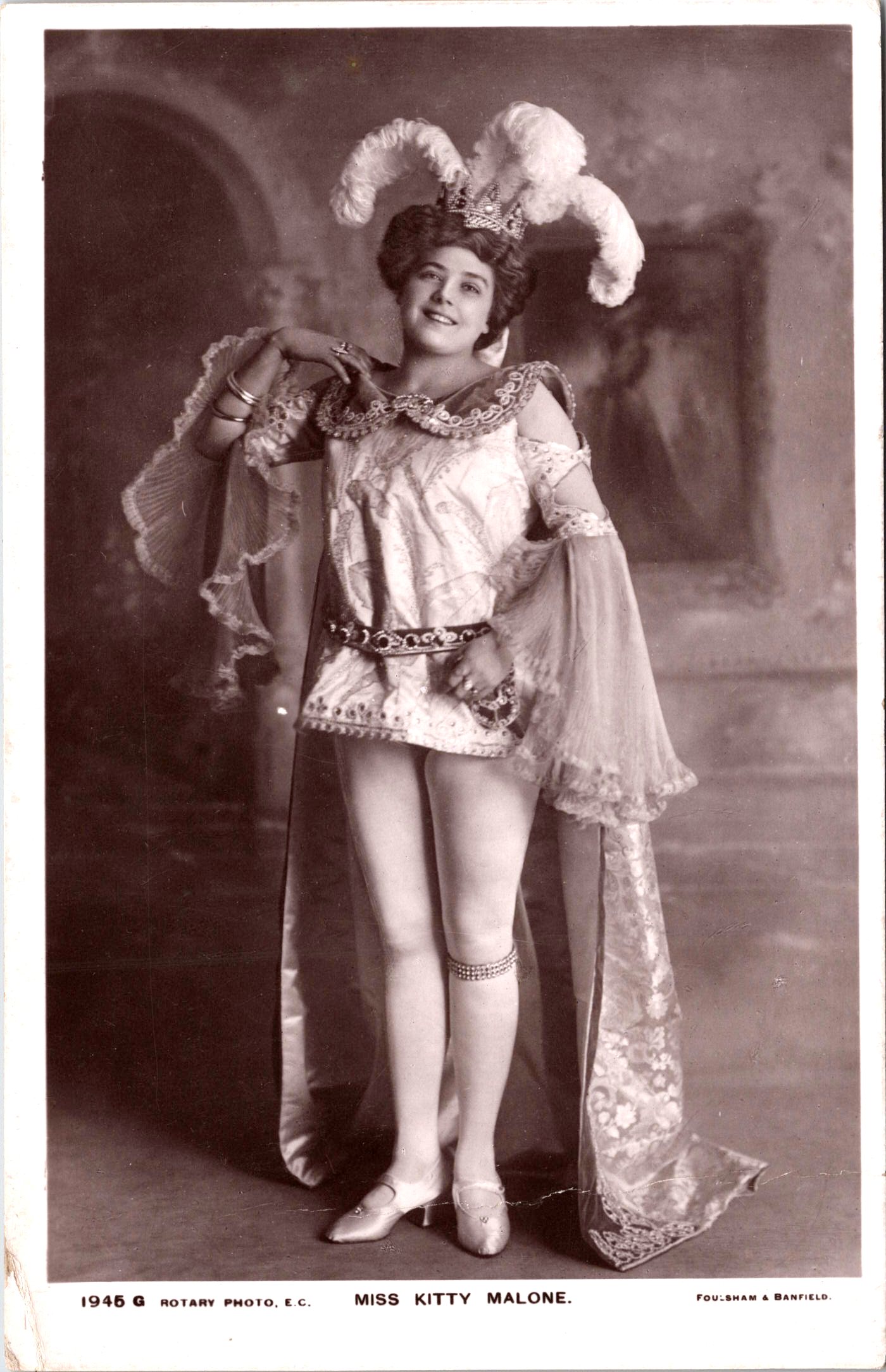
Postcard 2 is a risque vintage postcard, published by Rotary Photo and numbered 1945G in the series, features Miss Kitty Malone in an elaborate theatrical costume. This card earns the title of risque because Miss Malone’s top is exceedingly short, exposing much of her legs. The photograph was taken by the renowned Foulsham & Banfield studio. Miss Malone is dressed in an ornate, short tunic-style dress adorned with intricate embroidery and decorative trim. The outfit is cinched at the waist with a bejeweled belt, and she wears sheer, flowing sleeves that drape elegantly from her arms. She also sports shimmering stockings, one of which is embellished with a delicate garter, and dainty, pointed shoes. Her regal headpiece, topped with tall, white feathered plumes, adds to the opulent and theatrical nature of her attire. Her expression is warm and confident, with a slight smile and a poised demeanor. She gazes directly at the camera, her head tilted slightly to one side. Her dark, voluminous hair is styled in an elegant updo, framing her face beautifully. Her pose, with one hand resting on her hip and the other raised near her face, conveys a sense of grace and charisma, suggesting she was a performer or stage actress. The background of the image is softly blurred, allowing the intricate details of her costume and expression to stand out. The overall aesthetic of the postcard captures the glamour and theatrical style of the era. SOLD
This vintage real photo postcard features American actress, Marguerite Chapman (1918-1999). She was born in New York. While working as a telephone switchboard operator, she began to pursue a career in modelling. She was involved in national advertising campaigns. She approached Howard Hughes about appearing in one of his films. The film was never made but he showed her screen test to some Hollywood people and in 1939, she was signed by 20th Century Fox. In 1941 she did a brief stint with Warner Brothers and between 1942 and 1948, she worked for Columbia Pictures. Her film debut was in 1940 and for a couple of years she appeared in small roles of various films. Her 1942, she was signed for a lead role in a Republic Pictures in a twelve part adventure series. More leading roles followed. During World War II she entertained the troops and sold war bonds. In the 1950’s her work mostly included supporting film roles and in the 1960’s she appeared on many television shows. Chapman was married and divorced twice. The IMDb gives her 76 credits in her filmography between 1940 and 1977. She is credited with originating the concept of traveling autograph conventions. This postcard was published by RWP in 2003. SOLD
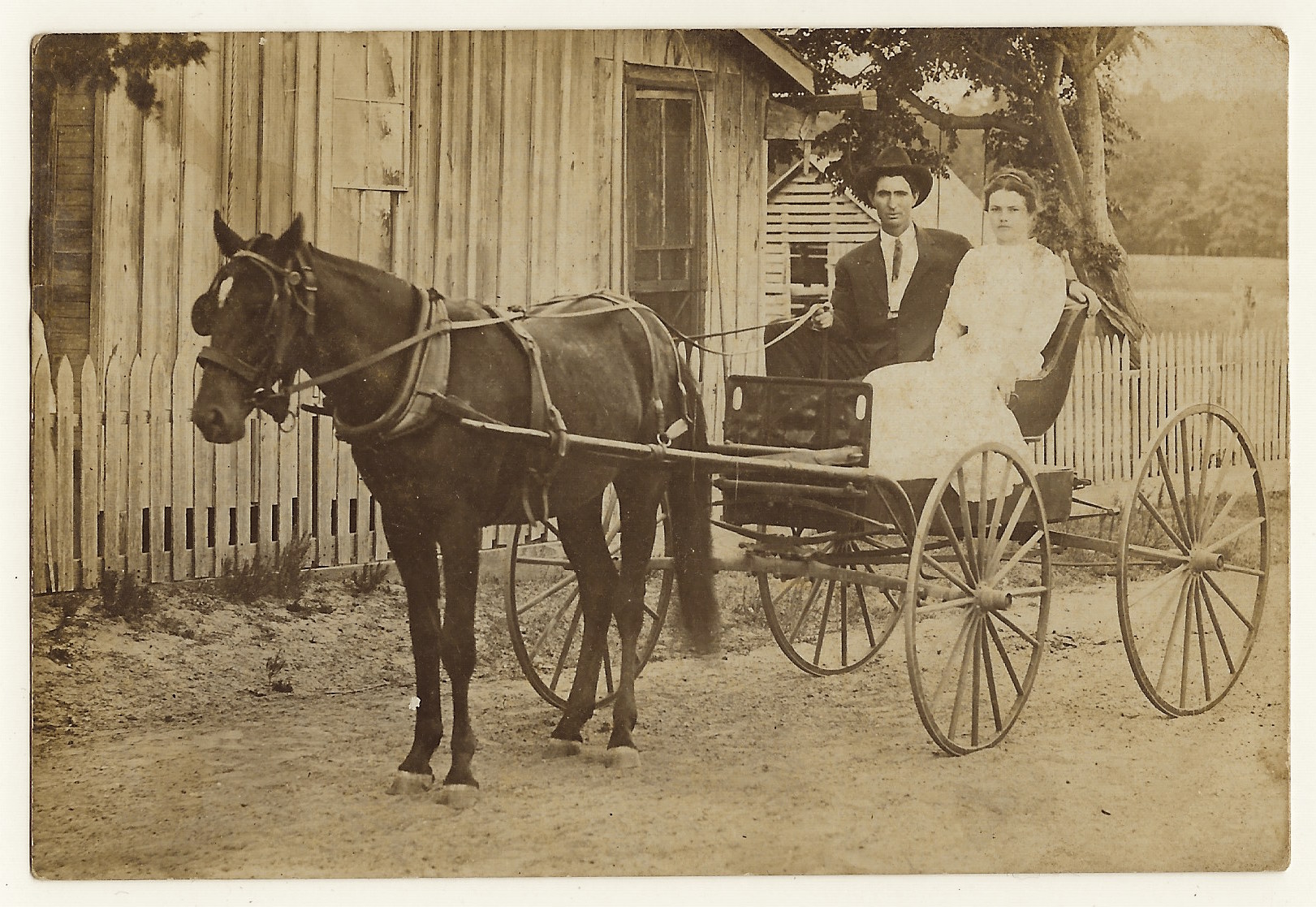
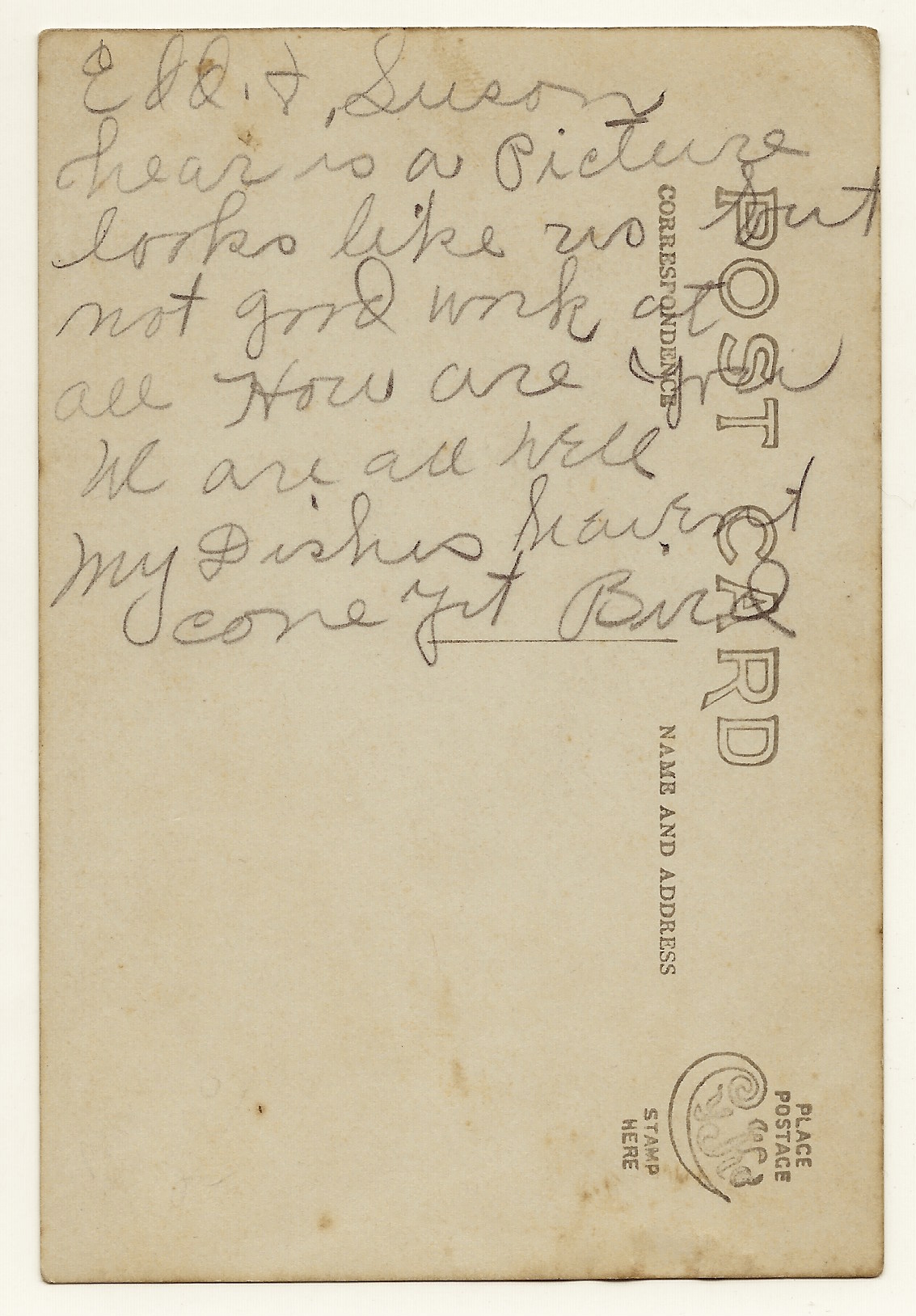
The message on this vintage real photo postcard is as follows: “Edd & Susan, Here is a picture. looks like us but not good work at all. How are you? We are all well. My Dishes haven’t come yet… Bird”. I added the punctuation since “Bird” didn’t seem to have the time or interest. This photograph features a young man and woman sitting in their horse drawn buggy in front of a rural house and landscape. The previous owner of this image believed that that the couple are dressed in their wedding clothes. I certainly can not confirm that, but the pair are certainly dressed in their nicest clothing. “Bird”, perhaps short for “Birdie”, is not very pleased with this photograph. Personally, I believe the photographer did an excellent job in capturing this couple, their horse and buggy, and their homestead. The stamp box on the reverse of this RPPC indicates that it was produced on Cyko paper sometime between 1904 and the 1920’s. SOLD
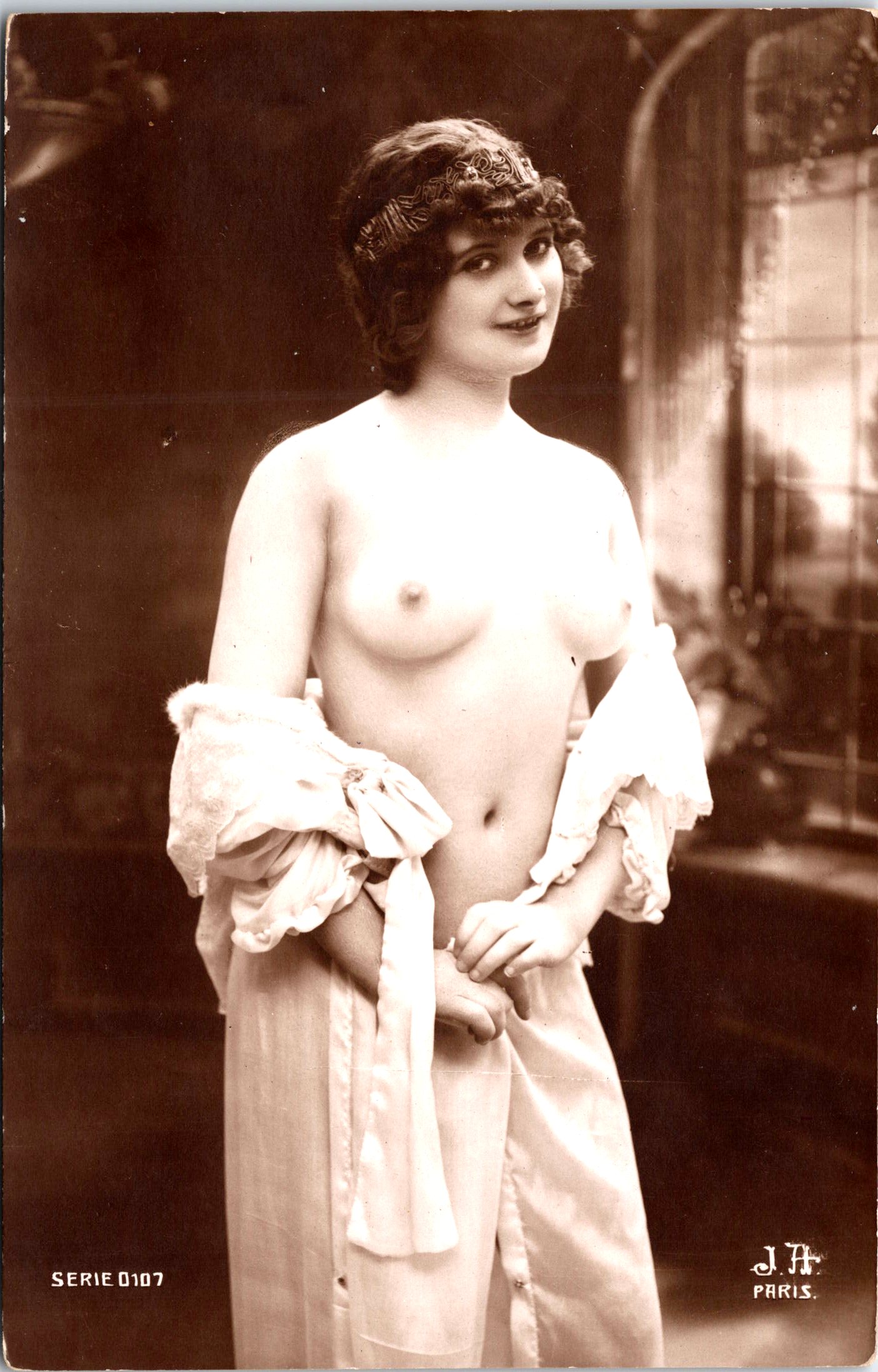
This French vintage nude real photo postcard features a pretty young woman model. Her facial expression can be described as alluring. This photograph is meant to titillate. The young woman is scantily dressed. More of her body is exposed than covered. She is wearing bed clothes, a negligee to be exact. This risque photographic portrait was published by celebrated photographer, Jean Agelou (1878-1921), as part of a series (No.D107). Agelou was a French photographer of the 1910’s and 1920’s who is best known for his erotic and nude photographs. He was born in Egypt and not much is known about his private life. Agelou generally used models between the age of 20 and 24 years-old. Although the 1900’s was the “golden age” of erotic photograph, photographers who took such risque photos had to use discretion. As a result, Agelou signed his work “JA”. In 1908, nudity in photographs was banned in France and photographers had to cover nude women images with strategically placed undergarments or other materials. Nude images had to circulate on the down low. They were sent in the mail inside of envelopes. Jean Agelou died in 1921; the result of a car accident. His brother George, who managed Jean’s business, also was killed in the crash. SOLD
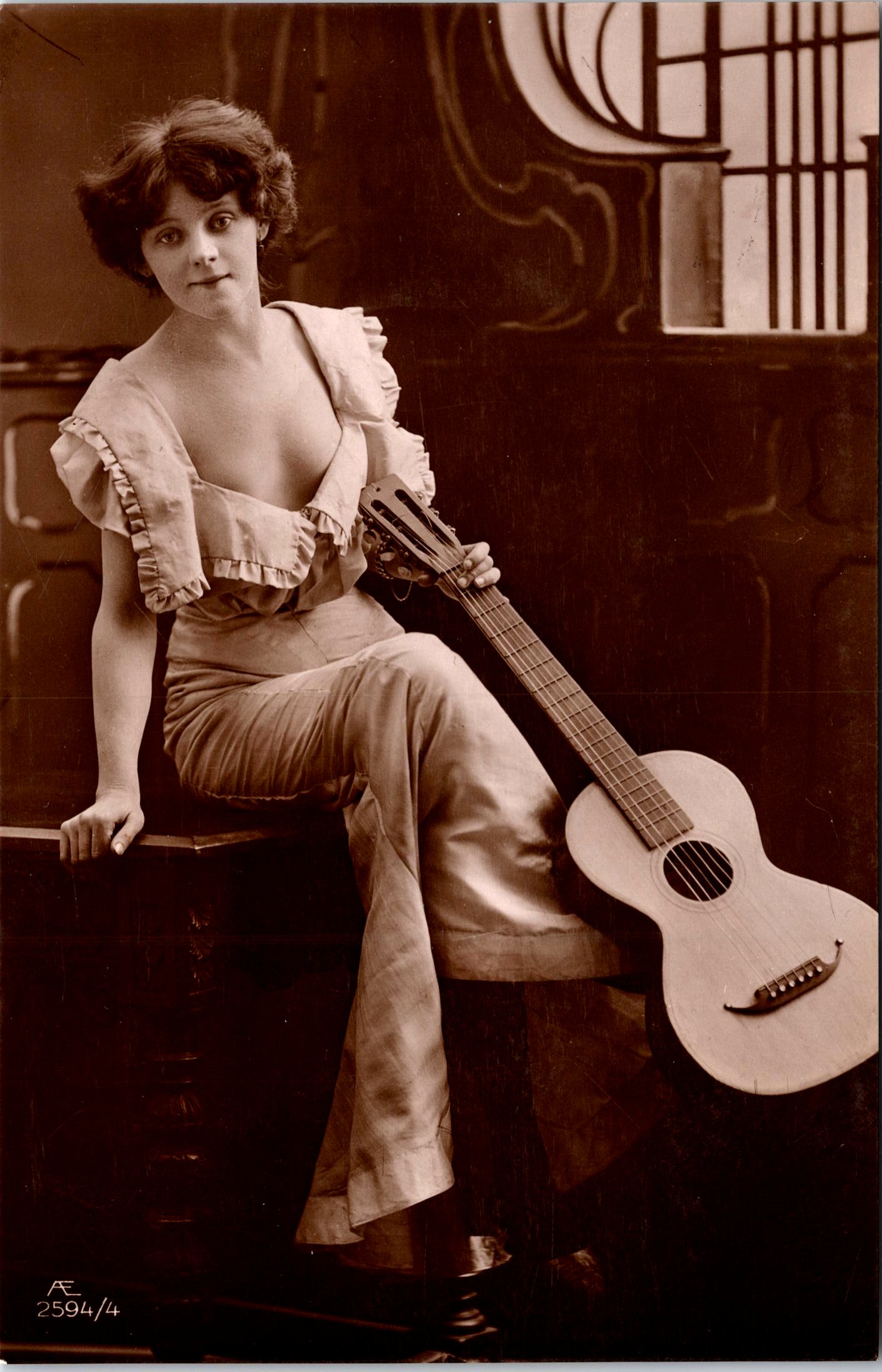
This vintage real photo postcard features a pretty young woman posing with her guitar. Her plunging neckline makes this a risque postcard. The card was published by Adolph Engel (Berlin, Germany) and is part of a series (No.2504/4). SOLD





 THE CABINET CARD GALLERY