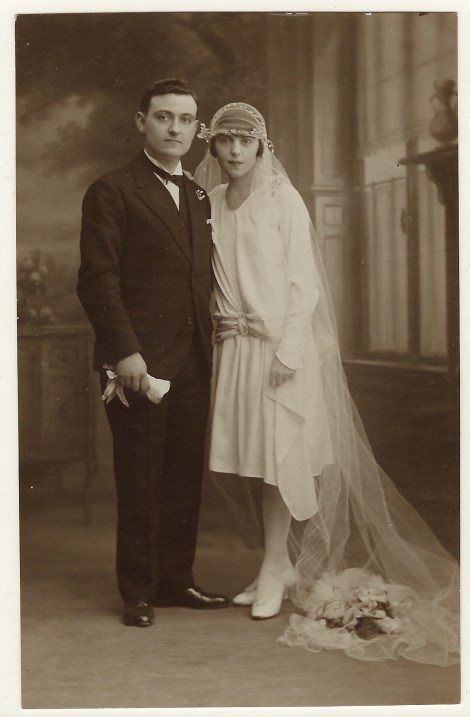
This vintage real photo postcard features a very attractive couple posing for their wedding portrait at the “Photographie des Arts” operated by F. Clement in Parc-Saint-Maur, France. This postcard’s stamp box indicates that it was produced sometime around 1916.The postcard is in excellent condition. (SOLD)
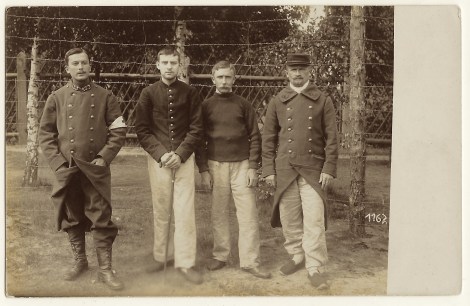
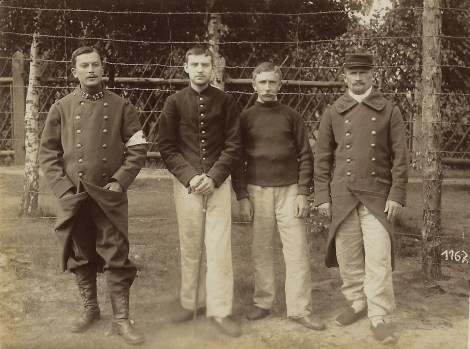
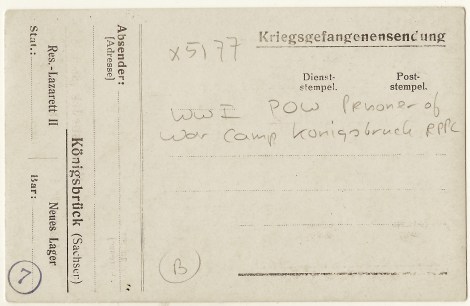
Some images are very effective at capturing history. This real photo postcard is one of those historic photographs. The image features World War I prisoners of war held at Camp Konigsbruck. The POW camp held Serbian, Russian, and French prisoners of war. The camp held about 15,000 captives. I am unsure if this photo shows four prisoners or two prisoners and two guards (the men wearing heavy coats). One of the possible “guards” is wearing a red cross armband. Note the high barbed wire fence in the background. This photograph was taken sometime around 1916. Konigsbruck is a town in the German state of Saxony. It is located only 17 miles from Dresden.
The beautiful woman seen on this vintage real photo postcard is Miss Paulette. I have been unable to find biographical information about her. The former owner of this photo postcard identified her as Miss Paulette and stated she performed in Paris at the Folies Bergere, a cabaret music hall established in 1869. This portrait of the actress is risque for it’s era but it is certainly tastefully done. In an attempt to identify this actress, I came across the five postcards seen below. I believe that the pretty woman seen in the postcard above is Paulette Del Baye although I lack any concrete convincing evidence. This postcard has a German stamp that is postmarked in Rixdorf (a neighborhood in Berlin). The card was postmarked 1912. The postcard was published by Neue Photographische Gesellschaft (NPG) which was located in Berlin and Stuttgart, Germany.The company was in business between 1894 and 1948. It was founded by Arthur Black (1862-1943) and it became one of the most well known and largest companies involved in the production of postcards. SOLD
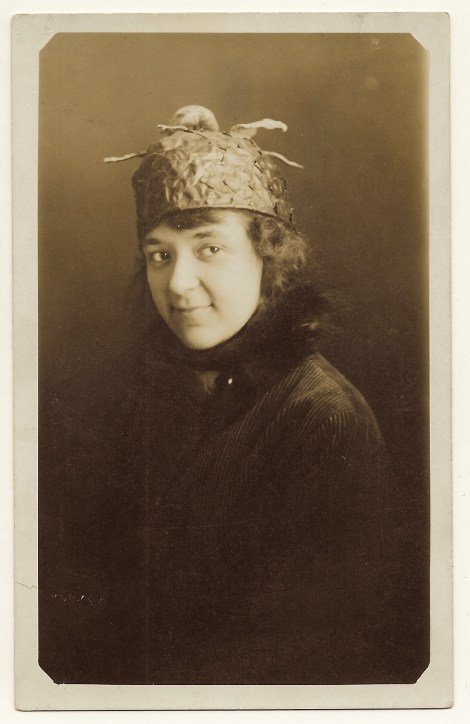
This vintage real photo postcard features a woman wearing an unusual hat. I am thinking that the millinery designer of this hat designed it in the fog of a bad hangover, or perhaps the woman in the photograph wore the hat into the woods and exited with a branch stuck through her hat. In addition, the branch appears to be hosting one leaf and a caterpillar tent. The subject of this photograph is wearing a winter coat and a nice pursed smile. The AZO stamp box on the reverse of the postcard indicates that it was produced sometime between 1904 and 1918. The identity of the hatted woman and the studio that took the photograph are unknown. SOLD
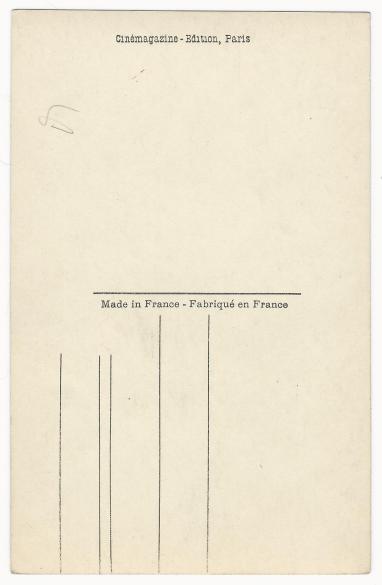
This real photo vintage postcard features actress Sandra Milovanoff (1892-1957). Although she was Russian born, she was known for her roles in French cinema, particularly during the silent era. Milovanoff was very passionate about classical dance and attended a number of dance schools in St. Petersburg. She then joined the dance company of Anna Pavlova. She toured varied European cities but left Russia in 1917 in order to flee the Bolshevik Revolution. She went with her family to Monte Carlo where she played a small role in a film. She was noticed by French director Louis Feuillade who began using her in films. She had much success in film until the arrival of sound movies which basically destroyed her career. The IMDb credits her with 28 film roles between 1917 and 1950. Her films include “Les Miserables” (1925), “My Crimes After Mein Kampf” (1940), and “The Private Life of an Actor” (1948). A sample of her work can be seen in the video seen below (“In The Night” (1929) starring Sandra Milovanoff and Charles Vanel). This postcard was published by Cinemagazine in Paris, France and is part of a series (No. 114).
A pretty young woman, holding a bouquet of flowers, poses for her portrait at a studio in Bucharest, Romania. Printing on the reverse of this real photo postcard reveals that the photographer was Julietta, an appointed photographer of Romania’s royal court. This postcard is dated 1914. (SOLD)
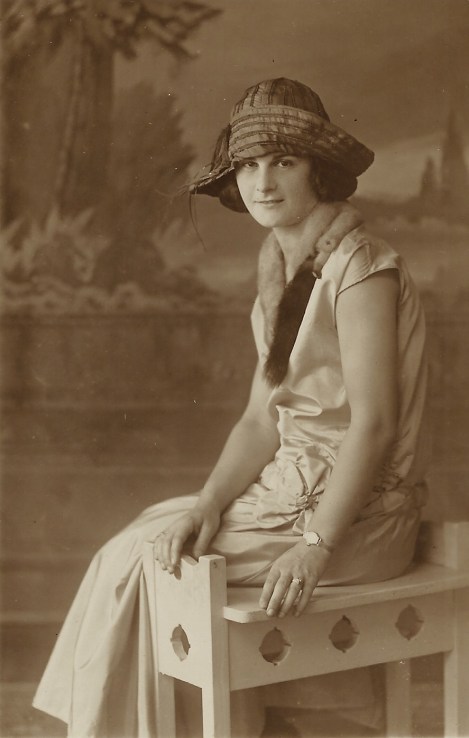
A pretty young woman sits on a bench and has her photographic portrait taken at the New York Studio in Passaic, New Jersey. She is wearing a watch, ring, and some type of fur animal. This vintage real photo postcard was produced by Defender.
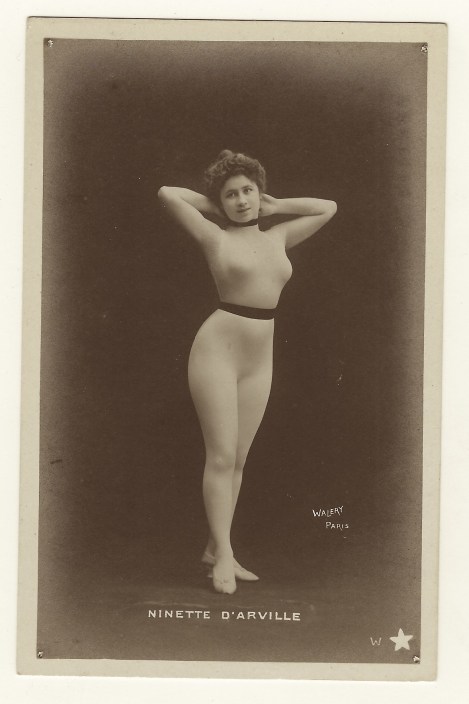
This vintage real photo postcard is racy for it’s time. The postcard features French cabaret artiste Ninette d’Arville. She is wearing a body stocking that is aimed at simulating nudity. Preliminary research found no biographical information about Miss D’arville. However, investigation did reveal that this postcard is part of a series that shows the actress in the same body stocking but assuming a number of different poses. The image utilized in this postcard was produced by photographer Lucien Walery. He was a celebrated Paris photographer known for his portraits of artists and cabaret dancers from the city’s music halls. He is very well known for his portraits of Mata Hari and Josephine Baker. Walery did a lot of work in the genre of nude/erotic photography. He photographed the beautiful women of Paris between the early 1900’s and the 1920’s. Sold
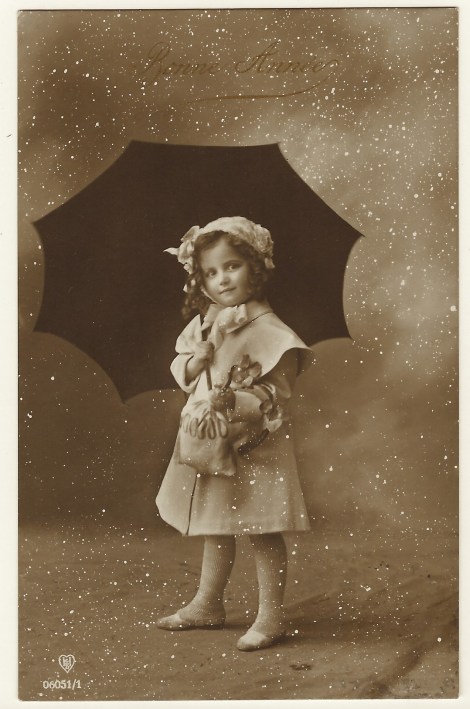
This vintage real photo postcard features a a little girl
dressed in her winter clothing using her umbrella to
protect her from falling snow.The little girl is adorable
and is wearing a very cute expression.The postcard is
a New Years card. On the message side of the postcard
is a sweet note from Aimee Banchet to her "Godmother and
Uncle". Google Translate came up with a rough translation
indicating that the card is a message from a niece
to her Aunt and Uncle wishing them much love and happiness
upon the New Year. The card is addressed to Mr and
Mrs Martin who resided in the town of Chonon les Bains,
France.The town is located in the Auvergne-Rhône-Alpes
region of eastern France. The postcard is from the early
1900's.The logo for the postcard publisher appears to
be "H.B.". Two postcard publishers used those initials;
Hutson Brothers Ltd (London,England) and Hoursch &
Bechstedt (Cologne,Germany).
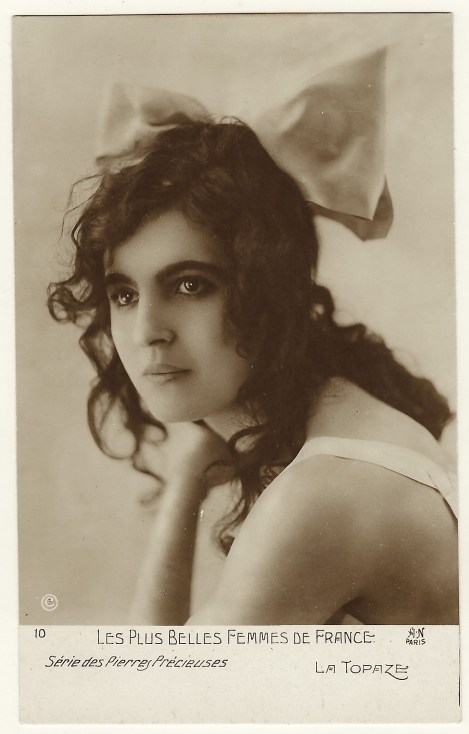
This vintage real photo postcard is part of a series named “Les Plus Belles Femmes de France” (The Most Beautiful Women of France). This series is about gem stones, and the model for this image represents “Topaze” (Topaz). There were a number of different series published. One of the more popular series was one in which models represented different French Provinces by wearing traditional clothing from that particular area of the country. This postcard was edited by well known photographer Alfred Noyer. The celebrated photographer supervised a large photo studio in Paris. The Noyer Studio operated from 1910 until the 1940’s. Many of his early postcards were reproductions of artworks. He also produced illustrated patriotic postcards during World War I. With the onset of the 1920’s he began producing postcards of children and women. Many of the postcards he produced of women were nudes or risque images. Some of his postcards list his name while others are simply marked “AN”.




 Paulette
 Paulette
 Paulette Del Baye
 Paulette Del Baye
 Paulette Debrives





 This vintage real photo postcard features a a little girl
dressed in her winter clothing using her umbrella to
protect her from falling snow.The little girl is adorable
and is wearing a very cute expression.The postcard is
a New Years card. On the message side of the postcard
is a sweet note from Aimee Banchet to her "Godmother and
Uncle". Google Translate came up with a rough translation
indicating that the card is a message from a niece
to her Aunt and Uncle wishing them much love and happiness
upon the New Year. The card is addressed to Mr and
Mrs Martin who resided in the town of Chonon les Bains,
France.The town is located in the Auvergne-Rhône-Alpes
region of eastern France. The postcard is from the early
1900's.The logo for the postcard publisher appears to
be "H.B.". Two postcard publishers used those initials;
Hutson Brothers Ltd (London,England) and Hoursch &
Bechstedt (Cologne,Germany).
This vintage real photo postcard features a a little girl
dressed in her winter clothing using her umbrella to
protect her from falling snow.The little girl is adorable
and is wearing a very cute expression.The postcard is
a New Years card. On the message side of the postcard
is a sweet note from Aimee Banchet to her "Godmother and
Uncle". Google Translate came up with a rough translation
indicating that the card is a message from a niece
to her Aunt and Uncle wishing them much love and happiness
upon the New Year. The card is addressed to Mr and
Mrs Martin who resided in the town of Chonon les Bains,
France.The town is located in the Auvergne-Rhône-Alpes
region of eastern France. The postcard is from the early
1900's.The logo for the postcard publisher appears to
be "H.B.". Two postcard publishers used those initials;
Hutson Brothers Ltd (London,England) and Hoursch &
Bechstedt (Cologne,Germany). 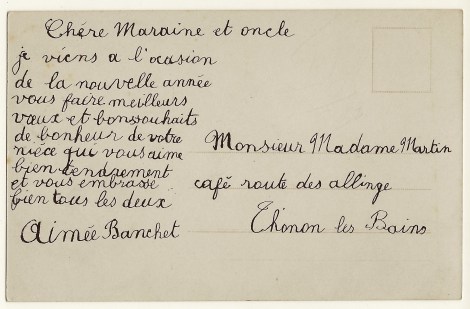


 THE CABINET CARD GALLERY