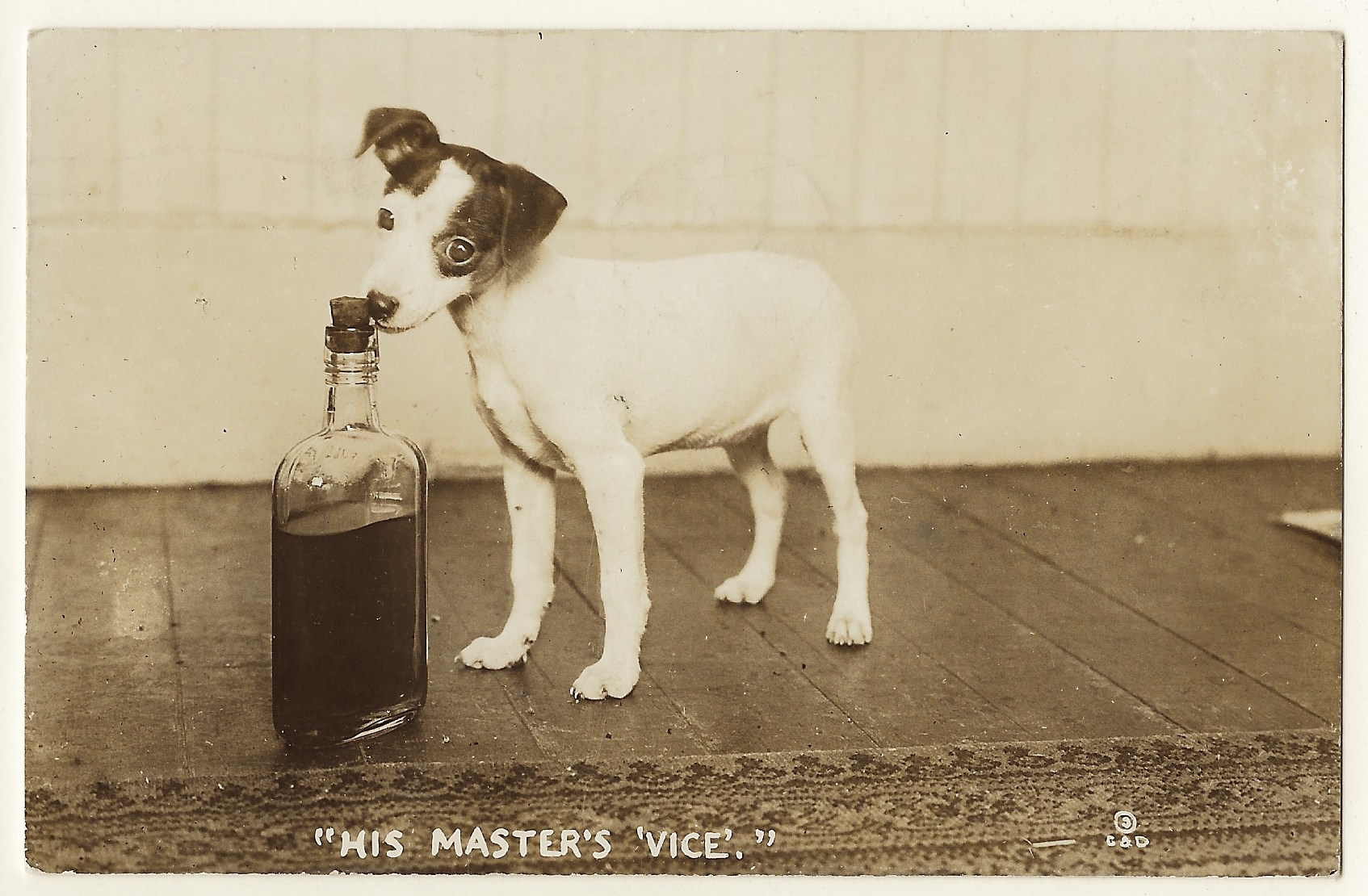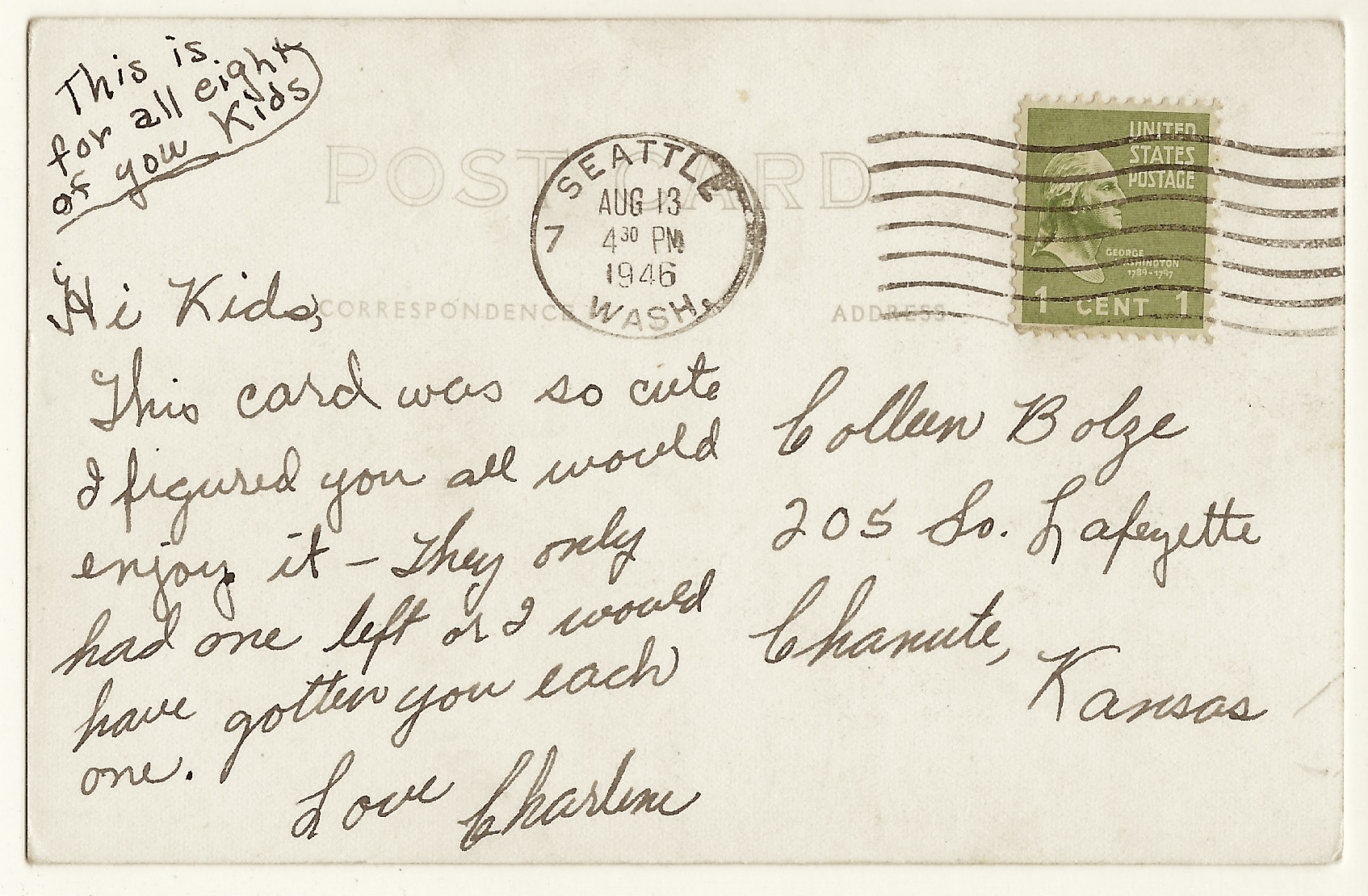
This vintage real photo postcard features a cute dog sniffing the cork on a bottle of whiskey. Below the photo is the caption “His Master’s Vice”. The dog on this comical postcard appears to be Jack Russell or a Chihuahua. Of course, the dog certainly may be a mixed breed. The postcard was postmarked in Seattle in the year 1946. The recipient of this postcard was Colleen Bolze, a sixteen year old girl in Chanute, Kansas. Printed on the right bottom of the card is the name “C & D”. This may represent the publisher but initial research was unable to confirm that C & D was a postcard publishing company. SOLD
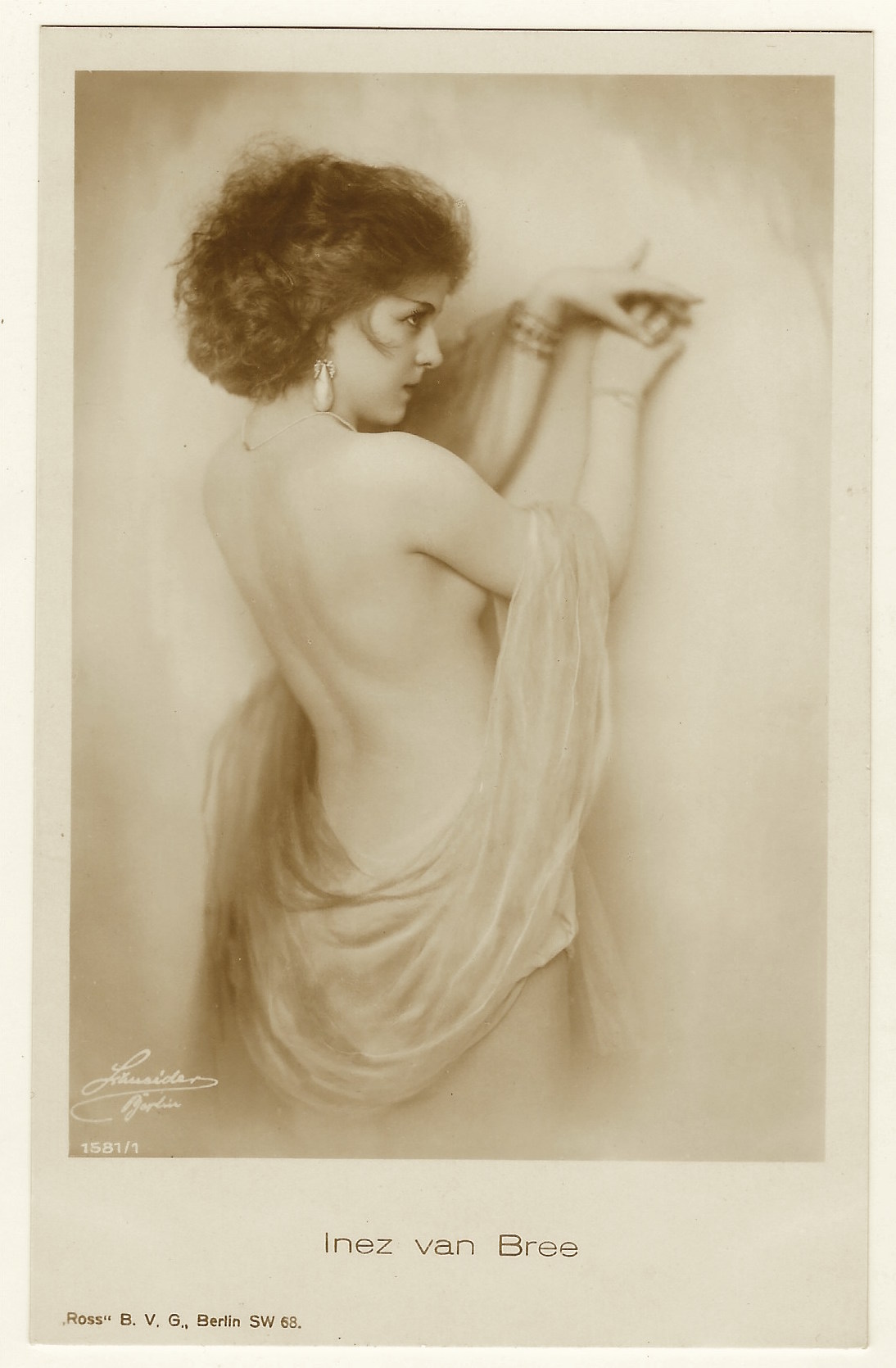
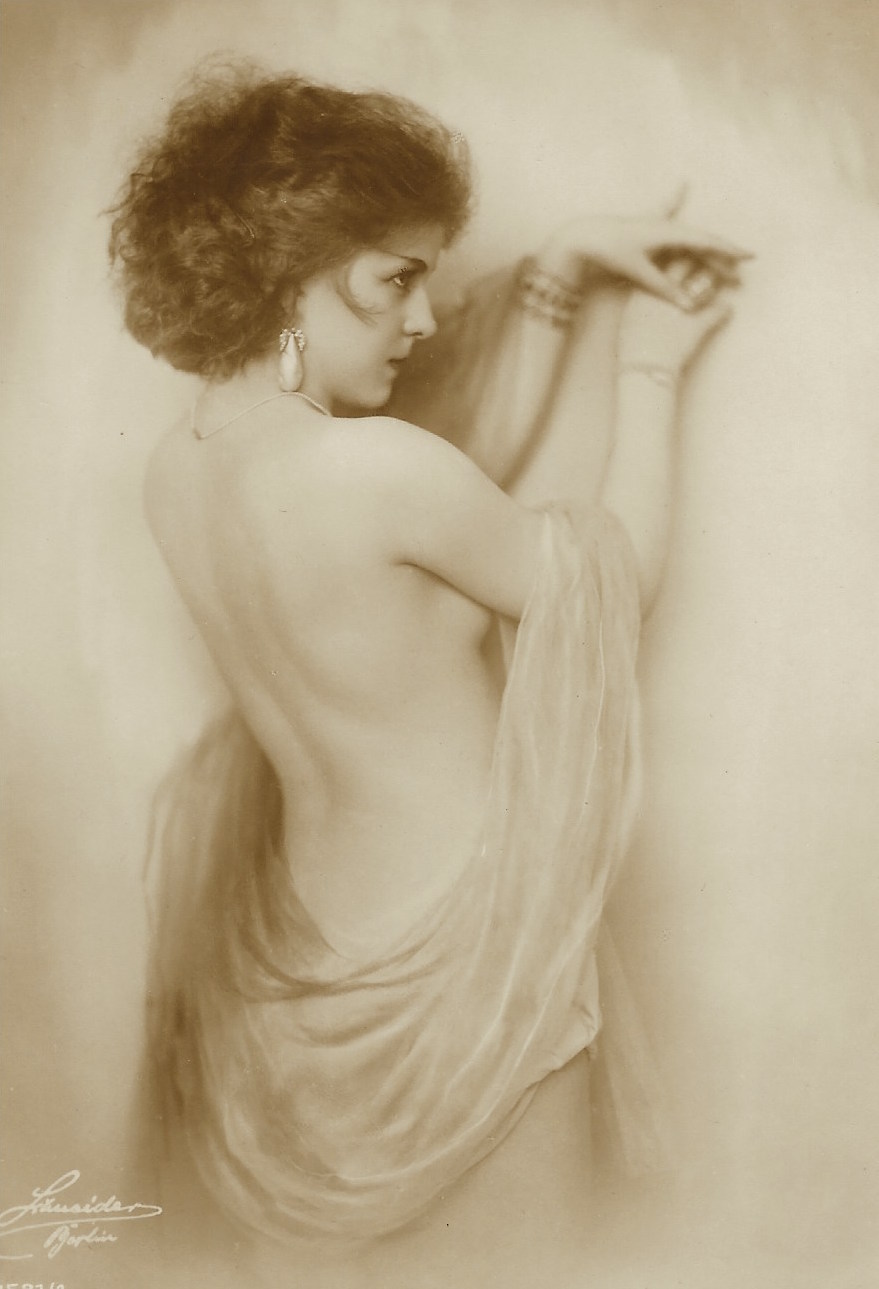
This vintage real photo postcard is one of the more risque Ross Verlag postcards in the Cabinet Card Gallery. The postcard is of German origin and is part of a series (no. 1581/1). It was published between 1927 and 1928. Preliminary research found little information about Inez Van Bree. A defunct University of Toronto website labels Miss Bree as a silent movie siren/star. The photographer of this portrait appears to be Ernst Schneider and the photograph was taken in Berlin, Germany. Research about Mr Schneider yielded a great deal of information. He was considered to be one of the most celebrated studio photographers in Berlin during three decades (1900’s, 1910’s, 1920’s. He photographed many celebrities from the world of theater, opera, circuses, and film. He was also one of the most prominent fashion photographers in Berlin. In addition, he was well known for his nude photography and he published books showcasing his work in this domain. Sometime around 1908 Schneider began working with postcard publishers “Rotophot” and “Neue Photographische Gesellschaft” (NPG). In 1919 he began working with Ross Verlag. SOLD
This vintage real photo postcard features a couple in a rowboat. This romantic rowboat cruise is likely taking place in the photographer’s studio. Interestingly, the young lady is looking at the photographer while the the rowboat captain is staring at his pretty first mate. The “Cyko” stamp box on this postcard indicates that it was published sometime between 1904 and 1920.
This vintage real photo postcard features Canadian born American singer and actress, Deanna Durbin (1921-2013). She is beautifully dressed. Her hat is a nice touch. Deanna Durbin looks quite pretty in this photo portrait. The postcard notes her affiliation with Universal Films. The postcard was published by Echte Foto, a Dutch company. Miss Durbin was an active performer between 1936 and 1948. She appeared in musical films and had the technical skill and vocal range of a legitimate soprano. She sang multiple styles of music including popular standards and operatic arias. Durbin’s first film appearance was with Judy Garland in MGM’s “Every Sunday” (1936). A YouTube clip of the two young actresses performing a duet from this film can be seen below. Shortly after her debut movie, she was given a contract by Universal Studios. She had great success with the studio playing “the ideal teenage daughter” is such films as “Three Smart Girls” (1936). She was only 14 years old when she appeared in “Three Smart Girls” and became an established star. Afterward, she had a string of successful musical films. In 1936, Deanna was offered an audition for the Metropolitan Opera but she rejected the offer because she believed she needed more operatic training. From 1936 through 1938, Durbin did a radio collaboration with Eddie Cantor. In 1938, Durbin was awarded an Academy Juvenile Award. Her co-winner was actor Micky Rooney.Durbin tired of her girl-next-door roles and by 1945, had appeared in a couple of films in more sophisticated roles. Unfortunately, she was not well received in these more mature roles. In 1946, Durbin was the second highest paid woman in the United States, second to Bette Davis. Durbin became the highest paid female in America in the year 1948. By 1949, she retired from acting and singing and never returned to public life. In fact, she never again agreed to be interviewed by the press, with just one exception. Durbin hated the adulation she received in her career and yearned for a “life of nobody”. She wanted to be anonymous. During her acting career, Durbin appeared in 23 films and even more sound recordings. Durbin had three marriages. Her husbands were assistant director Vaughn Paul (1941), writer-producer-actor Felix Jackson (1945) , and film producer-director Charles Henri David (1950). (SOLD)
Judy Garland & Deanna Durbin – Americana (Every Sunday, 1936)
This vintage real postcard is unique and adorable. A little boy is at the helm of a miniature sailing ship, not far from shore. Beach goers and large boats can be seen in the background. The toy ship commanded by this child is amazingly realistic down to the tiniest details. A logo below the photo states “Anana Kypopm” (the photographer?) and is dated 1964. The photographer’s logo displays a light house and a sailboat which indicates that the photo studio shooting this photograph was likely located in a beach resort town. The photo measures about 5 1/2″ x 3 1/2″.
This vintage photo postcard captures a most adorable wide-eyed little girl sitting on a wooden chair and holding an accordion. The girl’s expression is precious. She seems happy to be posing for this photograph. She is sitting in front of a collection of her toys including a nutcracker man, a dog on wheels, and a doll. The accordion has the logo of the Cucciolo company. This company operated in Italy and this postcard is likely of Italian origin and produced in the 1930’s. Printing on the reverse of the postcard indicates that the postcard was published on Agfa postcard paper. Founded in 1867, “Actien-Gesellschaft fur Anilin-Farrikation” (AGFA) produced chemical liquids for photography. In 1913, the company becgan to produce postcard papers. The company’s primary factory was located in Berlin, Germany. (SOLD)
This vintage real photo postcard features a family posing for their portrait and a photographer’s studio. The backdrop in this photograph is quite detailed. All four family members are well dressed. The two daughters are wearing similar but not identical dresses. The father in this family seems quite severe. He is also fashionable and well coiffed. Note his handlebar mustache. The writing on the reverse of this postcard is in German and from the best I can tell, the writer is simply sending greetings to someone.
I am hoping that Cabinet Card Gallery visitors are not offended by this tastefully done vintage nude real photo postcard. Postcards of nudes were a popular collectors item during the late 1800’s and early 1900’s. They were considered to be artistic and not pornographic, although most photographers and nude models did not allow their names to be printed on the postcards. In addition, some retail outlets (Photo Galleries) for these nude postcards kept them under the counter. Clearly, many of those involved with creating and selling these postcards, had fears of being prosecuted. Buyers of these postcards did not mail them. They were strictly collectibles. There is some disagreement about the women who posed for these photographs. Originally, many believed that the women were either local prostitutes, artist models, or actresses. However, there is a growing belief that most of the models were working women who modeled to supplement their income. This particular nude postcard was published by a French firm known as “P.C. from Paris. The P. C. logo is an abbreviation for Papeteries de Levallois-Clichy. The firm published a variety of real photo postcard topics including portraits of women, nudes, views, and holiday cards. The company was active in the 1920’s. The lovely model seen in this postcard was a popular one. She modeled for many of the firm’s nude postcards. This postcard is part of a series (#1887). She appears to be of Spanish origin and is casting an inviting gaze. She is wearing a “piano shawl”. Normally these shawls are used to decorate the top surface of a grand piano. Piano shawls were also used as an accessory in women’s fashion. SOLD
These vintage real photo postcards feature German actress Lissi Arna (1900-1964). She is known for the films “Harbor Drift” (1929, The Squeeker (1931), and Under the Lantern (1928). She appeared in German silent films and entered US films in 1930. She was an exotic femme fatale in German silents She was married to a doctor in 1939 and the couple lived in Venezuela until his death. She appeared in Hollywood in German language versions of American films. She was in the US for only one year and failed to get significant offers from any of the major studios. In the sound era she gradually lost her popularity and was confined to supporting roles through the 1930’s. The IMDb credits her with 62 films between 1915 and 1962. View the YouTube video below to see Lissi Arne appearing in “Under the Lantern” (1928).The first postcard was published by Ross Verlag as part of a series (no. 4199/2). Miss Arna’s portrait was taken by the Manasse studio which was located in Vienna, Austria. There also was a branch of the studio in Berlin. The Manasse studio was in existence between about 1922 and 1938. The studio was run by Olga Solarics (1896-1969) and her husband Adorja’n von Wlassics (1893-1946). Olga was known for her interest in photographing nudes. The studio flourished in Vienna during the 1930’s. Many of the portraits taken by the studio had an erotic flavor. The studio attracted some of the leading ladies of film and theater. The studio was also involved in producing photographs for advertising. This husband and wife team of photographers were very talented and very successful in their profession.
The second portrait postcard features a somewhat risque photograph of Miss Arna. The photograph reveals her bare back and shoulders as well as as a bare view above her breast. She is flashing a sly smile and smoking a cigarette at the end of a cigarette holder. The photo was taken by German photographer Kiesel in Berlin, Germany. The second postcard (no. 3091/1) is part of the same series as the first postcard. This postcard is published by Ross Verlag (Berlin, Germany).
This vintage real photo postcard features Edwardian theater actress Miss Dorothy Chard. Preliminary research yielded little information about her life and her career. More intensive research is required to uncover biographical information. The Internet Broadway Data Base (IBDB) notes that Miss Chard appeared in eleven Broadway shows from 1926 through 1930. She played in musicals but she primarily appeared in comedies. Among her credits are “Merry-Go-Round” (1927) and “Cinderelative” (1930). The dearth of information about Miss Chard reveals that she certainly was not a leading actress of her time but she certainly was beautiful and well known enough to merit the publishing of a photo postcard by the Rotary Postcard company. This postcard was part of the Rotary Photographic series (no. 4353 A). The photograph of Dorothy Chard appearing on this postcard was taken by the Foulsham & Banfield Studio.The pair were well known celebrity photographers. Frank Foulsham and A. C. Banfield operated a studio from the 1900’s through the 1920’s. The postcard is postmarked 1909 from Edinburg, Scotland. Edinburg is Scotland’s capital city. The content of the message on this postcard mentions “fresh cards” referring to newly released photo postcards. Collecting such cards was a popular hobby during this era. I guess this hobby was a precursor to collecting pokemon. I prefer collecting photo portraits. Call me “old school”. (SOLD)
The second vintage postcard features a portrait of Dorothy Chard from the same series as the top postcard. This Rotary postcard (no. 4353 K) presents a more complete view of the actress. Miss Chard was dressed in different clothing and accessories for the two portraits. She looks very friendly in card 1 but has an arrogant expression in card 2. The message on the reverse of this postcard states “Dearest Lil, Have you been feeling well today. I have. M. has not spoken to me yet. Wish I was going to see you tonight. –?– on saturday night. Have you had your chocolates? Hope you will like the P-C (postcard). I think it is very good. With fondest love. I remain yours forever. (JM?) My- Word -” It is interesting that the writers of postcard 1 and 2 both mention the photo postcard that they are sending. It would be interesting to know what “My-Word-” means. Does it mean “I will remain yours forever, you have my word”. Hopefully, a Cabinet Card Gallery visitor will be able to offer an explanation, (SOLD)