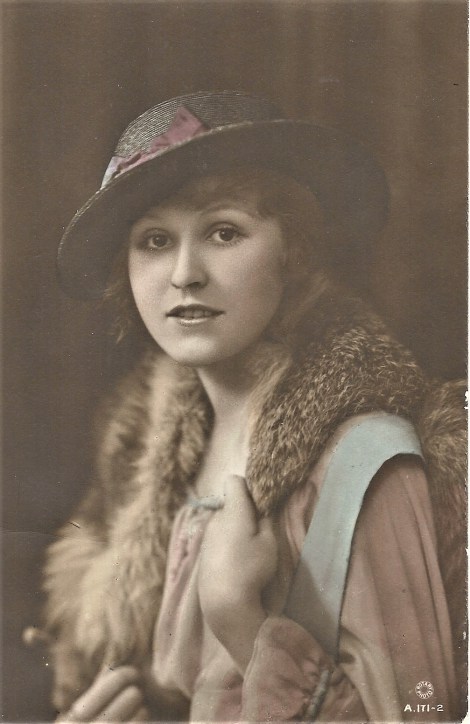
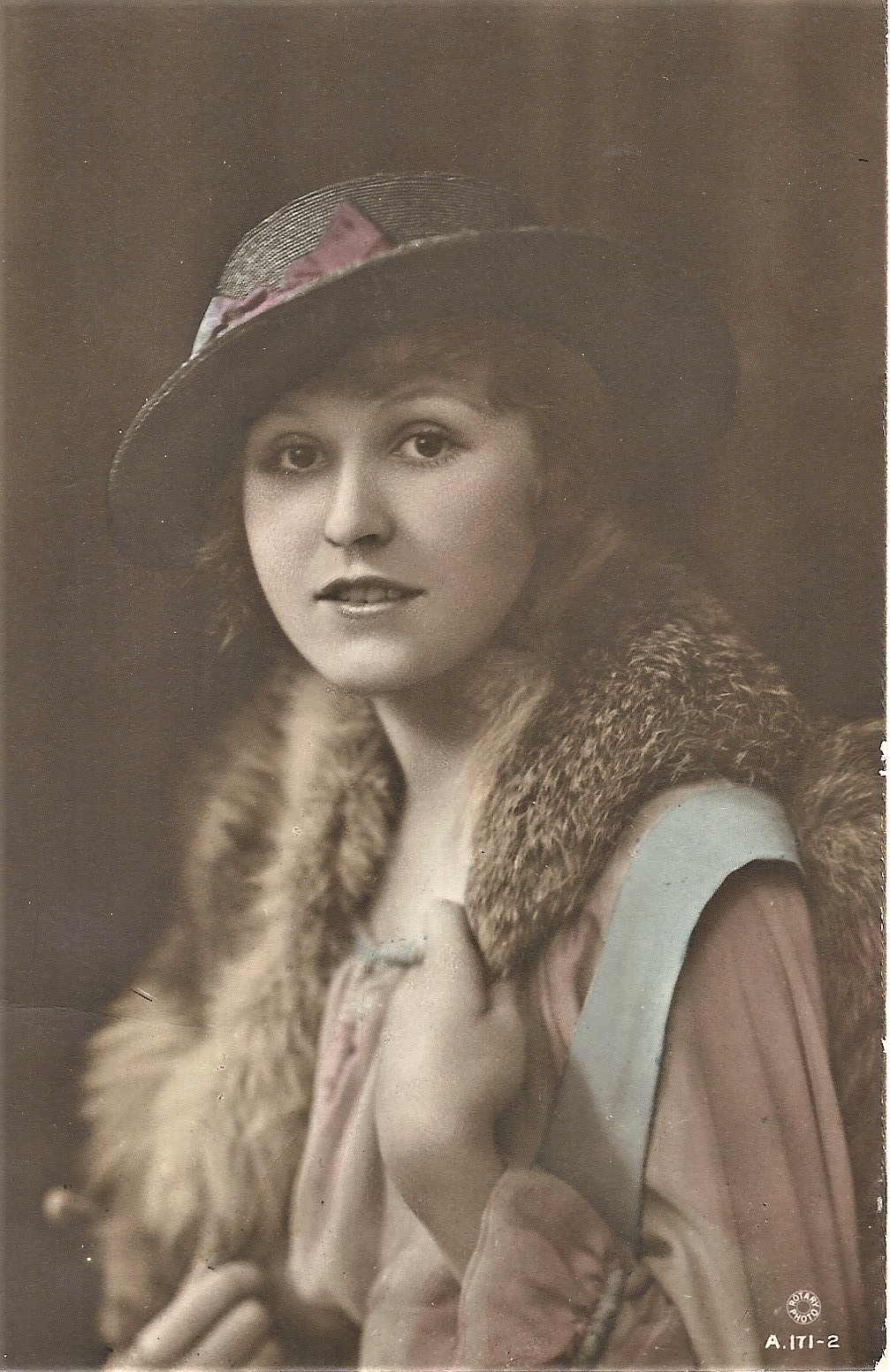
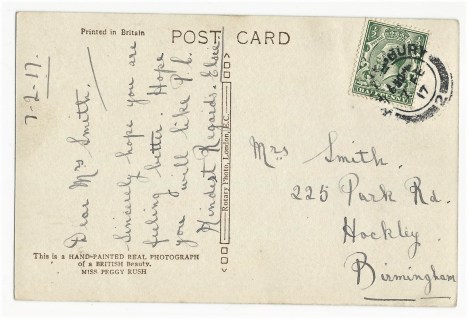
This vintage real photo postcard features pretty stage and film actress Peggy Rush. She was born in Chicago, Illinois, in around 1898. Her parents relocated to England when she was just three months old. Miss Rush began her stage career playing in musical comedy choruses. In 1915 she played such a role in New York. She was a member of the company that appeared in “Quinneys” at the Maxine Elliott theatre. The Green Book magazine (1916) reported that for for the first three seasons Rush appeared on stage, she was a chorus girl for the first year, and she was a leading lady for the final two seasons. A reviewer in “The Theatre” magazine described Rush as “fascinatingly girlish”. The New York Times (1916) reported her engagement to to the Honorable George St. John Brodrick, the eldest son of Viscount Middleton and heir to the peerage (definition – those holding title). George St John Brodrick, 2nd Earl of Midleton (1888 –1979) was an English aristocrat, landowner and soldier. It was not unusual for actresses or chorus girls to meet and marry titled individuals. Some of these men were “stage door Johnnies”. A photograph by the Bassano studio (1923) can be found in Britain’s National Portrait Gallery. I also found a notice of Rush’s divorce from her titled husband. I uncovered a 1924 press photo of Peggy Rush. The caption of the image discloses that the Viscountess Dunsford (Formerly Peggy Rush) was suing her husband, the count, for divorce. He went on to marry two more actresses. Miss Rush had a sense of humor. She once said that she never knew whether to refer to herself as American or English. She quipped that she felt safest calling herself a Chicagoan. This photo postcard was published by Rotary Photo as part of a series (no.A171-2).The card is “hand painted” and part of the “British Beauty” series. The postcard was written and postmarked in 1917. This real photo postcard is in very good condition.
Buy this Vintage Real Photo Postcard (includes shipping within the US) #3086
To purchase this item, click on the Pay with PayPal button below
$17.73
Buy this Vintage Real Photo Postcard (includes International shipping outside the US) #3086
To purchase this item, click on the Pay with PayPal button below
$26.23

 This vintage real photo postcard features three adorable little girls dressed in lacy colorful dresses and wearing flowers in their hair. The postcard was published by ABN and dates back to circa 1909. The postcard has a French stamp and a postmark from Ardeche, a department in southeast, France. The postcard in in very good condition (see scans).

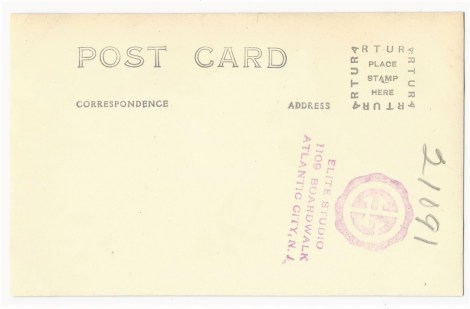
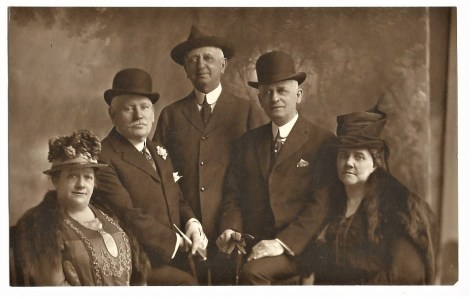 This vintage real photo postcard features five well dressed citizens being photographed by the Elite Studio, located on the boardwalk in Atlantic City, New Jersey. The gents and ladies look like they wandered off the set of “Boardwalk Empire”. Note the hats worn by this gathering of older adults. The 1919 Boyd’s Atlantic City Directory reports that the Elite Studio was operated by photographers Erna Hoefle and Ferdinand U. Latimer. Erna is a female name. Women operating photo studios during this era was not very common. This postcard has an Artura stamp box which indicates that the card was published sometime between 1908 and 1924. This vintage postcard is in excellent condition (see scans).
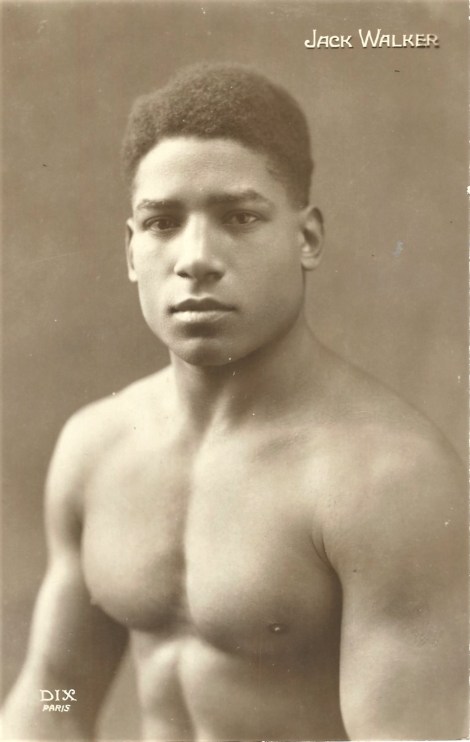 This vintage real photo postcard features boxer Jack Walker (Leone Jacovacci). His story is fascinating. He was born in Pomba (Belgian Congo) in 1902. His father was an Italian agronomist and his mother was Congolese. At age three, his father took him away from his mother and went to Italy where he left Jack to be raised by grandparents. Jack’s dad returned to the Congo. The child was a victim of racism in Italy so at sixteen years of age, he went to work as a “cabin boy” on a British ship. After arriving in England, he changed his name to John Douglas Walker, thinking the English name would help him be more socially accepted. He enlisted and served in the British army. Upon discharge, he learned to box in England and began his fighting career. During his boxing career he weighed about 150 pounds and his height was 5″ 10″. His final record as a fighter was 21 Wins, 22 Losses, and 5 Ties. His official record is thought to be incomplete. He began boxing in 1920 and his career ended in 1932. His fights were in Europe. He fought in England, France, Switzerland, Belgium, Italy, Norway, Austria, Denmark, and Spain. He fought using Italian citizenship and became the Middleweight Champion of Europe. Despite a number of successes in the ring, Jack never was accepted in Italy the way he would have liked. The racist and fascist society did not allow him to really feel like a full Italian citizen or enjoy the fruits of his boxing successes. After ending his boxing career, he became a wrestler for a few years and moved to France. He was trapped there through World War II. His companion, Berthe Salmon, changed her last name to avoid being identified as Jewish. Berthe gave birth to their only child, a daughter. Post war, he worked for the United Nations and assisted refugees. Later he was employed as a bit player in the Italian film industry. In his old age, he worked as an apartment doorman and janitor. Walker died in Milan, Italy in 1983. This postcard was published by Dix, a company located in Paris. Apparently, they published a series of portraits of boxers of the day. The Cabinet Card Gallery has another postcard from the series (Pierre Calloir: French Bantam Weight). SOLD
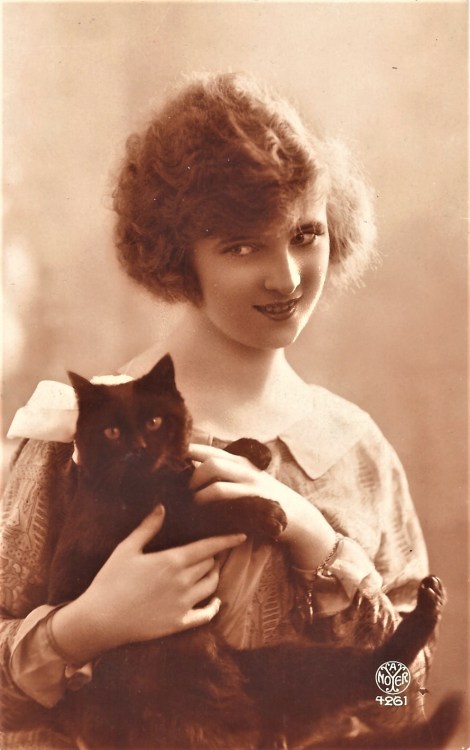 This vintage real photo postcard features a pretty young woman and her black cat. She appears to be in her teenage years. Note her coy smile. Her cat is certainly photogenic. This French postcard is dated 1925 and was published by Alfred Noyer. Noyer was well known and acclaimed for his work photographing nude, or partially clad, beautiful women. His Paris studio operated between 1910 and the 1940’s. This postcard is in very good condition (see scans).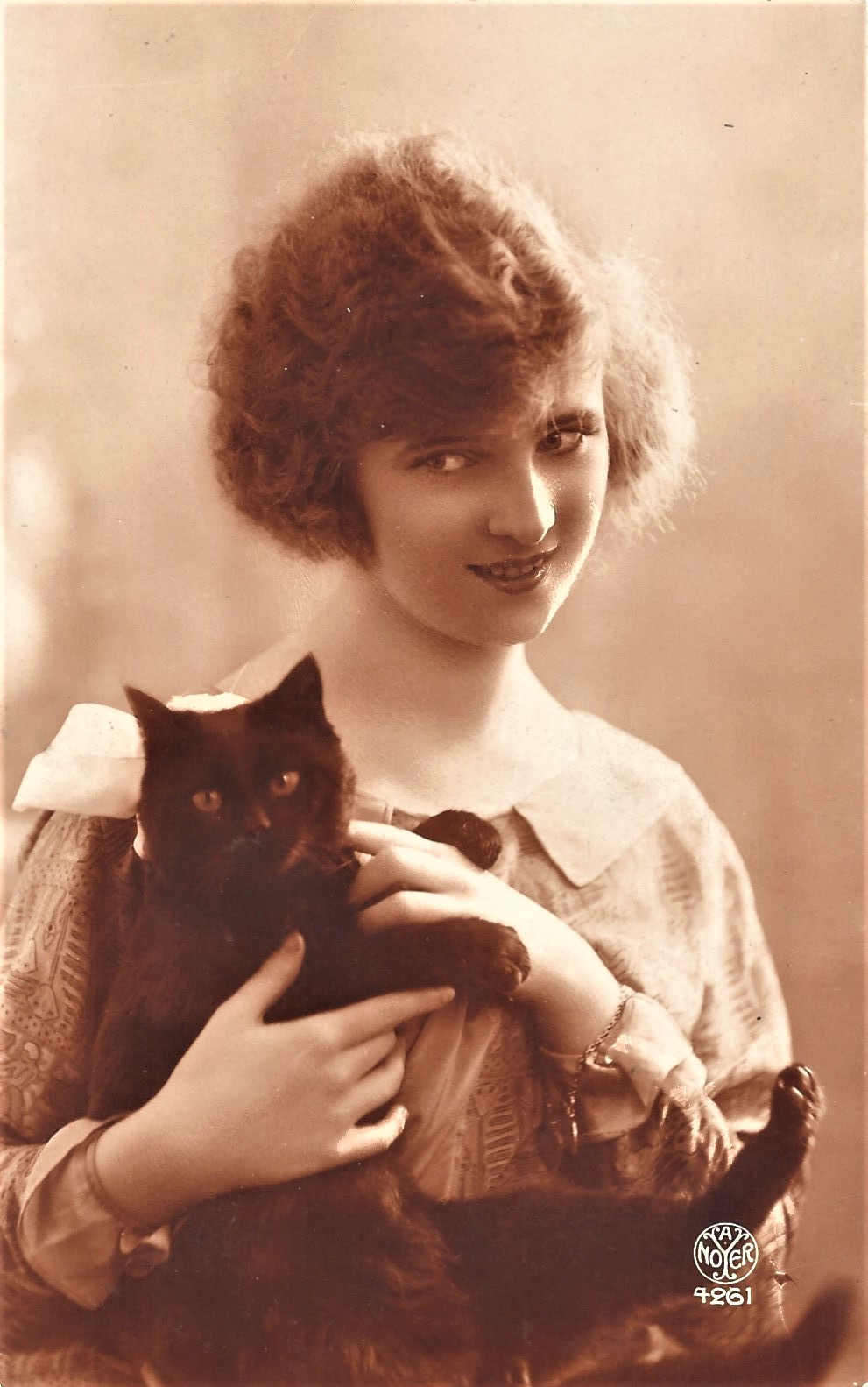


 This vintage real photo postcard features a well dressed father and presumably, his daughter. The child rests her hand on the shoulder of her father. Judging by her expression, physical contact with her father appears to have given her a sense of security and confidence. The young girl’s hat may indicate her nationality or ethnicity. The only clue that I have about that matter is that the card was purchased from a collector in Greece. This postcard is in very good condition (see scans).
 The pretty woman featured in this real photo postcard is Mable Woods. She was a theater actress. I could find little biographical information about her. I did discover that sometimes her name appeared as “Mabel” Woods rather than “Mable” Woods. I stumbled across a couple of real photo postcards in which Miss Woods made an appearance. Two of these cards were individual portraits of the actress but another postcard paired her with an actress name Rose de Vella. Mable Woods and Miss de Vella toured India together, performing in the chorus line for one of the “Gaiety Girls” touring companies. Irish born, George Edwards (1852-1915) was the theater manage of London’s Gaiety Theater. At one point he had sixteen touring companies. He had a propensity for hiring pretty young women to work as “Gaiety Girls”. These women were the chorus girls appearing in Edwardian musical comedies that began in the 1890’s. These women were an important ingredient for staging a successful musical production. They danced and appeared on stage in bathing attire and in the latest fashionable clothing. Unlike the corseted actresses from earlier musical burlesque shows, Gaiety Girls were viewed as respectable and refined. One writer reports that Gaiety girls “were polite, well-behaved young women”. Many Gaiety girls progressed to very successful acting careers. The list of former Gaiety girls reads like a hall of fame of celebrated actresses. Gaiety girls that catapulted to major roles include Marie Studholme, Mabel Love, Ellaline Terriss, Lily Elsie, Gladys Cooper, Phyllis Dare, and Gabrielle Ray. These and other starring alumni of the chorus, kept the moniker “Gaiety Girls”. The young women performing in Edward’s shows peaked the interest of wealthy gentlemen who became known as “Stage Door Johnnies”. They would wait outside the stage door and invite the actresses to dinner at fine restaurants. A number of women accepted the invitation. Sometimes the women would eventually marry one of these dates. A number of these women married noblemen, while others became the wives of professionals. In the book, “The Gaiety Years”, author Alan Hyman refers to the chorus as becoming “a matrimonial agency for girls with ambitions” to marry titled men. This postcard is in very good condition (see scans).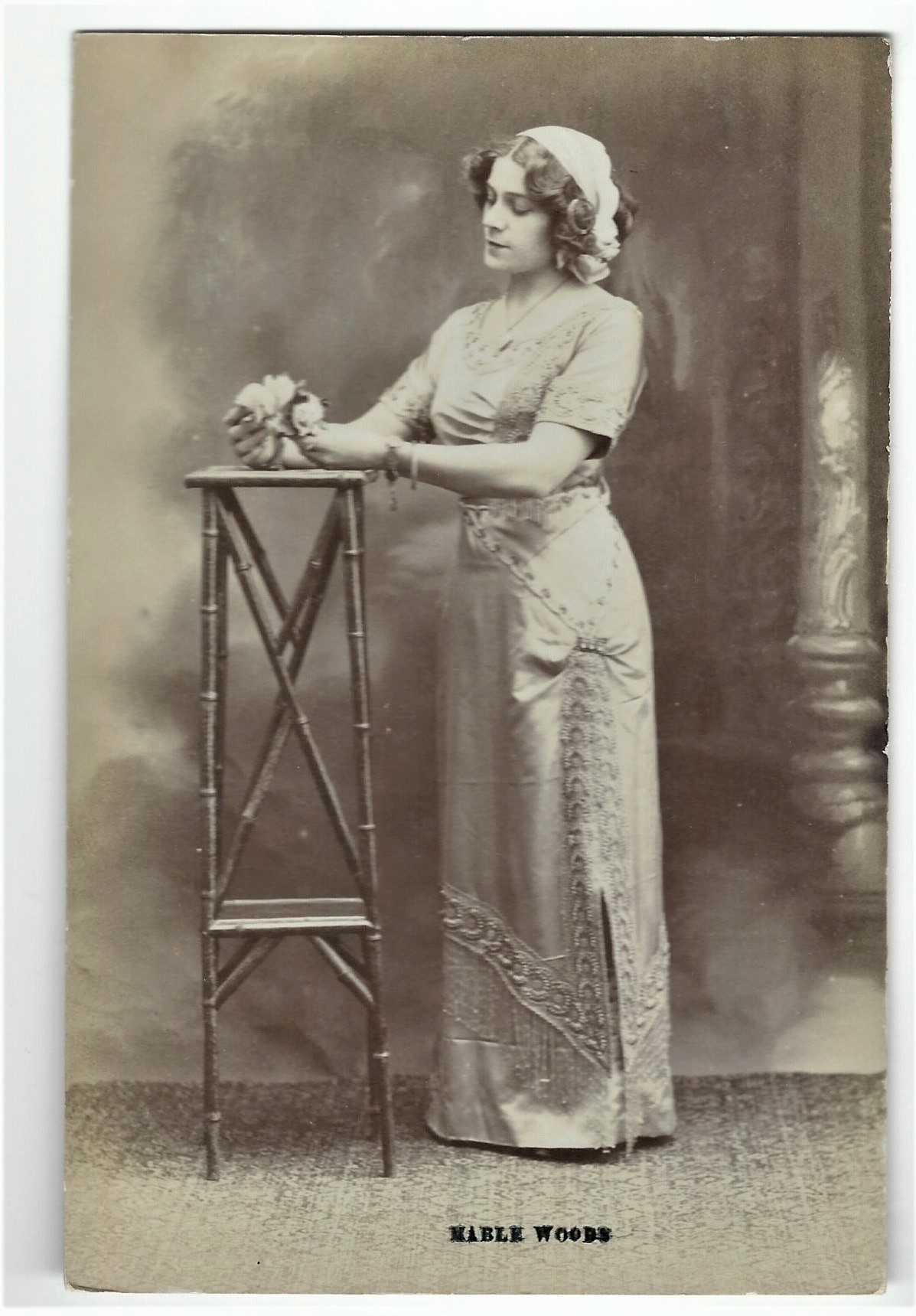

 PHOTO 1
 PHOTO 2
 PHOTO 3
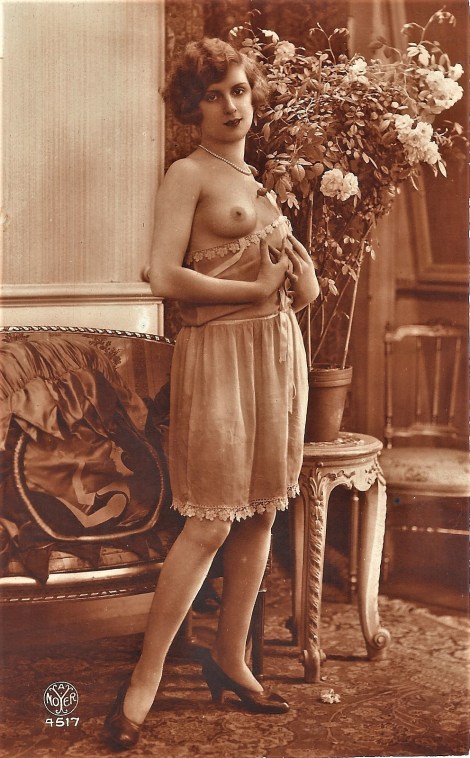 This french vintage real photo postcard is a wonderful example of Alfred Noyer’s work photographing nude, or partially clad, beautiful women. Noyer was a well known and acclaimed photographer. His Paris studio operated between 1910 and the 1940’s. Many of the postcards he produced featured nudes or risque images. This photo portrait postcard is part of a series (no.9517). SOLD


 THE CABINET CARD GALLERY