EVELYN HOLT : GERMAN ACTRESS : BANNED FROM FILM BY THE NAZIS : RPPC

POSTCARD 1 (SOLD)

POSTCARD 2 (SOLD)

POSTCARD 3 (SOLD)

Evelyn Holt (3 October 1908 – 22 February 2001) was a German actress. Her father was a journalist. Her film career began with UFA, a German film company. It did not take long for her to become a film star. She was popular in the 1920’s and early 1930’s. Holt was blond and blue eyed. In 1931 she became a soubrette at the Grosses Schauspielhaus (a popular theatre) in Berlin. Her film career came to an abrupt end when the Nazis’ took power. It was alleged that Holt was half Jewish, and she was banned from films. The ban was based on her being born with a Jewish sounding last name. Holt married Jewish publisher Felix Guggenheim (1904-1976) in 1936. Two years later the couple emigrated to Switzerland, then England, then the United States. She remained in the U.S. and never returned to acting.

Postcard 1 reveals that Evelyn Holt was quite pretty. She looks very confident in this image. Her dress is shiny. Is it silk? This postcard was published by Ross Verlag, a firm located in Berlin. The card was part of a series (no.6509/2). The photographer of this portrait is Walther Jaeger and the photograph was taken in Berlin, Germany. (SOLD)

Postcard 2 was published by Iris Verlag. Iris Verlag in Vienna was the most important Austrian publisher of film star postcards.  The logo for “Lux Film” can be seen in the lower left hand corner of  the image. The company was an Italian Film distribution and production company. This card is part of a series (no.946).  (SOLD)

Postcard 3  was published by Ross Verlag, a firm located in Berlin. The card was part of a series (no.3553/1). The photographer of this portrait is Ernst Schneider and the photograph was taken in Berlin, Germany.  He was considered to be one of the most celebrated studio photographers in Berlin during three decades (1900’s, 1910’s, 1920’s). He photographed many celebrities from the world of theater, opera, circuses, and film. He was also one of the most prominent fashion photographers in Berlin. In addition, he was well known for his nude photography, and he published books showcasing his work in this domain. Sometime around 1908 Schneider began working with postcard publishers “Rotophot” and “Neue Photographische Gesellschaft” (NPG). In 1919 he began working with Ross Verlag. The card was postmarked in 1928 in the city of Riga, Latvia.  (SOLD)

POSTCARD 1

POSTCARD 2

POSTCARD 3

CORINNE GRIFFITH : AMERICAN FILM ACTRESS, PRODUCER, AUTHOR, & BUSINESSWOMAN

POSTCARD 1 (SOLD)

POSTCARD 2 (SOLD)

This vintage real photo postcard features Corinne Griffith, an American film actress, producer, author, and businesswoman. Besides being talented, she was considered to be one of the most beautiful actresses of the silent film era.

Postcard 1 was published as part of the Picturegoer Series (No.97).  (SOLD)

Postcard 2 was published by Ross Verlag. Miss Griffith’s photo was taken by Defina. The logo for “First National Pictures” is located on the bottom left hand corner of the image. First National Pictures was an American motion picture production and distribution company. The company was founded in 1917 as a theater chain. It then began distributing movies and in 1924 it began producing films. In 1929 the company was absorbed by Warner Brothers. Griffith was under contract with First National between 1923 and 1932.  (SOLD)

POSTCARD 1

POSTCARD 2

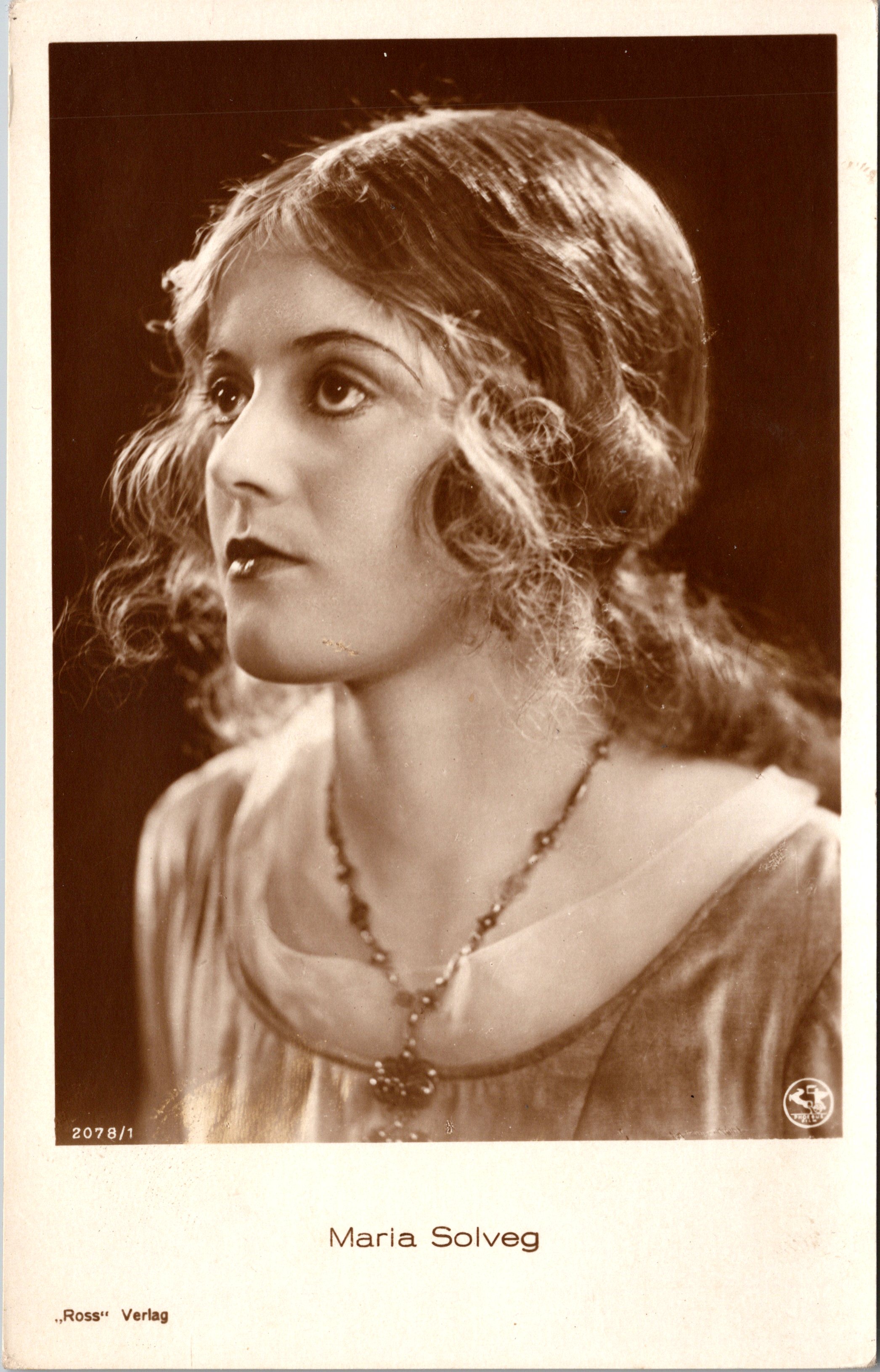
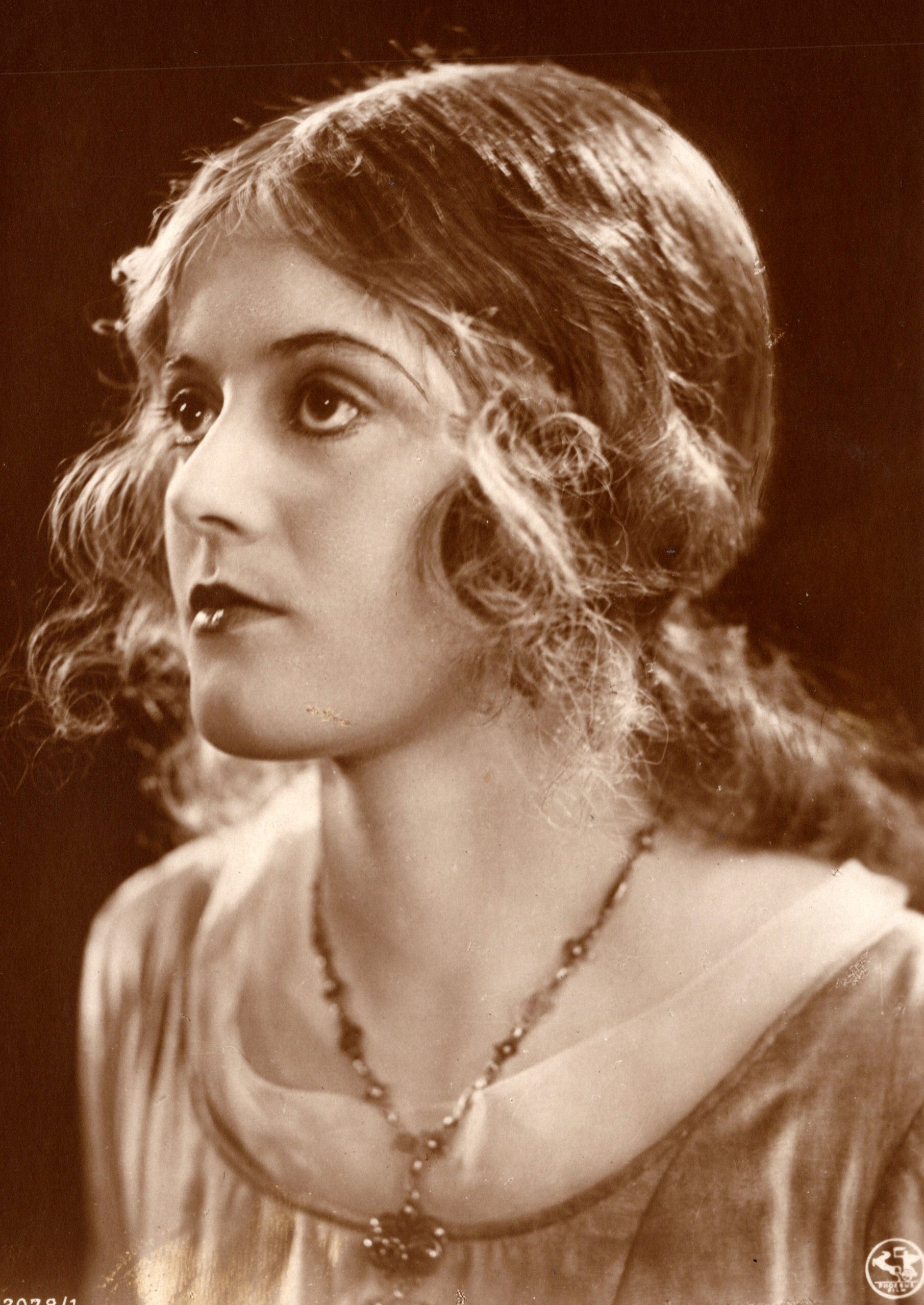
MARIA SOLVEG :(MARIA MATRAY) : PRETTY JEWISH ACTRESS, DANCER AND SCREENWRITER

This vintage real photo postcard features German film actress, dancer, and screenwriter Maria Solveg (1907-1993). She was also known as “Maria Matray”. Solveg was a star of the late Weimar film era. She married her mentor, director and choreographer, Ernst Matray. When Hitler rose to power, Solveg, who was Jewish, fled the country. She came to the United States in 1936 and launched a career as a choreographer and writer. She worked in Hollywood as a choreographer or assistant director during the 1940’s. Her well known movies included “The Hunchback of Notre Dame” (1939), “Pride and Prejudice” (1940), and “Dr Jekyl and Mr Hyde” (1941). In the 1950’s she wrote scripts for television. She became a German citizen again in 1960. The IMDb gives Solveg 52 credits for writing and 22 acting credits. This postcard was published by Ross Verlag as part of a series (no.2078/1).  (SOLD)

CONCHITA MONTENEGRO : SPANISH MODEL, DANCER, AND STAGE AND SCREEN ACTRESS

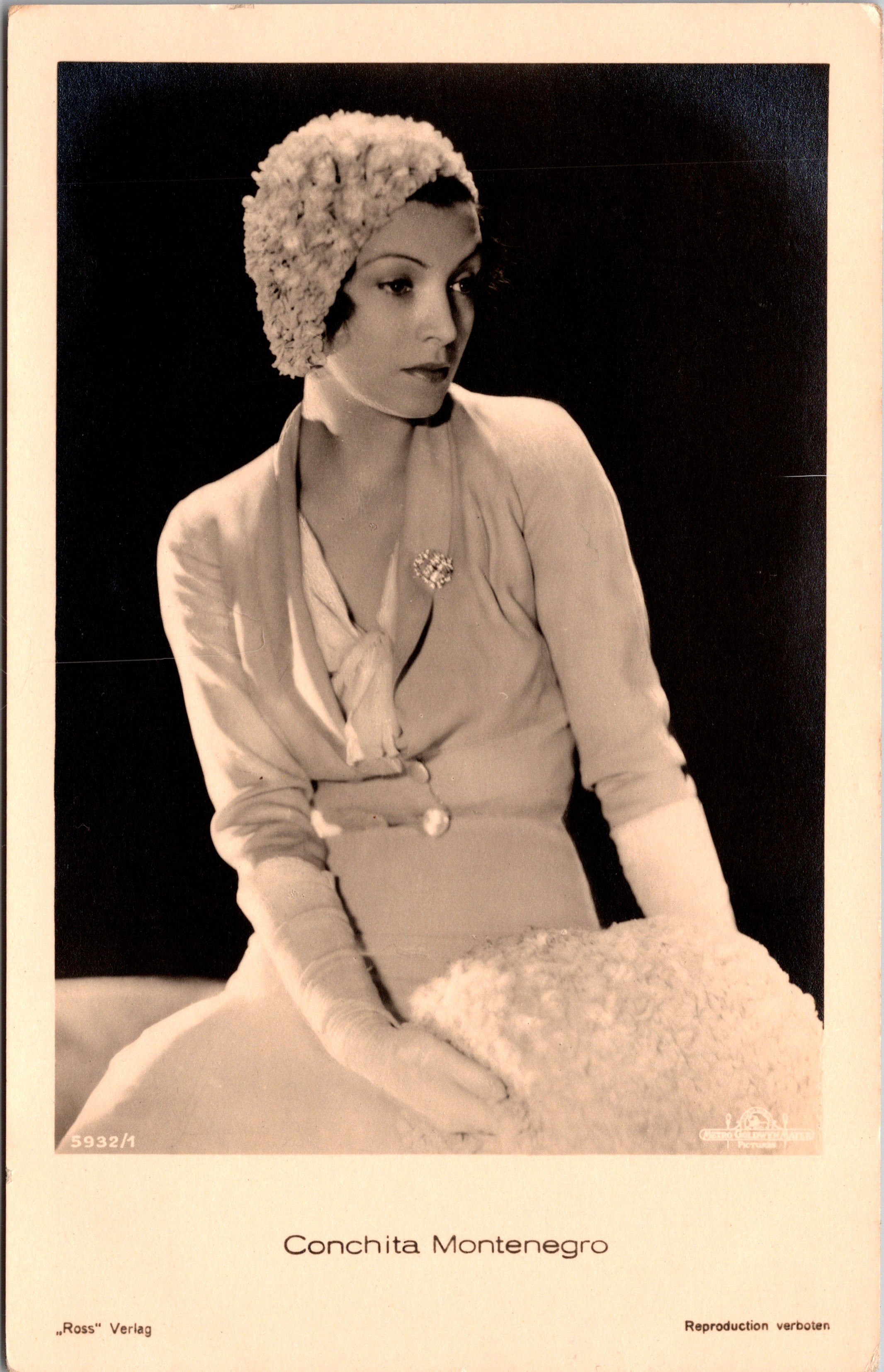
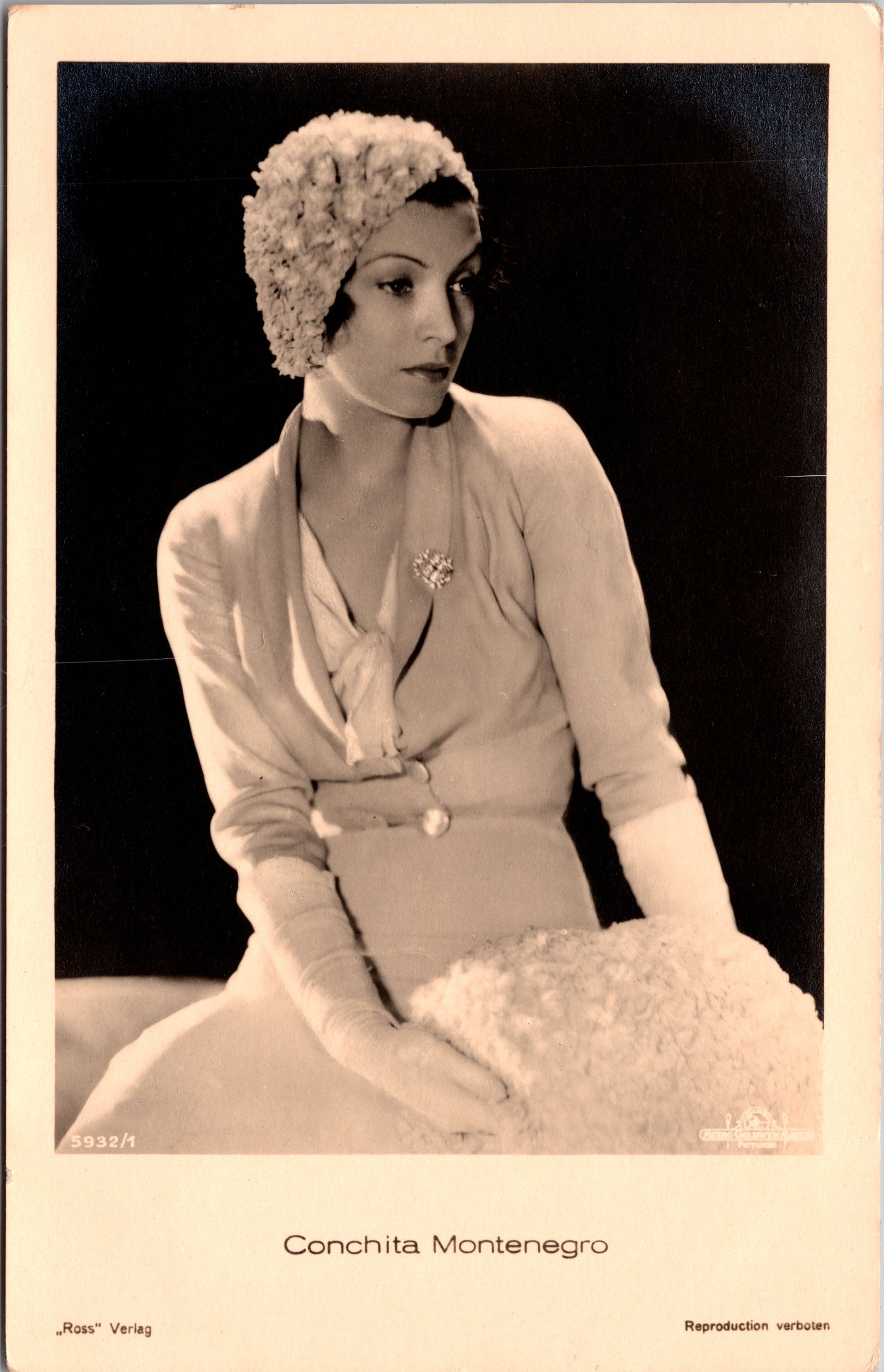
This vintage real photo postcard features Spanish model, dancer, and stage and screen actress, Conchita Montenegro (1911-2007). Montenegro learned classical and Spanish dance as a child. She is remembered for revolutionizing Spanish Dance. She transitioned to dramatic acting and starred in a number of productions. By the time she reached 13 years of age, she was famous in Hollywood, France, and Germany. She started in Hollywood with a contract with Metro Goldwyn Mayer. She began her film career in Spanish language versions of MGM movies. She quickly moved into American movies and her fame grew. In 1931, she left MGM for Fox Films. That same year, while on the way to shoot “The Cisco Kid” in Tucson, Arizona; she and many of the film crew and actors were involved in a serious train crash (derailment). In 1931, Fox named three of it’s actresses as “Fox debutante stars” and vowed to do so annually. Montenero, Helen Mack, and Linda Watkins were in the first trio that Fox honored as most likely to achieve stardom. Fox was competing with “WAMPAS Baby Stars” in forming this group of future stars. At times, Montenegro would perform at premiers of new films. She was able to showcase her multi talents, including vaudeville acts, at these shows. The IMDb credits Montenegro with 39 film appearances between 1927 and 1944. She played Lola Montes in the 1944 biopic. This vintage postcard was published by Ross Verlag as part of a series (No.5932/1). Note the logo for Metro Goldwyn Mayer in the bottom right hand corner of the image. Since Montenegro worked for MGM around 1930, she must have been around 19 years old when this photograph was taken. This postcard is in very good condition (see scans).

Buy this Vintage Real Photo Postcard (includes shipping within the US) #5106

To purchase this item, click on the Pay with PayPal button below

$14.00

Buy this Vintage Real Photo Postcard (includes International shipping outside the US) #5106

To purchase this item, click on the Pay with PayPal button below

$24.00

CHRISTA TORDY : GERMAN FILM STAR : MURDERED BY THE RUSSIAN RED ARMY : RPPC

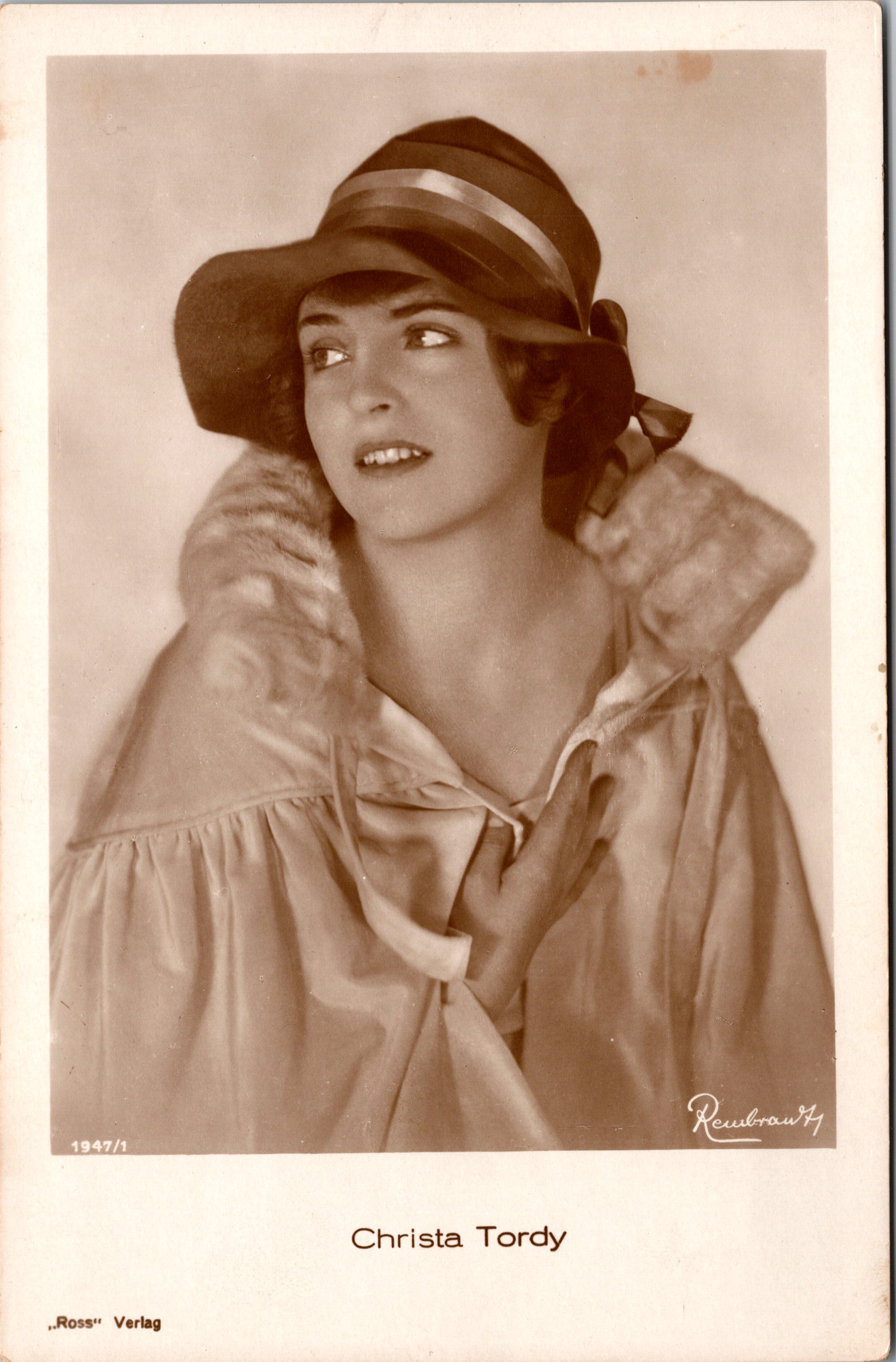
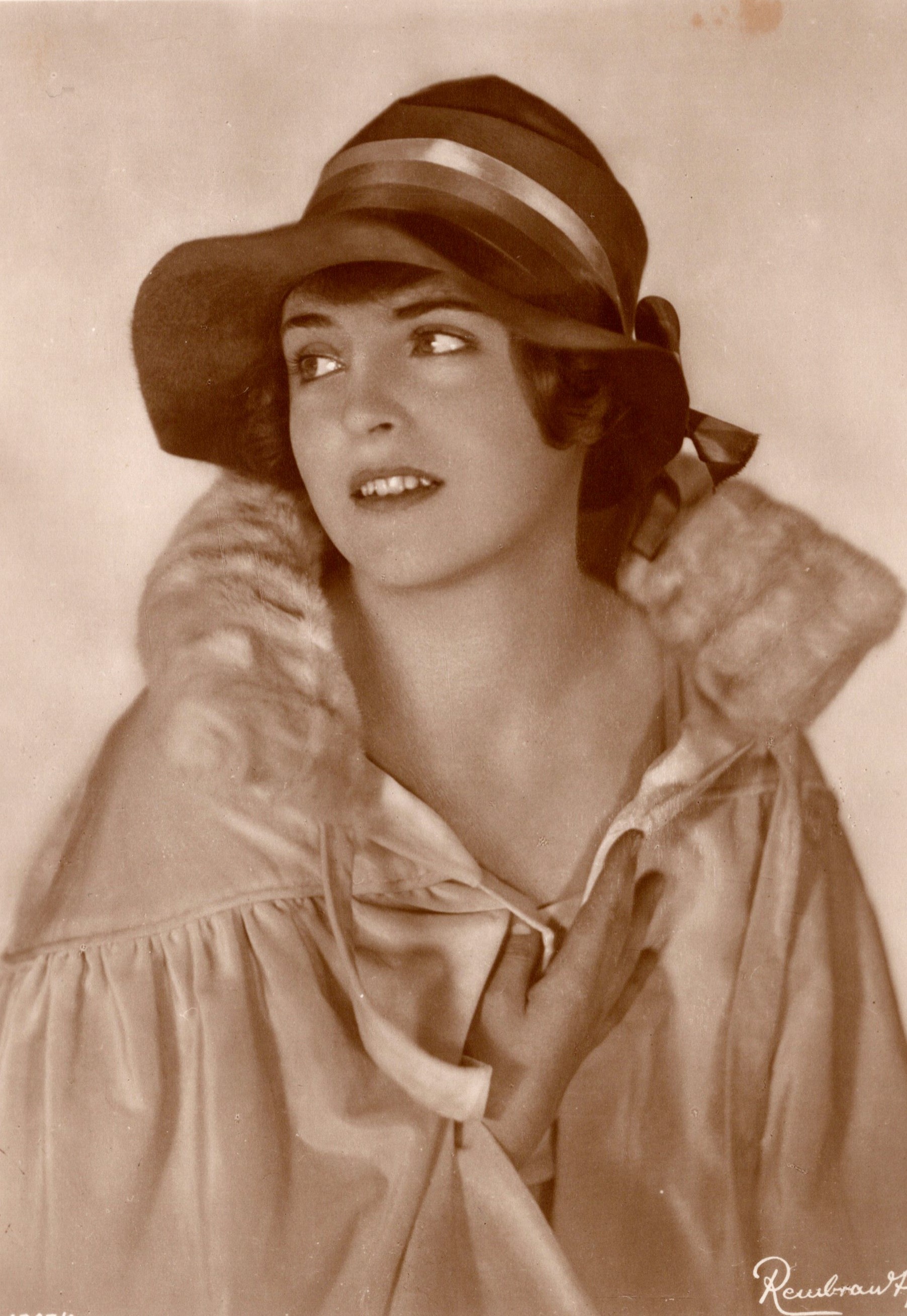
This vintage real photo postcard features German film actress, Christa Tordy (1904-1945). She was the cousin of silent film star Mady Christians. In fact, she was “discovered” while visiting her cousin who was working on a film at the time. Tordy was a leading star in German film but she abruptly ended her screen career after marrying celebrated actor, Harry Liedtke. He was twenty years her senior. Tordy and her husband were murdered at their home by the Russian Red Army during its invasion of Germany in World War II. Tordy must have been a very bright woman based on her educational resume. She graduated high school at seventeen and then moved on to college in Berlin and Munich where she studied art history, archaeology, philosophy and literature. When she completed her academic studies, she was awarded a doctorate. While in school she also took part in student theater. Tordy’s film debut was in 1926. The IMDb reports that she had eight film appearances between 1926 and 1928. Her final film was “Love on Skis” and she costarred in the film with her husband. Tordy and Liedtke met a tragic end at the hands of the Red Army. Liedtke was clubbed to death trying to defend his wife from violence and rape. Before their murder, the pair had attempted suicide. This card was published by Ross Verlag as part of a series (No.1947/1). Tordy’s photograph was taken by Rembrandt. (SOLD)

COLLEEN MOORE : AMERICAN SILENT FILM ACTRESS : DUTCH BOY BOBBED HAIRCUT : RPPC

This postcard features a portrait of American film actress, Colleen Moore (1899-1988).  She began her career in the silent film era. She was a fashionista and one of the highest paid stars of her time. She is also noted for popularizing the “dutchboy bobbed haircut”. Like many silent film stars, she was unable to adapt to “talkies” and decided to retire after just making a few  sound films. Upon retirement, Moore focused on investing, and was quite talented in that realm. She became a partner at Merrill Lynch and wrote a book about how to invest in the stock market. One of her hobbies involved dollhouses. In the early 1950’s, she helped design and curate “The Colleen Moore Dollhouse” which is still exhibited at the Museum of Science and Industry, in Chicago, Illinois. The dollhouse is 9 square feet and worth millions of dollars and has been seen by millions of museum goers. Moore was born in Michigan and her family relocated to Atlanta around 1908.They then moved on to Pennsylvania and finally, Tampa, Florida. At fifteen years of age, Moore had a screen test with director D. W. Griffith. Griffith owed a debt to Moore’s uncle, a successful newspaper man in Chicago. Moore must have done well on the screen test since she soon found herself playing heroines in Westerns. She signed a contract with Triangle-Fine Arts and for the first few years she appeared in minor supporting roles. When the Triangle Company folded she signed with Selig Polyscope. She appeared in “A Hoosier Romance” and “Little Orphant Annie”. They were popular films and Moore achieved some celebrity. When Selig closed their doors, Moore went to work on films from various companies. Her star kept rising. In 1922, Moore was named a WAMPAS Baby Star (honor for actresses on the threshold of fame). The IMDb credits Moore with 65 film appearances between 1918 and 1934. At the height of her career, she was earning over twelve thousand dollars a week. This vintage portrait postcard features Colleen Moore with her trademark dutch boy bobbed haircut. The card was published by Ross Verlag. Note the logo for First National Pictures in the lower right hand corner of the image. The card has a 1926 postmark. Moore was about 27 years old when the photograph was taken.  SOLD

THREE PORTRAITS OF JENNY JUGO : BEAUTIFUL AUSTRIAN ACTRESS (PLAYED ELIZA DOOLITTLE IN PYGMALION)

POSTCARD 1   (SOLD)

jugo3 POSTCARD 2

                                                        This image has an empty alt attribute; its file name is 5032-7_0001-1.jpg                                                                                                    POSTCARD 3

Jenny Jugo (1904-2001) was an Austrian actress. Her IMDb filmography reveals that she appeared in fifty-three films between 1925 and 1950. Jenny, as is evident in this vintage real photo postcard, was very beautiful. She was born in the Austro-Hungarian Empire. Her father owned a factory. She received her education in a convent. At age sixteen, she married actor Emo Jugo and the pair settled in Berlin, Germany. Their marriage was of short duration (1921-1922). She gave up her husband but not his last name. The German film studio, UFA, signed her to a contract in 1924. She struggled in the dramatic roles that she was given. By the end of the silent era, she was successful in comedies and specialized in that genre through the 1930’s. She often played perky, confident characters. She was often directed by Erich Engel. In 1935, Jugo played Eliza Doolittle in Pygmalion. Writer, George Bernard Shaw was so happy with her performance that he invited her to act in all of his plays on the English stage. She made films during the Nazi regime until 1943, when she returned to her Bavarian home. She was in a relationship with film producer Eberhard Klagmann who worked on her final three post-war films. In 1950, she married actor and former co-star, Friedrich Benfer. She retired from acting at age forty-six. She was given a lifetime achievement award for her outstanding contribution to German cinema. The IMDb biography of Jugo describes her as a “lively brunet, dimple-cheeked actress with a tom-boyish, unaffected manner”. The writer of the biography contends that Jenny Jugo flirted with stardom but did not achieve it. This assessment may be too harsh. To view Jenny Jugo acting in a 1931 film, watch the youtube video below.

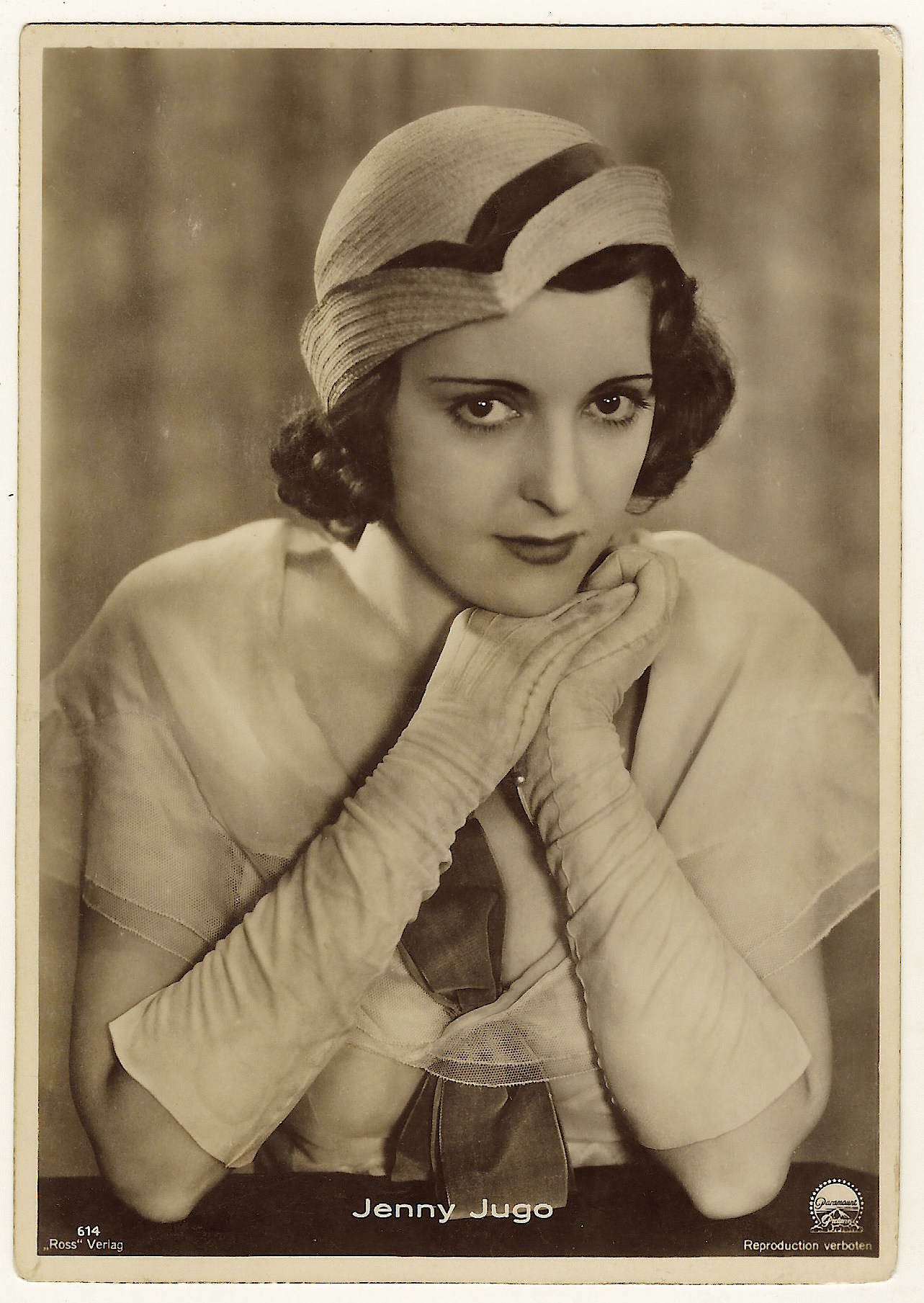
Postcard 1 was published by Ross Verlag and is part of the Luxusklasse series (no. 614).It is easily identifiable by the gold emblem on the reverse of the card.The postcard is larger than regular sized postcards. This vintage postcard measures about 4″ x 5 3/4″ and is in very good condition.   (SOLD)

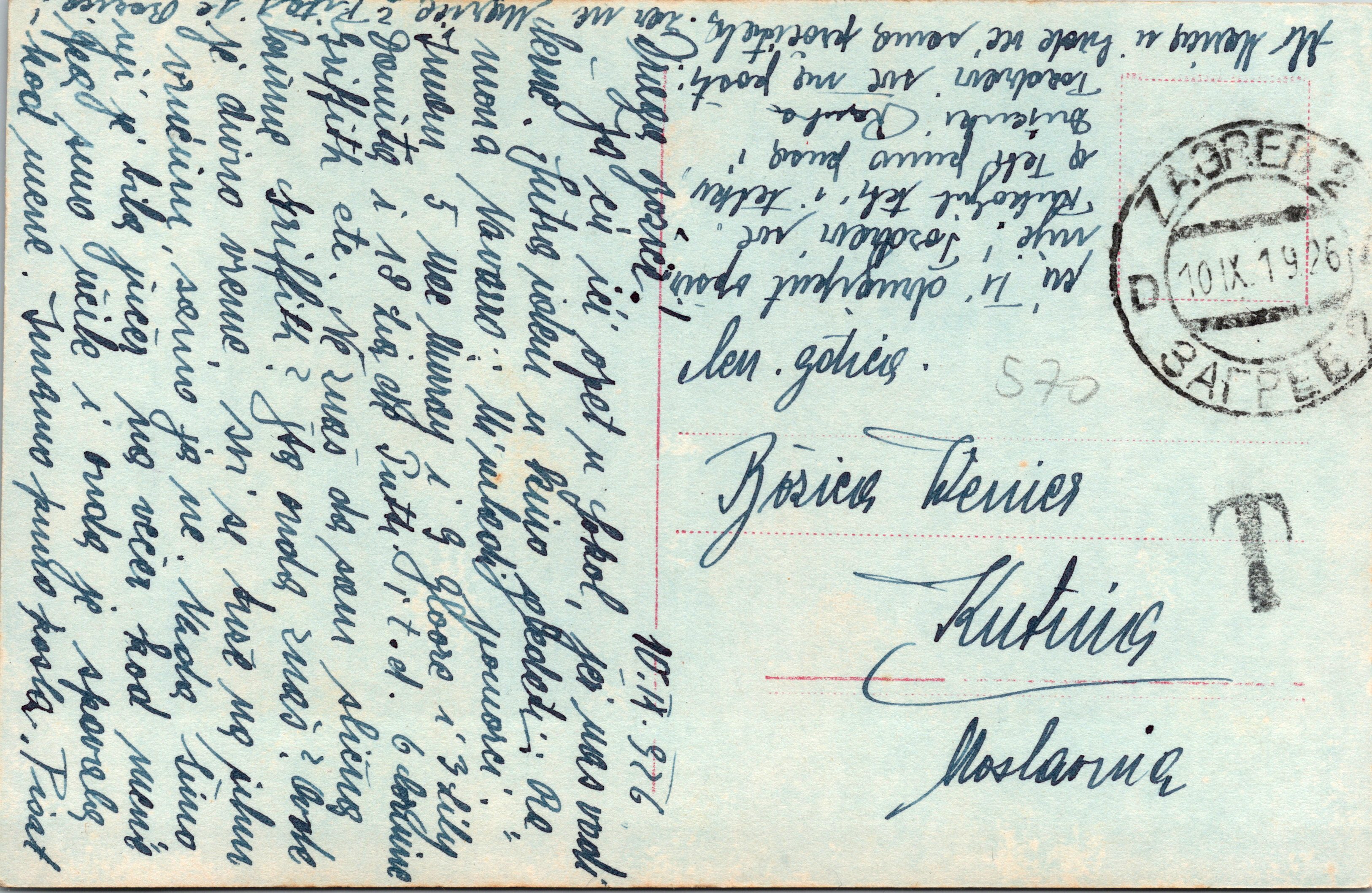
 Postcard 2 features Miss Jugo in a risque pose. She is wearing what appears to be skimpy lingerie. Her pose and facial expression projects a “come hither” message. This vintage postcard was published by Iris Verlag as part of series (no. 5383). The photographer of this portrait is Erich Engel of Berlin, Germany. There was also a German film and theatre director named Erich Engel (1891 –1966) . As stated above, Engel directed Jugo many times. Engel is listed on the postcard for either being the photographer, or possibly the director of the film she was working on at the time. The reverse of this post card indicates that it once resided in an album. The card is in very good condition (see scans).

Buy this vintage Real Photo Postcard (includes shipping within the United States) #2942

To purchase the item click on the Pay with Paypal button below

$34.71

Buy this Vintage Real Photo Postcard (Includes International Shipping Outside the United States) #2942

To purchase the item click on the Pay with Paypal button below

$43.21

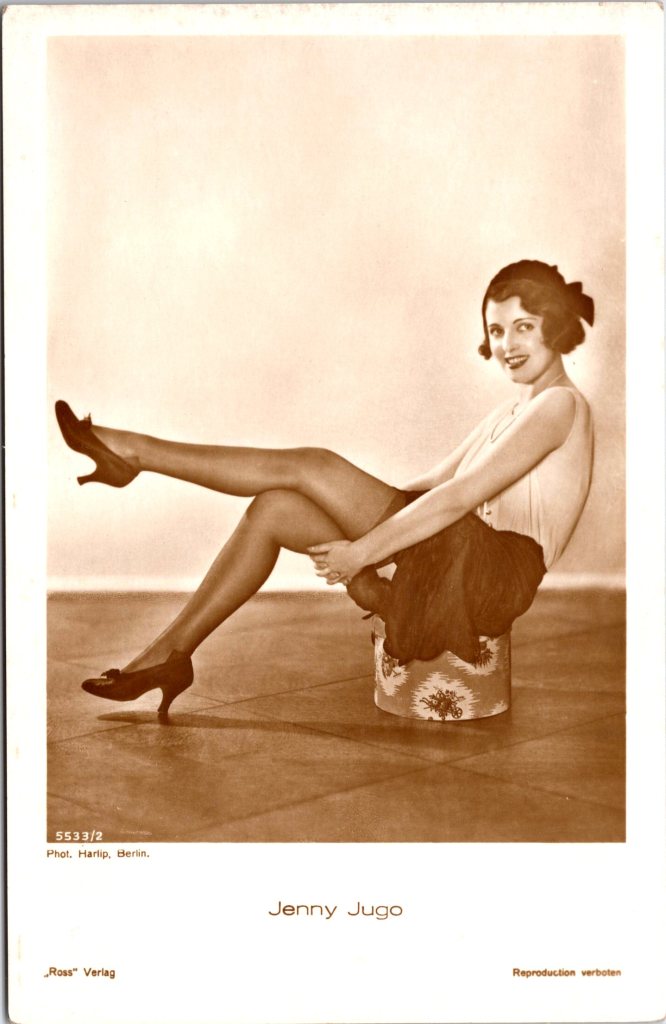
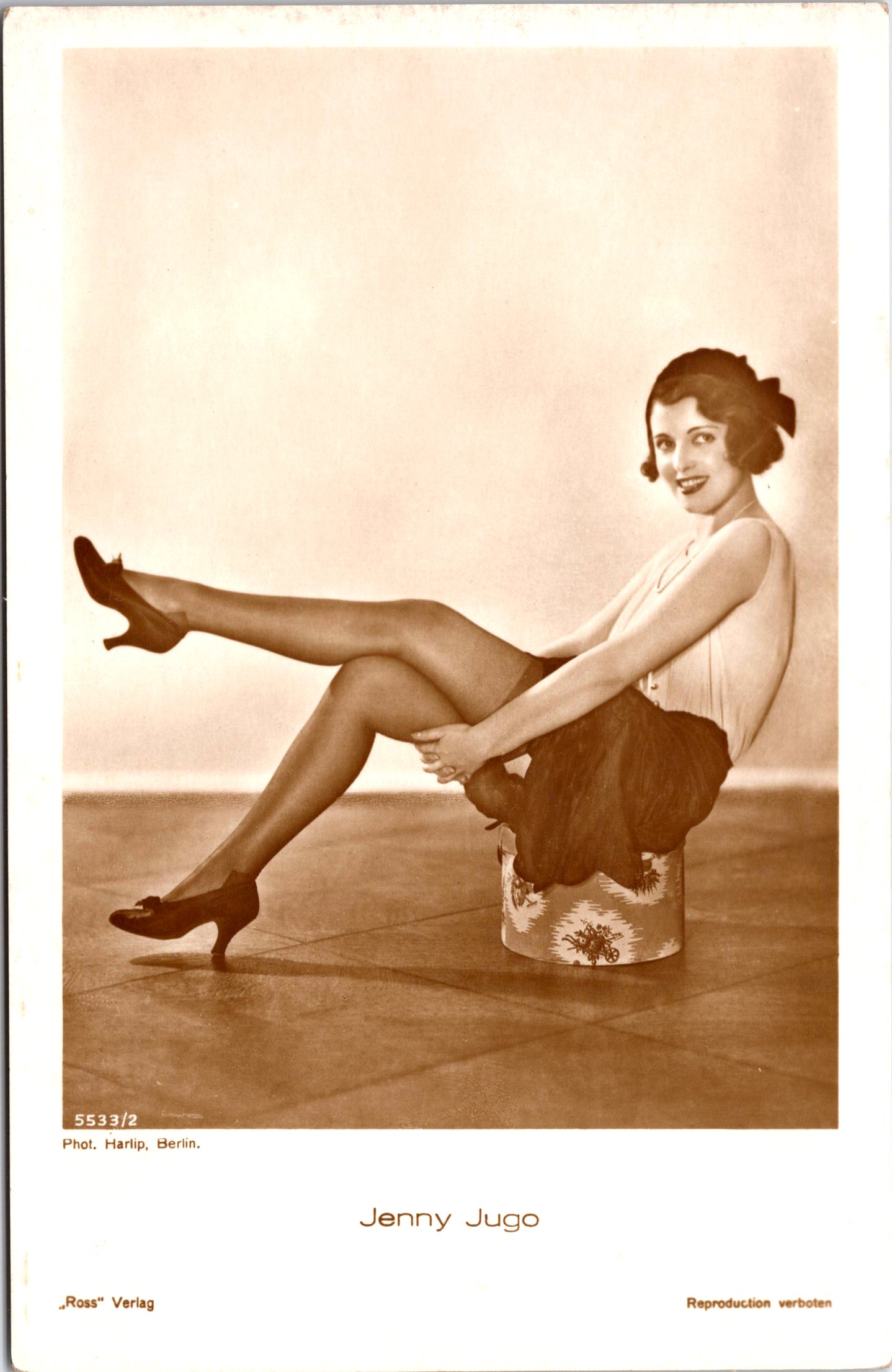
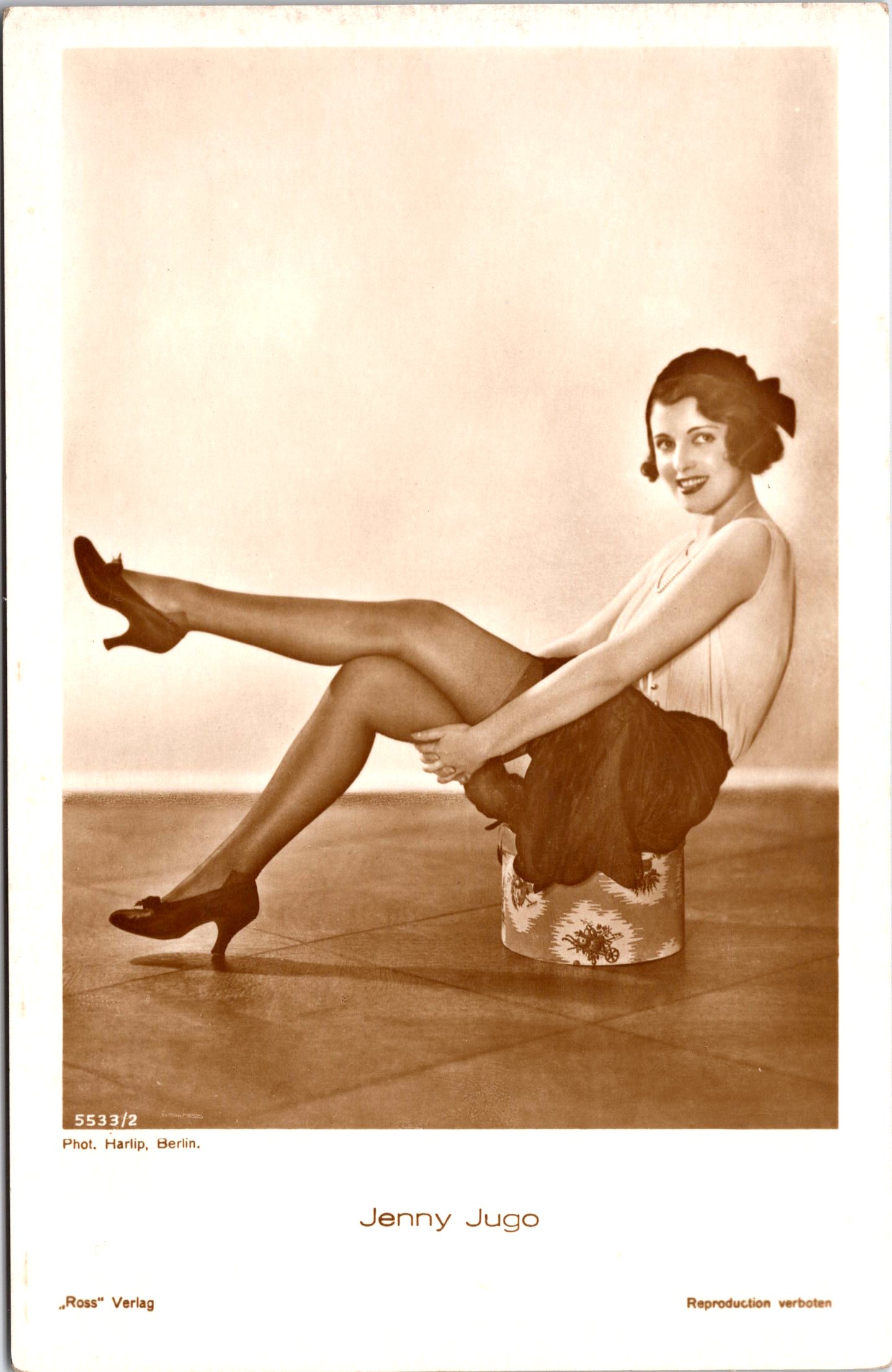
Postcard 3 was published by Ross Verlag as part of series (no. 5533/2). Miss Jugo’s  photographic portrait was taken by the Harlip studio, located in Berlin Germany. Gregory Harlip specialized in celebrity portraits. In 1937, Harlip left Berlin because of Nazi persecution. He relocated to London. Harlip died in 1945 and was succeeded by his wife who became one of the renowned society photographs of the 1950’s. She died in 1982. This portrait postcard is in very good condition (see scans).

 Max Hansen & Jenny Jugo “Who Takes Love Seriously? (1931)”

POSTCARD 1    (SOLD)

jugo3 3POSTCARD 2

POSTCARD 3

Buy this Vintage Real Photo Postcard (includes shipping within the US) #5032

To purchase this item, click on the Pay with PayPal button below

$23.85

Buy this Vintage Real Photo Postcard (includes International shipping outside the US) 5032

To purchase this item, click on the Pay with PayPal button below

$32.85

ERNA SACK : “GERMAN NIGHTINGALE” : OPERA STAR AND ACTRESS

This vintage real photo postcard features German soprano, Erna Sack (1898-1972). Her nickname was the “German Nightingale” due to her high vocal range.  She looks pretty in her dizzying attire and her feathered hat. Her blonde hair has been styled into ringlets. Sack was a very successful opera star. She toured all around the world. She also made many radio appearances and recordings. She performed in two movies,  Flowers from Nice (1936) and Nanon (1938).This postcard was published by Ross Verlag as part of a series (no. A1930/1). The logo for the film company, UFA can be seen in the right hand lower corner of the image. Miss Sack’s photo was taken by the Hammerer studio. She also toured in the United States and one of the venues in her tour was Carnegie Hall. (SOLD)

MARY PHILBIN – BEAUTIFUL AMERICAN FILM ACTRESS


mary philbin

POSTCARD 1   (SOLD)


This image has an empty alt attribute; its file name is 5032_0001.jpgPOSTCARD 2   (SOLD)

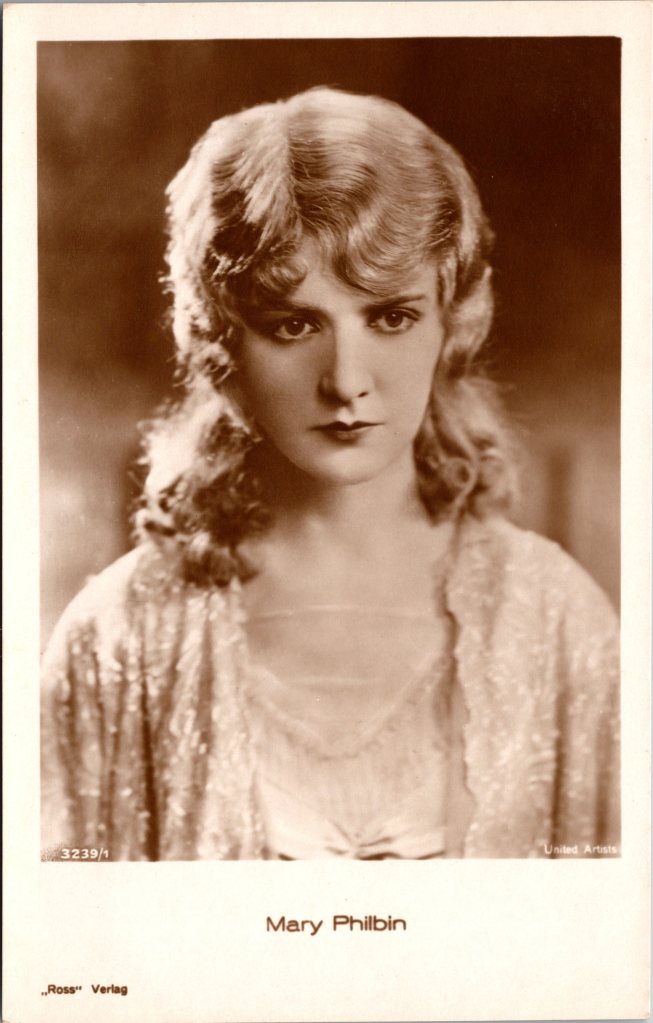
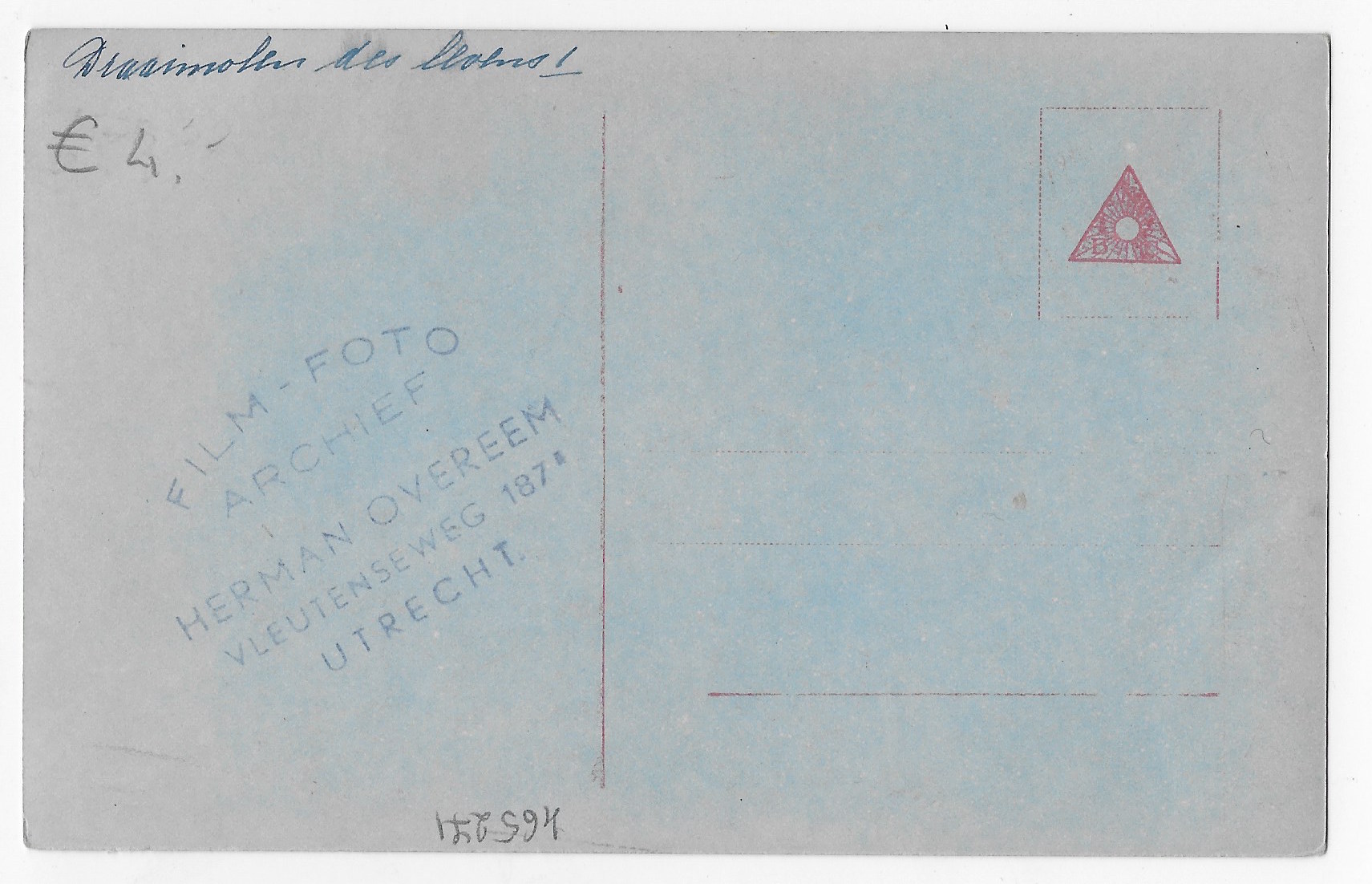
This vintage real photo postcard portrait (Postcard 1) features American actress Mary Philbin (1902-1993). She was active in film between 1918 and 1930. One of her most noted film roles was in “The Phantom of the Opera” (1925). She co-starred with Lon Chaney. A number of her roles involved playing the “beauty” in “Beauty and the Beast” type stories . Mary was born in Chicago, Illinois. Her parents were middle-class and of Irish descent. Her mother was convivial but controlling and domineering. She pushed her strong religious beliefs onto Mary. She adored her father who was “quiet, shy, and reserved”. She was very similar, personality-wise, to her dad. She would accompany him to the theater and there she developed a passion for the stage. She pursued dance and played the pipe organ and piano. She lacked a singing  voice, and surprisingly, never received training in acting. Mary’s acting career was launched after she won a beauty contest sponsored by Universal Pictures. The motion picture company promptly signed her to a contract. Her screen debut was in 1921 and during the following year she was named a WAMPAS Baby Star. This prestigious annual award, given by an association of film advertisers, was awarded to thirteen young women each year. These women were predicted to be on the verge of becoming major movie stars. During the 1920’s, Mary’s film career blossomed and she starred in a number of successful films, including “Drums of Love (1920), directed by D. W. Griffith. When “talkies” arrived, she played in a few films and even dubbed her own voice for the sound version of “Phantom of the Opera”. Unfortunately, her voice was considered too “girlish” to be suitable for talking pictures. She retired from the screen in the early 1930’s in order to become a caretaker for her elderly parents. She lived the rest of her life as a recluse. She never married and seldom made public appearances. An exception occurred when she attended the Los Angeles opening of Andrew Lloyd Webber’s musical version of “Phantom of the Opera”. She died of pneumonia at the age of ninety and is buried in Los Angeles, California. The IMDb reports that Mary appeared in 34 film between 1921 and 1929. She never married.  In 1926 she became engaged to Universal producer, Paul Kohner. When her family learned of the engagement, they were infuriated. They demanded a meeting with Kohner and all went reasonably well until the subject of religion arose. Kohner was Jewish and Mary’s family was Catholic. Mary’s mother was adamant in her belief that Kohner would attempt to convert Mary to Judaism. Paul and Mary informed her parents that no such thing  would happen. An argument developed between Paul and Mary’s parents. She was told by her parents that she would be disowned if she proceeded with her wedding plans. Mary was ambivalent but, in the end, despite still loving Paul, she returned her engagement ring to him. A biographer contends that this traumaticrd experience is the reason Mary never married. This vintage postcard was published by Ross Verlag, of Berlin, Germany. It is part of a series (no. 968/1). The name of the film distribution company (Filmhaus Bruckmann) can be seen on the bottom right corner of the image. A stamp on the reverse of the postcard indicates that it once was part of a collection belonging to Herman Overeem, of Utrecht, the Netherlands.  (SOLD)

Postcard 2 was published by Ross Verlag, of Berlin, Germany. It is part of a series (no. 3239/1). The name of the film company (United Artists) can be seen on the bottom left corner of the image.  (SOLD)


mary philbin 3

POSTCARD 1   (SOLD)
 

POSTCARD 2 (SOLD)

TWO BATHING BEAUTIES : RISQUE : ROW BOAT : PHOTO BY HENRY TRAUT : RPPC

This vintage real photo postcard features two smiling bathing beauties posing outside a beach cabana. This photograph is risque for it’s era. This image was produced by the studio of the esteemed photographer, Henry (Heinrich) Traut. The postcard was published by Rotophot Berlin (RPH). Rotophot eventually morphed into Ross Verlag.  (SOLD)