ANNY ONDRA: BEAUTIFUL AND TALENTED ACTRESS AND WIFE OF BOXING CHAMPION MAX SCHMELING

POSTCARD 6 (SOLD)

POSTCARD 5 (SOLD)


POSTCARD 1  (SOLD)

This image has an empty alt attribute; its file name is anny-ondra-9953-1_0001.jpg

POSTCARD 2  (SOLD)

This image has an empty alt attribute; its file name is anny-ondra-4451-1_0001.jpg

POSTCARD 3 (SOLD)

ANNY ONDRA: BEAUTIFUL & TALENTED ACTRESS : WIFE OF BOXING CHAMP MAX SCHMELING - Picture 1 of 3

POSTCARD 4

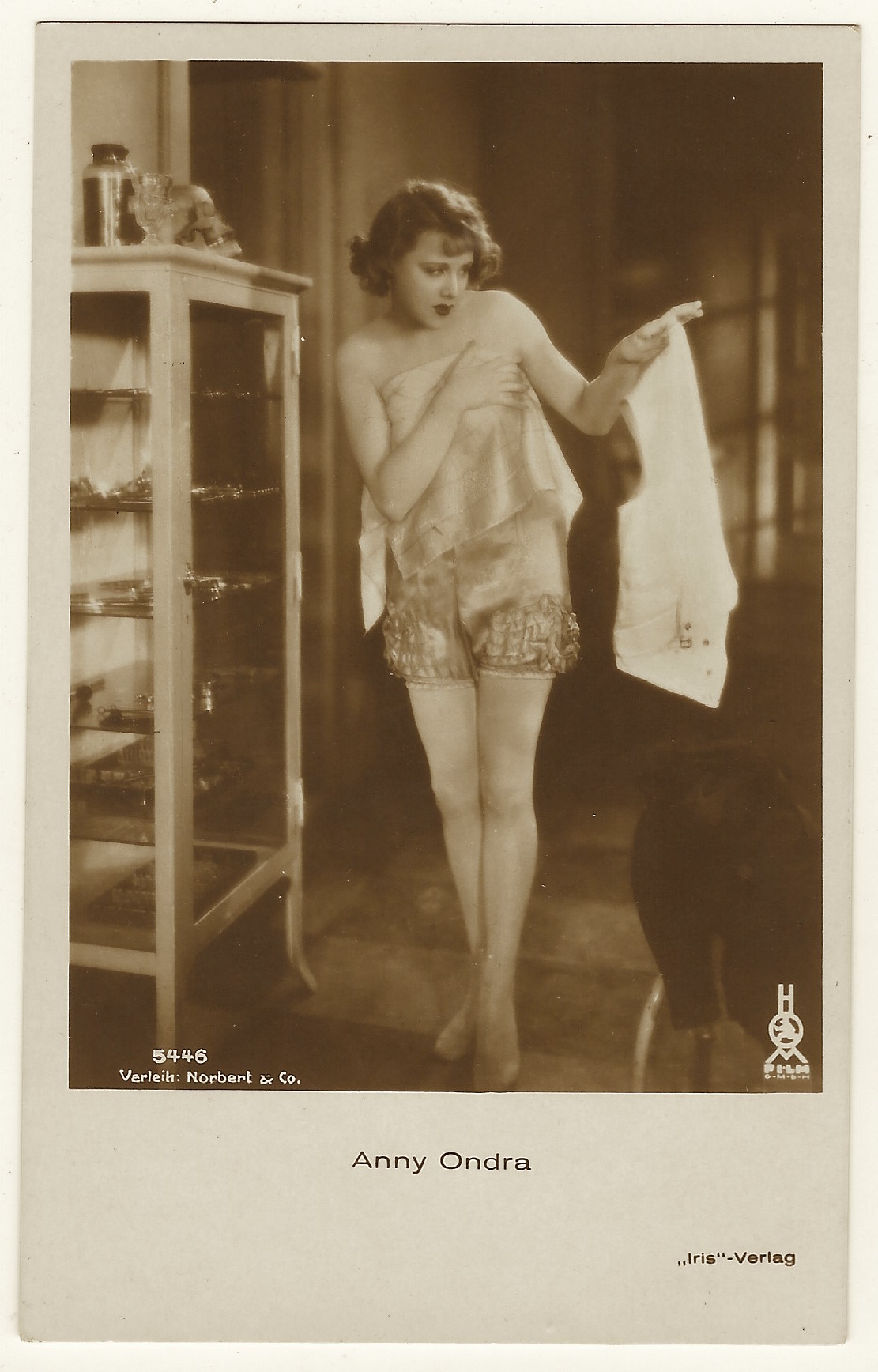
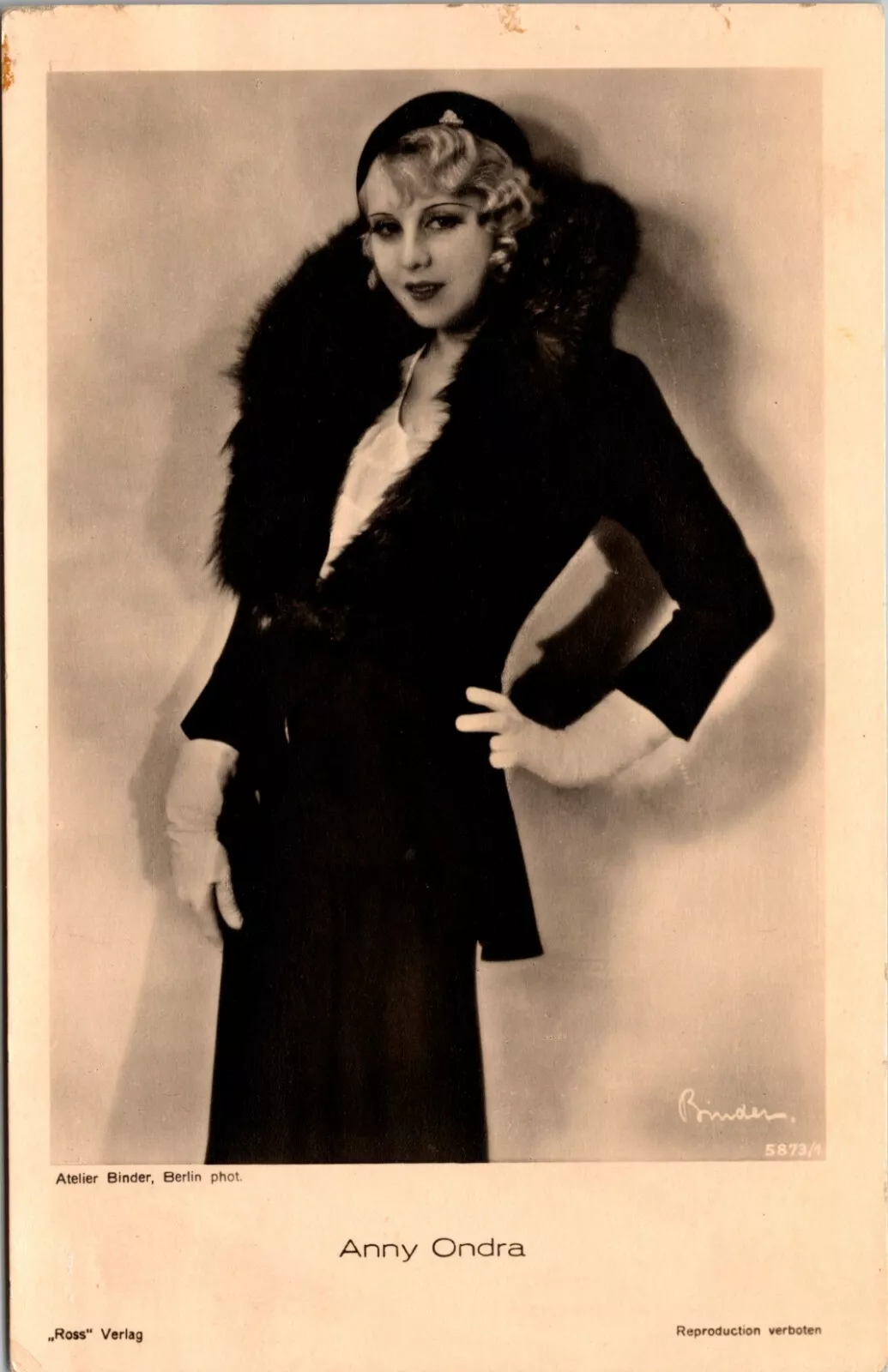
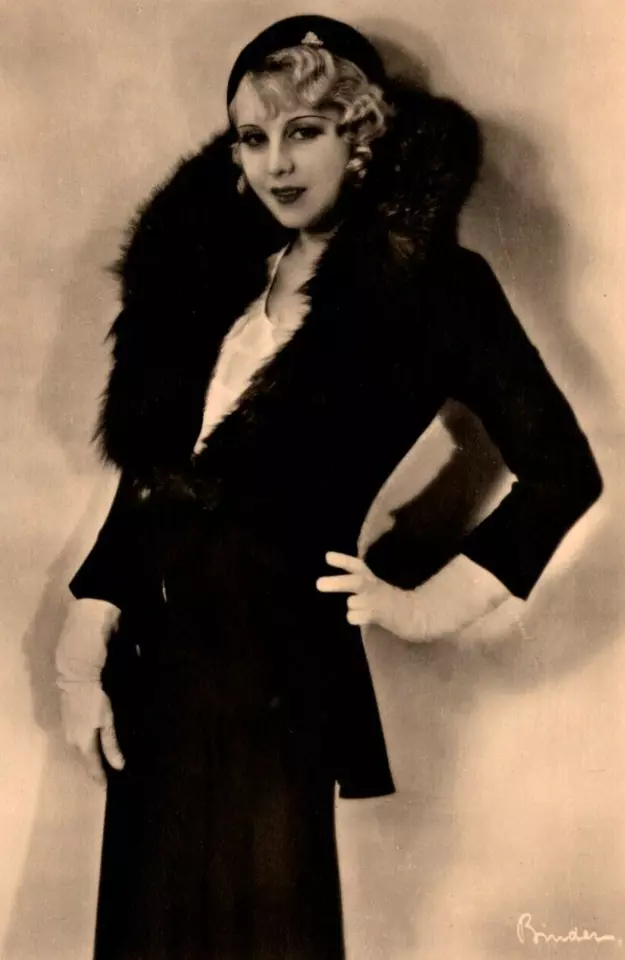
 This risque vintage real photo postcard (Postcard 1) features actress Anny Ondra. The postcard was published by Iris Verlag. The photograph is by Verleih Norbert & Co.. The postcard is part of a series (no. 5446). The photo seen on this postcard captures Ondra in a scene from the movie “Blackmail” (1929). This particular postcard is rare. I have searched extensively and have not been able to locate this particular image elsewhere. Anny Ondra (1903-1987) was a Czech film actress. She was born in Tarnow, Galicia, Austria-Hungary (now Poland). She was active in the movie industry between 1914 and 1957. She acted in Czech, Austrian, and German films in the 1920’s. She appeared in some British dramas, most notably, Alfred Hitchcock’s “The Manxman” (1929) and “Blackmail” (1929). The IMDb credits Ondra with over 90 acting credits between 1914 and 1957. She appeared in more than 40 films in the sound era. However, her career in British films was hurt by her thick accent. Check out the youtube video below. In this “test film”, Hitchcock “interviews” Ondra and makes her visibly uncomfortable and embarrassed by asking her very personal questions. She was married to German boxing champion Max Schmeling between 1933 and 1987. Schmeling was the world champion between 1930 and 1932. He is  well known for his fights with African American fighter, Joe Lewis. Ondra’s father was a Czech, Austro-Hungarian military officer and she grew up in Tarnow, Pula, and Prague. At the early age of seventeen, she acted in the theater as well as in a film. When her family learned that she had acted in a film, they were extremely angry. In fact, she reported that she was given a beating by her father. Post World War I was a time, for many people, that being an actress was akin to being a prostitute. Ondra began to live with her boyfriend (her debut film’s director) but after some time, the relationship ended because she wanted a family and he wanted nothing to do with marriage. In 1933, after a three year romance, Anny married Max Schmeling. She had been in a film with the boxer (“Knock-Out”, 1935). It was a “happy” marriage and the couple remained together until her death in 1987. Ondra and Schmeling were hot names in Nazi Germany. German fascists tried to exploit them in order to popularize their movement. Schmeling was seen as a German superman while Ondra represented the blonde Aryan type. The two celebrities refused to collaborate. Schmeling turned down honors and even helped hide two Jewish children, saving their lives. However, because of Nazi propoganda, many believed that the couple had collaborated. As a result, Schmeling and Ondra suffered financially for their fictional cooperation with the Nazis. Ondra was portrayed in two modern day movies, “Ring of Passion” (1978) and Joe and Max (2002).  (SOLD)

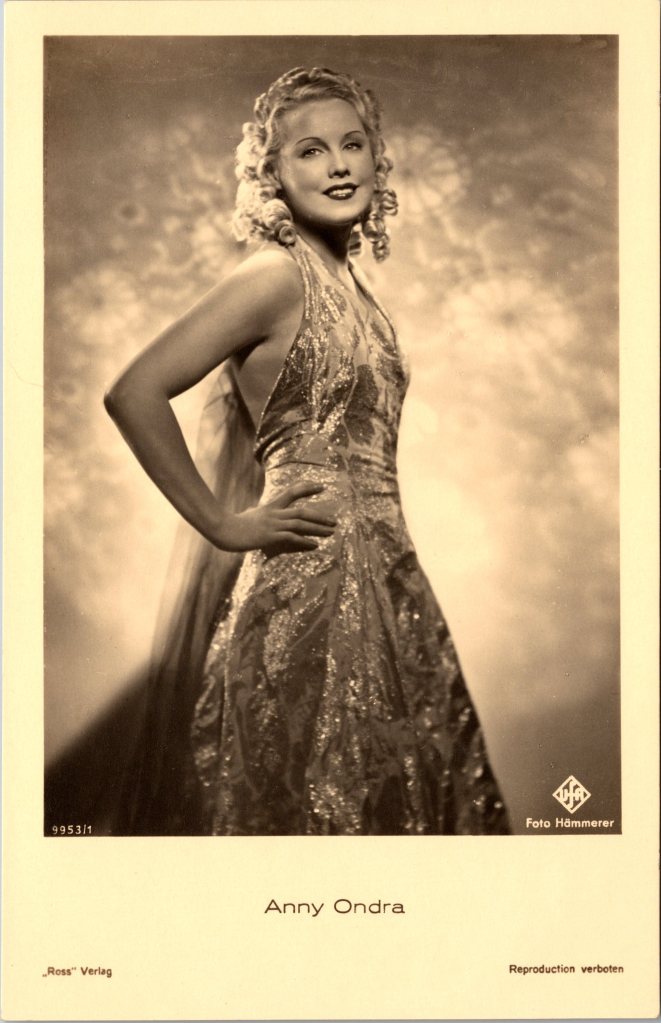
Postcard 2 was published by Ross Verlag. The photograph is from the Hammerer studio.  The logo for UFA, a German film company, can be seen in the right hand bottom corner of the image.   (SOLD)

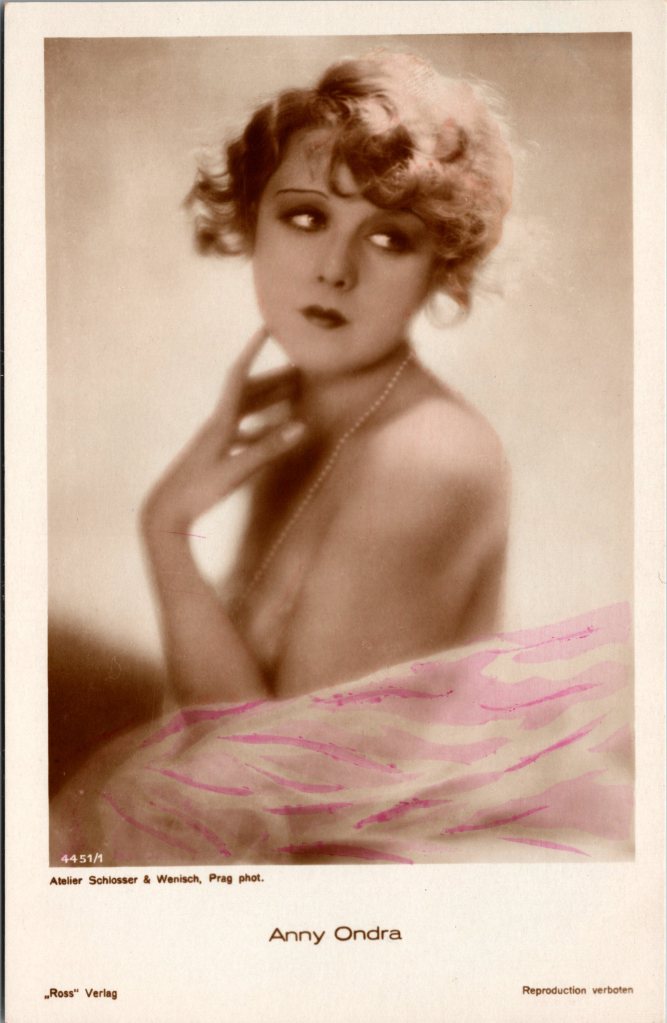
Postcard 3 is risque for it’s time. The postcard was published by Ross Verlag. Ondra’s photograph is from the Schlosser & Wenisch  studio. (SOLD)

Postcard 4 is an uncommon vintage real photo postcard is of Dutch origin and was published by  Remaco. The photograph shows Anny working in a tailor shop. She is pressing a shirt and smiling while she works. This photo likely captures a scene from one of Ondra’s films. Note the other woman in the photo busy at work on their tailoring tasks. This postcard is in very good condition. See Scans.

Postcard 5

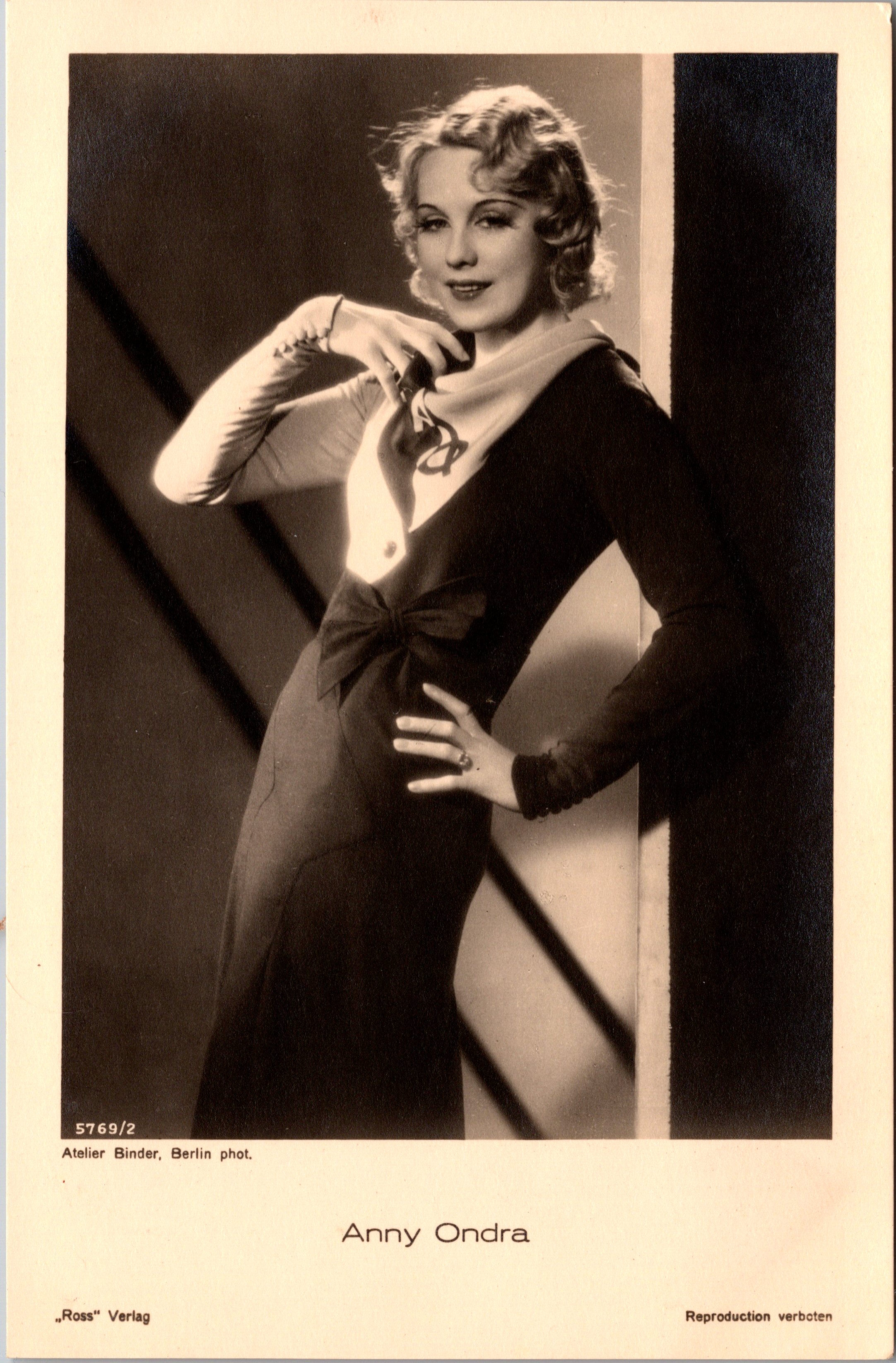
Postcard 5 was published by Ross Verlag. The photograph is by Alexander Binder. The postcard is part of a series (no. 5769/2).  (SOLD)

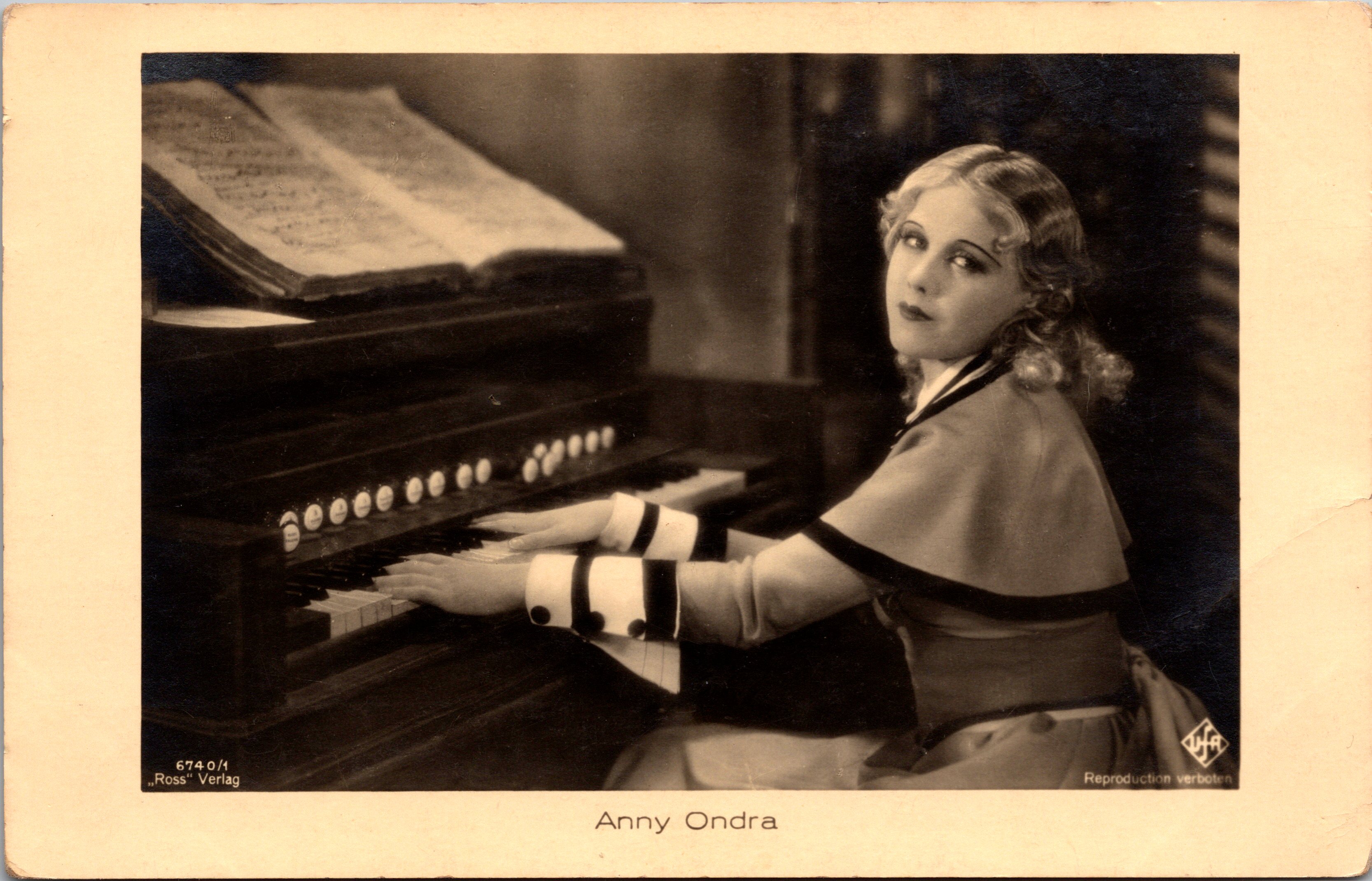
Postcard 6 features Ondra playing the piano. She is displaying a beautiful half smile. The postcard was published by Ross Verlag as part of a series (No.6740/1).The logo for UFA, a German film company, can be seen in the right hand bottom corner of the image.  (SOLD)


LA JANA : AUSTRO-GERMAN EXOTIC DANCER AND FILM STAR : RISQUE : RPPC

Postcard 1 (SOLD)

Postcard 2 (SOLD)

Postcard 3 (SOLD)

La Jana (1905-1940) was an actress and dancer. Her nationality was Austro-German. She was the illegitimate daughter of a master gilder and his housekeeper. Her parents wed four years after her birth. Her family was Jewish. She went by the name, Henny.. She trained as a dancer at the Frankfurt Opera Ballet and her first stage appearance was at the age of eight. She later began dancing in revues. She was “discovered” in Paris and brought to Berlin to meet with Frederic Zelnik who got her into films. The film director who “discovered” her said that the first time he saw her dance, “that woman possessed the most attractive body that I had set eyes upon” in my not all that long life. He went on to describe her as simple, nice and approachable. He added that she “had as much interest in sex as in Immanuel Kant”. meaning, none at all. As her career advanced, she danced in revues in Berlin, Stockholm, London, and many other cities. When she appeared in “Casanova” she viewed by the audience semi-naked and on a silver platter. In Berlin, she began an affair with Crown Prince Wilhelm. There were also rumors that she had an affair with Joseph Goebbels. Charlie Chaplin was also one of her lovers. Clearly, her attitude about sex changed from the earlier days of her dancing career. In 1937, her performance in a film catapulted her to film stardom. In 1940, while touring Germany, entertaining troops, she fell ill with pneumonia and passed away. The IMDb gives La Jana 23 film credits between 1926 and 1940.

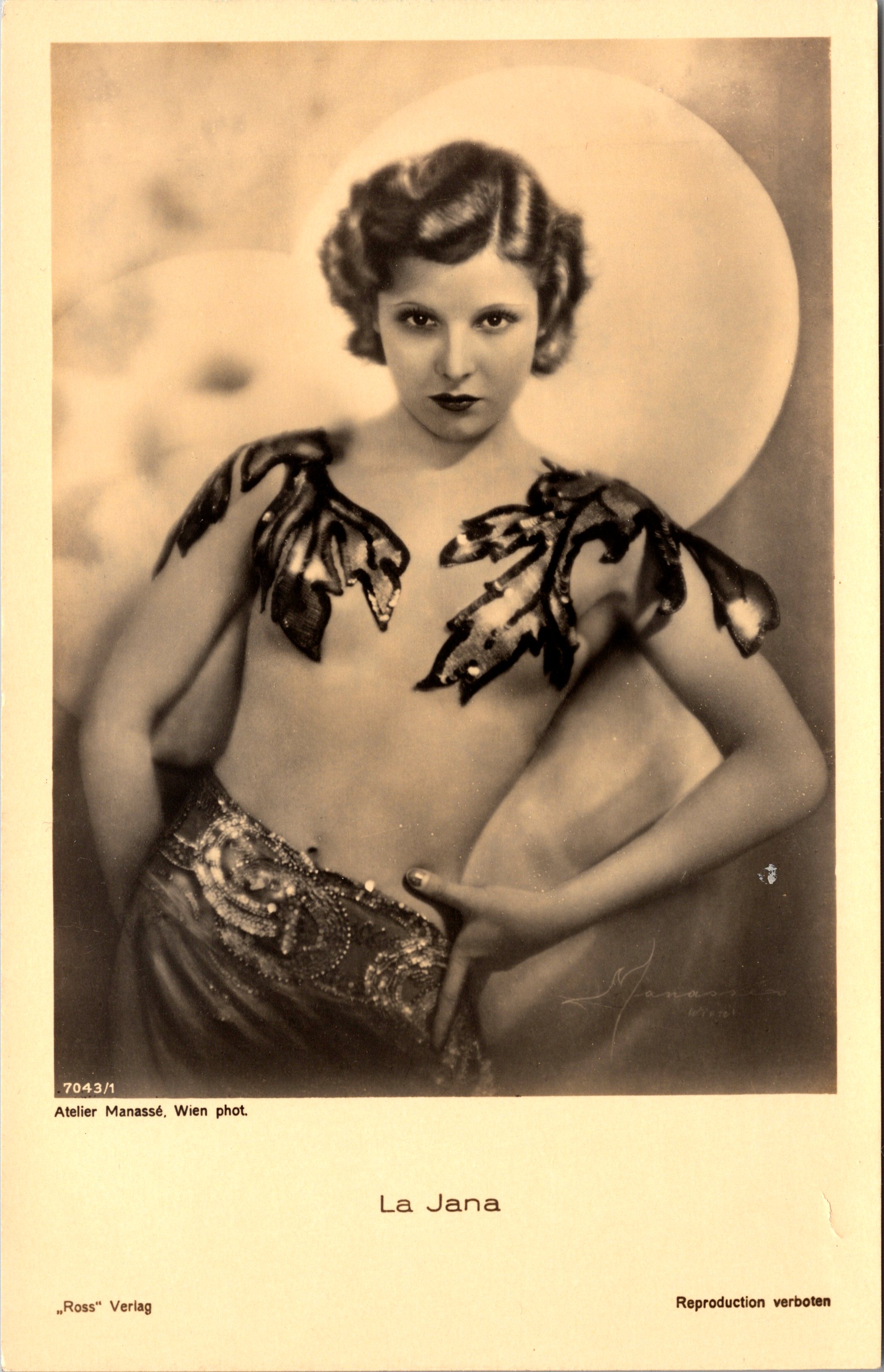
La Jana’s portrait for Postcard 1 was taken by the Manasse studio in Vienna, Austria. The Manasse studio was in existence between about 1922 and 1938. The studio was run by Olga Solarics (1896-1969) and her husband Adorja’n von Wlassics (1893-1946). Olga was known for her interest in photographing nudes. The studio flourished in Vienna during the 1930’s. Many of the portraits taken by the studio had an erotic flavor. The studio attracted some of the leading ladies of film and theater. This postcard was published by Ross Verlag (no.7043/1). This vintage postcard has a small imperfection located under La Jana’s left elbow. (SOLD)

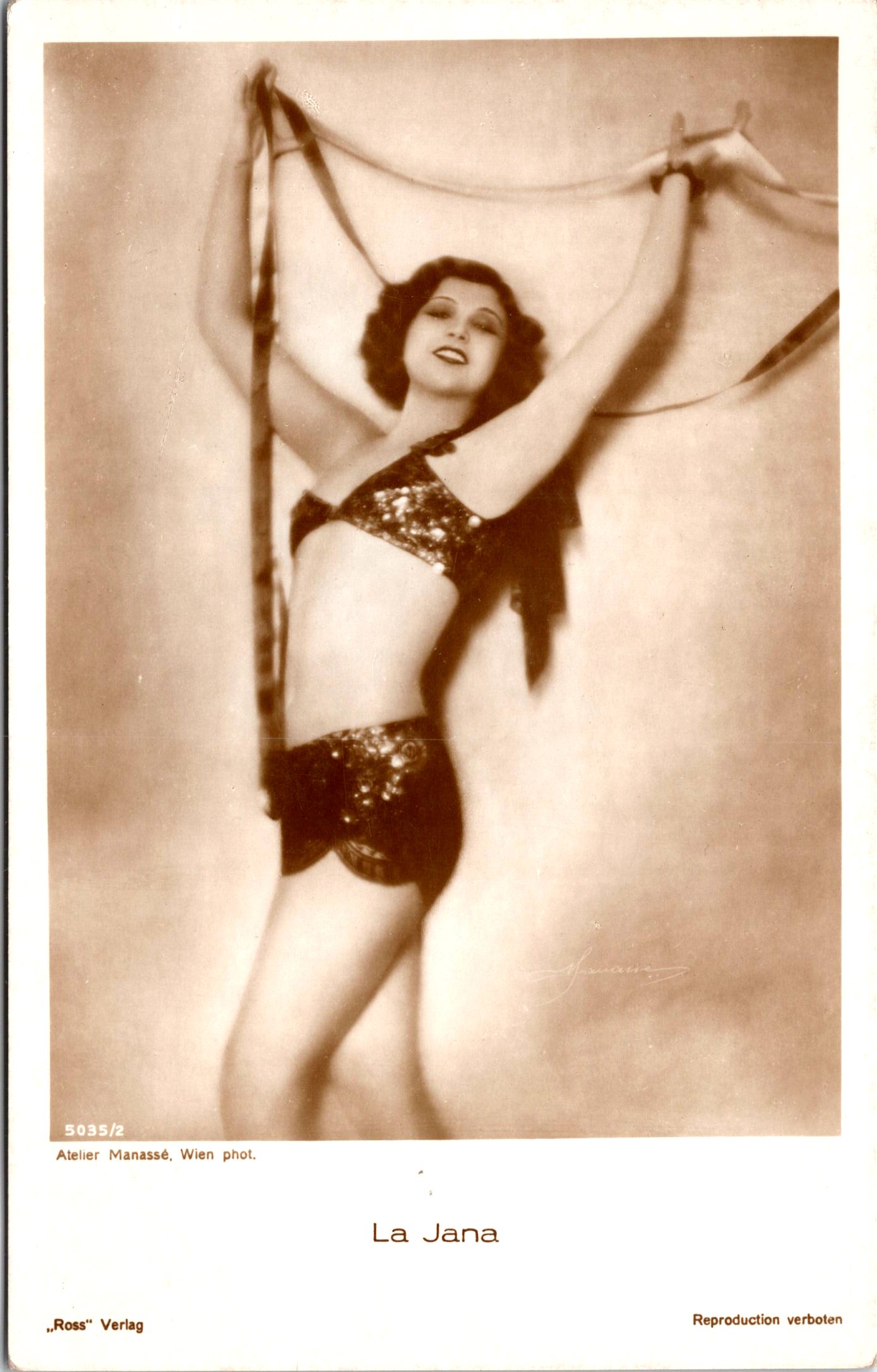
Postcard 2 was published by Ross Verlag (no.5035/2). Miss Jana’s photograph was taken by the Manasse studio in Vienna, Austria.  The Manasse studio was in existence between about 1922 and 1938. The studio was run by Olga Solarics (1896-1969) and her husband Adorja’n von Wlassics (1893-1946). Olga was known for her interest in photographing nudes. The studio flourished in Vienna during the 1930’s. Many of the portraits taken by the studio had an erotic flavor. The studio attracted some of the leading ladies of film and theater.  (SOLD)

Postcard 3 was published by Ross Verlag (no.3911/1). Miss Jana’s photograph was taken by Martin Badekow (1896-1983) in Berlin.  In the 1920’s, Badekow was a well known photographer in Berlin. He photographed portraits of many film stars and other celebrities. He also was a fashion photographer. Before she was famous, Badekow took many fashion photos of Marlene Dietrich. After World War I, he and his son Heinz, took photographs of the devastation in Berlin. Some of them can be found at Getty Images. After the 1920’s, interest in Badekow’s work waned. More recently, Badekow’s photographs from the Berlin cabarets and of the stars of German silent films, can now be found in museums and are considered symbolic images of Weimar Germany.  (SOLD)

AGNES ESTERHAZY : HUNGARIAN SILENT FILM ACTRESS : ROSS VERLAG : RPPC 1925

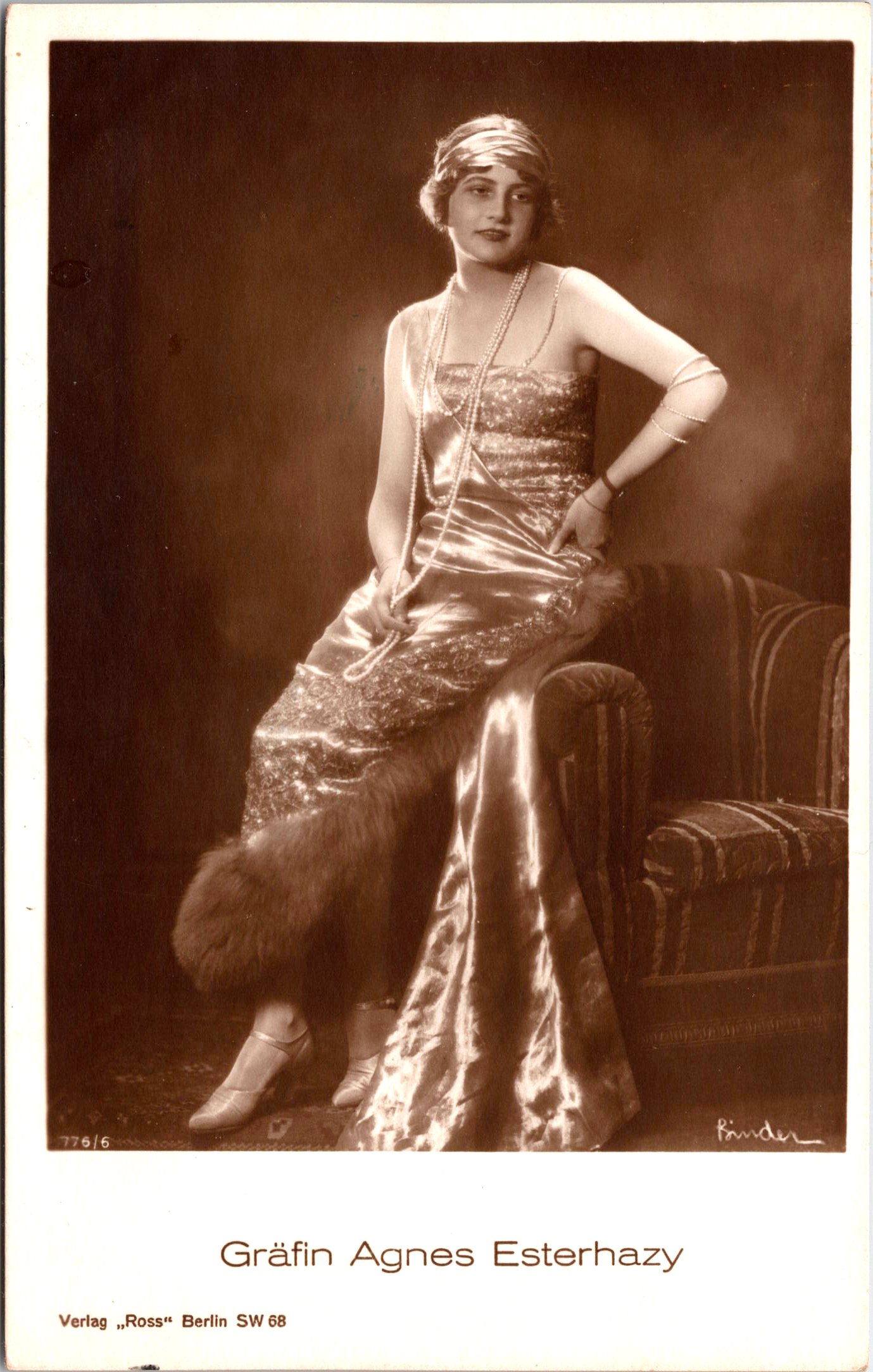
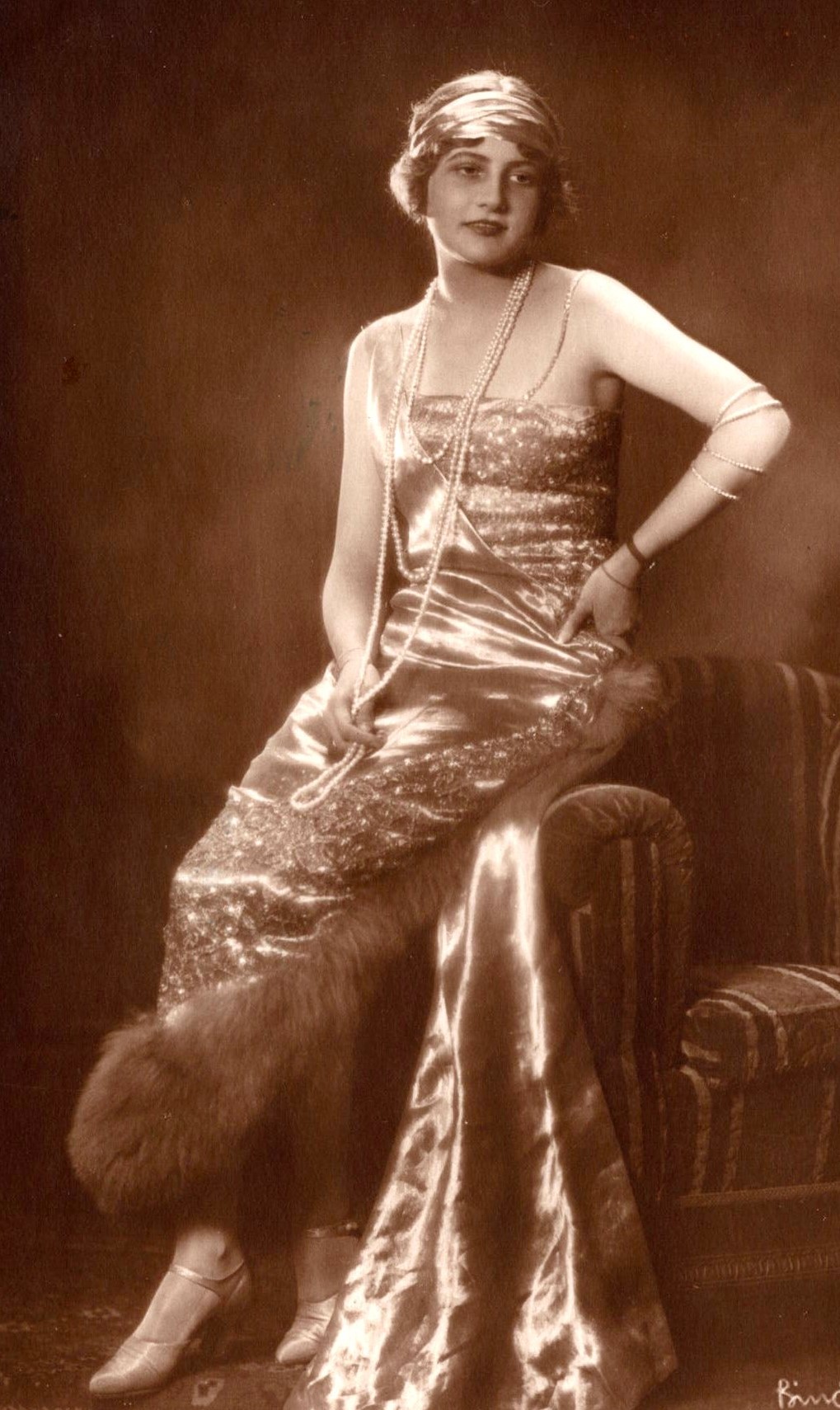
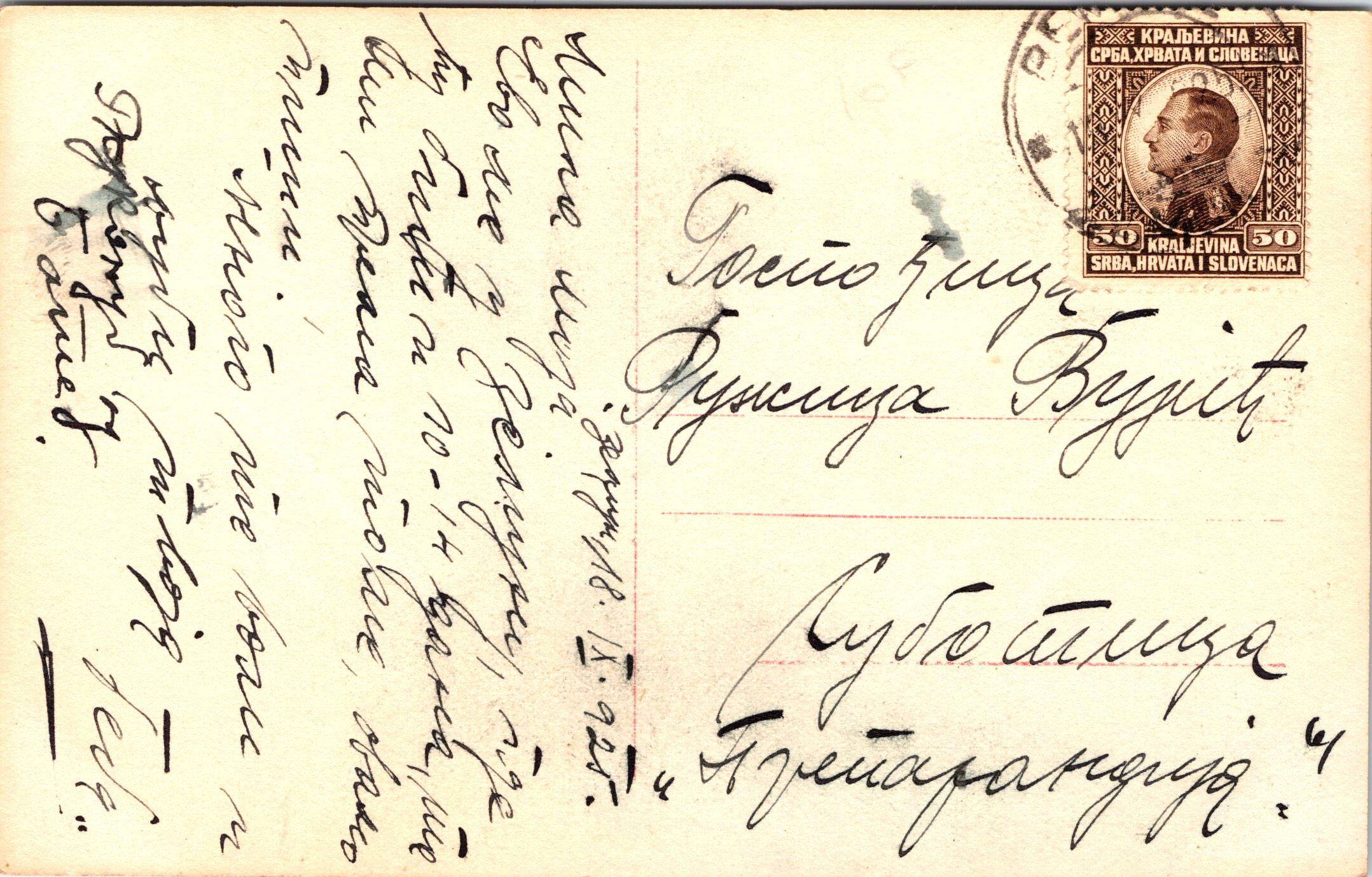
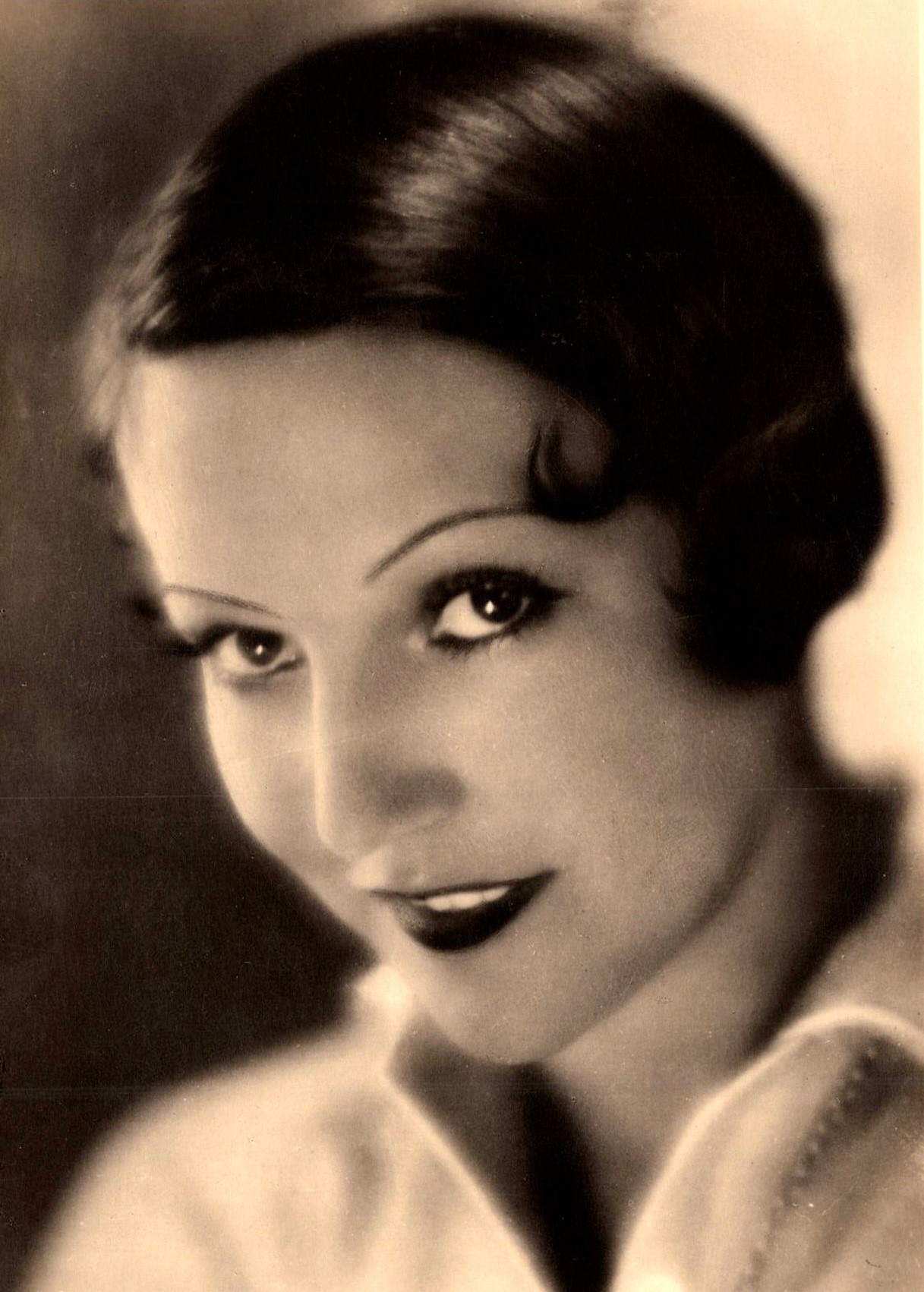
This vintage real photo postcard features Hungarian film actress Agnes Esterhazy (1891-1956). She is quite pretty and is dressed in flapper fashion. Esterhazy predominately appeared in Austrian and German films. In total, her IMDb filmography includes 32 films between 1918 and 1943. Her parents were a Count and Countess. She married actor Fritz Schulz in 1910. He was 14 years old and she was 19 years of age. I am sure there is an interesting story there and a lot of material for armchair psychologists to hypothesize about. After World War I, the pair lived in Budapest and Agnes began acting lessons. She made her film debut in 1918 and many more roles followed. During her career she acted alongside Harry Liedtke, Hanni Weisse, Asta Nielsen and Greta Garbo. Agnes mostly played supporting roles but she also played some leading roles. Esterhazy’s career virtually ended with the arrival of sound films. After her retirement from film, she she acted at various theaters, many of which were in Ostrava (Czech Republic). Esterhazy’s husband (Fritz Schulz) was arrested by the Nazis and held in a Vienna prison. His crime was that he was Jewish. Esterhazy was able to get him released in the Spring of 1938. This portrait postcard was published by Ross Verlag (Berlin). The postcard is part of a series (no.776/6). Esterhazy’s photograph was taken by celebrity photographer, Alex Binder (Berlin). The card is posted and has a stamp that was issued by Yugoslavia in 1921. The message on the postcard is dated 1925.  (SOLD)

KATHE VON NAGY : HUNGARIAN ACTRESS, DANCER, SINGER & MODEL : PHOTO BY YVA : RPPC

This vintage real photo postcard features Hungarian actress, singer, dancer, and model, Kathe von Nagy (1904-1973). She performed in both German and French films. Her father was a wealthy bank manager. At the age of sixteen, Nagy wanted to get married but her parents did not approve and sent her to a convent near Vienna, Austria. She stayed there 18 months but finished school elsewhere. Nagy wanted to become an author. She moved to Budapest and wrote articles for a magazine. She became interested in acting and enrolled in an acting school near Budapest. Her parents were none to pleased about her career choices and she was encouraged to return home where she worked in her father’s bank and secretly wrote novels. When she was about 22 years old, she moved to Berlin to pursue a career in film and worked for a Hungarian newspaper. She  was given a role in a 1927 comedy film and by 1928, she began starring in films and was considered one of Europe’s top up and coming film actresses. She became a highly successful film actress. The IMDb reports that she appeared in 57 films between 1915 and 1952. She basically retired from film during the second world war. The head of the SS., Heinrich Himmler asked Nagy to be the face and body for “sex dolls” provided to German soldiers. The premise was that the use of such dolls would lessen the syphilis problems encountered by many of the soldiers. Nagy refused the offer. This story may be apocryphal. This postcard was published by Ross Verlag as part of a series (no.6085/2). Nagy’s photo was taken by the Yva studio located in Berlin, Germany.  The name Yva is a pseudonym. The photographer was actually a woman named Else Ernestine Neulander-Simon (1900-1944). She was a German Jewish photographer and was well known for her “dreamlike, multiple exposed images”. She was a leading Berlin photographer during the Weimar Republic years of Germany. She specialized in fashion, nudes, and portraiture. Later, she became involved in the early days of producing photographs for advertising. Many of her photographs were published in magazines or were shown in international exhibitions. After the Nazis took power, she was forced to work as a radioagrapher (ie x-ray technician). In 1936 she was offered a job by Life Magazine, but her husband convinced her that life for German Jews would improve over time. He did not want to move and start a new life in a country where he did not speak the language. Unfortunately, she complied with his wishes. In 1938, Nazi regulations prohibited her from working as a photographer. In 1942, the Gestapo deported her and her husband to a death camp (probably Majdanek) where they were murdered.  SOLD

FOUR PORTRAITS OF PROVOCATIVE GERMAN SILENT FILM STAR RUTH WEYHER

POSTCARD 1
weyher
POSTCARD 2 (SOLD)


This image has an empty alt attribute; its file name is ruth-weyher_0001.jpgPOSTCARD 3  (SOLD)

RUTH WEYHER : SULTRY GERMAN SILENT FILM ACTRESS : RPPC - Picture 1 of 3

POSTCARD 4  (SOLD)

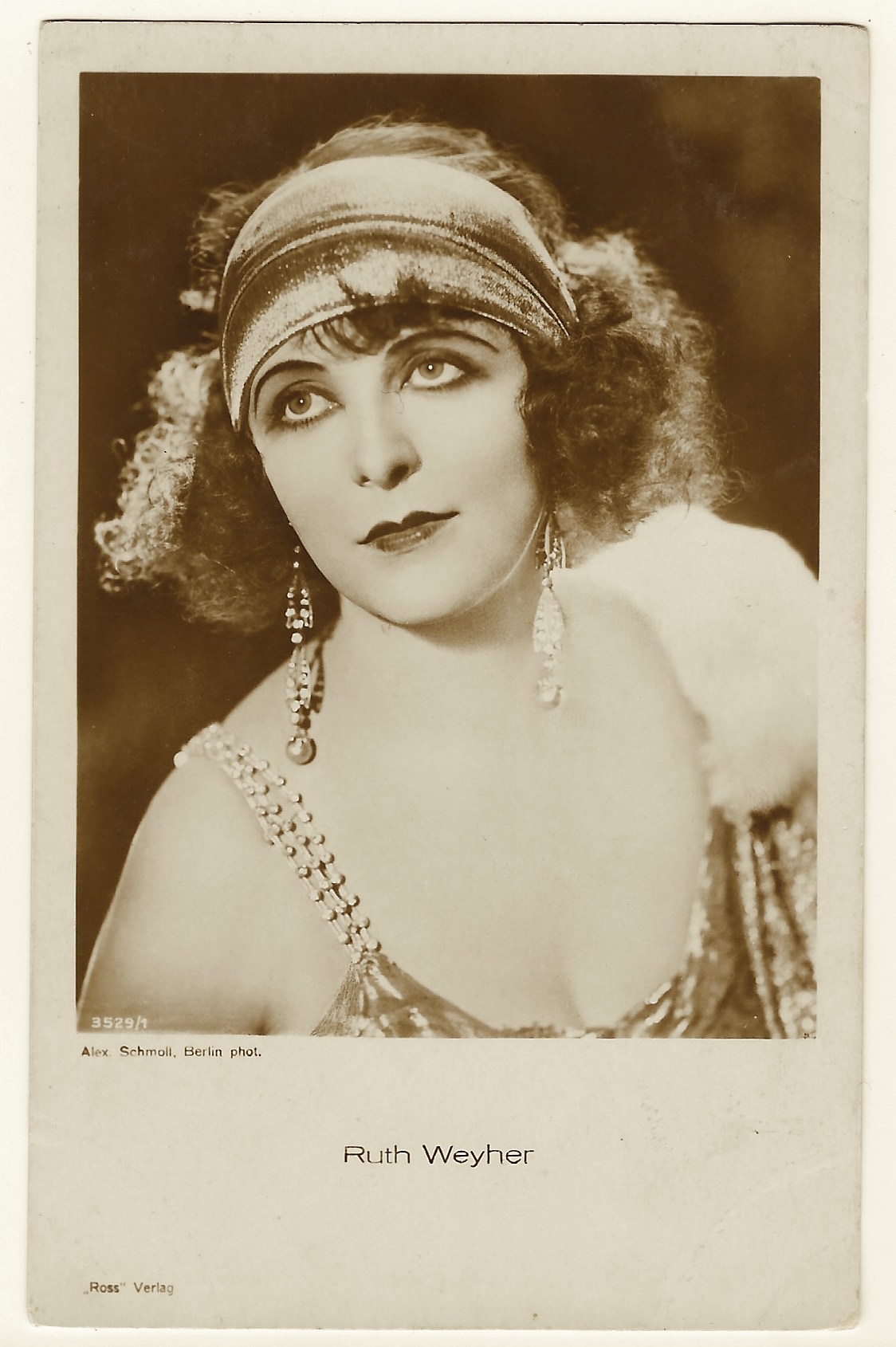
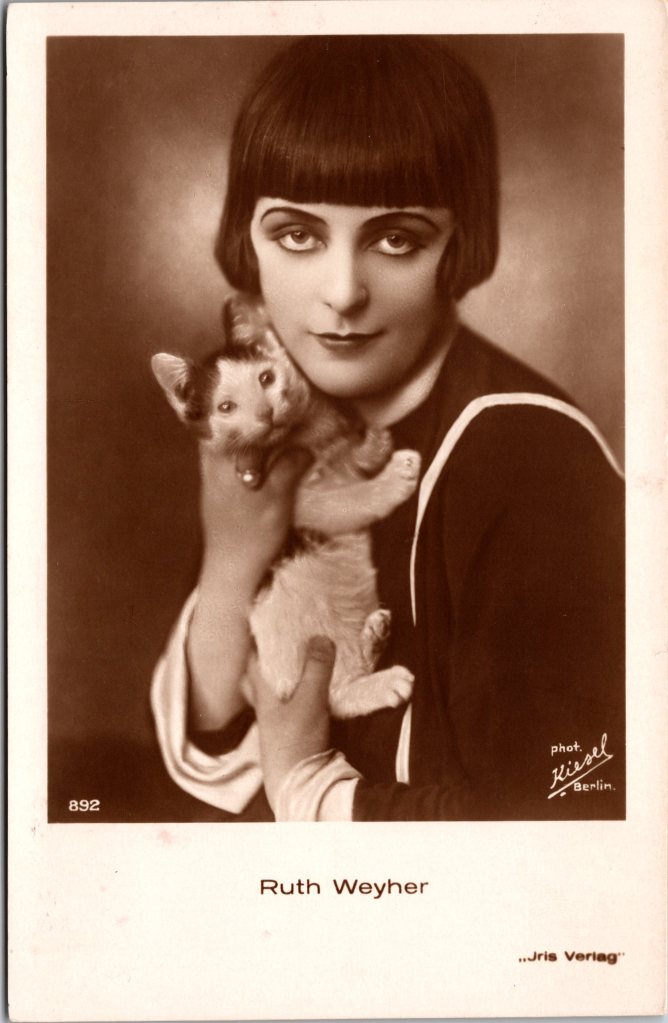
Postcard 1 is a vintage real photo postcard that features German silent film actress, Ruth Weyher (1901-1983). She was born in Neumark, East Prussia, Germany.  Weyher grew up in Danzig where she studied painting until she switched to a conservatory to study singing. An illness robbed her of her singing voice and in 1919 she travelled to Berlin where she studied a Max Reinhardt’s theatre school. Reinhardt was a well known director and producer. She appeared in 48 films between 1920 and 1930. She starred in director Georg Wilhelm Pabst’s film “Secrets of the Soul” (1926). She also produced a film in 1929. During her career, Weyher only appeared in a few sound movies and she abandoned acting after marrying publisher Hans Geiselberger in 1932. It is reported that she retired at her husband’s request. The video clip below features Miss Weyher in her appearance in the film “Shadows: A Nightly Hallucination” (1923). The film title translation was done by “google translate”. Weyher’s costar in this film was Austrian stage and film actor Fritz Kortner (1892-1970). A review of this film describes Weyher as “beautiful and passionate”.  Ruth Weyher’s appearance in this film can be described as risque or provocative. One of the themes of this film is infidelity. This postcard was published by Ross Verlag and is part of a series (no. 3529/1). The portrait of Miss Weyher was taken by Alex Schmoll, a photographer located in Berlin, Germany. There is Italian print on the reverse of the postcard that roughly translates as “Exclusive sale publisher: Ballerini and Fratini, Firenze (Florence, Italy). A bit of research reveals that the publishing house, Ballerini & Fratini Montespertoli began in Florence in the year 1912.                                     

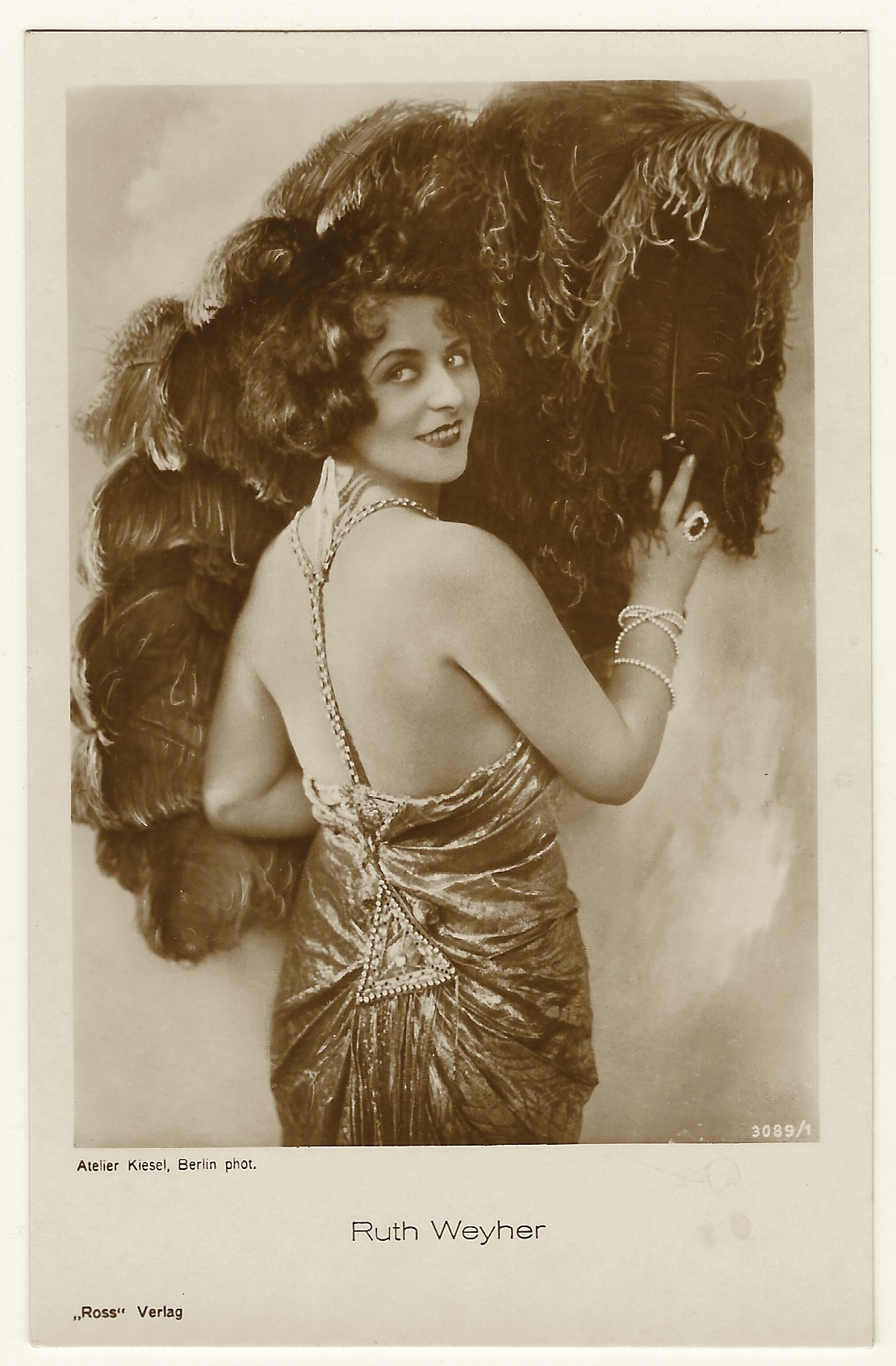
Postcard 2 features Ruth Weyher and was published by Ross Verlag. The postcard is part of a series (no. 3089/1). This portrait of Miss Weyher  has her posed in position to display her bare back. She has an engaging smile and holds a large fan of dark feathers. Some may find this image somewhat sexually provocative. The photographer of this photograph is Kiesel of Berlin, Germany.  (SOLD)

Postcard 3 is a vintage real photo postcard that features Miss Weyher holding an adorable kitten. This postcard was published by Iris Verlag and is part of a series (no. 892). The portrait of Miss Weyher was taken by Kiesell, a photographer located in Berlin, Germany. This postcard has remnants of it’s former scrapbook home on back of card. It is in  overall good condition (see scans).   (SOLD)

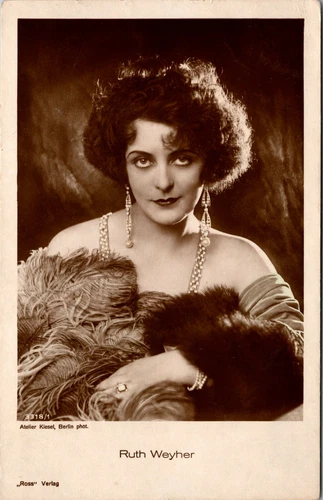
Postcard 4 was published by Ross Verlag and is part of a series (no. 3318/1). The portrait of Miss Weyher was taken by the Kiese studio in Berlin, Germany.   (SOLD)


LOIS MORAN : AMERICAN FILM AND STAGE STAR : AFFAIR WITH F. SCOTT FITZGERALD

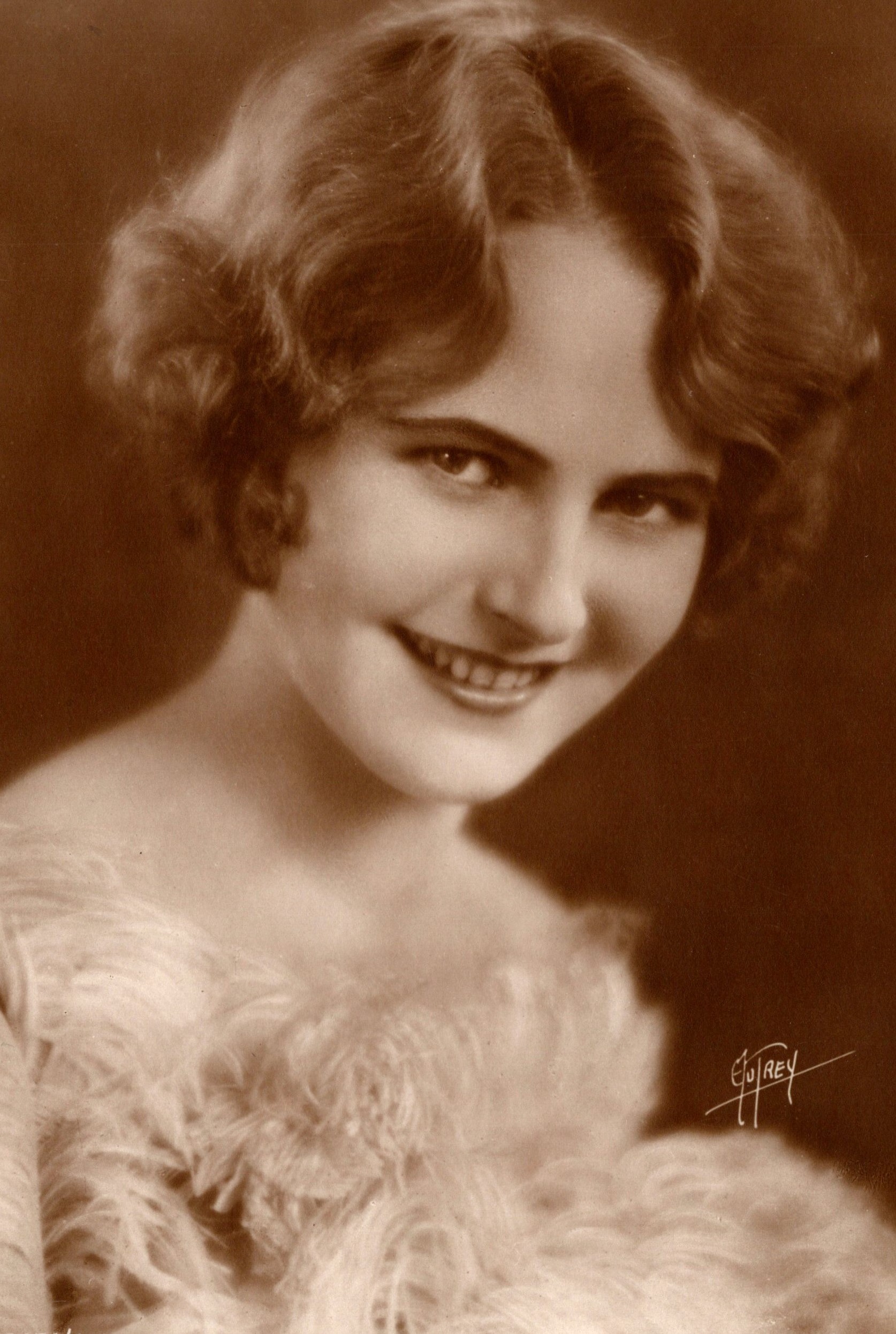
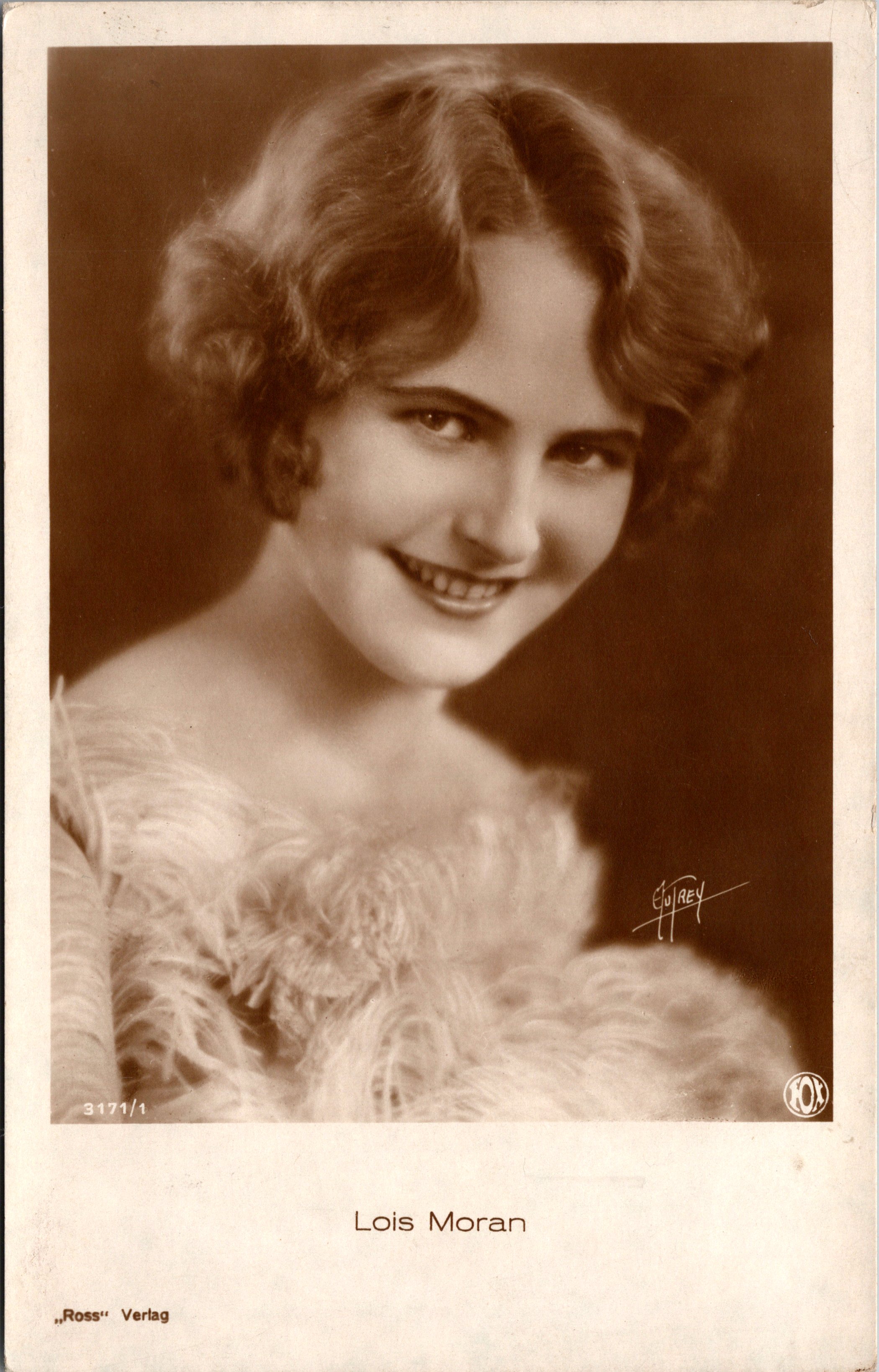
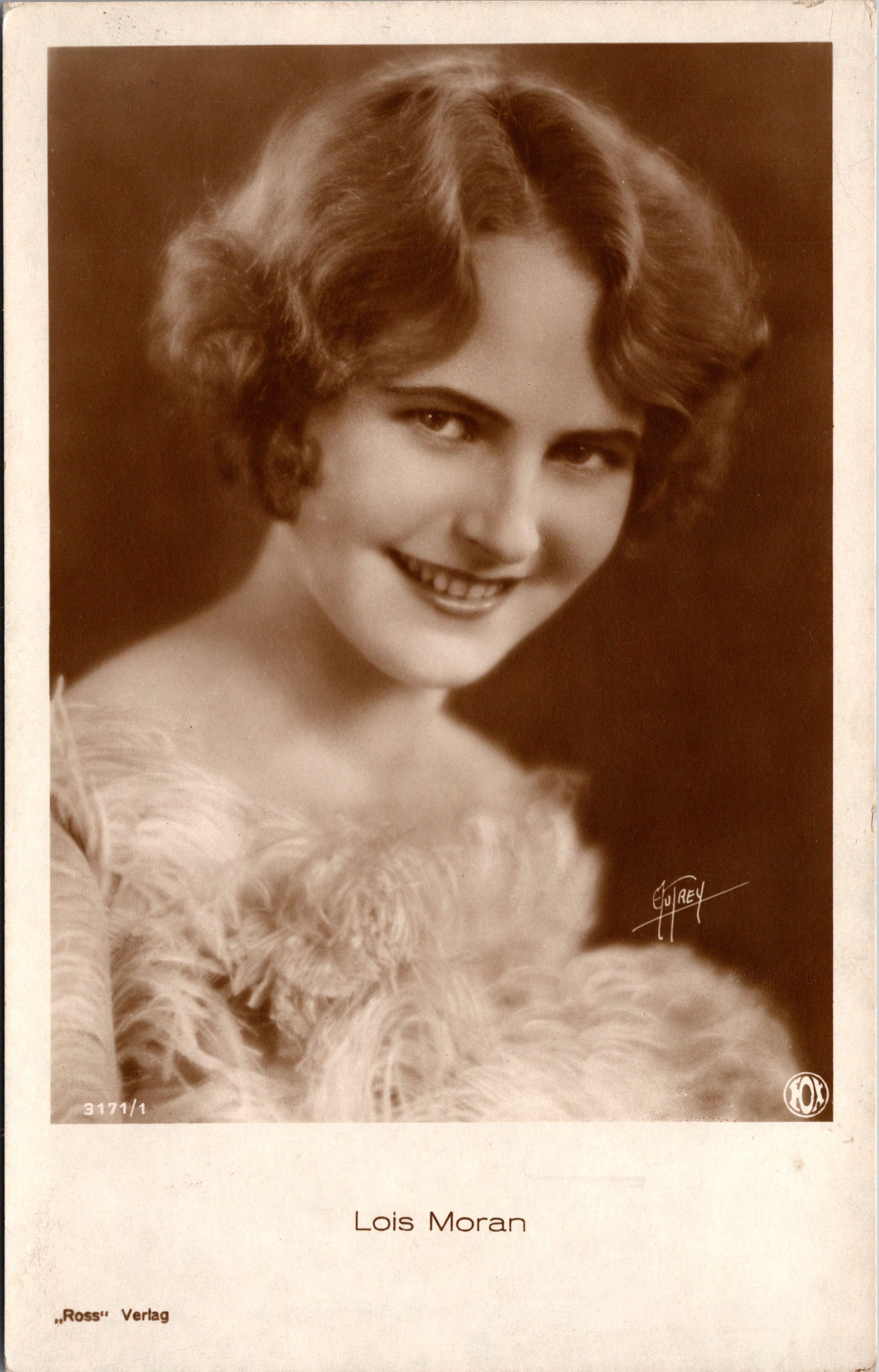
This vintage real photo postcard features actress Lois Moran (1909-1990). She was an American stage and film actress.  She was born in Pittsburgh, Pennsylvania. She lost both her father, and then her step father, at an early age. In 1921, at the age of 12, Moran and her mother moved to Paris, France. She began singing and dancing at the Paris National Opera at the early age of 13 years old. By age 14, she was appearing in silent films. Her debut in a Hollywood film occurred in “Stella Dallas” (1925). Moran’s film experience included musicals. In fact, she appeared with Al Jolson in “Mammy” (1930). The IMDb reports that Moran acted in 39 films between 1924 and 1974. She parlayed her experience in movies to begin acting on the Broadway stage. The IBDb lists Moran as appearing in 3 Broadway plays between 1930 and 1933.  Moran’s personal life included a short affair (1927) with “The Great Gatsby” writer F. Scott Fitzgerald. Interestingly, one of the characters (Rosemary Hoyt) in “Tender is the Night” is said to mirror Moran. In 1935, she married Clarence M. Young, the assistant Secretary of Commerce. This postcard was published by Ross Verlag as part of a series (No.3171/1). In the lower right hand corner is the logo of Fox Films. She was likely under contract with Fox when this photo was taken. The photo was taken by Fox photographer Max Munn Autrey (1891-1971). This vintage postcard is in good condition (see scans).

Buy this Vintage Real Photo Postcard (includes shipping within the US) #5218

To purchase this item, click on the Pay with PayPal button below

$14.00

Buy this Vintage Real Photo Postcard (includes International shipping outside the US) #5218

To purchase this item, click on the Pay with PayPal button below

$24.00

MADY CHRISTIANS : GAY STAGE AND FILM ACTRESS : POLITICALLY INVOLVED : FBI : RPPC

Mady Christians (1892-1951) was an Austrian-American actress. She appeared in many films and stage productions, both in Europe and the United States. This photograph captures Christians and two dogs in a scene from the silent film “Zoph und Schwert (Braid and Sword)” (1926). Some of her most notable performances include roles in the films “The Great Dictator” (1940) and “The Shop Around the Corner” (1940). She was also a successful stage actress and appeared in several Broadway productions. Christians was forced to flee Nazi Germany in the 1930s and emigrated to the United States where she continued her acting career. She was an active performer between 1916 and 1951. She was born in Vienna. Her father was a well known German actor. The family moved to Berlin and in 1912 they moved to New York City where her father became the general manager of the Irving Place Theater. In 1917, she returned to Europe to study acting under Max Reinhardt. Before the early 1930’s she appeared in several European films. In 1929, she starred in the first full sound film made in Germany. After touring the United States in a play, she was offered a Broadway contract. While appearing in Broadway she became part of a small and influential group of lesbian theater producers, directors, and actors. Christians became involved in political issues. She worked to help refugees, to gain rights for workers, supported Russian War relief, and was involved in other political issues. Her political work brought her to the attention of the FBI and other anti Communist groups, notably the House Committee on Un-American Activities. The FBI investigated Christians when an informant identified her as a “concealed communist”. The investigation virtually ended her performing career. She passed away in 1951 This card was published by Ross Verlag. The firm operated in Berlin, Germany. Note the mention of the German film company Aafa Film-Regie and the film’s director, Victor Janson in the lower right corner of the image.  SOLD

CLARA BOW : AMERICAN SILENT FILM ACTRESS : “THE IT GIRL” : RISQUE 

POSTCARD 1 (SOLD)

POSTCARD 2 (SOLD)

This uncommon vintage real photo postcard (Postcard 1) features silent film icon, Clara Bow (1905-1965 ). She successfully made the transition to talkies in 1929. Bow appeared in 46 silent movies and 11 talkies. She was known as the “It Girl” during the golden age of Hollywood. She was known for her vivacious energy, mesmerizing on-screen presence, and her impressive talent. She was born in Brooklyn, New York and grew up in the borough’s tenements. Both of her parents had mental health issues and she grew up in an unstable and chaotic environment. She was a resilient and determined child and she took on a caretaker role for her younger siblings. She was responsible and mature beyond her years. Despite her humble background, she became a very influential figure in cinema history. Her rise from poverty to stardom, and her groundbreaking portrayals of independent and liberated women, helped her gain an enduring legend of the silver screen. Clara Bow was discovered in 1922 when she participated in a magazine contest searching for new talent. Her photographs were seen by film producer B. P. Schulberg who saw her potential and offered her a screen test. Her screen presence was impressive and she signed a contract with Paramount Pictures. In her earliest films, her versatility was was obvious as she transitioned effortlessly between dramatic and comedic roles. It was the 1927 film, “It” that made Clara Bow a superstar and earned her the nickname of “The It Girl”. She was viewed as modern, charismatic, and sexually liberated. Bow was also successful in “talkie” films, despite her Brooklyn accent. While Bow was successful professionally, her personal life was a “hot mess”. She had a long term troubled marriage to actor Rex Bell (m.1931) and she battled her own mental health issues, including anxiety and depression. In 1933, Bow retired from acting and became a rancher. This vintage real photo postcard was published by Ross Verlag (Germany) as part of a series (No.3394/1). Bow is wearing a grass skirt, a Hawaiian Lei, and holding a ukulele. She is showing her bare legs. The card is risque for it’s era. The logo for Paramount Pictures can be found in the images bottom right hand corner.  SOLD

Postcard 2 was published by Ross Verlag (Germany) as part of a series (No.4480/1). Bow is wearing a short skirt. She is showing her bare legs. The card is risque for it’s era. The logo for Paramount Pictures can be found in the images bottom right hand corner.  SOLD

POSTCARD 1

POSTCARD 2

CAMILLA HORN : GERMAN ACTRESS AND DANCER : NAZI FOE : HOLLYWOOD : RPPC

POSTCARD 1 (SOLD)

POSTCARD 2 (SOLD)

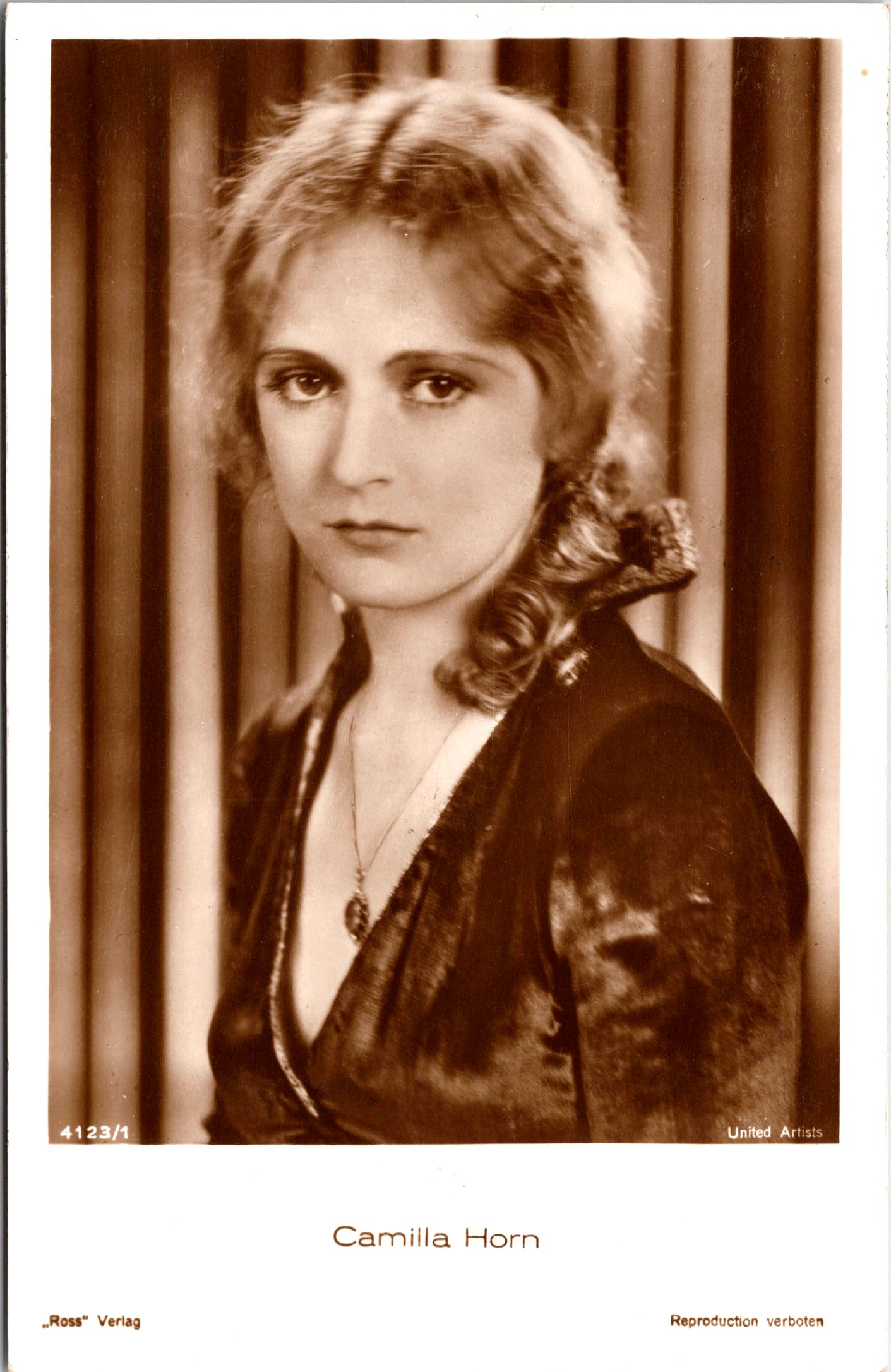
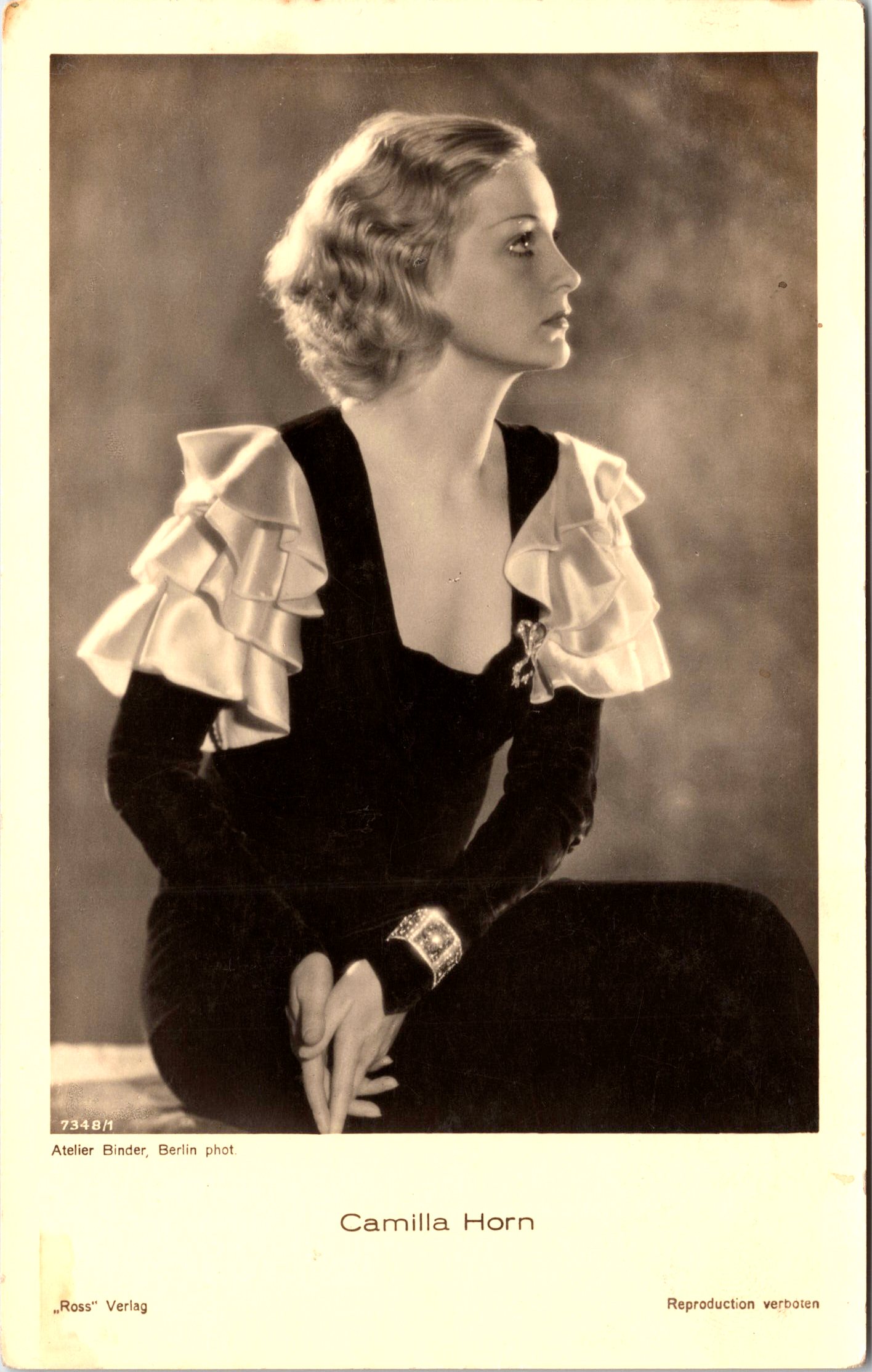
These vintage real photo postcards feature German dancer and film star of the silent and sound era, Camilla Horn (1903-1996). She also was an internationally known actress, starring in several Hollywood films of the late 1920’s as well as a few British and Italian productions. Her father was a civil servant working in the Railroad Industry. She was born in Germany and educated in Germany and Switzerland. Horn was educated to work as a dressmaker. She went to Berlin where she trained as an actress and dancer. She next became a cabaret dancer. In 1925, she worked as an extra in a German film. Her big break came in 1926 after she replaced Lillian Gist in the UFA production of “Faust”. In 1928 she left for Hollywood where she played opposite John Barrymore in “Tempest” and “Eternal Love”. She became romantically involved with film director, Joseph Schenck. She returned to Europe (upon the advent of sound film) and in the 1930’s got in trouble with the Nazis and was prosecuted for an alleged financial offense. During the war years, she was too outspoken against the Nazis. The regime investigated her. She tried to escape unsuccessfully to Switzerland. Thereafter, she kept a low profile. After the war, she was convicted by a British tribunal and sentenced for three months of jail due to some minor offenses. It was also reported that post war, she worked as an interpreter for occupying American forces. Horn was a screen star from 1930 until her retirement in 1953. Horn was married four times during her life. Interestingly, in about 1972 Bruce Springsteen wrote a song about her. Camilla Horn was quite beautiful. She had blonde hair, slanting brown eyes and classical features.

Postcard 1 was published by Ross Verlag as part of a series (No.4123/1). The logo for “United Artists” can be seen in the lower right hand corner of Horn’s image. This postcard has a 1930 postmark. (SOLD)

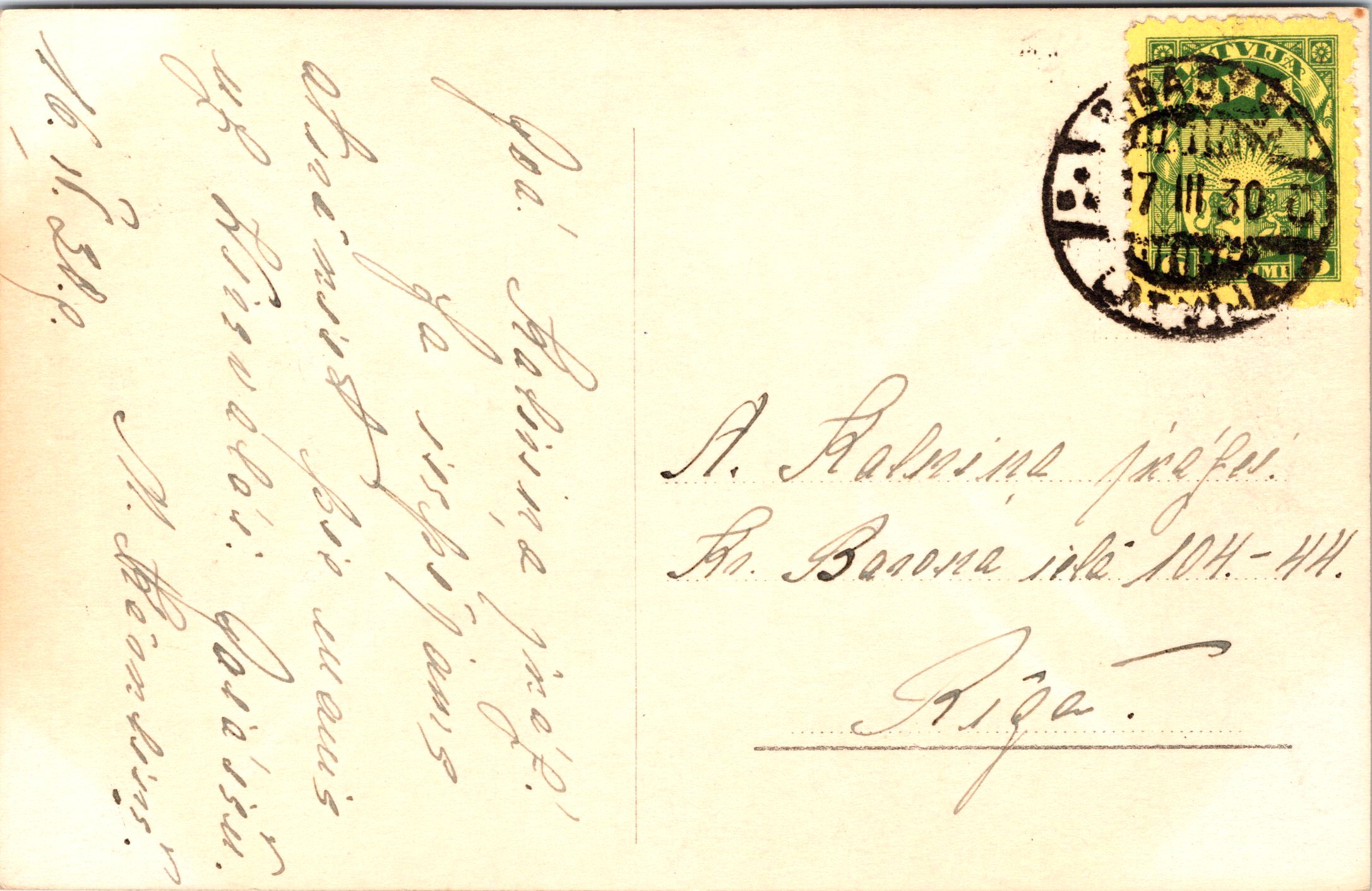
Postcard 2 was published by Ross Verlag as part of a series (No.7348/1). The card has a Latvian stamp and postmark.  (SOLD)

CLAIRE ROMMER : FILM ACTRESS :SAVED FROM NAZIS BY ARISTEDES De SOUSA MENDES

POSTCARD 1 (SOLD)
POSTCARD 2 (SOLD)

POSTCARD 3 (SOLD)

These vintage real photo postcards feature German film actress, Claire Rommer (1904-1996). Her filmography on IMDb credits her with 49 film appearances between 1922 and 1934. She made her film debut at the age of eighteen. She also began her career as a soubrette appearing in operettas and comedies on the Berlin stage. However, her fame came from her film work. She played both leading and supportive roles. She played in silent films and made a successful transition to sound films. She even sang in some of her talkies. She was married to a prosperous Jewih man, named Adolf Strenger. Because of her marriage, in 1938 she was banned from any participation in the German film industry. It was thought that she was probably not Aryan like her husband. The rise of the Nazis forced the couple to leave Germany and emigrate to the United States via Portugal.The pair left Europe with the assistance of Aristedes de Sousa Mendes. He was a Portuguese Consular stationed in France. Mendes defied orders from his government and issued thousands of visas to Jews, allowing them to escape with their families and their lives. He was a hero for his work as a Holocaust rescuer. Ultimately, Mendes was severely punished for his defiance. After leaving Germany, Rommer’s film career ended. In the US, she divorced her husband and married a meat industry multi-millionaire.

Postcard 1 was published by Ross Verlag as part of a series (No.1933/1). Claire Rommer’s photo portrait was taken by celebrity photographer, Alexander Binder. This vintage photo postcard is in excellent condition (see scans). (SOLD)

Postcard 2 was published by Ross Verlag as part of a series (No.1933/2). Claire Rommer’s photo portrait was taken by celebrity photographer, Alexander Binder. This vintage photo postcard is in very good condition (see scans). (SOLD)

Postcard 3 was published by Ross Verlag as part of a series (no.3010/1). Miss Rommer’s portrait was taken by famed celebrity photographer Alex Binder, who operated his studio in Berlin. The postcard was postmarked in 1928. (SOLD)