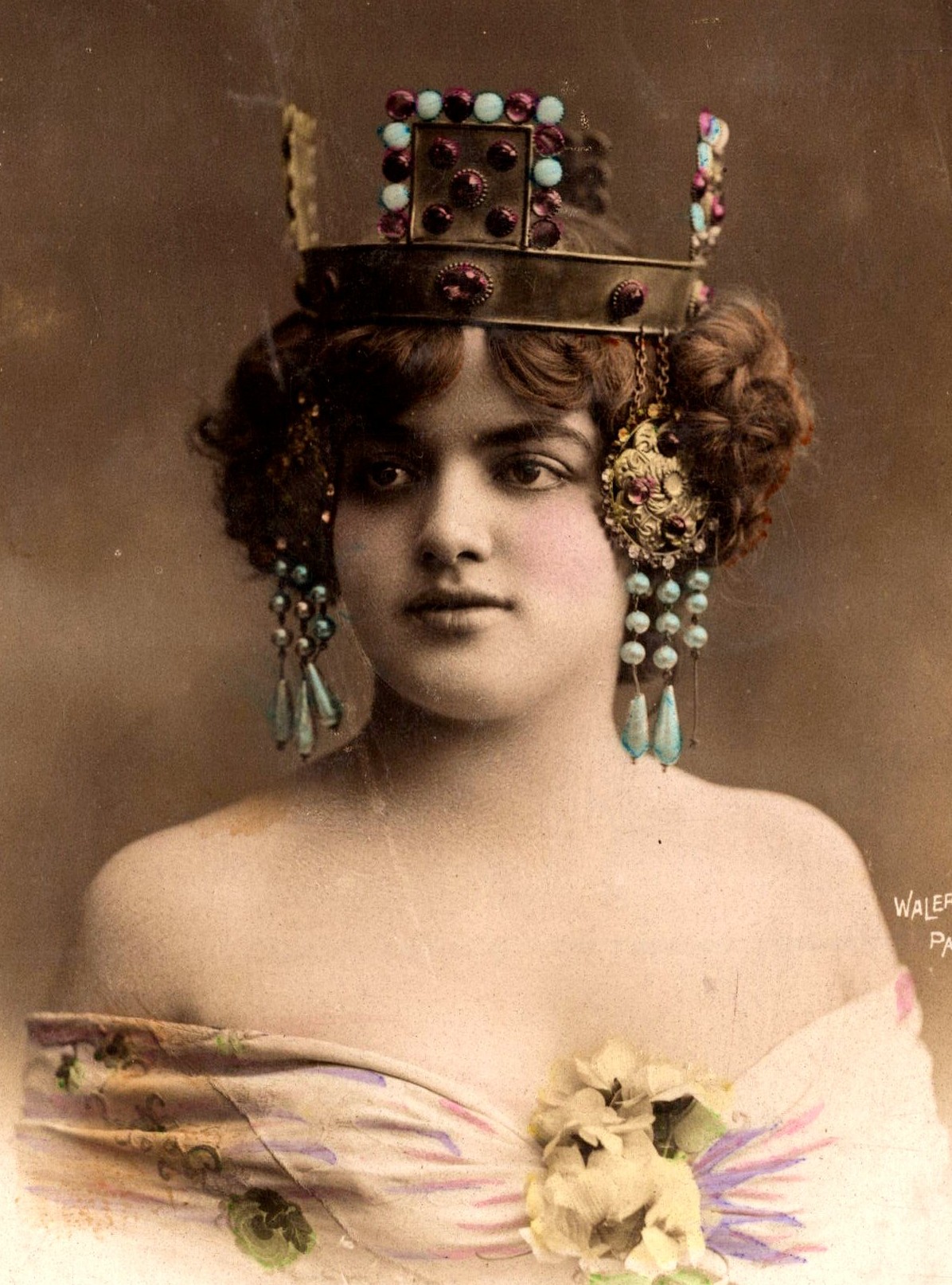
This vintage real photo postcard features performer, Miss Veglia. The title on the card indicates that she performed at the Folies Bergere, in Paris France. This actress may be Tina Veglia who was a silent film actress. One of the films that she is noted for is “The Three Musketeers” (1918).She is also listed as appearing in two Italian silent films. Interestingly, the word “Veglia”, translated from Italian to English, means “Vigil”. The portrait of Miss Veglia was hand tinted. She is wearing quite the interesting head piece. The ornate jeweled piece is crownlike and has a hodgepodge design. The message on this postcard, written in French, is captivating. A translation app translates the message as ” I suffer in silence and I do not complain. Not seeing me, you may think I’ve moved on, but despite that, I will love you always. I’m letting a little bit of hope shine through. Try to guess who is sending you this card…”. This is an extremely dramatic message. I wonder what eventually happened. Did the writer and recipient ever get together and live “happily ever after”? This photo portrait was taken by Walery at his Paris studio. He was a well known and talented celebrity photographer. The postcard was published by SIP as part of a series (no.5026). The postcard has a Belgian stamp and the care is addressed to someone in Courcelles-Pont-à-Celles, Belgium.(SOLD)
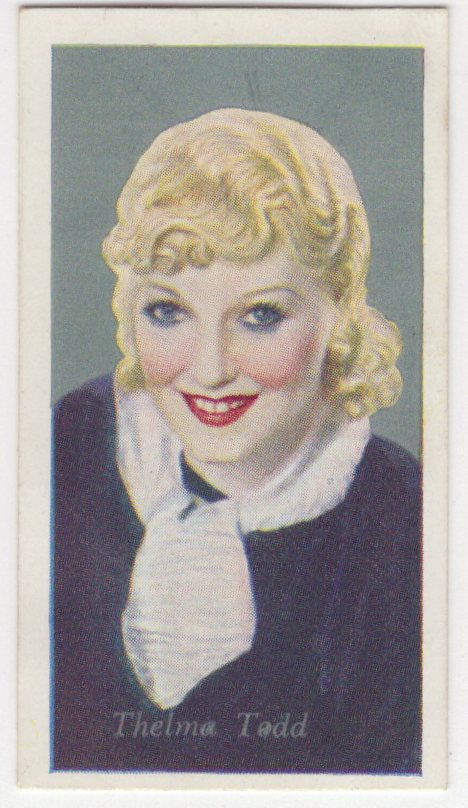
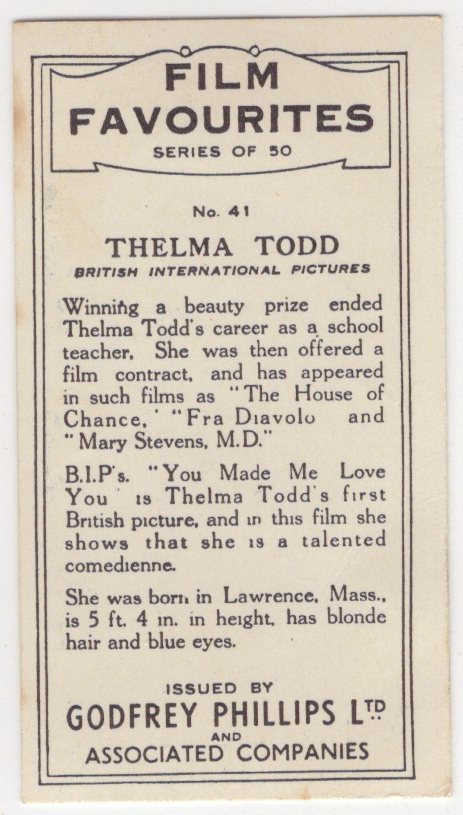
This vintage tobacco card features American silent and talkie film actress, Thelma Todd (1906-1935). She was also a businesswoman. Her nicknames included “The Ice Cream Blonde” and “Hot Toddy”. She appeared in about 120 feature films and shorts between 1926 and 1935. She was known for her comedienne talent. Among the performers she worked with are the Marx Brothers, Laurel & Hardy, and Buster Keaton. In 1934 she opened a restaurant in Los Angeles with two partners. In 1935 she was found dead in her Lincoln automobile. The car was in a garage and had died from carbon monoxide poisoning. Her death was ruled to be accidental but there was much speculation about whether she committed suicide or had been murdered. This cigarette card was published by Godfrey Philips Ltd. The firm was a British tobacco importer and manufacturer of cigars and Cigarettes. The business was established in 1844 and was one of the first tobacco companies to issue cigarette cards. Their first set was published in 1904. The cards were meant to stiffen cigarette packaging, to serve as a collectible, and to advertise the cigarette brand. This cigarette card was issued in 1934. SOLD
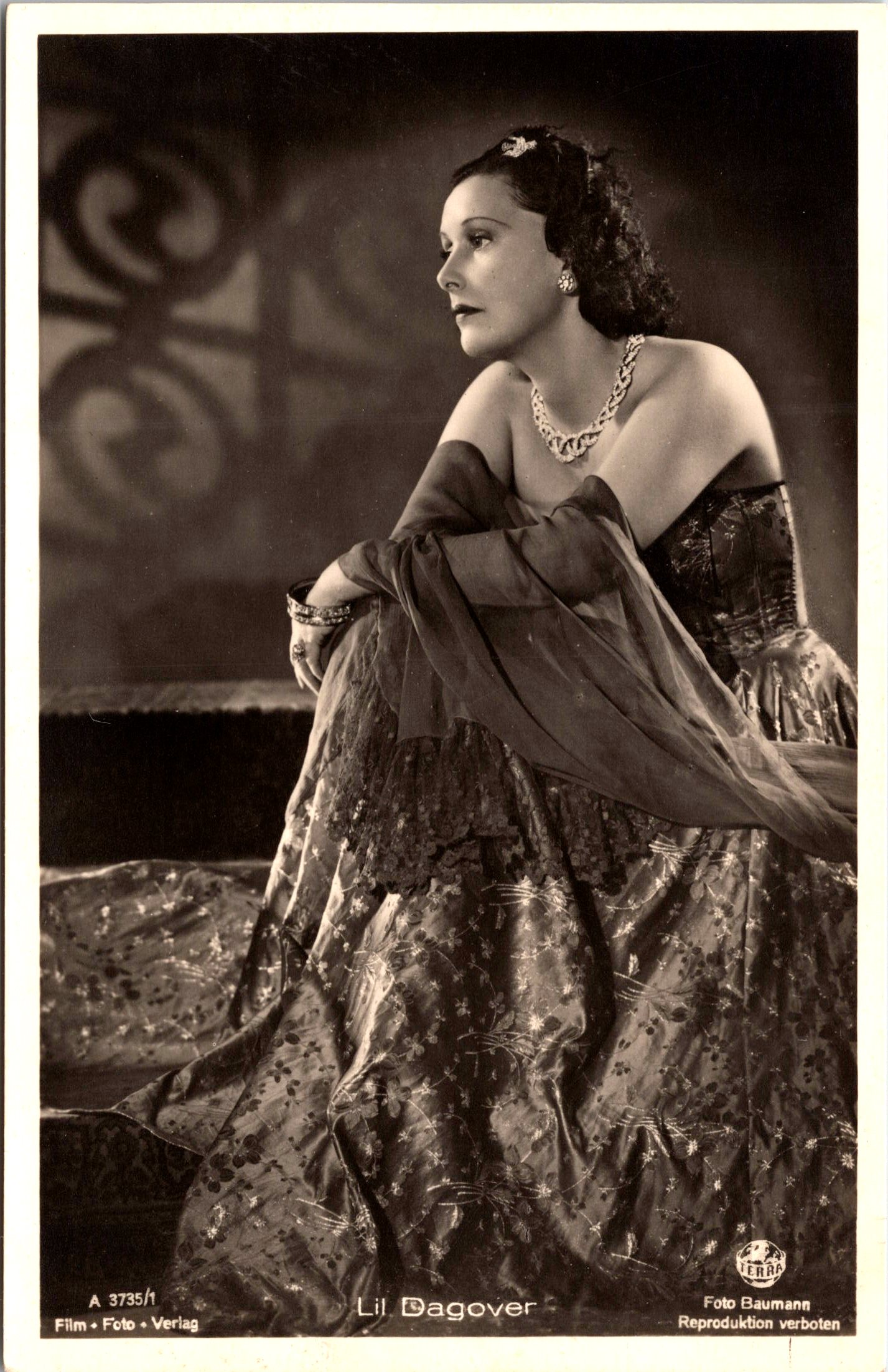
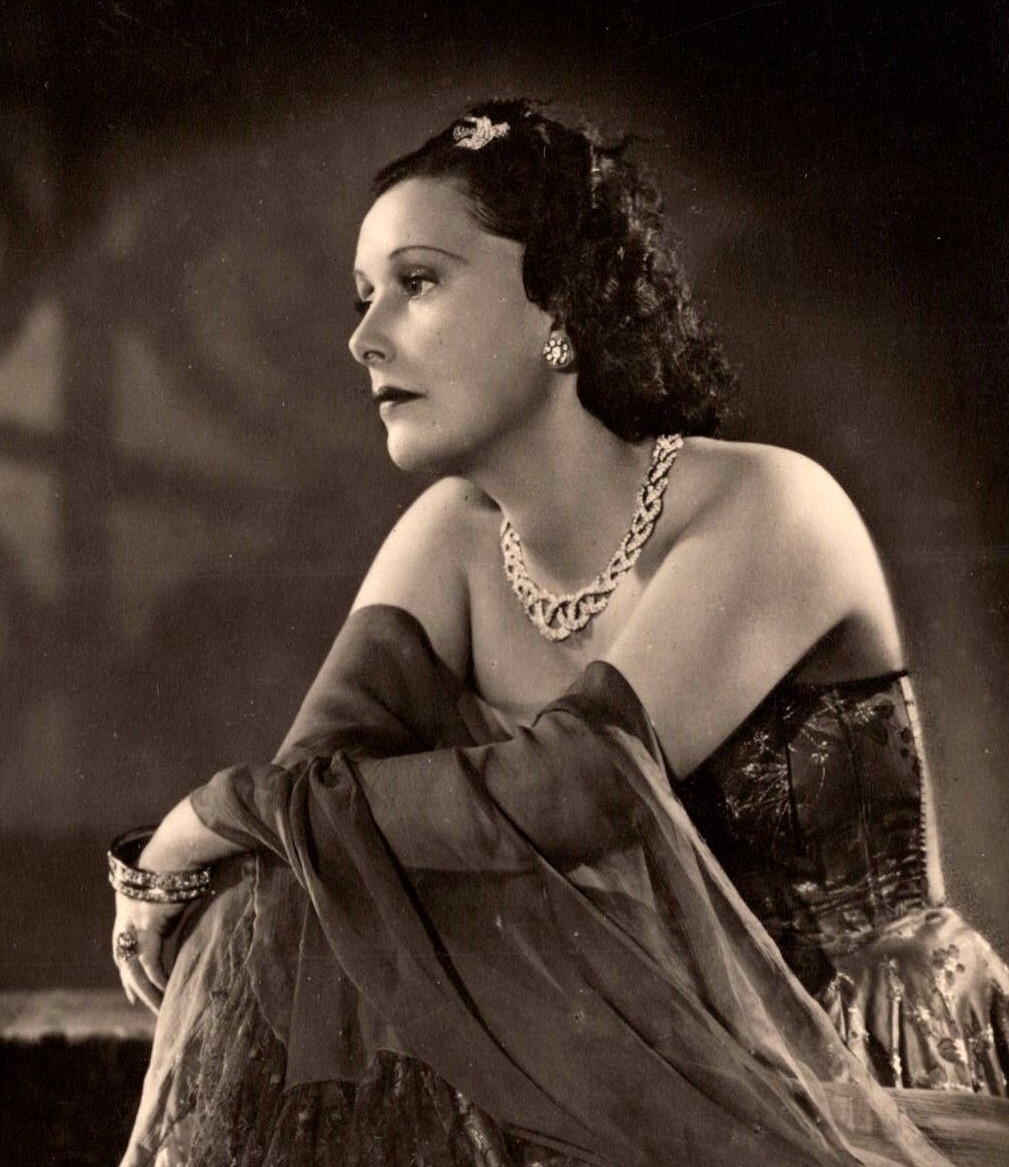
This vintage real photo postcard features celebrated German actress, Lil Dagover (1887-1980). She was renowned for her work in silent films, particularly her collaborations with key figures of German Expressionist cinema. Her striking beauty and ability to convey complex emotions made her one of the most recognizable faces of early 20th-century European cinema. Lil Dagover was born into a well-to-do family in the Dutch East Indies, where her father worked as a forestry officer. After his death, her mother relocated with the family to Europe, and Dagover spent much of her youth in Switzerland and Germany. She was orphaned at 13 years of age and was raised by relatives. She initially planned to become a painter but was drawn to the performing arts, which led her to pursue acting. Dagover’s acting career began on the stage, but her breakthrough came with the advent of film. She made her debut in 1913, though her rise to stardom began in earnest in the early 1920s when she worked with director Robert Wiene in the landmark German Expressionist film The Cabinet of Dr. Caligari (1920). Dagover became a favorite of directors such as Fritz Lang, F.W. Murnau, and Ernst Lubitsch. Her notable silent-era films include “Destiny” (1921), “Dr. Mabuse, the Gambler” (1922), and “The Chronicles of the Grey House” (1925). Her success continued during the sound era, where her aristocratic demeanor and elegance suited roles in historical dramas and comedies. Dagover remained active in German cinema during the Third Reich, a time when the industry was heavily influenced by propaganda. However, she largely avoided overtly political films, focusing instead on character-driven narratives. After World War II, she transitioned to stage work and television, continuing her career well into the 1970s. In regard to her personal life, in 1913 she married Fritz Daghofer, an Austrian officer. They had one child and the marriage ended in divorce. She married for a second time to a German film producer. This postcard was published by Film-Foto-Verlag as part of a series (No.A3735/1). Miss Dagover’s photograph was taken by Baumann between 1941 and 1944. The logo for Terra Film is in the bottom right corner of the image. Terra Film was a Berlin-based film production company. Founded in 1919, it became one of Germany’s largest film production companies in the 1930s under the Nazi regime. SOLD
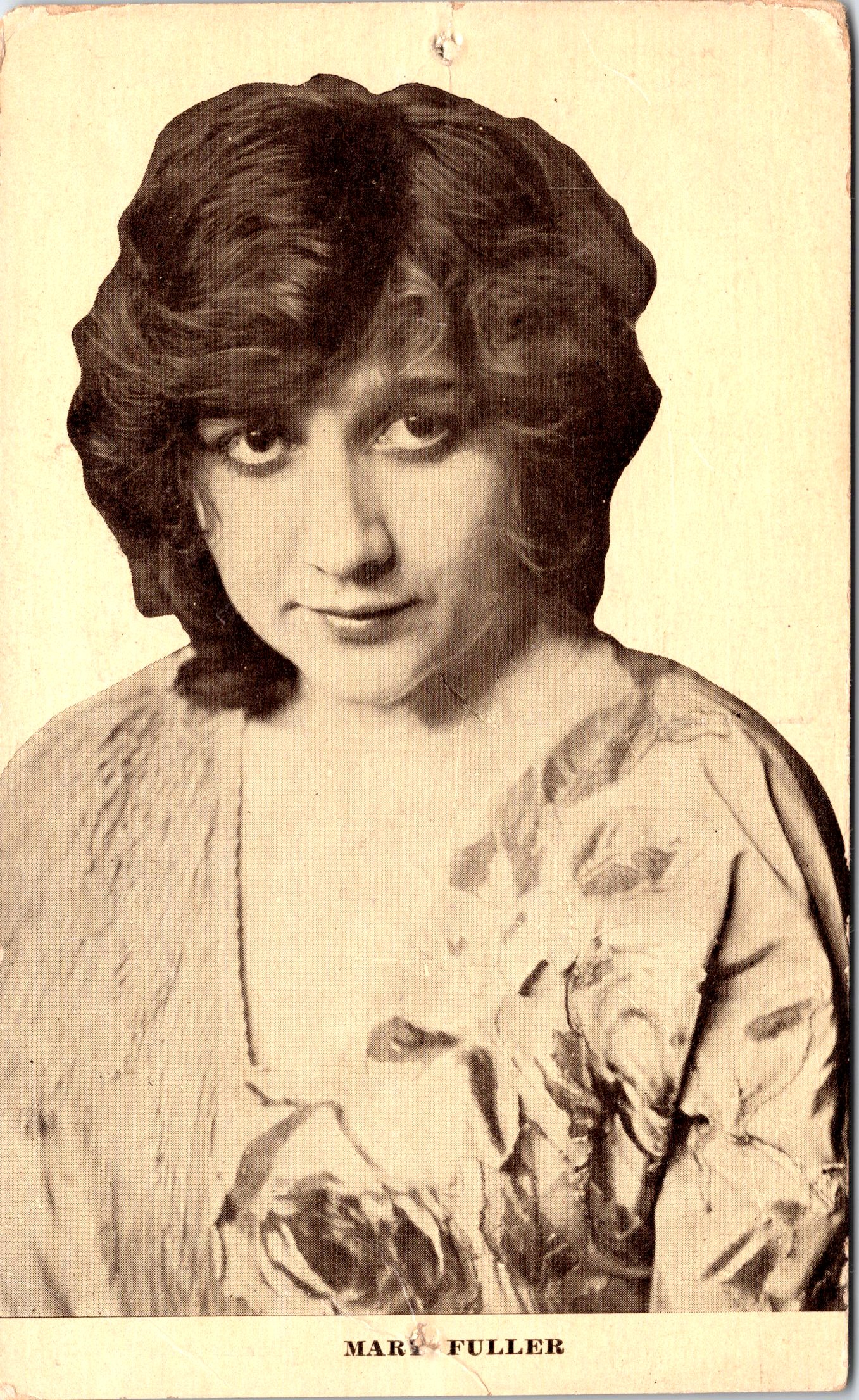
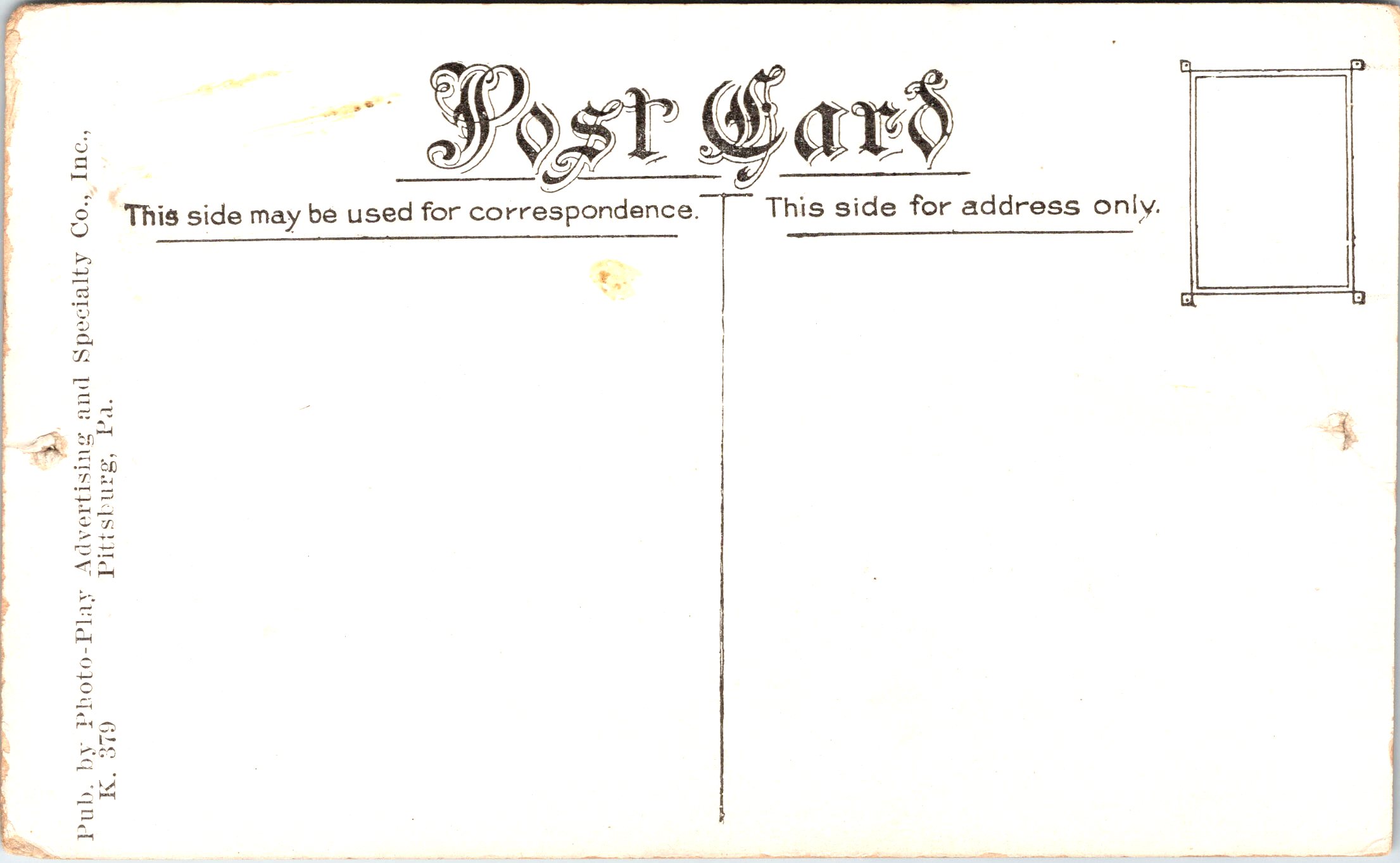
This vintage real photo postcard features American film actress Mary Fuller (1888-1973). She was born in Washington DC. Her father was an attorney. By 1906, she was working on stage. In 1907, signed with Vitagraph Studios to make films. In 1910, she signed with Edison Film Company. That same year, she appeared in the first film version of “Frankenstein”. By 1914, she was a major film star. After starting her career in theater, she made her film debut in 1908 when the industry was still in its infancy. Her work with the Edison Manufacturing Company helped establish her as a leading actress, and she quickly became one of the most recognized faces of silent film. One of her most famous roles was in “The Last of the Mohicans” (1911). In addition to her film work, Fuller was known for her appearances in short films and serials. Fuller was also a screenwriter. She penned eight films. When the film industry entered the sound era, Fuller’s popularity waned. After making a few sound films, she retired. In 1947, she suffered a nervous breakdown and spent the rest of her life (26 years) in a Washington DC psychiatric hospital. Her mental decompensation was precipitated by a failed affair with a married opera singer and later exacerbated by the death of her mother. The IMDb reports that Fuller appeared in 230 film roles between 1908 and 1917. This postcard was published by Photo-Play Advertising and Specialty Company. The firm was based in Pittsburg, Pennsylvania. SOLD
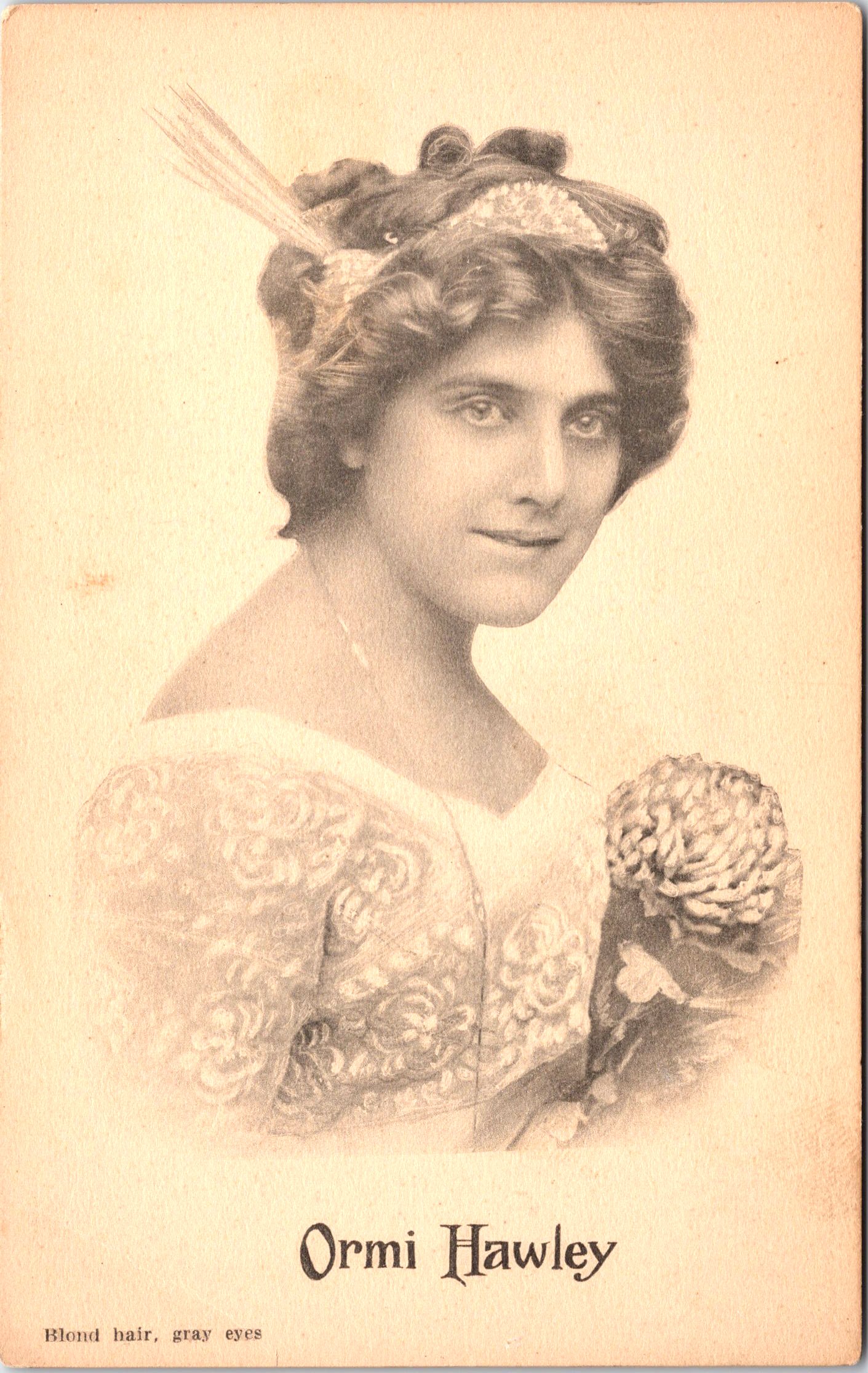
Ormi Hawley (1889-1942) was a pretty and popular American silent film actress. The IMDb reports that she has 129 film credits between 1911 and 1919. She must have garnered a significant amount of money because her nickname was “Opulent Ormi”. She also earned the nickname of “The Lillian Russell of the Pictures” because she frequently played society or aristocratic roles. Like many silent film actresses, she began her career as a teen on the stage. In 1911, she joined the Lubin Stock Company and over the next five years, she starred in dozens of short films. In 1918, she was the leading lady with opera legend Enrico Caruso. Later in her career, she managed the All-American Girls Symphony Orchestra. Upon marriage, she retired to her farm where she painted portraits and wrote children’s stories. This card was published by Kraus Manufacturing Company (New York) for the Lubin film company. Interestingly, the caption on the front of the card describes Hawley’s appearance. She is said to have blonde hair and gray eyes. (SOLD)
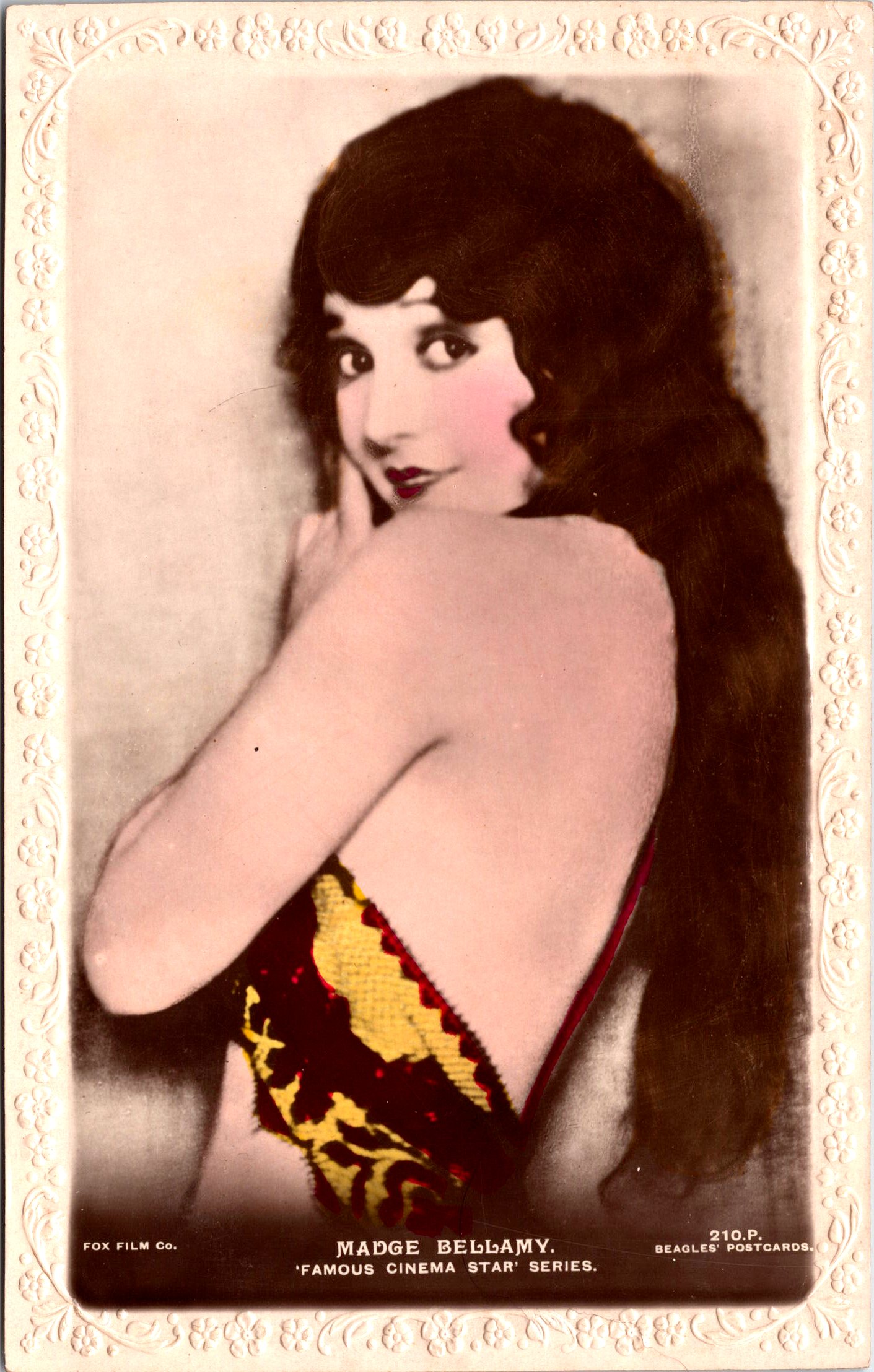
Postcard 1 is a hand tinted vintage real photo postcard that features Madge Bellamy (1899-1990), an American stage and film actress. She was a popular leading lady in films of the 1920’s and 1930’s. The sound era put the brakes on her career and a romantic scandal in the 1940’s brought it to a total stop. Madge was a Texan. She was born in Hillsboro and was raised in San Antonio and Brownwood. Her father was an English professor at Texas A&M University. As a young child she took dancing lessons but soon, she was interested in becoming an actress. At age 9, she made her stage debut in “Aida”. She and her family moved to Denver, Colorado. She met Carlos Bellamy there and the two married. When Madge decided to leave the state to pursue acting, her marriage ended. Madge went to New York City and worked on Broadway as a dancer. In 1919, she replaced Helen Hayes in Broadway’s “Dear Brutus”, opposite actor, William Gillette. Her career took off thereafter. In 1920, Madge appeared in her first film as a supporting actress to Geraldine Farrar. She then signed a contract with the Triangle Film Corporation. Her “breakout role” was as the title character in Lorna Doone (1922). In 1924 she signed a film contract with Fox Film Corporation. She stayed there five years and during that time she appeared in two films for film director, John Ford. In 1925, she began to have difficulties with fox executives. In 1928, she appeared in Fox’s first talking film, “Mother Knows Best”. In 1928, she married for a second time. The marriage lasted 3 days before she and her husband separated. By 1929, Bellamy’s career entered a tail-spin. She had made poor choices out of her unbridled anger. Fan magazines gave her the nickname of “Miss Firecracker” due to her temperament. In 1929, she also quit her contract with Fox, right after they bought the rights to make a film out of Broadway play. The vehicle was bought with a plan to have Madge be it’s star. Bellamy later admitted she quit over money and added “I got too big for my britches”. She didn’t work again until 1932. She accepted roles in “Poverty Row” (B-movies) films. One of these films was “White Zombie” (1932) in which she appeared opposite Bela Lugosi. Her performance received many poor reviews from film critics. By 1940, Madge basically had no film career. However, she wasn’t done with drama. She was arrested after firing three shots from a .32 caliber revolver at her former lover of five years. The incident was premeditated. She was angry at her intended victim because he married a model shortly after ending their affair. Fortunately, her aim was poor and she missed. The only casualty was her ex boyfriend’s car which took a couple of shots into it’s body. Bellamy pleaded guilty to a lesser charge (violating gun laws), and received a suspended six month sentence and probation. Madge Bellamy’s IMDb filmography reports 61 credits between 1920 and 1945. This vintage postcard is provocative. This postcard is risque for it’s era. She is showing a lot of bare skin. The postcard was published while Madge was under contract with Fox. Therefore, the postcard is from before 1929. The card was published by J. Beagles and is part of the “Famous Cinema Star Series” (No.210P). (SOLD)
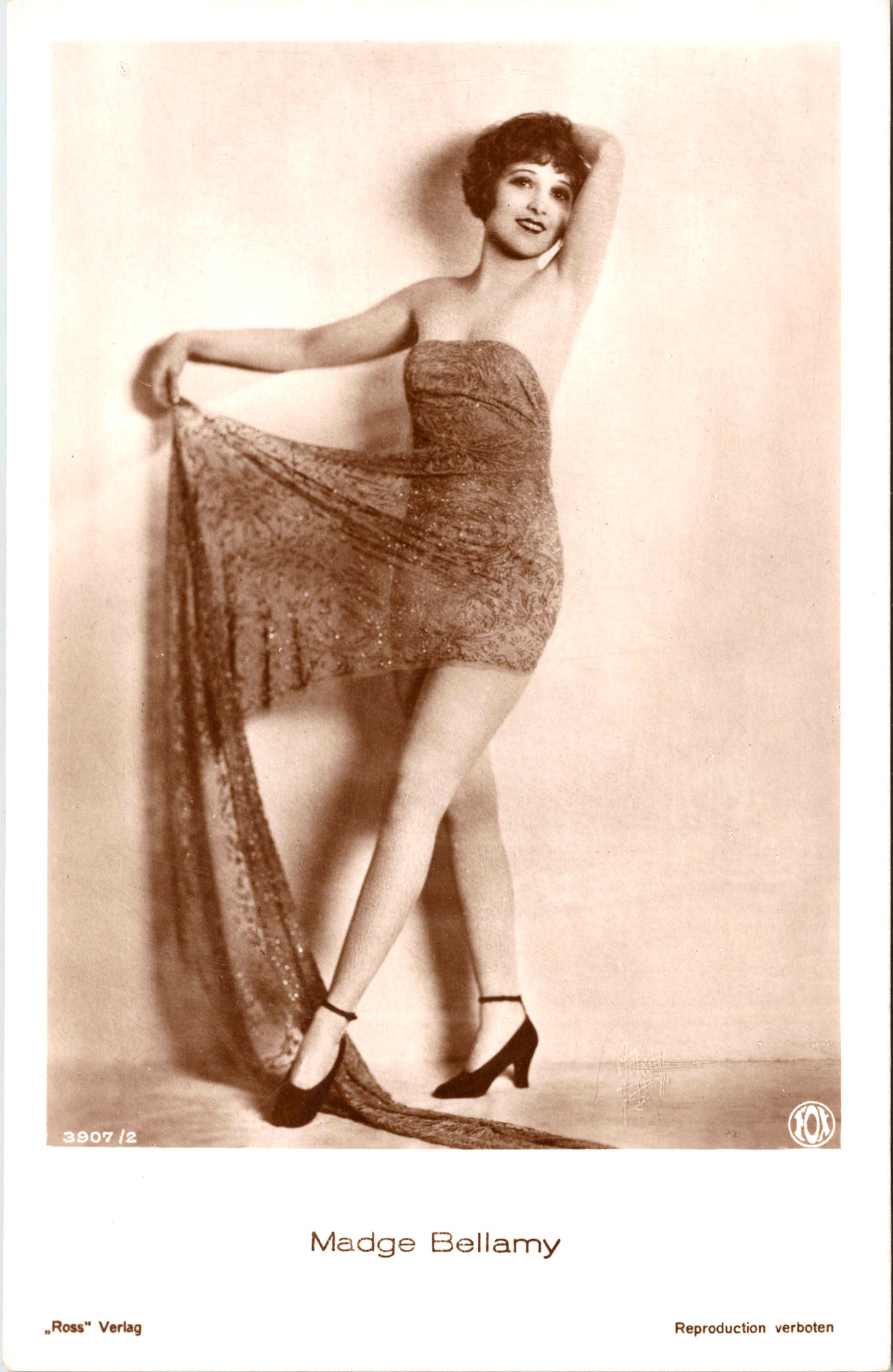
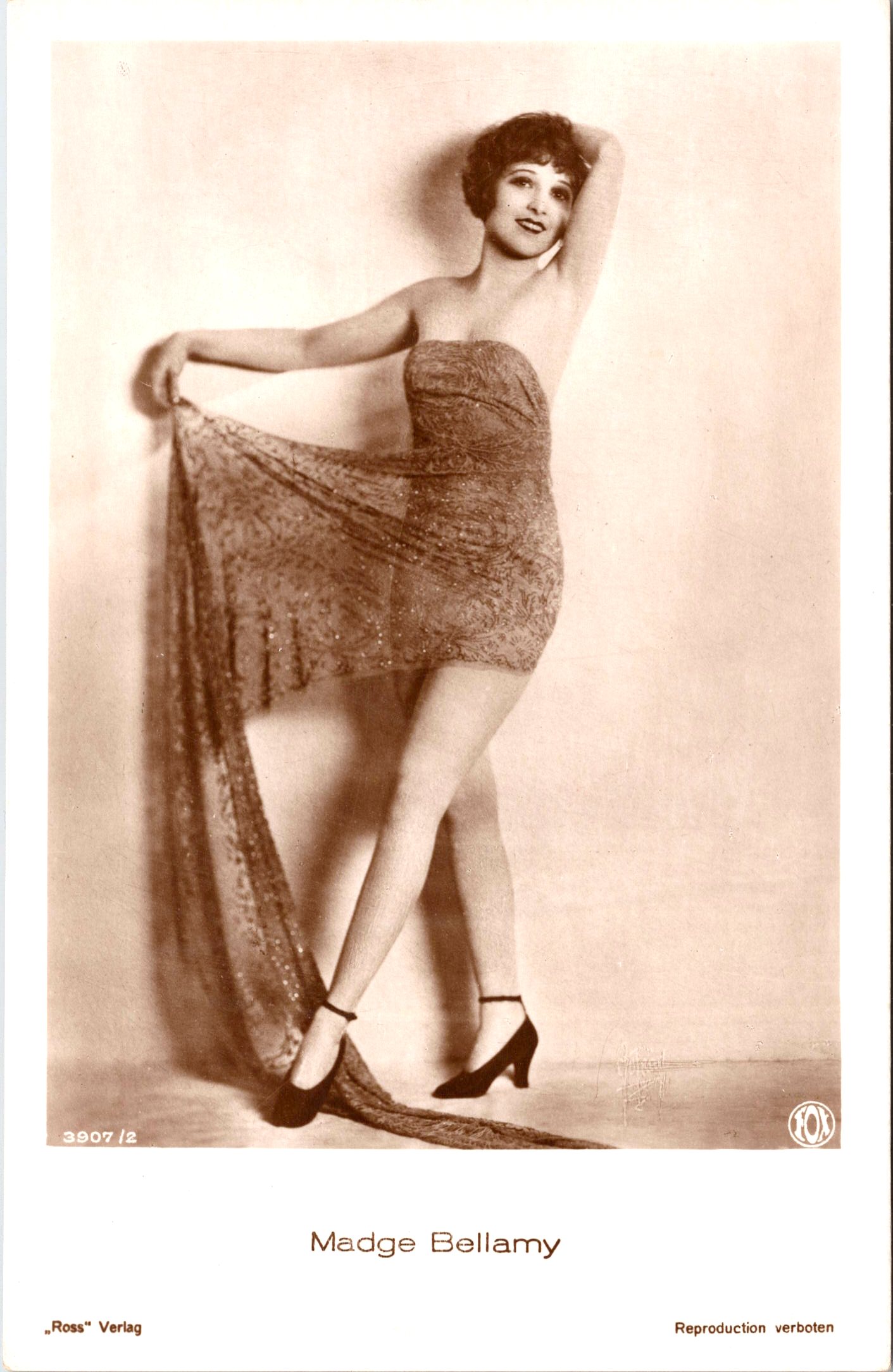
Postcard 2 offers another risque view of Madge Bellamy. Her alluring pose and short skirt qualifies this postcard to be considered provocative. This card was produced while Madge was under contract with Fox Films, sometime before 1929. This postcard was published by Ross Verlag as part of a series (No.3907/2). The postcard is in very good condition (see scans).
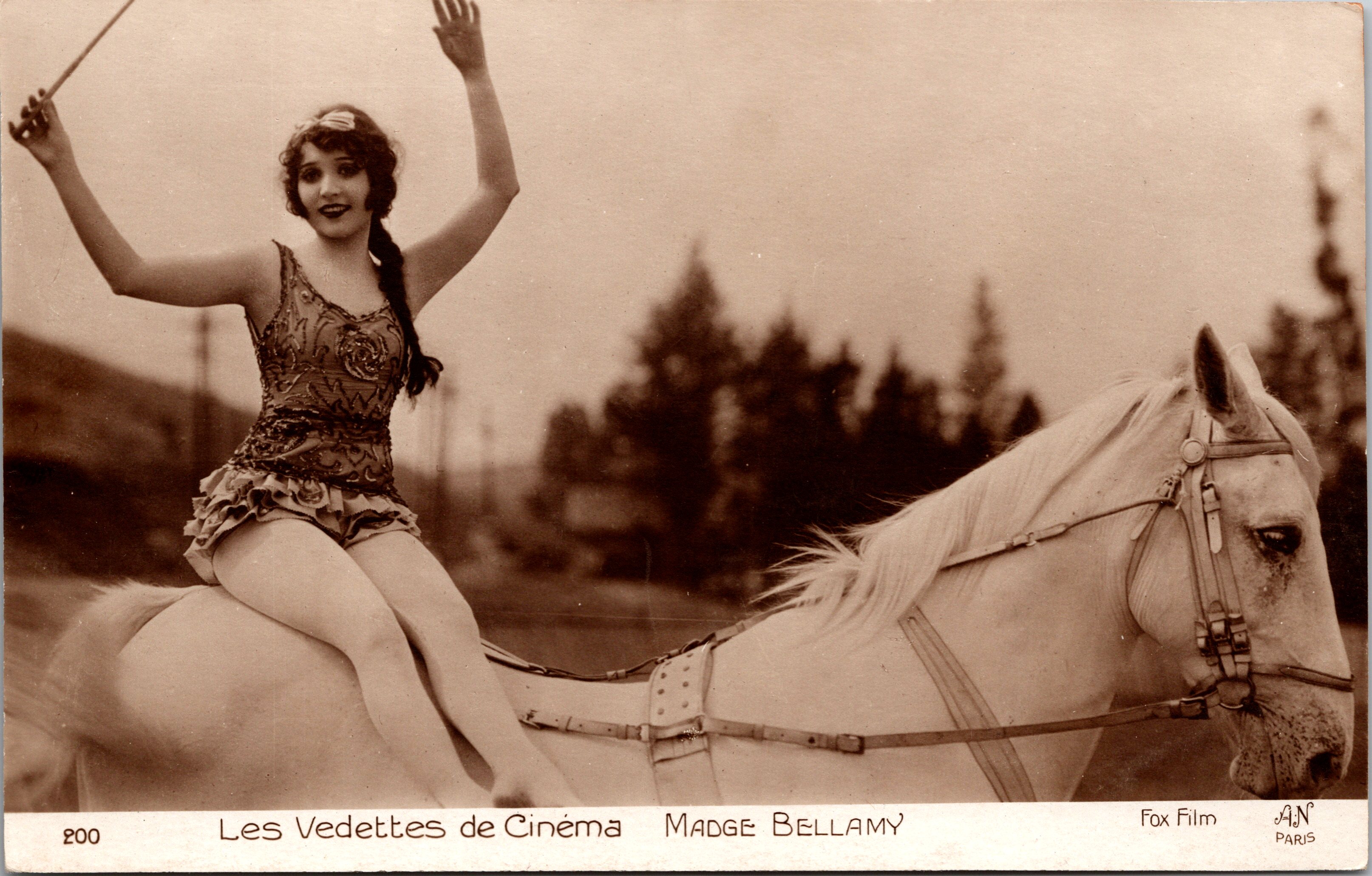
Postcard 3 is quite provocative. There are shades of Lady Godiva in this photograph. Miss Bellamy is pretty and scantily dressed. This postcard is risque for it’s era. The postcard was published while Madge was under contract with Fox. Therefore, the postcard is from before 1929. The card was published by Alfred Noyer and is part of the “Les Vedettes de Cinema” (The Stars of Film) series (No.200). This postcard is uncommon. (SOLD)
Buy this original Vintage Real Photo Postcard (includes shipping within the US) #7386
To purchase this item, click on the Pay with PayPal button below
$24.00
Buy this original Vintage Real Photo Postcard (includes International shipping outside the US) #7386
To purchase this item, click on the Pay with PayPal button below
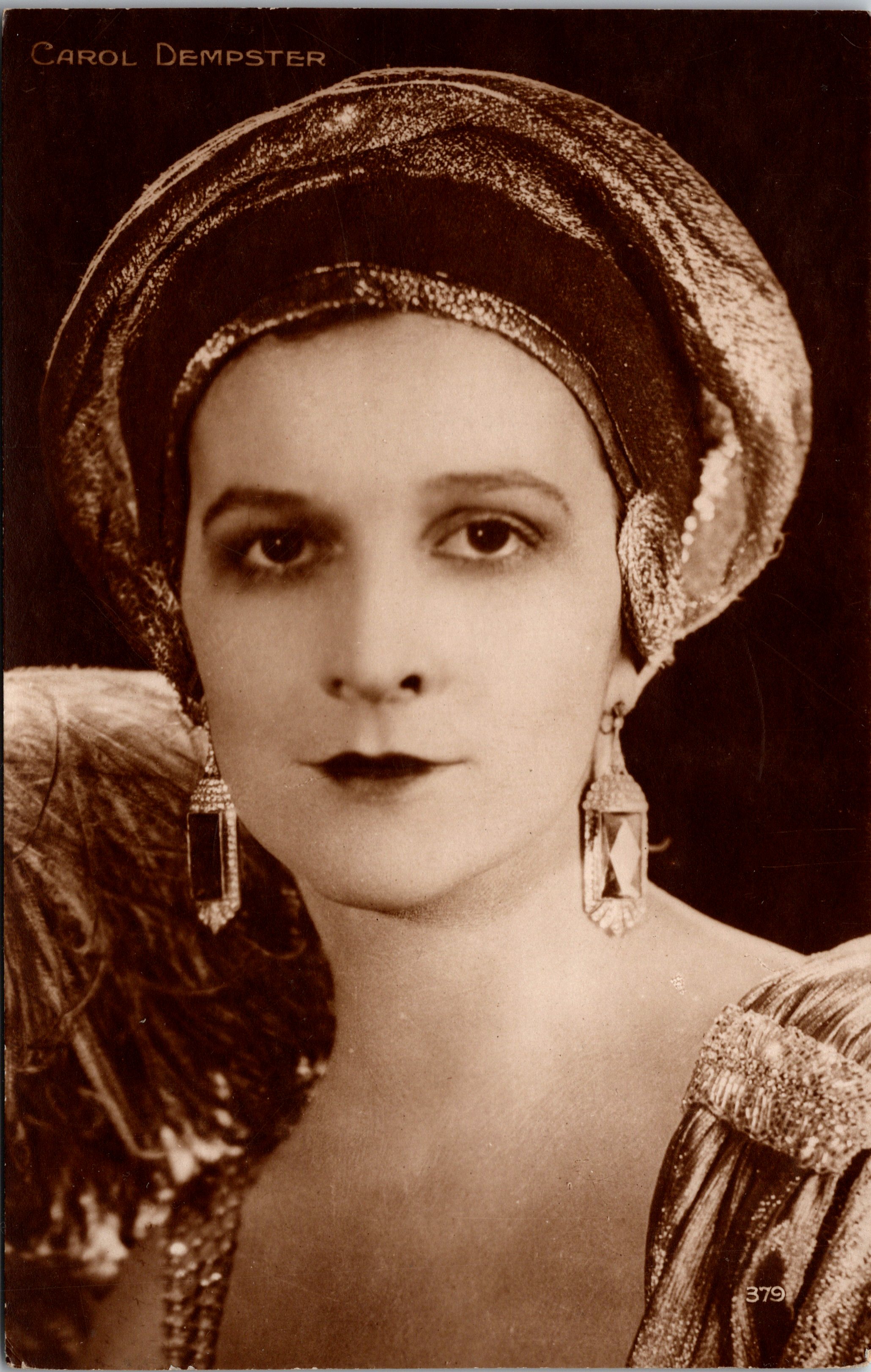
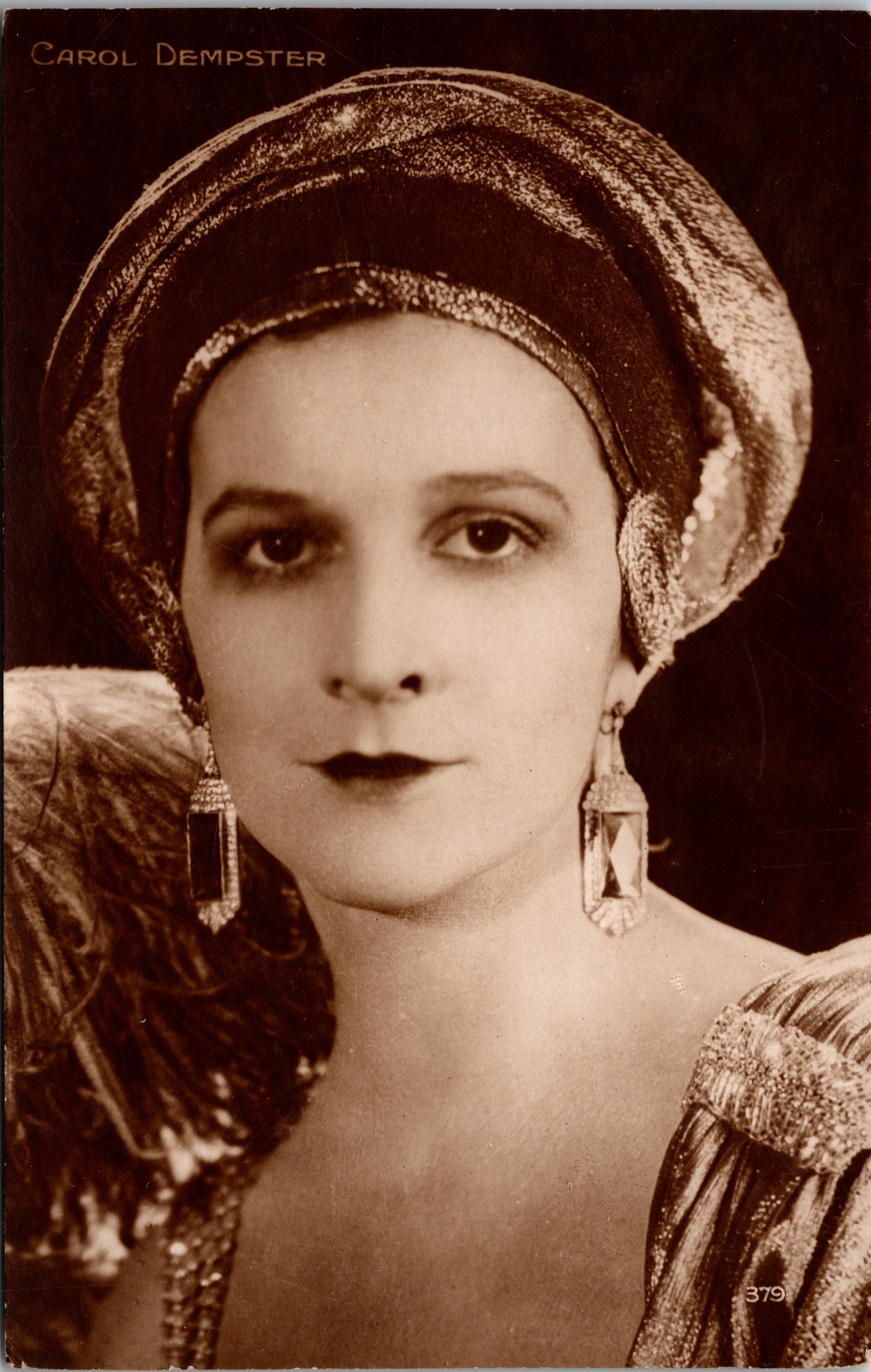
This vintage real photo postcard features American silent film actress, Carol Dempster (1901-1991). She was born in Minnesota. Her father was a captain on a ship that travelled on the Great Lakes. The family moved to California when her father switched careers. She was spotted dancing in a school program by noted dancer Ruth St. Denis. St. Denis recruited her for her own dance school. Griffith discovered her at the St. Denis school. Dempster began her film career as a protege of film director extraordinaire. She was one of a number of actresses he collected for his “stable”. Others included Lillian and Dorothy Gish, Miriam Cooper, and Mae Marsh. These other actresses were said to detest Dempster because she mimicked their acting styles. Dempster was given her first role in the 1916 film, “Intolerance”. She played a harem girl along with teenage newcomer, Mildred Harris. Dempster was just 15 years old. She became one of Griffith’s favorites and appeared in nearly every one the films he directed through the 1920’s. Their relationship became a romantic relationship during the arly 1920’s. Dempsters last film appearance was in 1926. She retired that year to marry a wealthy banker. Dempster was not seen as a great actress by critics. She was overshadowed by Lillian Gish. In addition her animated acting style and physical appearnce were considered relatively ordinary. The IMDb reports that Dempster appeared in 19 films between 1916 and 1926. This vintage postcard offers a closeup view of Miss Dempster She looks pretty and glamorous. The card was published by Cinemagazine (Paris Edition). The postcard dates back to the 1920’s and is in very good condition (see scans).
Buy this Vintage Real Photo Postcard (includes shipping within the US) #5295
To purchase this item, click on the Pay with PayPal button below
$25.00
Buy this Vintage Real Photo Postcard (includes International shipping outside the US) #5295
To purchase this item, click on the Pay with PayPal button below
This vintage real photo postcard features American actress, Thelma Todd (1906-1935). She rose to prominence during the 1920s and 1930s as a comedic actress in both silent films and early talkies. Todd became known for her beauty, talent, and comedic timing, appearing in over 120 films throughout her career. She was nicknamed “The Ice Cream Blonde” and “Hot Toddy”. Todd began her entertainment career as a teenager, winning several beauty pageants before making her way to Hollywood. She started in the film industry as an extra and later secured minor roles in silent films. Her breakthrough came when she signed a contract with Hal Roach Studios, where she starred alongside comedy legends like Laurel and Hardy, Charley Chase, and Our Gang. In the late 1920s, Todd successfully transitioned into “talkies,” showcasing her ability to deliver comedic lines with charm and wit. Some of her notable films from this period include “Monkey Business” (1931), “The Maltese Falcon” (1931), and “Horse Feathers” (1932). Despite her success on the silver screen, Todd faced personal challenges and setbacks. She had a tumultuous love life, including relationships with prominent figures such as director Roland West and gangster Lucky Luciano. Her relationship with West, who was married at the time, was marred by rumors and scandals. Tragically, on December 16, 1935, Thelma Todd’s life was cut short under mysterious circumstances. Her body was found in her car, parked in the garage of her café, the Thelma Todd’s Sidewalk Café in Pacific Palisades, California. While the exact cause of her death remains uncertain, it was officially ruled as accidental carbon monoxide poisoning due to a faulty garage heater. However, some speculation and conspiracy theories surrounding her death have persisted over the years. This postcard was published as part of the “Picturegoer” series (no.413). SOLD
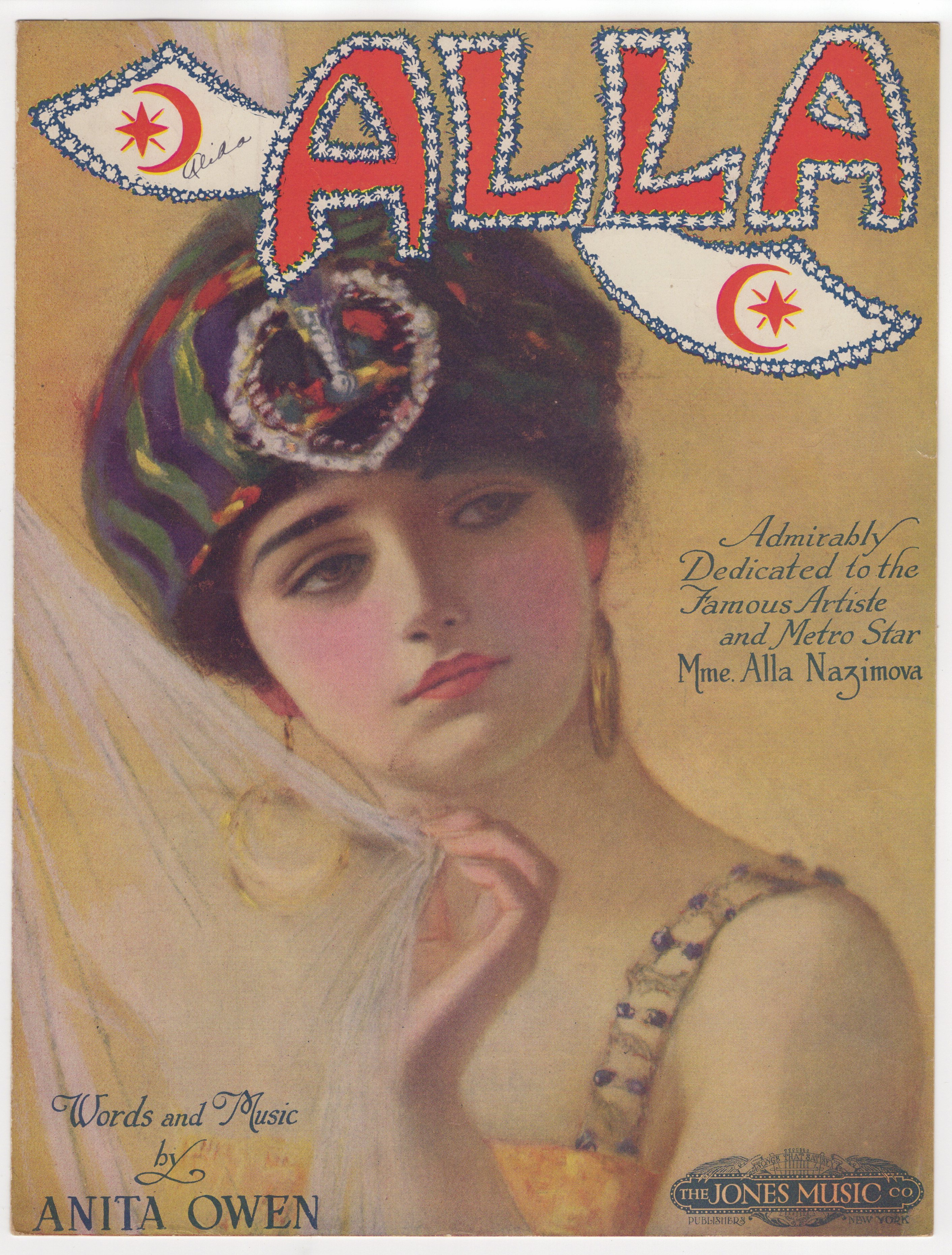
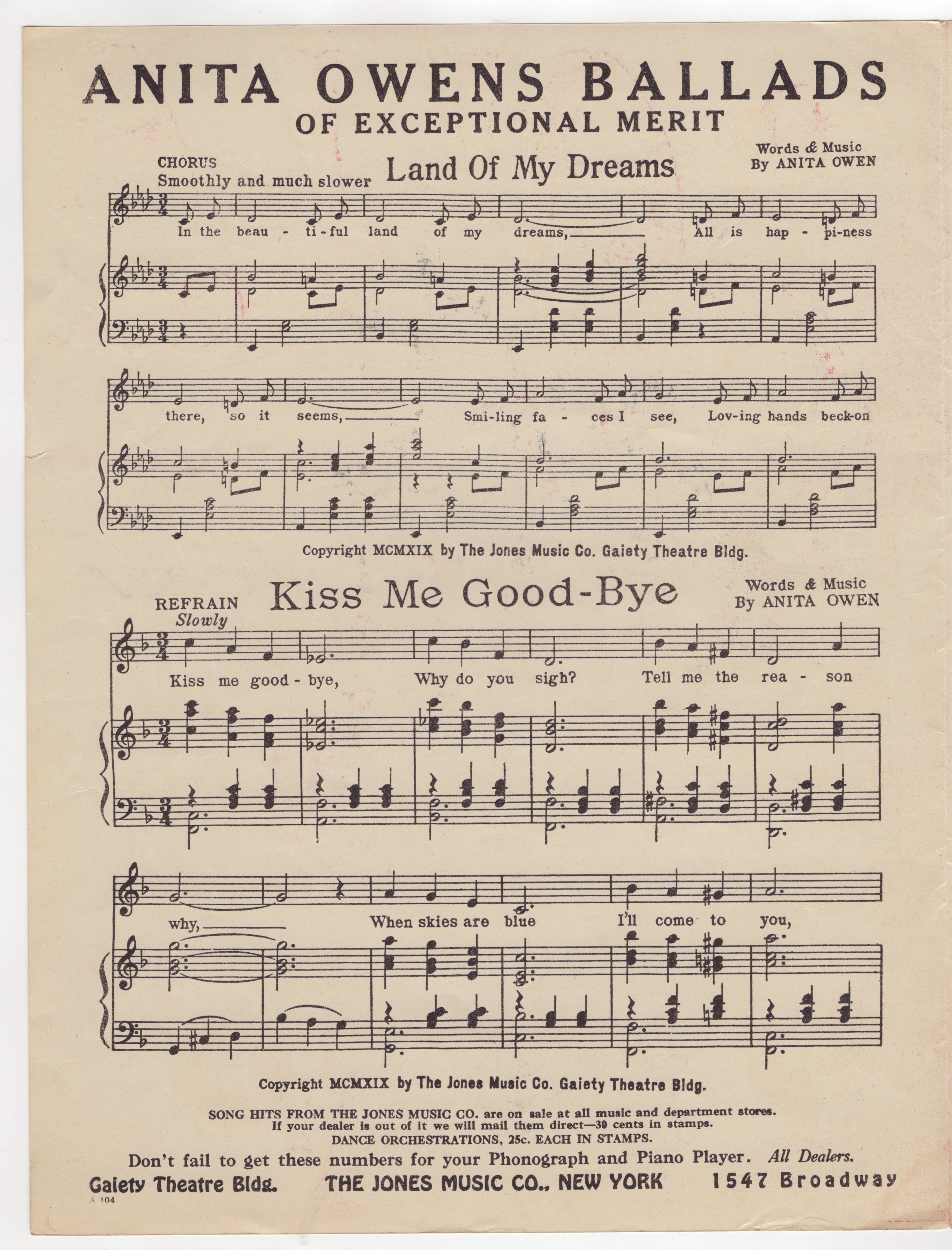
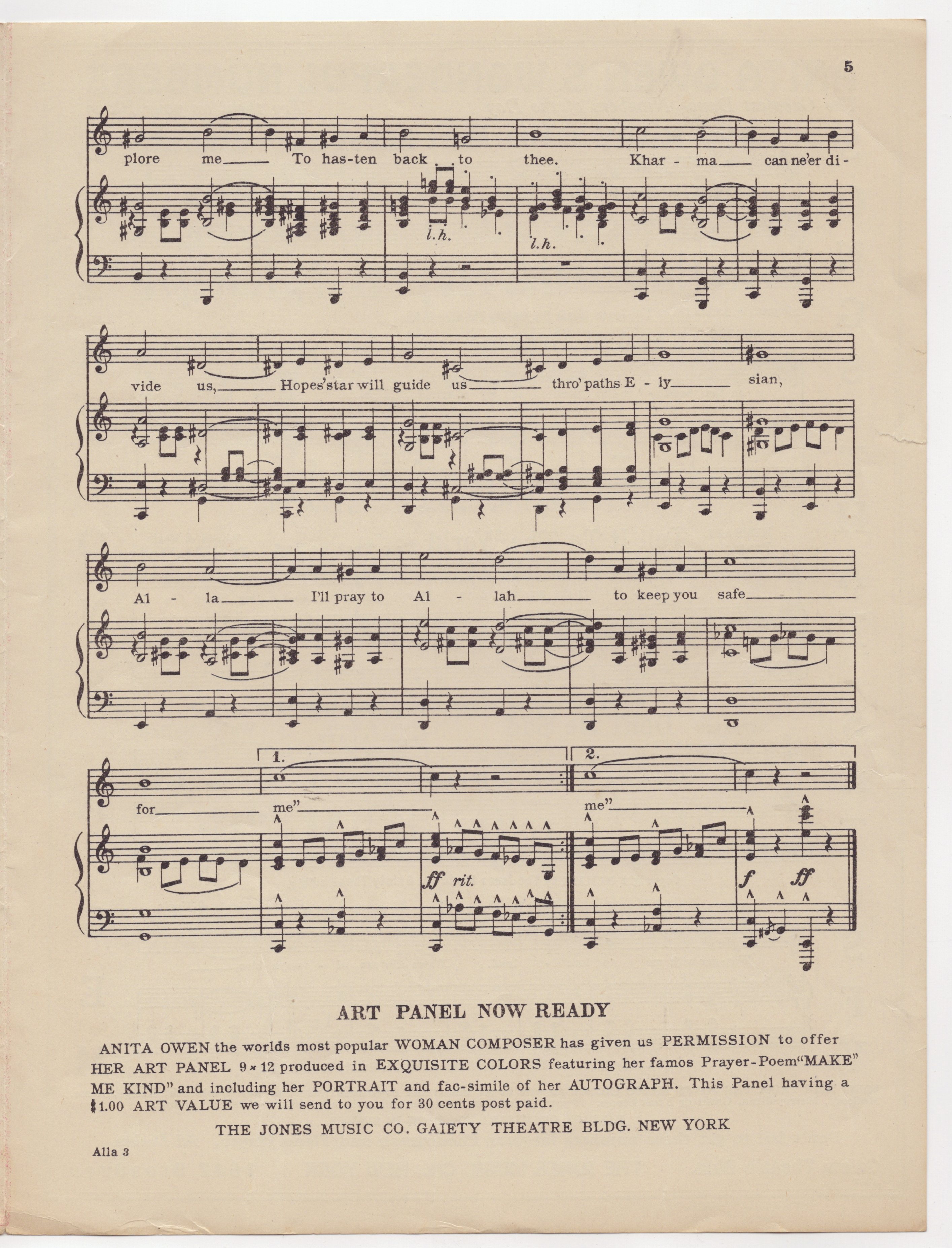
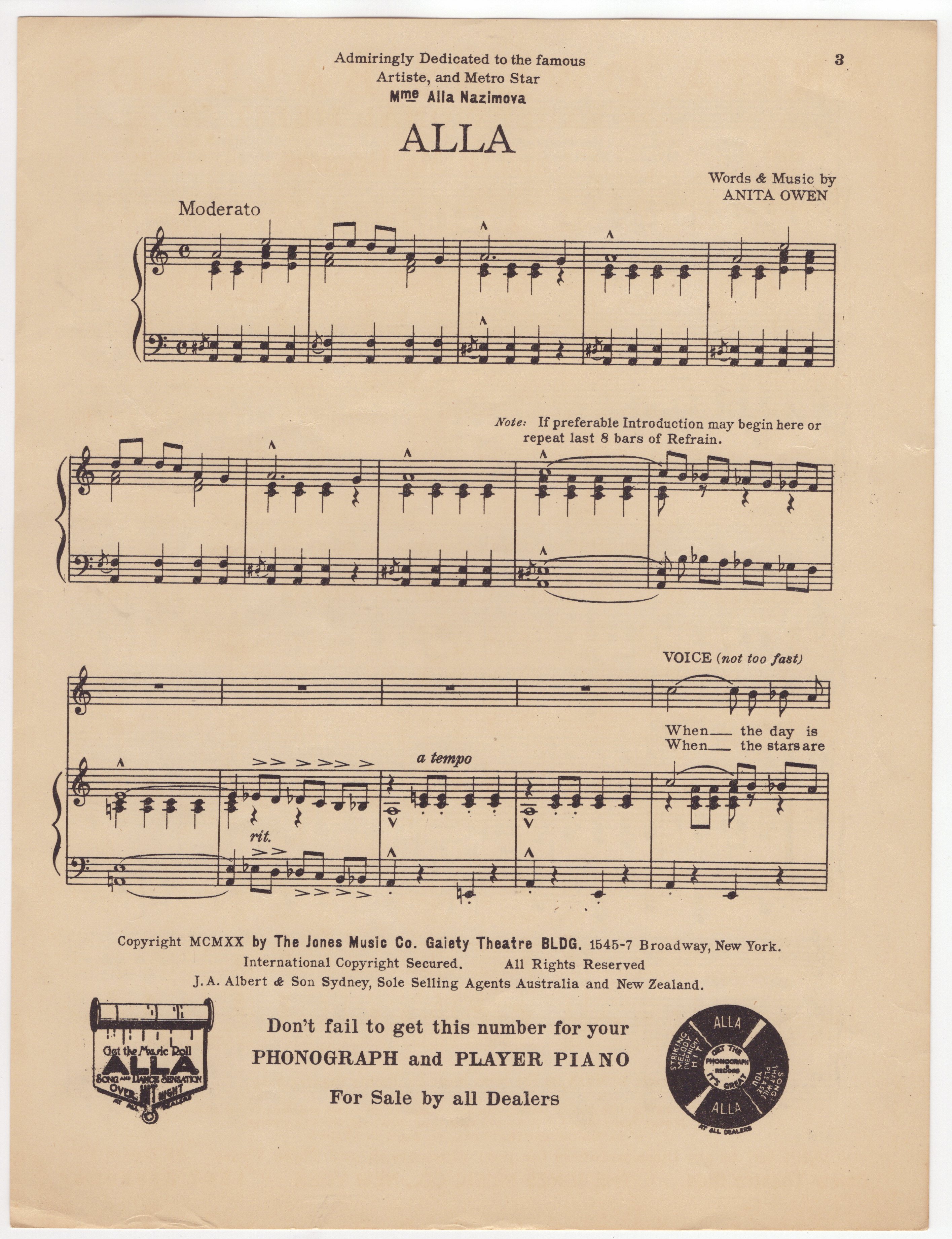
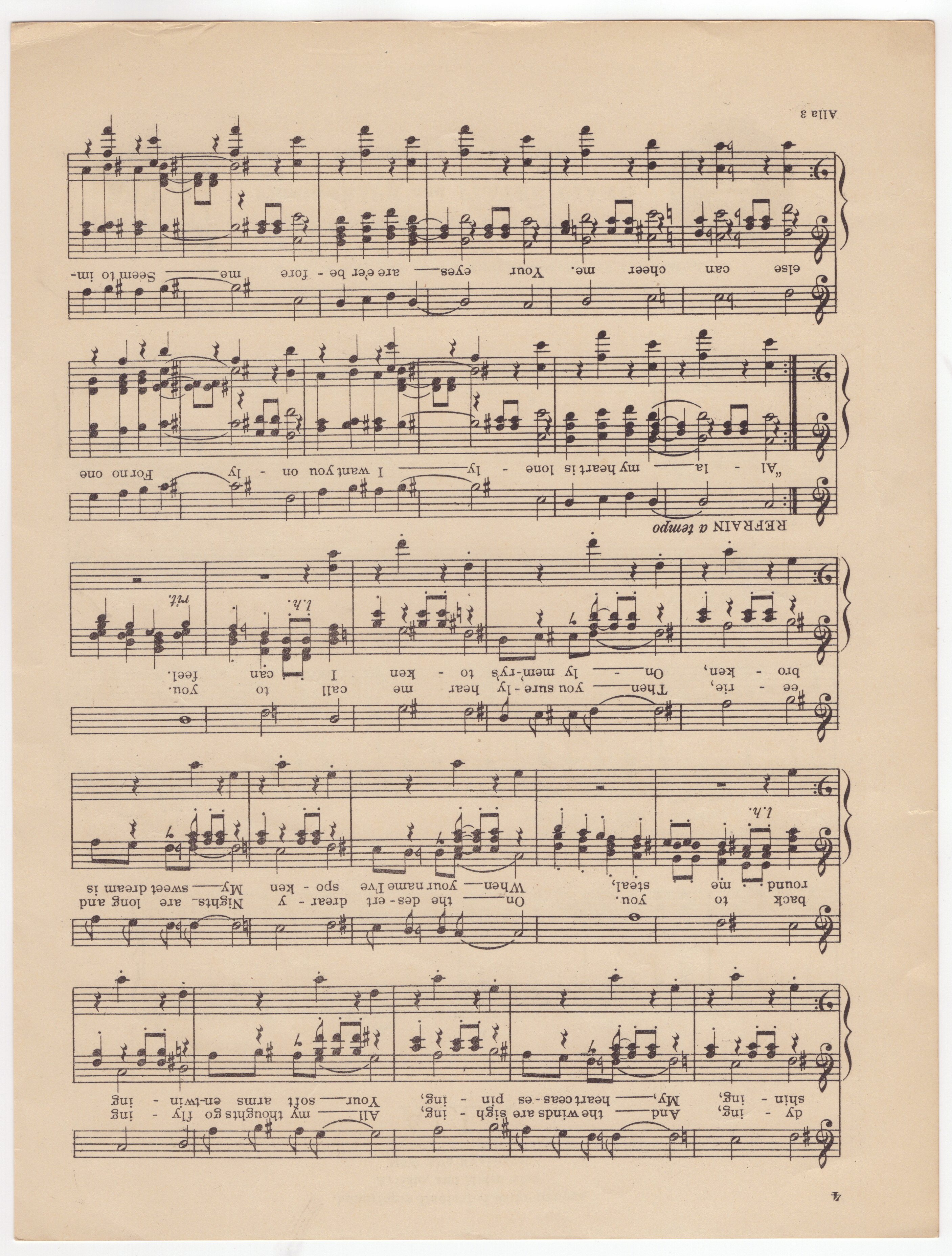
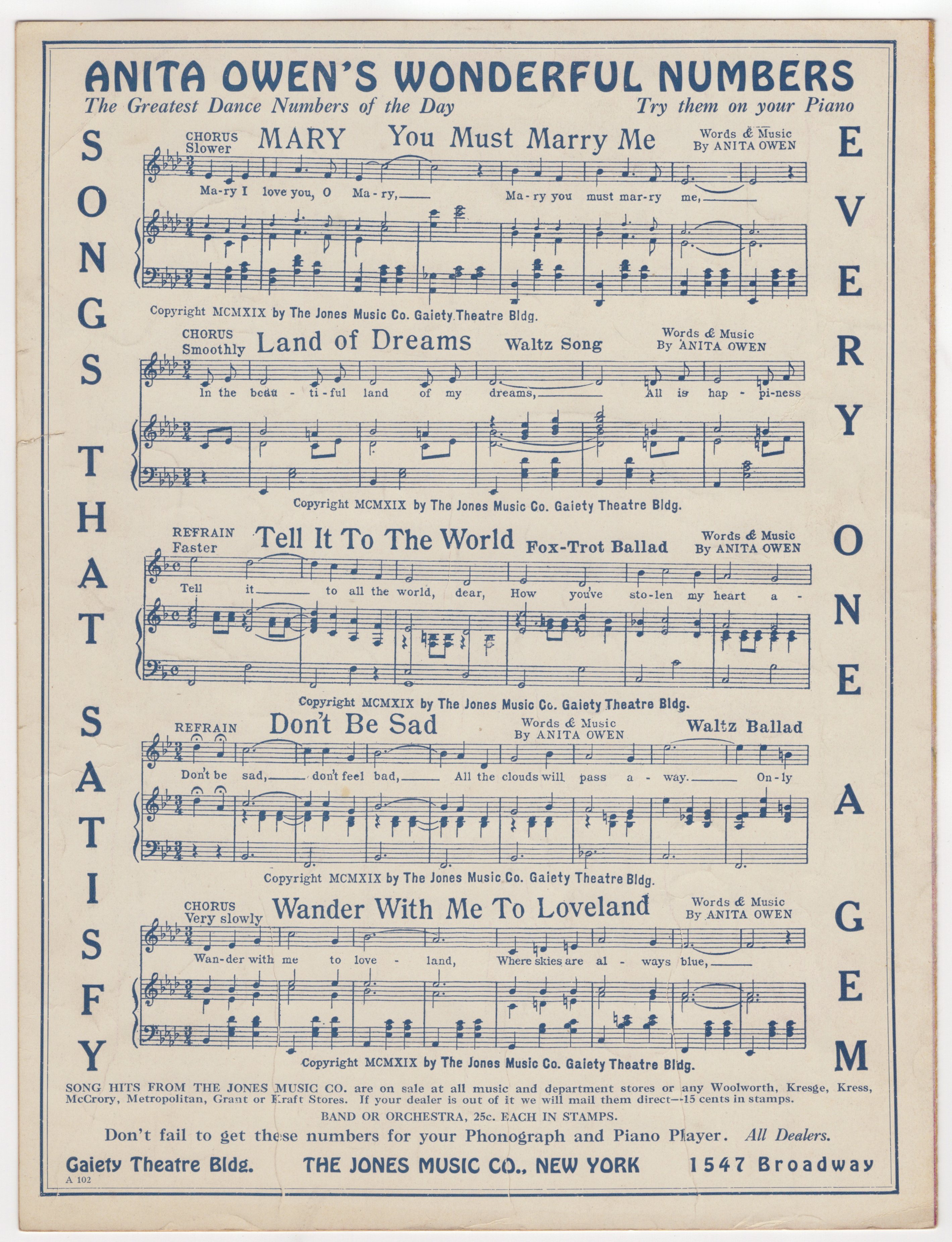
This vintage sheet music is entitled “Alla”. The music is dedicated to the “Famous Artiste and Metro Star”, Mme Alla Nazimova (1879-1945). She was a Russian-American actress, director, producer and screenwriter. She was noted for her classic Broadway work. She acted in the plays of Ibsen, Chekhov, and Turgenev. She later worked in film. She acted, wrote screen plays and directed films. Her film “Salome” (1922) is considered a “cultural landmark”. Nazimova was bisexual and her sexual escapades garnered much public attention. A portrait of Nazimova graces the front cover of this sheet music. This sheet music was published by The Jones Music Company in 1920. The firm was based in New York City. This sheet music is in very good condition (see scans). SOLD
This vintage real photo postcard features Hungarian actress, singer, dancer, and model, Kathe von Nagy (1904-1973). She performed in both German and French films. Her father was a wealthy bank manager. At the age of sixteen, Nagy wanted to get married but her parents did not approve and sent her to a convent near Vienna, Austria. She stayed there 18 months but finished school elsewhere. Nagy wanted to become an author. She moved to Budapest and wrote articles for a magazine. She became interested in acting and enrolled in an acting school near Budapest. Her parents were none to pleased about her career choices and she was encouraged to return home where she worked in her father’s bank and secretly wrote novels. When she was about 22 years old, she moved to Berlin to pursue a career in film and worked for a Hungarian newspaper. She was given a role in a 1927 comedy film and by 1928, she began starring in films and was considered one of Europe’s top up and coming film actresses. She became a highly successful film actress. The IMDb reports that she appeared in 57 films between 1915 and 1952. She basically retired from film during the second world war. The head of the SS., Heinrich Himmler asked Nagy to be the face and body for “sex dolls” provided to German soldiers. The premise was that the use of such dolls would lessen the syphilis problems encountered by many of the soldiers. Nagy refused the offer. This story may be apocryphal. This postcard was published by Ross Verlag as part of a series (no.6085/2). Nagy’s photo was taken by the Yva studio located in Berlin, Germany. The name Yva is a pseudonym. The photographer was actually a woman named Else Ernestine Neulander-Simon (1900-1944). She was a German Jewish photographer and was well known for her “dreamlike, multiple exposed images”. She was a leading Berlin photographer during the Weimar Republic years of Germany. She specialized in fashion, nudes, and portraiture. Later, she became involved in the early days of producing photographs for advertising. Many of her photographs were published in magazines or were shown in international exhibitions. After the Nazis took power, she was forced to work as a radioagrapher (ie x-ray technician). In 1936 she was offered a job by Life Magazine, but her husband convinced her that life for German Jews would improve over time. He did not want to move and start a new life in a country where he did not speak the language. Unfortunately, she complied with his wishes. In 1938, Nazi regulations prohibited her from working as a photographer. In 1942, the Gestapo deported her and her husband to a death camp (probably Majdanek) where they were murdered. SOLD














 THE CABINET CARD GALLERY