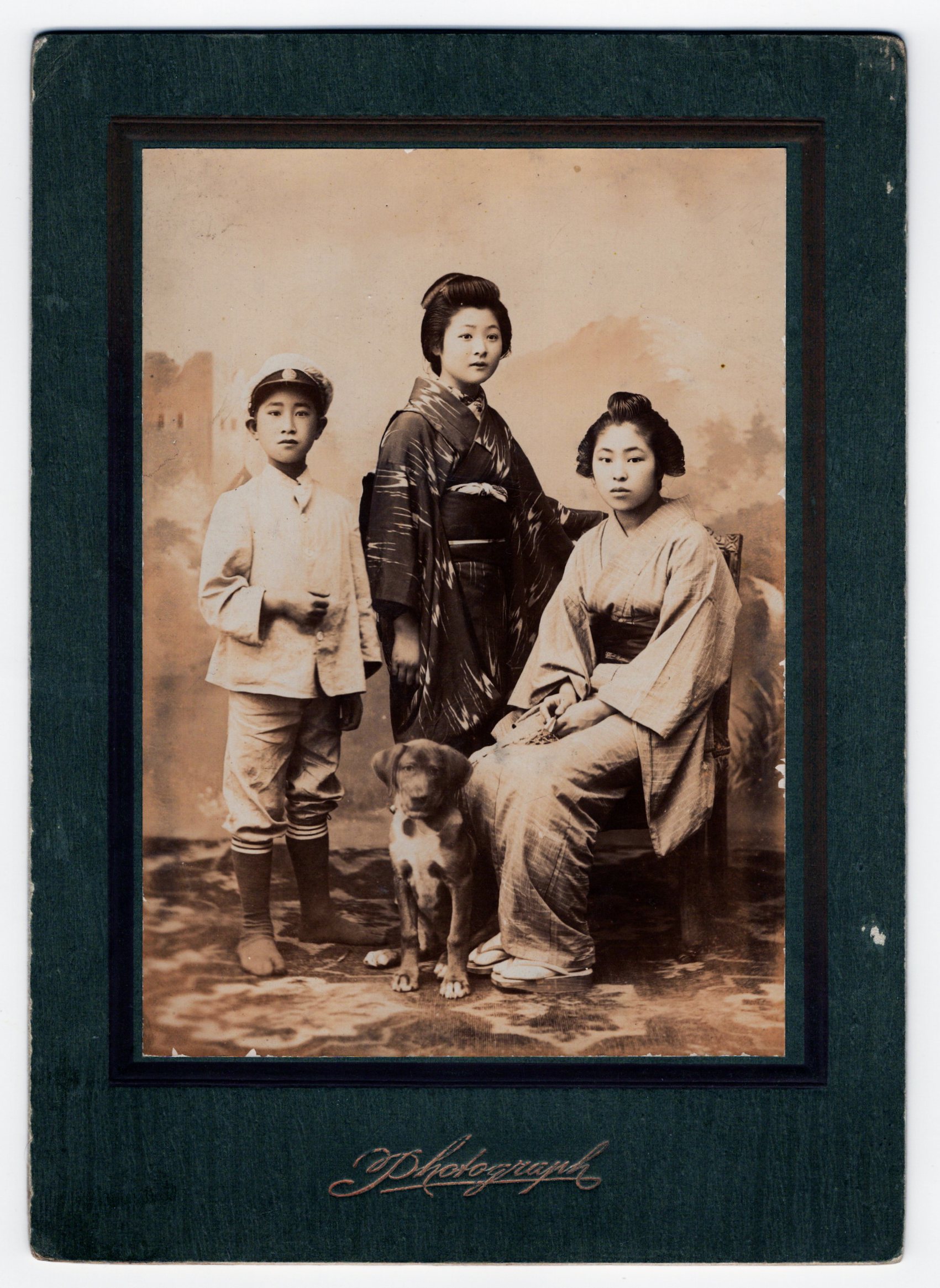
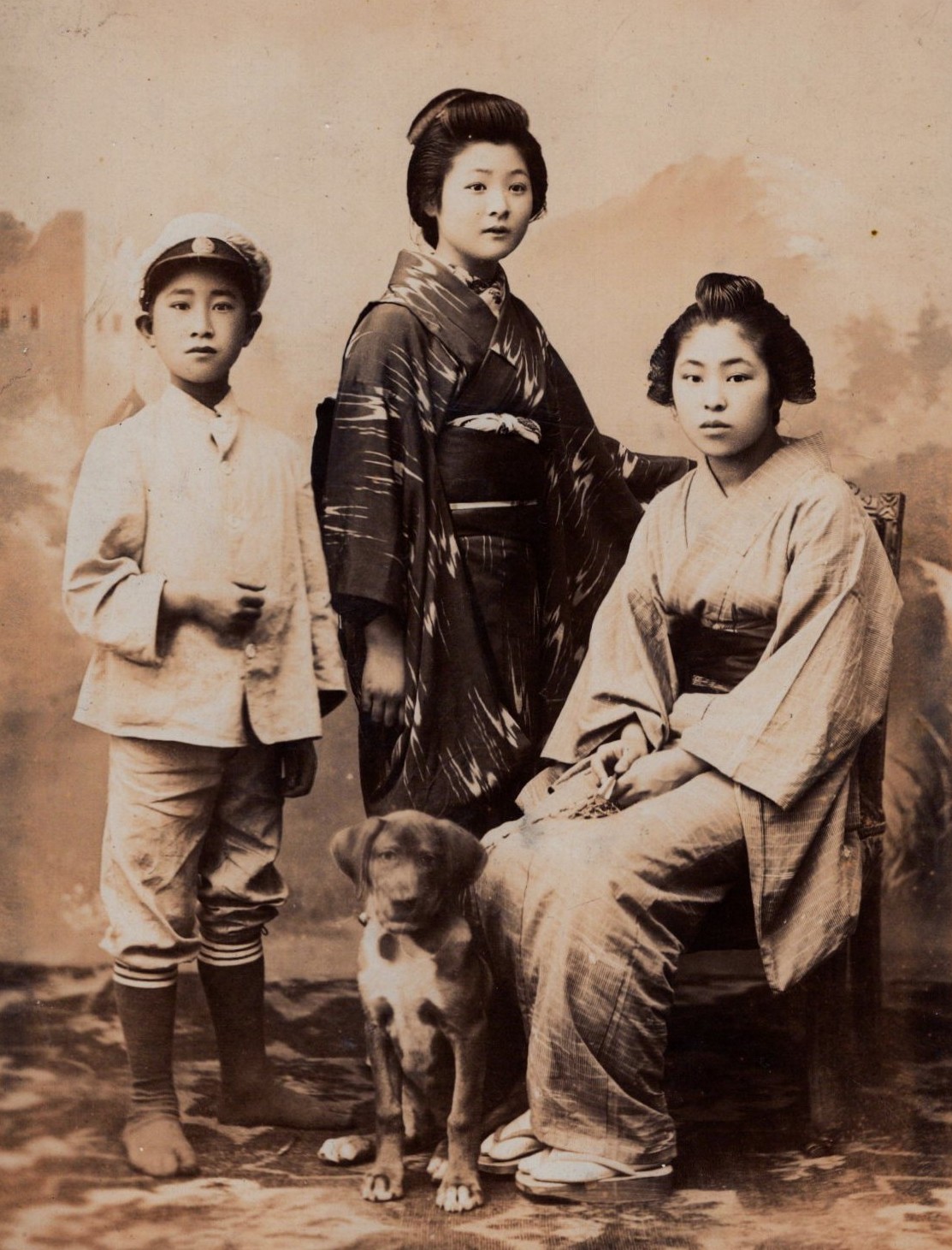
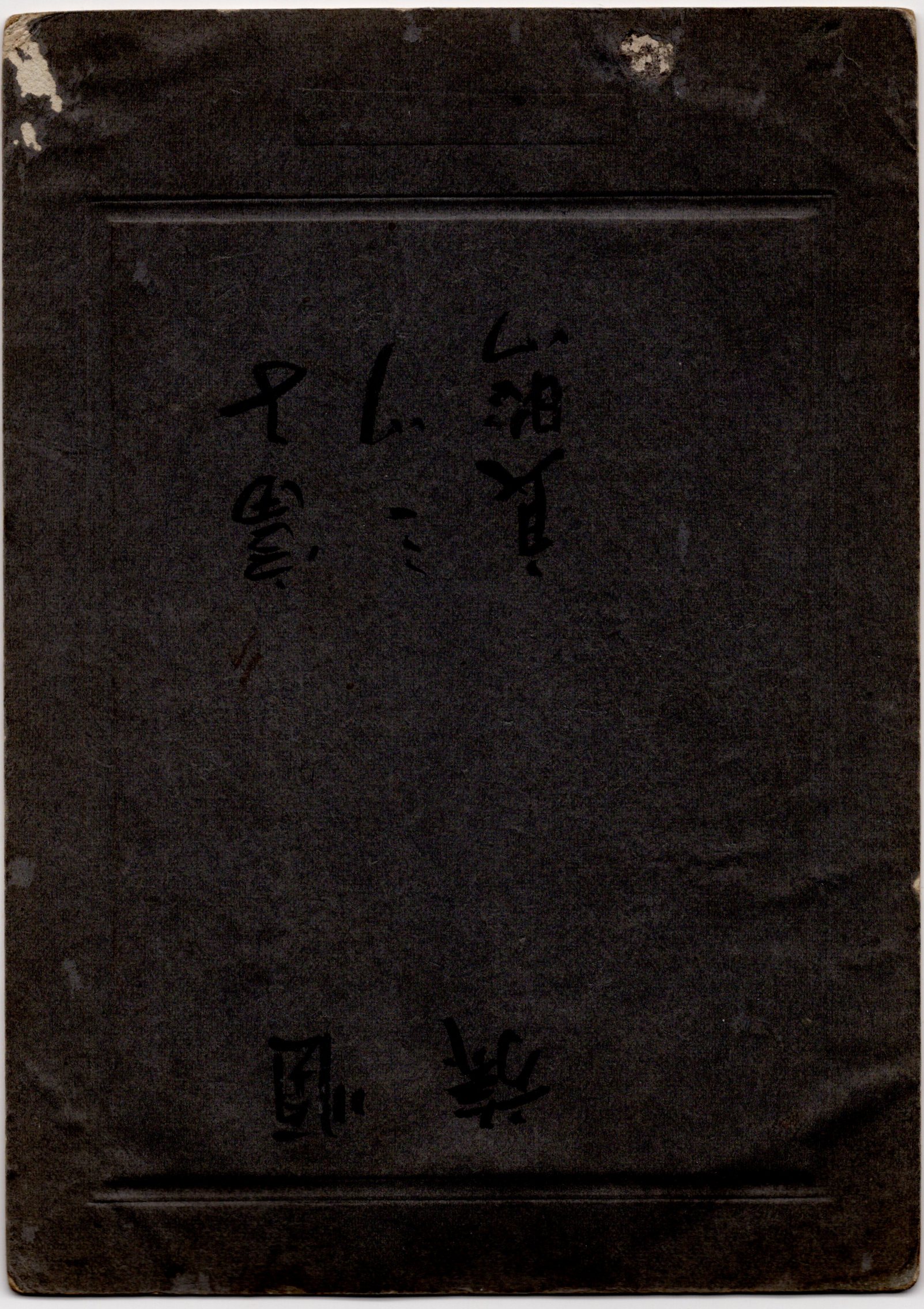
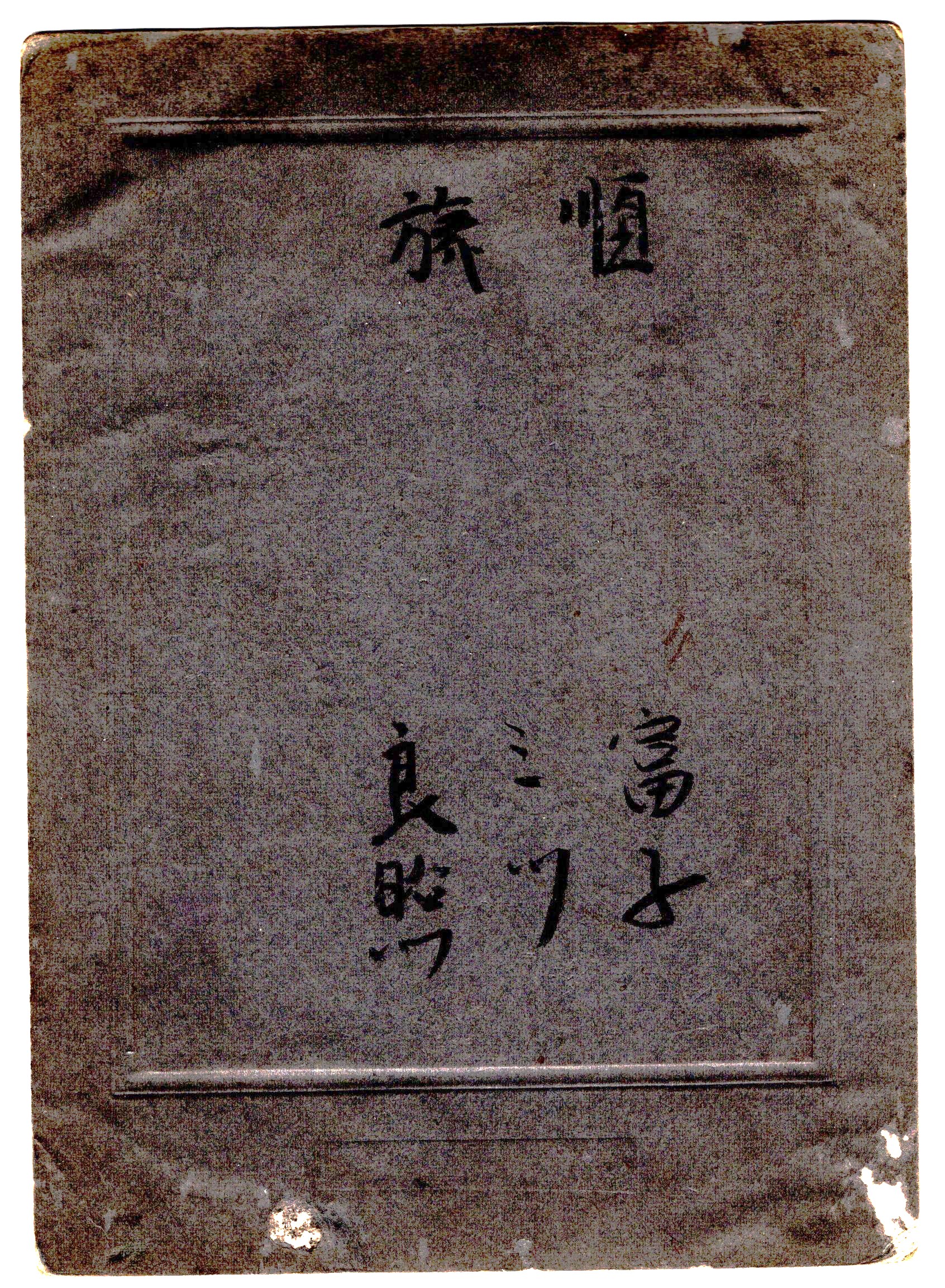
This cabinet card features a formal portrait of three individuals—two women and a boy—accompanied by a dog. The setting appears to be a professional photography studio, with a painted backdrop and a patterned floor covering. The young boy is dressed in a Western-style outfit, wearing a light-colored jacket, knee-length pants, tall socks, and a newsboy-style cap. His expression is neutral, and he holds his hands in front of him in a composed stance. The standing woman in the center wears a dark kimono with a traditional obi sash. Her hair is styled in an elegant updo, characteristic of the late Meiji or early Taisho period. She maintains a composed yet confident expression, resting one hand gently on the seated woman’s shoulder. The seated woman on the right wears a lighter-colored kimono with a darker obi. She has a calm expression and a poised posture, with her hands delicately resting in her lap. The dog, sitting in front of the group, is a medium-sized breed with a short coat. Its head is slightly tilted, giving it an endearing expression. The reverse side has handwritten Japanese inscriptions, adding to its historical interest. This cabinet card likely dates to the late Meiji period (circa 1895–1912) or early Taisho period (1912–1926), based on clothing style and photograph format.(SOLD)
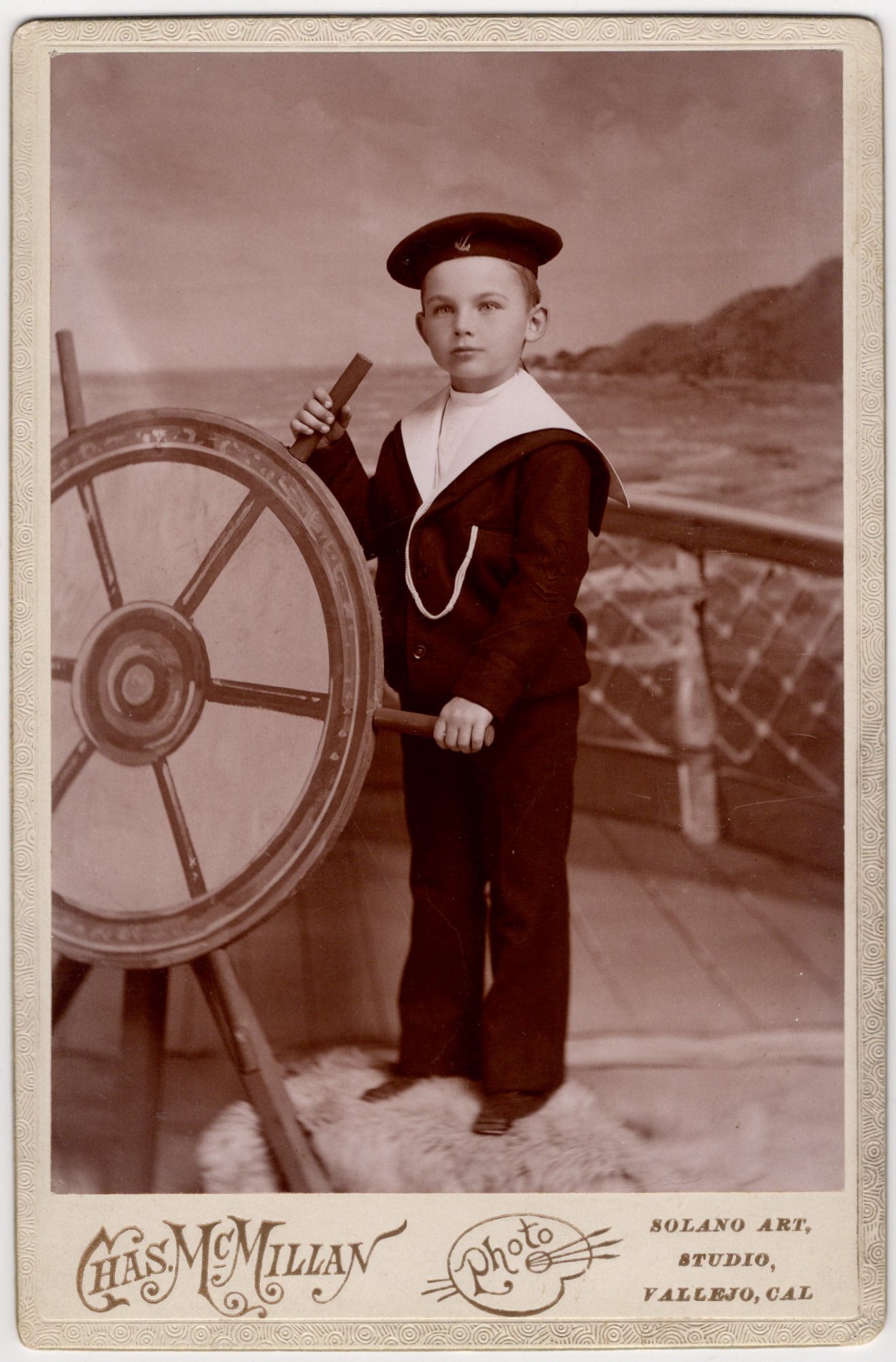
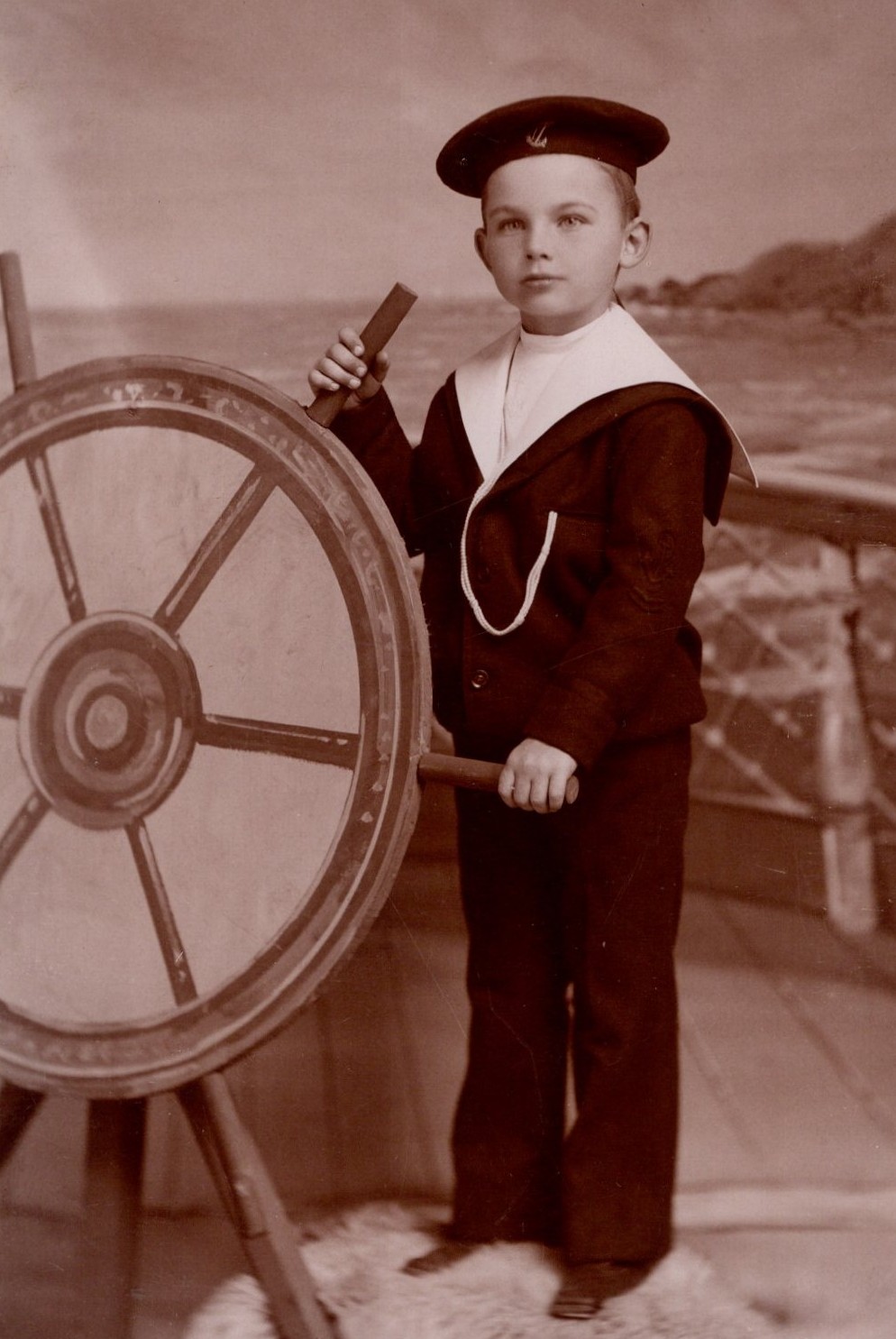
This item is a charming and visually striking cabinet card photograph of a young boy dressed in a sailor suit, posed at the helm of a ship’s wheel against a painted maritime backdrop. The child stands confidently as if steering a vessel, a popular and highly collectible studio theme of the late 19th century that reflected America’s fascination with naval power and seafaring life. This image was produced by Charles McMillan (Solano Art Studio). McMillan was one of the leading photographers in Vallejo, California, during the cabinet card era. Born in Canada in 1853, he began his career in Chicago before relocating to California in 1879. He eventually settled in Vallejo, where he established a successful studio. Vallejo itself holds a significant place in California history. Located in Solano County in Northern California, just northeast of San Francisco, Vallejo was an important naval and transportation hub during the late 19th century. It had earlier served briefly as the state capital in the 1850s and later became closely tied to maritime activity. The nautical theme of this photograph is therefore particularly fitting for Vallejo, reinforcing the connection between the studio setting and the maritime culture of the area. The boy’s sailor outfit—complete with cap, lanyard, and dark uniform—combined with the ship’s wheel prop and painted ocean backdrop, creates a wonderfully evocative and timeless image. The inclusion of a fur rug beneath his feet, a common studio prop of the period, adds an interesting and incongruous contrast to the otherwise maritime illusion. The cabinet card is in very good antique condition. The photograph remains strong with good contrast and pleasing sepia tones. There is minor corner wear. The mount is clean and the reverse is blank. See Scans.
This vintage cabinet card photograph is available for purchase at my store, The History Peddler, for $75.00 at auction.
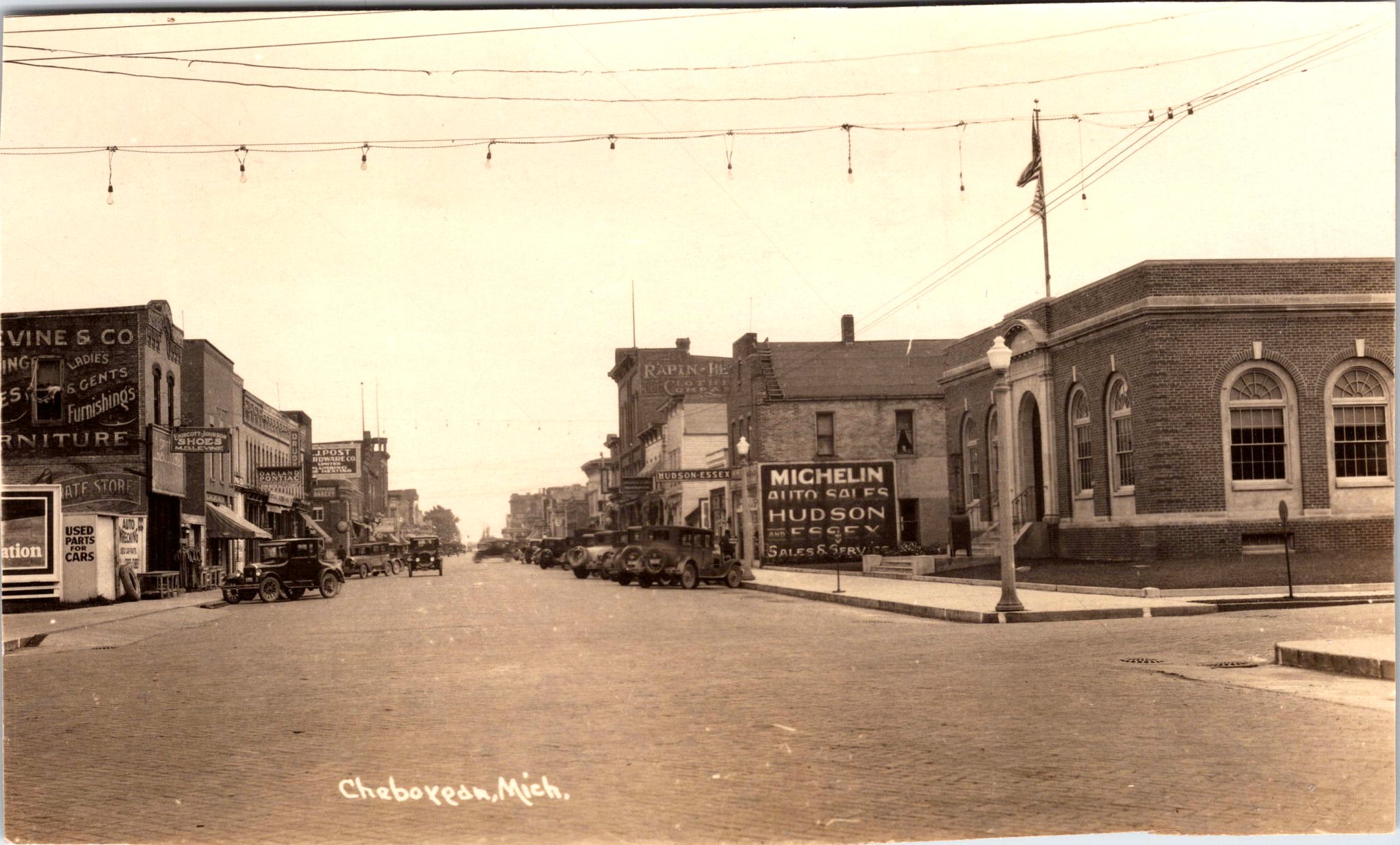
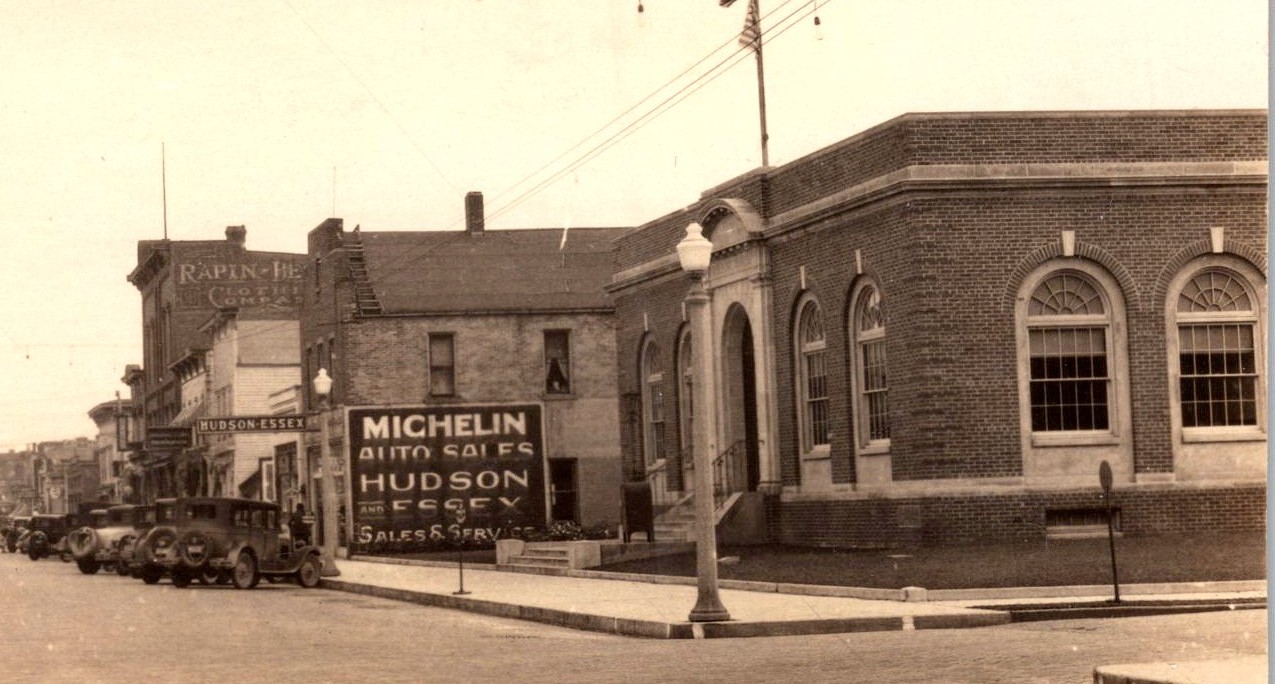
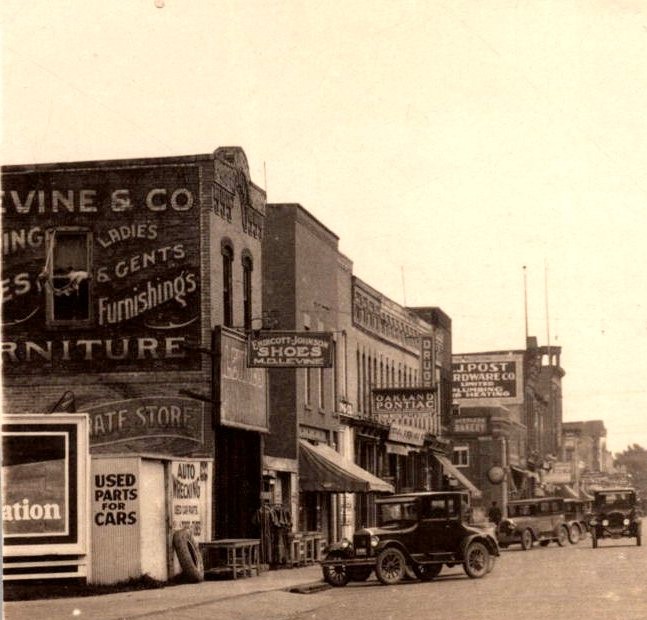
This rare and visually rich real photo postcard (RPPC) offers a crisp and detailed streetscape view of Cheboygan, Michigan, likely photographed in the late 1920s to early 1930s, based on the style of the automobiles parked along the brick-paved main street. The photo captures a classic American downtown, with storefronts, signage, and vintage vehicles creating a vivid snapshot of small-town life between the World Wars. Electric streetlight wires crisscross above the street, adding charm and historical character. On the left side of the street, visible businesses include: Levine & Co. – offering “Ladies & Gents Furnishings” and Furniture, Briscott & Johnson Shoes – M.L. Elvey, Pontiac Auto Sales – under a hanging Oakland Pontiac sign, J. Post Hardware, and a Used Parts for Cars and Auto Wrecking garage. On the right side one can see signs for: Michelin Auto Sales, Hudson and Essex Sales & Service, and a prominent brick building, likely the U.S. Post Office, flying an American flag. Also visible farther back are: J. Post Hardware Co., Rapin-Hirsh Clothing Company, and a Drug Store, barely visible beneath an awning. This view features a bustling commercial corridor, showcasing American small-town commerce in a transitional era when automobiles were beginning to dominate main streets across the country. Cheboygan is a small city in northern Michigan, located at the mouth of the Cheboygan River where it empties into Lake Huron. It sits just southeast of Mackinaw City, making it part of the gateway region to Michigan’s Upper Peninsula. Historically, Cheboygan was a center of the lumber trade and later developed a strong tourism and boating culture due to its proximity to the Great Lakes. SOLD
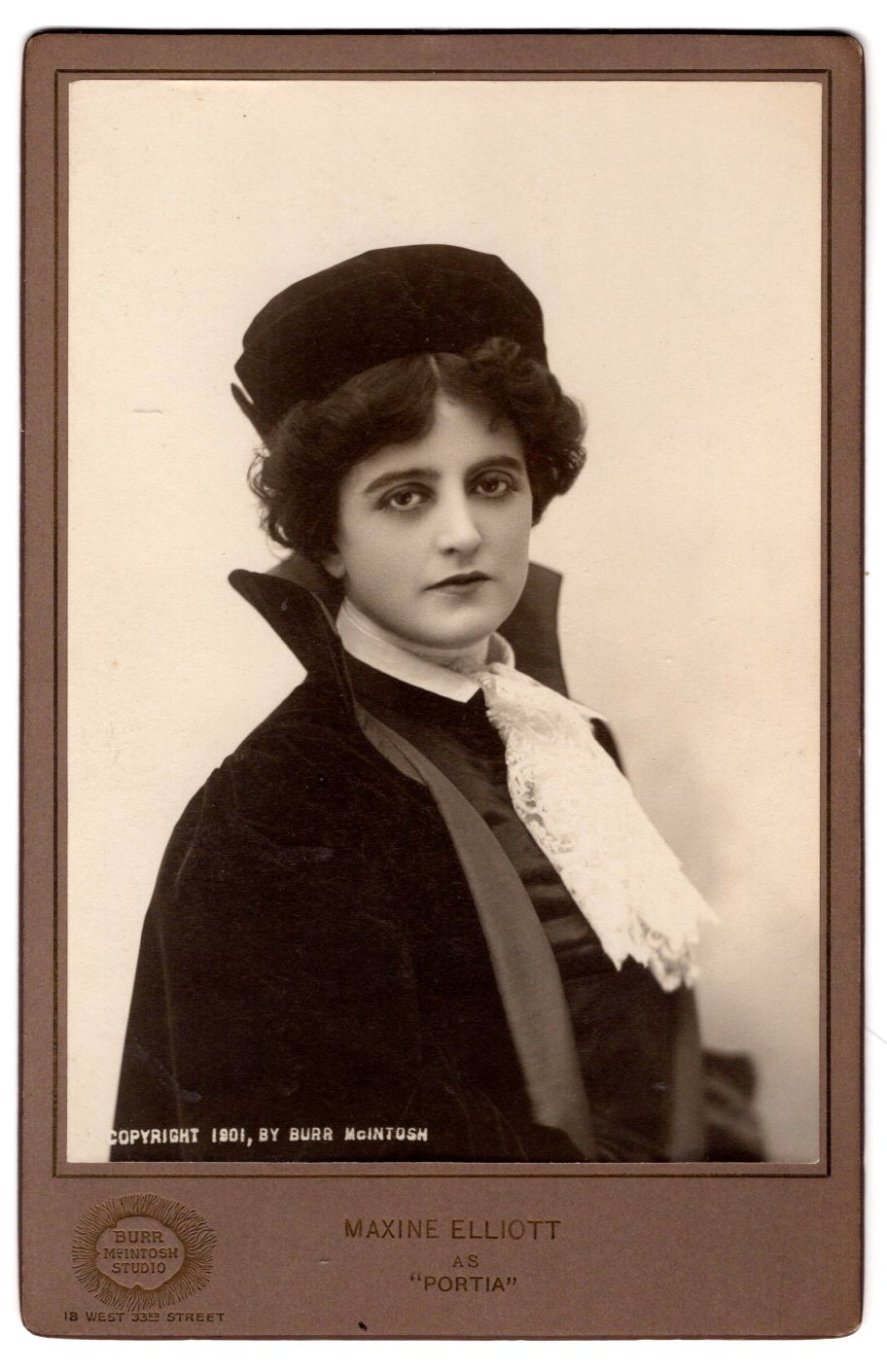
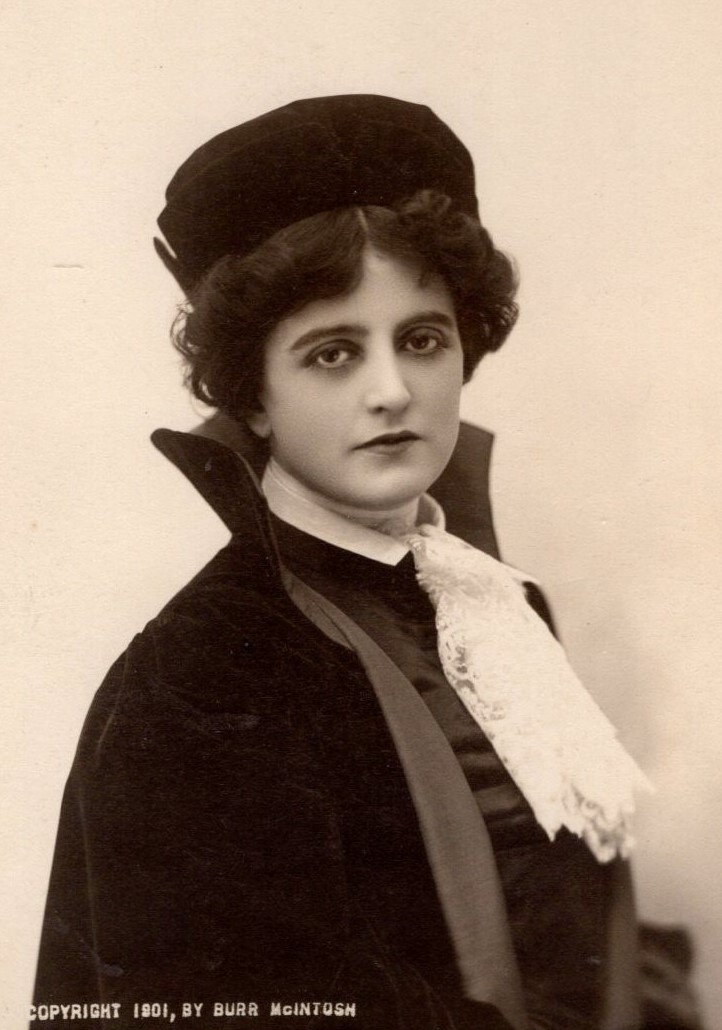
This cabinet card photograph features a portrait of beautiful stage and film actress, and businesswoman, Maxine Elliott (1868-1940). The photograph was taken in 1901 by Burr McIntosh at his New York City studio. The photograph captures her in costume playing “Portia” in William Shakespere’s “The Merchant of Venice”. Elliott was more than a stage actress. She managed her own theater and experimented with silent films in the 1910’s. Elliott was an extremely popular actress. Apparently she was popular with the men too. It is thought that she had affairs with famous people including King Edward VII and J. P. Morgan. It is also reported that she dated baseball hall of famer, John Montgomery Ward and heavyweight champion Gentleman James Corbett. During World War I she was very involved with the cause for Belgian relief. Elliott was born in Rockland, Maine. Her father was a sea captain. She had at least three siblings including her sister Gertrude Elliott, who also became a successful actress. When Maxine was 15, she was seduced and impregnated by a 25 year-old man. She may or may not have married the man but it is known that she lost the baby. In 1890 she made her first stage appearance. Her big break came in 1895 when she was hired by Augustin Daly to be the supporting actress for the highly acclaimed actress, Ada Rehan. In 1898, after divorcing husband number one, she married comedian Nat C. Goodwin. The two starred together in a number of productions including “Nathan Hale” and “The Cowboy and the Lady”. In 1903, Maxine appeared in the Broadway production of “Her Own Way” (1903). The play launched Maxine into stardom. In 1905, the play went to London where King Edward VII requested an introduction to the pretty actress. They met and then rumors started about the pair having an intimate relationship. In 1908, Goodwin obtained a divorce from Elliott. This is about the time she met 70 year-old J. P. Morgan. They became friends and rumors of their romantic involvement were never confirmed. Financial advice from Morgan helped her become a wealthy woman. The same year as her divorce, she opened her own theater, “The Maxine Elliott” in New York City. She was both the owner and the manager. In fact, she was the only woman in the US, at the time, managing her own theater. In regard to acting on Broadway, Elliott had an extensive resume. She appeared in 22 Broadway productions between 1894 and 1920. In 1913, she began acting in silent films. The IMDb reports that she was in five films including “From Dusk to Dawn” (1913), “Fighting Odds” (1917), and “The Eternal Magdalene” (1919). In 1913, Elliott went to England and started dating tennis star Anthony Wilding, fifteen years her junior. According to one source, the pair planned to marry, but he was killed in action in World War I. As a result, Elliott became obsessed with the war and moved to Belgium where she volunteered her money and time toward Belgian relief. It is reported that she also nursed wounded soldiers. Belgium recognized her by awarding her the Belgian Order of the Crown. Elliott retired from the stage in 1920. She stated that she “wished to grow middle-aged gracefully”. This cabinet card portrait features a young and beautiful Maxine Elliott. The photographer of this image is Burr McIntosh of New York City. William Burr McIntosh (1862-1942) lived an interesting life. Among his job titles listed by Wikipedia, are photographer, lecturer, film studio owner, silent film actor, publisher of the “Burr McIntosh Monthly”, reporter, and radio and early film pioneer. His sister was Nancy McIntosh, a noted operatic soprano. He was a graduate of Lafayette College in 1884. His most noted film role was his appearance in D. W. Griffith’s film, “Way Down East” (1920). Wikipedia notes that he appeared in 53 films between 1914 and 1934. This image is a beautiful remnant of turn of the century Broadway theater history. SOLD
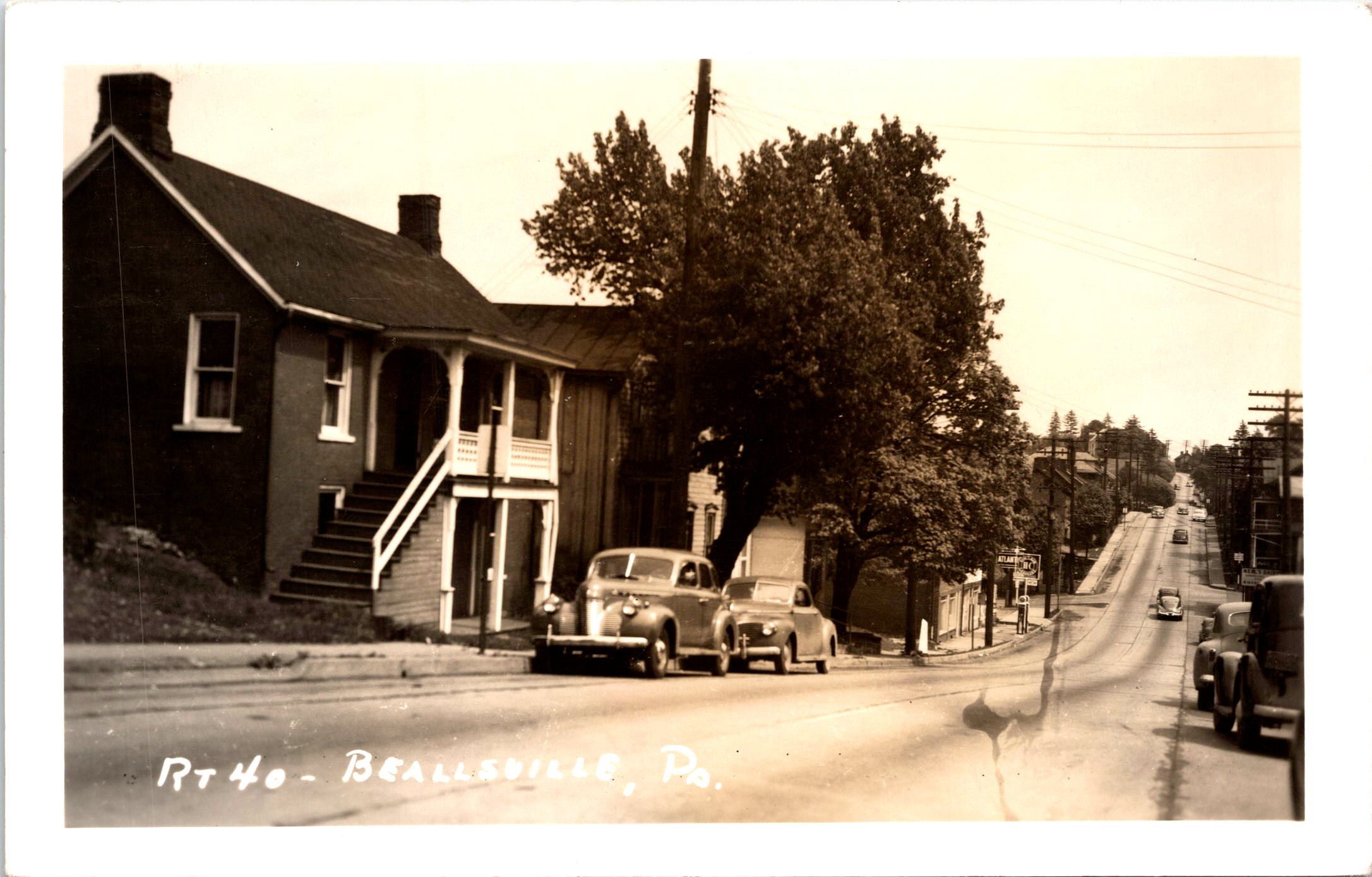
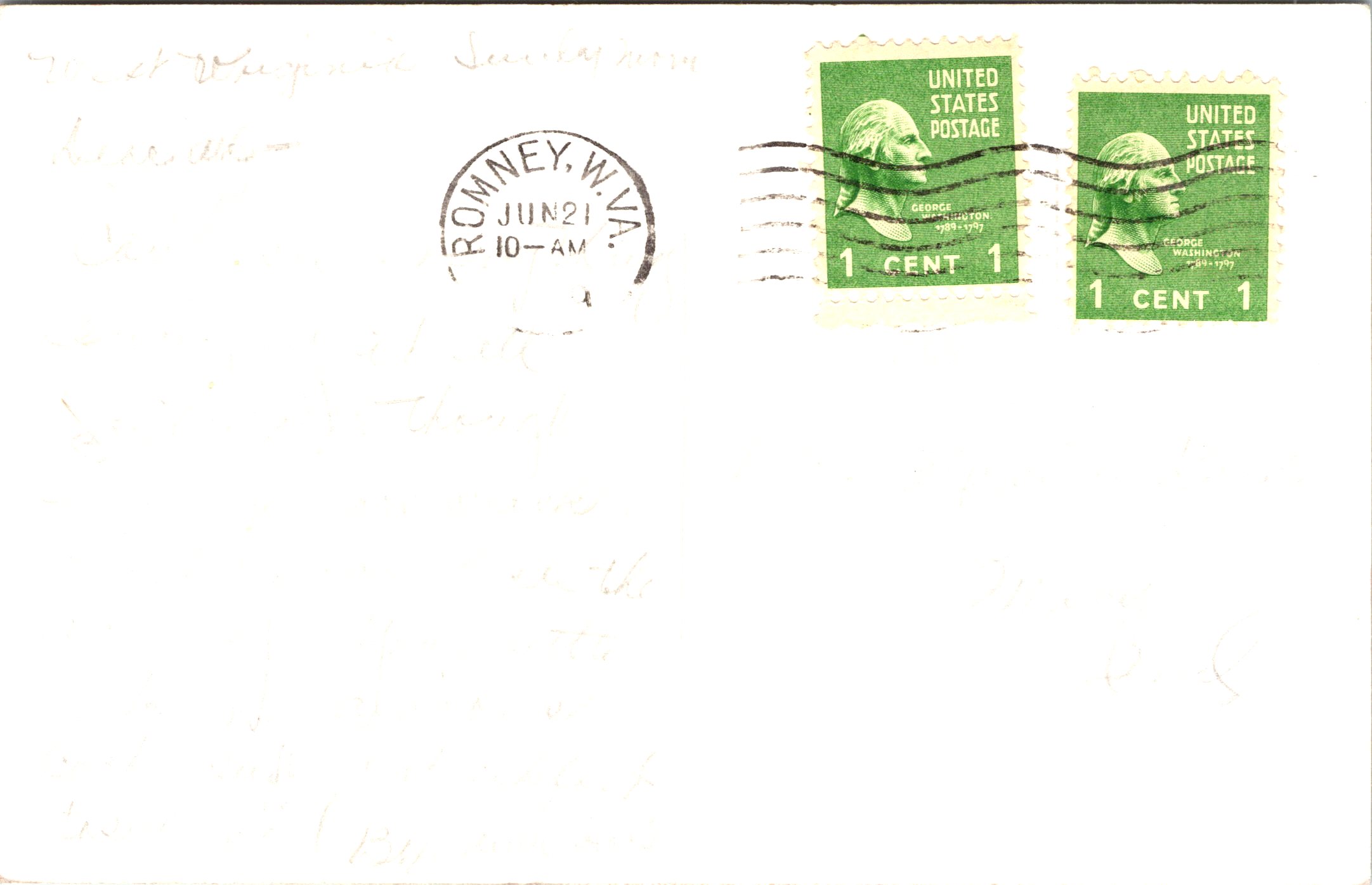
This appealing real photo postcard captures a classic mid-20th-century American street scene along Route 40 in Beallsville, Pennsylvania, showing a gently sloping roadway lined with utility poles, storefronts, residences, and several period automobiles. The photographer positioned the camera looking down the hill, giving the image depth and a strong sense of everyday life in a small Pennsylvania town during the late 1930s to early 1940s. Dominating the left foreground is a substantial frame house with a raised porch and exterior staircase, likely a mixed residential or residential-commercial structure typical of small Route 40 communities. The street itself is active but unhurried, with cars parked curbside and others traveling in the distance, reinforcing the postcard’s documentary quality rather than a staged or promotional feel. Two parked cars are clearly visible in the foreground. One is a larger sedan (left) that appears to be a late-1930s Chevrolet Master or Master Deluxe, likely circa 1939–1940. The second car is a smaller sedan (right) which is likely a late-1930s Plymouth or Dodge, circa 1938–1940. Additional vehicles farther down the street also appear consistent with late-1930s to early-1940s American automobiles, reinforcing the proposed dating. Beallsville is a small borough located in southwestern Pennsylvania, in Washington County, near the Monongahela River valley and not far from the West Virginia border. The town lies along U.S. Route 40, historically known as the National Road, one of the most important early transportation routes in the United States. Beallsville was established in the 19th century and developed as a modest service and residential community supporting regional coal mining, agriculture, and transportation traffic along Route 40. Like many towns along the National Road, it benefited from steady automobile traffic well into the mid-20th century. The postcard nicely reflects that era, when Route 40 still functioned as a vital commercial artery before the rise of the Interstate Highway System. The reverse of the postcard is postally used and bears two green 1¢ George Washington stamps. The card has a Romney, West Virginia postmark. (SOLD)
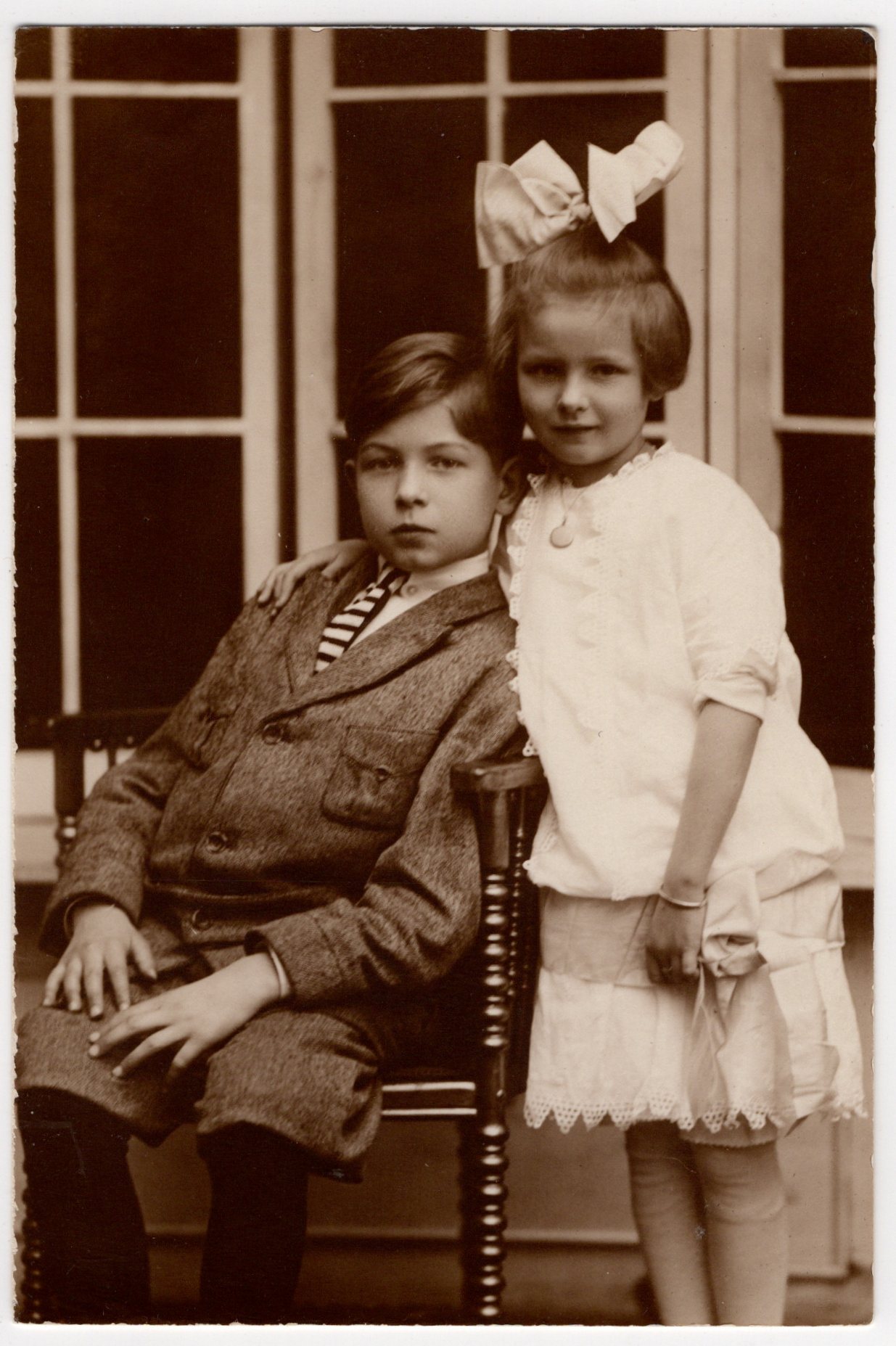
This charming vintage photograph measures approximately 6 x 4 inches and features a beautifully composed portrait of two children, likely a brother and sister, posed together in what appears to be a studio or carefully arranged indoor setting. The boy is seated in a wooden chair, dressed in a suit jacket with a striped tie and knee-length trousers with dark stockings, typical attire for a young boy in the early 20th century. He sits in a relaxed but composed pose, looking directly at the camera with a serious expression. Standing beside him is a young girl wearing a light-colored dress with a dropped waist and decorative trim along the hem, consistent with children’s fashion of the 1920s. She wears a very large bow in her hair, a popular style for young girls during this period, and rests her arm affectionately across the boy’s shoulder, suggesting a close sibling relationship. The background features multi-pane windows or a window-like studio backdrop, which adds strong visual structure to the composition and gives the photograph a very appealing, almost portrait-studio quality despite its smaller snapshot size. The overall composition is unusually well done for a photograph of this size, with excellent lighting and sharp detail. Based on the clothing, hairstyle, and photographic paper, this photograph likely dates to the 1920s. This is a wonderful and touching vintage portrait capturing a moment between two children, and a very nice example of early 20th century child portrait photography. The photograph is in very good vintage condition. The image is sharp with good contrast and detail. There is some light edge wear and minor corner wear. The back of the photograph shows a few small stains. Overall, the photograph presents very well and is a nice example of a vintage 1920s photographic portrait. See scans.
This vintage photograph is available for purchase at my store, The History Peddler, for $22.00 or best offer.
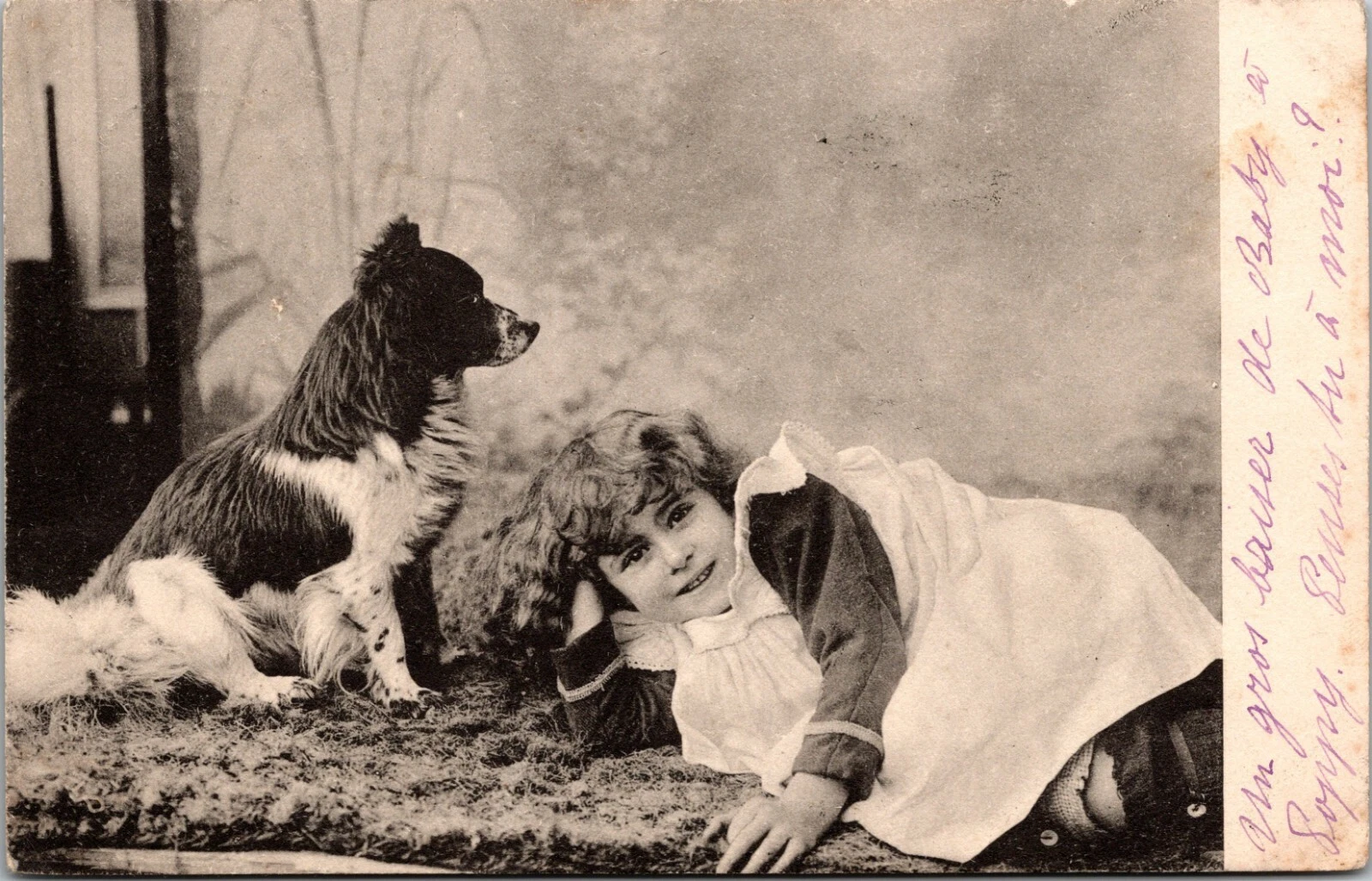
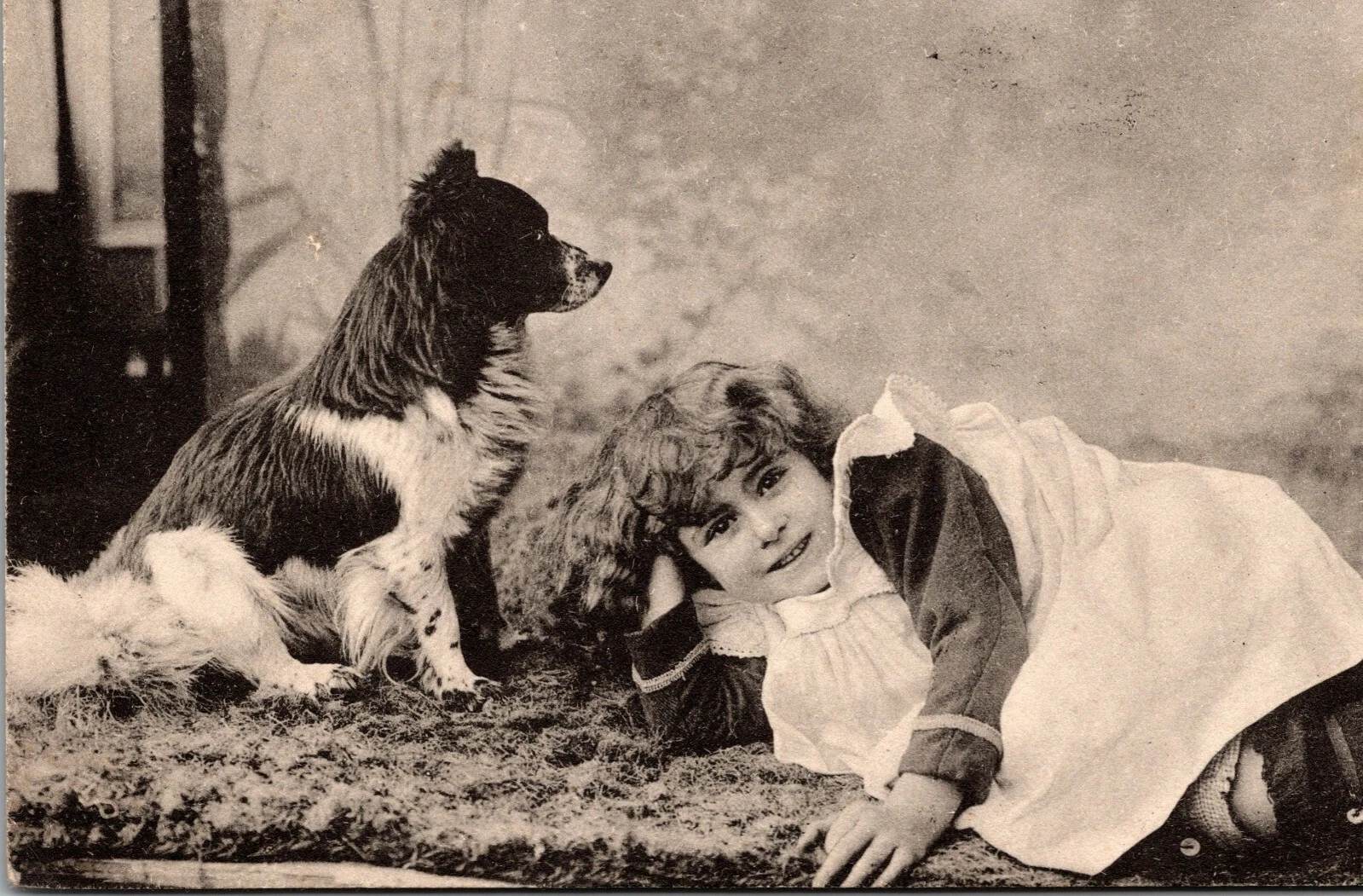
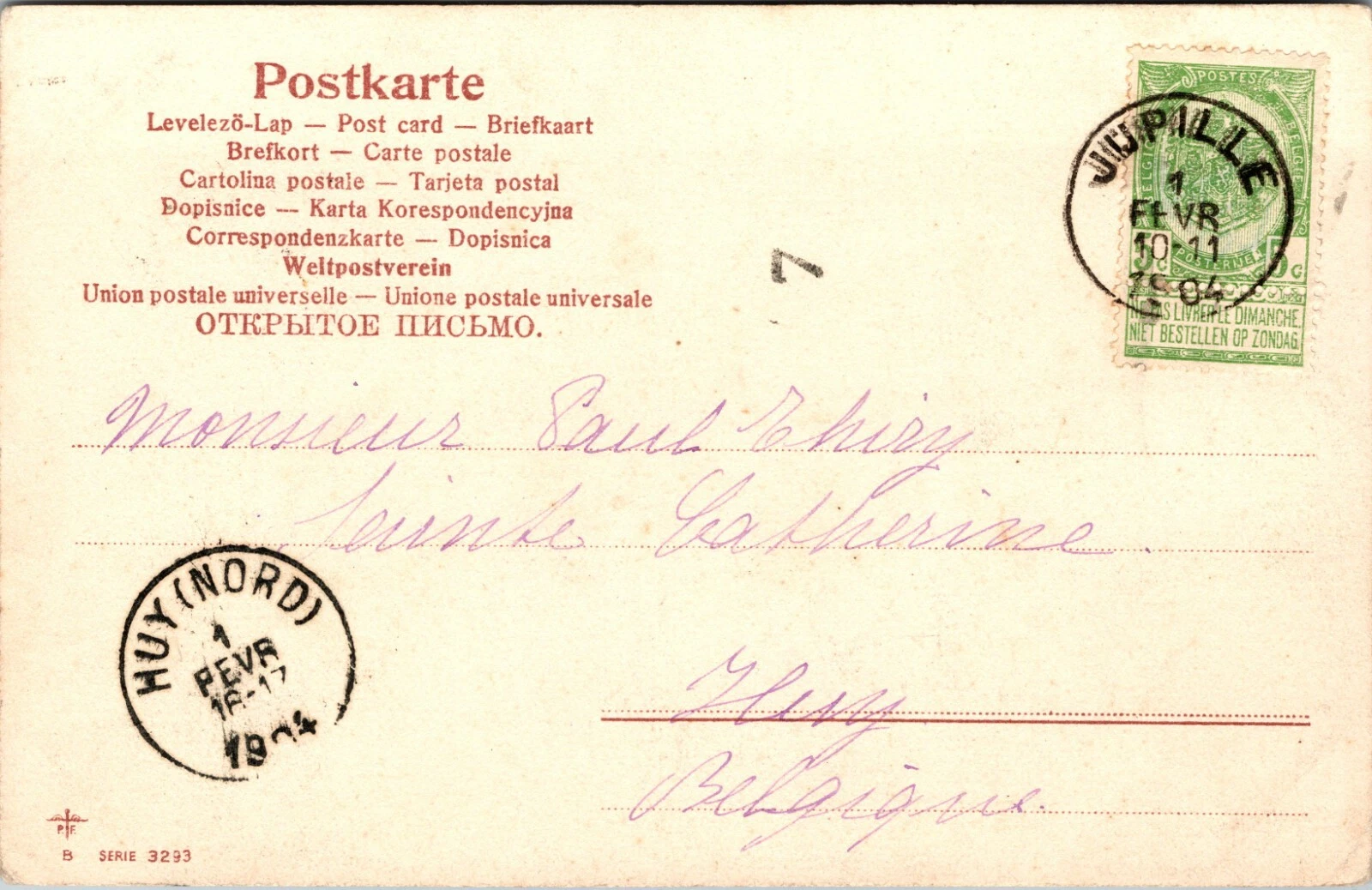
This antique undivided back postcard features a sweet little girl and her inattentive dog. The girl is adorable and is flashing a wonderful smile as she looks directly at the photographer. The dog is cute, but not cooperative with the photographer, as he looks intently away from the camera. The postcard was published by PFB (Paul Finkenrath), a Berlin postcard publishing and printing business. It is part of a series. (no. 3293). The Paul Finkenroth company made quality photo postcards and the company was heavily oriented toward export. They were known to be responsive to printing postcards that they’re customers desired over time. They were quite profitable but closed in 1911 when protective tariffs interfered with their business. The company was established by Paul Finkenrath and Paul Grasnick in 1897. The partnership lasted about a year and then Grasnick left to start his own lithography studio. SOLD
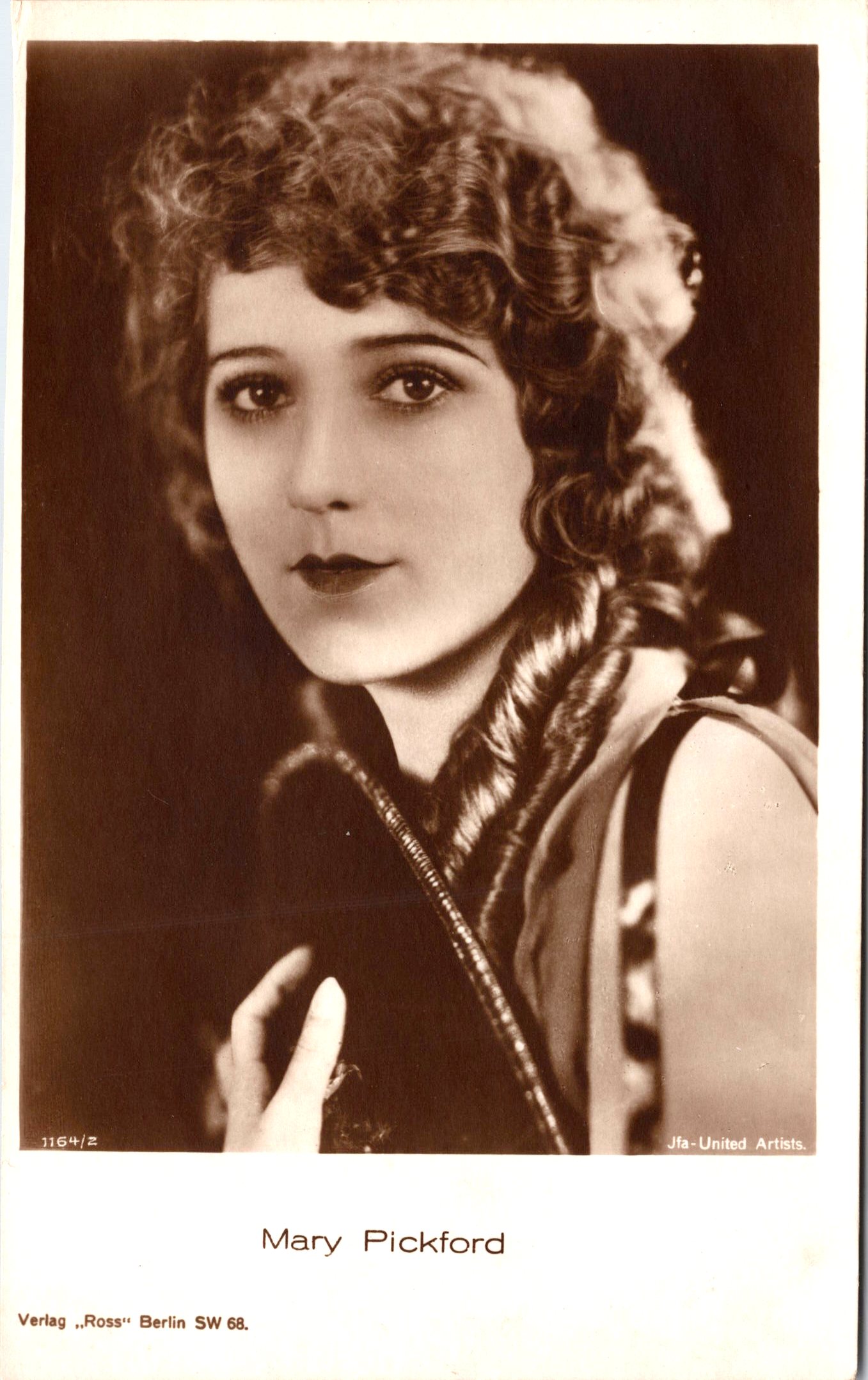
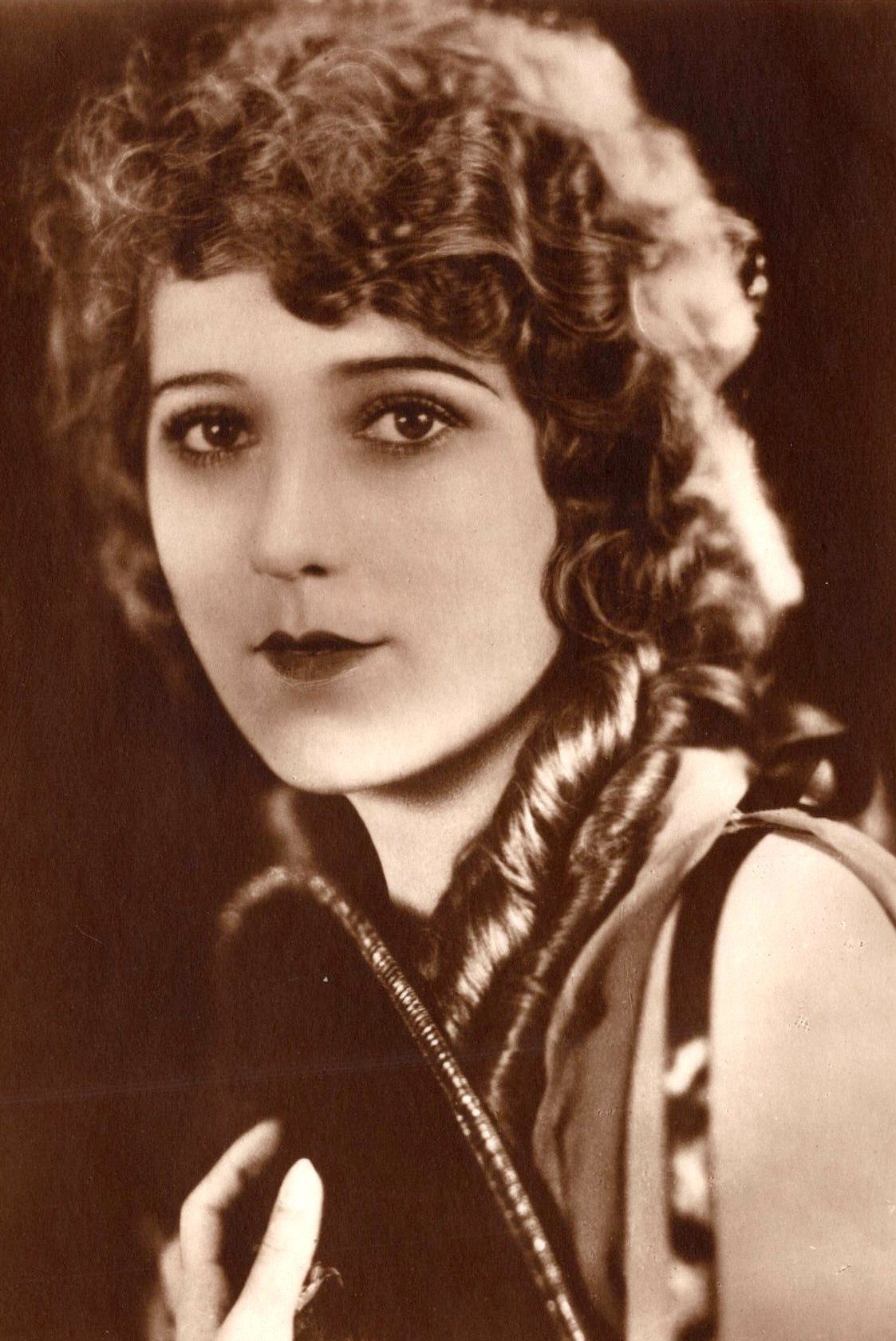
Mary Pickford (1892-1979) was a Canadian-American actress and one of the most influential figures in early Hollywood. She was often referred to as “America’s Sweetheart”. She was a pioneer of silent film and a co-founder of the film industry as we know it today. Pickford’s career began in childhood when she performed in theater productions in Canada and the United States. By the early 1900s, she transitioned to film, working with director D.W. Griffith at Biograph Studios. Her delicate beauty and expressive acting quickly made her a fan favorite, setting her apart in an era when exaggerated stage-style performances dominated silent films. During the 1910s and 1920s, Pickford became one of the highest-paid and most beloved actresses in the world. Starring in films such as Rebecca of Sunnybrook Farm (1917), Daddy-Long-Legs (1919), and Pollyanna (1920), she was known for playing wholesome, spirited young women. Her curly hair and signature on-screen innocence became iconic, but she was also a savvy businesswoman who understood the power of her brand. Pickford was not only a star but also a trailblazer in the film industry. In 1919, she co-founded United Artists alongside Charlie Chaplin, Douglas Fairbanks (her then-husband), and director D.W. Griffith. This revolutionary move allowed filmmakers to control their own productions rather than rely on major studios, changing the industry forever. As the film industry transitioned to “talkies,” Pickford retired from acting in the early 1930s, though she continued to produce films. Her contributions earned her an honorary Academy Award in 1976 for her lasting impact on cinema. Mary Pickford’s influence extends beyond her films. She helped shape the star system, paved the way for women in Hollywood, and co-founded the Motion Picture Relief Fund to support struggling actors. She remains an enduring symbol of early Hollywood glamour and innovation. Mary Pickford was born into a working-class family in Toronto, Canada. Her father, John Charles Smith, was an alcoholic who struggled to provide for the family and died from a workplace accident when Mary was just six years old. Her mother, Charlotte Hennessey Smith, was left to raise Mary and her two younger siblings, Lottie and Jack, on her own. To support the family, Charlotte encouraged her children to enter acting, and Mary began performing in theater at a young age. She soon became the family’s primary breadwinner, and her siblings, Lottie Pickford and Jack Pickford, also pursued film careers. Pickford transitioned from theater to film in the early 1900s, quickly rising to fame with her expressive acting and wholesome on-screen persona. By the 1910s and 1920s, she was one of the most recognizable stars in the world, earning the nickname “Queen of the Movies.” She also helped establish the Academy of Motion Picture Arts and Sciences. Mary Pickford was married three times. Pickford’s first marriage was to silent film actor Owen Moore (1911-1920). Her second and most famous marriage was to fellow silent film actor, Douglas Fairbanks (1920-1936). Her third marriage was to actor Charles “Buddy” Rogers (1937-1979). After retiring from acting in the early 1930s, Pickford focused on producing films and philanthropy. She became more reclusive in her later years, struggling with alcoholism and health issues. Today, she is remembered as a pioneering force in cinema history. This original real photo postcard (RPPC) features the legendary Pickford and a logo for United Artists, the film company. The postcard was published in Germany by Ross Verlag (no.1164/2). This postcard has minor corner wear and is in overall very good condition (see scans).
This vintage postcard is available for purchase at my store, The History Peddler, for $14.00 or best offer.
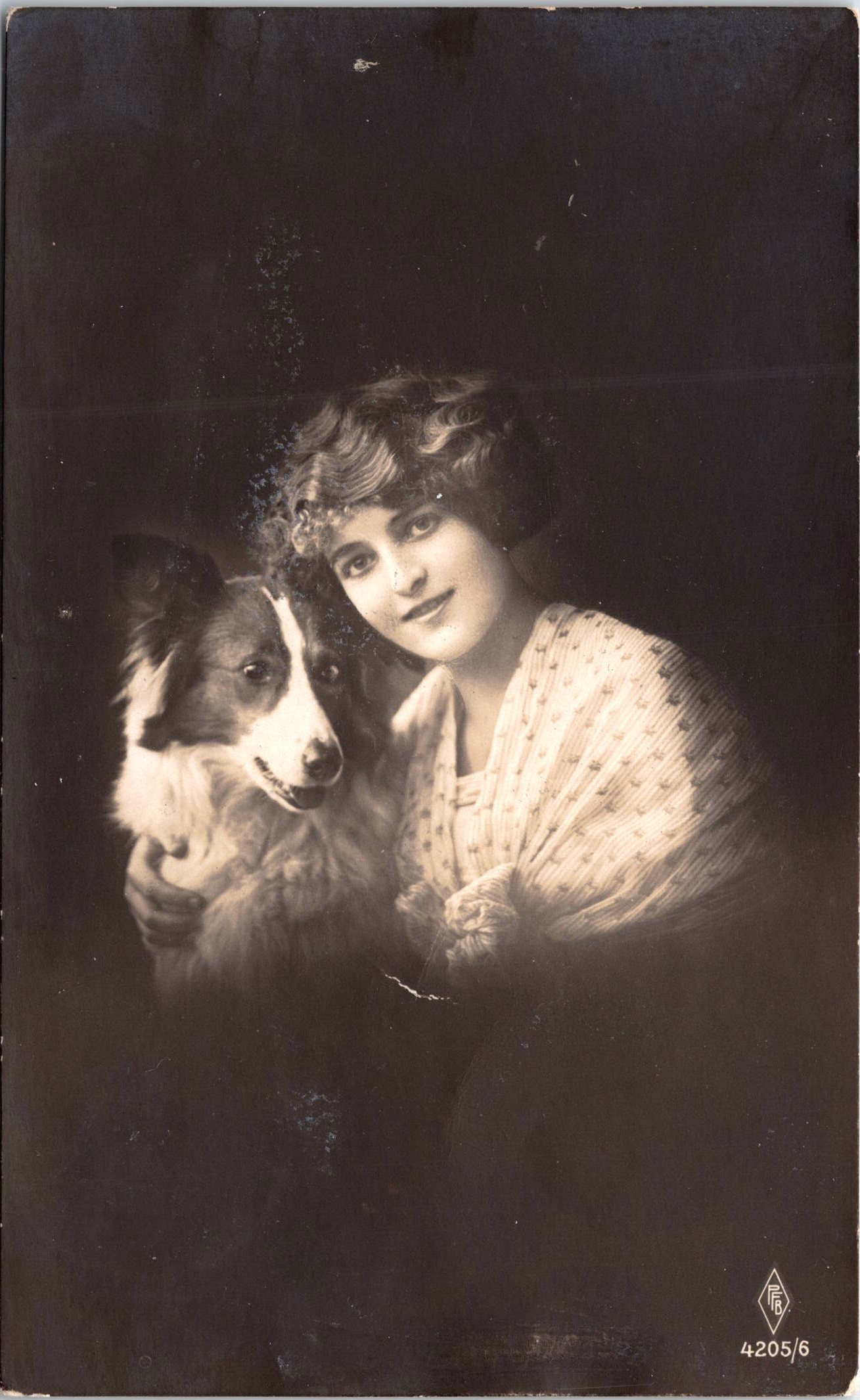
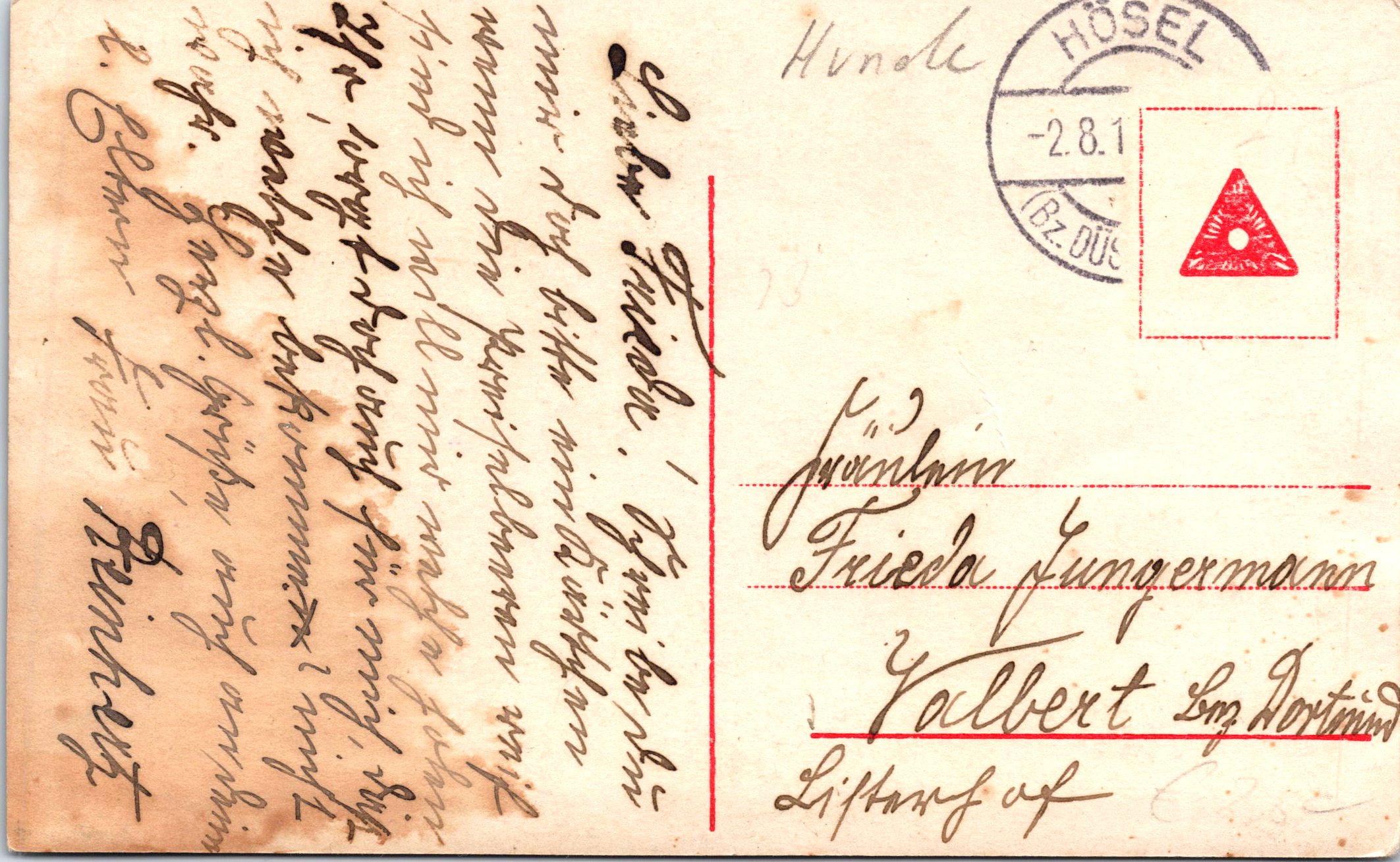
This original real photo postcard (RPPC) features a beautifully composed studio portrait of a young woman with her beloved dog, likely a Collie or Border Collie. The image is bathed in soft light, with a rich sepia tone that captures the elegance and emotion of the moment. The woman is dressed in a light-colored, delicately patterned wrap with a large bow, fashionably draped across her shoulders. Her wavy hair is styled in the popular bobbed fashion of the early 1910s, and her expression is serene, warm, and affectionate as she leans toward her loyal canine companion. The dog, with its intelligent gaze and distinctive facial markings, radiates calm and trust. Together, they project a timeless bond of companionship. In the lower right-hand corner of the card is the diamond-shaped logo “PFB”, identifying the publisher as Photochemie Paul Fink, Berlin, a prominent German firm known for high-quality photographic postcards. The serial number 4205/6 appears just below the logo. The reverse of the postcard bears a handwritten message in German and a clear postmark from Hösel (Bz. Düsseldorf). The card was addressed to Fräulein Frieda Jungermann in Valbert bei Dortmund, Germany. A rough translation of the message is “Dear Friedel! Warm greetings and kisses from all of us. We are doing well and hope you are healthy too. Looking forward to seeing you again soon. Warm regards, your parents.”(SOLD)
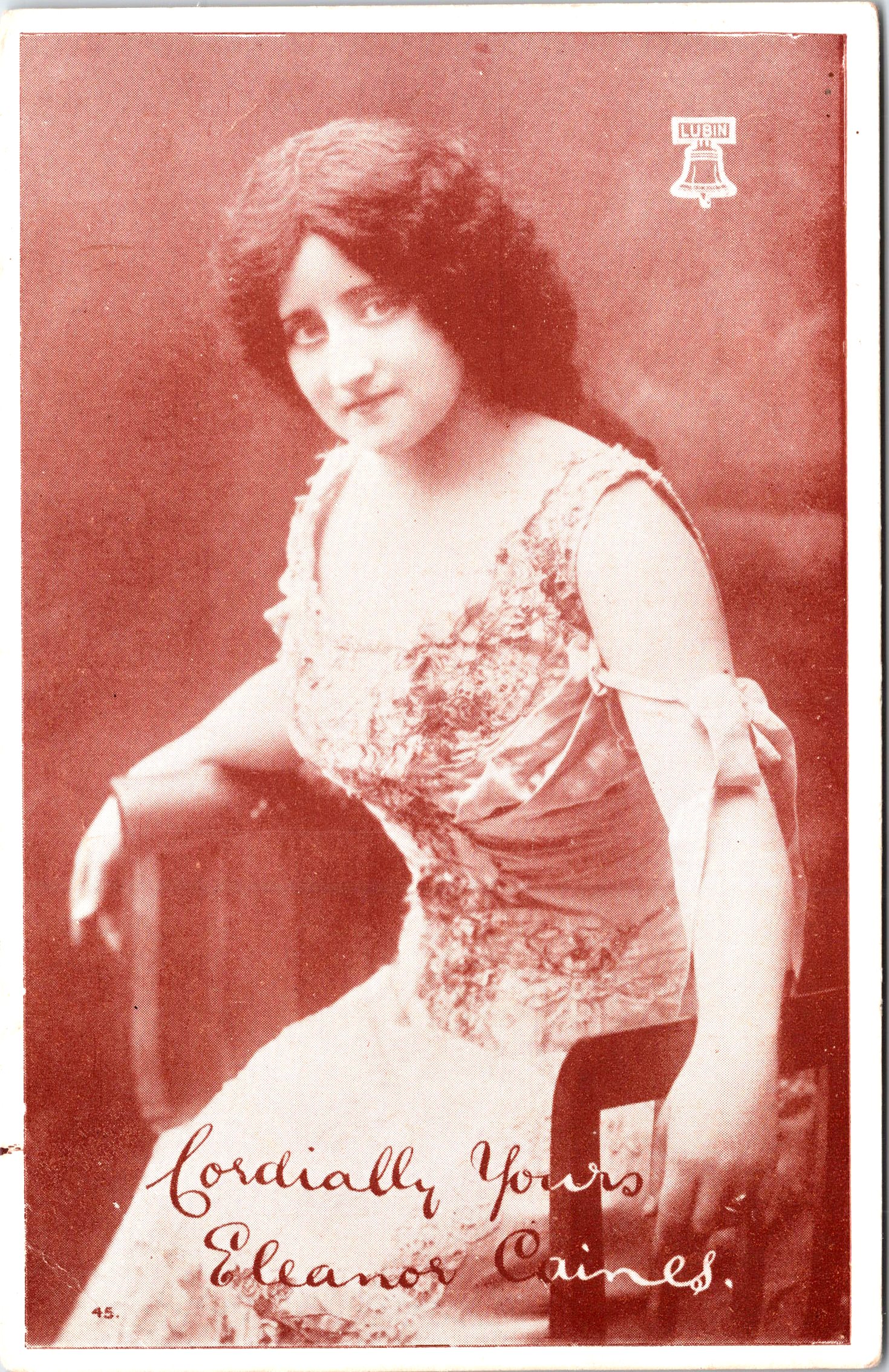
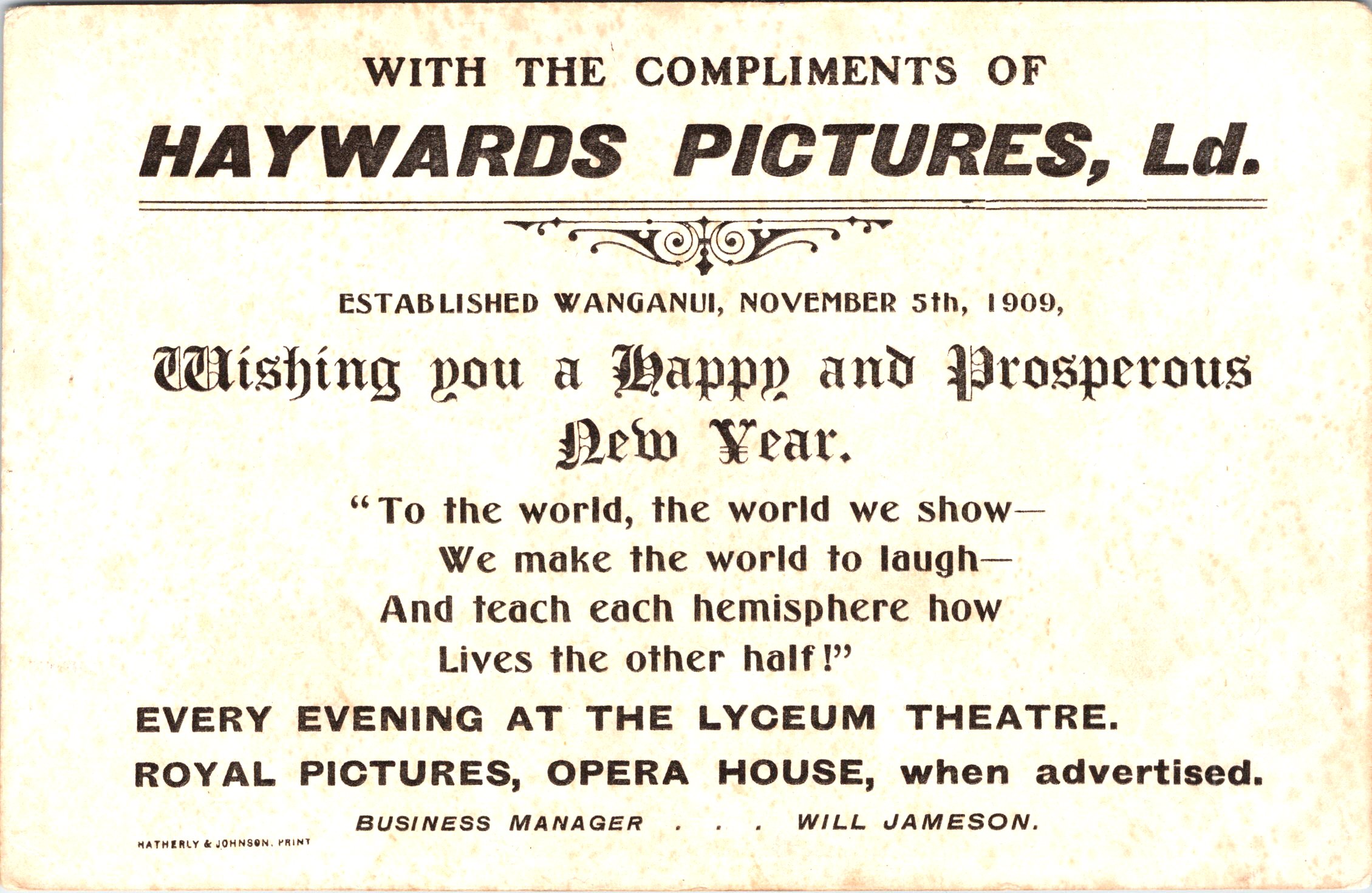
This attractive and unusual New Year’s real photo postcard features actress Eleanor Gaines, shown in a studio portrait with a printed facsimile inscription reading “Cordially Yours Eleanor Gaines.” The card carries the Lubin bell trademark in the upper right corner, identifying the image as connected with the Lubin Manufacturing Company, one of the early American motion picture studios of the silent film era. Founded by Siegmund Lubin in Philadelphia in the late 1890s, the Lubin Manufacturing Company became one of the major early film producers and distributors in the United States and was especially active between about 1905 and 1915. Lubin produced silent films, distributed prints internationally, and promoted actors who appeared in their productions, often issuing promotional postcards such as this one for publicity and theater promotion. The reverse of the card is particularly interesting and helps explain the purpose of the postcard. It reads: “With the compliments of Haywards Pictures, Ltd. Established Wanganui, November 5th, 1909. Wishing you a Happy and Prosperous New Year.” This identifies Haywards Pictures, Ltd. as the distributor or exhibitor. Haywards Pictures was an early motion picture exhibition company based in Wanganui (now spelled Whanganui), New Zealand, not in the United States or Britain. The Hayward family were important early cinema exhibitors in New Zealand, operating theaters and showing imported films, including American productions such as those made by Lubin. The card advertises screenings “Every Evening at the Lyceum Theatre, Royal Pictures, Opera House, when advertised,” which refers to local theaters in Wanganui where Haywards Pictures showed motion pictures. This places the postcard firmly in the early international film distribution network of the silent era, when American films were shipped abroad and exhibited by local companies. The printed New Year’s greeting and verse appear to be a promotional slogan rather than a quotation from a known literary source, and were likely written for advertising purposes, reflecting the early film industry’s emphasis on entertainment and spectacle: “To the world, the world we show—We make the world to laugh—And teach each hemisphere how lives the other half.” The small print at the lower left of the reverse reads Hatherly & Johnson, Print, who were printers operating in New Zealand and produced promotional material and postcards such as this for local businesses and theaters. Eleanor Gaines herself appears to have been one of the actresses associated with Lubin film productions during the early silent film period, likely around 1908–1912, when Lubin was actively promoting performers through postcards and theater advertising. Many Lubin players were stage-trained actresses who appeared in short silent films distributed internationally, and promotional postcards like this were produced for theaters to hand out to patrons, especially around holidays such as New Year’s, both as souvenirs and advertisements for upcoming motion picture programs. The number “45” on the front indicates this postcard was part of a numbered promotional series. SOLD