A very pretty woman with big dreamy eyes and dark hair poses for her portrait at the McKnight studio, in Centrailia, Illinois. The woman is wearing a dress that has four very large buttons at its top and smaller buttons below. The large and small buttons appear to be identical except for size. The decorative buttons show grapes or berries. The woman is also wearing a flower and earrings, as well as a pin at her collar. The pin features the letter “H”, which may be the first letter of her first or last name. The photographer of this image may be Frank McKnight or P. McKnight. Both of these individuals are listed in a directory of Illinois photographers as operating studios in Centralia during the cabinet card era. This photograph has a crossed out location on the bottom of the image. It is probable that the photographer formerly owned a studio in Missouri and moved to Illinois but kept his stock of pre-printed paper. Although it is easy to decipher the state, the town is blacked out beyond the point of recognition.
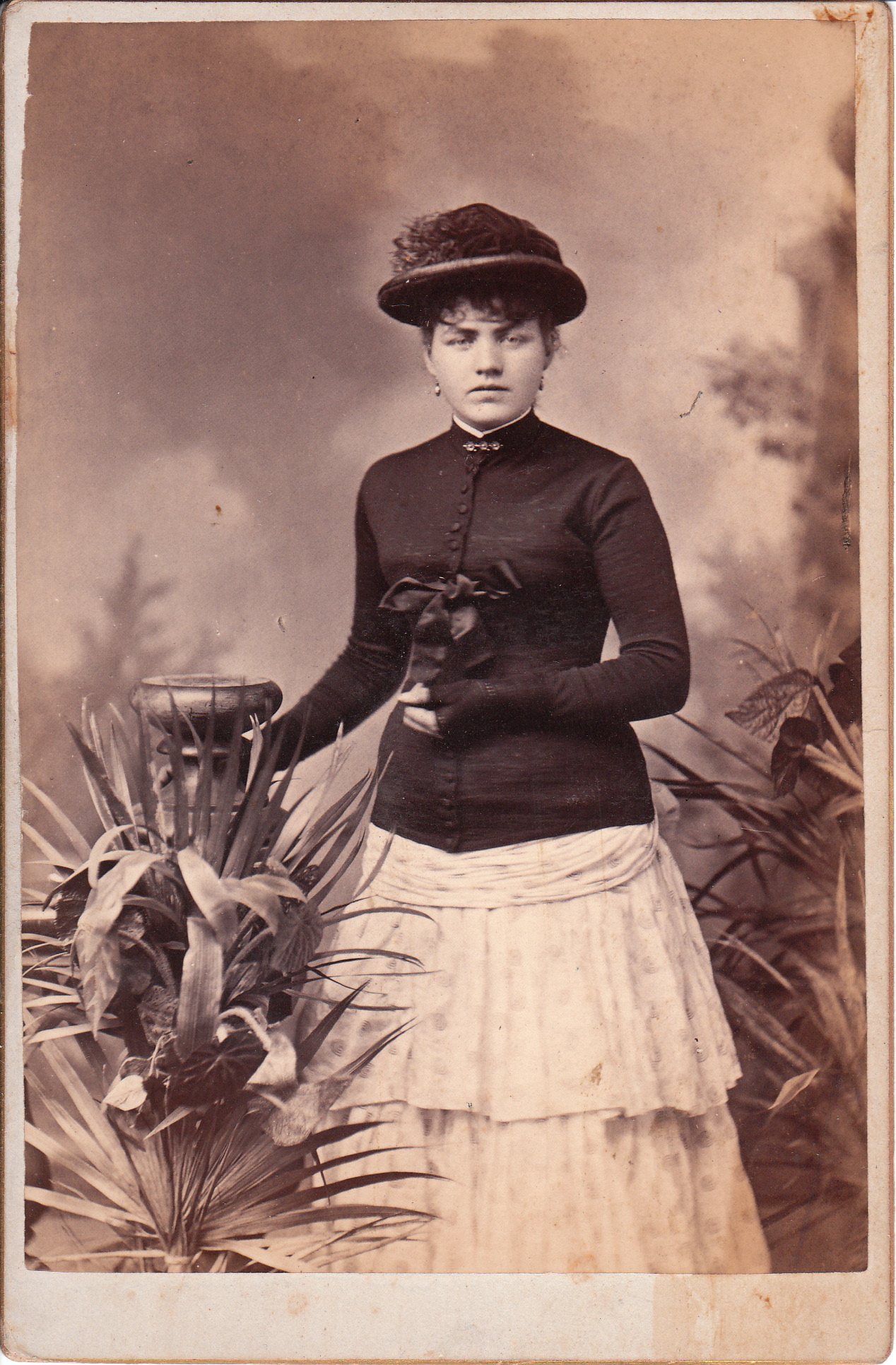
PRETTY WOMAN STANDS BY PLANTS IN BOSTON
A pretty woman stands among some plants at the photographic studio of Patten, Perkins and Stratton in Boston, Massachusetts. The studio was located at 47 Hanover Street in Boston. The woman is wearing a pretty hat and a large bow on her blouse. She is wearing a pattern dress and a collar pin. Note the woman’s fingerless gloves.
THE ENIGMATIC SISTERS OF MONTAGUE, MICHIGAN
This cabinet card presents an enigma. How can this photograph be interpreted? The image features, what are likely, three sisters, gathered around a table. Each of the young woman is holding a book, but only one of the three has their book open. So? What’s the enigma? The mystery concerns the fact that prominently displayed on the table is a picture frame without a picture. The missing picture hasn’t wandered too far away. It can be seen lying on the table, face up, in front of the frame. Hopefully, a cabinet card gallery visitor will leave a comment with their hypothesis as to why the frame and picture are separated in this image. The photographer of this portrait was Theodore A.Wirsing (1865-1938) of Montague, Michigan. Research about Wirsing yielded confusing information. He is reported to have had a studio in Annandale, Minnesota in 1902 and a studio in Maple Lakes, Minnesota in 1902 and 1914. Another source states that Wirsing ran his gallery in Montague between 1890 and 1910. He and his wife, Lillian Bovee Wirsing (1865-1930) are buried in Michigan. Wirsing can also be found in four United States census reports. In 1900, he was living in a boarding house in Corinna, Minnesota, and working as a photographer. He was unmarried. In 1910, Wirsing was living in Annandale, Minnesota and listed as a photographer. .He was also married. In 1920, he was still living in Annandale, Minnesota and he was managing a photographic gallery. In 1930, the 64 year-old, Wirsing, and his wife, were living in Bellingham, Washington. The census also states that Theodore Wirsing was working as a carpenter in Bellingham.
WOMAN IN CHAINS (STOCKTON, CALIFORNIA)
This cabinet card features a woman in chains. The previous sentence, and the title of this blog entry, may be misleading because the woman isn’t exactly in chains; instead, she is wearing a chain necklace. Don’t you hate those sensational headlines that are aimed to manipulate you to watch a particular news show, or read a certain newspaper? Sorry! This lady’s name is “Emmie” according to a notation on the reverse of the cabinet card. She is thin, pretty and curly haired. The chain she is wearing has a pin attached to her collar and also has a charm or locket. Ironically, the charm resembles a modern day pet identification tag. This image was photographed by Batchelder of Stockton, California. Perez Mann Batchelder (1818-1873) was a daguerreotypist, ambrotypist, and photographer active in a number of areas in California, including Sonora, Stockton, Vallecito, Murphy’s Camp, and Mokelumne Hill. He also operated studios in Melbourne, Australia (he followed the gold rush occurring down under) and Boston, Massachusetts. He worked in all of these locales over a short period of time. He clearly did not let moss grow under his feet. Batchelder with his brothers Nathaniel, Freeman, and Benjamin Pierce founded a daguerreian dynasty which in the 1850’s and 1860’s established dozens of galleries on both coasts of the United States and in Australia. Batchelder travelled incessantly and operated many enterprises simultaneously. He was born in Massachusetts and entered photography as a career in 1844. The book, “Pioneer Photographers of the Far West: A Biographical Dictionary” (2000) was the source of much of the information about Perez Batchelder.
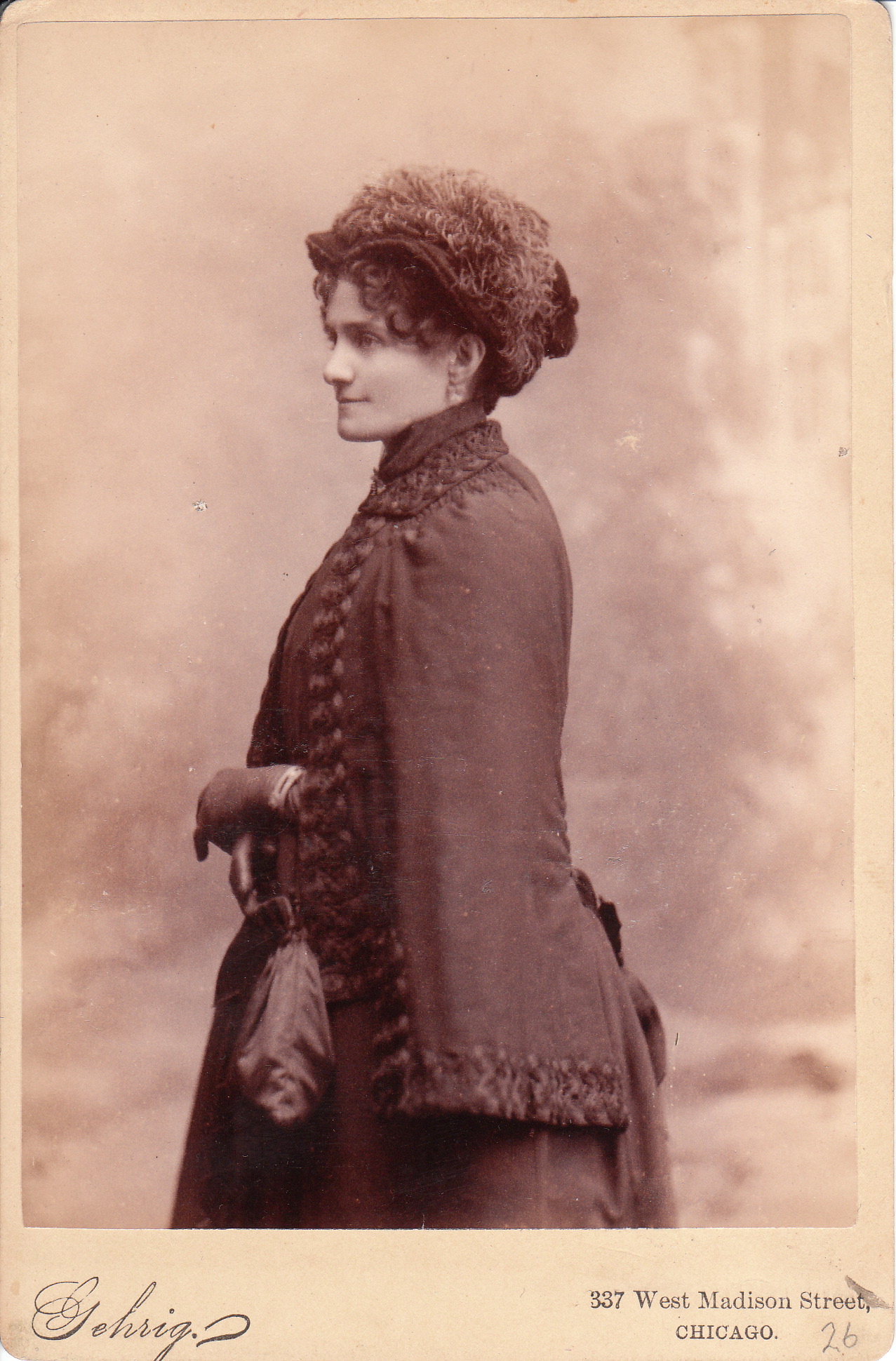
PRETTY AND FASHIONABLE IN CHICAGO, ILLINOIS
A very pretty woman poses for her portrait at the studio of well known photographer, Joseph W. Gehrig. Gehrig plied his trade in Chicago, Illinois. To view other photographs by Gehrig, click on the category “Photogapher: Gehrig”. The woman in this photograph is beautifully dressed. she is wearing leather gloves and a wonderful feathered hat. She appears to be holding a purse. She gives the appearance of a woman of means and it is likely that she was a member of Chicago’s high society.
PRETTY WOMAN IN PHILADELPHIA, PENNSYLVANIA (1885)
A pretty woman poses for her portrait at the Dunshee Studio in Philadelphia, Pennslvania. The studio was located across the street from the U. S. Mint. The subject’s dress has a very lacy collar and she is wearing an elaborate belt. Note the buttons on the side of her skirt. This arrangement of buttons is not commonly seen on dresses in cabinet card photographs. Her figure is improved by the corset that she is wearing. Print on the reverse of the photograph indicates that the image was produced in 1885. To view other photographs by Edward Sidney Dunshee, and learn more about his history, click on the category, “Photographer: Dunshee”.
BEAUTY WITH FINGERLESS GLOVES IN CHICAGO, ILLINOIS
A beautiful woman poses for her portrait at the Lewitz studio in Chicago, Illinois. She is surrounded by pretty flowers. She is wearing flowers on her dress and in her hair. There is also a floral treatment on the railing behind her. She is wearing a coat style dress and a lace blouse. She is also sporting fingerless gloves. This young woman spent some time at her jewelry box while preparing for this photograph. She appears to be wearing a necklace and a broach, although it may be a necklace with two pieces of jewelry attached. She is also wearing earrings. The photographer of this image is Emil Lewitz. To learn more about him and to view more of his photographs, click on the category, ‘Photographer: Lewitz’. SOLD
THREE YOUNG WOMEN IN BAD OEYNHAUSEN, GERMANY
Three pretty young women sit for their photograph at the studio of C. Colberg in Bad Oeynhausen, Germany. This image was produced in 1905. The women may be sisters; there seems to be a shared resemblance. The women are well dressed, and are likely from a family of means. Bad Oeynhausen was a spa town at the time of this photograph. It was thought that the thermal salt spring there had healing powers. Perhaps these three women were photographed while on vacation to the spa community. Research reveals that Colberg was a royal court photographer.
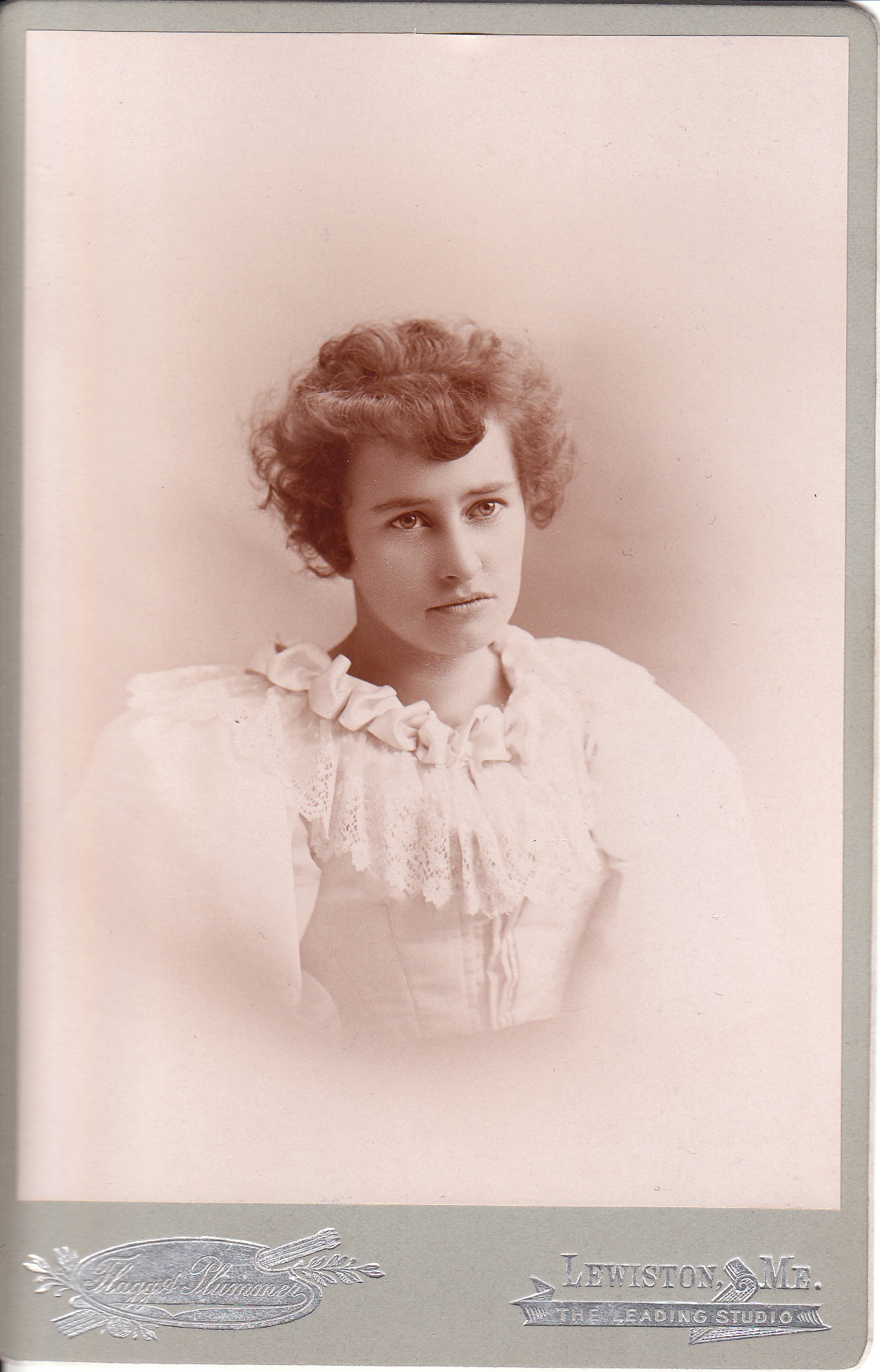
PRETTY WOMAN IN LEWISTON, MAINE
This photographic portrait features a pretty young lady posing for her portrait at the Flagg and Plummer gallery in Lewiston, Maine. The subject has quite the sour expression on her face. She looks exasperated, as if she has spent more time and effort at the photographer than she cared to. A pencilled inscription on the reverse of the photograph reveals that the Flagg and Plummer studio was the successor to the Curtis and Ross studio. The notation also discloses that the young woman in this photograph was named Florence L. Bisbee and that the image was produced in 1899. According to the U.S. Census of 1900, Florence Bisbee was born in 1877 and lived in Auborn, Maine. She lived with her father (Byron), mother (Adiline), and two older brothers. Florence worked as a dry goods clerk, her father was a grocery clerk, and her brothers worked as shoe cutters. By the 1910 census, Florence was employed as shoe stitcher and in the 1920 census she was still living with her parents at the age of forty-three. The 1930 census found her as a head of household and living with an older woman. She was still a shoe stitcher. Very little information could be found about this photographs creators. The Flagg and Plummer studio is mentioned in an article in The Bulletin of Photography (1915) concerning the formation of an advertising group of photographers.
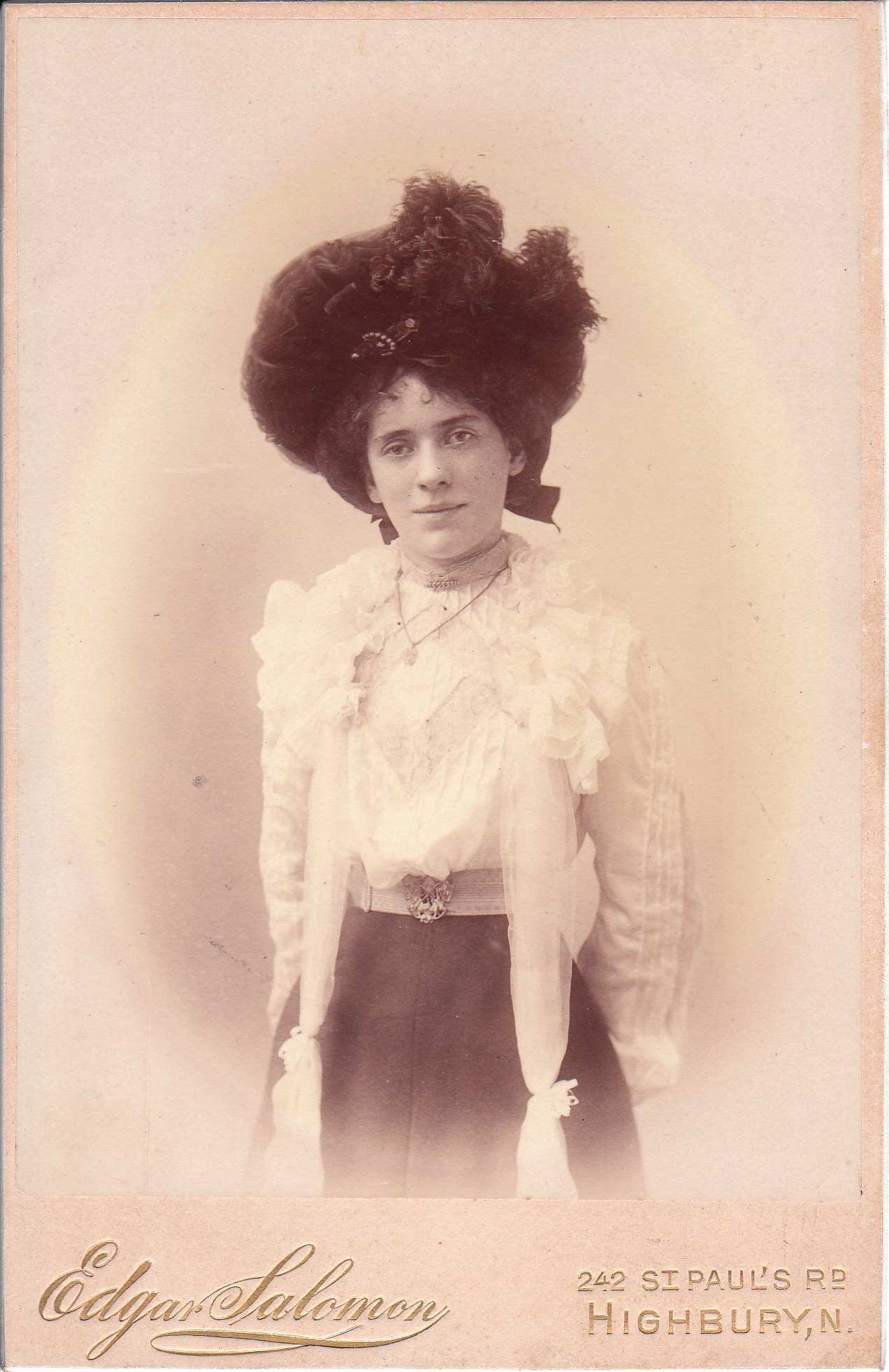
EIGHTEEN YEAR OLD GIRL IS A FUNKY DRESSER IN 1902 LONDON, ENGLAND
An internet dictionary defines funky as ” modern and stylish in an unconventional or striking way”. The pretty young lady in this cabinet card photograph is certainly dressed in a funky manner. She has a great smile and is remarkably well poised as she stands before the camera. Her scarf appears to be made of a fine fabric, and seems to be tied at the ends by ribbons. She is wearing an interesting belt with a decorative buckle. She is also wearing a terrific hat. Note her necklace and the brooch at her collar. A pencilled notation on the reverse of the cabinet card indicates that the young woman in the image is eighteen years of age and that the photograph was taken in 1902. The photographer was Edgar Salomon. He had a studio in two English cities; Highbury and London.