
 This vintage real photo postcard captures a pretty young woman with a polka dot scarf and a wonderful smile. She is posing for her portrait at an unidentified photo studio somewhere in Greece. SOLD

This vintage real photo postcard captures a pretty young woman with a polka dot scarf and a wonderful smile. She is posing for her portrait at an unidentified photo studio somewhere in Greece. SOLD

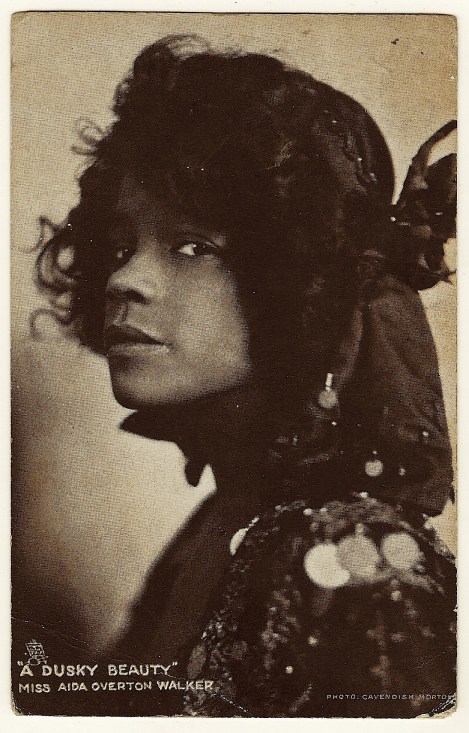
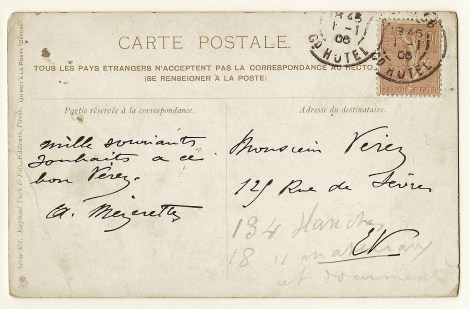
The subject of this vintage real photo postcard is Miss Aida Overton Walker. The caption above her name refers to her as “A Dusky Beauty”. Seems like a racist title to me. I don’t recall ever seeing its equivalent, “A Pasty Beauty”, on a portrait of a white female performer. Aida Overton Walker (1880-1914) was known as “The Queen of the Cakewalk”. She was African-American and an American vaudeville performer, singer, actress, and choreographer. She has been called the most famous African American female performer of the early twentieth century. She was married in 1899 to vaudeville performer, George Walker. Aida and her husband performed with the highly successful Bert Williams. They were the major black vaudeville and musical comedy act of the era. She was also a solo dancer and choreographer for a number of other vaudeville shows. Aida was well known for her 1912 performance of the ”’salome” dance. Aida was born in Richmond, Virginia and moved to New York City when she was young. She was educated there and received a great deal of musical training. When she was fifteen years old she joined the “Octoroons”, a black touring group. In 1900 she gained national notice with her performance of “Miss Hannah from Savannah” in the play, “Sons of Ham”. The song became a major hit. Overton Walker had significant theatrical success with her performances in Dahomey (1902), Abyssinia (1906), and Bandana Land (1908). Overall, Aida was praised by critics and fellow performers. She was financially successful. In 1908 she retired to care for her ill husband. In 1910 she returned to the stage as a solo act. In 1911, her husband died. By 1912, she was on tour again. That same year, she performed on Broadway as Salome. In 1914, Walker died suddenly from kidney failure. Two years before her death, she was performing in white variety theaters. She and Bert Williams were the only Black performers “permitted” to do so. At that time, African Americans were expected to confine themselves to “lower” entertainment such as comedy and ragtime. “High” art, like dramatic theater and classical dance were reserved for whites. Aida helped break that racist tradition. During her career, Aida addressed the issue of racial relations. She stated in an article in “The Colored American Magazine (1905), her view that that the performing arts could have a beneficial effect on race relations. Walker asserted “I venture to think and dare to state that our profession does more toward the alleviation of color prejudice than any other profession among colored people.” She also worked to improve working conditions, and to expand roles for black women on the stage. During the period Walker was performing, female actresses, especially black actresses, were seen as “immoral and oversexed”. Aida wrote “a woman does not lose her dignity…when she enters stage life”. Walker also worked to develop the talents of younger black performers within the framework of refinement and elegance. In 1908, she began organizing benefits to assist such causes as the Industrial Home for Colored Working Girls. This vintage postcard was published by Raphael Tuck, of Paris, France. The photographer of Miss Walker was Cavendish Morton (1874-1939). The National Portrait Gallery possesses 104 of Morton’s portraits. Morton had several careers including electrical engineering, architecture, acting, illustrating, and in the 1890’s he took up photography. He is known for his theatrical photo portraits. His son was a well known watercolor artist. This postcard was postmarked in 1908, The postcard is in good condition. See the youtube video below. It is a tribute to Aida Overton Walker. (SOLD)

 This ethnographic cabinet card features an Algerian man from Bone, Algeria. He is dressed in his culture’s traditional clothing. The preceding demographics are derived from the fact that this photograph was in a collection of images from Bone. The city of Bone is now known as Annaba. It is a port town on the Mediterranean, in northeastern Algeria. It is close to the Tunisian border. Bone was known for its mining. Iron ore was a major export. The city was named Bone while it was under French rule. Algeria received it’s independence in 1962. The man in this photograph has a wonderful smile. I wish I knew more about him. The photographer of this cabinet card is not identified. (SOLD)

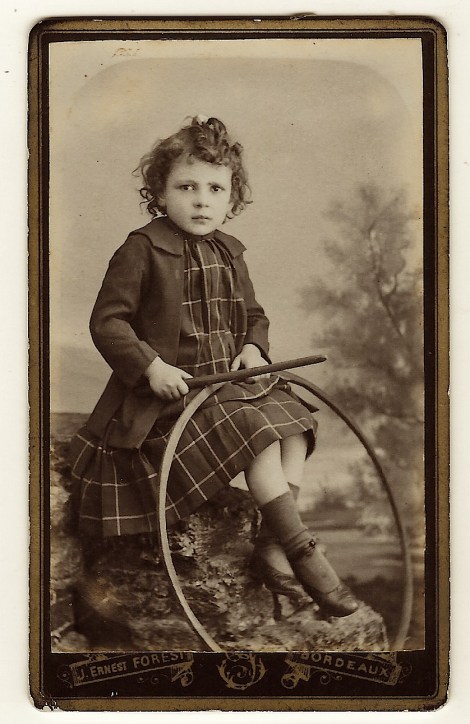
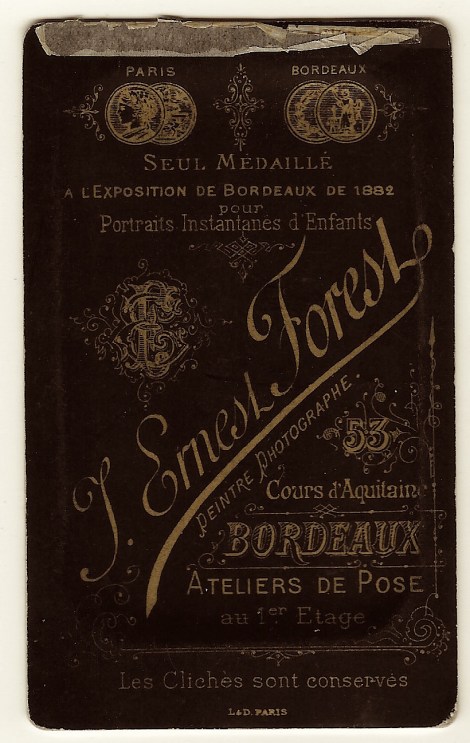
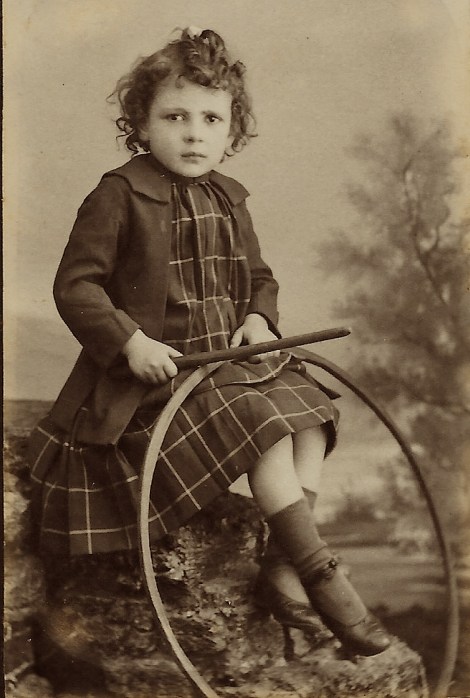 This carte de visite portrait features a young girl wearing a plaid dress and holding a hoop and stick toy. The photographer of this photo is J. Ernest Forest and he operated a studio in Bordeaux, France. Advertising on the reverse of the cdv indicates that the studio won prizes at exhibitions in Bordeaux and Paris.This photograph is in good condition (see scans). A look at the top of the backside of the cdv reveals that this photo is likely a former resident of a photo album or picture frame. (SOLD)
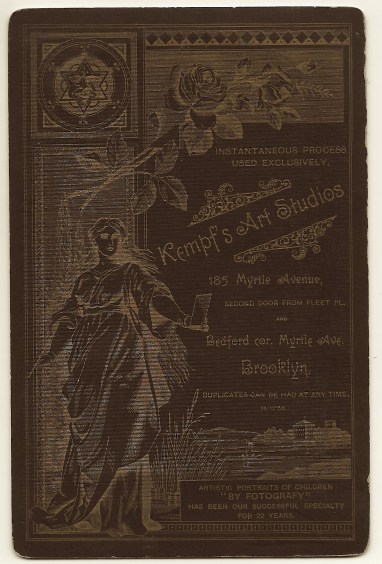
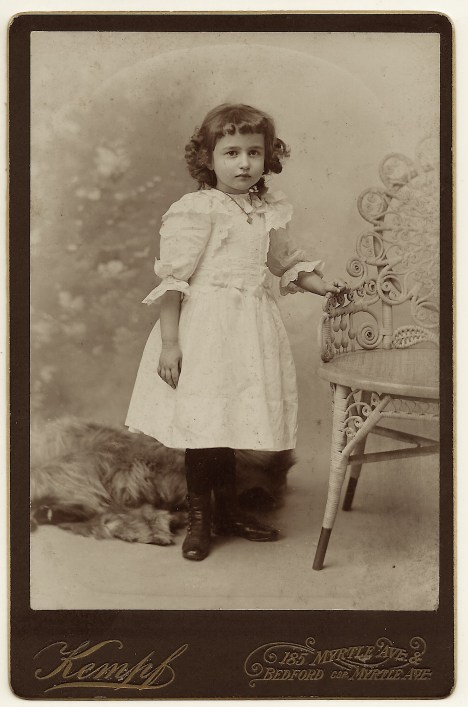 This cabinet card has many of the features of the “typical” little girl portrait of it’s era. A cute little girl poses in a nice dress alongside the customary chair and fur. The subject is wearing a necklace. She appears to be gazing at the camera with a degree of caution. The photograph was taken at Kempf’s Art Studios which was located in Brooklyn, New York. Advertising on the reverse of the photograph indicates that “Artistic Portraits of Children has been our Successful Specialty for 22 Years”. Charles L. Kempf was a photographer that began operating a Brooklyn studio in at least the late 1870’s and the studio was named after himself. He was listed in a Brooklyn business directory as early as 1874. A new business name, “Kempf’s Photographic Art Gallery” was esablished in the 1890’s and was in business until at least 1905. An early advertisement for Kempf’s Photography business appeared in the Brooklyn Eagle in 1876. The Photographic Times (1894) reported that Kempf’s patent for a photographic plate holder had expired. The 1910 United States census reveals that Kemp was 61 years old and born in 1849. He was born in Germany and immigrated to the United States in 1853, at the age of four years old. The census disclosed that he was married to Almira Kempf and lived with his wife and daughter, Florence (age 32). (SOLD)
 This vintage real photo postcard features a pretty young woman wearing an eye catching hat. This photo is part of a series entitled “Fascinating Hats”. The photographer of this beautiful photograph is Regina Relang (1906-1989). She was an outstanding German fashion photographer. She was from a talented artistic family. Her father was the artist, Paul Lang-Kurz, an art professor at the Art Academy in Stuttgart. Her mother was a noted craftswoman, and one of her sisters was a photographer, while the other sister founded the jewelery workshop, Langani. Regina studied art in Stuttgart and Berlin. She graduated as an art teacher in 1932. She continued her studies with French painter Amedee Ozenfant. Regina taught herself photography. Between 1932 and 1939, she travelled through out Europe. She published photographic reports of her travels in 1936. Her fashion photographs appeared in French, English, and American magazines. These publications included Vogue and Harper’s Bazaar. After the end of World War II, Relang moved to Munich. Twice a year, she published photographic reports on the fashion collections of Florence, Rome, Paris, and Berlin. She photographed the work of designers such as Christian Dior, Pierre Cardin, and Yves Saint Laurent. She was Germany’s leading fashion photographer of the 1950’s and 1960’s. Interestingly, in 1958, she took 8 of 12 cover photos for Madame Magazine. Much of Relang’s photographic work is in the Munich City Museum. This photograph is a reproduction.The original photograph was taken in 1962 and this french reproduction is from Nouvelles Images (1986). (SOLD)
 POSTCARD 1 (SOLD)
 POSTCARD 2 (SOLD)
 POSTCARD 2 (CLOSE-UP) (SOLD)
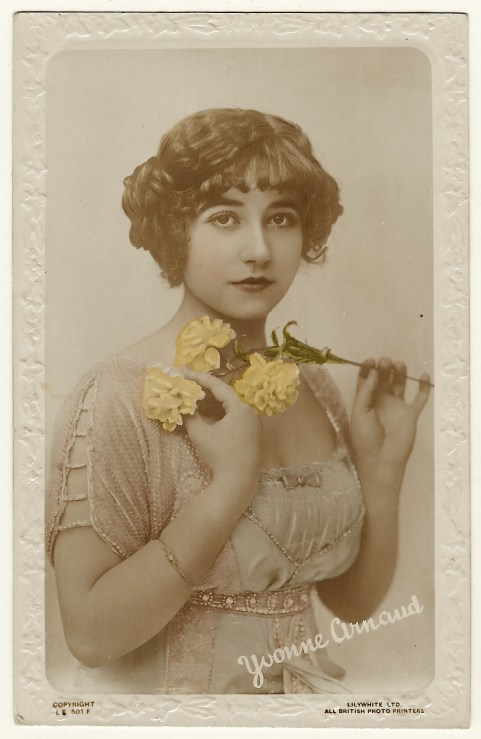
The pretty woman seen in this vintage real photo postcard (Postcard 1) is Germaine Yvonne Arnaud (1890-1958). She had a noteworthy career as a pianist, singer, and actress. She was most popular in her native France, as well as Britain. Arnaud was brought up in Paris and at the age of nine, she entered the Paris Conservatory where she studied piano. In 1905 she won a major competition for her skills in playing the piano. For the next six years, she performed with many of the leading orchestras in Europe and America. In 1911, at age 21, she began acting on the stage. Her first lead role was in the musical “The Girl in the Taxi”. After an operation damaged her vocal cords, she switched to acting in plays. She began her transition in the hit farce “Tons of Money” (1922). She played a role in the hit, “A Cuckoo in the Nest” (1925). She played in two Broadway productions; “And So To Bed” (1927) and “Canaries Sometimes Sing” (1930). In the 1930’s and 1940’s, she played dramatic roles in films. The IMDb credits her with 21 film roles between 1920 and 1958, Later in her career, she still performed as a pianist. Britain’s Yvonne Arnaud Theatre was named in her memory. Arnaud was married to actor Hugh McLellan in 1920. She was president of the “League Against Cruel Sports” from 1948 to 1951. Founded in 1924, the league is Britain’s leading charity that aims to stop the persecution, abuse, and killing of animals for sport. For example, the organization campaigns against Bull Fighting and Fox Hunting. Yvonne Arnaud was very popular; she was a sitter in 80 portraits in the collection of Britain’s National Portrait Gallery. The YouTube video below captures Arnaud playing piano with an orchestra conducted by John Barbirolli. The music was recorded in 1932. She is playing “Valse Caprice Op.76” which was composed by Camille Saint-Saens (1835-1921). The French composer was unique compared to his contemporaries in that he wrote music in many genres including chamber music, opera, symphonies, sacred choral music, concertos, and solo piano. He had many musical talents. evidenced by the fact that he was a composer, conductor, organist, and pianist. Postcard 1 highlights the beauty of Miss Arnaud. Note her romantic headdress. Her photograph was taken by Lucien Walery, a celebrated photographer who operated a studio in Paris. He was known for his portraits of actresses and cabaret dancers from the city’s music halls. He was well known for his portraits of Mata Hari and Josephine Baker. Much of his work was done in the genre of nude/erotic photography. He photographed the beautiful women of Paris between the early 1900’s and the 1920’s. This hand color tinted postcard (Postcard 1) is part of a series (no. 5111). It has a postmark of 1907. Postcard 2 is also a vintage real photo card portrait of Yvonne Arnaud. She looks beautiful in this color tinted postcard. This postcard was printed in Britain and was part of the Lilywhite Photographic Series (no. L 4, 501F). The publisher, Lilywhite Ltd, Halifax (L.L.H.), was founded by Arthur Frederick Sergeant. He also was the founder of Halifax Photographic Company which was based in Halifax, England. Lilywhite began publishing postcards in 1910; and in the 1920’s, the company took over Arrow Series Postcards. The company then published postcards under both the Arrow and Lilywhite names. This postcard has a postmark of 1925 and is in excellent condition (see scans).
 POSTCARD 1 (SOLD)
 POSTCARD 2 (SOLD)
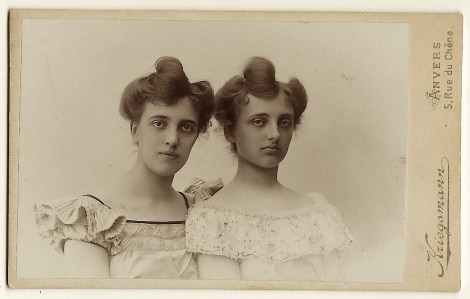
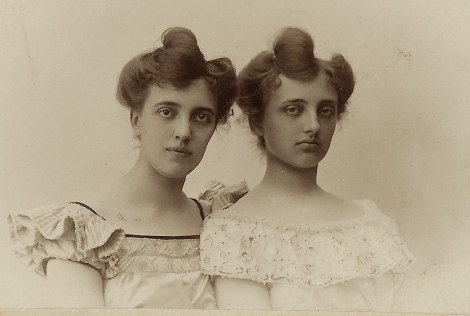
This carte de visite portrait features two pretty young women posing for their photograph at the Kriegsmann studio in Anvers, Belgium. These women are extremely likely to be sisters. They have similar faces and hairstyles. The women are wearing, what looks to be, spring or summer dresses. They are also wearing serious expressions. In fact, the woman on the right, appears dour. Anvers, the studio location, is also known as Antwerp. The city dates back to the middle ages. It is a port city and has an international reputation for it’s diamond trade. The young women in this photograph are identified by an inscription on the reverse of the cdv. they are Valentine and Madeleine Falcon. (SOLD)

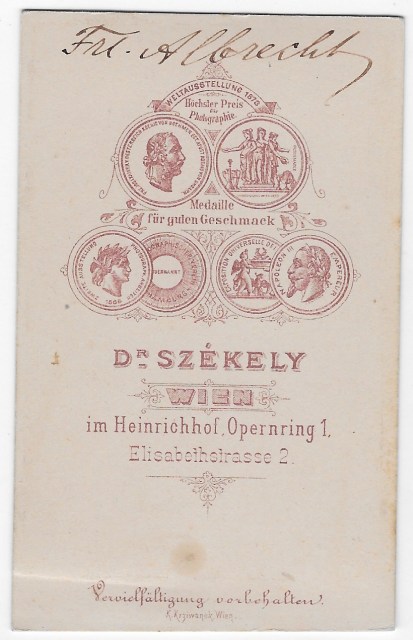
 This carte de visite portrait features Austria-Hungarian theater actress Hermine Albrecht (1856-1929). She studied acting with German actor, Karl Wilhelm Meixner and made her debut in 1875. In that year she signed with the Vienna City Theater where she worked until 1884. In 1887 she joined the ensemble of Burgtheater ensemble and in 1890 she was appointed a court actress. She left the theater in 1893 to join private life. She was married to Count Tamas Nyary de Bedegh (1838-1902). Her sister was also an actress (Charlotte Albrecht).The photographer of this image is Dr Szekely. He is cited multiple times in the photographic journals of his time for his photography research. Dr Szekely operated a studio in Vienna, Austria. As of this writing, the Cabinet Card Gallery has two other photos by Szekely. One of these images is of Austrian theater actress Josephine Wessely (1860-1887). To view the other photographs by Szekely, place his name in the blog’s search box.This photograph was taken during or after 1873. This is known because of the the award medallions seen on the reverse of the photograph is dated 1873, (SOLD)
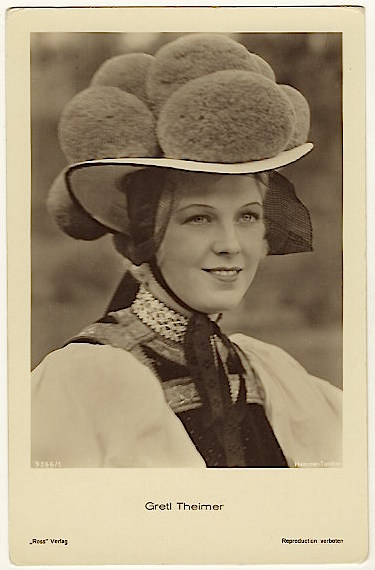 POSTCARD 1
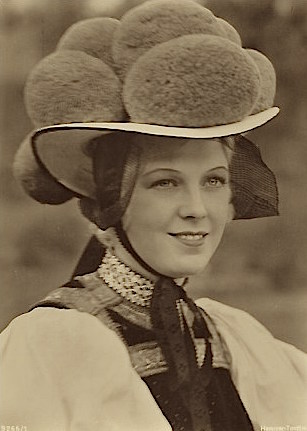 POSTCARD 1 (CLOSE-UP)
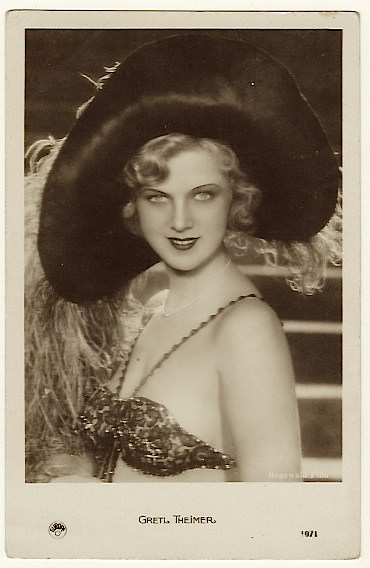 POSTCARD 2
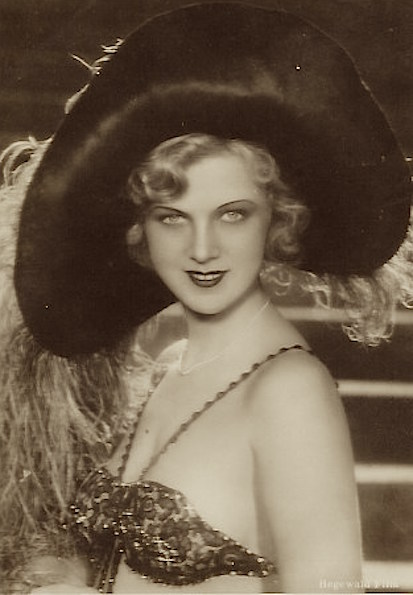 Postcard 2 (Close=up)
This vintage real photo postcard features Austrian actress, Gretl Theimer (1910-1972). She was a leading lady and singer of operatic films in the 1930’s. She was trained as a ballerina and she began her performing career as a child.She danced in the children’s ballet of the State Opera in Vienna. The IMDb reports that she has 57 film credits between 1930 and 1969. Her roles after World War II were predominately minor parts. Postcard 1 features Miss Theimer wearing a most interesting hat in this portrait. It looks like her hat is covered with dragon eggs, or giant dustballs. This photo postcard was published by Ross Verlag. The publisher was located in Berlin, Germany. The postcard is part of a series (no. 9266/1). The postcard has the logo of Hammer-Ton films. This photo postcard has excellent clarity and is in excellent condition. Postcard 2 offers a more risque view of Gretl Theimer. She is wearing a bikini top and a beautiful smile. She is accessorized with a string of pearls. Note her large hat and it’s plume of feathers. This photo postcard, judging by the logo on the front of the card, was published by “Europe”. It is part of a series (no. 1071). Embedded in the image is the words “Hegewald Film”. Liddy Hegewald (1884-1950) was a German film producer. She worked between 1919 and 1931. She worked in both the silent and early sound eras. Hegewald film was Liddy Hegewald’s own production company. To view Miss Theimer singing in a 1930 film, see the Youtube video below.
Buy this original Vintage Real Photo Postcard (includes shipping within the US) #2826
To purchase this item, click on the Pay with PayPal button below
$23.50
Buy this original Vintage Real Photo Postcard (includes International shipping outside the US) #2826
To purchase this item, click on the Pay with PayPal button below
$32.00
Buy this original Vintage Real Photo Postcard (includes shipping within the US) #2831
To purchase this item, click on the Pay with PayPal button below
$33.50
Buy this original Vintage Real Photo Postcard (includes International shipping outside the US) #2831
To purchase this item, click on the Pay with PayPal button below
$42.00
 POSTCARD 1
 POSTCARD 2
 | bmarshphd on NORTHPORT, LONG ISLAND, NEW YO… |
 | Libby Bryant on NORTHPORT, LONG ISLAND, NEW YO… |
 | rangerdon on BEALLSVILLE, PENNSYLVANIA : ST… |
| bmarshphd on ELEANOR GAINES : LUBIN SILENT… |
 | phantomfamous0cbbe9d… on ELEANOR GAINES : LUBIN SILENT… |
 THE CABINET CARD GALLERY