MEET THE NIGHT CREW: THREE MILITARY RADIOMEN IN HAWAII

radar

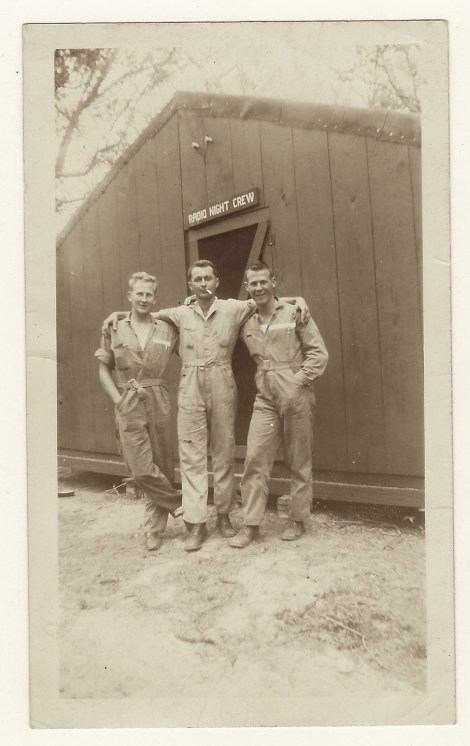
Three handsome military men pose in front of the radio shack for this snapshot portrait. The soldiers look like their having a great time. The man in the middle has a cigarette hanging out of his mouth. He looks like he’s playing a part in a World War II movie. Judging by the inscription on the reverse of the photograph, these guys are not in a war zone. In fact, the use of the word “Aloha” probably indicates that they are located in Hawaii. They are likely radiomen who worked the night shift which is logical since they are posing by the “Radio Night Crew’ sign seen above the shack’s door. This photograph was likely inscribed to, and sent to, “Arnolds” girlfriend. Along with the snapshot, the inscriber sent his “smiles” and “love and kisses”.  SOLD

radar-1

Published in: on January 5, 2017 at 1:28 pm  Comments (1)  
Tags: , ,

DAPPER YOUNG MAN HOLDING A WAND IN WORCESTER, MASSACHUSETTS

george-evansjpeg

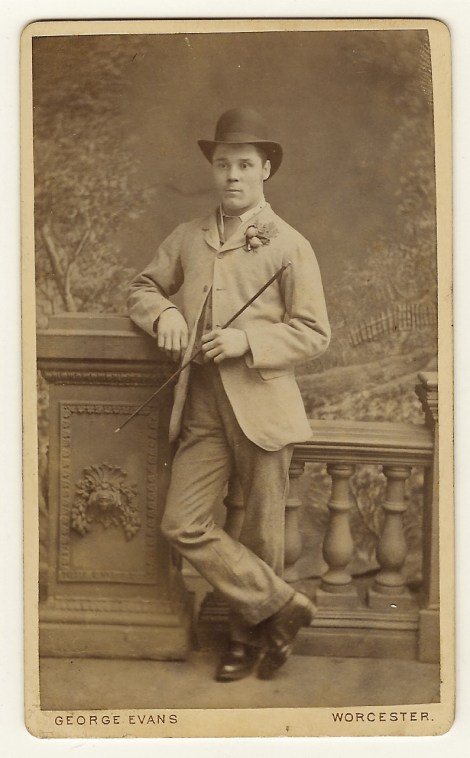
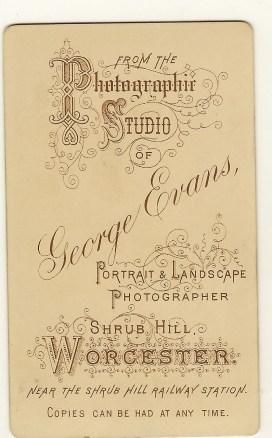
This carte de visite features a dapper young man wearing a corsage, derby hat, and a bit of a bewildered expression. Take note of his wand. I call it a wand for lack of a better description. One thinks of wands as being related to magic. However, not all wands are associated with magic. In fact, wands also are symbolic objects of power. The photographer of this cdv image is George Evans who operated a studio in Worcester, Massachusetts. ADDENDUM: Since this entry, an observant visitor to the Cabinet Card Gallery left a comment informing me that the location of Mr Evans studio was actually in Worcester, England. Further research confirms her observation.

geoge-evans

Published in: on January 4, 2017 at 3:05 pm  Comments (6)  
Tags: , , , ,

A NERVOUS YOUNG MAN AND HIS BICYCLE

bike-boy

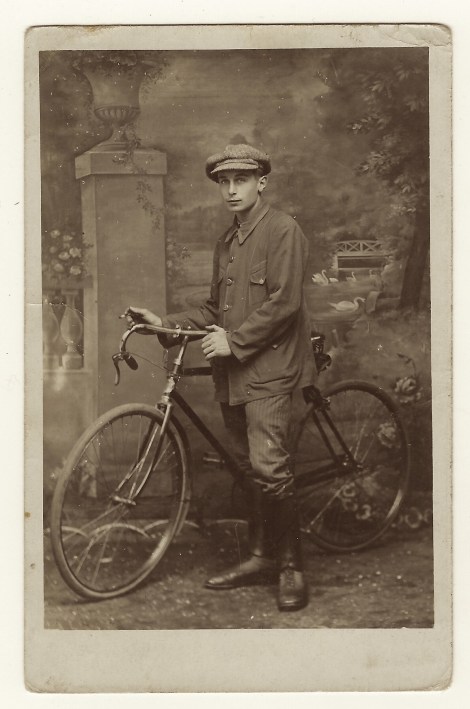
This vintage real photo postcard features a young man standing beside his bicycle. The look on his face can be described as similar to a “deer in the headlights”. One could also describe his expression as nervous. It is as if he just got caught doing something wrong. Maybe it has something to do with the cigarette that he is holding in his right hand, though I doubt it. He is wearing a great outfit and cap but I would surmise that his boots don’t make pedaling a bicycle particularly easy. Note that the backdrop in this studio photo is quite pretty and detailed despite that it is obviously fake. This postcard was produced in the very early 1900’s.  (SOLD)

bike-boy-1

Published in: on January 3, 2017 at 5:52 pm  Comments (2)  
Tags:

FASHIONABLE WOMAN IN BLACK BEADED DRESS IN URBANA, OHIO

beads

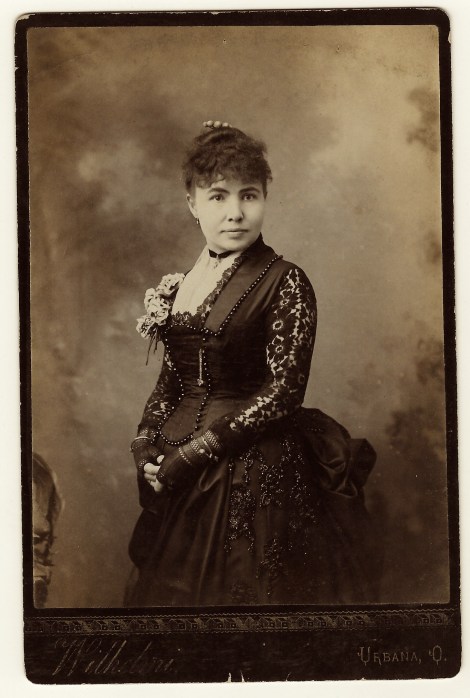
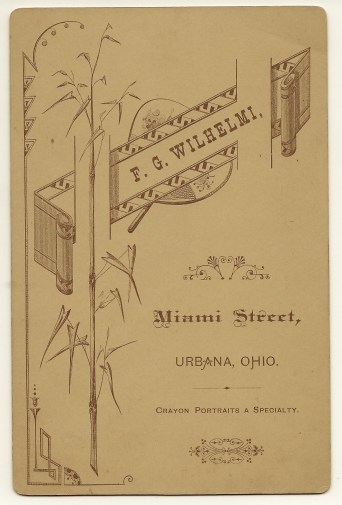
The lady is in black, possibly in mourning. She is wearing a pretty black lace heavily beaded dress. A hair ornament in her hair, a corsage on her dress, and fingerless gloves complete her ensemble. The woman wears a serious expression and has piercing eyes. The lighting in this portrait is well done and highlights the woman and her dress. The photographer of this interesting cabinet card image is F. G. Wilhelmi who operated a photography studio in Urbana, Ohio. Fred G Wilhelmi, like many of photographer colleagues, got around. He appears to have begun his photography career in Cumberland, Maryland (1871-1880). He then practiced his trade in Urbana (1885-1889) and Cleveland (1890- 1900 or later). The dates provided are approximate and come from two guides about early Ohio photographers.

beads-1

Published in: on January 2, 2017 at 12:15 pm  Comments (3)  
Tags: , , , ,

PORTRAIT OF KARINA BALL: BEAUTIFUL ACTRESS AND BREWERY DIRECTOR

bell


bell-1

Karina Bell’s beauty is quite apparent in this vintage real photo postcard portrait.  She was born in Hellerup, Denmark in 1898 and died in Denmark in 1979. Bell was a film actress who began her career as a ballet dancer. She made her stage debut in 1919. Most of her films were silent films produced in Sweden, Denmark or Germany. She did appear in two talkies. She was known for her roles in “Little Dorrit” (1924), Klovnen (1926), and “5 Raske Piger” (1933). Bell was one of the most popular stars of the Nordisk Films Kompagni in the 1920’s. She was married in 1934 to Knud Parkov (1894-1949). He was the director of a Danish brewery (Wiibroes Brewery) and a member of the Danish resistance. She retired from acting after she got married. The IMDb gives Karina Bell 20 credits. Her film appearances occurred between 1919 and 1933. Upon her husbands death, Bell took over his director duties at the brewery. This Austrian postcard was produced by Iris Verlag as part of a series (no. 589). The photograph was by Lux-Film.

bell-2

LOVELY PHOTOGRAPH OF TWO YOUNG GIRLS TAKEN BY THEIR PHOTOGRAPHER FATHER IN COLUMBUS, OHIO

odd-sisters

odd-sisters-4

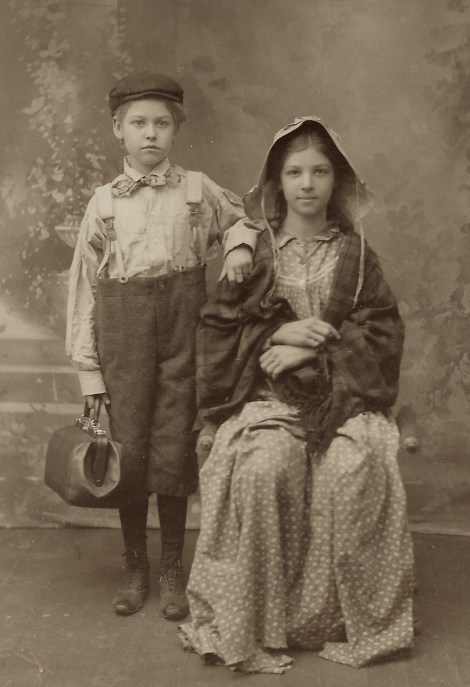
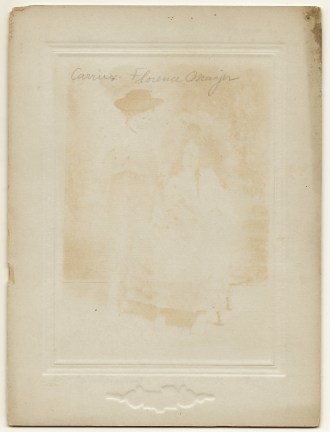
The photographer of this wonderful image is Alfonzo Mayer (1863-1963). He must have been very motivated to do a great job photographing these two children. His incentive was quite strong because the lovely children in this image were his daughters. The girls names are inscribed on the reverse of the photograph. Carrie was born in 1889. That’s her sitting in the chair with the blanket draped over her shoulders. She is wearing a bonnet, a precursor to modern day hoodies. Florence was born in 1893. She is standing next to Carrie and is wearing suspenders, a bow tie, and a cap. She is holding a leather bag, reminiscent of latter day’s doctor bags. The children are adorable. Both grew up to work in their father’s photography studio as operators. Carrie became a photographer, following in her father’s footsteps. The 1910 US census informs us that Alfonzo Mayer was born in Germany and immigrated to the US at two years of age. He married Otillie Mayer in about 1885. The couple had four children, but only three survived to the time of the census.   (SOLD)

odd-sisters-3

odd-sisters-2

Published in: on December 30, 2016 at 12:00 pm  Leave a Comment  
Tags: , , ,

THE PRETTIEST AND MOST INTENSE GIRL IN GOSHEN, INDIANA

bust-woman

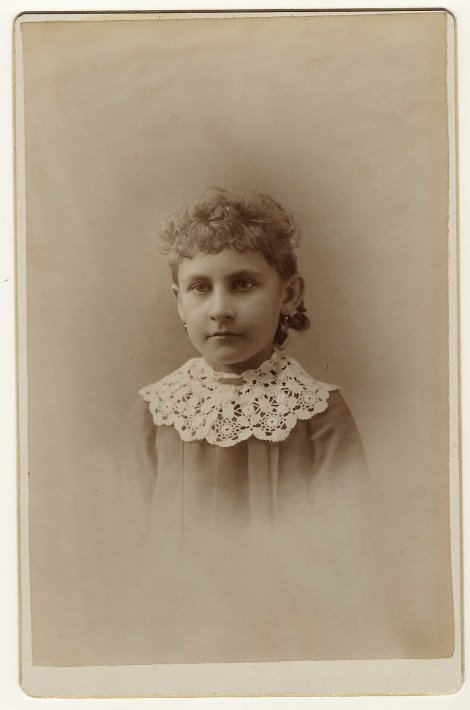
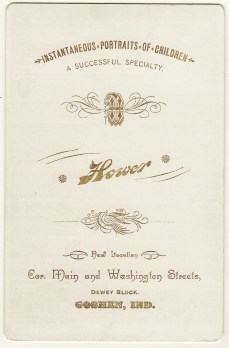
This cabinet card bust portrait features a pretty young girl who looks quite intense. I believe that she appears much older than her actual age. I would hypothesize that she is no older than in her young teens. She is wearing a lace collar and earrings. She has relatively short curly hair. This photograph was taken at the Hower studio in Goshen, Indiana.

bust-woman-2

Published in: on December 28, 2016 at 12:00 pm  Comments (2)  
Tags: , ,

THREE SIBLINGS AND A THREE WHEEL SCOOTER IN VALENCIA, SPAIN

three-spanish-kids

This vintage photograph is difficult to categorize. It looks like a cabinet card image and is mounted on stiff board cabinet card paper. However, the reverse of the image has divided postcard printing including a stamp box.  The three children, in this photograph are adorable despite their serious expressions. It is extremely likely that they are siblings. Note how the oldest child has a good grip on her little brother’s shoulders in a show of physical support and affection. The children are wearing nice but not fancy clothing. The little boy is standing on a three wheel scooter. Both girls are wearing necklaces with a charm as well as hair bows. The photograph was taken at the Julio D. Derrey studio. Printed advertising on the verso indicates that the studio was located in Valencia, Spain’s third to largest city.

three-spanish-kids-1

Published in: on December 27, 2016 at 12:00 pm  Comments (2)  
Tags: , , ,

PORTRAIT OF A CUTE CURLY HAIRED LITTLE FLOWER GIRL IN MALSTATT-BURBACH, PRUSSIA (CDV)

burbach

A cute little girl in a frilly white dress poses for her portrait at the Gluck Auf studio in Malstatt-Burbach, Prussia. The girl is holding a bouquet of flowers and has a ribbon in her pretty curly hair. She is also wearing flowers in her hair. This carte de visite may be a communion photograph. She is standing in front of a backdrop with a simple rural scene. The studio’s home of Malstatt-Burbach was combined with two other towns in 1909 to form the city of Sarbrucken. In 1900 the town belonged to Prussia.

burbach-1

Published in: on December 26, 2016 at 12:00 pm  Comments (1)  
Tags: , , , ,

POSTCARD ADVERTISEMENT FOR LANGSTON HUGHES BROADWAY PLAY “MULATTO” (RPPC)

mulatto


mulatto-1

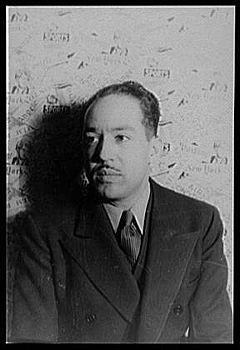
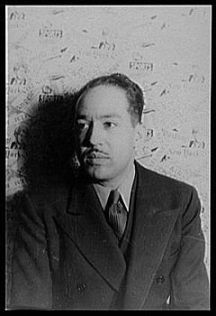
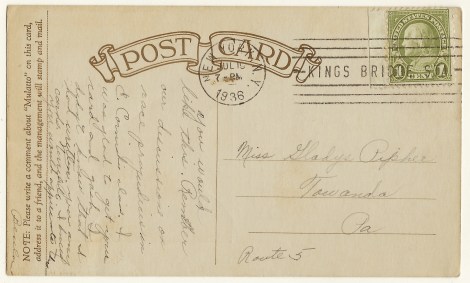
This postcard is incredibly interesting in many ways. It is an artifact of theater history as well as American History (Race Relations). It also serves as an important symbol concerning African American History. The postcard appears to be simply an advertisement for a play produced by Martin Jones entitled “Mulatto”. The postcard offers rave reviews from New York newspapers. The New York Times reported the play was “Flaming with sincerity.” and the Mirror exclaimed “Stark realism”. The play was in it’s ninth month at the time of the issuance of this postcard and it was appearing at the Ambassador Theatre located just west of Broadway. Seats could be had for as low as 55 cents and for as high as $2.75. The play “Mulatto” was written by Langston Hughes. It was the first African American authored play to become a long-run Broadway hit. It opened in October (1935) and closed in September (1936) after running for 373 performances. The show then toured for two seasons. Langston Hughes wrote the play in 1930 and it was his first full-length play. The play covered powerful issues such as conflict between father and son, the power of class and whiteness, oppression of southern African Americans, and the lasting effects of slavery. The play also is seen by some as anti-lynching. The Broadway version of “Mulatto” was altered by producer Martin Jones without consulting with Langston Hughes. Jones took Hughes already shocking play and sensationalized it. Jones’s editing handiwork did not help Hughes’s reputation. The play, already emotionally charged, became very controversial. In fact, it was banned in Philadelphia. By the way, did you notice Mr. Hughes is not even mentioned on this advertising postcard? Hughes was much more than a talented playwright. He was also a poet, novelist, and social activist. He was one of the innovators of  “jazz poetry” and an important part of the “Harlem Renaissance”. He was born in Joplin, Missouri in 1902. He was left with his grandparents while his mother pursued a theatrical career. His grandmother’s first husband had fought and died for abolitionist John Brown. She helped shape his intense pursuit for social and racial equality. Hughes was an excellent student. In the 1910’s he moved to Illinois and joined his mother. They later moved to Cleveland, Ohio. After high school he lived a year in Mexico with his father and than enrolled in Columbia University (New York City) in 1921. He left school due to racial prejudice and held various jobs and published some of his writing. He received some harsh criticism from some of the African American community for his use of stereotypical African American dialects. He returned to college, graduated from Lincoln College, and continued writing becoming very well known. I mentioned that this postcard was very interesting from a number of perspectives. One feature that makes this postcard unique is the printed notation on it’s reverse. The “blurb” requests that theatre goers who attended a performance of “Mulatto”, write their comments about the play on the postcard and address it to a friend. The management promises to stamp the postcard and see to mailing it. This was a creative way to publicize and market the play to a “target audience”. This method was essentially low tech social media. The writer of this postcard utilized the opportunity to pen a message to a friend in Towanda, Pennsylvania. The postcard was mailed from New York in July of 1936. Referring to the play, the writer stated “You would like this. Remember our discussions on race prejudice in E. (Cornish’s?) class.” and “I know you would appreciate this”. One of the things that amazes me is that the writer actually discussed racial prejudice in school in the 1930’s and was interested in the topic.
LANGSTON HUGHES
mulatto-2