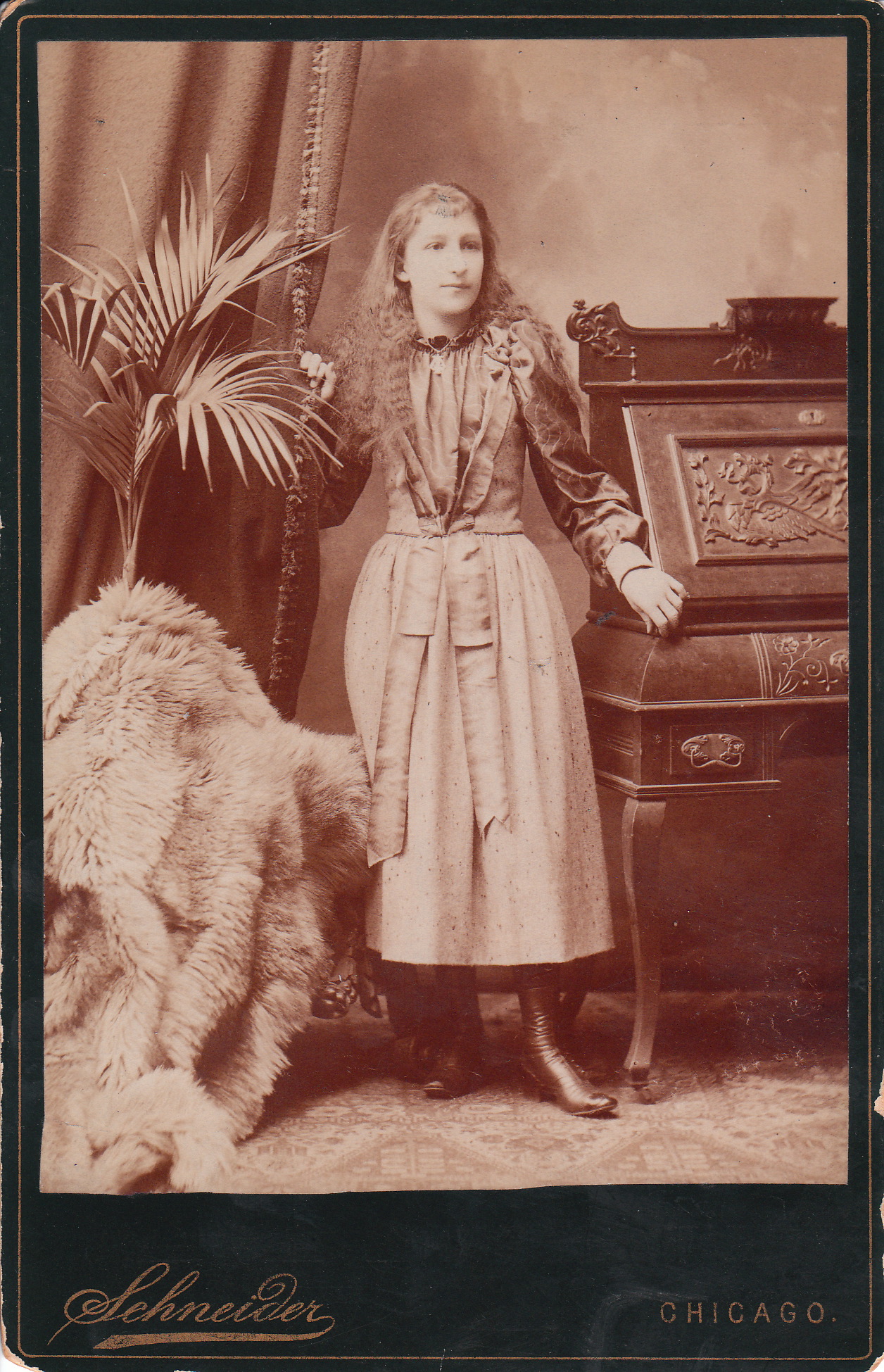
 A young woman poses for her portrait in a staged study at the Schneider studio in Chicago, Illinois. She is surrounded by standard studio props including a desk, fur, plant, and curtain. The desk has a dragon design. Schneider’s studio was located at 2135 Archer Avenue. The Lakeside Directory of Chicago (1876) lists a photographer named George Schneider who was located at 219 & 221 North Avenue. It is unknown if he is the same photographer that operated on Archer Avenue and produced this photograph. SOLD
YOUNG WOMAN IN A STUDY IN CHICAGO

CARTE de VISITE PORTRAIT : HANDSOME WELL DRESSED GENTLEMAN : MADISON, WISCONSIN
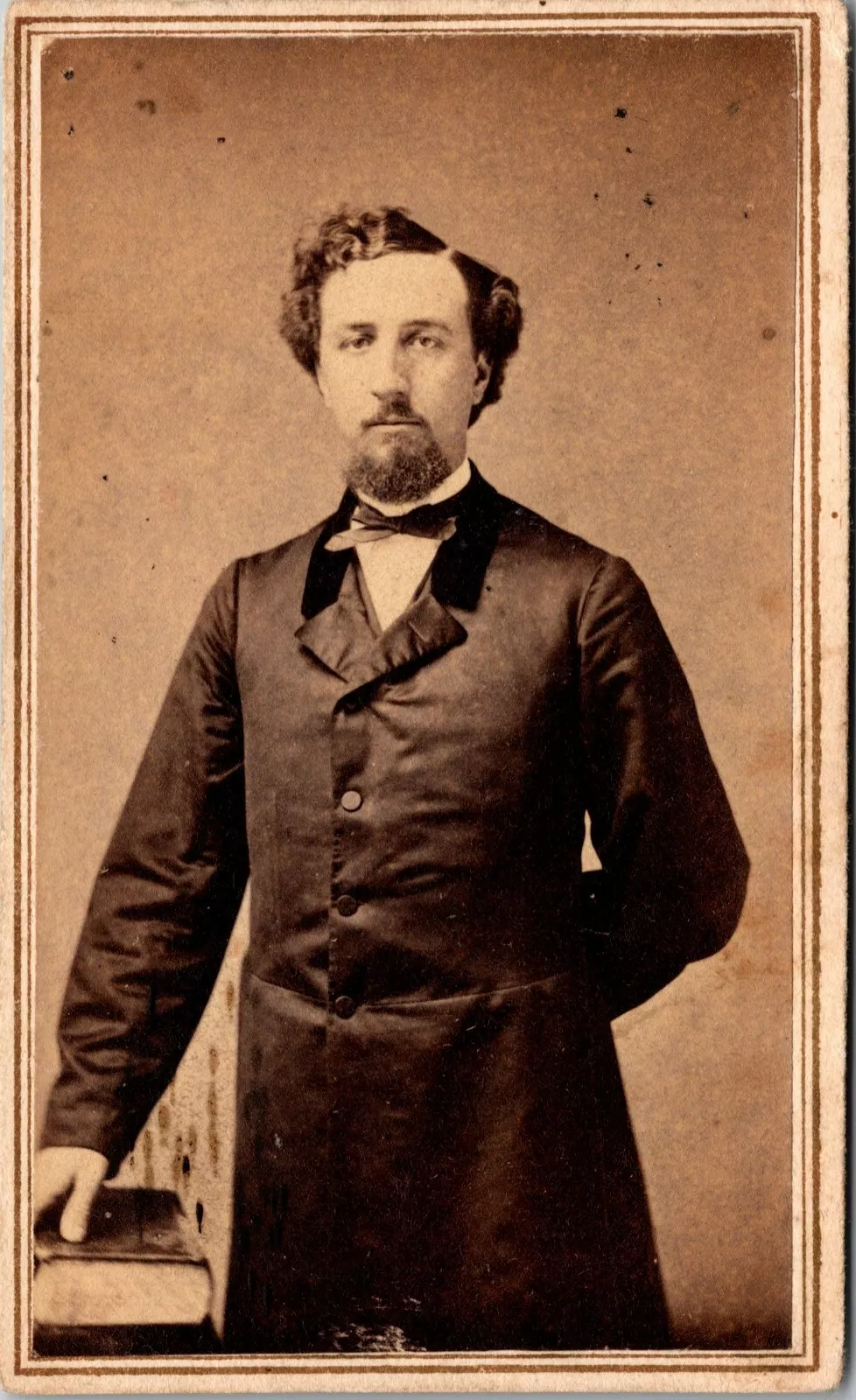
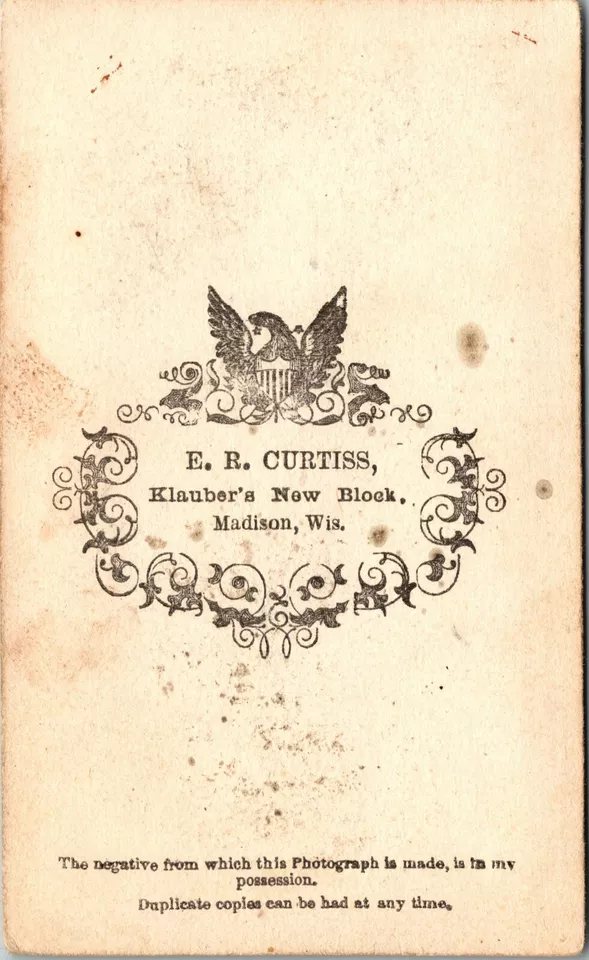
This striking carte de visite (CDV) features a well-dressed gentleman posed in a confident and composed studio portrait by E.R. Curtiss (1836-1906) of Madison, Wisconsin. The sitter stands in a classic mid-19th-century pose, one hand resting on a book while the other is held behind his back, projecting an air of quiet authority and intellectual refinement. The gentleman’s appearance is particularly appealing, with softly curled hair, a neatly groomed mustache, and a full beard that frames his face. His expression is calm and direct, with a steady gaze that gives the portrait a strong presence. He is dressed in a dark, well-tailored coat with a velvet collar, buttoned vest, and bow tie—attire that reflects the formal style of the late Civil War to Reconstruction-era period. The reverse bears an ornate backmark for E.R. Curtiss, Madison, Wisconsin, featuring an American eagle motif and decorative scrollwork. He operated a photo studio in Madison, Wisconsin. Curtiss was born in Southington, Connecticut and married Eva A. Lingenfetler of Fonda, New York in 1859. An interesting physical characteristic of this example is that it is printed on slightly thinner cardstock than is typically encountered with CDVs. Based on the style of dress, pose, and mount design, this CDV likely dates to approximately the late 1860s to early 1870s. The condition of this cdv is good overall. The image remains clear with good contrast and detail. There are scattered small surface specks and light marks visible. The corners show light wear and the mount exhibits typical handling wear for its age. The reverse shows moderate soiling and spotting but retains a strong, legible backmark. The thinner cardstock is intact with no structural issues. Overall, this 150 year-old photograph is a solid and displayable image with appealing subject matter (see scans).
This carte de visite is available for purchase at my store, The History Peddler, for $18.00 at auction
Interested collectors may view the listing here:
https://www.ebay.com/itm/336575595451
PIONEERING BOOK CLUB IN GENEVA, OHIO
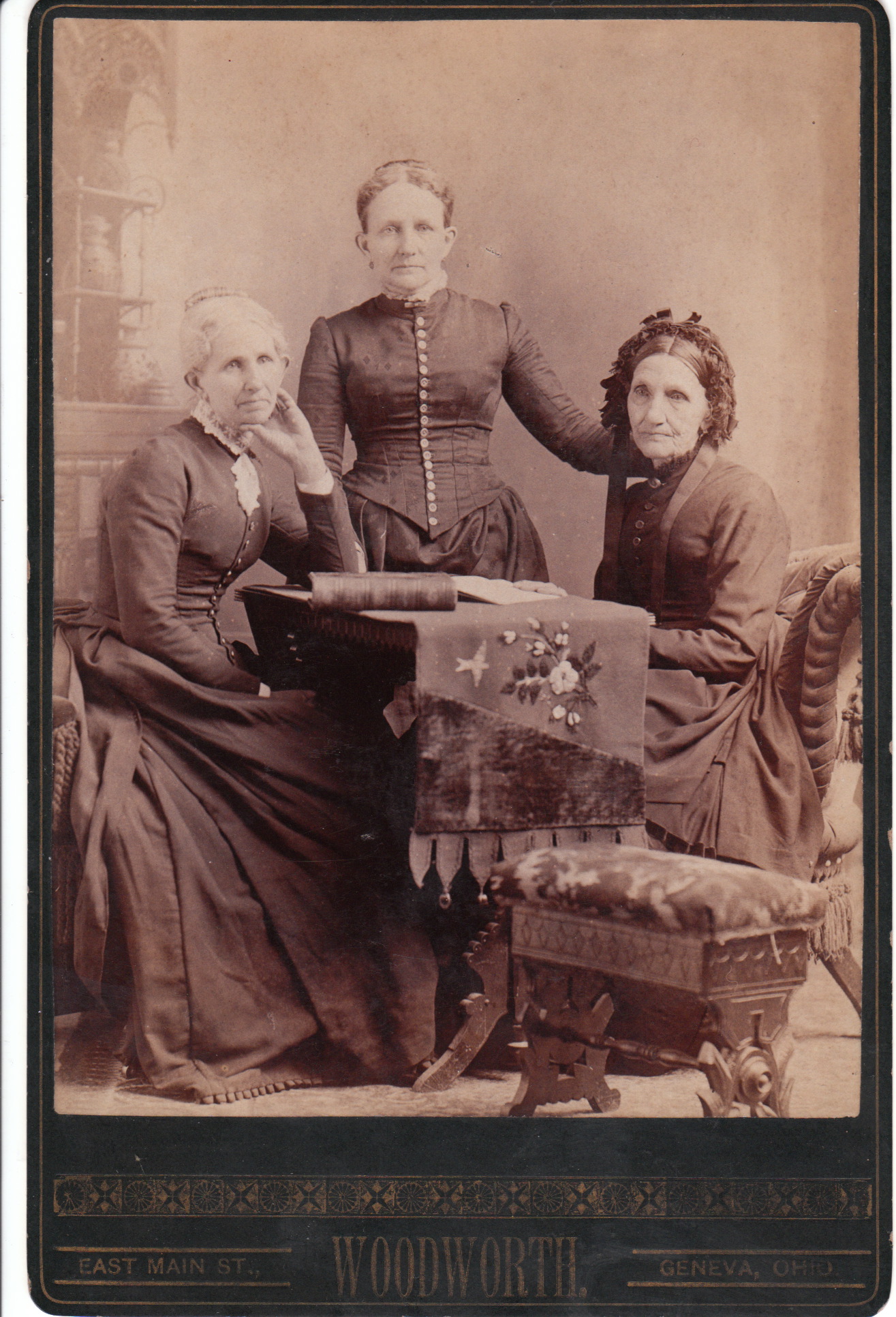 This cabinet card is an image of three grand ladies gathered around a table. Atop the table is one closed and one open book. This meeting of the Geneva Ladies Book Club was the forerunner of the modern day version of women’s book clubs. The previous statement may be false, but it does raise the value of this cabinet card. The photographer of this image is Woodworth, of Geneva, Ohio. James P. Woodworth (1845-?) was born in Kingsville, Ohio. He was active as a photographer in Geneva by 1869. He and his wife (Ruby M. Thorp) operated Woodworth’s Fine Art Gallery in Geneva until 1886. SOLD
WOMEN’S FIELD HOCKEY TEAM : UNIFORMS & STICKS : BRIGHTON, ENGLAND : RPPC 1907
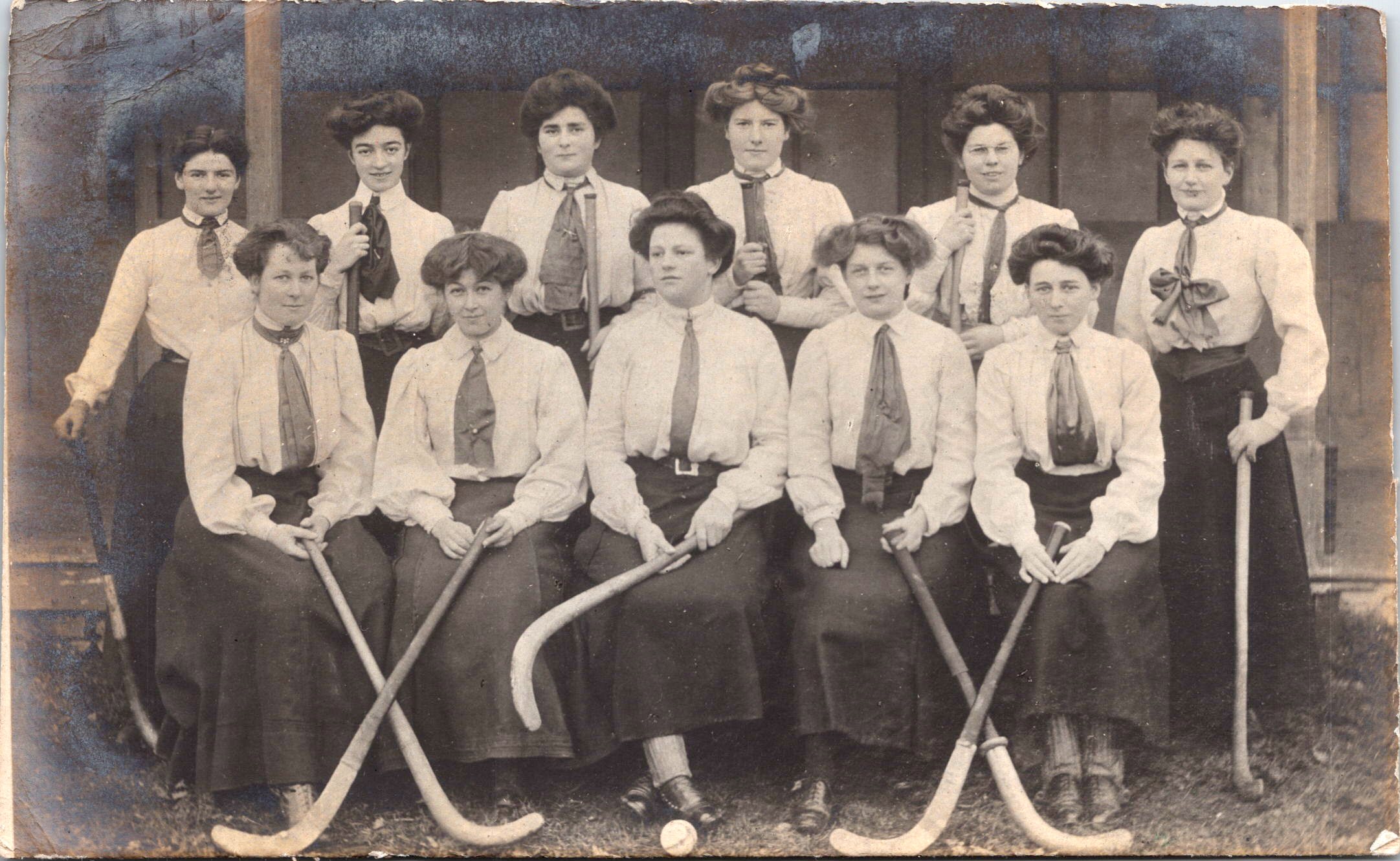
This is a fascinating and uncommon early real photo postcard depicting a
women’s field hockey team, posed formally with their sticks and ball in what appears to be a school or club setting. The group consists of eleven young women arranged in two rows, dressed in coordinated athletic attire typical of the Edwardian period—long dark skirts paired with light blouses and ties, reflecting both modesty and the emerging presence of women in organized sport. Each player holds a field hockey stick, with several crossed in front for a carefully composed team portrait. A single ball rests prominently at the feet of the front row, reinforcing the athletic identity of the group. The players’ hairstyles—loosely pinned up with volume at the crown—are consistent with the circa 1905–1910 period, and their expressions range from serious to quietly confident, offering a compelling glimpse into early women’s athletics. The reverse of the card is postmarked
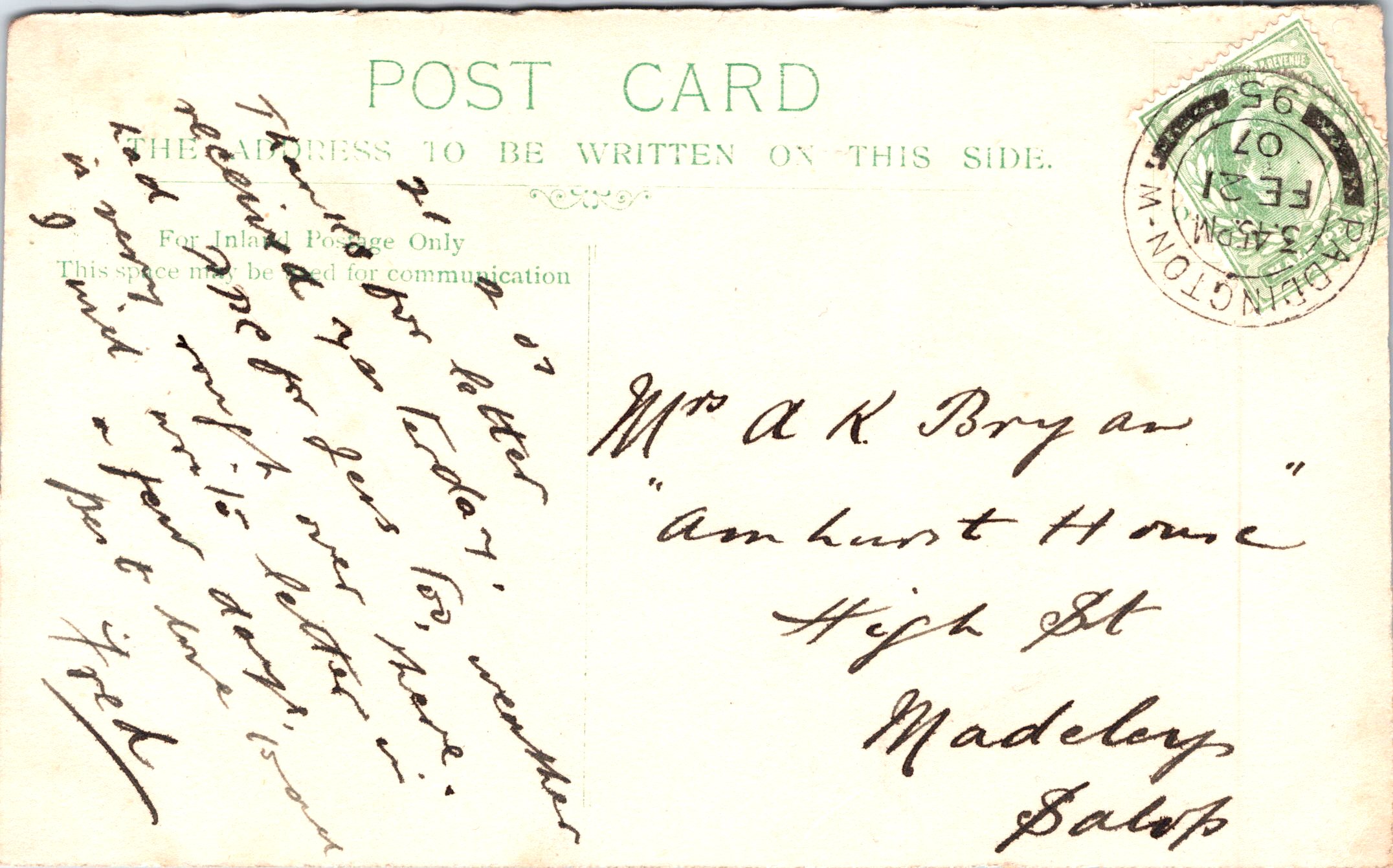
BRIGHTON, ENGLAND, FEBRUARY 7, 1907. It bears a green one-penny stamp of
King Edward VII. The card features a divided back. The postcard is in
good antique condition with some age-related wear. The image remains clear with strong detail, though there is visible edge wear, corner rounding, and some surface discoloration and spotting, particularly along the borders. The reverse shows expected toning, a clear postmark, and legible handwriting. Overall, this is a well-preserved and displayable example of a women’s field hockey team and early women’s sports (see scans).
This vintage Postcard is available for purchase at my store, The History Peddler, for $28.00
Interested collectors may view the listing here:
https://www.ebay.com/itm/336507878222
CONSTANCE COLLIER : IN COSTUME AS CLEOPATRA : ACTRESS, ACTING COACH, WRITER

POSTCARD 1 (SOLD)
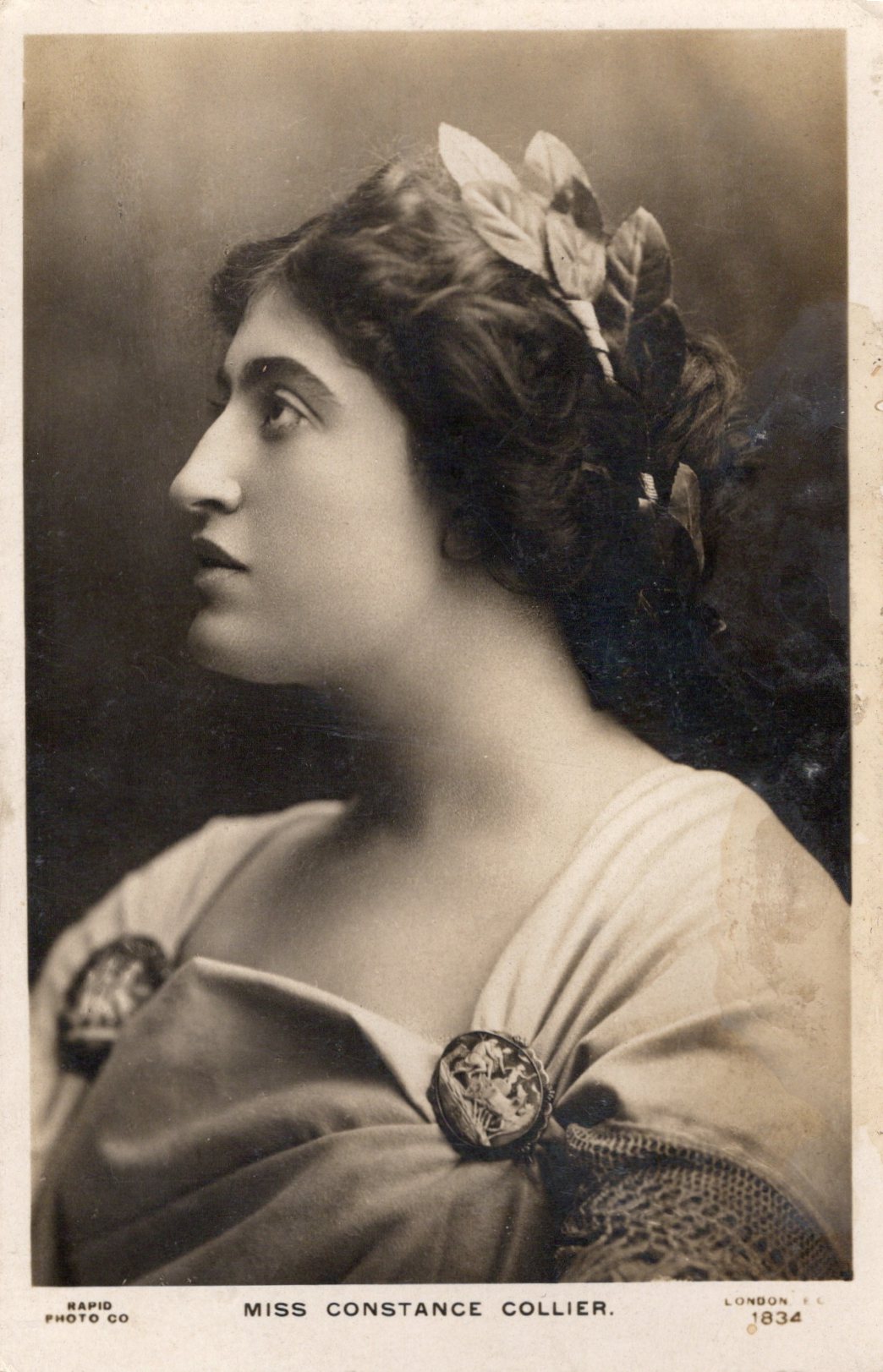
POSTCARD 2 (SOLD)
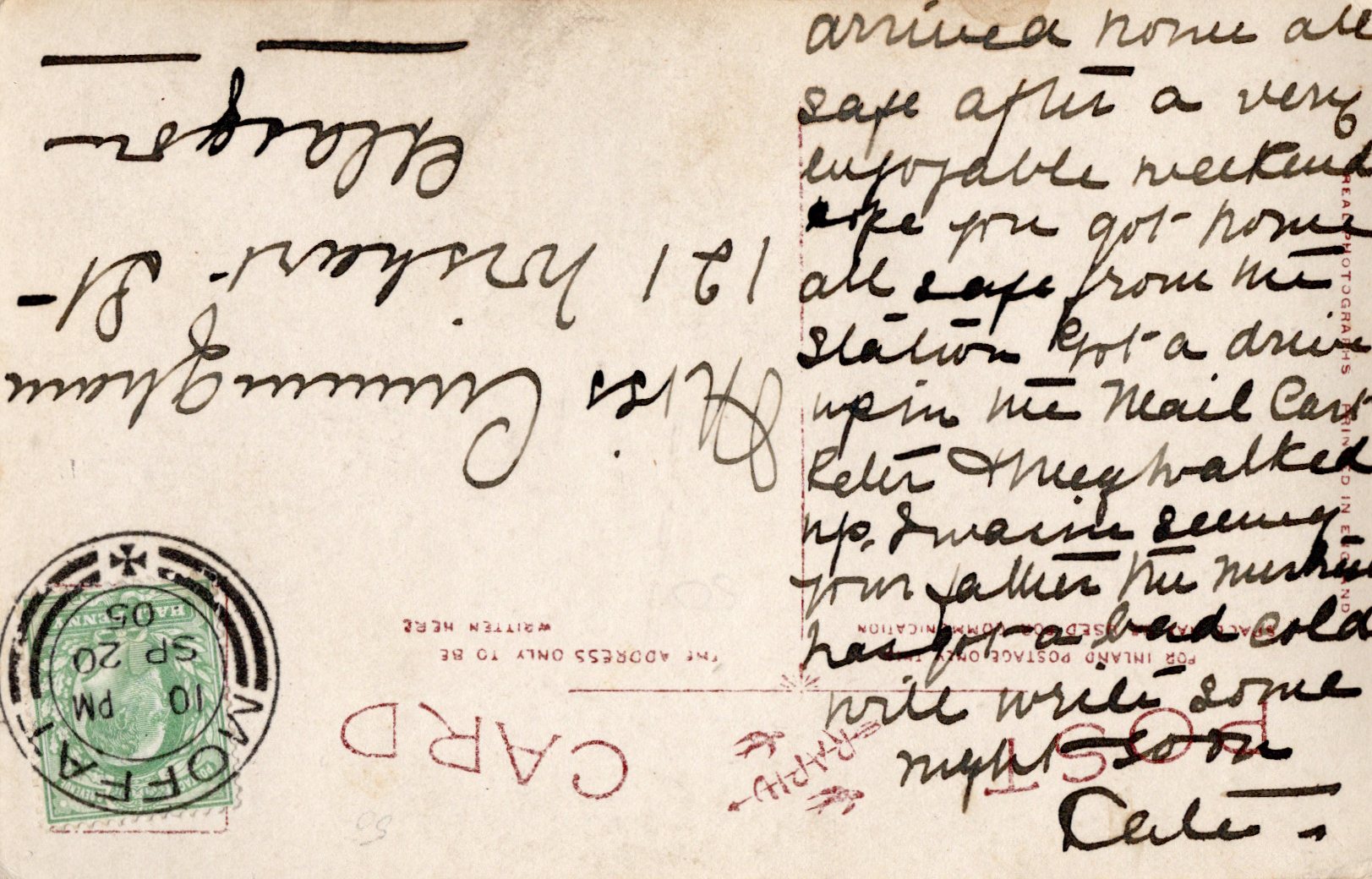
Postcard 1 is a vintage real photo postcard featuring English stage and film actress and acting coach, Constance Collier (1878-1955). She also wrote hit plays and films. She has another claim to fame. She was the first person to be treated with insulin in Europe. This postcard captures Miss Collier in costume for her role of Cleopatra in “Antony and Cleopatra” (1906). Marc Antony was played by Herbert Beerbohm Tree and the production’s venue was at “His Majesty’s Theatre”. Collier began her stage career at the age of three. She appeared in “A Midsummer Night’s Dream”. At the age of 15, she became one of the “Gaiety Girls”. This group was a famous dance troupe based in London’s Gaiety Theatre. In 1905, Collier married English actor, Julian Boyle. He was better known as the famous theatrical cross-dresser, Julian L’Estrange. After appearing in “Antony and Cleopatra”, Collier became very popular and seen as a distinguished actress. In 1908, she made the first of several tours of the United States. In her 1916 tour of the US, she made four silent films including in D. W Griffith’s, “Intolerance”. In 1918, her husband died from the Spanish flu while the pair were on a US tour. The influenza epidemic of 1918-1919 killed 650,000 Americans. It was the era’s version of Covid-19. In the early 1920’s, Collier became close friends with actor, Ivor Novello. They acted and co-wrote together. In the late 1920’s, Collier relocated to Hollywood where she became a voice coach. She filled a valuable role because talkies were beginning to replace silent films and many actors were in need of help with the transition. Her most famous students were actresses, Colleen Moore, Marilyn Monroe, Vivien Leigh, and the Hepburn sisters. While teaching, she still performed on Broadway and made films. The IBDb reports that Collier was in 21 Broadway shows between 1908 and 1939. These shows included Oliver Twist (1912), Othello (1914), Camile (1931), and Dinner at Eight (1933). According to IMDb, Collier performed in 29 films, wrote 7, and was in the crew of 4. She performed for Otto Preminger as well as Alfred Hitchcock. She was awarded an American Shakespeare Festival Theatre Award for distinguished service for training actors for Shakespearean roles. This postcard was published by Rotary Photo as part of a series (No.4039H). Miss Collier’s photographic portrait was taken by the Foulsham & Banfield studio. The National Portrait Gallery possesses this same card in their Constance Collier postcard collection. They possess 33 different photographs of Miss Collier. (SOLD)
Postcard 2 was published by Rapid Photo as part of a series (No.1834). Note the size of the buttons on her dress and her hair ornament composed of four leaves. (SOLD)
POSTCARD 1
POSTCARD 2
PORTRAIT OF AN OLDER MAN WITH BRIGHT EYES AND A LONG WHITE BEARD (PITTSBURG, PENNSYLVANIA)
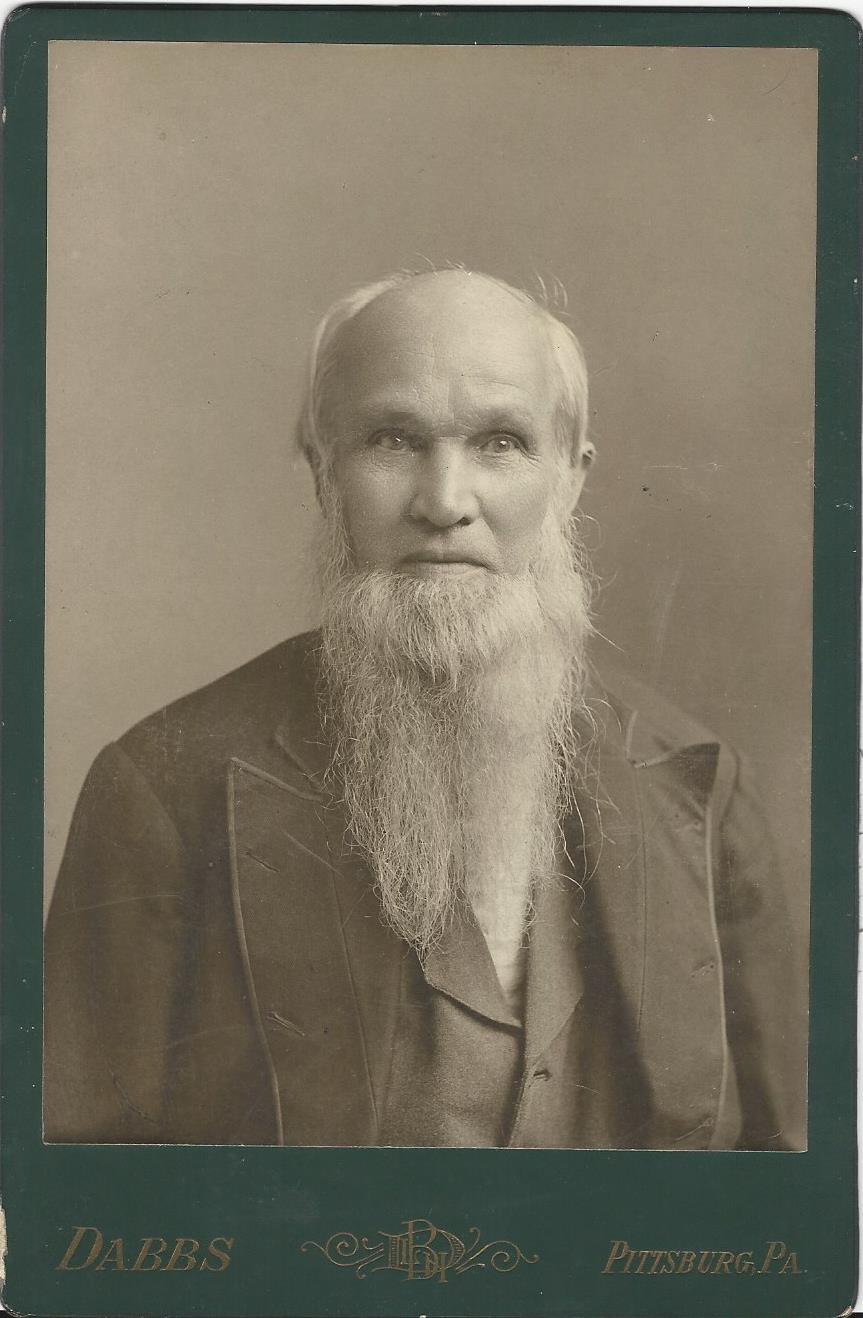
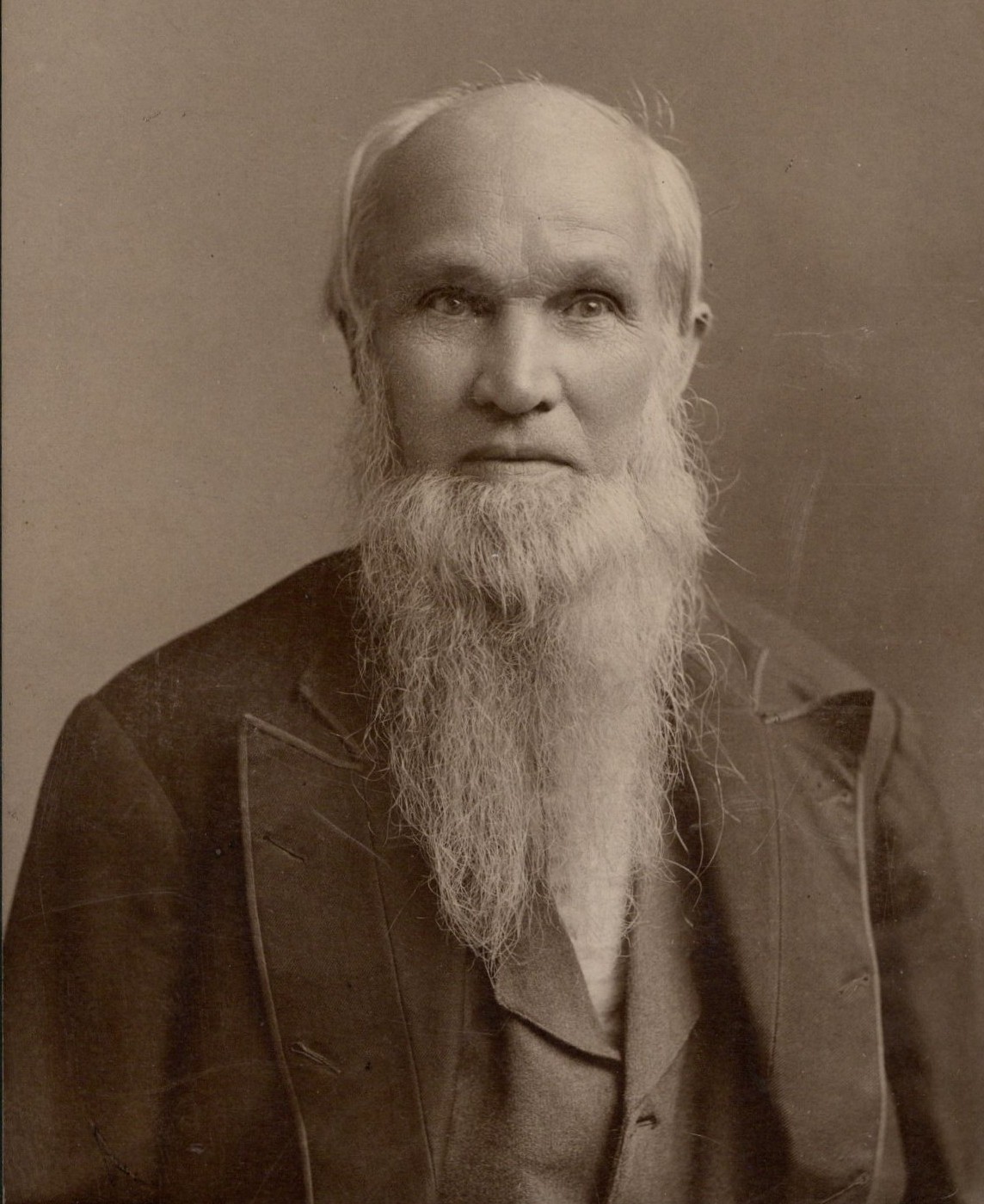
This cabinet card portrait features a well dressed handsome older gentleman with a wonderful long white beard. The man has striking eyes. They are bright and soft and he projects a certain sweetness and friendliness. This photograph was produced by the Dabbs gallery in Pittsburg, Pennsylvania. Benjamin Lomax Horsley Dabbs was born in London in 1839. He immigrated into the United States while still in his childhood. His father was a pioneer in the American photographic supply trade. Dabbs learned the photography field from his father, George Dabbs. Benjamin came to Pittsburgh in 1861 and opened a business selling photography supplies. That same year he also bought a gallery from a Mr. Rorah. He grew the business dramatically and in 1869 he sold his supply business to concentrate on being a photographer. During his tenure as a photographer in Pennsylvania, he was considered by many to be the best photographer in the state. In 1868 Dabbs married Sadie Dickson and the couple ultimately had nine children. Dabbs was a close personal friend of Abraham Lincoln and steel magnate Andrew Carnegie. Dabbs drew some attention for his stance on free resittings for customers who were not satisfied with the portraits taken by his studio. Unlike many other photographers, he refused free resittings because “the public do not value what they can get for nothing”. In his later years, Dabbs was debilitated by rheumatism and other illness. He died at age sixty in 1899. His celebrated portrait of Andrew Carnegie can be viewed today at Pittsburgh’s Carnegie Museum of Art. There is very light writing on the reverse of the cabinet card. The writing includes the name E. E. Headley. This cabinet card has minor edge and corner wear and is in overall good condition (see scans).
This Cabinet Card is available for purchase at my store, The History Peddler, for $36.00
Interested collectors may view the listing here:
https://www.ebay.com/itm/336204531912
MAUD ALLAN : RISQUE : SALOME : DANCER, ACTRESS, AND CHOREOGRAPHER : 1908 : RPPC
POSTCARD 1 (SOLD)

POSTCARD 2 (SOLD)
POSTCARD 3 (SOLD)
POSTCARD 4 (SOLD)
POSTCARD 5 (SOLD)
POSTCARD 6 (SOLD)
POSTCARD 7 (SOLD)
POSTCARD 8 (SOLD)
POSTCARD 9 (SOLD)
POSTCARD 10 (SOLD)
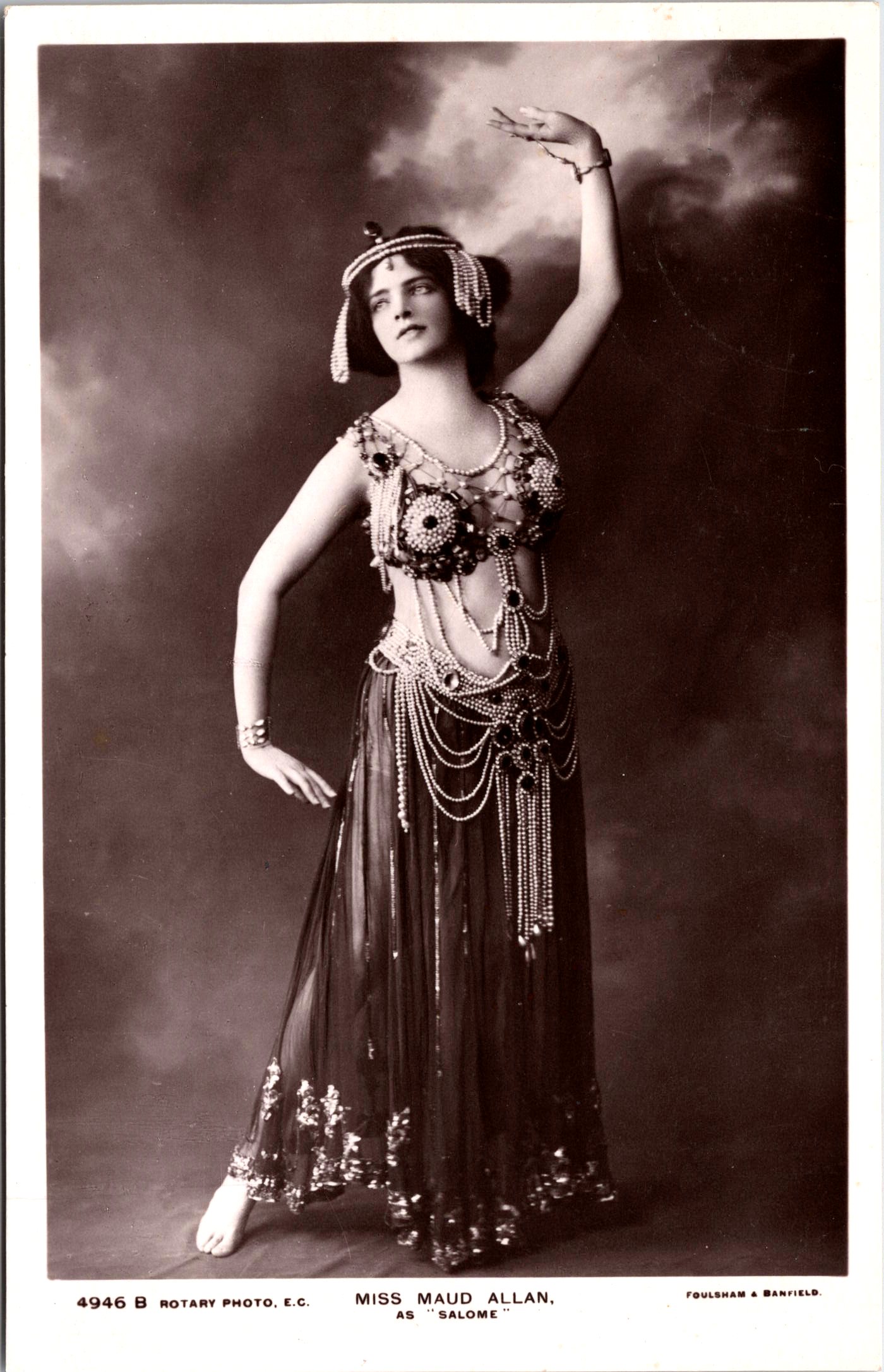
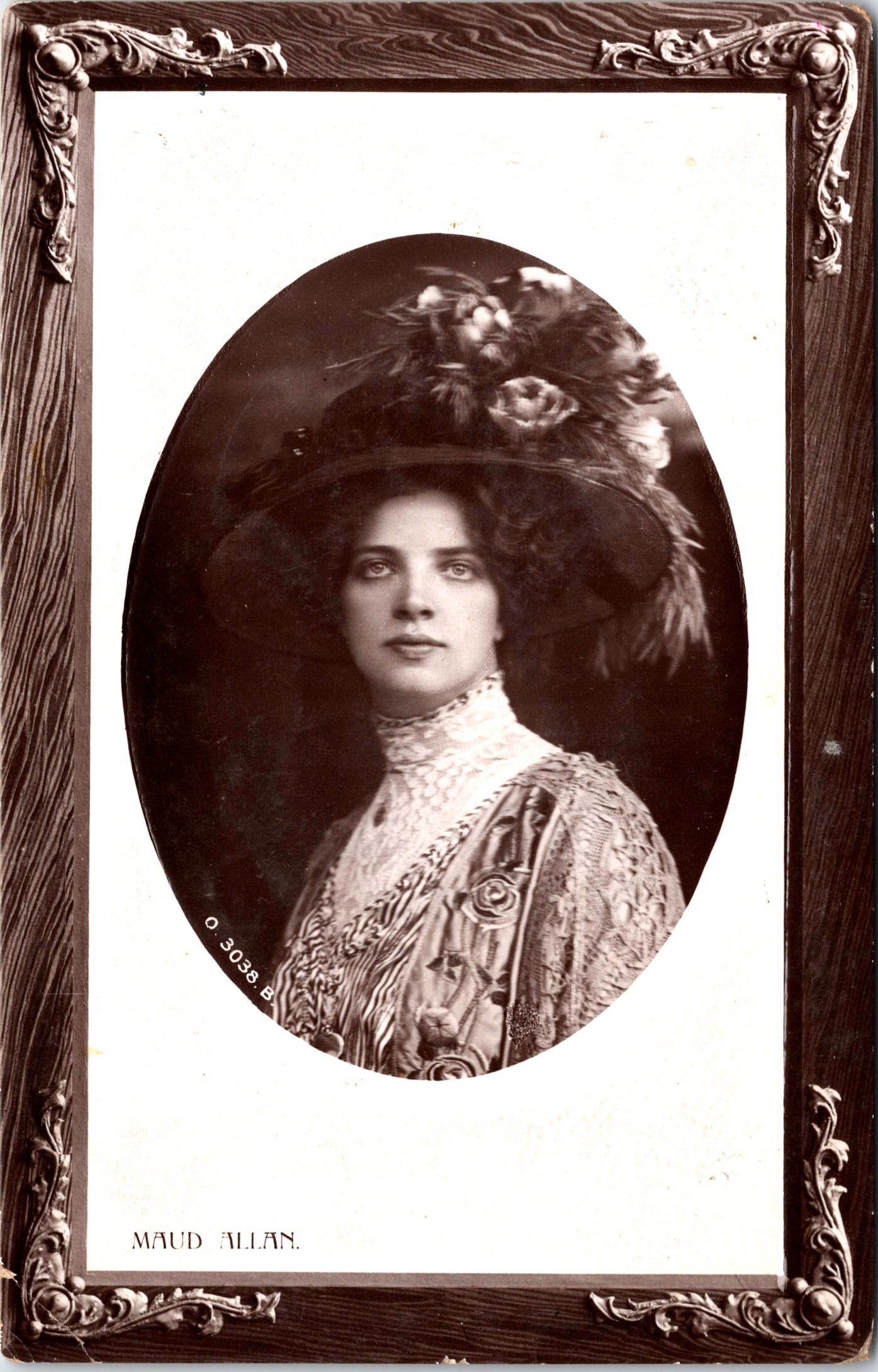
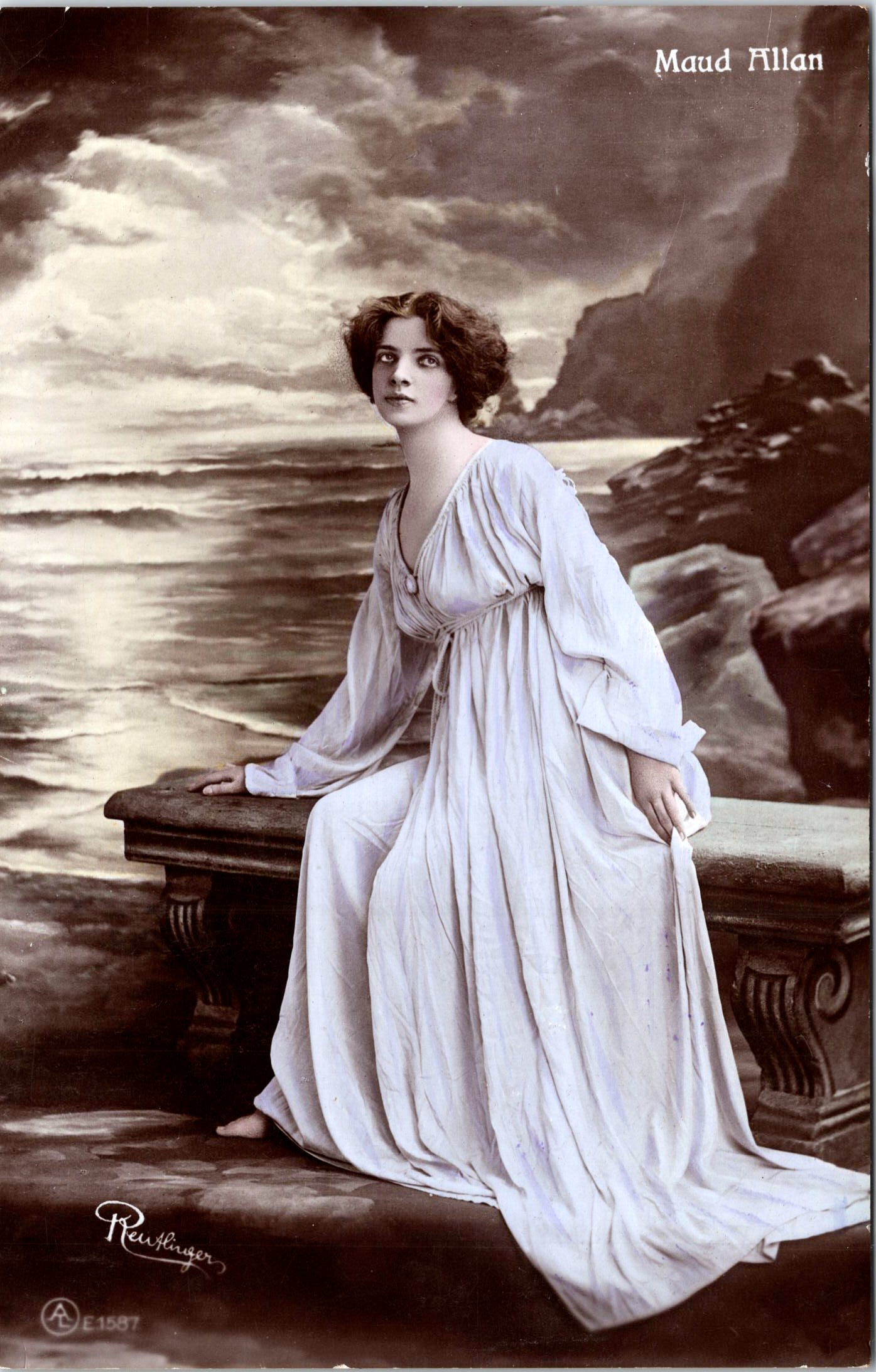
These risque vintage real photo postcards feature Maud Allan (1873-1956). She was a Canadian-born dancer, choreographer, and actress, who performed in the United States and Europe at the turn of the 20th century. She was known for her performances of the “Vision of Salome”, an interpretive dance based on the Oscar Wilde play “Salome”, in which she portrayed the title character. Allan’s performances were controversial and often drew criticism for their erotic content. She also was known for her court case in 1918 against a British newspaper, the Illustrated Times, who published an article accusing her of promoting immorality and lesbianism. She sued for libel and won. In regard to Allan’s sexual orientation, she was a lesbian and was involved with women her entire life. She had a long affair with Margot Asquith, the wife of Herbert Henry Asquith, the Prime Minister of the United Kingdom from 1908 through 1916. Allan also had a long affair with Verna Aldrich, her secretary.
Postcard 1 presents Allan dancing as “Salome”. She is wearing a sexually provocative costume. She is covered with jewelry. This postcard was published by Rotary Photo as part of a series (No.4946B). Miss Allan’s photograph was taken by the Foulsham & Banfield studio. An inscription on the card’s reverse reveals that the card is from 1908. (SOLD)
Postcard 2 This postcard also presents Allan dancing as “Salome”. Once again, she is wearing a sexually provocative costume and is covered with jewelry. This postcard was published by Rotary Photo as part of a series (No.4946Q). Miss Allan’s photograph was taken by the Foulsham & Banfield studio. This card is from circa 1908. (SOLD)
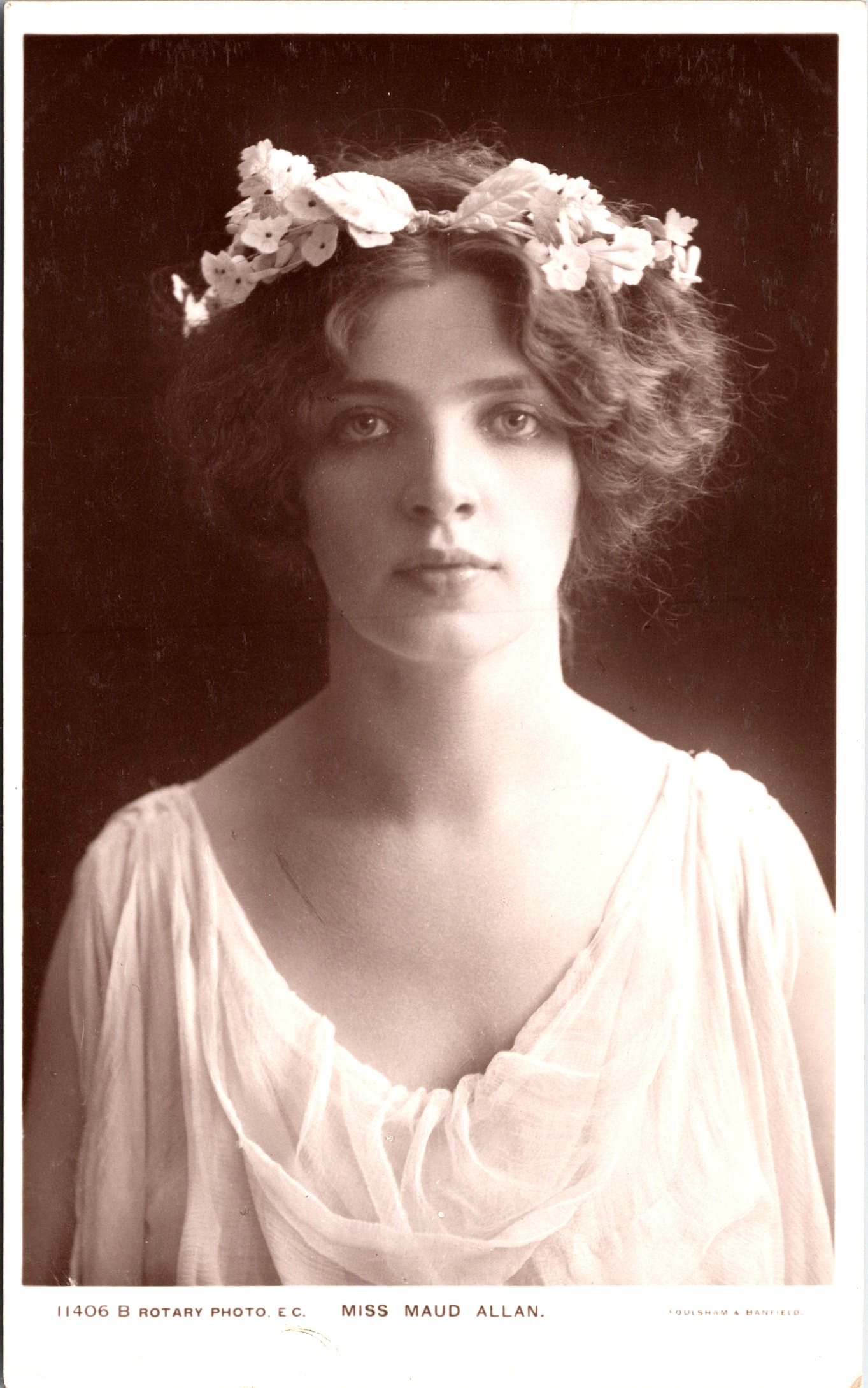
Postcard 3 is rare. The card captures Miss Allan wearing a sexually provocative costume. She is covered with jewelry. This postcard was published by Rotary Photo as part of a series (No.11406B). Miss Allan’s photograph was taken by the Foulsham & Banfield studio. This card is from circa 1908. (SOLD)
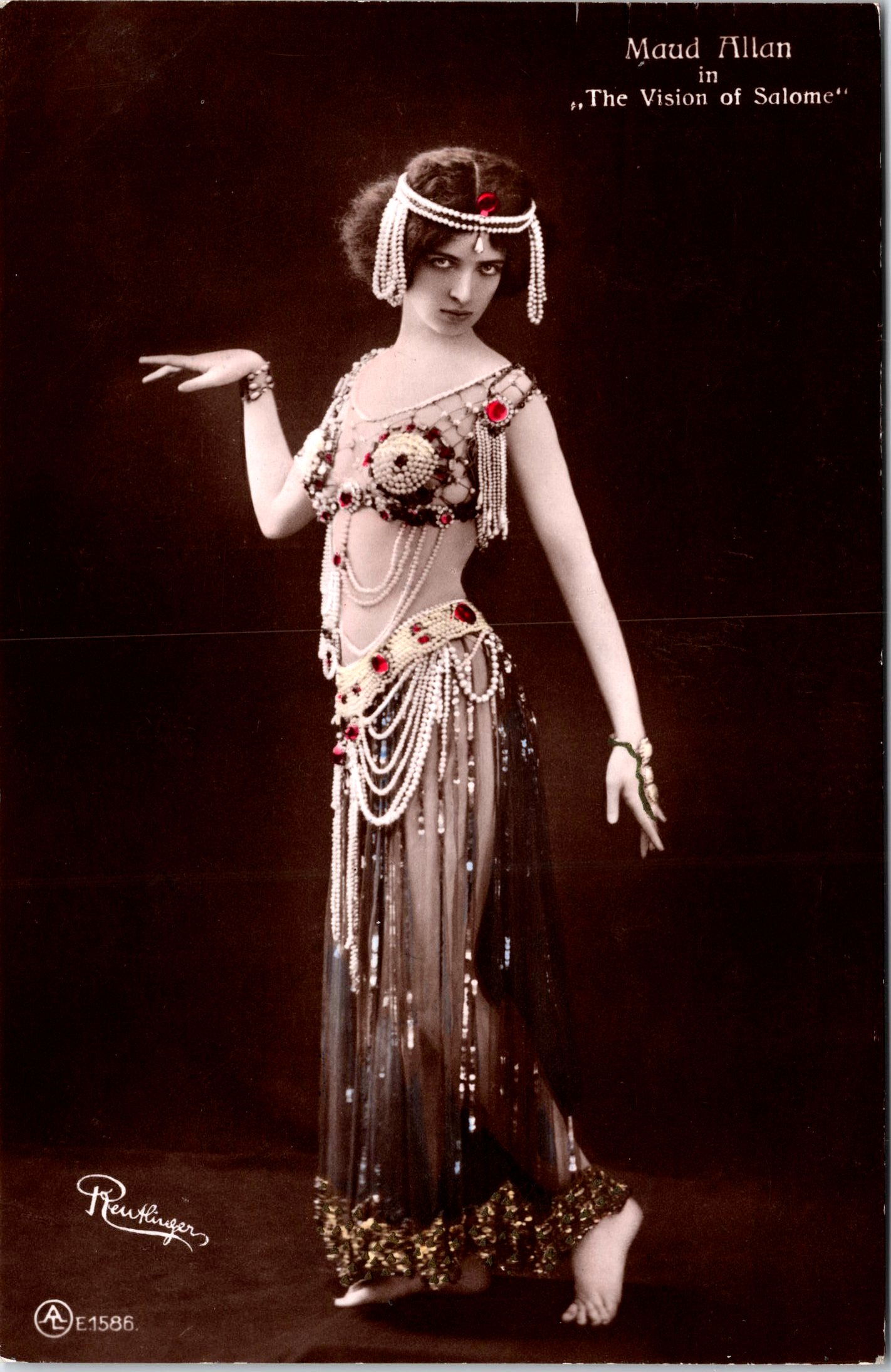
Postcard 4 is a risque vintage postcard that was published by Aristophot. Allan’s photograph was taken by Leopold Reutlinger as part of a series (no.E1586). This Salome postcard has a 1908 postmark. (SOLD)
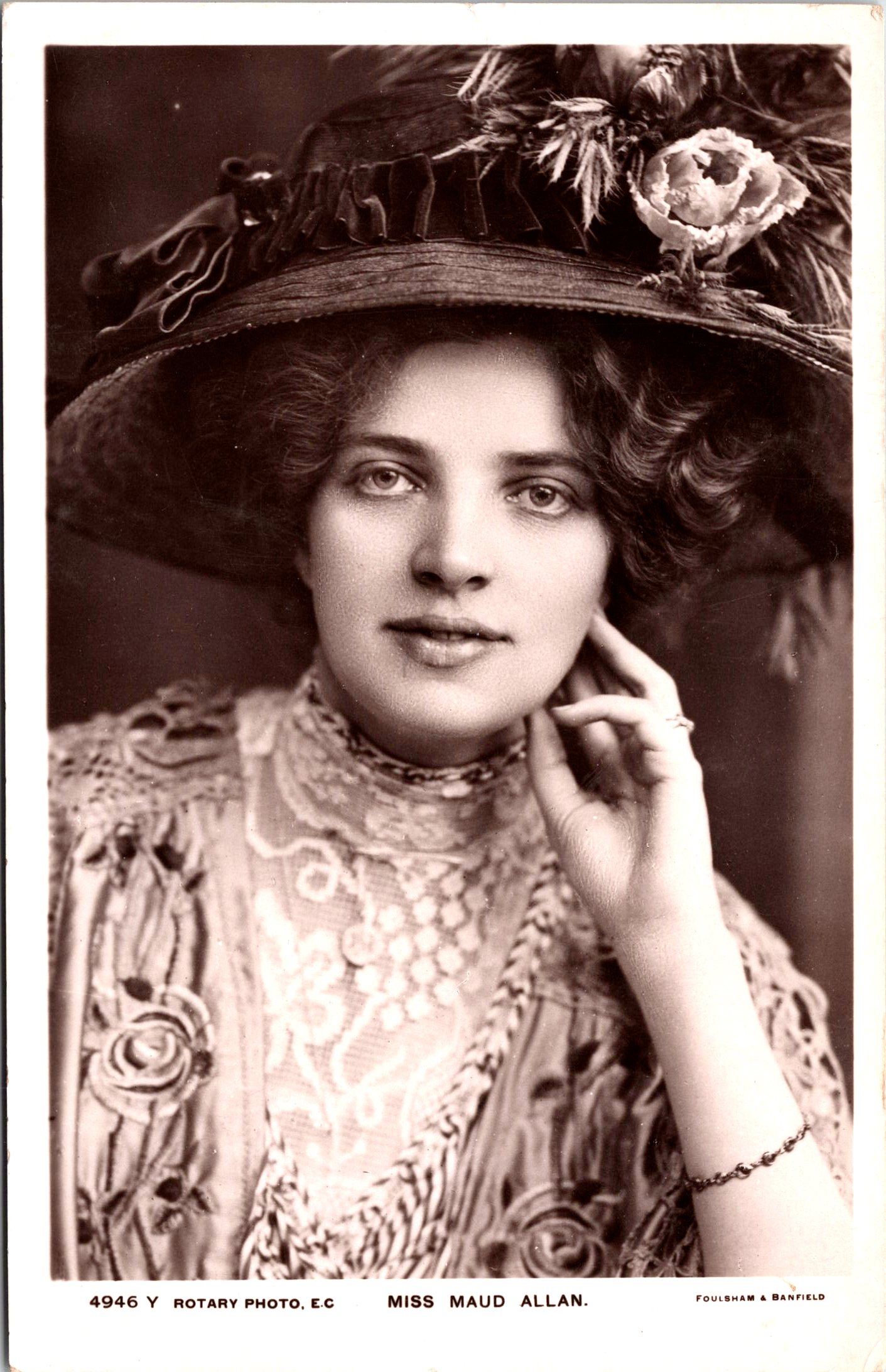
Postcard 5: Most vintage postcards of Miss Allan, capture her in various risque poses during her performance in “Salome”. This uncommon postcard portrait captures her well dressed and elegant looking. This card is uncommon and was published by Rotary Photo as part of a series (No.4946Y). Miss Allan’s photograph was taken by the Foulsham & Banfield studio. This card has a 1906 postmark. (SOLD)
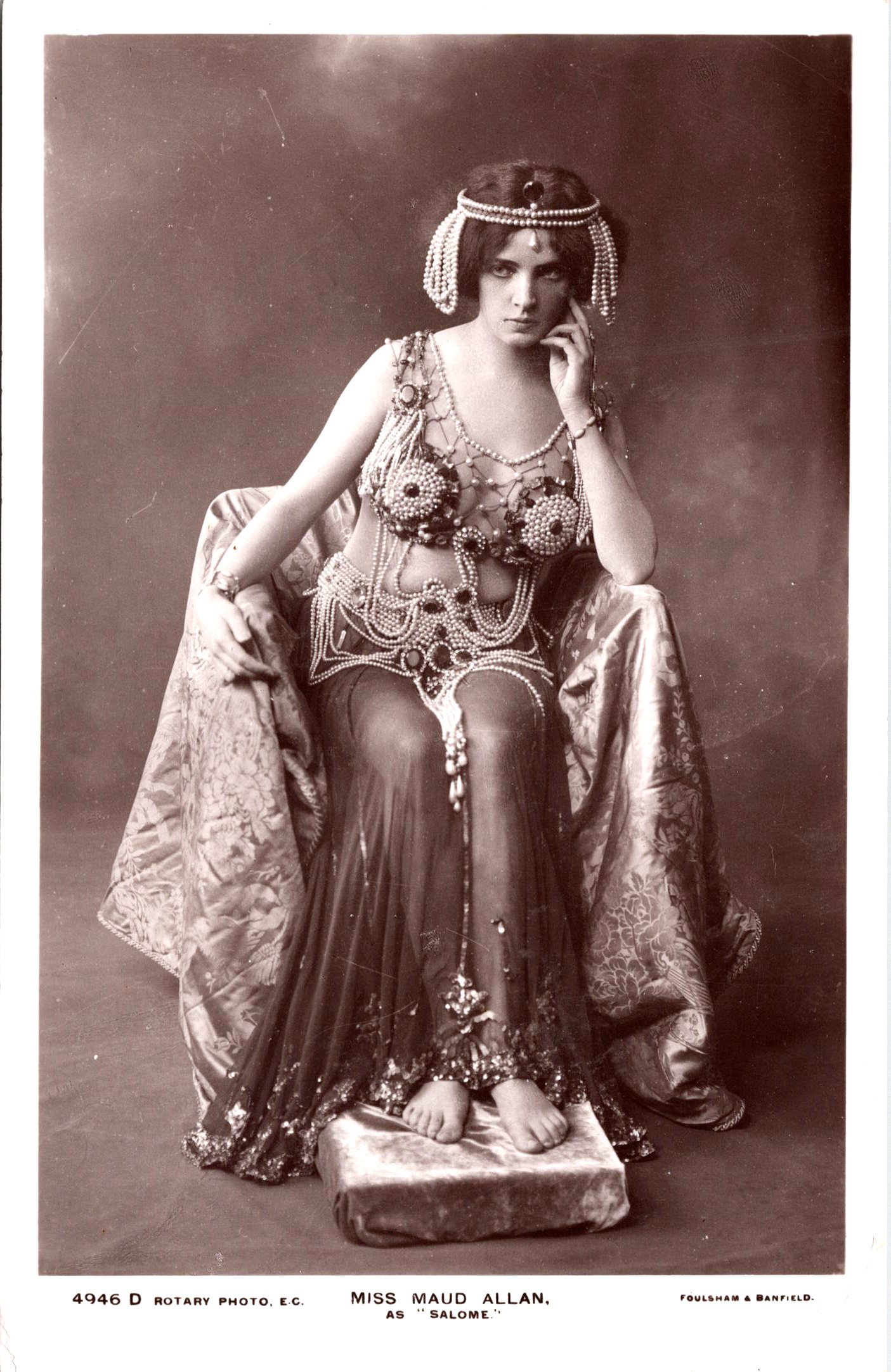
Postcard 6 features Maud Allan in an erotic costume as she plays “Salome”. This postcard was published by Rotary Photo as part of a series (No.4946D). Miss Allan’s photograph was taken by the Foulsham & Banfield studio. (SOLD)
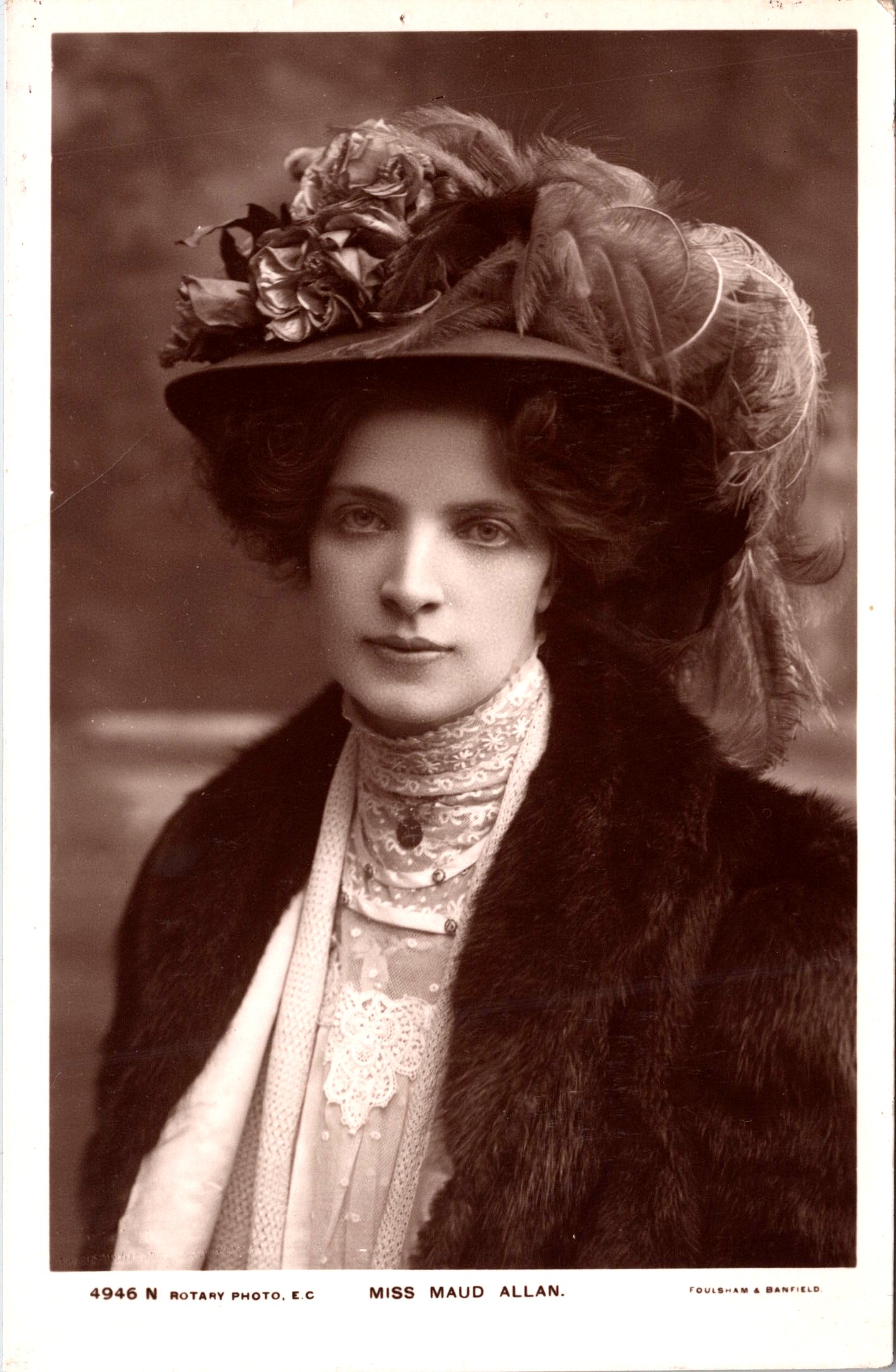
Postcard 7 was published by Rotary Photo as part of a series (No.4946N). Miss Allan’s photograph was taken by the Foulsham & Banfield studio. This postcard features Allan radiating an aura of refined elegance and timeless beauty. Her attire is a masterful display of Edwardian fashion. She wears a high-necked lace blouse adorned with intricate detailing, lending her an air of sophistication and grace. Over this, she dons a luxurious fur coat that adds richness and depth to her ensemble. Around her neck, a delicate pendant peeks out, suggesting a taste for understated yet exquisite jewelry. Her hat is a work of art in itself, lavishly adorned with roses, feathers, and ornate embellishments. The elaborate design frames her face beautifully, complementing her delicate features. Her hair, arranged in soft, voluminous curls beneath the hat, enhances her classic femininity. Maud’s expression is serene yet captivating, her slightly parted lips and soft gaze conveying both intelligence and an enigmatic charm. Her eyes hold a quiet confidence, suggesting a woman of depth, creativity, and individuality. Altogether, Maud Allan’s appearance in this postcard speaks to her remarkable beauty, not only in her physical features but also in the grace and character she exudes. She appears as a woman who is elegant, enigmatic, and effortlessly captivating. (SOLD)
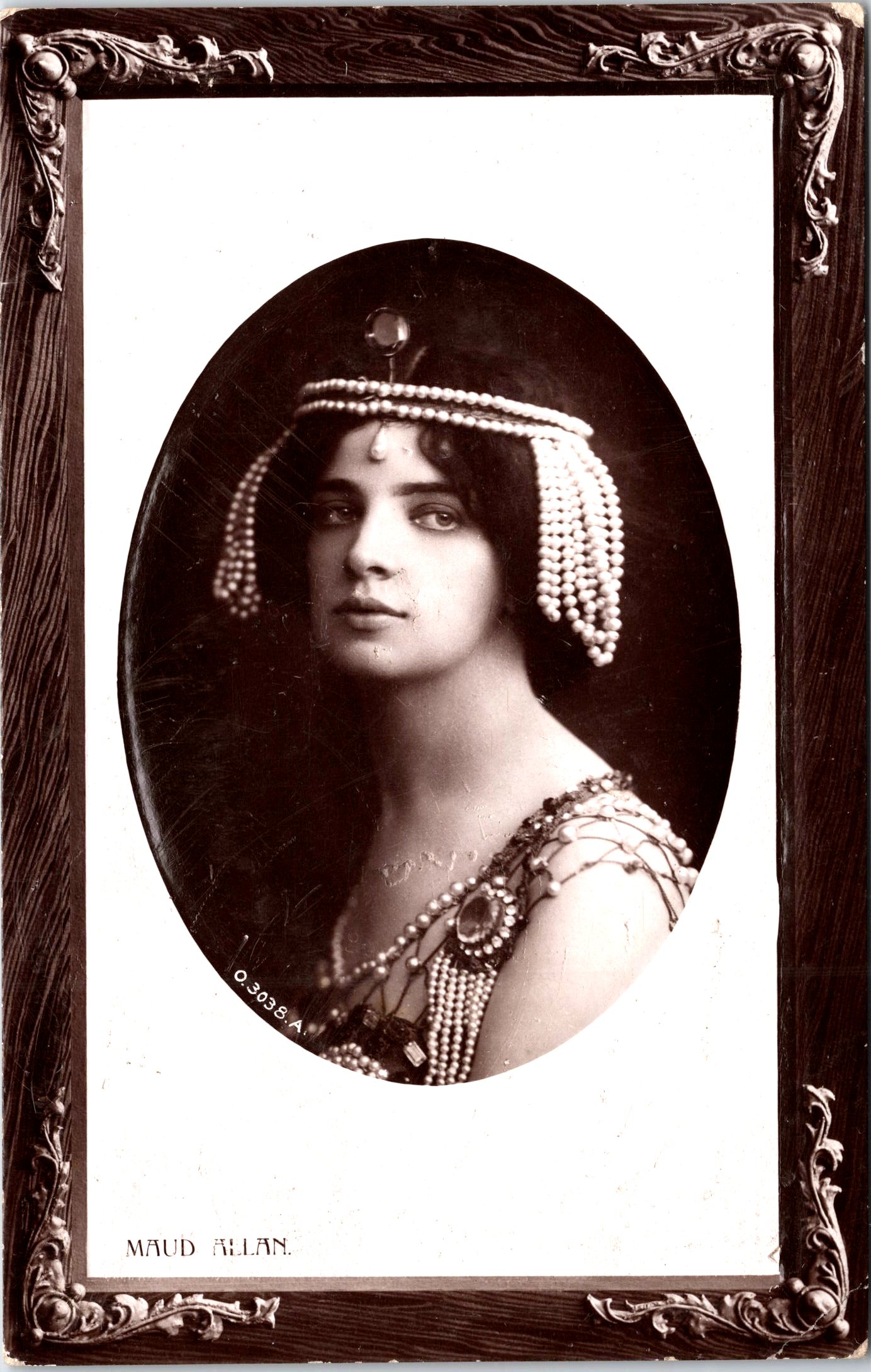
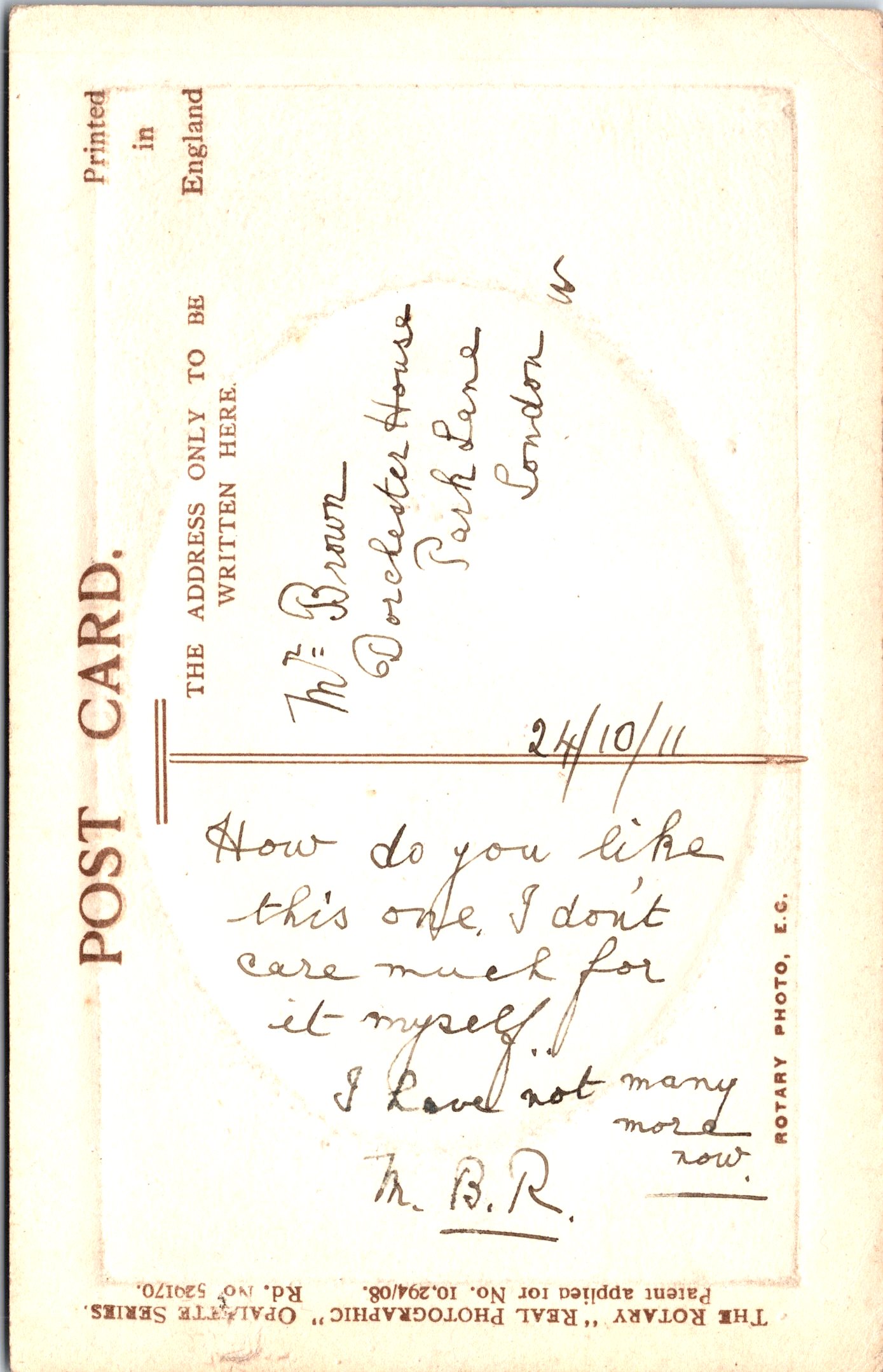
Postcard 8 is a portrait of Allan wearing an elaborate costume: strands of pearls draped across her shoulders and chest, a large bejeweled ornament on her bodice, and a pearl headdress with a central jewel resting on her forehead. Her dark hair frames her face, and she gazes with a calm, slightly enigmatic expression. The overall mood of the image is both theatrical and regal, emphasizing her role as a stage performer who often blurred the line between classical dance and sensual spectacle. The postcard was published by Rotary Photo as part of their “Opalette” series. The ornate printed “frame” around the oval portrait adds an additional decorative touch. The postcard has a divided back and there is a handwritten note dated in 1911. The correspondence reads: “How do you like this one, I don’t care much for it myself. I have not many more now. Th. B.R.” It is addressed to a man located in London. (SOLD)
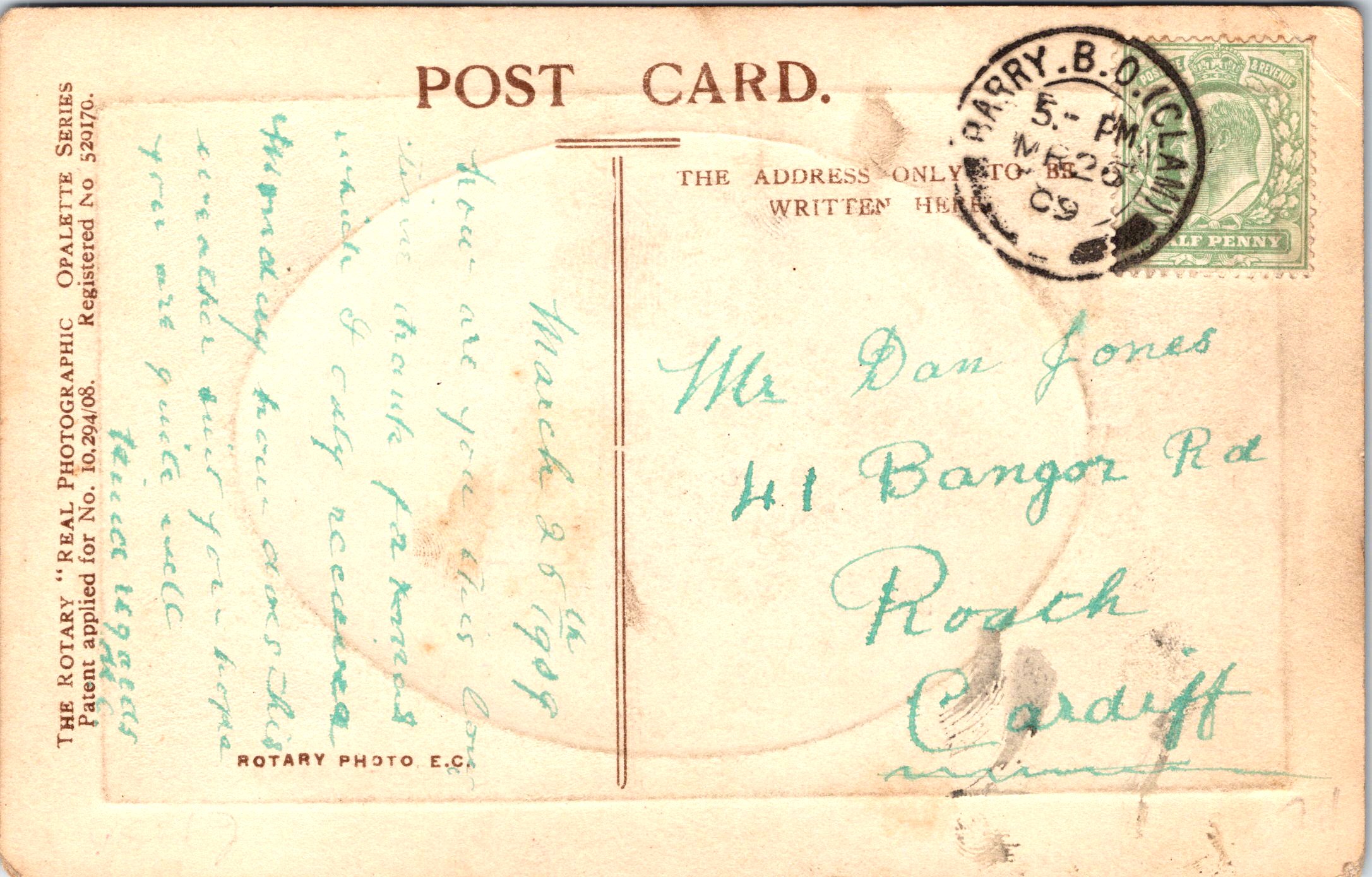
Postcard 9 was published by Rotary Photo and is part of the firm’s Opalette Series. this postcard has a postmark from 1909. (SOLD)
Postcard 10 is a striking Edwardian real photo postcard features Maud Allan, the celebrated dancer and stage performer whose career bridged classical, exotic, and highly sensual performance at the turn of the 20th century. Allan is shown seated in a flowing, classical-style gown, posed against a dramatic seaside backdrop of rocks, surf, and stormy skies. The pose is both poised and emotionally charged, with her gaze turned slightly upward, giving the image a dreamlike, almost mythic quality. She is dressed in a soft, empire-waist gown with loose sleeves and a long, flowing skirt. The styling deliberately evokes antiquity and romantic fantasy, which aligns perfectly with Allan’s reputation for expressive, sensuous dance interpretations rather than traditional ballet technique. Her bare foot and relaxed posture add to the quiet intimacy of the image. The photograph was taken by Leopold Reutlinger, one of the most important and accomplished theatrical photographers of the period. Reutlinger’s portraits of performers are widely collected and appear in museum collections; his work is especially prized for its technical quality and dramatic staging. His signature appears in the image, and the postcard carries the Reutlinger studio mark and serial number E1587, confirming it as part of his commercial theatrical series. This is an Aristophot Real Photo Postcard, as clearly indicated on the reverse. Aristophot Co. Ltd. was a London-based publisher, specializing in high-quality photographic postcards of actors, dancers, and performers. The reverse also notes “Printed in Saxony,” which was common for high-end photographic postcard production during this period. This specific image of Maud Allan is uncommon. The combination of Maud Allan + Reutlinger + Aristophot makes this a particularly desirable postcard. In fact, this photograph of Miss Allan can be found in Britain’s National Portrait Gallery. The postcard in their collection was postmarked in 1909. SOLD
POSTCARD 1
POSTCARD 2
POSTCARD 3

POSTCARD 4
POSTCARD 5
POSTCARD 6
POSTCARD 7
POSTCARD 8
POSTCARD 9
YOUNG GIRL WEARING STRAW HAT & HOLDING A FAN : GERMAN RPPC c1915
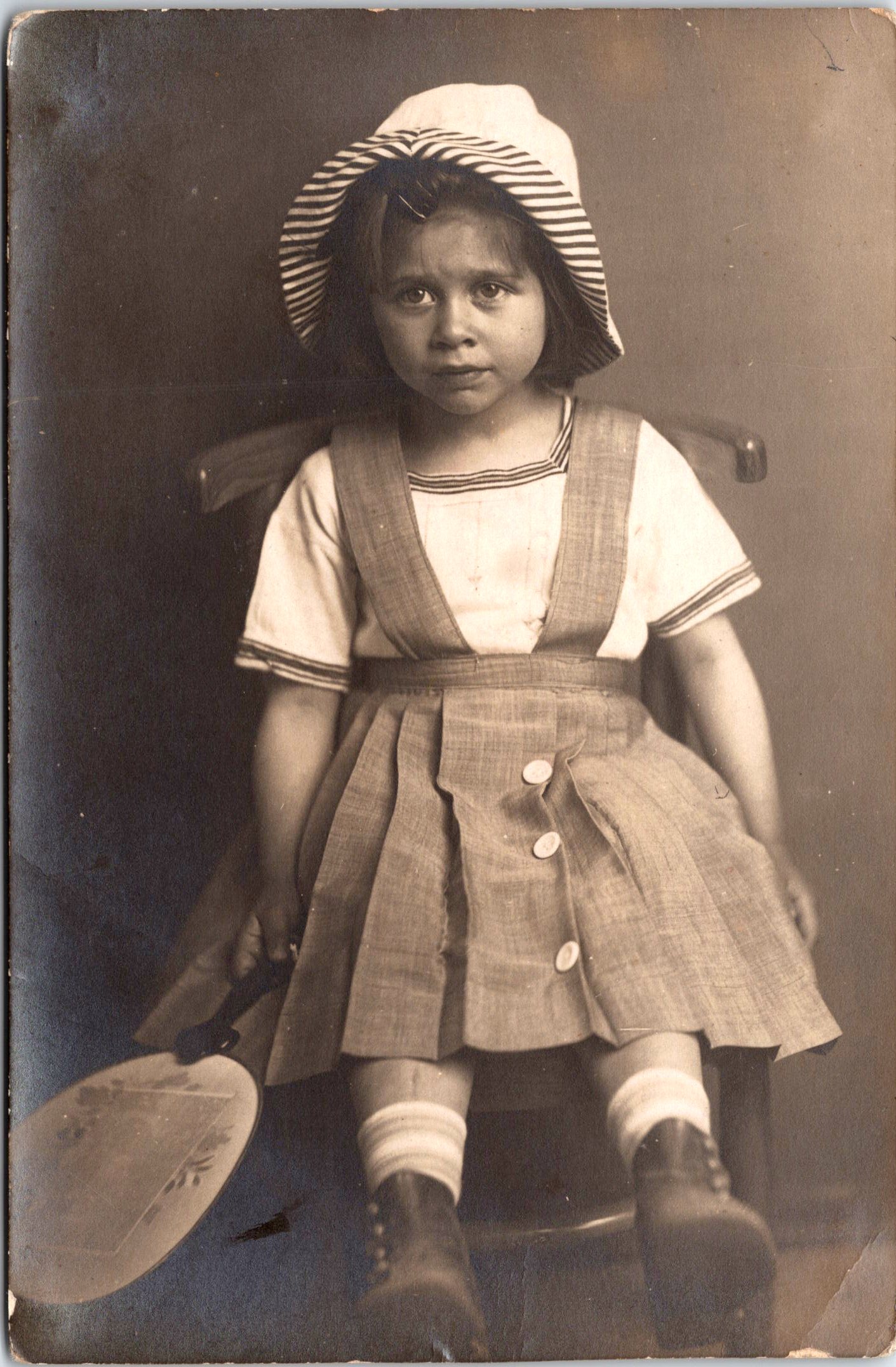
A wonderfully expressive vintage real photo postcard featuring a young girl seated in a studio portrait, captured with remarkable intimacy and character. The child sits upright on a simple wooden chair, gazing directly at the camera with large, searching eyes and a slightly solemn, almost questioning expression that gives the image unusual emotional depth. She is dressed in a charming early 20th-century outfit: a light blouse with striped trim at the collar and sleeves, paired with a pinafore-style dress secured with wide shoulder straps and large decorative buttons down the front. Her clothing has a practical yet stylish look typical of the period. On her head she wears a soft, wide-brimmed hat with bold striped edging, which frames her face beautifully and adds a playful, fashionable touch.In her hand, she appears to be holding a small fan or possibly a toy paddle, with a flat, rounded surface and a short handle. Given its shape and decorative quality, it most closely resembles a child’s hand fan, though it could also be a novelty or toy accessory used by the photographer to help keep the child engaged during the sitting. The photograph measures approximately 3.5 by 5.25 inches, consistent with real photo postcards of the era. Based on the clothing, hairstyle, and photographic style, this image likely dates to around 1910–1920. The postcard is in overall good condition with strong visual appeal. The image retains nice contrast and clarity, though there is moderate age toning. The corners exhibit noticeable rounding and wear. The reverse shows heavier toning, spotting, and adhesive residue from it’s former days residing in a postcard album. Despite this, the photograph remains fully intact and displays well (see scans).
This vintage Postcard is available for purchase at my store, The History Peddler, for $16.00 at auction
Interested collectors may view the listing here:
https://www.ebay.com/itm/236794379904
HESTER STREET NYC : JEWISH NEIGHBORHOOD MARKET SCENE : VINTAGE POSTCARD 1906
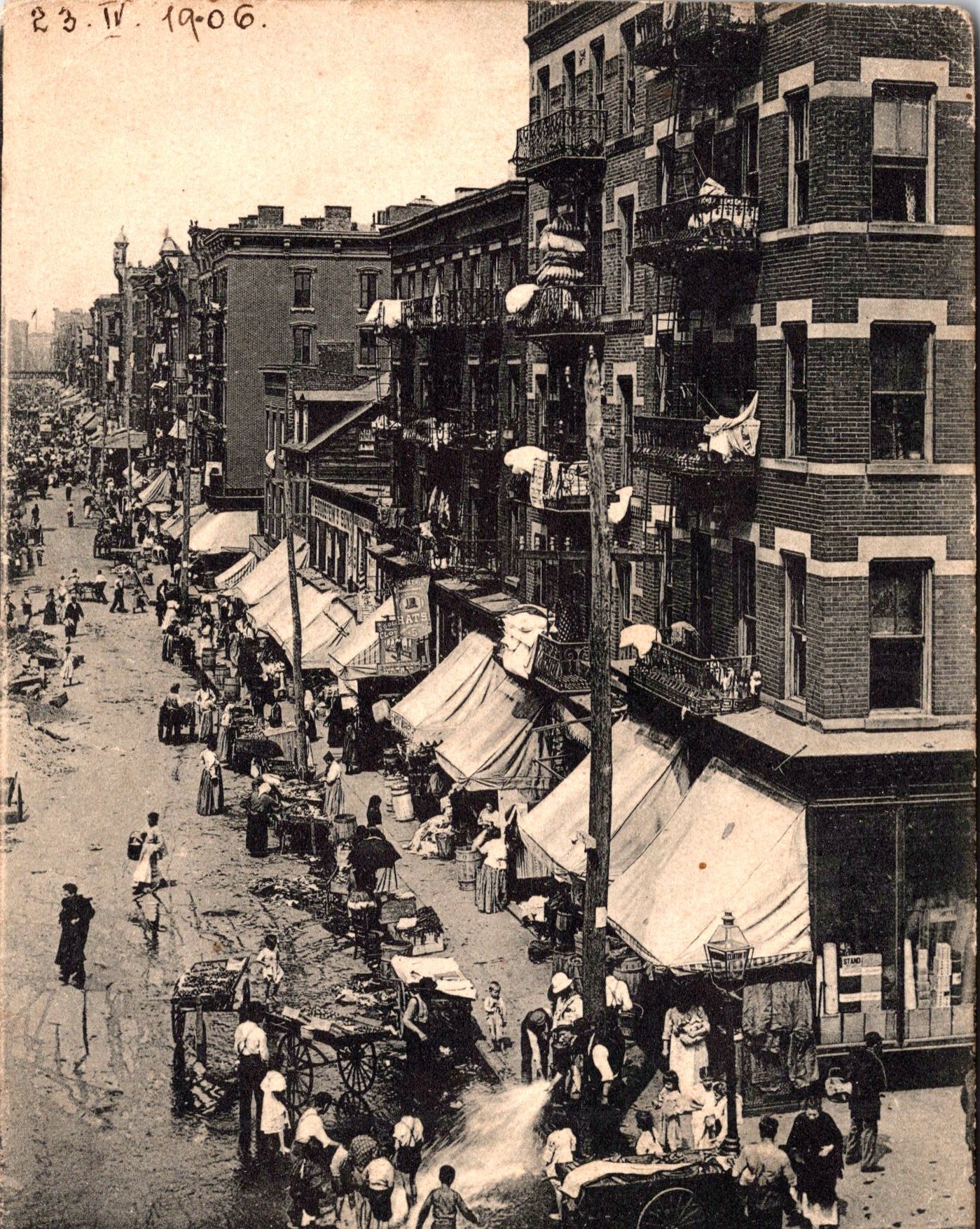
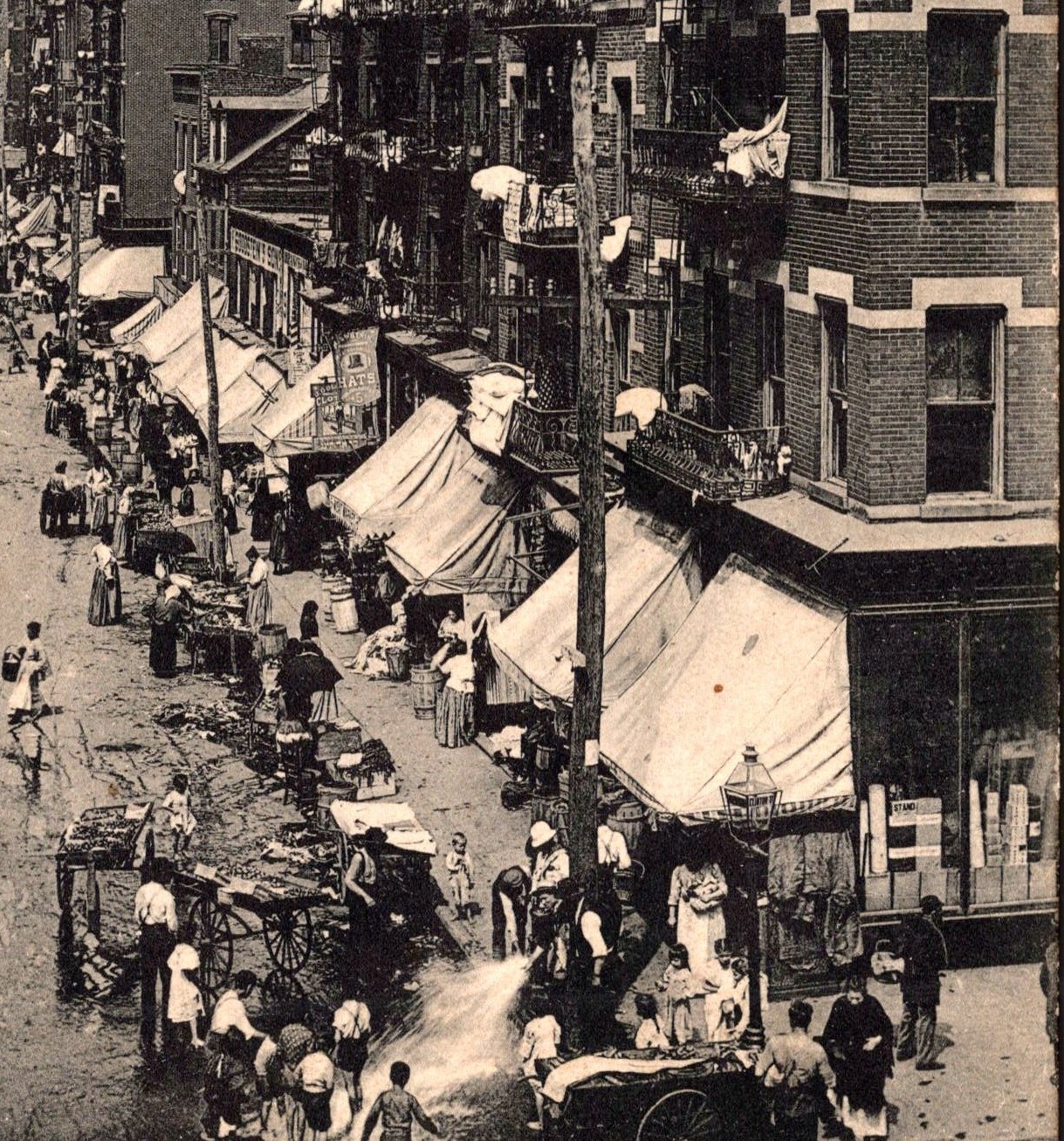
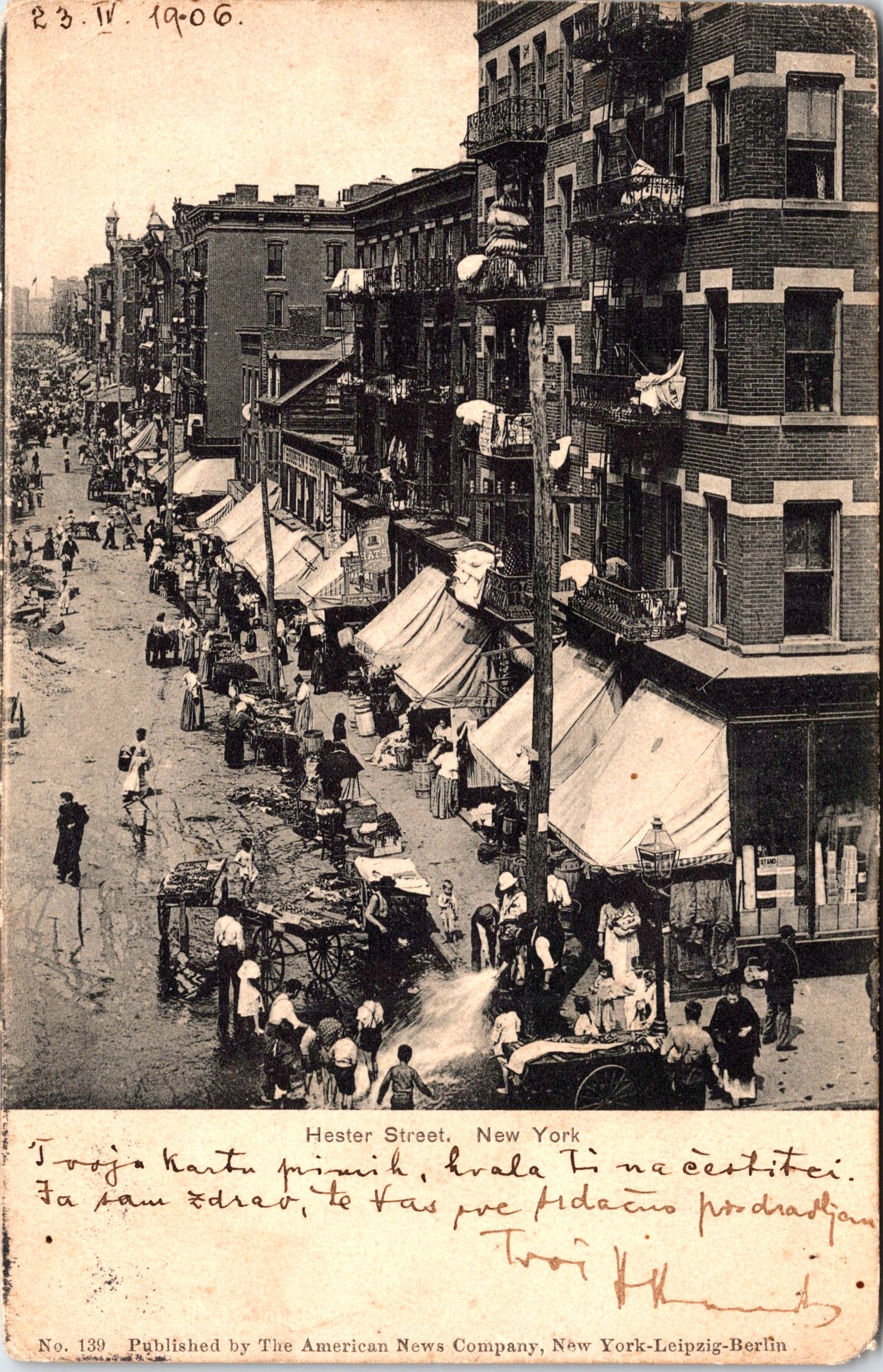
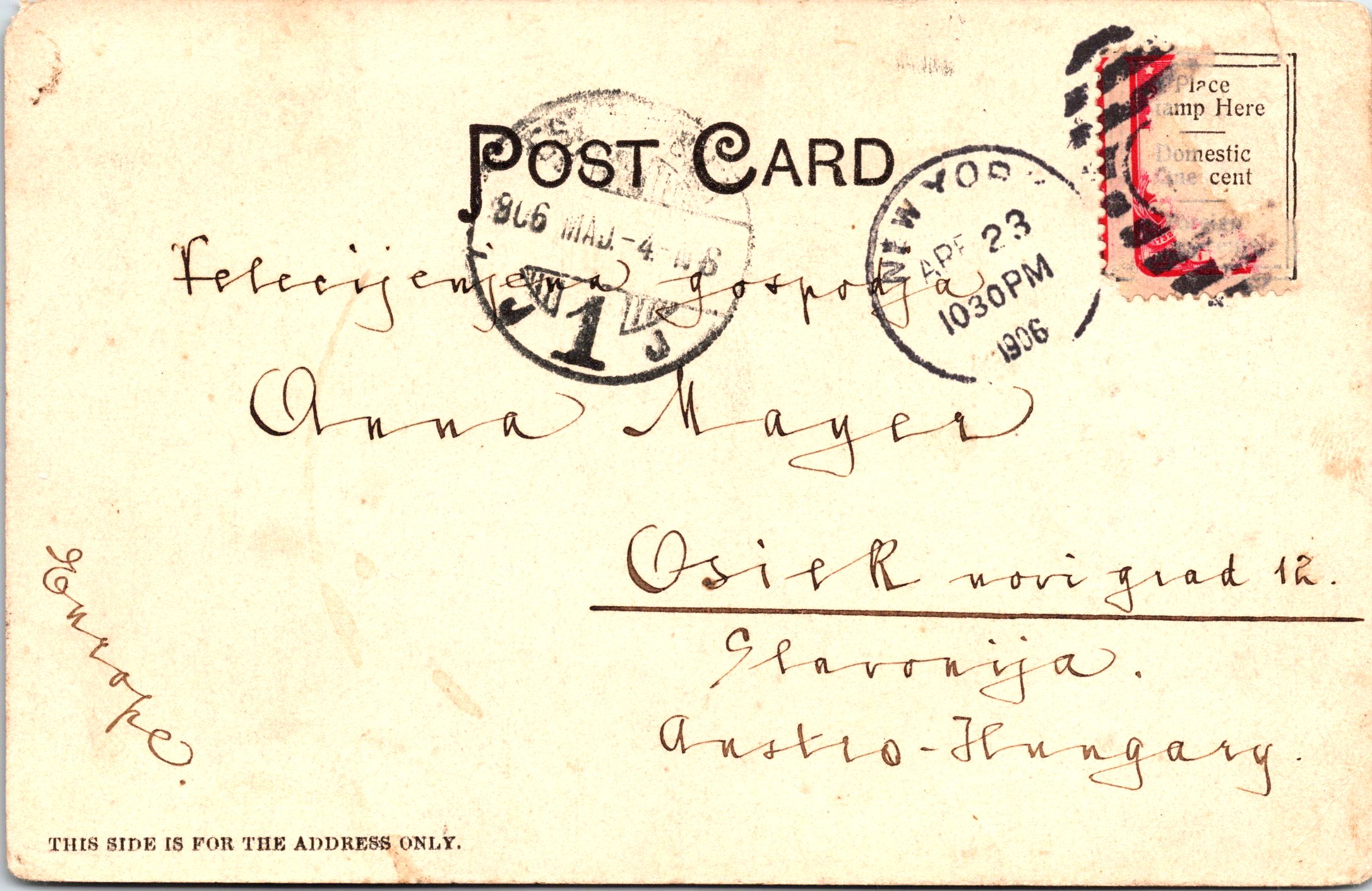
This terrific early New York City postcard captures Hester Street on the Lower East Side during its bustling immigrant-era heyday. Published by The American News Company (No. 139)—one of the major postcard publishers of the early 20th century—this 1906 street scene shows an extraordinarily lively and detailed view of life in one of the most densely populated neighborhoods in America at the time. The image portrays Hester Street crowded with vendors, pushcarts overflowing with produce, women in long skirts shopping along the muddy street, and merchants working under the characteristic canvas awnings hung from the tenement storefronts. Laundry hangs from iron fire escapes, children play in the street, and a man hoses down the roadway in an attempt to control dust and refuse. This postcard is a rich visual record of the Jewish immigrant community that transformed the Lower East Side in the late 19th and early 20th centuries. The urban density, the clothing, the signage, and the architecture all reflect the conditions described in reform literature and immigrant memoirs of the era. The card is postmarked New York, 1906, and was mailed to Osiek, Slavonija, then part of Austro-Hungary. The handwriting on the front and back suggests that the writer was likely a Slavic-speaking immigrant sharing news and thanks with family overseas—a compelling historical link between the immigrant sending the card and the old world receiving it.The message is written in a South Slavic language (likely Croatian or Serbian written in Latin script). Handwriting is challenging, but the meaning is clear. The translated message is “Your card arrived. Thank you for the congratulations. I am healthy and wish you all the best”. SOLD
MRS LEWIS WALLER (FLORENCE WEST) : STAGE ACTRESS : OSCAR WILDE: (ROTARY PHOTO)
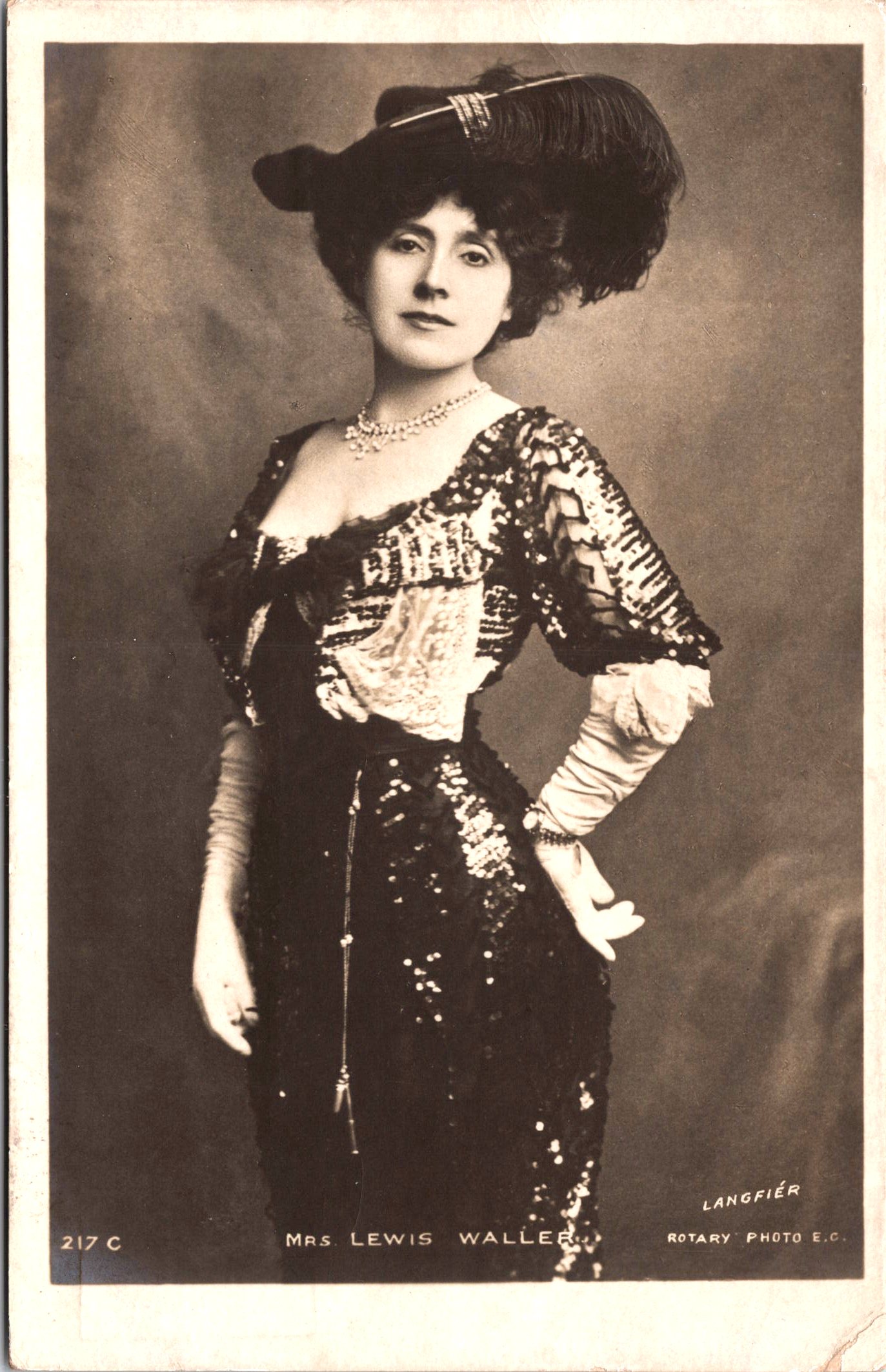
This vintage real photo postcard features Mrs. Lewis Waller, otherwise known as Florence West (1858-1912). She was an English actress known for creating roles in new plays written by Oscar Wilde and Bernard Shaw. She frequently appeared on London’s West End stages with her husband, actor Lewis Waller. She married Waller in 1882 and made her stage debut in 1883. She retired in 1905. Five portraits of Florence West can be found in Great Britain’s National Portrait Gallery. This postcard was published by Rotary Photo as part of a series (no.217C). Miss West’s photograph was taken by the studio of Louis Saul Langfier. He was the husband of actress Pearl Lyndon. SOLD