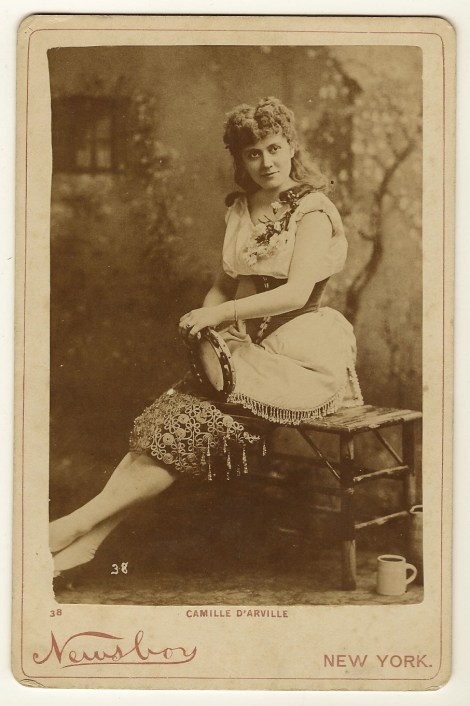
 This cabinet card portrait features pretty stage star Camille D’Arville (1863-1932). The photograph was published by Newsboy and was number 38 of a series of images used as tobacco premiums. The actress is dressed like a gypsy in this photograph. She is holding a tambourine. It is interesting to note the mug in the bottom right hand corner of this image. One wonders the purpose of it’s inclusion in the photograph. It is also evident that to make this image a bit more risque, Miss D’Arville’s legs are partially exposed in the photograph. The Illustrated American (1892) wrote that she “is not only a delightful singer but she is also a charming woman”. Miss D’Arville was born in Holland in 1863 of well to do parents. When she was young she was known in her community as “the humming bird of Holland” because of her penchant for singing and her pretty voice. At age eleven she became active in amateur theater. At age fifteen she became devoted to concert singing and entered the Academy of Music in Amsterdam. Her professional career began at age twenty-two when she became a light opera actress in London. She premeired in “Cymbia” at the Strand Theater. She performed in London for six years. In 1888, J. C. Duff organized a strong opera company and engaged her to appear in “The Queens Mate” on Broadway in New York City. She shared the stage with Miss Lillian Russell. Reviewers of the play reported that Miss D’Arville captured the audience. As her career developed, she became “one of the foremost artists on the comic operatic stage”. In an interesting interview that appeared in the San Francisco Call (1900), D’Arville spoke about the issue of balancing career and marriage. She was preparing to marry Capitalist E. W. Crellin and had declared that she was going to retire from the footlights. The newspaper scoffed at the notion of her retiring because so many actresses before her had made the same declaration upon their marriage, yet after turning their backs on the stage, they do a “right about face” again. The paper opined that “they flit back before the honeymoon is over”. Miss D’Arville asserted that she wouldn’t miss her salary (reported to be “something like” a thousand dollars a week). She stated that she would miss the audience “hanging on” to every note she sang. She had a theory about mixing marriage and career. She asserted that when an artist, milliner or stenographer renounces her vocation for “the highest profession-domestic life- the world nods its approval”. However, she contends that female professionals, such as actresses, lawyers, doctors, and journalists, do not receive social approval when leaving their careers for marriage. She declares that in her opinion, attempting to combine stage and home life is about as easy as mixing oil and water. As a result, she believes that “any woman who pursues a profession after her marriage makes a miserable failure of it”. Balancing work and home is seen as so stressful that professional women have to quit at least one, and they usually choose to quit matrimony. She concludes that “marriage does not handicap a woman in her profession, but a profession seriously interferes with married life.” The issue concerning women’s ability to balance career and marriage remains part of the public debate today. Perhaps we should focus more on men’s ability to balance work and family life. It clearly is not just a problem for women. It is really incredible how researching a photograph can take one in so many different directions. Researching a vintage photograph is akin to going on a journey to a mystery destination.






 THE CABINET CARD GALLERY