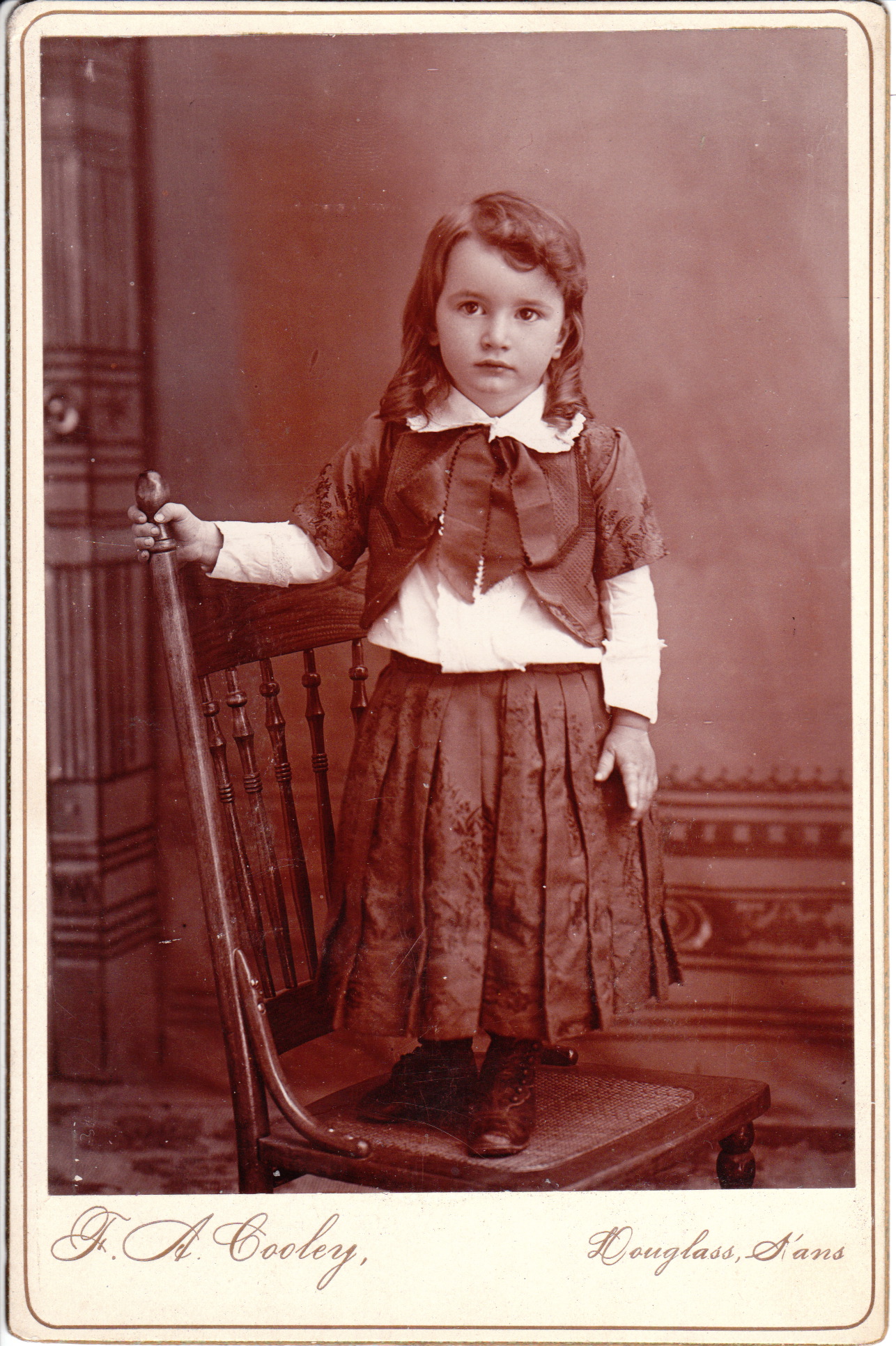
 F A Cooley was a photographer located in Douglass, Kansas and he produced this cabinet card portrait of a well dressed little girl standing on a chair. She looks a bit uncertain as to how to pose for the portrait. It was a difficult task to photograph children and part of the photographers job was to put the child at ease. Mr. Cooley was unsuccessful at this venture. It must be pointed out that there is a possibility that the child in this portrait may actually be a boy. Douglass, Kansas was established in 1869 by a trader named Joseph Douglass. He established the town along cattle trail that began in Texas. In 1877 the Florence, El Dorado, and Walnut Valley Railroad Company built a branch line that in 1881 was extended to Douglass. Initial research uncovered no information about the photographer of this image.
LTTLE GIRL STANDING ON A CHAIR IN DOUGLASS, KANSAS

GROOM AND THIN WAISTED BRIDE IN READING, PENNSYLVANIA

This cabinet card appears to feature a Reading wedding couple. The couple is well dressed and the bride is wearing a feathered hat instead of a veil which lends some doubt to the wedding theory. The woman is wearing and holding flowers. Note her thin waist and his large hands. The photographer is John D. Strunk who operated in Reading, Pennsylvania. To view other photographs by Strunk, click on the category “Photographer: Strunk”.
A WOMAN AND HER LABRADOR RETRIEVER IN HONESDALE, PENNSYLVANIA
 J A Bodie of Honesdale, Pennsylvania photographed this lady and her lab at the Bodie Art Studio located on the Keystone Block. The woman is holding a wonderful large hat featuring what appears to be long feathers. The lady and her canine companion are posed atop bales of hay. The dog is likely a labrador retriever and he or she has very expressive eyes that seem sad and lonely and begging for attention. The photographer of this cabinet card is either Joseph Alonzo Bodie (1852-1935) or his son, Joseph A. Bodie Jr.. Junior followed his father into the family business. The senior Bodie learned photography from E. I. Stearns and in 1875, Bodie bought half interest in Stearns’s studio. By 1878, Bodie became the sole proprietor of the studio. The Bulletin of Photography (1912) reported that Bodie’s studio was totally destroyed by fire and the loss was valued at $2500.00 and was only partially covered by insurance. In a later issue, the same journal stated that Bodie had rebuilt the studio.
CUTEST DOG IN BRIDGEPORT, CONNECTICUT (1892)
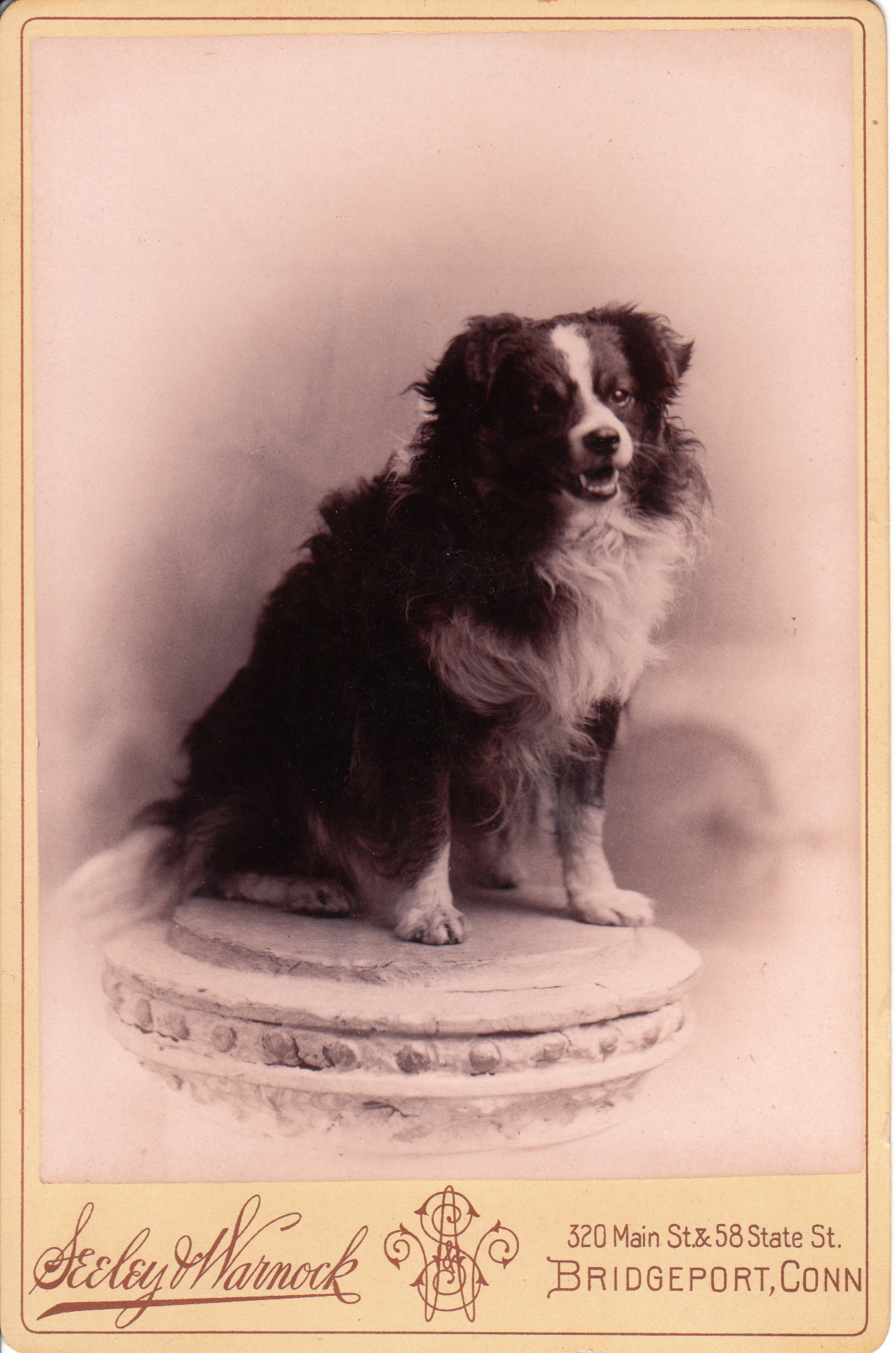 Photographers Seeley & Warnock took this photograph of a cute dog posing in their studio in Bridgeport, Connecticut. What a pose? The photographers have captured this adorable canine exhibiting a smile (with his/her mouth open). The lighting utilized in this photograph could have been better, but lets remember that dogs are tough customers for a photographer. On the reverse of the cabinet card is advertising that states “Instantaneous Portraits of Children A Successful Specialty”. Note that photographing children is not only a “specialty” but it is a “successful specialty”. Additional printing on the reverse of the cabinet card indicates that it was produced in 1892. Preliminary research found no information about Mr. Warnock but there is an abundance of information about Mr. Seeley. Henry James Seeley was well known in Grand Army of the Republic circles. He was a department commander (Connecticut) and served in national offices of the organization. He was born in Jericho, Vermont in 1849. At the age of fifteen he enlisted in the 10th Indiana Battery, Light Artillery. After serving with the unit he was transferred to the gunboat Stone River which was operating on the Tennessee River. His next post was Fort Johnson in Huntsville, Indiana. Seeley entered and left the military as a private. After mustering out of the military in 1865, he taught school in Carbondale, Illinois. He then went to Vermont to further his education and then had teaching stints in Rome (NY), Worcester, Fall River and Bridgewater (MA). In 1872 he moved to Bridgeport where he studied photography and finally settled down. He opened a photography studio there in 1872 at 922 Main Street. He spent the next forty-five years or more working as a photographer.
FRANCES EVERETT: THEATER ACTRESS PORTRAIT (NEWSBOY SERIES: 1891)
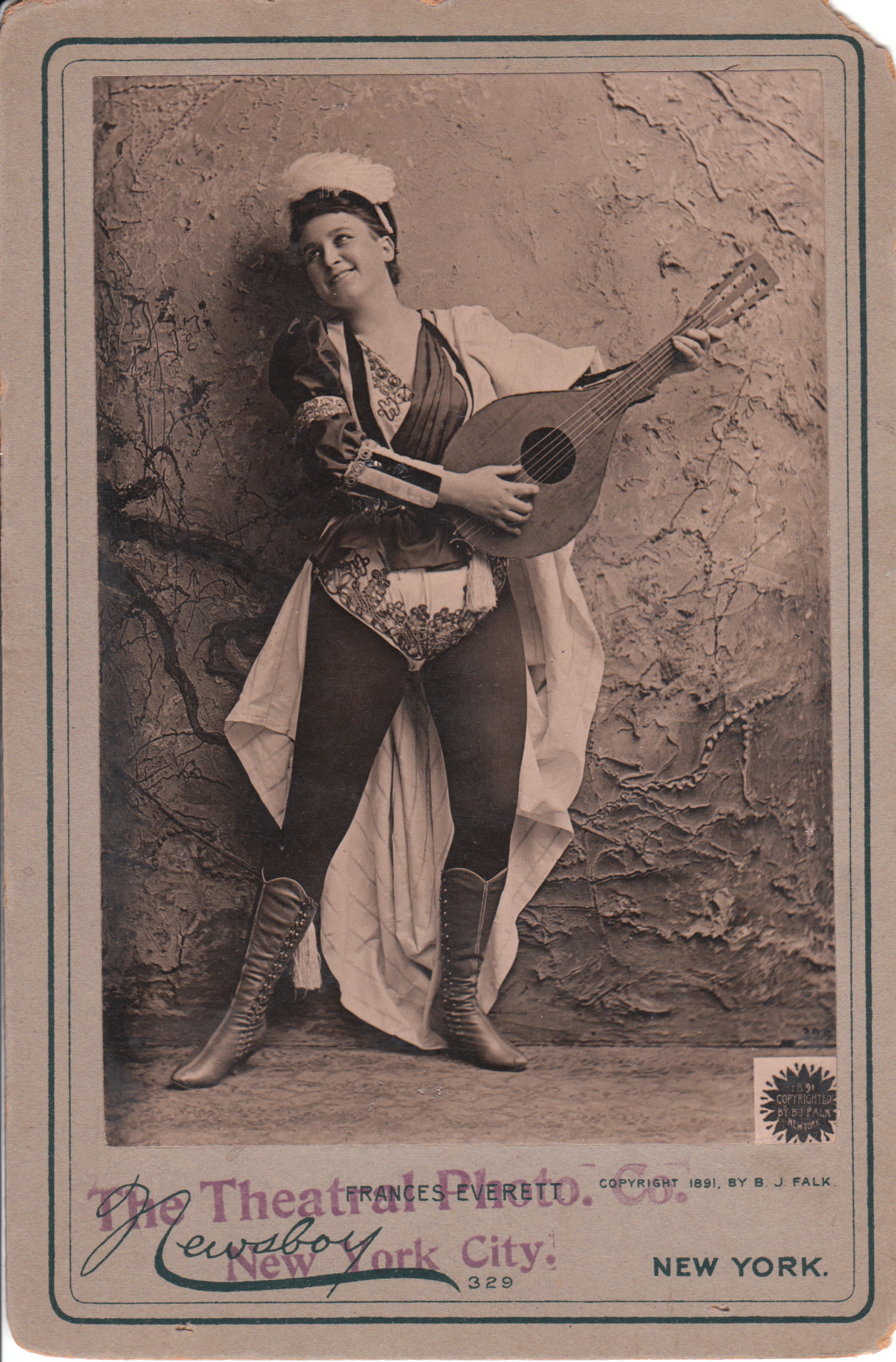 This Newsboy cabinet card features a portrait of actress, Frances Everett. The photograph is number 329 of a series of images published by Newsboy to distribute as a premium with their tobacco products. The photograph was taken by B. J. Falk and has a copyright of 1891. The cabinet card has a stamp from the Theatral (Theatrical?) Photo. Company of New York City. Miss Everett holds a string instrument (mandolin?) and is dressed in a rather risque costume for her era. She is also wearing a great smile. Preliminary research found no biographical information about Miss Everett or the Theatral Photo Company.
ADORABLE VICTORIAN TODDLER IN LONG GOWN IN MINONK, ILLINOIS
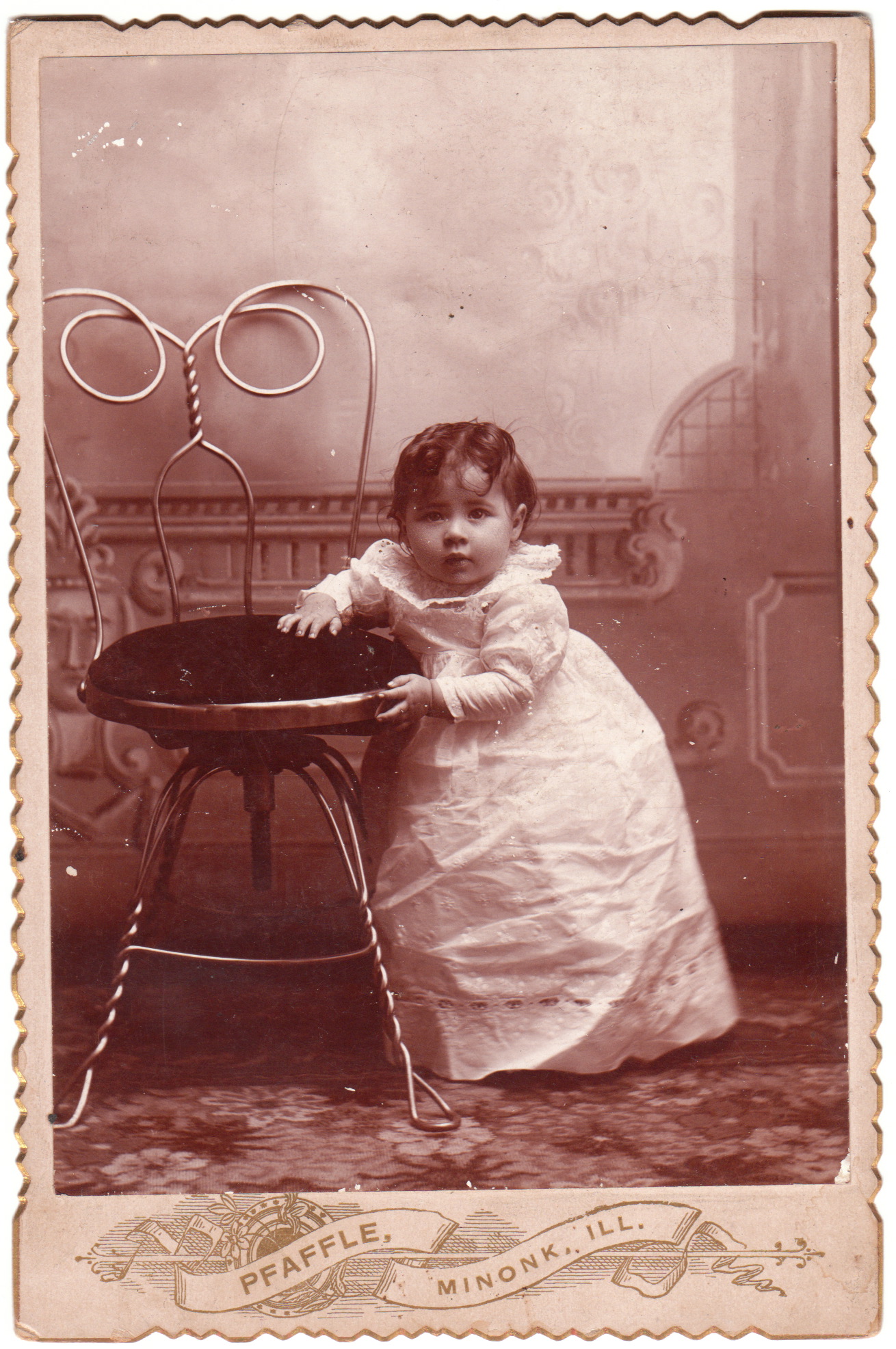
A toddler wearing a long gown poses by an ice cream parlor style chair in the Pfaffle studio in Minonk, Illinois. Henry Pfaffle was a man with many interests and talents. He was a optometrist in Minonk over 60 years.He began working as a printer in 1876 and entered the fields of optometry and photography in 1889. He recorded much of the early history of Minonk. He had photograph car built for him that could be placed on a railroad flat car and taken from town to town. After arriving at a new town, the photograph car would be drawn by horses to desired locations for taking photographs. Pfaffle had an interest in astronomy and constructed telescopes. The first telescope he built was sold to Eureka College. Pfeffle was also very interested in weather. He was an observer and displayer of weather flags for the Federal Weather Bureau. He died in 1952 and interestingly, donated the money from his estate to the city of Minonk for water supply improvements. (SOLD)
ADORABLE LITTLE GIRL WEARING HER FANCIEST CLOTHES TAKES A FAKE STROLL IN A FAUX PARK IN READING, PENNSYLVANIA
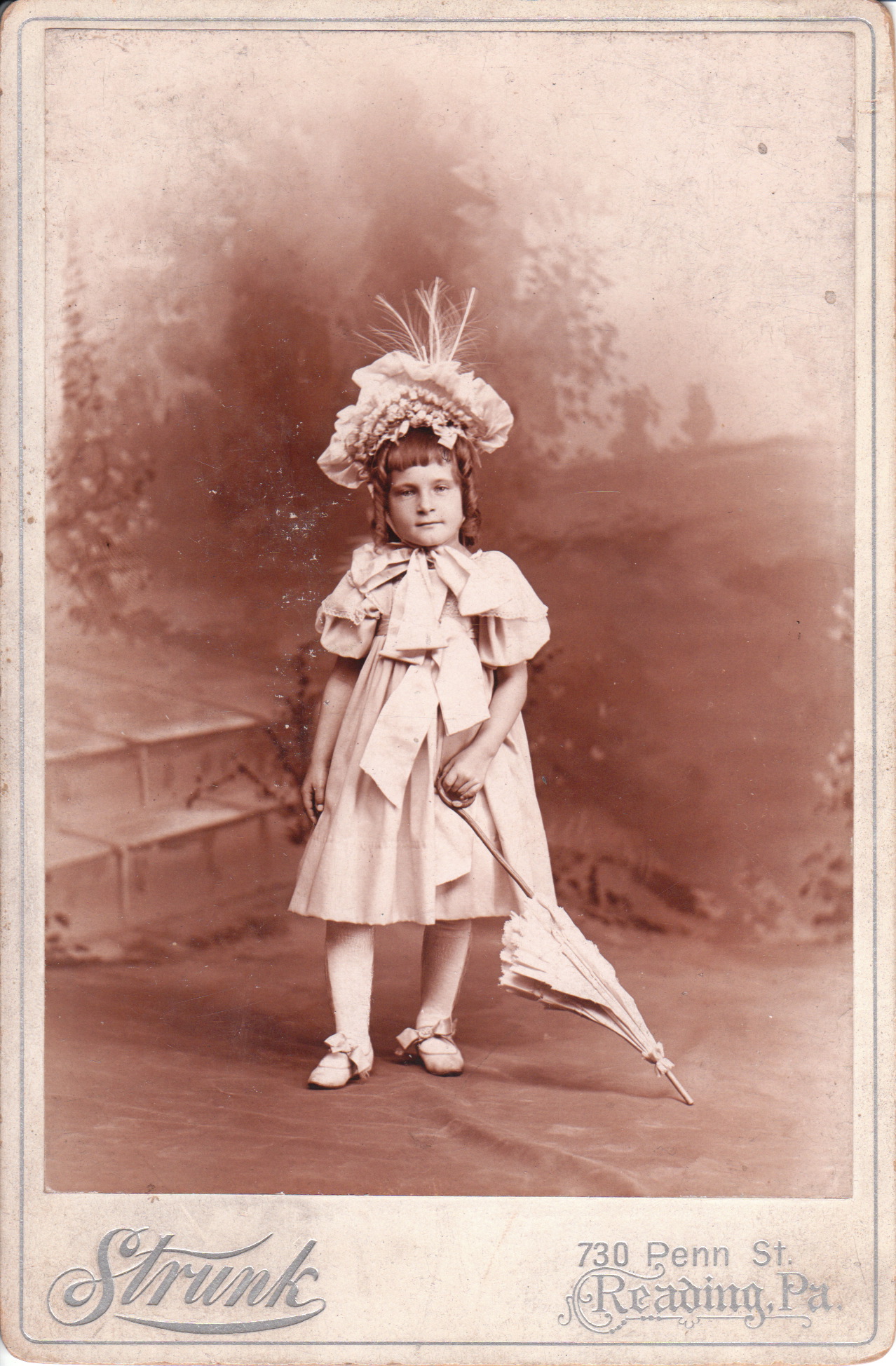 The subject of this photograph is a darling little girl with sausage curls under a fancy hat. She is seen faking a walk in a faux park. The little girl is holding a parasol. The photographer of this image is John D. Strunk of Reading, Pennsylvania. To view other photographs by Strunk and to learn more about him, click on the category “Photographer: Strunk”.
THREE ARROGANT NE’ER DO WELLS IN WEST CHESTER, PENNSYLVANIA
 The previous owner of this cabinet card described the subjects in the photographs as “thugs”, “ne’er do wells”, and “arrogant”. We will never know if these are fitting descriptions but that is one of the reasons that collecting and viewing cabinet cards is such an interesting and fun activity. Interpreting these photographs require a knowledge of history, detective work, and psychological awareness. In addition, our interpretations of the photographs are also influenced by our own personalities, experiences, and projections. This particular photograph certainly shows three guys with attitude. They dressed nicely for their portrait. The seated man looks like a tough guy and the expression of the gentleman behind his right shoulder seems to communicate that he is ready for a confrontation. The photographer of this cabinet card is W. C. Bell.
SIX FRAUEN (WOMEN) ALL IN A ROW IN CASSEL, GERMANY
 This photograph was produced by G Ewald in Cassel, Germany. The image shows six women standing in a row. They are showing a great deal of affection toward each other and seem to be having a good time. Writing on the reverse of the image indicates that the photograph was taken in 1904. The town of Cassel became known as Kassel in 1928.
PORTRAIT OF A TRAIN CONDUCTOR (RAILROAD OF NEW JERSEY)
 J. C. Sunderlin produced this portrait of a train conductor in full uniform. Sunderlin operated a studio on Main Street in Flemington, New Jersey. The subject of this photograph is wearing a cap that has a plate tag which states “Conductor”. The patches on the lapel of his jacket indicate that he was employed by the “Railroad of New Jersey”. It is likely, but not certain, that this gentleman worked for the Central Railroad of New Jersey. This railway line has its roots in the 1830’s but adopted the Central Railroad name in 1849. Note this gentleman’s terrific bushy mustache. The photographer, John Corbin Sunderlin was born in 1835 at Fort Anne, New York. His birth name was John Corbin Vorce but his mother died during his infancy and he was adopted at nine years of age. He married Harriet A. Penny in 1855 and the couple had five children. In 1856 he left farming for photography. He became an itinerate photographer and his studio was located on a horse drawn wagon. During the civil war he enlisted in the 5th Vermont Volunteer Infantry where he reached the rank of sergeant. His obituary states that he served three years in participated in eight major battles until he was wounded at Fredericksburg. After the war he settled in Fort Edward, New York. While living in Fort Edward he was a member of the Grand Army of the Republic, the Masons, Odd Fellows, and the New York State Prohibition Party. He worked as a photographer until 1870 when he was ordained by the Methodist Church. In 1880 he left his ministry work and returned to his career in photography. He operated a studio in Flemington until 1902 when he bought a studio in Blairstown, New Jersey from William C. Walters. He remained in Blairstown until his death from pneumonia in 1911.


 THE CABINET CARD GALLERY