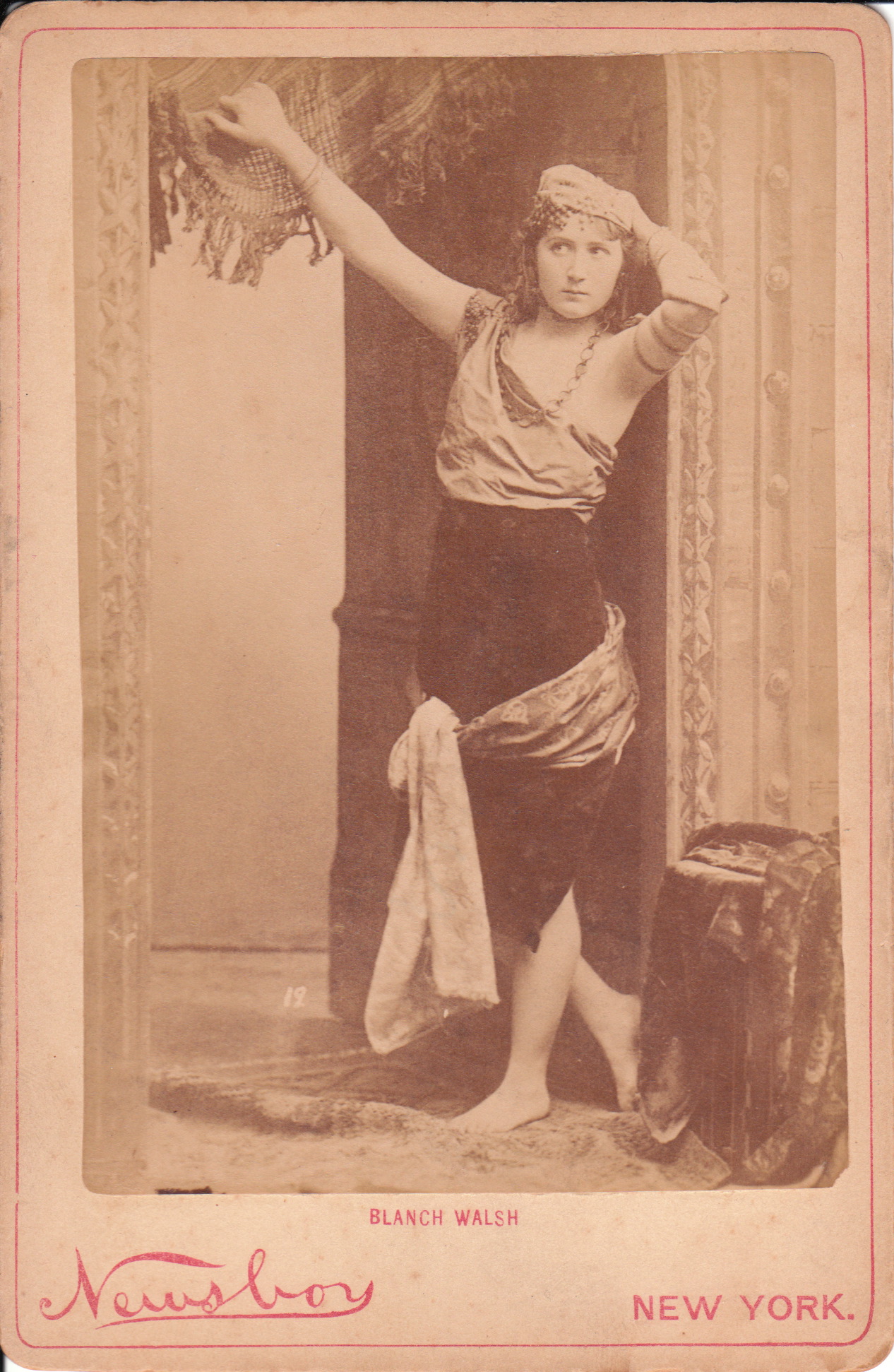
 This cabinet card photograph of actress, Blanch Walsh, was published by Newsboy and was given as a premium to buyers of the company’s tobacco products. The photograph was number 12 of a series of celebrity photographic portraits. This particular photograph is particularly provocative and risque. Miss Walsh is exhibiting a great deal of exposed skin. Her pose and expression add to the subliminal sexuality. Miss Walsh is costumed as if to portray a gypsy. Note her jewelry. She is wearing a chain around her neck and multiple bracelets on her left arm. To view other theatrical images by Newsboy, click on category “Photographer: Newsboy”. Blanch Walsh (1873-1915) was a highly regarded American stage actress. She also appeared in one film, “Resurrection” (1912). She was born in New York City and educated in the public schools. Her father was T. P. Fatty Walsh, a Tammany politician and prison warden (The Tombs). Her stage debut was in 1888. She worked in the Charles Frohman Company as well as the William Gillette Company. She looked like a younger version of stage star Fanny Davenport. When Miss Davenport was ill for some time before dying in 1898, Blanch Walsh was given a number of her emotional roles. To view photographs of Miss Davenport, write Fanny Davenport in cabinet card gallery’s search box. Walsh’s most sensational role was as Maslova in Tolstoy’s “Resurrection” (1903). She also received much acclaim for her performance in “The Woman in the Case” (1905). The New York Times printed an article about Walsh upon her post surgical death. She was viewed as a major actress who likely would have risen to greater heights in the theater world if her life had not been cut short by her unfortunate early demise.
BLANCH WALSH: STAGE ACTRESS IN PROVOCATIVE POSE (PUBLISHED BY NEWSBOY)

PORTRAIT OF A JOCKEY WEARING HIS COLORS IN SARATOGA, NEW YORK
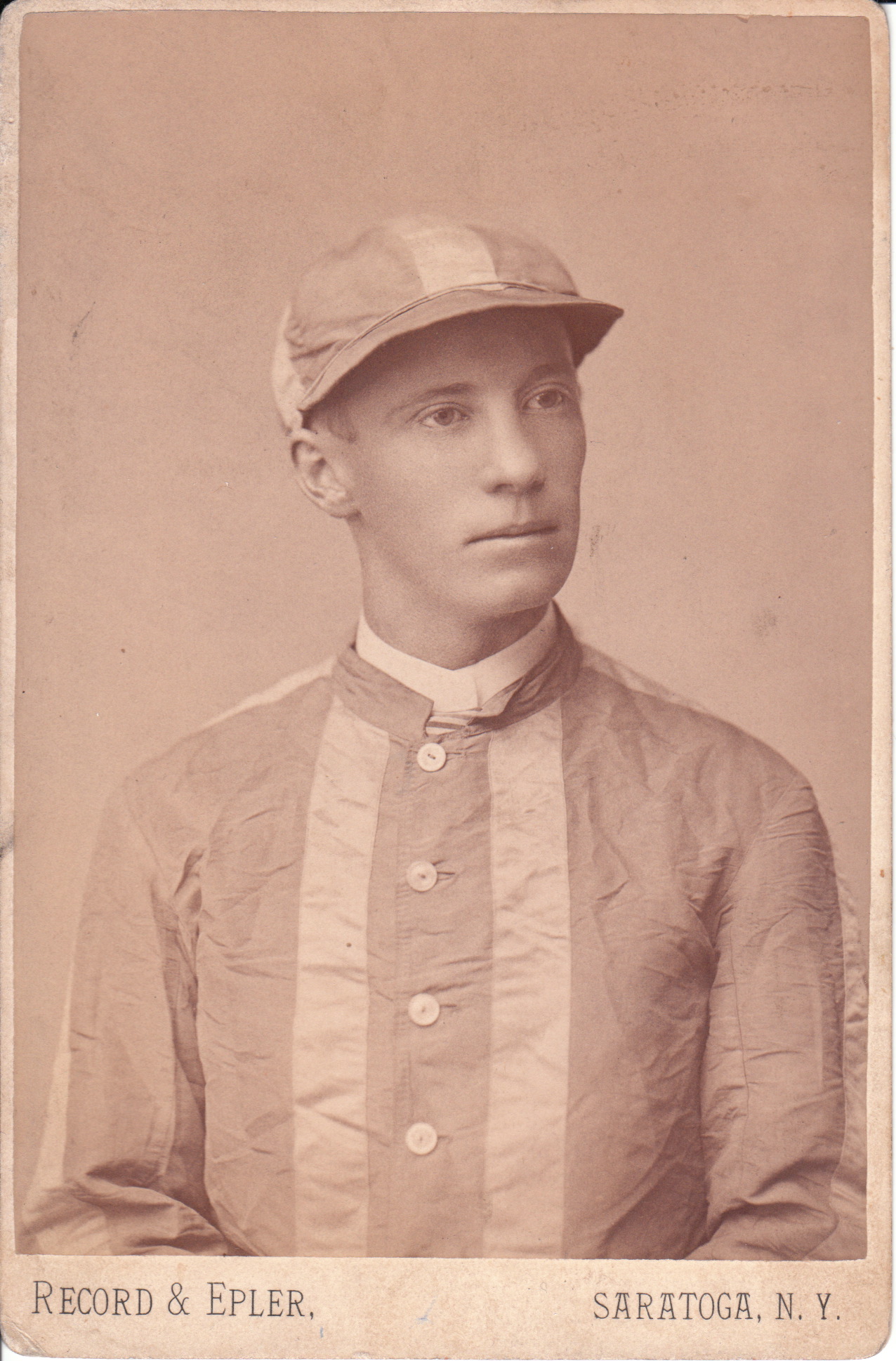
This cabinet card is a portrait of a horse racing jockey wearing his colors. The photograph was taken by the Record & Epler studio in Saratoga, New York. According to the printing on the reverse of the photograph, the studio was located on the corner of Broadway and Phila Street. To view other photographs by this studio, click on category “Photogapher: Record & Epler”. Saratoga is a resort and horse racing town. The Saratoga Race Course is a Thoroughbred horse racing track in Saratoga Springs. The track opened in 1863.
SMILING LITTLE GIRL HOLDS HER DOLL IN DOVER, ENGLAND
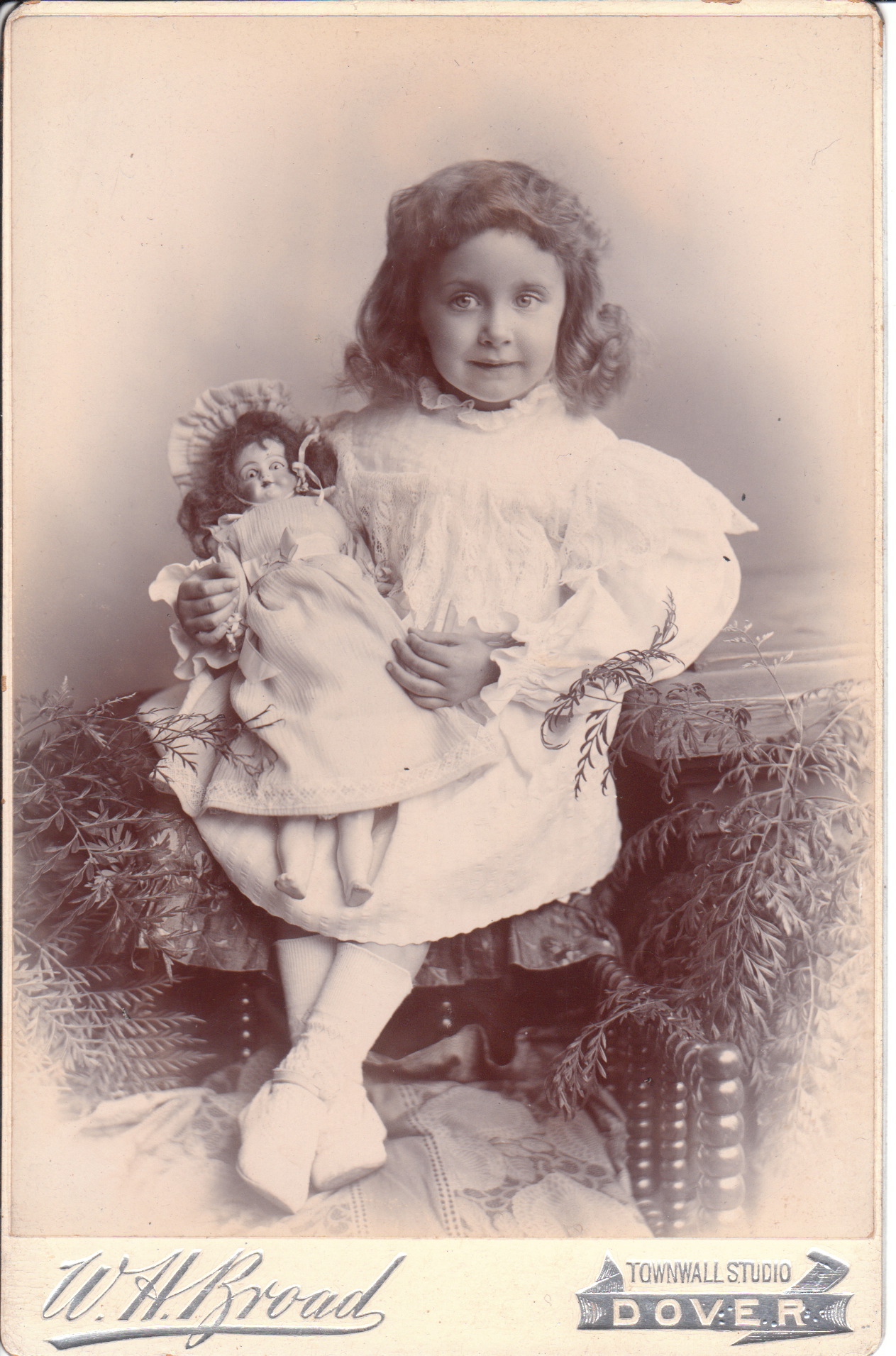 An adorable and sweet looking little girl poses with her beautiful doll in this portrait by W. H. Broad of the Townwall Studio in Dover, England. She is sitting near a careful arrangement of fern or some other plant leaves. The child’s expression could be described as “frozen in happiness”.
PHOTOGRAPHIC PORTRAIT OF STAGE ACTRESS BELLA MOORE IN COLUMBUS, OHIO
 This cabinet card portrait features singer, dancer, actress Bella Moore. She is wearing lace and a nice cap and smile.During her stage career she was also known as Mrs Fred Vokes (to learn more about the Vokes family, use the search box to search for Fred’s sister, actress “Rosina Vokes”). An ad placed in Harry Miner’s American Directory for the Season 1884-1885 (1884), contains rave reviews of Miss Moore from Cincinnati and Louisville newspapers. The ad also advertised a play named “A Mountain Pink”. Miss Moore was starring in the play which was appearing in Cincinnati. This cabinet card was photographed by the studio of Baker & Potter in Columbus, Ohio. Baker may be one of the principals of the Baker Art Gallery. To view other photographs by Baker, click on the category “Photographer: Baker Art Gallery”. The reverse of this cabinet card advertises that copies of the photograph could be obtained for 25 cents by mail.
MINNIE PALMER: SUCCESSFUL THEATRE ACTRESS NEARLY MURDERED BY HER POSSESSIVE HUSBAND
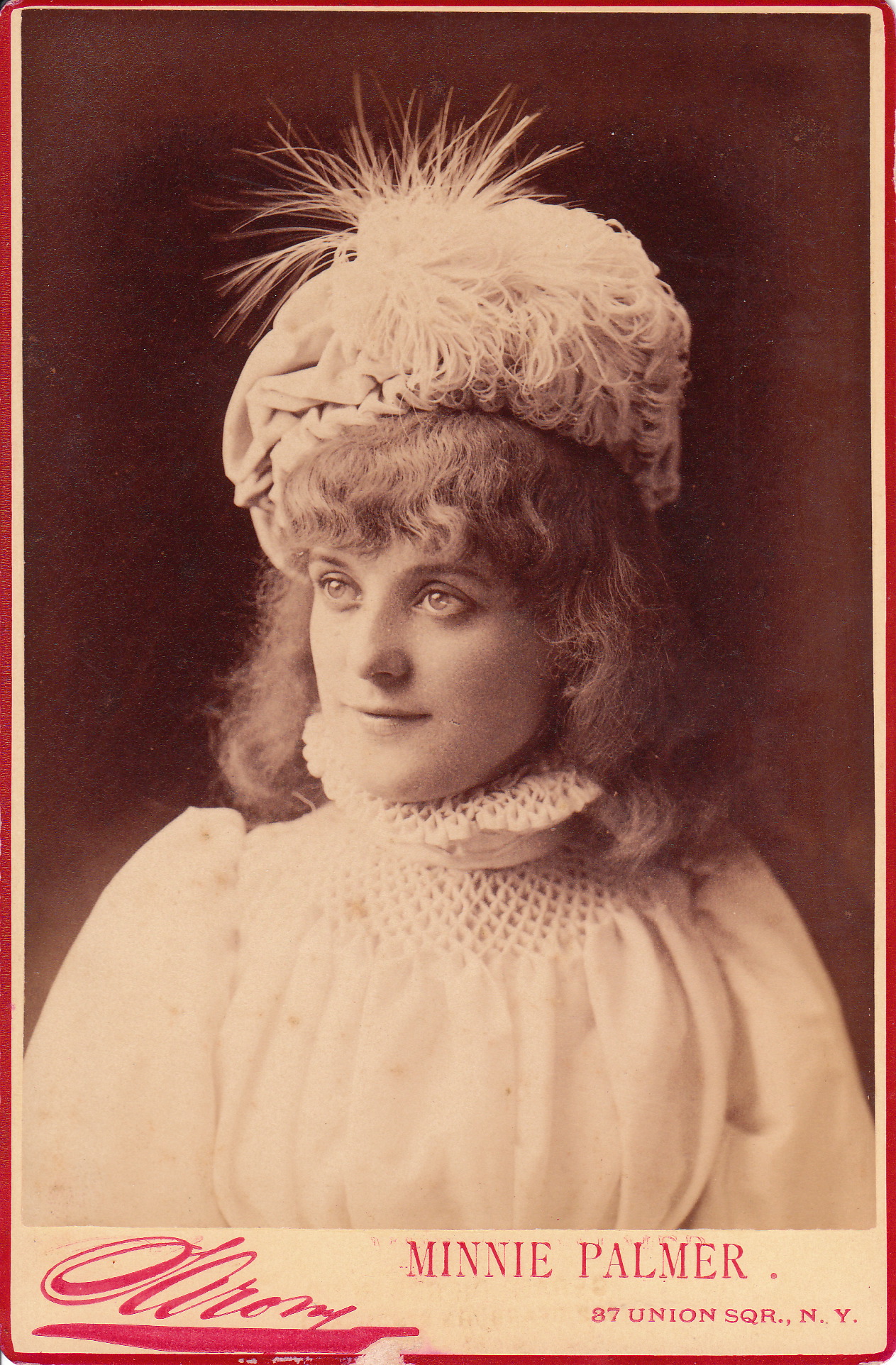
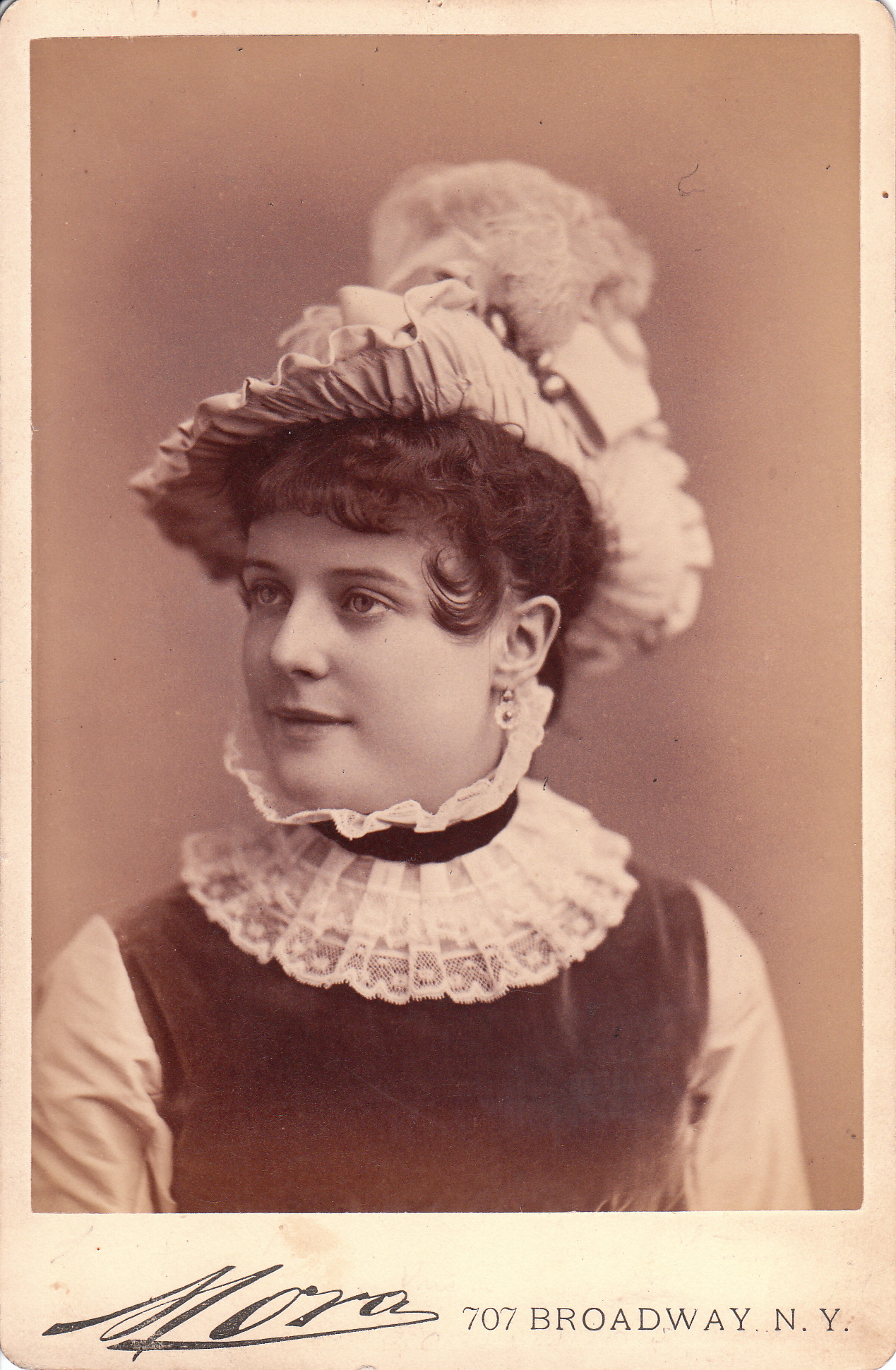
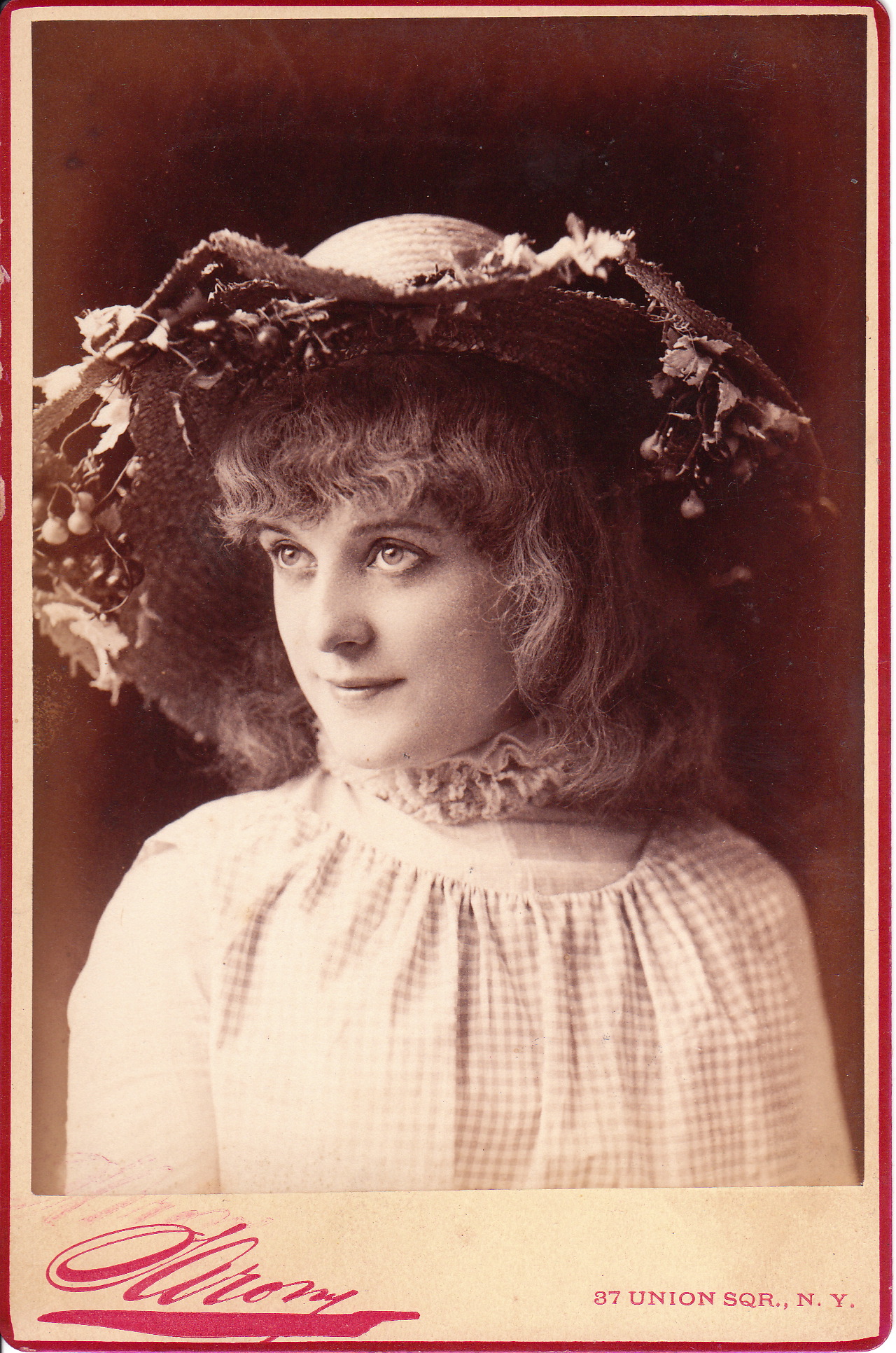
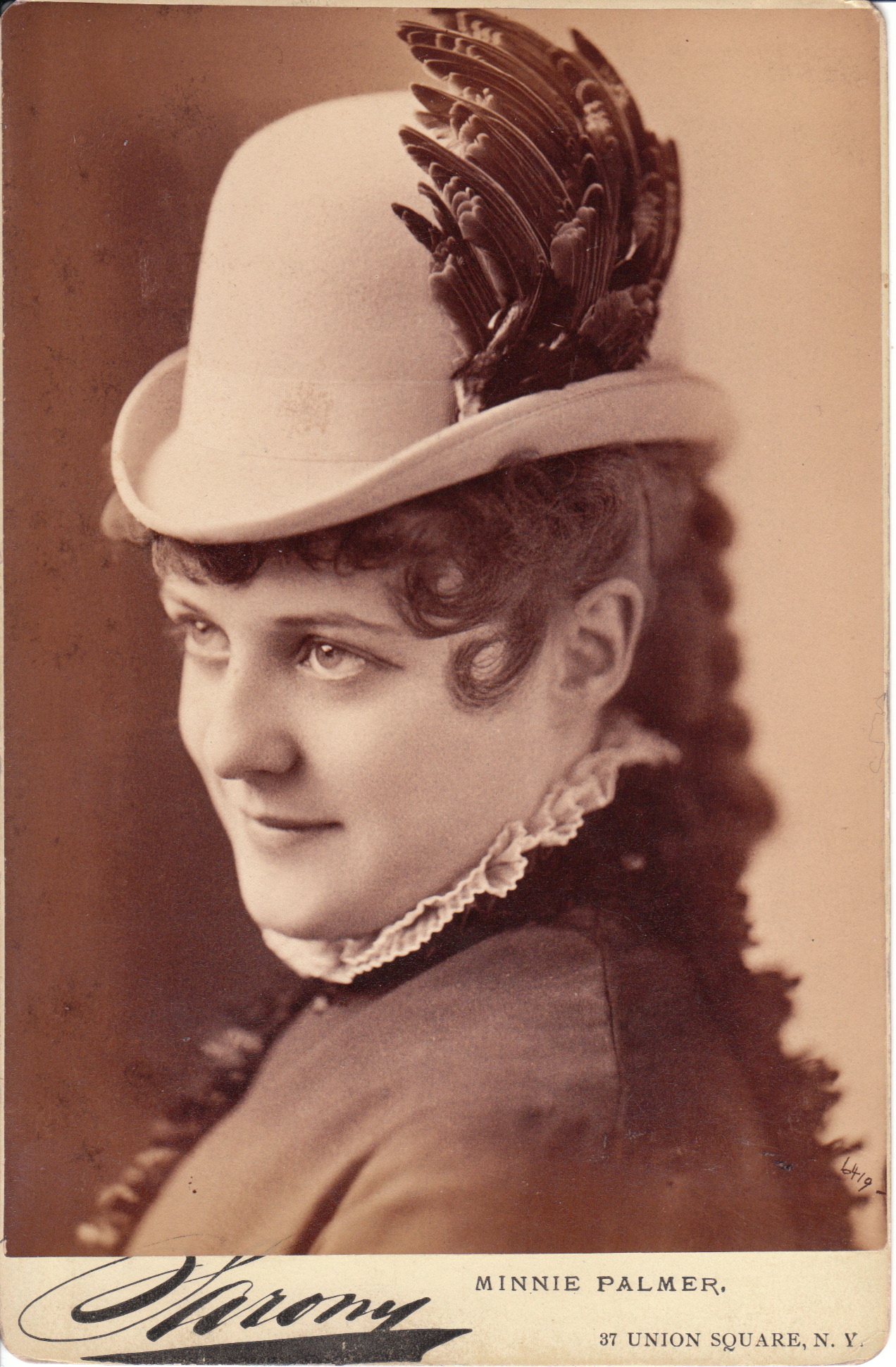
These cabinet cards feature a portrait of theatre actress, Minnie Palmer (1860-1936). Palmer was born in Philadelphia and spent her early childhood in a convent. At age eight, her family moved with her to Vienna where she was taught music and German. She then went to Paris where she learned dancing and French. At age eleven, in 1876, she went to Baltimore, Maryland, and made her first stage appearance. She then acted in Booth Theatre’s production of “Dan’l Druce”. This appearance was followed by roles in “Engaged“, “The Cricket on the Hearth” and other plays. She was very successful in “Two Orphans” and in the 1879-80 theatre season she had great notice in “The Boarding School” and “My Sweetheart“. Palmer also was successful at having aspects her personal life detailed in the newspaper. The New York Times (1890) reported her “narrow escape from death” when she was assaulted by her husband who brandished a huge carving knife. She received minor injuries to her face and her hand. Her husband, John Rogers, was also her manager. Rogers was angry because his wife had ignored his edict that she stay away from her mother. Apparently, upon her return from attending a horse show with her parents, Rogers attacked her. Rogers was a very possessive man; he had already written many insulting and abusive letters to Palmer’s friends in an effort to keep them away from her. Palmer was certainly not media shy. She gave the Times reporter a very detailed story about the violent incident and problems in her marriage which they were happy to print. The photographer of the top cabinet card is Sarony. The second cabinet card is a portrait by celebrity photographer, Mora. Both photographers were located in New York City. To see other photographs of these talented celebrity photographers, click on Cabinet Card Gallery’s category “Photographer: Sarony” and “Photographer: Mora”. The third cabinet card is by Sarony and it does a great job of capturing Minnie Palmer’s exceptional beauty. The fourth cabinet card, also by Sarony, is a close-up portrait of Miss Palmer wearing a feathered hat. Once again, Minnie Palmer is quite photogenic. She has sparkling beautiful eyes and a wonderful smile.
STAGE AND SILENT FILM ACTRESS MABEL TRUNELLE IN FORT WAYNE, INDIANA

This cabinet card features stage and film actress Mabel Trunnell (1879-1981). The reverse of the photograph is inscribed “Yours Truly, Mabel Trunnell 1898”. Therefore, this image captures Miss Trunnell at about age nineteen. Mabel Trunnell was born in Dwight, Illinois. She began her career as an actress of the stage but at age thirty-two she began to appear in films. In 1911 she appeared in “A Modern Cinderella, In the Days of Chivalry” and in “The Star Spangled Banner”. Her last film was in 1923 when she was in the movie “The Love Trap”. Her filmography on IMDb indicates that she acted in 199 different films. At the age of forty-four she returned to the stage. She was married to Herbert Prior, an early British film star. Trunnell was one of Hollywood’s first movie stars as was identified with Edison Studios. A magazine article in “The Moving Picture World” (1915) reviews one of her performance. The reviewer wrote “Mabel Trunnell becomes more attractive as the course of time silvers her hair”. An interesting sociological comment was also made by the reviewer which was in regard to the admirable strength portrayed by Trunnell’s character. The reviewer notes “most of us are tired of seeing women pictured as incurable weaklings”. The reviewer was certainly a man who was ahead of his time. This cabinet card was produced by the Barrows studio in Fort Wayne, Indiana. It appears that Miss Trunnell was photographed in a costume from one of her performances. She is dressed very much like a maid and seems a bit troubled in her pose. The photographer, Frank Rufus Barrows operated a studio in Fort Wayne between 1880 and 1900. He is considered one of the city’s most prolific photographers and had several locations while in business there. He was born in Sturgis, Michigan in 1854. He came to Fort Wayne in 1880 and partnered with Frank H. Clayton in operating a photographic studio. In about a years time he became the sole proprietor of the studio. He had many photos appear in Fort Wayne Illustrated (1897). He left Indiana for Medford, Massachusetts and operated a studio there until 1910 when he moved to Eugene, Oregon where he died in 1920.
THE MAGNIFICENT SEVEN: MEET THE MEN OF SLEEPY EYE, MINNESOTA
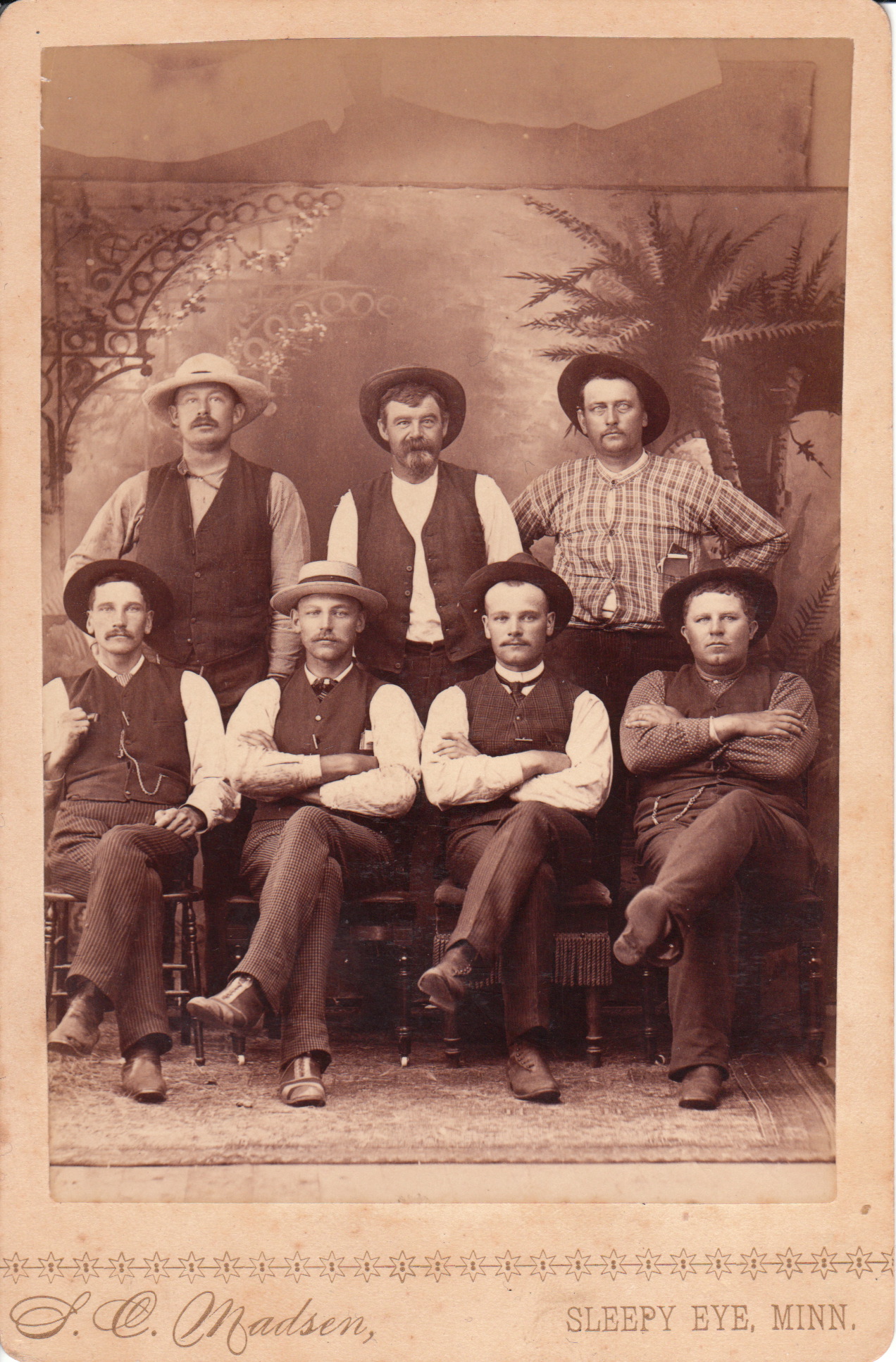 Members of the cast of the American Western movie “The Magnificent Seven” (1960) pose for a group picture in Sleepy Eye, Minnesota. These seven gunmen were hired to protect a small Mexican agricultural village from a gang of marauding bandits. The cast included Charles Bronson (back row left), Steve McQueen, Yul Brynner, James Coburn, Robert Vaughn, and Eli Wallach. Wait a minute! Even though the Charles Bronson guy really looks like Charles Bronson, how could the cast of a 1960 movie appear in a turn of the century cabinet card photograph? In addition, what would Hollywood actors be doing in Sleepy Eye, Minnesota if they are in a film where the locale is Mexico? Besides that, is there really a town called Sleepy Eye? It’s time for a confession. The men in this photograph are not members of a movie cast even though I could almost swear that the guy in the back row is Charles Bronson. In regard to the existence of a town named Sleepy Eye; yes it does exist. The town of Sleepy Eye is named after Chief Sleepy Eye, or Ishtakhaba. He was a chief of the Sioux tribe and happened to have droopy eye lids. He was one of four Sioux Indians to meet President James Monroe in 1824 in Washington D.C.. This image was produced by Sleepy Eye photographer S. C. Madsen who also had a studio in New Ulm, Minnesota. He operated in Sleepy Eye between 1884 and 1892 and had a studio in New Ulm in 1888. Since this cabinet card advertises the New Ulm studio on the reverse of the photograph, this photograph was likely taken in 1888. Who are the men in the picture? Unfortunately, they are not identified. They appear to be businessmen from town but that of course is just a guess (two of the men have papers in their shirt pocket). Three of the men in the bottom row have their arms crossed resting on their abdomen. The fourth gentleman apparently didn’t get the message from the photographer who posed them. The man on the far right of the top row must have just finished the all you can eat buffet at the Silver Dollar Saloon judging by the tightness of his shirt.
MISS LILLIAN RAYMOND: PRETTY STAGE ACTRESS WHOSE LIFE WAS CUT SHORT BY TUBERCULOSIS
 On July 17th, 1911, the New York Times printed the following obituary, reporting from Louisville, Kentucky. “Lillian Dolfinger, known to the theatrical world as Lillian Raymond, who appeared in “The Girl of the Golden West’, and several other New York productions, died today at the home of her father here from tuberculosis. She was 25 years old. Miss Raymond was to appear in one of the New York productions this Fall, but became ill”. Investigation revealed that Miss Raymond appeared on Broadway on three occassions. She appeared in “Wonderland” (1905), “About Town” (1906), and “The Girl Behind the Counter” (1907). All three shows were musicals. No other information about Miss Raymond could be found during preliminary research. The photographer of this image is C. J. Horner who described himself through his advertising as a “European Photographer. His studio was located at 11 Winter Street in Boston, Massachusetts. It is tragic that Lillian Raymond’s stage career and life was cut short by illness. We will never know to what heights this pretty young actress may have climbed in the theatrical world. The photographer of this image rose to lofty heights in his profession. Swedish born Carl Joseph Horner (1864-1926) was probably the best sports photographer of his era. He was particularly known for his baseball photographs, many of which appeared on tobacco company issued baseball cards. Among the players he photographed were Cy Young and Tris Speaker. His panoramic portrait of the 1912 “Red Sox Champions” is well known among collectors.
LOVELY COUPLE IN EVANSVILLE, INDIANA (GEORGE AND ANNA SCHMIDT)
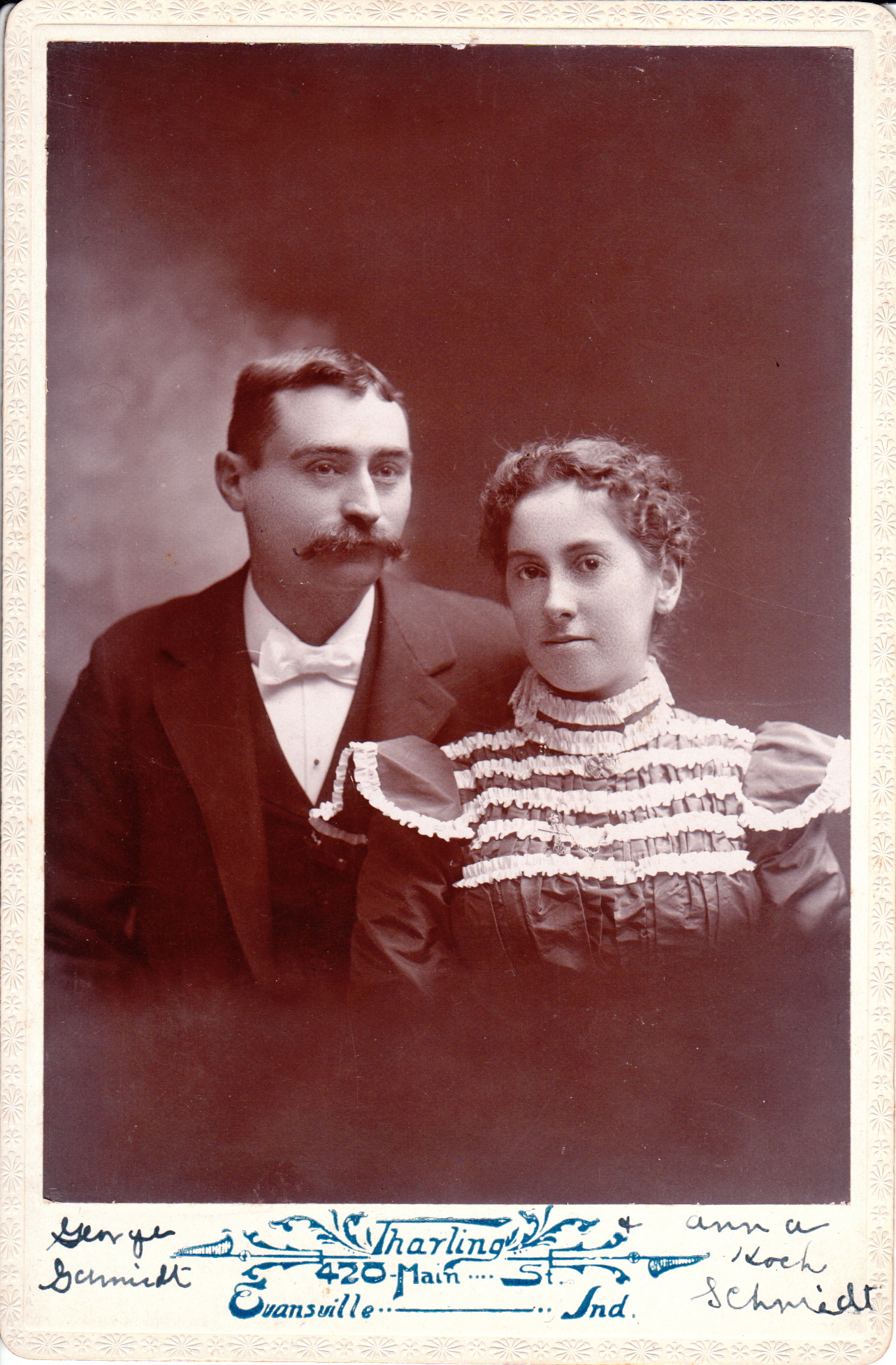 A lovely formally dressed couple is featured in this cabinet card portrait by the John W. Tharling in Evansville, Indiana. The man and woman are identified as George Schmidt and Anna Hoch Schmidt. The 1900 census reveals that George and Anna were married in 1897. They made their home in Pigeon, Indiana. George worked as a stocker at the gas works. George was born in 1878 and was educated through the eighth grade. Anna was born in 1872. Both were natives of Indiana and were of German heritage. The 1910 US census finds the couple living in Knight, Indiana and George working as a farmer. The couple had two children, Hubert (age 9) and Idella (age 4). The couple also had a nineteen year-old live-in housekeeper. As a side note, Knight, Indiana was named in anticipation of the University of Indiana’s basketball program having great success under the leadership of coach Bobby Knight. He coached the Indiana Hoosiers between 1971 and 2000 and led the team to three NCAA championships. Sorry. I couldn’t resist telling the mythical origin of the naming of Knight, Indiana. The 1920 census discloses that the couple had added a third child, Miranda (age 3). They were living in Evansville. By the time the 1940 census was taken, Anna had died and George was living in Knight with his daughter Miranda (Grennan) and her family.
LADY LIBERTY AND HER TWO APATHETIC CHILDREN
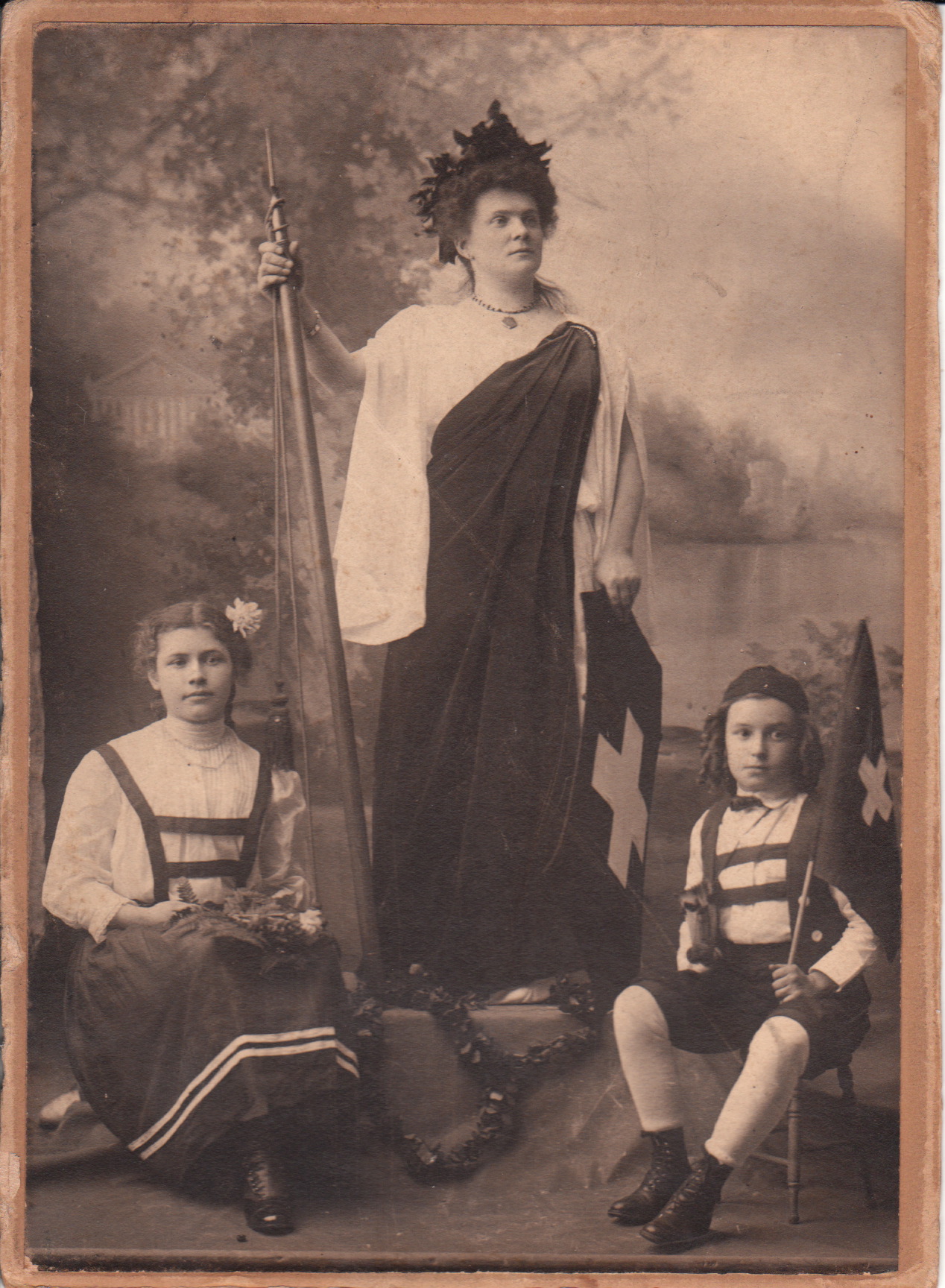 This photograph presents an interesting mystery. What exactly is going on in this image? It appears that this is a photograph of a theatrical presentation or possibly a costumed mother and her costumed children having fun and posing at a photographic gallery. Their clothing appears to be European. The mother is dressed in some sort of patriotic costume. She is holding a black flag with a white cross and a pole that may be a flag staff. The young boy is holding an identical flag to his mother. What is the origin of this flag? Some assistance from an informed cabinet card gallery visitor to answer this question would be greatly appreciated. A similar flag to the pictured flag is Saint Piran’s Flag. Saint Piran’s Flag is the flag of Cornwall. The people of Cornwall used the flag as a symbol of identity. Saint Piran is supposed to have created the flag from seeing the molten tin spilling out of the black ore in his fire. It is a white cross on a black background but the cross part covers the whole flag rather than float in the background like the crosses on the flags in this image. The woman in this image looks rather intense while the children appear uninterested. The subjects of this photograph are unidentified as is the photographer. The photograph has been trimmed to fit into a frame or album and it is likely that the name of the photographer and studio were removed in the process.


 THE CABINET CARD GALLERY