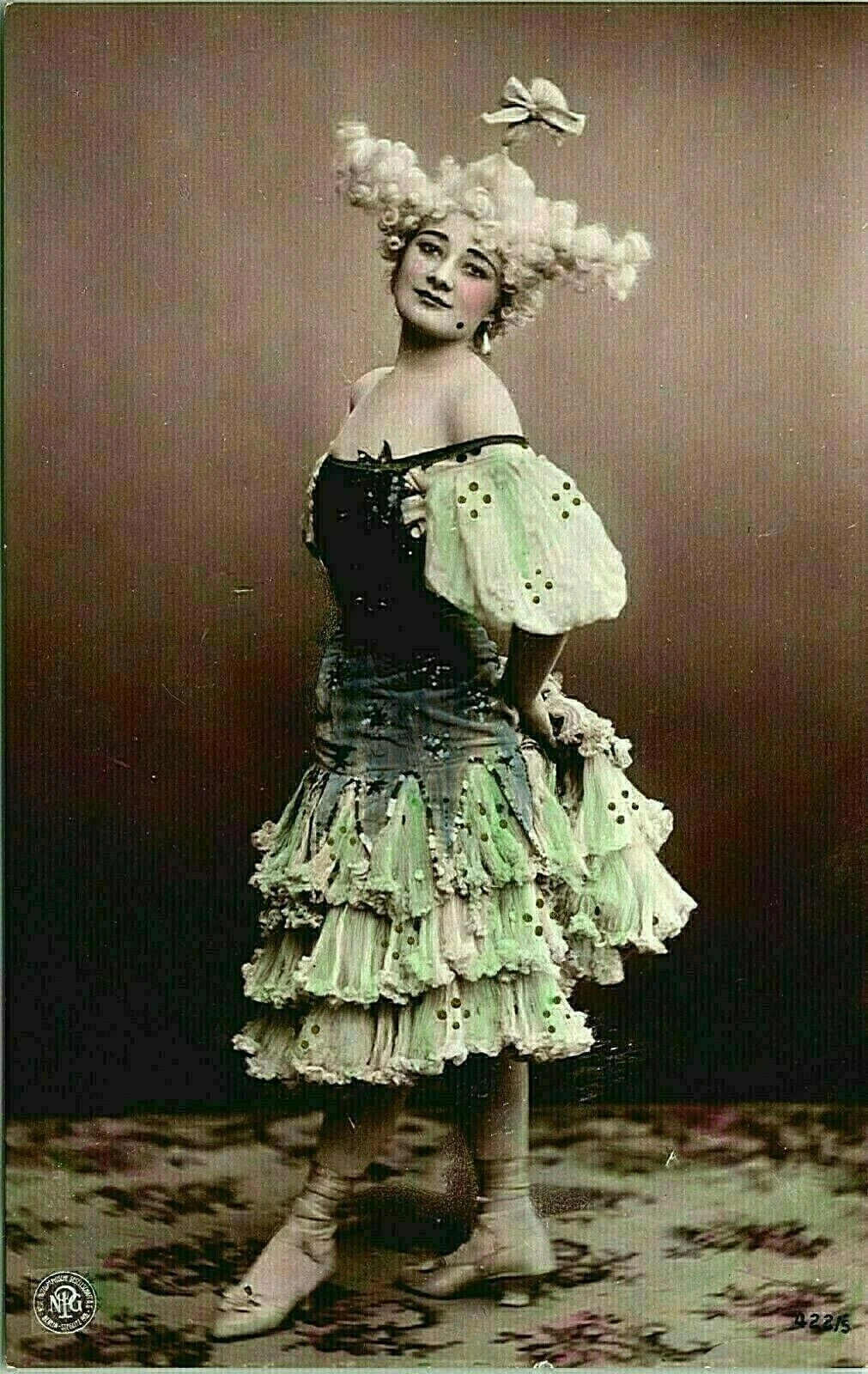
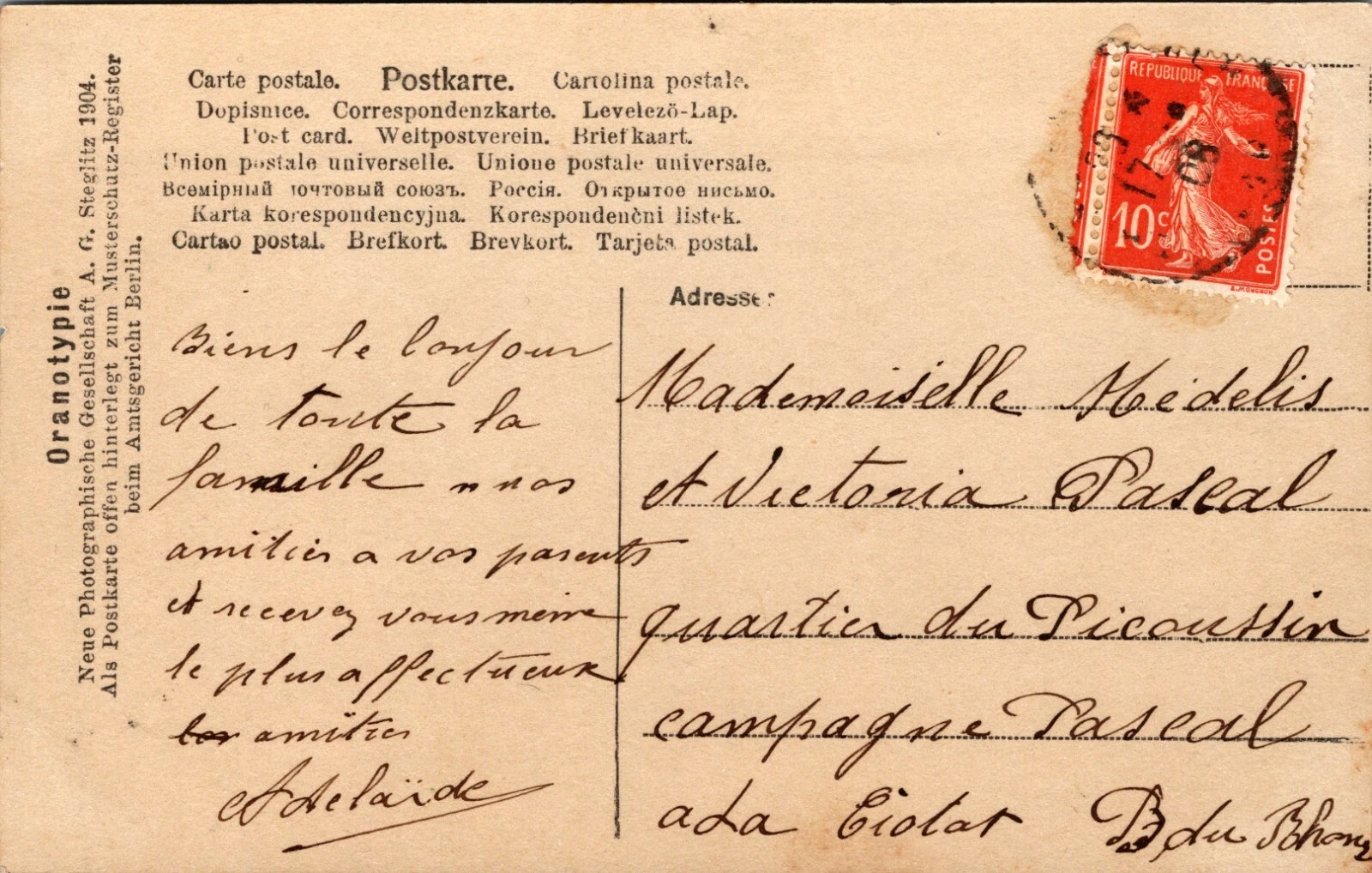
This vintage real photo postcard features an attractive young woman wearing some sort of costume. She appears to be a performer. She is wearing a white wig with an “elevated bow”. This postcard is hand color tinted. The postcard was published by Neue Photographische Gesellschaft (NPG) which was located in Berlin and Stuttgart, Germany.The company was in business between 1894 and 1948. It was founded by Arthur Black (1862-1943) and it became one of the most well known and largest companies involved in the production of postcards.This postcard is an Oranotypie. An oranotype is a trade name for a type of glossy real photo postcard published by NPG at the beginning of the 20th century. The postcard has a French stamp and the card was postmarked in 1908. SOLD
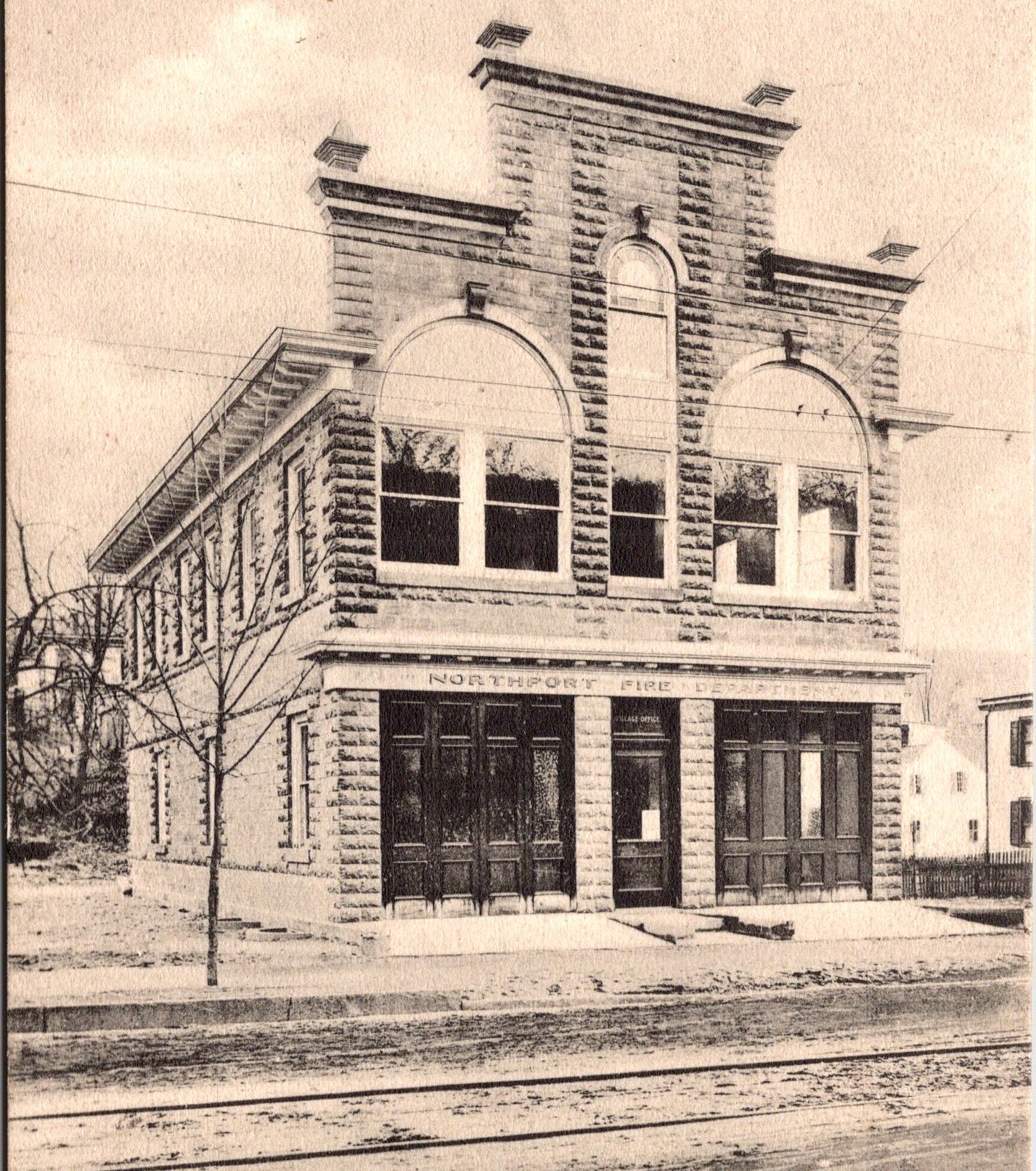
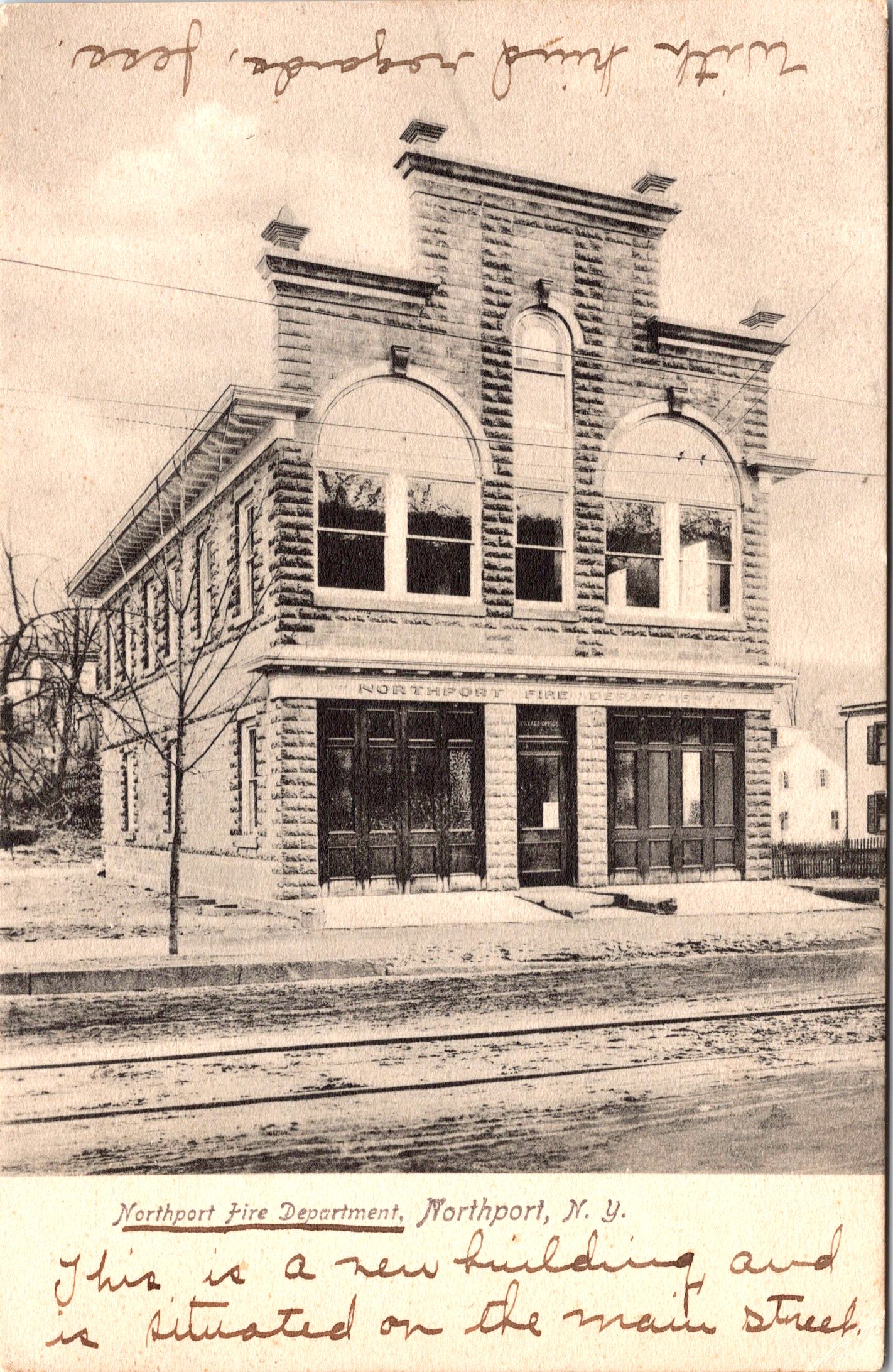
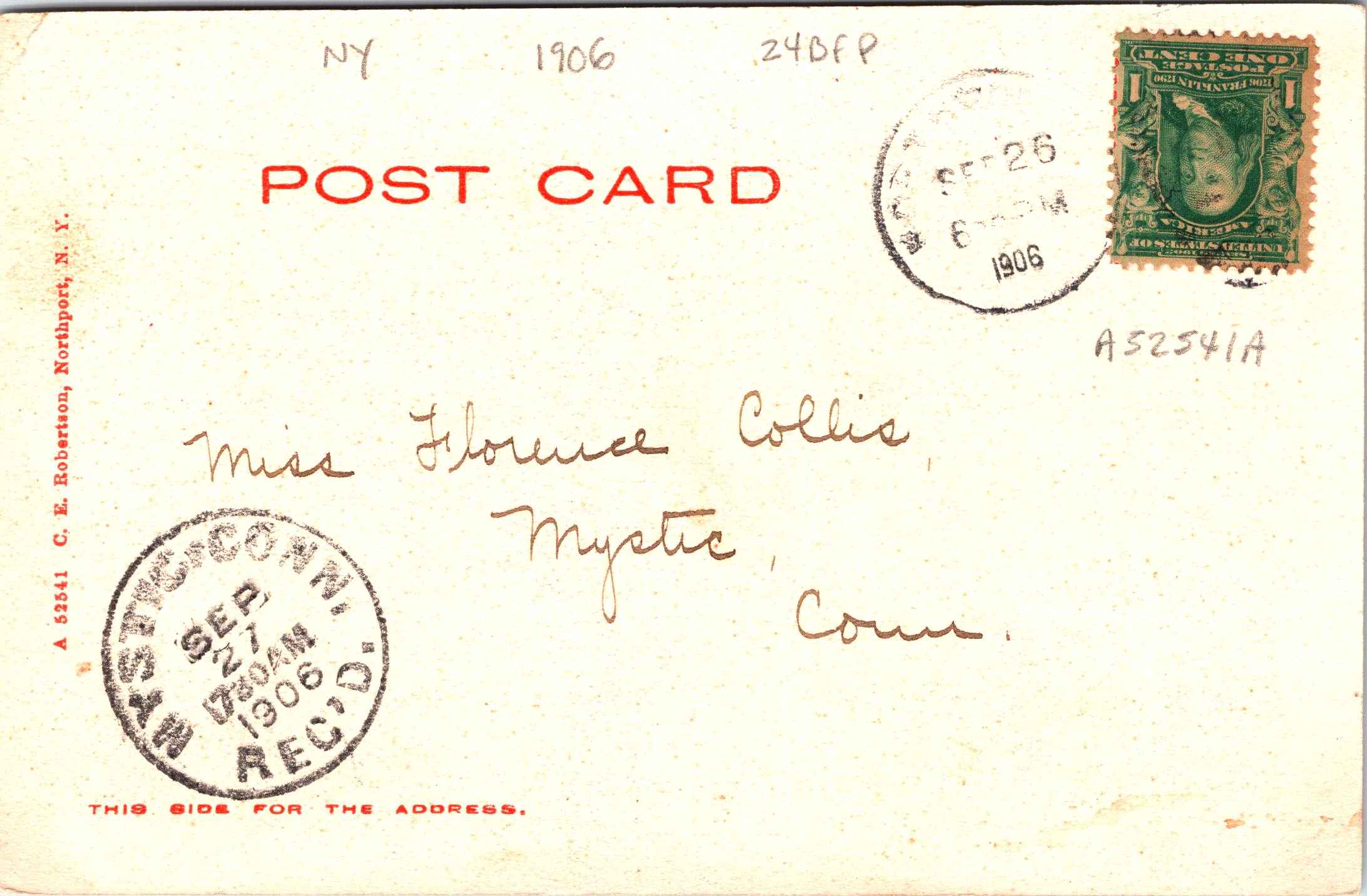
This vintage lithographic undivided back postcard depicts the station of the Northport Fire Department. Northport is located on the north shore of Long Island, New York. this postcard was published by C. E. Robertson (Northport). The card is part of a series (no.A52541). The postcard has a 1906 postmark. The message on the card reveals that this depiction captures the station just after it was built. Northport’s organized fire protection grew out of the village’s late-19th-century boom—shipbuilding, publishing, sand mining, oyster work, and a denser downtown that made major fires a constant threat. In 1889, local business leaders met and formed the Northport Hook and Ladder Company, the direct ancestor of today’s department. A few years later, in 1893, taxpayers approved an incorporated fire district; at that point the Hook and Ladder Company effectively became the Northport Fire Department. The first firehouse was located Woodbine Avenue (barn firehouse). The first “station” was humble but practical: a barn . that had a bell mounted on top for alarms. Early equipment was pulled to fires by hand. As the village expanded, Northport built a more formal headquarters. Construction began in 1905, and the new firehouse was completed in 1906, sharing space with Village Hall. Post-World War II growth demanded something larger and more modern. In 1955, the older building was replaced and the department moved into a new headquarters on Main Street. The present Main Street firehouse was later renovated and enlarged in 2002, and a new façade was added specifically designed to resemble the 1906 building—a deliberate nod to the department’s best-known historic headquarters. This postcard has the typical corner wear seen in old postcards and it also has a light crease in it’s lower right corner. This postcard is in overall good condition (see scans).
This cabinet card is available for purchase at my store, The History Peddler, for $22.00 or best offer.
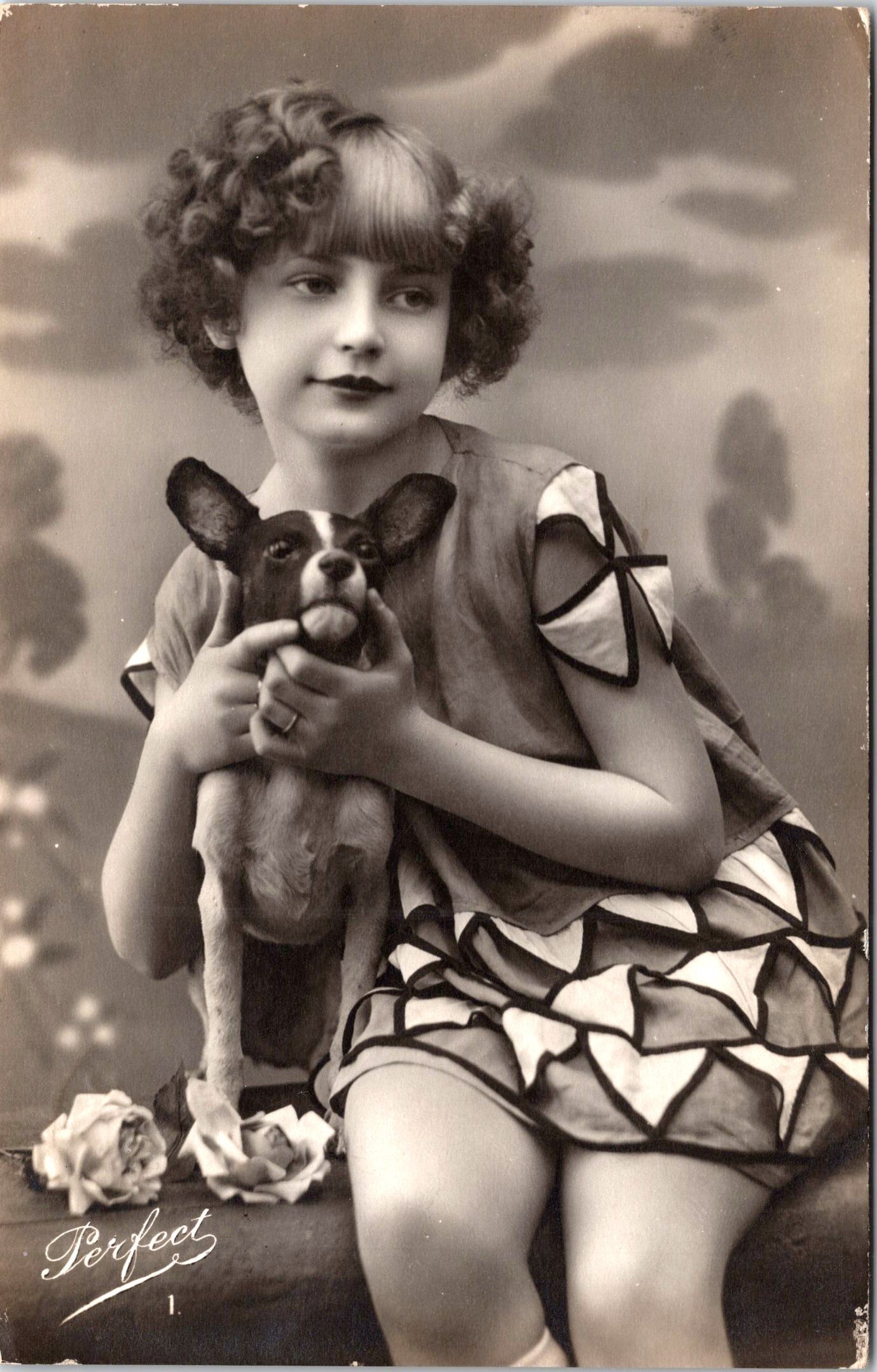
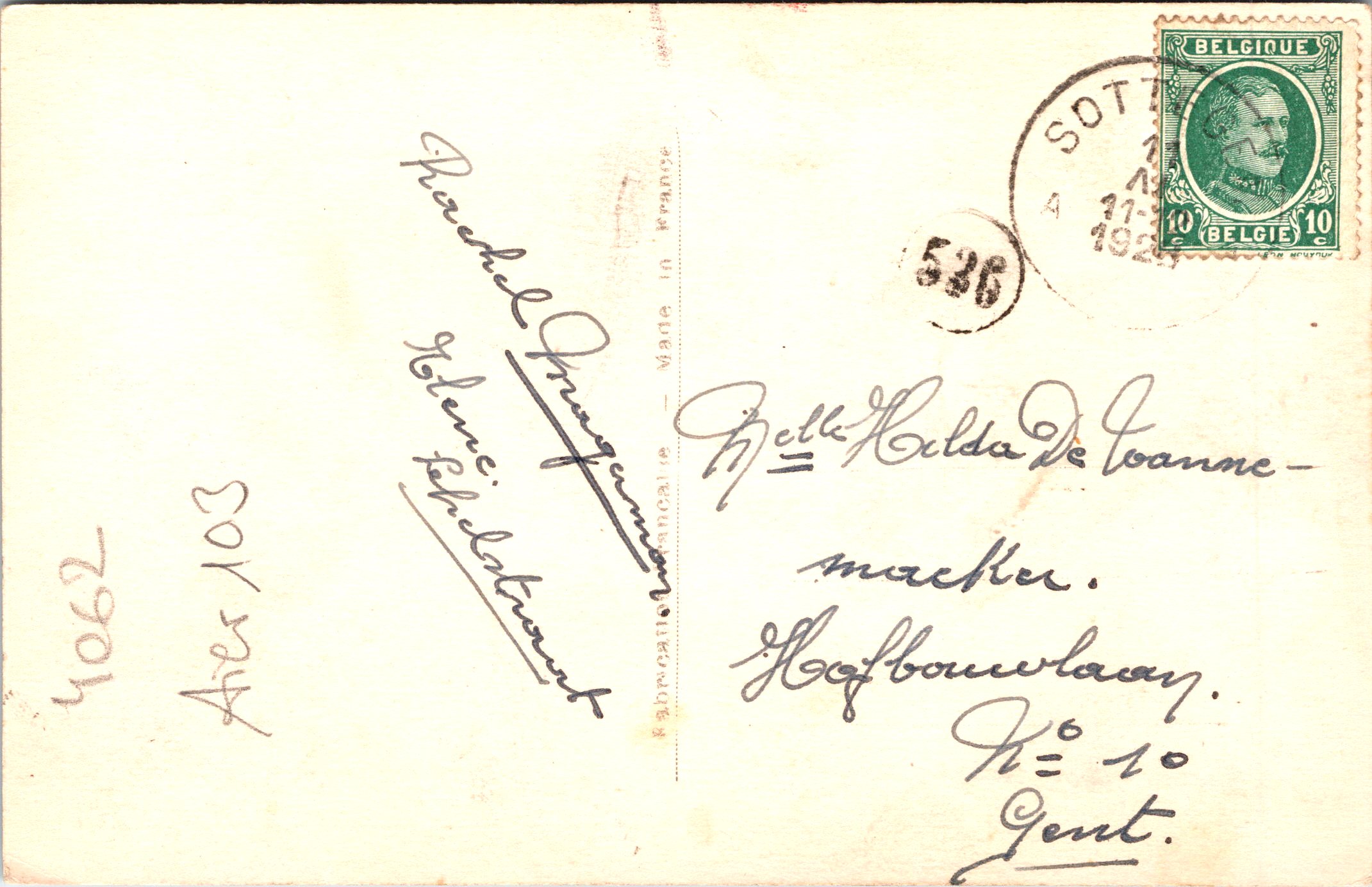
This charming vintage real photo postcard captures a delightful scene of a little girl lovingly holding her dog. She wears a short-sleeved dress with decorative trim—possibly silk or rayon—featuring a playful geometric pattern or layering. Her hair is styled in tight curls—indicative of a child’s fashionable curls in the 1920s. The dog, small and alert, could be a toy or miniature Chihuahua‑type, with pointy ears and a poised stance. I believe it is most likely a Jack Russell Terrier. The pair sit against a painted backdrop with floral imagery, creating a refined and innocent studio portrait. The postcard is from publisher Perfect, with the signature “Perfect” scripted on the lower left of the front. The card is postally used, with handwriting on the reverse, a green 10-centime stamp from Belgium, and a postmark dated 1926, likely from Sottegem, Belgium. The handwritten message on the reverse is in French is addressed to recipient in Belgium. Translated, the missage message reads: “Kindly and affectionately”. (SOLD)
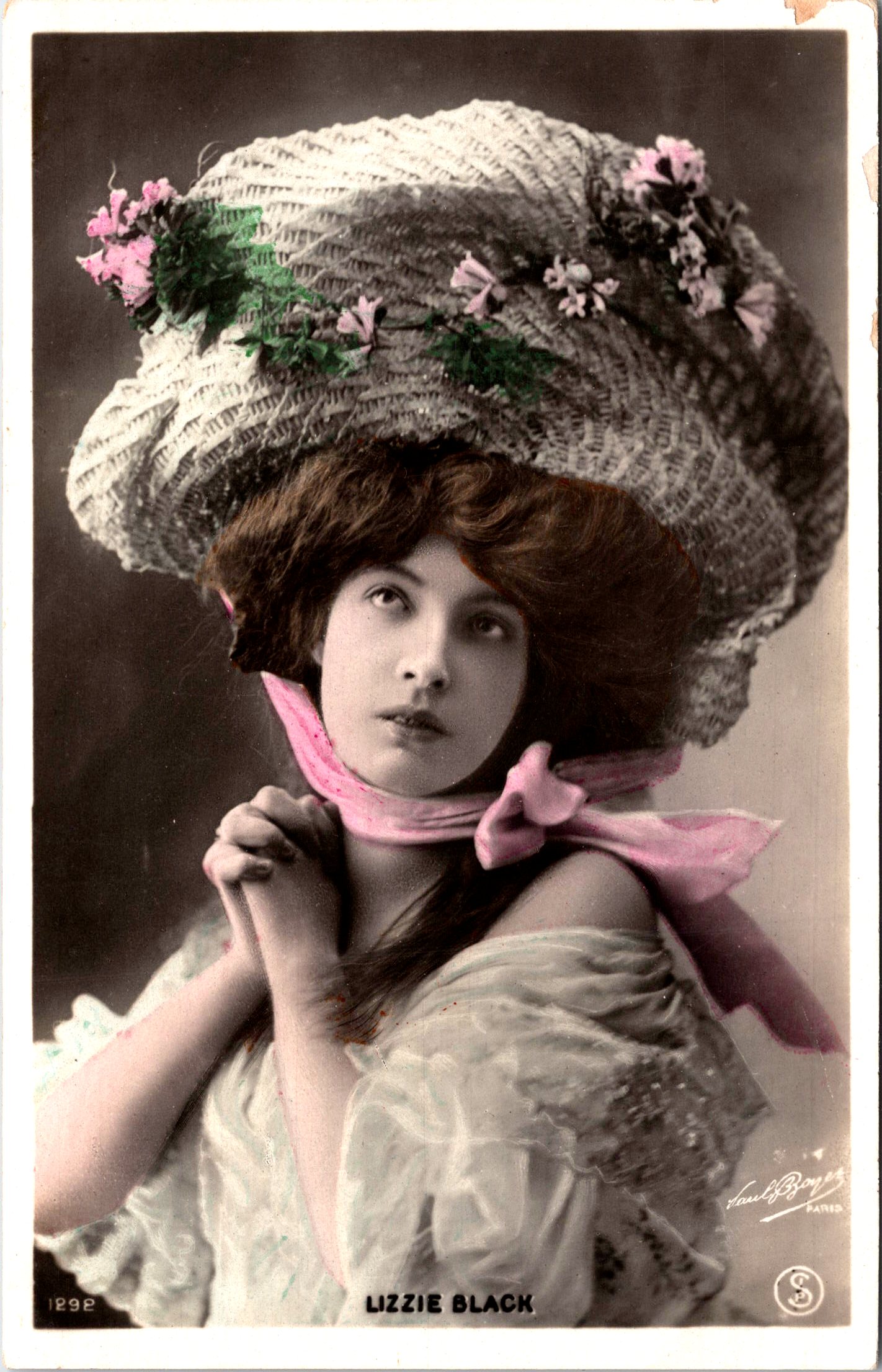
This exquisite Belle Époque postcard features the captivating performer Lizzie Black, photographed in Paris by the noted theatrical photographer Paul Boyer and published by S.I.P. (Société Industrielle de Photographie). The card is from the S.I.P. numbered actress series and has the serial number 1292. The reverse bears the format used in the first decade of the twentieth century, supporting a date of approximately 1904–1908. The portrait itself is striking and beautifully composed. Lizzie Black is shown in three-quarter view, her hands gently clasped beneath her chin in a pose that conveys softness and introspection. Her gaze drifts slightly upward and away from the camera, giving her an almost dreamlike, wistful expression—an effect typical of theatrical publicity imagery designed to evoke romantic allure rather than direct engagement. Her features are delicate and refined, framed by softly waved dark hair arranged in the fashionable style of the period. She wears a voluminous woven straw hat of dramatic proportion, lavishly decorated with hand-tinted pink blossoms and green foliage. The subtle yet effective color tinting extends to the pink ribbon tied beneath her chin and to faint blush tones in the flowers, contrasting beautifully with the otherwise sepia-toned photographic base. Her gown appears to be a light, sheer fabric with ruffled sleeves and delicate textural detail, suggestive of stage costume or fashionable portrait attire of the Belle Époque. The combination of oversized millinery, soft fabric, and romantic pose creates an image that is both theatrical and distinctly Parisian. The lower right corner bears Boyer’s elegant signature, “Paul Boyer – Paris,” and the S.I.P. monogram. As for biographical details, Lizzie Black remains elusive in surviving theatrical records. Despite research efforts, she does not appear prominently in English- or French-language reference sources, suggesting she may have been a stage performer whose career was either brief, regional, or conducted under a different stage name. This was not uncommon among early twentieth-century café-concert and revue artists. In regard to condition, the postcard’s corners show minor wear, with small edge imperfections visible at the upper right. The image remains strong and well-centered, with the hand-tinting still vibrant. The reverse is clean and unused. Overall, this is a very attractive and well-preserved Paul Boyer portrait postcard (see scans).
This vintage postcard is available for purchase at my store, The History Peddler, for $24.00 or best offer.
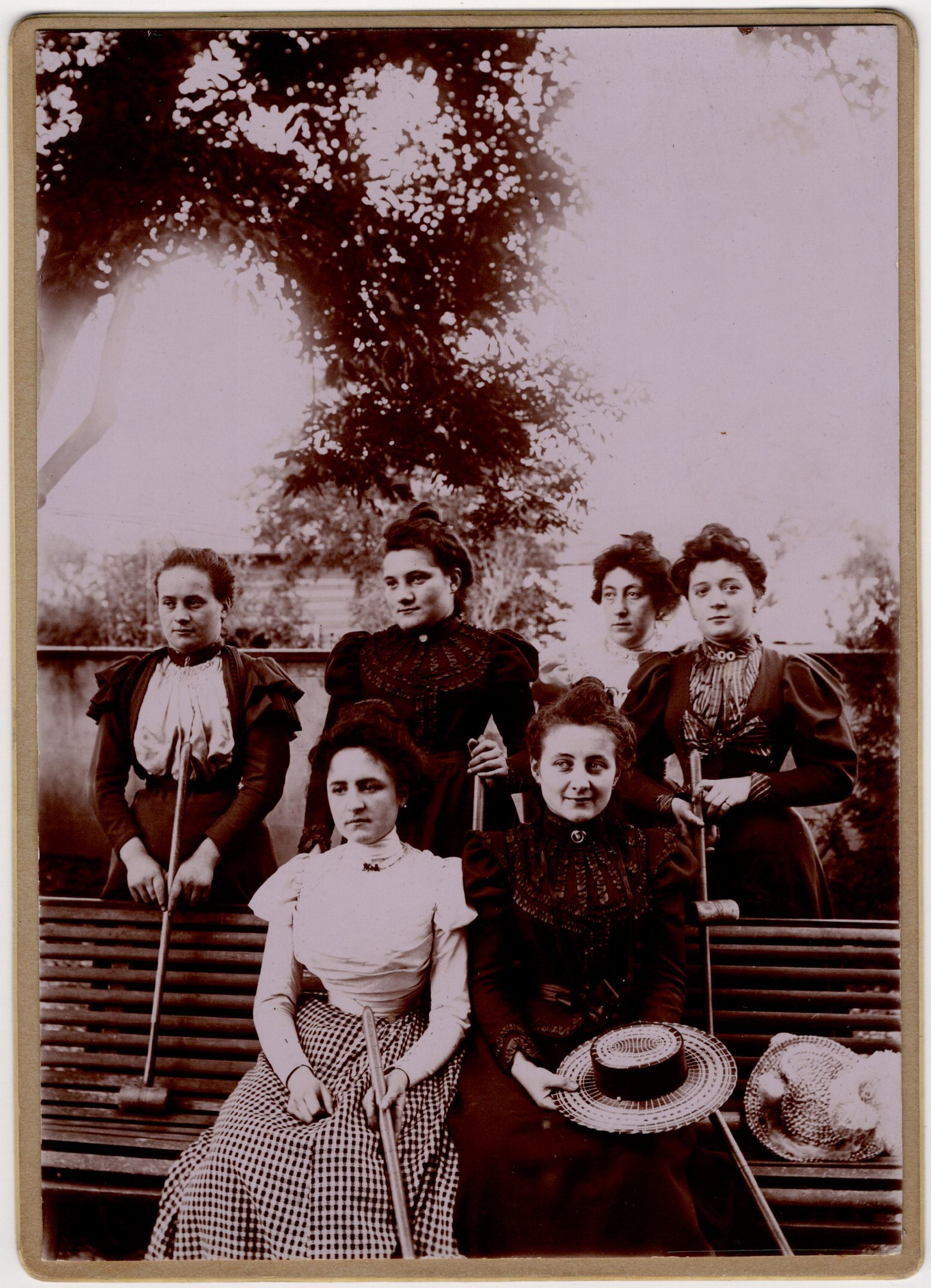
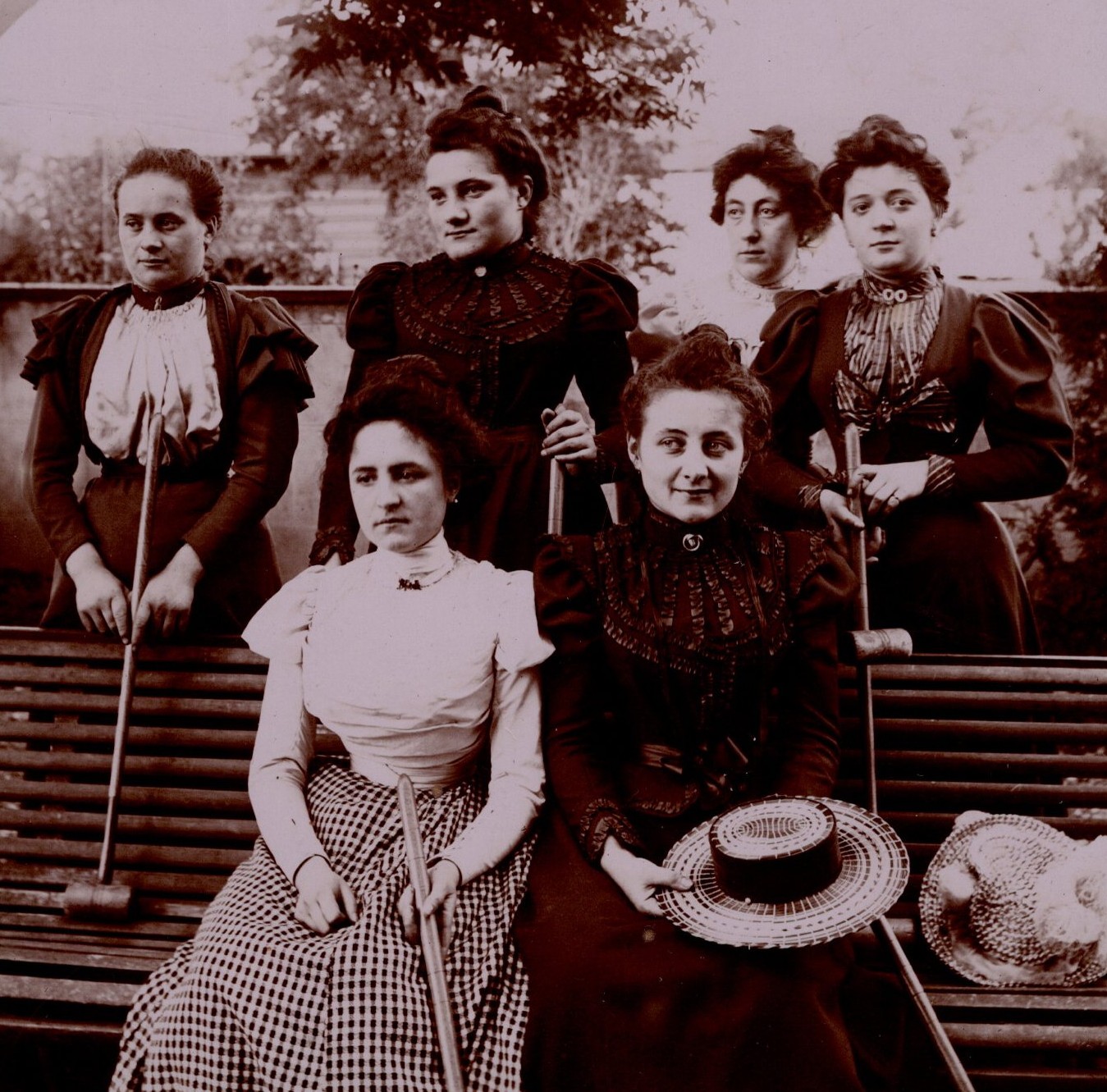
This is a wonderfully candid-feeling group portrait of six young women taking a breather from a game of croquet. They’re perched across a slatted garden bench beneath a big shade tree, each with a mallet either resting in her hands or propped against the seat. Two straw hats—one a jaunty boater—sit on the bench like time-capsule props. Nobody is posing stiffly; there’s the relaxed camaraderie of friends who’ve been laughing and competing all afternoon. Clothing helps date the scene to the late 1890s–very early 1900s. We get classic leg-of-mutton sleeves, high collars, pin-tucked bodices, and waist belts, with hair dressed up in the fashionable pompadour style. The woman at left looks off with a serious “game face,” the two standing in the middle wear tiny, knowing smiles, and the two seated in front give us the best expressions: one cool and composed with her mallet across her lap, the other glancing sideways with a mischievous, almost conspiratorial look. It’s easy to imagine them as a local club, sisters, or classmates—Victorian sport as social life is exactly what made croquet so popular.(SOLD)
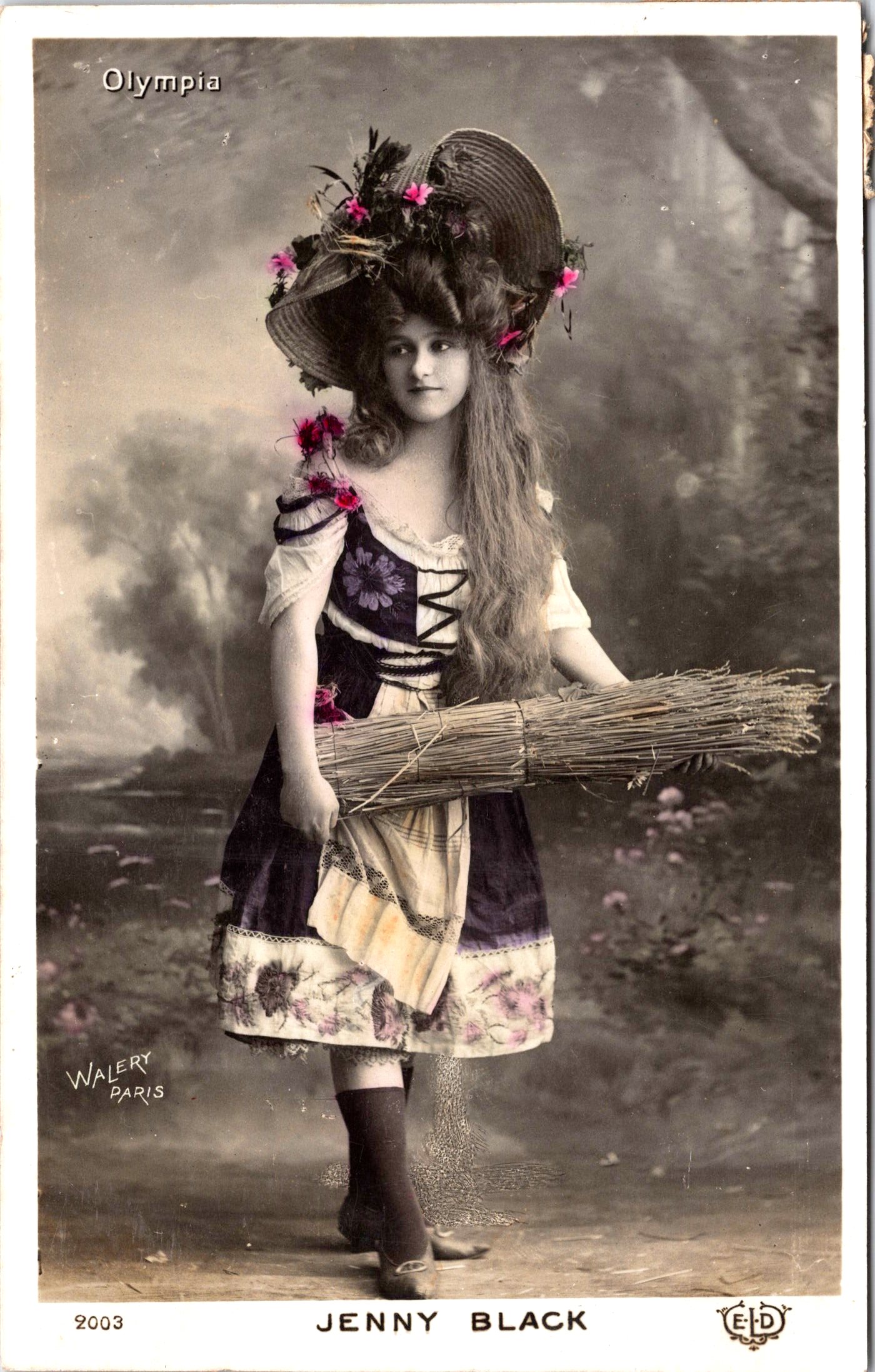
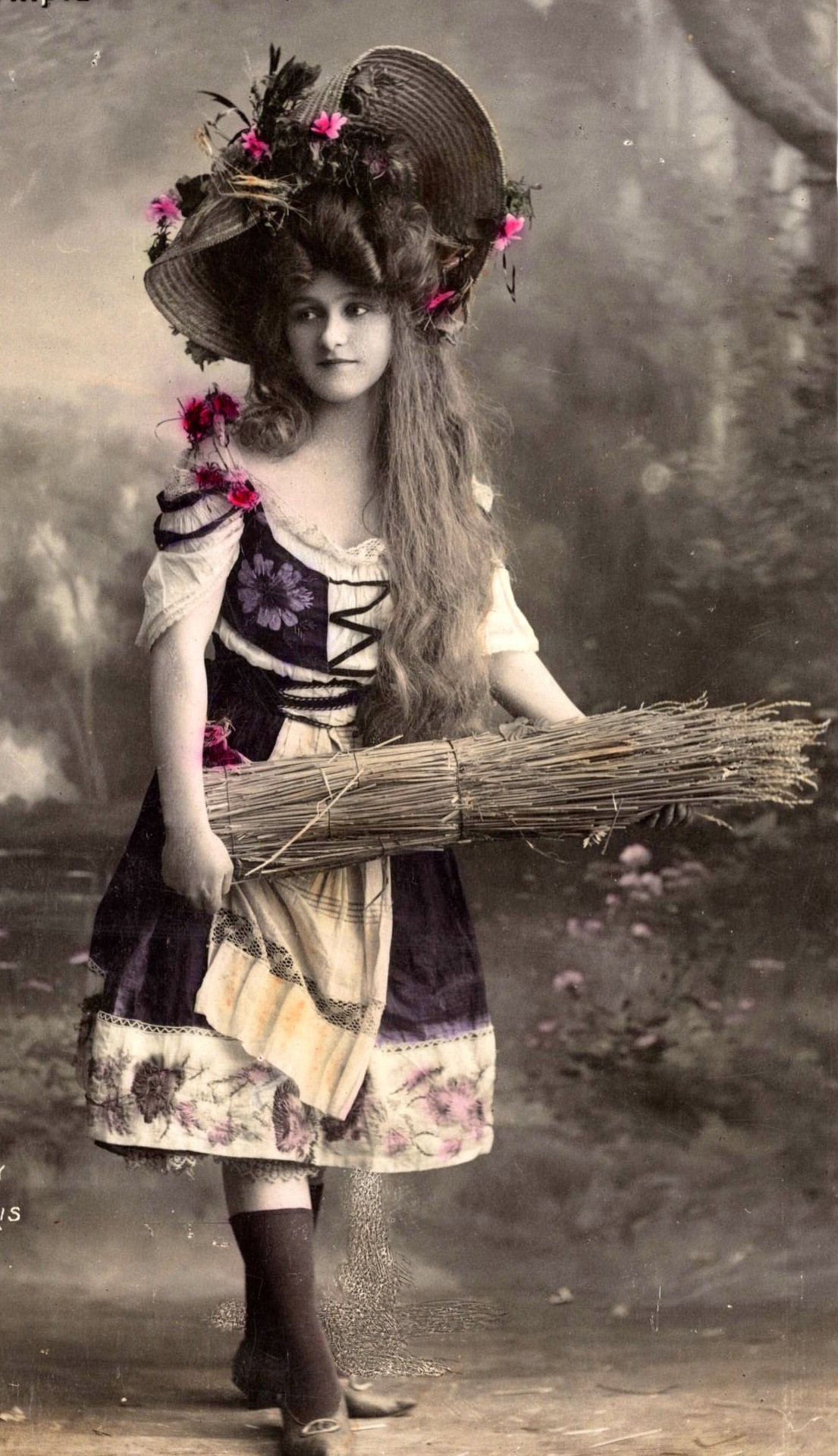
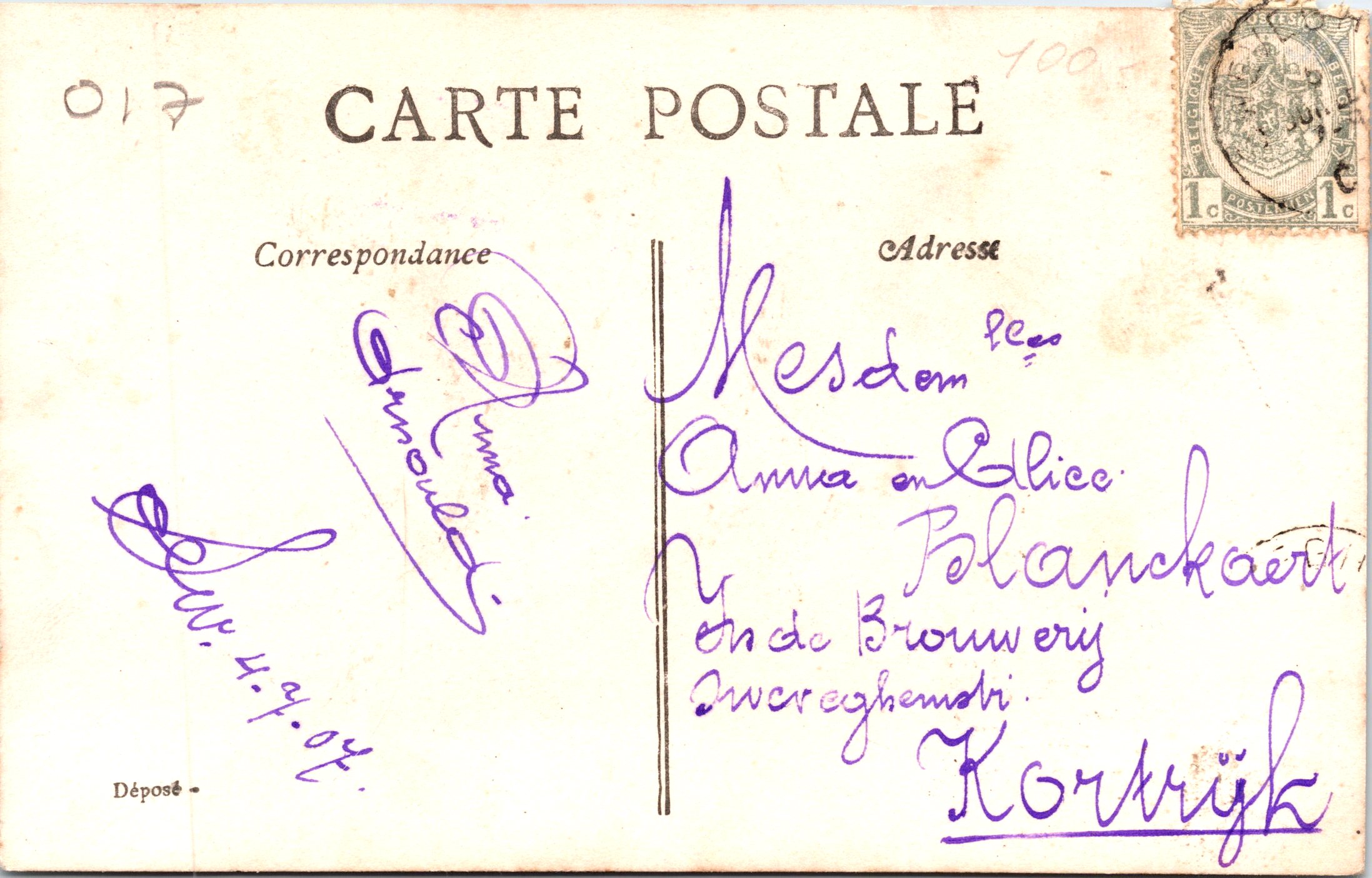
This is a rare and beautiful hand-tinted theatrical postcard featuring the performer Jenny Black, photographed by Walery of Paris, one of the most celebrated society and theatrical photographers of the Belle Époque. In the upper left corner of the image appears the word “Olympia,” referring to the famous Olympia Theatre in Paris, the legendary music hall founded in 1888 by Joseph Oller, which became one of Europe’s premier venues for revue, operetta, and variety performers. The association with the Paris Olympia situates this image firmly within the vibrant theatrical culture of early twentieth-century France. Jenny Black is depicted in a charming pastoral costume, suggestive of a stage role. She stands in a studio setting designed to evoke the countryside, holding a bundled sheaf of wheat in her arms, perhaps portraying a rustic maiden or harvest girl in a musical or operetta production. Her elaborate wide-brimmed hat is richly adorned with feathers and hand-applied pink floral accents, which are delicately tinted along with the flowers on her bodice and skirt. Her long flowing hair cascades over one shoulder, and she gazes slightly off to the side with a soft, composed expression. The costume itself is highly decorative — a dark bodice with floral detailing, light puffed sleeves, corset lacing at the front, and a patterned hemline. The careful hand coloring adds warmth and dimension, particularly to the flowers and subtle blush tones.The photographer, Walery (a studio name used by the Walerian family of photographers and later by successors), was known for producing high-quality theatrical portrait postcards during the height of the postcard collecting craze. At the lower right appears the publisher’s monogram “E.L.D.” with decorative framing, which corresponds to the Paris publisher Ernest Le Deley, a firm active in the early 1900s that issued many theatrical and glamour portrait cards. The card is numbered “2003” which suggests it is part of a series. The postcard bears a Belgian 1 centime stamp with a circular cancellation. The handwritten date reads 1907. The cards condition is very good for age, with light corner wear. The hand-tinting remains attractive and well preserved. The reverse shows typical aging and postal cancellation, but remains clean and fully legible (see scans). This is a striking Belle Époque theatrical portrait from one of Paris’s most important stages with the artistry of Walery’s studio and the glamour of the Olympia Theatre.
This vintage postcard is available for purchase at my store, The History Peddler, for $24.00
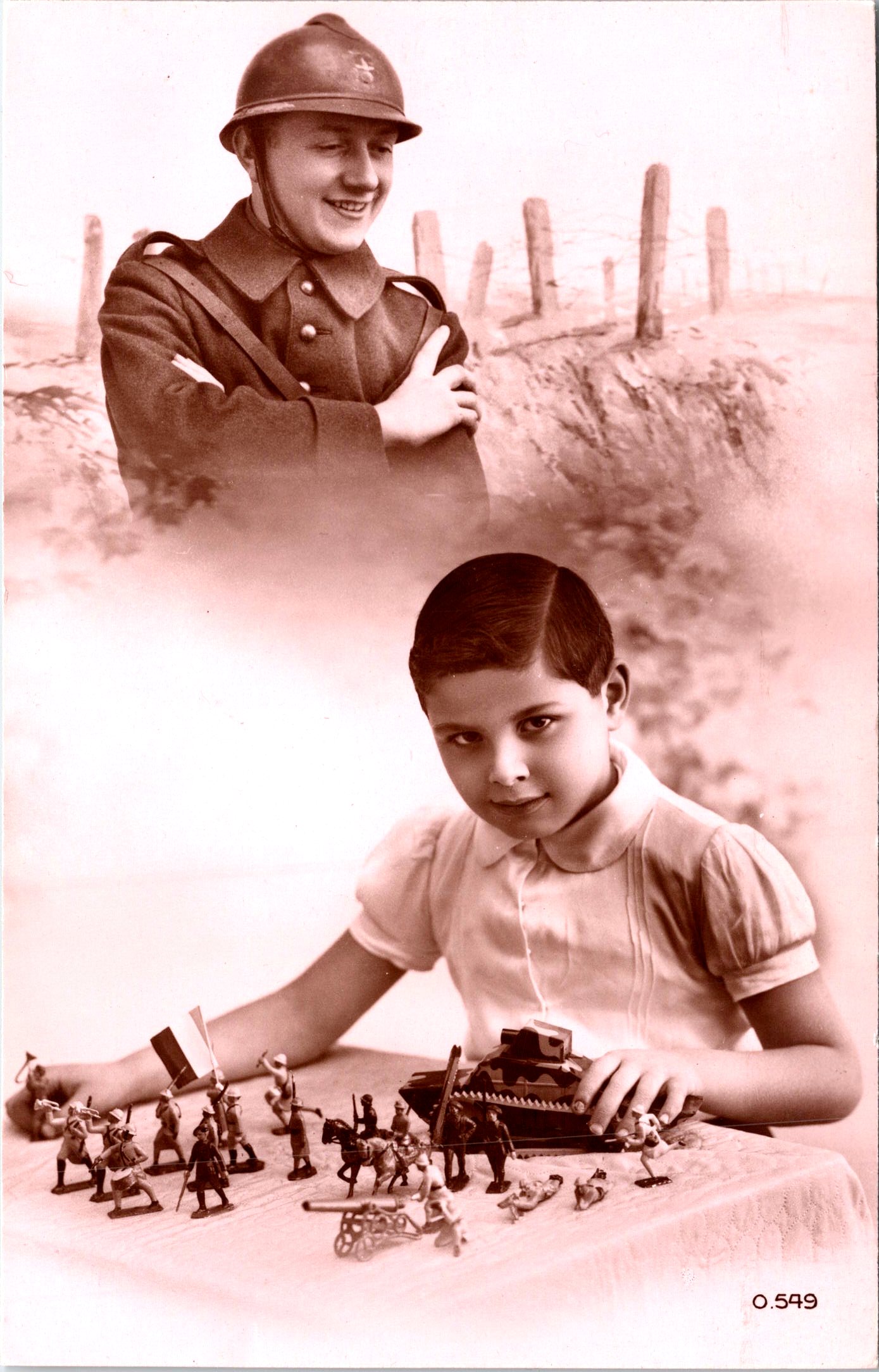
These vintage real photo postcards extol the glory of war. We see images of a cute little boy playing with his toy soldiers. Above him, we see an image of a smiling World War I soldier looking down on the young lad. Perhaps these photographs can be interpreted as a soldier at war fondly remembering his days playing with toy soldiers. A second interpretation may be that a little boy is fantasizing fighting in a “real war” while he is playing with his militaristic toys. It is clear that these photo postcards were aimed to stimulate feelings of patriotism during a time of war. Many generations of young boys have had a skewed view of war. Fighting wars has been viewed as glorious and exciting. One teenager once told me that he didn’t want to live his life without having the experience of going to war. When these young boys (and in present times….girls) grow up and become participants in warfare, they realize that the fantasy is nothing like the reality. These postcards are an example of propaganda meant to garner support for France, it’s policies, and it’s troops. These postcards were published in France and are part of a series (0 549). (ALL THREE POSTCARDS SOLD)
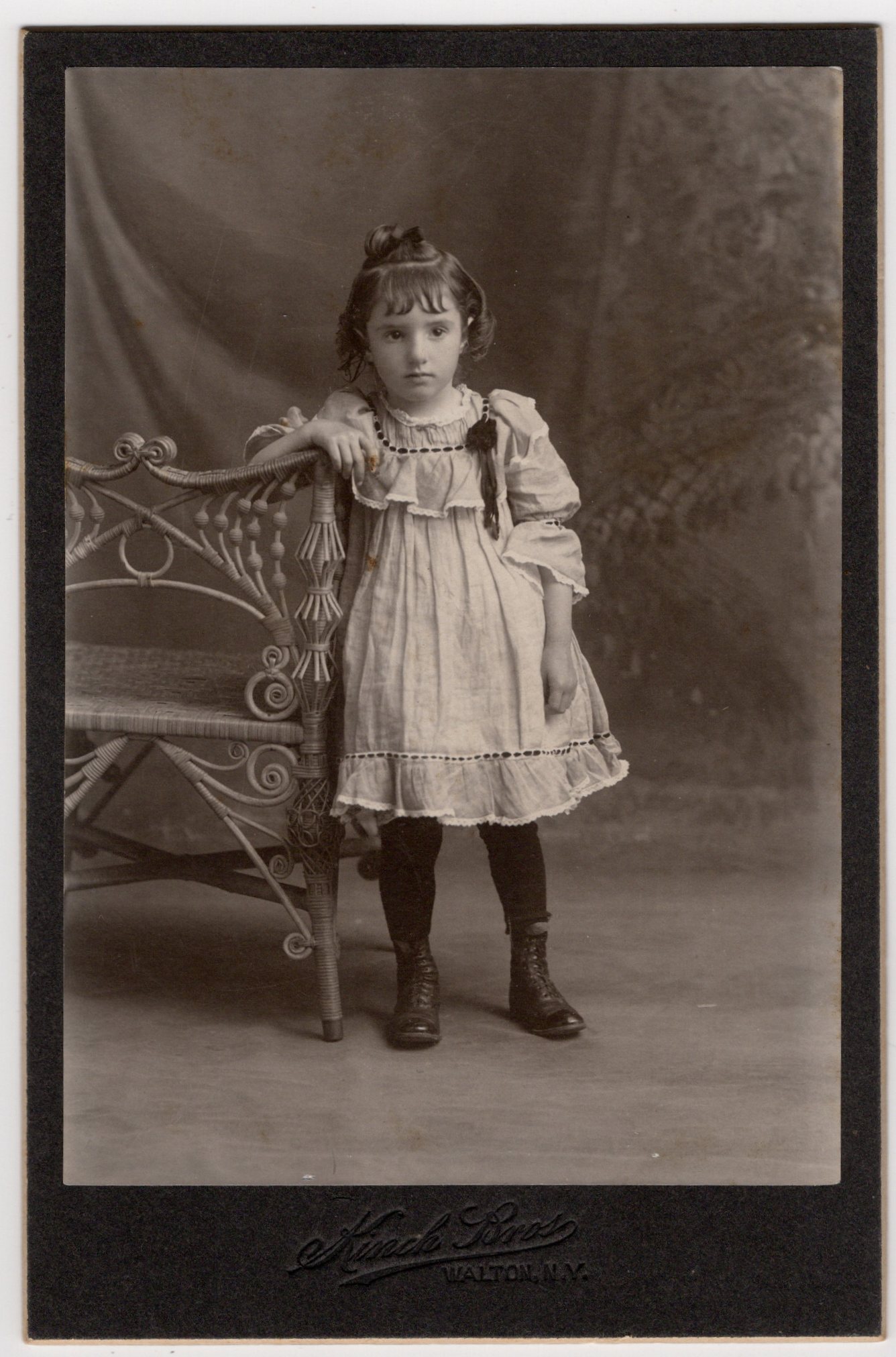
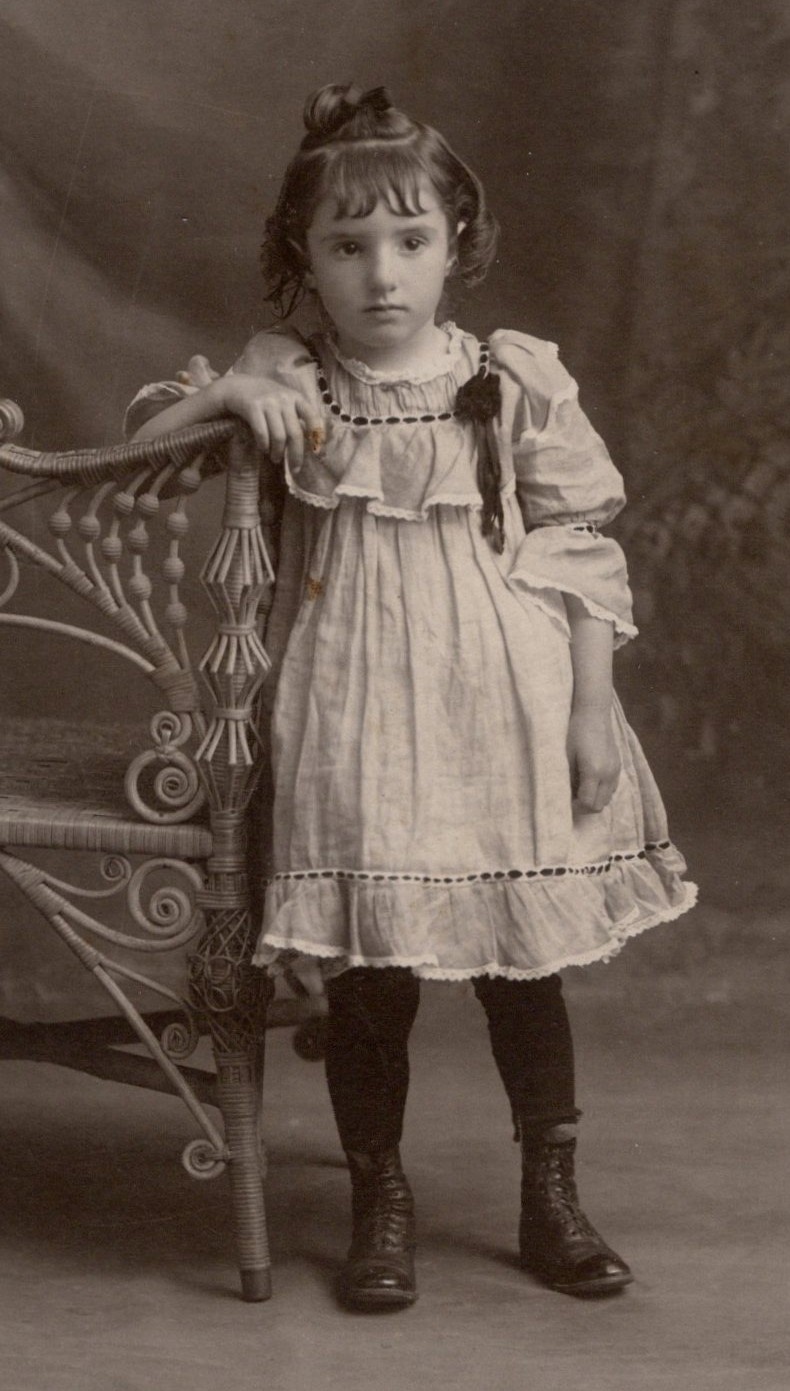
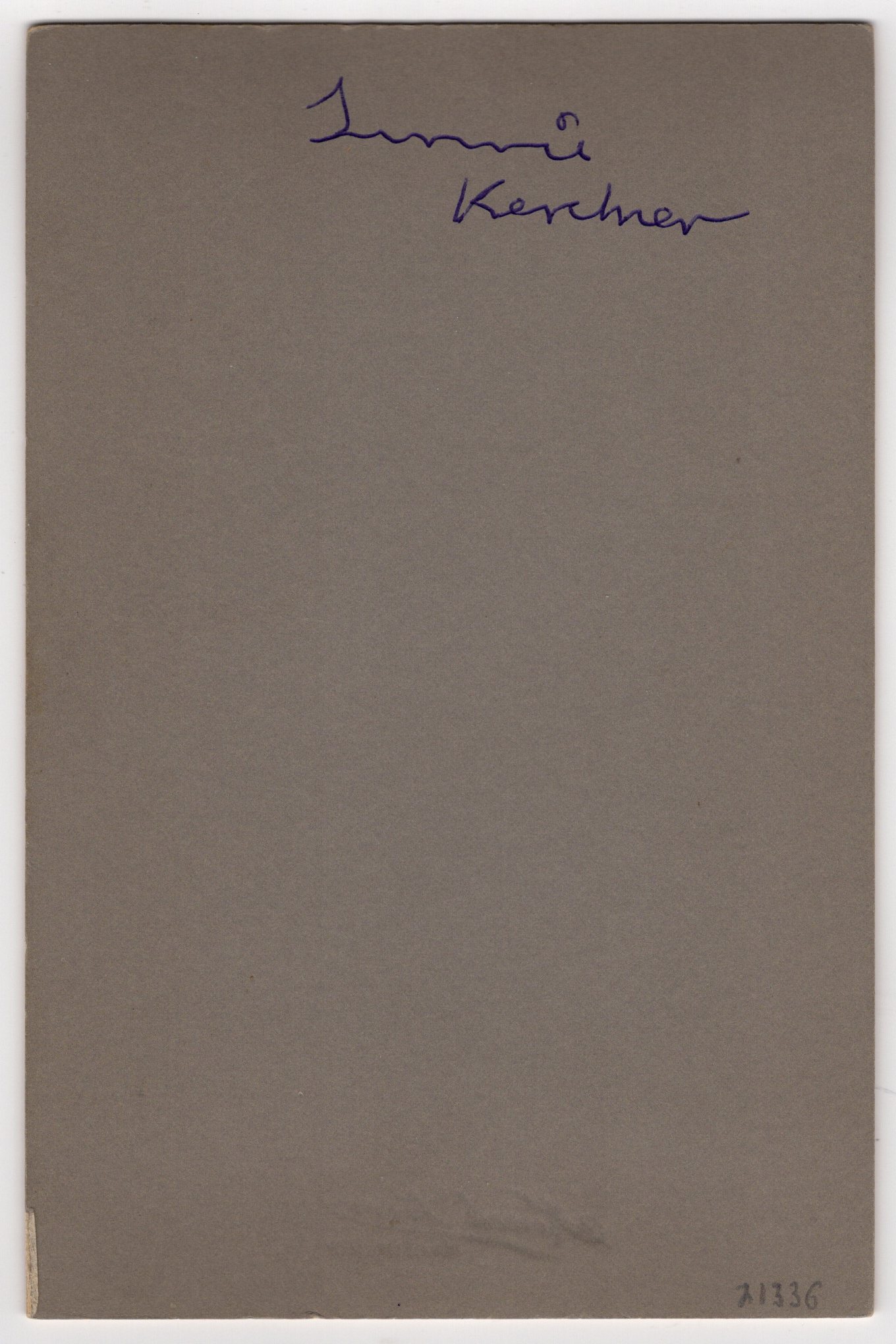
This photograph is a lovely antique cabinet card studio portrait of a young girl, photographed by Kinch Bros., Walton, New York — one of Delaware County’s most established and long-operating photographic studios. The little girl stands beside an ornate wicker settee, resting one arm across its curved and intricately woven back. The wicker furniture, with its scrollwork and turned spindles, is a beautiful example of late-19th-century studio props. She wears a light dress with ruffled trim and dark decorative accents at the neckline and sleeves, paired with dark stockings and lace-up boots. Her hair is styled with short bangs and gathered at the crown, and she looks directly at the camera with a composed, slightly solemn expression so characteristic of formal turn-of-the-century portraiture. The image has strong clarity and pleasing tonal contrast. The mount is embossed at the lower margin with the studio’s name and location. The Kinch Brothers studio was an important part of Walton’s commercial and social history. Harvey J. Kinch operated under his own name circa 1894–1899, having apparently purchased the studio of Frank L. Sprague. Around 1899, his brother, Edgar Kinch, joined him, and the firm became Kinch Brothers. The brothers operated studios in Walton and Hancock, documenting Delaware County families for more than three decades. The Walton studio burned in July 1935, after which Harvey retired. Edgar continued briefly under the name “Kinch Studio” until his death in 1939. Harvey and Edgar were sons of Nathan Kinch, a prominent Walton businessman and Civil War enlistee (101st N.Y. Volunteers). Given the mount style and studio imprint, this cabinet card likely dates from circa 1899–1910, during the early Kinch Brothers partnership. The reverse bears a handwritten name which, in my reading, appears to be “Jennie Kerchner” (interpretation based on legibility; handwriting can vary). This cabinet card is in very good overall condition for it’s age. The mount remains firm and attractive (see scans). This is a wonderful example of small-town New York photography with strong Delaware County provenance and an appealing period child portrait.
This vintage postcard is available for purchase at my store, The History Peddler, for $24.00
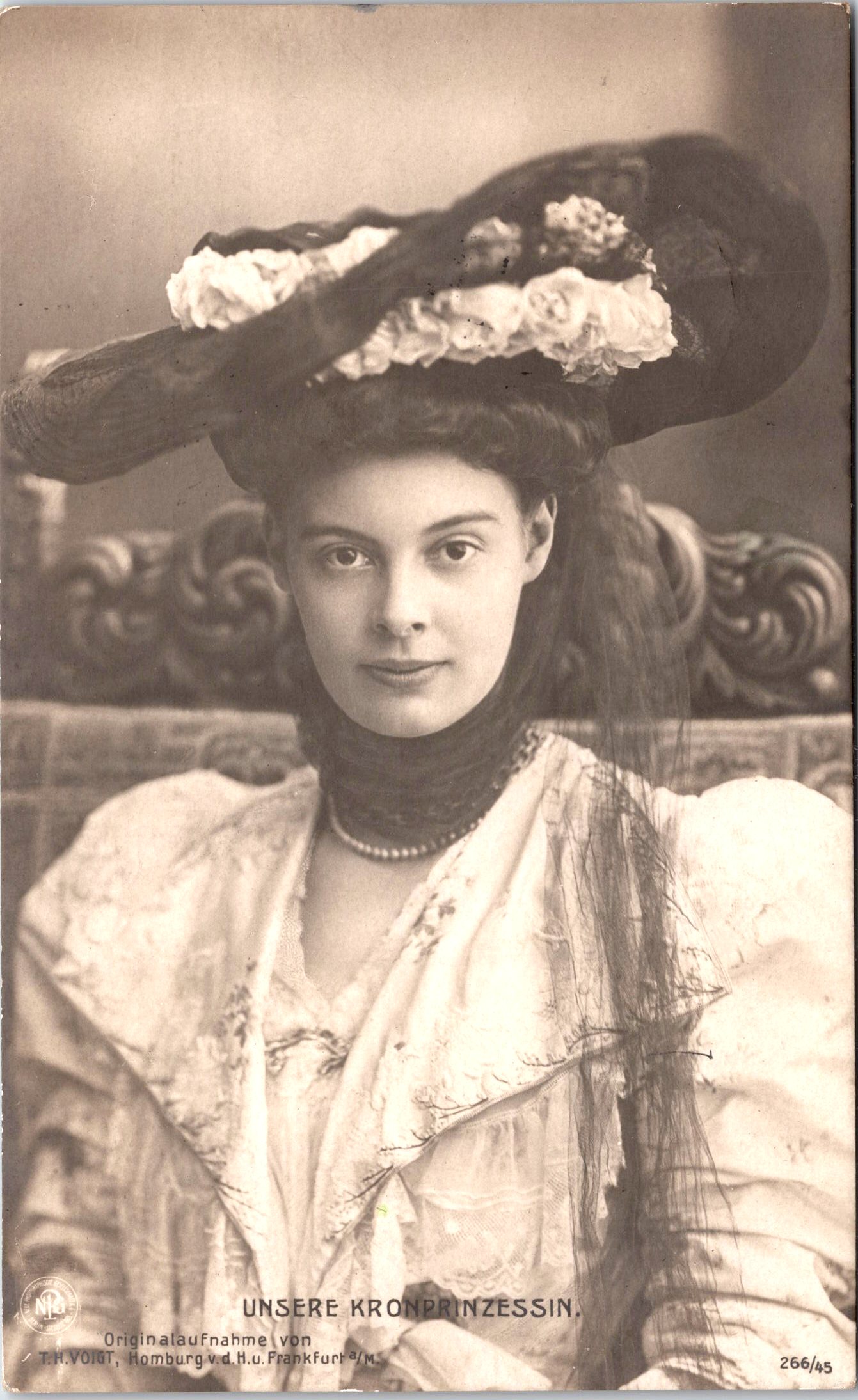
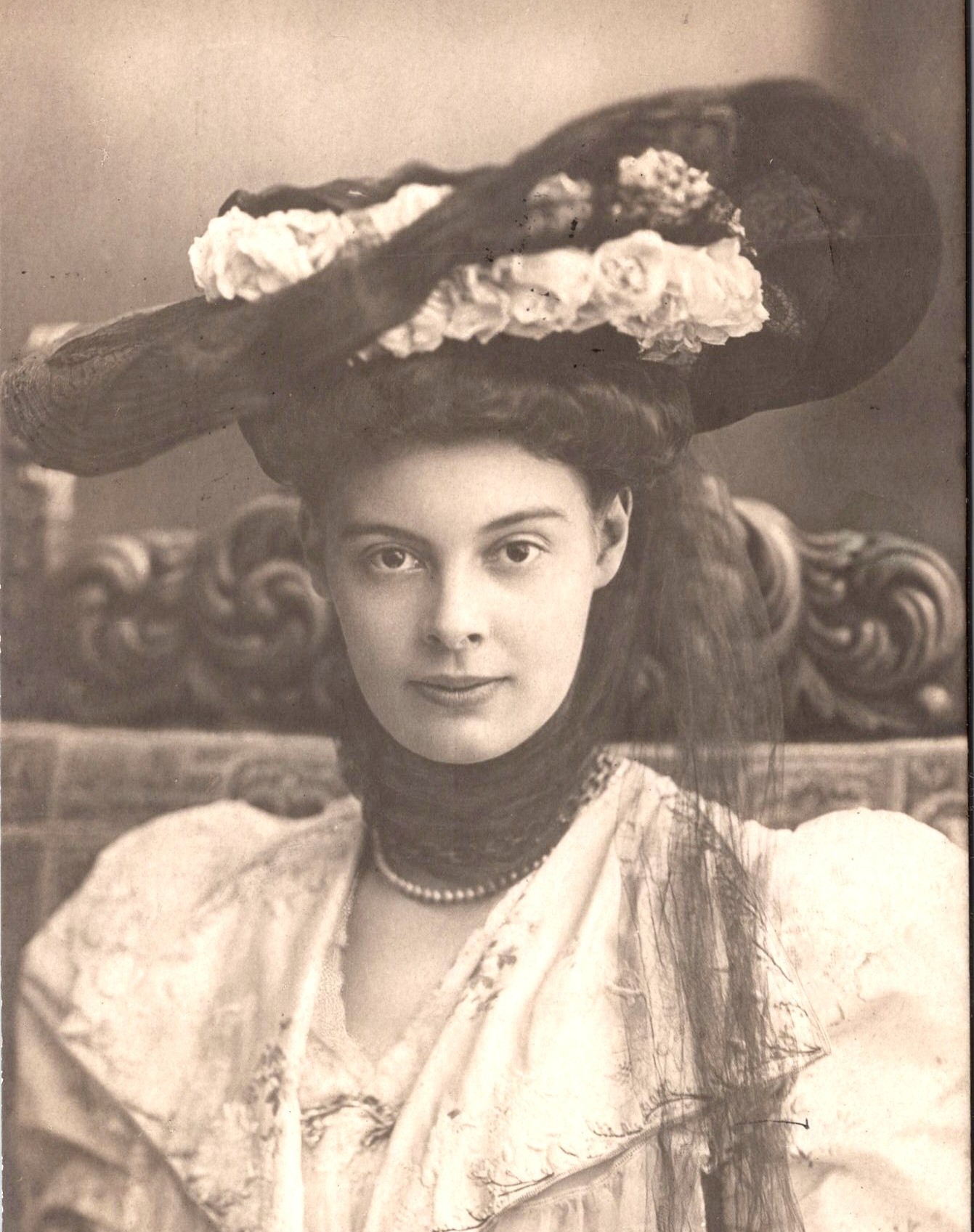
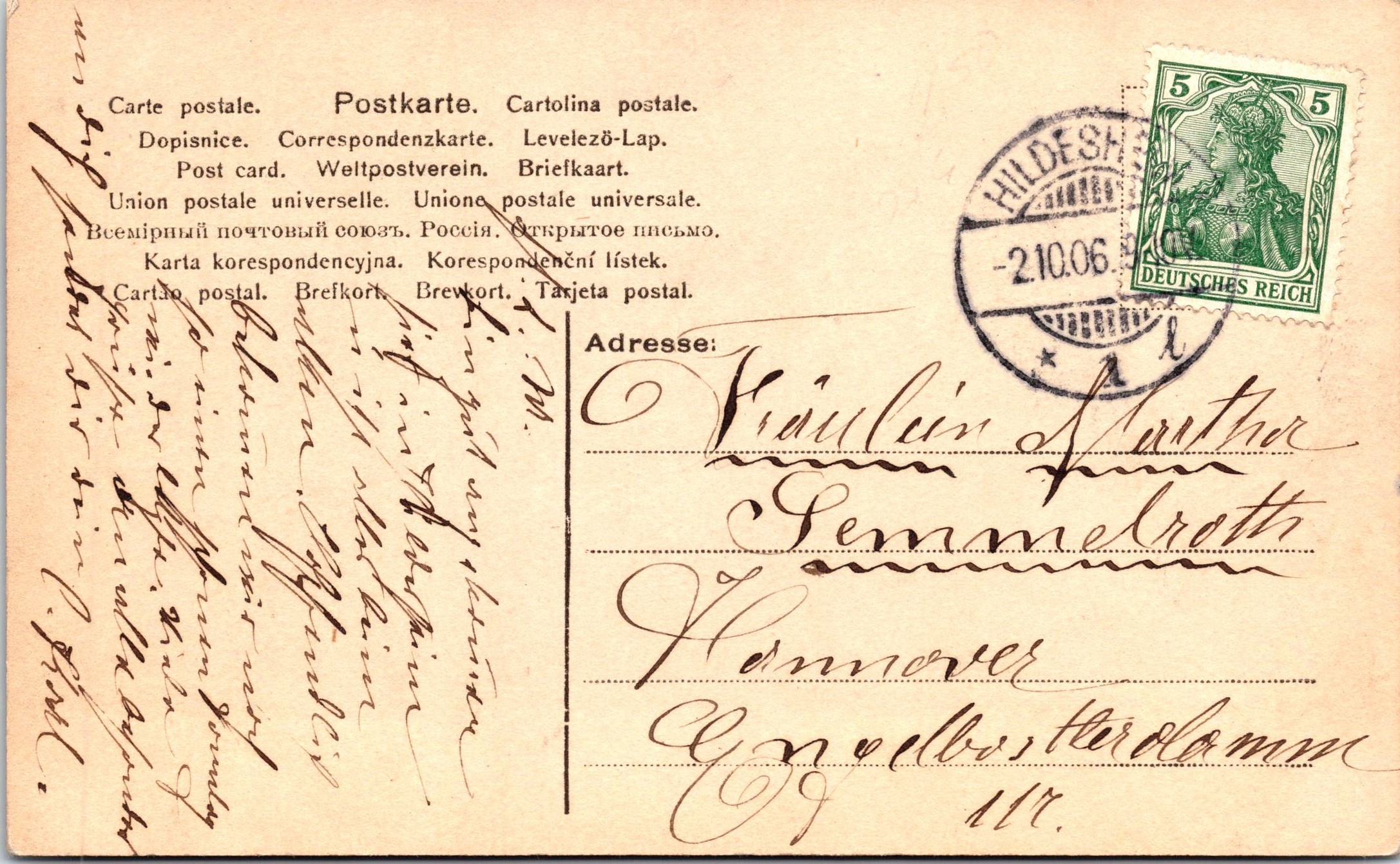
Crown Princess Cecilie of Prussia (1886–1954) was a prominent royal figure in early 20th-century Germany. She was the daughter of Frederick Francis III, Grand Duke of Mecklenburg-Schwerin, and Grand Duchess Anastasia Mikhailovna of Russia, making her a granddaughter of Emperor Nicholas I of Russia. Cecilie came from a highly prestigious lineage that united German and Russian imperial bloodlines. In 1905, she married German Crown Prince Wilhelm (Wilhelm of Prussia (1882–1951), the eldest son of Kaiser Wilhelm II, Emperor of Germany and King of Prussia. As the wife of the Crown Prince, Cecilie held the title of German Crown Princess and was seen as the future Empress of Germany. However, the German monarchy was overthrown in 1918 at the end of World War I, and the family went into exile. Wilhelm never ascended the throne, as the monarchy was abolished with the abdication of his father, Wilhelm II. Cecilie and Wilhelm had six children.Their marriage, while initially harmonious and dutiful, became strained over time due to Wilhelm’s infidelities and political turmoil. Despite no longer being royalty in power, Cecilie remained a respected figure. After the monarchy fell, she lived modestly in Germany and did not follow her husband into exile in the Netherlands. She died in Bad Kissingen, West Germany, in 1954. This real photo postcard is a studio portrait of Crown Princess Cecilie, taken by T.H. Voigt, a photographer based in Homburg v.d.H. and Frankfurt a/M. The publisher number “266/45” appears in the lower right corner, and the “NPG” logo indicates it was part of the Neue Photographische Gesellschaft series—one of the most prestigious photo publishers inImperial Germany. In this beautifully lit and softly focused portrait, Crown Princess Cecilie sits regally, gazing directly at the camera with serene confidence. Her expression is calm and composed, projecting the quiet dignity expected of a royal consort. She wears a sumptuous white or light-colored gown, richly embroidered with floral motifs and delicate lace details. Around her neck is a strand of pearls, and an elegant dark scarf or netting is wrapped gracefully around her collar and beneath her chin. Her wide-brimmed hat, adorned with layers of flowers and lace, is spectacular—an extravagant Edwardian fashion statement in keeping with her status. Her long hair is styled in a voluminous updo beneath the hat. The combination of textures—lace, netting, silk, and pearls—exudes both softness and formality, symbolic of her royal role. The postcard is addressed to a woman residing in Hanover, Germany and the card is postmarked in 1906 in Hildesheim, Germany. Cecilie had been a princess for just a short time when this photo was taken. The stamp on the card is a 5 Pfennig green stamp bearing the image of Germania, a common stamp of the Deutsches Reich (German Empire), designed by Paul Eduard Waldraff and issued between 1900–1922. The cursive German message on the left margin is difficult to fully decipher, but it appears to be a friendly greeting. (SOLD)
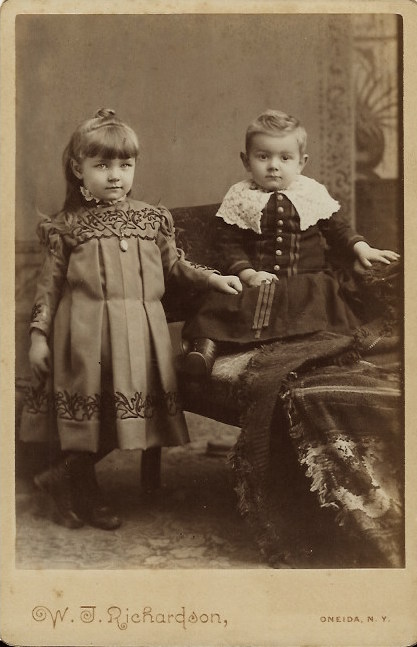
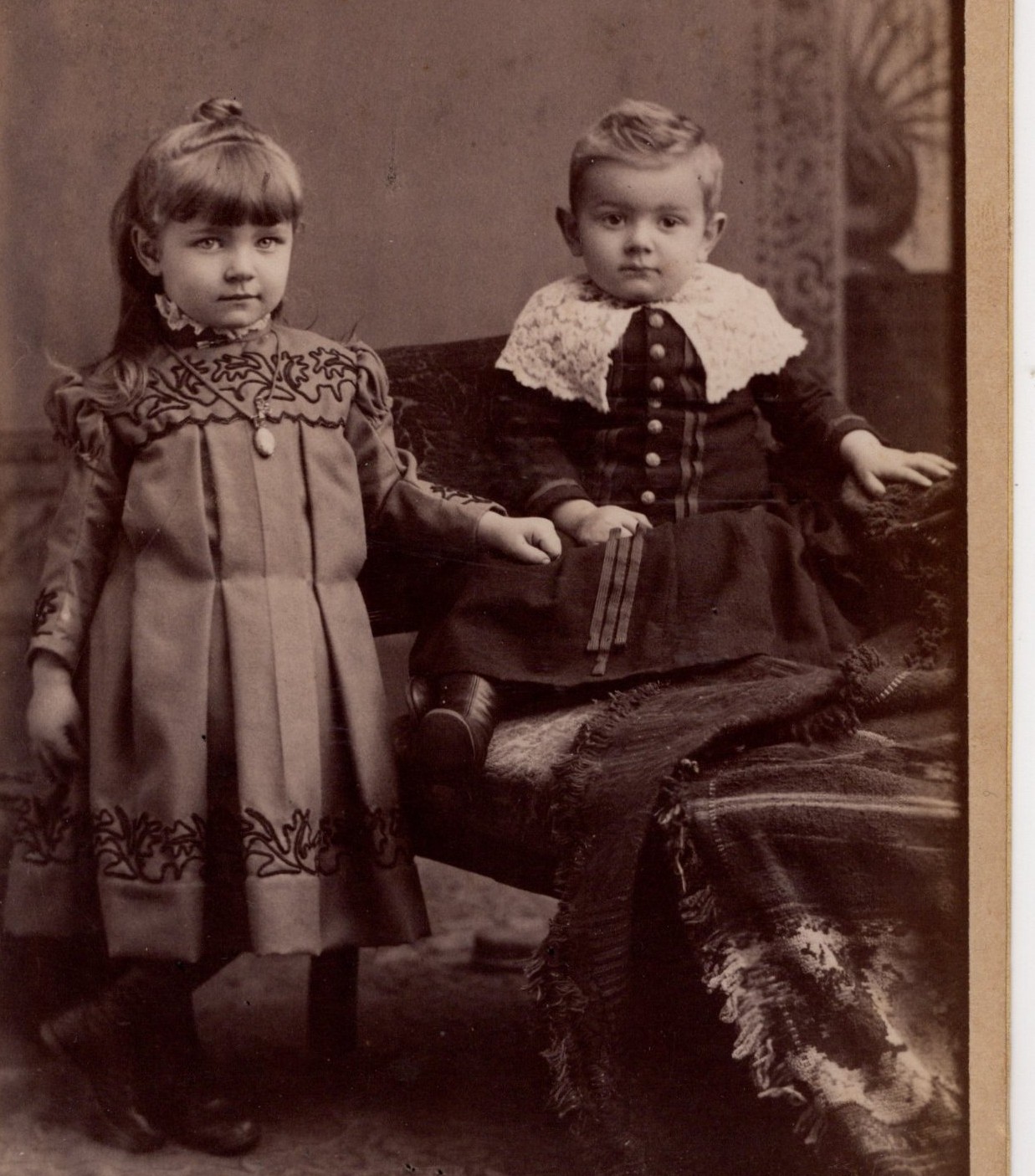
This charming late nineteenth-century cabinet card was photographed by W.J. Richardson of Oneida, New York, and depicts a beautifully dressed young girl standing beside a seated toddler boy in a carefully arranged studio interior. The girl wears her hair in long braids and is adorned with decorative buttons or breast ornaments that add visual interest to her otherwise modest Victorian dress. She stands confidently, her posture poised and composed. She is adorable. Beside her, the younger boy sits with a softer, slightly tentative expression, creating a lovely contrast between sibling composure and childhood vulnerability. The “big sister” seems to be assuming a protective posture in relationship to her sibling. Both children share pleasant smiles. The careful posing, the understated backdrop, and the children’s clothing all reflect the aesthetic sensibilities of the 1880s–1890s, when cabinet cards were at the height of their popularity. The mount style and photographic tone strongly suggest a date in the late 1880s to early 1890s. The image retains strong contrast with tonal depth. There is light, even age toning consistent with photographs of this period. The mount shows gently rounded corners, and the cabinet card remains solid and structurally sound. The cabinet card has gold beveled edges which are in good condition. Overall, the card presents in very good antique condition and displays beautifully (see scans).
This cabinet card is available for purchase at my store, The History Peddler, for $35.00


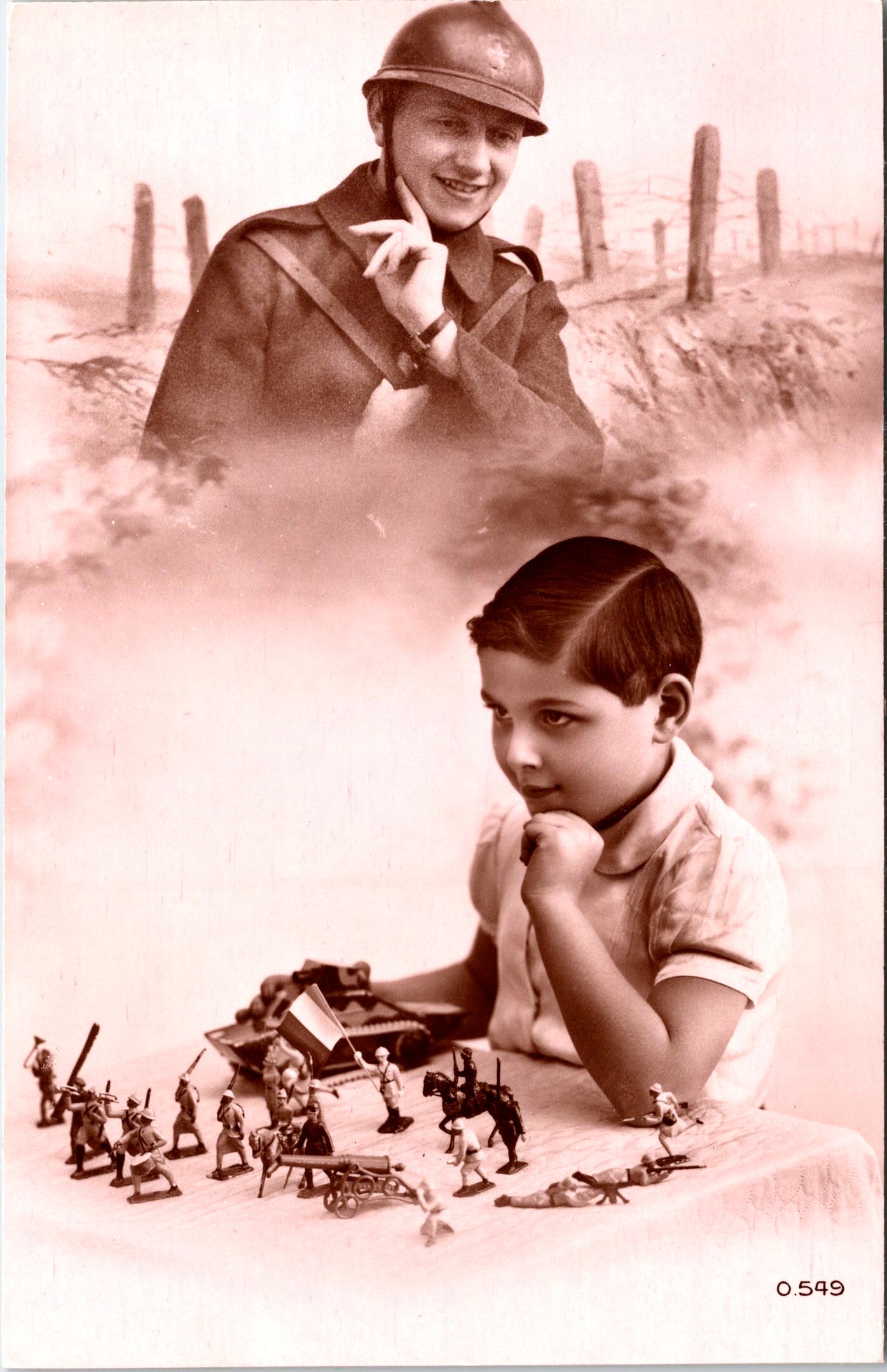
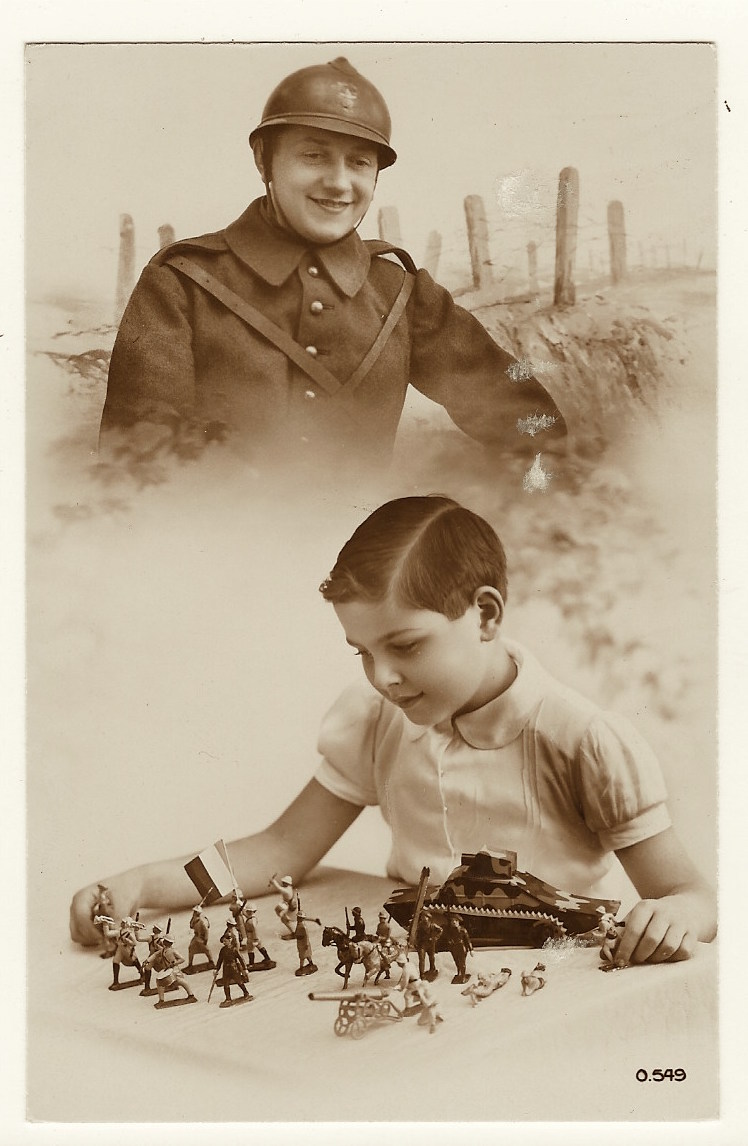 POSTCARD 2 (SOLD)