This cabinet card features three precious little children wearing adorable outfits. The child in the center of the image is holding a rake and wearing a large bow tie and a straw hat. The two girls are flanking the little boy in the middle and each girl is holding their hat. There is a basket of flowers on the floor in front of the trio of children. The photographer of this image is the Mathison studio in Tekamah, Nebraska. Ingbert L. Mathison (1868-1935) was born in Denmark in 1868. He came to America with his parents at the age of 2. He grew up in Iowa and came to Tekamah, Nebraska in 1891. He became a photographer and later added furniture sales to his business. The 1900 US census reveals that Mathison was married to Grace Theodoria Christy (1870-1902) and the couple had four children between the ages of 3 and 9. Two years after this census, Grace died, leaving Ingbert with four young children. Ingbert soon got remarried. His new bride was Mary Etta Slaughter (1873-1939). The Mathison family then moved to a community outside of Denver, Colorado. Ingbert worked as a farmer, and later, a grocer, in Colorado. He died in a Denver hospital in 1935 at the age of 67. The cause of death was hemorrhages of the stomach.
THIRTEEN TEENAGE GIRLS POSE AT PAJAMA PARTY? STAGE PRODUCTION? WEDDING? (DECIDE FOR YOURSELF)
What is happening in this unusual and interesting cabinet card photograph? Your guess is as good as mine. There are thirteen teenage girls in this image who seem to be celebrating something. The girl in the center of the photograph is wearing a crown or veil and is flanked by two girls pressing their hands up against each other as if to create a steeple.. Are they holding a train of a dress? The girl in the bottom row, second to the right, is also holding something, but what is it? Too many questions, and too few answers. Note the girls hairstyles, or lack of hair styles. Long and disheveled hair seems to be the fashion in this photograph. Do you think that this photograph captures a stage production? A Pajama Party? A Wedding? What is your best guess? This photograph was produced by the Bailey studio located at 86 North Third Street, in Columbia, Pennsylvania. Most likely, the photographer of this photograph is William Bailey (born about 1854). At some point in his career he operated a studio in Columbia. His father David Bailey (born about 1830) and his brother (born about 1861) were also both photographers. The 1880 census finds all three of these men living in Tamaqua, Pennsylvania which is located about 80 miles from Columbia. To view other photographs by William Bailey, click on the category “Photographer: Bailey”.
MEET THE HERSHEY FAMILY OF LANCASTER, PENNSYLVANIA
I remember the excitement that I felt shortly after purchasing this photograph. I had flipped the photograph over to the reverse side and found an inscription which identified the three subjects in the photograph. The three names were “Harry E. Hershey, Dora E. Hershey” and “Frances Mayer Hershey”. The photograph was dated “1907”. Seeing the “Hershey” name, and noting that the photograph was from a studio in Lancaster, Pennsylvania made me think that the subjects of this photograph could be quite interesting. The Hershey family is quite important in the history of Lancaster, Pennsylvania. Think Hershey Chocolate! I knew that the founder of Hershey Chocolate was Milton Hershey but I thought perhaps that Harry E. Hershey may have been an integral part of the business, or in some of the family’s other enterprises. Research found no such connection between Harry or Milton. The 1880 census found Harry Elmer Hershey (1863-1911) at age 16 living with four older siblings and his parents (Jacob and Annie Hershey) in East Hempfield, Lancaster County, Pennsylvania. The 1900 census listed the 36 year old Harry as married to 30 year old Dora Elizabeth Mayer Hershey (1870-1924). They were newlyweds having been married just three months. Harry, Dora, and both sets of their parents were all born in Pennsylvania. Harry was listed as working as a treasurer of a hardware company. A number of business directories between 1888 and 1907 reveal that he worked in this position for many years. The 1910 United States census adds 8 year old daughter Frances Mayer Hershey (1902-1994) to the family unit. The 1920 census indicates that 17 year old Frances and her mother lived together and both were unemployed. Harry had been dead for nine years. This Hershey family portrait features a well dressed family. Harry and Dora are both smiling, and cute little five year-old Frances’s body language seems to be saying, “Hey, don’t forget about me”. The photographer is the Miesse studio in Lancaster, Pennsylvania. D. Walter Miesse (1878-1964) had a studio at 24 West King Street in Lancaster between 1894 and 1940.
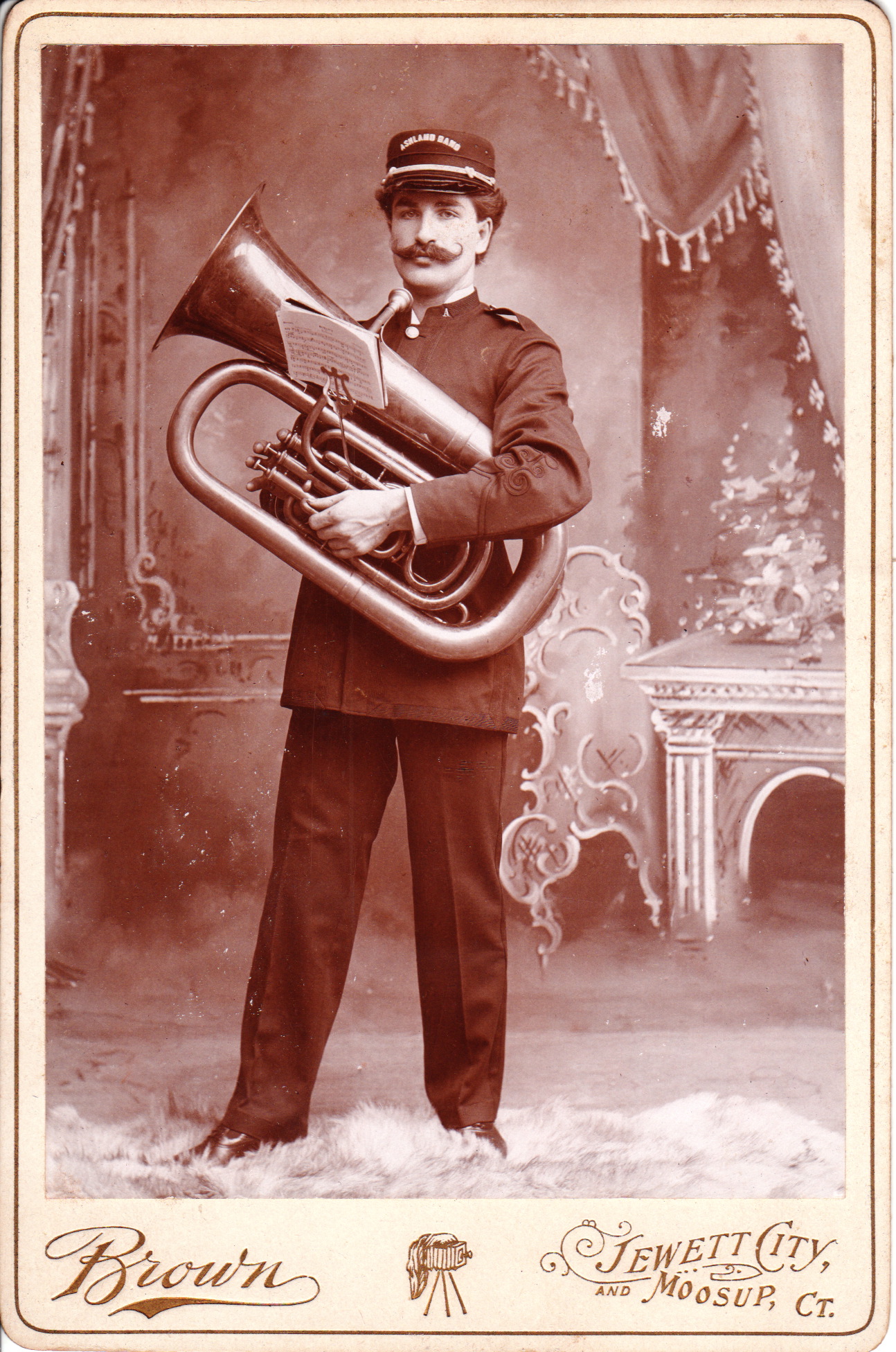
UNIFORMED BAND MEMBER AND HIS TUBA IN JEWETT CITY, CONNECTICUT
This cabinet card features a uniformed band member and his tuba. At least I think it is a tuba but I would appreciate some confirmation from a cabinet card visitor well versed in identifying musical instruments. Note the sheet music clipped to his brass instrument The musician has a terrific handlebar mustache and his cap indicates that he is a member of the “Ashland Band”. This image was produced by the Brown studio in Jewett City as well as Moosup, Connecticut. Jewett City is a borough in the town of Griswold and Moosup is located in the town of Plainfield. Jewett City and Moosup are 12 miles apart. To drive from Jewett City to Moosup, one starts off on Ashland Street. I wonder if the “Ashland Band” is related to “Ashland Street”? Research reveals that the photographer William H. Brown was born in Packerville, Connecticut in 1853. His father was an overseer in the local mill. Brown was educated in public schools and his first job was as a store clerk. After three years of working in the store, he bought it and ran it for four years until he sold it. He then went back to work as a store clerk but bought a camera and for fun, photographed his friends and others during off hours. In a short time, it was clear that Brown had much talent in the area of photography. In about 1888 he opened a photography business. He had studios in Dayville and Wauregan. Later he opened galleries in Jewett City, Taftville and Moosup. Brown was married in 1874 to Miss Lillian Bennett and the couple had two daughters, Lillian and Alice.
PRETTY AUNT MARTHA DISCOVERS LEAVES ON STEROIDS IN CHICAGO, ILLINOIS
According to an inscription on the reverse of this cabinet card, the pretty woman featured in this cabinet card photograph is “Aunt Martha’. She is wearing a ring on her right index finger and is also wearing a hair bow. Aunt Martha poses for this photograph while standing at the proverbial garden wall. Note the giant leaves atop the post of the wall. The Taylor & Martin studio produced this photograph. The studio was located in Chicago, Illinois.
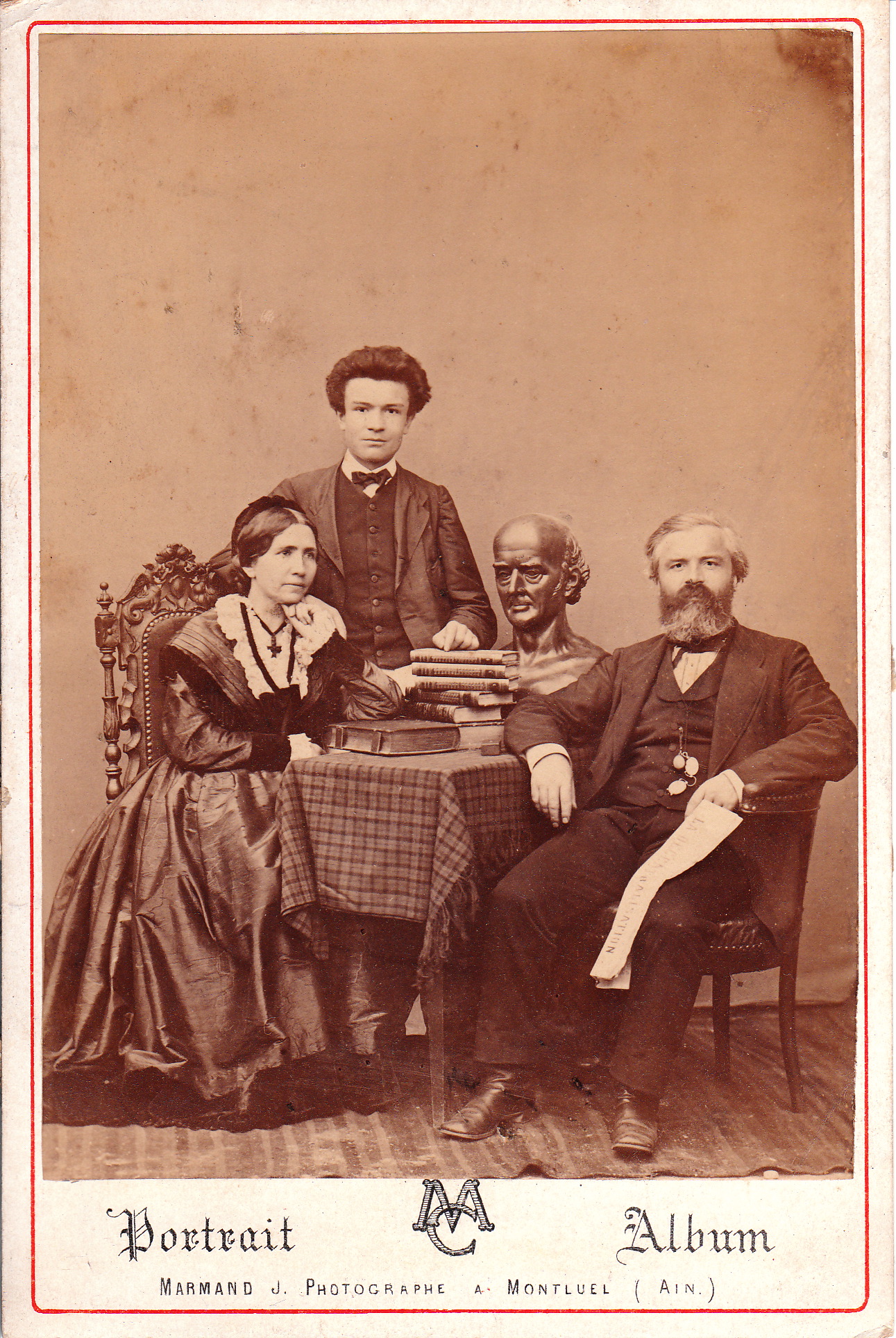
INTELLECTUAL FAMILY IN MONTLUEL, FRANCE DISCUSSES POLITICAL MATTERS
Photographer J. Marmand produced this cabinet card photograph of an intellectual family in Montluel, France. Montluel is in eastern France on the outskirts of Lyon. This appears to be an early cabinet card from the 1870’s. The father in this image is holding a newspaper or magazine with a headline that appears to say “La Decentralisation”. This refers to a system of government in which power is exercised by both the state and it’s communities or institutions. The mother in this portrait is displaying a “thinking pose”. The father has no need to pose; he naturally has the appearance of an intellectual. The couple’s son is well dressed and well groomed and looks very serious and mature. Note the pile of books and the bust on the table. These props add to the scholarly climate portrayed in this photograph.
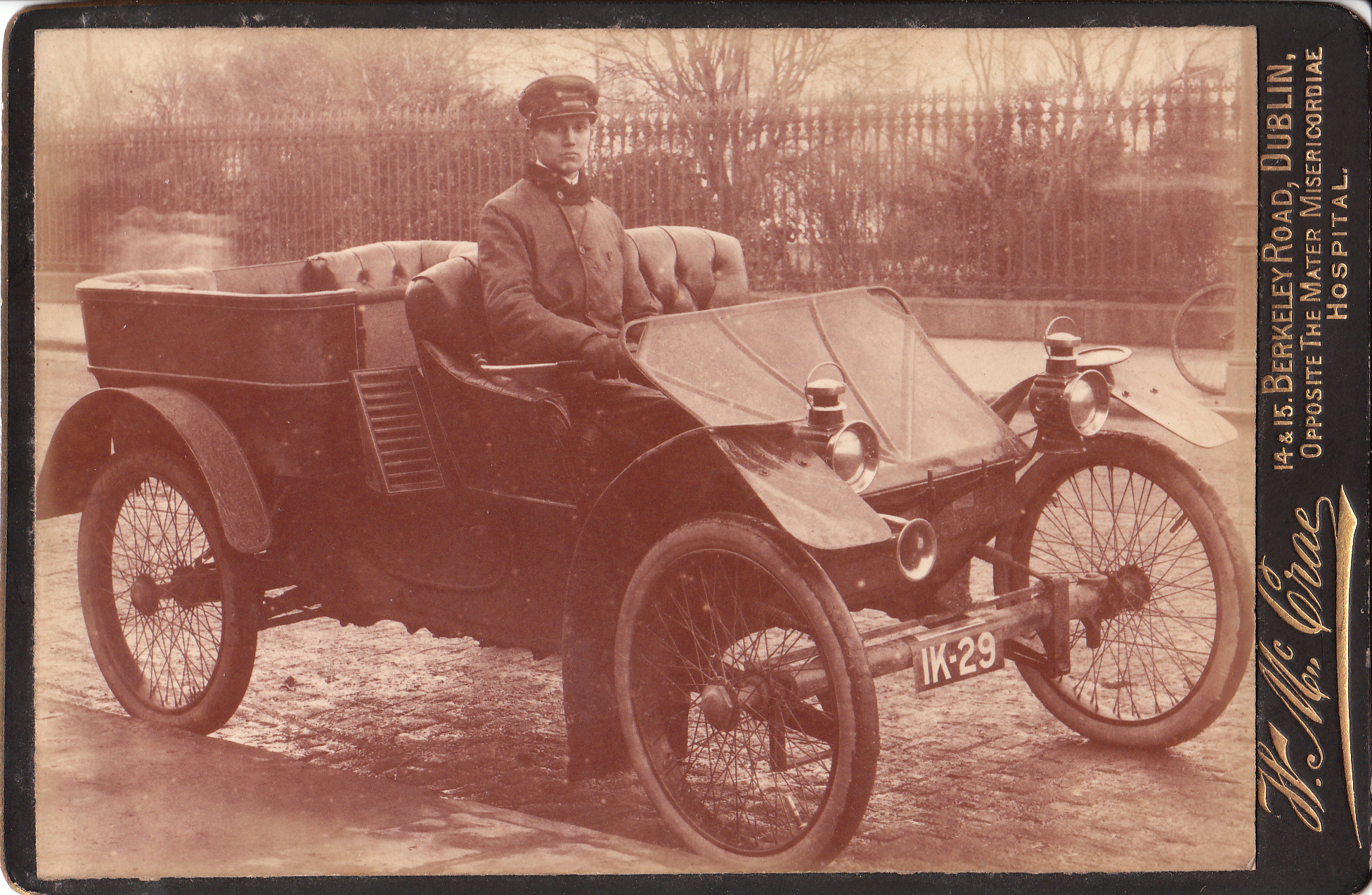
EARLY MOTOR CAR AND CHAUFFEUR IN DUBLIN, IRELAND
This unusual cabinet card is by William McCrae, art photographer located at Berkeley Road in Dublin, Ireland. His studio was opposite the Mater hospital. He was formerly located at Lafayette. This image features an early motor car and chauffeur. The previous owner of the photograph asserted that this car’s registration plate (ik-29), indicates that the car was from Dublin and the time of the photograph was sometime after 1904, when registration plates were introduced.
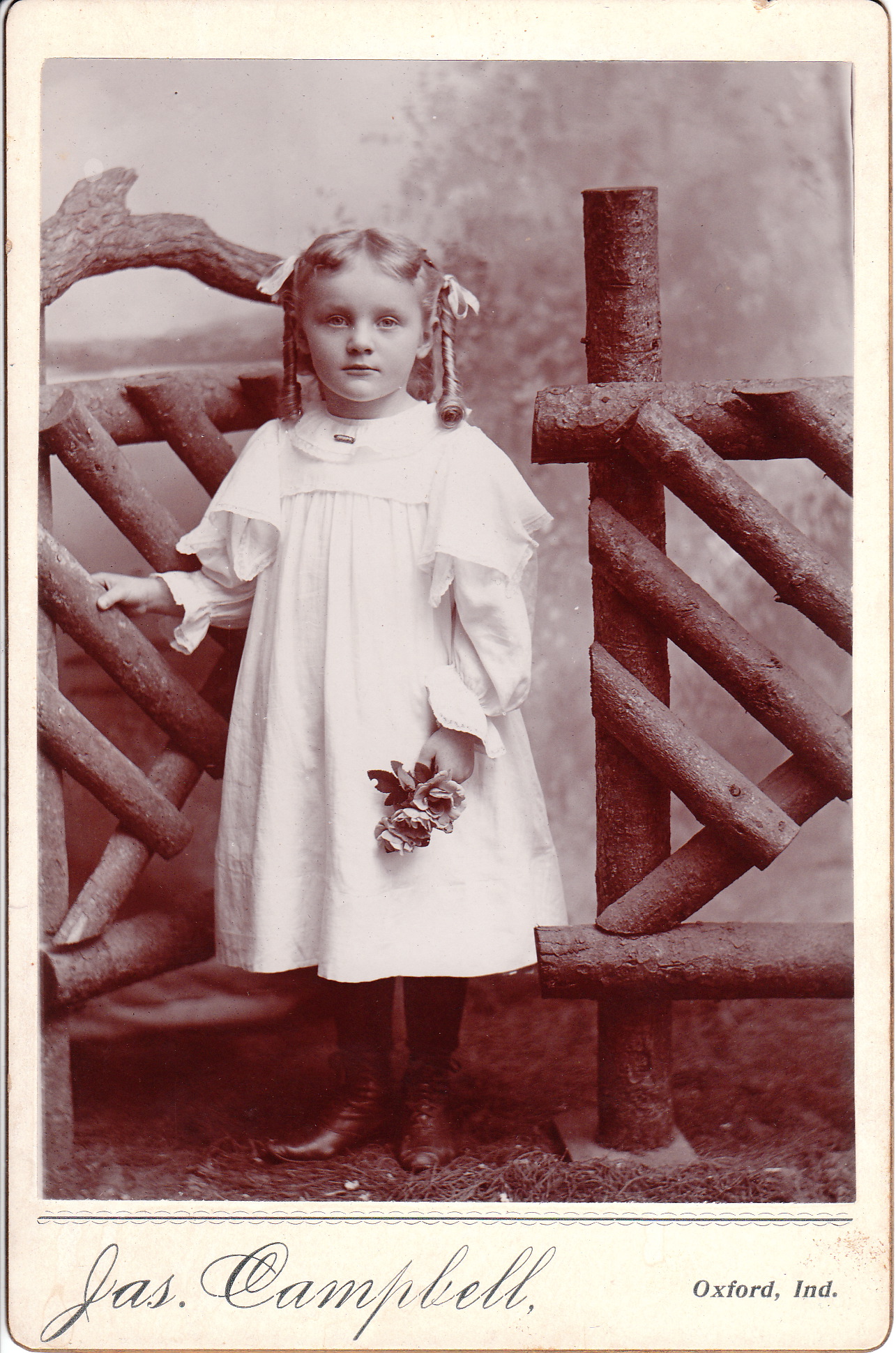
ADORABLE LITTLE GIRL IN OXFORD, INDIANA
An adorable young girl poses by a wooden gate for photographer James Campbell in Oxford, Indiana. The little girl has terrific curls tied by bows and is holding flowers. The photographer of this cabinet card was a civil war veteran. The New History of the Ninety Ninth Indiana Infantry (1900) gives a brief biographical sketch of Campbell along with his photograph. James D. Campbell was born in 1845 in Fayette County, Indiana. He and his parents moved to Oxford in 1854. He was a well respected soldier in the civil war. He was a member of the 99th Indiana Infantry (Company C). He entered and left his regiment as a private. The book reports “He was one of those quiet faithful soldiers; always ready and always willing to do his duty”. His biography also describes him as married but having no children.
DAPPER GENTLEMAN IN JANESVILLE, WISCONSIN (WILLIAM J GRANT)
The dapper gentleman featured in this photograph is identified on the reverse of the cabinet card as William J Grant. Mr. Grant is quite dapper in appearance but it is a bit incongruous that he is standing next to a stack of bales of hay. The photographer’s last name is Tice and his studio was located in Janesville, Wisconsin. The Wisconsin and Minnesota Gazetteer (1865) includes an advertisement for J. A Tice of Janesville. The subject of this photograph, William J. Grant, was born in 1848 in the state of New York. The 1870 US census finds the 22 year old Grant working on the family farm. He lived with his parents, William and Ann Grant (both born in Ireland) and his three sisters Mary (age 28), Elizabeth (age 24) and Euphemia (age 20). The 1880 census reveals that Grant was married but lived without his wife in a boarding house. He worked as a teamster. The 1900 census lists Grant as single and still living in a boarding house. He was employed as a drayman. Drayman? What is a drayman? A drayman is a driver of a dray. Does that help? It didn’t help me, so here is the rest of the story. A dray is a low and flat-bed wagon without sides. The wagon is usually pulled by horses or mules to transport goods.