A pretty light haired woman wearing a nice smile and a corsage, poses for her portrait at the Newman studio in Philadelphia, Pennsylvania. The leaves on the wall post create an autumn scene. Research found little information about photographer Newman. A photographer directory lists A. Newman as a gallery operator between the 1890’s and 1900. To view other photographs by this photographer, click on the category “Photographer: Newman”.
LITTLE GIRL POSES FOR PORTRAIT WITH HER DOLL IN A STROLLER
A little girl poses with her doll and toy stroller at C. B. Long’s Elite Studio. The child has a serious expression highlighted by her pursed lips. She is posed somewhat distant from the camera so she and her doll do not fill much of the image. The backdrop seems to somewhat dominate the photograph. Research yielded little information about C. B. Long other than one article appearing in the St. Louis and Canadian Photographer (1900) which announced that Long had sold his gallery in Wesley, Iowa. That information does not necessarily mean that this portrait comes from that particular studio because it was not unusual for photographers to move from place to place during the course of their business career.
PORTRAIT OF A BRIDE AND GROOM IN OMAHA, NEBRASKA
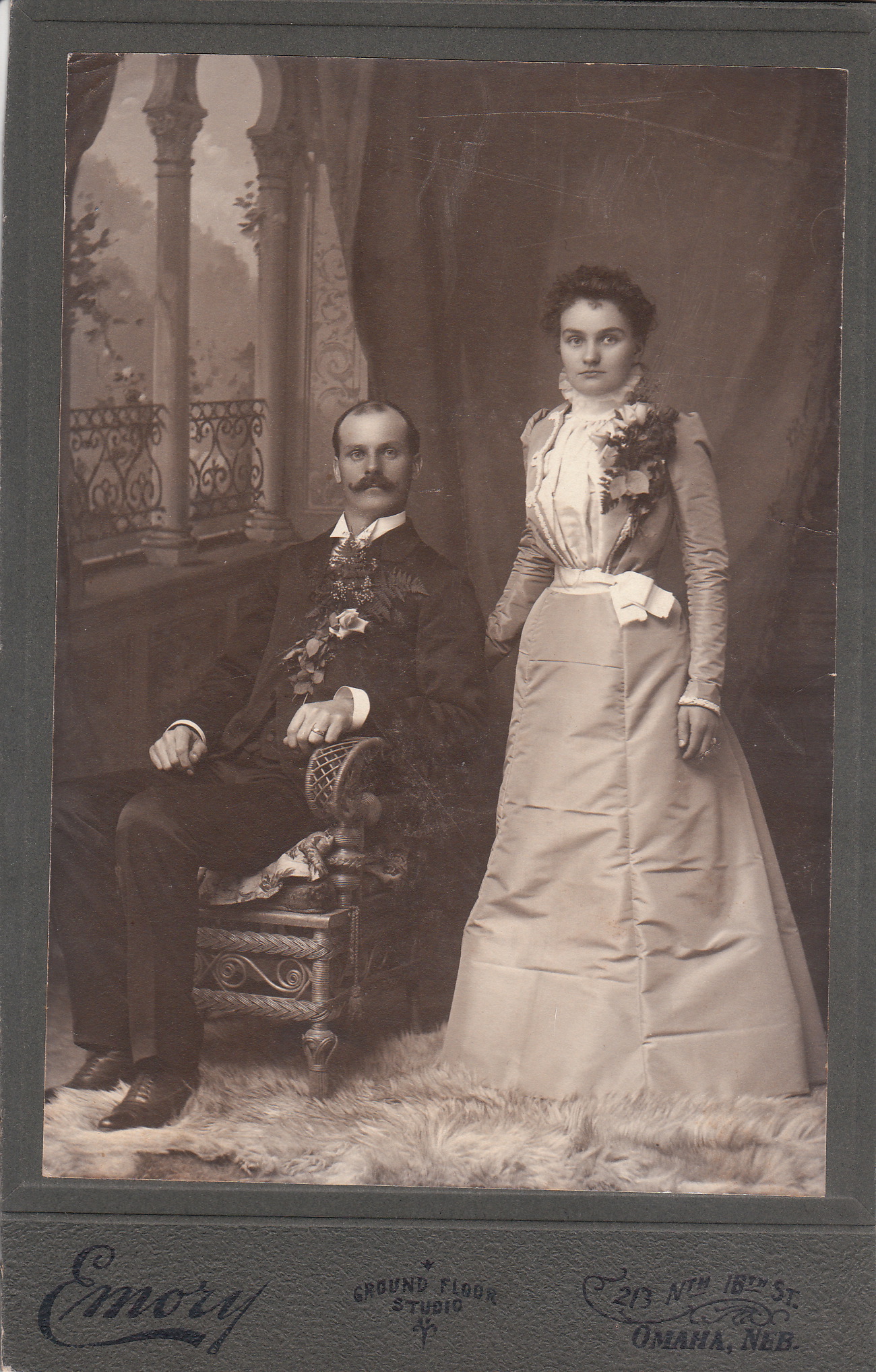
This wedding photograph features a beautifully dressed and handsome bride and groom at the Emory studio in Omaha, Nebraska. The couple are wearing large rose corsages as well as wedding bands. The photographer utilized a wonderful backdrop in posing the newly married couple. A photographer historical directory indicates that Horace S. Emory (1864-1922) operated as a photographer in the 1880’s and 1890’s. He also appears in the US Census in both 1900 and 1920. His occupation is listed as photographer in both censuses. His wife’s name was Mary Emory. The Bulletin of Photography (1922) reported that Emory was working for the Dean Studio in Omaha when he “dropped dead on January 11th. He had just completed taking a photograph”. He was 58 years old.
CARLOTTA BRIANZA: CELEBRATED ITALIAN BALLERINA (PORTRAIT BY FALK)
This cabinet card portrait features pretty celebrated Italian ballerina, Carlotta Brianza (1867-c.1933). Note that the jewelry that is hanging from her necklace is shaped like a horse. It is also worth mention that this photograph is somewhat risque for the era. Brianza was born in Milan, Italy and was the prima ballerina at La Scala before going to Russia. She created a sensation in Luigi Manzotti’s ballet “Excelsior” as the Spirit of Light. She went to Russia in 1887 after completing a US tour. She was acclaimed for her work in “Sleeping Beauty” and “Esmerelda”. She returned to the west in 1891 when she became the prima ballerina for the Vienna Opera. She died in Paris under suspicious circumstances that suggest she committed suicide. This portrait was produced by celebrity photographer Benjamin J. Falk of New York City. To view other photographs by Falk, click on the category “Photographer: Falk”.
DARK HAIRED BEAUTY IN LOVELY DRESS IN CORNING. IOWA
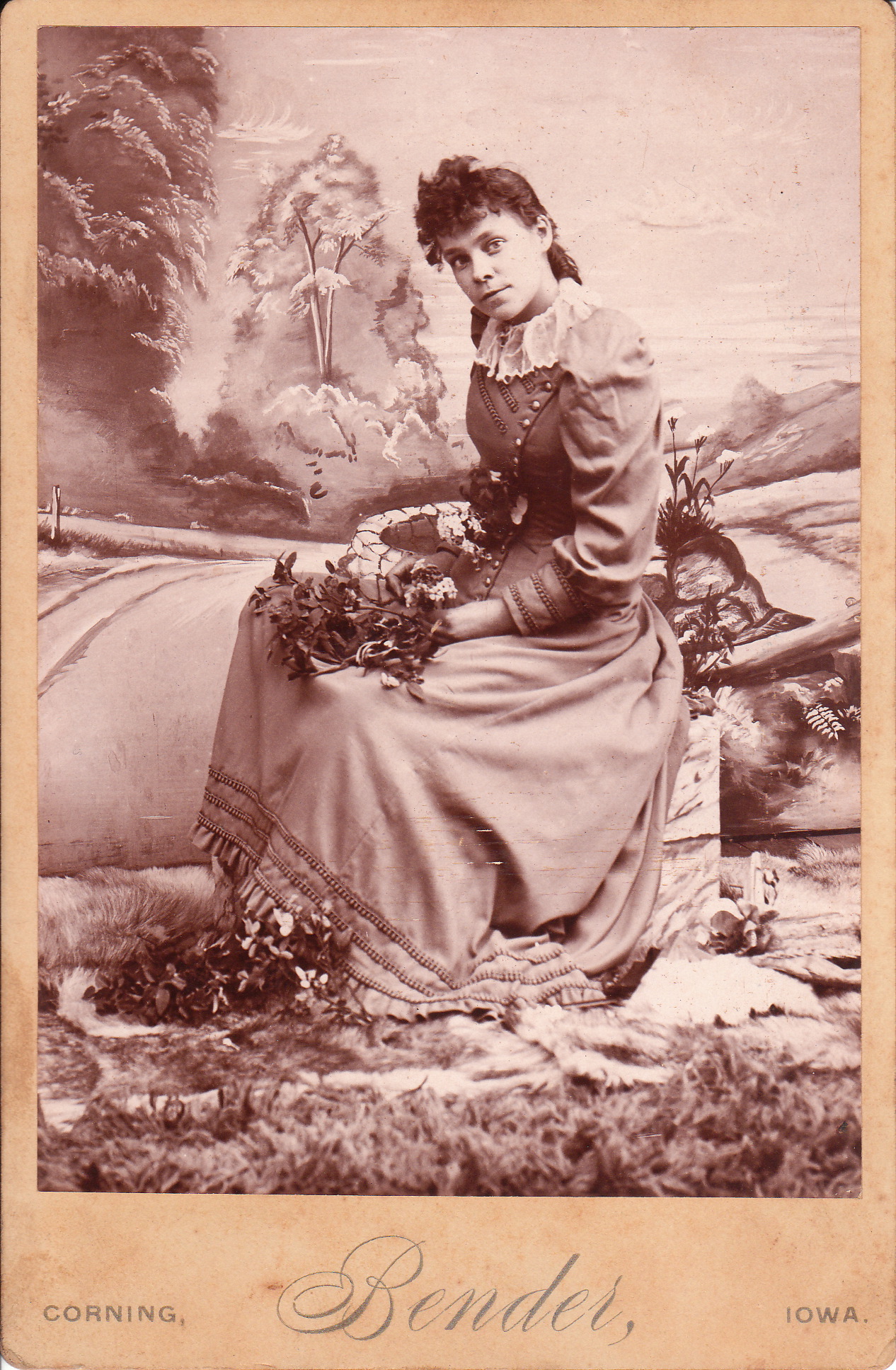
A pretty dark haired young woman in a lovely dress poses for her portrait at the Bender studio in Corning, Iowa. She is holding flowers on her lap and has additional flowers lying at her feet. She is sitting in front of a poorly painted backdrop. It looks like it was painted by a Corning elementary school class rather than professionally done. The history of Corning is quite interesting. The first Europeans that came to the Corning area were a group of French Icarians who arrived from Illinois in 1854. A town was formed and named Icaria. The small and french-speaking community was dedicated to the utopian principles of Etienne Cabet (French philosopher and Utopian Socialist). combined with the democratic principles of the American and French Revolutions. In the 1860’s the community became divided between “traditionalists” and “progressives”. The progressives left town to form their own community, which was close to Corning (surveyed for development in the 1850’s).
SWEET LITTLE GIRL AND HER PARASOL IN CHICAGO, ILLINOIS
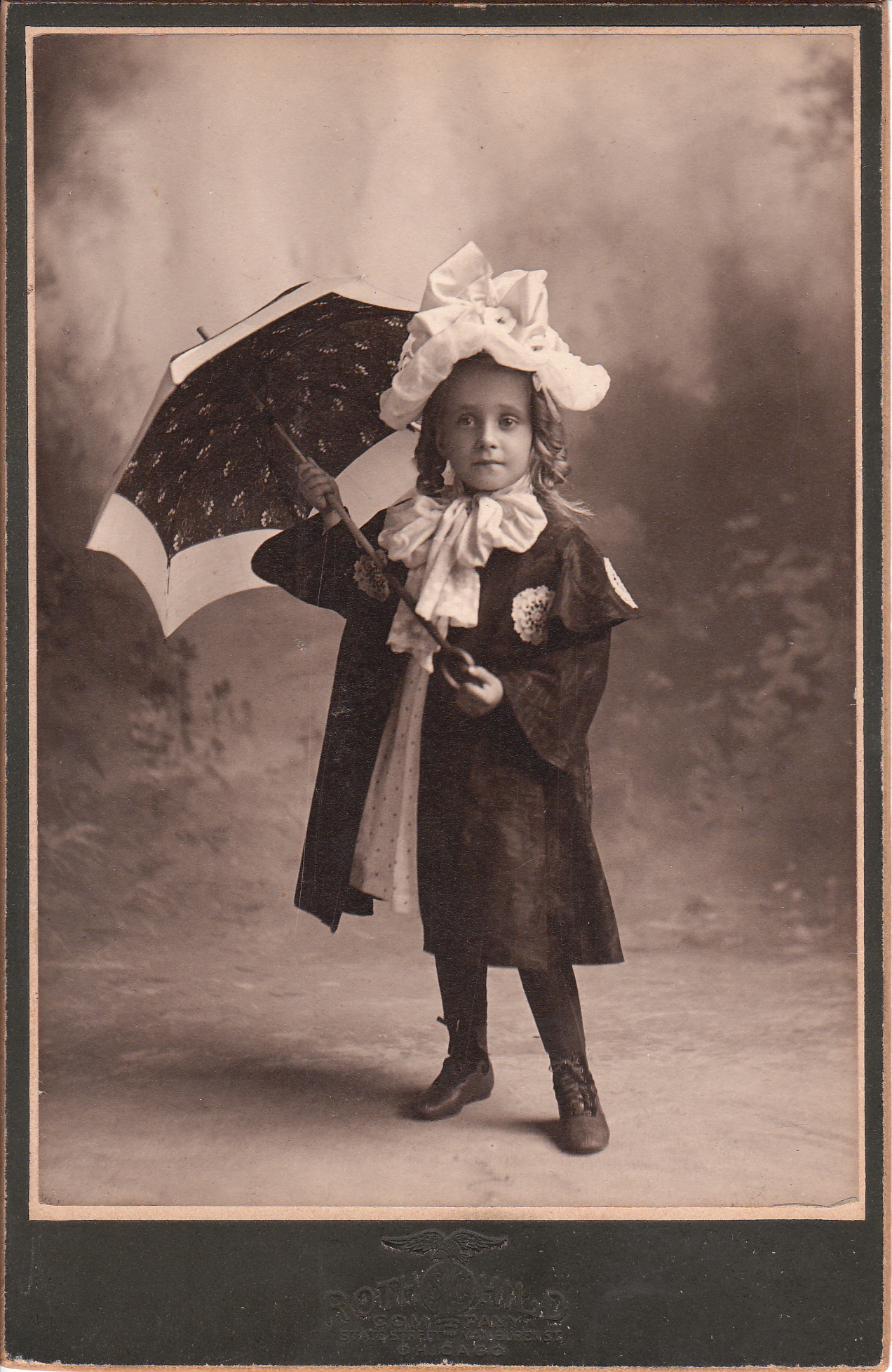
A sweet little girl poses for her portrait at the Rothschild studio in Chicago, Illinois. She is holding a pretty parasol and her curls are covered by a large bonnet. The little girl is identified on the reverse of the photograph as Florence Peterson. It is also noted that the studio was located on State Street and Van Buren. The studio was within the A. M. Rothschild Department Store and the store was opened at the aforementioned address in 1881. The store was bought out by Marshall Fields in 1923. Research was unsuccessful at uncovering information about little Miss Peterson because “Florence Peterson” was a relatively common name in Chicago at the time this image was produced.
EQUISITE PORTRAIT OF A BRITISH SOLDIER IN INDIA BY THE WELL RESPECTED STUDIO OF BOURNE AND SHEPERD
This cabinet card portrait features a uniformed British soldier in India. At least that is the opinion of the previous owner of this photograph. For all I know, this may be a photograph of a French soldier in France. Hopefully, one of Cabinet Cards Gallery’s visitors, knowledgeable about military history and uniforms, will be able to tell us with certainty which nation’s army this gentleman represents. The photographer of this crisp, clear, and riveting image is the Bourne & Sheperd studio. The Bourne & Sheperd studio was established in 1863. It is the oldest photographic studio still in operation. It was the most successful commercial firm in 19th and early 20th century India and it had outlets in Paris and London as well as a mail-order service. Samuel Bourne came to India in 1863 and partnered with an established Calcutta photographer. Charles Sheperd had partnered with a photographer in Agra in 1862. The two men joined forces in Shimla. Among his accomplishments, Bourne was known for his photographic expeditions to the Himalayans and Kashmir. He became celebrated as one of India’s best photographers. While Bourne was off making himself famous, Sheperd wasn’t just sitting home eating curried chicken and naan. Sheperd became known as a master printer. The partners opened a studio in Calcutta which became their flagship. They became the photographers of Indian Royalty and the British elite. In 1870 Bourne went back to England and opened a cotton mill and became a magistrate. In 1879 Sheperd returned to England. The partners continued to operate the Indian studios with continued success for a number of years. Since then, the studio has had multiple owners.
PORTRAIT OF CHARLOTTE CASTERLINE IN BATAVIA, NEW YORK (FEMALE PHOTOGRAPHER, 1898)
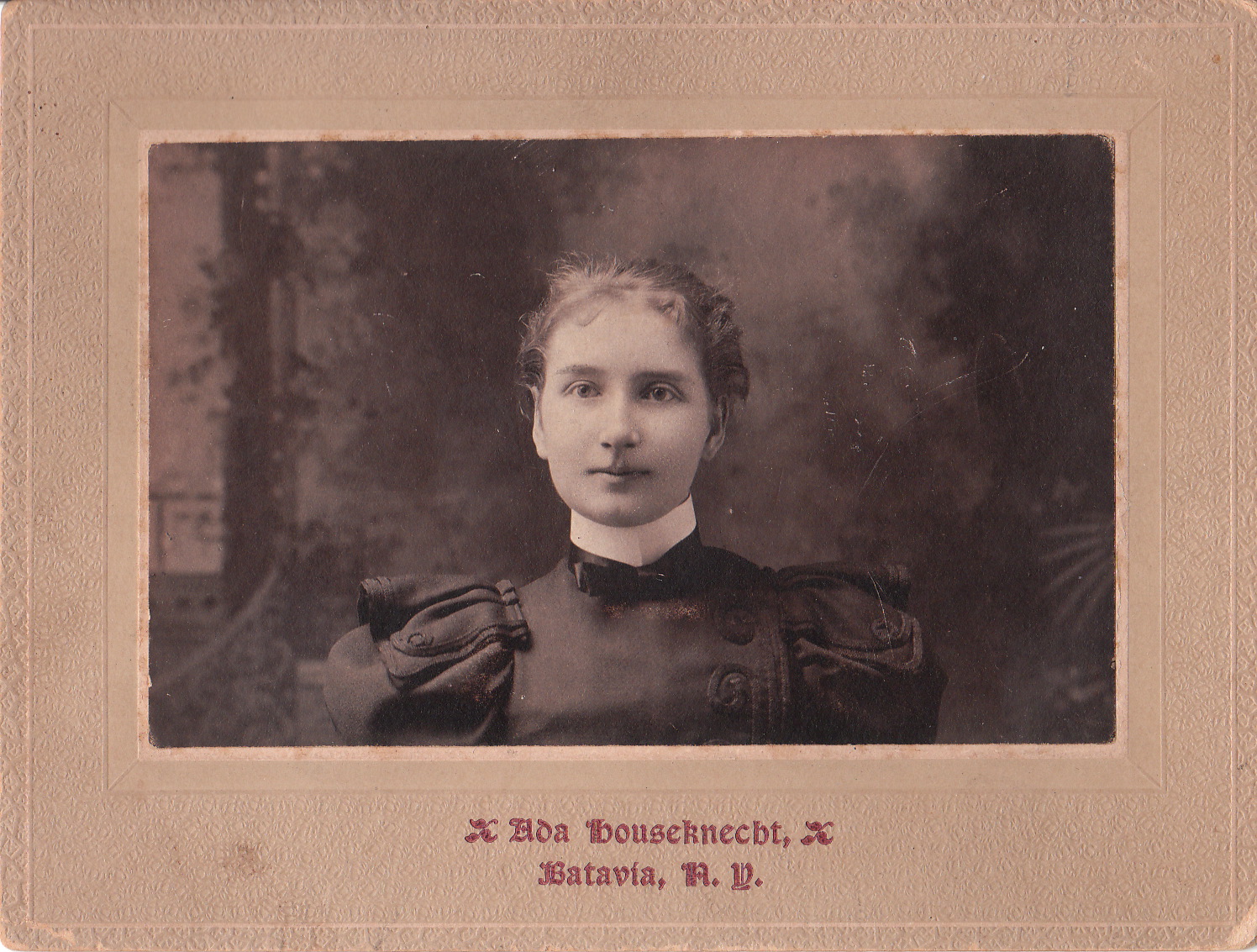
The subject of this portrait is Charlotte Casterline of Hammondsport, New York. Her name is pencil written on the reverse of the photograph along with the initials “G. S. N. S.”. The image is dated “1898”. The photographer of this portrait is Ada Houseknecht of Batavia, New York. Research found a cabinet card photographed by Houseknecht Brothers studio located at 106 Main Street in Batavia. The studio was active from 1880 until 1949. A separate investigation revealed that Batavia was the home of a studio operated by Beecher (1858-1930) and Ada Houseknecht (1871-?). Beecher went to work for photographer William Wilson in 1880 and bought out the studio. Ada started as a photo retoucher but became a full time photographer with her husband, Beecher. She was one of the first female professional photographers in the state of New York. She took over the studio when Beecher died in 1930. Little could be discovered about Charlotte Casterline. The 1899 Annual Report of the Superintendent (New York) notes that Charlotte graduated from the Normal School in Geneseo, New York. She was 0ne of the few students in the school who majored in science. After completing some research about Miss Casterline, it seems likely that this photograph was taken at her graduation from the Geneseo State Normal School (G. S. N. S. ?).
INTELLECTUAL MAN POSES FOR HIS PORTRAIT IN PHILADELPHIA, PENNSYLVANIA
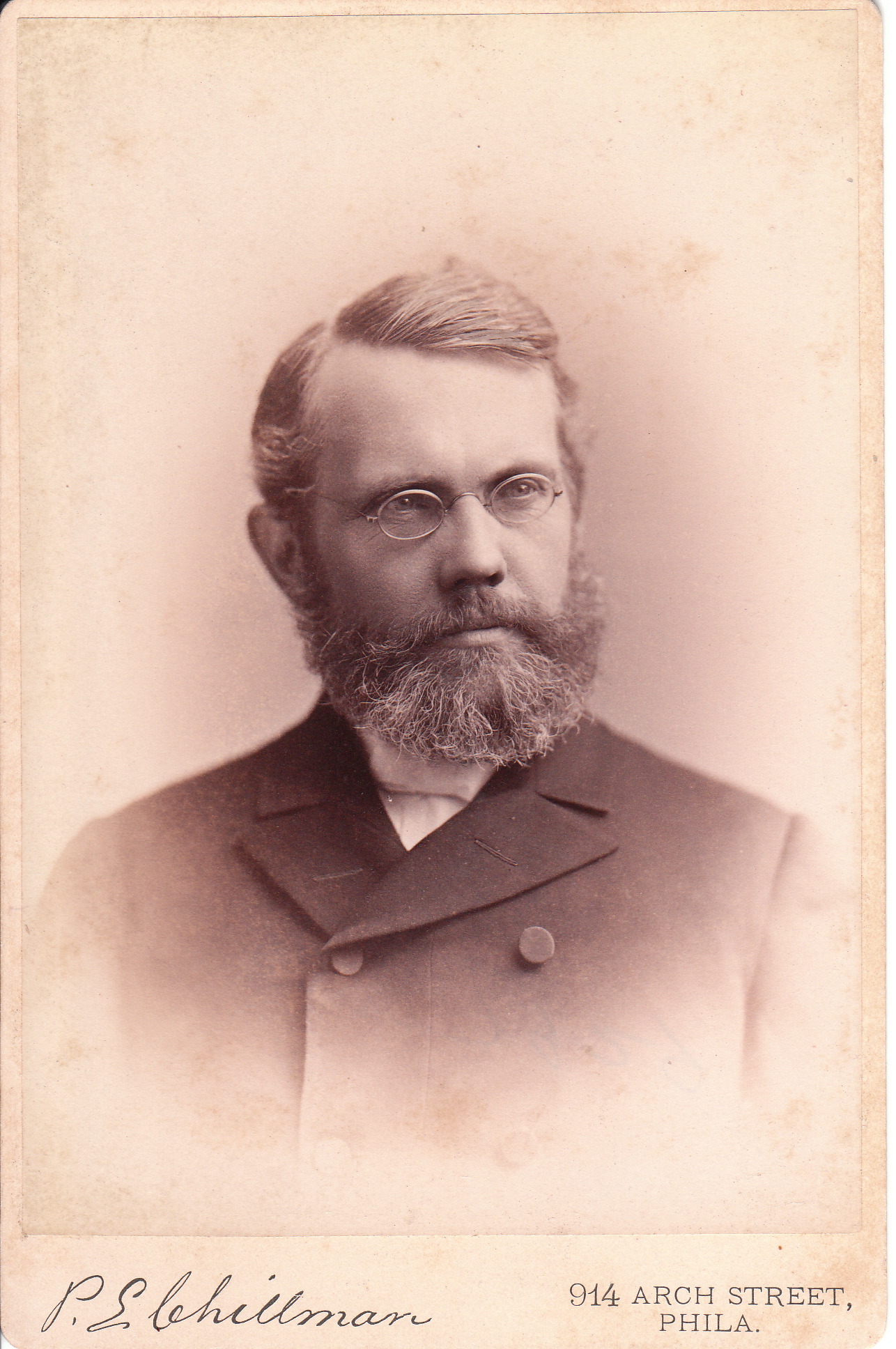
This cabinet card features a well dressed man posing for his portrait at the studio of Phillip E. Chillman in Philadelphia, Pennsylvania. This gentleman looks like an intellectual. Perhaps its his wire rim glasses and well trimmed beard that contributes to his appearance of intellectual prowess. However, I think his expressive eyes are what makes him appear so bright. His eyes can best be described as analytical. This guy is taking it all in, and processing it. To learn more about the photographer, and to view more of his photographers, click on the category “Photographer: Chillman”.
AFRICAN AMERICAN MAN IN WAXAHACHIE, TEXAS
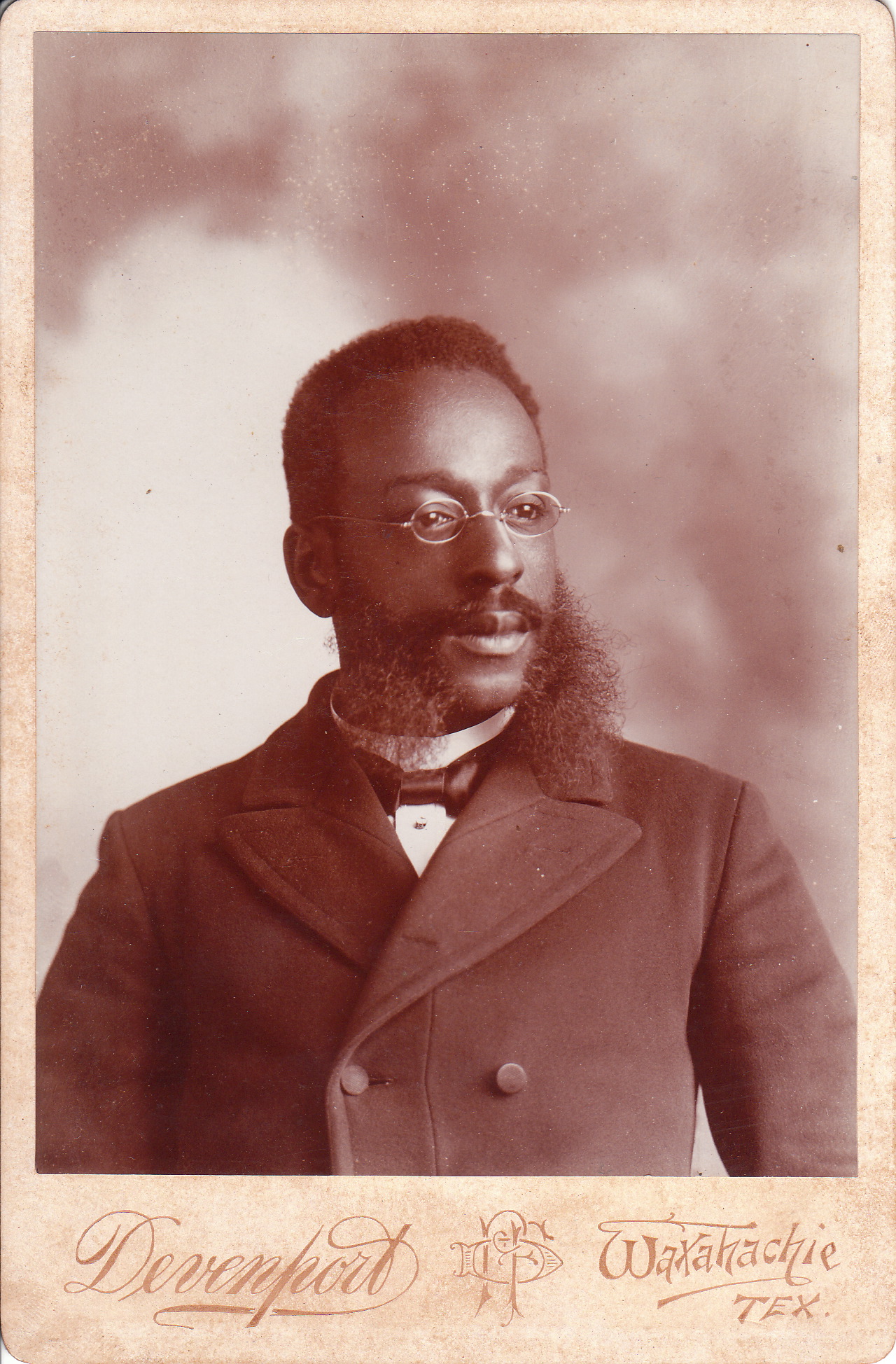
This cabinet card portrait features a well dressed young African American man wearing wire rim glasses. He has a terrific mustache and sideburns. His name is written on the reverse of the photograph (“R. L. Woods”). The photographer is Devenport and the studio was located in Waxahachie, Texas. Perry F. Devenport is identified in the 1900 US census as being forty-three years old and living in Waxahachie with his wife Marie and their three children. He was working as a supervisor for the city water company. He is also cited in the 1920 census but by that time he was sixty-five years of age and married to a forty-four year old woman named Caudia (Candice). In the 1920 census, Perry and Caudia Devenport were both listed as photographers. Interestingly, Caudia is cited in a number of photography journals. She was on the necrology committee of the Professional Photographers Association of Texas according to the Bulletin of Photography (1917). The Photographic Journal of America (1917) announced that she had won some photography awards. To view other cabinet card photographs of African Americans, click on the category “African Americans”.