
A lovely young lady is featured in this photographic portrait. She is beautifully dressed and is wearing a hat that is nicely adorned with flowers. The name of the photographer and his location are unknown. SOLD
A lovely young lady is featured in this photographic portrait. She is beautifully dressed and is wearing a hat that is nicely adorned with flowers. The name of the photographer and his location are unknown. SOLD

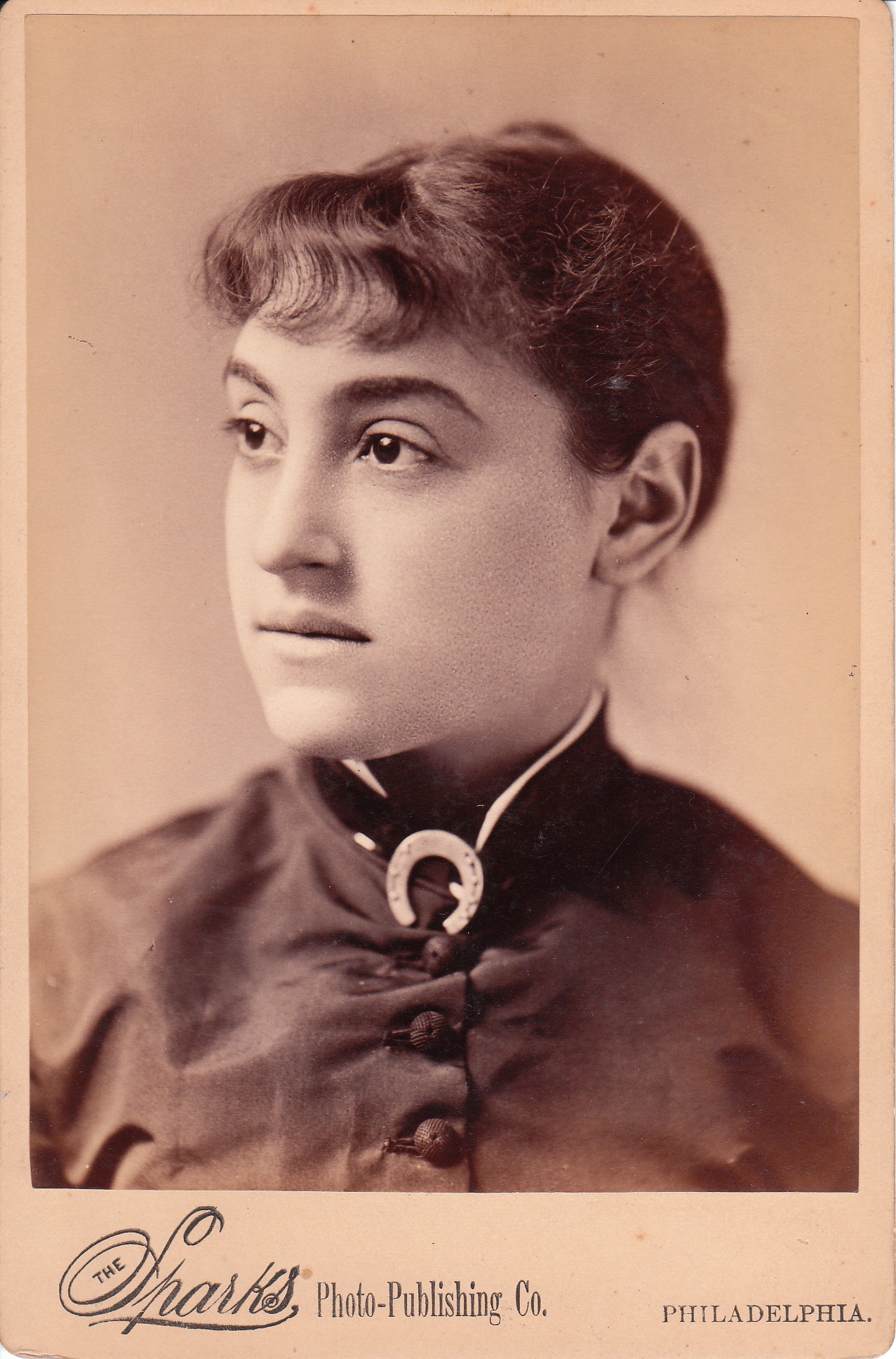
A beautiful young actress poses for her portrait at The Sparks studio in Philadelphia, Pennsylvania. She is wearing a horseshoe broach which probably was supposed to bring her good luck. This actress’s name was Marion Elmore. She was born in 1860 in a tent in Sandhurst, Australia. Her parent were English and they were in Australia because they were hoping to hit it big in the Gold Rush. Elmore began her acting career at age three. She played in Rip Van Winkle with touring American actor, Joseph Jefferson. In the 1870’s she was a member of Lydia Thompson’s famous burlesque troupe. “The Blondes” performed a risque mix of songs, dance and comedy. They also were very well known for showing a great deal of leg in their revealing costumes. She came to the United States in 1878 with the troupe but soon went off on her own as an actress and vaudeville performer. Her first starring role was in Chispa (1883). This play was poorly reviewed. The “Virtual Dime Museum” quotes the journal “Music and Drama” which wrote that the play “was dramatic rubbish, and that it does not fit Marion Elmore any better than her straw hat, which was continually falling off”. The New York Times (1882) also lambasted the play. The critic had mixed feelings about Miss Elmore, but stressed her negatives. He blamed actress Maggie Miller for perpetuating a type of actress that he found abhorrent. These actresses were seen as stock actresses who rose to “money making dignity” by performing in troupes like Lydia Thompson’s Blondes. He described Elmore as a “vivacious exponent of the high art of leg burlesque”. The critic asserts that the craze surrounding Lydia Thompson, and other similar troupes, was one of the worst stupidities of the stage” and that he was pleased that the popularity of this type of entertainment had become “extinct”. On the positive side, the critic enjoyed Elmore’s sense of humor and her “brightness”. One fortuitous outcome of her acting in Chispa was that she fell in love with, and in 1884, married her co star, Frank Losee. Another actress in Chispa was Lina Merville. Her portrait can be found in the Cabinet Card Gallery via the search box. As Elmore’s career continued, she acted in many plays in the New York area. She was active through the 1890’s and the early twentieth century. She died at age ninety in 1950. To view other photographs of actresses by Sparks, click on the category “Photographer: Sparks Photo Publishing Co.”.

PHOTO 1
The top Cabinet Card is an image of two Salvation Army workers photographed by Suddard of Fall River, Massachusetts. The young couple are both in uniform; he has a tambourine and she is holding a trumpet. It is interesting to note that he is wearing a late 1800’s version of an embossed tee shirt. His shirt’s lettering states “NO CROSS NO CROWN”. A present day, non religious meaning of this saying would be “no pain, no gain”. The motto on the shirt was a widely used expression and an early user of the phrase was William Penn, the founder of the Quaker colong of Pennsylvania. The second photograph, also by Suddard, shows the same couple in a different studio setting. Once again, the couple is attired in a salvation army uniform. The gentleman is wearing a different style uniform than he wore in the top photograph. In the bottom photograph, the woman has taken possession of the tambourine and the man is holding papers. These two cabinet cards were purchased more than two years apart and I am fairly certain that they were purchased from different sellers. Amazingly, these images have ended up together again. A third cabinet card image by Suddard can be found elsewhere in the Cabinet Gallery. It can be accessed by clicking the category “Photographers: Suddard”.

A well dressed man arrives in town driving a horse drawn buggy. He arrives at his destination under the cover of darkness. The man is holding a long whip. There is a lamp on the carriage that is in place next to the driver. This photograph appears to have been taken outside. The horse is standing next to a brick building. Perhaps the building is a stable. There are three men visible in the background of this picture. Why are these men included in this image? Perhaps a Cabinet Card Gallery visitor has a theory they are willing to share in regard to interpreting this photograph. The photographer and location of this image is unknown.
 A young man, wearing a salvation army uniform, poses for his portrait at a studio in Philadelphia, Pennsylvania. The man has long hair and a great mustache. The photographer of this image was Frank A. Kroneberger (1847-?). The photographer’s studio was located at 1313 and 1315 Columbia Avenue. Kroneberger was born in Maryland and was of German heritage. He appears in the 1900 census as living in Philadelphia and working as a photographer. He was listed as being married to Henrietta Kroneberger since 1870 and as having three daughters (age 16 to age 21). Kroneberger had longevity in the field of photography. He is listed in various directories (from 1877 to 1918) as being a photographer. He appears to have started his career in Chester, Pennsylvania. To view other images of Salvation Army workers, click on the category “Salvation Army”.
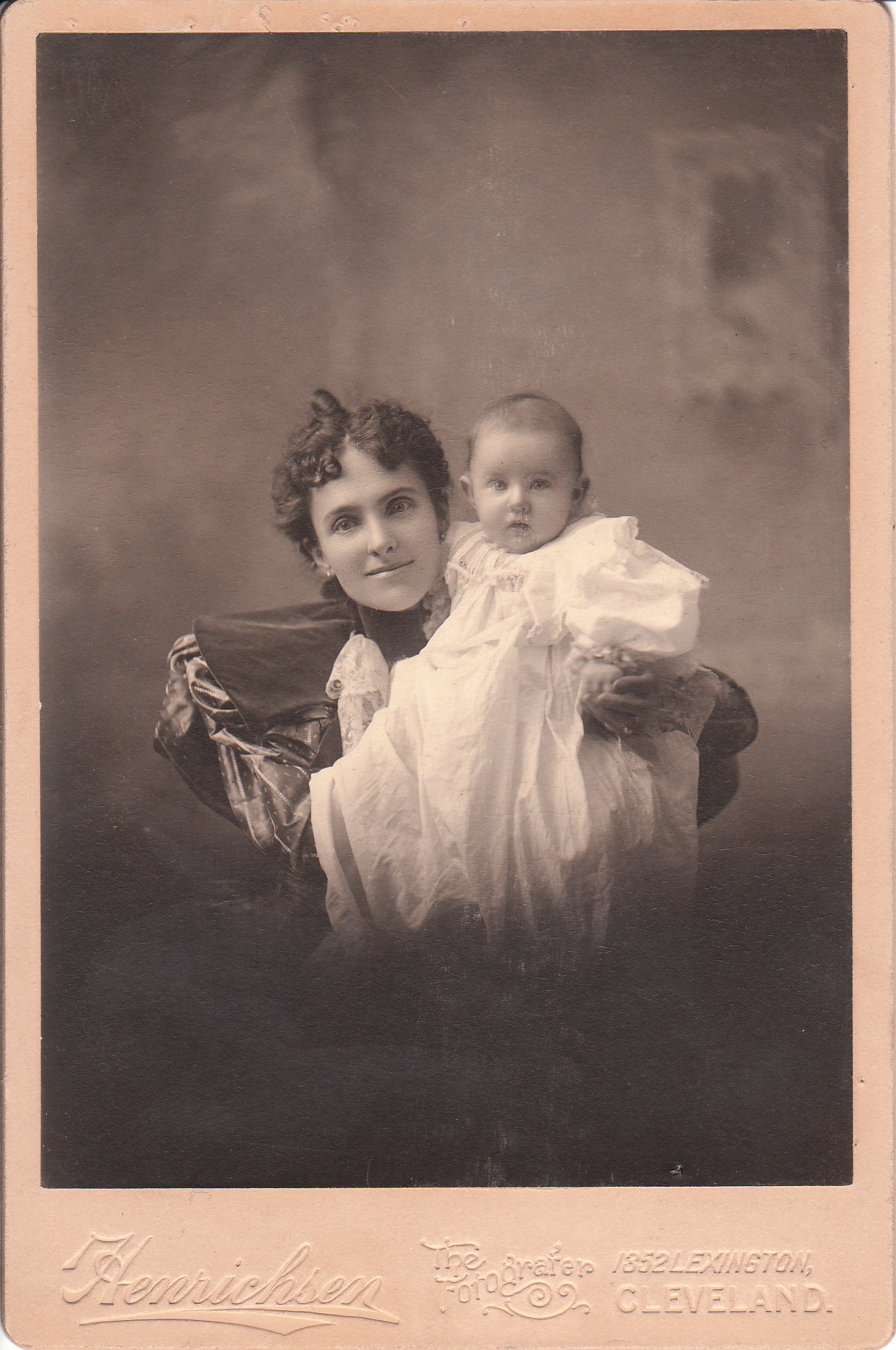
Film reviewers speak of a category of movies called “feel good” movies. It has been my observation that there is a category of cabinet cards that should be called “feel good” cabinet cards. This cabinet card, featuring a mother and her baby, falls into the “feel good” genre. This image exudes joy. Mom is smiling. It is important to note that smiling subjects are a rare occurrence in cabinet card photography. Mom’s eyes are smiling too; she just can’t contain her joy. Mom is beautiful, and of course, all babies are adorable. Does anyone wonder how mom was able to hold her baby in this pose for as long as it took to have the photograph taken? Mom likely had some invisible assistance. The child is likely sitting on a platform of some type that has been blocked out by the photographers “tricks” during the development process. This image was photographed by Henrichsen who’s studio was located at 1352 Lexington, in Cleveland, Ohio. John H. Henrichsen operated his studio in Cleveland between 1891 and 1897 and was located on Lexington from 1893 until 1894. These dates were found in the book, “Ohio Photographers 1839-1900” (1998). Henrichsen was also mentioned in Wilson’s Photographic Magazine (1896), as a competitor for prizes at a major photography exhibit.

A unknown photographer captures an attractive unidentified couple in a lovely portrait. The pair are nicely dressed and appear relatively comfortable in front of the camera. The photographer and the location of the studio are both unknown.


These cabinet cards feature American stage actress, Mary Anderson (1859-1940). Interestingly, Anderson’s father was an Oxford educated New Yorker who after Mary was born, moved his family to Kentucky. He then joined the Confederate army and was killed in action when Mary was just three years old. Mary was not much of a student but loved to read Shakespeare. Her step father sent her to New York at age 14 to take ten professional acting lessons. In 1875, at age 16, Mary Anderson began her stage acting career in a Kentucky production of Romeo and Juliet. She continued acting in Kentucky and then appeared in a number of other cities, including New York. Her critical reviews tended to be mixed but she was well loved by the public. She then worked the New York and touring company stages for twelve years until she spent the next six years on the English stage (appearing in a lot of Shakespeare productions). She then returned to the United States, and at age 30, collapsed on stage with a case of nervous exhaustion. This experience, likely coupled with less than favorable reviews, caused her to retire from acting.
Cabinet Card 1 features Anderson in the role of Galatea. A review of Mary Anderson’s performance in this role appeared in the New York Times in a September 1884 edition. She was appearing opposite British actor William Terriss, in the play “Pygmalion and Galatea”, at the Lyceum Theatre in London. Many notables were in attendance, including Oscar Wilde. The review states ” Miss Anderson surpassed herself and that the performance was throughly artistic and finished”. The cabinet card was photographed by The Vanderweyde Light of London, England (182 Regent Street W.). Henry Van Der Weyde (1838-1924) was an artist and photographer. In 1877, he became the first photographer to install and take photographs by electric light. (SOLD)
The second cabinet card was photographed by celebrity photographer, Sarony. The image reflects Mary Anderson’s great beauty. To view other photographs by Sarony, click on Cabinet Card Gallery’s category “Photographer: Sarony”.
The third cabinet card was photographed by “The Sparks Studio”. The studio was located in Philadelphia, Pennsylvania and the artist/manager was Elliott Houseworth. This cabinet card offers a profile portrait of the attractive Ms. Anderson. The 1880 census lists Elliott A. Houseworth as being born in 1855, residing in San Francisco, California, and working as a photographer. Houseworth also appears in the 1900 census as living in Norwood, Pennsylvania and working as a manager. These demographics fit the photographer of this image, since Houseworth managed Sparks Photography Studio and Norwood is only about eleven miles from Philadelphia. To view other photographs of actresses by Sparks, click on the category “Photographer: Sparks Photo Publishing Co.”.
The fourth cabinet card features a smartly dressed Mary Anderson and was photographed by George Rockwood, of New York City. To learn more about Rockwood and to view more of his photographs, click on the category “Photographer: Rockwood”. A sticker on the reverse of the photograph indicates that the image was once part of the Kean Archives in Philadelphia, Pennsylvania. The Kean Archives was a company that served as a source of illustrations and photographs for various modes of media. They eventually were purchased by Getty Images.


Emma Loraine appears to have been a minor stage star. The New York Times (1879) reported that Wallack’s Theatre production of “Our Girls” included Ms. Loraine in the cast. Also in the cast was Maurice Barrymore. The New York Times (1881) has a story about the Wallach company going on tour because their new theatre was under construction. The company was planning to perform “She Stoops to Conquer” and “The School for Scandal” while on tour. Performing as part of the touring company was Osmond Tearle, Rose Coghlan, and Emma Lorraine. The cabinet card gallery has images of both Tearle and Coghlan that can be viewed by typing each of their names in the search box. Their names must be searched separately. Both cabinet card portraits of Loraine were photographed by celebrity photographer, D. H. Anderson of New York City. To view other images by Anderson, click on the category “Photographer: Anderson (New York)”. An article in the Photographic Times and American Photographer (1883) describes Anderson’s studio at 785 Broadway in New York City. The location was formerly the studio operated by famed photographer, Mathew Brady. Anderson is considered a pioneer in early photography. He made his first pictures (daguerreotypes) in Paducah, Kentucky in 1855. He later worked in Cincinnati (Ohio), Dayton (Ohio), New Orleans (Louisiana), Louisville (Kentucky), and various other cities. He finally settled for awhile in Richmond, Virginia in 1865. In 1881, he sold his studio and moved to New York City. The previously cited article described a “composition group” portrait that Anderson was working on during the magazine writers visit to his studio. The photograph was described as measuring eleven feet by fourteen feet and picturing the 7th Regiment posing in their new armory. The image included over a thousand soldiers.

A very pretty woman with big dreamy eyes and dark hair poses for her portrait at the McKnight studio, in Centrailia, Illinois. The woman is wearing a dress that has four very large buttons at its top and smaller buttons below. The large and small buttons appear to be identical except for size. The decorative buttons show grapes or berries. The woman is also wearing a flower and earrings, as well as a pin at her collar. The pin features the letter “H”, which may be the first letter of her first or last name. The photographer of this image may be Frank McKnight or P. McKnight. Both of these individuals are listed in a directory of Illinois photographers as operating studios in Centralia during the cabinet card era. This photograph has a crossed out location on the bottom of the image. It is probable that the photographer formerly owned a studio in Missouri and moved to Illinois but kept his stock of pre-printed paper. Although it is easy to decipher the state, the town is blacked out beyond the point of recognition.
 | rangerdon on BEALLSVILLE, PENNSYLVANIA : ST… |
 | bmarshphd on ELEANOR GAINES : LUBIN SILENT… |
 | phantomfamous0cbbe9d… on ELEANOR GAINES : LUBIN SILENT… |
 | summertime75 on MARY MILES MINTER : SILENT FIL… |
 | beth on WINGS CIGARETTES : ADVERTISING… |
 PHOTO 2 (SOLD)
 Cabinet Card 1 (SOLD)
 THE CABINET CARD GALLERY