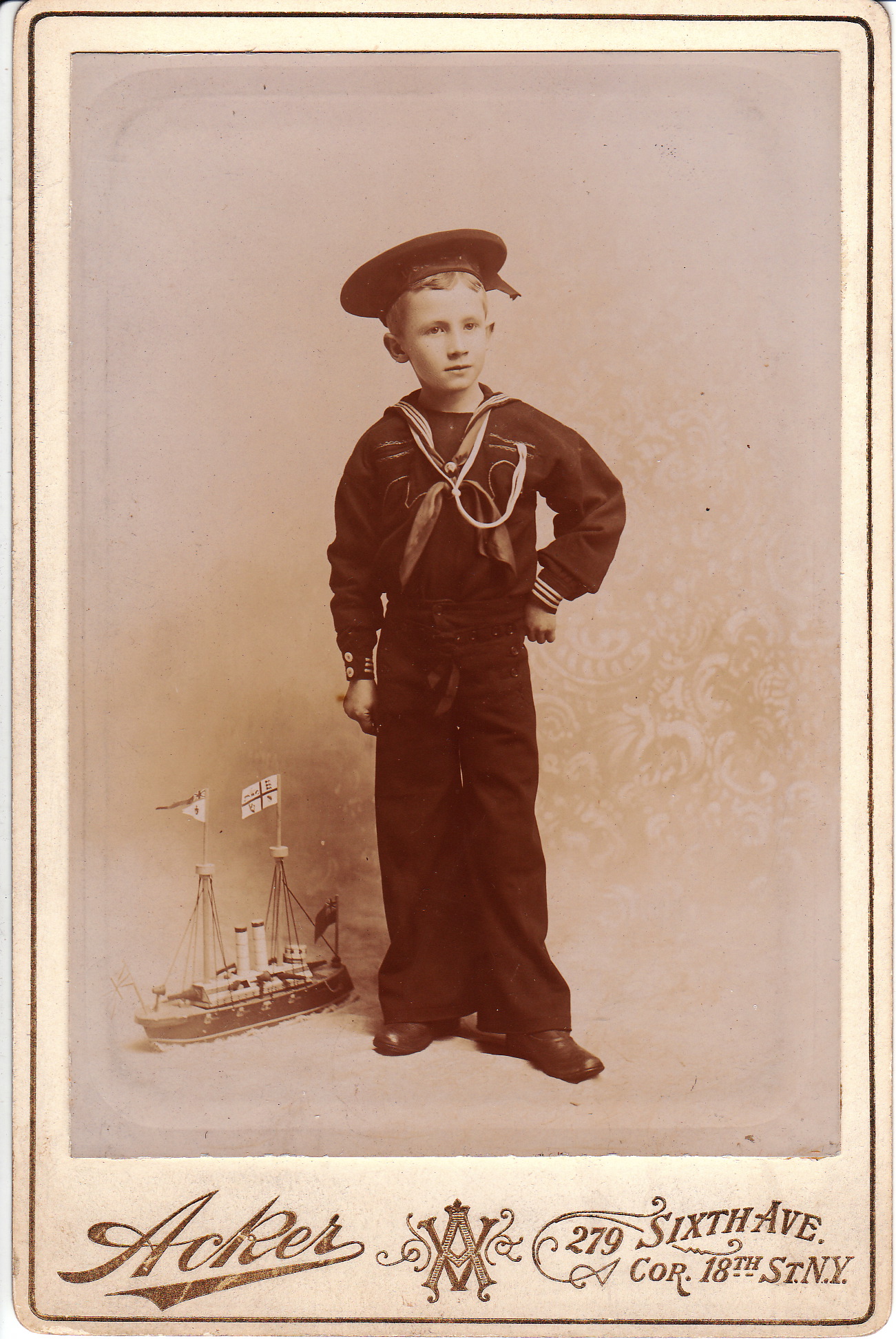
A young boy poses proudly wearing a very realistic looking naval uniform. He is standing next to his very detailed toy boat. The ship appears to be a war vessel and appears to be flying a flag similar to the flag of Great Britain. The little admiral was photographed by a New York City photographer named Acker. Perhaps a visitor to the cabinet card gallery can identify the navy represented by the lads uniform and the vessel’s flag. (SOLD)
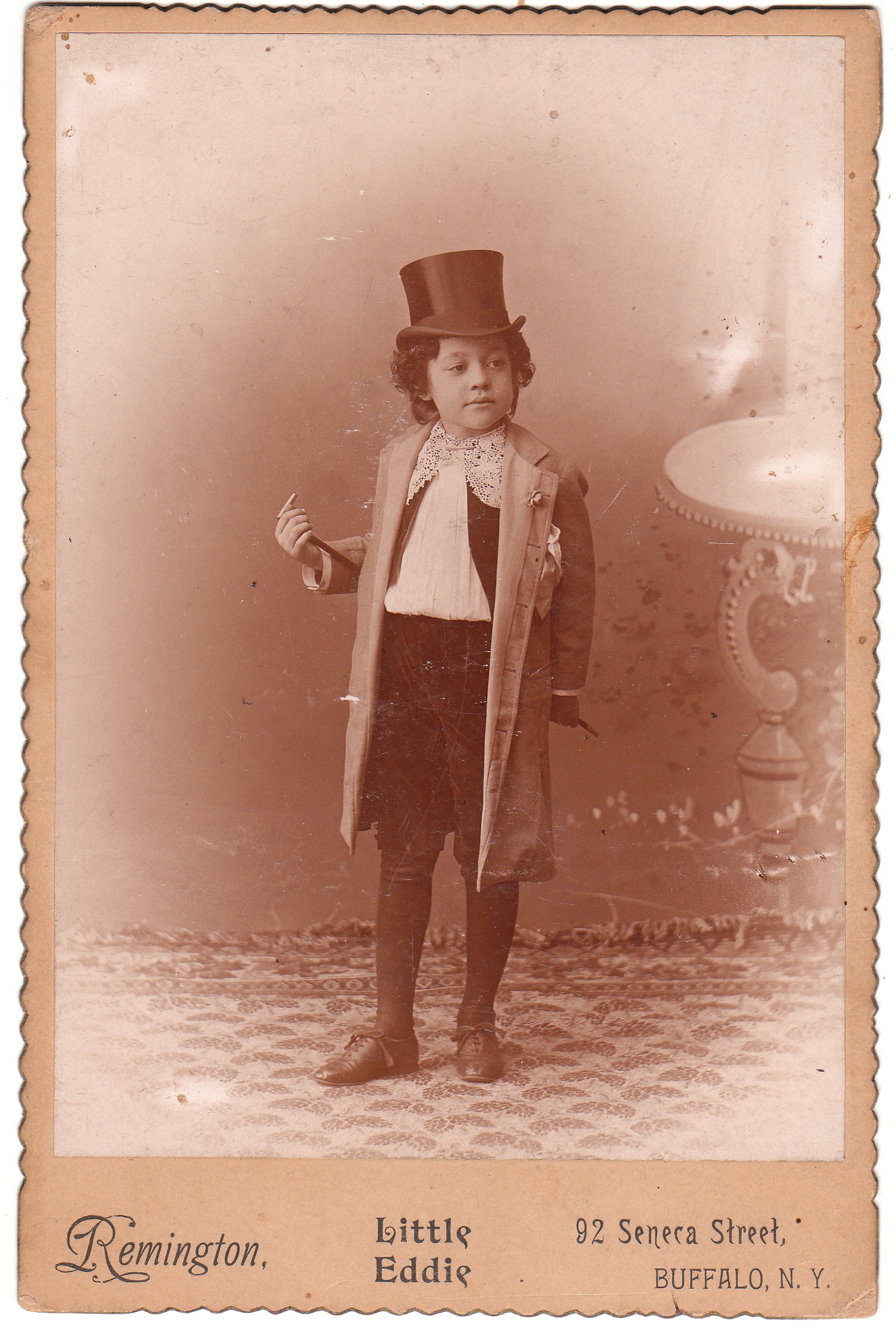
LITTLE EDDIE : WEARING A TOP COAT AND TOP HAT : BUFFALO, NEW YORK : CABINET CARD
Who is Little Eddie? “Little Eddie” is the subject of this cabinet card photograph but research yielded no information about him. In this image, long haired Little Eddie is wearing a top coat and top hat. He is also wearing a lace collar with a triangular bib. He has a flower pinned to his lapel and a white handkerchief in his breast pocket. He is holding a wand type stick. The object has a small handle. The boy in this picture has a look of a showman. Perhaps he wasn’t even a boy but instead an adult midget (the term “little person” was not yet used). The photographer of this image was Edward A. Remington who was a native of Greenfield, Massachusetts and came to Buffalo, New York from Chicago, Illinois. Remington’s obituary appears in The Professional and Amateur Photographer (1909). The article states that he was a “widely known” photographer in Buffalo for 15 years. He left behind a widow, Mrs. Mamie Remington. (SOLD)
PORTRAIT OF IDA PEASE IN BLISSFIELD, MICHIGAN (1885)
This cabinet card portrait features an attractive woman named Ida Pease. At the time of the photograph, she was seventeen years old. She was photographed by Dorus Griffeth Freeman (1848-1936) of Blissfield, Michigan. An inscription on the reverse of the photograph indicates the subject’s name and the date of the photograph (1885). Ms. Pease is wearing dark clothing and her top appears to be velvet. She is wearing a bracelet and a collar pin. Her beautiful figure gets an assist from a corset. Research reveals that Ida Pease was born in 1868 in Michigan. According to the 1880 U.S. census, she was the daughter of Seth and Esther Pease who were both born in New York. At the time of the census, she was 12 years old and her father was working as a farmer. Her brother Richard (age 18) also lived in the household. (SOLD)
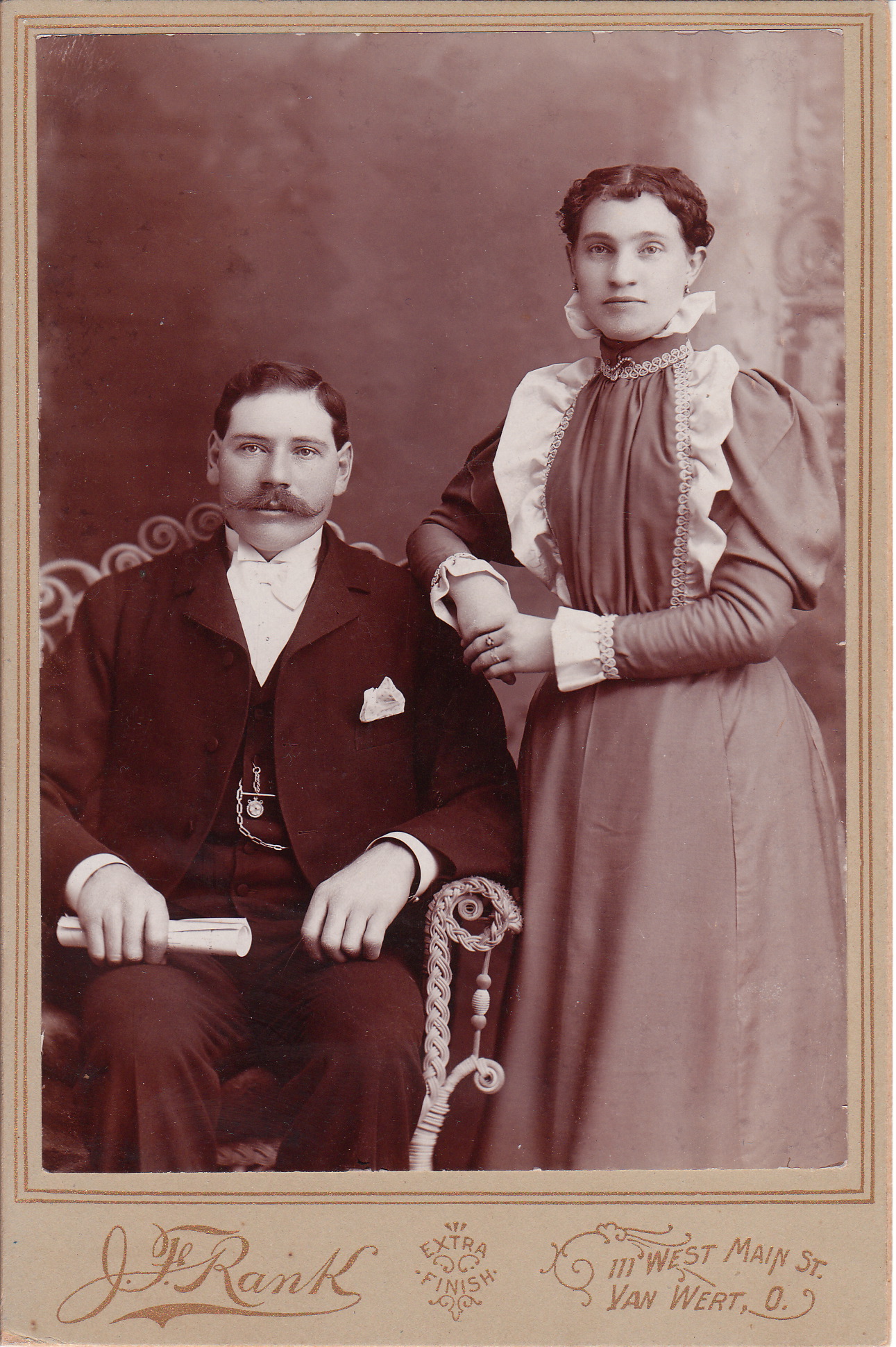
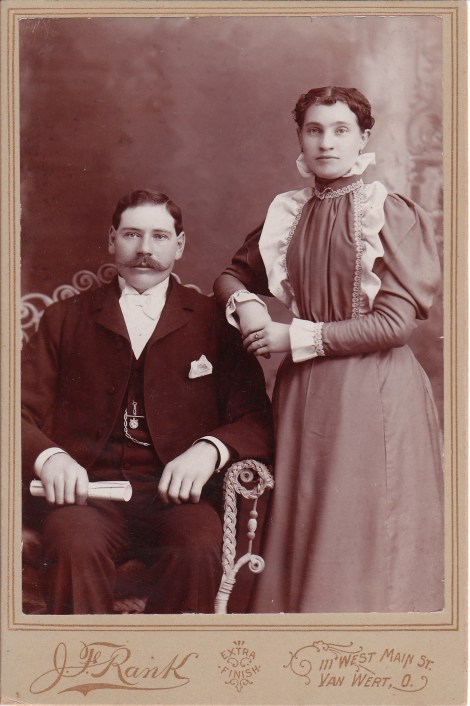
PROUD COUPLE AND A DIPLOMA IN VAN WERT, OHIO
A young couple poses for their portrait in this cabinet card photographed by J. F. Rank of Van Wert, Ohio. The man in the image is holding a rolled document that appears to be a diploma. He is dressed in formal clothing which suggests that the portrait may be a graduation picture. He has a fine handle bar mustache and is wearing a pocket watch. The woman in this picture is nicely dressed and well adorned with jewelry. Jeremiah F. Rank (1847-1913) was born in Shelby, Ohio. He learned the trade of photography from I. S. Hartsock in Van Wert, Ohio, in 1872. After being trained, he quickly bought Hartsock’s studio and operated the business until 1892 when he sold the gallery. After traveling around the United States for two years, he opened galleries in Schuyler and Lincoln, Nebraska. He eventually returned to Van Wert and opened another studio there. In 1874, Rank was married to Mary I. McBride of Oskaloosa, Iowa. To view other photographs by this photographer, click on the category “Photographer: Rank”.
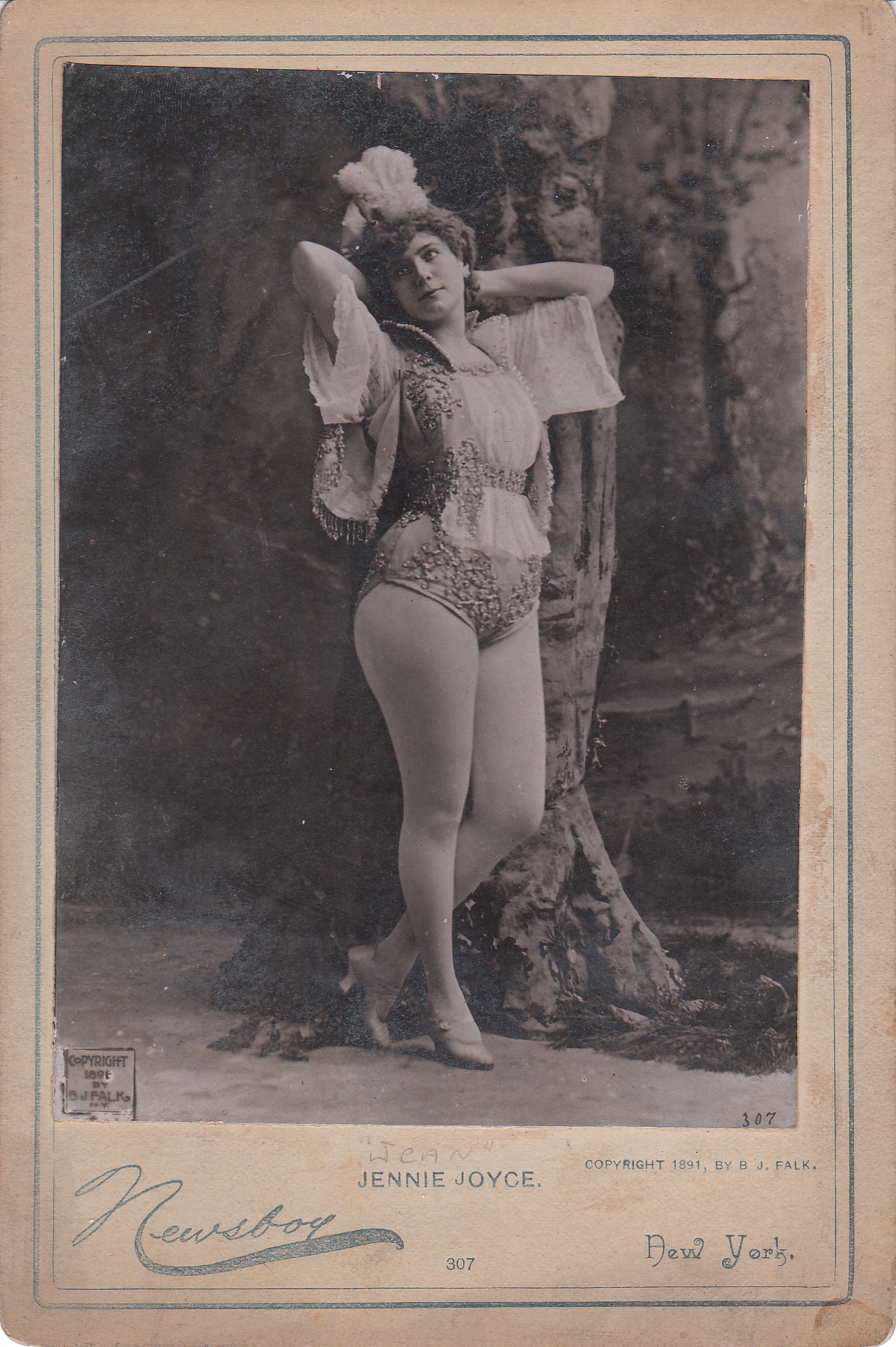
JENNIE JOYCE: TROUBLED STAGE STAR PHOTOGRAPHED BY FALK FOR NEWSBOY
This photograph, by celebrity photographer B. J. Falk, features stage star Jennie Joyce. She was photographed for the Newsboy tobacco company and the image was used as a premium to reward purchasers for buying Newsboy products. The image has a copyright date of 1891 and is number 307 in the Newsboy series. This photograph is risque for its era. Miss Joyce is showing much of her nearly bare legs and is exhibiting a sexually provocative pose. The New York Times (1892) published an article reporting that Jennie Joyce was sued by her husband for divorce. John E. Stanley’s request for a divorce was uncontested. The newspaper described Jennie Joyce as a variety actress and singer. An 1899 article in the same newspaper reported a story about problems in the marriage of Joyce and sportsman Phil Daly Jr.. Daly had told Joyce that he would be out all night but according to plan, returned home at two in the morning only to find his wife with another man (Phillip Wood). Daly fired a number of shots at Wood but missed. Daly’s parting shot was to file for divorce and end his five year marriage. The bad publicity caused by Joyce’s marital problems cause her to speculate in another 1899 Times article that she planned to leave the United States to perform pantomime in London until the fallout from her divorce had diminished. An additional conflict was in the news when the New York Times (1901) printed a story about Joyce successfully suing theatre manager, Alexander Hashim for unpaid salary. Jennie Joyce was clearly a gossip magnet for the press and she provided them with a lot of material. SOLD
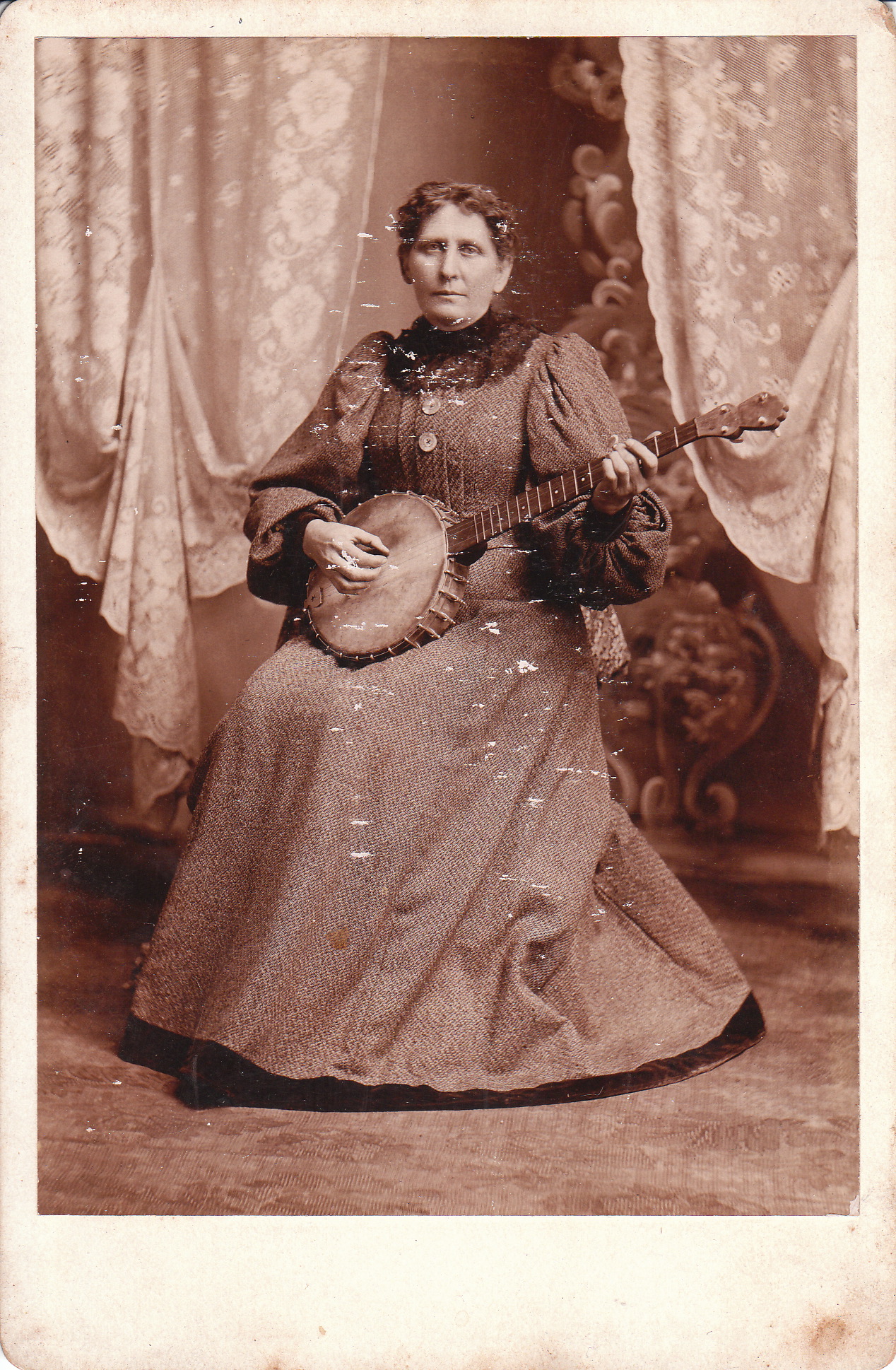
LADY AND A BANJO
A lady and her banjo are the subject of this cabinet card portrait. She is posed as if she is performing. She sits with the banjo on her knees and curtains draped behind her. Although the photograph is marred by age, it is still a spectacular image because it captures the role music played in home entertainment at the turn of the nineteenth century. The performer and the photographer are unidentified. SOLD
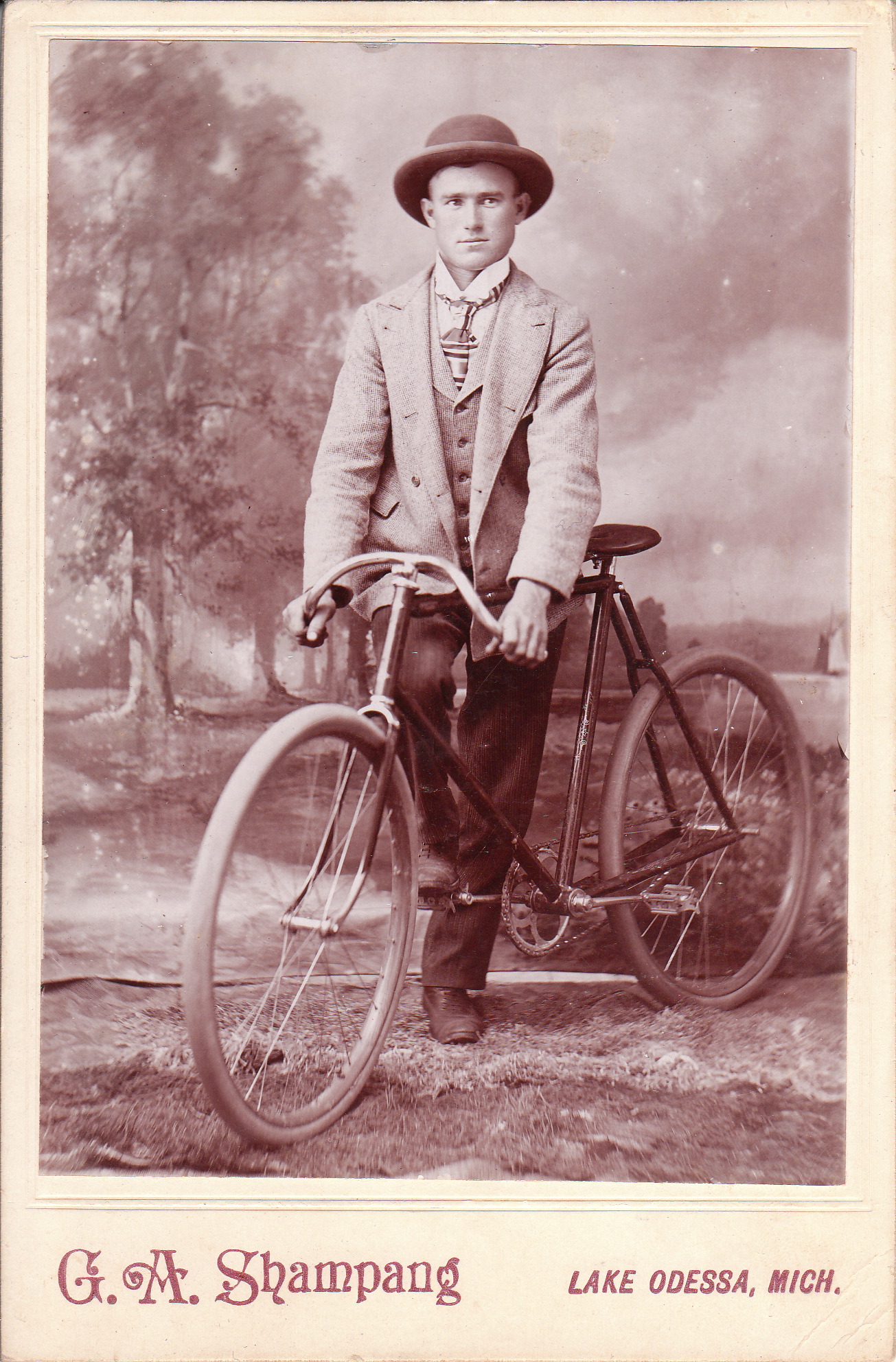
NICELY DRESSED BIKE RIDER IN LAKE ODESSA, MICHIGAN
A young man poses holding a bicycle at the studio of G. A. Shampang in Lake Odessa, Michigan. The good looking man is dressed in what is probably his finest clothing. Take note of where the backdrop screen reaches the floor. The photographer was a bit careless and did not take notice or action to insure the backdrop touched the floor properly to promote a more credible background. Oops! G. A. Shampang located in Lake Odessa in the late 1890’s. According to an ad in the Lake Odessa Wave, the studio was located above the Lake Odessa Savings Bank on the corner of Fourth Avenue and Second Street. In late 1898 Shampang took on Mr. Mead as a partner, forming Shampang & Mead. Something apparently went wrong with the partnership because Shampang bought back Mead’s shares in the business after just three months of joint ownership. Shampang operated the gallery until about 1910. In 1911 he moved to California and later on, moved to Saginaw, Oregon where he owned an oil station. In 1931 he succumbed to a stroke. His wife, Ada Ema Rozell, survived him. To learn more about Shampang, visit the web site for the Ionia County Genealogical Society. SOLD
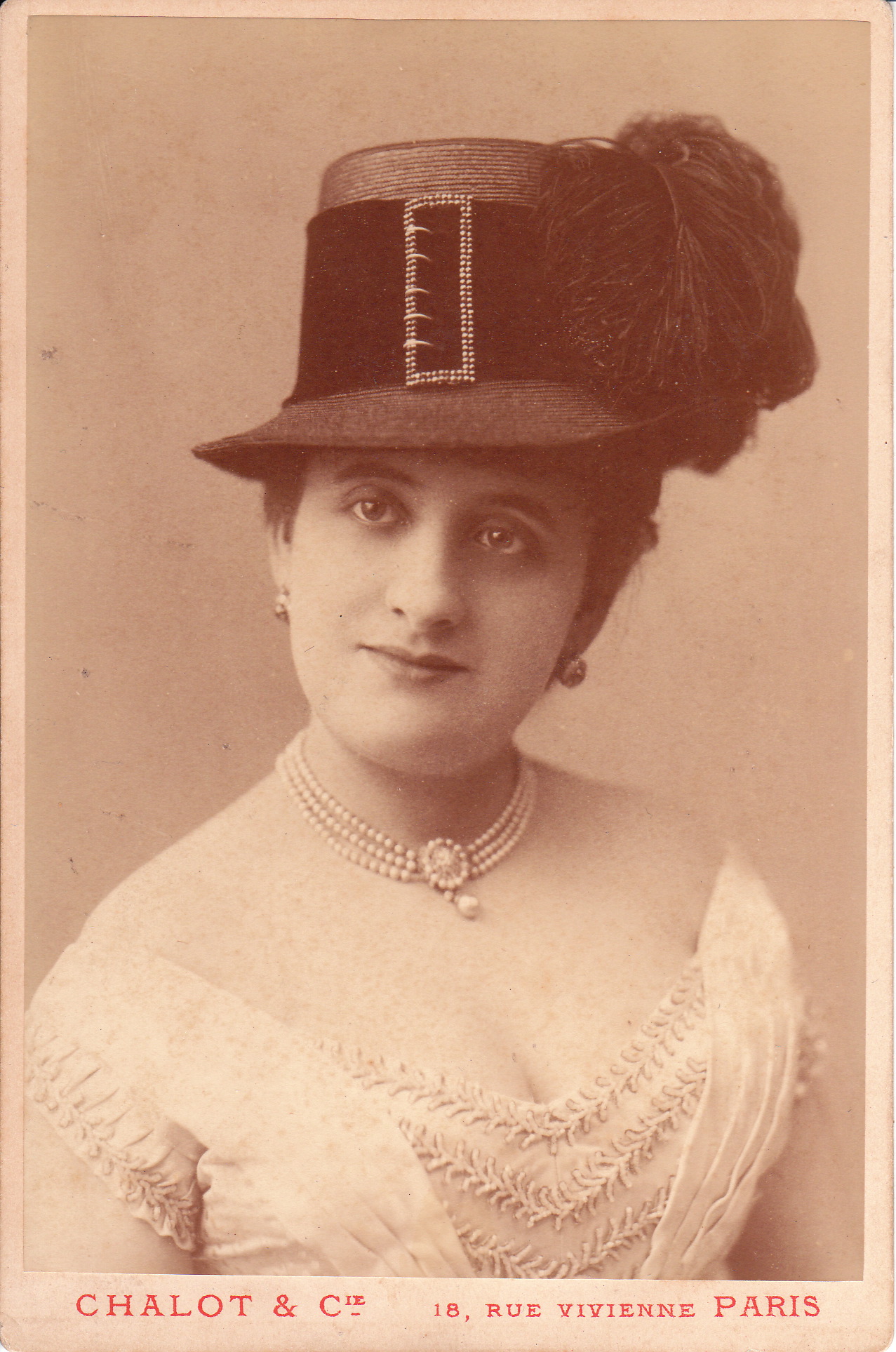
CONCHITA GELABERT: BEAUTIFUL OPERA STAR IN PARIS, FRANCE
This cabinet card features the lovely Conchita Gelabert, soprano and operetta actress. Marie “Conchita” Gelabert was born in Madrid in 1857 and died in Paris in 1922. She was educated in the Paris Conservatory of Music. An article in the New York Times (1922) announced her death. She was described as a “Spanish Comic Opera singer. who for many years was one of the most celebrated of Paris stars”. The article states that Gelabert “died today alone and forgotten”. Apparently, she had left the stage in 1890 and went into seclusion for the rest of her life. The cause of her abandoning her career and becoming an isolate, was an unhappy love affair. The article credits Gelabert with creating many roles, including “The Beautiful Person”and “The Grand Mogul”. This portrait was photographed by Chalot and Company of Paris, France. Ms. Gelabert is a stage beauty with eyes and an expression that can best be described as playful. She is wearing an interesting hat and well adorned with jewelry. Her dress is a bit risque but by Paris standards, this is a tame photograph. The photographer of this image, Isadore Alphonse Chalot was one of the subjects of an article appearing in the American Journal of Photography (1890). The article was entitled “Photographers in Paris- Their Studios and Workshops”. SOLD
FOUR SIBLINGS AND THEIR TOYS IN STEINHEIM, GERMANY
A sister and three brothers pose for their portrait at the Lammersen studio in Steinheim, Westphalia, Germany. The young girl is holding a doll with bows in its hair; which is the same way that the young girl wears her hair. One of the boys is playing with blocks while another boy is holding a book. The photographer of this image, F. Lammersen, took the photographs for an article appearing in the Strand Magazine (1898). The article was entitled “The Most Wonderful Hedge in the World” and was about the work of a railway guard at the Steinheim station. The railroad employee used his spare time to artistically clip hedges into wonderful sculptures and Lammersen’s camera provided many illustrations of the talented gardeners creative work.
EXCEPTIONALLY BEAUTIFUL WOMAN FROM DARMSTADT, GERMANY
The woman in this photograph is absolutely beautiful. She is also elegant and stylish. She is wearing a pretty boa and hat. The photographer of this image is Hofmann & Company. The studio was located in Darmstadt, Germany. Darmstadt is in the city of Hesse, which is a little south of Frankfurt. An inscription on the reverse of the photograph has the subject’s name and the date of the photograph. The name of this pretty fraulein is illegible but it is clear that the photograph was taken in 1905.