PORTRAITS OF GEORGE AND LIZZIE IN CHICAGO (STILL TOGETHER AFTER ALL THESE YEARS)

These two cabinet card portraits come from the same source and belong together. Writing on the reverse of one photograph indicates that the couple are named George and Lizzie. Perhaps the young man and  woman are married to each other. If not married, the two subjects may be siblings. The photographer of both cards is Copelin whose studio was located on the Northwest corner of Madison and State Streets in Chicago, Illinois. The exact address was 75 Madison Street. Some biographical information concerning the Copelin studio is available, but it is very difficult to sort out. It seems that Copelin had a succession of photography businesses. Alexander J. W. Copeland  (1851-c1923) and Melander bought out their boss to open a studio in Chicago sometime around 1870.  Copelin & Son was established in 1871 and existed about ten years. The business has an interesting story associated with it. The gallery was established just six days before the Chicago Fire (1871) and the building was completely destroyed in the blaze. The building had been the first photographic gallery in Chicago but had housed many proprietors. A.J. Copelin rebuilt the business. In the early 1880’s, the Copelin Gallery was established. Copelin eventually left portrait photography and opened a successful commercial photography business. Copelin is also recognized as one of the founding fathers of the Photographers Association of America.

CHARLES J. FOLGER: SECRETARY OF THE TREASURY UNDER PRESIDENT CHESTER ARTHUR

UThis cabinet card features Charles James Folger (1818-1884) who was an American lawyer and politician. He served as Secretary of the Treasury under President Chester Arthur. Folger was born in Nantucket, Massachusetts but lived most of his life in Geneva, New York. He attended Hobart College. His political career includes judgeships and some terms in the New York State Senate (1862-1869). While in the state senate, he served four years as President Pro Tempore. In 1869 he left state government after being appointed by President Ulysses Grant as the Assistant U.S. Treasurer. In 1870, he became a judge of the New York Court of Appeals and eventually became the Chief Judge. H eft the judgeship in 1881  to serve as Secretary of the Treasury, and during that tenure, he ran for Governor in New York against future U.S. President, Grover Cleveland. Folger had many accomplishments and he has just added a new honor to his legacy. Folger’s wonderful muttonchops, qualifies him to join the facial hair elite in the category of “Beards (Only the Best)”. Click on the category to view unusual styles of facial hair. This portrait was photographed by Falk, a well known New York City, celebrity photographer. To view other photographs by Falk, click on the category “Photographer: Falk”. A stamp on the reverse of  this cabinet card reveals that it was formerly owned by Culver Pictures of New York City, New York. Culver Pictures has been collecting photographs and illustrations from the 19th and first half of the 20th century, since 1926. These pictures are used in books, films, and other forms of media. At the time that this cabinet card was stamped by the company, Culver Pictures was located in New York City.

“LADIES AND GENTLEMEN, BOYS AND GIRLS, CHILDREN OF ALL AGES, LOOK AT THE GIRL ON THE FLYING TRAPEZE” …ROSE AUSTIN, AERIAL PERFORMING STAR

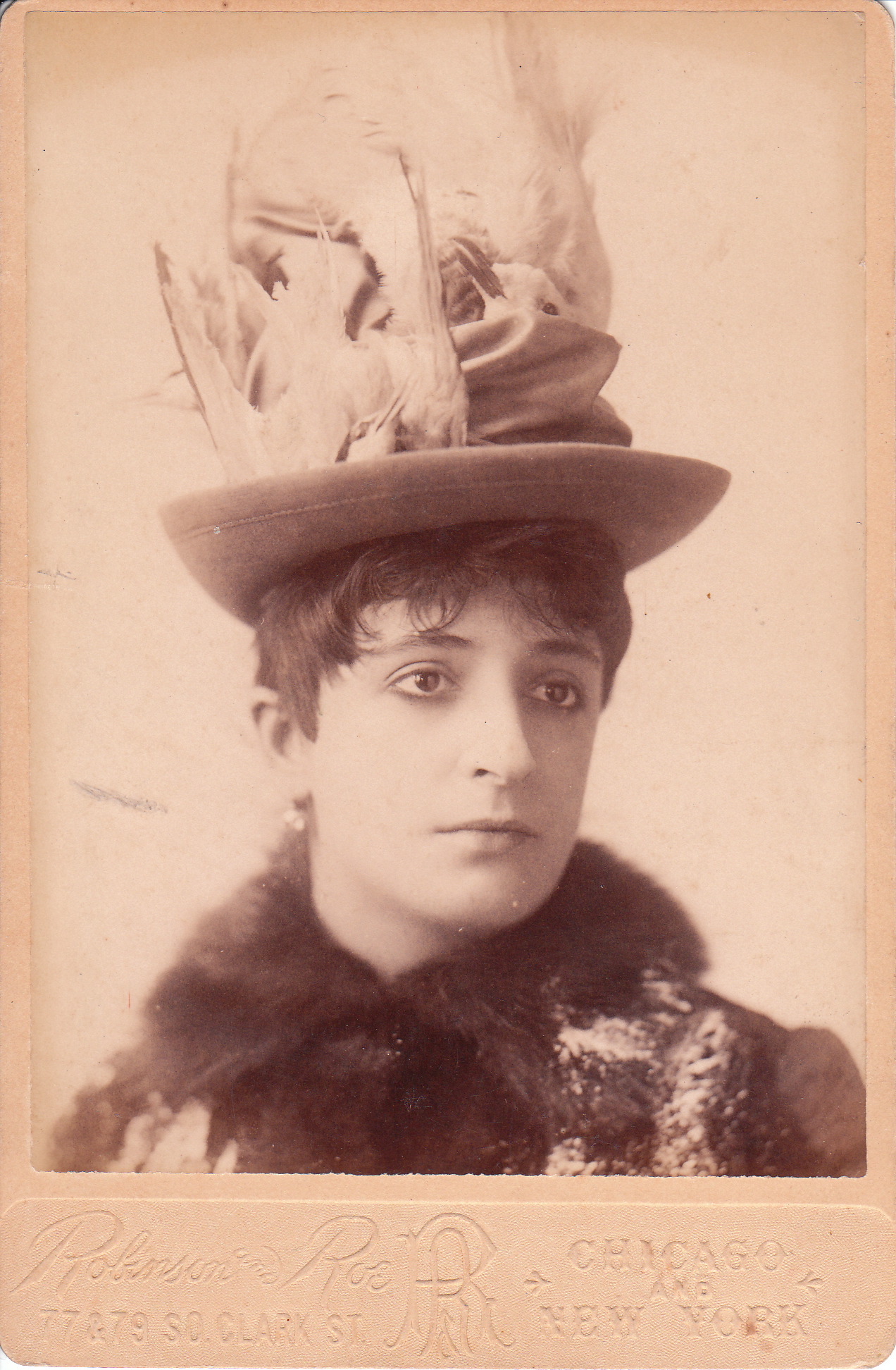
This cabinet card features a pretty, Rose Austin, of the Austin Sisters, who were well known trapeze artists. On the reverse of the photograph is a pencilled notation that states the performer’s name and “Bath Beach, Long Island, New York” (Bath Beach is in Brooklyn). The image was published by the Robinson & Roe studio which had galleries in both Chicago and New York City. The Circus Historical Society’s web site cites the “Austin Family”. Its members included R.G., Aimee (1870-1907), George E., and Rose. Among their venues were Orrin Brothers (1883-1884), W. W. Cole (1885), Coney Island (1892), and Bentley’s (1895). Aimee Austin, born in London, was an aerialist who was known as the “Human Fly” for her talent of “ceiling walking”. She began performing with Rose Austin, at nine years of age, as part of the Austin Sisters aerial act which played at the Circus Rentz, in Berlin, Germany. The act was managed by R. G. Austin. The aerialist performed with various European circuses before coming to the United States. Rose Austin was the subject of three articles in the New York Times. A 1892 article was entitled “Cannot Find Rose Austin”. The article reported that the disappearance of Ms. Austin from her home in Bath Beach. She was described as a well known trapeze performeer and leader of the “clever” Austin Sisters. It was also metioned that she was the wife of R. G. Austin; the manager of the Australian Theatrical Company. At the time of her disappearance, she and her sister were performing at Vaceas’s West End Casino in Coney Island, New York. She had been last seen boarding a ferry bound for New York City. The article points out that Ms. Austin had suffered from epilepsy for the previous four or five years and had experienced a severe attack about ten days earlier.(An acrobat with epilepsy? Doesn’t seem like a terrific career choice.). The article closes with a statement that both Rose Austin’s husband and her doctor, believed that she was either in a hospital, or had fallen off the ferry and drowned. A follow up article (1892) revealed that Ms. Austin had been found and was currently confined to bed as “she is wandering in her mind”. She couldn’t account for her whereabouts or activities during the time she was missing and last remembered falling ill on the ferry. A third article in the New York Times (1894) reports that Rose fell from a trapeze while performing with her brother George in Coney Island. She fell after fainting (one would imagine she had a epileptic seizure). She and her brother fell into a net together and knocked heads, rendering them both unconscious. George recovered quickly but Rose was brought home to Bensonhurst (Brooklyn) in a delirious condition. To view other photographs by Robinson and Roe, and to learn a little about them, click on the category “Photographer: Robinson & Roe”.  SOLD


LITTLE GIRL AND HER RATTLE IN ROCHESTER, NEW YORK

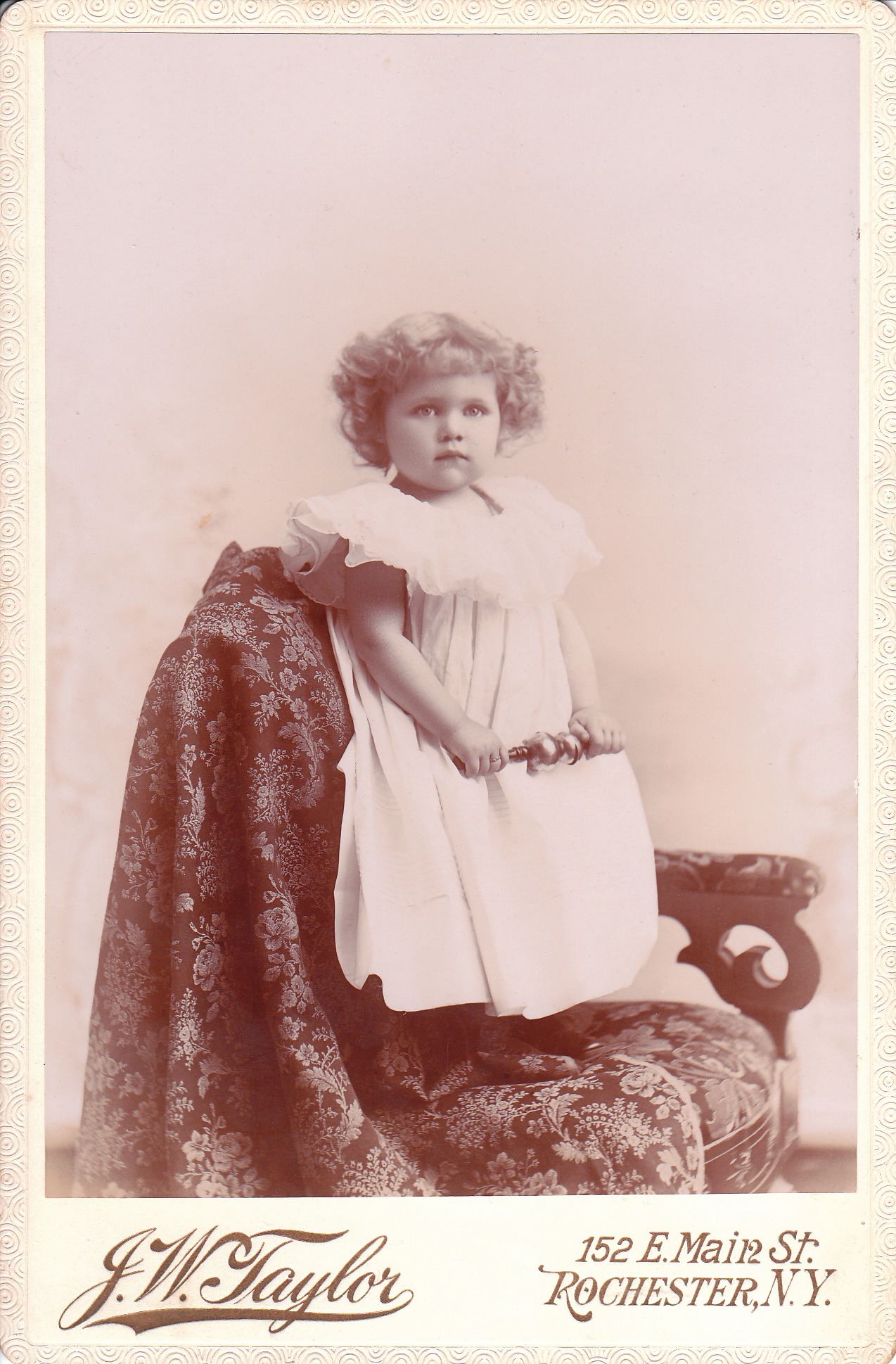
A cherubic, curly haired little girl stands on a blanket covered chair in the photographic studio of J. W. Taylor, in Rochester, New York. The girl is wearing a long gown and a very serious expression. She firmly holds a rattle with both hands. To view other photographs by Taylor, click on the category “Photographer: Taylor JW

Published in: on December 22, 2011 at 12:01 am  Comments (1)  
Tags: ,

A BOY AND HIS WOODEN TRICYCLE IN CLINTON, MASSACHUSETTS

This cabinet card features a well dressed young boy posing next to a wooden tricycle in the Jenness Studio, in Clinton, Massachusetts. The lad is wearing a suit, bow tie, and hat. Note the decorated wooden  handlebars on the tricycle and the fancy seat. The first tricycle was invented in 1680 by a disabled German man who wanted to maintain his mobility. There were many versions invented over time until Starley developed the first rotary chain drive tricycle in 1877. After the introduction of this model, tricycle riding became very popular. Tricycles and bicycles can be found in many cabinet card photographs. To view examples of such images, click on the category of  “Bicycle”.

Published in: on December 21, 2011 at 12:01 am  Comments (1)  
Tags: , , ,

PRETTY DANCER DOES A SPLIT (UNUSUAL RISQUE POSE)

This photograph captures an attractive dancer in an unusual pose. She is doing a split, which is a very risque pose for this time era. The woman is likely a professional dancer but it is possible that she is just a very athletic, and provocative young lady. There is no identification available of the young woman or of the photographer and studio. Perhaps a visitor to the Cabinet Card Gallery will recognize the dancer and leave a comment concerning her identity.  SOLD

Published in: on December 20, 2011 at 12:01 am  Comments (2)  
Tags: ,

PRETTY WOMAN IN LEWISTON, MAINE

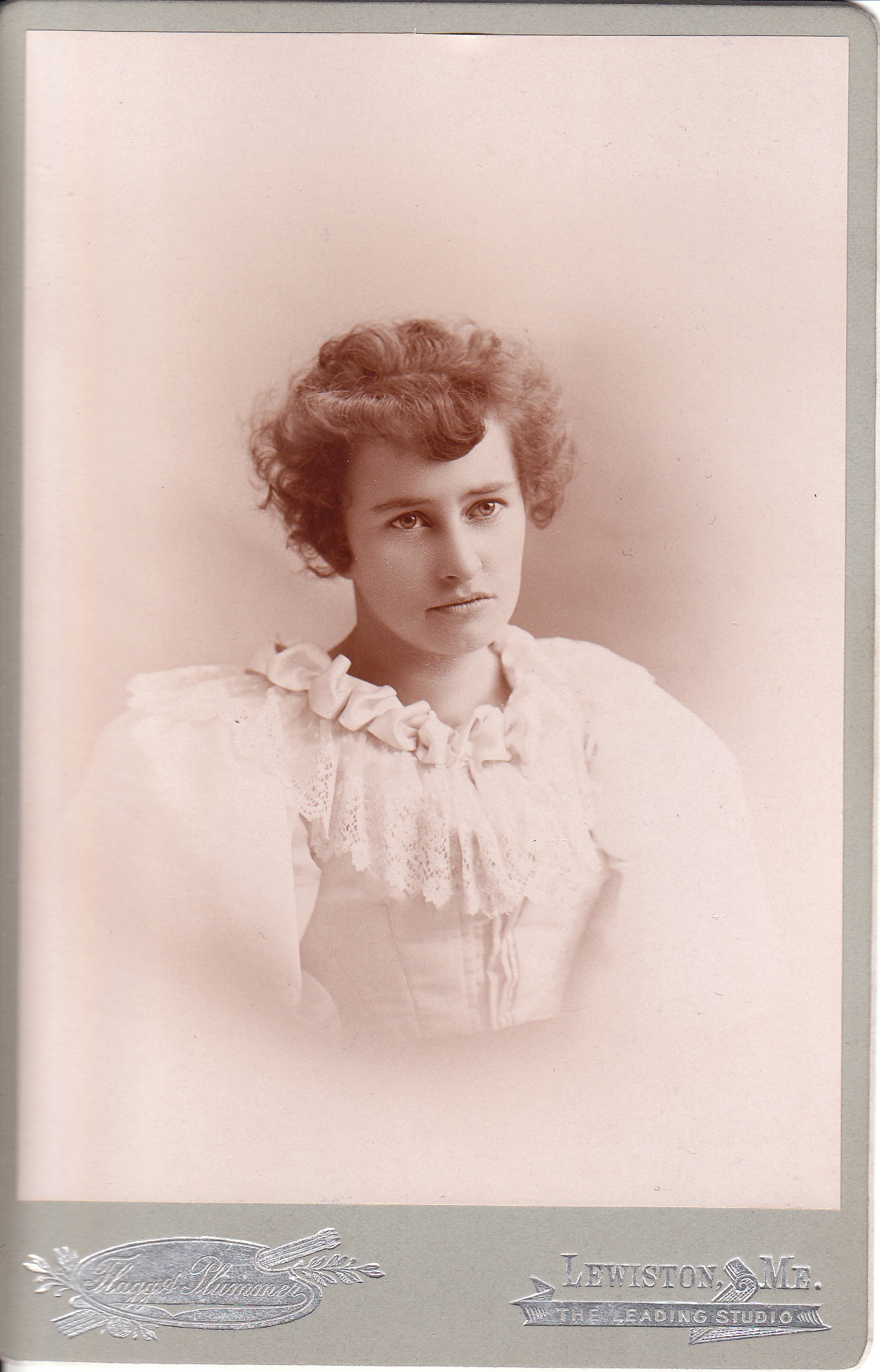
This photographic portrait features a pretty young lady posing for her portrait at the Flagg and Plummer gallery in Lewiston, Maine. The subject has quite the sour expression on her face. She looks exasperated, as if she has spent more time and effort at the photographer than she cared to. A pencilled inscription on the reverse of the photograph reveals that the Flagg and Plummer studio was the successor to the Curtis and Ross studio. The  notation also discloses that the young woman in this photograph was named Florence L. Bisbee and that the image was produced in 1899. According to the U.S. Census of 1900, Florence Bisbee was born in 1877 and lived in Auborn, Maine. She lived with her father (Byron), mother (Adiline), and two older brothers. Florence worked as a dry goods clerk, her father was a grocery clerk, and her brothers worked as shoe cutters. By the 1910  census, Florence was employed as shoe stitcher and in the 1920 census she was still living with her parents at the age of forty-three. The 1930 census found her as a head of household and  living with an older woman. She was still a shoe stitcher. Very little information could be found about this photographs creators.  The Flagg and Plummer studio is mentioned in an article in The Bulletin of Photography (1915) concerning the formation of an advertising group of photographers.

Published in: on December 19, 2011 at 12:01 am  Leave a Comment  
Tags: , , , , , , ,

AN ADORABLE BABY AND A PERAMBULATOR IN SOFIA, BULGARIA

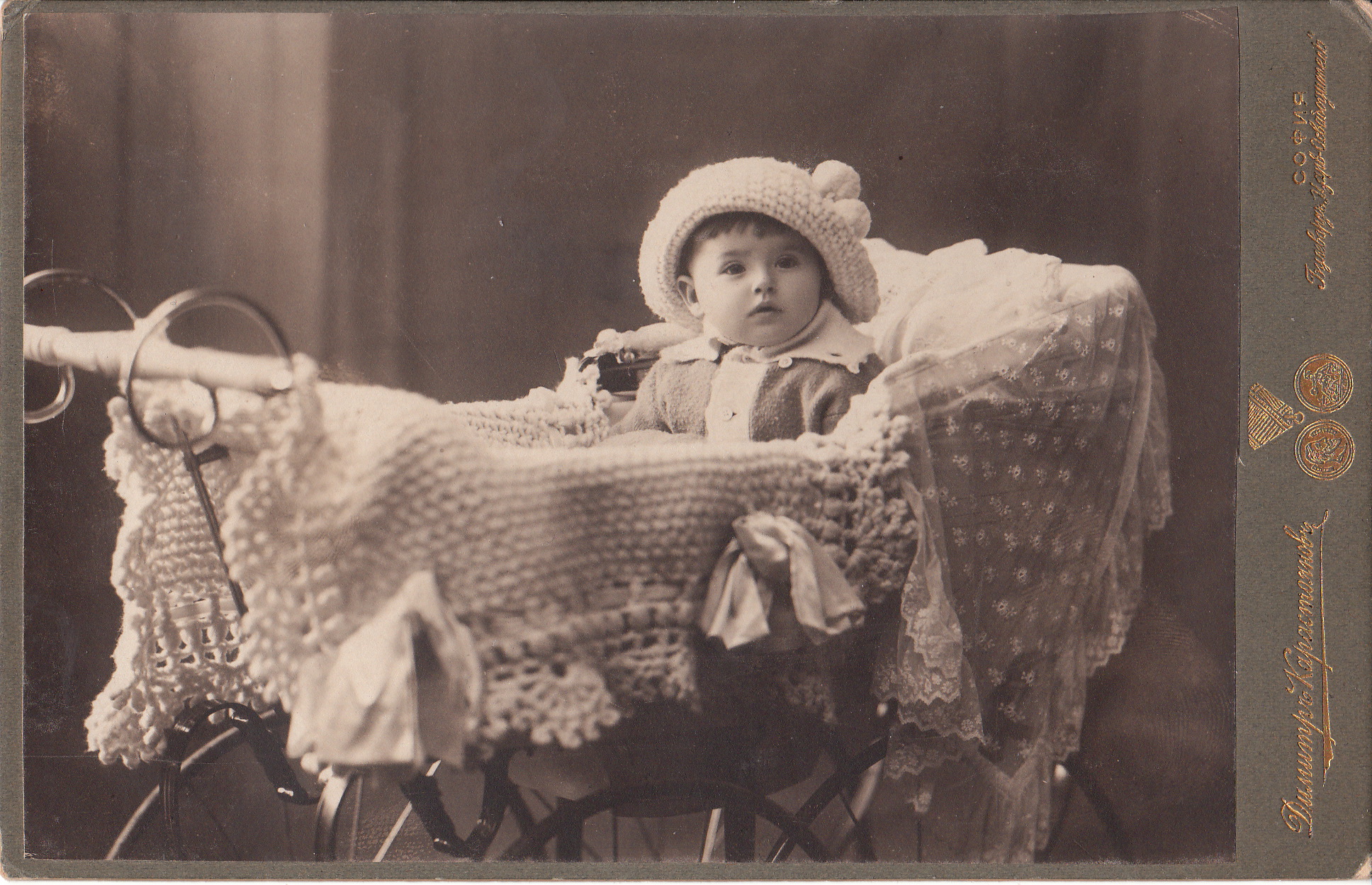
An adorable baby peers out of a comfortable looking perambulator at the studio of photographer, Dimitr Karastoyanow, in Sofia, Bulgaria. Note the baby’s wonderful hat. A written inscription on the reverse of the photograph reveals that the image was produced in 1912. To view other turn of the century perambulators, click on Cabinet Card Gallery’s category “Baby Carriage”.

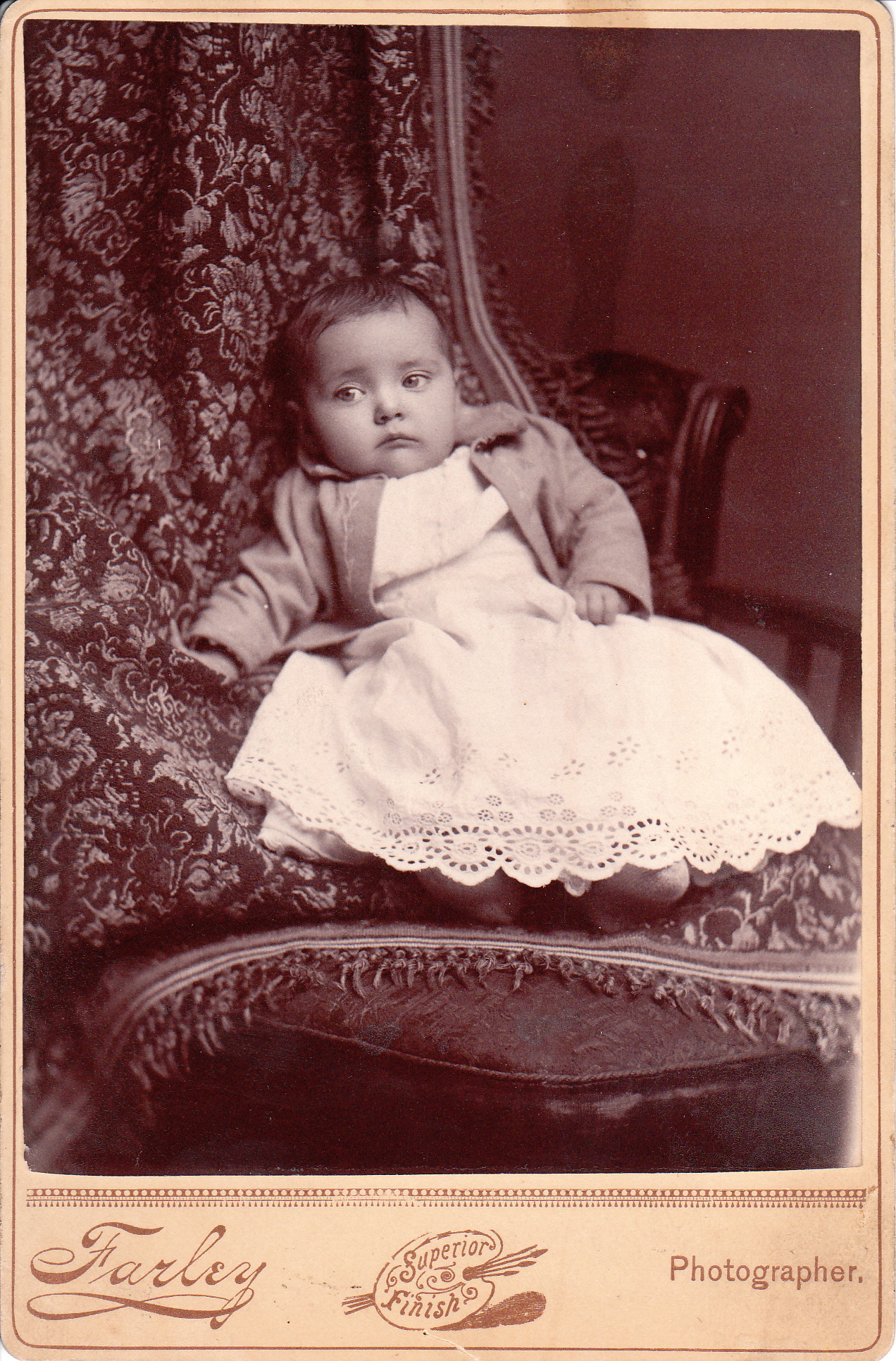
PORTRAIT OF AN ADORABLE BABY FUTURE SCHOOL TEACHER

This cabinet card photograph features a very cute baby wearing a gown and sweater. She has beautiful big eyes According to an inscription on the reverse of the image, the baby is named  Atalie Jean Crum and she was five months and two days old, at the time the photograph was taken. Atalie Crum can be found on both the 1900 and 1910 U.S. census. She was born in 1890 and resided in Penn, Illinois. She lived with her parents, Brooke W. Crum, and Laura V. Crum. Both of her parents were born in Pennsylvania and her father was a farmer. The 1910 census reveals that at age twenty, Atalie was employed as a school teacher. A 1913 publication from the Illinois Office of Public Instruction, states that Atalie taught school in Stark County, Illinois (District 53). At an unknown age, she married Claude Sterling, a local farmer. An obituary in the Peoria Star (1936), reports the death of John Wesley Crandell. He died at the age of 78 in Castleton, Illinois. He was his community’s last surviving civil war veteran. A male quartet sang at the funeral and they were accompanied by a Mrs Atalie Sterling at the piano. This is likely the Atalie Sterling in the photograph. Atalie lived a long life, dying in 1969 at age eighty in Wyoming, Illinois. The photographer of this cabinet card is difficult to identify with any certainty. There was a photographer named W. H. Farley who operated in Crete and Gibson Illinois in the 1880’s. A photographer named A. Farley also had a studio in Illinois. Research uncovered another cabinet card with the same Farley logo as this cabinet card. The card was from a studio located in Tampico, Illinois. Tampico is the likely place that Atalie Crum was photographed.

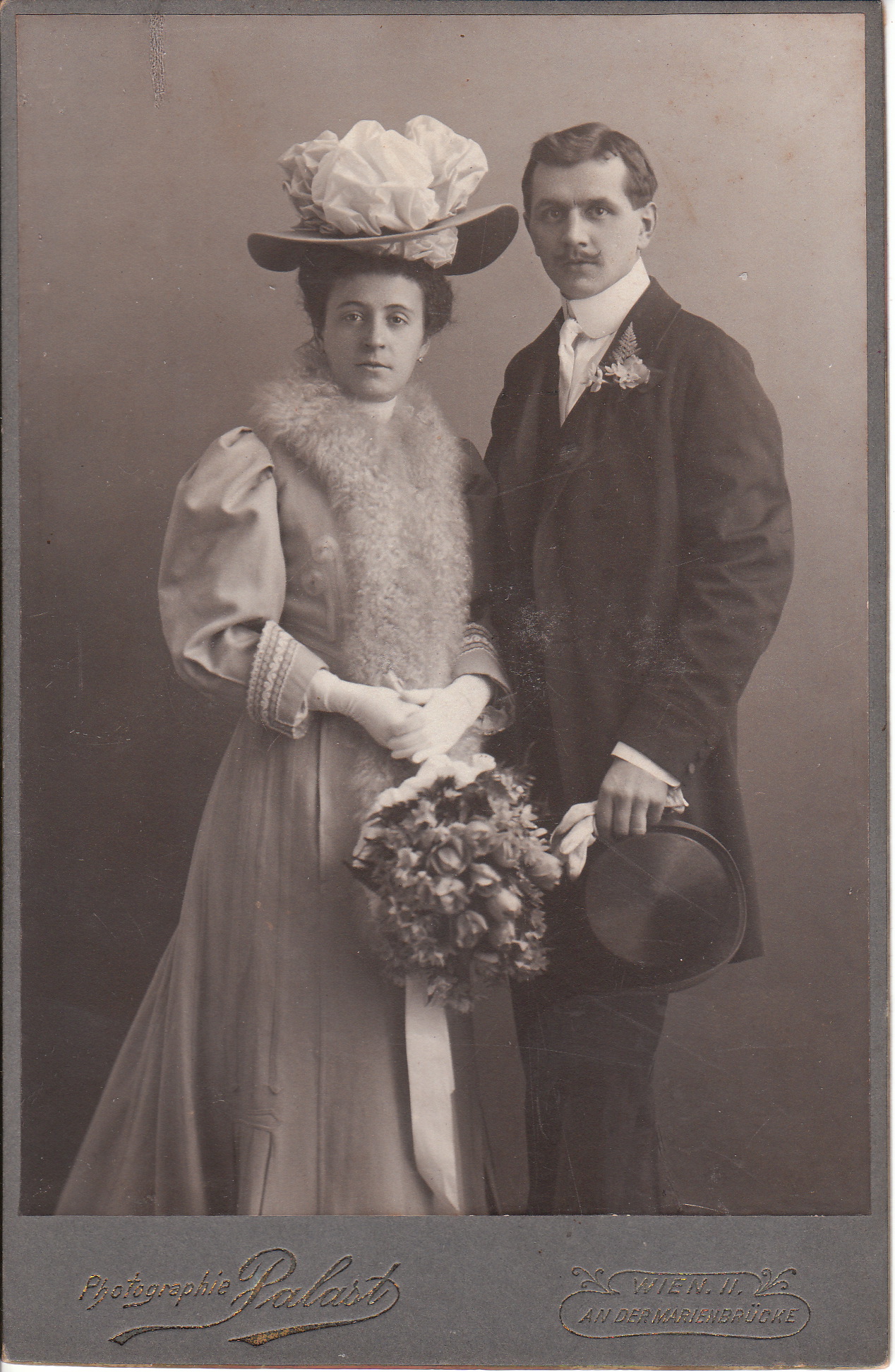
BEAUTIFULLY DRESSED AND ATTRACTIVE COUPLE IN VIENNA, AUSTRIA

The couple in this photograph are attractive and handsomely dressed. The woman is wearing a fashionable hat and gloves, and is holding an arrangement of flowers.  The gentleman is formally dressed, holding a pair of gloves, and wearing a corsage. He is also holding, what appears to be a top hat.  The couple is likely  from the wealthy and privileged class. The photographer is named Palast, or something close to that name. The legibility of  the name of the photographer is not clear and any help from cabinet card gallery visitors  in identifying the photographer, would be appreciated. The photographer’s studio was located in Vienna, Austria.

Published in: on December 12, 2011 at 12:01 am  Comments (4)  
Tags: ,