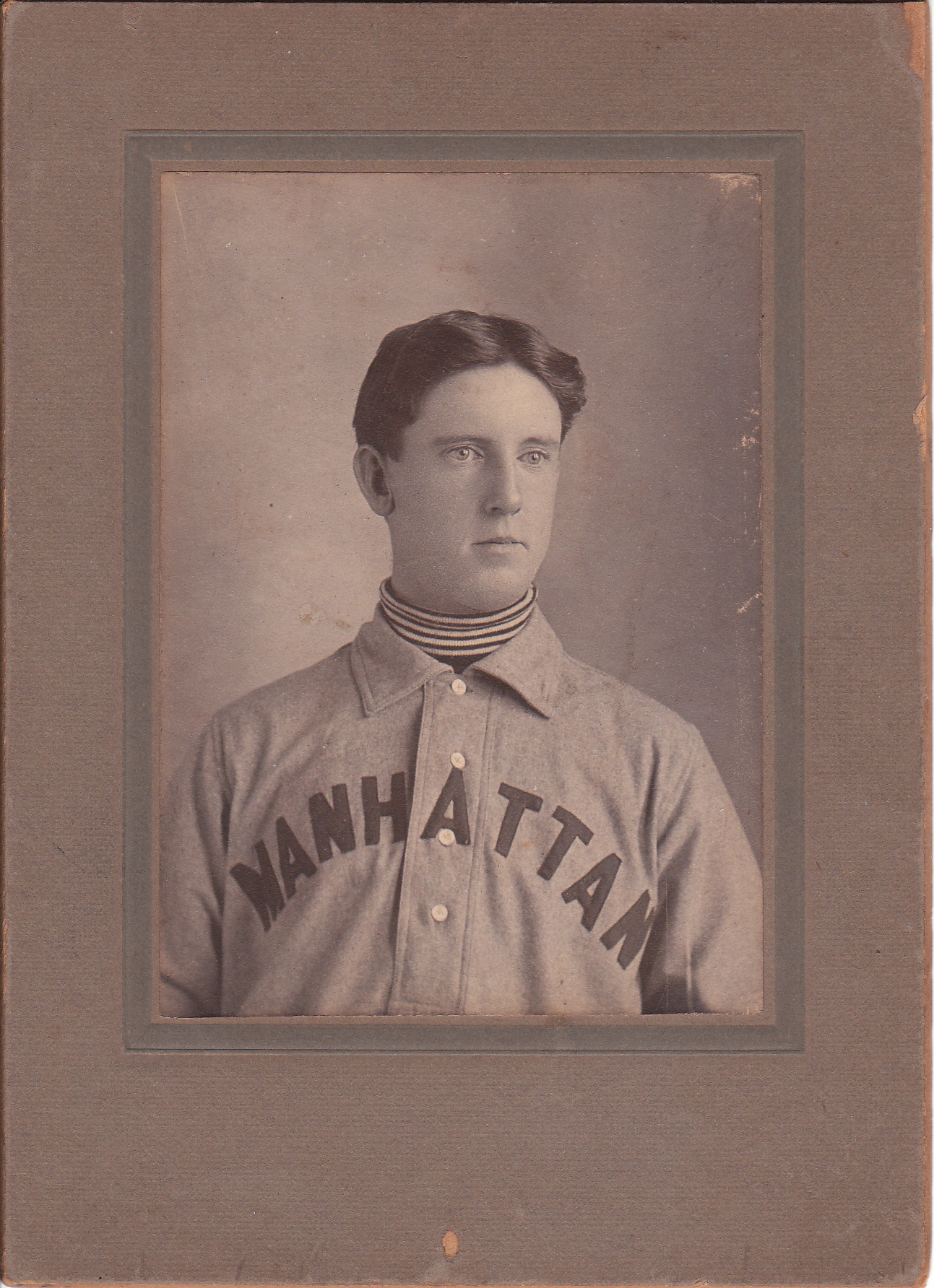
 A young baseball player in uniform, poses for a photographer at an unknown studio in this antique photograph. Did he play for the Manhattan College Jaspers? Lets investigate some college and baseball history! Manhattan College, a Catholic school, was established in 1853 as the Academy of the Holy Infancy. The school became a college in 1859 and the schools name became Manhattan College in 1863. The school coexisted with Manhattan College High School, which was originally founded in 1854. The high school served as a prep school and many of its graduates went on to attend Manhattan College. Manhattan College had a baseball team early in its history as well as early in baseball’s history. The college played the New York Giants annually in the late 1880’s and into the 1890’s. They played their games at the Polo Grounds. An interesting side note is that Manhattan College is credited by Baseball’s Hall of Fame, as creating the “seventh inning stretch” which was later adopted by the Major Leagues. In addition, 28 players from Manhattan College have made it to Major League Baseball. The Manhattan College team is named the “Jaspers” The name originates from an individual, Brother Jasper, who served the college in the late nineteenth century and brought baseball to the school. He also was the teams first coach. The question remains; is the player in the photograph a former member of the collegiate Jaspers? Is he a former member of the prep school team; or is he a member of some other team from a non New York town called Manhattan? Perhaps a visitor to this site will pitch hit for this writer and determine just which Manhattan team this young man played for.
EARLY BASEBALL PLAYER: WAS HE ON THE ROSTER OF THE MANHATTAN COLLEGE JASPERS?

BUNDLED UP FOR THE COLD: ADORABLE LITTLE GIRL IN FOSCANI, ROMANIA
 Although this image is a studio portrait, this bundled up little girl looks seriously cold. Her long and heavy coat appears to be made out of fur or possibly wool. Her hands are kept warm in a muff and her wide brimmed hat protects her face from the falling snow. If the wind is blowing the snow toward her; she is out of luck. Are those flowers that she is wearing in her hair? Flowers, in the winter? Perhaps its because of that famous song, “If you go to Foscani, be sure to wear, flowers in your hair”. Oops! Wrong city and wrong era! The photographer of this image is Franz X. Koroschetz of the aforementioned, Foscani, Romania.
DAPPER MAN WEARING A DERBY IN LANCASTER, PENNSYLVANIA
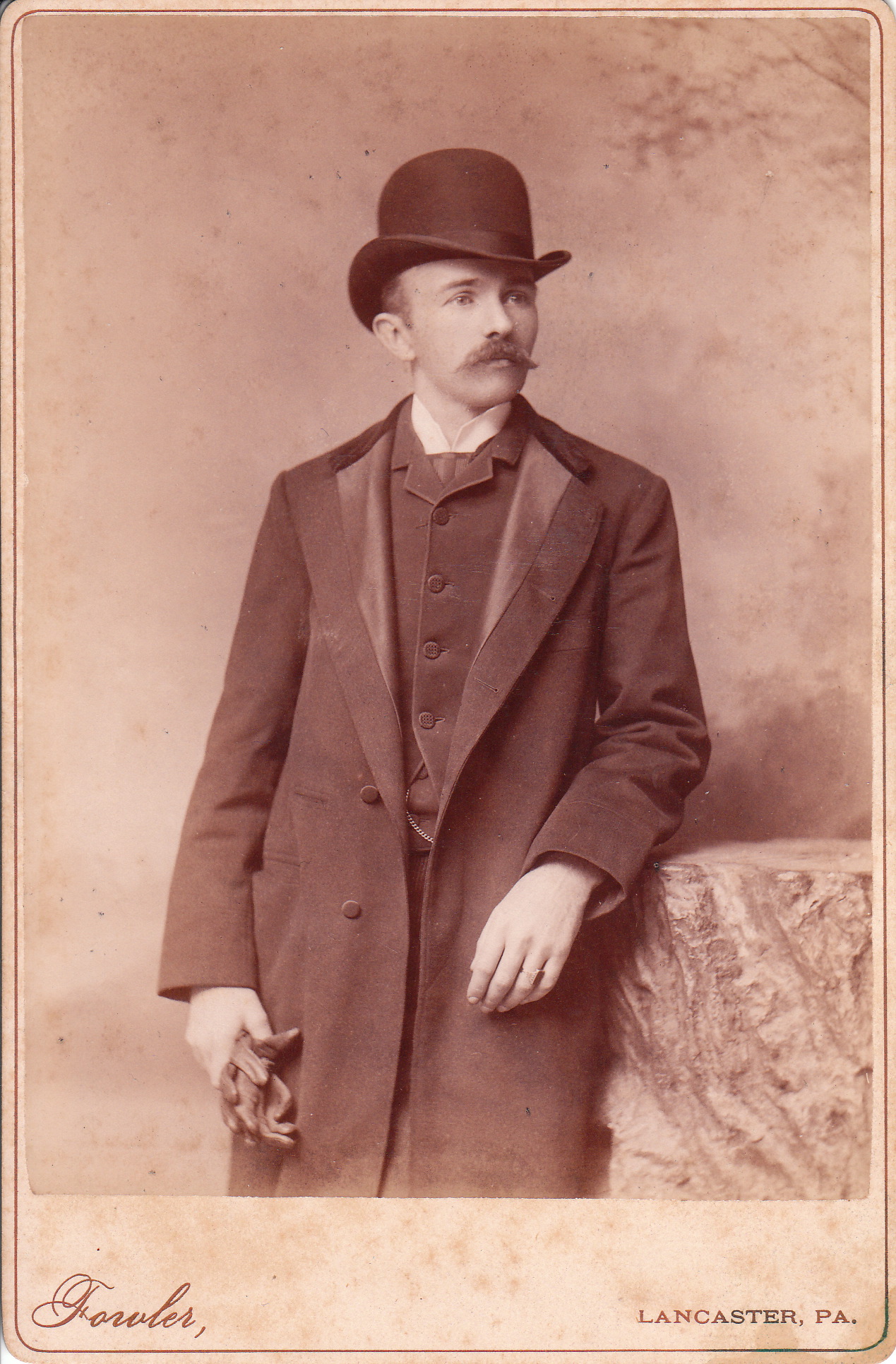 A dapper man poses for his portrait at the studio of Lewis C. Fowler, in Lancaster, Pennsylvania. This gentleman is nicely dressed. He is wearing a long outer coat with what appears to be a velvet collar and satin lapels. He is holding a pair of gloves and has a derby hat on his head. The subject of this photograph’s image possesses an aura of success and importance. Fowler’s photographic studio was located at 12 West King Street, in the town of Lancaster. An advertisement in the Lancaster Board of Trade directory appeared in 1887. A directory of businesses in Philadelphia, indicates that Fowler operated a studio there in 1890. It is unknown whether he conducted businesses in both cities simultaneously. To view other photographs by Fowler, click on the category “Photographer: Fowler (Lewis)”.
A STUDIOUS LOOKING MAN WEARING PINCE-NEZ SPECTACLES IN NEW YORK CITY, NEW YORK
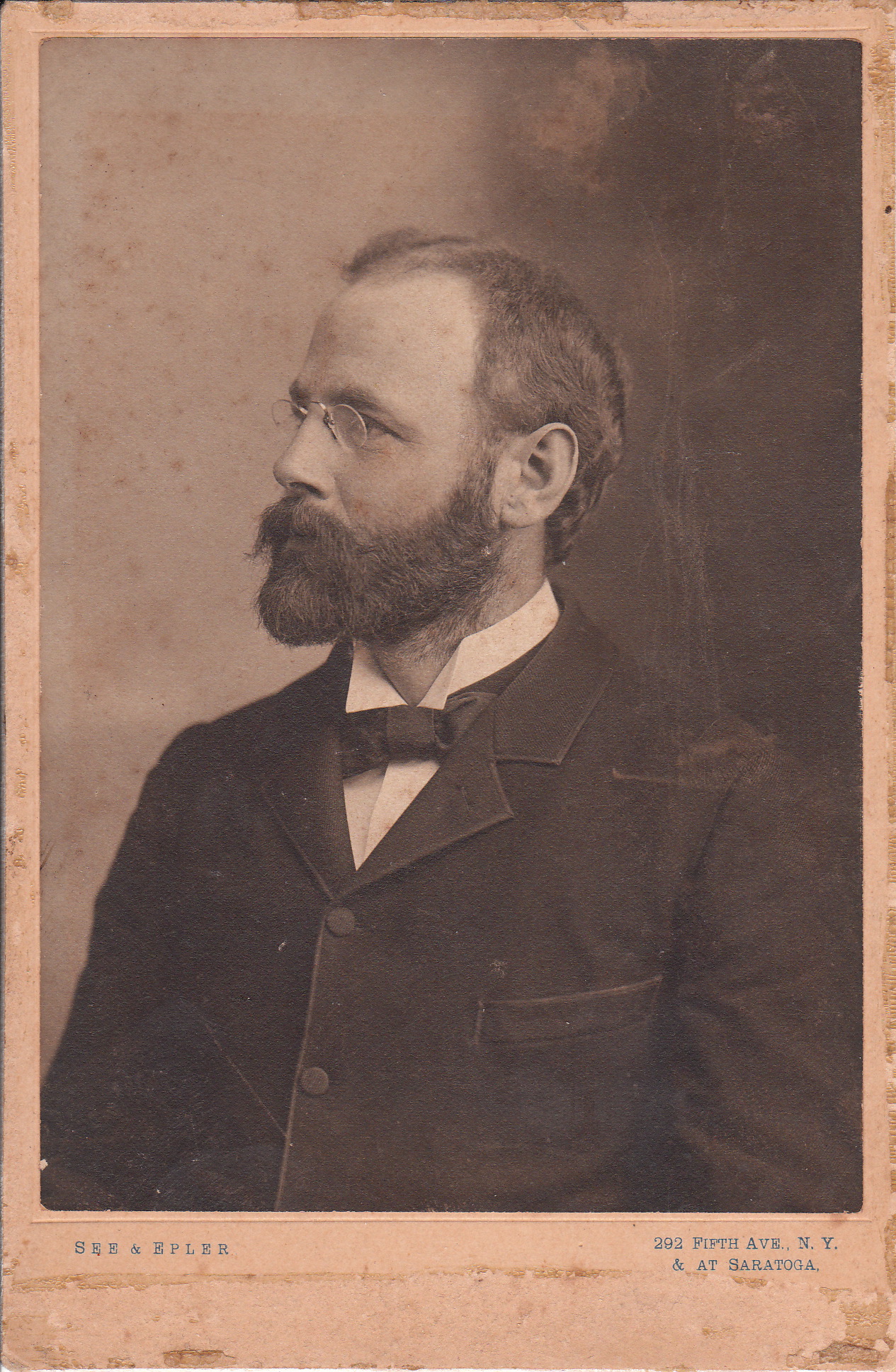 The gentleman pictured in this cabinet card has the appearance of a scholarly man. The man’s pince nez eyeglasses, and his beard contribute to his studious look. Pince-nez glasses are a style of spectacle that is supported without earpieces, by pinching the bridge of the wearer’s nose. The name has French origin and this type of eyewear reached peak popularity between 1880 and 1900. The photographer of this cabinet card is H. T. See & H. (I. or J.) Epler. The middle initial of Epler is unclear in the reference where it was found. An advertisement for the See & Epler studio appeared in the Columbia Spectator (1899). The advertisement stated the studio was the “Photographer to Columbia University” and that the firm offered special rates to students. The studio was located in New York City and Saratoga, New York.
SOMEWHAT ATTRACTIVE YOUNG WOMAN IN BANGOR, MAINE
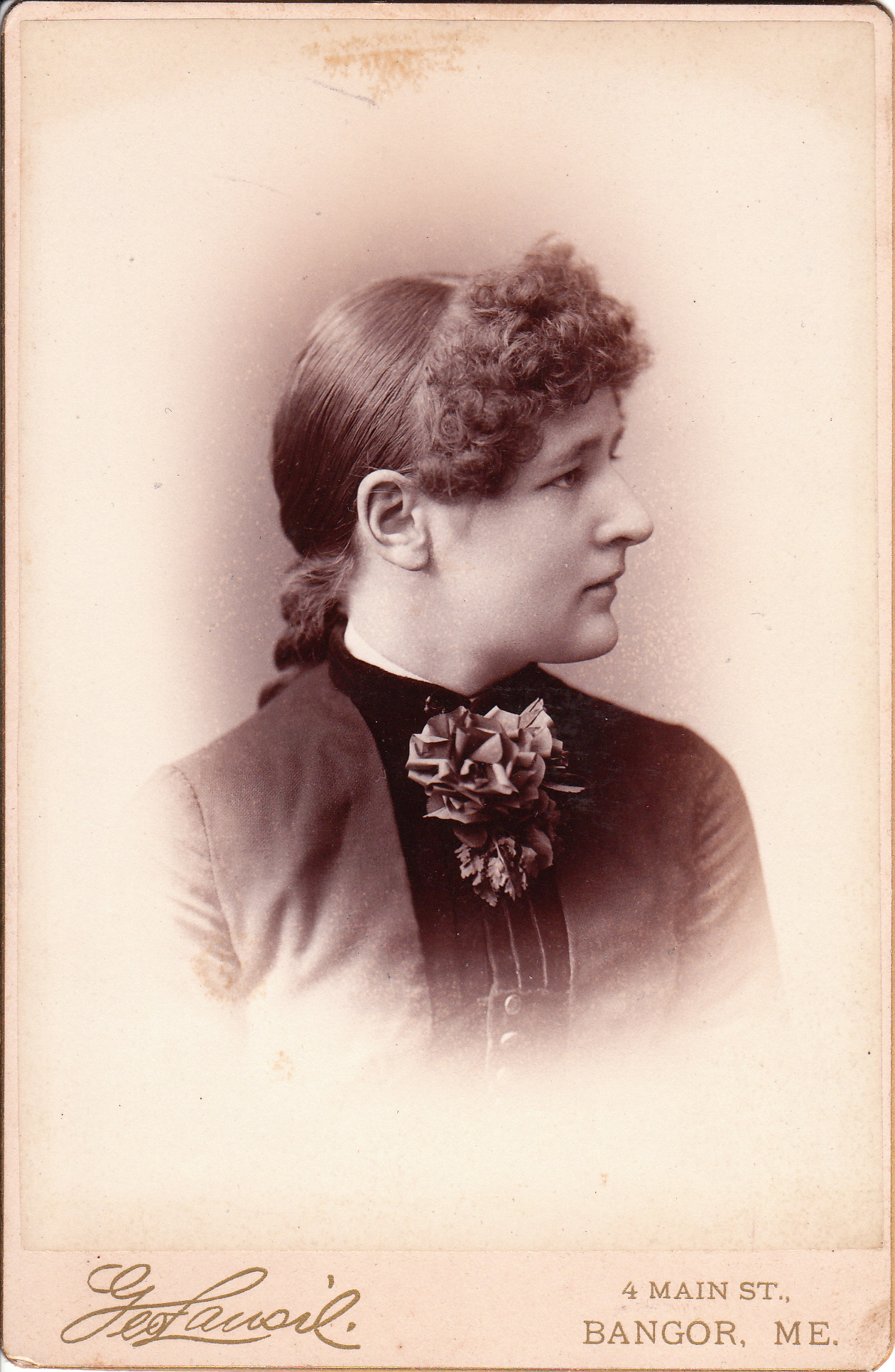 This cabinet cad features a somewhat attractive young lady posing at a photographic studio, in Bangor, Maine. The profile image reveals an interesting hairstyle that includes braids. The photographer was George Lausil.
FAMILY PHOTOGRAPHED BY “THE TWO JOHNS” IN LINCOLN, NEBRASKA
 A couple and their two young children pose for the photographer at the “The Two Johns” studio in Lincoln, Nebraska. The couple is dressed in western clothing. The woman’s outfit looks suspiciously like a salvation army uniform. The woman is holding an umbrella. The little girls couldn’t be sitting any closer. Their straw hats can be seen on the floor. Note how elaborate the backdrop is in this photograph.
CLASS PHOTO IN FRONT OF RURAL SCHOOLHOUSE IN PRAGUE, NEBRASKA
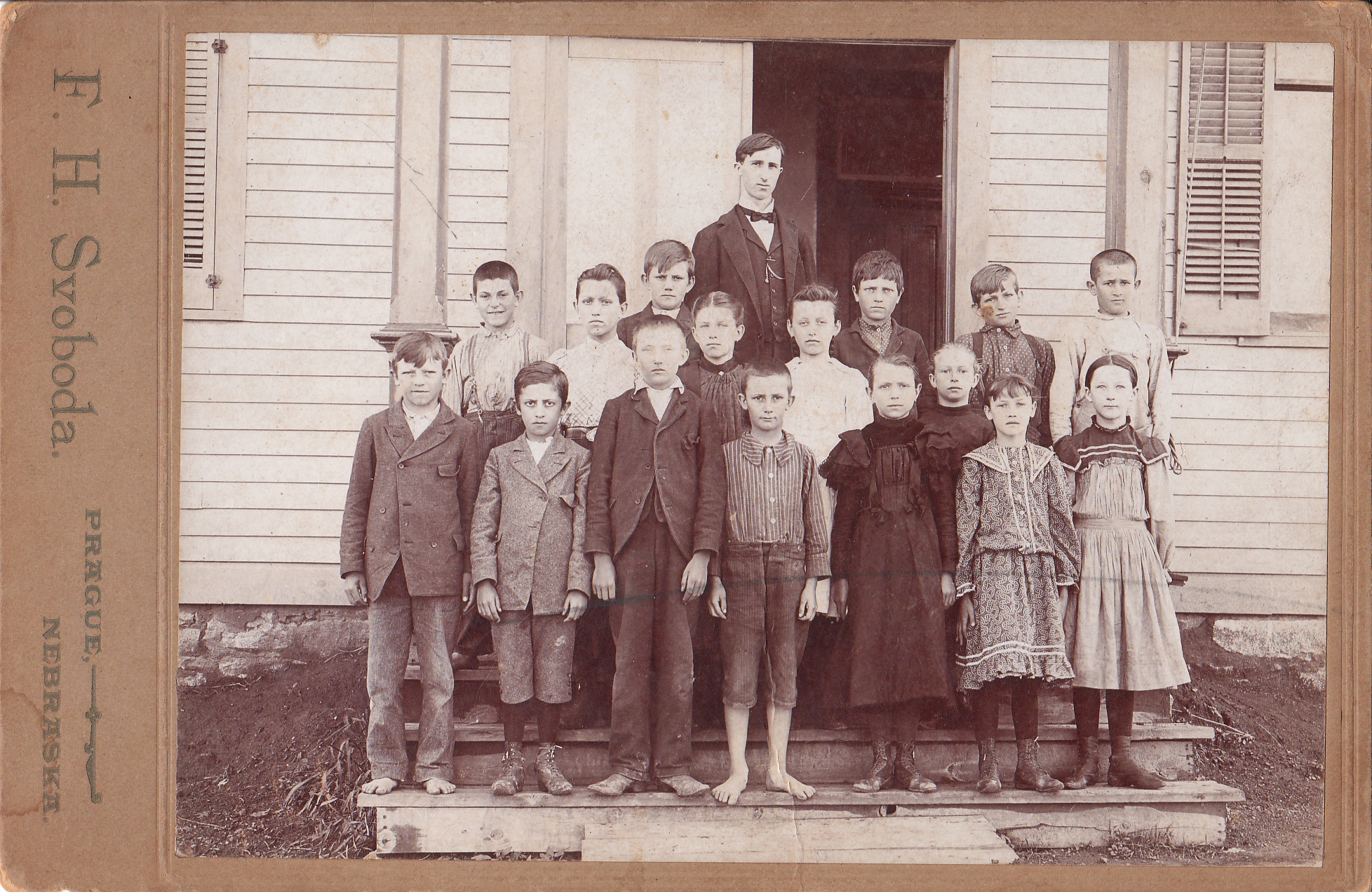 This cabinet card offers a glimpse back into historical times of the American education system. This image dates back before “teaching for the test” was standard policy for many school districts. Sixteen children are posed in front of their schoolhouse. Their young teacher stands behind his class. The children seem to have dressed nicely for “picture day”, but at least a couple of the boys are barefoot. F. H.Svoboda was the photographer of this image and his studio was located in Prague, Nebraska. At one time, Svoboda published the first, and only, Czech juvenile magazine in Nebraska. He was a school teacher and later engaged in photography. In 1909, he began to publish the Schuyler Messenger, which existed until 1920. The Messenger was a weekly newspaper in Schuyler, Nebraska. The town of Prague has an interesting history. Its early inhabitants included many Czech settlers who arrived in America seeking prosperity during the 1880’s. In 1887, the town was built to support a newly established railroad station. The town was built by the Lincoln Land Company and became a thriving community catering to the agricultural economy of the area. The largest business in the town was a lumberyard. The town’s name, Prague, is named after the capital city of Czechoslovakia.
PRETTY AND VIVACIOUS YOUNG WOMAN WITH UNUSUAL HAIRSTYLE IN BUDAPEST, HUNGARY
 This cabinet card features an attractive young woman with a great smile. She gives the appearance of someone very vivacious. She is beautifully dressed and her hair is very long and worn in a style that can best be described as a “hair pile”. One wonders how much time it would take her to dry her hair after bathing. Were hair dryers available to this pretty long tressed lady? Most readers will be surprised to learn that this portrait was likely taken after the invention of the hair dryer. Hair dryers were invented in 1890 by Alexandre Goldefroy. He drew his inspiration from vacuum cleaners. Goldefroy owned a hair salon in France; and his patrons sat under the hair dryer. Hand held hair dryers were invented in the 1920’s. The photographer of this image is Kozmata Ferencz (1846-1902), located in Budapest, Hungary. To view other photographs by Ferencz, a celebrated Hungarian photographer, click on the category “Photographer: Ferencz”.
DISTINGUISHED OLDER MAN WITH HALF A BEARD IN BOSTON, MASSACHUSETTS
 This cabinet card features the portrait of a gray haired older man with an appearance problem. He apparently had a great deal of ambivalence about whether he should grow a beard. In a flash of brilliance, he decided to grow a half a beard, the bottom half. He is a distinguished looking man and no one could look as good as he does, with half a beard. This photograph is a fine example of creative facial hair styles; therefore it earns its place in Cabinet Card Gallery’s category of “Beards (Only the Best)”. This image was photographed by Chamberlain of Boston, Massachusetts.
EIGHT ATHLETIC LOOKING BLOKES IN SYDNEY, AUSTRALIA
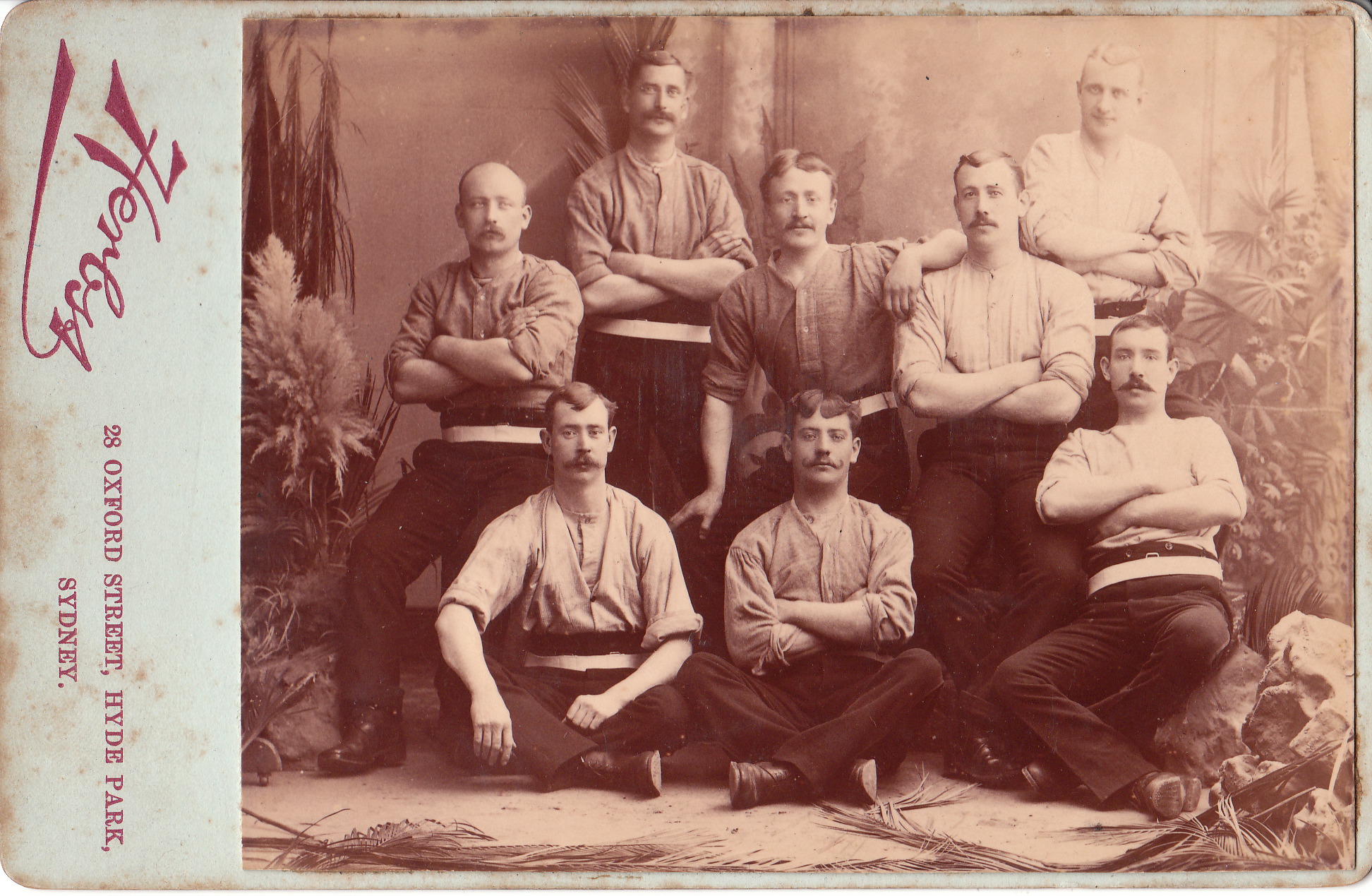 This cabinet card is a portrait of eight very athletic looking men. The men are dressed very similarly. Their pants appear to be identical and they each are wearing a wide white belt around their waists. The image presents a number of questions. Are these Aussie blokes wearing a uniform? Are they members of a sports team? Are they wearing work clothing and all share the same occupation? Hopefully some Cabinet Card Gallery visitors will leave a comment that gives their opinion as to the answers to the aforementioned questions. The photographer of this image is Herbst of Sydney, Australia. He is mentioned in a number of Sydney newspapers published in the 1890’s. Advertisements for his studio appear in the newspapers, and there is mention of some of the notables he photographed.


 THE CABINET CARD GALLERY