POSTCARD 1
POSTCARD 2
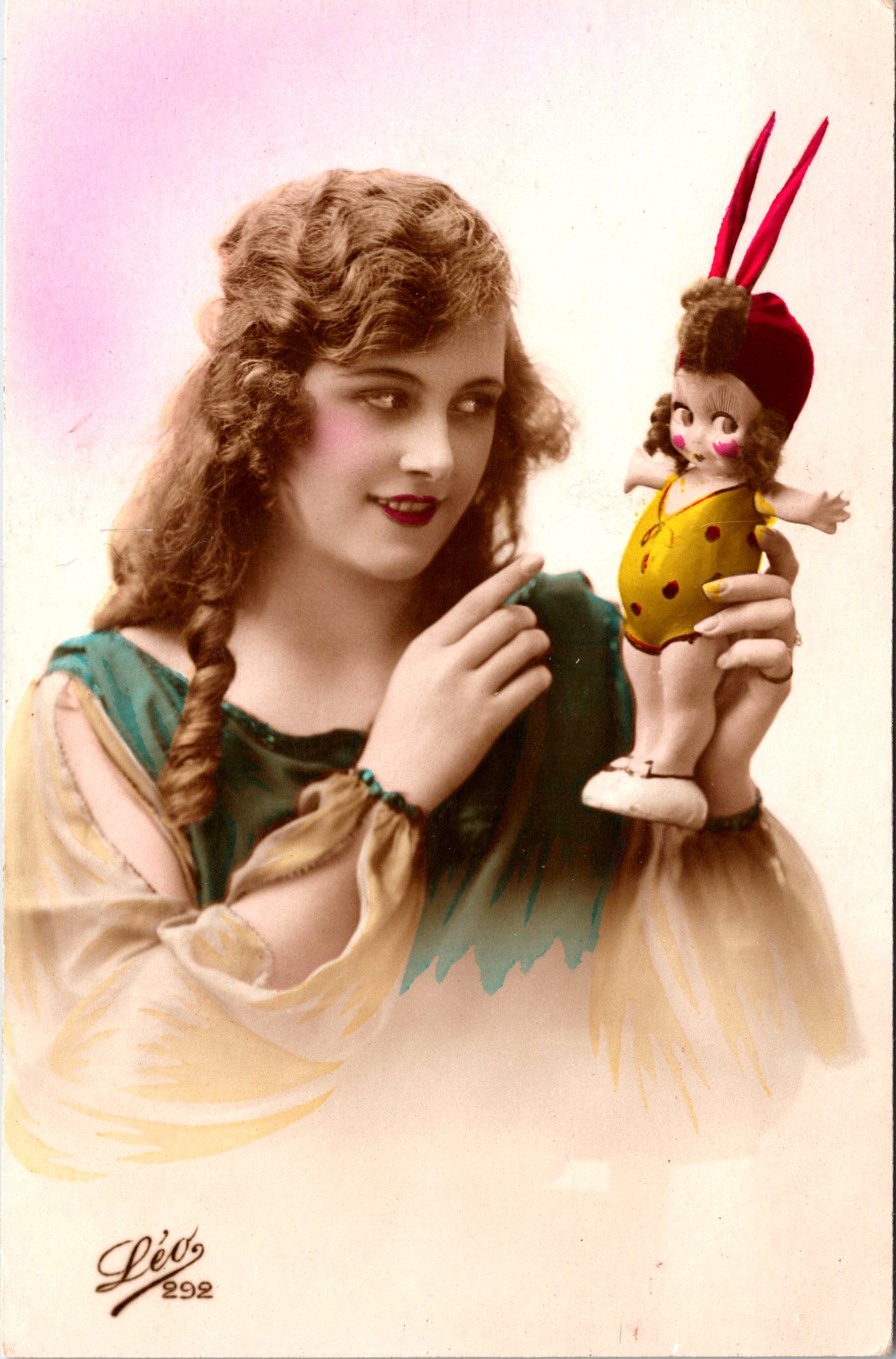
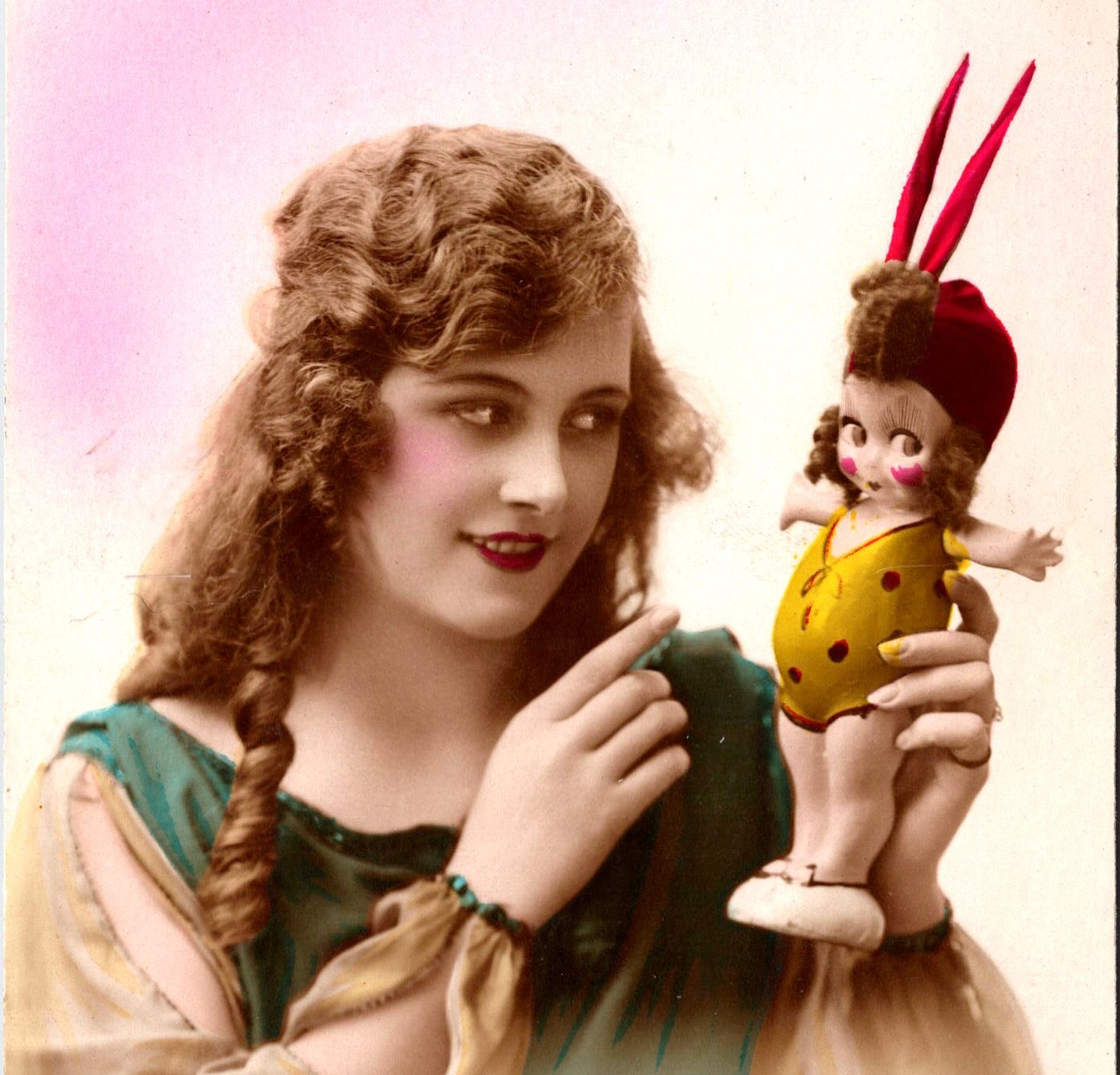
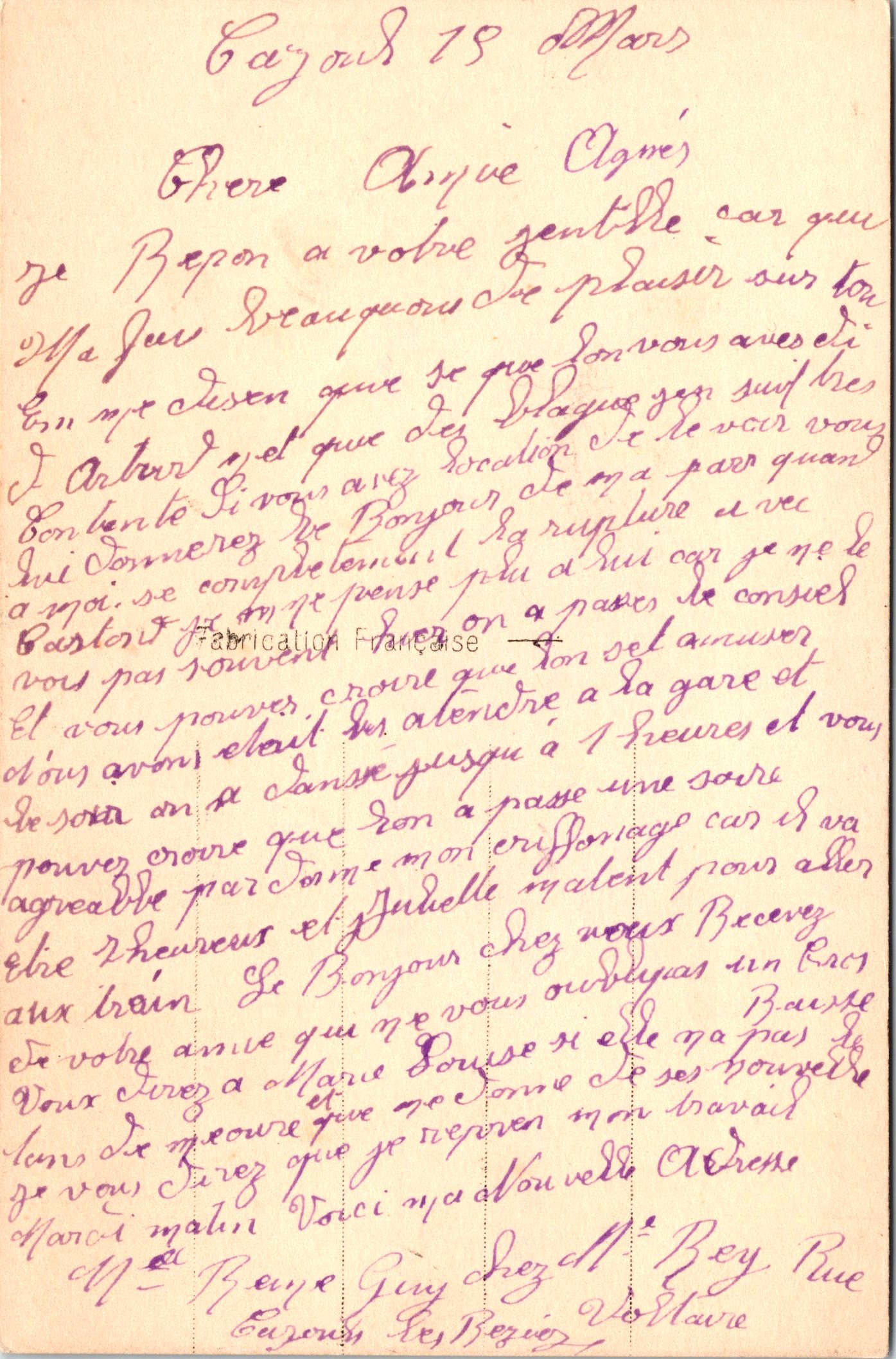
This vintage French tinted real photo postcard features a pretty young woman holding a very cute kewpie doll. Kewpie is a brand of doll which was modeled after a comic strip character created by cartoonist Rose O’Neill in 1909. The doll had a similar appearance to cupid. In 1912 the first kewpie doll appeared and it was a bisque doll. Later, the dolls were made of composition (1920’s), celluloid (1930’s and 1940’s), and later plastic kewpies made their appearance. The woman in this photo has a beautiful smile and pretty eyes. She is colorfully dressed. This postcard was published in the 1920’s by Leo as part of a series (No.292). SOLD

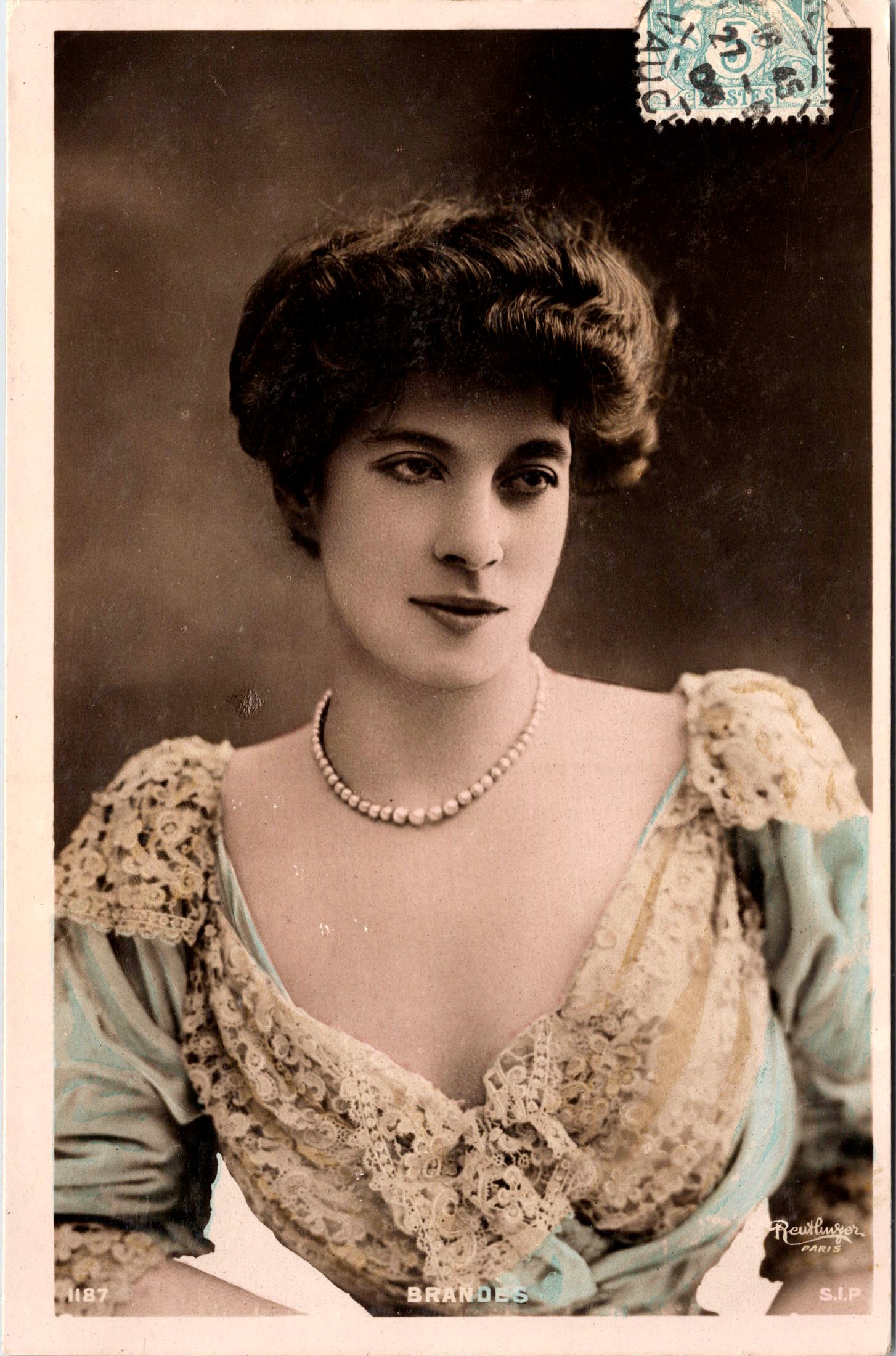
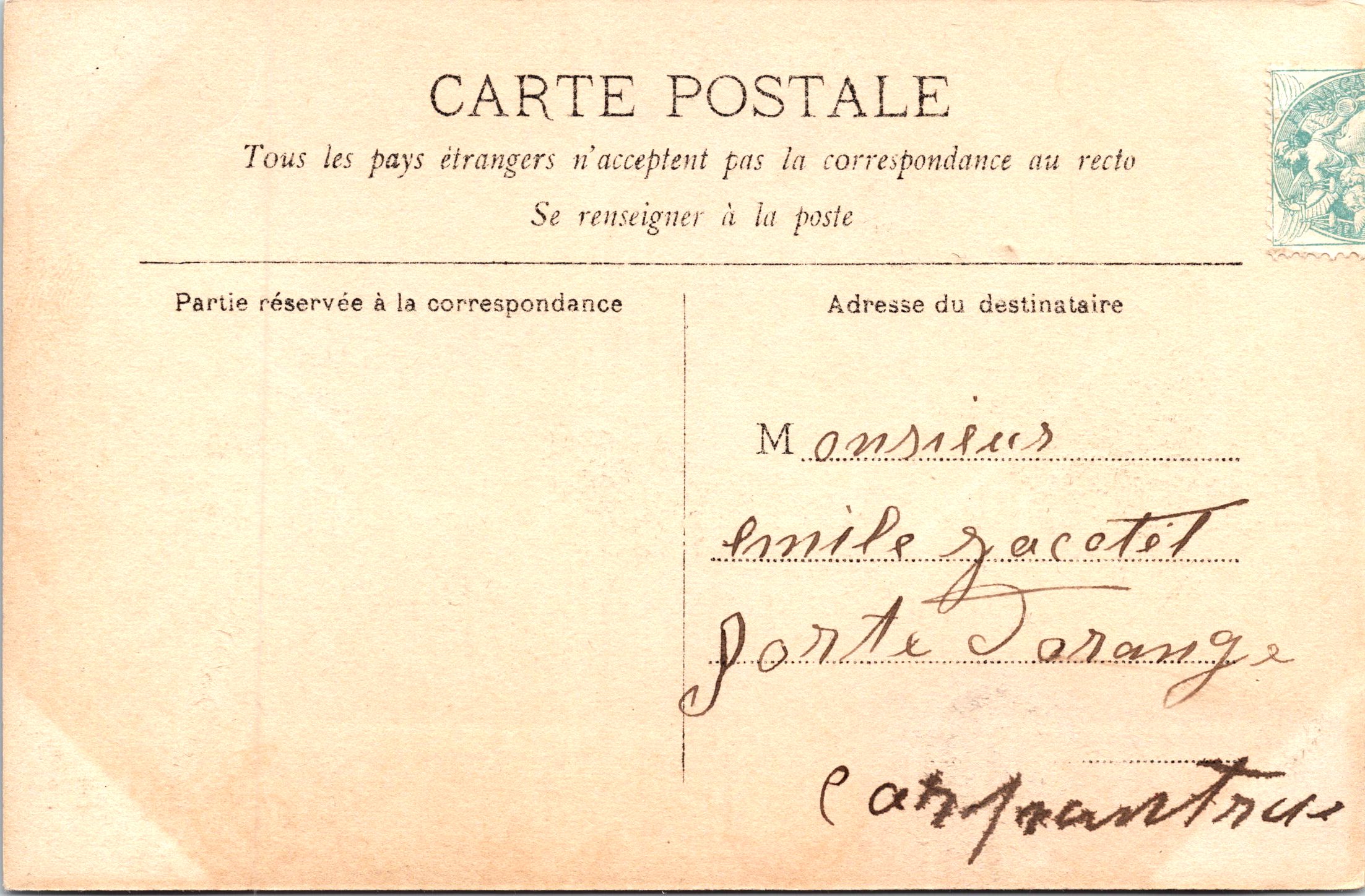
This is a striking and elegant Belle Époque hand tinted portrait postcard featuring the actress Brandes, photographed by the renowned Paris studio of Léopold-Émile Reutlinger. This beautifully composed image, issued as part of the S.I.P. (Société Industrielle de Photographie) series, bears the serial number 1187. The subject is presented in a classic Reutlinger studio style—softly lit, refined, and idealized—wearing an ornate lace bodice with delicate hand-applied tinting in pale blue and cream tones. A string of pearls and her carefully styled coiffure reinforce the fashionable aesthetic of the early 1900s. Reutlinger’s studio was widely known for producing high-quality portrait photographs of leading actresses, opera singers, and stage personalities, many of which were issued as collectible postcards during the height of the Belle Époque. The sitter is identified as Brandes, very likely Marthe Brandes (1862–1930), a French stage actress and comedienne active in Parisian theatre during the late 19th and early 20th centuries. She was a member of the Comedie-Francaise in 1896. She also played at the Theatre de la Renaissance. She often played the femme fatale. She appeared in works by notable playwrights such as Alexandre Dumas and Maurice Donnay. She was associated with the vibrant theatrical scene of Paris, frequently appearing in productions that blended drama and light comedy. As with many performers of the period, surviving biographical detail is somewhat limited, but her presence in Reutlinger’s catalog confirms that she had achieved a level of recognition sufficient to warrant commercial postcard distribution.The card is addressed to a gentleman in Carpentras, France. The postcard was postmarked in 1906. In regard to condition, the postcard is in overall good condition with strong visual appeal. The image retains excellent contrast and detail, and the hand-tinting remains attractive and well-preserved. There is light, even age toning to the card stock. The upper right corner shows the original stamp and postmark, with minor associated wear. Corners show mild wear consistent with age (see scans).
This vintage postcard is available for purchase at my store, The History Peddler, for $14.00 at auction
Interested collectors may view the listing here:
https://www.ebay.com/itm/236787768354
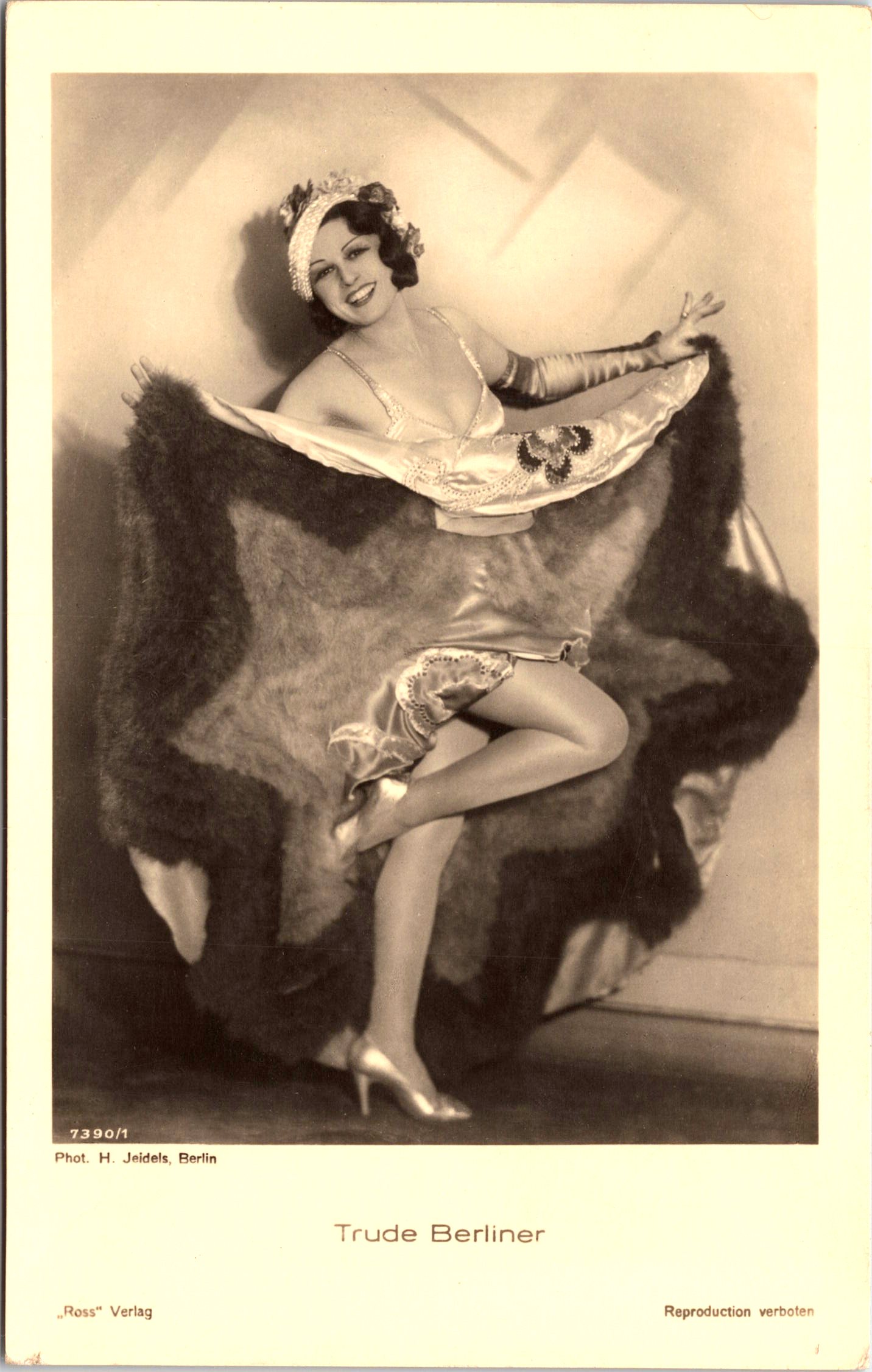
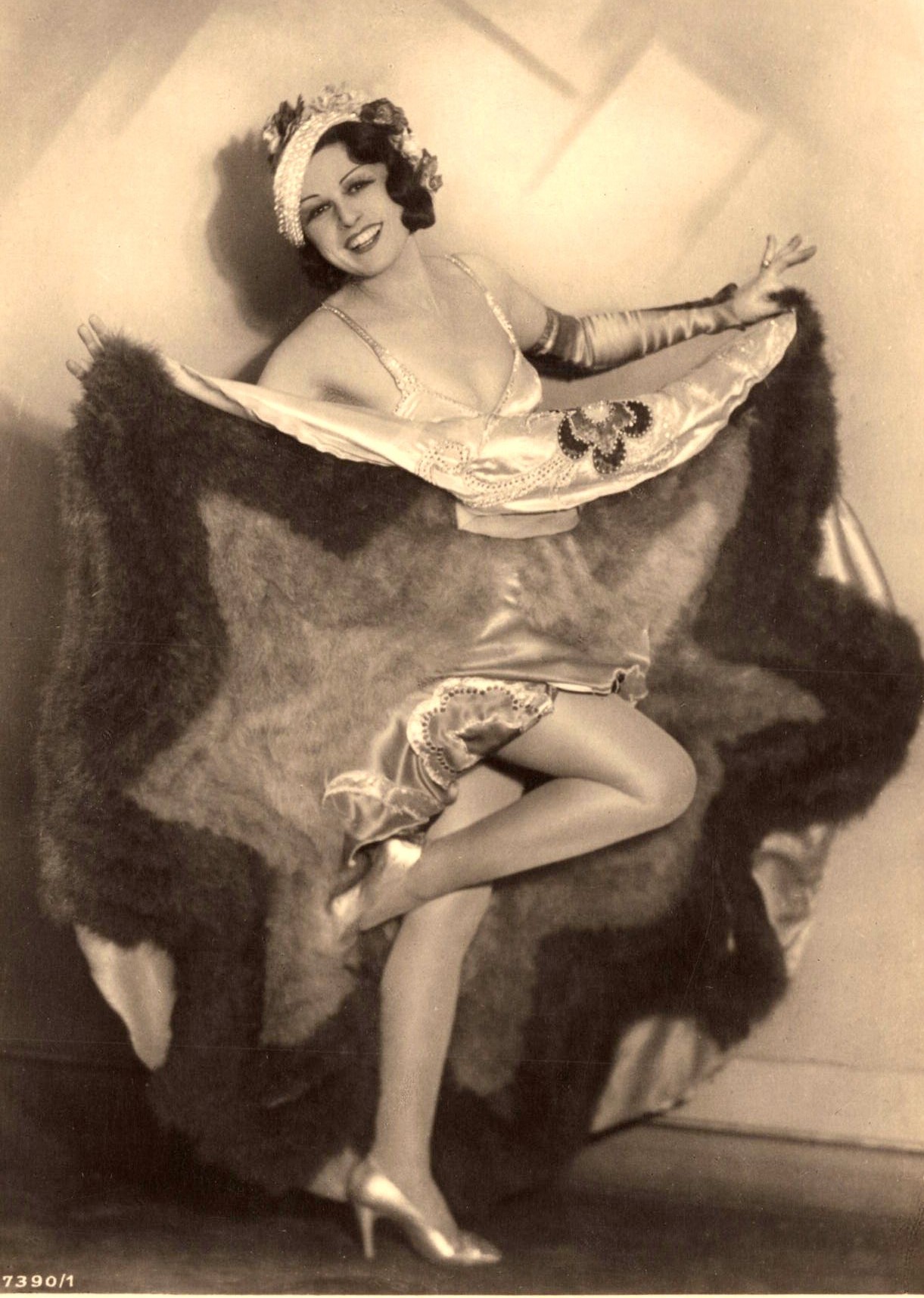
This vintage real photo postcard features Trude Berliner (1903-1977), German actress, singer and dancer. She was also a popular cabaret and comic performer at the Scala and Wintergarten in Berlin during the 1920’s. This postcard captures her doing a happy dance. The photo is risque. She is showing her bare legs and lifting her dress. Her film career took off and she ultimately appeared in 48 films between 1916 and 1955. She was in a number of well known German movies. Berliner was forced to flee Germany when the Nazis took power in 1933. She first went to France but emigrated to the United States in 1939. Unfortunately, Hollywood did not offer the kind of opportunities she experienced in Europe. She was only able to obtain bit parts in four movies. Interestingly, her first role in an American film was in “Casablanca” (1942). She left acting after 1945 and managed a date farm. This postcard was published by Ross Verlag as part of a series (No.7390/1). The photograph on this postcard was taken by H. Jeidels at his Berlin studio. (SOLD)
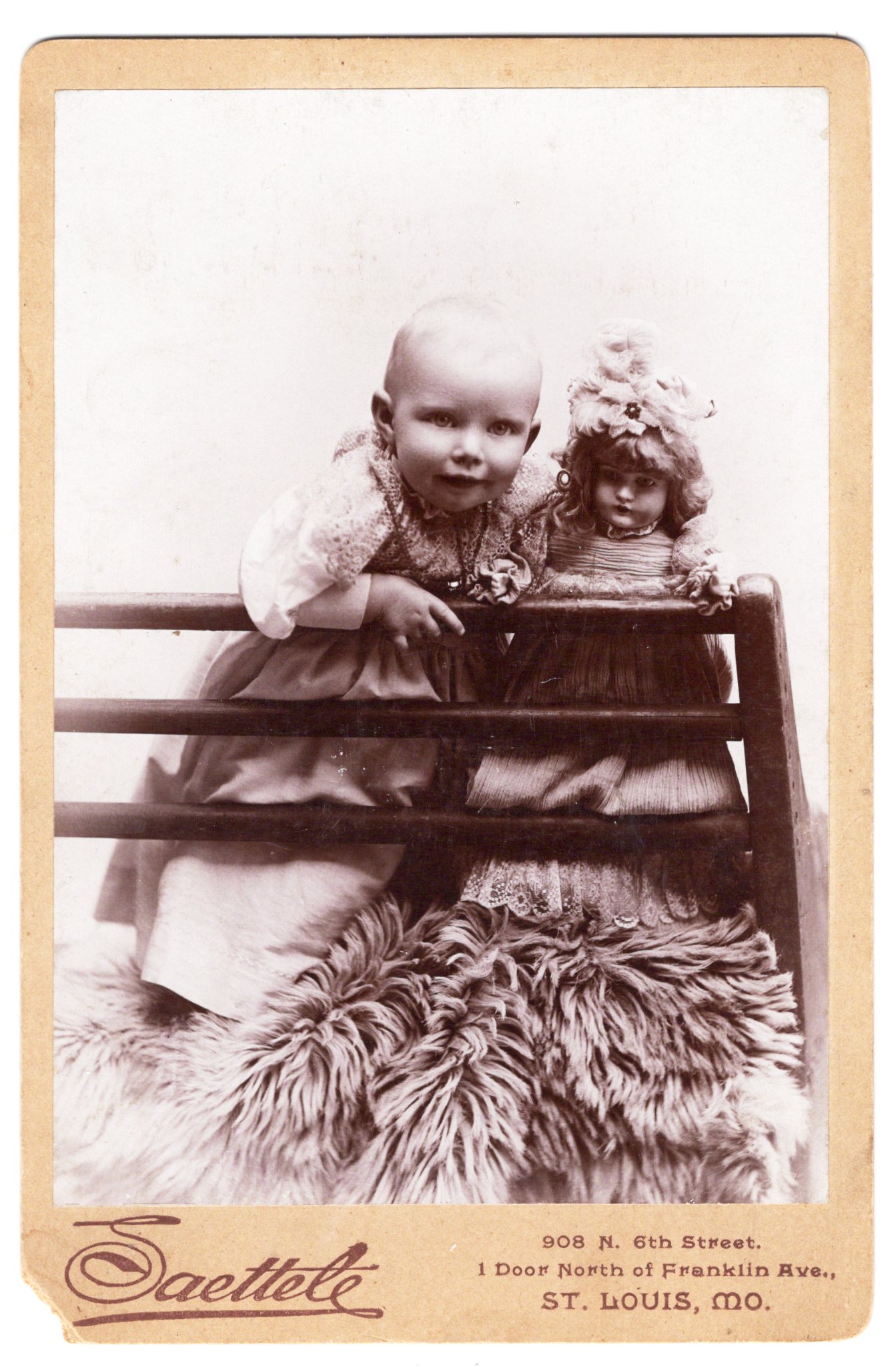
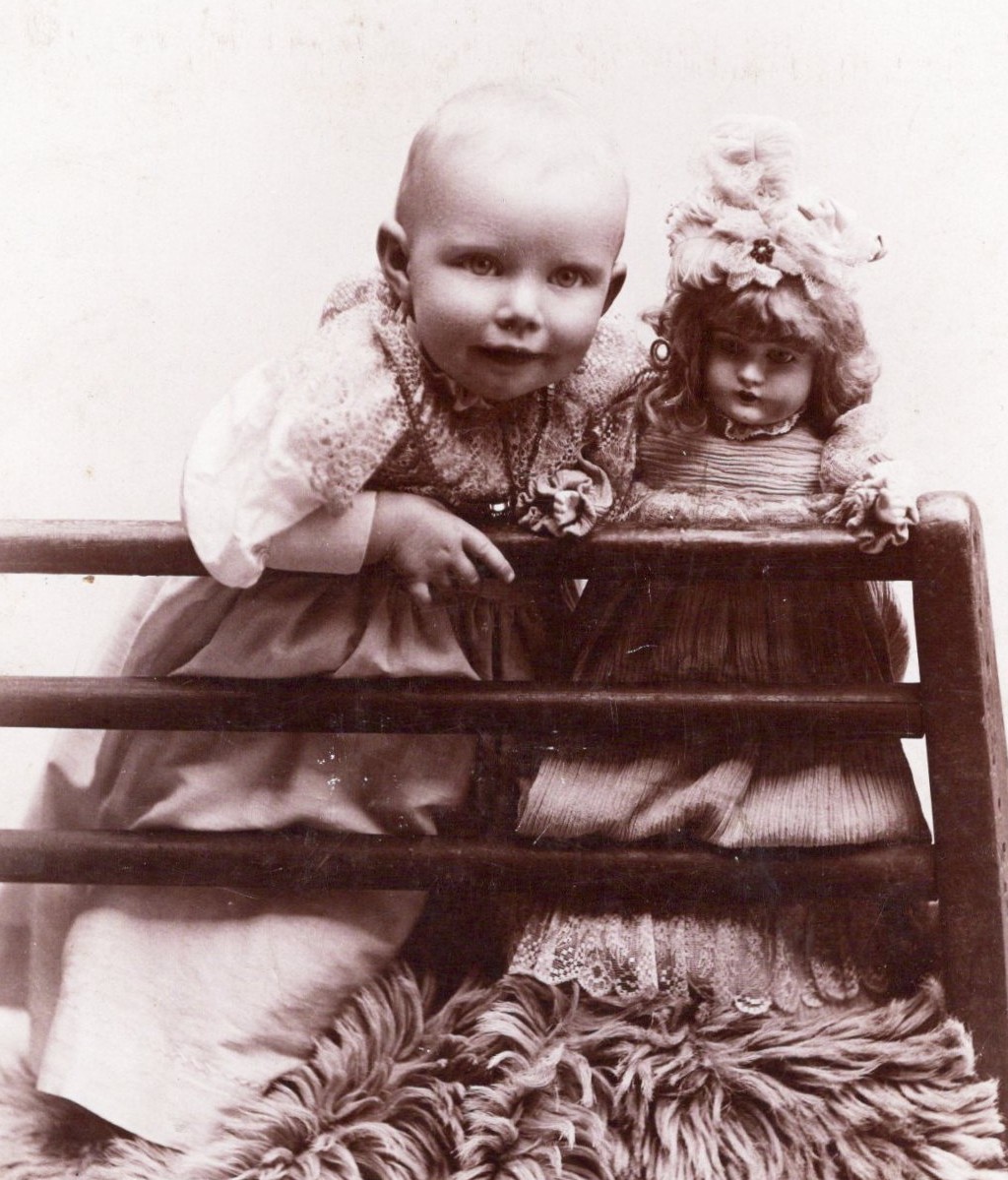
This charming 19th-century cabinet card photograph features a baby posed beside a beautifully dressed porcelain doll. The infant leans forward over a wooden prop, gazing directly at the camera with a curious and slightly mischievous expression. The child is dressed in a light gown with delicate lace trim, while the doll beside her is ornately dressed, wearing a finely pleated gown accented with lace and an elaborate feathered bonnet. The pairing of the child and doll creates a whimsical and endearing composition. The photograph was taken at the studio of Saettele, located in St. Louis, Missouri (imprinted on the mount). Research reveals that the Saettele studio was at the address on the mount only one year (1905). This studio portrait has crisp clarity, strong contrast, and uses fur rugs and furniture props to stage the image. The mount is a standard cabinet card size, with the photographer’s name “Saettele” in ornate script at the bottom. (SOLD)
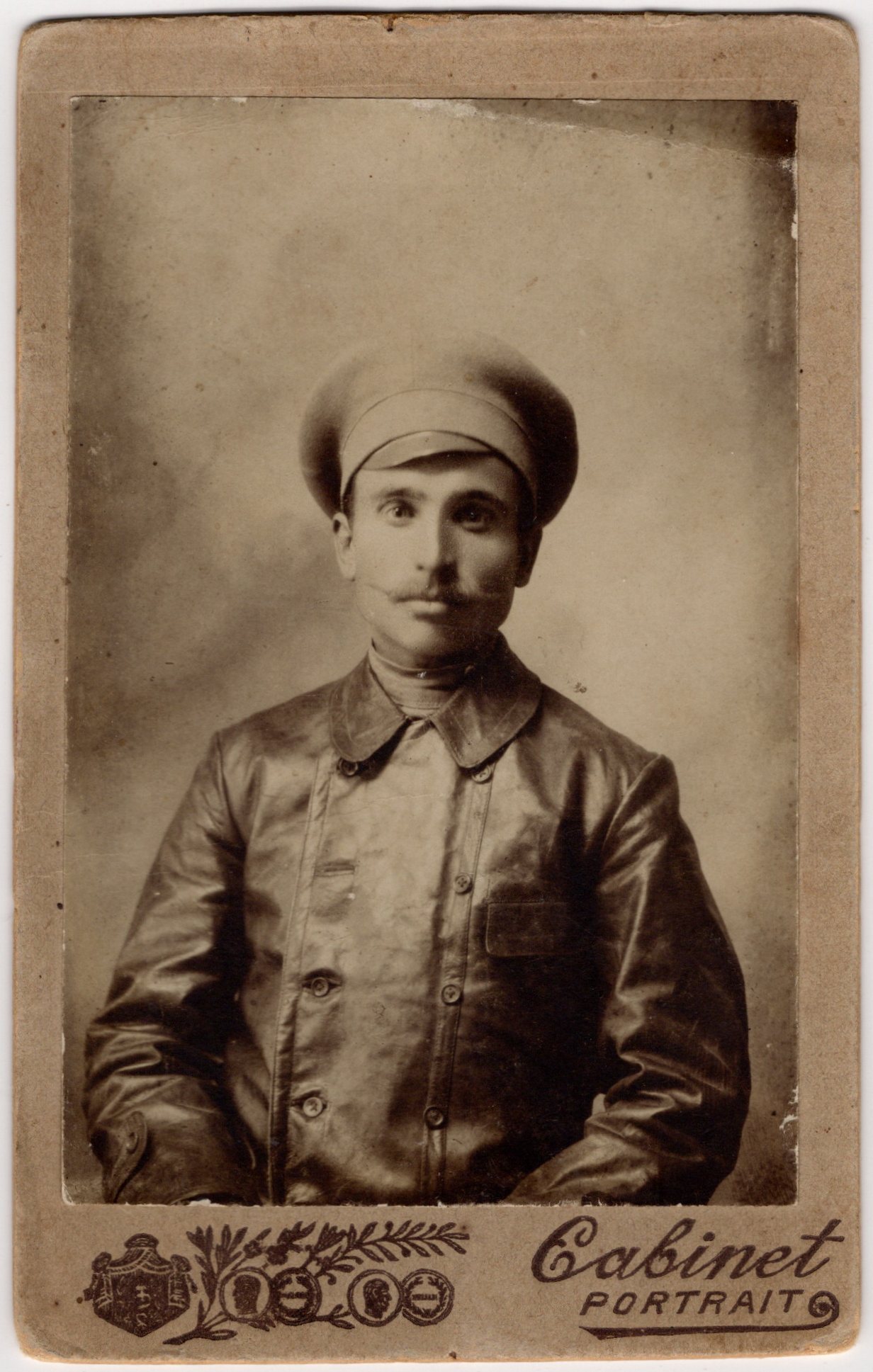
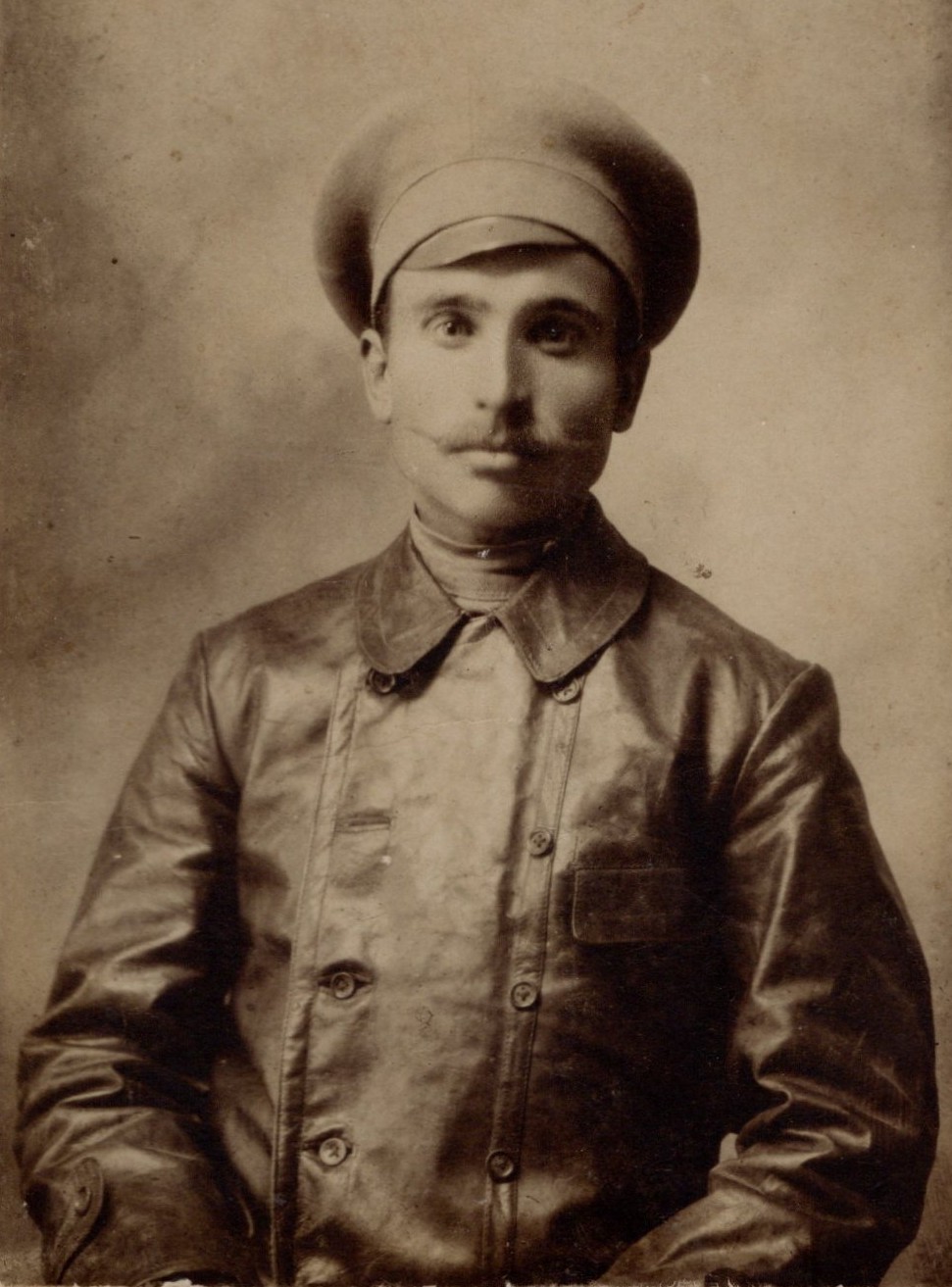
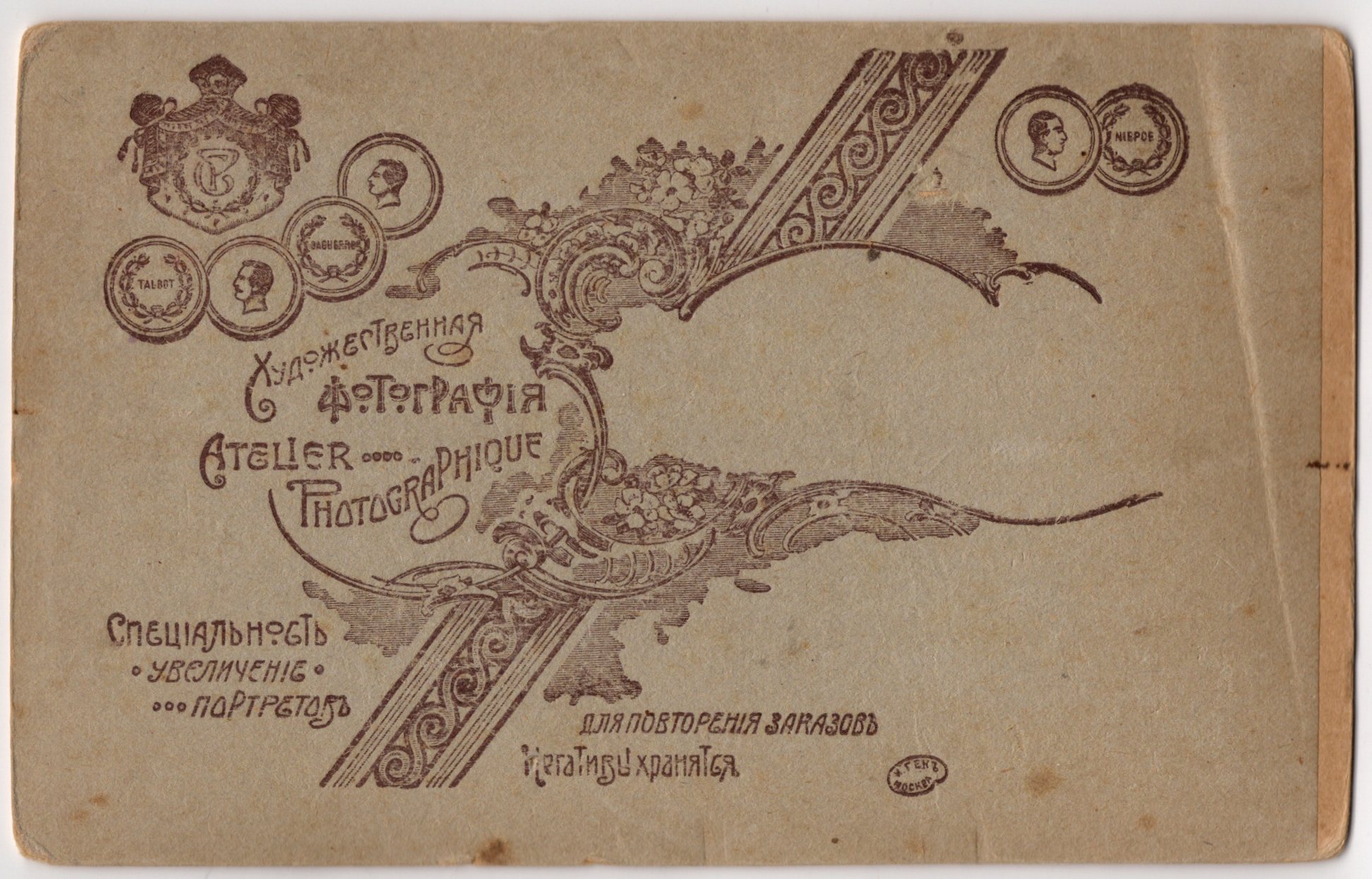
This is a striking and somewhat unusual cabinet card portrait featuring a young man posed in studio, dressed in what appears to be a distinctive uniform or occupational attire. The photograph has a strong presence, with the sitter facing forward and engaging the viewer directly, his expression calm, alert, and slightly intense. He wears a neatly groomed thin mustache, and his wide, steady gaze adds a sense of personality and individuality to the image. What immediately stands out is his clothing. He is dressed in a buttoned leather or leather-like jacket, which has a slightly reflective surface, suggesting either treated leather or a heavy protective garment. Beneath it, he wears a high-collared shirt or tunic. On his head is a rounded cap with a structured band, reminiscent of military or early industrial uniforms. The overall look strongly suggests an occupational or service-related portrait—possibly railway, early aviation, mechanical trades, or even a paramilitary or military-adjacent role. While it is difficult to definitively identify the exact profession, the uniform is clearly not ordinary civilian dress. The mount is attractively printed with decorative elements. The reverse is particularly informative and places the photograph geographically. It is printed in both Russian and French. The presence of Cyrillic text, combined with the bilingual French wording (common in higher-end studios of the Russian Empire), strongly indicates that this cabinet card originates from Imperial Russia, likely dating to the late 19th or early 20th century (circa 1895–1910). The photograph presents well overall with a pleasing, slightly warm sepia tone and good clarity of detail. There is moderate, honest age-related wear to the mount, including some edge and corner wear, light soiling, and minor surface marks. Notably, there is a visible diagonal crease at the top right corner of the mount, which can be felt when handled but does not break through or significantly distract from the image area. See Scans
This vintage postcard is available for purchase at my store, The History Peddler, for $80.00 at auction
Interested collectors may view the listing here:
https://www.ebay.com/itm/236779044557
 POSTCARD 1
 POSTCARD 2 (SOLD)
 POSTCARD 3 (SOLD)
 POSTCARD 4 (SOLD)
 POSTCARD 5 (SOLD)
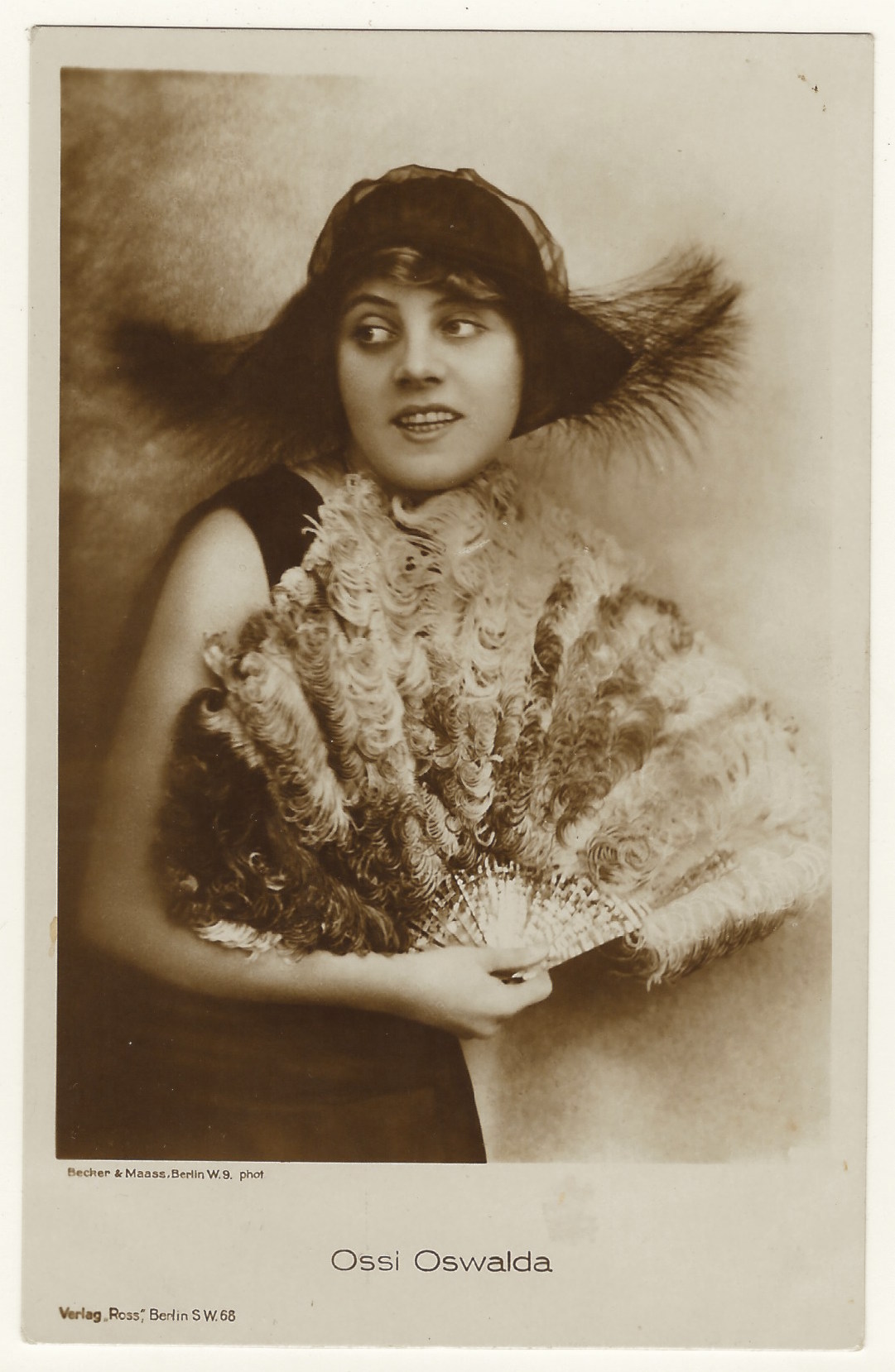
The beautiful actress seen in the top vintage real photo postcard is named Ossi Oswalda (1897-1947). She was born in Germany and appeared predominately in silent films. She was a leading lady, popular comedienne, dancer, and singer. Due to her popularity, she was known as “the German Mary Pickford”. Ossi began her career as a ballerina and she danced in a chorus line for a theater in Berlin. She made her film debute in “Night of Horrors” (1916) and was noticed by actor/screenwriter Hanns Kraly, who introduced her to director Ernst Lubitsch. Oswalda’s early career began with appearances in several Lubitsch films. In 1921, she and her husband started a film production company that produced four films over four years, all starring Miss Oswalda. After 1925, she was under contract to UFA, a German film company. After the transition to “talkies”, Oswalda joined the ranks of actresses and actors, who’s career took a nose dive. She only acted in two sound films. Her final screen appearance was in “The Star of Valencia”. She then began acting on the stage. She appeared in operettas in Germany and Vienna. When the National Socialists took power in Germany, she emigrated to Prague with her “Jewish life partner”, Julius Aubenberg. In 1943, she wrote a story for a Czechoslovakian film. In summarizing Ossi’s career, the IMDb credits her with 51 film appearances, producing 5 films, and 1 screen writing credit. It is reported that she frequently played child-like spoiled women. She appeared in drag in at least one film. Oswalda’s first marriage (1919-1925) was to a Hungarian baron. After her divorce, the actress began a highly publicized romantic relationship with Crown Prince Willhelm (1882-1951). Simultaneously, the actress Lily Damita, was having an affair with the Prince’s son. The royal family put a kibosh to both “inappropriate” relationships. In 1947, she died in Prague at age 48, bankrupt and suffering from multiple health problems. This German real photo postcard is published by Ross Verlag soemetime between 1919 and 1924. The photograph of Miss Oswalda was taken by Becker & Maass of Berlin. Note her pretty hat and fan. Hopefully, she wasn’t allergic to feathers. Oswalda was young when this photograph was taken. She was beautiful and no older than 27 years of age.
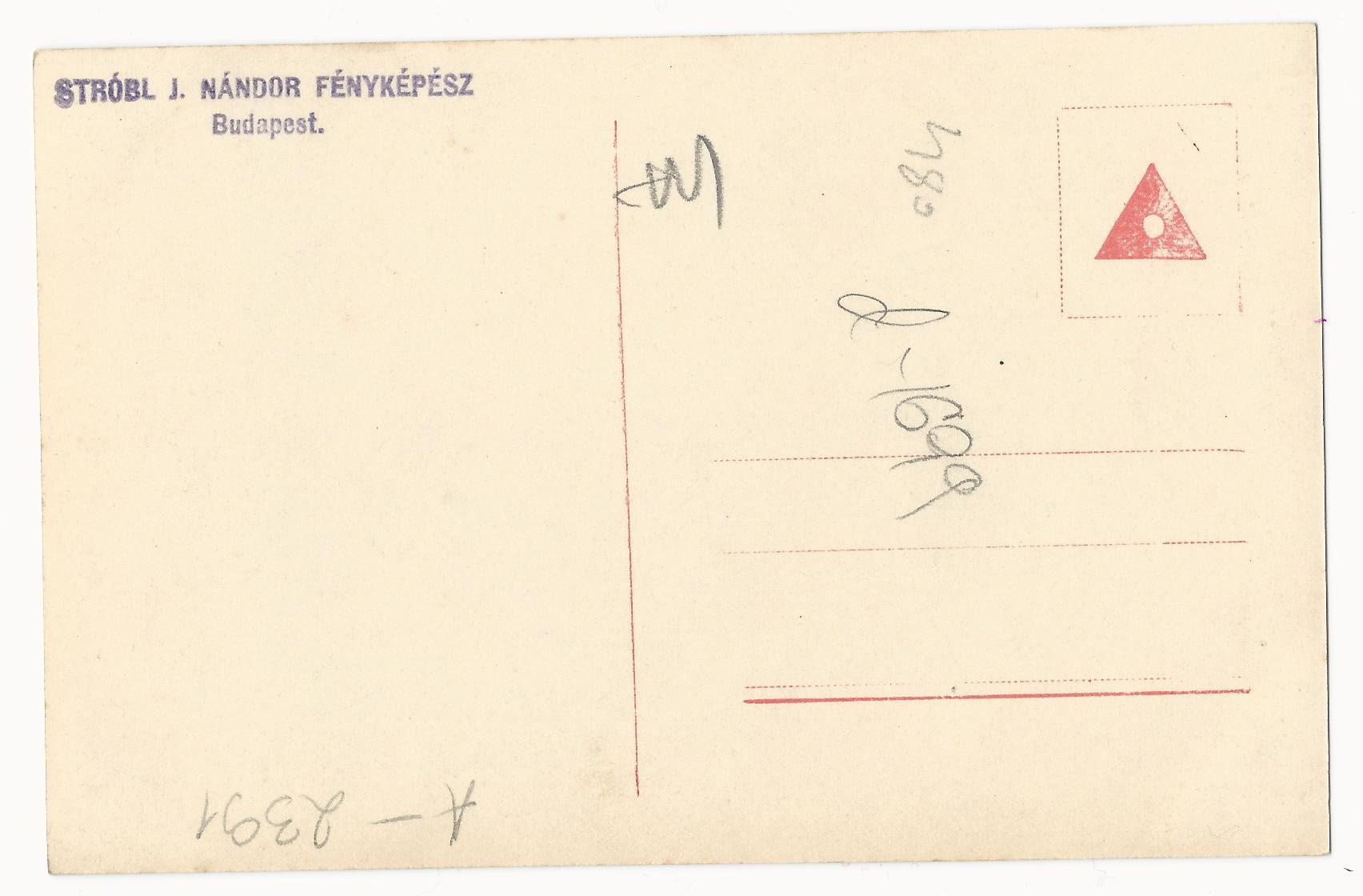
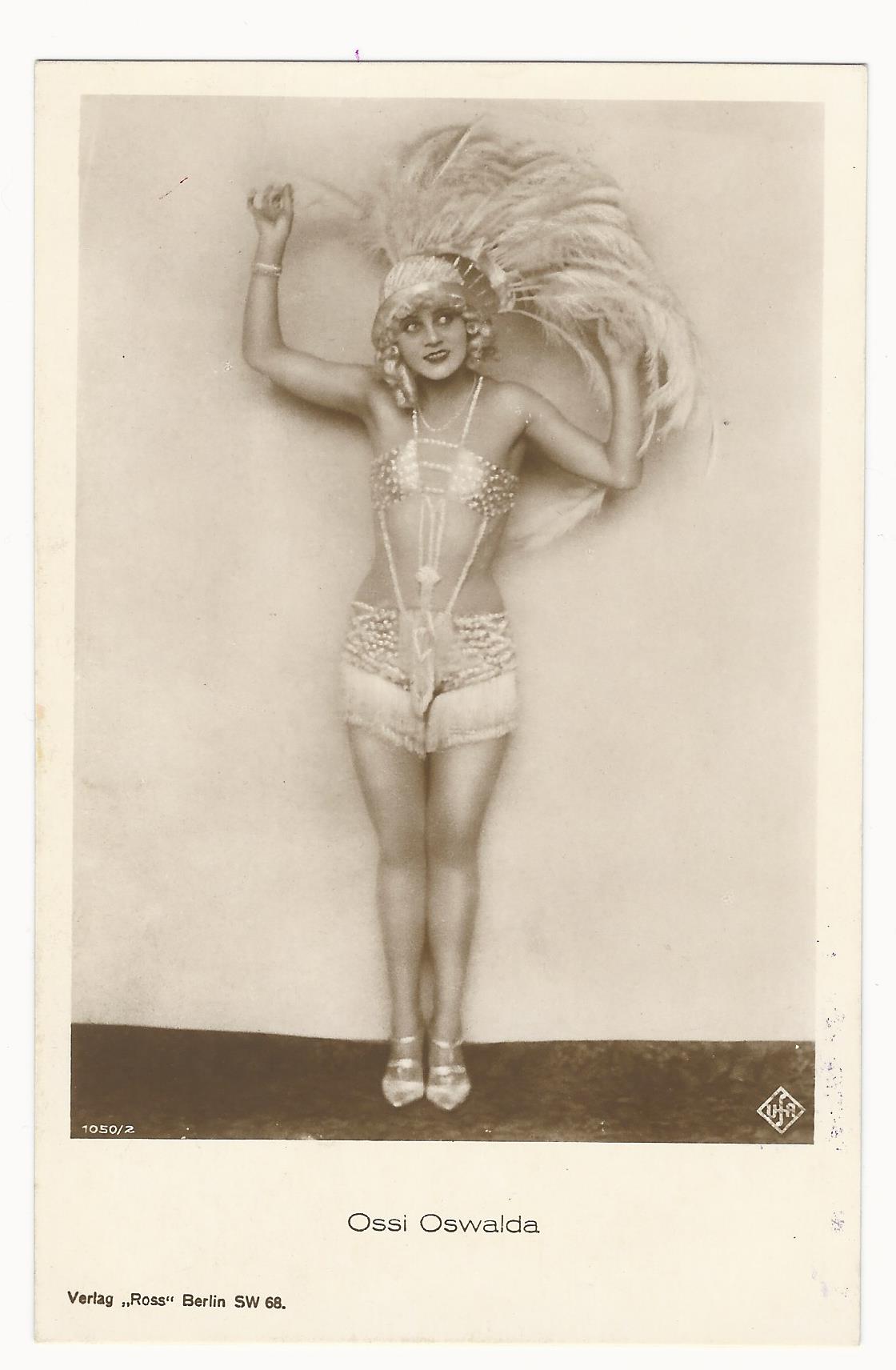
Postcard 2 features Miss Oswalda in a very skimpy costume. Her feathered hat is quite showy . She has a wonderful smile and pretty eyes. This risque postcard was part of a series (no. 1050/2) and published by Ross Verlag of Berlin, Germany. The logo of UFA, a German film company, appears on the lower right hand corner of the postcard. The reverse of the postcard reveals that that the photographer is Strobl J. Nandor of Budapest, Hungary. (SOLD)
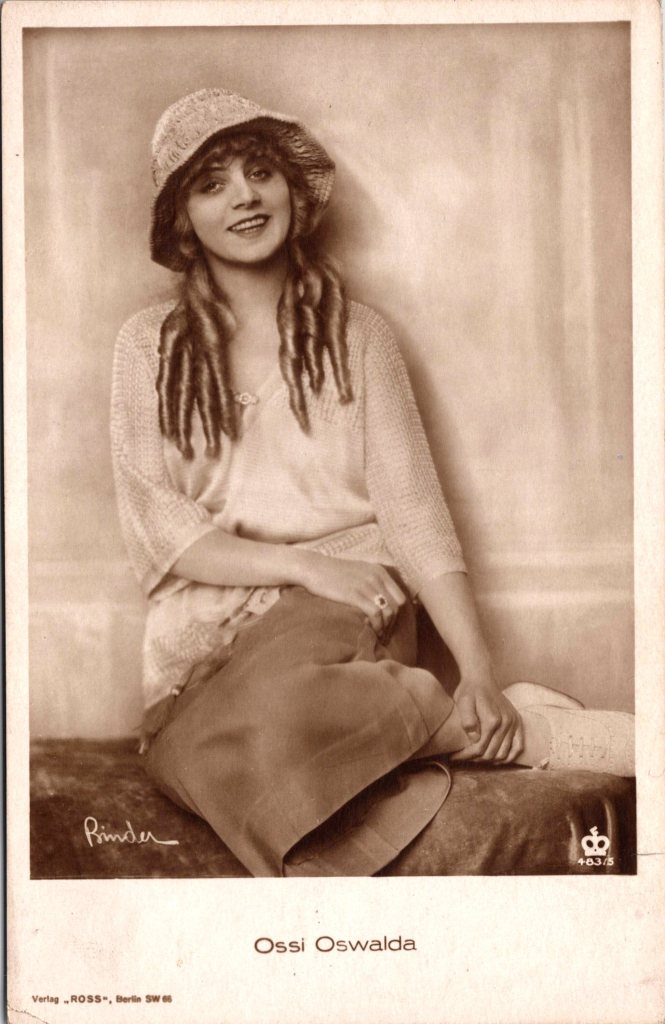
Postcard 3 is a German real photo postcard that was published by Ross Verlag. Miss Oswalda’s photo was taken by celebrity photographer Alex Binder. (SOLD)
Postcard 4 captures Miss Oswalda looking amused. She is flashing a wonderful smile. This postcard was published by Ross Verlag of Berlin, Germany (no.474/2). (SOLD)
Postcard 5 captures Miss Oswalda in a provocative pose. She is wearing a short skirt resulting in quite a leggy photo. Posing her with her hands on her hips was aimed at being suggestive. This risque postcard was published by Ross Verlag of Berlin, Germany (no.483/1). The photographer of this portrait of Oswalda was celebrity photographer Alex Binder. (SOLD)
POSTCARD 1
POSTCARD 2
POSTCARD 3
POSTCARD 4
POSTCARD 5
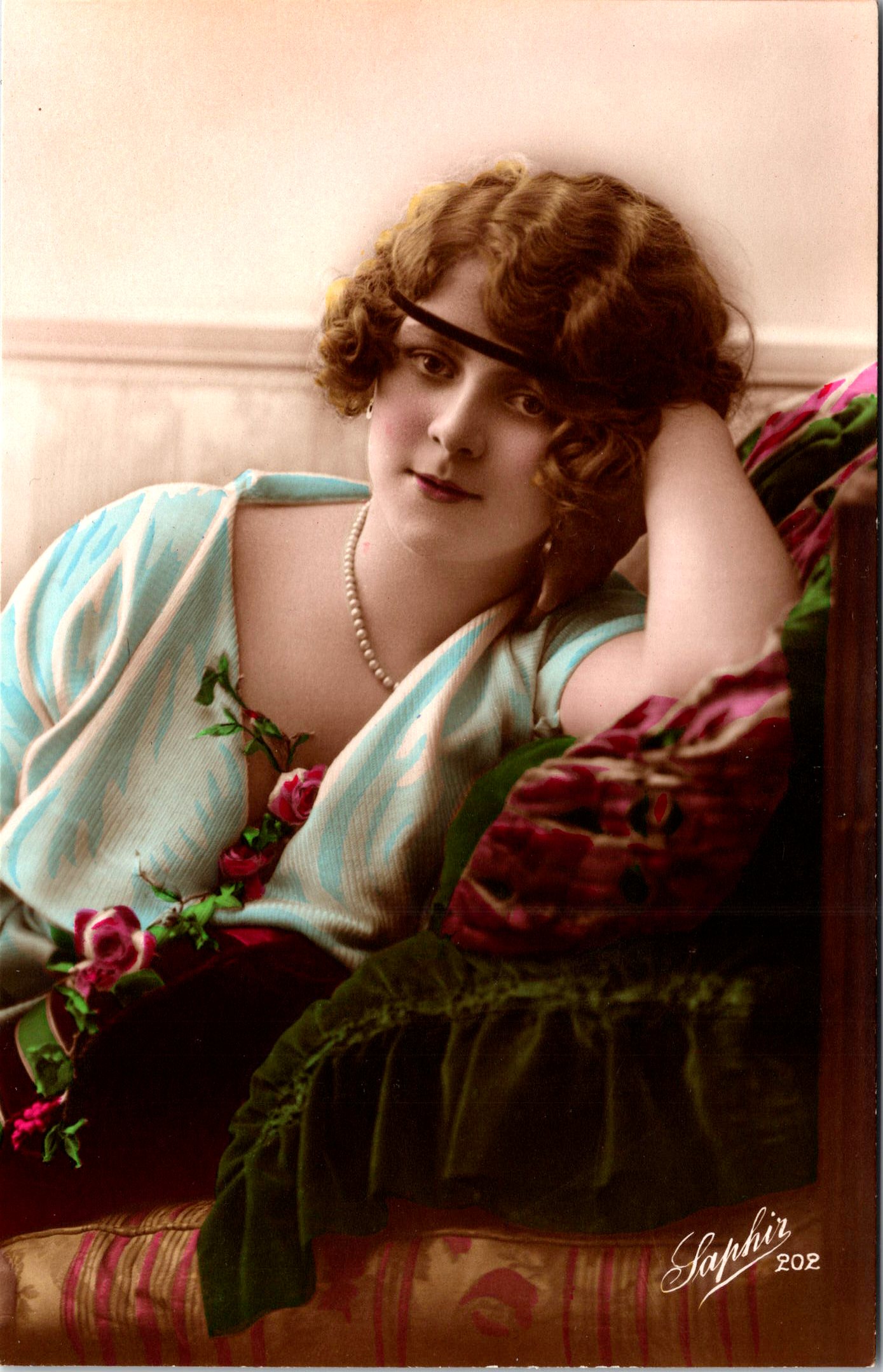
This is a beautiful and highly appealing real photo postcard featuring a glamorous young woman in a softly posed, intimate portrait that perfectly captures the elegance and style of the late Edwardian to early 1920s period. The image has been tastefully hand-colored, with delicate pink tones to the cheeks, soft natural coloring to the lips, and rich hues brought out in her clothing and surroundings, giving the portrait a warm, lifelike presence. The young woman reclines slightly, resting her head gently on her hand, her expression calm, inviting, and quietly confident. Her gaze meets the viewer with a subtle softness that gives the image a distinctly personal, almost cinematic quality. She is fashionably dressed in a light, flowing garment with soft blue tones, accented by a string of pearls around her neck. A thin dark headband worn across the forehead reflects the transitional style moving toward the 1920s, while her softly waved hair frames her face beautifully. Adding to the composition are decorative floral elements, including small pink roses woven into the scene, and richly colored drapery beneath her arm, which enhances the romantic, almost boudoir-like atmosphere. The lower right corner bears the signature “Saphir 202,” identifying the publisher—Saphir being well known for producing high-quality European glamour postcards in the early 20th century. I have found Saphir cards to be uncommon. Printing on the reverse of the divided back postcard confirms its French manufacture. The postcard is in excellent antique condition overall. The image remains vibrant with strong contrast and attractive coloration (see scans).
This vintage postcard is available for purchase at my store, The History Peddler, for $28.00 at auction
Interested collectors may view the listing here:
https://www.ebay.com/itm/236779160241
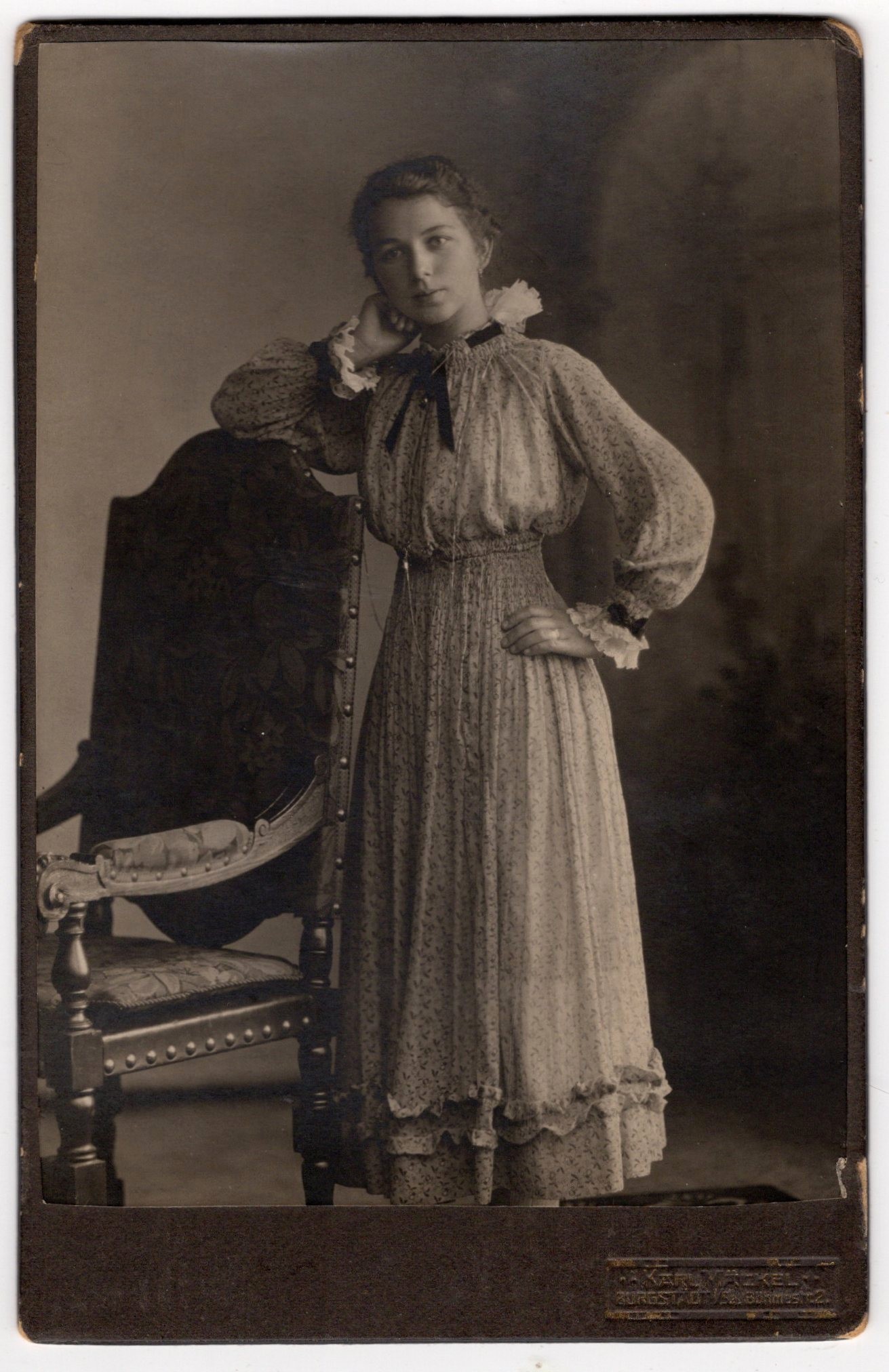
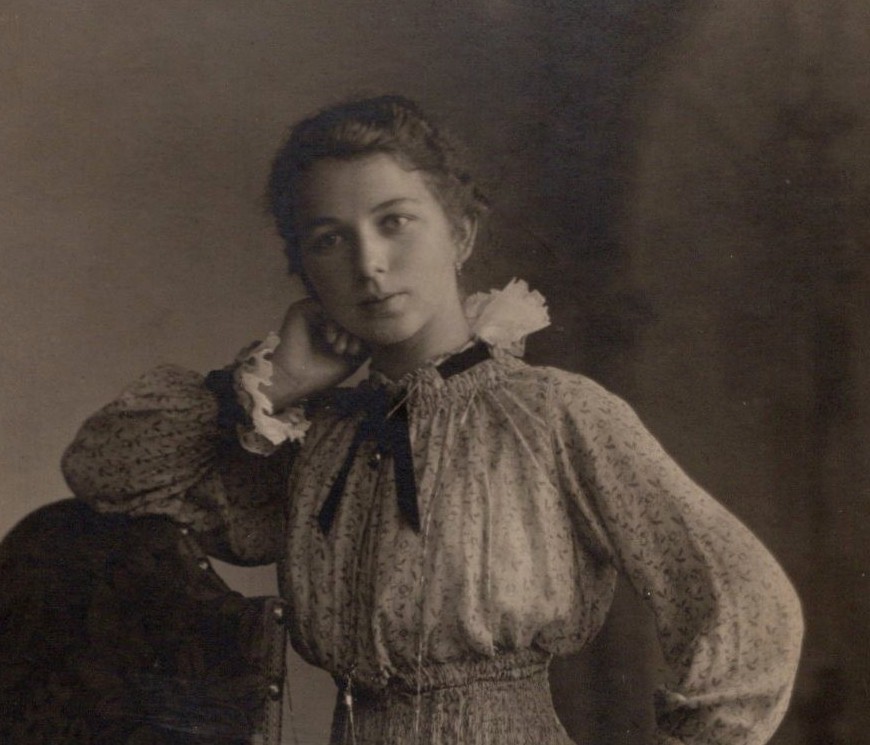
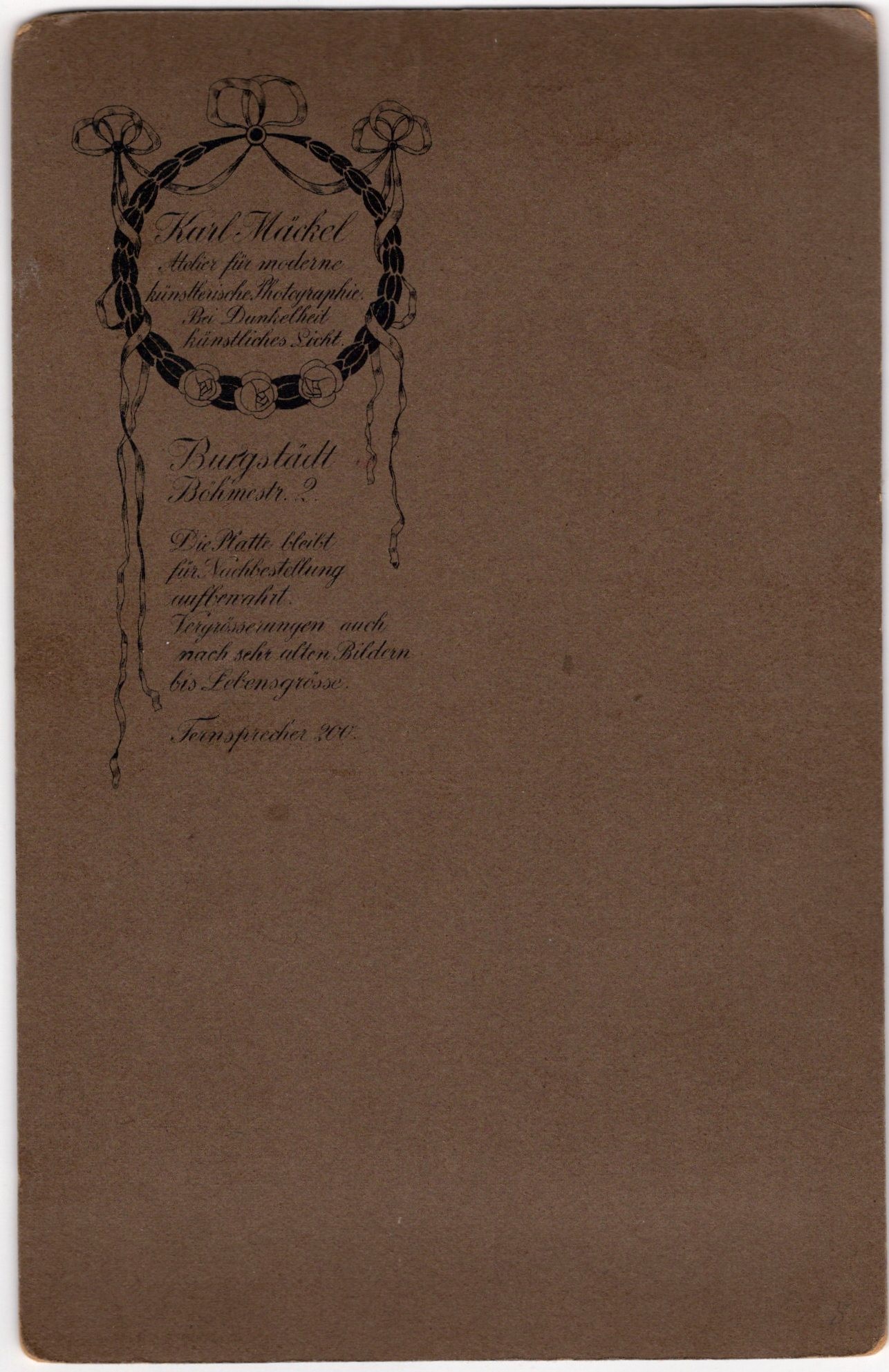
This evocative early 20th-century studio photograph presents a poised young woman photographed full-length in a formal interior setting. She stands beside an upholstered armchair, resting one hand thoughtfully against her cheek while the other is placed confidently at her waist. The pose feels both contemplative and self-assured, a balance that was highly favored in Edwardian portraiture, where sitters were encouraged to convey refinement and emotional depth. She is dressed in a long, light-colored patterned dress with a softly gathered bodice and a high, ruffled neckline accented by a dark ribbon bow. The sleeves are voluminous and finished with lace-trimmed cuffs, and the skirt falls in gentle tiers, creating a graceful silhouette typical of the period circa 1905–1915. Her hair is worn swept back and neatly styled, emphasizing her youthful face and direct, quietly introspective gaze. The photographer’s careful use of soft, diffused lighting creates a gentle tonal range, highlighting facial features while allowing the background to fall away into a subtle vignette. The overall effect is intimate and dignified, capturing both the sitter’s individuality and the aesthetics of turn-of-the-century Central European studio photography. The reverse bears an ornate printed studio mark for Karl Mückel, described as “Atelier für moderne künstlerische Photographie” (Studio for modern artistic photography), located in Burgstädt, Böhmen (Bohemia)—then part of the Austro-Hungarian Empire. The decorative wreath-and-ribbon design is characteristic of Art Nouveau–influenced photographic branding, reinforcing a date in the early 1900s. The backmark text also notes the availability of enlargements and reproductions, a common feature of professional European studios serving middle-class clientele during this period. Bohemia at the turn of the 20th century was a vibrant cultural crossroads, blending German, Czech, and Austro-Hungarian artistic traditions. Studio portraits like this one were often commissioned to mark important life moments—coming of age, engagement, or family milestones—and were prized personal keepsakes. The refined styling and professional presentation suggest a sitter from a comfortable, possibly bourgeois background. (SOLD)
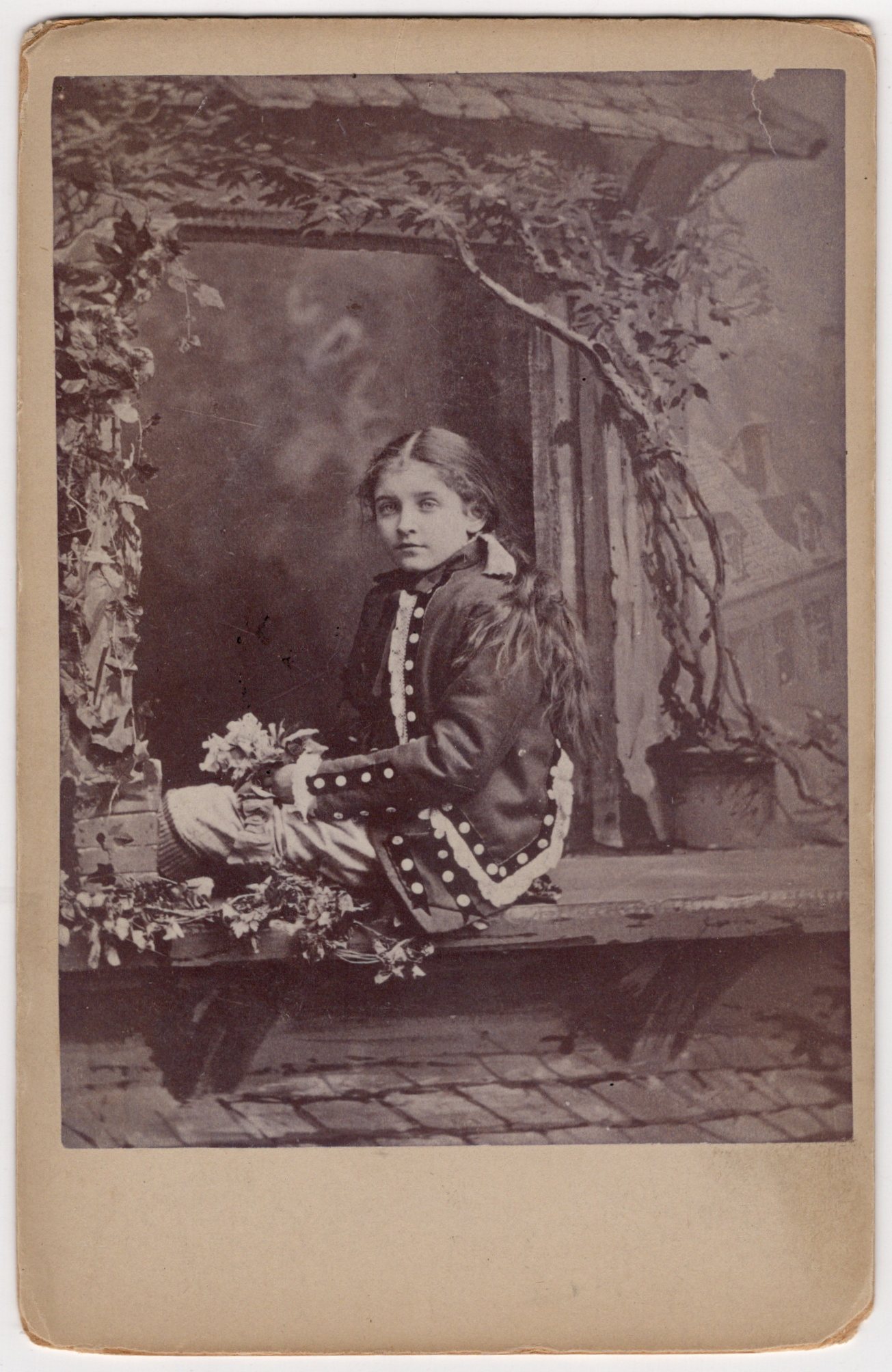
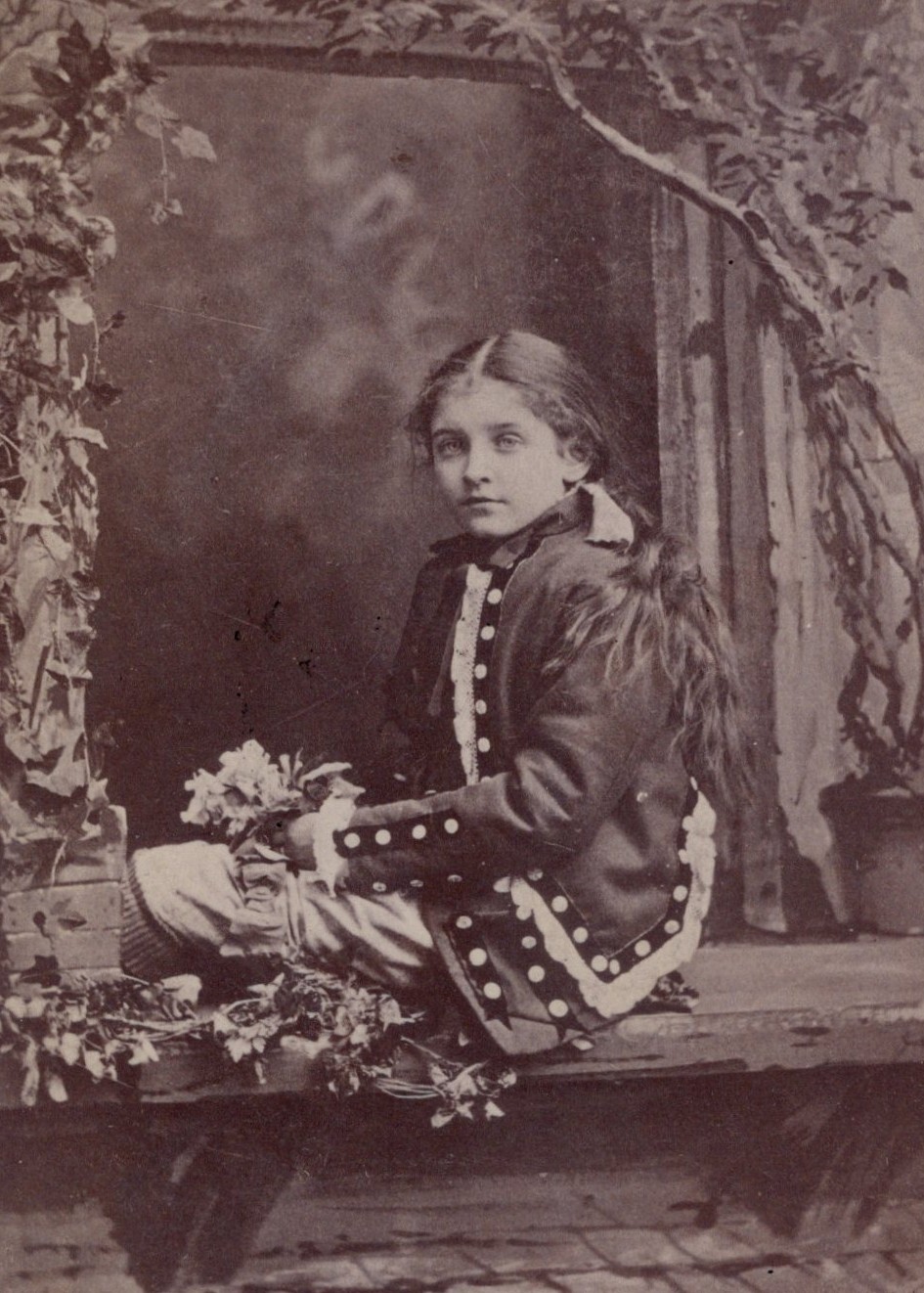
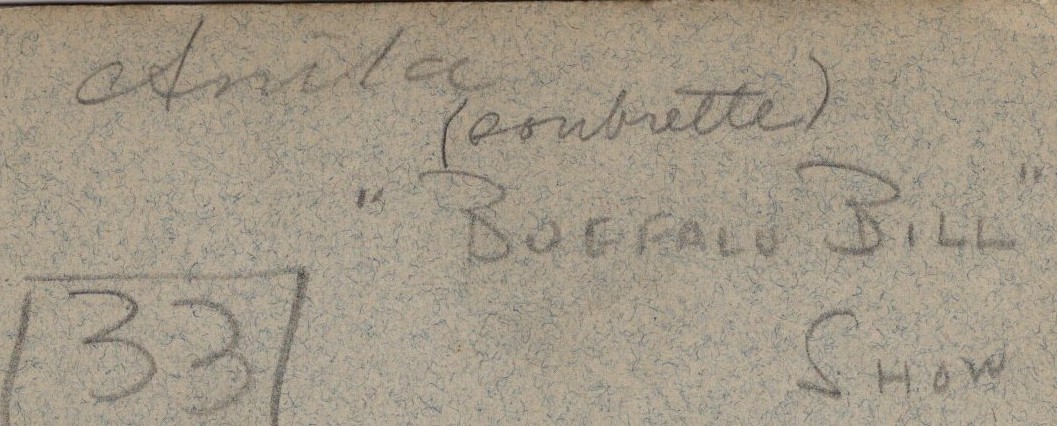
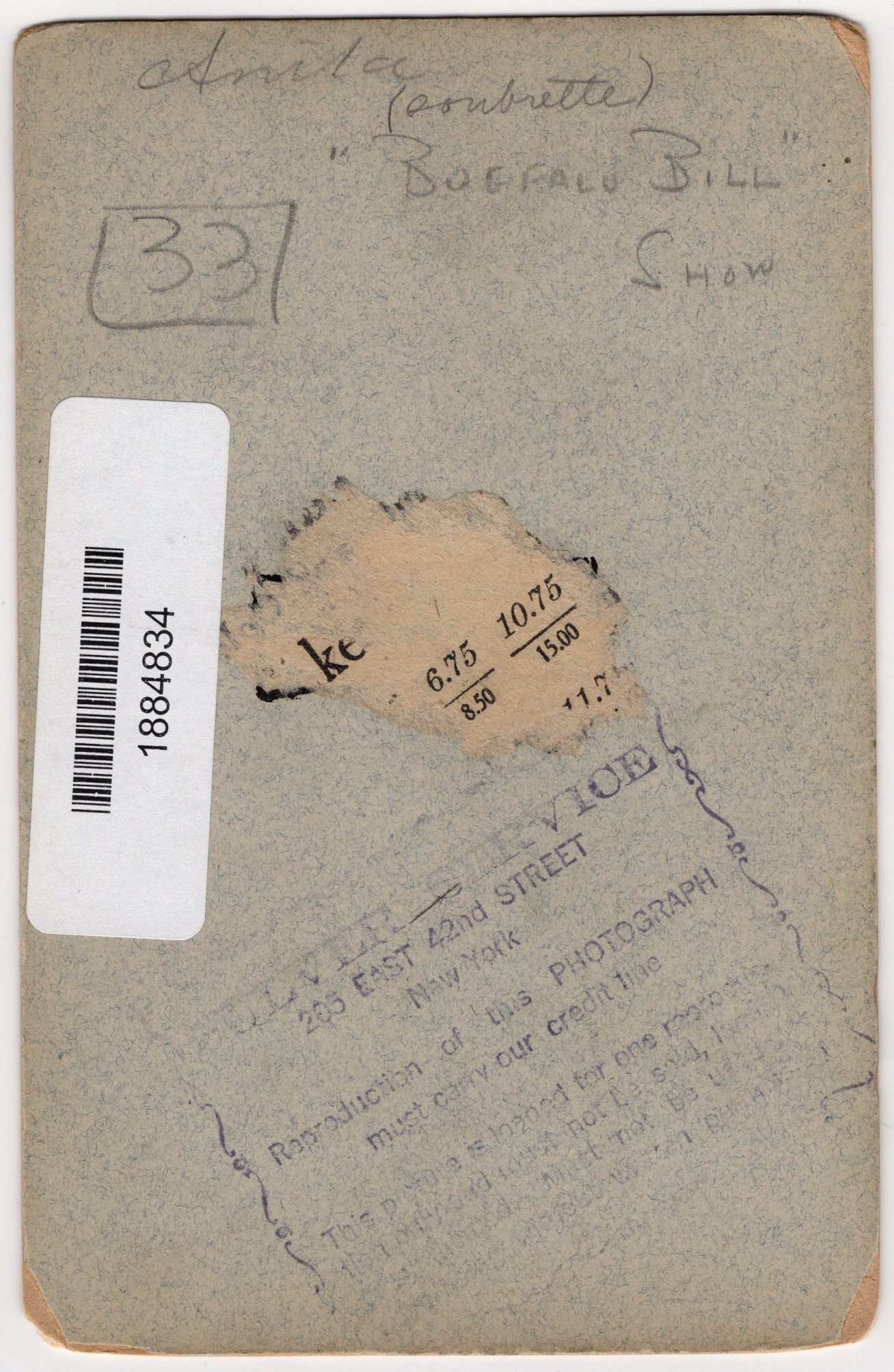
This is a wonderfully evocative and visually striking cabinet card photograph depicting a young female performer posed in an elaborate theatrical costume, seated within a carefully constructed rustic studio setting of vines, flowers, and a cottage-like backdrop. The composition has a distinctly staged, almost storybook quality, with the sitter turned slightly while looking directly toward the camera, her expression calm, thoughtful, and self-assured. She appears quite young, yet carries herself with the poise of a performer accustomed to being observed. Her costume is particularly eye-catching and strongly suggests a theatrical or exhibition role rather than everyday dress. The fitted jacket is decorated with bold, evenly spaced button-like accents running along the seams and edges, giving it a stylized, almost uniform-like appearance. The outfit is paired with lighter-toned trousers or leggings, an unusual and somewhat progressive choice for the period, reinforcing the impression that this is a stage costume rather than conventional attire. Her long hair is parted at the center and falls naturally, softening the otherwise structured look of the costume. What makes this cabinet card especially intriguing is the identification written on the reverse that reads: “Anita (soubrette) ‘Buffalo Bill Show’.” The show operated between 1883 and 1915. The term soubrette refers to a young female stage performer, often associated with lively, theatrical, or light operatic roles. While Buffalo Bill’s Wild West show did not operate as a traditional play with fixed characters, it featured a wide range of performers presented in stylized roles, particularly during its European tours. Although a performer named Anita is not prominently documented in surviving records, the show employed many individuals who were billed under first names or stage names. Also on the reverse is a faint but readable stamp identifying that this photograph was once owned by Culver Service, a company known for distributing historical and theatrical imagery to the press and book publishers. The photograph itself has a pleasing sepia tone with good clarity and contrast, and the image retains strong visual impact. There is some honest age-related wear to the mount, including corner rounding and light surface marks. The reverse shows expected signs of age, including a partial paper label, an inventory bar code, and faint stamp impressions, all of which add to the piece’s authenticity and history (see scans). This is a compelling and somewhat mysterious cabinet card, combining theatrical costume, early entertainment history, and a direct written association with the Buffalo Bill Wild West show.
This Cabinet Card is available for purchase at my store, The History Peddler, for $75.00 at auction
Interested collectors may view the listing here:
https://www.ebay.com/itm/336553194886
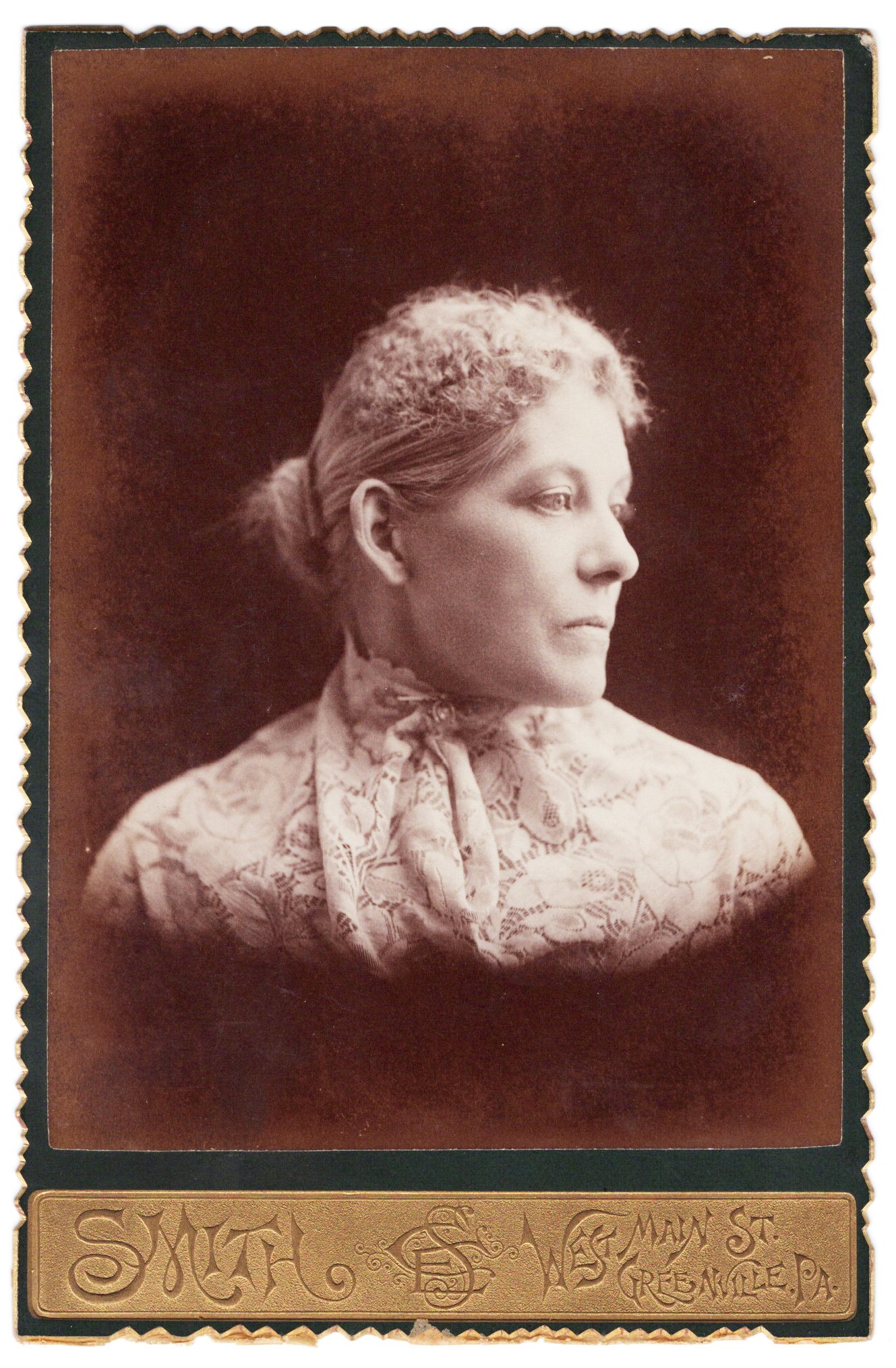
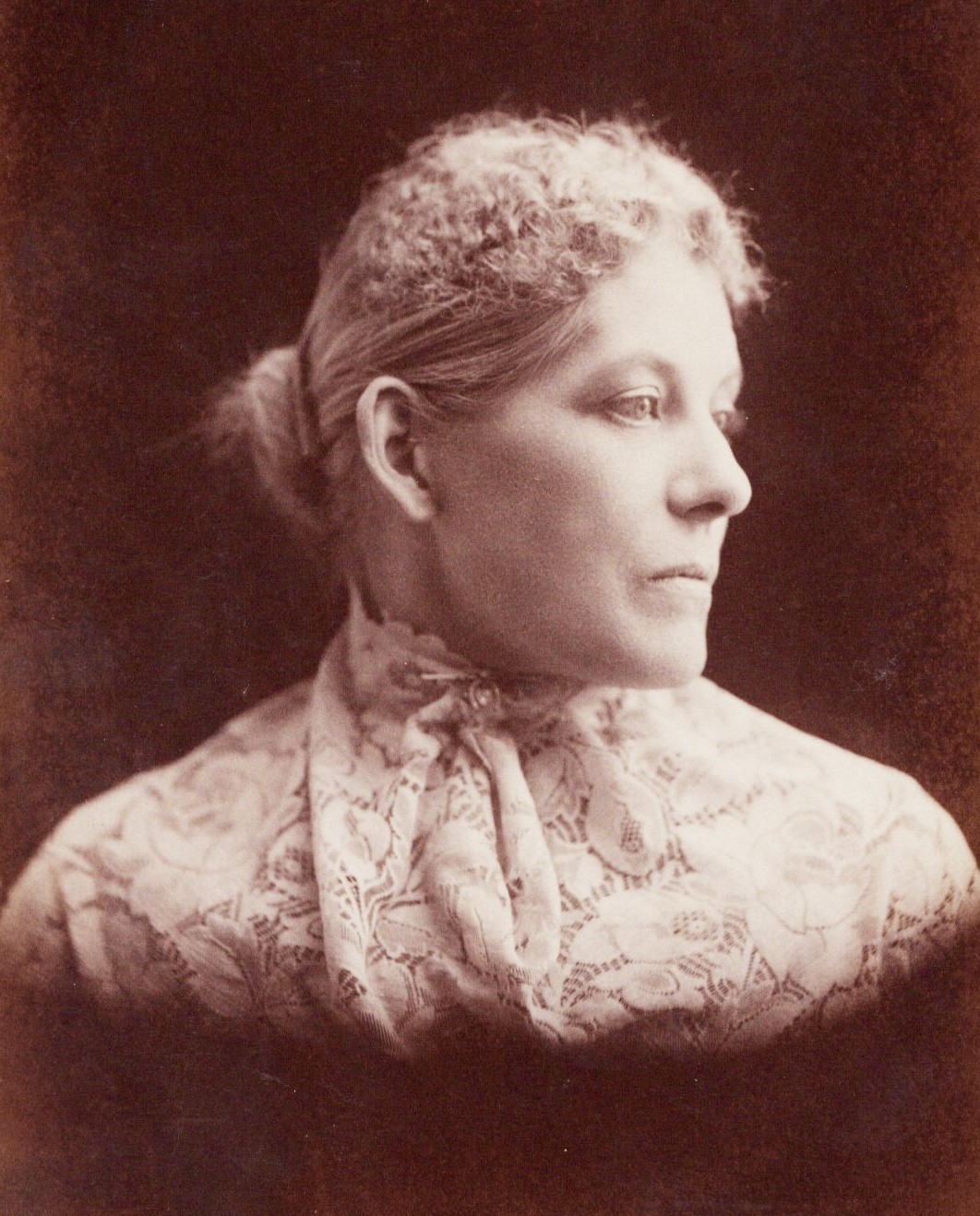
This cabinet card features a portrait of a blonde woman photographed by Smith of Greenville, Pennsylvania. A remarkable feature of this card is Smith’s use of dramatic lighting to present a crisp and clear image of the woman sitting for the portrait. The photographer is likely E. C. Smith who is noted in a number of photography magazines, from the late 1890’s, as an award winning photographer from Greenvile, Pennsylvania. SOLD
 | Eric Snyder on WWI ERA FRENCH COLONIAL SOLDIE… |
 | bmarshphd on NORTHPORT, LONG ISLAND, NEW YO… |
 | Libby Bryant on NORTHPORT, LONG ISLAND, NEW YO… |
 | rangerdon on BEALLSVILLE, PENNSYLVANIA : ST… |
| bmarshphd on ELEANOR GAINES : LUBIN SILENT… |
 THE CABINET CARD GALLERY