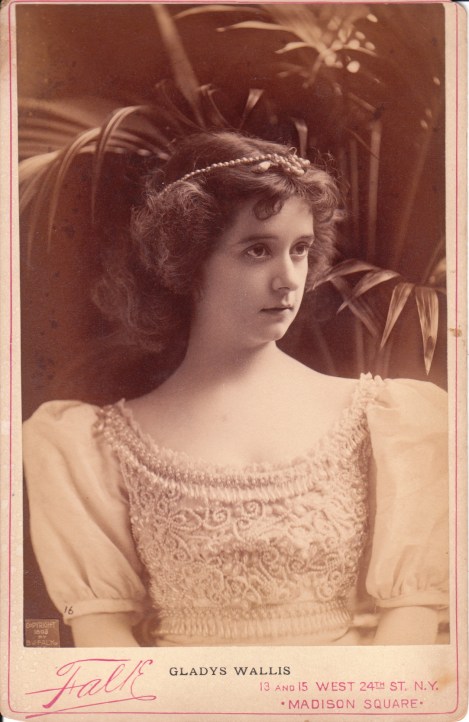
 Gladys Wallis, theater star, is the subject of this portrait by celebrity photographer B. J. Falk. Miss Wallis appears to be very young when she posed for this cabinet card photograph. The image is numbered 16 in a series and has a copyright date of 1893. In fact, she was just eighteen years old when she sat for this portrait. Glady Wallis (1875-1953) lived an interesting life. The Florence Times (1932) tells some of her story in an article that is predominately about her husband Samuel Insull (1858-1938). The article was quite disparaging of Insull and in the lead of the story the reporter writes “The keen brain of Samuel Insull built a 4,000,000,000 public utilities empire but he failed when he attempted to bring about his wife’s come-back as an actress after her 26 year absence from the stage”. The attempt cost him 200,00 dollars. Gladys Wallis’s was originally named Mary Bird. She was of Irish descent and upon becoming an actress was determined to be viewed as a respectable woman. She was anti alcohol and reportedly, anti sex. Insull had originally seen her as a “starry eyed and raven-haired young ingenue in an 1898 theater production in Chicago. She was just a teenager and he was 36 years-old starstruck admirer. They later met at a dinner party and two years later, they married. Gladys quickly retired from the stage and became a society lady. She had a number of estates and servants, was active in fund raising for charities, went to high society affairs and functions, and wore expensive clothing and jewelry. It is reported that she wasn’t an easy person to get along with and was not very well liked among the ladies of society. She and Insull reportedly had a tempestuous relationship and among their issues was her disinterest in sex. Insull supported her temperance beliefs. The couple had a son who eventually attended Yale University. In 1925,Wallis revealed her desire to return to the stage because of her desire for “self expression”. Her husband funded the theatrical endeavor and its proceeds were to be directed toward charity. Society turned out in mass for the opening night of what was to be a two week engagement where Mrs. Insull played the “coquettish role”of Lady Teazle. Attendees included Marshall Fields, the Armours, the Drakes, and the Pullmans. The success of this limited engagement spurred Wallis to return to Broadway. Wallis may have felt ready for Broadway but apparently Brodway wasn’t ready for Wallis and she returned to Chicago in 1927. She was not yet done with acting so she took a five year lease on a Chicago theater and established a performing company. This project failed and before long he company was operating at a loss of more than a thousand dollars a day. Things also did not go well for Mr. Insull. The depression severely impacted his business and eventually there were even charges filed against him. He fled to Europe with his wife where they entered “voluntary exile”. He was eventually deported from Europe but was well defended in a Chicago trial and found innocent of all charges. However, the Insulls had lost their fortune and at the time of his death, his estate was quite meager. There are a number of books available about Mr. Insull and they probably make quite interesting reading. This photograph was taken by B. J. Falk, New York City celebrity photographer. To learn more about this photographer and to see more of his images, click on the category “Photographer: Falk”.
PRETTY YOUNG STAGE ACTRESS GLADYS WALLIS (PHOTOGRAPH BY B J FALK)

PORTRAIT OF THEATER ACTRESS LILLIE THORNE
 The attractive woman in this photographic portrait is named Lillie Harris Thorne. Her name is printed on the reverse of the image. There was a theater actress named “Lillie Thorne” who performed during the cabinet card era and the subject of this portrait is likely the same Lillie Thorne. The Golder & Robinson studio was located on Broadway in New York City and was known for it’s celebrity photographs. Unfortunately, preliminary research yielded little information about Lillian Thorne.
PRETTY YOUNG WOMAN WINS THE LOTTERY IN NEW YORK CITY
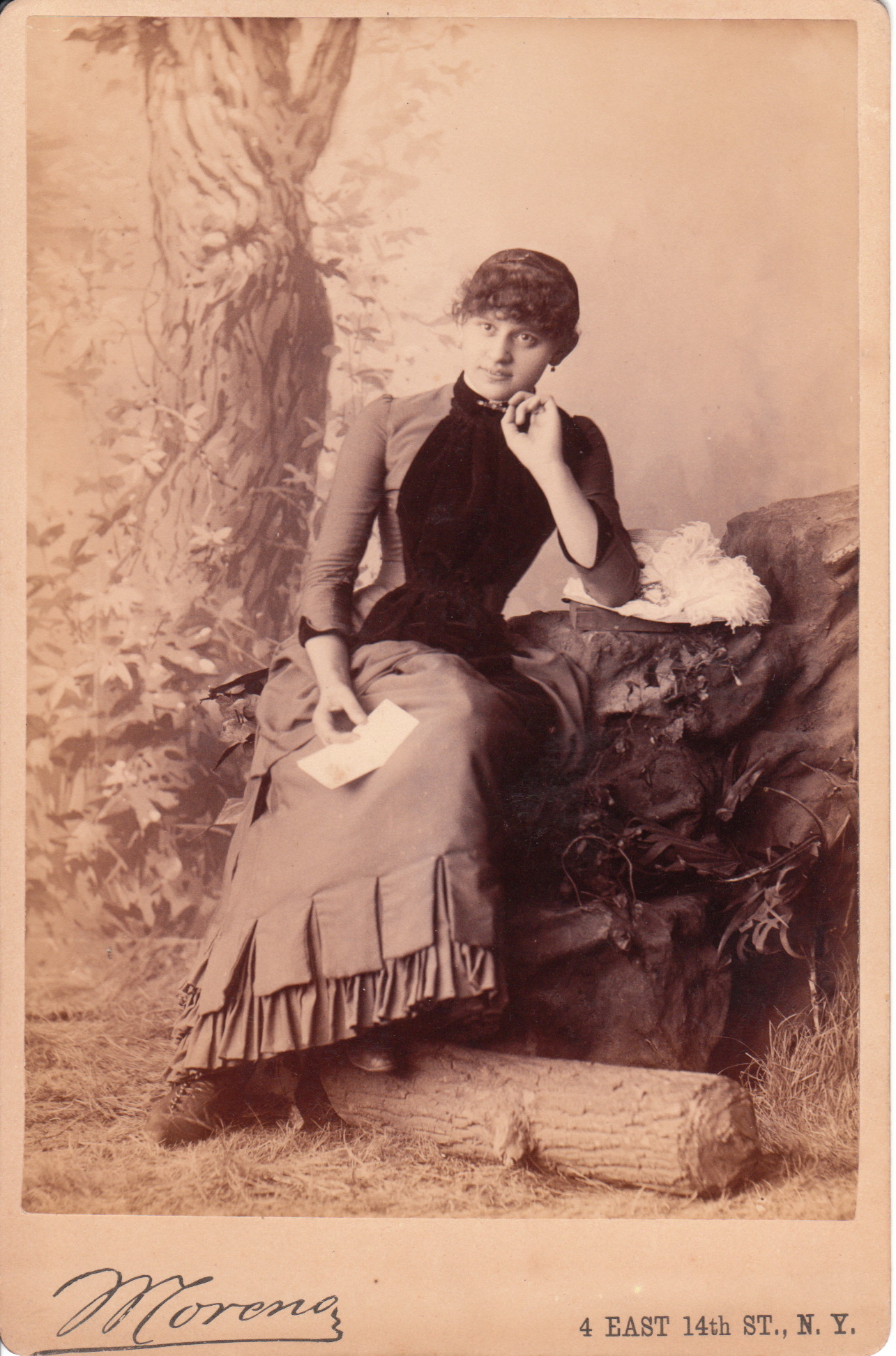 A pretty young woman sits on a faux rock as she poses at the Moreno studio in New York City. She is holding what appears to be an envelope in her hand but at first glance looks like bank check. This fashionable subject is very thin waisted and present herself in what the photographs previous owner called “a fetching pose”. Antonio E. Moreno was a Cuban painter and graphic artist who became a photographer after seeing the success of his New York based countryman, Jose Maria Mora (see category “Photographer: Mora”). In 1881, Moreno took over a failing New York City photographic studio. The business end of the studio was run by his co-director, Jose Lopez. Moreno developed the business into a great success due to his great talent as a photographer, developer and innovator. He became noted in photographic circles and received much acclaim from his participation in photographic expositions. He surrounded himself with talented co-workers. Much of his staff came from Mexico. Spanish cameraman Antonio Urda was considered to be excellent at his craft but was a fiery man who eventually committed suicide by drinking development fluid after failing to murder printer Domingo Costello. After this incident, Moreno preferred to hire English speaking Europeans to work at his studio. One of his hires was printer Nahum Lubosh whom he snared from celebrated photographer B. J. Falk (see category “Photographer: Falk”). Another employee, cameraman A. L. Simpson pioneered the use of slides utilized in theater sing-alongs. In 1890 Moreno partnered with the Taber Art Company in publishing photographs of beautiful female models in what has been described as “genre scenes and allegories”. The photographs were well posed, precisely lit and very tasteful. Moreno’s gallery was in business for a quarter of a century and was a center for performing arts portraiture. One wonders if the subject of this cabinet card portrait was in fact a theater actress. To view other photographs by Moreno, click on the category “Photographer: Moreno”.
MAUDE BRANSCOMBE: CELEBRATED BEAUTY AND ACTRESS


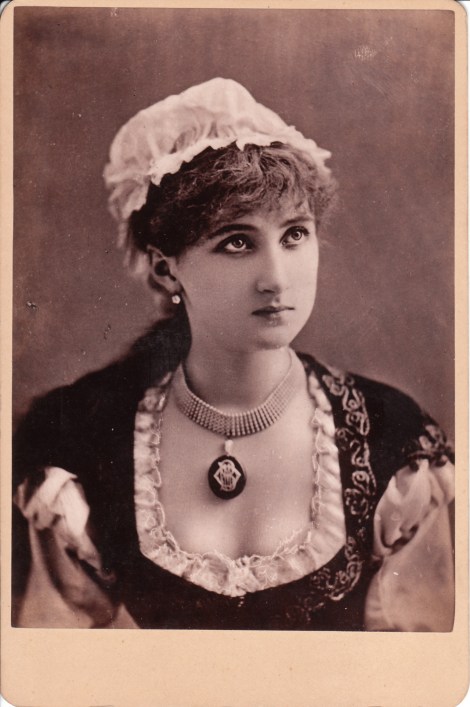

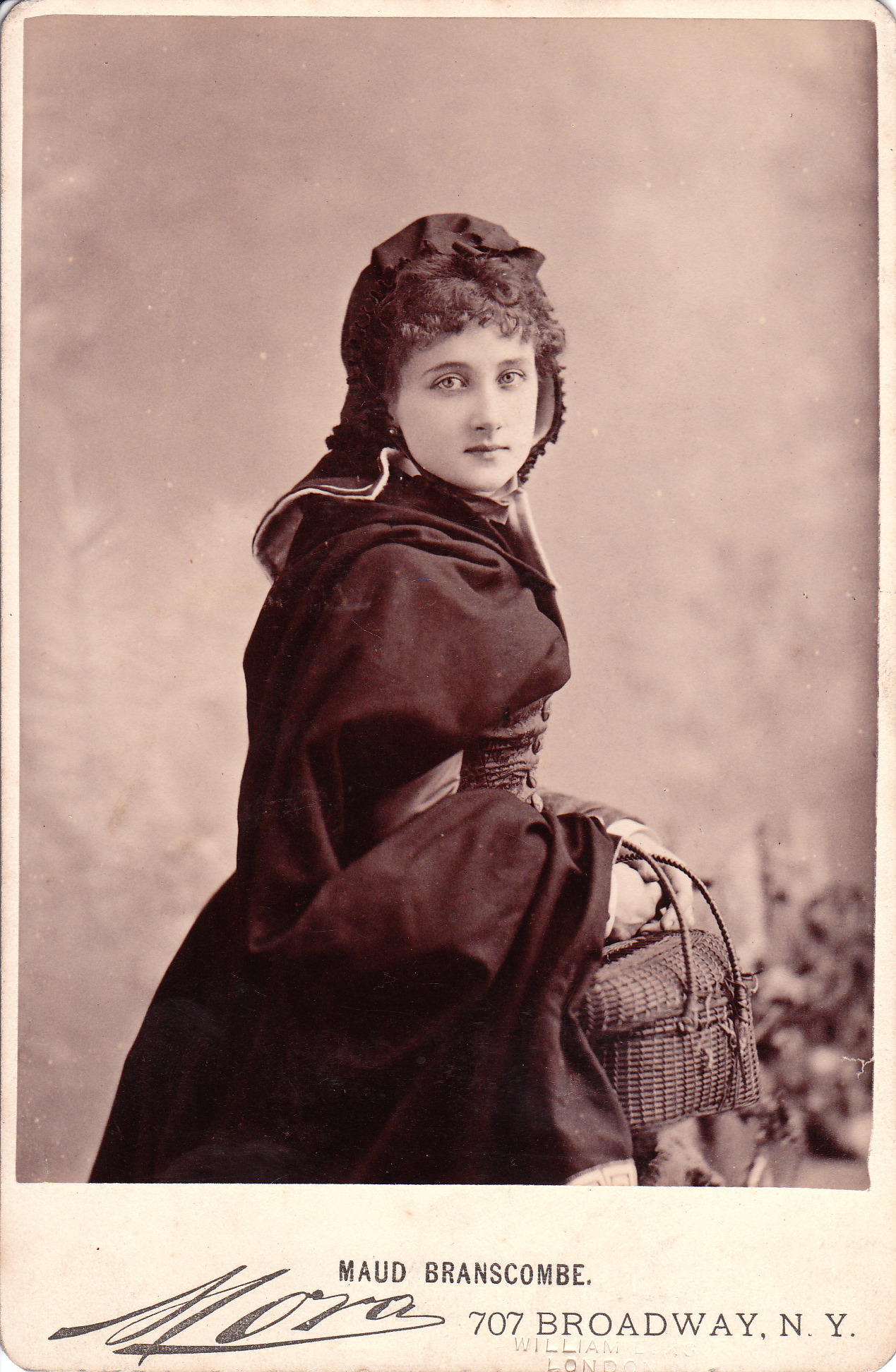
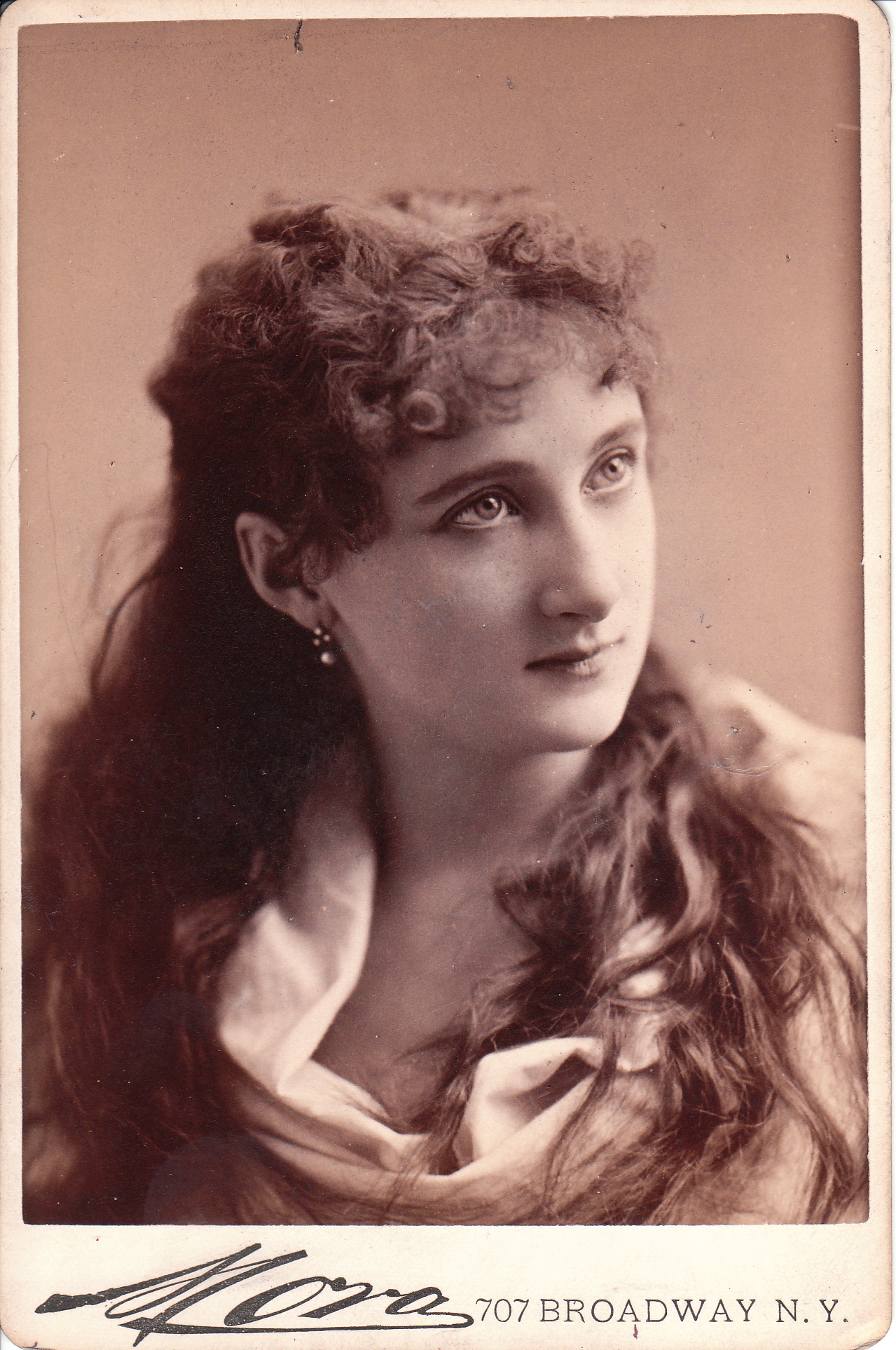

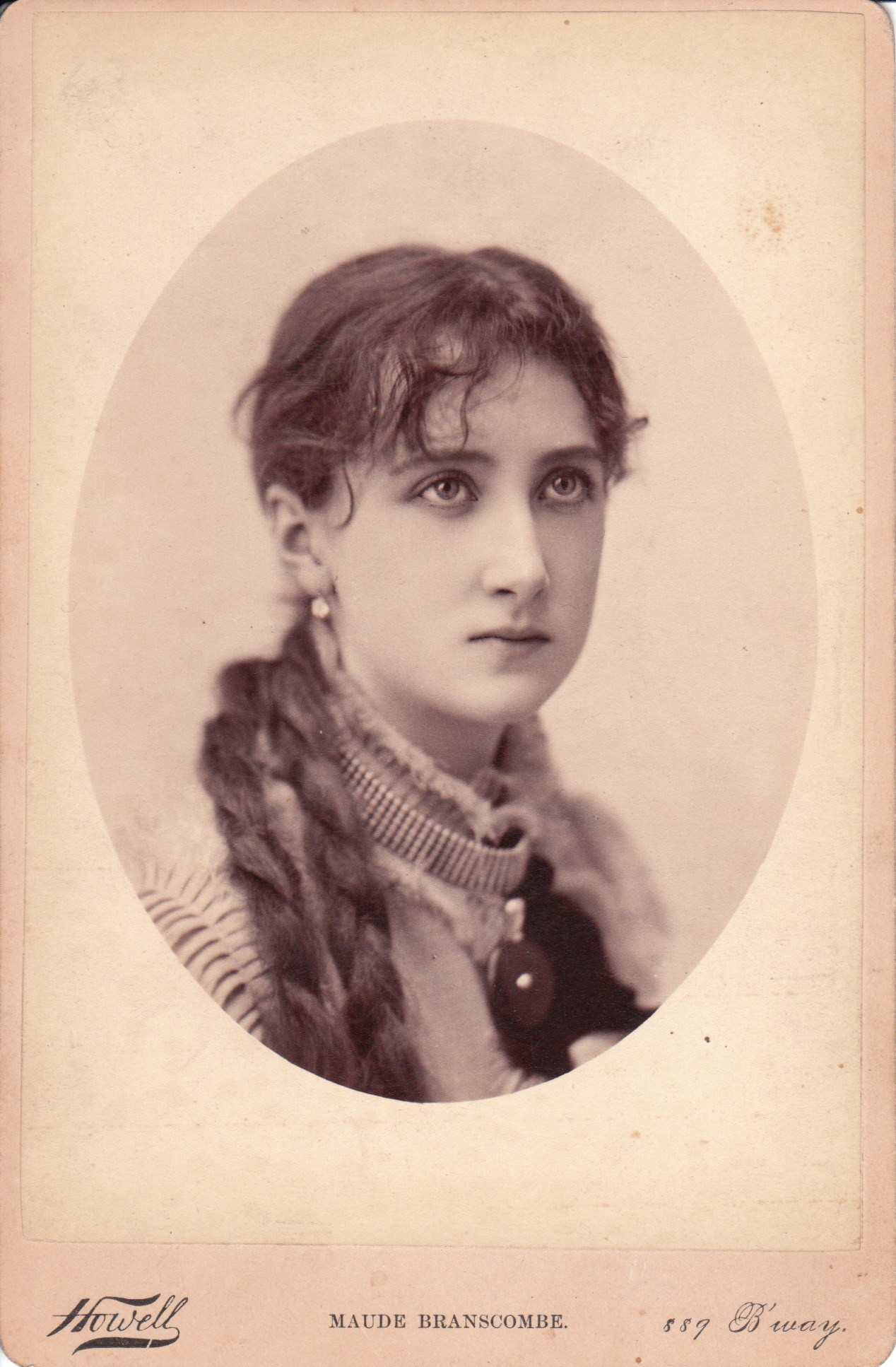


Maude Branscombe was a very popular stage beauty and light opera singer. She was reported to be the most photographed woman of her day. Biographical information about her is sparse and more will be added at a later date. Her first appearance on the New York stage was in 1876 as Cupid in a revival of Ixion at the Eagle Theatre. The portrait at the top was photographed by renowned W & D Downey of London, England.
The second portrait was cropped so the photographer is unknown.
The third portrait (Branscombe is wearing a necklace) is by L. Levin & Son of San Francisco, California.
The fourth cabinet card image was photographed by Sarony. Sarony was a well known celebrity photographer and more of his portraits can be viewed by clicking on the category of “Photographer: Sarony”. Sarony does an excellent job of capturing Branscombe’s beauty and her alluring eyes.
The fifth and sixth, and seventh cabinet card were photographed by another celebrity photographer, Jose Mora, of New York City. Interestingly, the fifth and seventh cabinet card captures Branscombe in the same costume as the second cabinet card. It is likely that the photographer of cabinet card number two, is also Jose Mora. To view other photographs by Mora, click on the category of “Photographer: Mora”.
The eighth cabinet card portrait of Branscombe was photographed by Howell, another New York City photographer with a studio on Broadway. Howell’s close-up photograph captures the actress’s beauty and her wonderful eyes. She is wide eyed and her hair is a bit mussed. These qualities add to the allure of Miss Branscombe.William Roe Howell was born in 1846 in Goshen, New York. He had a passion for drawing and painting and he directed his creative interest into the field of photography as a young adult. He opened a photographic studio in Goshen. In 1863 he moved to New York City where he joined Robert and Henry Johnston at Johnston Brothers Studio at 867 Broadway. In 1866 the firm became Johnston & Howell. In 1867, he became the sole proprietor of the gallery. By 1870, he was gaining much recognition in the field of photography. His great location in New York City gave him access to many fashionable upper class men and women as well as many celebrities. Among his photographic subjects were P. T. Barnum, Buffalo Bill, and Robert E. Lee. He opened a branch studio in Brooklyn. In 1873 he came one of five Americans to be awarded a special grand prized at the Vienna World Fair. He frequently received mention in the photographic journals. He published a book of cabinet cards that received much praise. He became a photographer for West Point, Princeton, and other notable institutions. He won many medals at photography exhibitions. In 1878 he moved his business from 867 to 889 Broadway and opened another studio with a partner (Meyer) at 26 West 14th Street. In 1880 he retired from photography due to health reasons. In 1886 he moved with his family to Washington D.C. intent on opening a photography business there. He then disappeared. He vanished just two weeks before the grand opening of his new studio. He left his wife of 16 years (Fannie Scott) and his five children penniless. His wife stated that Howell was an eccentric man and that he must have got tired of business and family problems “and cut loose from us”. He apparently returned home after a short duration of absence and his business appeared in the 1888 Washington D. C. business directory but not in the 1889 directory. He died of tuberculosis in New York City in 1890. He had been residing at the home of a colleague who ran a photography studio in Harlem. It is believed by some biographers that he had divorced his wife and returned to New York without his family.
The ninth cabinet card is another portrait photographed by Jose Mora. The actress’s costuming detracts from the overall appeal of the photograph. She seems lost in the swirl of her head covering. However, the photographer does an excellent job of highlighting Miss Branscombe’s seductive eyes. The phrase “Maude Branscombe eyes” certainly rivals the phrase “Bette Davis eyes”.
Cabinet card number ten also comes from the studio of Jose Mora. She is well dressed in this portrait. It is not clear if she is dressed for a stage role or if she is attired for a jaunt around town.
AGNES EVANS: THEATRE ACTRESS DRESSED IN QUITE RISQUE FASHION

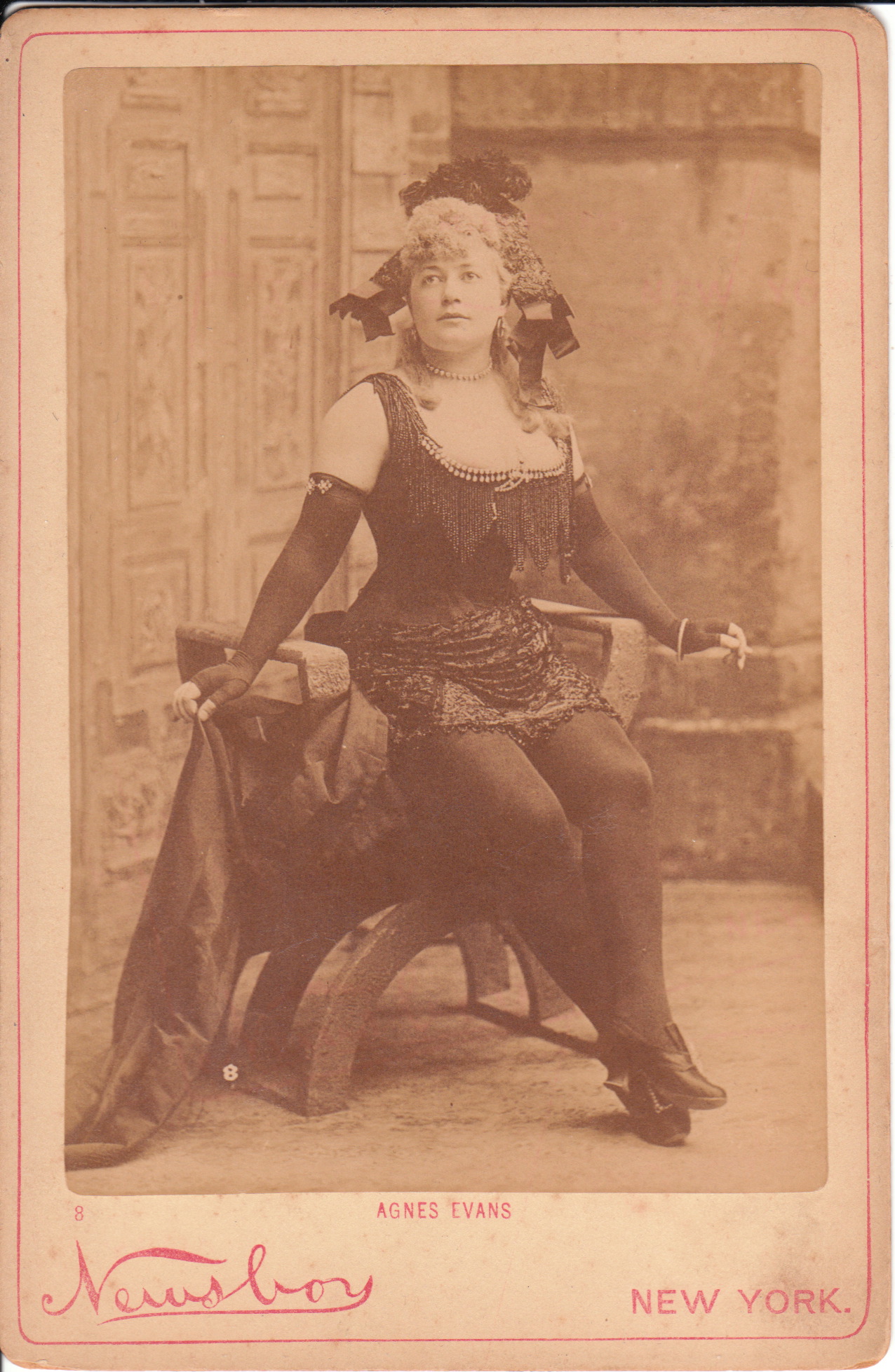
Agnes Evans poses for this cabinet card (top) photographed by Newsboy of New York. Agnes Evans was a theatre actress who performed in the Broadway production of the Pit (1904). The actress is wearing a very revealing risque dress. Further research by myself or assistance from visitors to this site will hopefully further illuminate her life and career. Newsboy was a brand of plug tobacco and Newsboy photographs were given away as a premium by tobacconists and drug stores who sold the tobacco. The images were produced by the National Tobacco Works of New York. They were likely produced and issued in the early 1890’s. The bottom image features Miss Evans in another Newsboy cabinet card (number 8 in a series). She is wearing a risque costume that includes fingerless gloves.
LULU GLASER: ROCKET ASCENT FROM UNDERSTUDY TO STAGE STAR
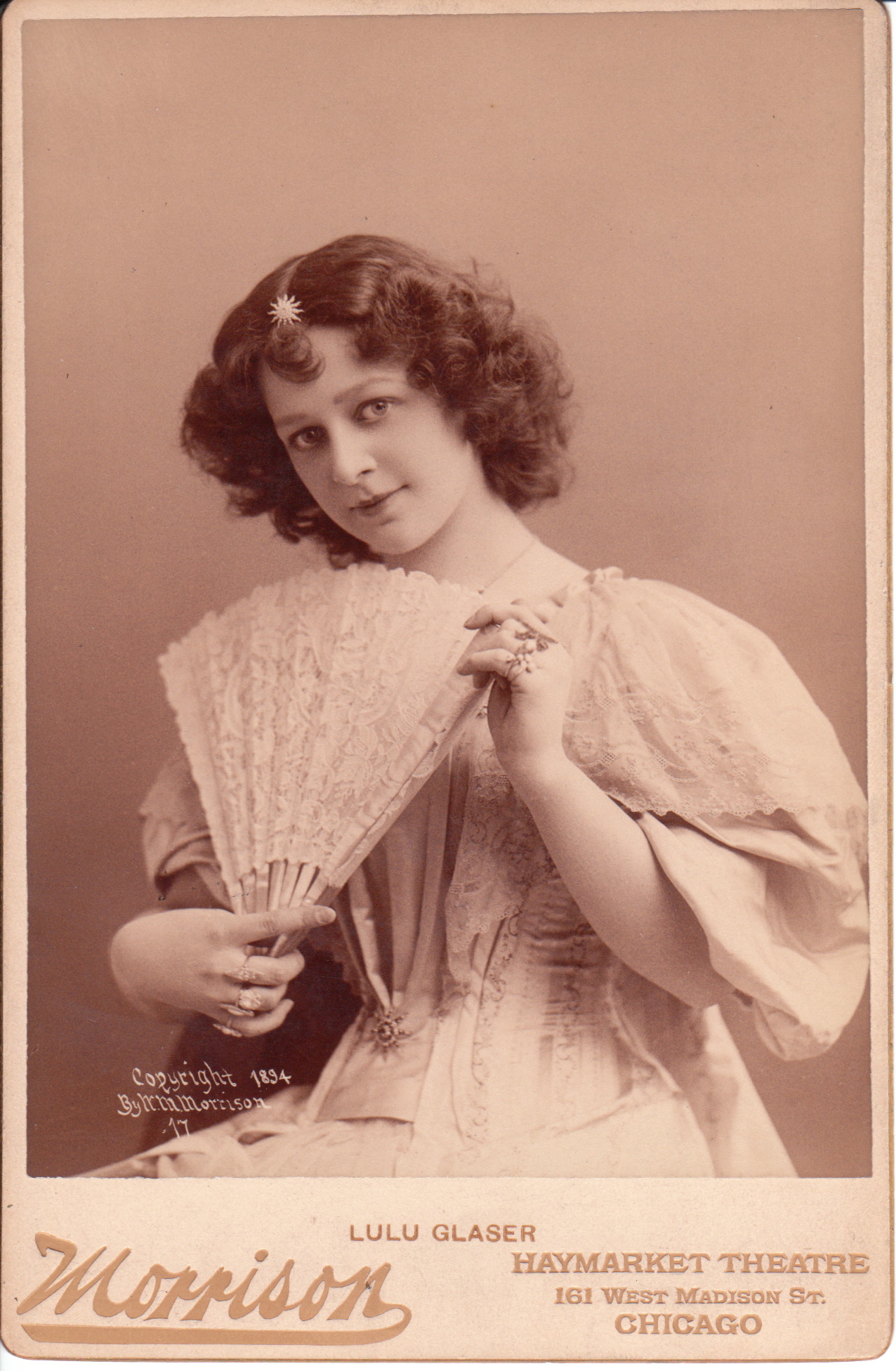 CABINET CARD 1 (SOLD)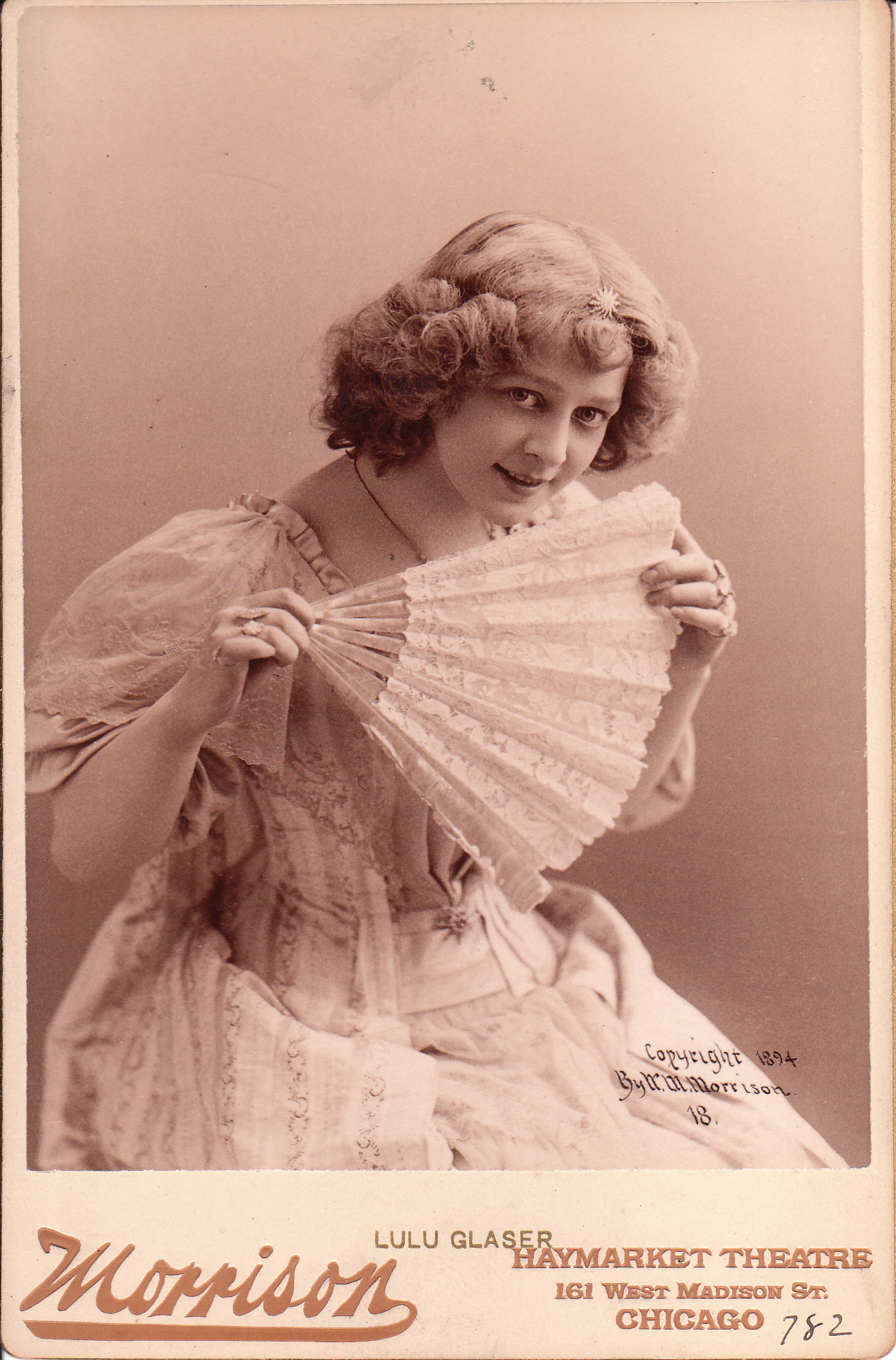
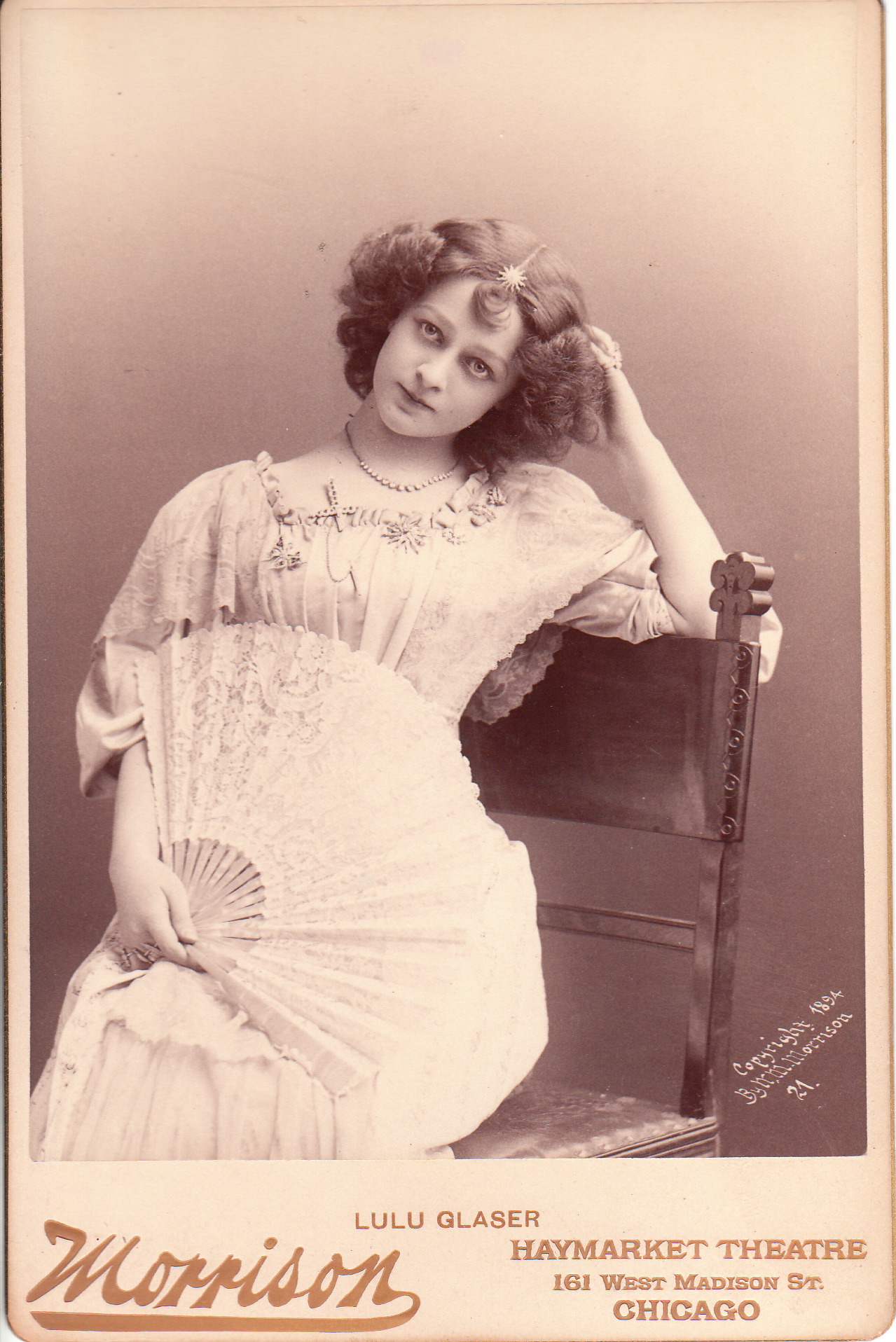
CABINET CARD 2 & 3
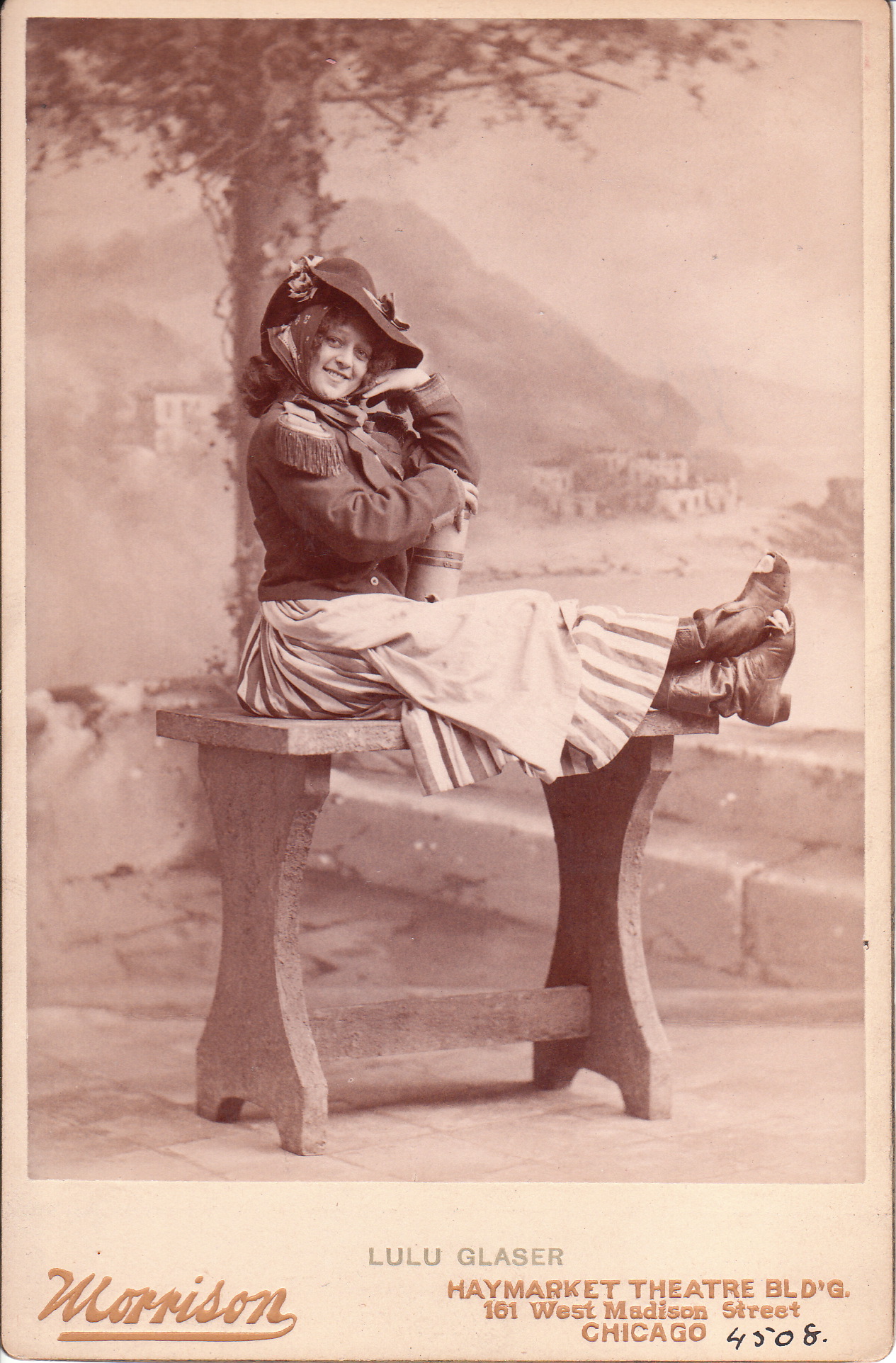
CABINET CARD 4
CABINET CARD 5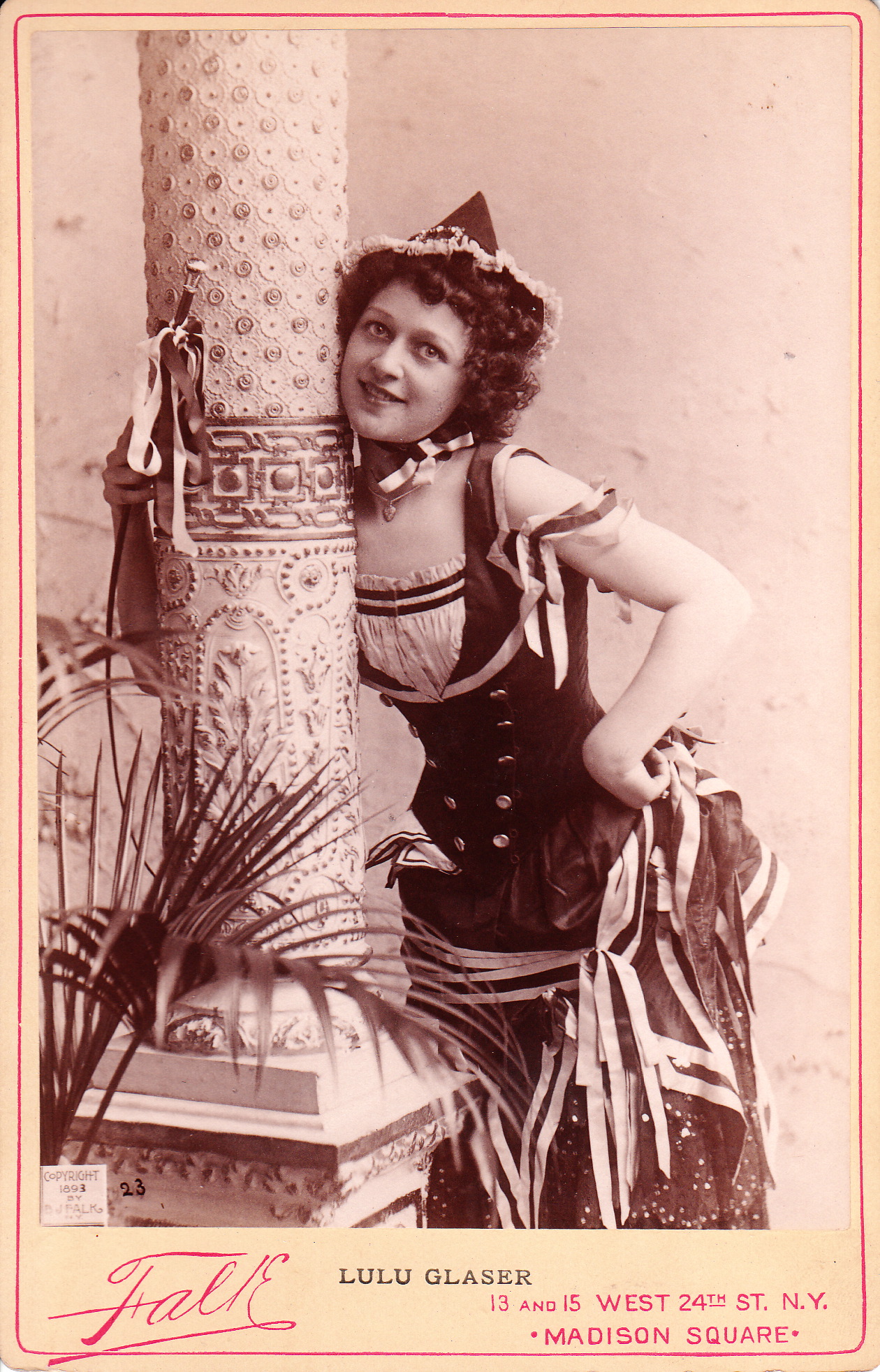
CABINET CARD 6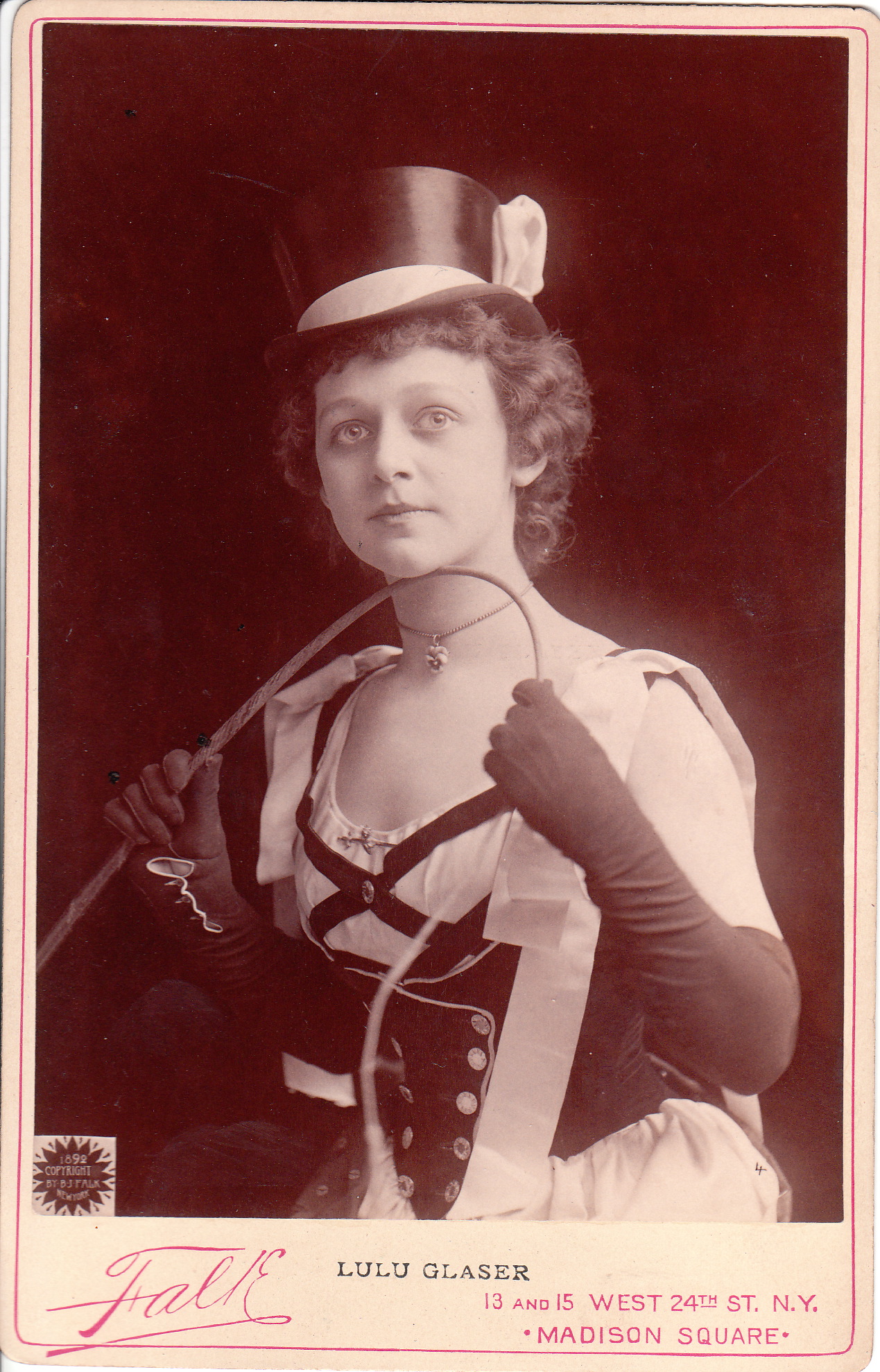
CABINET CARD 7
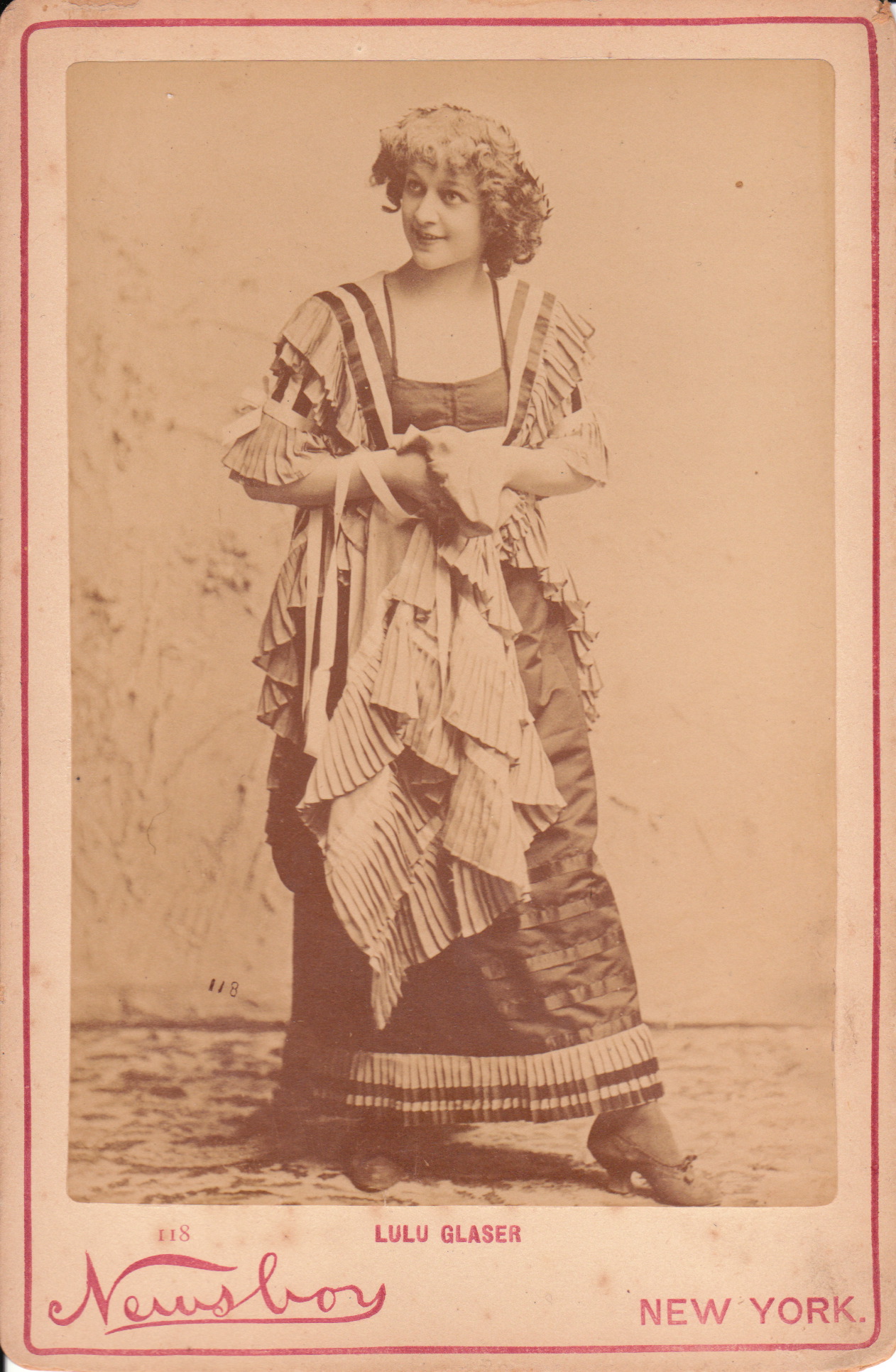 CABINET CARD 8
These cabinet cards features Lulu Glaser (1874-1958), a Pennsylvania born actress and singer. She came to Broadway with no previous professional experience when she was hired to play in the chorus of “The Lion Tamer (1891)”. She was also given the role of understudy to the Prima Donna. After the star fell ill, Lulu Glaser took over the role and began a meteoric rise to stardom. For the next twenty plus years, Glaser played many roles in such productions as “The Merry Monarch” (1892), “Erminie” (1893), “The Little Corporal” (1898), and “Miss Dolly Dollars” (1895). She achieved her greatest success in “Dolly Varden” (1902). Lulu Glaser was a beautiful woman and this portrait confirms that assessment.
In Cabinet Card 1 Glaser is holding a fan and her expression could be described as coy. She is adorned with a great deal of jewelry including multiple rings, a hair pin and a pin on the midsection of her dress. The photographer of this image, as well as the next four images, is Morrison, of Chicago, Illinois. The photographs have a copyright date of 1894. Morrison was a well known celebrity photographer and his studio was housed in the Haymarket Theatre. To view other photographs by Morrison, click on this site’s category “Photographer: Morrison”.
The sixth photograph of Glaser is by celebrity photographer, Falk, of New York City, New York. This photograph is copyrighted 1893. The seventh photograph, also by Falk, captures Glaser in costume for an unknown titled play. She is holding a whip and not looking particularly friendly. The image looks like it would be appropriate accompanying an ad on one of the controversial sections of Craig’s List. The photograph is dated 1892. To see other photographs by Falk, click on the category “Photographer: Falk”.
Photograph number eight captures Lu Lu Glaser in the same costume she is wearing in photograph number five. The eighth photo was published by Newsboy as a premium used to accompany the sale of their tobacco products. The image is number 118 of a series of celebrity photographs. To view other Newsboy photographs, click on the cabinet card gallery category “Photographer: Newsboy”.
MISS LILLIAN RAYMOND: PRETTY STAGE ACTRESS WHOSE LIFE WAS CUT SHORT BY TUBERCULOSIS
 On July 17th, 1911, the New York Times printed the following obituary, reporting from Louisville, Kentucky. “Lillian Dolfinger, known to the theatrical world as Lillian Raymond, who appeared in “The Girl of the Golden West’, and several other New York productions, died today at the home of her father here from tuberculosis. She was 25 years old. Miss Raymond was to appear in one of the New York productions this Fall, but became ill”. Investigation revealed that Miss Raymond appeared on Broadway on three occassions. She appeared in “Wonderland” (1905), “About Town” (1906), and “The Girl Behind the Counter” (1907). All three shows were musicals. No other information about Miss Raymond could be found during preliminary research. The photographer of this image is C. J. Horner who described himself through his advertising as a “European Photographer. His studio was located at 11 Winter Street in Boston, Massachusetts. It is tragic that Lillian Raymond’s stage career and life was cut short by illness. We will never know to what heights this pretty young actress may have climbed in the theatrical world. The photographer of this image rose to lofty heights in his profession. Swedish born Carl Joseph Horner (1864-1926) was probably the best sports photographer of his era. He was particularly known for his baseball photographs, many of which appeared on tobacco company issued baseball cards. Among the players he photographed were Cy Young and Tris Speaker. His panoramic portrait of the 1912 “Red Sox Champions” is well known among collectors.
PORTRAIT OF A PRETTY UNIDENTIFIED ACTRESS IN NEW YORK CITY
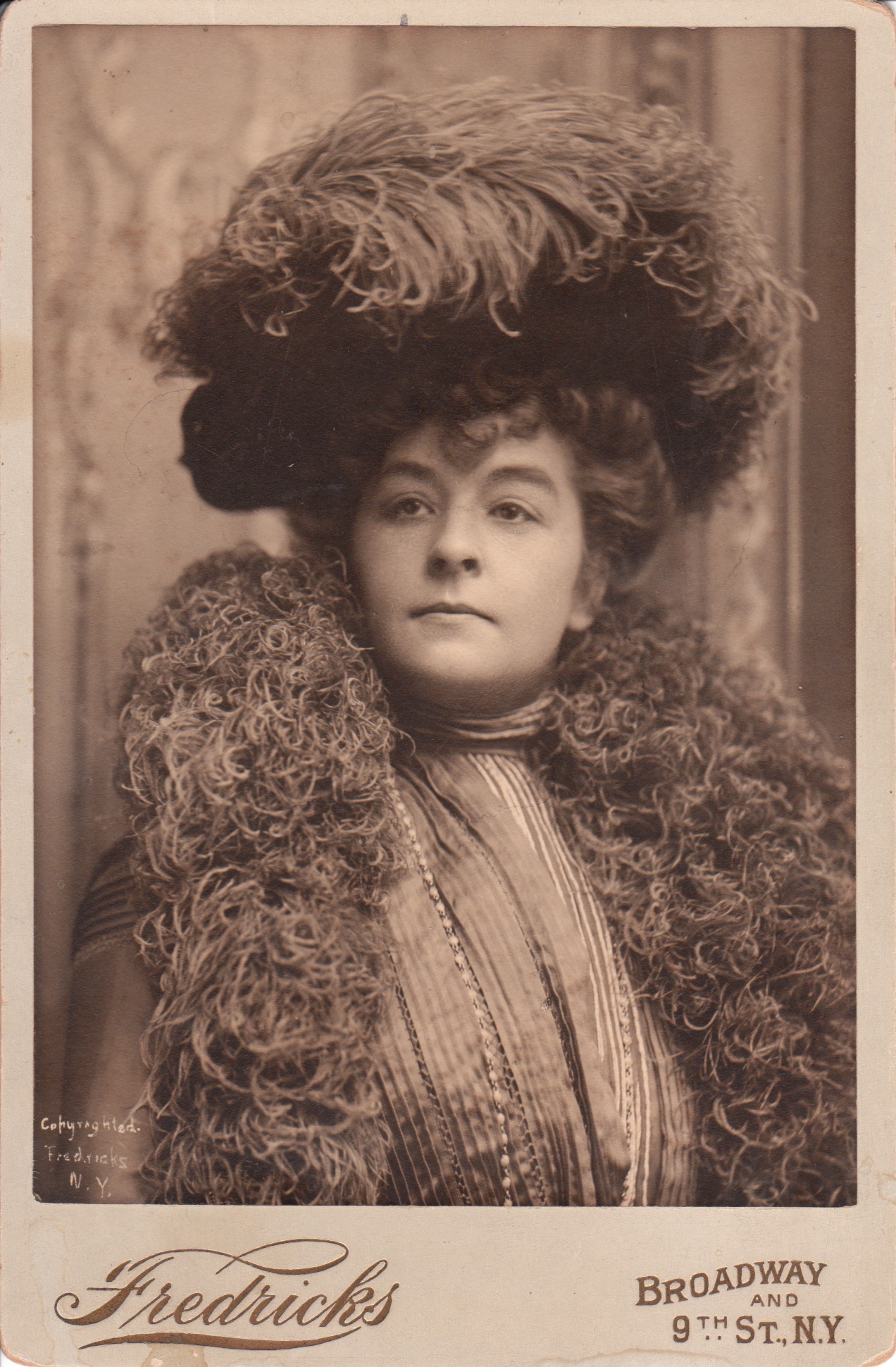
This portrait features an attractive unidentified actress. This woman seems to love texture. Note the fabrics she is wearing. She has a wonderful feathered hat and a shaggy stole. At least I think its a stole but I am uncertain and welcome intervention from a cabinet card gallery visitor knowledgeable about woman’s fashion. The woman looks quite handsome in her high collar dress and lovely accessories. The photograph was taken at Fredricks Knickerbocker Family Portrait Gallery in New York City (770 Broadway). To learn more about Mr. Fredricks and to view more of his images, click on the category “Photographer: Fredricks”.
CUTE KIDS ON BROADWAY (NEW YORK CITY)
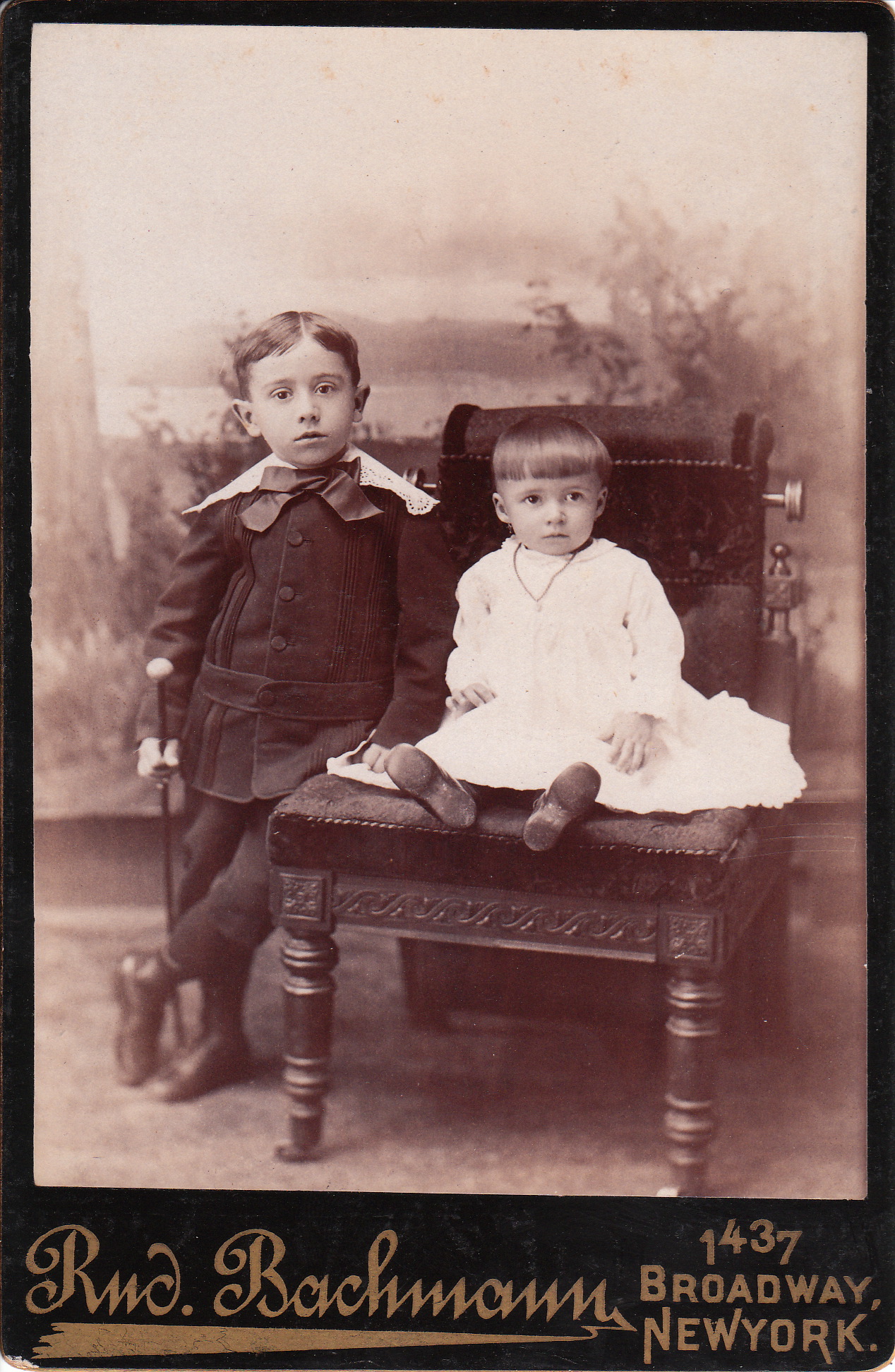 Two adorable kids pose for photographer Rud Bachmann whose studio was located on Broadway in New York City. The older child is holding a walking stick. It is very likely that the children are siblings. The photographer’s full name is Rudolph Bachmann. He was born in 1850 in Switzerland. He came to the United States in about 1880 and by 1884 was operating a photography business at 1437 Broadway in New York City. The gallery remained at that address until 1922 when the studio was relocated to 6 East 14th Street. Cabinet cards published after 1914 indicate that he was joined in business by his son.
CELEBRATED ACTRESS ADA REHAN AND HER LABORADOR RETRIEVER (PAGE INCLUDES ADDITIONAL PORTRAITS OF MISS REHAN)
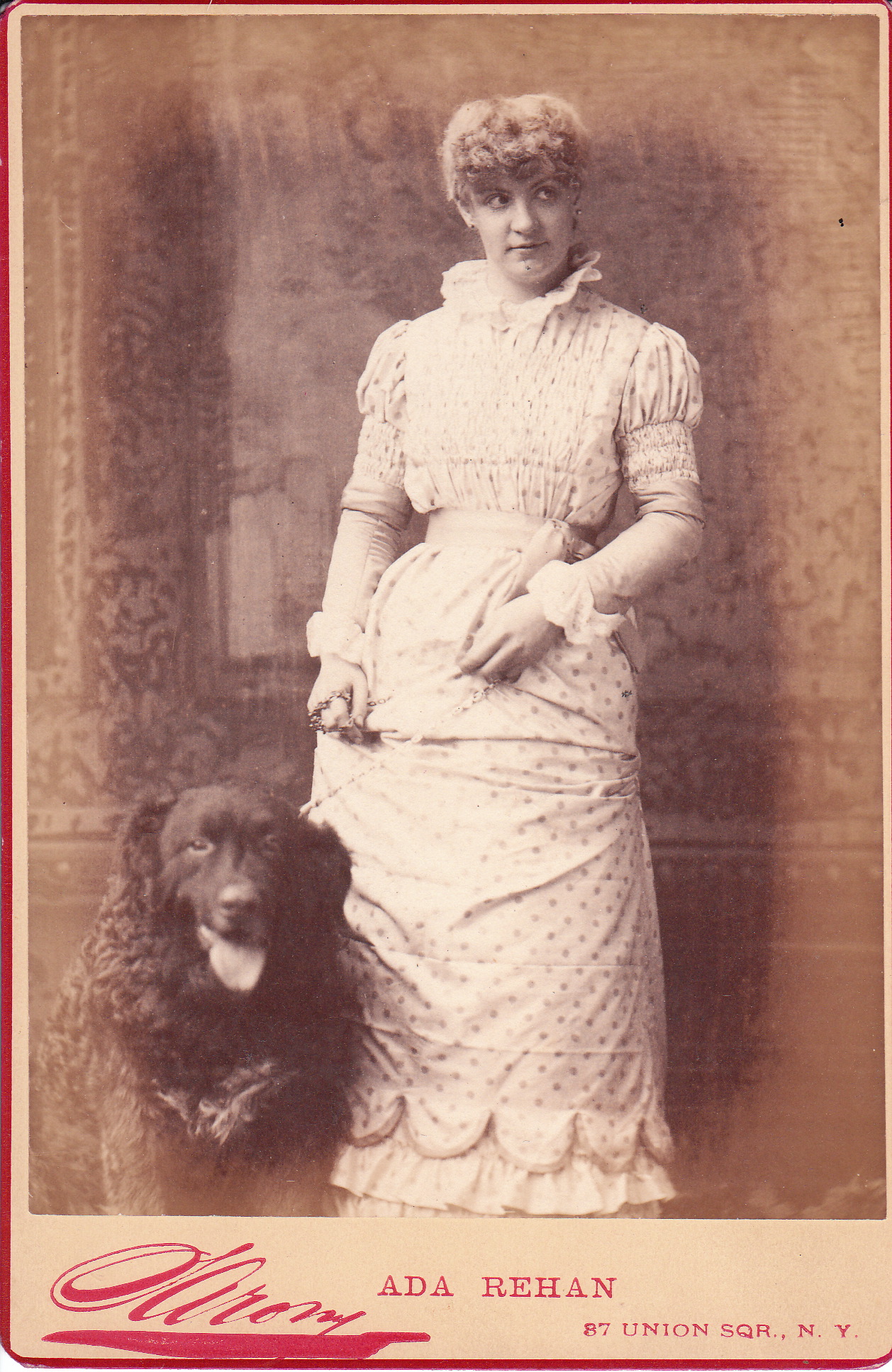 PHOTOGRAPH 1 (SOLD)
 PHOTOGRAPH 2
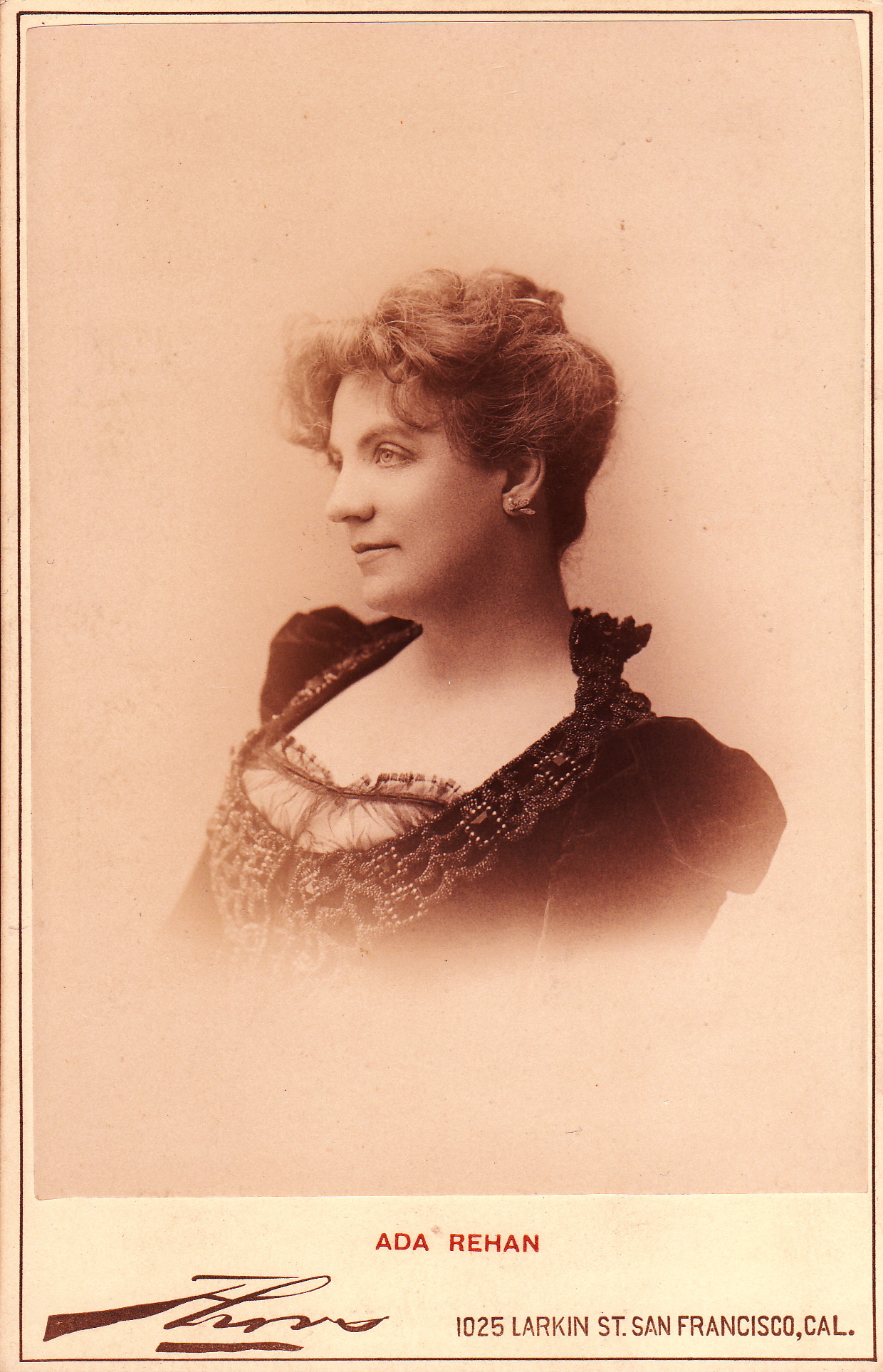 PHOTOGRAPH 3
Ada Rehan was a well known and respected American actress. The top cabinet card portrait of Ms Rehan and her dog was published by Napoleon Sarony, a famous celebrity photographer in New York City, New York. Ada Rehan was born in Ireland and came to the United States at six years of age. She grew up in Brooklyn, New York. She began acting as a child. From 1873 until 1875 she became more active in acting at Mrs. Drew’s Theatre in Philadelphia, Pennsylvania. She then joined John Albaugh’s company and appeared in Baltimore, Albany and numerous other cities. In 1879 she joined Augustin Daly’s company upon his opening of his New York theater. She worked with his company for twenty years and appeared throughout Europe. The IBDB reveals that Ada Rehan appeared in 12 Broadway productions. Some of the Broadway and non Broadway plays she appeared in include a number of Shakespeare productions such as “As You Like It” and “Twelfth Night”. Rehan also acted in “The School for Scandal”, “Foresters”, “Cinderella at School”, and “Our English Friend”. She retired from the stage in 1906 and lived in New York City until her death. It is interesting to note that Ms Rehan’s dog is on a leash. The leash is made of metal links. She is holding the leash with both hands. This is the first leash that I have observed in the many cabinet card photographs of dogs that I have seen. The dog at the end of the leash in this image appears to be a laborador retriever. (SOLD)
The second portrait of Miss Rehan was published by Newsboy of New York. The image was number 68 in a series of photographs. Newsboy distributed these images as premiums for their tobacco product sales.
The third image of Miss Rehan is a bust portrait by Louis Thors of San Francisco, California. Thors was born in Holland in 1845. He was of French descent and educated in France. He was fitted for service in the Merchant Marine and he served in that capacity for a number of years before coming to California in 1876. By 1880 he had established his photography business. One source states that his studio had more than twelve “apartments”. He won a Bronze Medal at the Paris Exposition in 1889. His wife, Gertrude M. Thors was also a photographer. Camera Craft: Photographic Association of California (1910) printed Thors’s obituary. He was described as one of the highest esteemed photographers in San Francisco. He died of stomach cancer at age seventy-two. He worked in the photography business in San Francisco for over forty years. He left the city after the San Francisco fire and worked in St. Louis for two years before returning to California. The obituary reports that after his immigration to the United States, his skill as a painter earned him employment with photographers Bradley and Rulofsen (click on category “Photographer: Bradley and Rulofsen” to view some of their photographs). In addition, the death notice asserted that besides his talents as a photographer, Thors had a charming personality and high moral character. To view other photographs by Thors, click on the category “Photographer: Thors”.


 THE CABINET CARD GALLERY