JULIA MARLOWE: ESTEEMED AMERICAN STAGE ACTRESS

CABINET CARD 1

   CABINET CARD 2   (SOLD)

CABINET CARD 3  (SOLD)

CABINET CARD 4

CABINET CARD 5

CABINETCARD 6CABINET CARD 7   (SOLD)

CABINET CARD 8

CABINET CARD 9

MARLOW8

CABINET CARD 10

MARLOWE IN INGAMAR_0003
SPIN MARLOWE_0002

CABINET CARD 11

CABINET CARD 12

BRANSCOMBE

CABINET CARD 13

This image has an empty alt attribute; its file name is julia-marlowe-falk.jpg

CABINET CARD 14   (SOLD)

JULIA MARLOWE: ESTEEMED STAGE ACTRESS : SARONY : CABINET CARD PORTRAIT  c1890 - Picture 1 of 3

CABINET CARD 15 (SOLD)

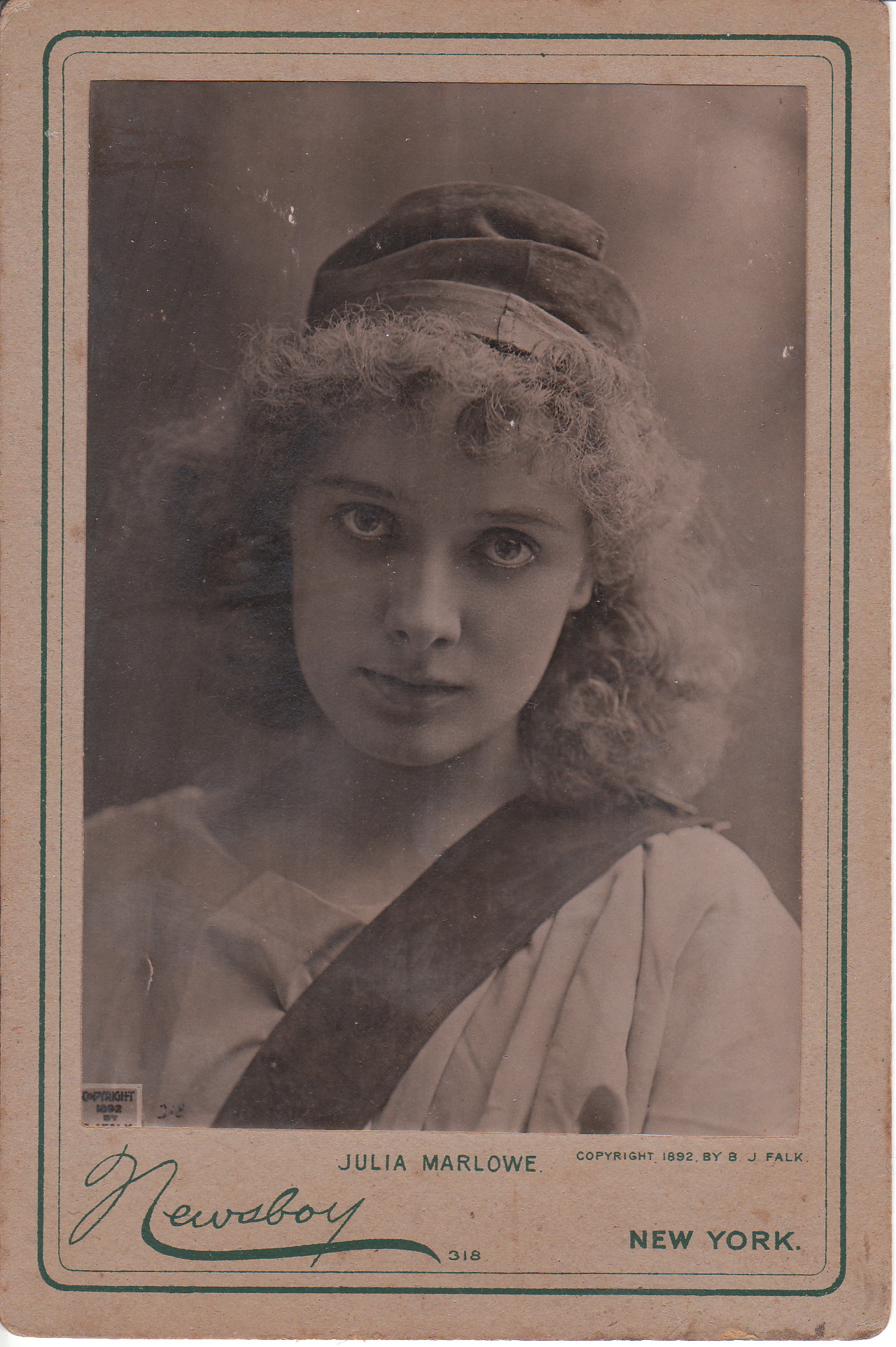
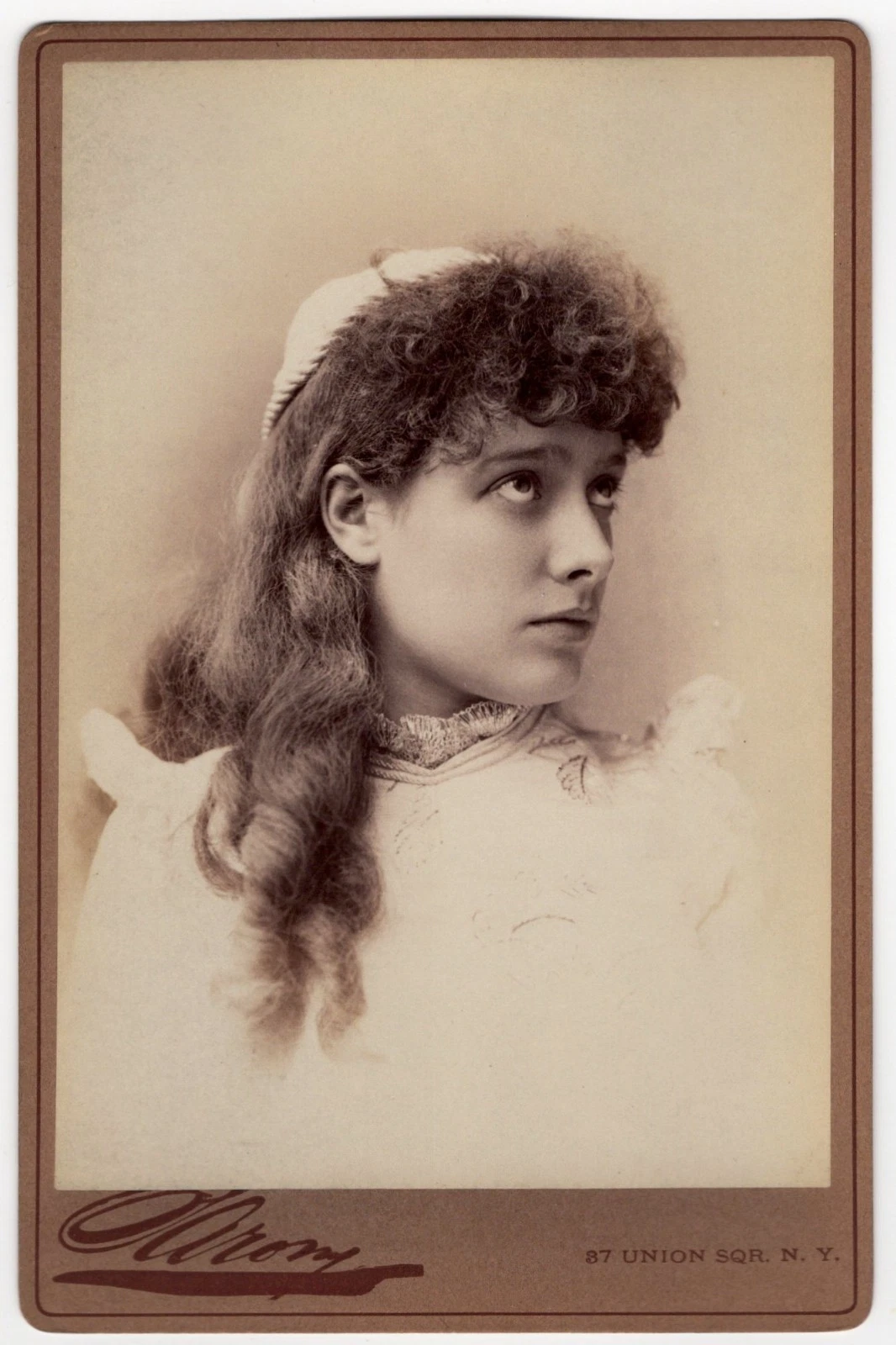
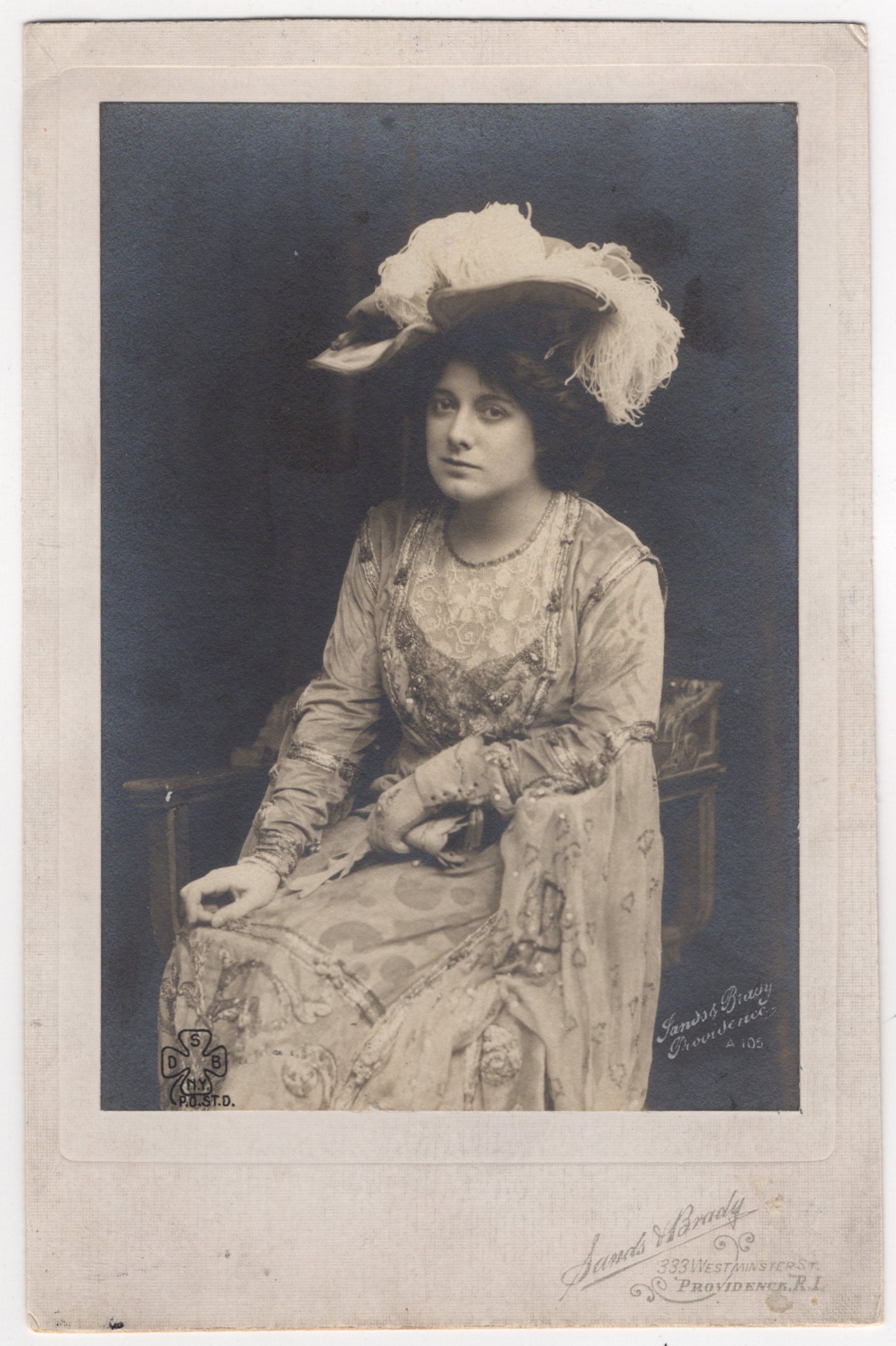
Julia Marlowe (1865-1950) was born in England and as a young child moved to the United States with her family. In her early teens she began her theatrical career with a juvenile opera company. She began playing Shakespeare in her home town of Cincinnati, Ohio. She made her Broadway debut in 1895 and by the end of her career, had appeared in more than 70 Broadway productions. Her first husband was actor, Robert Tabor. Their marriage lasted six years. In 1904 she appeared in “When Knighthood was in Flower”. Great success in this play brought her financial independence. Earlier, in 1903, she appeared in ‘The Cavalier” and “Ingomar”. The New York Sun wrote about her performance in “Ingomar”; “There is not a woman player in America or in England that is – attractively considered- fit to unlace her shoe”. In 1904 she began a partnership with actor E. H. Sothern. They toured the United States performing various plays of Shakespeare. They were managed by Charles Frohman and later, the Shubert brothers. They were considered to be among the major Shakespearian actors of the day. In 1906, Marlowe played in “Jeanne d’Arc” and also as Salome in “John the Baptist”. Later, Sothern and Marlowe played in London but were not terrific box office successes there. In 1911 Marlowe and Sothern married each other. In 1920 and 1921, they made eleven phonograph recordings for the Victor Company. The top Cabinet Card was produced by Newsboy as a premium for their tobacco products. The photographer was Falk and the image is from 1892.

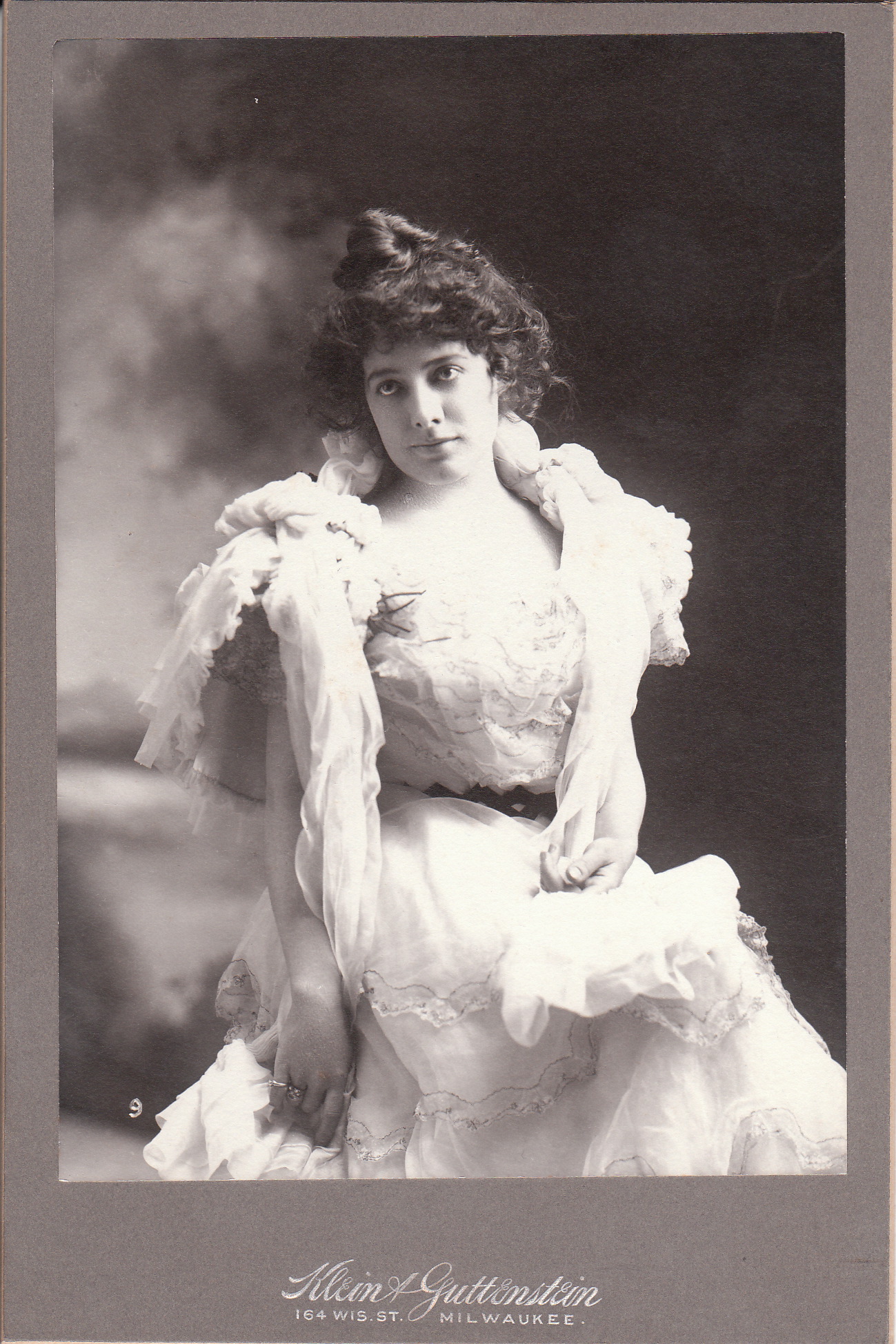
The second portrait of Julia Marlowe has a notation on the reverse of the card stating “Julia Marlowe Tabor”. Therefore, this photograph was likely taken during the time of her marriage to Tabor (1894-1900). The photographic studio that produced this portrait is  Klein & Guttenstein of 164 Wisconsin Street, in Milwaukee,  Wisconsin.  Klein and Guttenstein were leading photographers of their time. Wilson’s Photographic Magazine (1902) reveals that the two men  were very active in the Photographers Association of Wisconsin and other photography organizations. The photographers were considered part of a network of photographers skilled at producing publicity images of theatrical and vaudeville stars to be used in national magazines and other publications. The New York Public Library has a collection of portraits of actress Blanche Bates; produced by Klein & Guttenstein. The University of Pennsylvania Library has one of Klein & Guttenstein’s portraits of Julia Marlowe.  (SOLD)

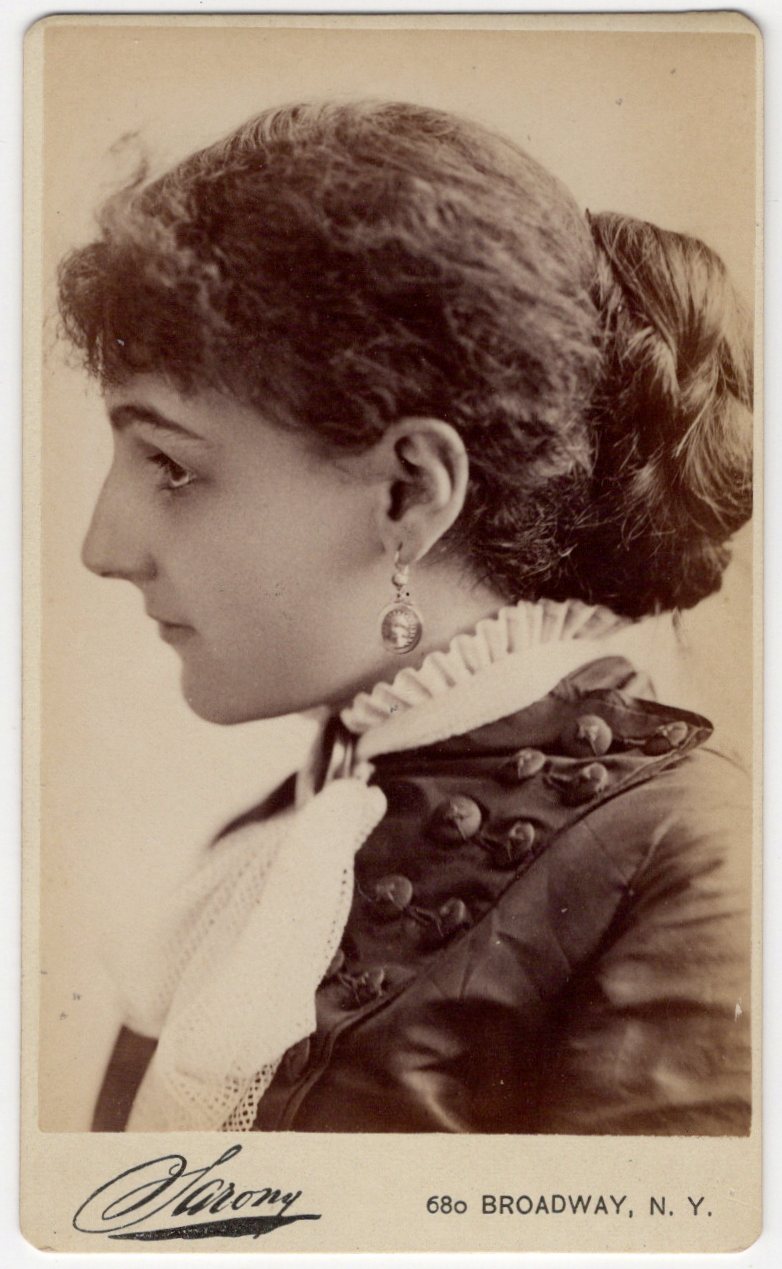
The third portrait of Julia Marlowe in the cabinet card gallery collection is photographed by Sarony, the famed celebrity photographer located in New York City.  This cabinet card is signed by the actress and dated 1890. Additonal photographs by Sarony can be viewed by clicking on the category “Photographers: Sarony”.  SOLD

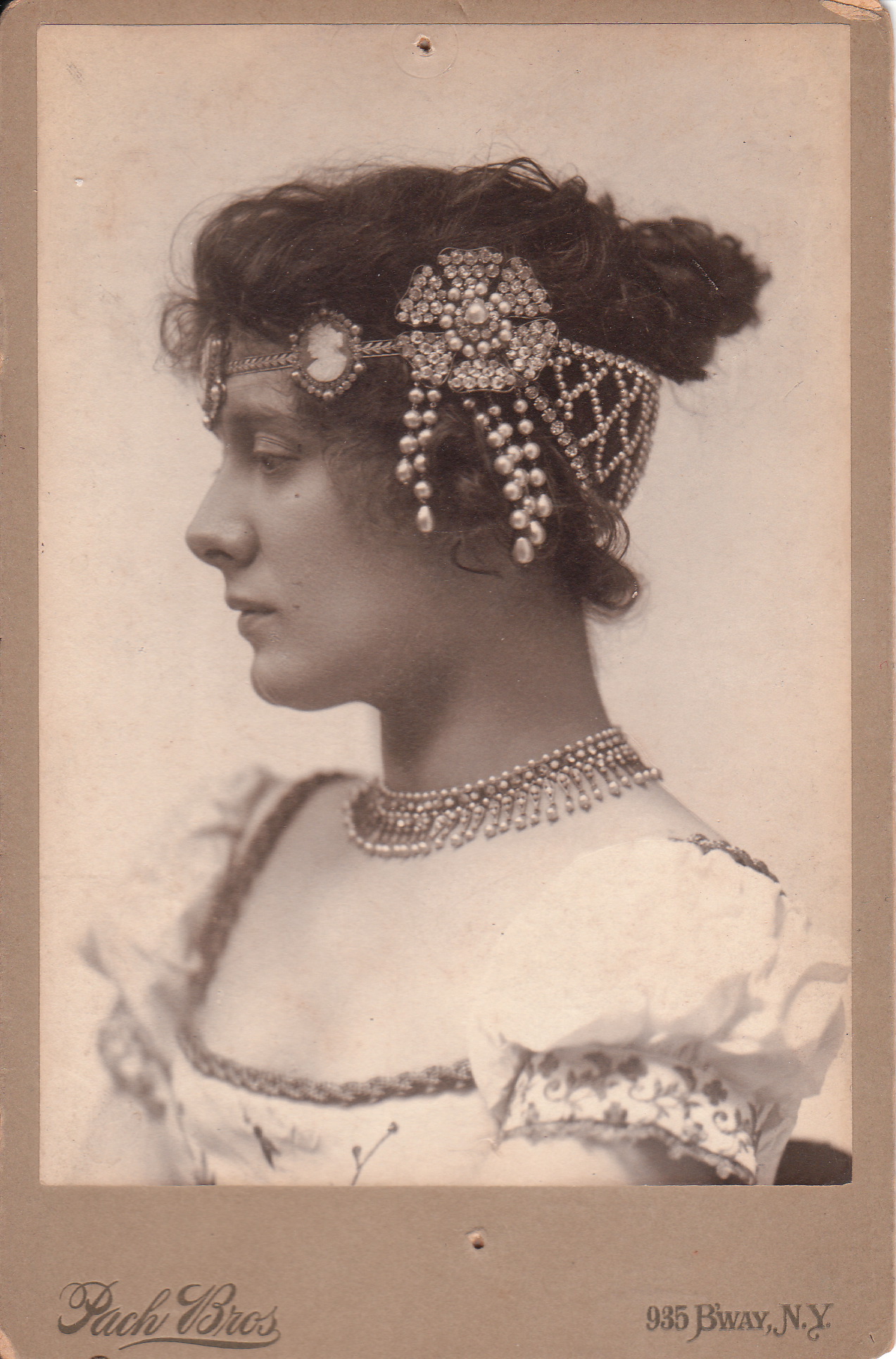
The fourth portrait of Miss Marlow features her in role in the production of “Countess Veleska”. The play was adapted for a German work, “The Tall Prussian”, by Rudolph Stratz. The play opened in New York in 1898 at the Knickerbocker Theatre. The review in the New York Times (1898) stated that the “drama was made wholly interesting by the personal charm and sincerity of Miss Marlowe”. In a sarcastic tone, the reviewer comments about Marlowe’s co star, Bassett Roe. The reviewer states that Roe has only two qualities of the man he was playing, “height and good looks”. The reviewer continues his scathing description of Roe; “The only time he actually warmed up was when he accidentally set his hair on fire. Even then he would have let it burn if Miss Marlowe had not gone to his rescue.” The photographic studio that produced the “Countess Veleska” cabinet card was Pach Brothers of New York City. Pach Brothers were photographers known for their photographs of celebrities of their era. To see additional photographs by the Pach Brothers, click on this site’s category of “Photographers: Pach Brothers”.

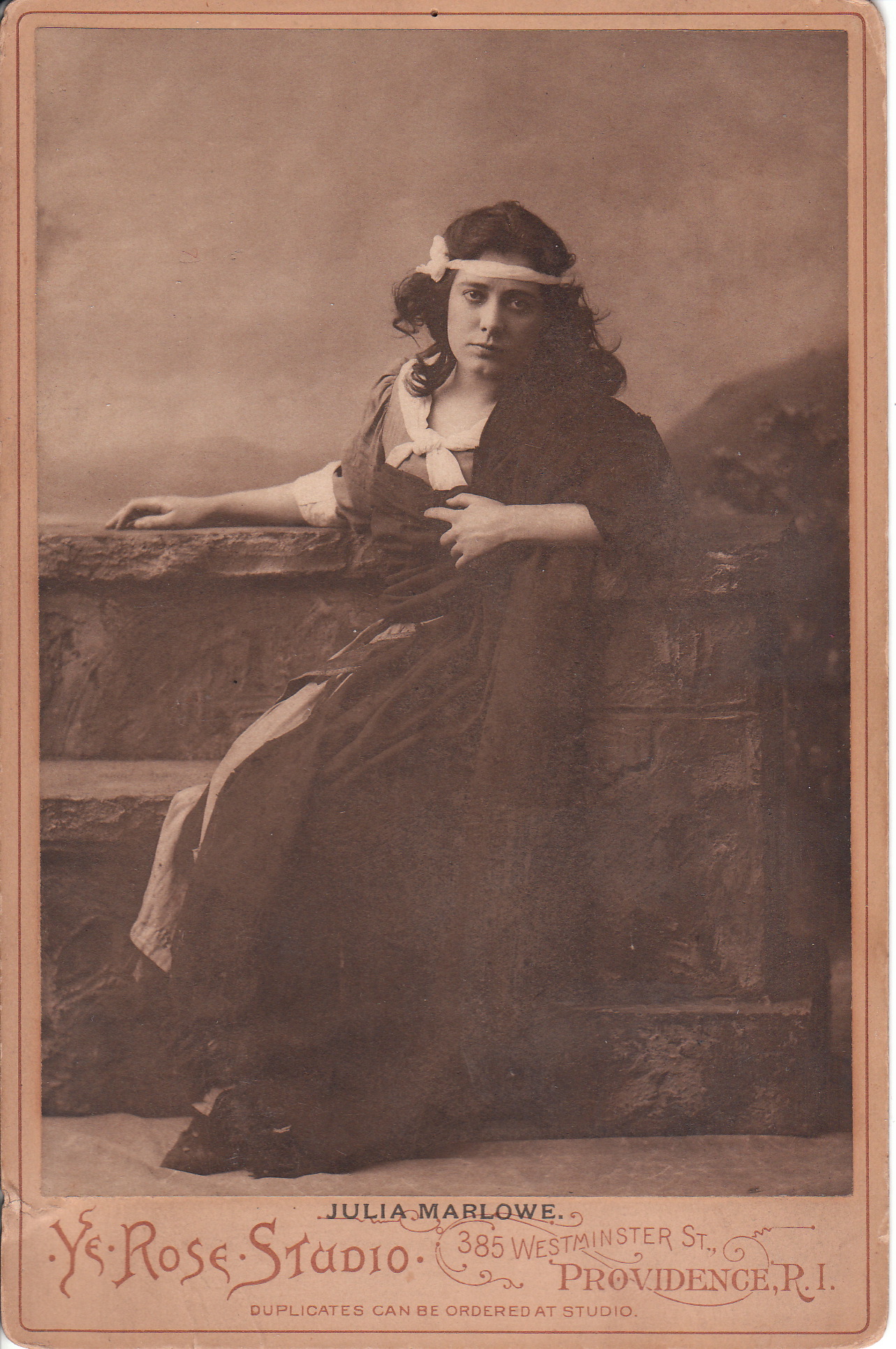
The fifth portrait of Julia Marlowe appears to be a photograph of the actress in costume for an unknown stage production. The image was photographed by Ye Rose Studio of Providence, Rhode Island. The reverse of the card indicated that the studio was opened in 1886. The studio was located in the Conrad building in downtown Providence. The building still exists. Other photographs by the Ye Rose Studio can be viewed by clicking on the category “Photographer: Ye Rose”.

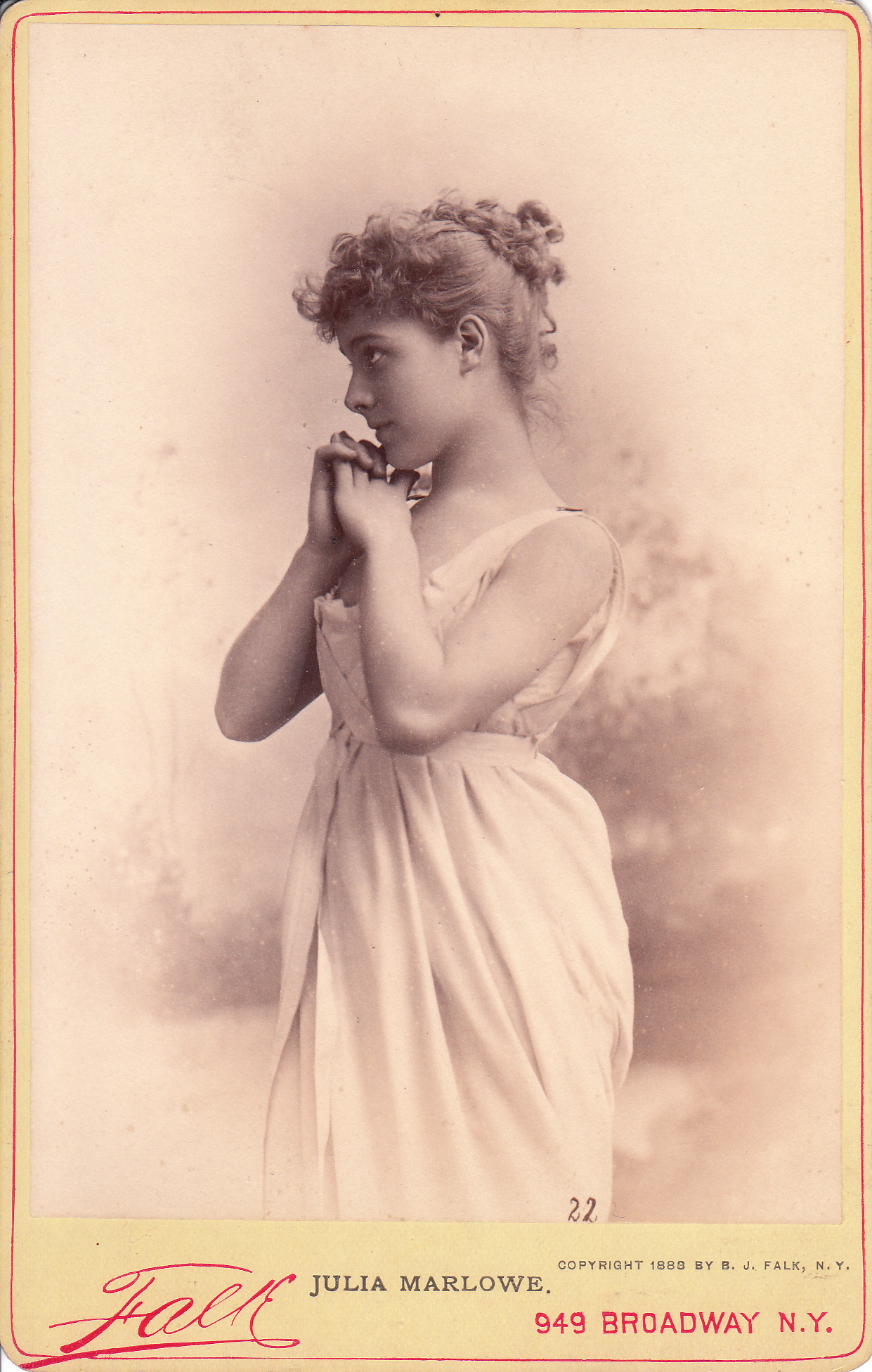
Portrait number six is an excellent example of the beauty of Julia Marlowe. This image, from 1888, captures Ms. Marlowe at the young age of twenty-three. The photographer of this portrait was B. J. Falk, a celebrity photographer located in New York City, New York. To view other photographs by Falk, click on the category “Photographer: Falk”.

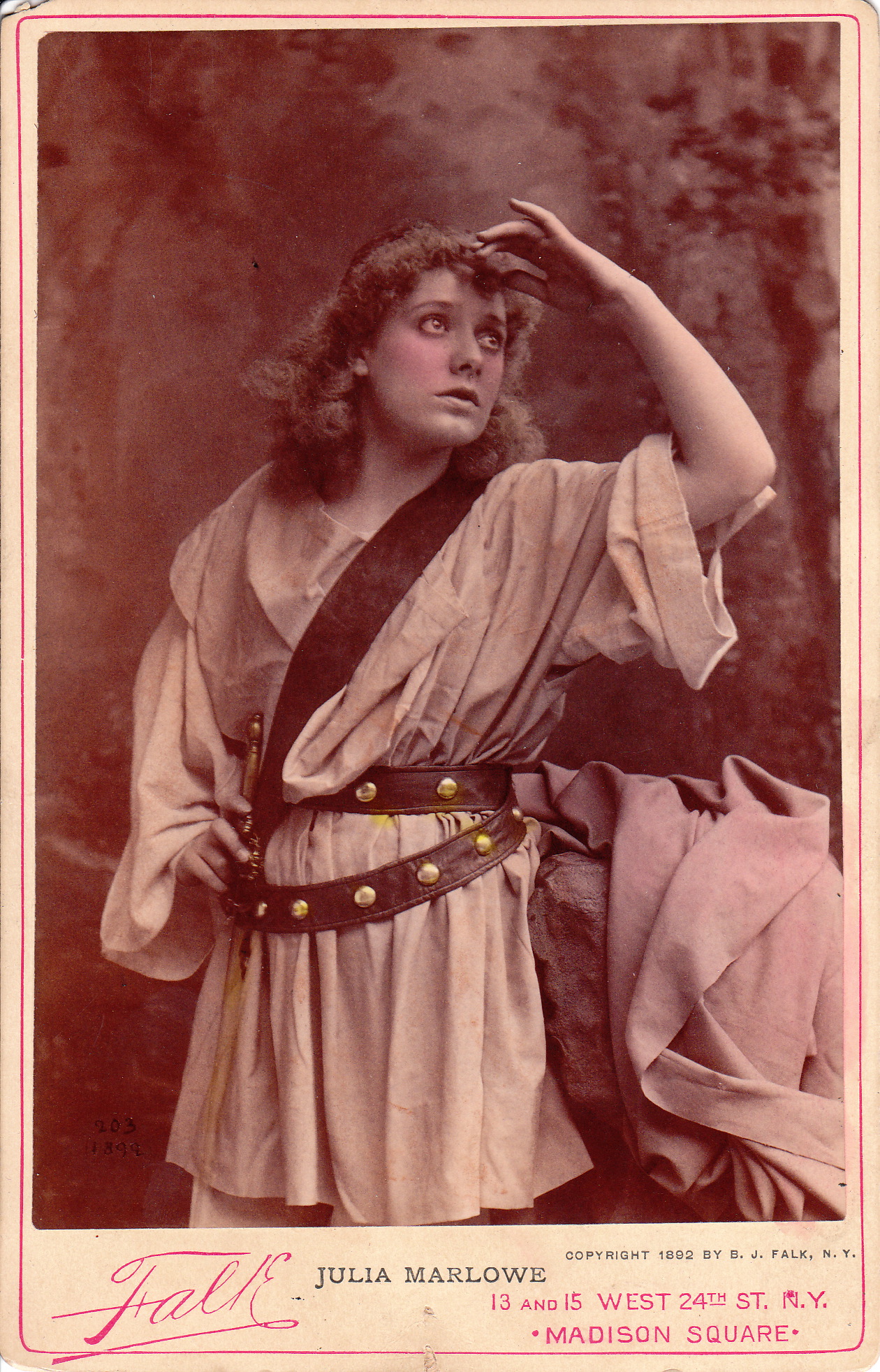
The seventh portrait is another example of a B. J. Falk image. The photograph features a costumed Julia Marlowe in the production of “Cymbeline“. Cymbeline is a play by William Shakespeare that was based on legends about the early Celtic British King,  Cunobelinus. The play deals with themes that include innocence and jealousy. Ms. Marlowe plays Imogen, the King’s daughter. Her expression in the photograph shows fear and concern as she looks at someone or something in the distance. Her left hand shades her eyes while her right hand clutches her belted dagger. A stamp on the reverse of  this cabinet card reveals that it was formerly owned by Culver Pictures of New York City, New York. Culver Pictures has been collecting photographs and illustrations from the 19th and first half of the 20th century, since 1926. These pictures are used in books, films, and other forms of media. At the time that this cabinet card was stamped by the company, Culver Pictures was located in New York City.  (SOLD)

Portrait number eight is a close-up photograph of Miss Marlowe. The photographer of this cabinet card is the studio of Rose & Sands whose gallery was located in Providence, Rhode Island. Note that photograph number five also came from the Rose studio, but at that time, the gallery was called, the Ye Rose studio. The Wilson’s Photographic Magazine (1899) reports that Rose and Sands were the proprietors of Ye Rose. A humorous headline in a photography magazine stated “Providence Provides for All, And Rose Provides for Providence”.  Print on the reverse of this cabinet card reveals that the Rose & Sands studio was opened in 1886 and that it specialized in “High Class Portraits from Cabinet to Life Size”. Also of interest, like photograph number seven, there is a stamp on the reverse of the photograph with the name “Culver Pictures Inc”.

Photograph number nine features the beautiful Miss Marlowe displaying a mischievous smile. Note her engaging large eyes. She is wearing a somewhat revealing dress (for the cabinet card era) and has a wonderful hat atop her head. This cabinet card photograph was published in 1888 by Benjamin Falk of New York City.  The image is marked with the number sixty-nine.

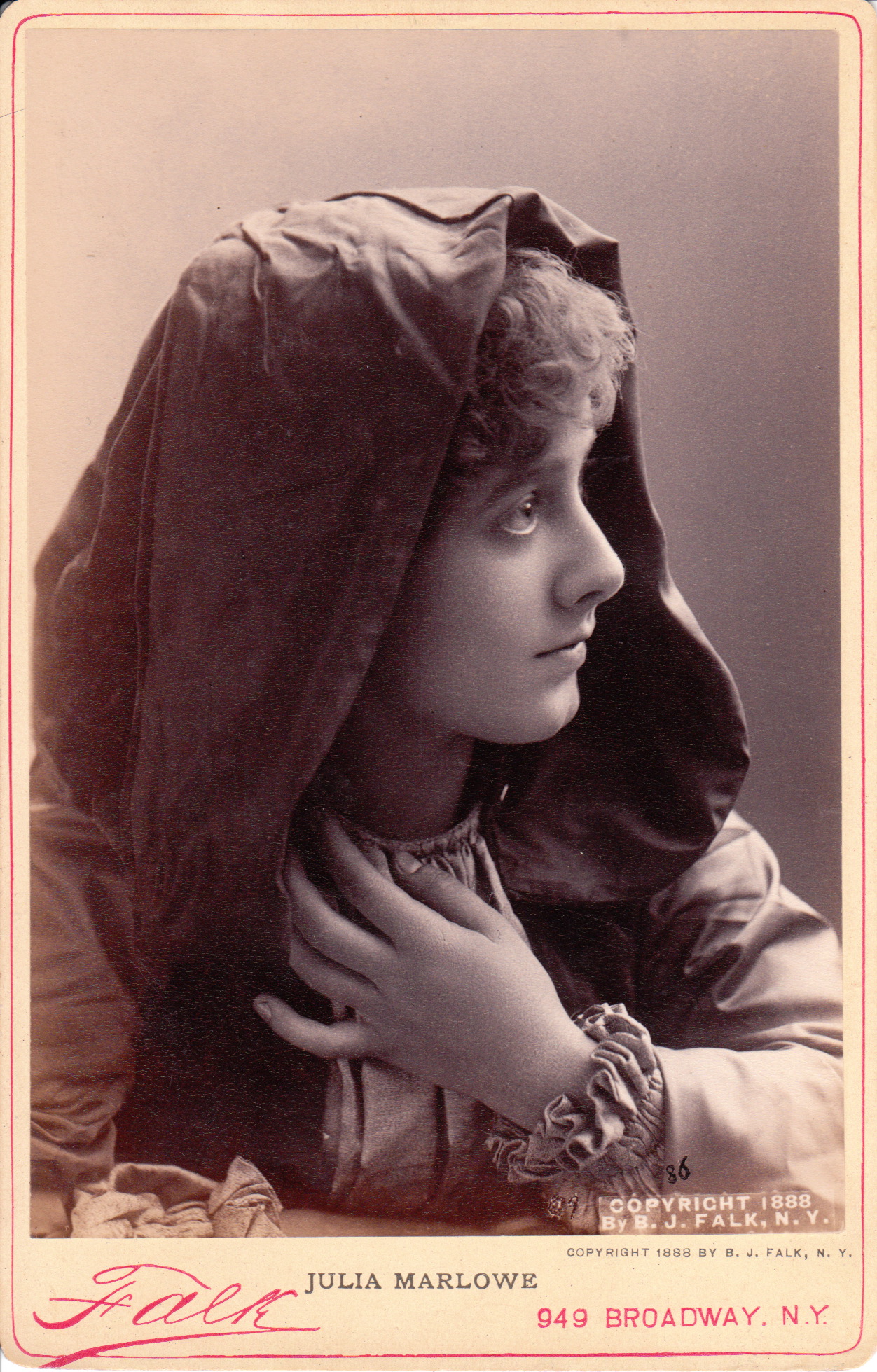
Portrait number ten is a closeup of Julia Marlowe with her head covered, but with her pretty face very visible. She is likely in costume for this photograph. The photograph is taken by B. J. Falk of New York City and has a copyright date of 1888. The cabinet card is marked number “86”.

The eleventh photograph captures Miss Marlowe staring hypnotically at a flower. Someone, has written below her name that the image features her in the role of Parthenia in the production of “Ingomar”.  The New York Times (1904) reviews the play and Miss Marlowe’s performance on opening night at the Empire Theater in New York City. The newspaper reports that Frederick Halm’s play was “impossibly romantic and deliciously sentimental piece of old-fashioned theatrics. Tyrone Power played Ingomar and he was described as “vigourous and picturesque” but the article added that his voice was “not at its best”. The review pointed out that Marlowe’s appearance in this play was to be her last appearance as an independent star before joining E. H. Sothern’s Shakespearean repertory. In regard to Marlowe’s acting in this play, it was written that she played a “dear little prig – adorably dear” (prig can be defined as smug or arrogant) and she presented “a masterpiece of harmonious, modulated, and sustained acting”. The 1904 performance of Julia Marlowe in “Ingomar” marked a return performance for this accomplished actress. The New York Times (1888) wrote a very positive review of the opening night performance in Washington D.C.. The appreciative audience included three Supreme Court Justices and a number of members of the Chinese Embassy. This cabinet card was produced by the previously mentioned Ye Rose Studio of Providence, Rhode Island and it likely dates back to her 1888 performance in the role.

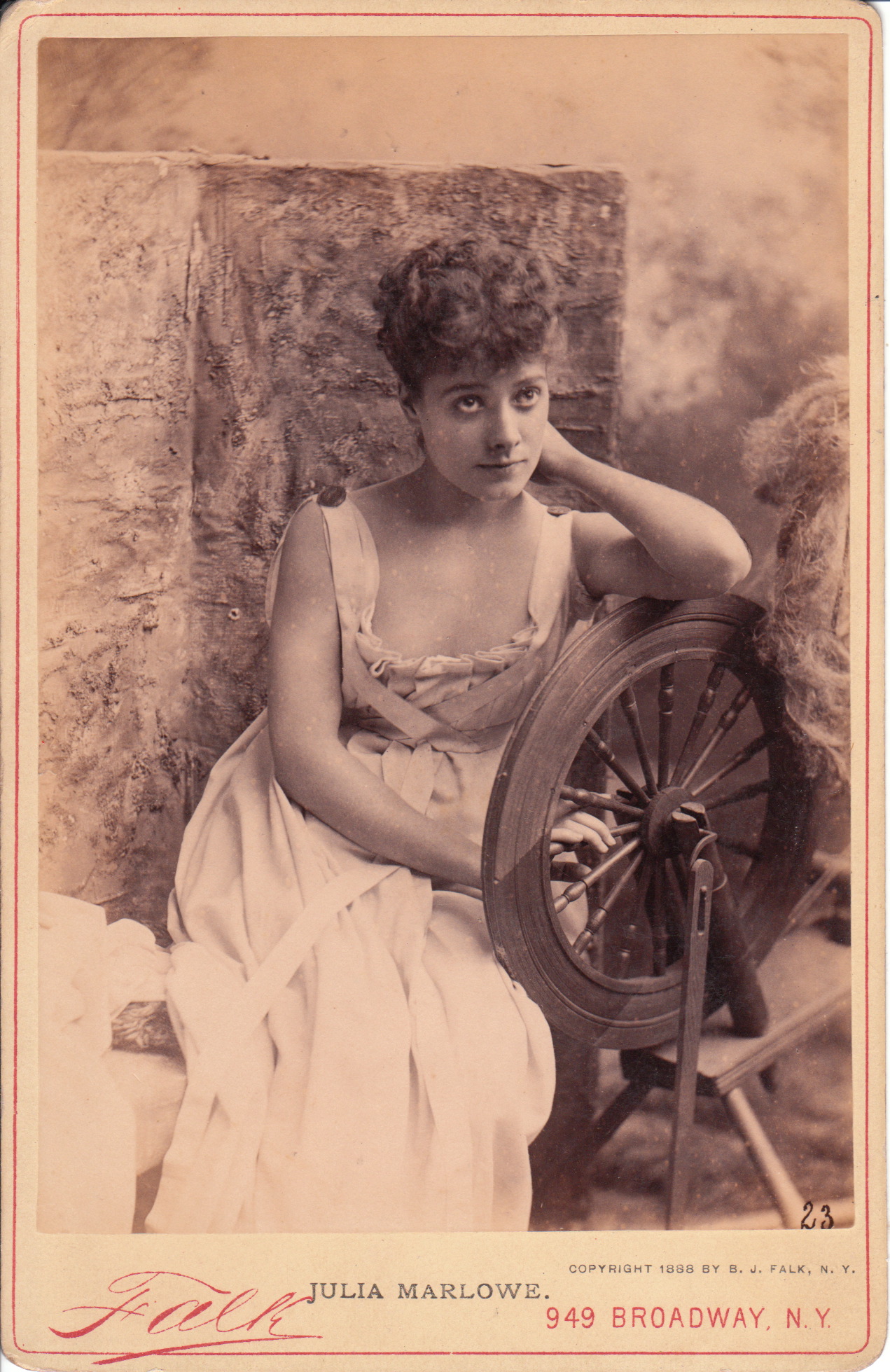
The twelfth cabinet card was produced by Benjamin Falk of New York City. He posed Miss Marlowe next to a spinning wheel. Her low cut dress makes this image a bit risque for the cabinet card era. If Falk or Miss Marlowe thought that looking up at the camera would create a “fetching appearance”, I would contend that their efforts failed. Rather than “fetching”, she appears dazed. The actress was a beautiful woman and provocativeness was not necessary to enhance her image. This photograph was produced in 1888 and was part of a series (#23).

Cabinet Card number thirteen is part of a series that includes Cabinet Card number ten. Both cards were photographed by Benjamin  Falk and have a copyright date of 1888. Both portraits are close-ups but this one is captures Marlowe looking at the camera while number ten offers a profile view. Falk really captured the actresses eyes. Her eyes are beautiful and they are haunting at the same time. This photograph is marked number number 83 of the series.

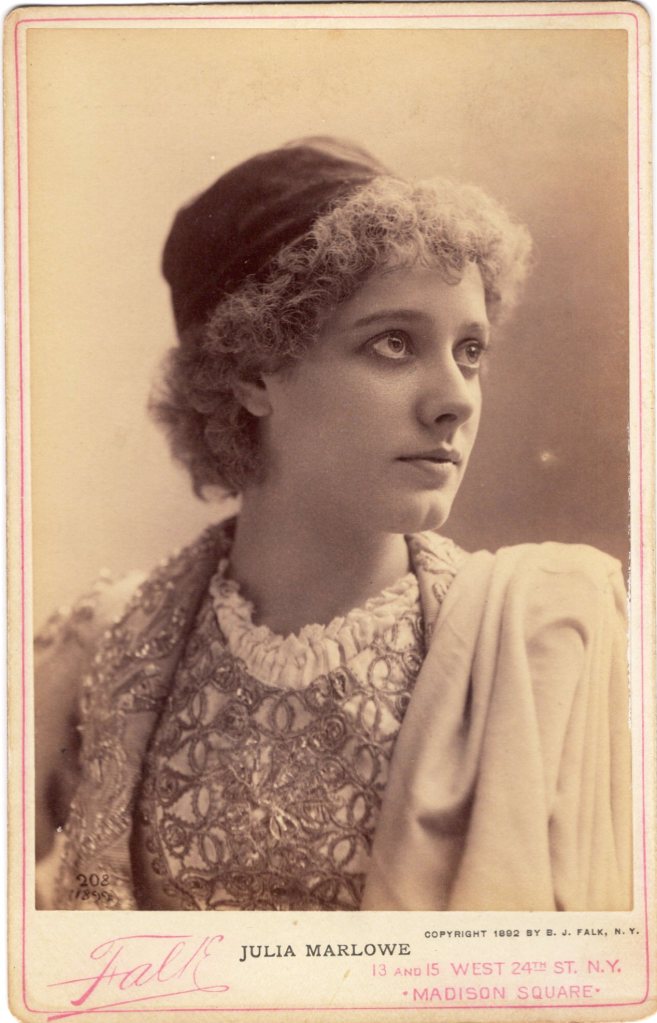
Cabinet Card fourteen features another beautiful portrait of Julia Marlowe. This photograph was taken by Benjamin Falk and was copyrighted in 1892. This cabinet card is uncommon, possibly rare.  (SOLD)

Cabinet Card 15 was photographed by Napoleon Sarony, the famed celebrity photographer located in New York City.  (SOLD)

FANNY DAVENPORT: AMERICAN STAGE ACTRESS (1880)

PHOTO 1

PHOTO 2 (SOLD)

PHOTO 3 (SOLD)

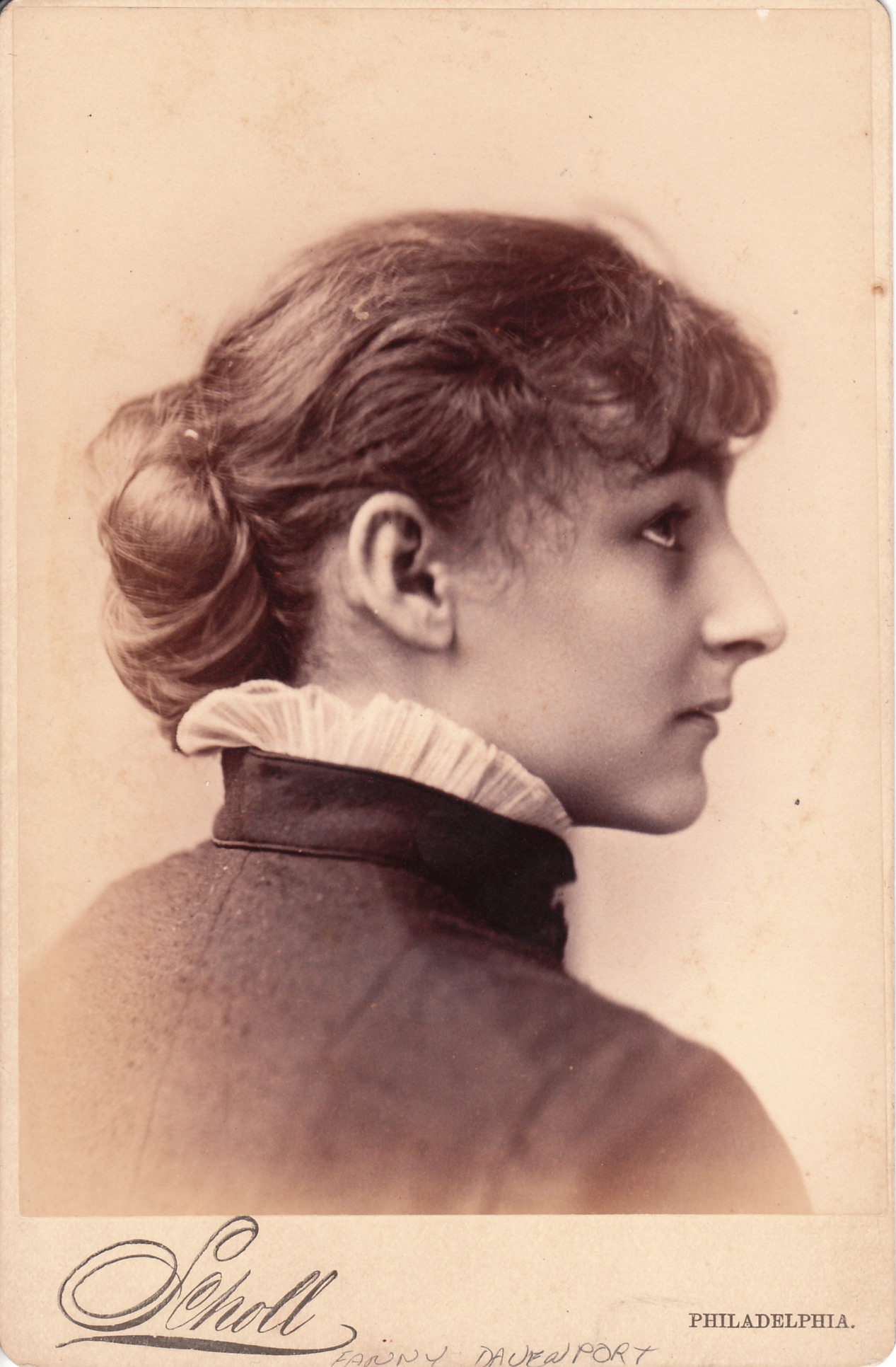
The top Cabinet Card is an image of American stage actress, Fanny Davenport. The photograph is dated February 28, 1880. Miss Davenport (1850-1898) was thirty years of age when she sat for this photograph by Emil Scholl, in Philadelphia, Pennsylvania. He photographed many celebrities and this site has a category that includes a number of his images.  To view these images, click on the category “Photographer: Scholl”. Davenport was born in London, England and educated in public schools in Boston, Massachusetts. In 1862 she appeared in ” Faint Heart Never Won Fair Lady” in New York. In 1869 she became a member of the Augustin Daly Theater Company. She later formed her own company. She had great success in “Fedora” (1883) and “Cleopatra” (1890). Fellow actor, Otis Skinner, in a backhanded compliment stated that “Miss Davenport was a handsome woman, her business sense keen and her industry untiring. To these qualities rather than her acting, she owed the late success in which she accumulated a fortune in her productions.”

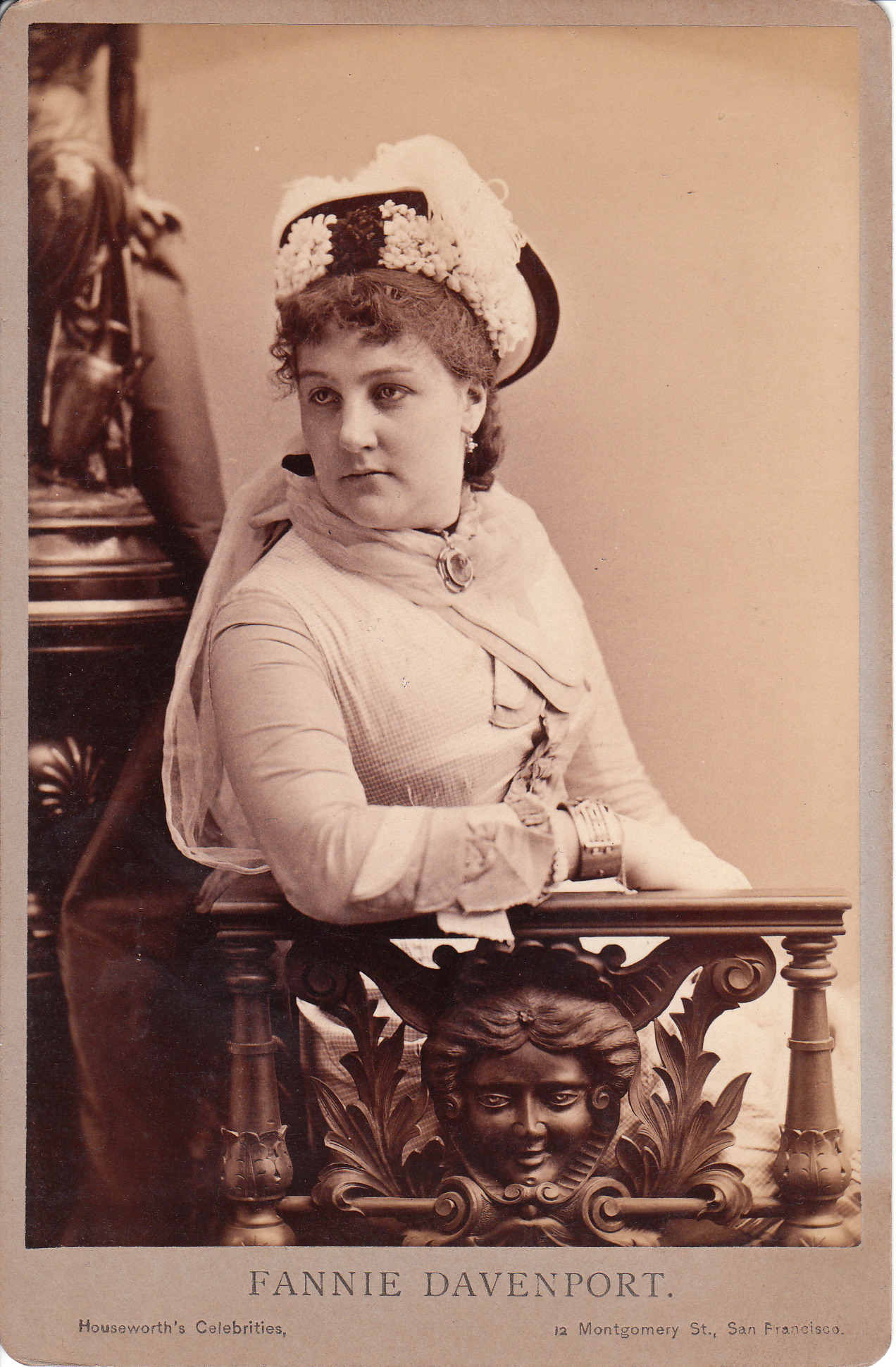
The second photograph features a portrait of Davenport by Thomas Houseworth, whose studio was located in San Francisco, California. This image was part of the “Houseworth Celebrities” series. The series included three thousand titles for different categories, including entertainment and government. Note the carving below the chairs armrest in this photograph. Also take notice of Miss Davenport’s interesting hat. Thomas Houseworth (1828-1915) was an optician, photographer, and photographic publisher. Houseworth and George S. Lawrence came to San Francisco in 1849, during the Gold Rush. They caught gold fever and worked as miners in Calavera and Trinity counties. After two years of mining, they admitted defeat, and returned to San Francisco. In 1855, they partnered in a store that sold optical supplies and other miscellaneous items; but the partners became most well known for their stereographs. In 1859 they sold stereographs from an English company, but they soon contracted with local photographers to acquire and publish a diverse collection of stereos featuring various aspects and scenery of northern California and western Nevada. Later, they began to publish and market stereographs under their own name and by the early 1860’s had built the largest collection of stereographs for sale on the west coast. Lawrence retired in 1868 and the firm became known as Thomas Houseworth and Company. Houseworth hired the most talented photographers he could find.  His photographers included Thomas Hart (Transcontinental Railroad Construction), Carleton Watkins (The Sierras’), and Eadweard Muybridge (Yosemite). By the 1870’s Houseworth’s business was failing due to increased competition. He left the field of photography in the 1880’s and went to work as an accountant and an optometrist.

Photograph 3 is a carte de visite portrait of Fanny Davenport (1850-1898) . The photo was taken at the Broadway studio of Napoleon Sarony. This photograph is from circa 1880. Miss Davenport  was about thirty years of age when she sat for this photograph by Napoleon Sarony in New York City. 

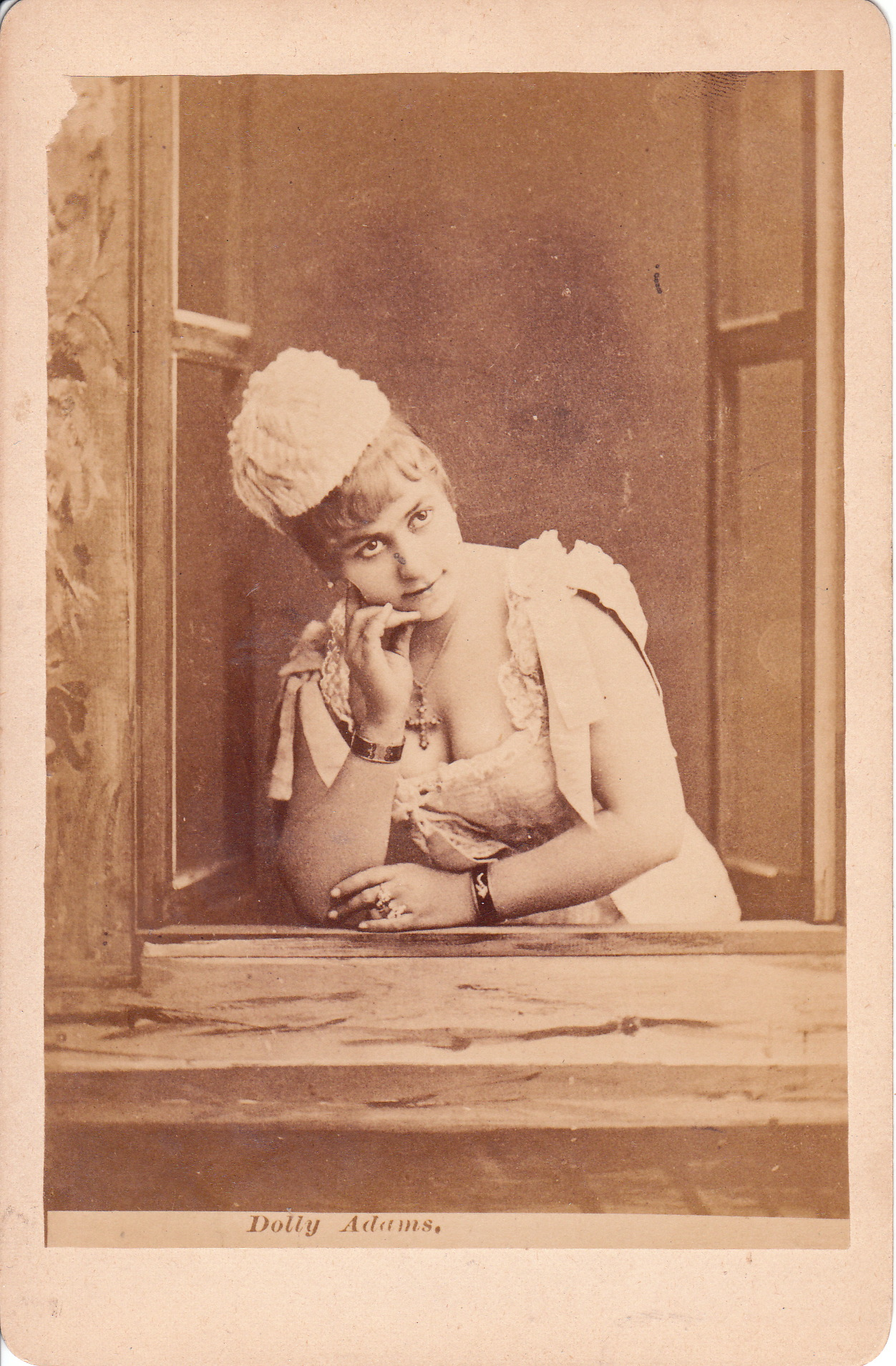
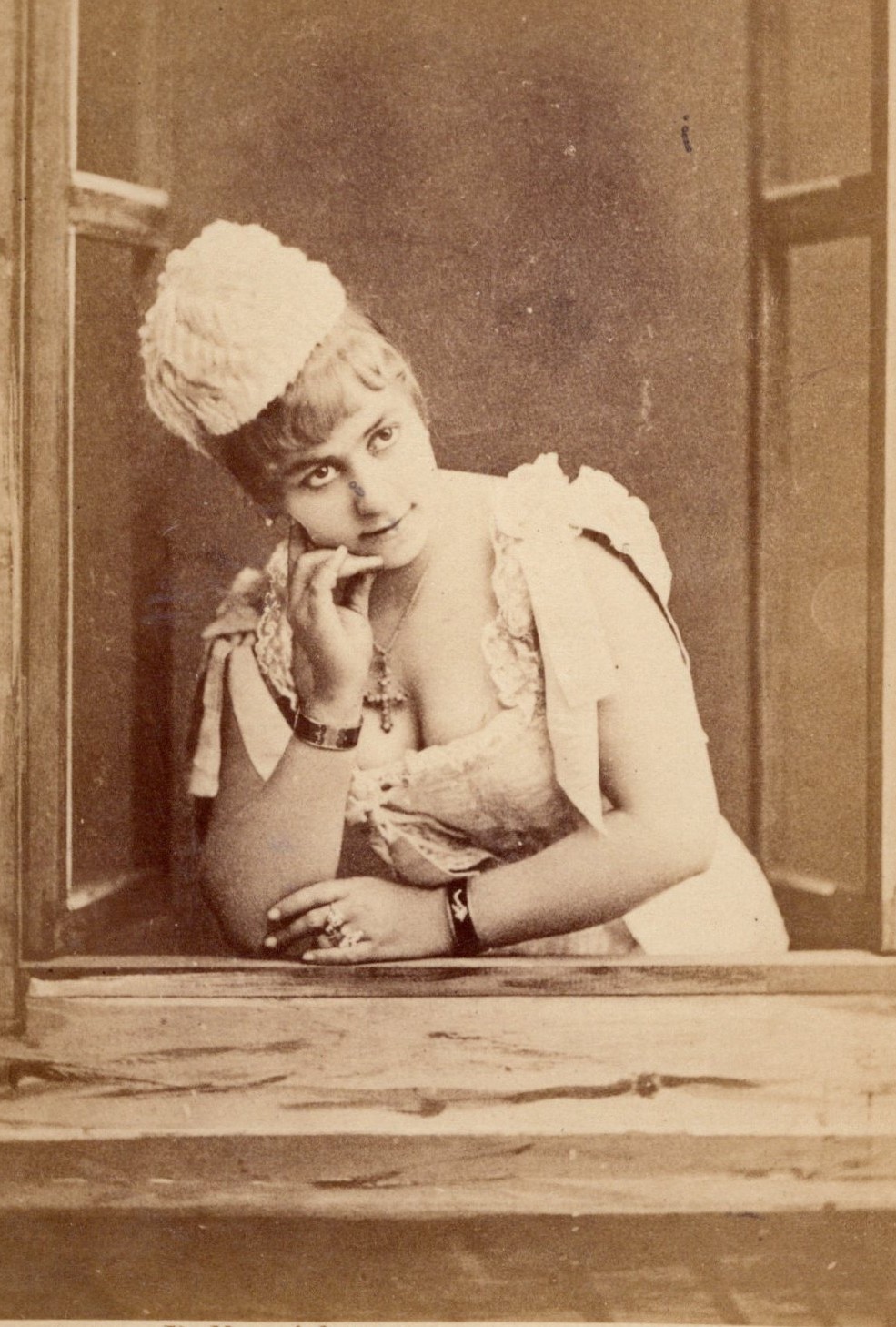
DOLLY ADAMS : THE WATER QUEEN : LIVED ON THE WILD SIDE

It turns out that there were two New York City actresses named Dolly Adams. I will tell you the story of both of them. Each actress made sensational headlines. The first Dolly Adams that I describe had an interesting and unique wedding experience. The second Dolly Adams described is Dolly Adams “The Water Queen”. It is her photograph that accompanies this blog entry. 

The New York Times of September 21, 1897 reports that Emma Viola Street a variety actress, known as Dolly Adams;  and Frederick Hillmeyer,  the son of a well-to-do hotel proprietor,  were married in a Harlem, New York, prison. They had to be married by a clergyman because a court room judge refused to perform the ceremony because he thought “the marriage could not turn out happily”.  The reason why Hillmeyer was in court was because he was accused by Ms Adams of stealing  jewelry and cash from her Park Avenue flat. Ms Adams requested that the judge withdraw the charges but he refused to do so, causing the actress to have an “epileptic” fit. 

Dolly Adams, the “Water Queen”  lived a very interesting life. She was born Ellen Loretta Callahan in 1860 in New York. Her parents were from Ireland. Her father, a longshoreman, died when Dolly was young. Dolly’s mom went to work and Dolly received little supervision and a age sixteen was working as a prostitute in a New York parlor house. During her youth she used to swim at the New York Aquarium with a group of other girls. She was a talented swimmer and received special training and learned to hold her breath under water for an extended period of time. She eventually became an underwater performer and was given the title “Water Queen”. Dolly moved to San Francisco, accompanying a couple of madams out west. She lived on the wild side in California. She became famous when she attended the Policeman’s Ball dressed as Cupid and ran up to President Grant and pinned a lily on the lapel of his coat. Observers stated that President Grant, a man who didn’t flinch in battle, appeared shocked upon this floral assault by Miss Adams. She also won first place for her costume. Dolly Adams returned to New York City where she continued to live a life full of drama and travail. She died in 1888 aboard a steam ship which was to take her on a tour of the orient. The cause of death was the impact of syphilis, opium addiction and pneumonia.  (SOLD)

Published in: on July 7, 2024 at 12:00 pm  Comments (2)  
Tags: , ,

MYSTERY ACTRESS IN SAN FRANCISCO: ETTA ?????

mystery

CABINET CARD 1

CABINET CARD 2   (SOLD)

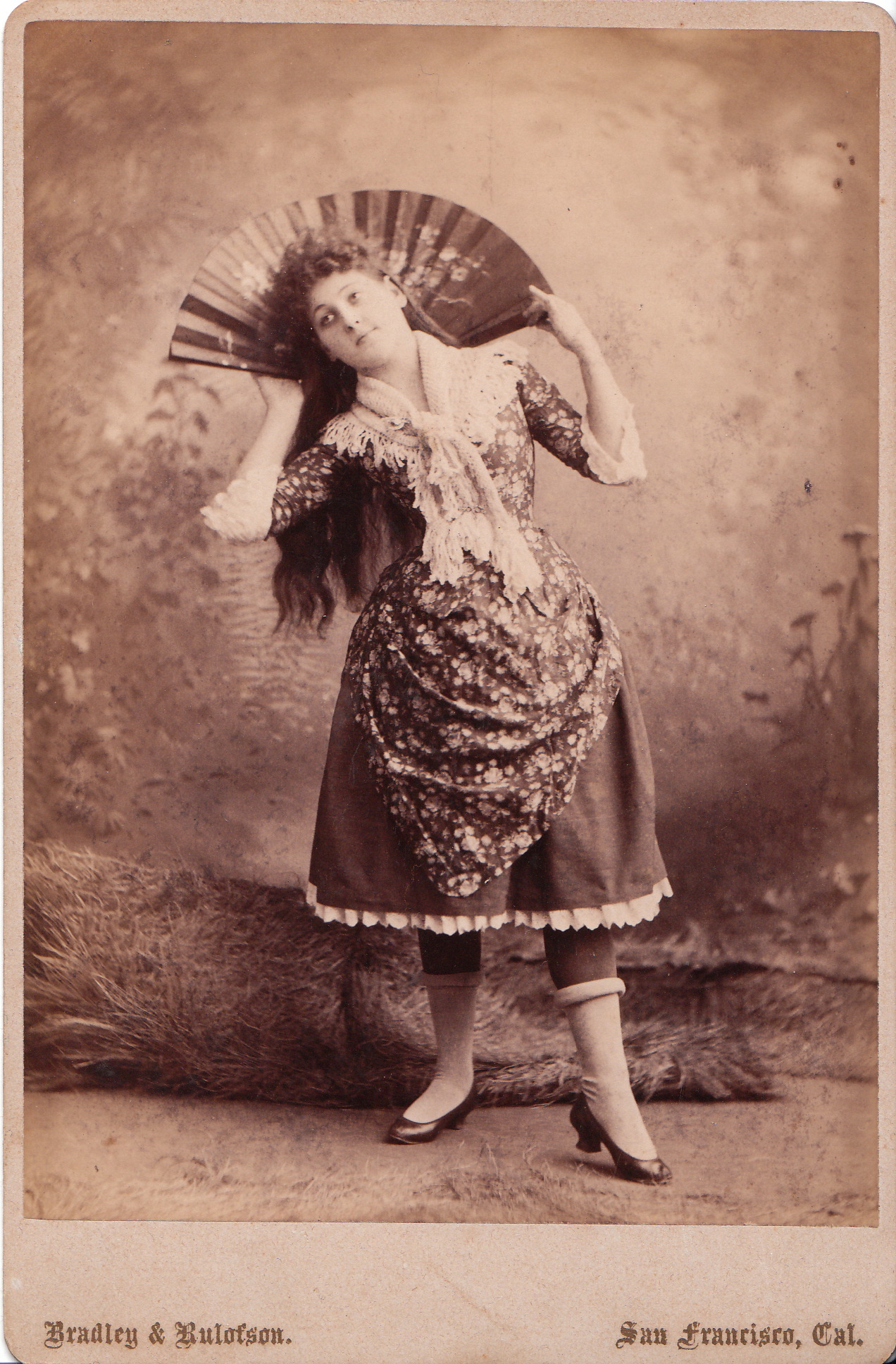
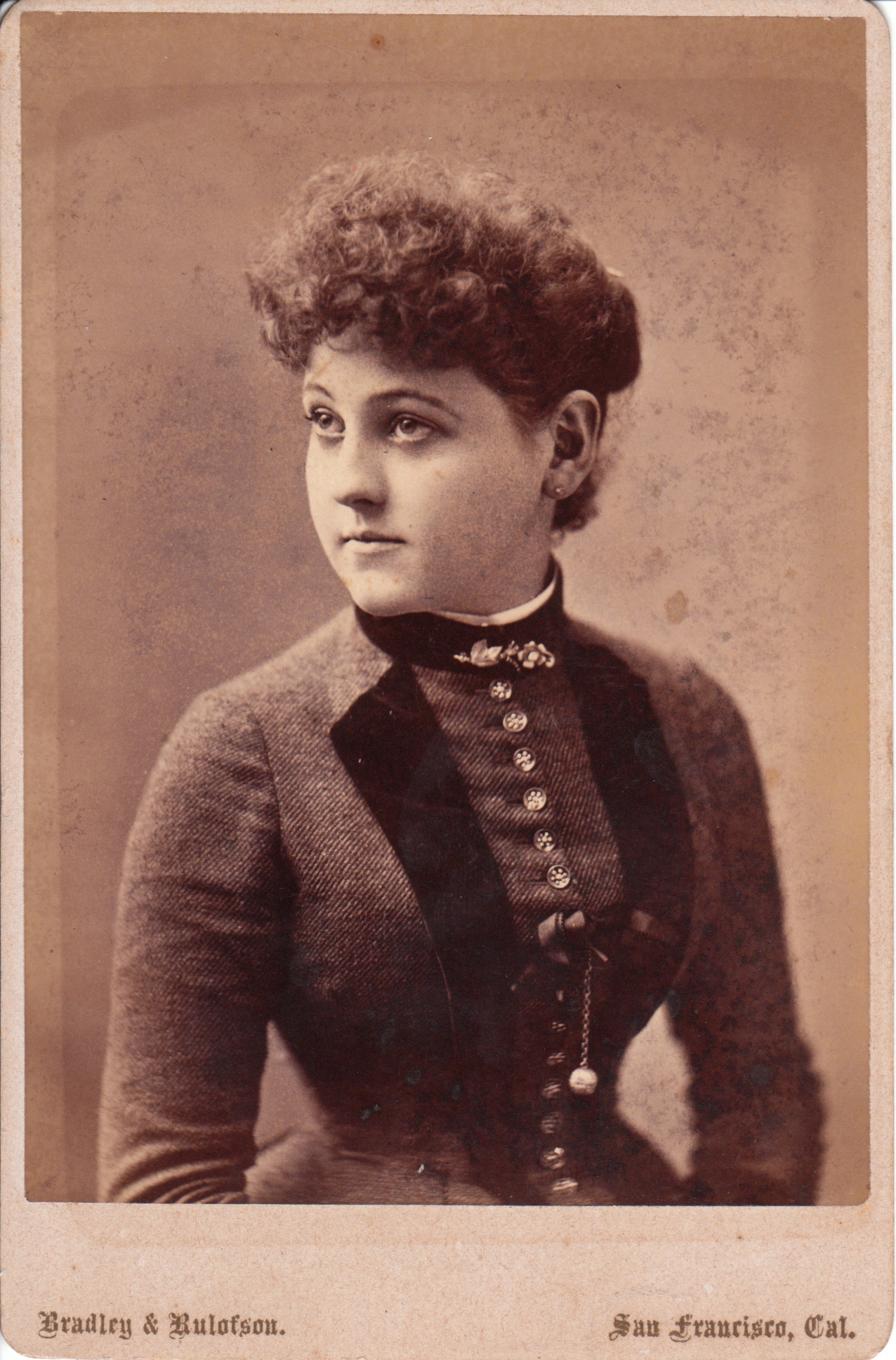
These two Cabinet cards present quite a mystery. The dramatically dressed and attractive young woman in Cabinet Card 1 is simply identified as “Etta”. She appears to be an actress and my research reveals a large number of actresses named Etta who were stage performers around the turn of the century. I have been unable to determine this actresses identity, but a leading candidate might be Etta Butler (1879-1903). Etta Butler was a well-known actress and impersonator. She began her career at age 19 with the Tivoli Chorus in San Francisco. A year later she became a member of the “Around New York in Eighty Minutes” company. She was later featured in Frohman  comedies. She was last seen in “The Liberty Belles” at the Madison Square. Because of her popularity and promise, she was retained by David Belasco in a long term contract. She died of Typhoid fever in Roosevelt Hospital, in New York City at age 24. This mystery lady was photographed by Bradley and Bulofson of San Francisco, California.

Cabinet Card 2 has an inscription on the reverse signed by “Etta”. Are these two cabinet cards, taken by the same photographer, portraits of the same woman? One can see enough resemblance between the two images to hypothesize  that they are likely the same “Etta”. Take a look at another cabinet card by these photographers by clicking on the category “Photographer: Bradley & Rulofson”. That very same click will provide the reader with additional information about the photographers of this image.  (SOLD)

Published in: on January 16, 2024 at 12:00 pm  Comments (14)  
Tags: , , , , ,

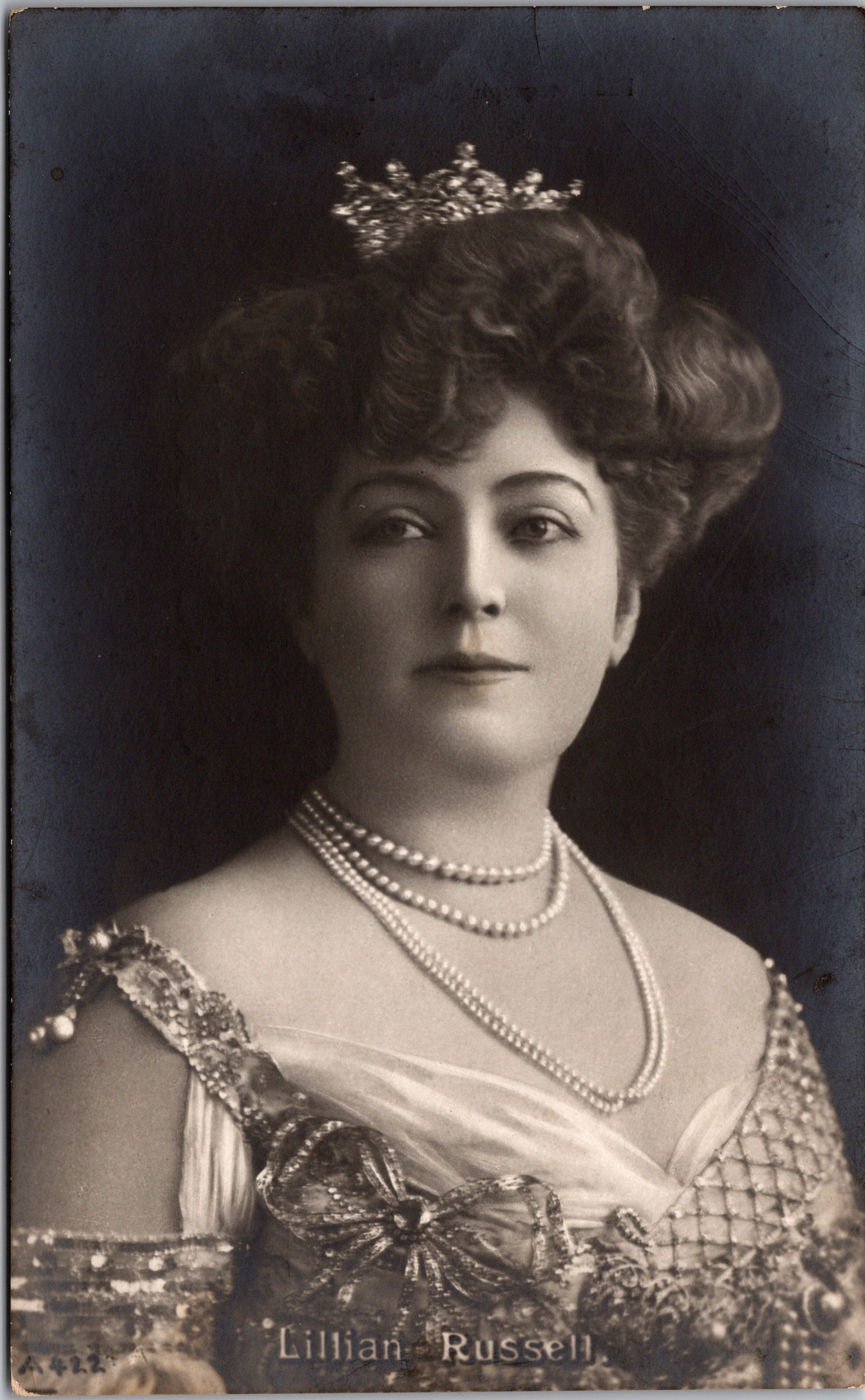
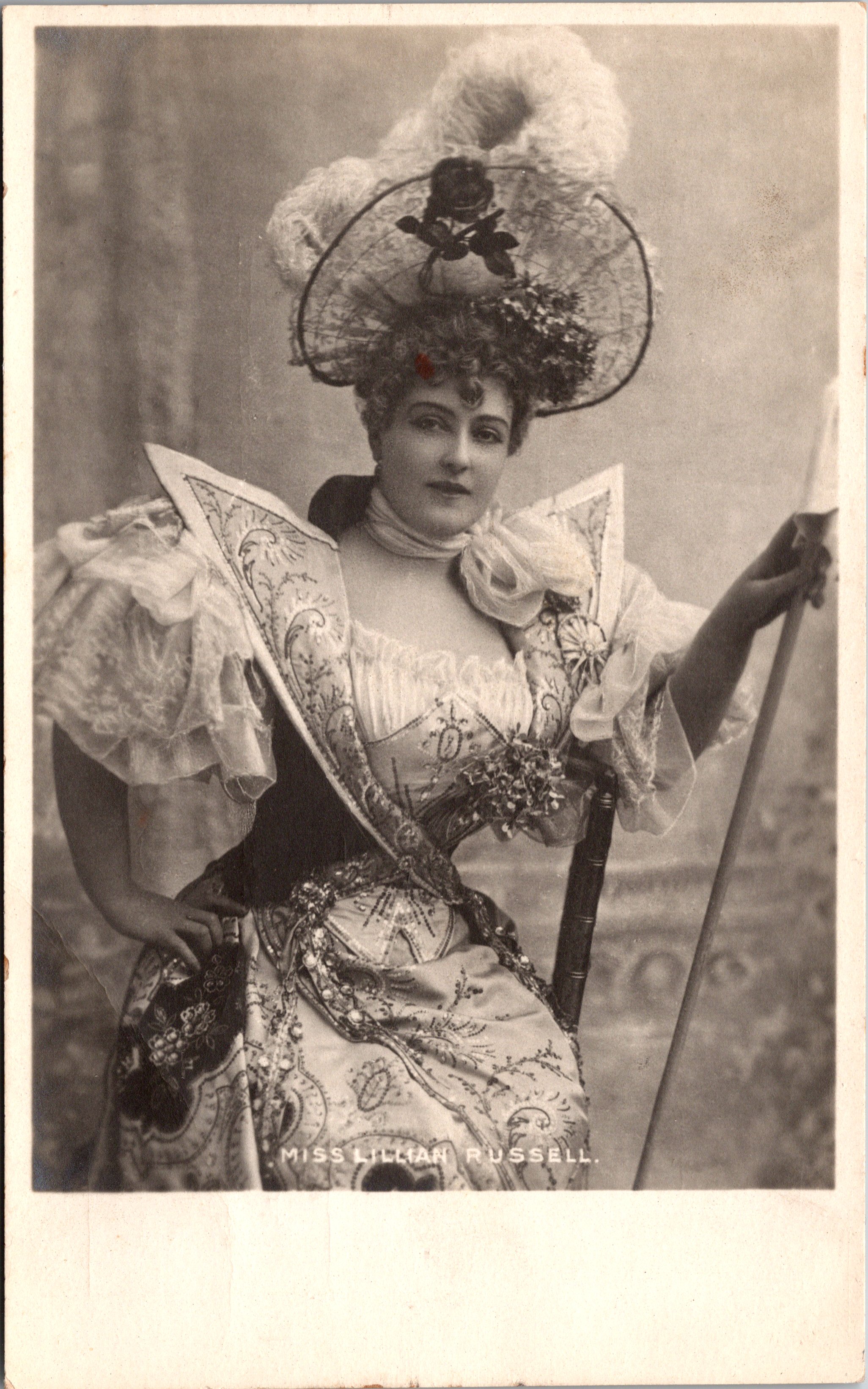
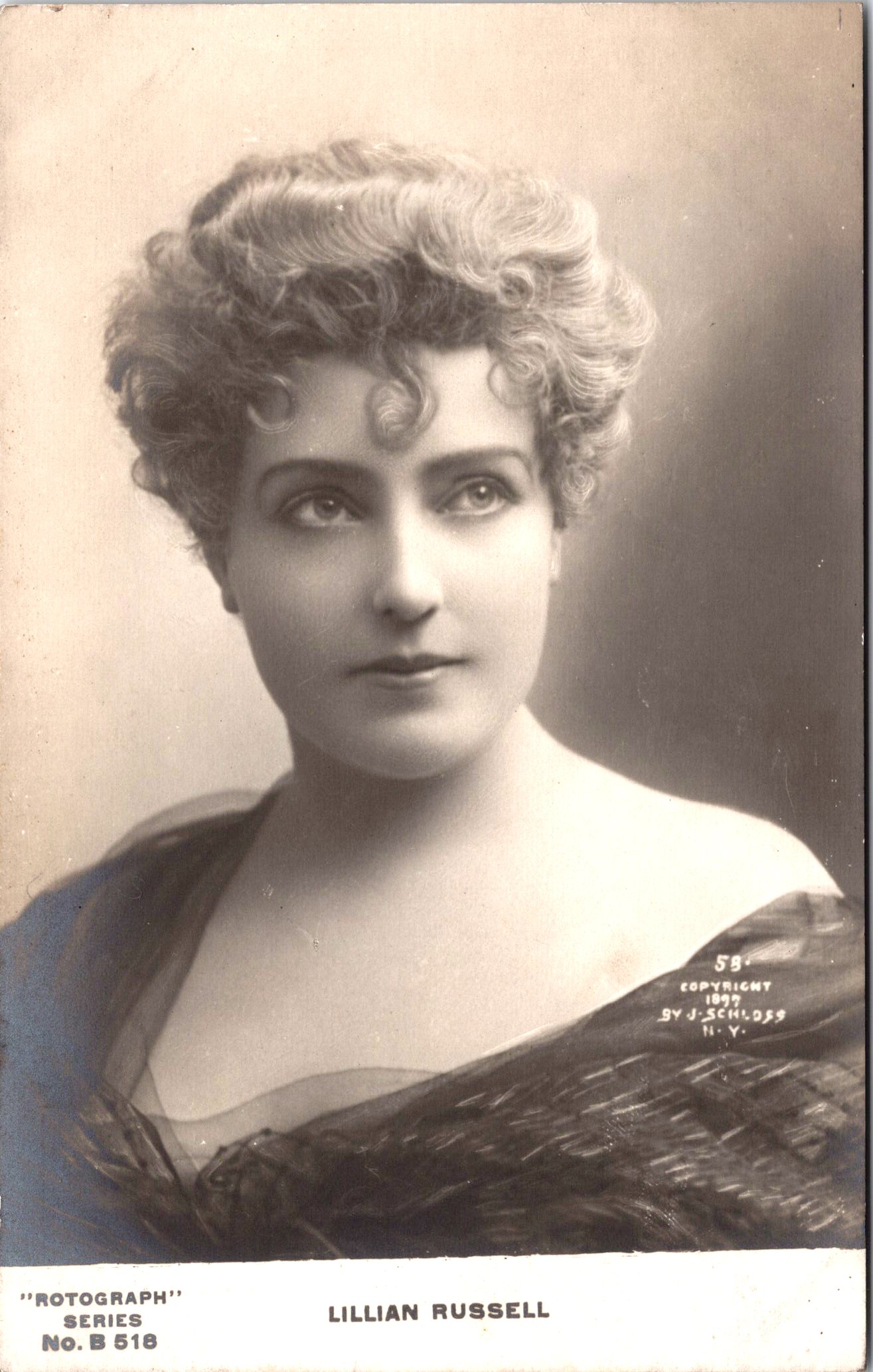
LILLIAN RUSSELL: CELEBRATED AMERICAN ACTRESS AND SINGER

russell_0002CABINET CARD 1

CABINET CARD 2   (SOLD)

CABINET CARD 3  (SOLD)

LIL RUSSSELL_0002CABINET CARD 4

MISSLILLIAN_0002
 CABINET CARD 5

RPPC 6 (SOLD)

RPPC 7 (SOLD)

RPPC 8(SOLD)

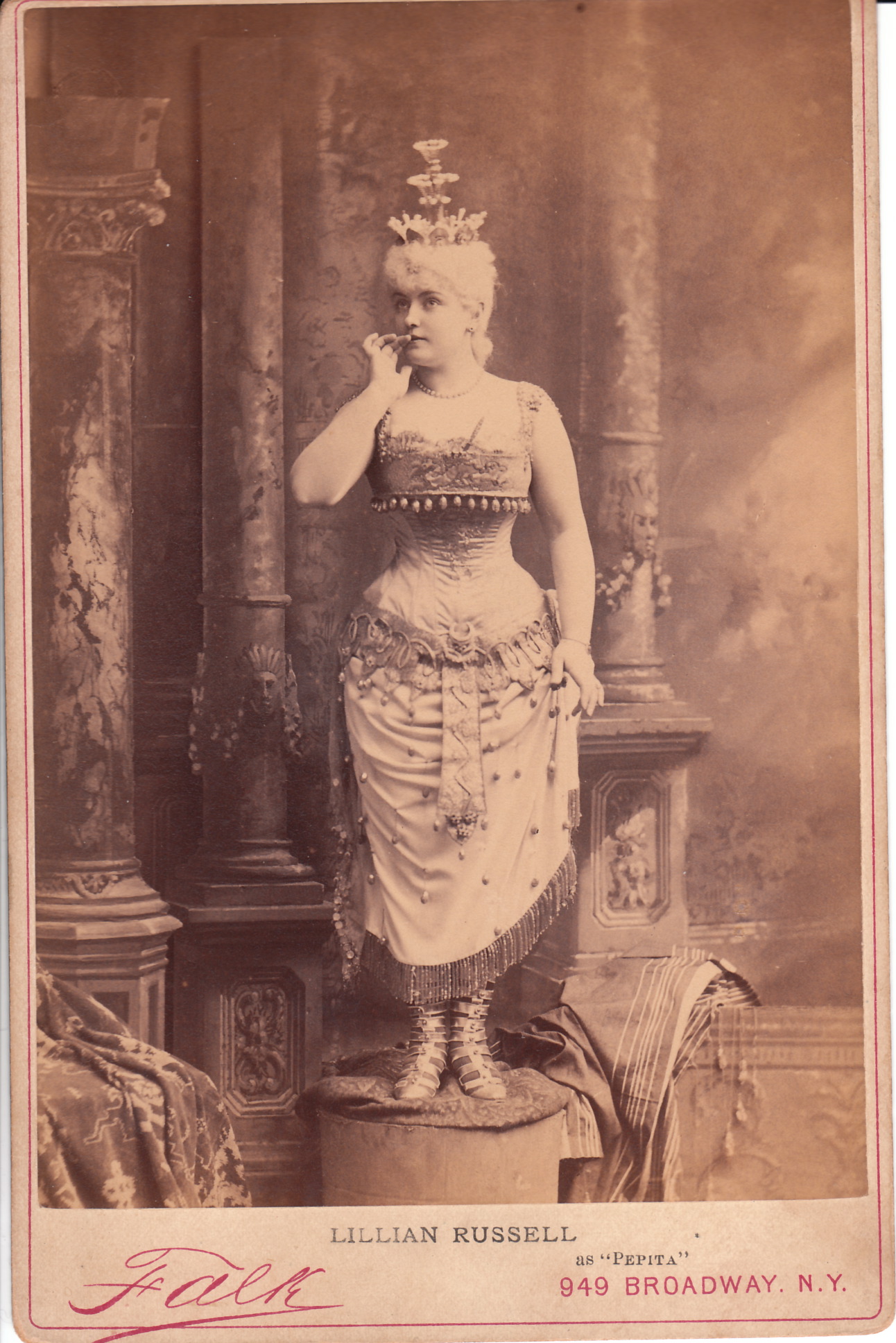
Lillian Russell (1860-1922) is pictured in the Cabinet Card 1 photograph by famed New York celebrity photographer, Falk. Lillian Russell is captured in costume as she appeared in “Pepita” (1886). Russell was a very famous American actress and singer who was known for her beauty, style, voice and stage presence. Her theater career began with roles in comic operas including the work of Gilbert and Sullivan. She married composer Edward Solomon in 1884 and two years later, he was arrested for bigamy.  She performed in New York and elsewhere in starring roles in comic opera and musical theatre. In 1904 she switched to dramatic roles due to voice problems. She later also appeared in vaudeville. She retired from the stage in 1919. She later wrote newspaper columns, advocated for women suffrage, and was a popular lecturer.  She married four times and her longest marriage was to Diamond Jim Brady who supported her extravagant lifestyle for four decades. It is interesting to note that the New York Times (4/2/1886) reported that during the performance of “Pepita”, an opera by her husband, Edward Solomon; there were obvious signs of marital discord observed on stage. The newspaper blamed issues revolving around Russell’s interfering mother, as well as, issues pertaining to Russell’s sudden prosperity. The newspaper article correctly predicted that there would soon be a divorce.

Cabinet card 2 is also photographed by Falk. This photograph provides a close-up image of Lillian Russell and is a testimonial to her beauty.(SOLD)

Cabinet card 3 was published by Newsboy and used by the tobacco company as a premium (#340). The photographer was Falk and the image was copyrighted in 1893. To view a collection cabinet cards by Falk; click on the category “Photographer: Falk”. (SOLD)

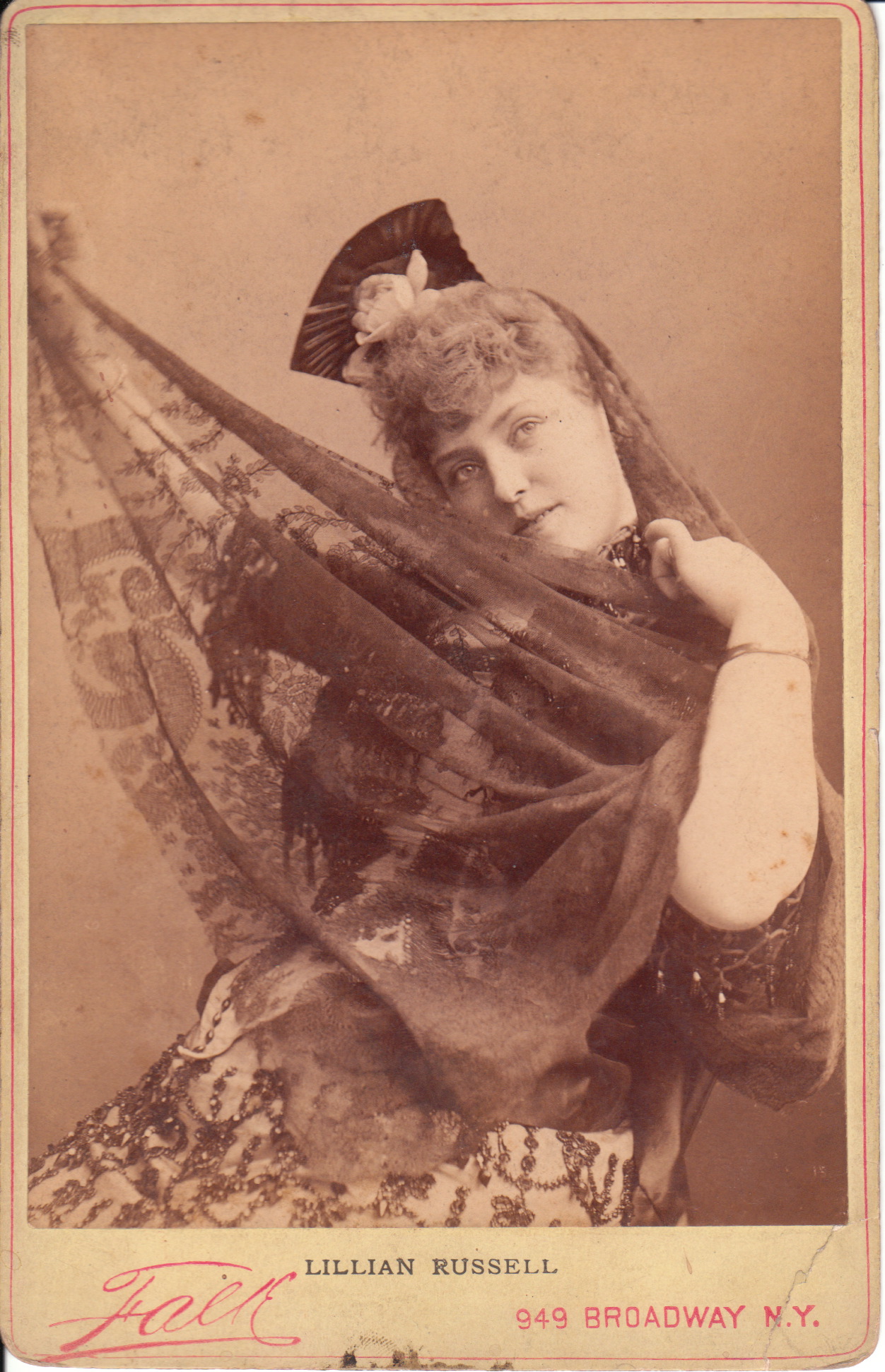
Cabinet card 4 is another image produced by B. J. Falk. Miss Russell is in costume and is posed provocatively partially behind sheer lace.

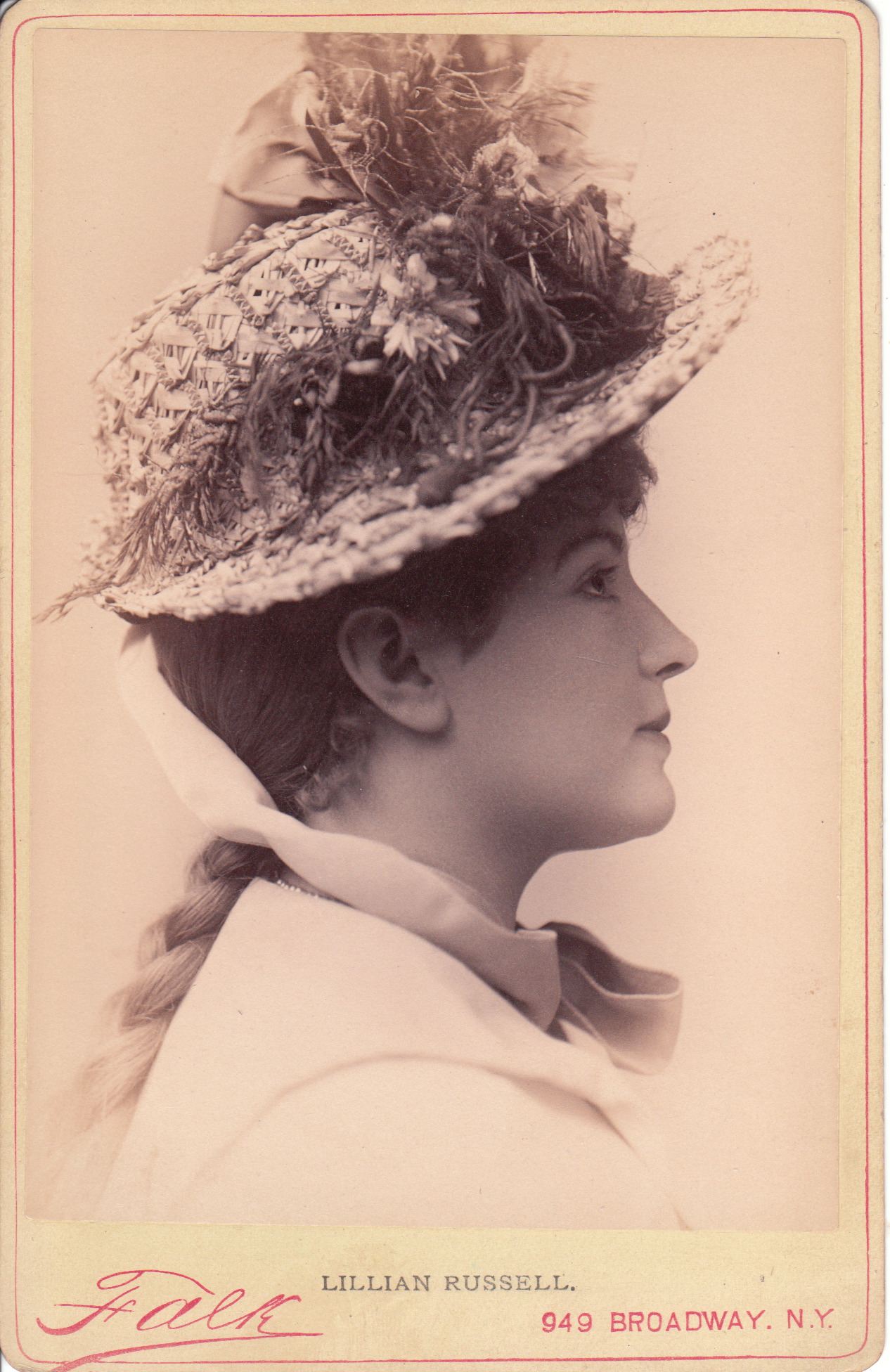
Cabinet card 5, also by Falk, provides a terrific profile portrait of the beautiful Miss Russell.

Lillian Russell is pictured in this vintage real photo postcard (RPPC 6). This undivided back postcard was published in 1907 or earlier. (SOLD)

RPPC 7 is an undivided back postcard portrait of Miss Russell. She is in costume. The publisher of this card is Pascalis, Moss & Company. The firm was London based and ceased publishing postcards in 1902. At that time Charles H. Pascalis (c1877-?) left the company and the firm changed it’s name to Henry Moss & Company. (SOLD)

RPPC 8 is risque in terms of the “plunging” neckline of Russell’s dress. This vintage postcard was published by Rotograph as part of a series (No.B518) Miss Russell’s photograph was taken by Jacob Schloss in 1899. (SOLD)

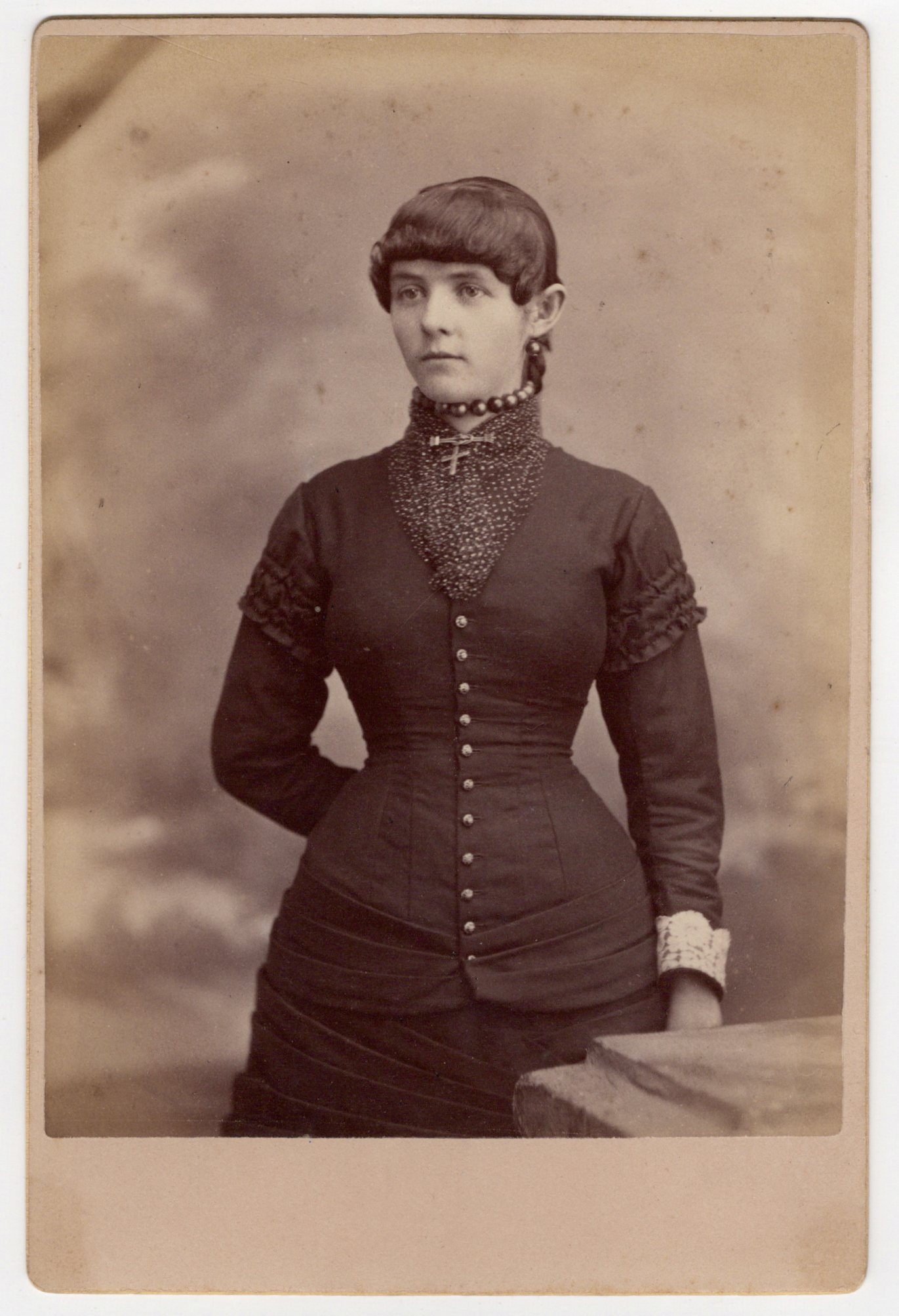
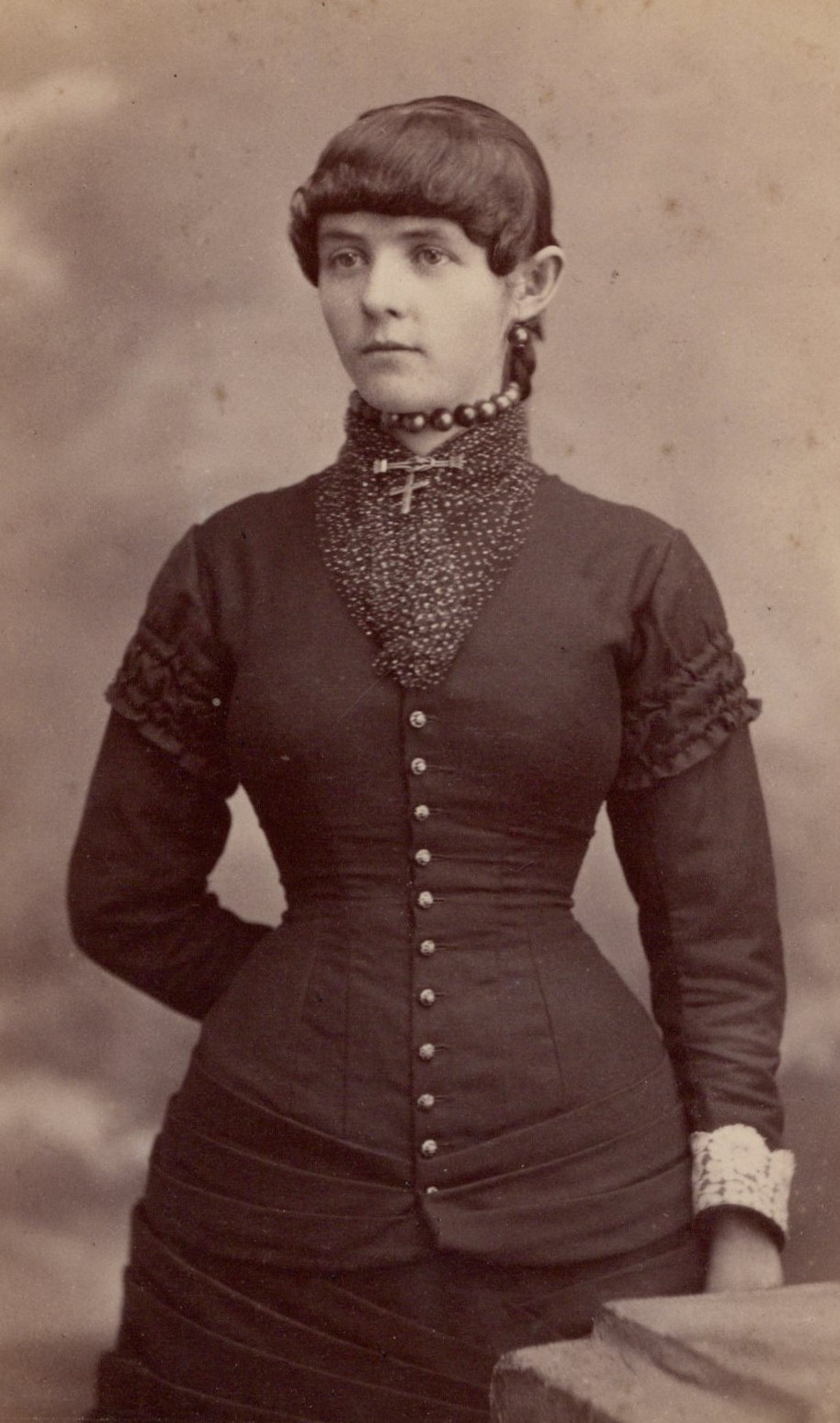
PRETTY AND SHAPELY YOUNG WOMAN : ASSIST FROM A CORSET : BANGS : CABINET CARD

This Cabinet Card presents an attractive woman in a beautiful dress. She is wearing  a “choker” necklace, a cross, and  earrings. Note her somewhat unusual hairstyle and that she is wearing bangs. In addition, the woman in this portrait achieved an hour-glass type figure with an assist from a corset. A corset is a garment that was worn to mold a woman’s  torso into a desired shape. Typically, corsets reduced the size of woman’s waist and exaggerated the size of their bust and hips. SOLD

Published in: on September 26, 2023 at 5:43 pm  Leave a Comment  
Tags: , ,

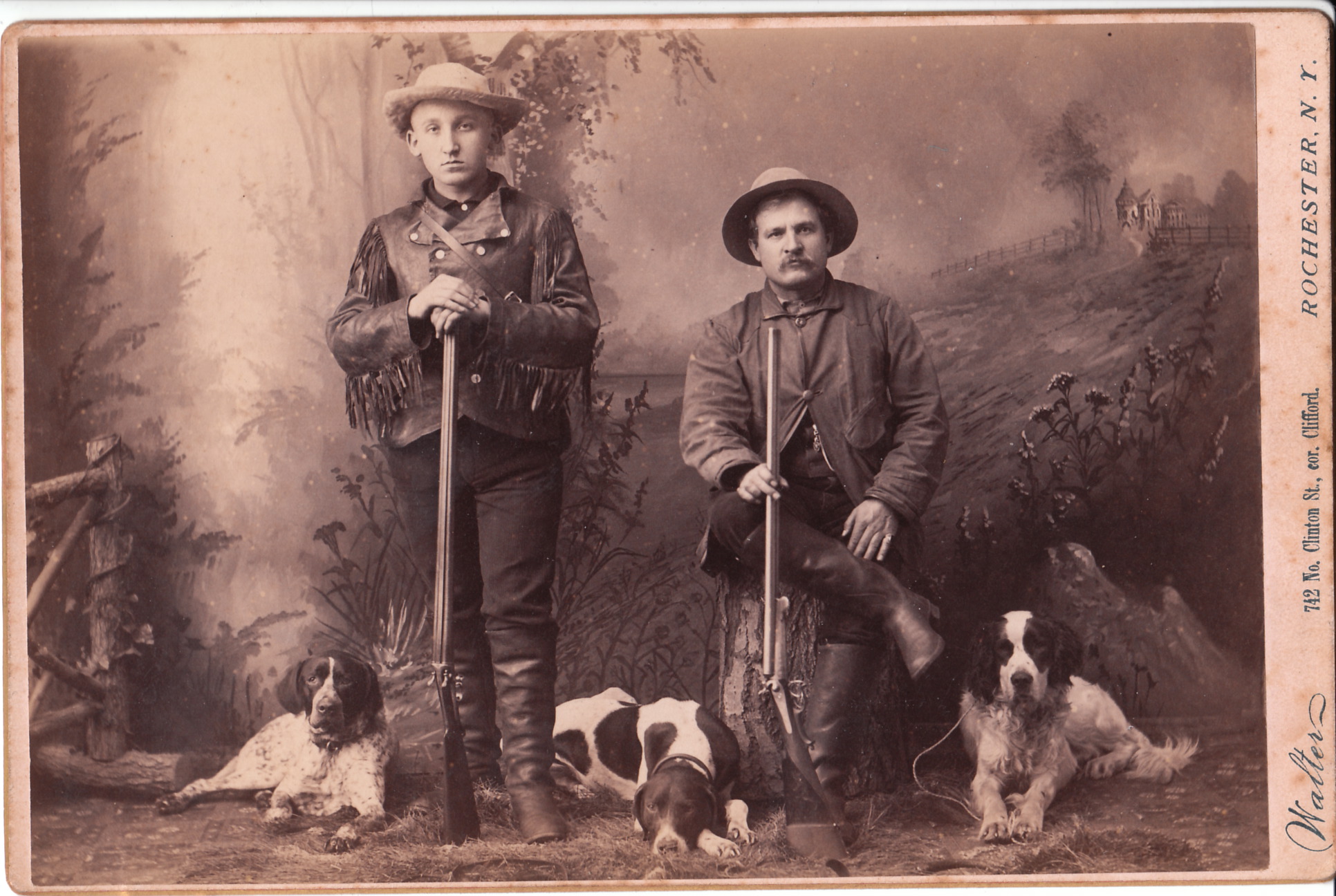
Two Hunters and their Rifles and Dogs (1887)

huntersThis terrific Cabinet card image shows two Hunters and their three hunting dogs. Both gentleman are wearing boots and are holding rifles. This studio photograph was produced by Walter of Rochester, New York. Notation on the reverse of the card identifies the hunters and is dated 1887.    SOLD

Published in: on April 11, 2023 at 12:00 pm  Comments (2)  
Tags: , , , ,

ETHEL BARRYMORE: A STAGE BEAUTY

blog1CABINET CARD 1

CABINET CARD 2

                                                                                                                                      brrymore

                                                                 POSTCARD 1  (SOLD)

ethelPOSTCARD 2  (SOLD)

barrymorePOSTCARD 3

barrymore-againPOSTCARD 4   (SOLD)

BARRYMORE PCPOSTCARD 5  (SOLD)

ETHEL BARRYMORE: STAGE BEAUTY : BROADWAY : RPPC  (1906) - Picture 1 of 2POSTCARD 6 (SOLD)

Ethel Barrymore (1879-1959) was an outstanding American actress and a member of the famous theatrical Barrymore family. She was born Ethel Mae Blythe in Philadelphia, Pennsylvania. Her parents were actors and she was the sister of John and Lionel Barrymore.  She was the great aunt of modern day actress Drew Barrymore.

Ethel Barrymore was considered by many to be the greatest actress of her generation. She was a major Broadway performer and first appeared there in 1895. She had roles in A Dolls House by Ibsen (1905).  She was a strong supporter of the Actors’ Equity Association and played a major role in the 1919 strike. She played in Somerset Maugham’s comedy, The Constant Wife (1926). She also starred in motion pictures beginning her film career in 1914.  Notable films included None but the Lonely Heart (1944) and The Spiral Staircase (1946). Around 1900, Winston Churchill proposed marriage to Barrymore but she refused. She later married Russell Griswold Colt in 1909 and had three children. She died of cardiovascular disease in 1959 at her home in California. The Ethel Barrymore Theatre in New York City is named in her honor.

The cabinet card 1 portrait of Ethel Barrymore was photographed by Phillips Photographers of Philadelphia, Pennsylvania. To view other photographs by Phillips, click on the category “Photographer: Phillips”. The second image (cabinet card 2) of the actress was produced by Sarony, the famous celebrity photographer who’s studio was located in New York City. To see other Sarony photographs, click on the category “Photographer: Sarony”.

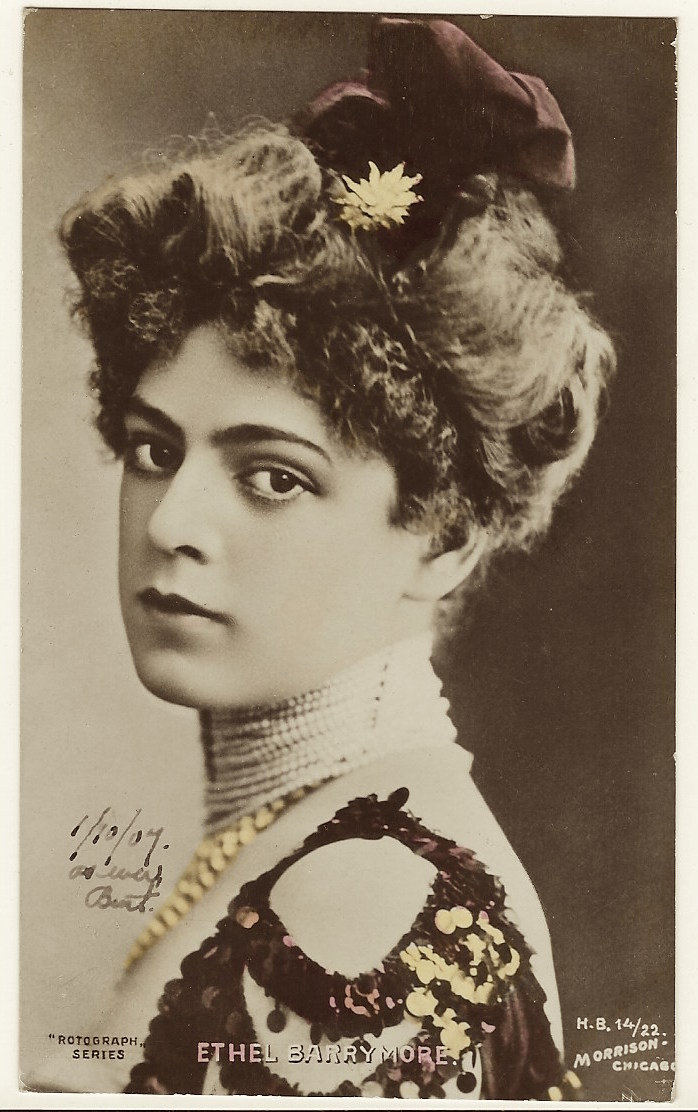
The third portrait of Miss Barrymore appears on postcard 1, published by the Rotograph Company who operated in  New York City and Germany. This postcard portrait was taken by famed Chicago photographer William Morrison. He is well known for his excellent portraits of theatrical stars. He produced both real photo postcards and cabinet cards. This postcard is number HB/1422 of the “Rotograph Series”. The image on this postcard is color tinted. This postcard has been mailed and postmarked (1907). The reverse of this postcard can be seen below.To view other photographs by Morrison, click on the category “Photographer: Morrison”.

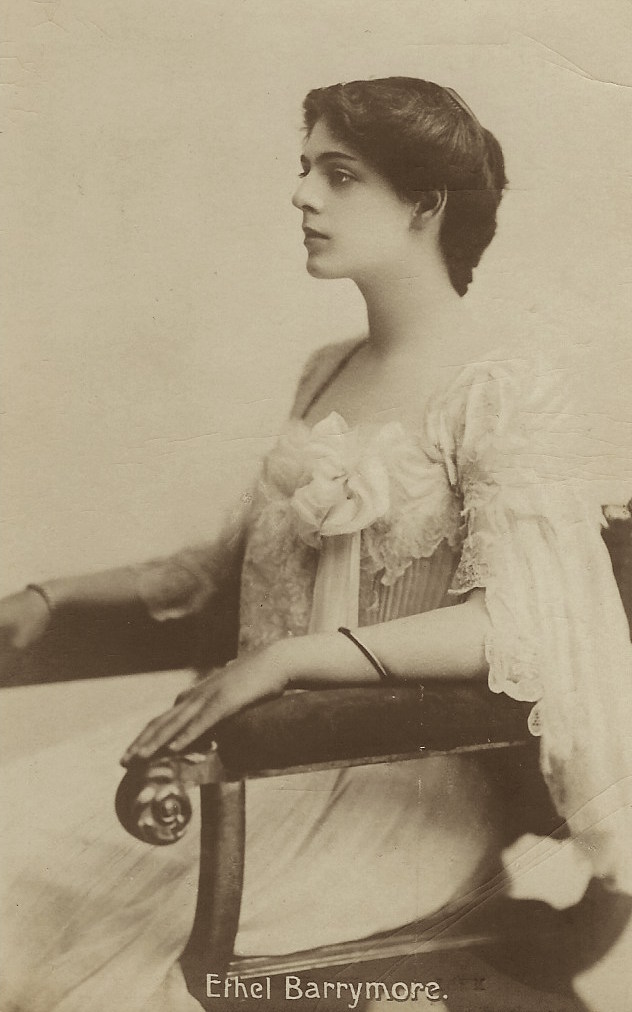
The fourth portrait of Ethel Barrymore is an uncommon one (postcard 2). The image provides a lovely profile view of this legendary actress. If you search for this exact postcard online, you likely won’t find it. This postcard was published by E. Frey & Company who operated in  New York City . Research reveals that postcards displaying the printed name of  “E. Frey” were actually published by the Souvenir Post Card Company which existed between 1905 and 1914. It was located at 268 Canal Street in New York City. The company was purchased by Valentine & Sons and the combined company became Valentine – Souvenir. This postcard was printed in Germany and is in good condition (see scan).

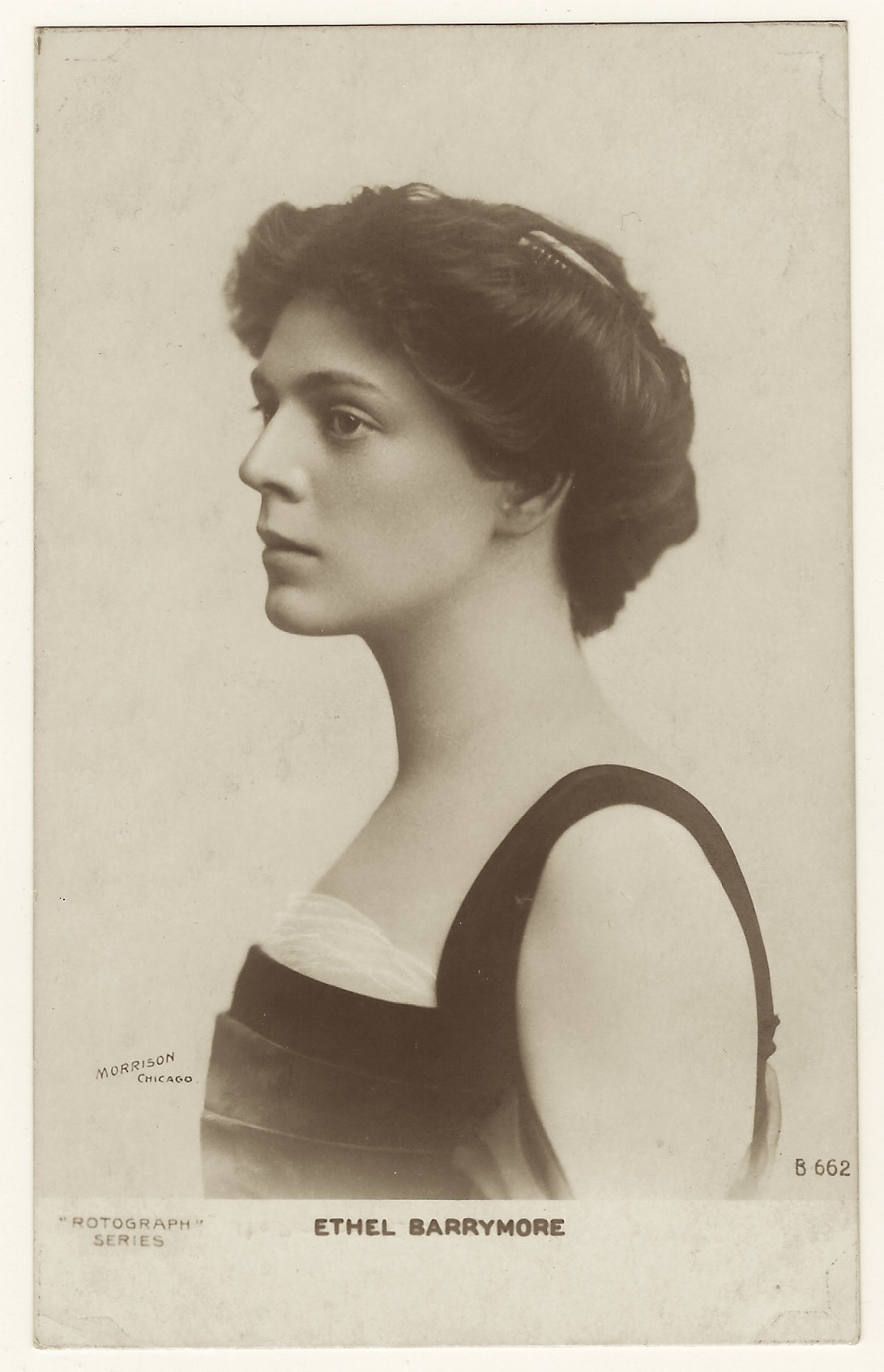
The fifth photograph (postcard 3) of Miss Barrymore was published by the Rotograph Company. This postcard portrait was taken by famed Chicago celebrity photographer William Morrison.This postcard is number B 662 of the “Rotograph Series”. The image has excellent clarity.

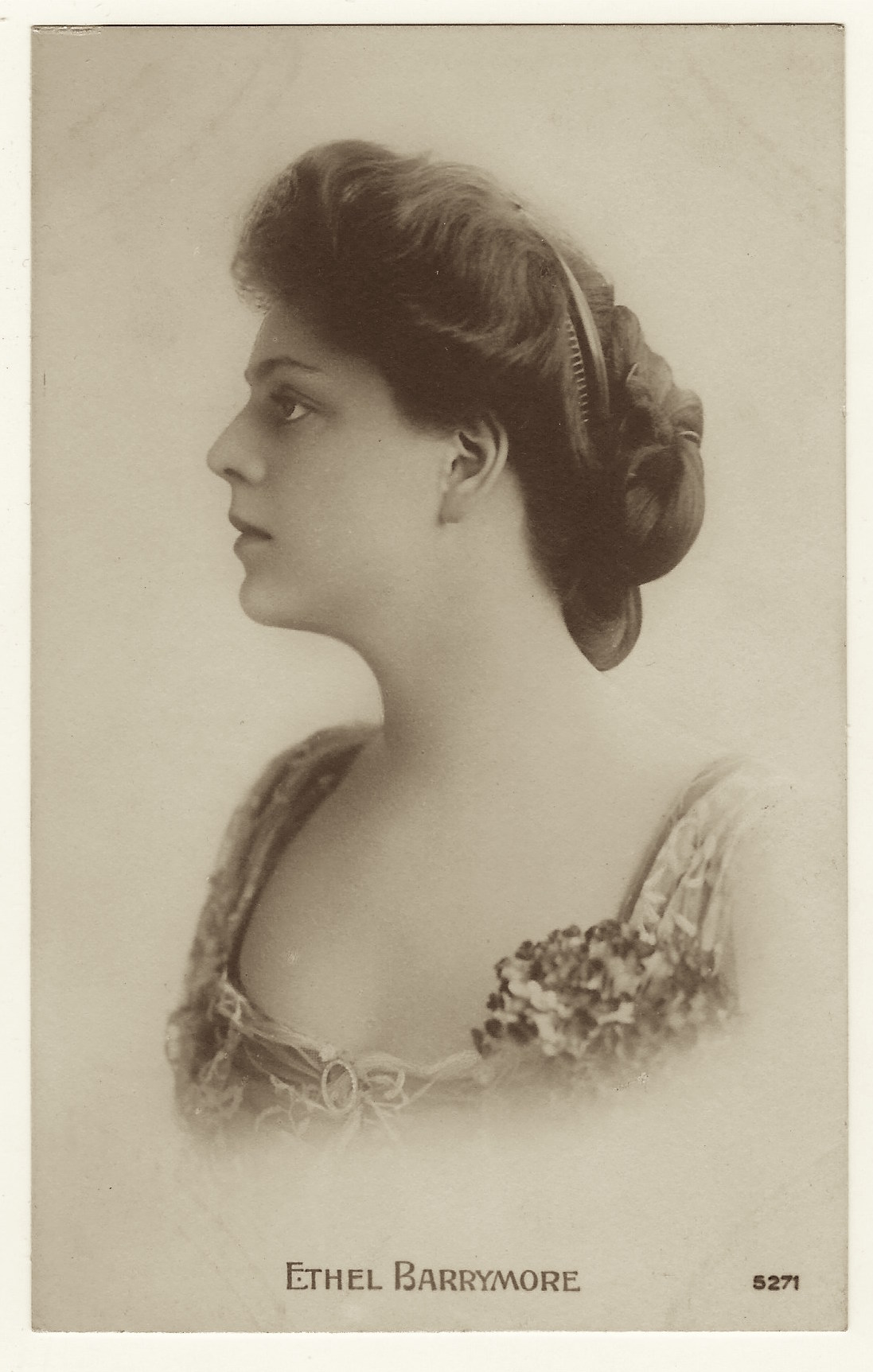
The sixth image (postcard 4) is a vintage real photo postcard portrait of Ethel Barrymore. The postcard was published by Albert Hahn who was based in New York City (200 Broadway) and Hamburg. Hahn operated his company between 1901 and 1919. The postcard was produced in Germany sometime in the decade of 1900-1910. The postcard is part of a series (no. 5271).  (SOLD)

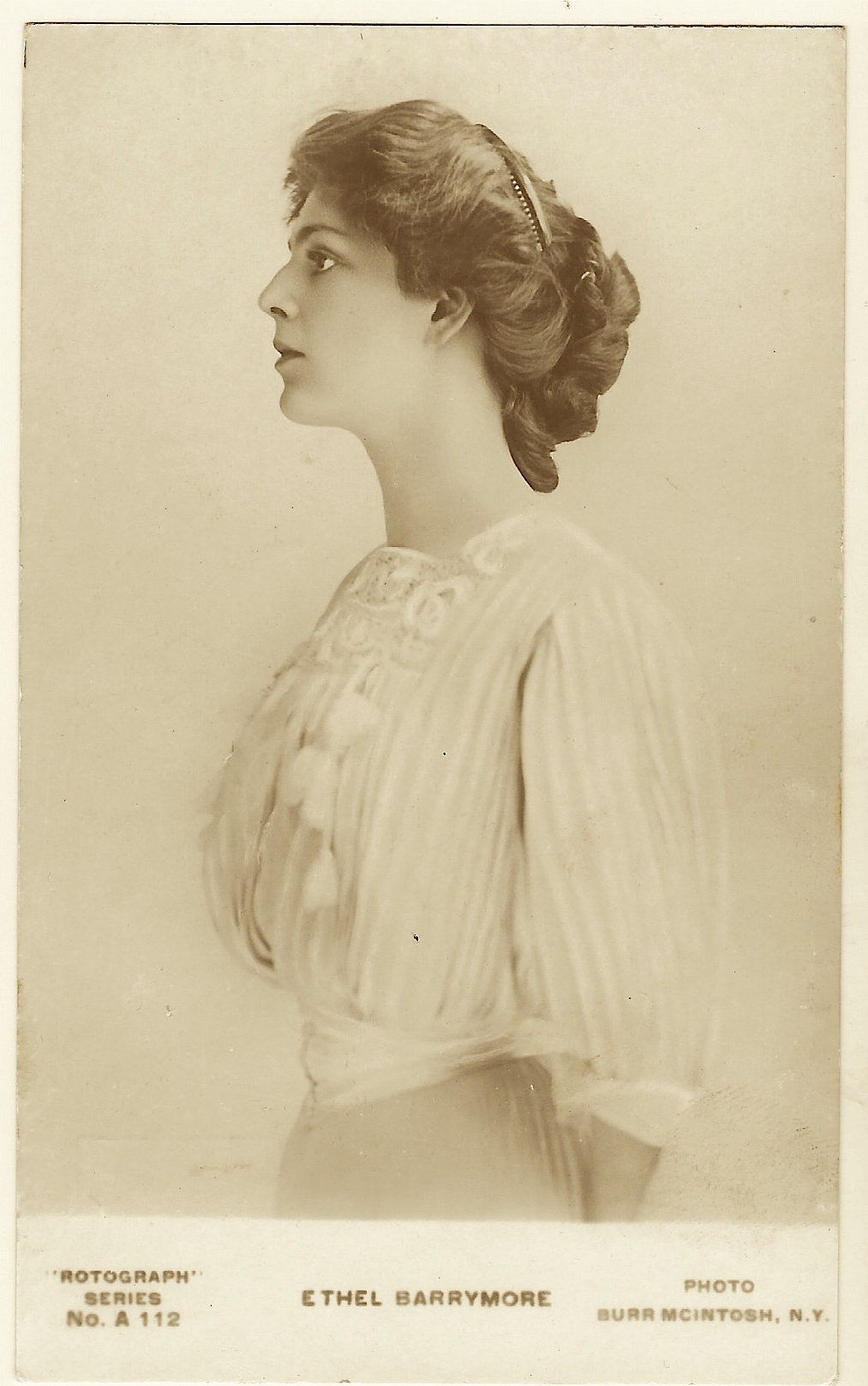
Postcard 5 offers a profile view of Miss Barrymore. The postcard was published by the Rotograph Company as part of the Rotograph Series (No. A 112). The photographer of this image is Burr McIntosh of New York City. William Burr McIntosh (1862-1942) lived an interesting life. Among his job titles listed by Wikipedia, are photographer, lecturer, film studio owner, silent film actor, publisher of the “Burr McIntosh Monthly”, reporter, and radio and early film pioneer. His sister was Nancy McIntosh, a noted operatic soprano. He was a graduate of Lafayette College in 1884. His most noted film role was his appearance in D. W. Griffith’s film, “Way Down East” (1920). Wikipedia notes that he appeared in 53 films between 1914 and 1934. This vintage postcard is in very good condition.

Postcard 6 is a portrait of Miss Barrymore that was postmarked in 1907.   (SOLD)

barrymore AGAIN 1

POSTCARD 4

studholme pc 3

        POSTCARD 5   

ETHEL BARRYMORE: STAGE BEAUTY : BROADWAY : RPPC  (1906) - Picture 2 of 2Postcard 6 (Sold)

PORTRAIT OF AN ATTRACTIVE FASHONABLE COUPLE : WOMAN HOLDS CABINET CARD

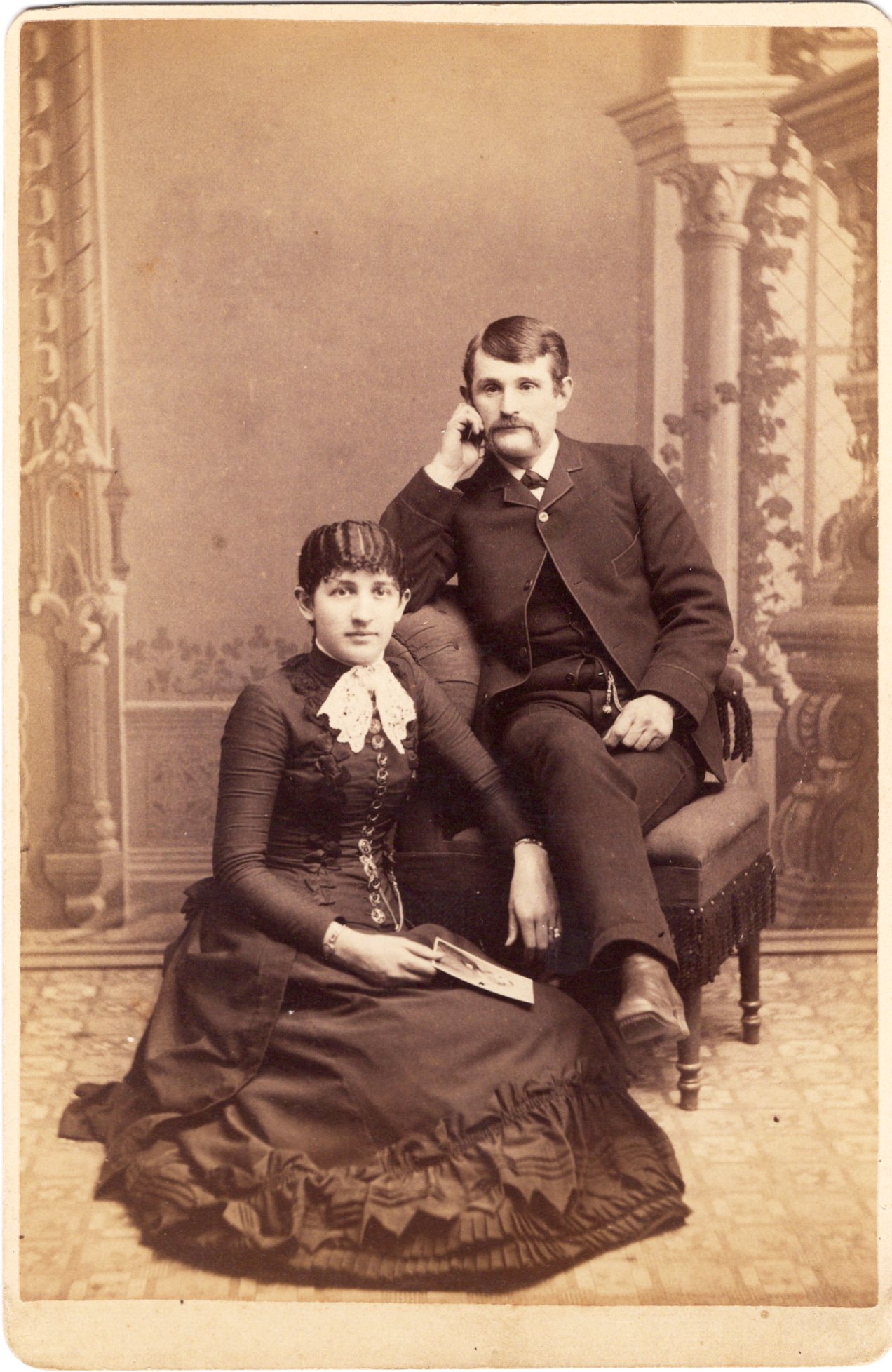
This is an interesting cabinet because of the way that this couple is posing for their portrait. It is unusual to see a a woman sitting on the floor while posing for a cabinet card photograph. It is also not typical to see a woman sitting at the feet of a man in cabinet card images. The subjects of this photograph may be married, or perhaps, they are brother and sister.  The couple is nicely dressed and the woman is holding a photograph of a man. The backdrop is high quality.  There is no identifying information about the two individuals in the image or about the photographer. This cabinet card portrait is in excellent condition (see scans).

a-woman-at-his-feet-1-1

Buy this Cabinet Card (includes shipping within the US) #3841

To purchase this item, click on the Pay with PayPal button below

$28.70

a-woman-at-his-feet-1-2

Buy this Cabinet Card Photograph (includes International shipping outside the US) 3841

To purchase this item, click on the Pay with PayPal button below

$37.95

Published in: on February 18, 2022 at 12:00 pm  Comments (1)  
Tags:

MLLE POLAIRE: FRENCH SINGER AND ACTRESS (PHOTOS BY REULINGER & NADAR)

polaire-2Photo 1

polaire 2020-05-01_075606  PHOTO 2

polaire2 2020-05-01_075728 PHOTO 2 (CLOSE-UP)

Mlle Polaire is actually the stage name used by French singer and actress Emilie Marie Bouchaud (1874-1939). Polaire was born in Algiers, Algeria and began her theatrical career as a cafe singer at the young age of 15. She moved to France two years later and ad0pted the stage name Polaire and became a music hall singer. In 1895, Henri de Toulouse-Lautrec drew a sketch of her which appeared in the satirical magazine Le Rire. In 1900 her portrait was painted by Leonetto Cappiello and her popularity rose even more. She began acting in Paris in 1902 and became a major celebrity star. She was thought to be a gifted comedic actress but was also very well known for her beauty. She was famous for her tiny, corsetted waist. She was five feet and three inches tall. She lavishly overdressed in furs and dazzling jewels. In 1911 she appeared in her first silent film role and later appeared in six films of director Maurice Tourneur in 1912 and 1913. She then returned to the stage and toured the United States and England. She later made a reappearance in films, performing in ten (some were talkies). She died at age 65 and was buried in France. This cabinet card photograph (Photo 1) was taken in Paris, France at the studio of Reutlinger. Charles Reutlinger (1816-1860) was a French photographer whose studio operated between 1850-1937 in Paris, France. Among his subjects were many celebrities including the prettiest ladies of Paris. To view other photographs by Reutlinger, click on the category “Photographer: Reutlinger”.                                                       The second photo of Miss Polaire is featured in this vintage real photo postcard (Photo 2). She looks beautiful in this image. She is sitting cross-legged and wearing dark clothing, boots, and a large bow. Examining the print of the front of the card provides some interesting information.  We learn that the photographer of this image is the celebrated and talented Paul Nadar (1856-1939).He was a French photographer. He learned photography by his father, Felix Nadar, also a talented portraitist. Paul eventually ran his father’s studio. The establishment catered to a affluent clientele and was very successful. In 1890 he began shooting photographs from a hot air balloon. The press referred to him as “The Fearless Paul Nadar”. Nadar also photographed sites in Europe and Ssia along the ancient silk route. Some consider his work from that trip to be the first incidence of “photo-reportage”. In 1893 he became an agent in France for Eastman Kodak. The word “Eclair” appears in the bottom right hand corner of the photo. The Eclair Company was a movie production company established in 1907 and headquartered in Paris. The company produced many silent shorts in France beginning in 1908 and it’s American division produced films from 1911 through 1914. Included in their productions was one of the first film version of  “Robin Hood”.  In the top left hand corner of the photograph is the word “Bouffes”. The “Theatre des Bouffes-Parisiens” is a theatre located in Paris and founded in 1855. It was the location of the production that Miss Polaire was appearing in when she posed for this photograph. The name of the production can be seen in the bottom border of the card, “Claudine a l’Ecole”. The translated title of the play is “Claudine at School”. The story is from a 1900 novel by the French writer, Colette. It is a tale about a 15 year-old girl and her brazen conflicts with the headmistress and fellow students in her school. This vintage postcard has a great deal of back story. It is in excellent condition (see scans).

Buy this Vintage Real Photo Postcard (includes shipping within the US) #3062

To purchase this item, click on the Pay with PayPal button below

$38.76

Buy this Vintage Postcard (includes International shipping outside the US) 3076

To purchase this item, click on the Pay with PayPal button below

$47.25

polaire 3 2020-05-01_075923 PHOTO 2