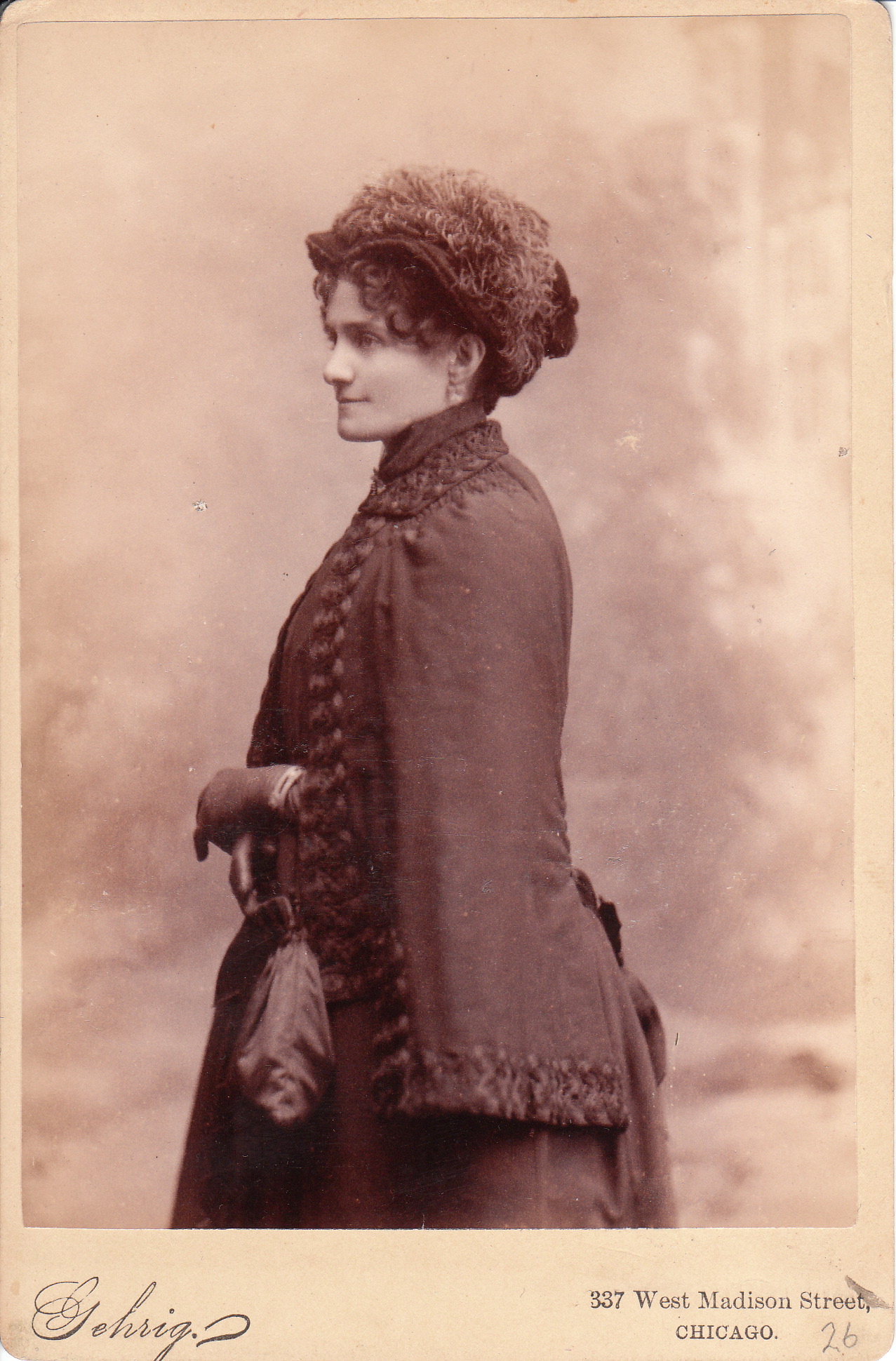
A very pretty woman poses for her portrait at the studio of well known photographer, Joseph W. Gehrig. Gehrig plied his trade in Chicago, Illinois. To view other photographs by Gehrig, click on the category “Photogapher: Gehrig”. The woman in this photograph is beautifully dressed. she is wearing leather gloves and a wonderful feathered hat. She appears to be holding a purse. She gives the appearance of a woman of means and it is likely that she was a member of Chicago’s high society.
MAE BRANSON: PROVOCATIVELY POSES IN CHICAGO, ILLINOIS
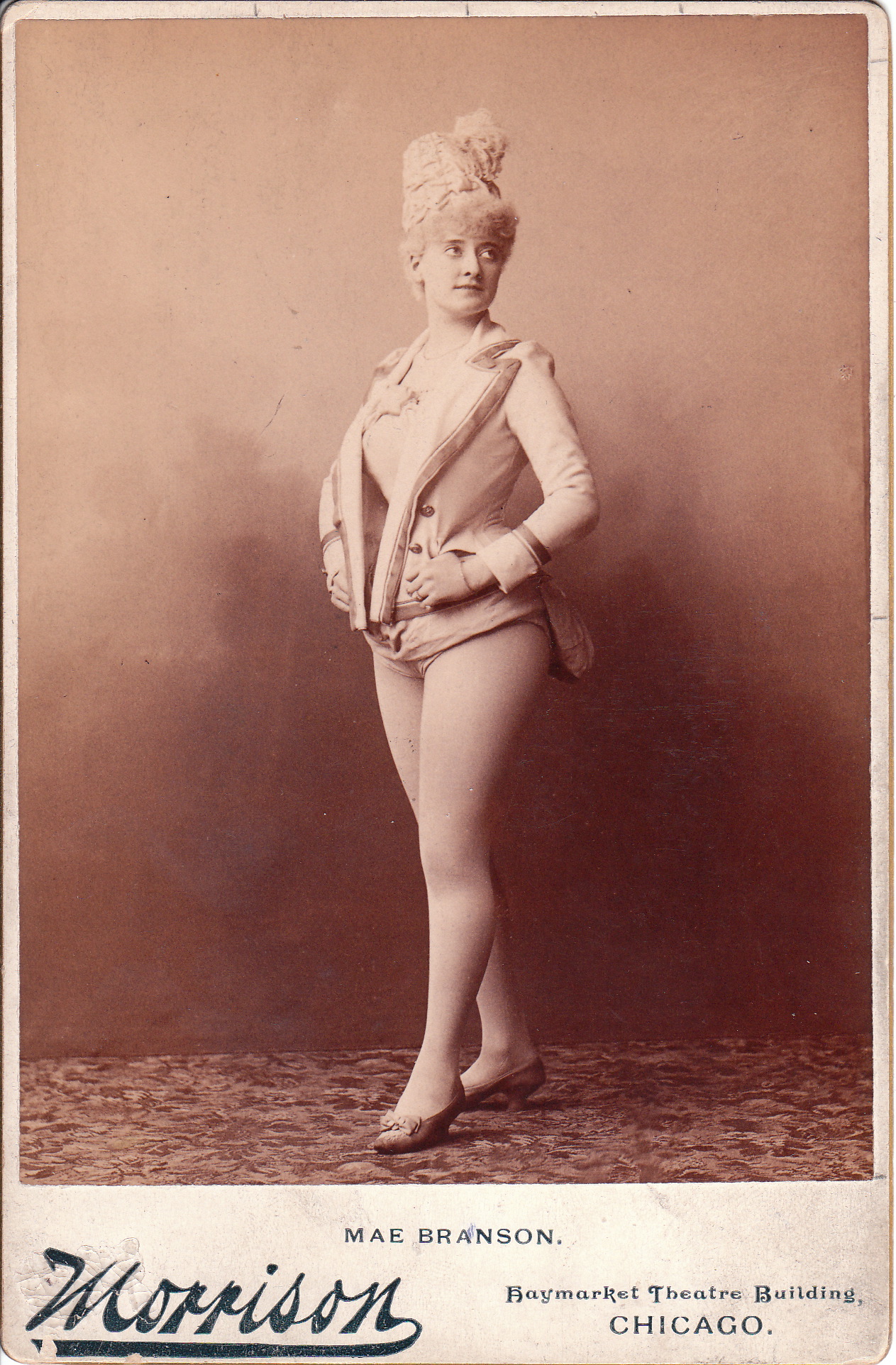
A sexy, busty, and leggy, blonde Mae Branson poses for celebrity photographer, William McKenzie Morrison, in Chicago, Illinois. The photographer’s studio was located in the Haymarket Theatre Building. To learn more about this well known photographer, click on the category “Photographer: Morrison”. A stamp on the reverse of this photograph indicates that the cabinet card was formerly owned by Culver Pictures. Culver was located in New York City, and for a fee, provided images to newspapers, films, and other forms of media. Research yielded little biographical information about stage beauty, Miss Branson. The National Police Gazette (1892) reports the bathing exploits of four actresses at Long Brauch. The article was written in poetry form and the verses included the following lines: “and in the surf she daily dips in jaunty bathing dress; That fits her like a glovelet – not an inch the more or less”. The actresses described were Minnie Seligman, Geraldine McCann, Della Fox, and Mae Branson. The site of the sexy swimming exhibition was likely Long Branch, New Jersey; “Long Brauch” was likely a misspelling. It appears that MTV’s reality TV show, “Jersey Shore“, is a remake; because there seems to have been plenty of provocativeness at the Jersey Shore in 1892. Mae Branson’s name also appears in an article in a Maine newspaper, The Lewiston Daily Sun (1893). The article appeared in the Music and Drama section. A review of the play “1492” describes Miss Branson as exhibiting “agreeable singing and artistic work” which obtained “prompt and hearty recognition”. (SOLD)
PORTRAITS OF GEORGE AND LIZZIE IN CHICAGO (STILL TOGETHER AFTER ALL THESE YEARS)
These two cabinet card portraits come from the same source and belong together. Writing on the reverse of one photograph indicates that the couple are named George and Lizzie. Perhaps the young man and woman are married to each other. If not married, the two subjects may be siblings. The photographer of both cards is Copelin whose studio was located on the Northwest corner of Madison and State Streets in Chicago, Illinois. The exact address was 75 Madison Street. Some biographical information concerning the Copelin studio is available, but it is very difficult to sort out. It seems that Copelin had a succession of photography businesses. Alexander J. W. Copeland (1851-c1923) and Melander bought out their boss to open a studio in Chicago sometime around 1870. Copelin & Son was established in 1871 and existed about ten years. The business has an interesting story associated with it. The gallery was established just six days before the Chicago Fire (1871) and the building was completely destroyed in the blaze. The building had been the first photographic gallery in Chicago but had housed many proprietors. A.J. Copelin rebuilt the business. In the early 1880’s, the Copelin Gallery was established. Copelin eventually left portrait photography and opened a successful commercial photography business. Copelin is also recognized as one of the founding fathers of the Photographers Association of America.
SALVATION ARMY SISTERS IN CHICAGO, ILLINOIS
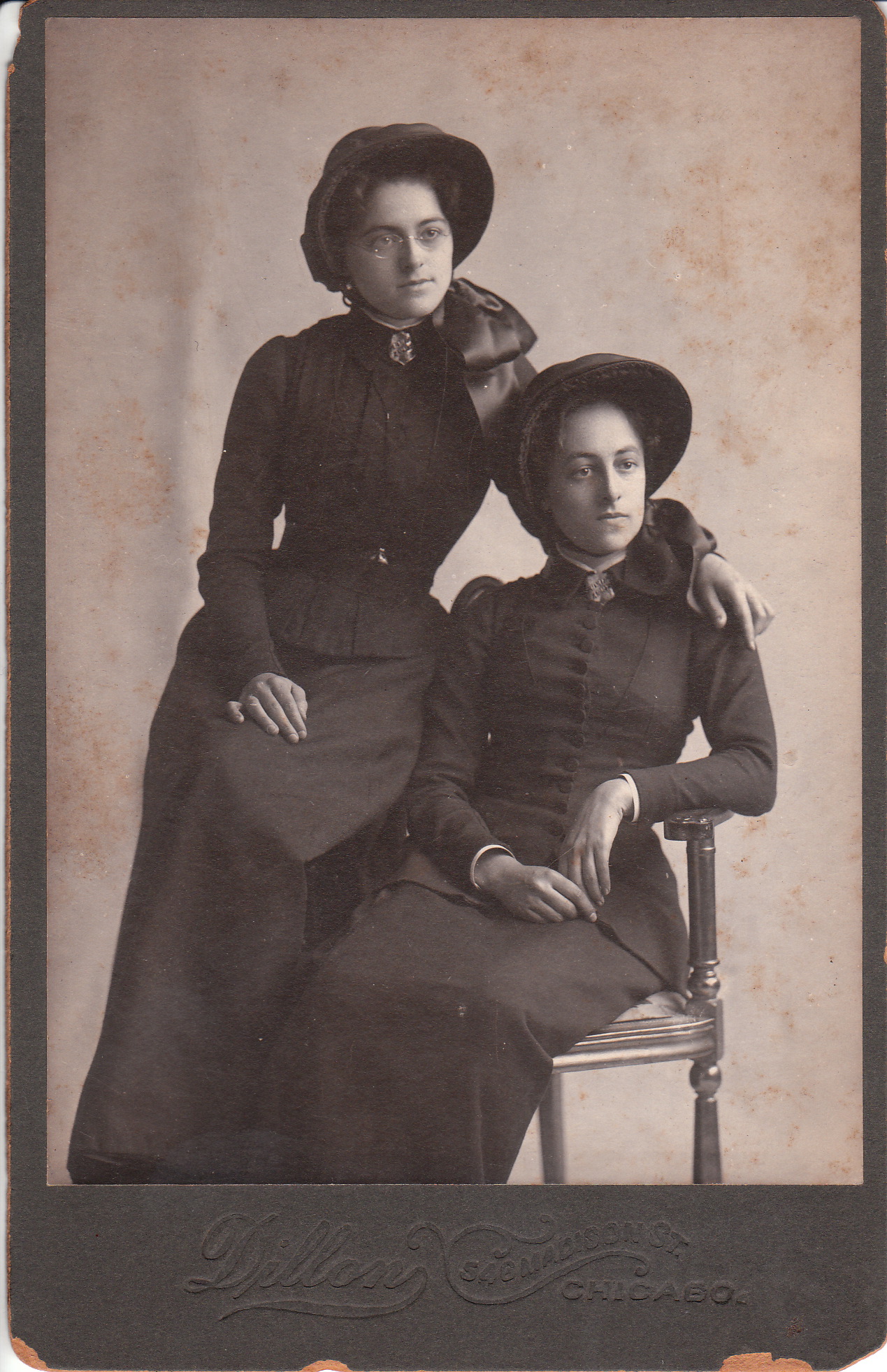
This photograph, by Dillon, features two young woman in their Salvation Army uniforms. Dillon’s studio was located in Chicago, Illinois. The woman’s Salvation Army brooches are worn at their collar. Note that one of the woman is wearing spectacles. The name “Walker” is written twice on the back of the photograph. The names appear directly above and below each other which likely indicates that each woman is named Walker, and that they are sisters. To view other photographs of Salvation Army workers, click on the category “Salvation Army”. The photographer of this image may have been S. W. Dillon, who was the Vice President of the Chicago Photographers Club, according to an article in The Photo Beacon (1897).
CHILD WITCH IN BRAIDWOOD, ILLINOIS
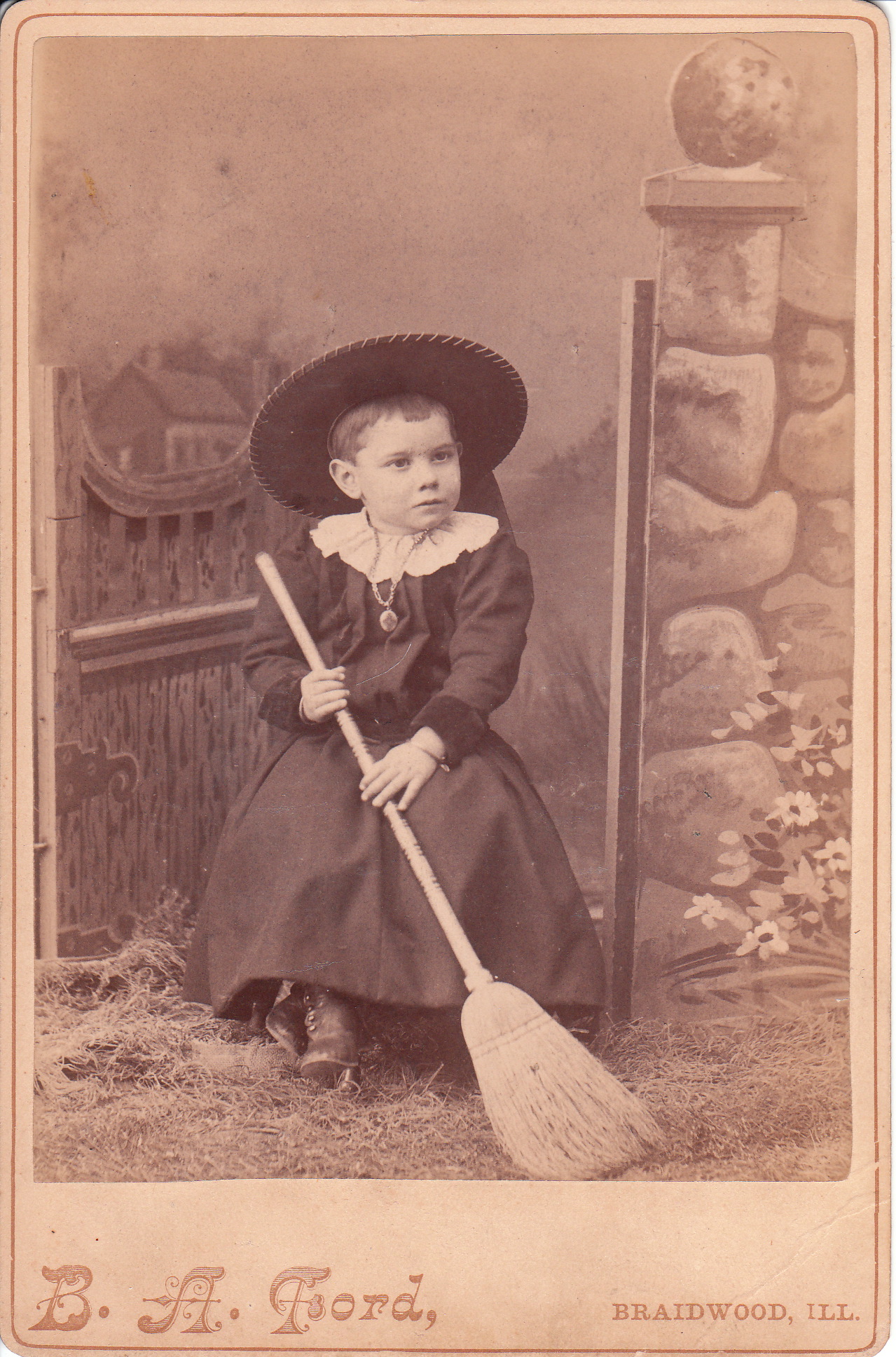
A young witch prepares for take-off with her trusty broom. The photograph must have been taken around the time of Halloween. In reality, this photograph is a portrait of a young child posing with a broom. The child’s clothing, though appropriate for the era, resembles the garb of a witch. The child is wearing a necklace and a bracelet which favors the likelihood that the child is a girl. The photographer of this image is B. A. Ford of Braidwood, Illinois. Ford was a photographer of note in Illinois. He was a documenter of the early history of coal fields in his town. In 1879 he advertised for an apprentice for his busy studio. Many of his subjects were miners or members of miner’s families. In an 1885 ad he offered to give free advice to his customers so that they may learn the art of hand tinting. Ford’s community of Braidwood was located 53 miles southwest of Chicago, Illinois. In 1864, a family digging for water, found coal and soon a mining community sprouted. The town was called Keeversville. James Braidwood was an early resident and he became the superintendent of the sinking of the first deep mine shaft. In 1873, the town was named in his honor.
A MAN AND HIS BIKE IN CHICAGO, ILLINOIS
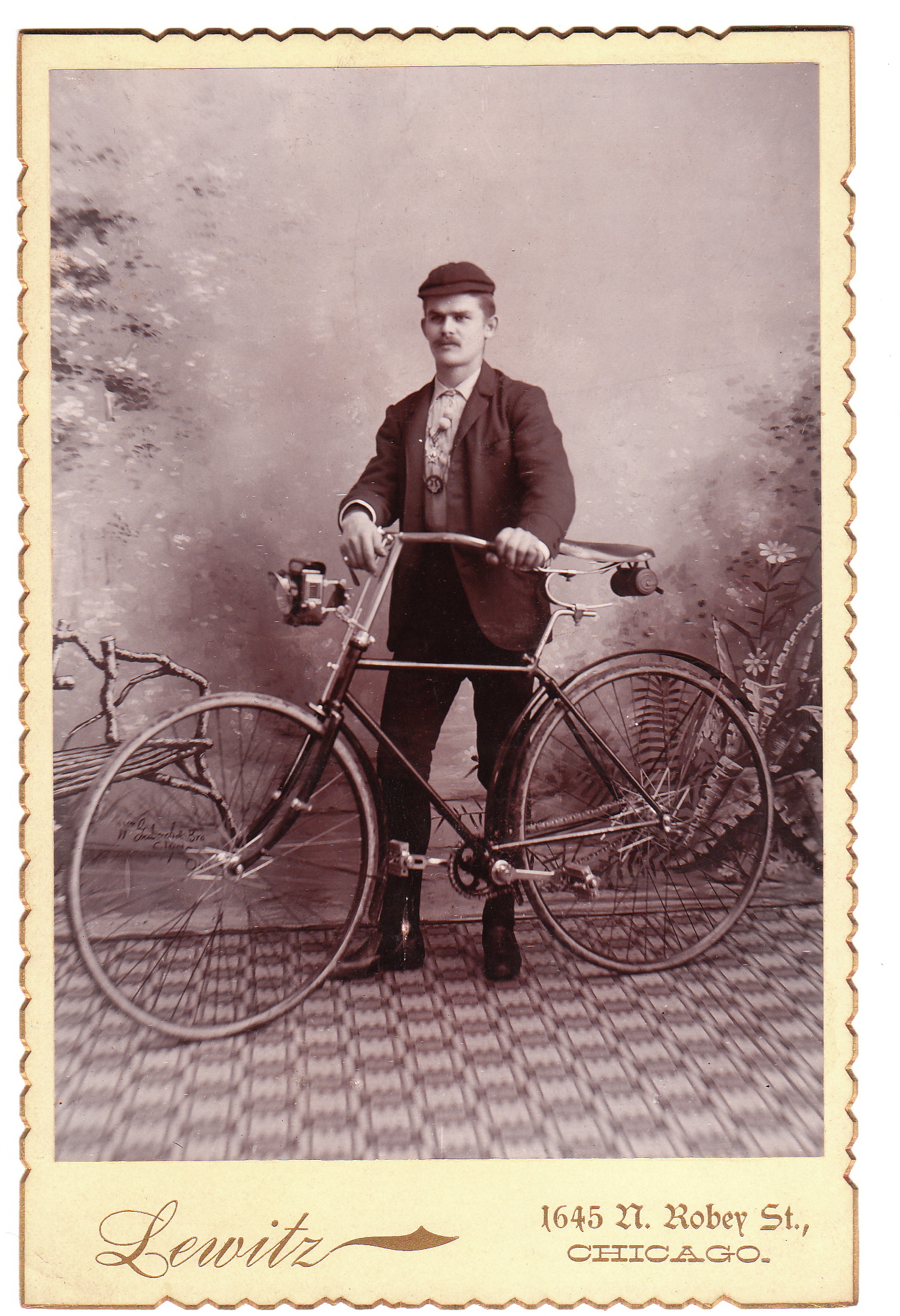
This cabinet card features a young man posing with his bicycle. His “ride” is very “tricked out”. Check out the accessories. The bike has a large headlight and something that looks like a “fanny pack” hanging from the seat. Hopefully, a visitor to the cabinet card gallery can explain the purpose of the “fanny pack”. Visitor feedback would also be appreciated concerning the gentleman’s necktie. One hesitates to call it a necktie because it seems to be a collection of items including cotton balls, and possibly, a small round framed photograph. The tie is sort of like a “charm tie”. The gentleman’s cap looks great and will help keep his hair in place while riding. The photographer is Lewitz whose studio was located in Chicago, Illinois. Research found two photographers in Chicago sharing the name of Lewitz. Charles Lewitz operated a studio at 1643 North Robey Street. This address was next door to where this cabinet card was photographed; indicating that Charles was the likely photographer of this image. However, life is rarely that simple. Complicating matters is the fact that Emil Lewitz was a photographer who had a gallery at 1843 North Robey Street. Most likely, Charles and Emil were related and ran all three studios, each one at different points of time. It appears that the photographer of this cabinet card was an enterprising man. An advertisement on the reverse of the card notes “Photographs Taken of Houses and Groups”. To view other photographs by the Lewitzs’, click on the category “Photographer: Lewitz”.
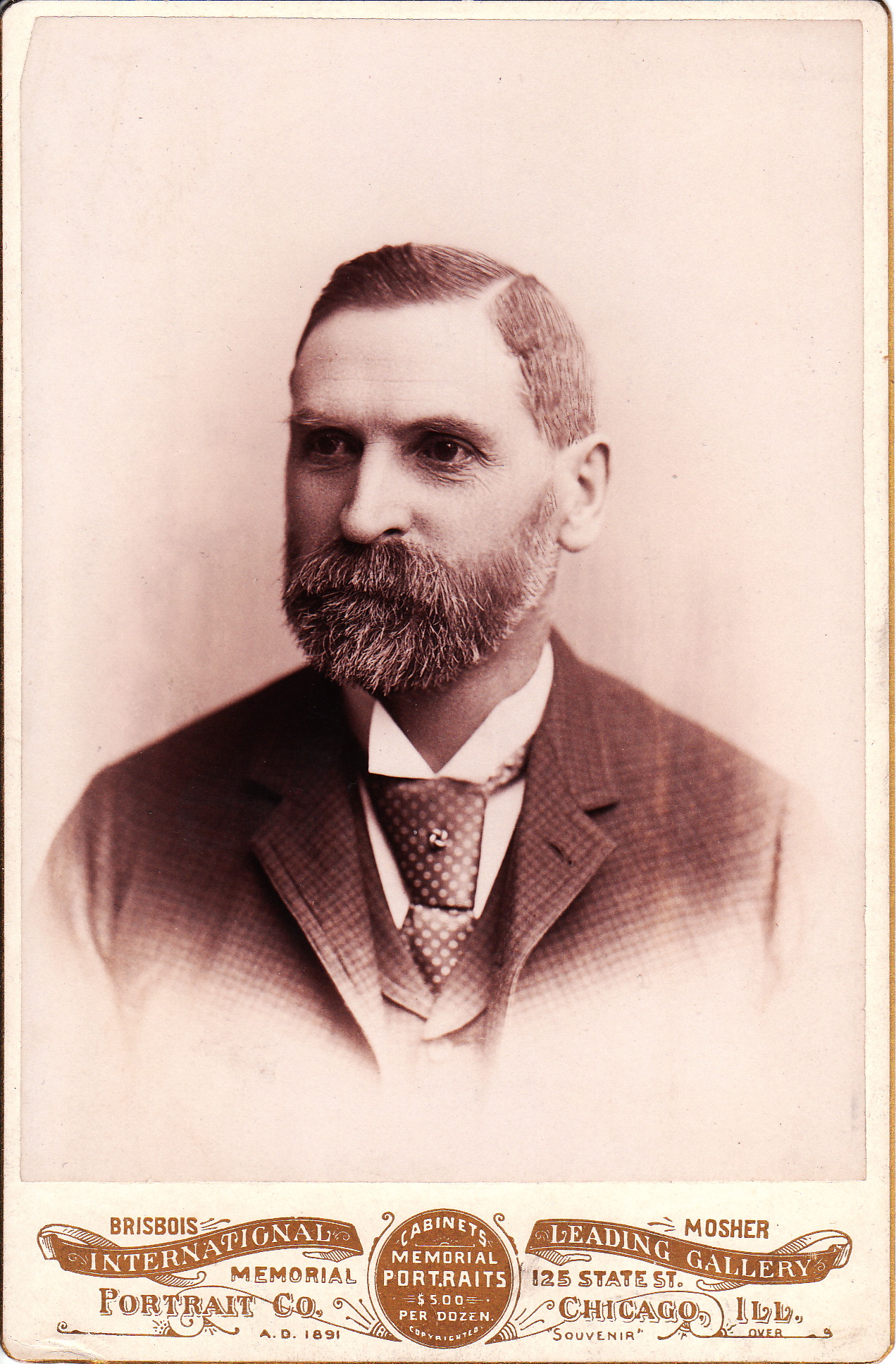
MEMORIAL CARD BY MOSHER OF CHICAGO, ILLINOIS
This cabinet card served as a memorial to the gentleman pictured in the image. The photograph was taken by the Mosher Gallery of Chicago, Illinois. The cabinet card is dated 1891. This cabinet card is particularly interesting because the Brisbois International Memorial Portrait Company is also listed as producing the photograph. Research revealed no information about the Brisbois Company. Was Brisbois a subsidiary of Mosher’s gallery? Printed on the center bottom of the card, is an advertisement stating that the Memorial Portraits could be purchased at the cost of five dollars per dozen. It seems rather unseemly that the studio would put prices on the front of actual Memorial Cards purchased by grieving families. It is possible that this cabinet card was used as a sample to help sell Memorial Portraits to customers. Mosher was a well known and talented photographer. To learn more about him, click on the category “Photographer: Mosher”.
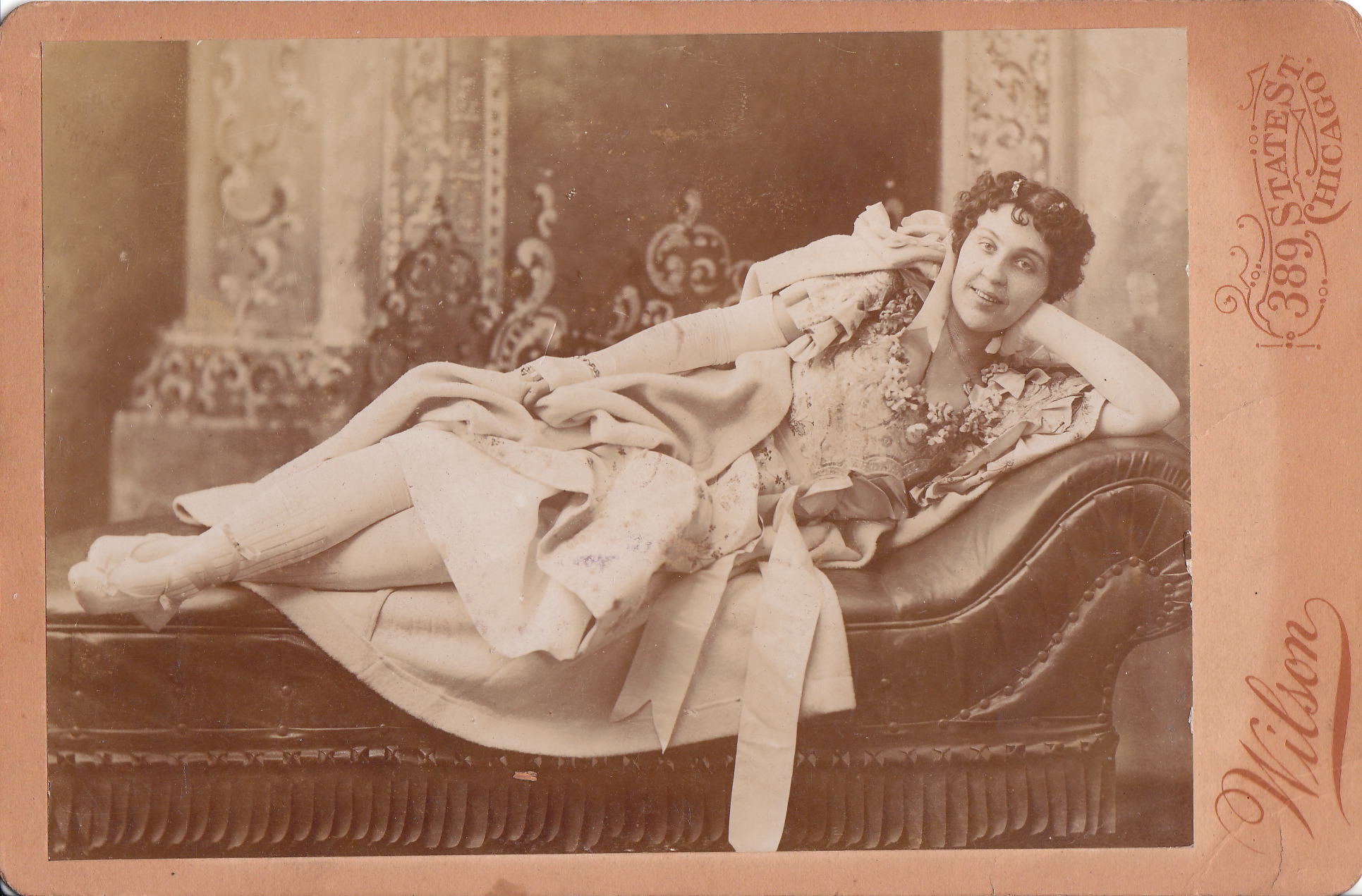
PROVOCATIVE WOMAN ON A FAINTING COUCH IN CHICAGO, ILLINOIS
This cabinet card features a young smiling woman lying on a fainting couch. This image is quite risque for its time. The style and folds of the woman’s dress, her exposed feet, her smile and her body language all contribute to the provocativeness of this image. Fainting couches were popular in the 19th century and used predominately by woman. They are couches with a back that is traditionally raised at one end. There are two major theories as to why these type of couches became popular. The first theory was that some women wore their corsets so tight, that they restricted blood flow; causing fainting. This theory has pretty much been debunked. A second theory was that the couch was popular because many women of that time suffered from “female hysteria”. This medical condition caused symptoms that included faintness, nervousness, and insomnia. The illness was treated by “pelvic massage”. The couch was a great setting for hysterical woman to receive the treatment from visiting physicians and midwives. This female psychiatric illness sounds very much like an anxiety attack, and Xanax and Ativan seem to have replaced “pelvic massage” on a fainting couch. The photographer of this cabinet card was J. B. Wilson of Chicago, Illinois. To view other photographs by Wilson, click on the category “Photographer: Wilson (JB)”. The subject of this photograph may have been an actress.
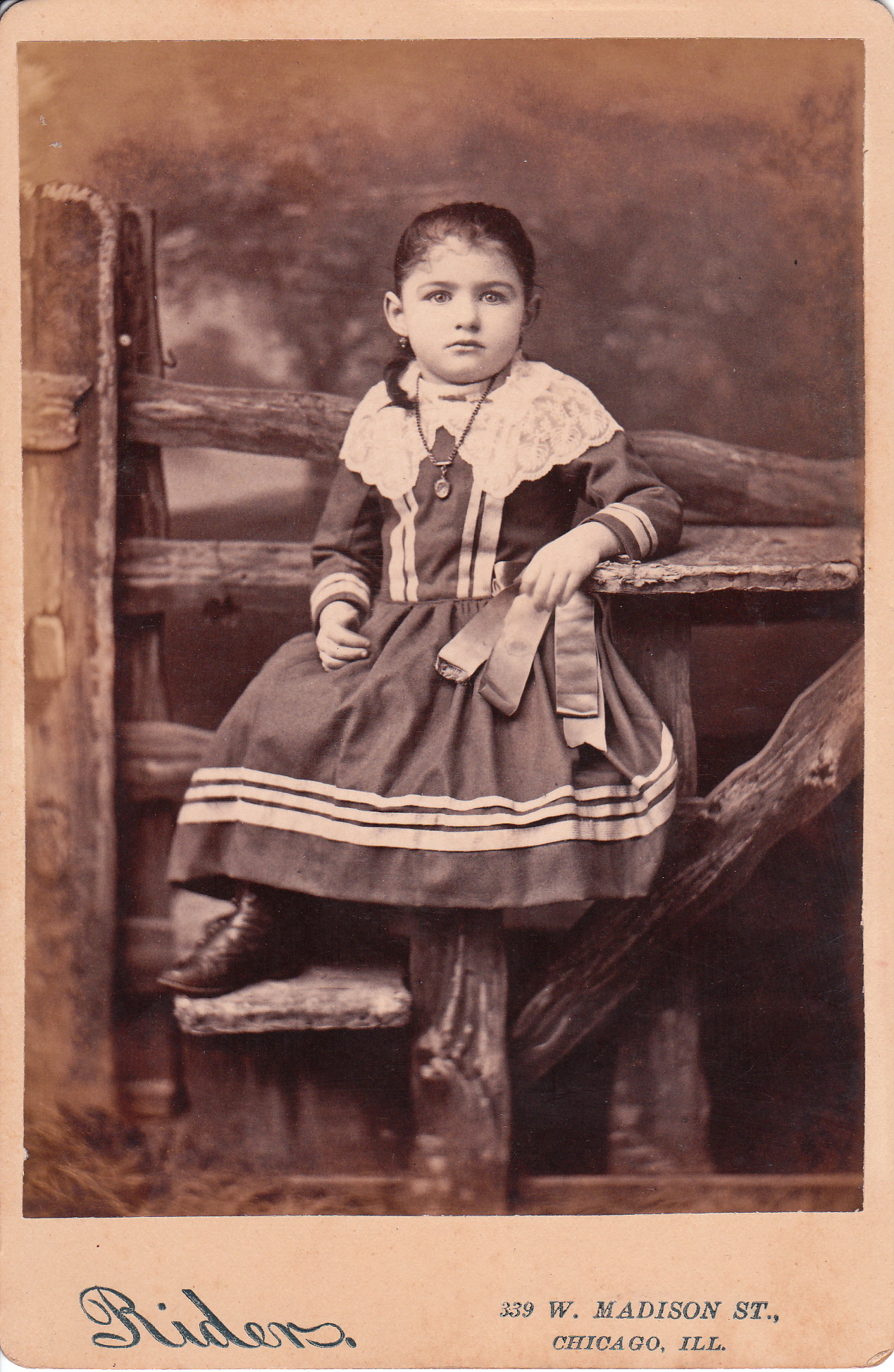
ADORABLE AND BEAUTIFULLY DRESSED LITTLE GIRL IN CHICAGO, ILLINOIS
A cute little girl poses for her portrait at the studio of Briggs L. Rider, of Chicago, Illinois. The child is wearing a very cute outfit that includes lace and ribbons. The photographer, Rider, was active in Tipton, Iowa (1855), Des Moines, Iowa (1856-1860), and Chicago, Illinois (1864-1896?). During part of his tenure in Chicago, Rider was partners with photographer, Joseph Gehrig. Rider was a daguerreoist and cabinet card photographer. He also copied paintings, drawings and daguerreotypes; and taught daguerreotype art. The address listed on this cabinet card indicates that it was produced sometime between 1878 and 1890.
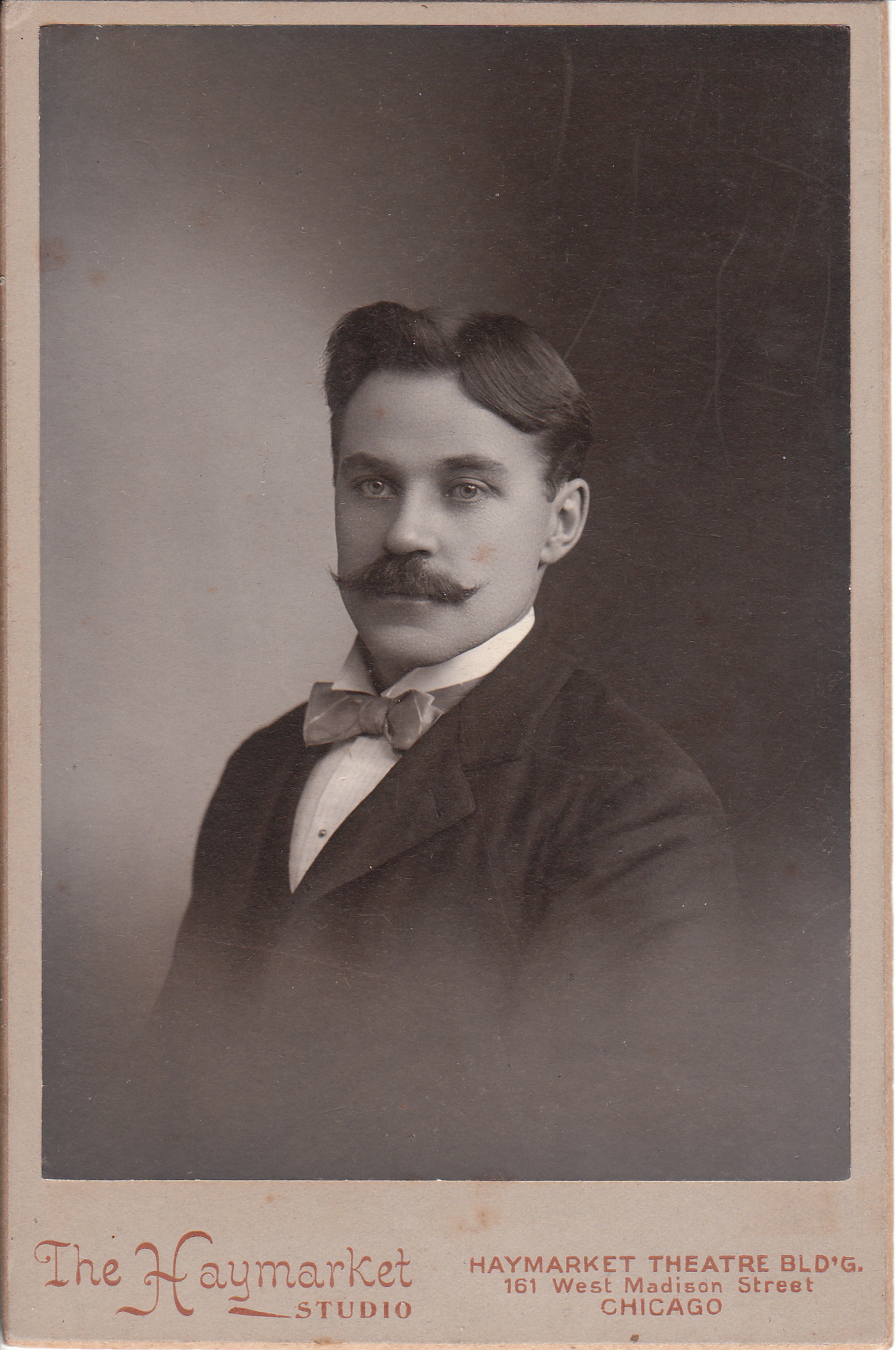
GOOD LOOKING GUY AT THE HAYMARKET THEATRE IN CHICAGO, ILLINOIS
A handsome and well dressed young man poses for his portrait at the Haymarket Studio in Chicago, Illinois. The studio was located in the Haymarket Theatre Building. The subject may be an actor from one of the theatre’s productions. The gentleman has an interesting hairstyle and a wonderful mustache. This cabinet card lists the studio that took the photograph, but does not name the photographer. Morrison, was a well known photographer who operated out of the Haymarket Theatre Building and ads advertising the sale of his studio appear in a number of photographic journals of 1900. Perhaps the photographer who created this image was a successor to Morrison. To view photographs by Morrison, click on the category “Photographer: Morrison”.