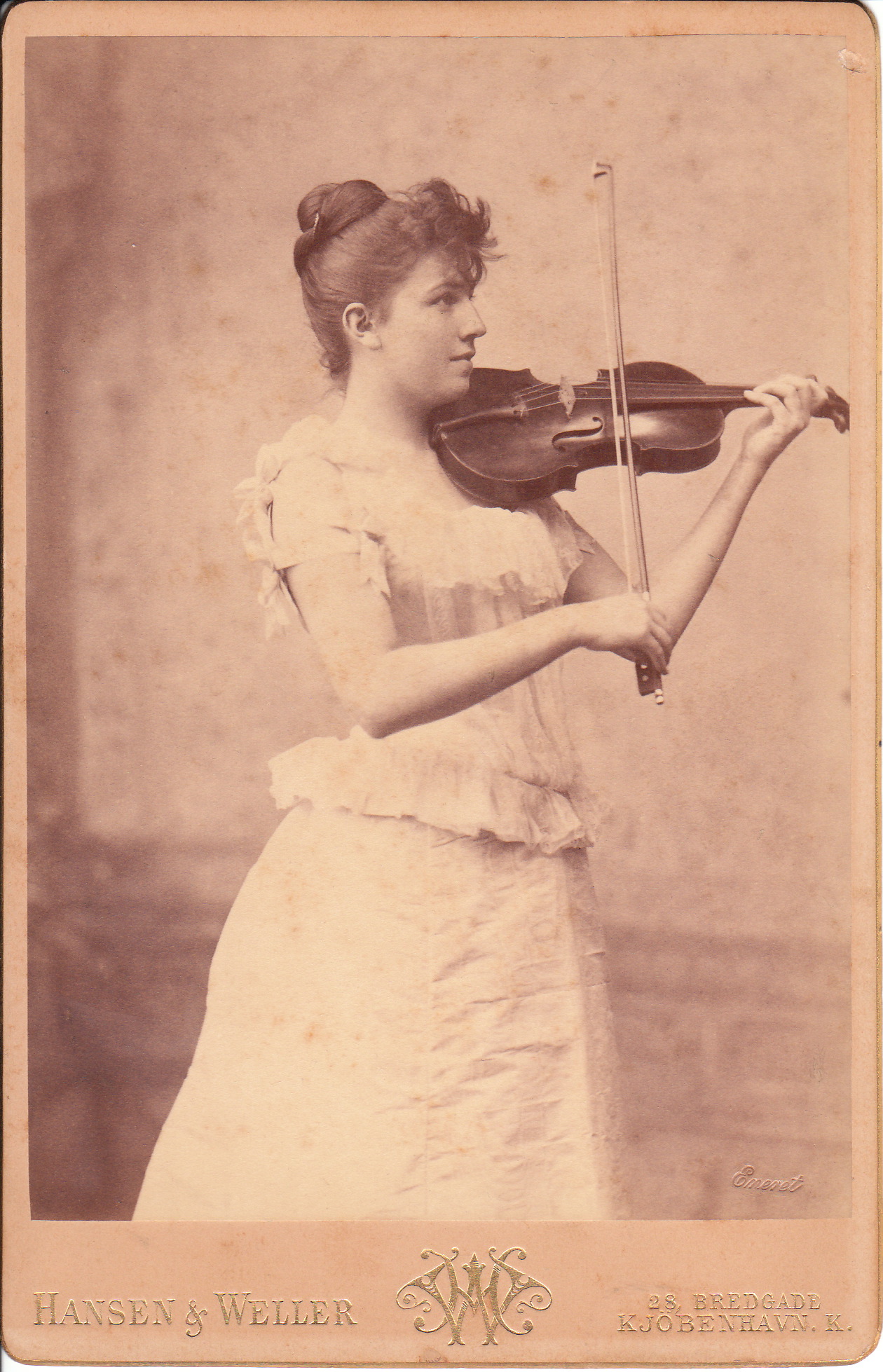
A pretty woman poses for her photograph at the studio of Hansen & Weller in Copenhagen, Denmark. The studio’s address was 28 Bredgade. The woman is playing her violin with her bow. Her hair is up and she appears to be wearing a corset , giving her a lovely figure. One of the photographers is George Emil Hansen (1833-1891). He was a pioneer Danish photographer. His father and brother were also photographers. He won photography awards in London (1862) and Berlin (1865). Hansen was the photographer of the Danish Royal Family. His photographic work spanned from 1856 through 1891. There is a gold lettered word embedded in the lower right corner of the image. The word is “emeret”; and research may illuminate the word’s meaning. “Emeret” most likely signifies that the person in the photograph had retired from a notable profession, such as acting or teaching, or was being honored post-career. It is likely a Scandinavian variant or typographical version of the Latin word “emerita” (female form of emeritus). SOLD
This cabinet card was photographed by George Rockwood (1882-1911) whose studio was located at 17 Union Square West in New York City. The reverse of the card identifies the subject of this portrait as Maud Harrison (c1856-1907). I have verified that this is indeed Maud Harrison. The corseted Miss Harrison is attractive and wearing a hat, a flower in her hair, and a cross. She is also wearing what appears to be wrist bands. The purpose of these bands beyond fashion, is unknown. Maud Harrison began her career at the Madison Square Theater. The IBDb reports that she appeared in five Broadway plays between 1877 and 1900. These productions include “Pink Dominos” (1877), “French Flats” (1880), and “Naughty Anthony” (1900).The New York Times reports Harrison’s death in 1907. She was found unconscious by a maid in her New York City hotel room. She died shortly after being discovered. Her cause of death was determined to be “Paralytic Stroke”. She had stopped acting in 1902 to care for her sick mother. She was in New York attempting to find a theatrical role to restart her career. For some reason, the Times reports that Miss Harrison was a Christian Scientist. This cabinet card’s photographer, George Rockwood was born in Troy, New York. He graduated from college with a PhD; reportedly either from the University of Chicago, or Columbia University. At 21 years of age, he was a newspaper reporter for the Troy Daily Times and at age 23, he was managing editor of the Troy Daily Post. He began working as a photographer in St. Louis and in 1857 opened a studio with his brother Elihu in New York City. He is credited for bringing CDV’s to America. His obituary in the Washington Post reports that Rockwood photographed more than 350,00 people. This cabinet card has foxing above Miss Harrison’s bust. SOLD
This cabinet card features an attractive young woman posed holding a book. The woman is nicely dressed and has a lovely figure. Her great figure is, no doubt, assisted by her tight corset. The book she is holding is entitled “Grifting“. The definition of grifting is “engaging in petty swindling”. What is a nice girl like the girl in this image doing with such a sensational book? The most likely reason she has possession of that particular title is that; it was there in the studio. The book likely belonged to the photographer. The studio that produced this photograph was the Aime Dupont gallery. Dupont (1842-1900) founded his photography business in 1886 in New York City, New York. He was formerly a sculptor and he was of Belgian origin. His American wife, Etta Greer, was also a photographer. She was well respected for he work as a portraitist of opera singers in Paris, France. She was educated in Paris and spent much of her childhood there. She also met and married Dupont in Paris. The couple was very talented and they became very popular as portrait photographers in New York. Among their society and celebrity clients were many singers who were appearing in New York. After Dupont’s death, his wife, and later his son (Albert), operated the studio. His wife kept the name of the studio the same, after the death of her husband. In 1906, the Metropolitan Opera hired its own official photographer, resulting in diminished portrait work in that sector. The studio went bankrupt in 1920. A couple of interesting questions about this photograph remain unanswered. Is the subject of this photograph someone famous in society or the performing arts? Who was the photographer, was it Aime Dupont, or his wife, Etta? SOLD
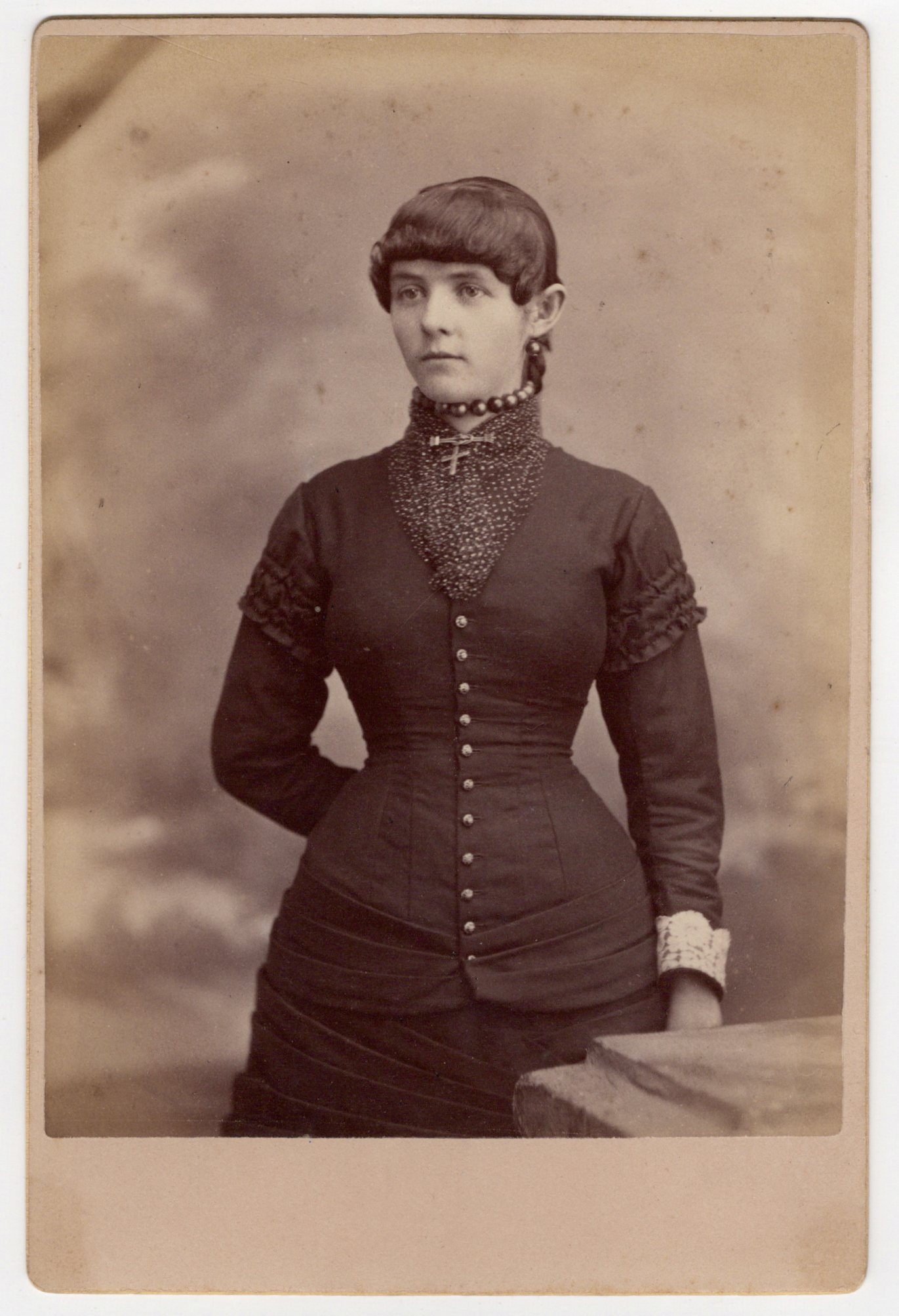
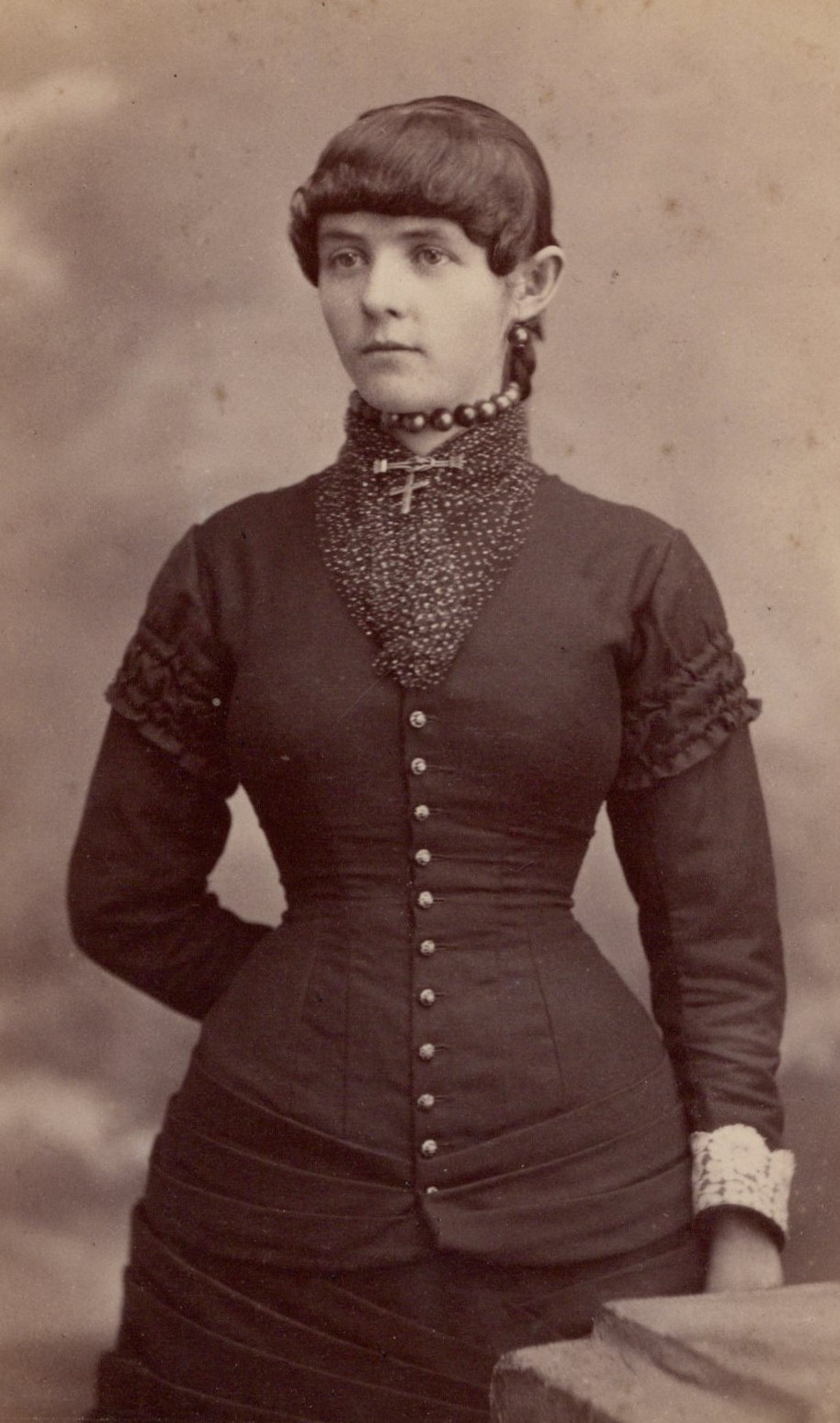
This Cabinet Card presents an attractive woman in a beautiful dress. She is wearing a “choker” necklace, a cross, and earrings. Note her somewhat unusual hairstyle and that she is wearing bangs. In addition, the woman in this portrait achieved an hour-glass type figure with an assist from a corset. A corset is a garment that was worn to mold a woman’s torso into a desired shape. Typically, corsets reduced the size of woman’s waist and exaggerated the size of their bust and hips. SOLD
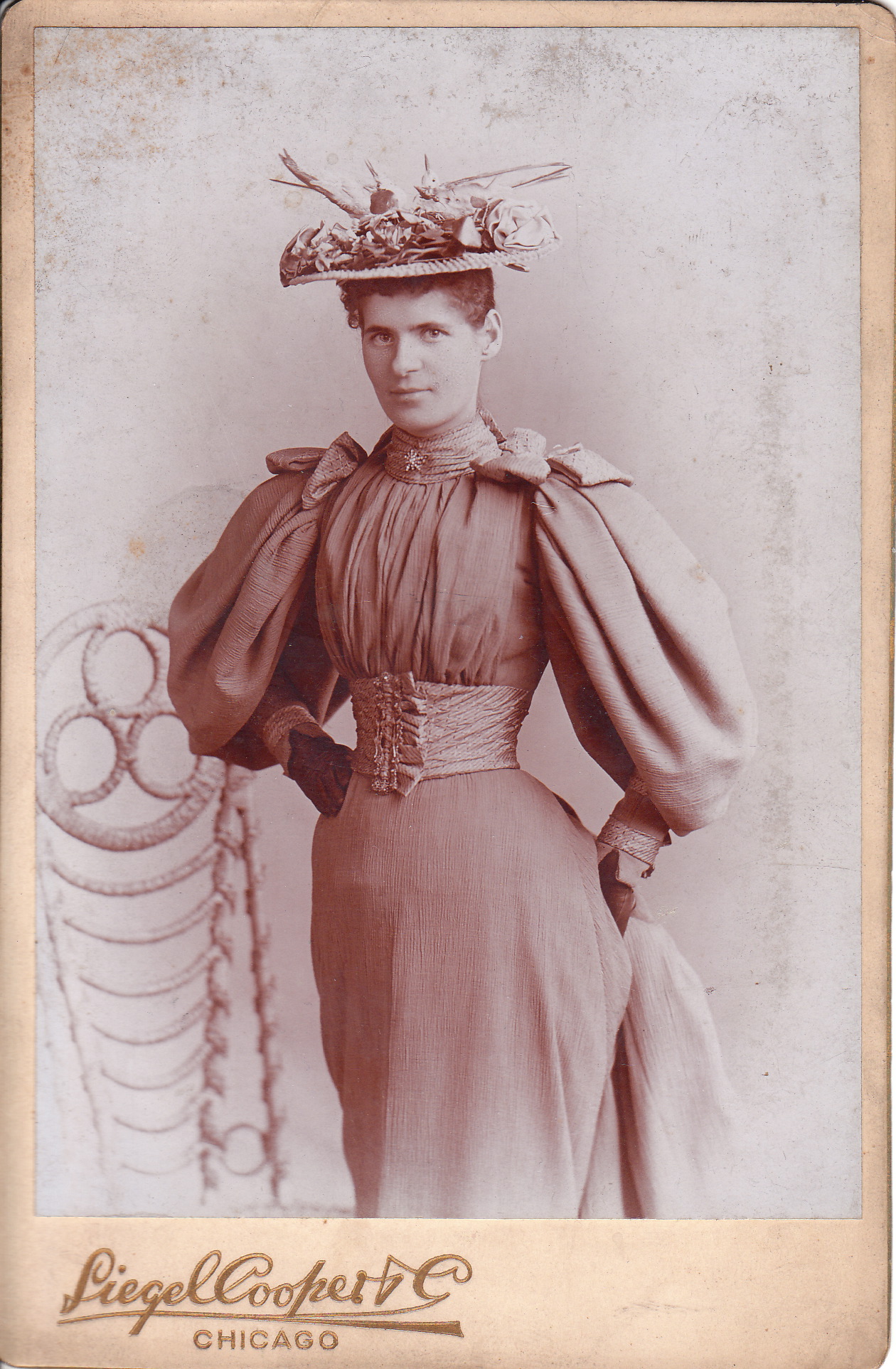
This cabinet card features a fashionable woman wearing an interesting, but not necessarily attractive hat. She is very thin waisted, thanks to a corset. The photographer is Siegel Cooper and Company of Chicago, Illinois. Siegel Cooper was a major department store in Chicago. Note the art work on the reverse of this cabinet card. Click on category “Photographer: Siegel Cooper” to see other photographs by this studio. (SOLD)
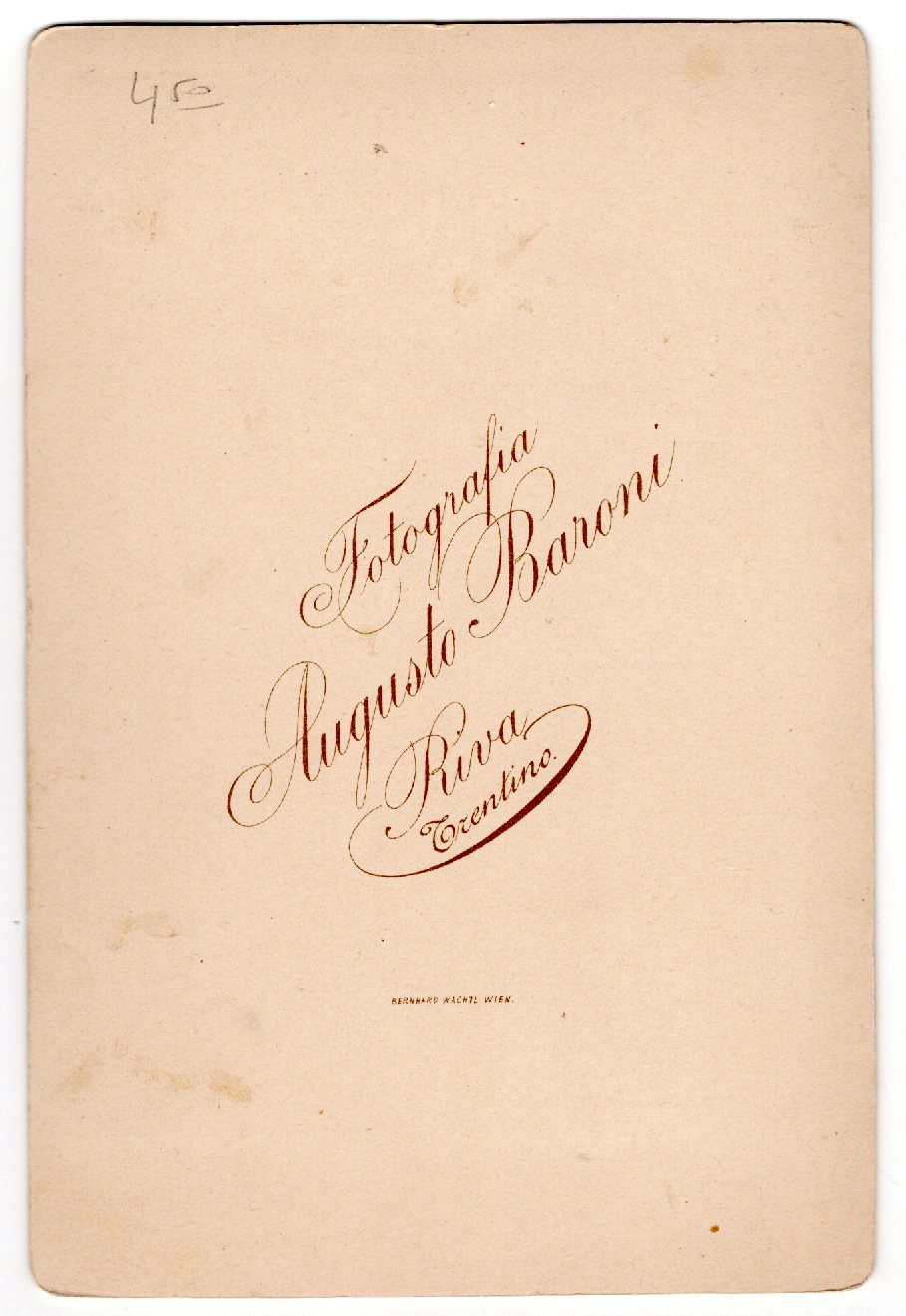
A pretty young woman poses for her cabinet card portrait at the studio of Augusto Baroni in Riva, Italy. The town of Riva is located in northern Italy in the province of Trentino. The town is formally known as Riva del Garda. The subject of this photograph is wearing a heavy chain necklace with a locket. She is wearing a beautiful dress. Her very thin waist is likely the result of a corset. This cabinet card photograph is in very good condition (see scans).
Buy this Vintage Original Cabinet Card (includes shipping within the US) #6174
To purchase this item, click on the Pay with PayPal button below
$58.00
Buy this Vintage Original Cabinet Card (includes International shipping outside the US) #6174
To purchase this item, click on the Pay with PayPal button below
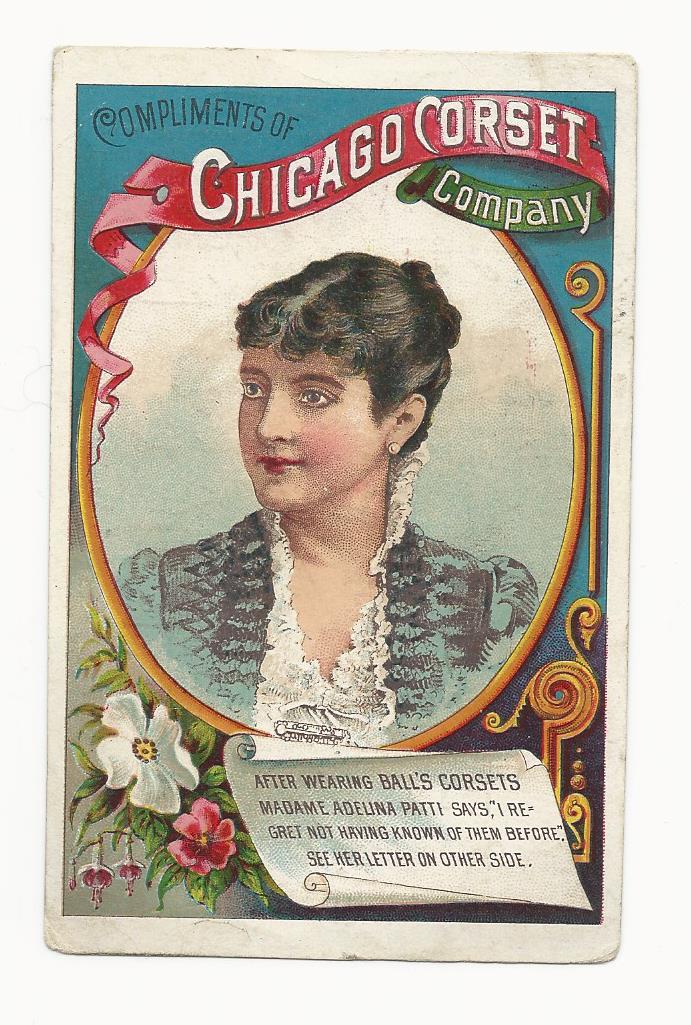
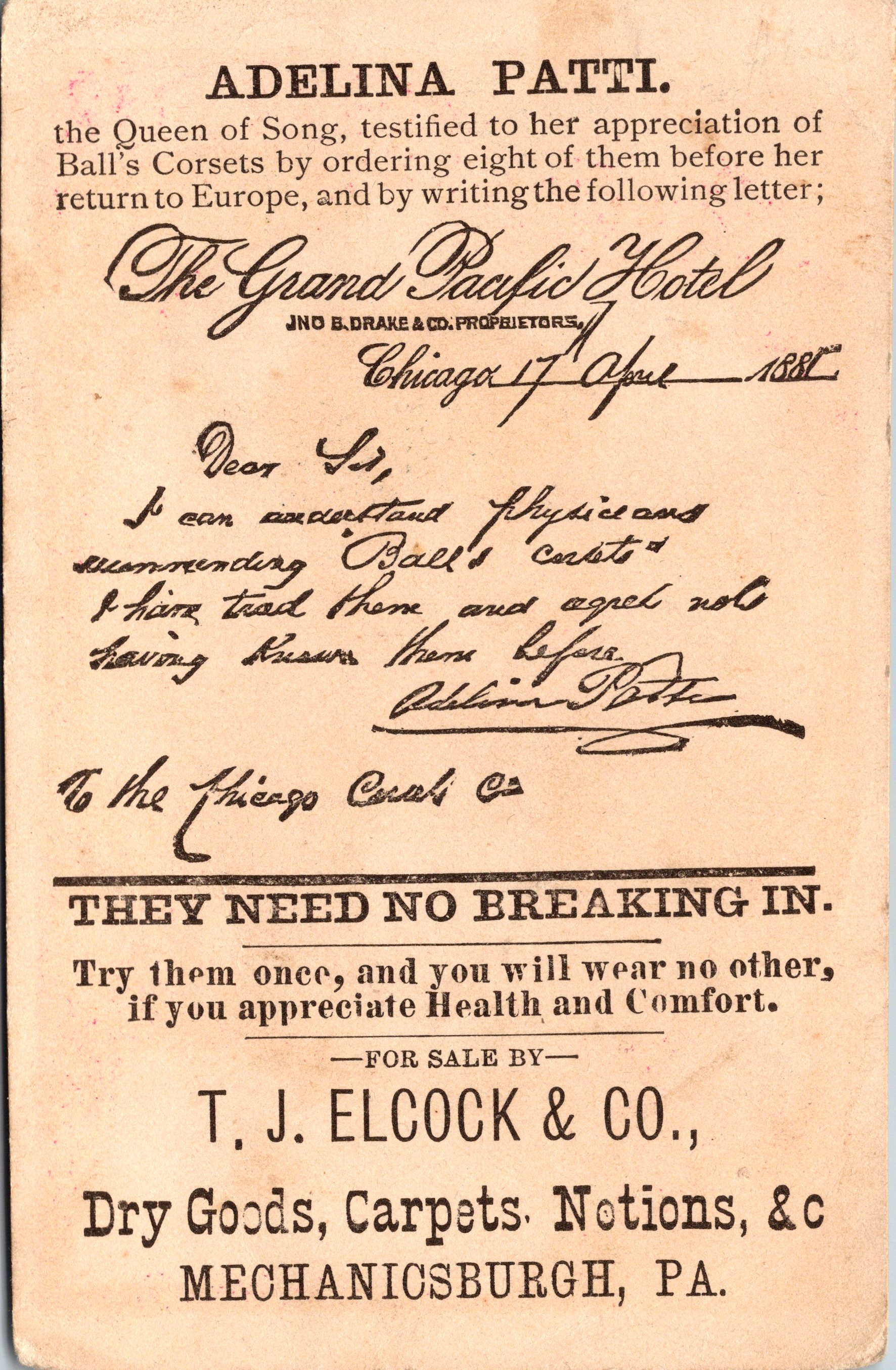
This item is a vintage trade card advertising corsets for the Chicago Corset Company. The card dates back to the 1880’s. The wasp waisted women seen in a number of the photographs of the cabinet card era, didn’t get that way from going to Jenny Craig and the gym. Their secret weapon was wearing a corset. This trade card utilizes a “celebrity spokesperson”. Adelina Patti, a famous opera singer, sings the praise of Ball’s Corsets which were manufactured by the Chicago Corset Company of Aurora, Illinois. She ordered eight corsets and testified that she wished that she had known about them sooner. The company advertising on the card brags that “they need no breaking in” and that they provide “health and comfort”. This particular trade card is also advertising the T. J. Elcock & Company which was a Dry Goods, Carpet, and Notions store in Mechanicsburgh, Pennsylvania. Here is a little information about the Chicago Corset Company, The business is cited in Robin Shepard’s “The Best Breweries and Brewpubs of Illinois (2003). The author writes that in the late 1800’s and early 1900’s Aurora was considered the corset capitol of the world. There were at least three corset companies operating their factories there and one of the largest was the Chicago Corset Company. In fact, I read elsewhere, that the company was the second largest corset company in the world. At one point, the business employed 600 people and produced 2 million corsets a year. The word “corset” began to be used in the English language in about 1828. “The Ladies Magazine” described it as a “quilted waistcoat”. The primary reason for using corsets was to slim the body and help it conform to a fashionable silhouette. Generally speaking, the corset reduces the waist and exaggerates the bust and hips. Apparently there were “overbust corsets” and “underbust corsets”. Sometimes, corsets were used for medical or for fetish purposes. I’ll refrain from elaborating about the medical and fetish purposes and leave detailed explanation to your imagination. The corset company’s spokesperson on this trade card is Adelina Patti (1843-1919). She was a celebrated 19th century opera singer who earned a great deal of money for her performances at the height of her career. She sang in both Europe and America and is probably one of the most famous sopranos in history. She was born in Madrid. Her father was tenor Salvatore Pattie and her mother was soprano Caterina Barilli. Her parents were Italian and she grew up in the Bronx, New York. She sang professionally from childhood. At sixteen years of age, she made her operatic debut at the Academy of Music in New York City. At age eighteen she began performing in Europe. She later performed “Home Sweet Home” for President Lincoln and his wife shortly after the death of their son, Willie. The bereaved parents requested an encore. She was associated with the song for her entire career. In her prime, Adelina Patti demanded to be paid five thousand dollars a night. She asked to be paid in gold, prior to each performance. She demanded top billing and that her name be in bigger font than others in the company. She also demanded that she not be obligated to attend rehearsals. Did someone say, DIVA? It was reported that she trained her parrot to say “Cash, Cash”. Be sure to look below to see some interesting images pertaining to corsets as well as an image of Miss Patti. (SOLD)
Adelina Patti
Corset Shop Window
Polaire was famous for her tiny, corseted waist, which was sometimes reported to have a circumference no greater than 16 inches (41 cm)
A woman models a corset in this 1898 photograph.
Brooklyn Museum Costume Collection at The Metropolitan Museum of Art
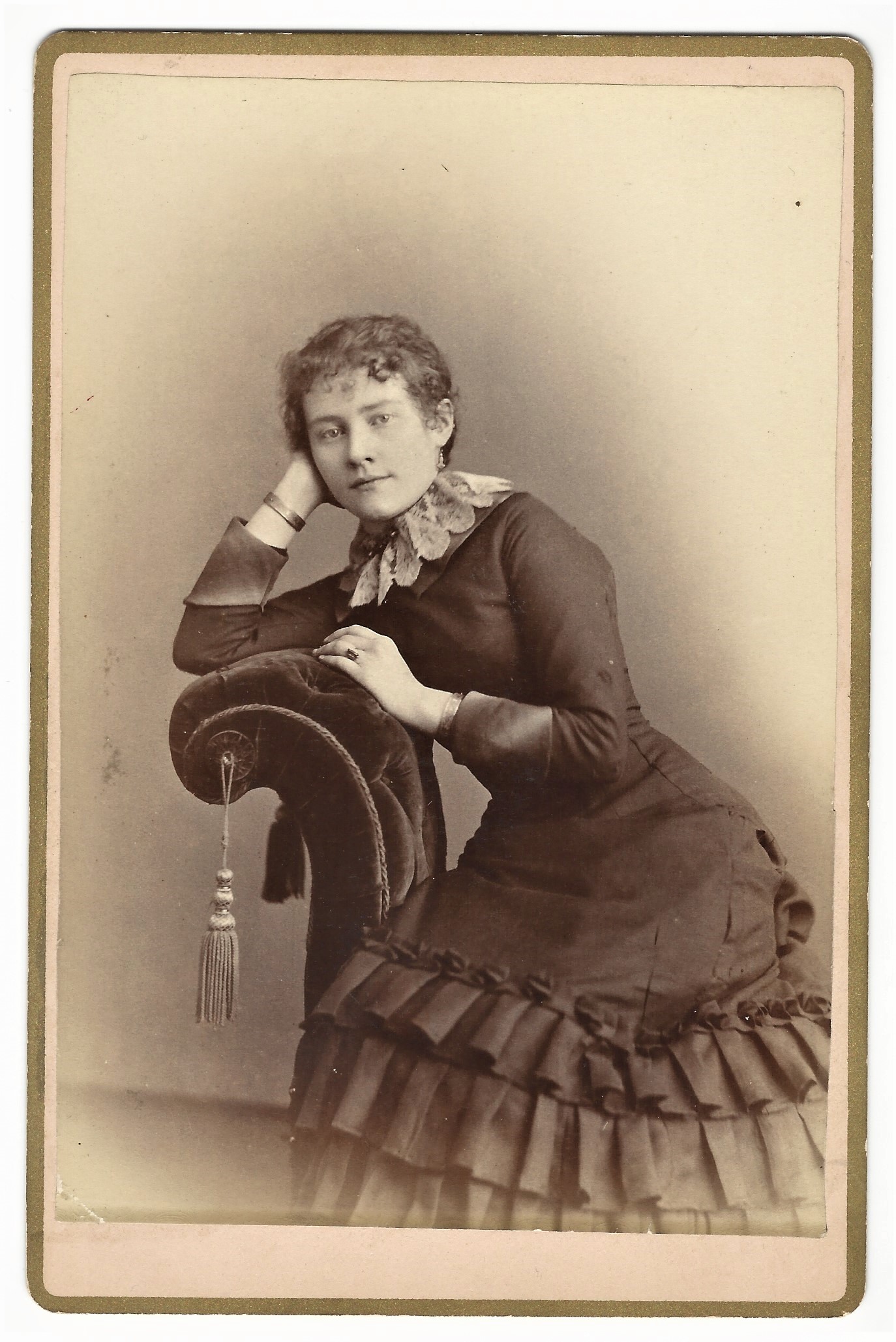
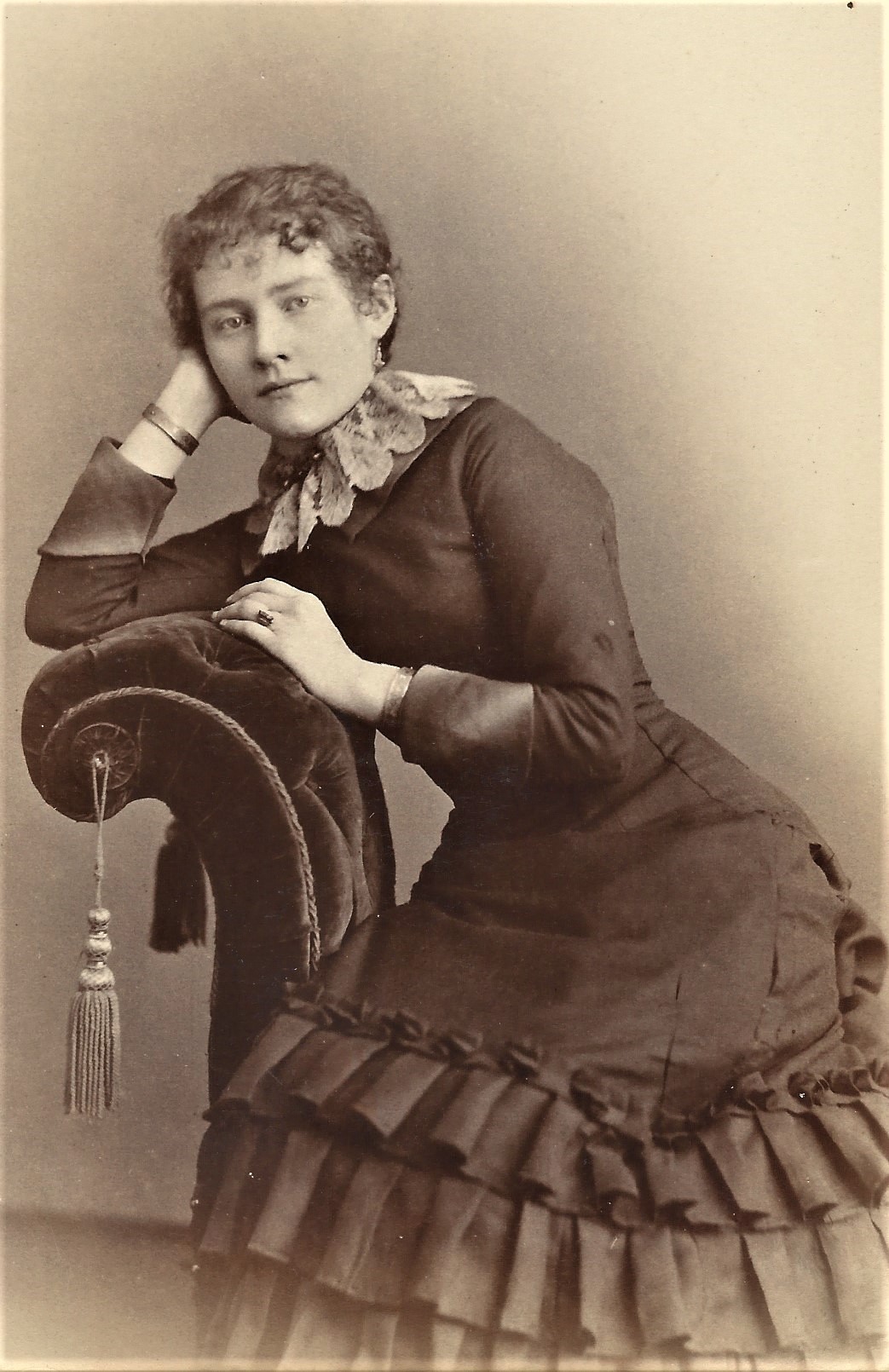
The photographer of this cabinet card is A. L. Lehnkering located at 87 East Main Street in Rochester, New York. She is wearing a gorgeous dress with rows of ruffles at the bottom. Note her tiny waist, likely courtesy of a corset. She is also wearing jewelry including a band around her wrist and a ring. She looks pensive. She is leaning on a chair with tassels. August L. Lehnkering seems to have occupied a few different addresses on East Main Street. In addition to number 87 (listed on the reverse of this image). he also operated out of 87 and 89 East Main Street, as well as 208 East Main Street. He was working out of 87 East Main in 1879, according to the Rochester Business Directory. He is mentioned in the American Journal of Photography (1891) for being awarded a photographic patent, and also in two photography journals published in 1906 for contributing to a charitable fund. This cabinet card portrait has a gold border. (SOLD)
The young woman in this cabinet card portrait is tall, thin, and wearing a dark dress. She is very well dressed. The woman is tightly corseted, which is typical for the era of this photograph. She is holding a folded fan. This photograph was taken in Florence, Massachusetts at a gallery operated by Ferdinand William Schadee (1840-1901). Schadee was born in Bavaria, Germany. I found no record of when he arrived in the United States. In 1869, he married Eliza A Schadee and the couple eventually had at least three children. Schadee was a Mason. A publication entitled “The History of Florence, Mass.” (1895) reveals that Schadee established his gallery there in 1885. Prior to that time, he ran a studio in Northampton, Mass. That studio was operated under the name of “Hardie & Schadee”. The 1880 US Census lists Schadee as a photographer as does a number of editions of the Northampton and Easthampton directory. He was listed in the directory up to 1901, indicating that he was working as a photographer until his passing. (SOLD)









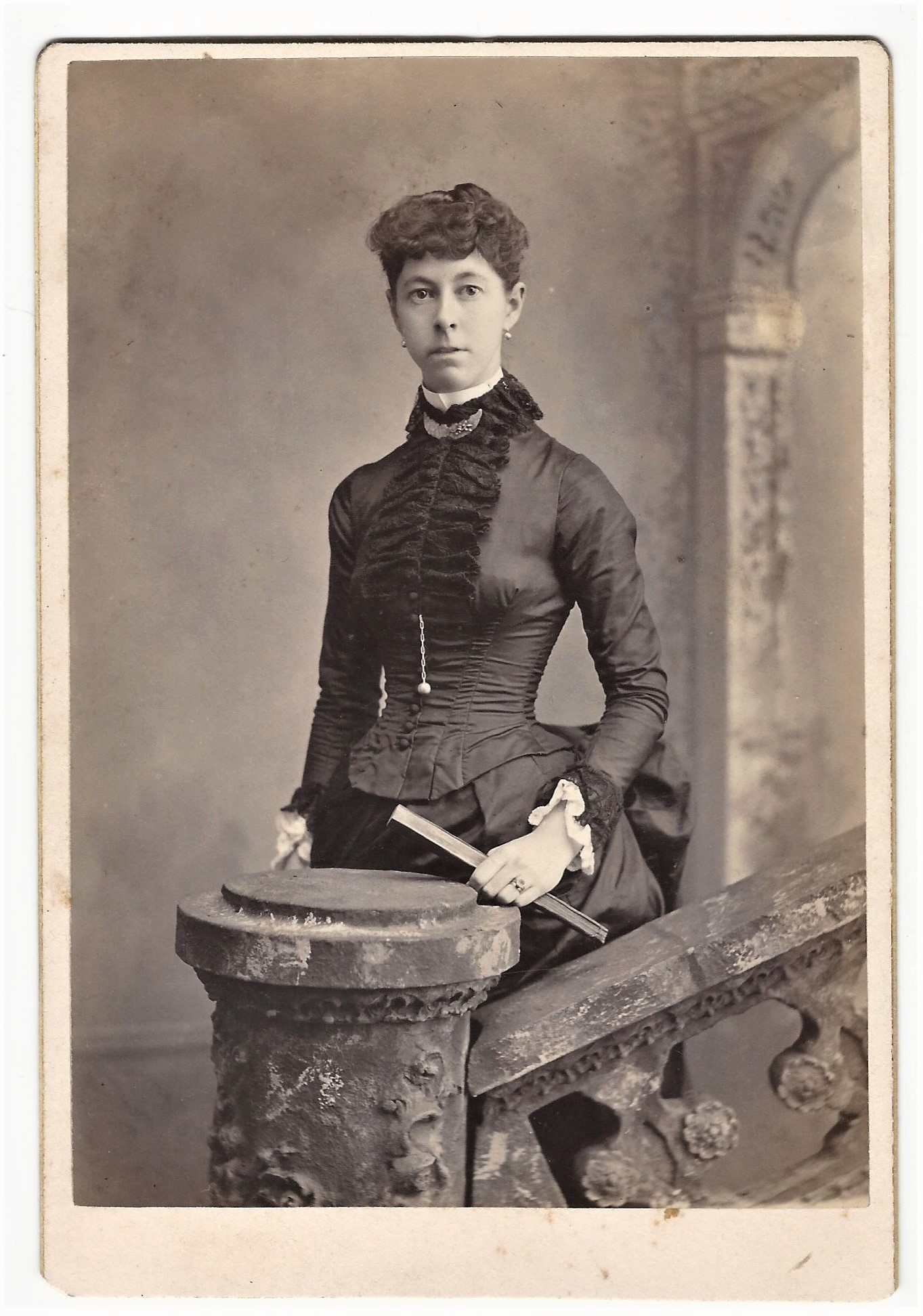
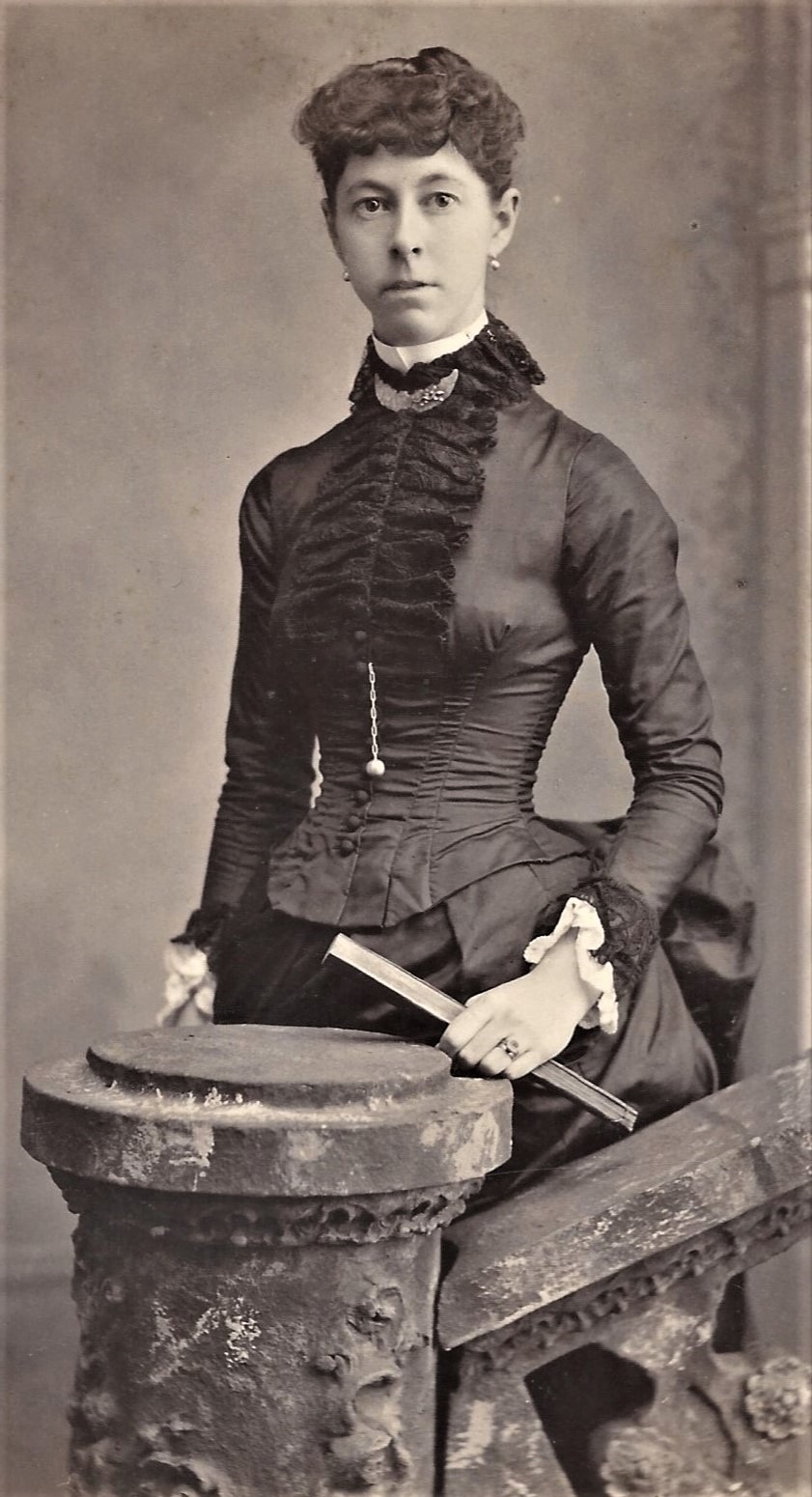 The young woman in this cabinet card portrait is tall, thin, and wearing a dark dress. She is very well dressed. The woman is tightly corseted, which is typical for the era of this photograph. She is holding a folded fan. This photograph was taken in Florence, Massachusetts at a gallery operated by Ferdinand William Schadee (1840-1901). Schadee was born in Bavaria, Germany. I found no record of when he arrived in the United States. In 1869, he married Eliza A Schadee and the couple eventually had at least three children. Schadee was a Mason. A publication entitled “The History of Florence, Mass.” (1895) reveals that Schadee established his gallery there in 1885. Prior to that time, he ran a studio in Northampton, Mass. That studio was operated under the name of “Hardie & Schadee”. The 1880 US Census lists Schadee as a photographer as does a number of editions of the Northampton and Easthampton directory. He was listed in the directory up to 1901, indicating that he was working as a photographer until his passing. (SOLD)


 THE CABINET CARD GALLERY