
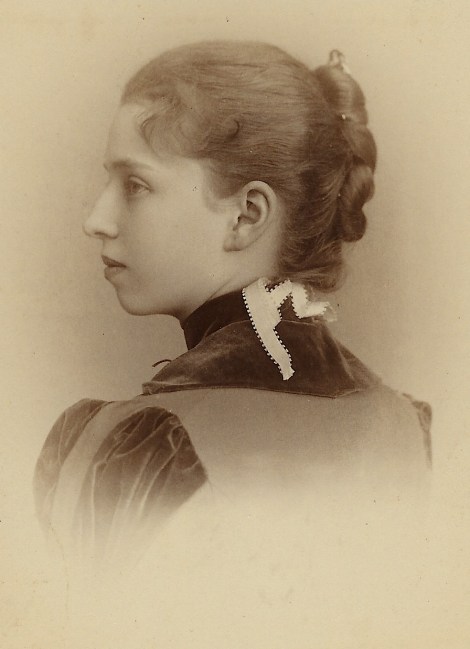
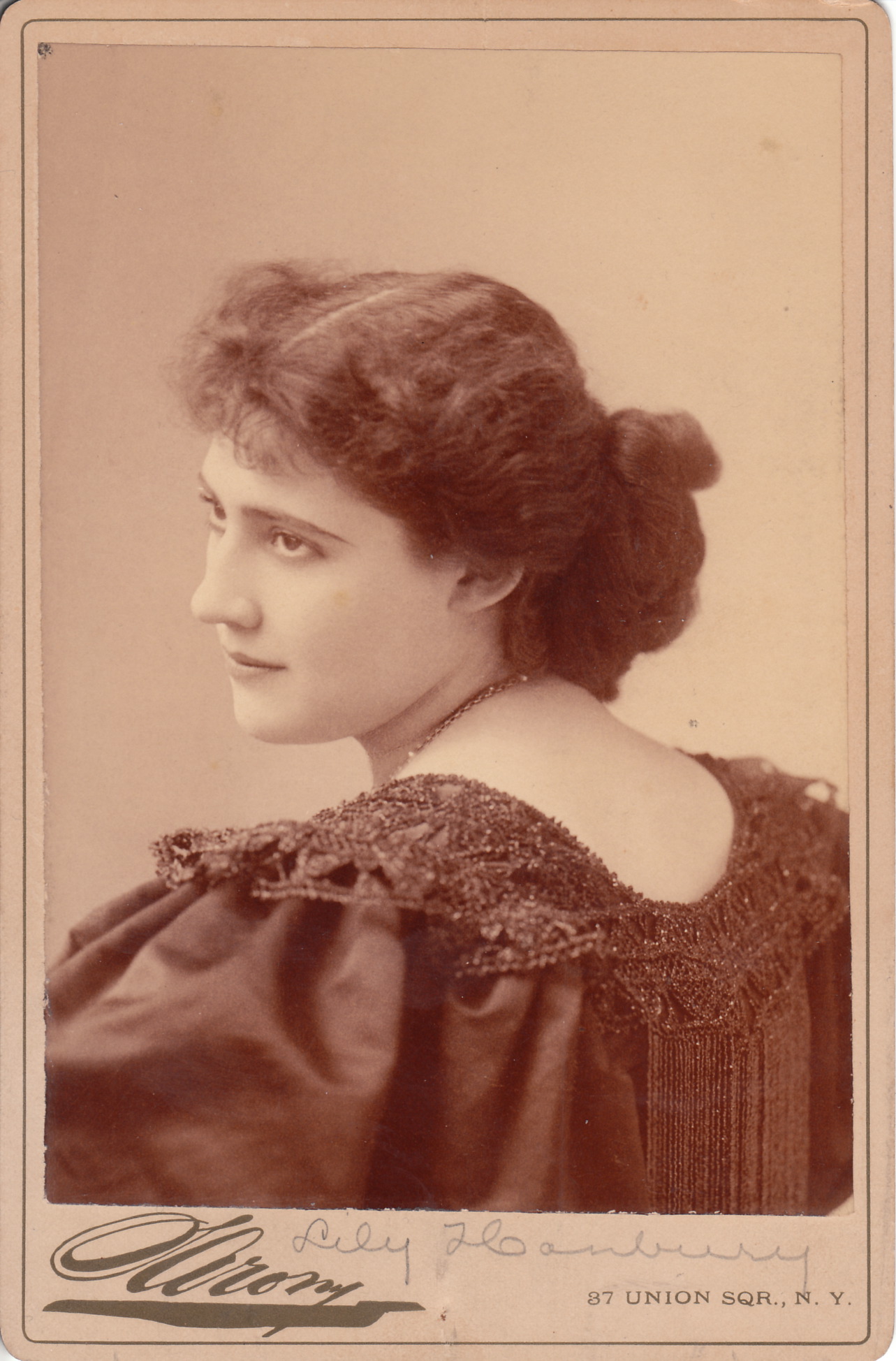
 This cabinet card features a portrait of an attractive young lady. She is posed with her back toward the camera, a pose which offers a profile view. The photographer of this image is Samuel Sharpsteen of Grand Rapids, Michigan and the photograph was taken in 1890. The previous owner of this cabinet card stated that Sharpsteen was of the Jewish faith, but that is not factually correct. There is a tendency for owners of cabinet cards to see a name that “sounds Jewish” and assume that the bearer of that name, must be Jewish. This kind of logic results in many incorrect identifications of Jewish photographers. It so happens, that Mr. Sharpsteen was of the Methodist faith. Samuel Sharpsteen was born in 1850 near Battle Creek, Michigan. His parents were native New Yorkers who were among the early settlers of Michigan. He was educated in Battle Creek’s public schools and at age 20 left home to apprentice in photography. He then went of Owosso, Michigan, where he and his older brother opened a gallery. After six months, his brother left the partnership; and Sharpsteen stayed in Owosso until 1882. He also married his wife there. His wife’s name was Nattie Tuttle, and she was from Cleveland, Ohio. His next location was Ionia, Michigan, where he stayed 8 years. An 18 month stint in Detroit was followed by his move to Grand Rapids. His gallery was in Grand Rapids from 1888 until , at least, 1903. His studio moved around a lot. Research located nine different Grand Rapids locations over the years that he was there. In addition, he had a partner in 1890 and their studio was known as Sharpsteen & Andrews. The Bulletin of Photography (1916) announced Sharpsteen’s death. He died in Grand Rapids at age 71. This cabinet card photograph is in very good condition (see scans).

Buy this original Cabinet Card Photograph (includes shipping within the US) 2802
To purchase this item, click on the Pay with PayPal button below
$51.50
Buy this original Cabinet Card Photograph (includes International shipping outside the US) 2802
To purchase this item, click on the Pay with PayPal button below
$60.00


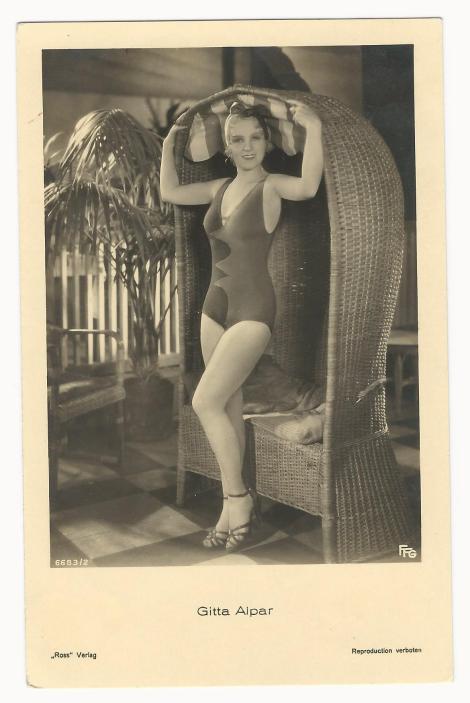
 This vintage real photo postcard features Hungarian actress Gitta Alpar (1903-1991). She starred in operas and operettas. This photograph is risque relative to the time it was taken. Miss Alpar is wearing a tight bathing suit. Note that the swim suit has a nice design on it’s front. She is posing in front of a large rattan chair. Gitta was born in Budapest, Hungary. She was the daughter of a Jewish cantor. From an early age, she studied singing and piano at the Academy of Music. In 1923, she made her debut at the Budapest State Opera House. She had a long career and she performed at the great opera houses of Vienna, Berlin, an many other international venues. Alpar’s first films were made in Germany. In 1931 she married an actor, Gustav Frohlich. Their marriage ended in 1935 because Alpar was Jewish and the marriage was against the law in Nazi Germany. A related fact is that both of her brothers, a pianist, and a violinist, were concentration camp survivors. Alpar appeared on Hitler’s anti semitic “hit list”. She left Germany in 1933, and then did some globe hopping. She first went to Austria, followed by Hungry, England, and the United States. She continued her singing and film career in the US. The IMDb credits Alpar with nine acting credits from 1932 through 1941. Alpar’s accent ruined her chance to be a successful Hollywood actress. After the war, she primarily worked as a singing teacher. For a sample of Miss Alpar’s singing voice and acting, click on the YouTube segment below. This postcard was published by Ross Verlag and is part of a series (no.6683/2). Alpar’s photo was taken by FFG (Froehlich-Flm GmbH). (SOLD)



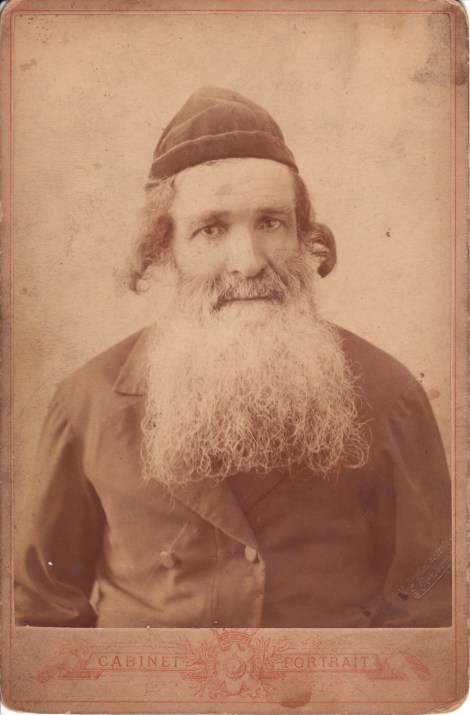 This Cabinet card is an image of a Hasidic Jewish Man. The photograph was taken by M Puhaczevski in Ponevezh, Lithuania. Note the gentleman’s skull cap and his payot (sideburns).
 This Cabinet card comes from the estate of a Jewish family. The photograph is an image of a Jewish family in Minsk, Russia. The parents and children are dressed up nicely for their visit to the photographers studio. Note the footwear and the young boy’s hat.


 THE CABINET CARD GALLERY