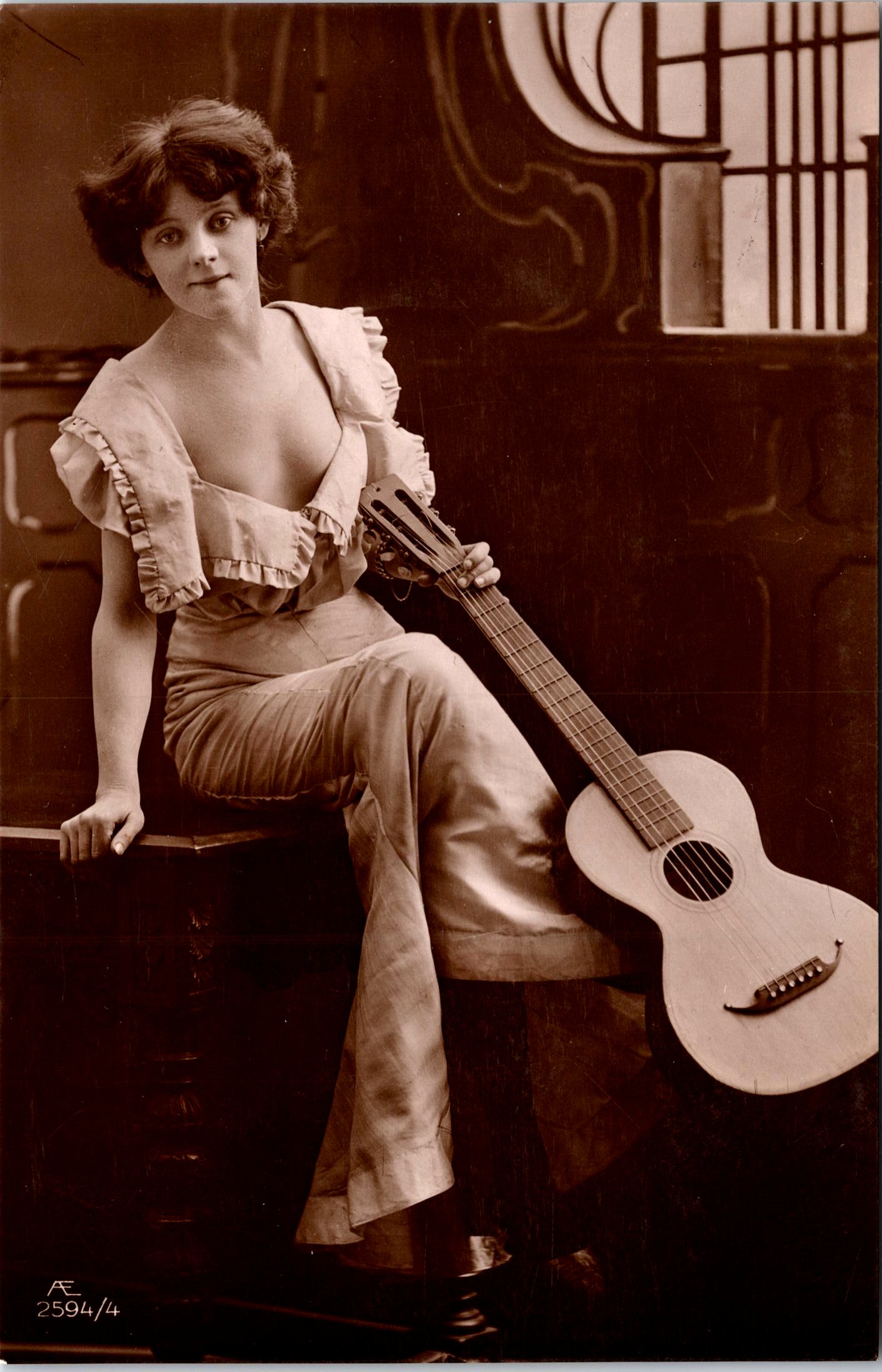
This vintage real photo postcard features a pretty young woman posing with her guitar. Her plunging neckline makes this a risque postcard. The card was published by Adolph Engel (Berlin, Germany) and is part of a series (No.2504/4). SOLD
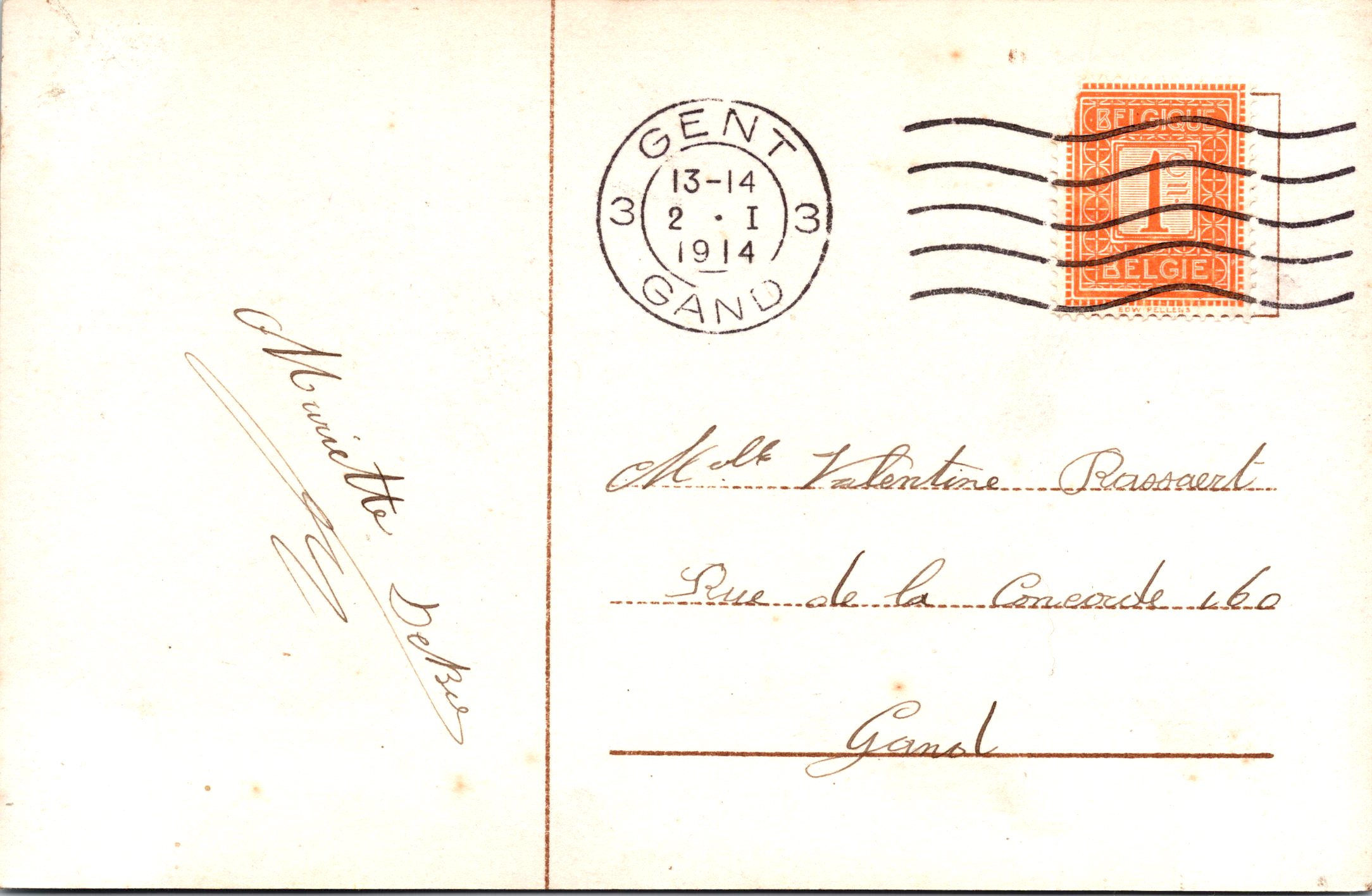
This vintage real photo postcard features a pretty young woman posing with her guitar. Her plunging neckline makes this a risque postcard. The card was published by Adolph Engel (Berlin, Germany) and is part of a series (No.2504/4). SOLD

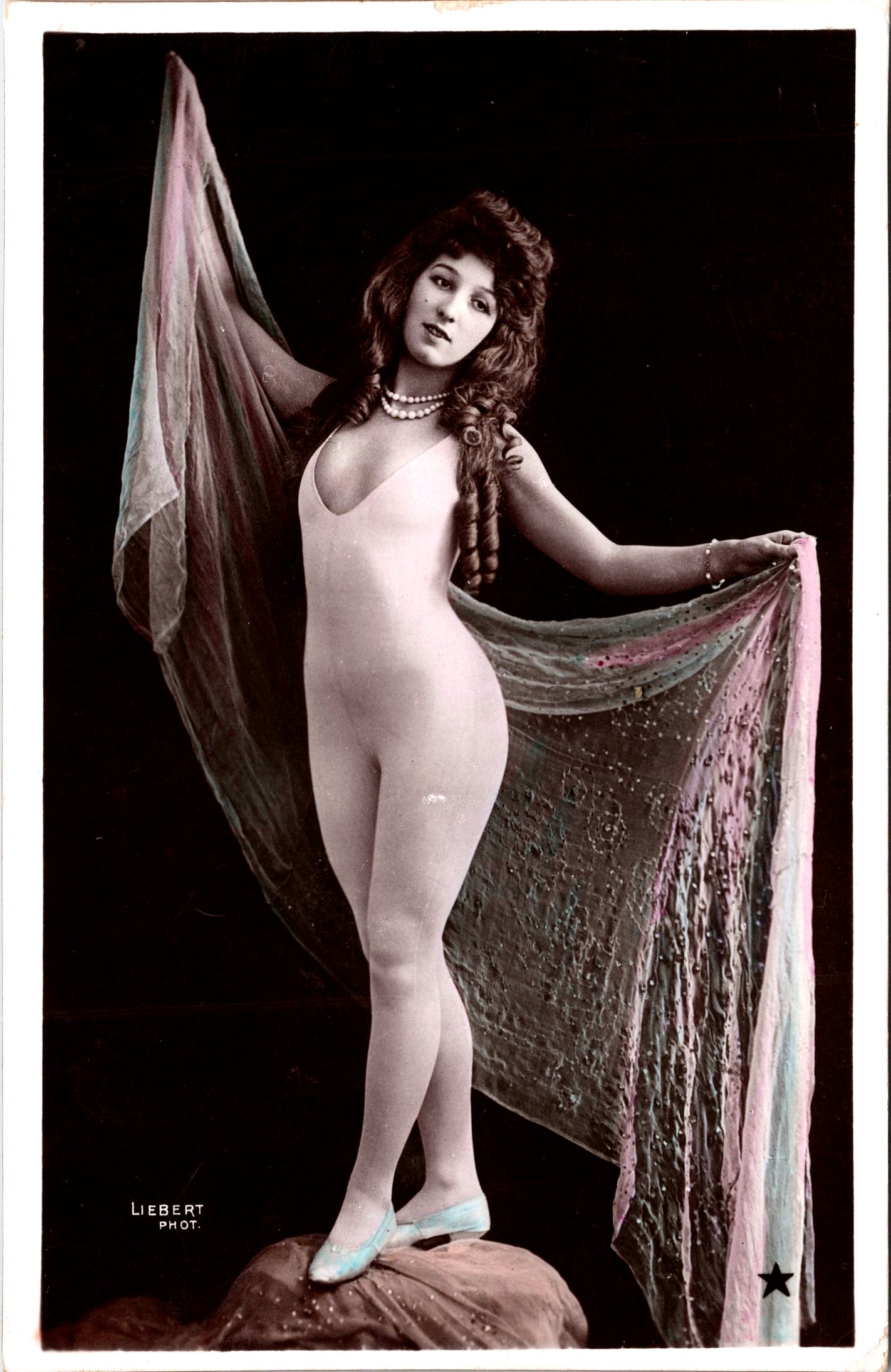
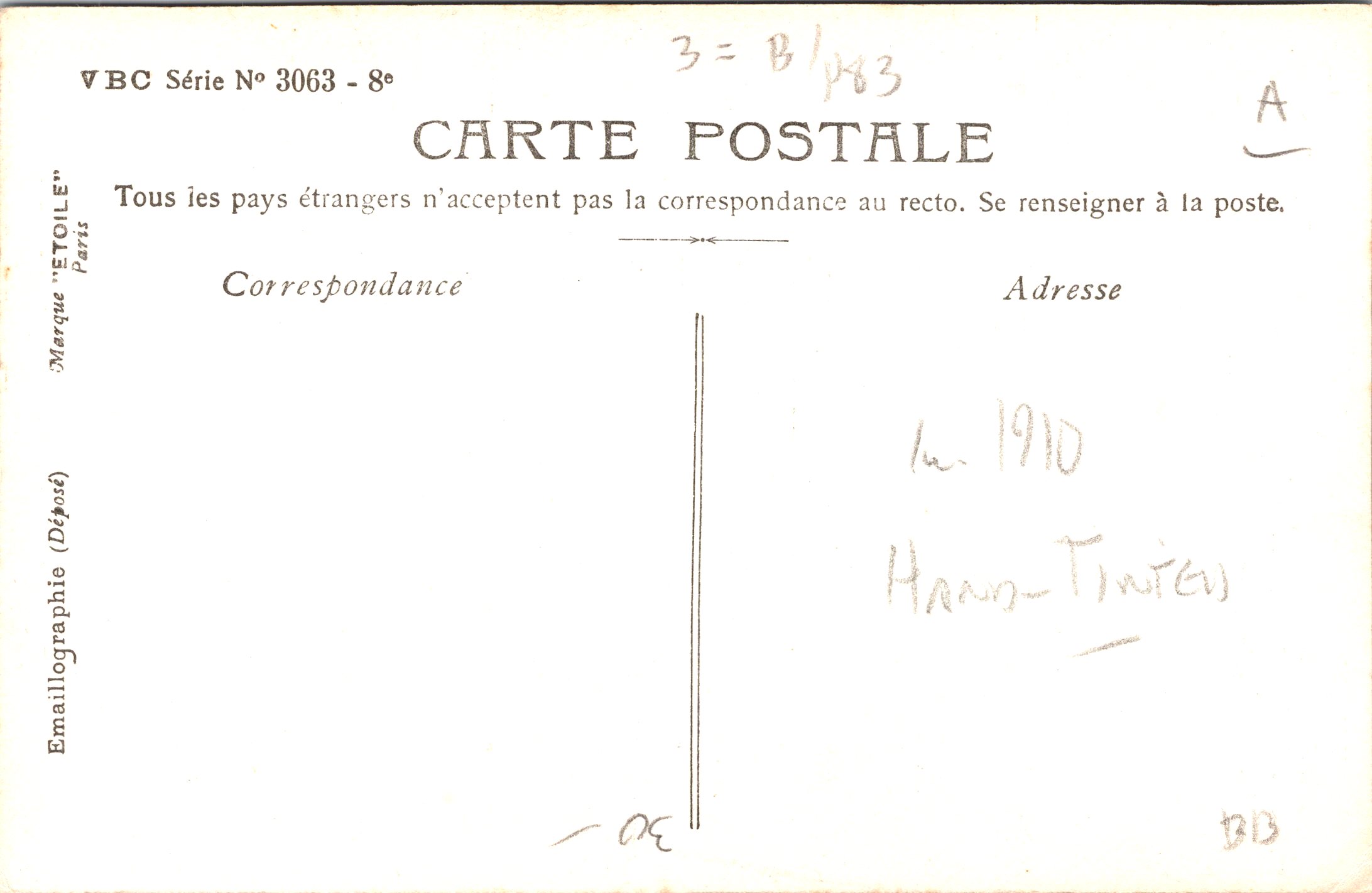
This vintage real photo postcard features an unidentified pretty performer. She is posed like a dancer. This is a risque postcard. She is wearing a flesh colored body suit and is posed in a provocative manner. The model on this card was likely a minor player based on the fact that she is not named on the postcard. This photo was taken at the studio of A. Liebert, in Paris, France. The Getty Museum, located in Los Angeles, California, as well as other fine museums, have photographs in their collections by Paris photographer, Alphonse J. Liebert (1827-1913). Many of his Parisian subjects were actresses. Perhaps Miss Lesian is one of those actresses. Mr. Liebert has an interesting story. He was a photographer in Nevada City, California (1857-1862), and later, operated in Paris (1863-1890’s). He was born in France. He became an officer in the French Navy. He left the navy in 1848 to study daguerreotypy. He must have reenlisted in the navy because In 1851, he arrived in San Francisco, as a Lieutenant on a French ship. This was a time when there was much excitement about Gold mining. As a result, there was a mass desertion of the ship’s crew. The sailors joined the rush for gold. Liebert had in mind, his own venture. He and two partners decided to take on the project of refurbishing a steamship. They sought investors and hired workers to transform the ship. However, due to the partners inexperience, the venture failed. Liebert than tried gold mining but met little success. In 1857 he opened a photo gallery in Nevada City. He lost thousands of dollars after a fire in 1858. In 1859 Liebert ridiculed a former photography pupil of his, named Louis Celarie, in the press. This started a bitter professional feud. Soon after, Liebert announced that he had won a medal at the state fair. Unfortunately, there was no evidence to confirm this claim. The competition between Liebert and Celarie was fierce. Each offered special promotions to best the other. By 1861, Liebert triumphed, evidenced by the sale of Celarie’s studio. About a year later, Liebert sold his photo gallery. By 1863, he had returned to France and opened a gallery specializing in tintypes. Liebert closely identified with his photography experience in America, and as a result, he named his Paris gallery “Photographie Americaine”. Liebert began to write photography articles and books, and ultimately, invented a prototype solar camera. In 1867, Liebert had a problem with the law. He was sentenced to two months in prison and levied a fine of 200 francs. He was charged for the intent to distribute banned post mortem photographs. These were not photos of some random person. Instead, they were images of Emperor Maximillian, who had been executed in Mexico. Liebert ultimately did exhibit these photos. Liebert was becoming more and more successful. His photo gallery was so lavish that a reviewer for the British Journal of Photography wrote that it was “worthy of the smiles of the ‘God of Light’, and a repository for some of the best productions of the photographic art”. In 1879, Liebert’s gallery was the first studio to utilize electric light. By 1880, he was considered to have the most impressive photo studio in Paris. . The card was published by Star or Etoille Publishing (Paris). This postcard image was created by a process called “emaillographie”. It is interesting to note that the first five letter of the process are “email”. This postcard was part of the V B C series (No.3063). SOLD
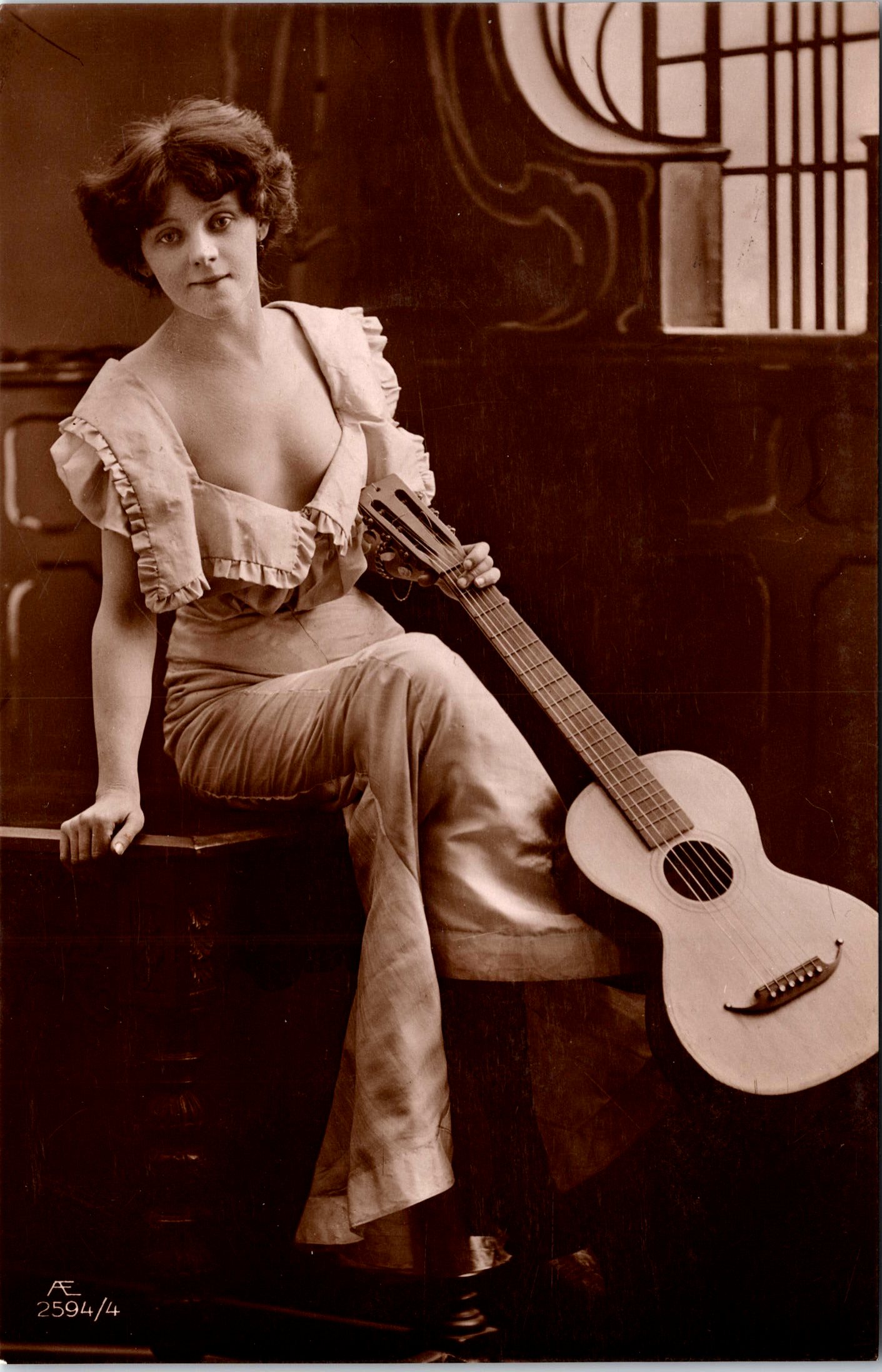
This vintage real photo postcard features a pretty young woman posing with her guitar. Her plunging neckline makes this a risque postcard. The card was published by Adolph Engel (Berlin, Germany) and is part of a series (No.2504/4). SOLD
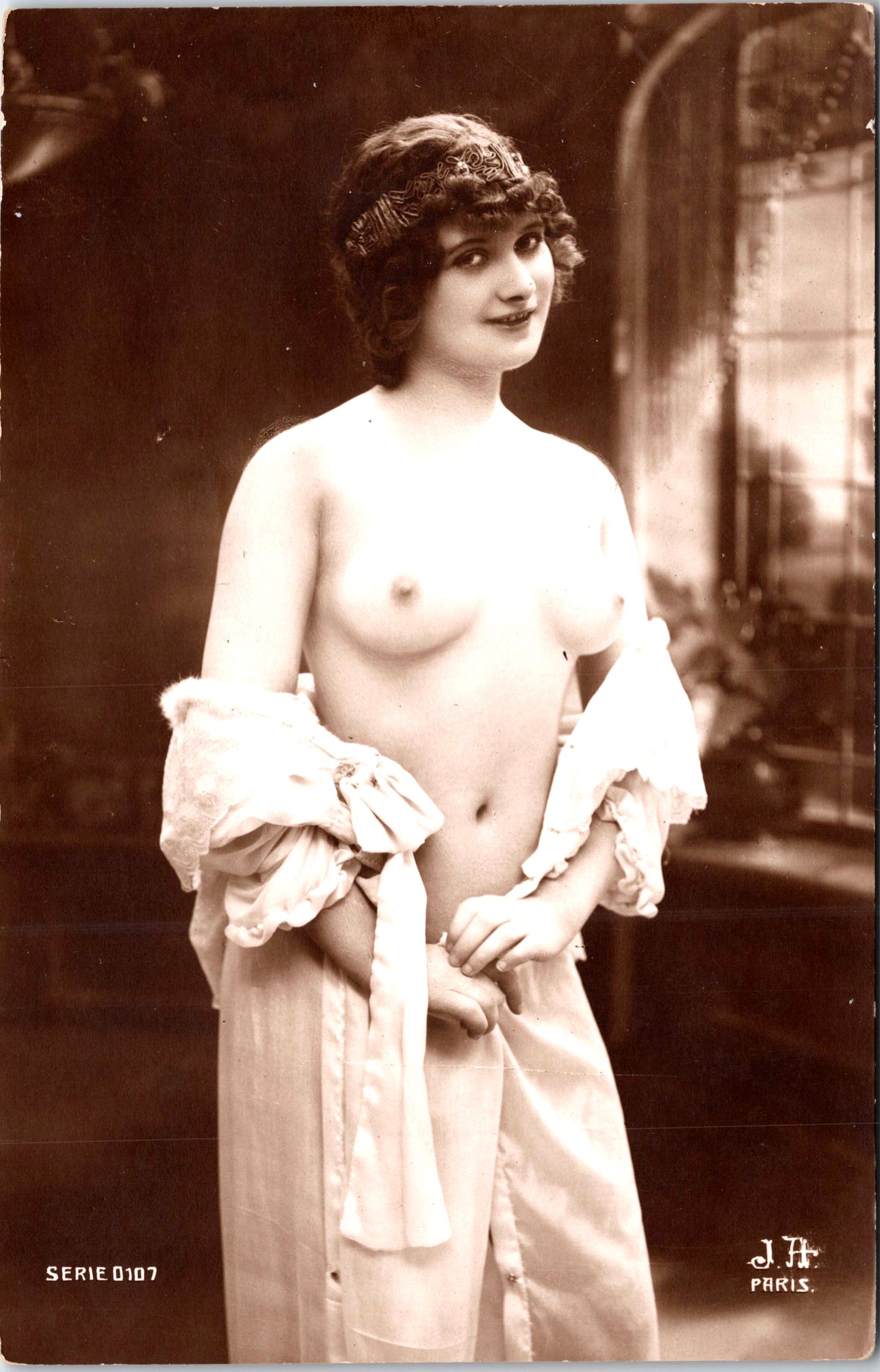
This French vintage nude real photo postcard features a pretty young woman model Her facial expression can be described as alluring. This photograph is meant to titillate. The young woman is scantily dressed. More of her body is exposed than covered. She is wearing bed clothes, a negligee to be exact. This risque photographic portrait was published by celebrated photographer, Jean Agelou (1878-1921), as part of a series (No.D107). Agelou was a French photographer of the 1910’s and 1920’s who is best known for his erotic and nude photographs. He was born in Egypt and not much is known about his private life. Agelou generally used models between the age of 20 and 24 years-old. Although the 1900’s was the “golden age” of erotic photograph, photographers who took such risque photos had to use discretion. As a result, Agelou signed his work “JA”. In 1908, nudity in photographs was banned in France and photographers had to cover nude women images with strategically placed undergarments or other materials. Nude images had to circulate on the down low. They were sent in the mail inside of envelopes. Jean Agelou died in 1921; the result of a car accident. His brother George, who managed Jean’s business, also was killed in the crash. SOLD

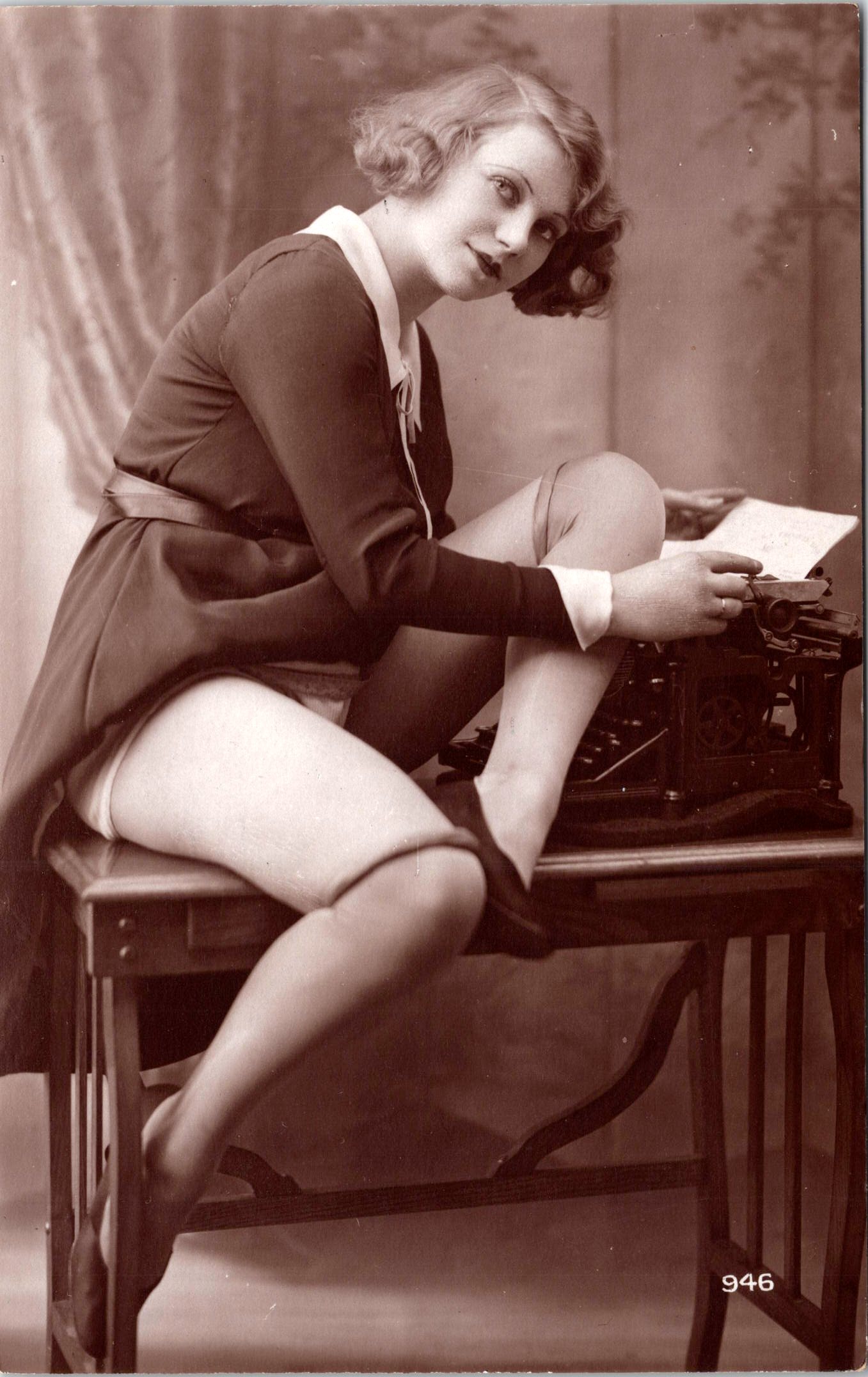
This original real photo postcard (RPPC) features a risqué French flapper secretary in a provocative pose atop her wooden desk, an old-fashioned typewriter at her fingertips. Dressed in a short, dark dress with a white collar and cuffs, her outfit flutters open to reveal her stockings, garter, and lacy undergarments, making this a bold, flirtatious workplace fantasy from the 1920s or early 1930s. Her wavy bobbed hair, softly curled, frames her face, giving her that quintessential Roaring Twenties allure. Her sultry gaze and playful smirk suggest she’s in on the joke, making eye contact as she teasingly holds a piece of paper while perched suggestively on the desk. A product of its time, this image glorifies the “sexy secretary” trope, something that today would be seen as wildly inappropriate in the #MeToo era. Back then, however, this pin-up style was considered both cheeky and glamorous. (SOLD)
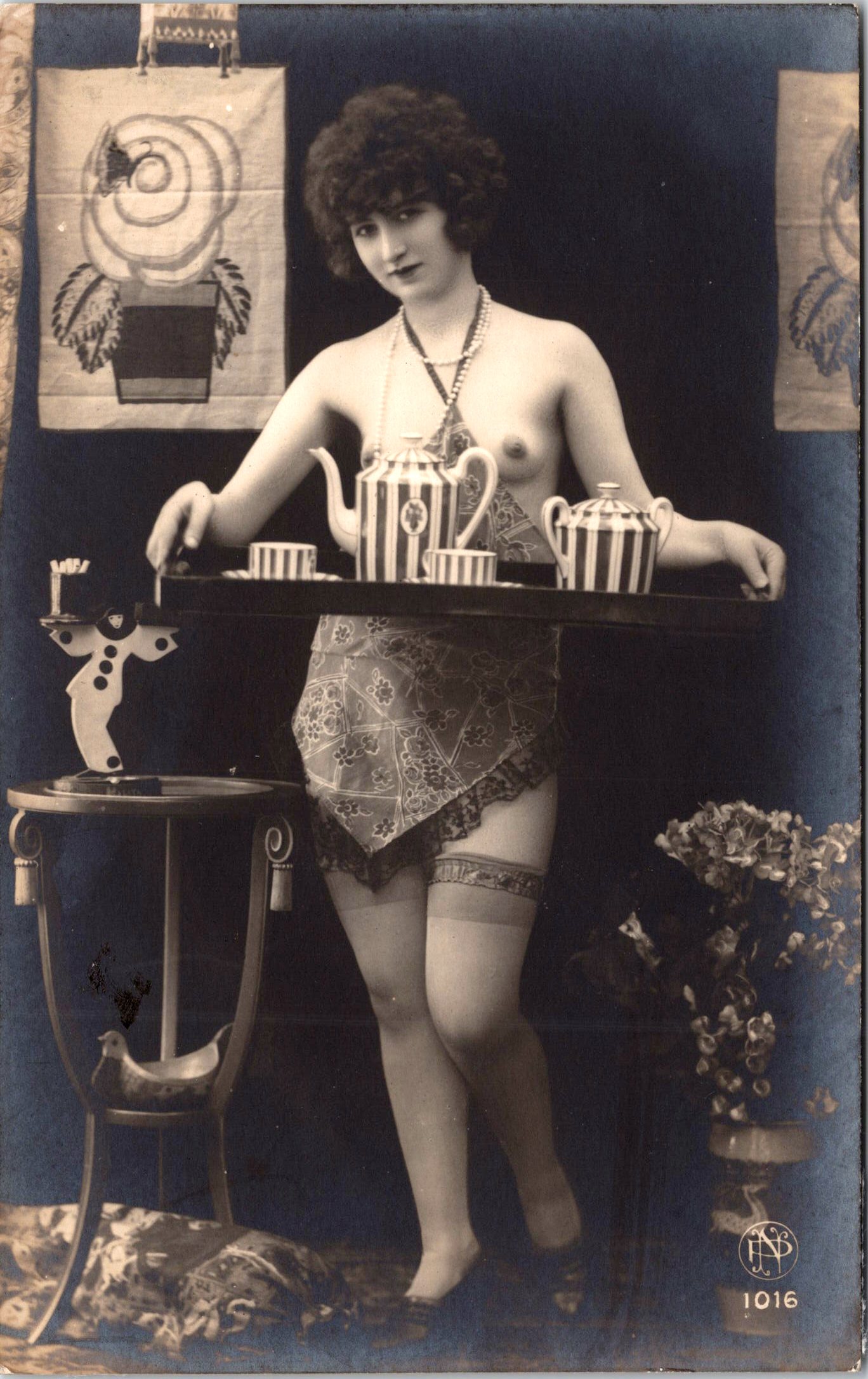
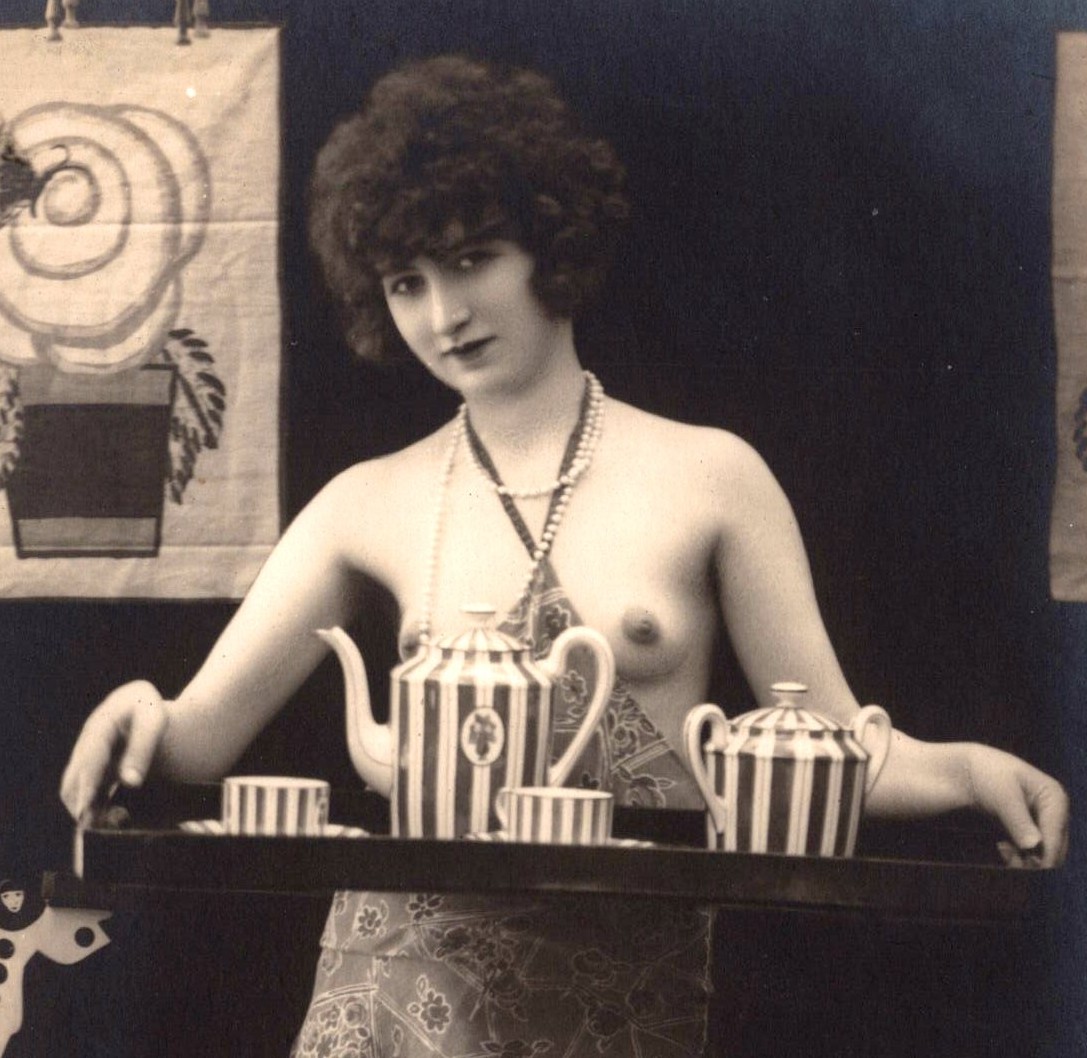
This rare risque real photo postcard captures a staged and playful tableau likely from the 1920s or 1930s. The photograph features a woman in a provocative pose, standing against a backdrop with decorative elements. Her attire is minimal—she wears a halter-style garment fashioned from a patterned scarf or similar material, leaving her torso exposed. She also dons stockings secured with garters, along with a string of pearls that adds a touch of elegance to her otherwise suggestive presentation. Her curly hairstyle is typical of the early 20th century. The woman holds a tray containing a striped tea set, consisting of a teapot, cups, and saucers, which she presents as if serving tea. On the small table to her left, there is a whimsical figurine, perhaps a pierrot or clown. This object adds a playful and slightly surreal touch to the scene. The art on the wall behind her appears to be a fabric panel with a floral design, adding a domestic and slightly bohemian atmosphere to the setting. The woman’s facial expression is subtle, with a faint smile that exudes confidence and a hint of amusement. Her pose, along with the setting, suggests that this postcard was intended as a risqué but artistic depiction, typical of many such images produced for collectors or admirers of “boudoir” photography during this era. The publisher of this postcard is unidentified, other than the initials “NP”. Preliminary research did not reveal the actual name of the publishing company. SOLD
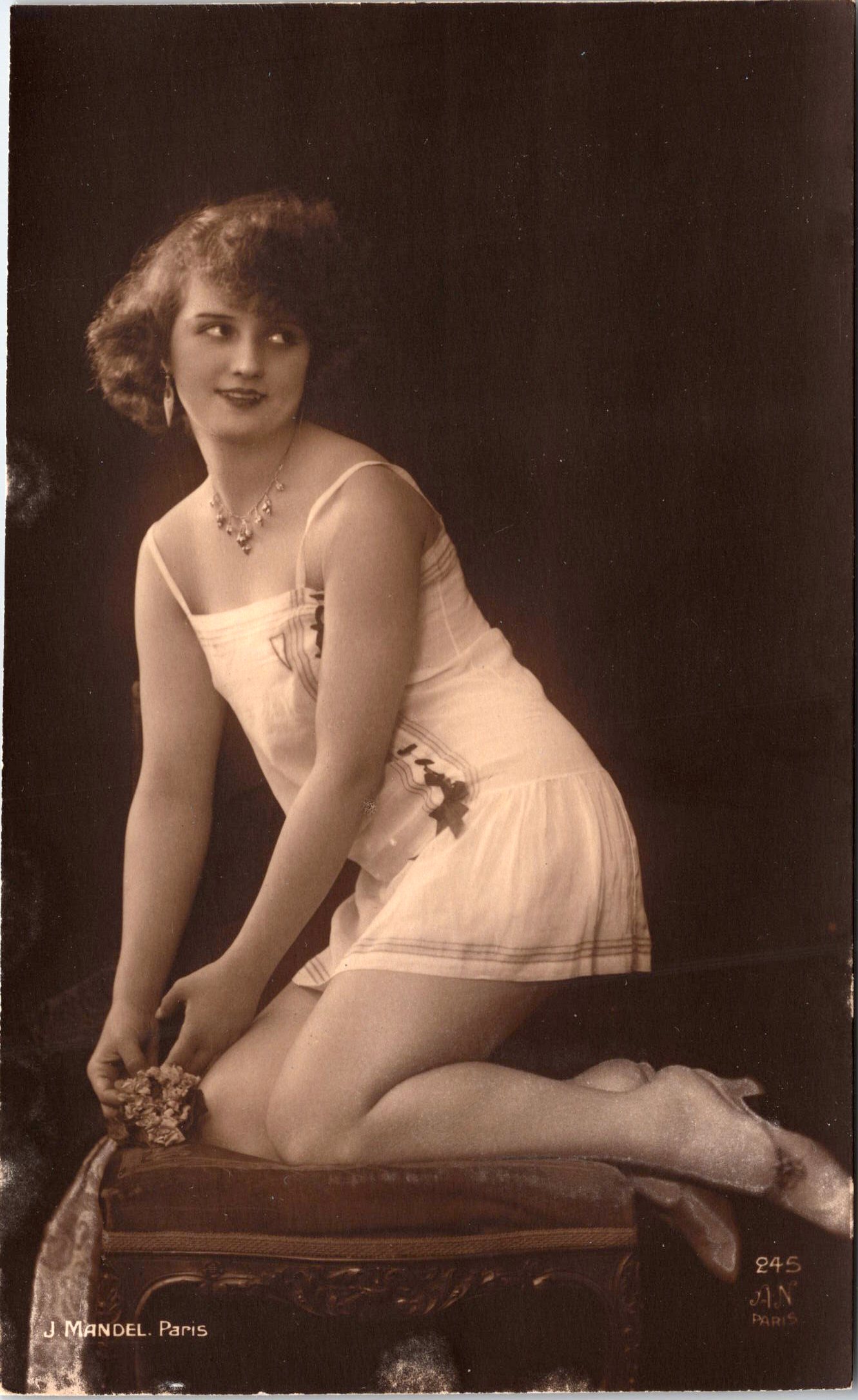
This vintage real photo features a pretty young woman wearing a negligee and holding a small bouquet of flowers. The woman is perched on an ornately carved wooden stool with upholstered fabric. She is in a graceful, slightly coy pose, looking off to her left, avoiding direct eye contact with the camera. She has short, wavy hair, characteristic of the 1920s or early 1930s style, giving her a modern and sophisticated look for the era. Her expression is flirtatious yet demure, exuding a mix of elegance and allure. She is wearing a light, sleeveless garment resembling a chemise or slip, commonly associated with boudoir or risqué photography of the time. The outfit is detailed with delicate embroidery and small ribbon accents, enhancing its feminine charm. Her night clothes are accessorized with a simple yet sparkling necklace and earrings. This postcard was published by Alfred Noyer (Paris). The model’s photograph was taken by J. Mandel. Mandel was a noted Parisian studio or publisher that specialized in photographic postcards during the early 20th century. Many of his works were part of the “boudoir” genre, featuring women posed in intimate or suggestive settings. SOLD

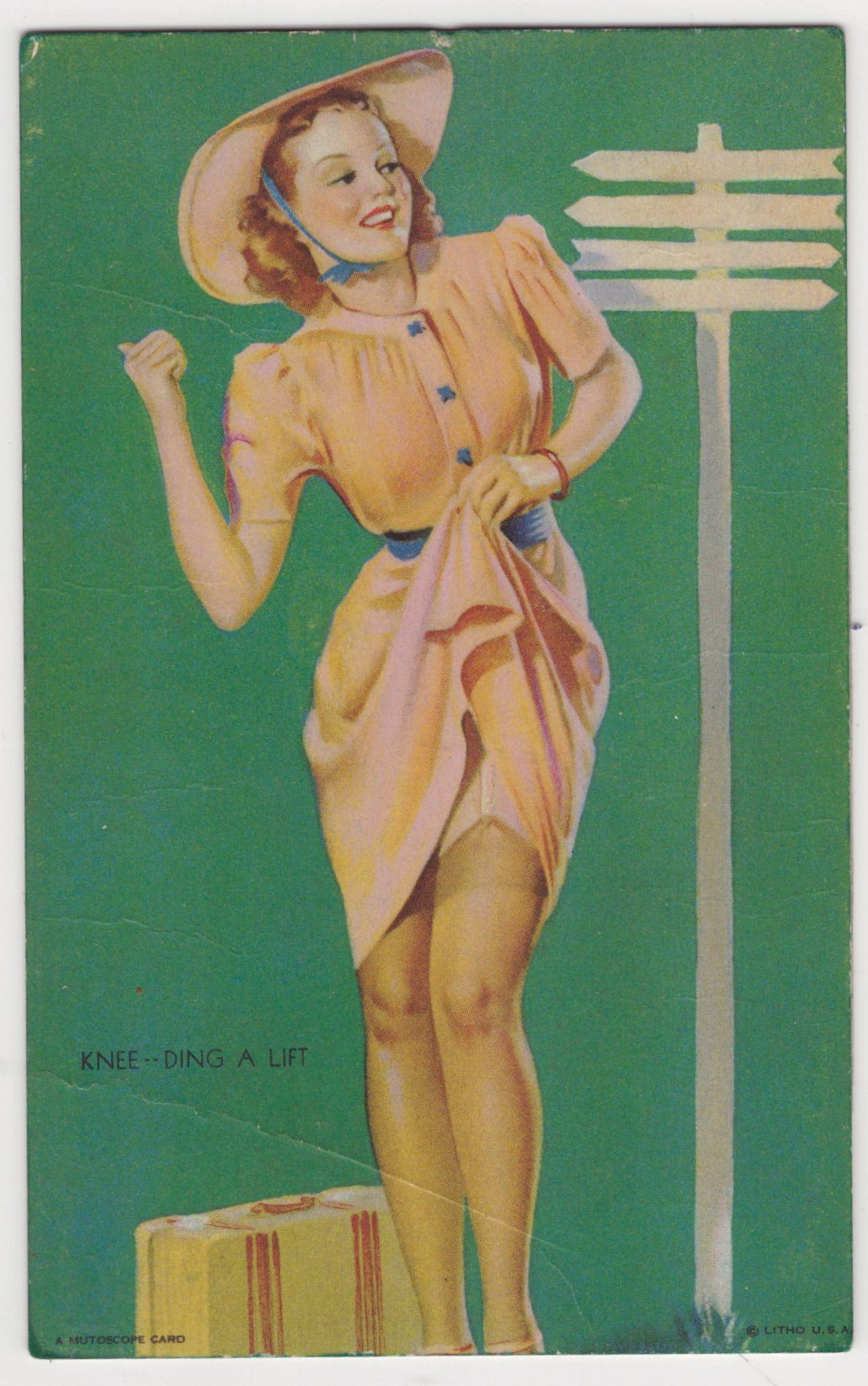
This arcade card features a pretty woman hitchiking. She has lifted her skirt and is flashing a beautiful smile in hopes of catching a ride. This card is risque. The artist of this pin-up is the celebrated Gil Elvgren. The card was published by Mutoscope. SOLD

This risque vintage real photo postcard features a nude pretty young woman smiling at the camera. Her image on this card is provocative. She covers the sexually charged areas but the postcard remains alluring. Although she is covering herself, she does not seem terribly embarrassed about her state of undress. SOLD

This vintage risque postcard features a bikini clad Marisa Allasio (1936- ), a renowned Italian actress and a popular figure in 1950s cinema. Known for her beauty and charm, she became a prominent “sex symbol” of Italian film. Allasio starred in nearly 20 films between 1952 and 1958, often embodying lively, youthful roles in comedies that resonated with audiences of Italy’s post-war economic boom. Her most famous performances include roles in Poor But Beautiful (1957) and Pretty But Poor (1957), both directed by Dino Risi, as well as Seven Hills of Rome (1958) alongside Mario Lanza. Her film career ended abruptly in 1958 when she married Count Pier Francesco Calvi di Bergolo, a member of Italian nobility and the grandson of Italy’s King Victor Emmanuel III. Post-marriage, she left the film industry and focused on family life, becoming the Countess of Bergolo. Despite her brief career, Allasio remains a nostalgic icon of Italian cinema from that era, remembered for her vivacious on-screen presence and embodiment of 1950s Italian glamour. This vintage postcard is larger than the standard postcard. This card measures about 5.75 x 4.00 inches. This postcard was published by Rotalfoto. The firm was based in Milan, Italy. The postcard was published in the 1950’s and is in good condition (see scans).

Buy this Vintage Real Photo Postcard (includes shipping within the US) #7749
$12.00

Buy this Vintage Real Photo Postcard (includes International shipping outside the US) #7749
To purchase this item, click on the Pay with PayPal button below
$22.00
 | bmarshphd on MEET THE HERSHEY FAMILY OF LAN… |
 | Brigitte on MEET THE HERSHEY FAMILY OF LAN… |
 | usermattw on TWO MEN ON BICYCLES : FEMALE P… |
| bmarshphd on Young Egyptian Woman : Veil :… |
 | summertime75 on Young Egyptian Woman : Veil :… |

