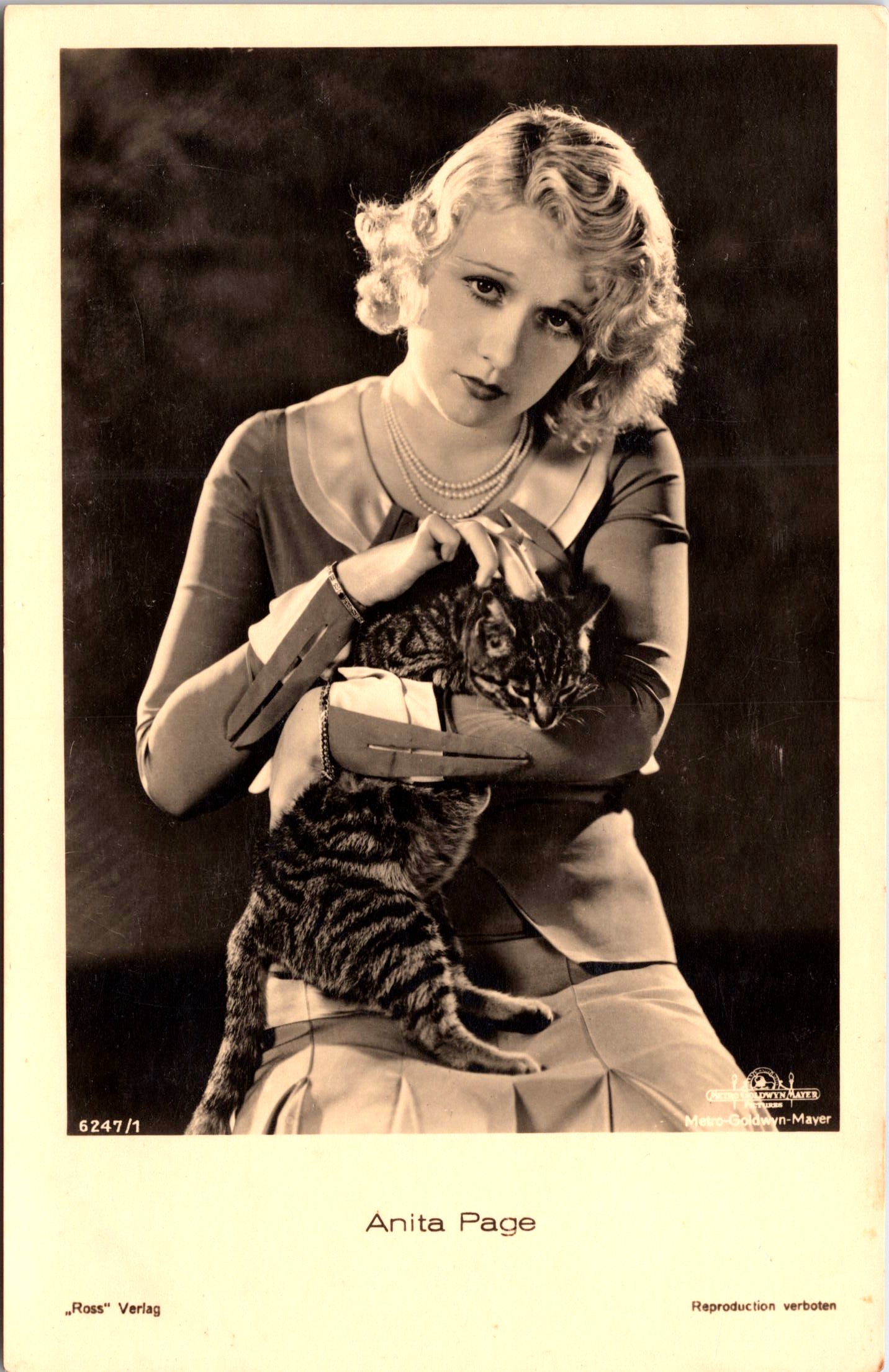
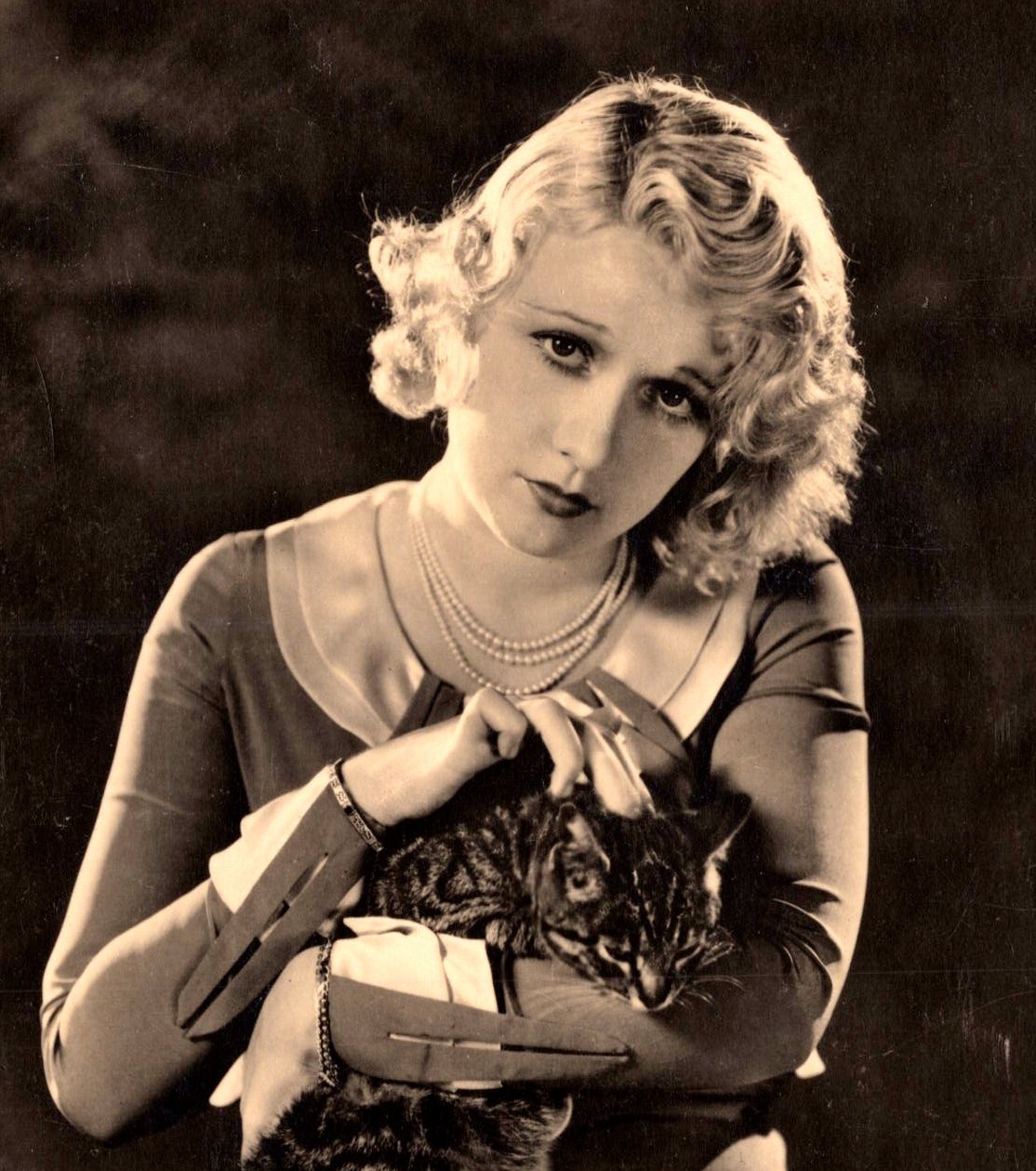
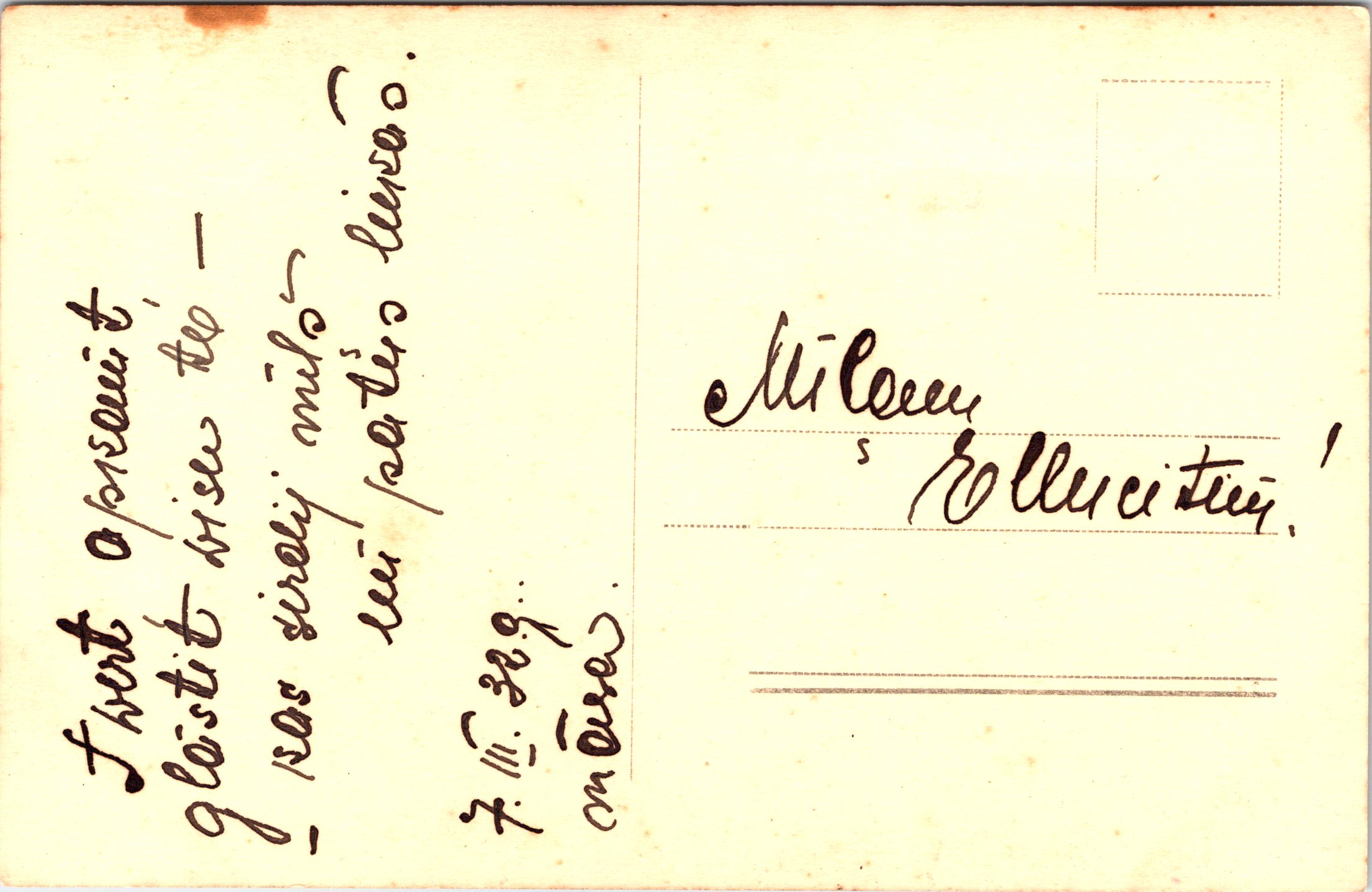
This sepia-toned publicity postcard features Anita Page (1910-2008), an iconic silent and early sound film actress, posing with a tabby cat. She cradles the cat gently in her lap, both arms encircling it protectively. The cat appears calm, eyes half-closed in contentment or sleep, nestled into Page’s arms. Anita is styled with soft, sculpted blonde curls typical of late 1920s-early 1930s glamour. She wears a tailored dress or top with a broad, satin-trimmed collar and decorative slashes on the cuffs, along with a double-stranded pearl necklace and a bracelet on one wrist. Her expression is wistful—perhaps intentionally melancholy or dreamy—a popular aesthetic in studio portraits of the era. Her makeup emphasizes the eyes with dark liner and curved brows, enhancing her expressive gaze. The presence of the cat lends the portrait an intimate and slightly whimsical tone, softening the glamorous studio setting and humanizing the star. It was not uncommon for stars to be photographed with animals to add charm or relatability. The publisher of this postcard is Ross Verlag, a German company based in Berlin. The card is identified as (No.6247/1). The circular logo in the bottom right corner of the card belongs to Metro-Goldwyn-Mayer (MGM), the major Hollywood studio with which Anita Page was under contract. The message on the reverse of the card is written in Czech (or possibly Slovak). A rough translation reads: “Your devoted, Wishes you everything good – Your dear Miloš, I send you this card for memory. The card is dated 1929. Anita Page was a major screen star in the late 1920s and early 1930s, often called “the girl with the most beautiful face in Hollywood.” She rose to fame starring alongside Joan Crawford in Our Dancing Daughters (1928) and appeared in The Broadway Melody (1929), which won the Academy Award for Best Picture. She retired young in the 1930s but returned sporadically to the screen in later years. She was one of the last surviving stars of the silent film era. (SOLD)
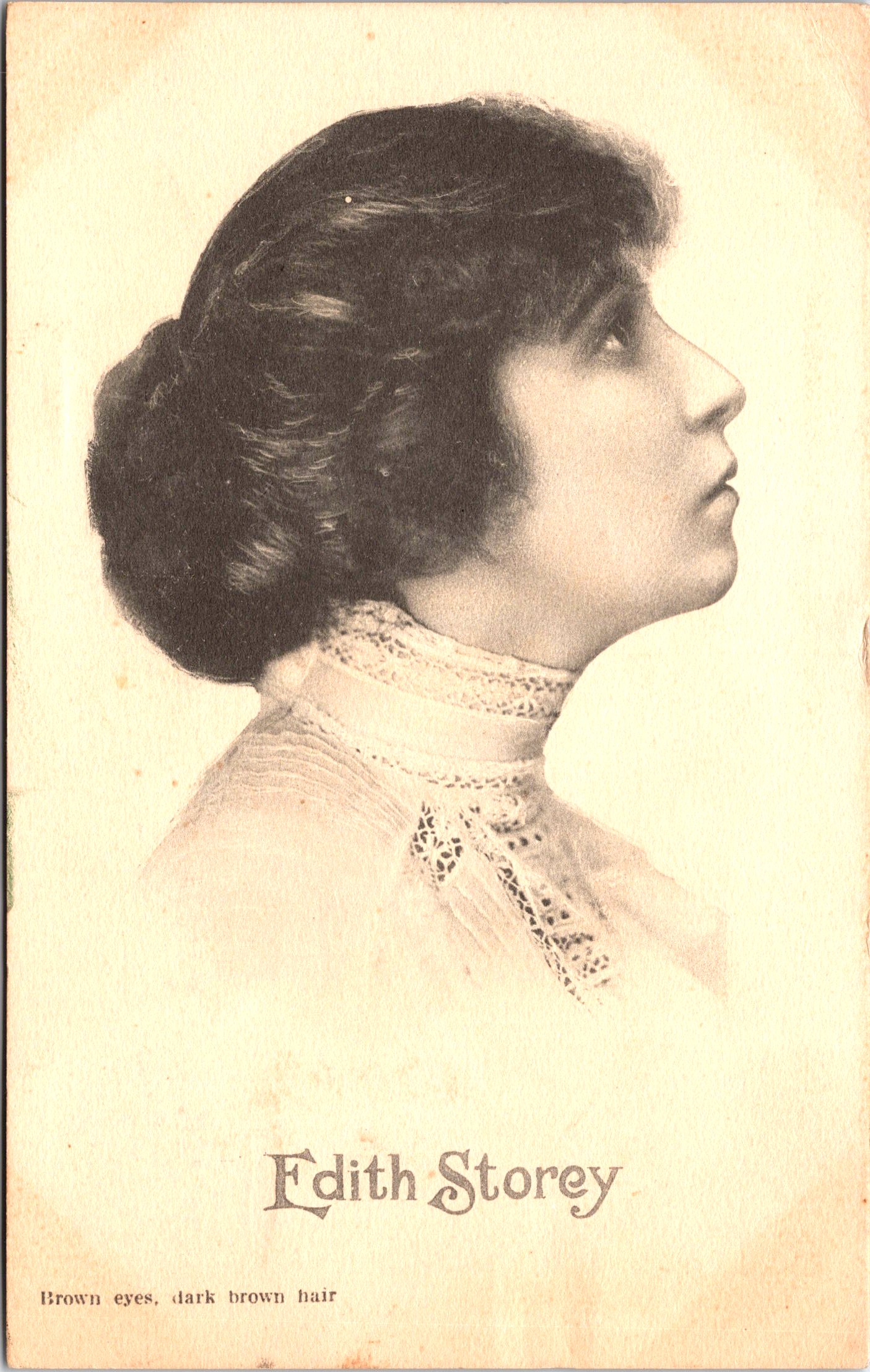
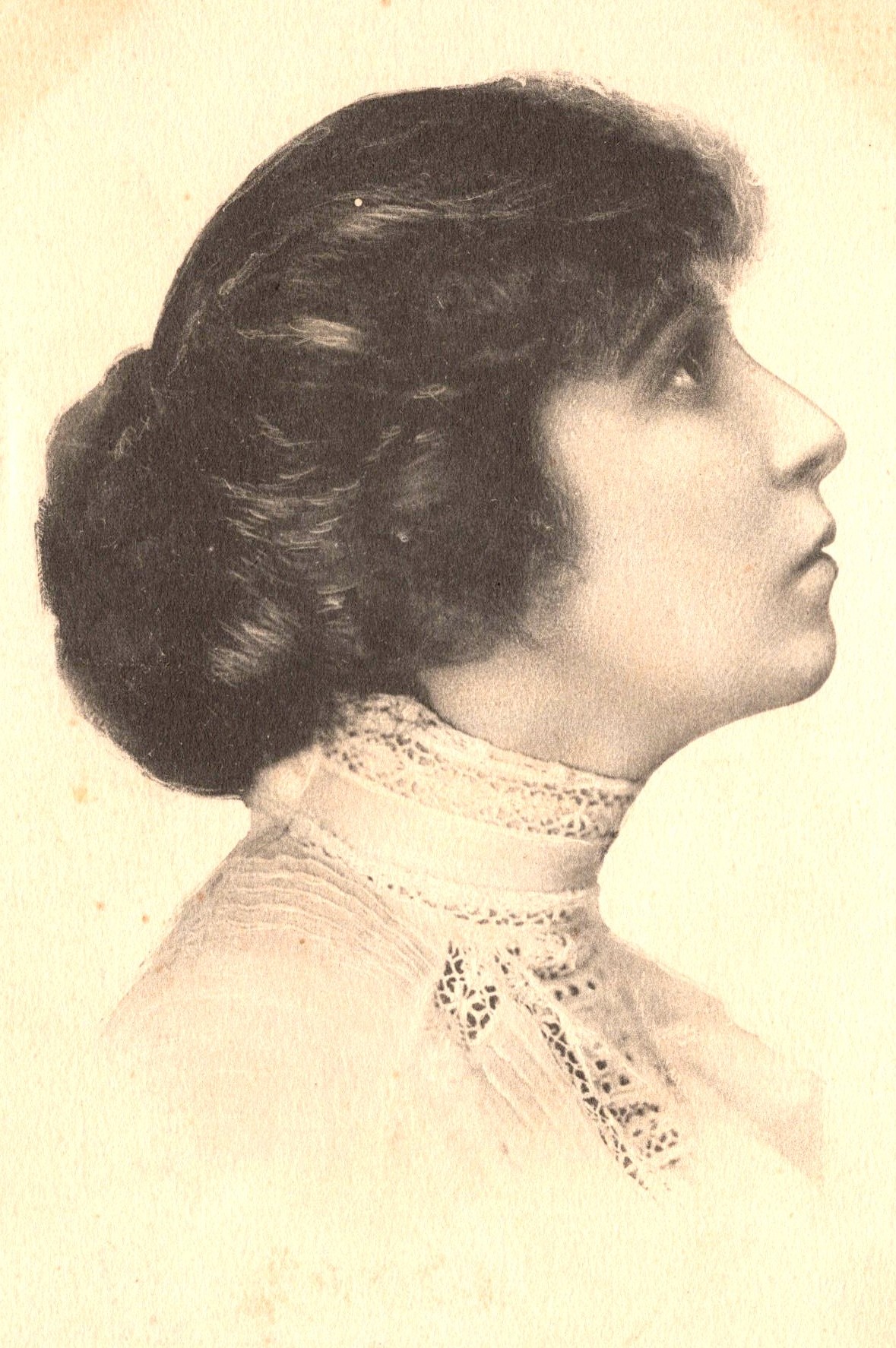
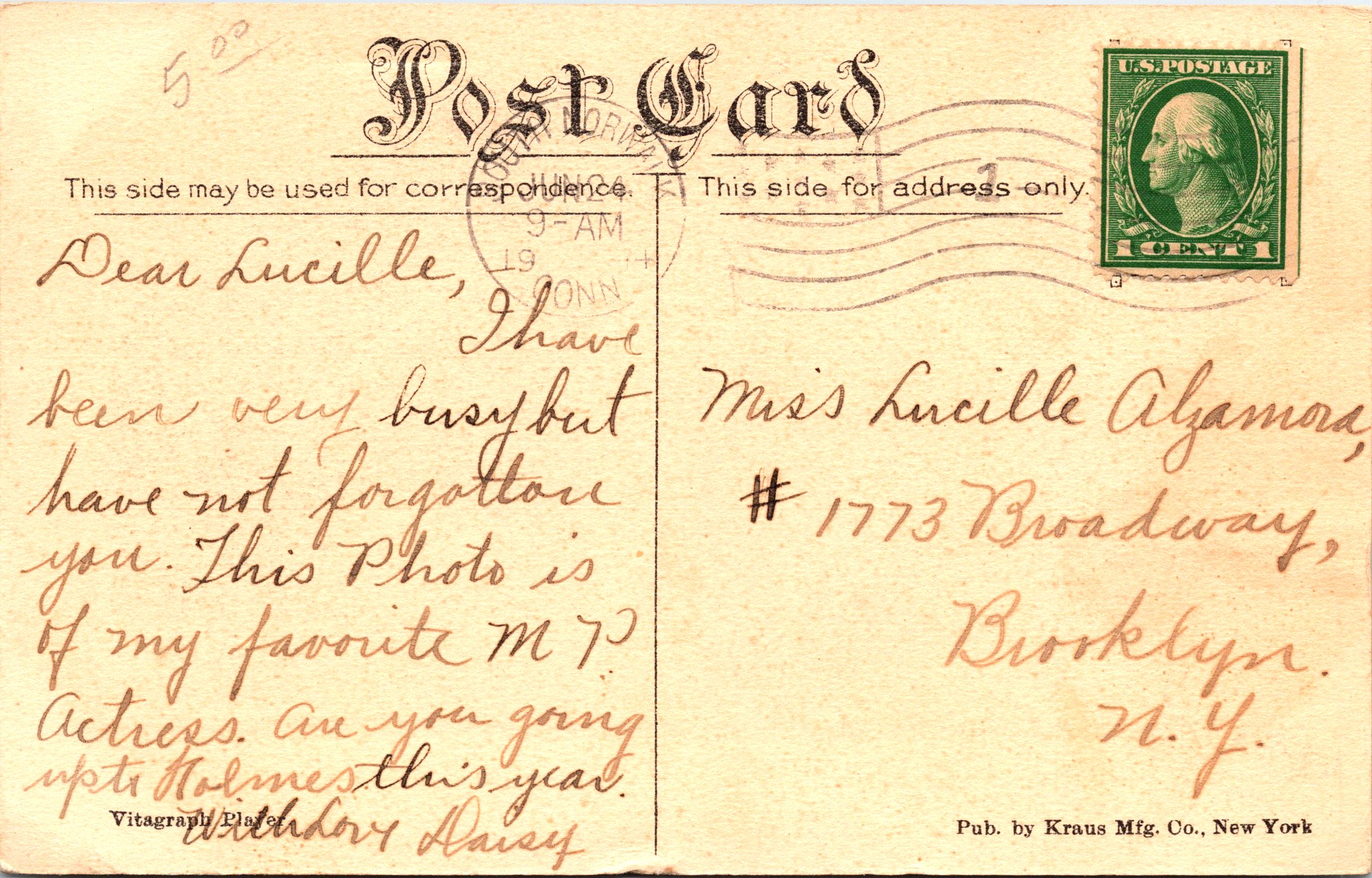
This vintage real photo postcard features American silent film actress, Edith Storey (1892-1967). She was born in New York City and began acting when she was still a child. Her first film was “The Two Brothers” (1908). By 1913, she had appeared in 75 films and between 1908 and 1921 she performed in nearly 150 films. She performed in many Westerns and was noted for her excellent horseback riding skills. She also did her own stunts. She worked for Vitagraph Studios (New York) for the majority of her career. Storey also acted on stage and was noted for acting in a number of male impersonation roles. She appeared in two Broadway plays. The first was in 1903 and the second was in 1904. She retired at the age of 29 in the year of 1921. During the Spanish Flu Epidemic, Storey drove an ambulance in New York City for the National League for Women’s Service. It is also reported that she worked as a hospital night nurse at the height of the epidemic. After retiring she served almost 30 years as village clerk for Asharoken, Long Island. She died at the age of 75 in Northport, Long Island, New York. Within the message on the this postcard, Daisy (the sender) tells Lucille (the recipient) that Edith Storey is her favorite movie actress. A caption on the front of this card states that Storey has brown eyes and dark brown hair. This postcard was published by Kraus Mfg. Co. of New York. (SOLD)
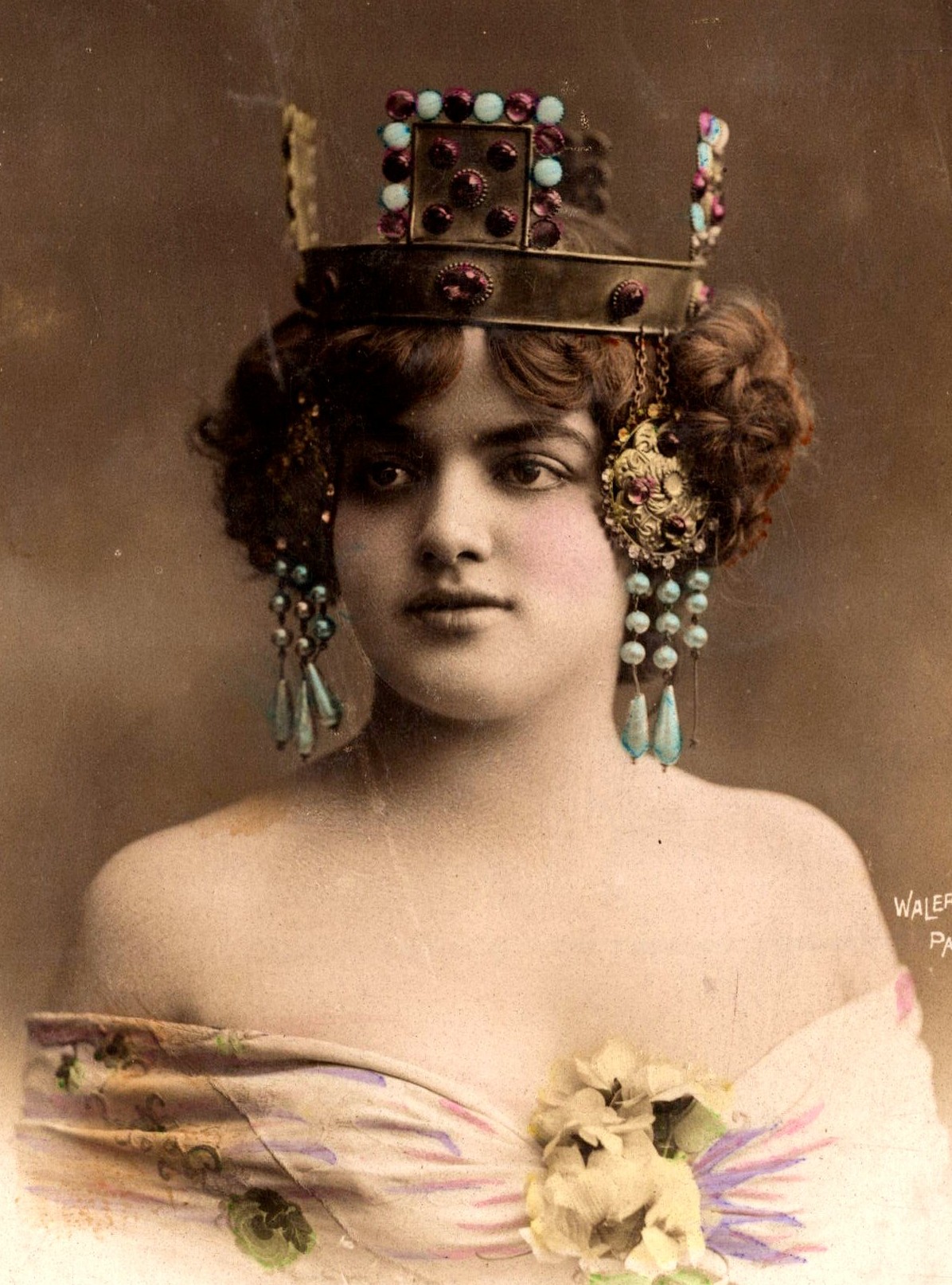
This vintage real photo postcard features performer, Miss Veglia. The title on the card indicates that she performed at the Folies Bergere, in Paris France. This actress may be Tina Veglia who was a silent film actress. One of the films that she is noted for is “The Three Musketeers” (1918).She is also listed as appearing in two Italian silent films. Interestingly, the word “Veglia”, translated from Italian to English, means “Vigil”. The portrait of Miss Veglia was hand tinted. She is wearing quite the interesting head piece. The ornate jeweled piece is crownlike and has a hodgepodge design. The message on this postcard, written in French, is captivating. A translation app translates the message as ” I suffer in silence and I do not complain. Not seeing me, you may think I’ve moved on, but despite that, I will love you always. I’m letting a little bit of hope shine through. Try to guess who is sending you this card…”. This is an extremely dramatic message. I wonder what eventually happened. Did the writer and recipient ever get together and live “happily ever after”? This photo portrait was taken by Walery at his Paris studio. He was a well known and talented celebrity photographer. The postcard was published by SIP as part of a series (no.5026). The postcard has a Belgian stamp and the care is addressed to someone in Courcelles-Pont-à-Celles, Belgium.(SOLD)
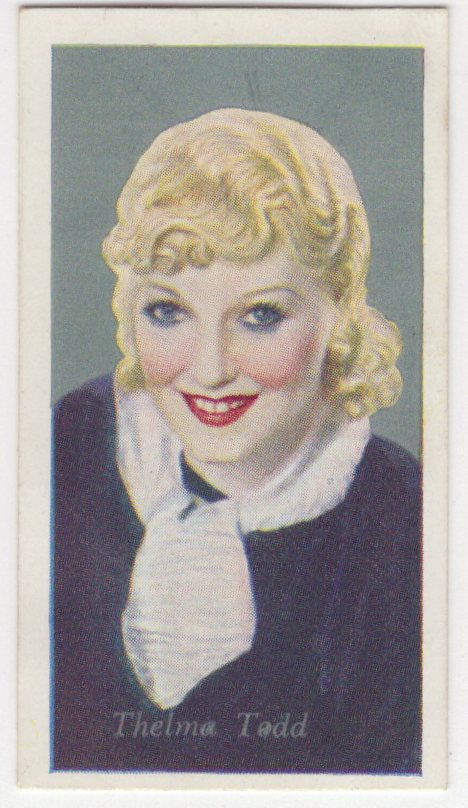
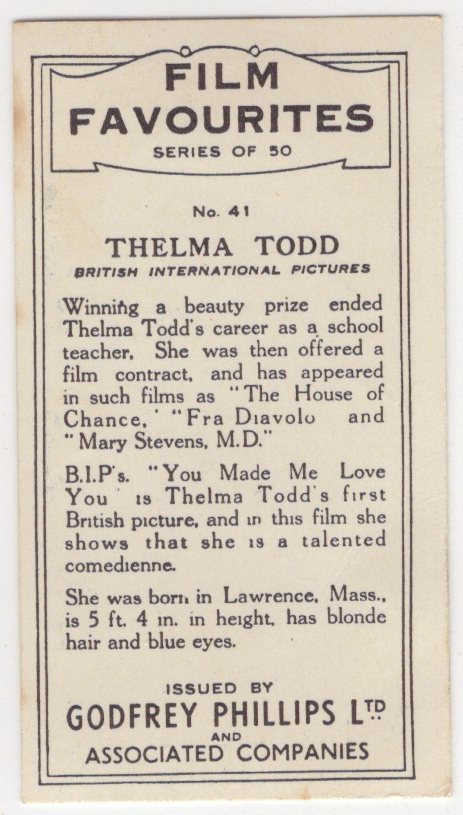
This vintage tobacco card features American silent and talkie film actress, Thelma Todd (1906-1935). She was also a businesswoman. Her nicknames included “The Ice Cream Blonde” and “Hot Toddy”. She appeared in about 120 feature films and shorts between 1926 and 1935. She was known for her comedienne talent. Among the performers she worked with are the Marx Brothers, Laurel & Hardy, and Buster Keaton. In 1934 she opened a restaurant in Los Angeles with two partners. In 1935 she was found dead in her Lincoln automobile. The car was in a garage and had died from carbon monoxide poisoning. Her death was ruled to be accidental but there was much speculation about whether she committed suicide or had been murdered. This cigarette card was published by Godfrey Philips Ltd. The firm was a British tobacco importer and manufacturer of cigars and Cigarettes. The business was established in 1844 and was one of the first tobacco companies to issue cigarette cards. Their first set was published in 1904. The cards were meant to stiffen cigarette packaging, to serve as a collectible, and to advertise the cigarette brand. This cigarette card was issued in 1934. SOLD
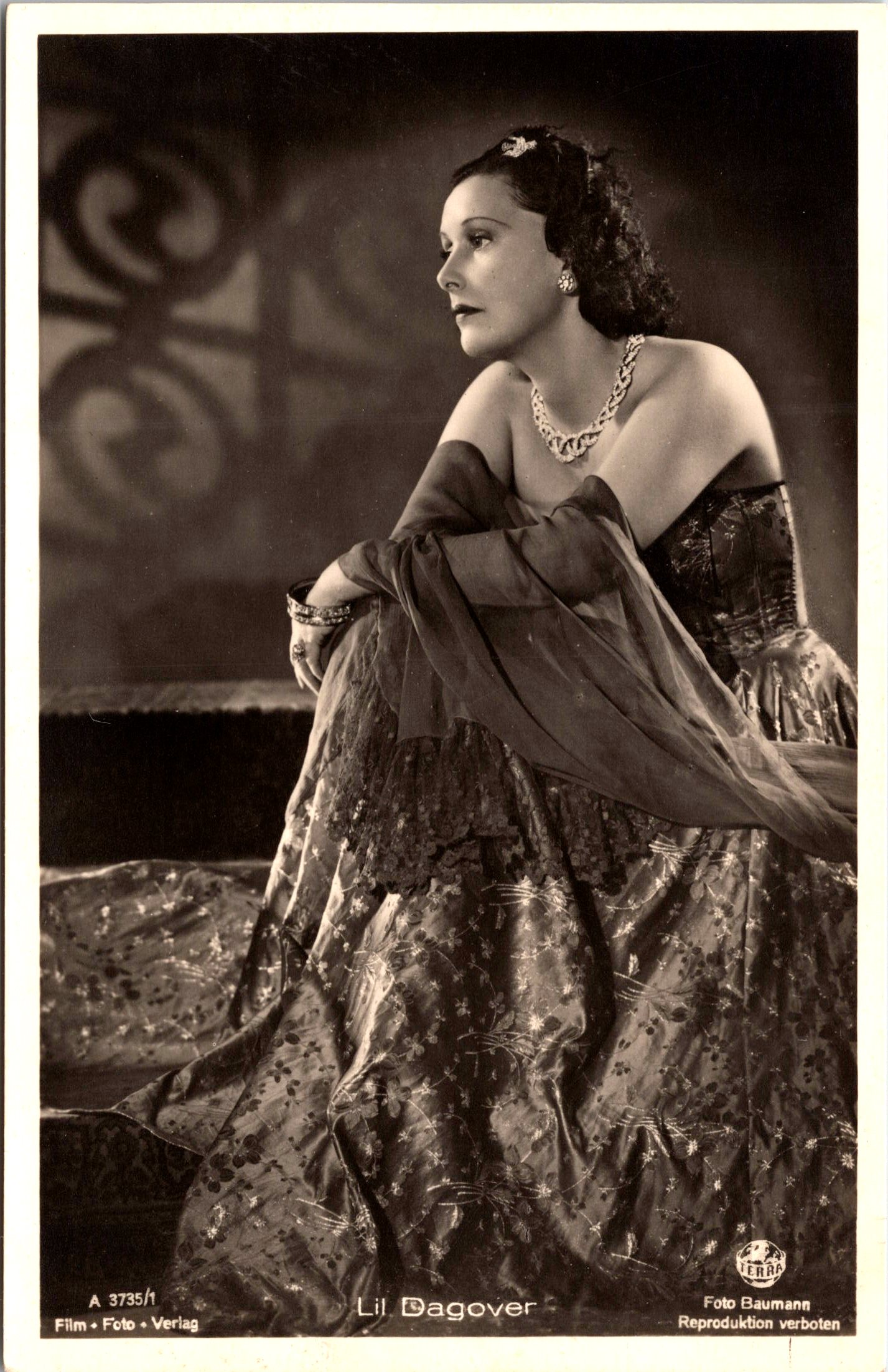
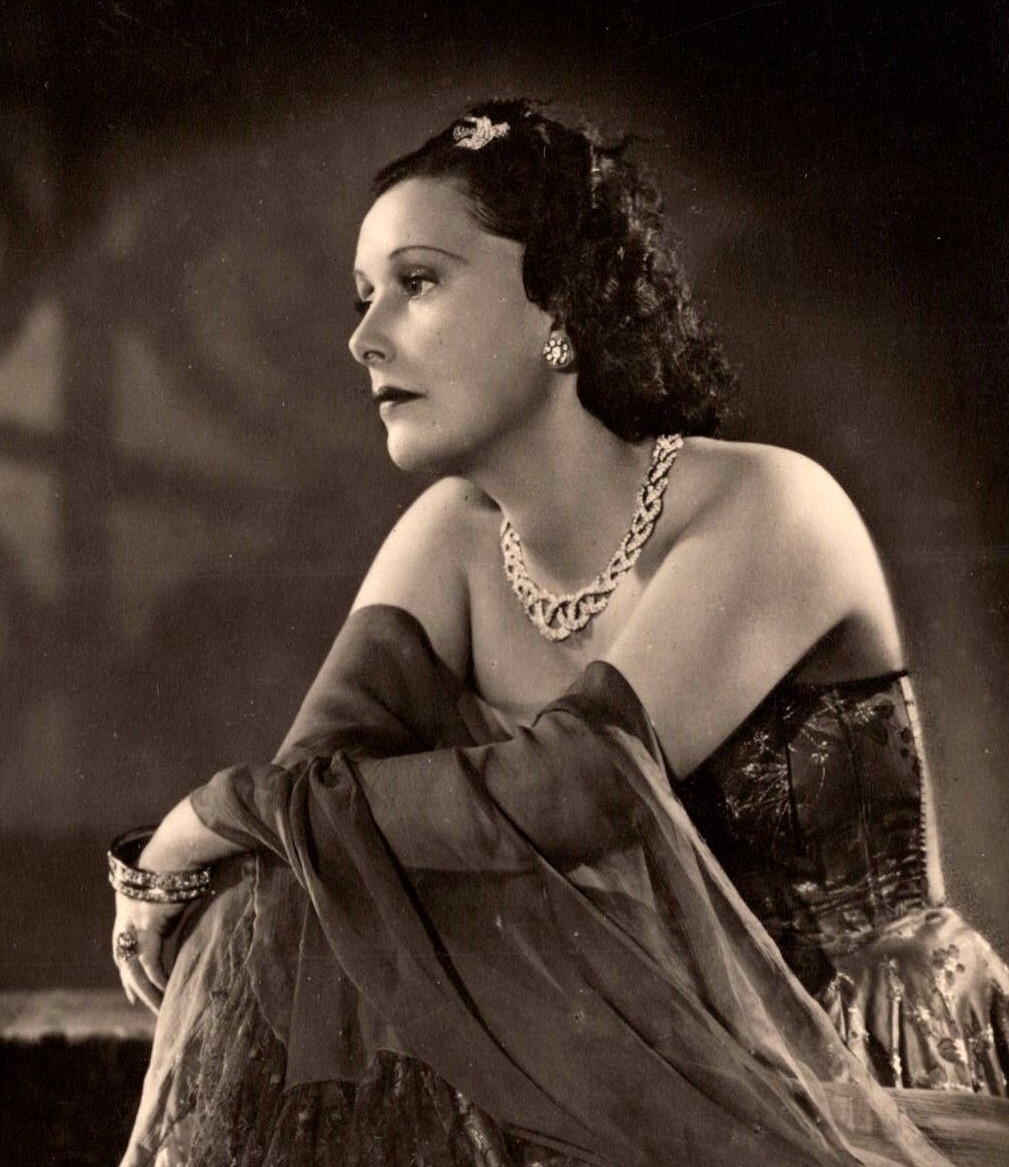
This vintage real photo postcard features celebrated German actress, Lil Dagover (1887-1980). She was renowned for her work in silent films, particularly her collaborations with key figures of German Expressionist cinema. Her striking beauty and ability to convey complex emotions made her one of the most recognizable faces of early 20th-century European cinema. Lil Dagover was born into a well-to-do family in the Dutch East Indies, where her father worked as a forestry officer. After his death, her mother relocated with the family to Europe, and Dagover spent much of her youth in Switzerland and Germany. She was orphaned at 13 years of age and was raised by relatives. She initially planned to become a painter but was drawn to the performing arts, which led her to pursue acting. Dagover’s acting career began on the stage, but her breakthrough came with the advent of film. She made her debut in 1913, though her rise to stardom began in earnest in the early 1920s when she worked with director Robert Wiene in the landmark German Expressionist film The Cabinet of Dr. Caligari (1920). Dagover became a favorite of directors such as Fritz Lang, F.W. Murnau, and Ernst Lubitsch. Her notable silent-era films include “Destiny” (1921), “Dr. Mabuse, the Gambler” (1922), and “The Chronicles of the Grey House” (1925). Her success continued during the sound era, where her aristocratic demeanor and elegance suited roles in historical dramas and comedies. Dagover remained active in German cinema during the Third Reich, a time when the industry was heavily influenced by propaganda. However, she largely avoided overtly political films, focusing instead on character-driven narratives. After World War II, she transitioned to stage work and television, continuing her career well into the 1970s. In regard to her personal life, in 1913 she married Fritz Daghofer, an Austrian officer. They had one child and the marriage ended in divorce. She married for a second time to a German film producer. This postcard was published by Film-Foto-Verlag as part of a series (No.A3735/1). Miss Dagover’s photograph was taken by Baumann between 1941 and 1944. The logo for Terra Film is in the bottom right corner of the image. Terra Film was a Berlin-based film production company. Founded in 1919, it became one of Germany’s largest film production companies in the 1930s under the Nazi regime. SOLD
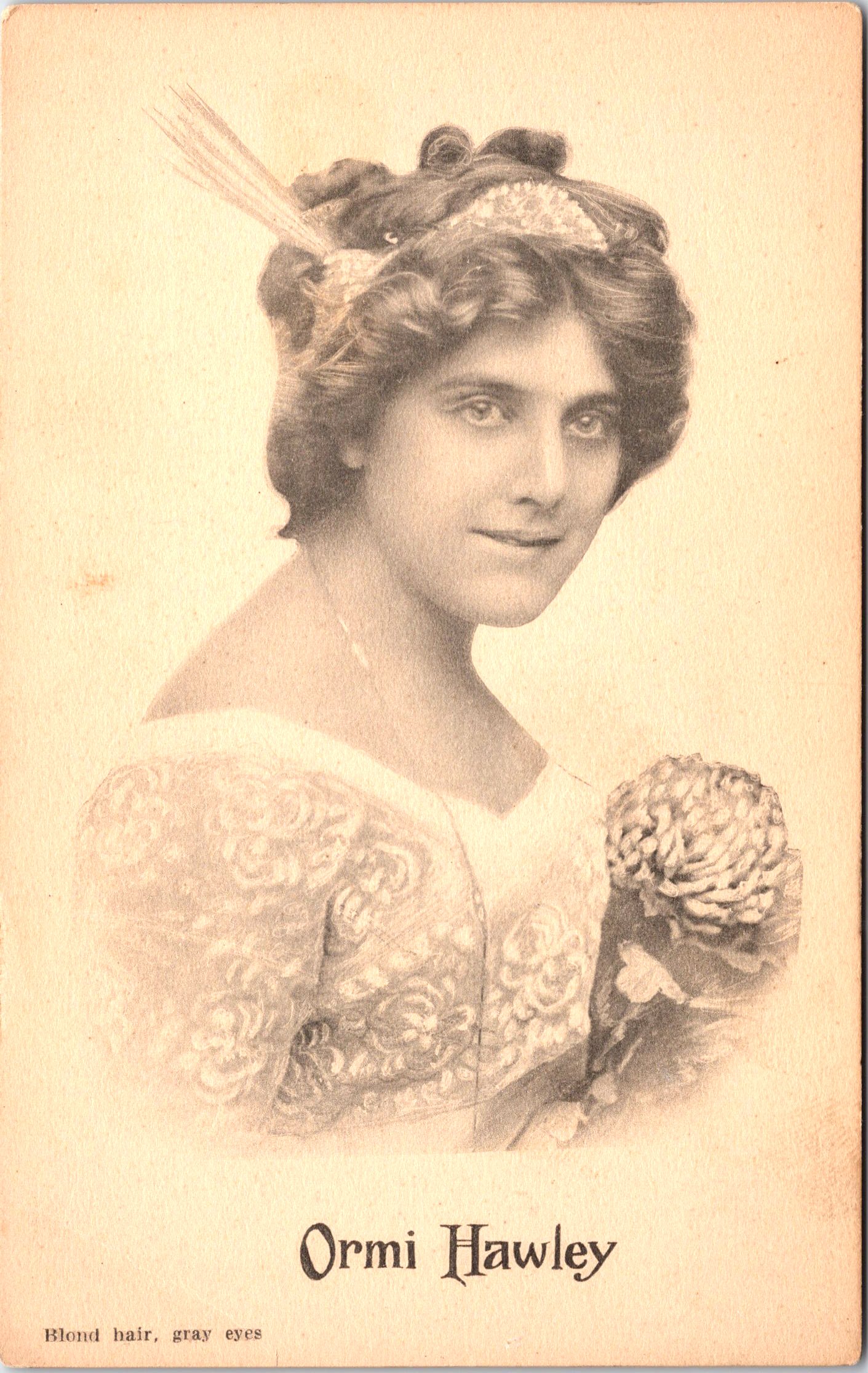
Ormi Hawley (1889-1942) was a pretty and popular American silent film actress. The IMDb reports that she has 129 film credits between 1911 and 1919. She must have garnered a significant amount of money because her nickname was “Opulent Ormi”. She also earned the nickname of “The Lillian Russell of the Pictures” because she frequently played society or aristocratic roles. Like many silent film actresses, she began her career as a teen on the stage. In 1911, she joined the Lubin Stock Company and over the next five years, she starred in dozens of short films. In 1918, she was the leading lady with opera legend Enrico Caruso. Later in her career, she managed the All-American Girls Symphony Orchestra. Upon marriage, she retired to her farm where she painted portraits and wrote children’s stories. This card was published by Kraus Manufacturing Company (New York) for the Lubin film company. Interestingly, the caption on the front of the card describes Hawley’s appearance. She is said to have blonde hair and gray eyes. (SOLD)
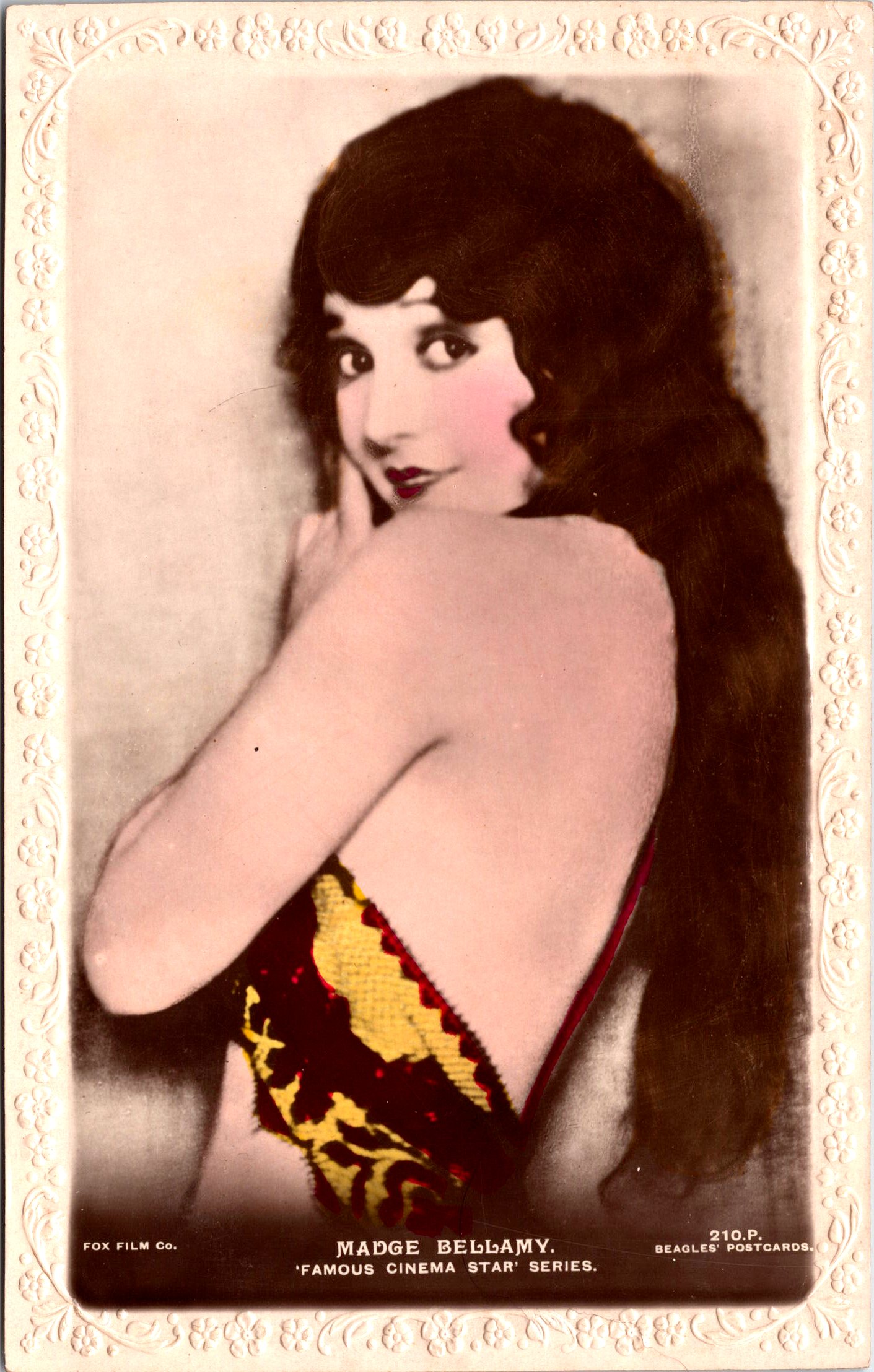
Postcard 1 is a hand tinted vintage real photo postcard that features Madge Bellamy (1899-1990), an American stage and film actress. She was a popular leading lady in films of the 1920’s and 1930’s. The sound era put the brakes on her career and a romantic scandal in the 1940’s brought it to a total stop. Madge was a Texan. She was born in Hillsboro and was raised in San Antonio and Brownwood. Her father was an English professor at Texas A&M University. As a young child she took dancing lessons but soon, she was interested in becoming an actress. At age 9, she made her stage debut in “Aida”. She and her family moved to Denver, Colorado. She met Carlos Bellamy there and the two married. When Madge decided to leave the state to pursue acting, her marriage ended. Madge went to New York City and worked on Broadway as a dancer. In 1919, she replaced Helen Hayes in Broadway’s “Dear Brutus”, opposite actor, William Gillette. Her career took off thereafter. In 1920, Madge appeared in her first film as a supporting actress to Geraldine Farrar. She then signed a contract with the Triangle Film Corporation. Her “breakout role” was as the title character in Lorna Doone (1922). In 1924 she signed a film contract with Fox Film Corporation. She stayed there five years and during that time she appeared in two films for film director, John Ford. In 1925, she began to have difficulties with fox executives. In 1928, she appeared in Fox’s first talking film, “Mother Knows Best”. In 1928, she married for a second time. The marriage lasted 3 days before she and her husband separated. By 1929, Bellamy’s career entered a tail-spin. She had made poor choices out of her unbridled anger. Fan magazines gave her the nickname of “Miss Firecracker” due to her temperament. In 1929, she also quit her contract with Fox, right after they bought the rights to make a film out of Broadway play. The vehicle was bought with a plan to have Madge be it’s star. Bellamy later admitted she quit over money and added “I got too big for my britches”. She didn’t work again until 1932. She accepted roles in “Poverty Row” (B-movies) films. One of these films was “White Zombie” (1932) in which she appeared opposite Bela Lugosi. Her performance received many poor reviews from film critics. By 1940, Madge basically had no film career. However, she wasn’t done with drama. She was arrested after firing three shots from a .32 caliber revolver at her former lover of five years. The incident was premeditated. She was angry at her intended victim because he married a model shortly after ending their affair. Fortunately, her aim was poor and she missed. The only casualty was her ex boyfriend’s car which took a couple of shots into it’s body. Bellamy pleaded guilty to a lesser charge (violating gun laws), and received a suspended six month sentence and probation. Madge Bellamy’s IMDb filmography reports 61 credits between 1920 and 1945. This vintage postcard is provocative. This postcard is risque for it’s era. She is showing a lot of bare skin. The postcard was published while Madge was under contract with Fox. Therefore, the postcard is from before 1929. The card was published by J. Beagles and is part of the “Famous Cinema Star Series” (No.210P). (SOLD)
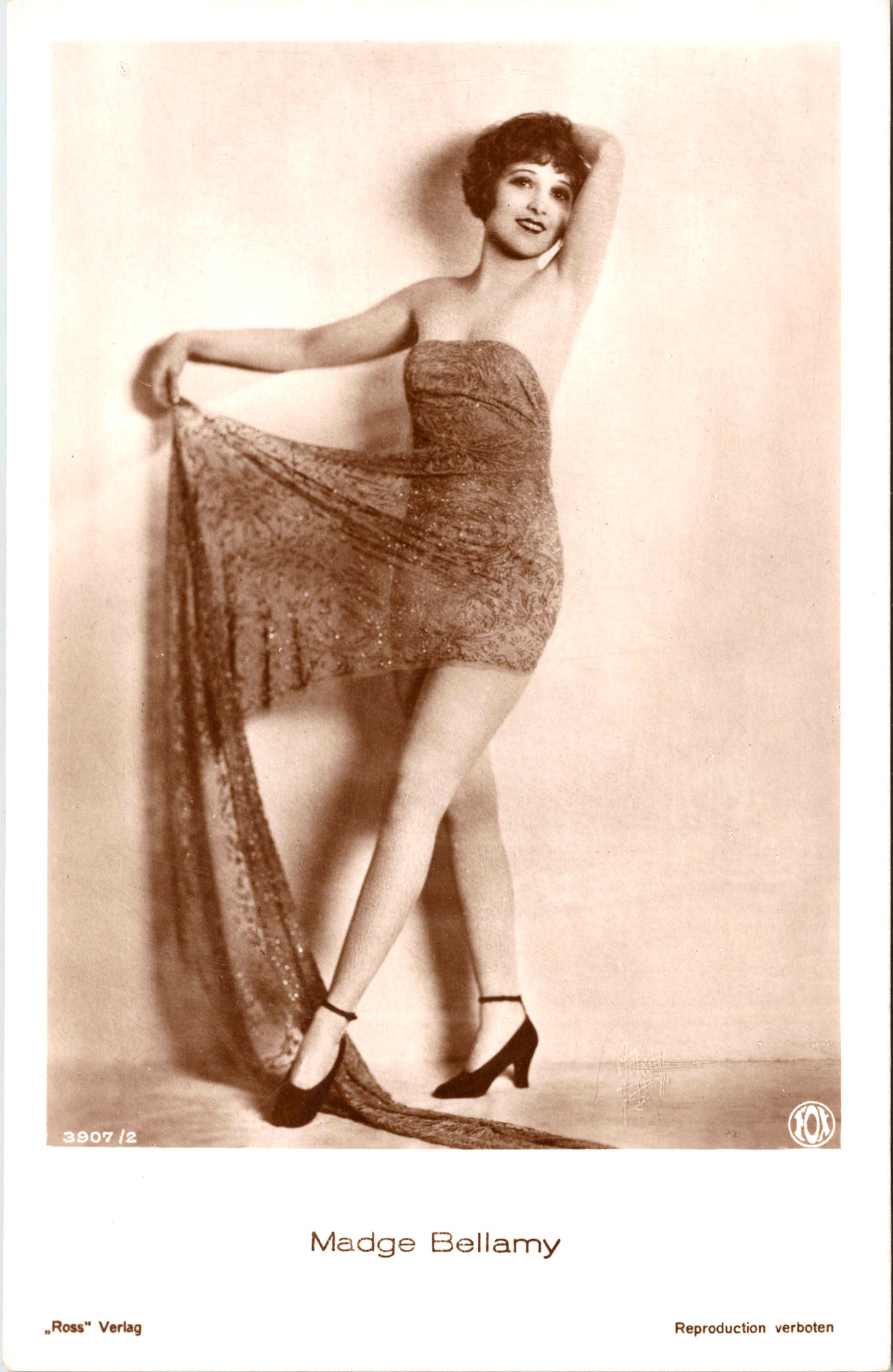
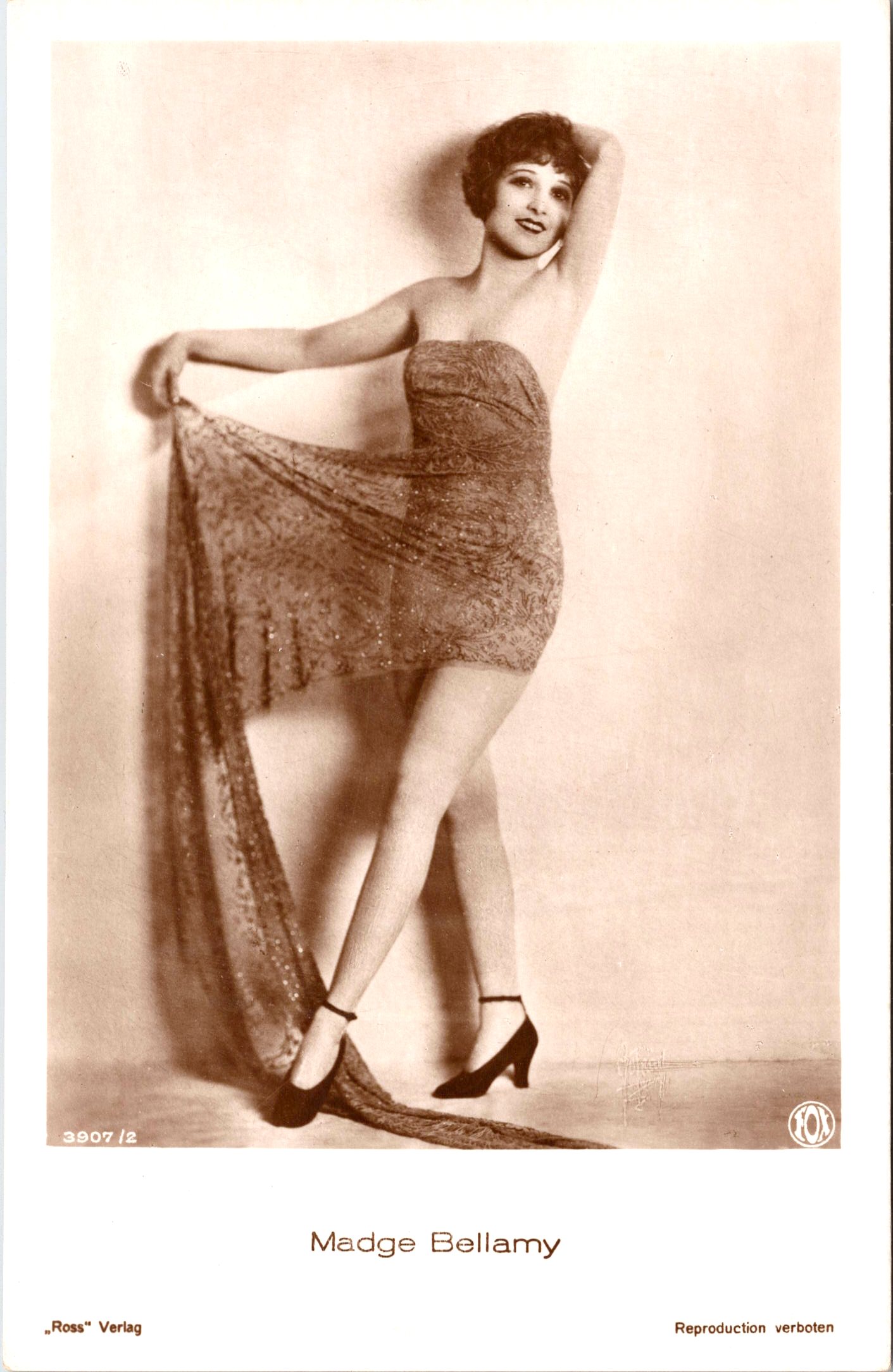
Postcard 2 offers another risque view of Madge Bellamy. Her alluring pose and short skirt qualifies this postcard to be considered provocative. This card was produced while Madge was under contract with Fox Films, sometime before 1929. This postcard was published by Ross Verlag as part of a series (No.3907/2). The postcard is in very good condition (see scans).
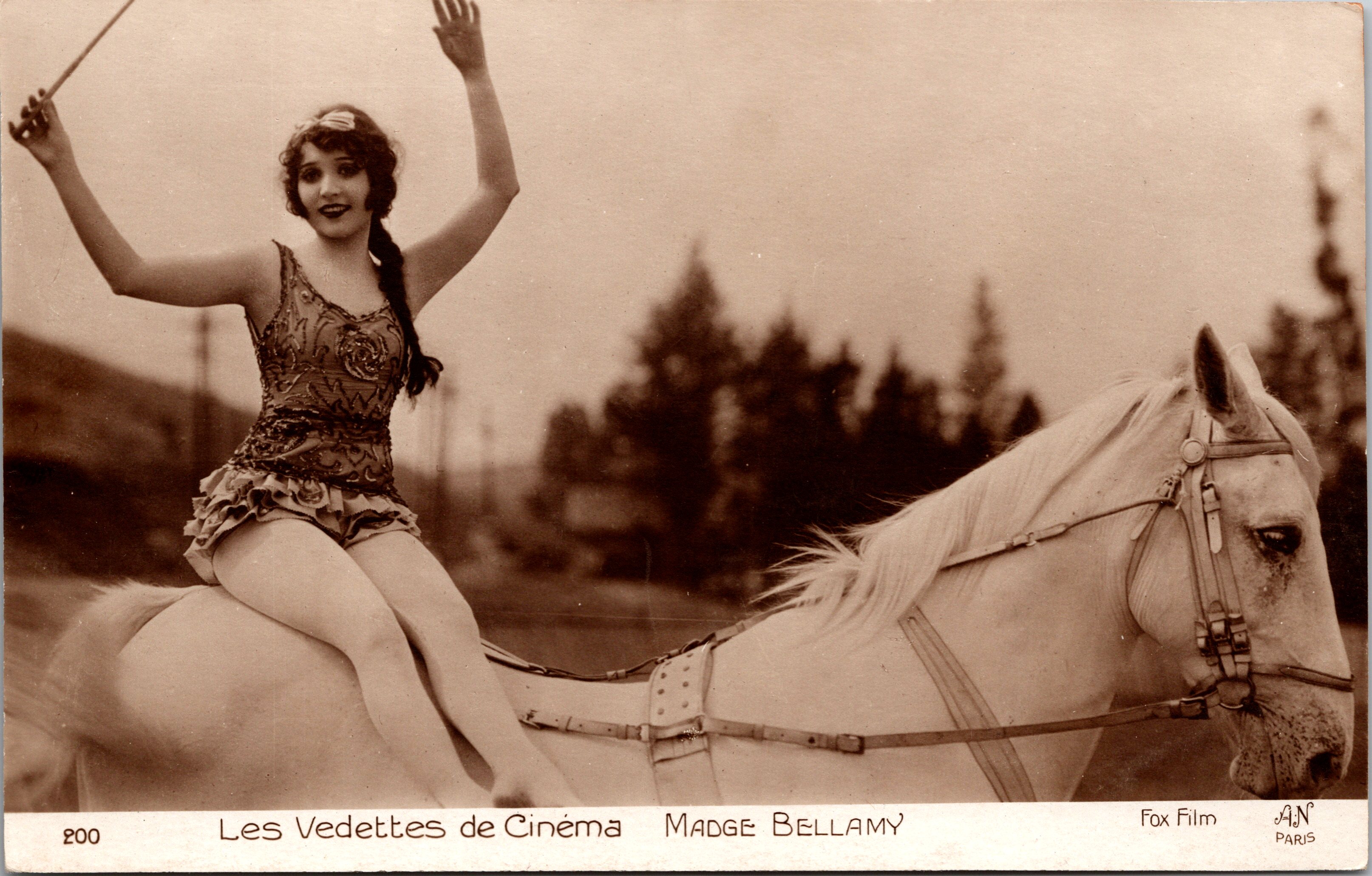
Postcard 3 is quite provocative. There are shades of Lady Godiva in this photograph. Miss Bellamy is pretty and scantily dressed. This postcard is risque for it’s era. The postcard was published while Madge was under contract with Fox. Therefore, the postcard is from before 1929. The card was published by Alfred Noyer and is part of the “Les Vedettes de Cinema” (The Stars of Film) series (No.200). This postcard is uncommon. (SOLD)
Buy this original Vintage Real Photo Postcard (includes shipping within the US) #7386
To purchase this item, click on the Pay with PayPal button below
$24.00
Buy this original Vintage Real Photo Postcard (includes International shipping outside the US) #7386
To purchase this item, click on the Pay with PayPal button below
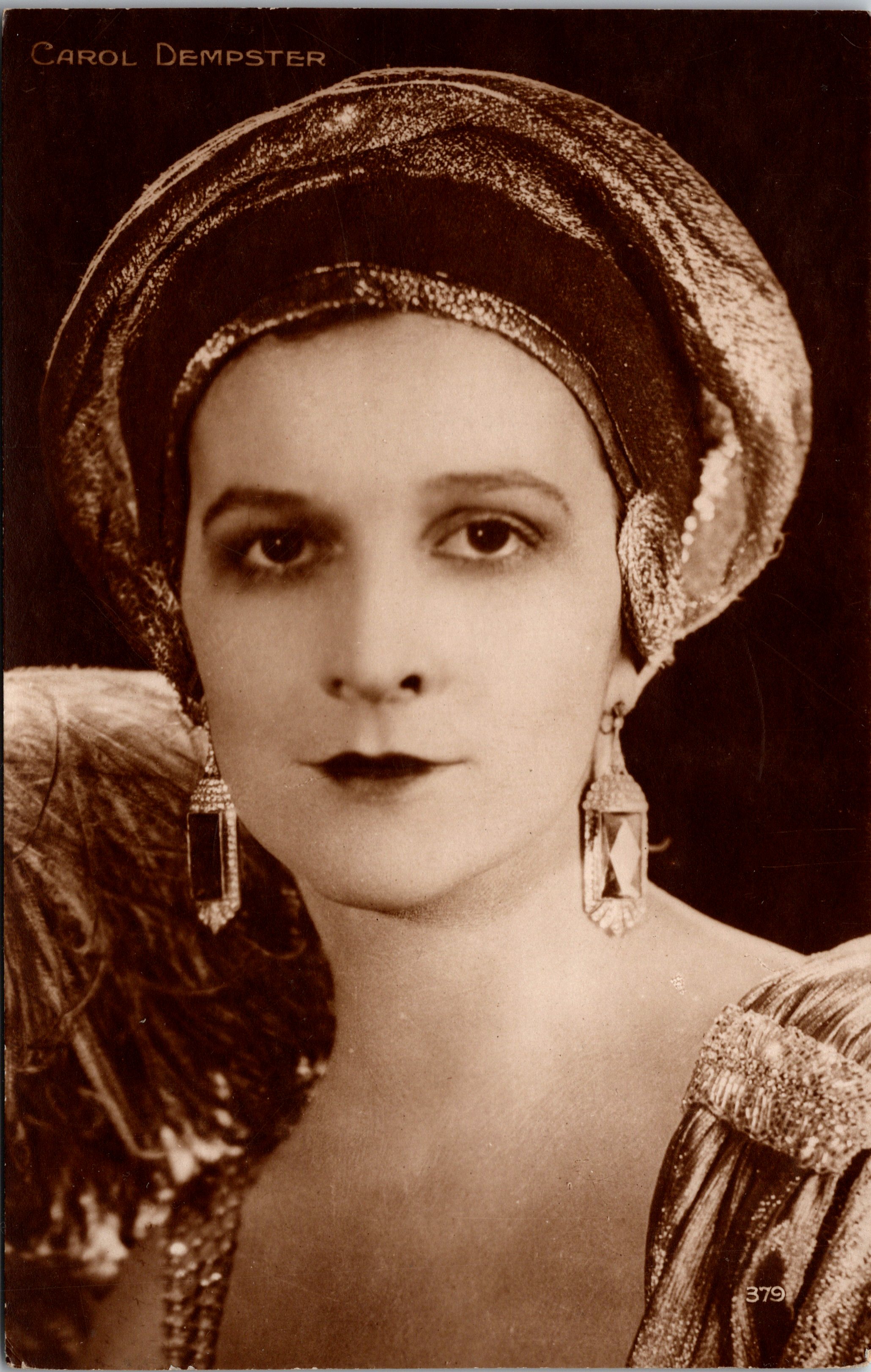
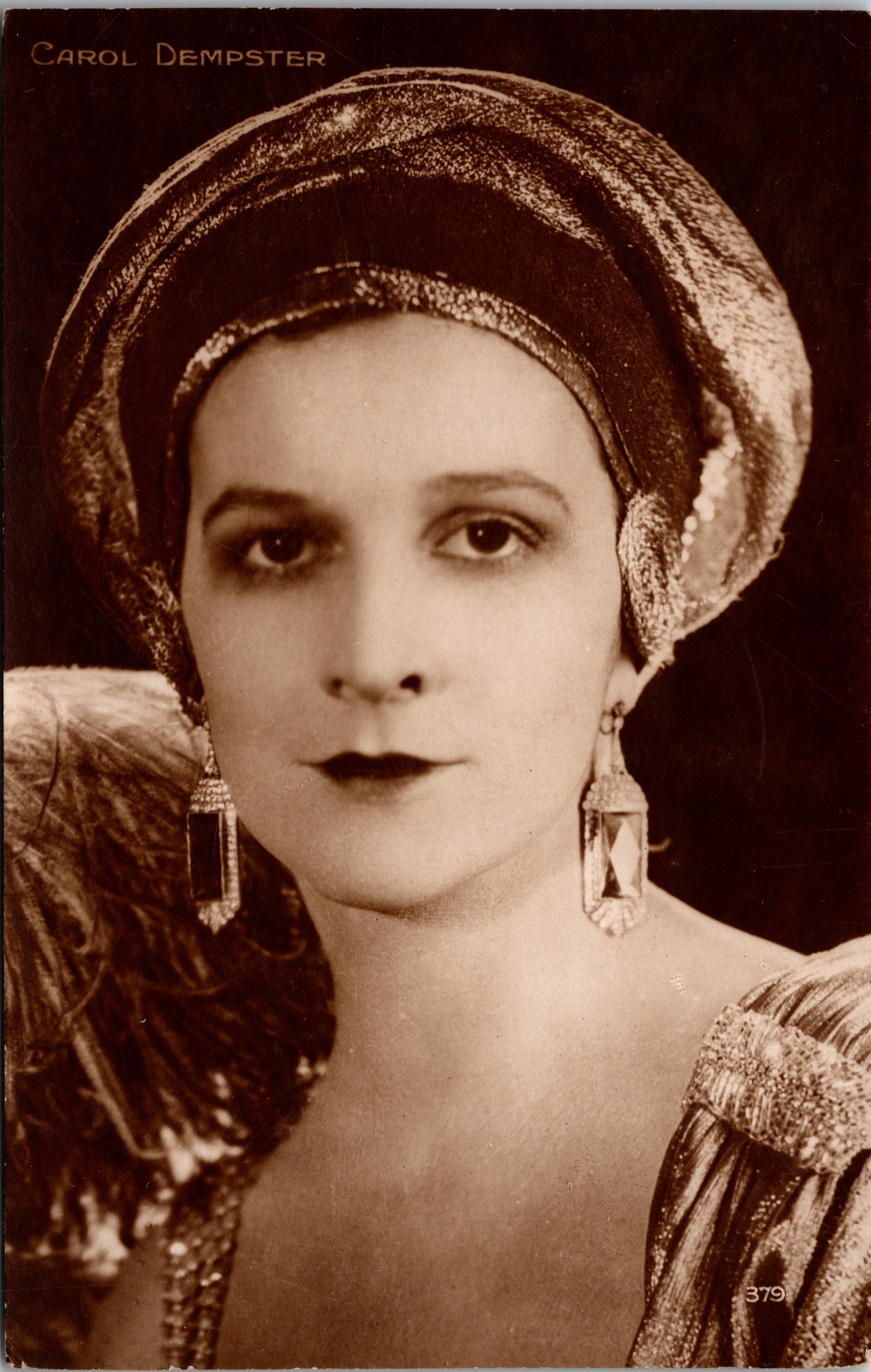
This vintage real photo postcard features American silent film actress, Carol Dempster (1901-1991). She was born in Minnesota. Her father was a captain on a ship that travelled on the Great Lakes. The family moved to California when her father switched careers. She was spotted dancing in a school program by noted dancer Ruth St. Denis. St. Denis recruited her for her own dance school. Griffith discovered her at the St. Denis school. Dempster began her film career as a protege of film director extraordinaire. She was one of a number of actresses he collected for his “stable”. Others included Lillian and Dorothy Gish, Miriam Cooper, and Mae Marsh. These other actresses were said to detest Dempster because she mimicked their acting styles. Dempster was given her first role in the 1916 film, “Intolerance”. She played a harem girl along with teenage newcomer, Mildred Harris. Dempster was just 15 years old. She became one of Griffith’s favorites and appeared in nearly every one the films he directed through the 1920’s. Their relationship became a romantic relationship during the arly 1920’s. Dempsters last film appearance was in 1926. She retired that year to marry a wealthy banker. Dempster was not seen as a great actress by critics. She was overshadowed by Lillian Gish. In addition her animated acting style and physical appearnce were considered relatively ordinary. The IMDb reports that Dempster appeared in 19 films between 1916 and 1926. This vintage postcard offers a closeup view of Miss Dempster She looks pretty and glamorous. The card was published by Cinemagazine (Paris Edition). The postcard dates back to the 1920’s and is in very good condition (see scans).
Buy this Vintage Real Photo Postcard (includes shipping within the US) #5295
To purchase this item, click on the Pay with PayPal button below
$25.00
Buy this Vintage Real Photo Postcard (includes International shipping outside the US) #5295
To purchase this item, click on the Pay with PayPal button below
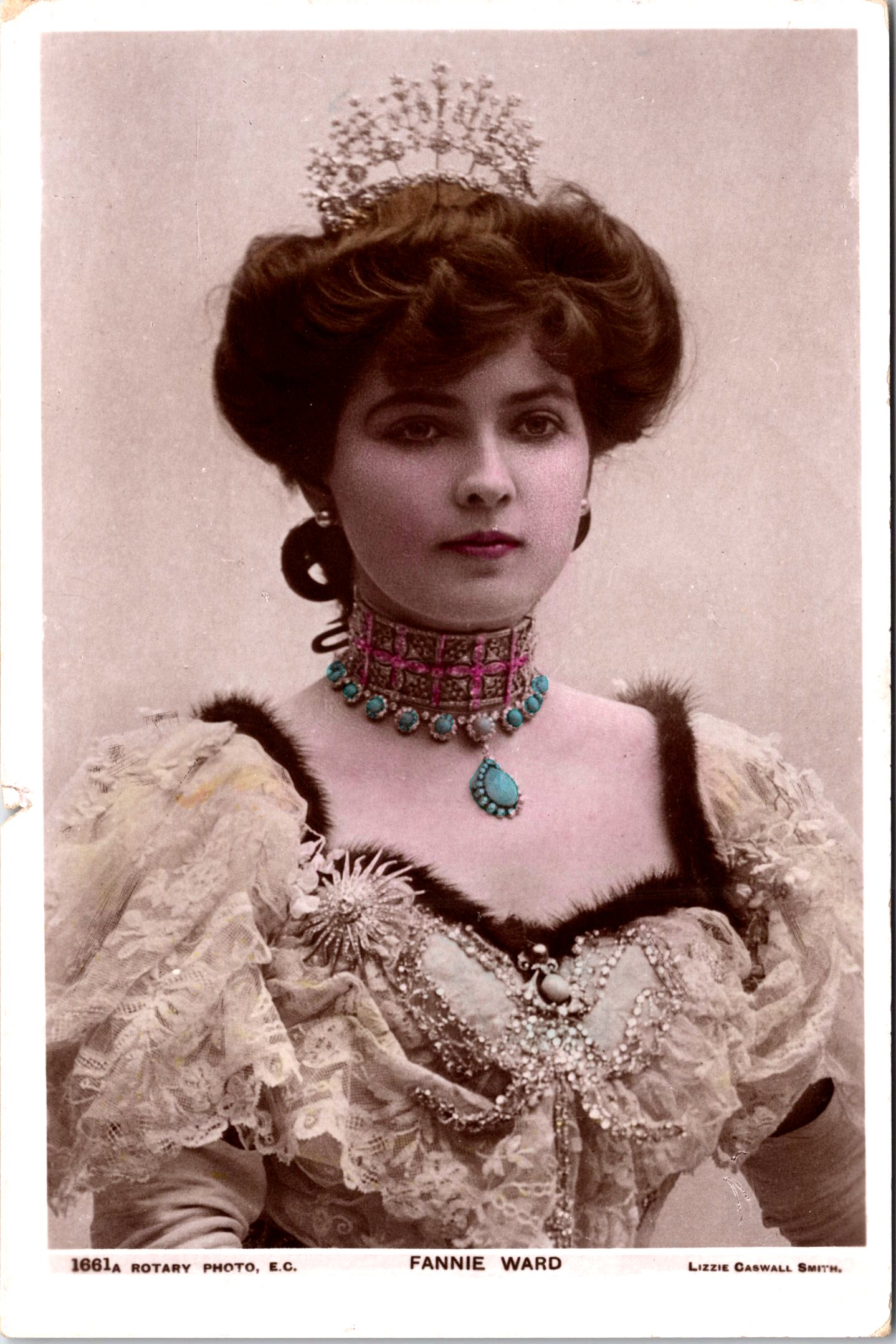
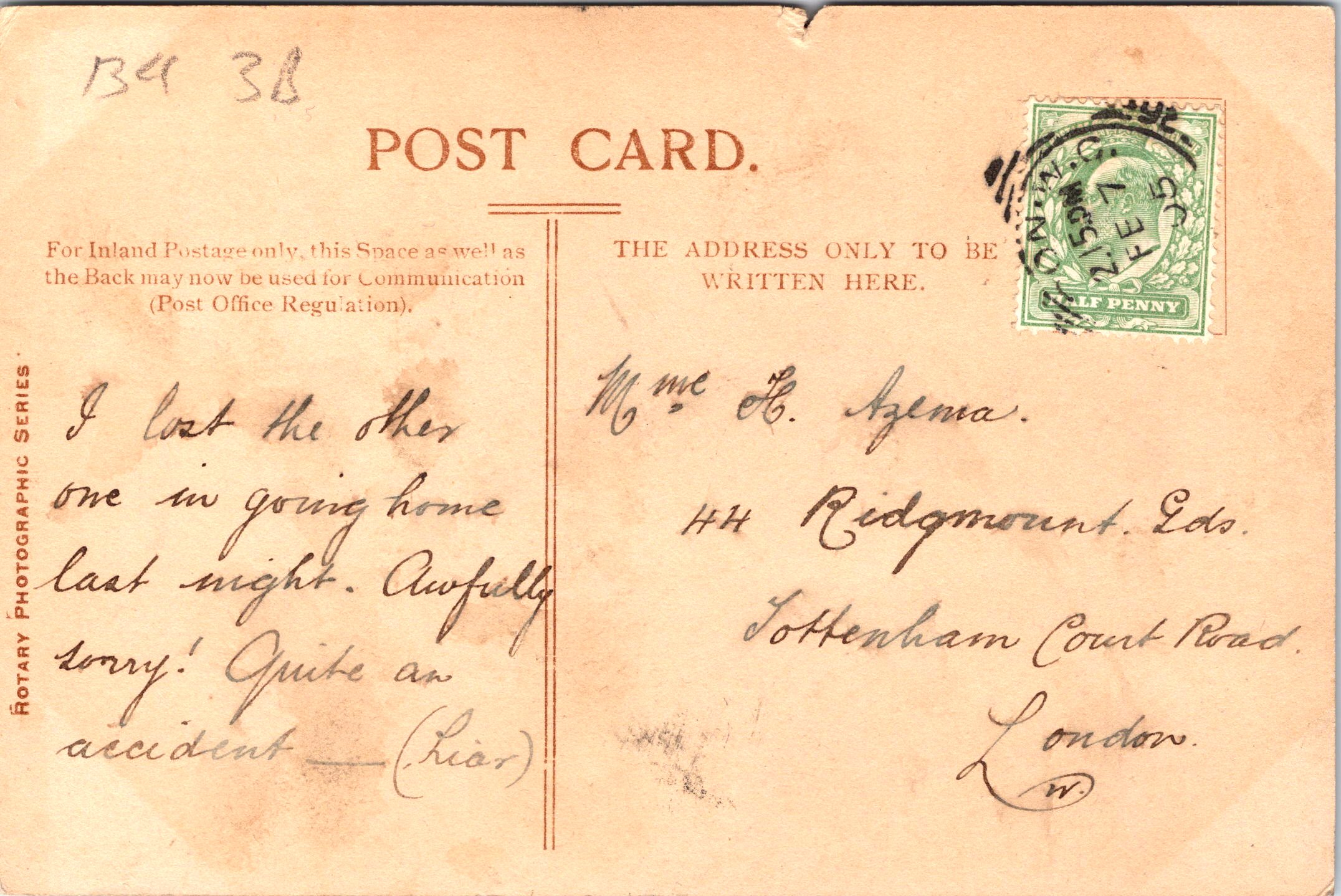
This vintage real photo postcard features pretty American stage and silent film actress and film producer, Fannie Ward (1872-1952). She was also the star of light comedies on Broadway. She began her career in the early 1890s, and appeared in over 100 films between 1895 and 1920. She was known for her roles in silent comedies and melodramas, and was considered one of the most popular actresses of her time. She played starring roles in “Madam President”, “The Shop Girl” and many others. Her screen debut was in Cecil B DeMille’s sexually charged, “The Cheat” (1915). Ward also produced several films, including the 1913 film “The Chink in the Armour,” which was directed by her then-husband, Frank Keenan. She retired from acting in 1920, but continued to work in the film industry as a producer until her death in 1952. In addition, after her retirement from the screen, she opened a beauty salon in Paris called “The Fountain of Youth”. The name of the salon is a bit ironic. Ward was known for her youthful appearance. It was not ununsual for her to play the parts of women one of two decades her junior. Ward held feminist beliefs which she wasn’t shy to talk about. In 1909, she told a reporter that her husband hated her work and then pointed out the hypocrisy of society’s support of men pursuing their interests (ie. art, sports, travel) but not supporting women who did the same. In addition, Ward worked as a film producer, a role not usually populated by women. Rotary Photo published this postcard as part of a series (No.1661A). The firm was located in London. Miss Ward was photographed by celebrated female photographer, Lizzie Caswall Smith. This posted postcard has a 1905 postmark. SOLD
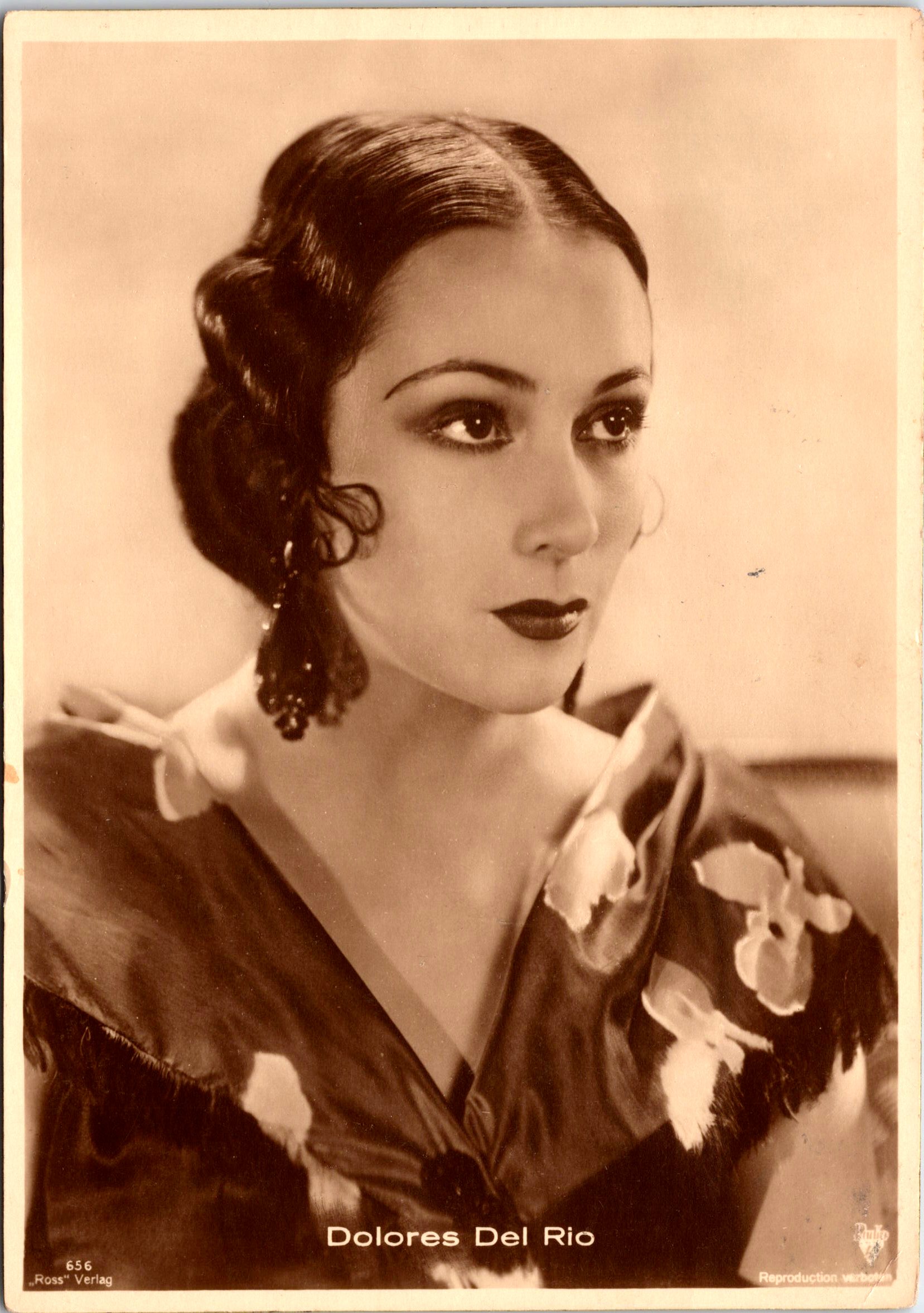
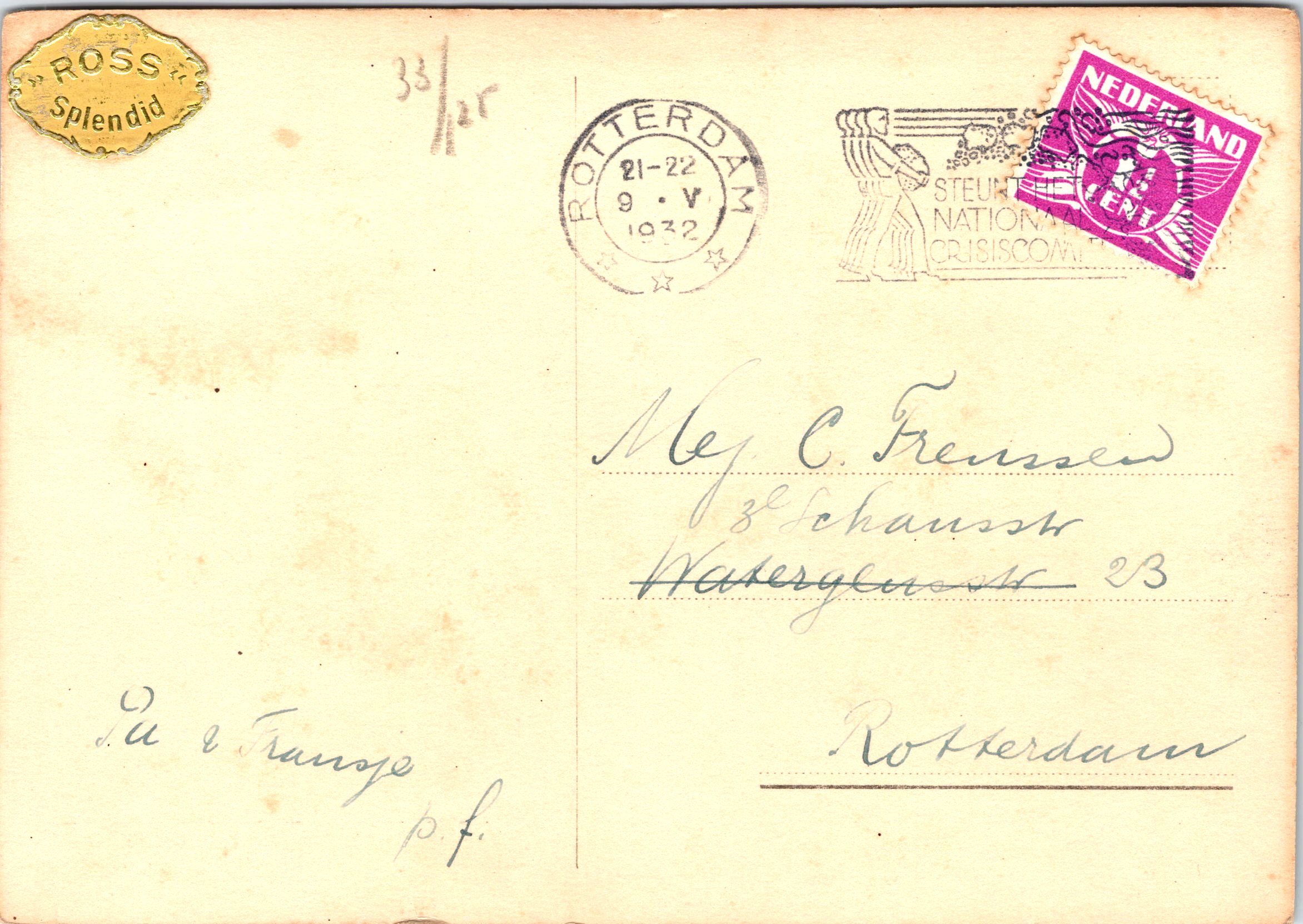
This vintage real photo postcard features pretty Mexican actress, dancer, and singer; Dolores del Rio (1904-1983). Del Rio’s performing career spanned more than half of a century. She was the first major Latin American actress to become an American film star (1920’s & 1930’s). Del Rio was also a major star in Mexican films. Dolores was known for her beauty as well as for her talent. She was discovered in Mexico and her Hollywood film career started in 1925. She began her career with a number of successful films, including “Ramona” (1928) and “Evangeline (1929). During the silent film era, she was considered the female version of “latin lover”, Rudolph Valentino. Del Rio was one of the fortunate actresses whose career was not destroyed by the advent of sound films. She acted in a wide range of film genres. “Bird of Paradise” (1932) and “Madame Du Barry” (1934) were among her successful films of the 1930’s. In the early 1940’s, her Hollywood career began to flounder sparking Del Rio to return to Mexico to become a major star of Mexican cinema. She continued acting in Mexican films through the 1950’s. Beginning 1960 she acted in both Mexican and Hollywood films. During the late 1950’s through the early 1970’s, Del Rio acted in theater and television. Dolores was born in Durango City, Mexico. Her parents were part of Mexican aristocracy whose lineage could be traced to Spain. Dolores was the cousin of actor Ramon Novarro (another silent film”latin lover”), and of Mexican cinema actress, Andrea Palma. During the Mexican Revolution (1910-1920), Dolores’s family lost its fortune. Her family felt threatened by Pancho Villa’s insurgence. It was time to “get out of town”. Her father fled to the United States while she and her mother escaped to Mexico City. Acting was an integral part of Dolores’s getaway. She and her mother felt compelled to dress as peasants to insure safe passage on the train to Mexico City. Her parents reunited there in 1912. Dolores attended a college in Mexico City operated by French nuns. After seeing Russian ballerina, Anna Pavlova perform; Dolores decided to become a dancer and took lessons from a well respected teacher. At age 17, Dolores married Jaime Martinez del Rio. He was from a wealthy family and was educated in England. The couple honeymooned in Europe for two years and Dolores formed close relationships with a number of members of European aristocracy. When the couple returned to Mexico, they settled in Mexico City. In 1925, Dolores met American filmmaker Edwin Carewe, and he was spellbound. He convinced Dolores and her husband to move to Hollywood where he promised to make Dolores a star. Her husband hoped to write screenplays there. When they arrived in Tinseltown, Carewe launched a public relations campaign to raise excitement about his beautiful find. He built up her aristocratic background by saying such gems as Dolores was “the first lady of high Mexican Society” and that she had come to Hollywood with a collection of shawls and combs valued at fifty thousand dollars. Dolores made her film debut in “Joanna” (1925), where she played a vamp of Spanish-Brazilian origin. Her first starring role was in the comedy “Pals First” (1926), directed by Carewe. That same year, Dolores appeared in the war film “What Price Glory?”. The movie was a huge financial success and helped Dolores become one of the “WAMPAS Baby Stars” of 1926. Other members of her “class” were Mary Astor, Joan Crawford, Janet Gaynor, and Fay Wray. By then, her film career was rocketing. Her role in Resurrection” (1927), a popular film based on a Tolstoy novel, further propelled her career. While her career was succeeding, her personal life was a “hot mess”. Her marriage to Del Rio ended in 1928. He had much difficulty being in the shadow of his famous and successful wife. Six months after Dolores filed for divorce, Del Rio died in Germany. While dealing with her grief, she had to deal with constant harassment from her discoverer, Edwin Carewe. He wanted to be more than her agent and her director since he had first launched her career. In 1929, Dolores announced to the press, that despite Carewe’s claims, the pair were just friends and business companions. She added that they had no plans for marriage. Soon thereafter, she cancelled her contract with him. The end result was a legal dispute that was settled out of court. Carewe’s anger did not end there. He disparaged her the press and refilmed “Resurrection” starring Lupe Velez, another popular Mexican film star. In 1930, Del Rio married MGM art director, Cedric Gibbons. They became one of Hollywood’s most followed couples of the early 1930’s. In 1932, the film, “Birds of Paradise”, was released to rave reviews. The film starred Del Rio and actor, Joel McCrea. The movie was a South Seas love story. A scandal arose from the film because of a scene featuring the pair swimming naked. Controversy continued in Del Rio’s appearance in “Flying Down to Rio” (1933). In this film, Del Rio was the first actress to wear a two piece bathing suit on screen. Fred Astaire and Ginger Rogers danced together for the first time on film, in this movie. Del Rio and Astaire also did an “intricate” dance number in the film. Del Rio found herself in political hot water when she and Ramona Novarro and Lupe Velez attended a special screening of a Mexican film which was accused of promoting Communism in California. Del Rio was accused of being a Communist for her attendance at the screening. In 1940, Del Rio began an affair with actor/filmmaker, Orson Welles. The dalliance resulted in Del Rio and Gibbons divorce. In 1954, Dolores was scheduled to co-star in a Spencer Tracy film, but the US government would not give her permission to work in the United States. The government believed she was sympathetic toward communism for attending the aforementioned film screening and for signing a petition supporting a world peace conference. After some time, she was able to remedy the problem by writing a persuasive letter to the US authorities. Later in life Del Rio did express some “political” beliefs. She stated that she wished she could play Mexican roles to show what life in Mexico was really like. She felt such an opportunity could help diminish the ugly stereotypes that existed about Mexicans in American society. She stated that it was her great wish to make fans realize the beauty, wonder, and greatness of Mexicans as a people. She asserted that the great majority of Americans view Mexicans as a “race of bandits, or laborers, dirty, unkempt, and uneducated”. Why do these false negative stereotypes sound so familiar? Del Rio wanted to show “the best that’s in my nation”. It has been pointed out by more than a few writers that Dolores del Rio was no “Latin bombshell”. Instead, she was noted for her elegance. The IMDb reports that Del Rio has 63 film credits ranging from 1925 through 1978. This vintage postcard was published by Ross Verlag as part of a series (no.656). The reverse of the card has a gold seal stating “Ross Splendid”. This postcard has a Netherlands stamp and was postmarked in Rotterdam in 1932. SOLD









 THE CABINET CARD GALLERY