DAPPER YOUNG MAN HOLDING A WAND IN WORCESTER, ENGLAND (CARTE DE VISITE))
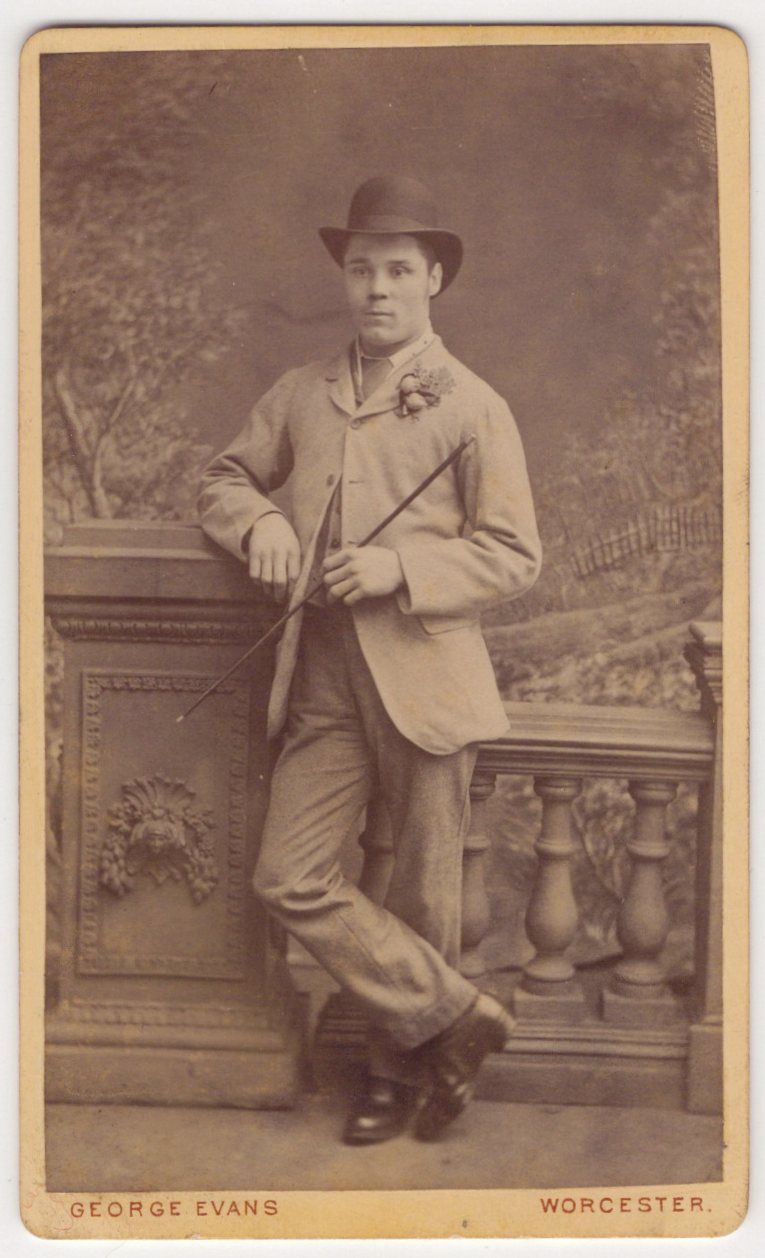
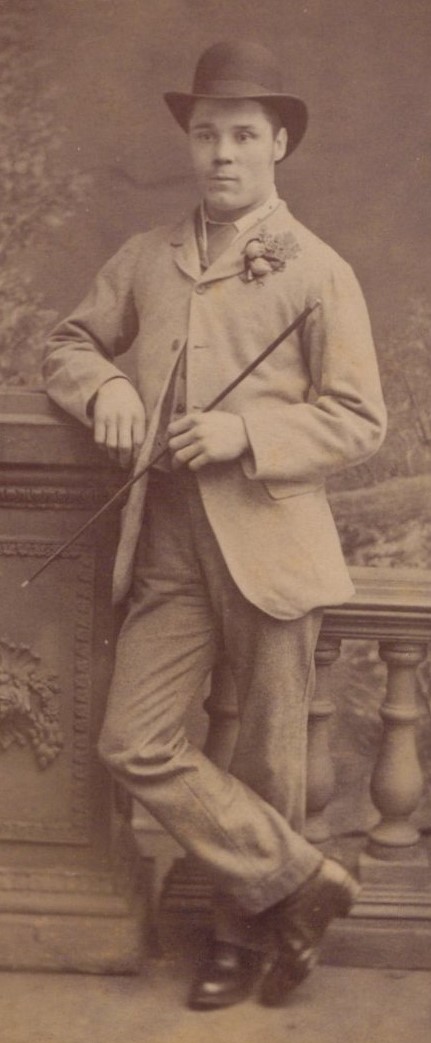
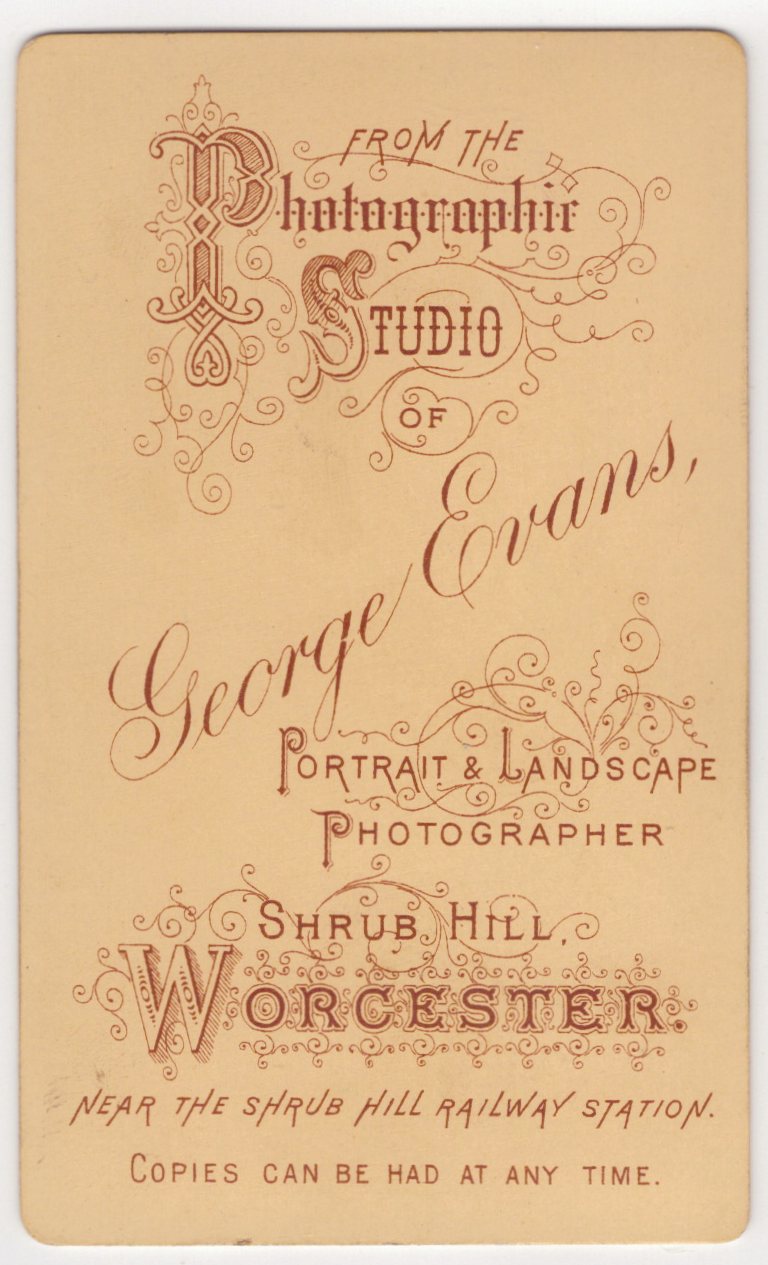
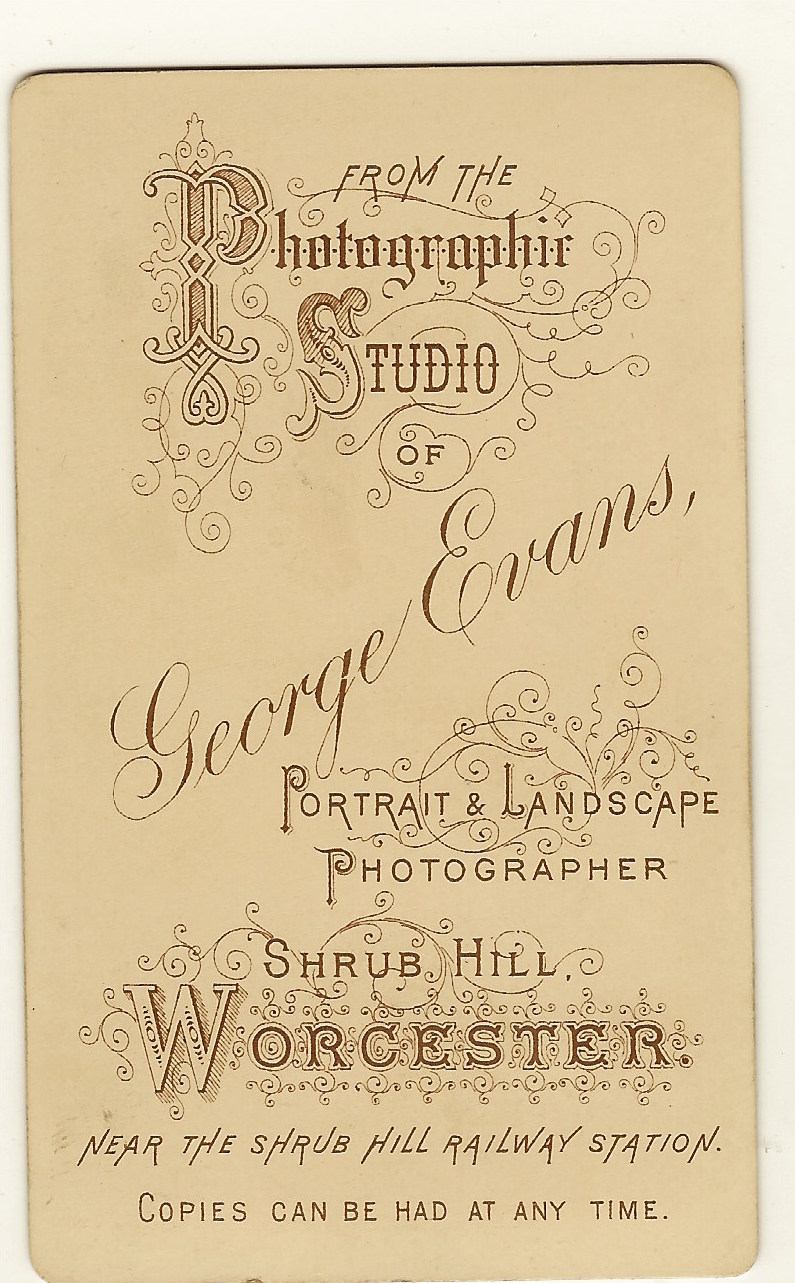
This carte de visite features a dapper young man wearing a corsage, derby hat, and a bit of a bewildered expression. Take note of his wand. I call it a wand for lack of a better description. One thinks of wands as being related to magic. However, not all wands are associated with magic. In fact, wands also are symbolic objects of power. The photographer of this cdv image is George Evans who operated a studio in Worcester, England. This cdv is in excellent condition (see scans).

Buy this Carte de Visite Photograph (includes shipping within the US) 6191
To purchase this item, click on the Pay with PayPal button below
$28.00
Buy this Carte de Visite Photograph (includes International shipping outside the US) #6191
To purchase this item, click on the Pay with PayPal button below
$38.00

PORTRAIT OF A LOVELY YOUNG WOMAN : FERDINAND FLODIN : STOCKHOLM, SWEDEN
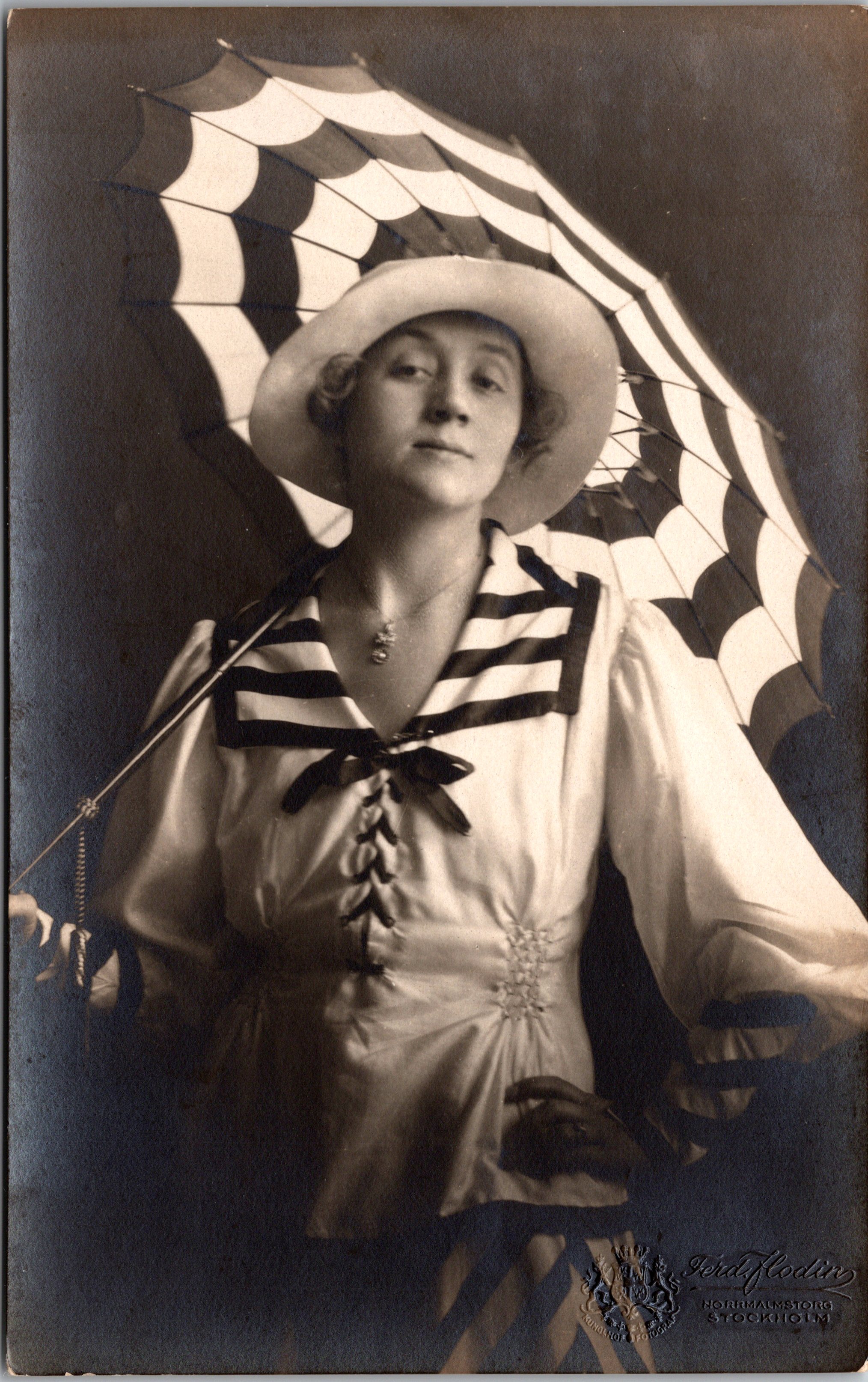
This vintage real photo postcard features a portrait of a lovely young woman. She is beautifully dressed and holding a parasol. This postcard photograph was taken by Ferdinand Flodin (1863-1935). He was a Swedish photographer who operated a studio in Stockholm. He was well known for his portrait work, especially of theatrical performers. He was educated in the United States from 1883 to 1887. For the next two years he ran a photography gallery in Worcester, Massachusetts. He then returned to Sweden. In 1906 he became secretary of the Swedish Photogaphers Association, a post he held nine years. This postcard was published by Axel Eliasson’s Art Publishers. The publishing house was founded in 1890 and the Stockholm company was the leading producer of postcards in Sweden for many years. SOLD

PORTRAIT OF REVEREND ALBERT TYLER (1823-1913): PUBLISHER AND HISTORIAN IN WEBSTER, MASSACHUSETTS
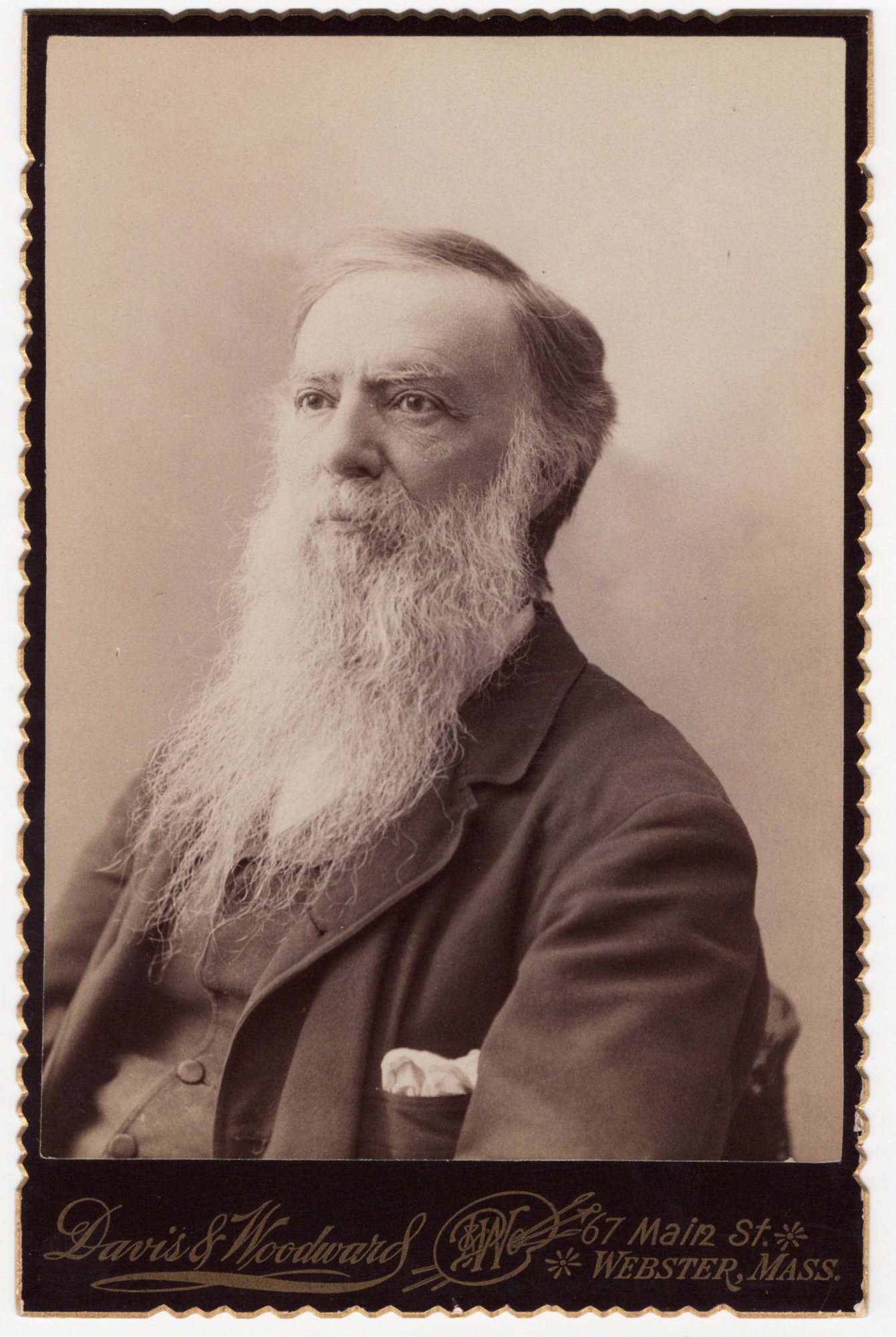

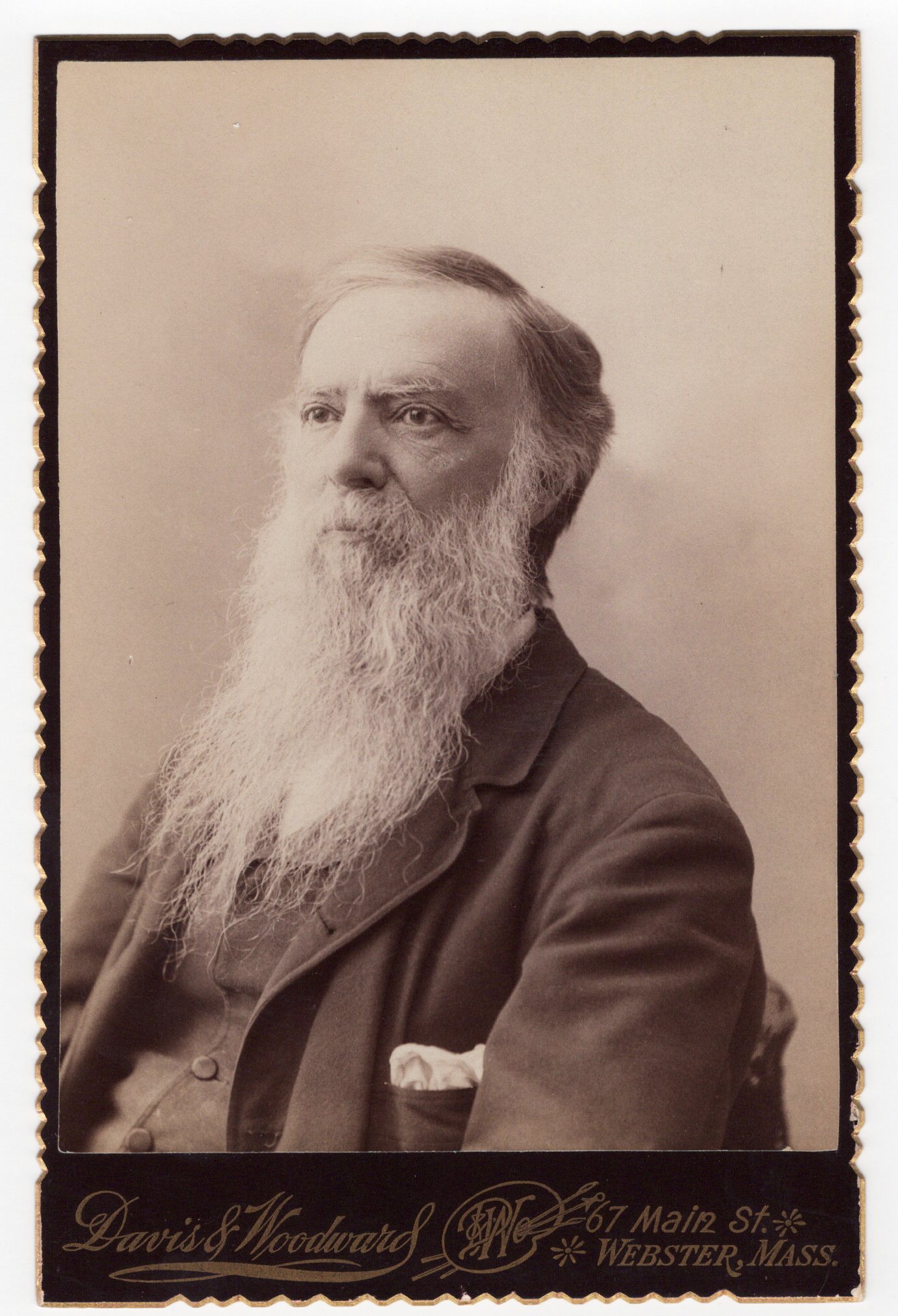
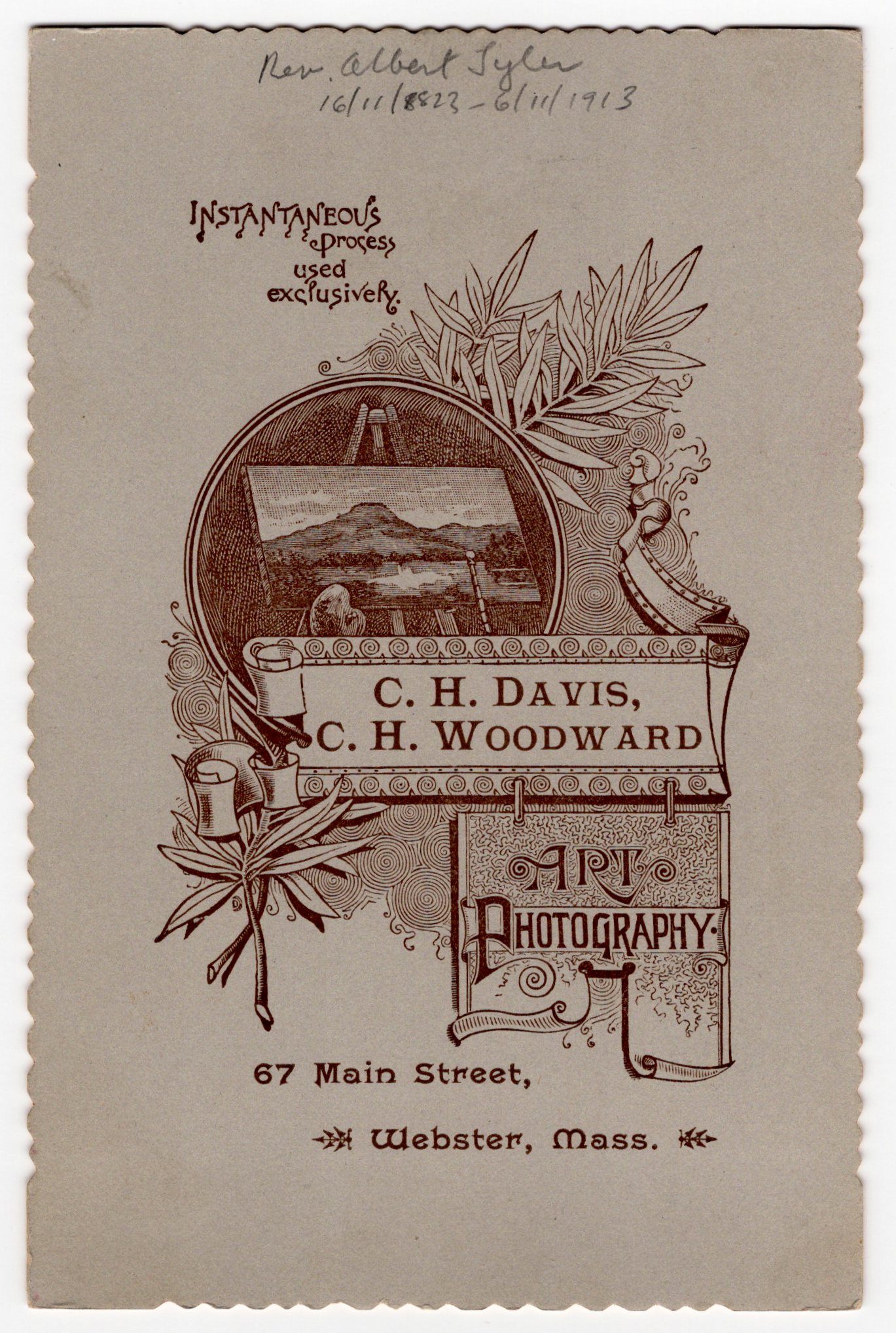
This cabinet card is a portrait of Reverend Albert Tyler (1823-1913) who was a publisher and historian in Worcester, Massachusetts. Tyler was a Universalist minister. Tyler’s portrait was done by the studio of Davis & Woodward, located in Webster, Massachusetts. Tyler’s name, date of birth, and date of death are listed in an inscription on the reverse of the photograph. This image was taken in his later years and he has a long gray beard that becomes very wispy at its bottom. In the book, “History of Worcester Massachusetts” , by Lincoln and Hersey (1862), Tyler is said to have been born in Smithfield, Rhode Island. The publication states that Tyler was ordained in 1851 from the Union Association of Universalists in Warren, Massachusetts. He then became pastor of churches in Oxford, Ma. (2 years), Granby, Connecticut (6 years), and Quincy, Ma.. Next he moved to Worcester and entered the printing business. The Webster Times (1889) supplies an interesting story about Reverend Tyler. He was in attendance of the 28th reunion of the 15th Massachusetts Volunteer Infantry Regiment (Company E) when he displayed some unusual behavior. Tyler “created a sensation” among the 25 veterans in attendance “by rising and saying he received a “spiritual communication” from Lieutenant Nelson Bartholomew who had died during the war. The message that Tyler received stated that the Lieutenant’s spirit was attending the meeting and found it “most enjoyable to him” and that he loved his comrades, just as he had in 1861. This cabinet card photograph is in very good condition (see scans).

Buy this Cabinet Card (includes shipping within the US) #3785
To purchase this item, click on the Pay with PayPal button below
$28.75
Buy this Cabinet Card Photograph (includes International shipping outside the US) 3785
To purchase this item, click on the Pay with PayPal button below
$37.75
LORRAINE DREUX: PRETTY STAGE ACTRESS DIES YOUNG AND TRAGICALLY
CABINET CARD 1 (SOLD)
CABINET CARD 2 (SOLD)

CABINET CARD 2 (CLOSE-UP) (SOLD)
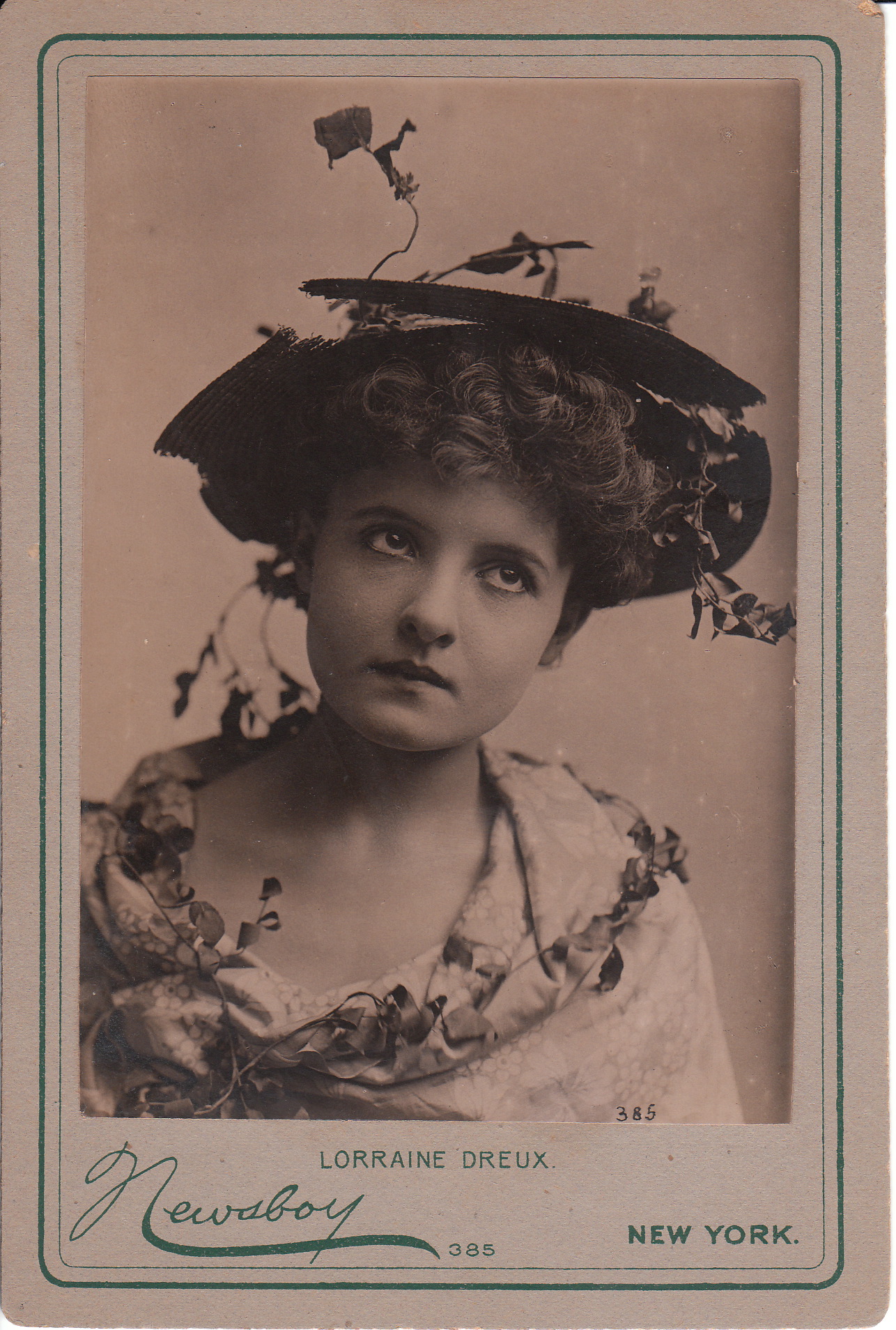
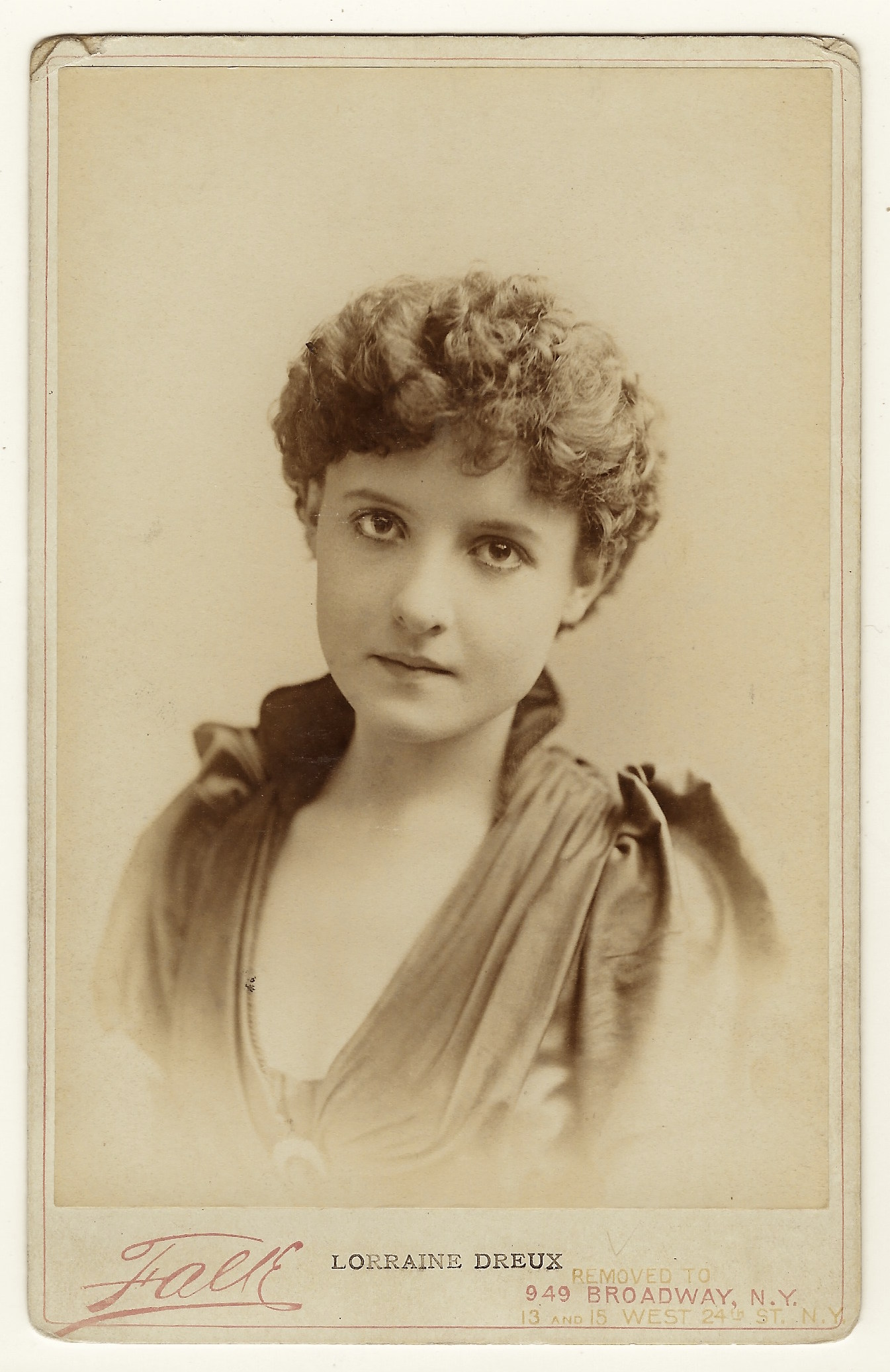
This cabinet card is a portrait of theatre actress, Lorraine Dreux. The image is part of the Newsboy Series (#385) and was published in New York City. The Newsboy series was used for advertising purposes by the Newsboy Tobacco Company. Celebrity photographs were given away as premiums upon the sale of tobacco products.To view other Newsboy photographs, click on the category “Newsboy”. Ms. Dreux looks like she ran through the woods in order to arrive at the photography studio in a timely fashion. She has twigs and leaves on her head and even is wearing a necklace of branches around her shoulders. It seems she is modeling “the natural” look. Her eyes are looking upward, as if to say, “Am I really wearing sticks and leaves?”. Who was Lorraine Dreux? The Illustrated America (1893) describes her as “young and pretty, with soft dark eyes, a tremulous little mouth, and a dazzling complexion”. She was born in Marquette, Michigan, of well to do parents. Her father did a great deal of business in the East and she spent much time on the banks of the Hudson River in New York. She was educated at home by a governess supervised by Dreux’s beautiful mother. She decided that she wanted to be an actress while in her early teens. Her parents reluctantly gave her permission and her first experience acting occurred while she was in London, England, with her mother. She was engaged by Mr Charles Wyndham to play comedy parts in London stage shows. She next joined the London Globe Theatre Stock Company playing sentimental roles. She then joined an English traveling theatre company. She soon returned to America and appeared in a number of plays, including “Ninety Days” with William Gillette. The article closes with the prediction that Dreux would be a successful actress in America because she possessed both beauty and talent. The New York Times (1894) reported on Dreaux’s appearance in “Lem Kettle” at the Bijou theatre. She also appeared in “Rush City” (1894) which was staged in Brooklyn (New York), and also in “Nance Oldfield” (1896) in New York. The latter show starred Rose Coghlan and her portrait can be seen in the Cabinet Card Gallery by placing her name in the “search box”. Dreux appeared in one Broadway production, “The Spectator” (1896). The New York Dramatic Mirror (1908) reported the tragic death of Lorraine Dreux. She was described as a well known and capable leading women of many stock companies outside of New York City. She died in New York’s Bellvue Hospital at age 35. The article reports that she “had fallen on evil days” and was “too proud to let her friends know of her plight”. She let an illness go till it turned into acute pneumonia which led to her death. Her last two engagements were in Worcester, Massachusetts and Rochester, New York. She received excellent reviews for her acting in both productions. However, her wardrobe was stolen and she was criticized for the way she dressed for her part in Rochester. She returned home “down hearted and discouraged” and sick, penniless and homeless. She met an old friend on the streets of New York who took her home to be fed and cared for but her condition worsened. A collection was made from other actors and actresses and the money was used to admit her to Bellvue Hospital where she died. Aid from the Actors Fund paid for her funeral and burial at Evergreen Cemetery. The second cabinet card portrait above, features Lorraine Dreux and her “Bette Davis eyes”. In this photograph, Miss Dreux has remarkable striking eyes. She is gazing directly at the camera. Many cabinet card portraits of actresses captures them with averted gaze. For example, the majority of cabinet card images of Sarah Bernhardt, that I have seen, has the celebrated actress staring away from the camera. Modern neuroscience has demonstrated that people find attractive faces with direct gaze are “more rewarding” than faces with averted gaze. This particular cabinet card is a bit risque as a result of Dreux’s relatively plunging neckline. This portrait was taken by Benjamin Falk, the celebrated New York celebrity photographer. (SOLD)

CABINET CARD 2
DAPPER YOUNG MAN HOLDING A WAND IN WORCESTER, MASSACHUSETTS
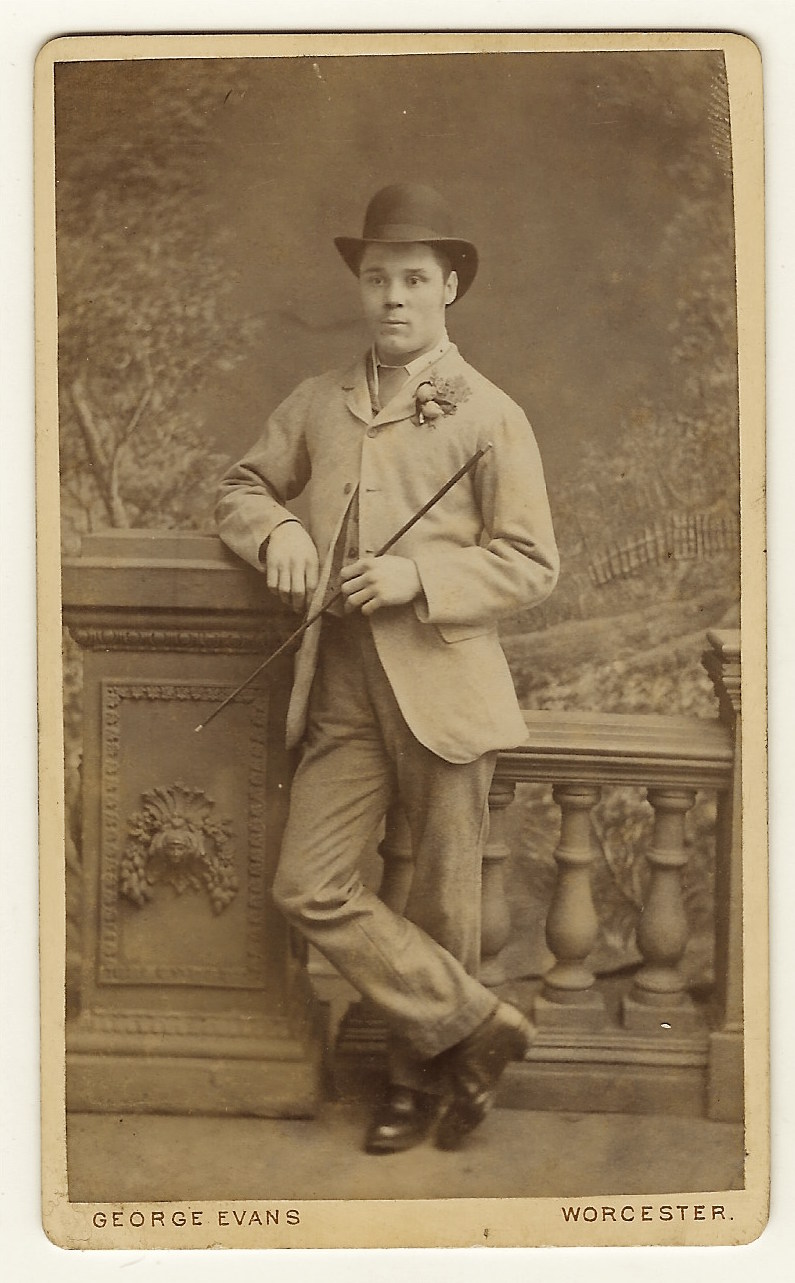
This carte de visite features a dapper young man wearing a corsage, derby hat, and a bit of a bewildered expression. Take note of his wand. I call it a wand for lack of a better description. One thinks of wands as being related to magic. However, not all wands are associated with magic. In fact, wands also are symbolic objects of power. The photographer of this cdv image is George Evans who operated a studio in Worcester, Massachusetts. ADDENDUM: Since this entry, an observant visitor to the Cabinet Card Gallery left a comment informing me that the location of Mr Evans studio was actually in Worcester, England. Further research confirms her observation.
PRETTY AND FASHIONABLE TEENAGER IN WORCESTER, MASSACHUSETTS (CARTES DE VISITE)
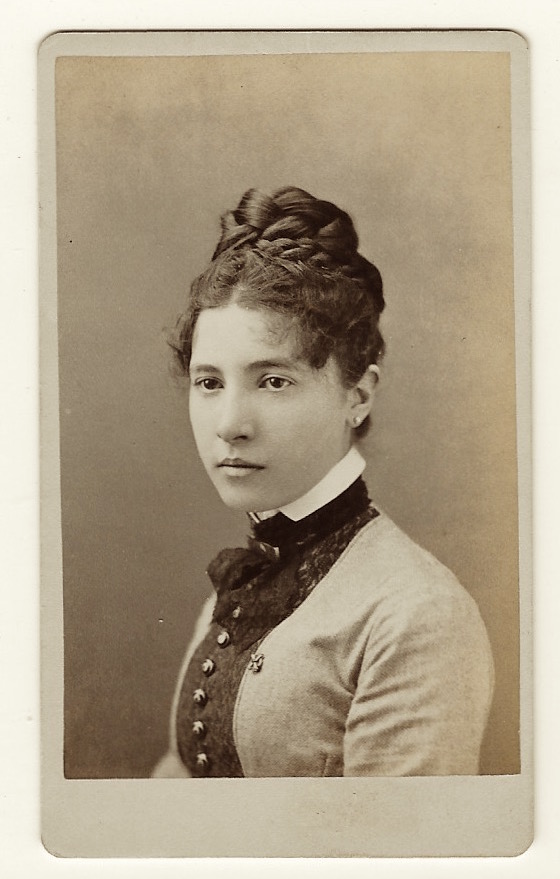
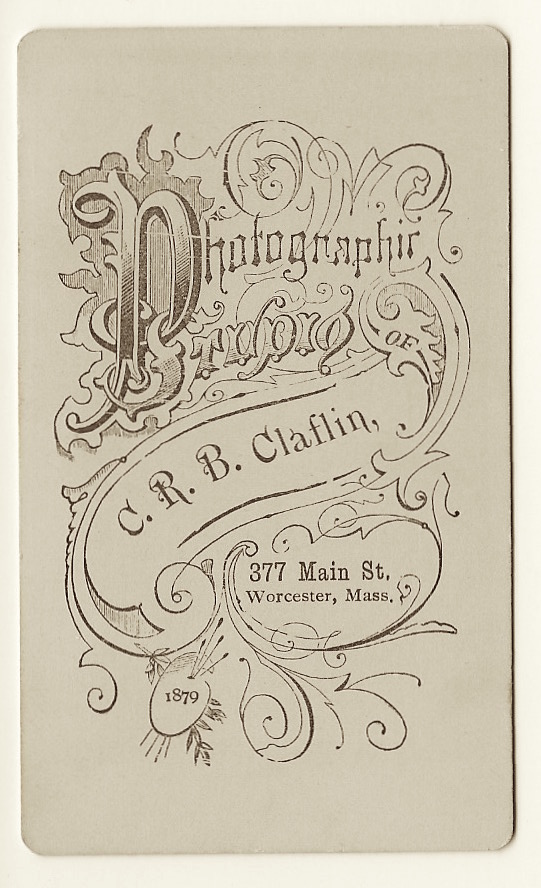
A pretty young woman poses for her portrait at a studio belonging to photographer C. R. B. Claflin in Worcester, Massachusetts. I suspect that the woman in this photograph is in her teenage years. She is handsomely dressed in her high collared tailored dress. She is wearing a pin on her dress as well as earrings. The reverse of this cartes de visite image reveals that the photograph was taken in 1879, during the transition from cdv’s to cabinet cards. Note the misspelling on the reverse of the cdv. The word “Photographer” is spelled as “Photographir”. It seems unlikely that Mr. Claflin was unaware of the printer’s error. My guess is that he felt a need to not waste his money and utilized the card stock despite the mistake. Charles Ripley Burnett Claflin (1817-1897) was a photographer during many decades. He operated studios in Worcester during part of the 1850’s through part of the 1890’s. On of his images appears in the book American Victorian Costume in Early Photographs (2013). Claflin was married to Emma Claflin. SOLD
WELL DRESSED CONFIDENT LITTLE GIRL IN WORCESTER, MASSACHUSETTS
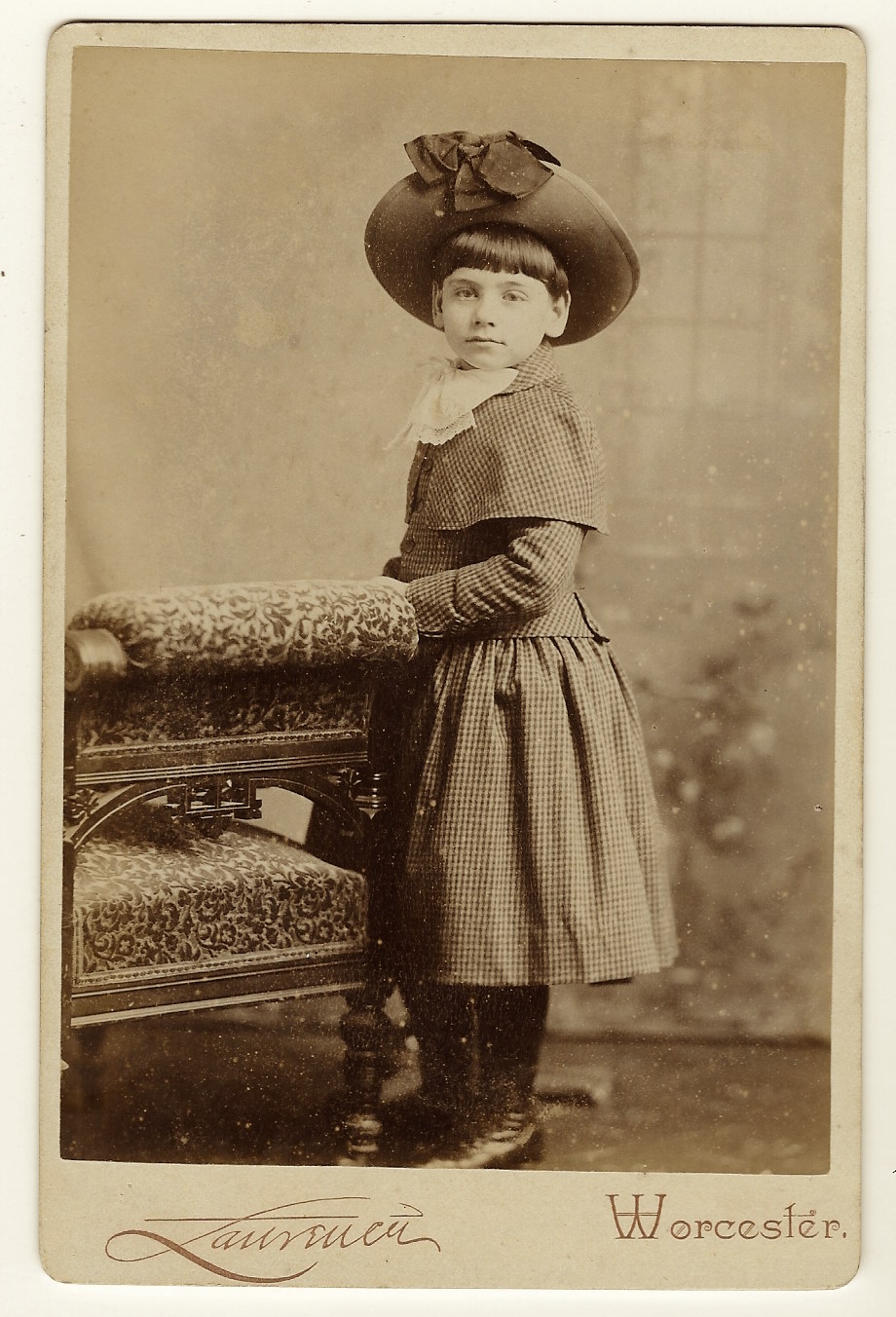
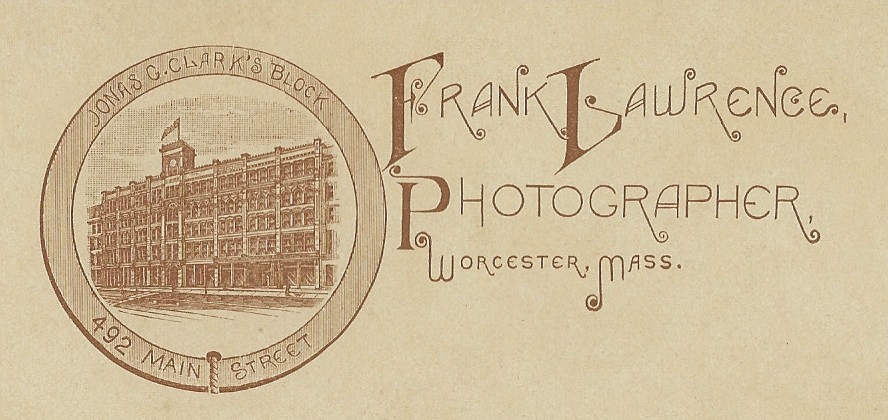
A cute little girl wearing a checkered dress and big hat posses for her photograph at the Lawrence studio in Worcester, Massachusetts. The child projects an air of confidence as she gazes at Frank Lawrence, the photographer. A drawing of Lawrence’s studio can be seen on the reverse of this cabinet card (see image below). His studio was located on the John G.Clark’s Block. To learn more about this photographer and to view more of his photographs, click on the category “Photographer: Lawrence”. (SOLD)
PORTRAIT OF AN ARMENIAN COUPLE IN WORCESTER, MASSACHUSETTS (PHOTOGRAPHED BY ARMENIAN PHOTOGRAPHER)
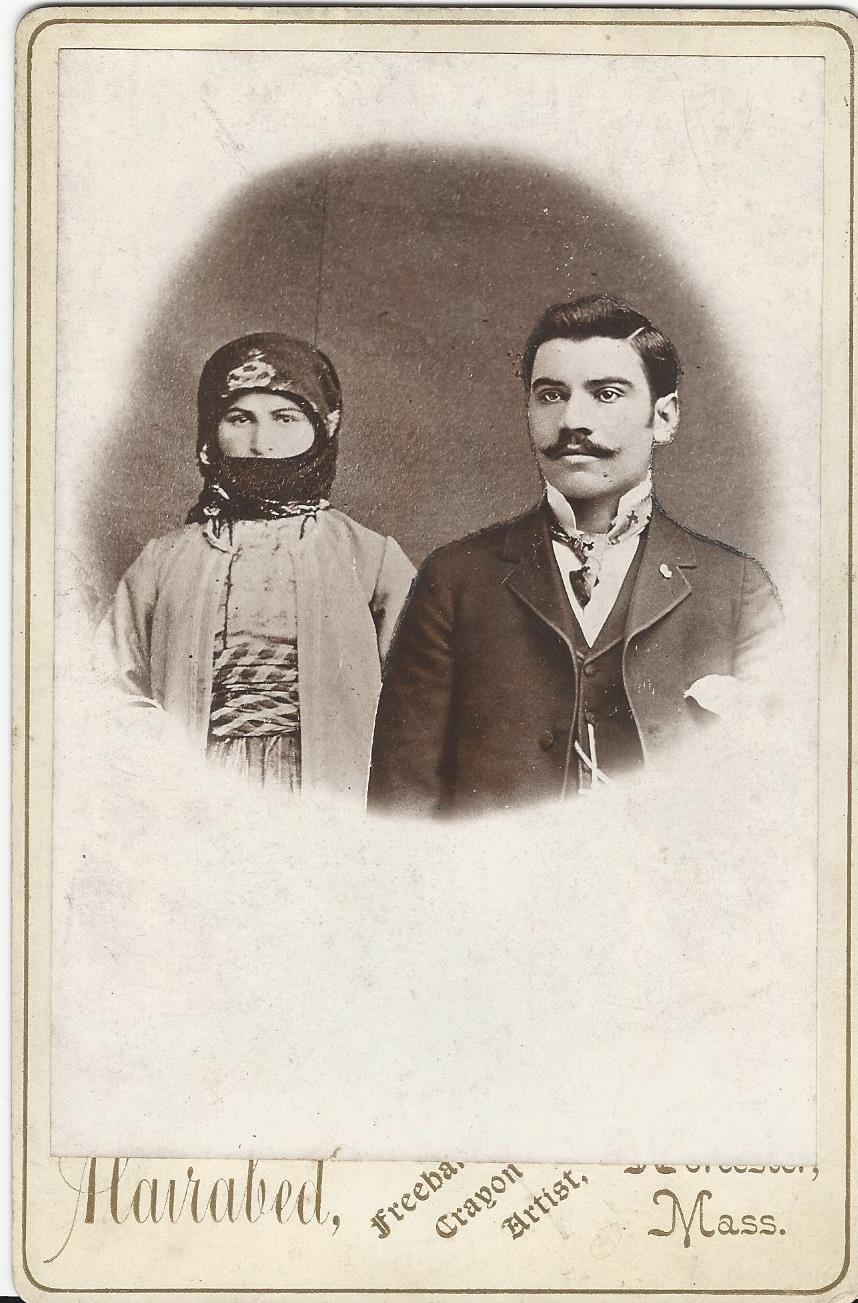
One of the wonderful benefits of studying antique images is that they often are remnants of important and interesting history. This cabinet card image is a terrific example of a photographer capturing history with his/her camera. In this case, the photographer was just not cataloging history, but he was part of it. Lusadaran, the Armenian Photography Foundation, cites the photographer of this cabinet card. An article on their web site discloses that Hairabed was a photographer in Worcester, Massachusetts in the 1900’s through the 1920’s. During his photography career he had shortened his name from his given name of Hairabedian. There is no mention of his first name. The article reports that he had likely emigrated to America from the Ottoman Empire. Once here, he photographed the first waves of Armenian Genocide survivors and immigrants settling in the Worcester area. His specialty was taking studio portraits. After doing some preliminary research, I may have uncovered the photographer’s first name. The city directory of Providence (1909 and 1910) lists a photography studio operated by Bedros and Astoor Hairabedian. The 1910 directory notes that Astoor Hairabedian moved to Salem, Massachusetts during that year. This image was most likely taken before 1910 but it would not be unusual for a family photography business to have been operating at two or more different cities simultaneously. Perhaps Astoor had decided to move to Massachusetts to manage or work at that location to replace or join another relative already there. What do we know about the subjects of this cabinet card portrait? Not much. We can only surmise by their dress and appearance that they are Aremenian immigrants to the United States shortly after the turn of the century. The woman in the image is wearing traditional clothing including a scarf covering her head and much of her face.
THREE YOUNG SIBLINGS IN WORCESTER, ENGLAND
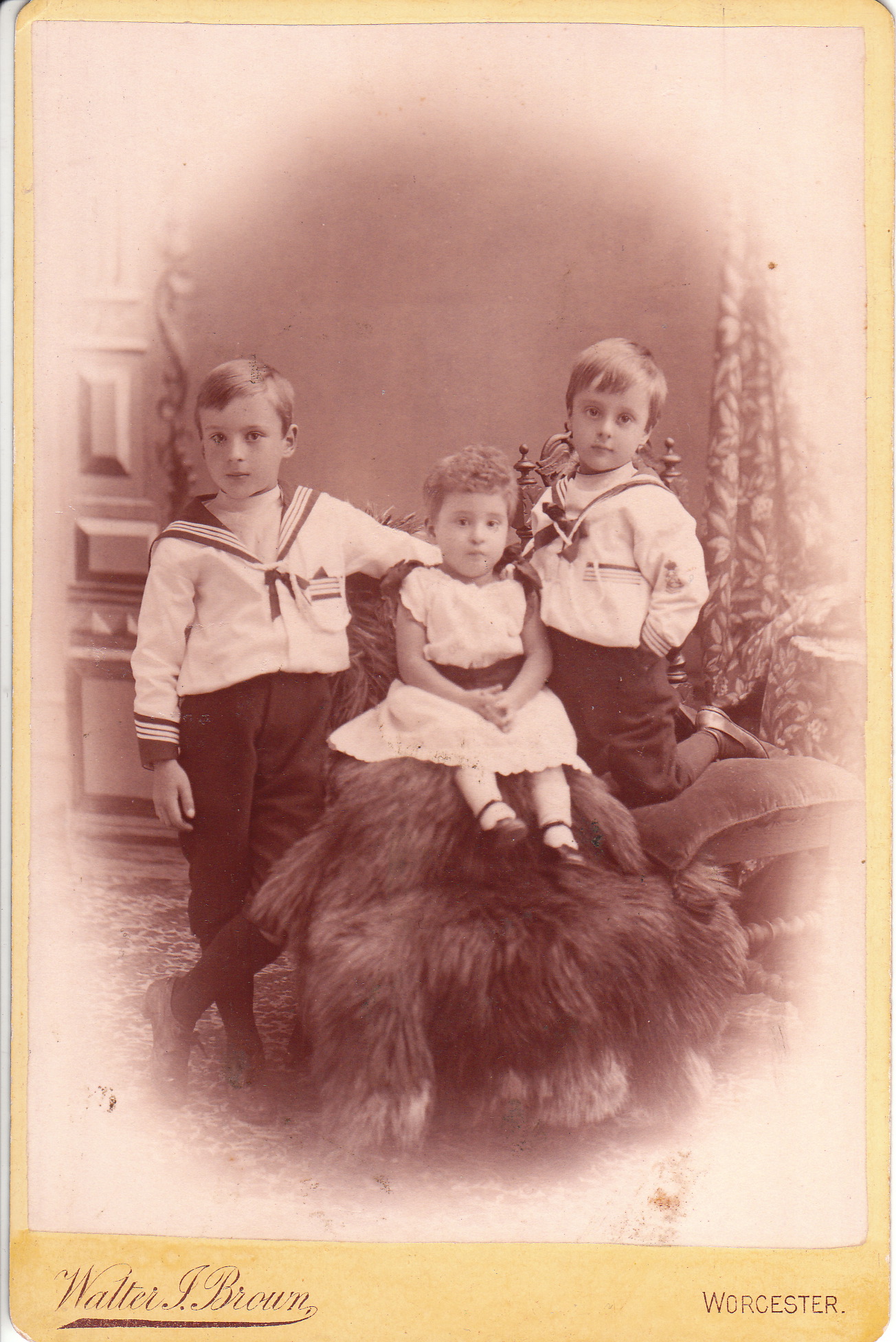
This cabinet card features three adorable young siblings posing at the West End Studio in Worcester, England. The boys are wearing sailor suits. Their little sister sits between them with her hands clasped and a with a bewildered expression. Walter J. Brown’s studio was located at 9 Bridge Street in Worcester.


 THE CABINET CARD GALLERY