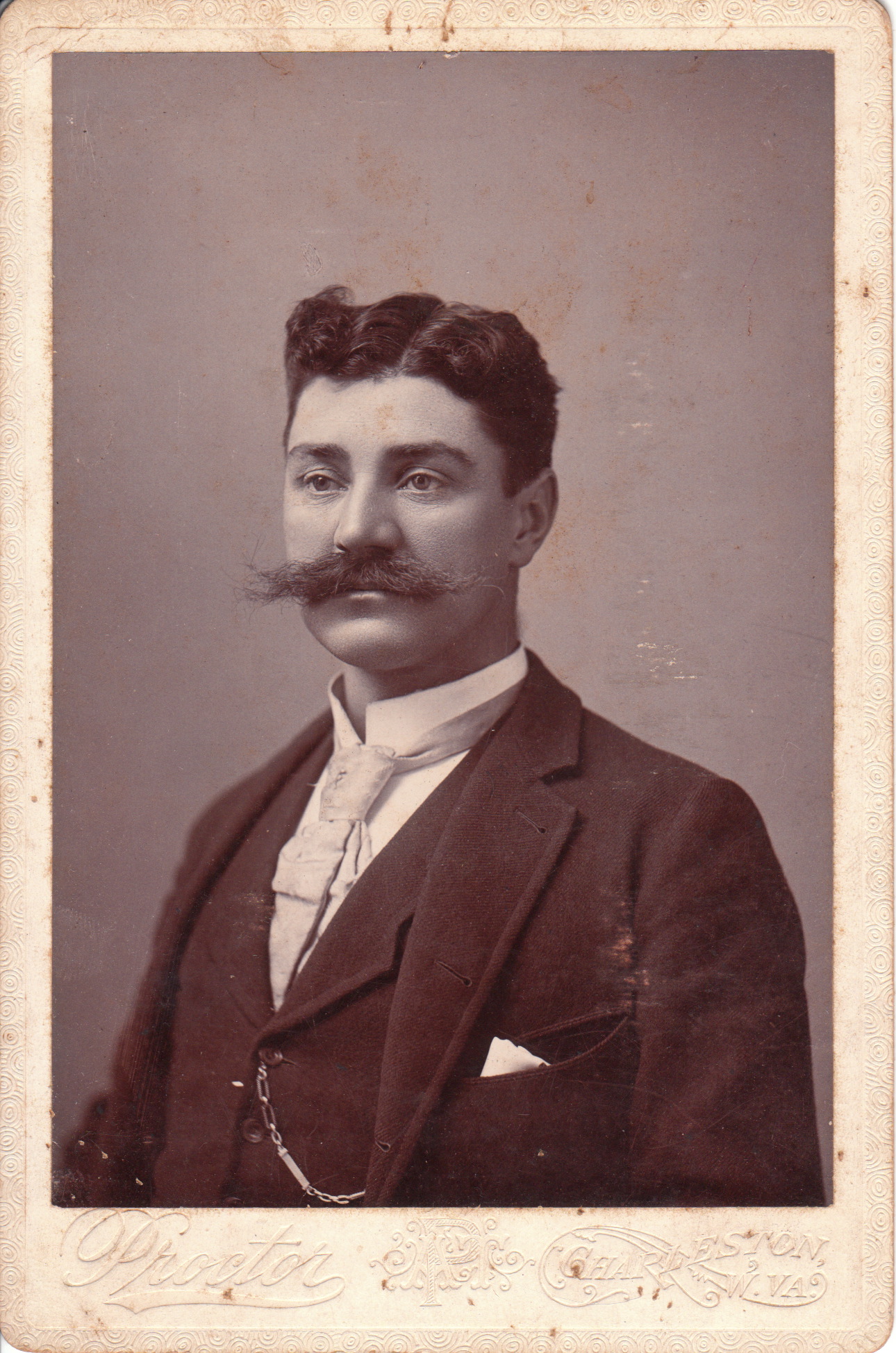
 The Proctor studio produced this cabinet card portrait of a man with a walrus mustache. This admirable facial hair places this image in the category “Mustaches (Only the Best”). Click on the category to view an array of notable mustaches. A. T. Proctor’s studio was located on Capitol Street in Charleston, West Virginia. He was the successor to the Becker & Fell studio. Alfred Tobert Proctor was born in 1864 in Catalpa, Virginia. Sometime about 1888 he began his photography career in Charleston. He originally partnered with Elmer B. Tully (Proctor & Tully). In 1894 they moved their business to Huntington, West Virginia leaving photographer William Erskine to run the Charleston studio. In 1897 Erskine joined the two partners in Huntington. Ultimately the partnership ended and the three photographers operated independent businesses. Proctor was very active in the photography community. He served as President of the American Photographers Association for several years beginning in 1910. He competed in many exhibitions and Eastman Kodak used his portrait in its national advertising. He died of a heart attack in 1933. Much of his work now resides in the special collections library at Marshall University.
A MAN AND HIS WALRUS MUSTACHE IN CHARLESTON, WEST VIRGINIA

FOUR GRANDDAUGHTERS GATHER AROUND THEIR GRANDMA FOR A FAMILY PORTRAIT (1898)

This photograph presents an unidentified family portrait from an unidentified photographer and location. A message is written on the reverse of the photograph and it states “Wishing Grandma many happy returns, May 4, 1898” It is likely that the four girls in this attractive family are sisters and that the older adult in the image is their grandmother, although she could possibly be their mother. The grandmother/mother is seated at a table and holding an open book. One of the girls has a magazine or newspaper on her lap. She also is wearing a change purse on her belt. The sister behind her is wearing spectacles, possibly a pince nez.
TWO STYLISH DANDIES POSE IN DENVER, COLORADO
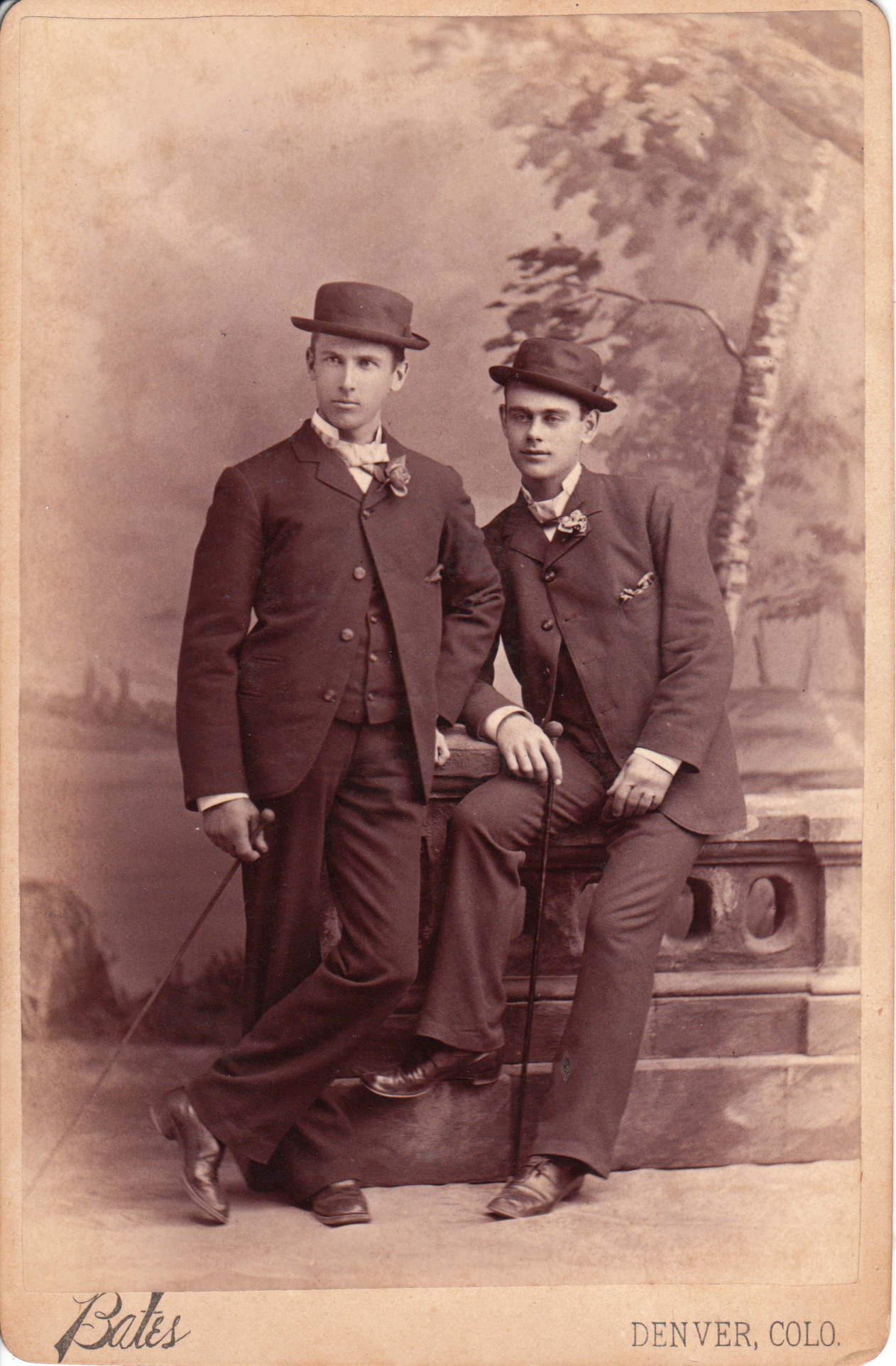
This cabinet card features two dandies posing at the Bates studio in Denver, Colorado. The studio was located in the Tabor building at Sixteenth and Larimer Streets. The subjects of this photograph are well dressed and wearing hats. Both men are holding walking sticks. The reverse of the image has an inscription that states ” Nellie Sanborn’s, 1882″. Research revealed very little about the identity of Nellie Sanborn. The only lead found is that there was a Nellie Sanborn born in Colorado in 1863 who appears in the Iowa State Census of 1885. At the time of the census she was living in the town of Keokuk and was twenty-two years old. Nellie Sanborn’s connection to the gentlemen in this image is unknown. Photographer W. L. Bates appears in the 1881 Denver city directory under the occupation of photographer. A Colorado genealogical site contends that Bates worked as a photographer in Denver between 1880 and 1890.
SALVATION ARMY MEMBER WEARING “JESUS IS MIGHTY TO SAVE” RIBBON IN IPSWICH, MASSACHUSETTS
 A member of the Salvation Army poses for his portrait at the Dodge studio in Ipswich, Massachusetts. He is wearing a “S” pin identifying his affiliation with the religious/community service group. He is also wearing a ribbon which asserts that “Jesus is Mighty to Save”. The Cabinet Card Gallery has a wonderful collection of photographs of Salvation Army members and to view them, click on the category “Salvation Army”. George K. Dodge is listed as a a photographer in a number of Ipswich business directories from 1888 through 1896. He may have served in the 99th New Hampshire infantry as a musician between 1861and 1862. His military service is likely but not confirmed.
PORTRAIT OF A WHISKERED OLD GENTLEMAN

The subject of this cabinet card portrait is unidentified. The photographer and his studio’s location is also unknown. The whiskered gentleman featured in this image is wearing his sunday best for his day at the photography studio. The old gentleman appears as if he has had a lot of experiences over the course of his life. He looks quite wise.
THE CATATONIC DANCERS OF HARTFORD, WISCONSIN
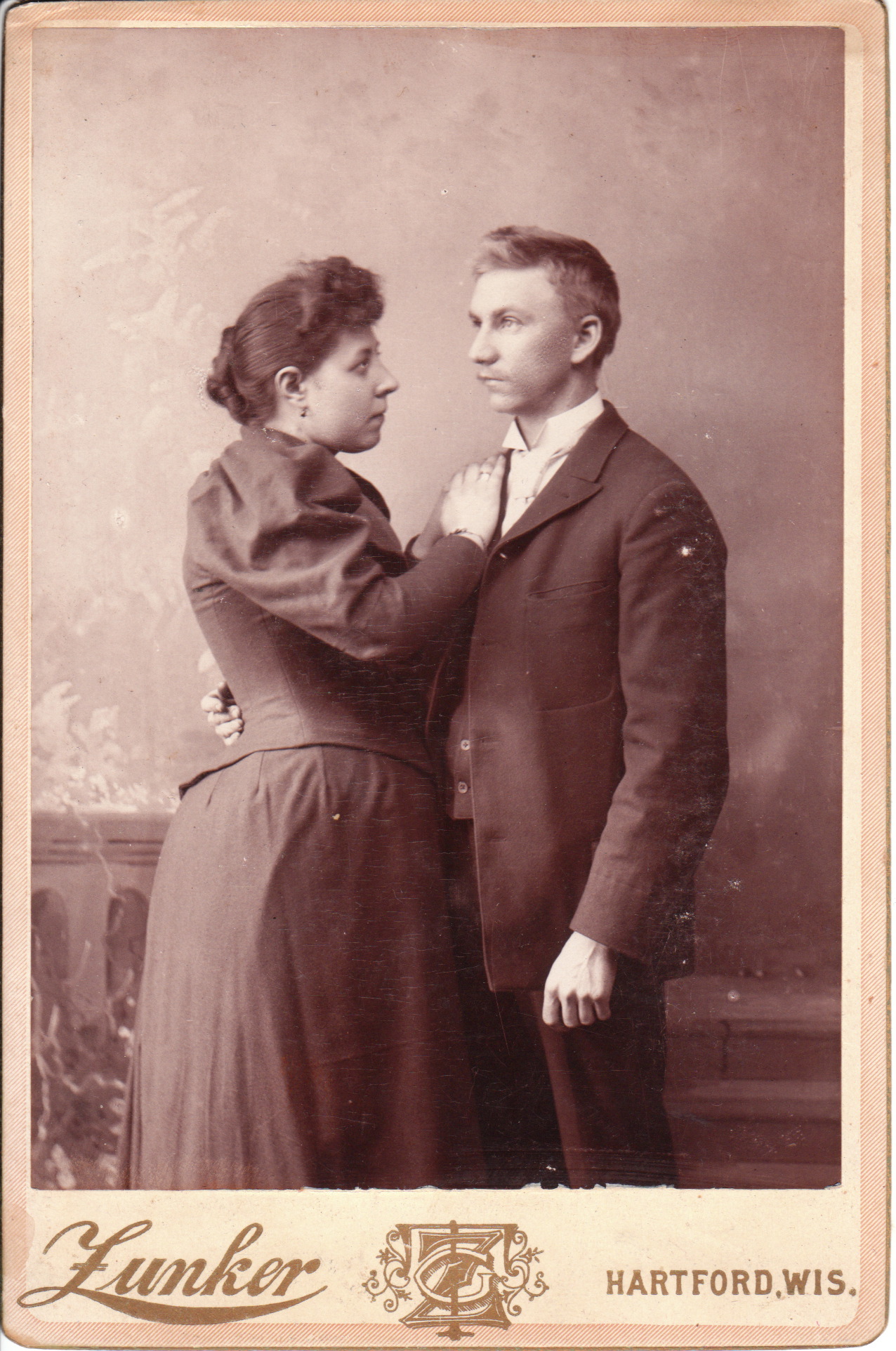 This cabinet card portrait seems to capture dance partners preparing to participate in an episode of “So You Think You Can Dance”. A quick assessment reveals that they need to work toward looking more relaxed and natural. This image comes from the studio of T. G. Zunker in Hartford, Wisconsin. The Milwaukee city directory listed Zunker as a photographer in their issues of 1897 through 1899. Hartford and Milwaukee are 39 miles apart. According to the historical photography web site Langdon Road, Theodore Zunker operated his photographic business in Hartford from 1900 through 1915. The reverse of the card has an inscription that states “Fond Du Lac” which is a city 37 miles from Hartford. There is also a humorous comment written on the back of the photograph. The message states “When you get your man, hang on to him”. It seems that everyone becomes a comedian when they see this image. This cabinet card definitely begs for a humorous caption.
PRETTY YOUNG WOMAN WINS THE LOTTERY IN NEW YORK CITY
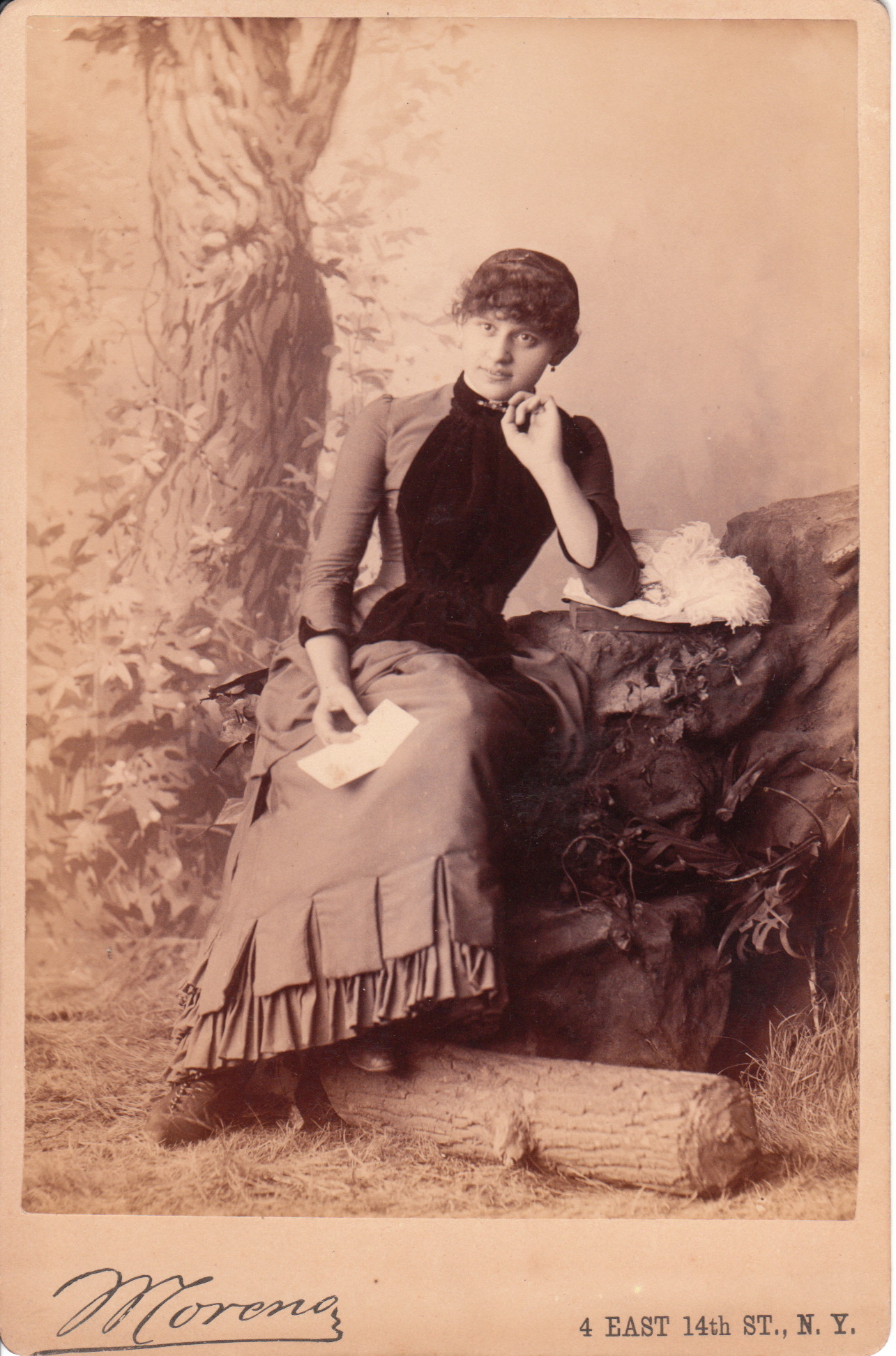 A pretty young woman sits on a faux rock as she poses at the Moreno studio in New York City. She is holding what appears to be an envelope in her hand but at first glance looks like bank check. This fashionable subject is very thin waisted and present herself in what the photographs previous owner called “a fetching pose”. Antonio E. Moreno was a Cuban painter and graphic artist who became a photographer after seeing the success of his New York based countryman, Jose Maria Mora (see category “Photographer: Mora”). In 1881, Moreno took over a failing New York City photographic studio. The business end of the studio was run by his co-director, Jose Lopez. Moreno developed the business into a great success due to his great talent as a photographer, developer and innovator. He became noted in photographic circles and received much acclaim from his participation in photographic expositions. He surrounded himself with talented co-workers. Much of his staff came from Mexico. Spanish cameraman Antonio Urda was considered to be excellent at his craft but was a fiery man who eventually committed suicide by drinking development fluid after failing to murder printer Domingo Costello. After this incident, Moreno preferred to hire English speaking Europeans to work at his studio. One of his hires was printer Nahum Lubosh whom he snared from celebrated photographer B. J. Falk (see category “Photographer: Falk”). Another employee, cameraman A. L. Simpson pioneered the use of slides utilized in theater sing-alongs. In 1890 Moreno partnered with the Taber Art Company in publishing photographs of beautiful female models in what has been described as “genre scenes and allegories”. The photographs were well posed, precisely lit and very tasteful. Moreno’s gallery was in business for a quarter of a century and was a center for performing arts portraiture. One wonders if the subject of this cabinet card portrait was in fact a theater actress. To view other photographs by Moreno, click on the category “Photographer: Moreno”.
A BOY, A BIKE, AND A BAD BACKDROP
 Photographer Robert Franck of Worms, Germany produced this rather amateurish cabinet card. The boy is holding his bicycle while posing indoors on what appears to be a stage with a nautical painting on a screen behind him. The child looks as if he is standing in front of a giant picture postcard. Look closely and you can see the stand on each side of the backdrop that holds it in place. The stand is on the floor and located at both corners of the screen. If the photographer stood closer to the subject, the edges of the backdrop would have not been in the image; significantly improving the picture. The very obviously fake plant behind the rear bicycle wheel further detracts from this image. Despite my criticism of this photograph, there is something that I like about it. If one focuses on the boy and his bike, this is a fine image of a child and his beloved mode of transportation. This photograph presents a bit of confusing information because on the reverse of the image, the photographers name is listed as F. Berf (possibly F. Ferf). Perhaps Mr Franck succeeded Mr Berf as owner of the studio and was using up Mr Berf’s card stock. Also on the reverse of the cabinet card is a hand written note that identifies the child as “the little Hoffman boy on his bicycle. He is now married.” (SOLD)
PORTRAIT OF STAGE ACTRESS MARY HAMPTON (BY CELEBRITY PHOTOGRAPHER MORRISON IN CHICAGO, ILLINOIS)
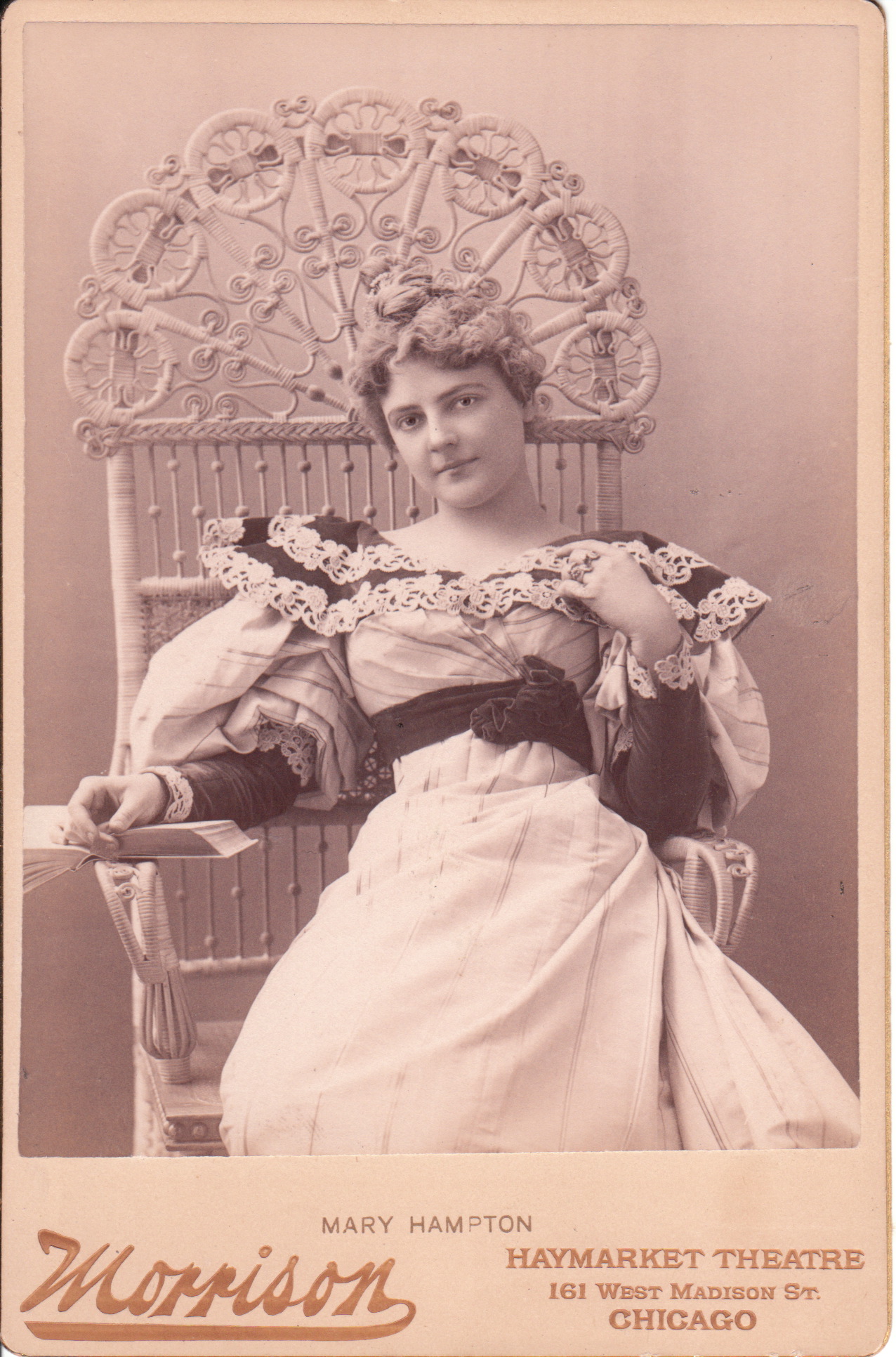 This cabinet card portrait features slumping actress Mary Hampton photographed by Chicago celebrity photographer William McKenzie Morrison. Miss Hampton was a pretty woman and apparently a very successful actress of her day as there are many references to her, as well as accolades about her, in theatrical magazines and newspapers. A photograph of her appears in Broadway Magazine (1898). The New York Times (1899) printed a large illustrated portrait of Miss Hampton in her role as Gertrude Ellingson in the play “Shenandoah”. The book “American Women Theatre Critics: Biographies and Selected Writings of Twelve ….” by Alma J. Bennett (2010) praises Hampton in her role as Rosamund. It is asserted that she played the part “true to the high standard of womanly power and gentleness”. The reviewer also compared her favorably to the great actress Helena Modjeska. The New York Times (1931) printed an obituary when she died at age 63. To view other photographs by Morrison, click on the category “Photographer: Morrison”.


 THE CABINET CARD GALLERY