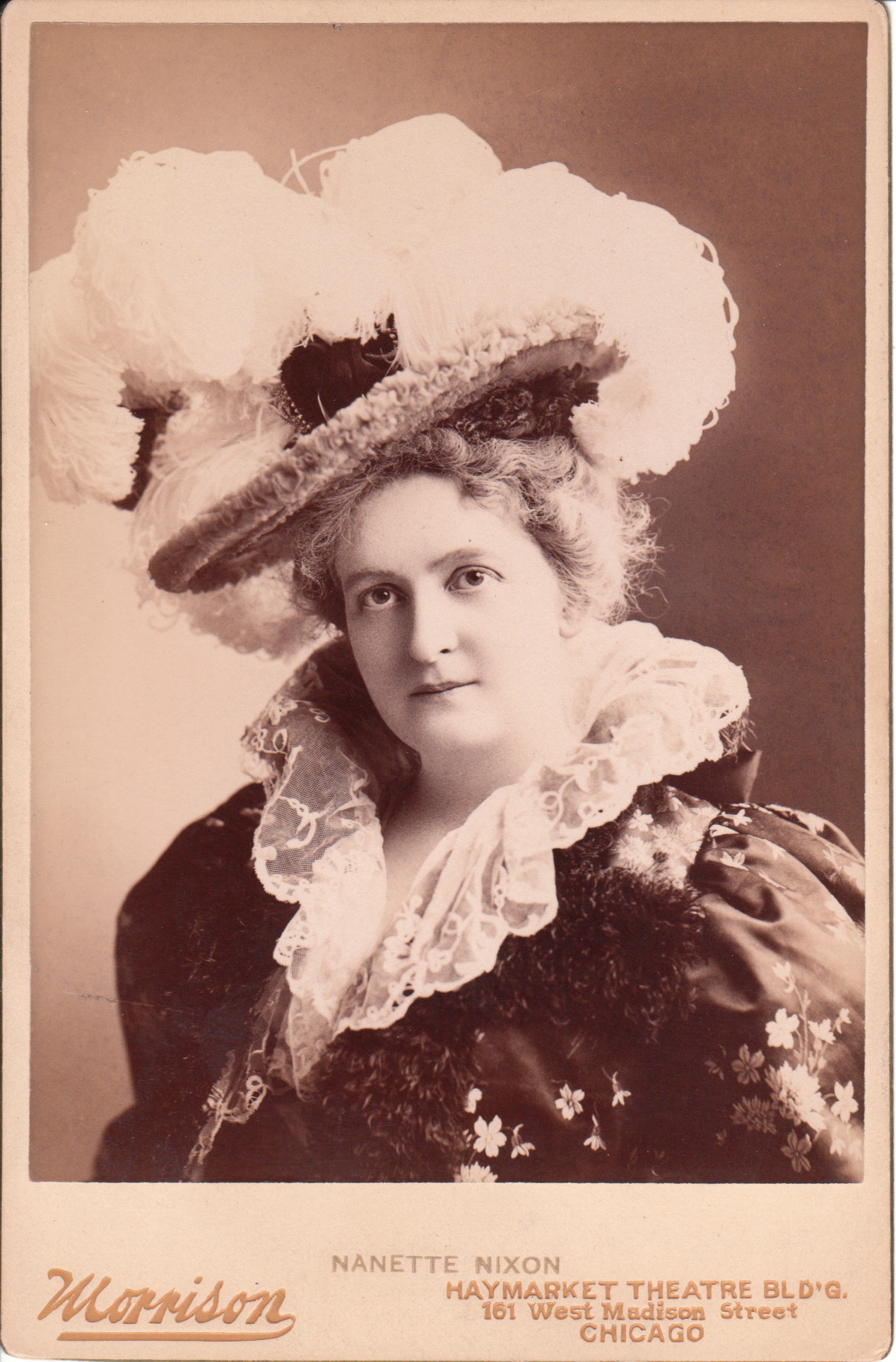
 This cabinet card features stage actress Nanette Nixon. She is wearing a flower pattern dress with a lace collar. Nixon’s photograph appeared in The Sunday Telegraph (1898) and the text describes her as “soulful and able as an actress”. The brief article reports that theatre goers in New York were looking forward to her upcoming appearances there. Interestingly, the photograph in the Telegraph was taken by the same photographer who produced the photograph appearing on this cabinet card. The photographer of this image is William Mckenzie Morrison whose studio was located in the Haymarket Theatre building in Chicago, Illinois. Morrison was a well known and successful celebrity photographer. The reverse of the photograph is illustrated with medals from the Columbian Exposition in Chicago (1893), Photographers Association of America (1894), The Cotton States and International Exposition (1895), and various other competitions. To view other photographs by Morrison, click on the category “Photographer: Morrison”.
STAGE ACTRESS NANETTE NIXON IN CHICAGO, ILLINOIS

PRETTY WOMAN WITH CURLS IN VIENNA, AUSTRIA (PORTRAIT OF AUSTRIAN THEATER ACTRESS JOSEPHINE WESSELY)
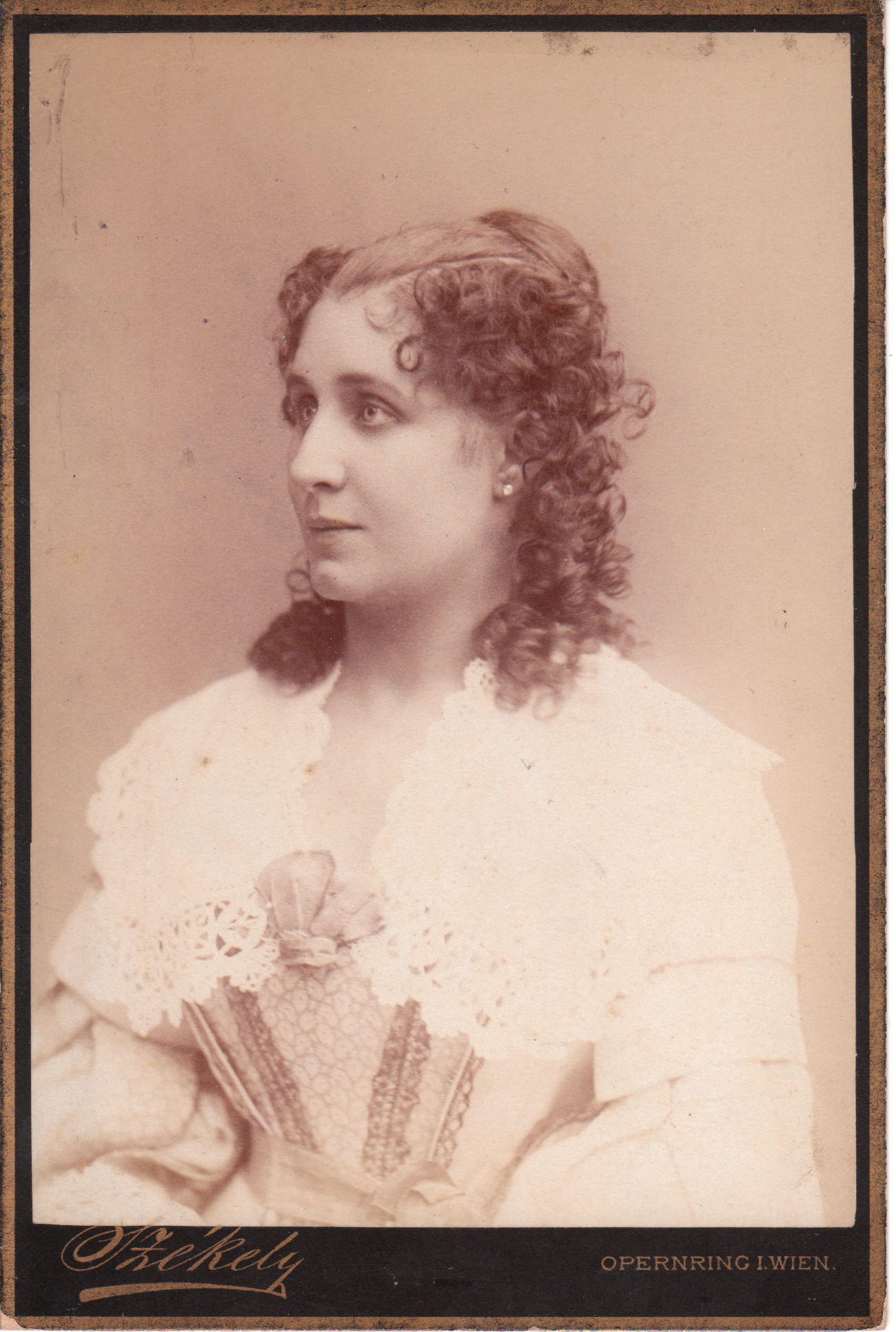 A pretty woman poses for her portrait in the studio of Dr Szekely in Vienna, Austria. The woman has an unusual hair style. Her hair seems to be straight on top of her head and she has beautiful curls on the side. The reverse of the photograph identifies the subject as Austrian theater actress Josephine Wessely (1860-1887). Wessely was born in Vienna and the daughter of a shoemaker. She began drama school at age fourteen and had her debut in “Intrigue and Love” in 1876 at the Leipzig City Theater. In 1879 she became a member of the Burgtheater ensemble. She was known for playing juvenile tragic roles and gained recognition for playing Gretchen in Goethe’s “Faust”. Wessely died at 27 years of age. The cause of her death is suspected to be leukemia. Printing on the reverse of the card reveals that Dr Szekely won medals for his photography in exhibitions in Vienna (1873) and Paris (1878). To learn more about Dr Szekely and to view more of his photographs, click on the category “Photographer: Szekely”.
ACTRESS HOLDS THEATER MASK ALOFT IN NICE, FRANCE
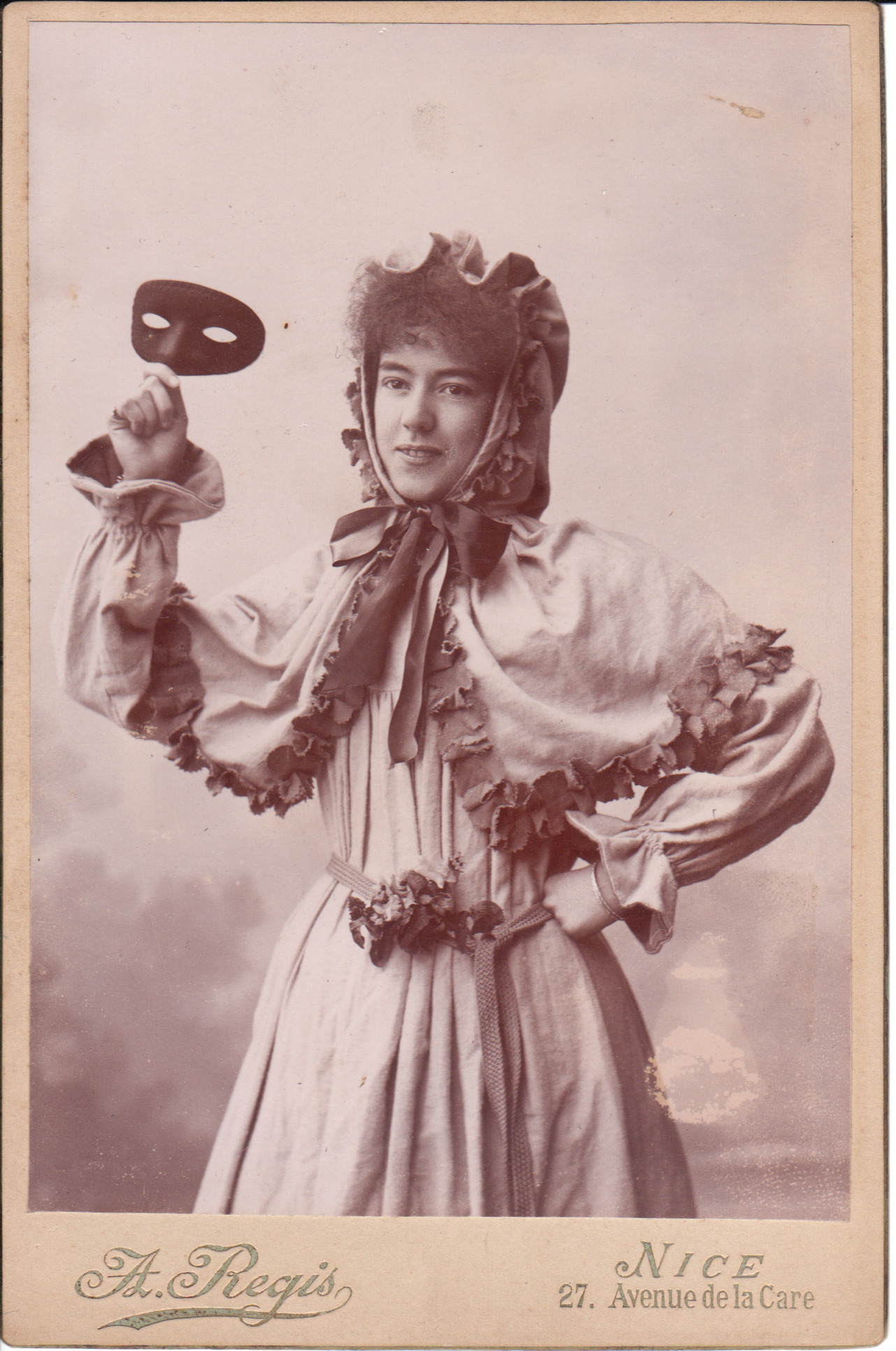 This cabinet card photograph captures a young woman holding a theater (carnival) mask. It is very likely that this smiling woman is an actress and that she is wearing a theater costume. Her dress is very unique and interesting. Hoperfully, some of the fashion informed visitors to the cabinet card gallery will leave commentary about the subject’s attire. The cabinet card gallery is fortunate to have so many visitors willing to leave interesting and educational comments. This photograph was produced by A. Regis who operated a gallery in Nice, France.
ISABELLE URQUHART: COMIC OPERA AND MUSICAL COMEDY STAR (PHOTOGRAPH BY NEWSBOY)

This cabinet card features actress Isabelle Urquhart (1865-1907). She was an American stage actress and contralto who appeared in mostly comic operas and musical comedies. Urquhart was born in New York City and claimed to have been educated in a convent. She made her first stage appearance in 1881. She performed as a chorus girl at the Standard Theatre in New York City. She than appeared in a number of small roles. From 1882 through 1883 she joined Augustin Daly’s company and acted in productions including “The Passing Regiment” and “The Squire”. In the latter production she was only seventeen years of age but played a ninety-seven year old woman. She returned to light opera because of it’s better compensation although she stated she preferred legitimate drama to comic opera. She had much success in major roles in light operas including in the hit operetta “Erminine” which ran from 1886 through 1888 at the Casino Theatre. She also had success in other productions by luminaries such as Gilbert and Sullivan. In her leading lady role in “Erminine”, she started a fashion trend by not wearing petticoats in order “to accentuate her gorgeous figure”. Urquhart later appeared in vaudeville. Blue Vaudeville (2004) states that in a sketch at the Union Square Theatre, she “did little more than display her form in a handsome gown to the utmost advantage”. Urquhart also performed in several Broadway plays including “The Diplomat” (1902), “Arms and the Man” (1906), and “How He Lied to Her Husband”. This cabinet card was published by Newsboy and was number one i a series of photographs that were distributed as a premium accompanying tobacco sales.
ACTRESS IN VIENNA DRESSED IN EXOTIC JAPANESE COSTUME
 This cabinet card photograph features an actress in an exotic Japanese costume. The photographer is S. Weitzmann whose studio was located in Vienna, Austria. Writing on the reverse of the image dates the photograph as being produced in 1907 and advertising on the reverse states that the studio won medals in exhibitions in Paris, London, and Grand Prix in 1906. The woman in this image is wearing gloves and an interesting hat. She is also holding a fan. Weitzmann is mentioned in Hitler’s Silent Partners: Swiss Banks, Nazi Gold, And The Pursuit Of Justice (2011). The book states that Weitzmann was the foremost portrait photographer in Vienna and worked for the Austrian Royal Court before its demise in 1918. To view other photographs by Weitzmann,click on the category “Photographer: Weitzmann”.
MADAME BUTTERFLY IN KLAGENFURT, AUSTRIA
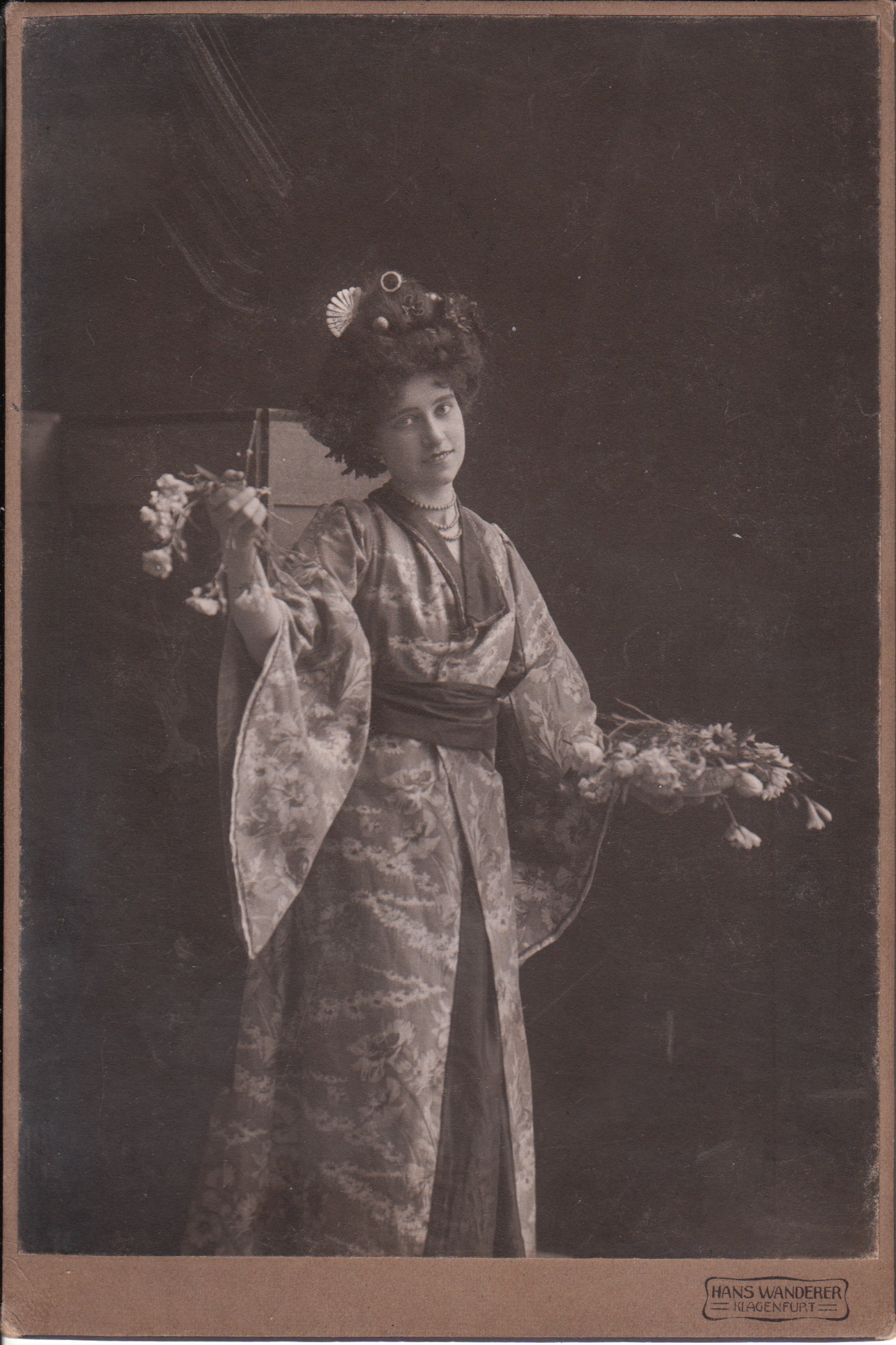 This image features an attractive actress playing Madame Butterfly in a 1909 production. The preceding information comes from an inscription on the reverse of the photograph. The photographer is Hans Wanderer and his studio was located in Klagenfurt, Austria. Madam Butterfly is an opera by Giacomo Puccini. The story was originally written by James Long (1898). David Belasco dramatized the story for theater. The operatic version of Madame Butterfly premiered in Milan, Italy in 1904.
AGNES EVANS: THEATRE ACTRESS DRESSED IN QUITE RISQUE FASHION

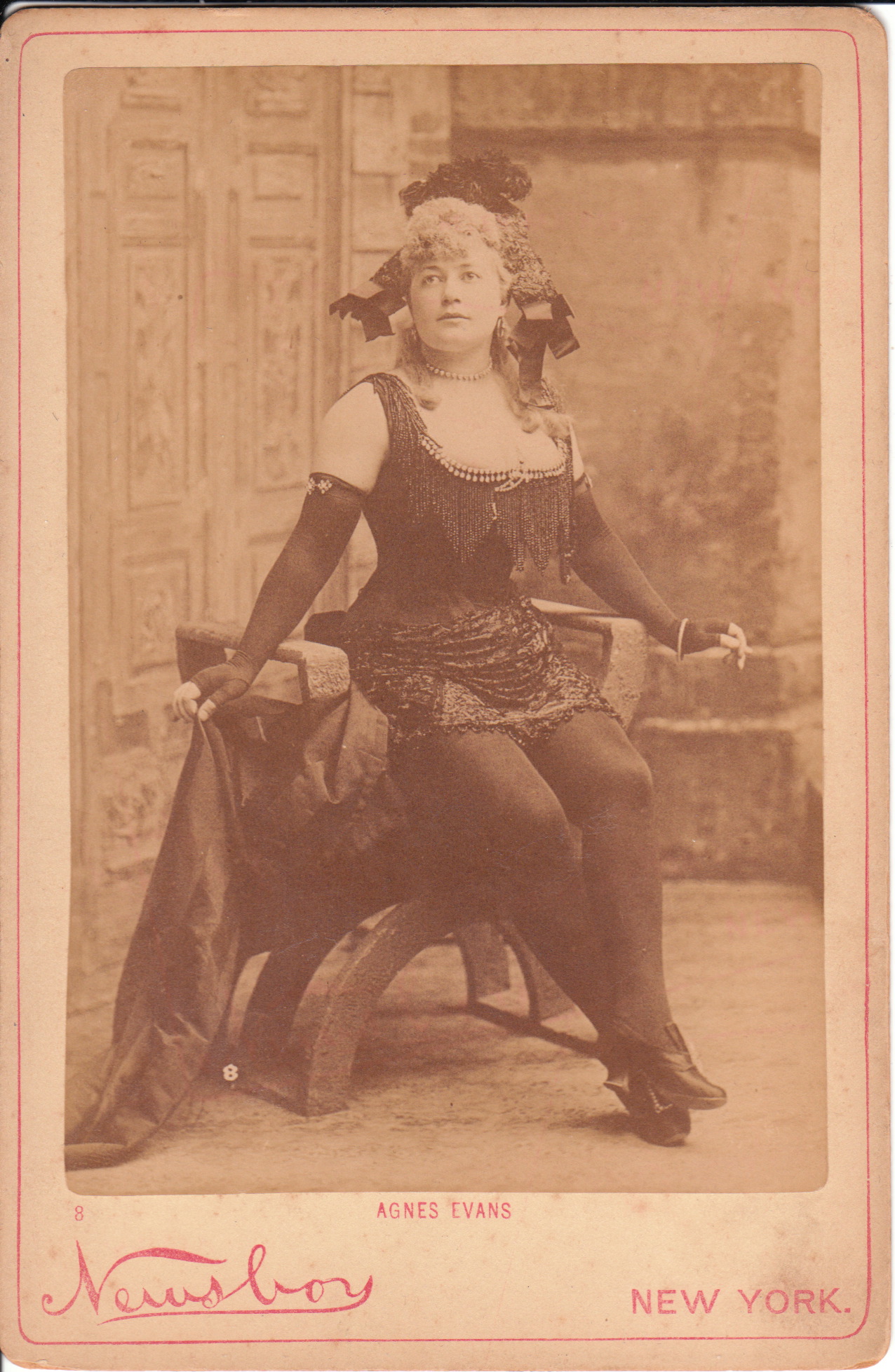
Agnes Evans poses for this cabinet card (top) photographed by Newsboy of New York. Agnes Evans was a theatre actress who performed in the Broadway production of the Pit (1904). The actress is wearing a very revealing risque dress. Further research by myself or assistance from visitors to this site will hopefully further illuminate her life and career. Newsboy was a brand of plug tobacco and Newsboy photographs were given away as a premium by tobacconists and drug stores who sold the tobacco. The images were produced by the National Tobacco Works of New York. They were likely produced and issued in the early 1890’s. The bottom image features Miss Evans in another Newsboy cabinet card (number 8 in a series). She is wearing a risque costume that includes fingerless gloves.
EVA McGINLEY: CHARACTER CHANGE ARTIST
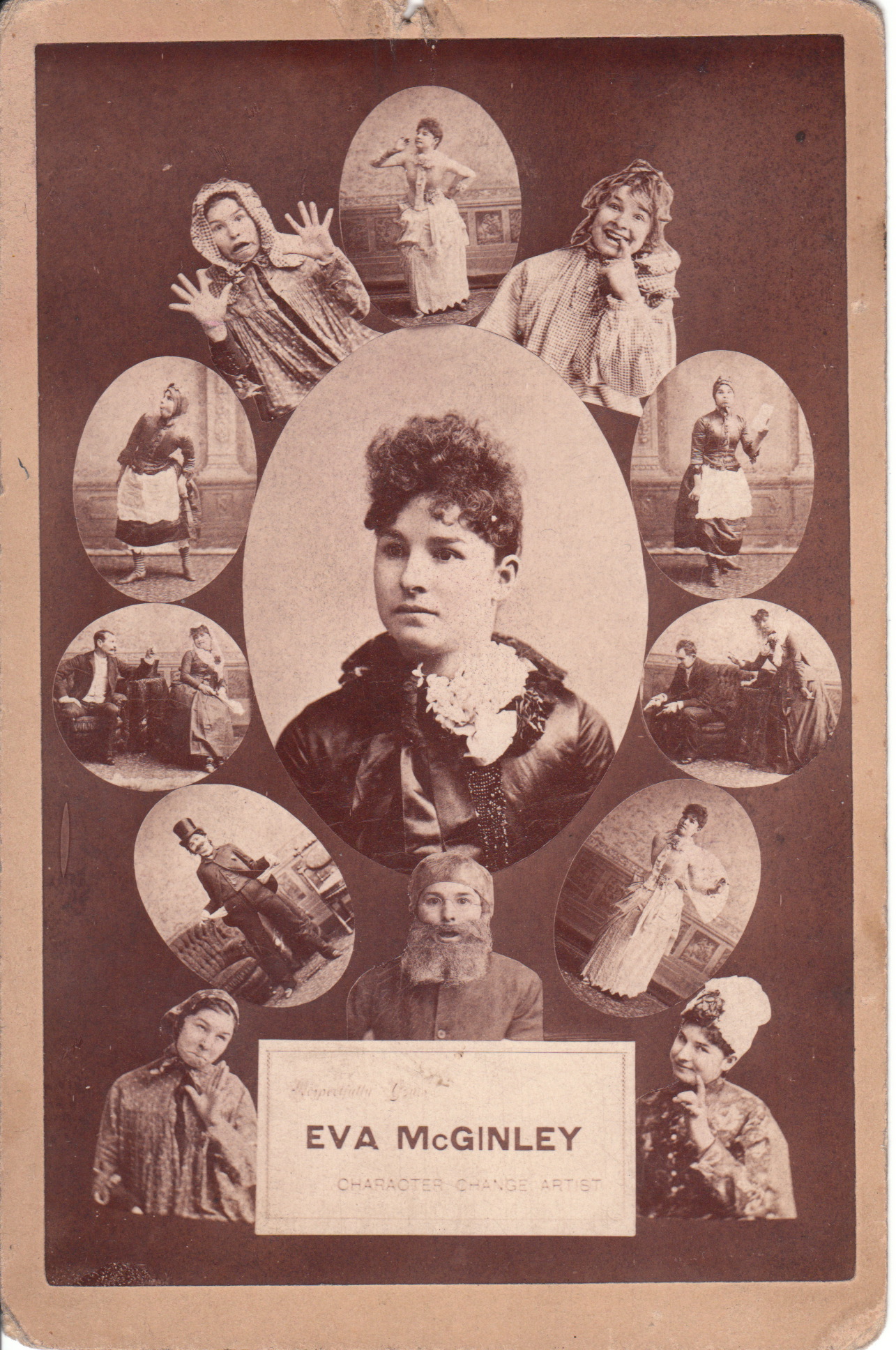 This composite cabinet card features Eva McGinley and is subtitled indicating that she was a “character change artist”. The central portrait on the card shows a prim and proper lady but the image is surrounded by other images displaying Miss McGinley’s versatility and talent to play disparate character roles. Eva McGinley was not a major actress which is apparent by the dearth of information readily available in my preliminary research. However, two newspaper articles were found pertaining to Miss McGinley. The New York Dramatic Mirror (1900) reported that “Eva McGinley’s voice failed her at Greenfield, Iowa last week” and she and her husband Bob went to Omaha to recuperate. A second article appeared in the New York National Police Gazette (1900) which proclaimed that Miss McGinley and her husband were enjoying themselves in Lakeview, Iowa and that she had shot and killed the largest pelican ever killed on Wall Lake. Imagining Miss Mcginley hunting pelicans with a rifle is distasteful to me but it certainly indicates that she really was quite a “character”. The photographer of this image is unidentified.
LULU GLASER: ROCKET ASCENT FROM UNDERSTUDY TO STAGE STAR
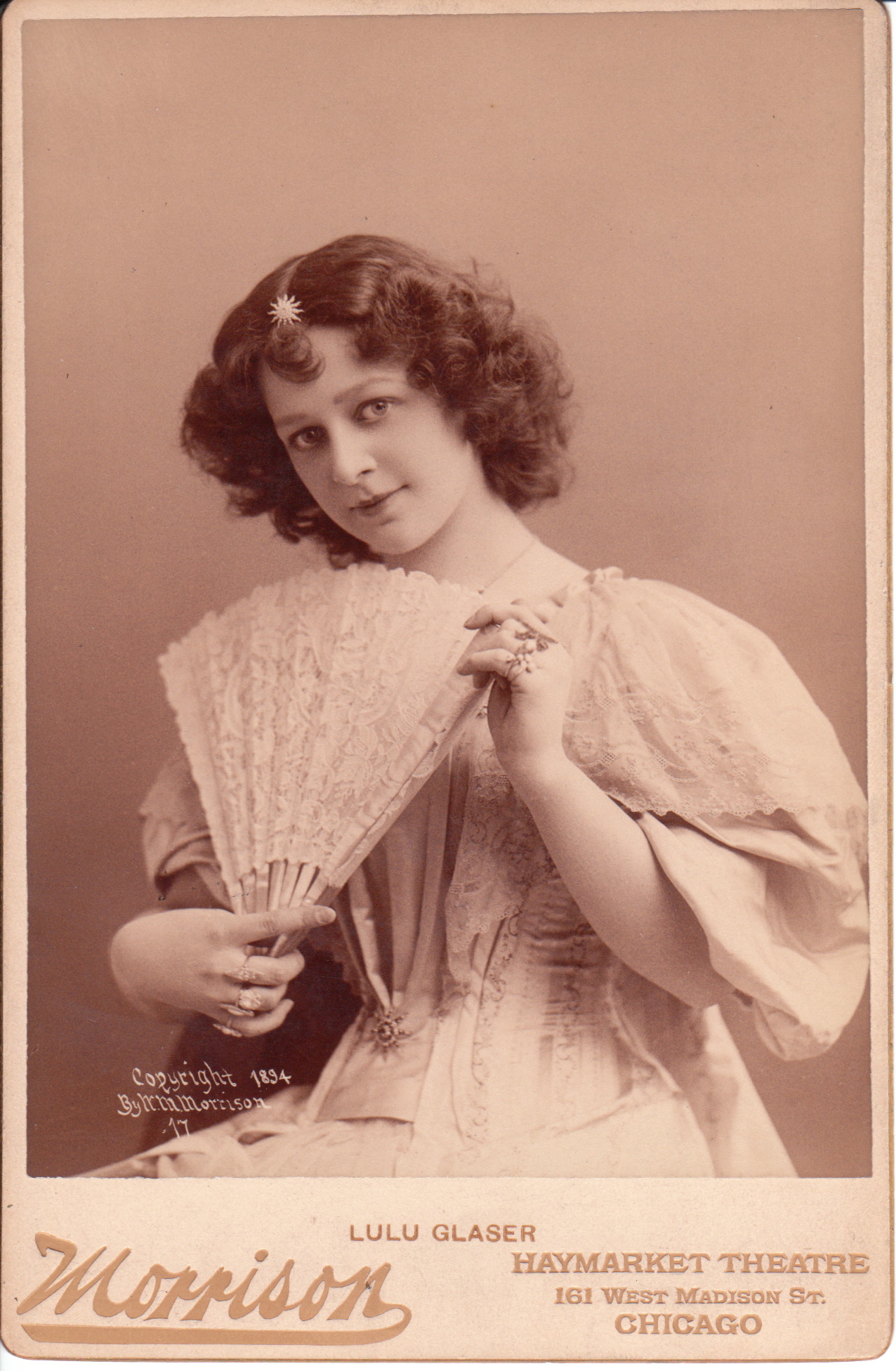 CABINET CARD 1 (SOLD)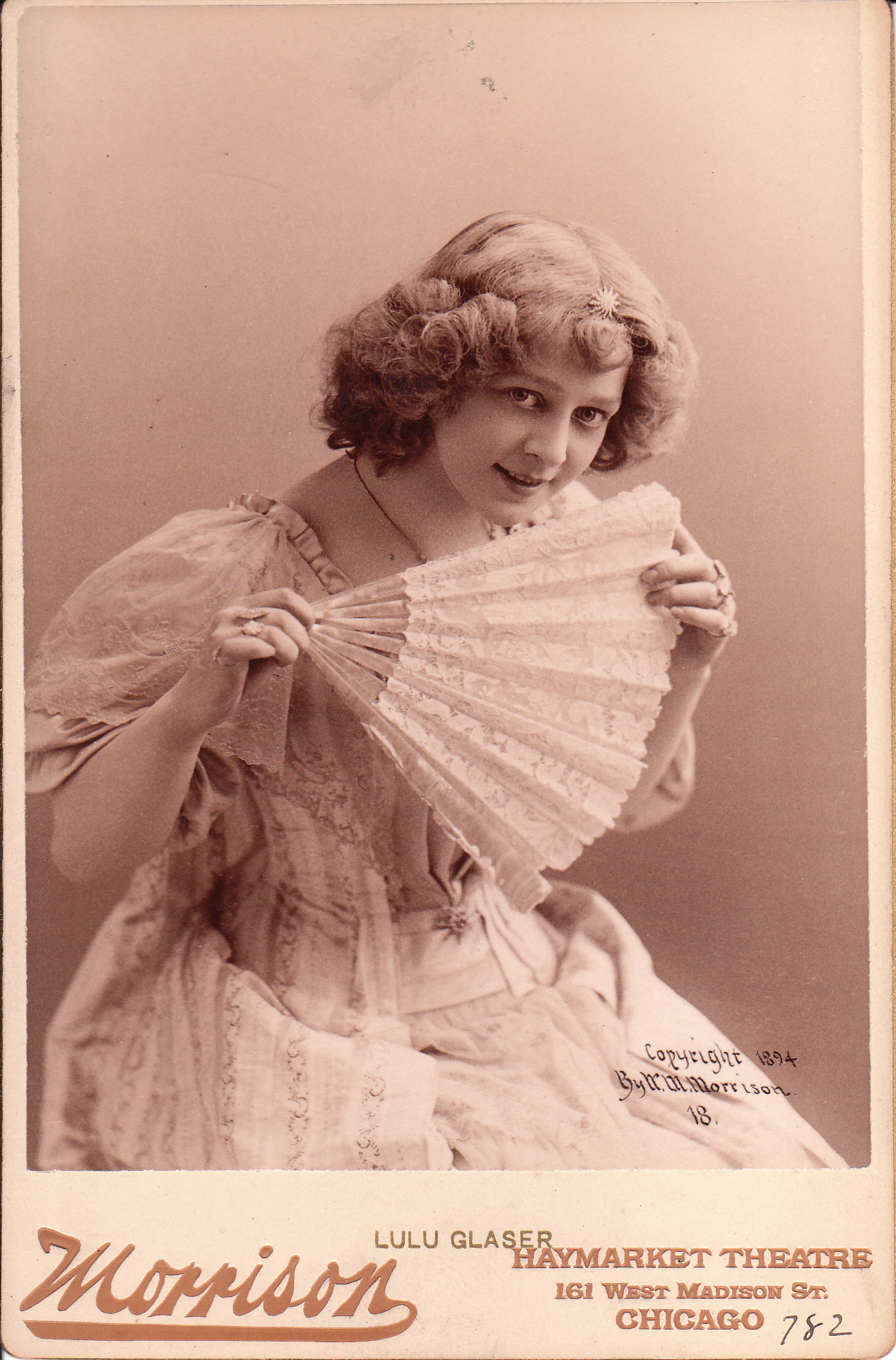
CABINET CARD 2 & 3
CABINET CARD 4
CABINET CARD 5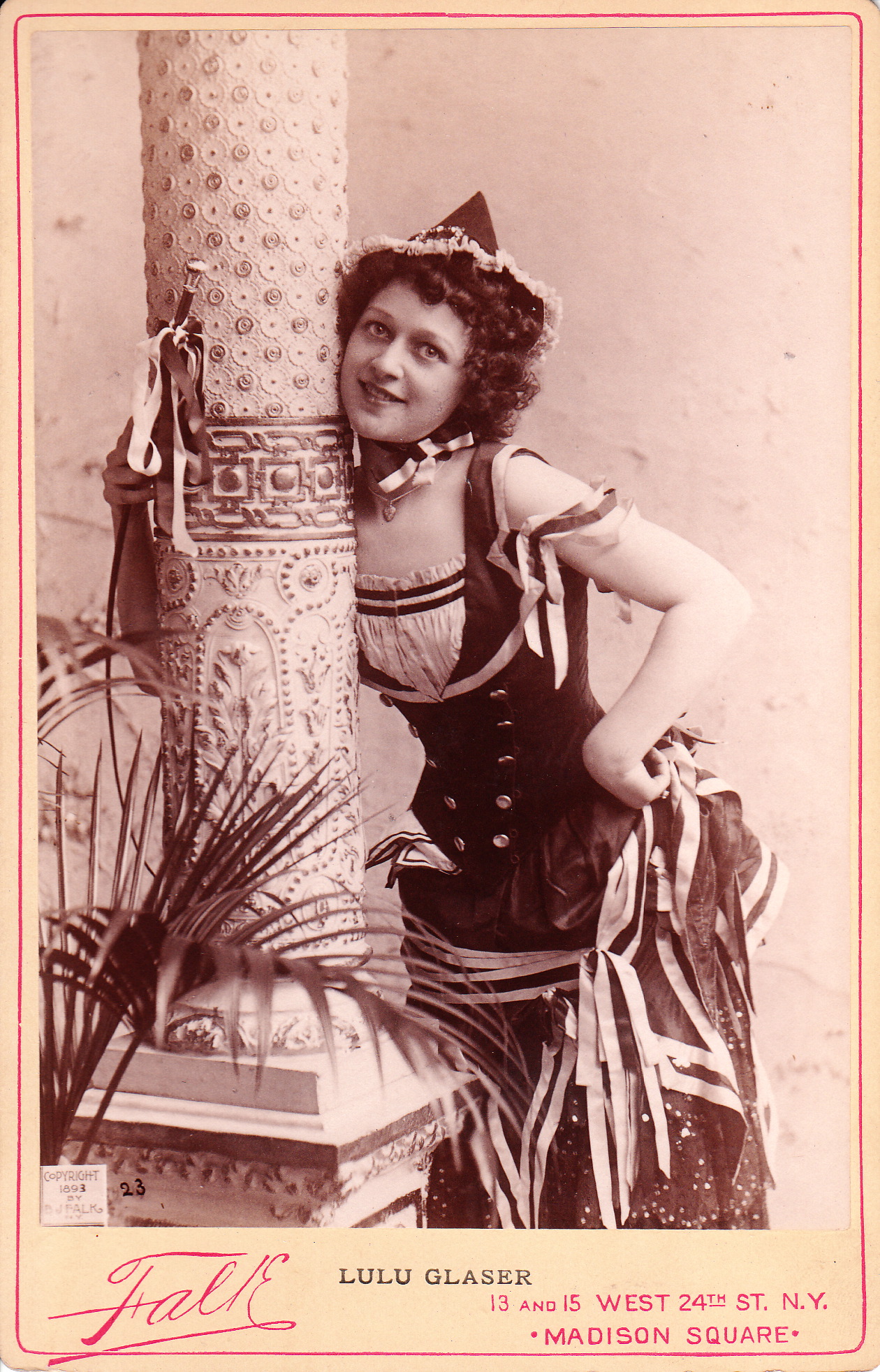
CABINET CARD 6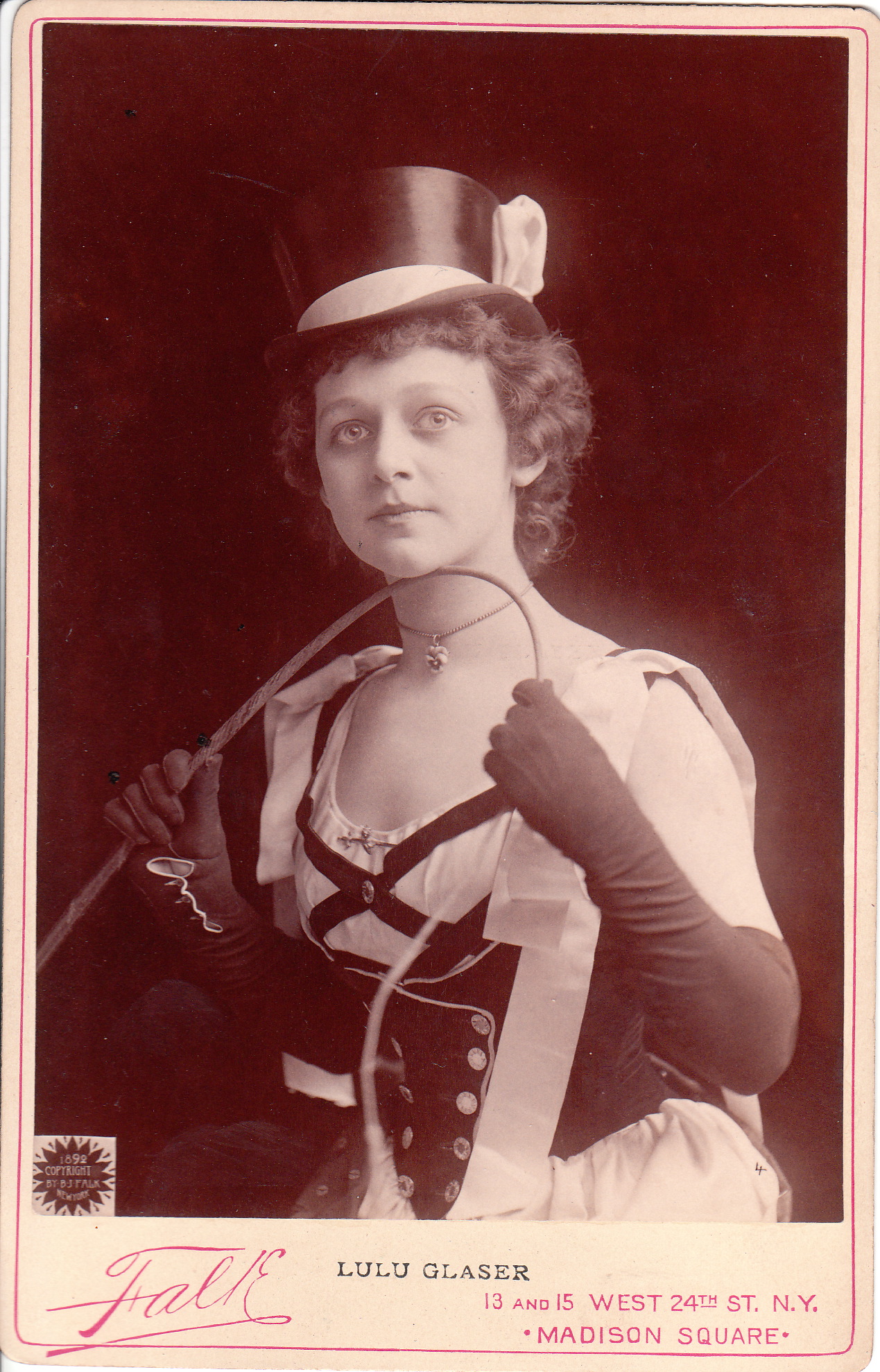
CABINET CARD 7
 CABINET CARD 8
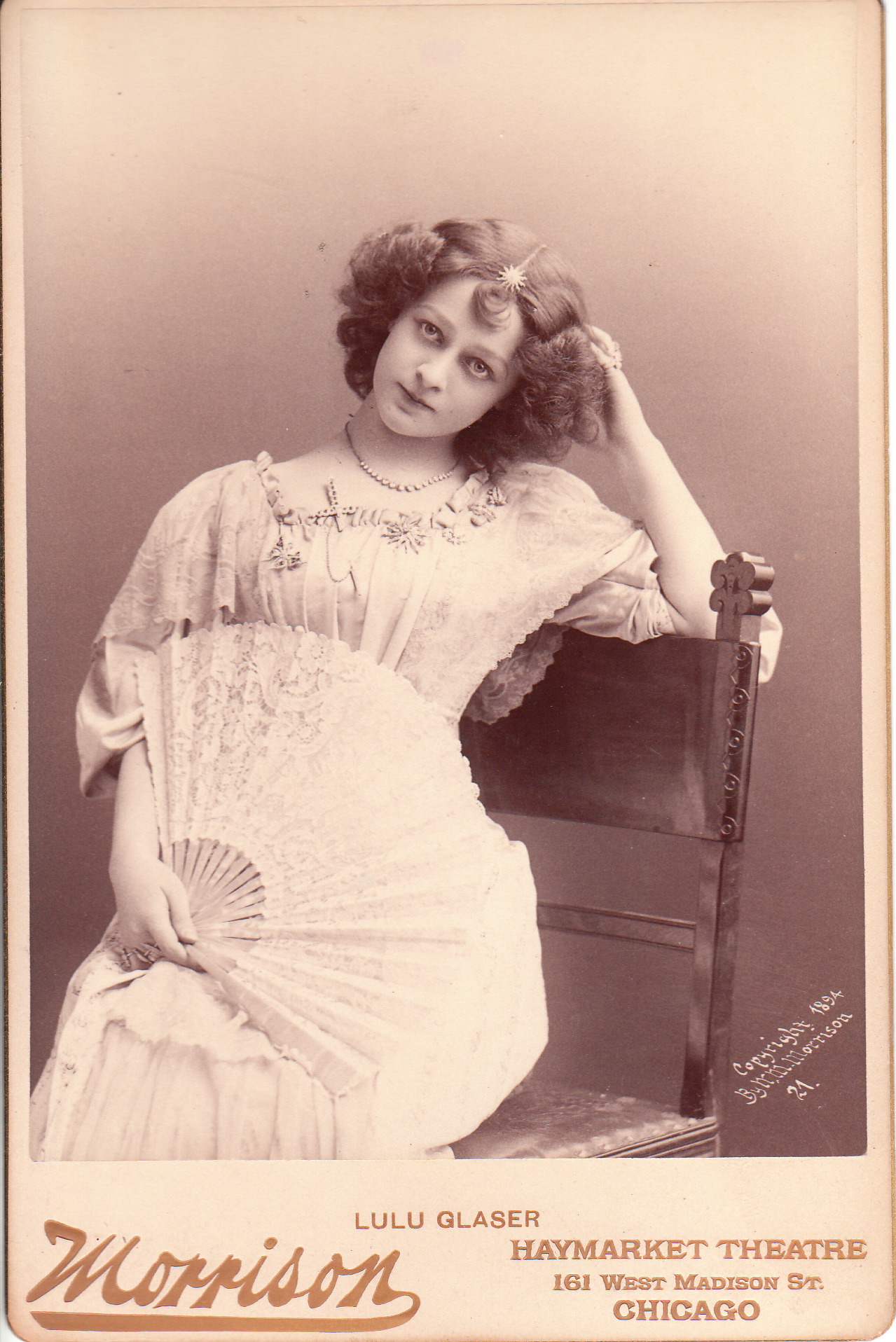
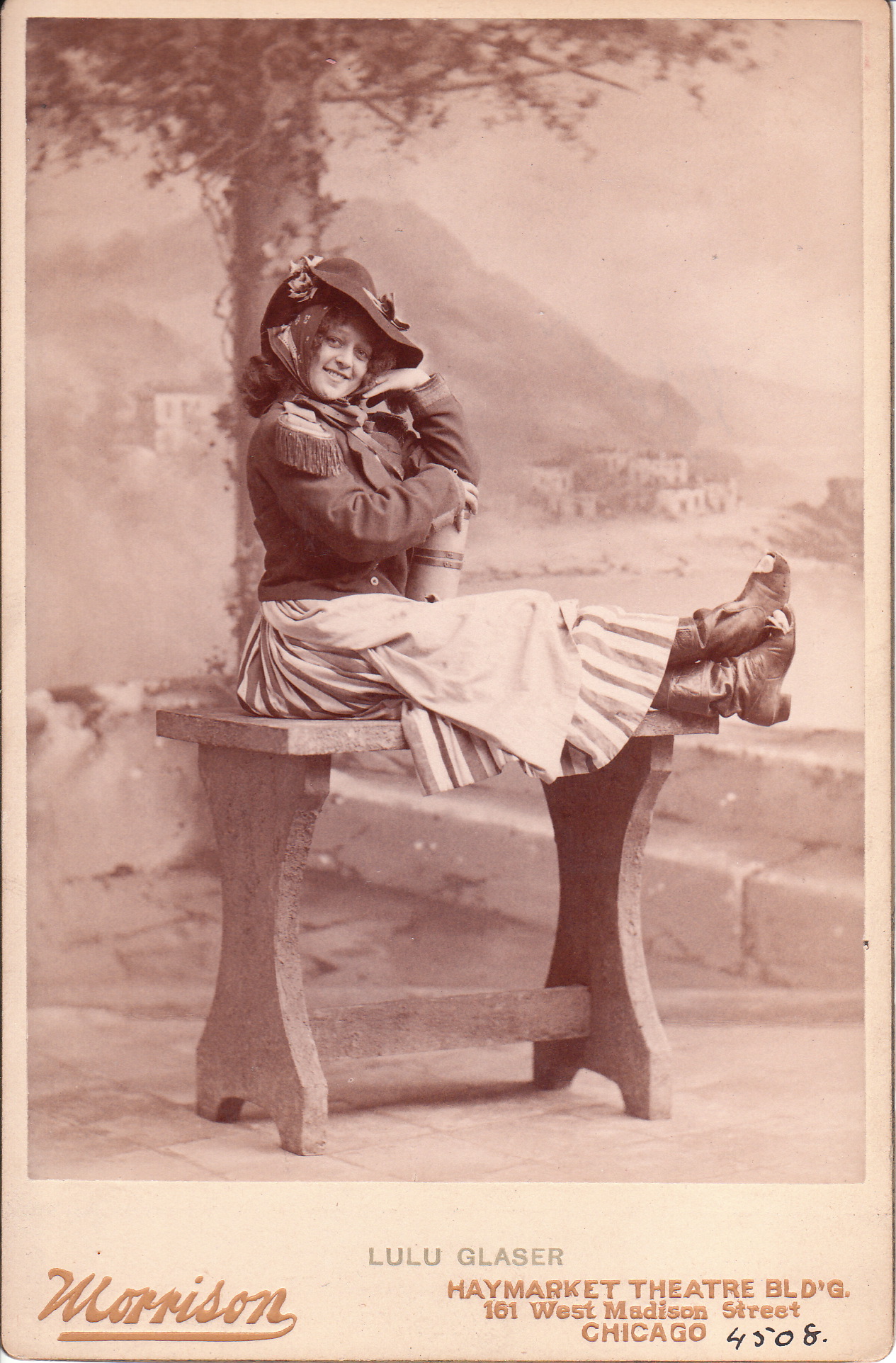
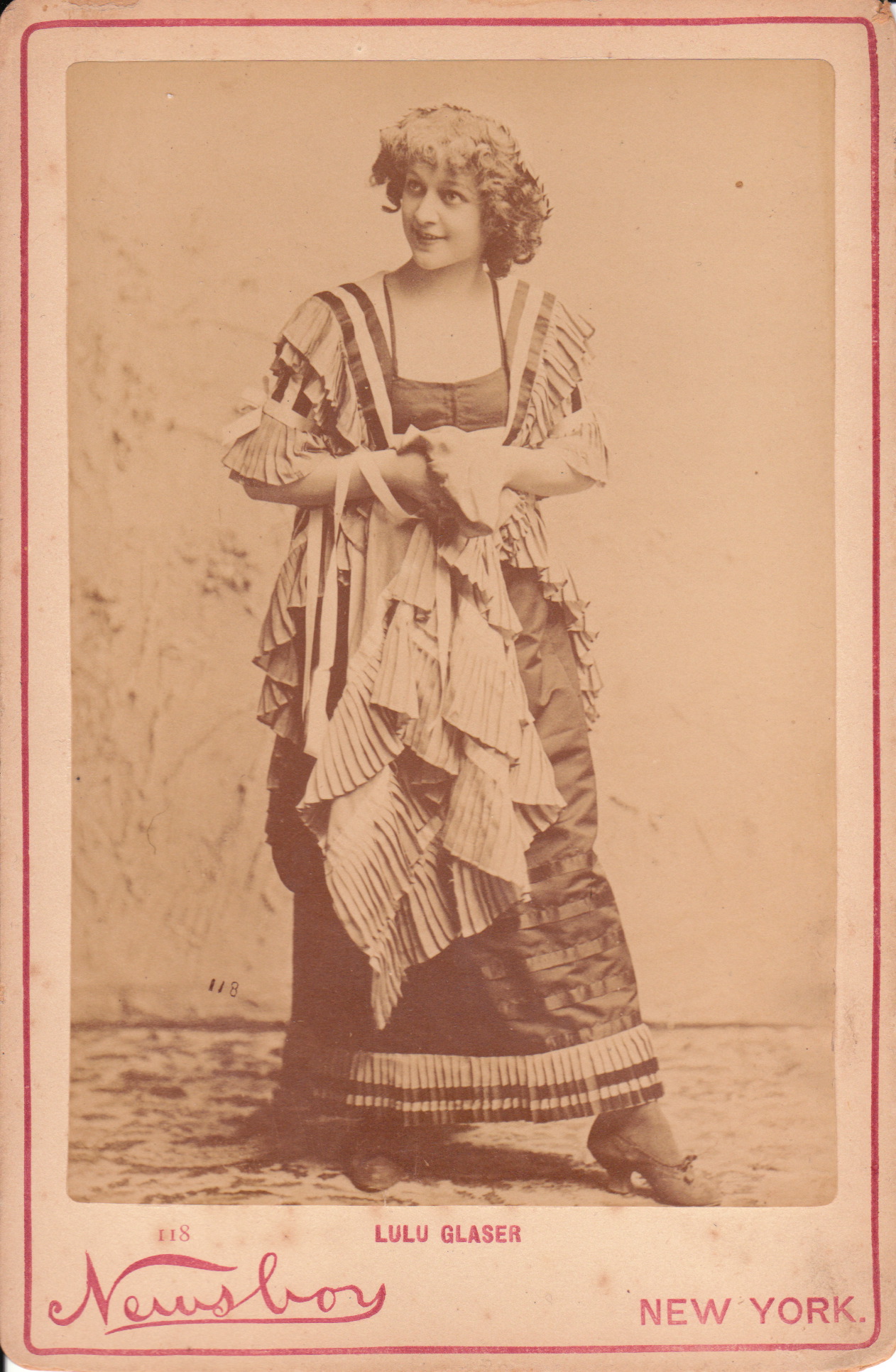
These cabinet cards features Lulu Glaser (1874-1958), a Pennsylvania born actress and singer. She came to Broadway with no previous professional experience when she was hired to play in the chorus of “The Lion Tamer (1891)”. She was also given the role of understudy to the Prima Donna. After the star fell ill, Lulu Glaser took over the role and began a meteoric rise to stardom. For the next twenty plus years, Glaser played many roles in such productions as “The Merry Monarch” (1892), “Erminie” (1893), “The Little Corporal” (1898), and “Miss Dolly Dollars” (1895). She achieved her greatest success in “Dolly Varden” (1902). Lulu Glaser was a beautiful woman and this portrait confirms that assessment.
In Cabinet Card 1 Glaser is holding a fan and her expression could be described as coy. She is adorned with a great deal of jewelry including multiple rings, a hair pin and a pin on the midsection of her dress. The photographer of this image, as well as the next four images, is Morrison, of Chicago, Illinois. The photographs have a copyright date of 1894. Morrison was a well known celebrity photographer and his studio was housed in the Haymarket Theatre. To view other photographs by Morrison, click on this site’s category “Photographer: Morrison”.
The sixth photograph of Glaser is by celebrity photographer, Falk, of New York City, New York. This photograph is copyrighted 1893. The seventh photograph, also by Falk, captures Glaser in costume for an unknown titled play. She is holding a whip and not looking particularly friendly. The image looks like it would be appropriate accompanying an ad on one of the controversial sections of Craig’s List. The photograph is dated 1892. To see other photographs by Falk, click on the category “Photographer: Falk”.
Photograph number eight captures Lu Lu Glaser in the same costume she is wearing in photograph number five. The eighth photo was published by Newsboy as a premium used to accompany the sale of their tobacco products. The image is number 118 of a series of celebrity photographs. To view other Newsboy photographs, click on the cabinet card gallery category “Photographer: Newsboy”.
BLANCH WALSH: STAGE ACTRESS IN PROVOCATIVE POSE (PUBLISHED BY NEWSBOY)
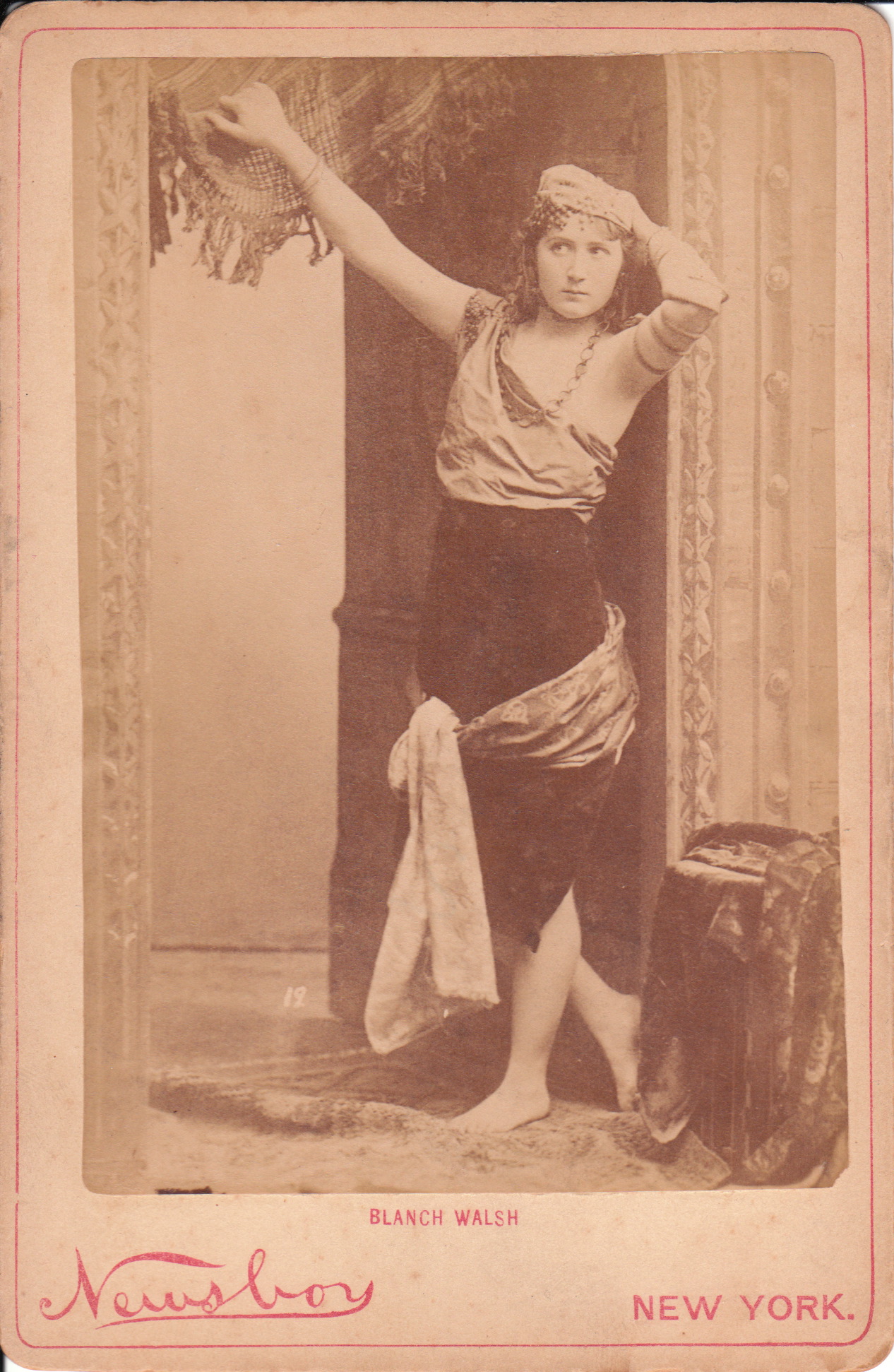 This cabinet card photograph of actress, Blanch Walsh, was published by Newsboy and was given as a premium to buyers of the company’s tobacco products. The photograph was number 12 of a series of celebrity photographic portraits. This particular photograph is particularly provocative and risque. Miss Walsh is exhibiting a great deal of exposed skin. Her pose and expression add to the subliminal sexuality. Miss Walsh is costumed as if to portray a gypsy. Note her jewelry. She is wearing a chain around her neck and multiple bracelets on her left arm. To view other theatrical images by Newsboy, click on category “Photographer: Newsboy”. Blanch Walsh (1873-1915) was a highly regarded American stage actress. She also appeared in one film, “Resurrection” (1912). She was born in New York City and educated in the public schools. Her father was T. P. Fatty Walsh, a Tammany politician and prison warden (The Tombs). Her stage debut was in 1888. She worked in the Charles Frohman Company as well as the William Gillette Company. She looked like a younger version of stage star Fanny Davenport. When Miss Davenport was ill for some time before dying in 1898, Blanch Walsh was given a number of her emotional roles. To view photographs of Miss Davenport, write Fanny Davenport in cabinet card gallery’s search box. Walsh’s most sensational role was as Maslova in Tolstoy’s “Resurrection” (1903). She also received much acclaim for her performance in “The Woman in the Case” (1905). The New York Times printed an article about Walsh upon her post surgical death. She was viewed as a major actress who likely would have risen to greater heights in the theater world if her life had not been cut short by her unfortunate early demise.


