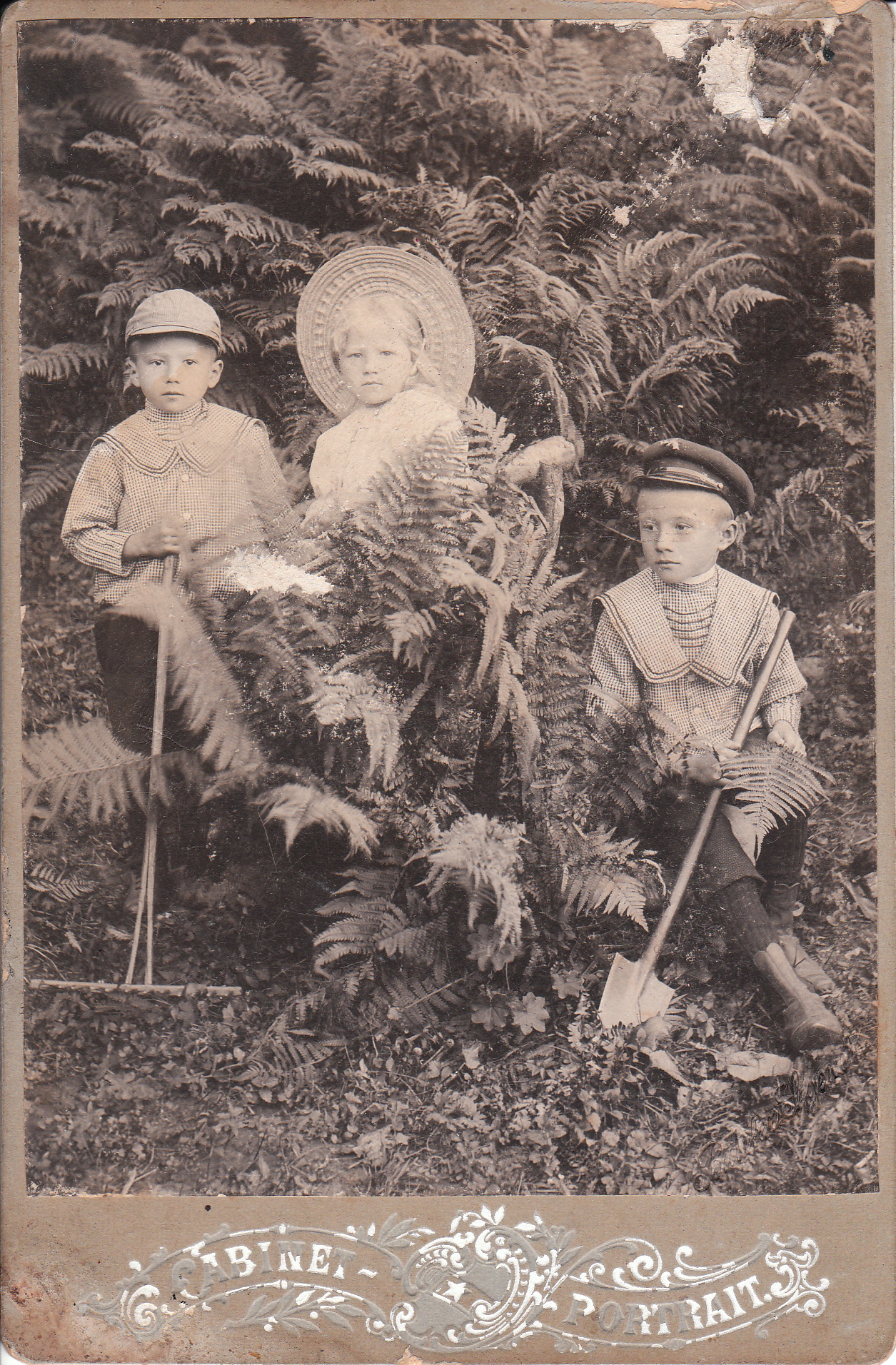
 Three children are photographed in a garden, in this cabinet portrait by an unknown photographer somewhere in Imperial Russia. The nicely dressed kids are adorable. One boy is holding a rake while the other is holding a shovel. The boy with the shovel is wearing a military hat while the girl is more practical, wearing a sun hat.
WORK DETAIL IN IMPERIAL RUSSIA (KIDS IN A GARDEN)

YOUNG CHILD AND LITERARY DOG POSE FOR THEIR PORTRAIT IN MOUNT VERNON, OHIO
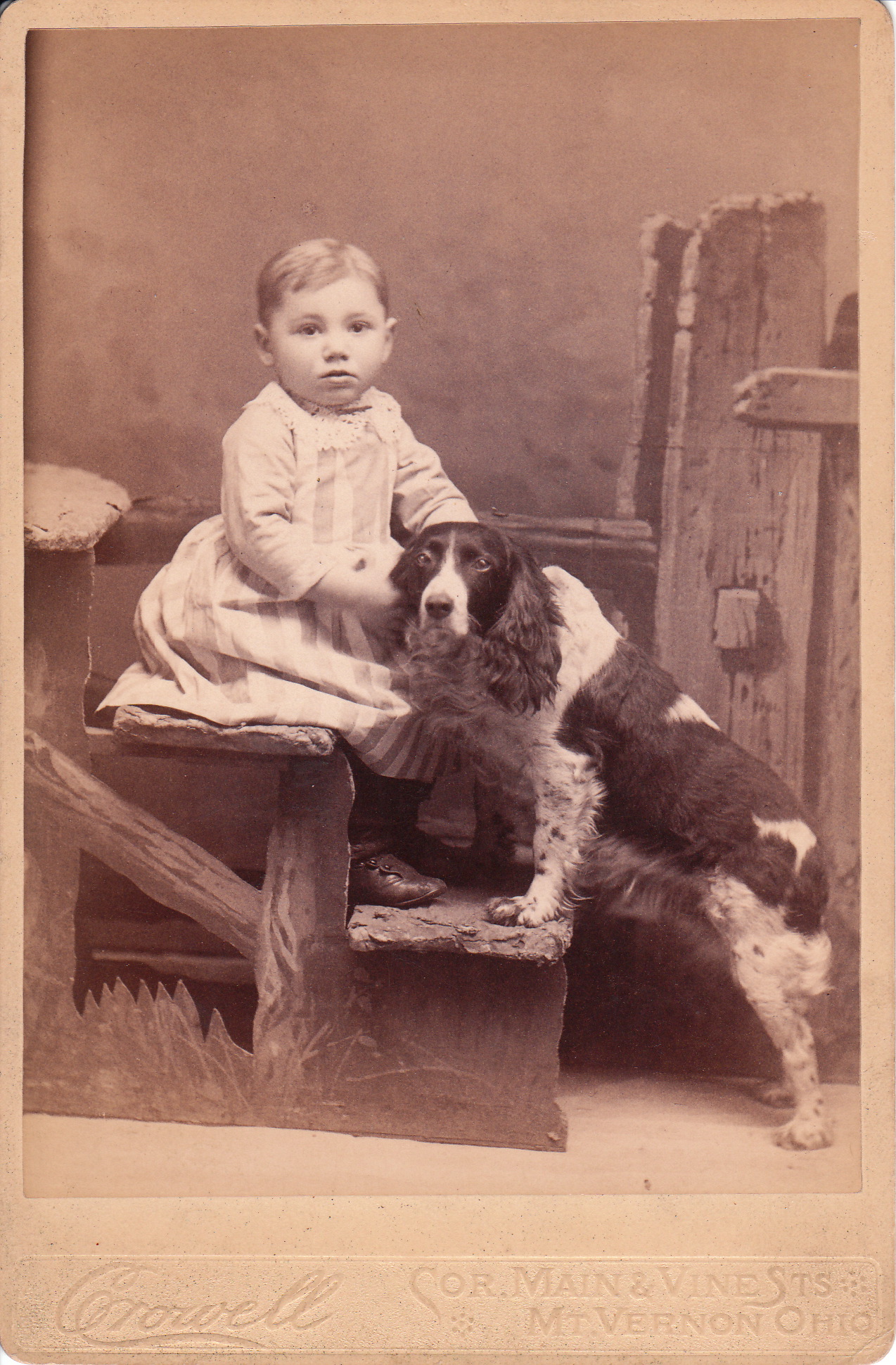 Photographer, Fred S. Crowell published this cabinet card portrait of a child and his/her pet dog. The dog appears to be an English Springer Spaniel. Writing on the reverse of the card indicates that the child’s name was Caroll Clucas and the dogs name was Peredeo. The canine’s name was not completely legible and Peredeo is a “best guess”. Peredeo is actually a name that comes from the story of Rosamund. Rosamund, the wife of King Alboin plotted to have her cruel husband killed. It was suggested to her that she employ Peredeo, “a very strong man”, to accomplish the murder. Peredeo refused to kill his King, but that night, he mistakenly slept with a disguised Rosamund. As a result of this adultery, Peredeo agreed to kill Alboin, in order to avoid retribution for sleeping with Rosamund. Now lets jump many centuries forward to the mid to late 1800’s. The photographer did an excellent job of photographing the dog; no easy task. Crowell’s studio was located in Mount Vernon, Ohio. Fred Crowell (1844-?) was born in Huron County, Ohio. He began his career as a salesman in a bookseller and stationers shop. He next worked for a jeweler. His first photography job was in Mt. Vernon but he also worked in Norwalk, Sandusky, and Cleveland, Ohio. His photography jobs included a stint in Erie, Pennsylvania. Crowell rose in his career to own photography galleries. He operated in Frederickstown, Ohio (1866-1869) and Mt. Vernon (1869-1889). To view other photographs by Crowell, click on the category “Photographer: Crowell”. Little information could be found about the identity of Caroll Clucas. It appears that his parents names were William G. Clucas and Ida Cassel Clucas. He had a sister, Fenella Viola Clucas (1887-?).
A XYLOPHONE DUET IN LIVERPOOL, ENGLAND
 Two sisters, in identical dresses, pose for a cabinet card portrait, as they play separate xylophones. The girls are very conscious of the camera as they pretend to play their duet. The xylophones are atop interesting pieces of furniture, or perhaps, trunks. Viewers of this image must consider the possibility that the sisters in this photograph are actually one, and the same, person. It was not unusual during this era for a photographer to use trick photography to place one person in two positions in the same photograph. The photographer of the cabinet card was E. J. (possibly E. T.) Vanderbilt, whose studio was located in Liverpool, England.
CHILD WITCH IN BRAIDWOOD, ILLINOIS
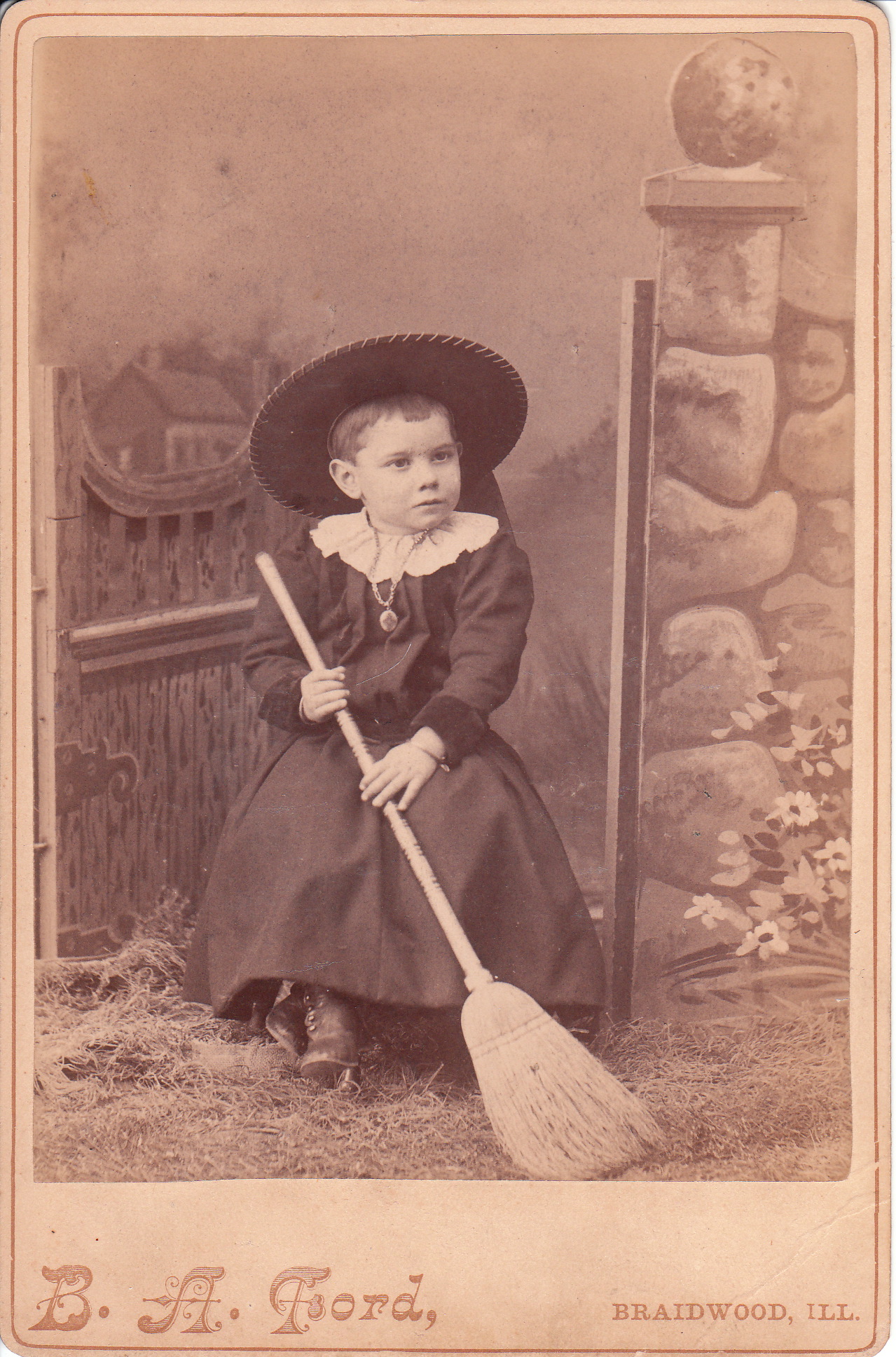 A young witch prepares for take-off with her trusty broom. The photograph must have been taken around the time of Halloween. In reality, this photograph is a portrait of a young child posing with a broom. The child’s clothing, though appropriate for the era, resembles the garb of a witch. The child is wearing a necklace and a bracelet which favors the likelihood that the child is a girl. The photographer of this image is B. A. Ford of Braidwood, Illinois. Ford was a photographer of note in Illinois. He was a documenter of the early history of coal fields in his town. In 1879 he advertised for an apprentice for his busy studio. Many of his subjects were miners or members of miner’s families. In an 1885 ad he offered to give free advice to his customers so that they may learn the art of hand tinting. Ford’s community of Braidwood was located 53 miles southwest of Chicago, Illinois. In 1864, a family digging for water, found coal and soon a mining community sprouted. The town was called Keeversville. James Braidwood was an early resident and he became the superintendent of the sinking of the first deep mine shaft. In 1873, the town was named in his honor.
ADORABLE BABY IN A WASHBOWL IN BALTIMORE, MARYLAND
 A very cute baby poses for a photographer, artistically placed in a washbowl. The baby appears inquisitive about the proceedings. Bachrach & Bro. is the studio that produced this portrait. The gallery was located in Baltimore, Maryland. Kudos for the photographer for this creative close-up image. The Bachrach studio was nationally known and is still known today. David Bachrach (1845-1921) was an American commercial photographer based in Baltimore. He made significant contributions in technical, artistic and professional advancements in the field of photography. He was a national spokesperson for photographers and published many articles and photographs in photography journals. He experimented with self toning papers and developed the first practical process of photographic printing on canvas, a precursor to photo engraving. Bachrach Inc., founded in 1910, is still headed by the Bachrach family. The company owned studios in all major east coast cities. One of Bachrach’s earliest photographs was taken on assignment to cover the dedication of the Soldiers National Cemetery at Gettysburg in 1863. He photographed President Lincoln delivering what would become, a very famous speech. Bachrach’s home is listed on the National Register of Historic Places. He once shared the home with a celebrated relative, Gertrude Stein. Among his famous portraits are images of Ulysses Grant, Theodore Roosevelt,Mark Twain, and Alexander Graham Bell. Bachrach’s business was truly a family business. Among the relatives who were involved in the business was a brother, a son, and two grandsons.
BRATTY LOOKING KID IN SAN JOSE, CALIFORNIA
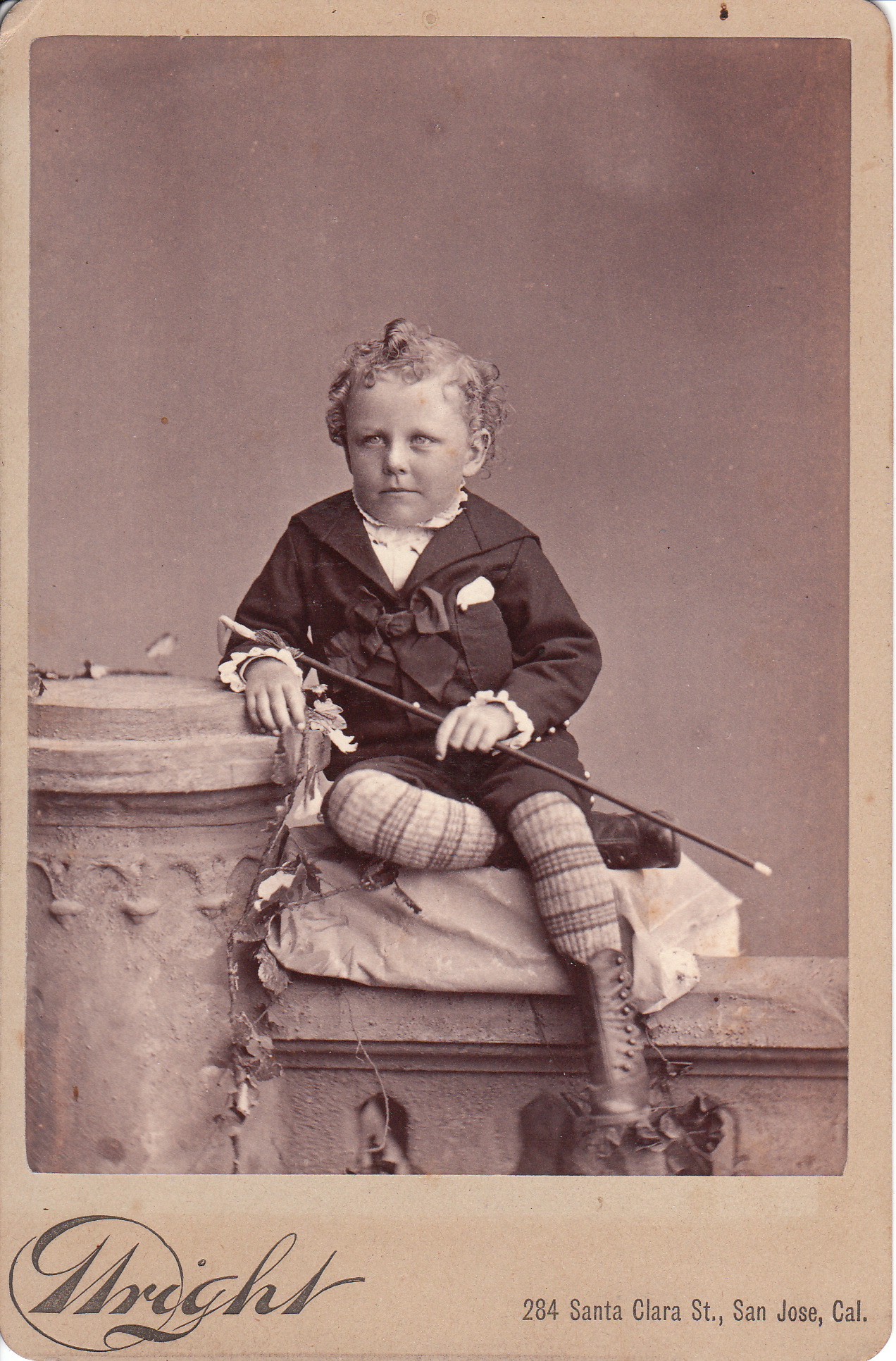 This cabinet card features a portrait of a “gangsta” little boy. Although it is unfair to defame this child merely on the basis of his appearance; it is difficult to get past his dour and sinister expression. He is dressed well for the occasion of his photograph. He is wearing a shorts suit with a handkerchief strategically placed in his jacket’s top pocket. He is sporting colorful woolen stockings and high button shoes. The boy is holding a thin walking stick, or riding crop. The photographer of this cabinet card is Wilbur W. Wright whose studio was located in San Jose, California. He is not the famed aviation pioneer, Wilbur Wright, brother of Orville Wright. Photographer Wright is listed in a number of San Jose business directories ranging from 1890 through 1907. The address of his gallery is listed as 24 Santa Clara Street, and not 284 Santa Clara Street, as printed on this cabinet card.
ADORABLE SIBLINGS IN SALEM, MASSACHUSETTS
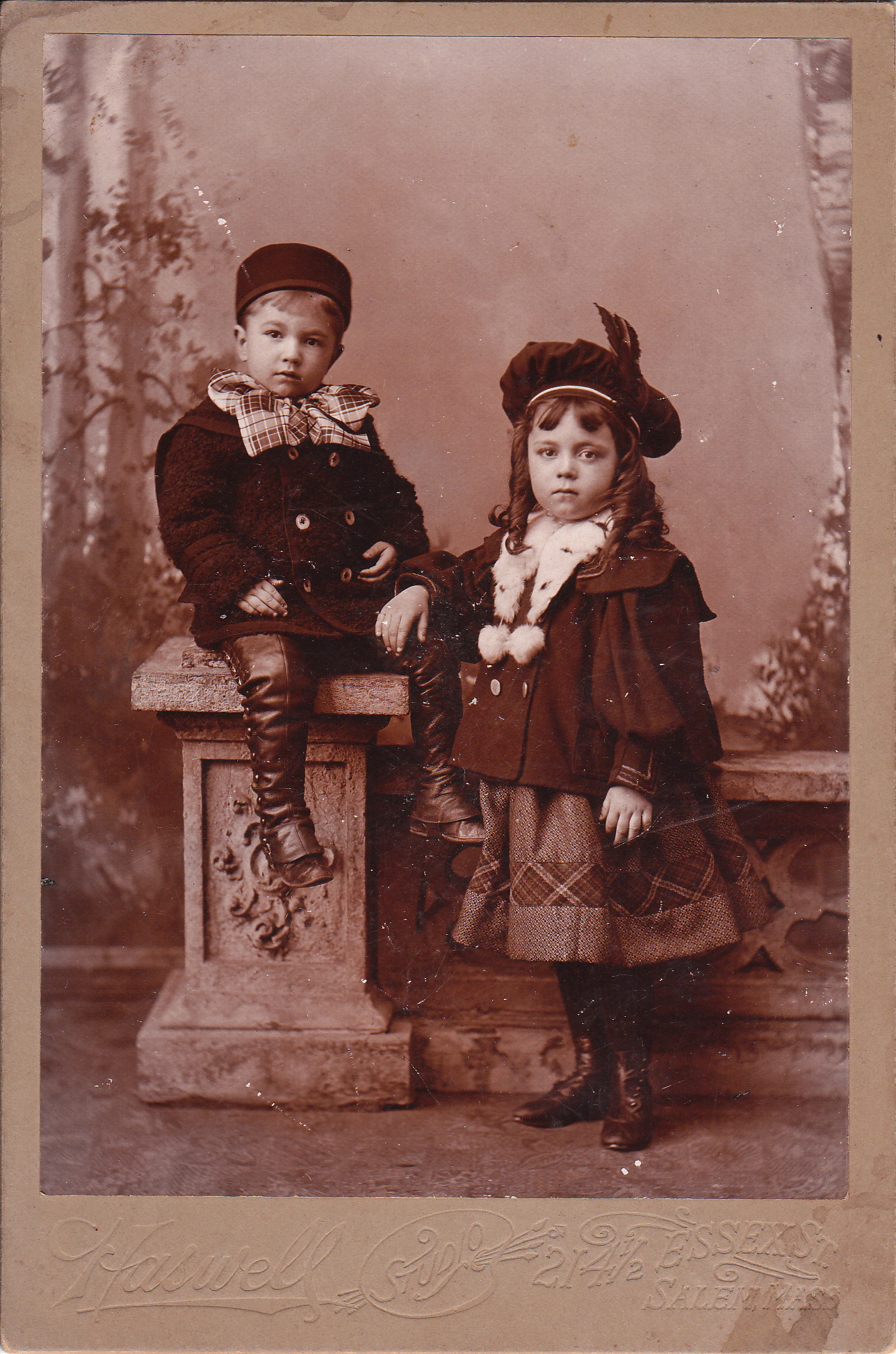 This cabinet card is a portrait of two adorable siblings posing for their portrait at a studio in Salem, Massachusetts. The photographer is S. S. Haswell. The children are fashionably dressed for cold weather. Their jackets appear to be similar or identical. The little boy sports beautiful long boots and a large bow tie. The girl is wearing a cute scarf with pom poms as well a cute cap.
A YOUNG BOY AND HIS PULL-TOY DOG
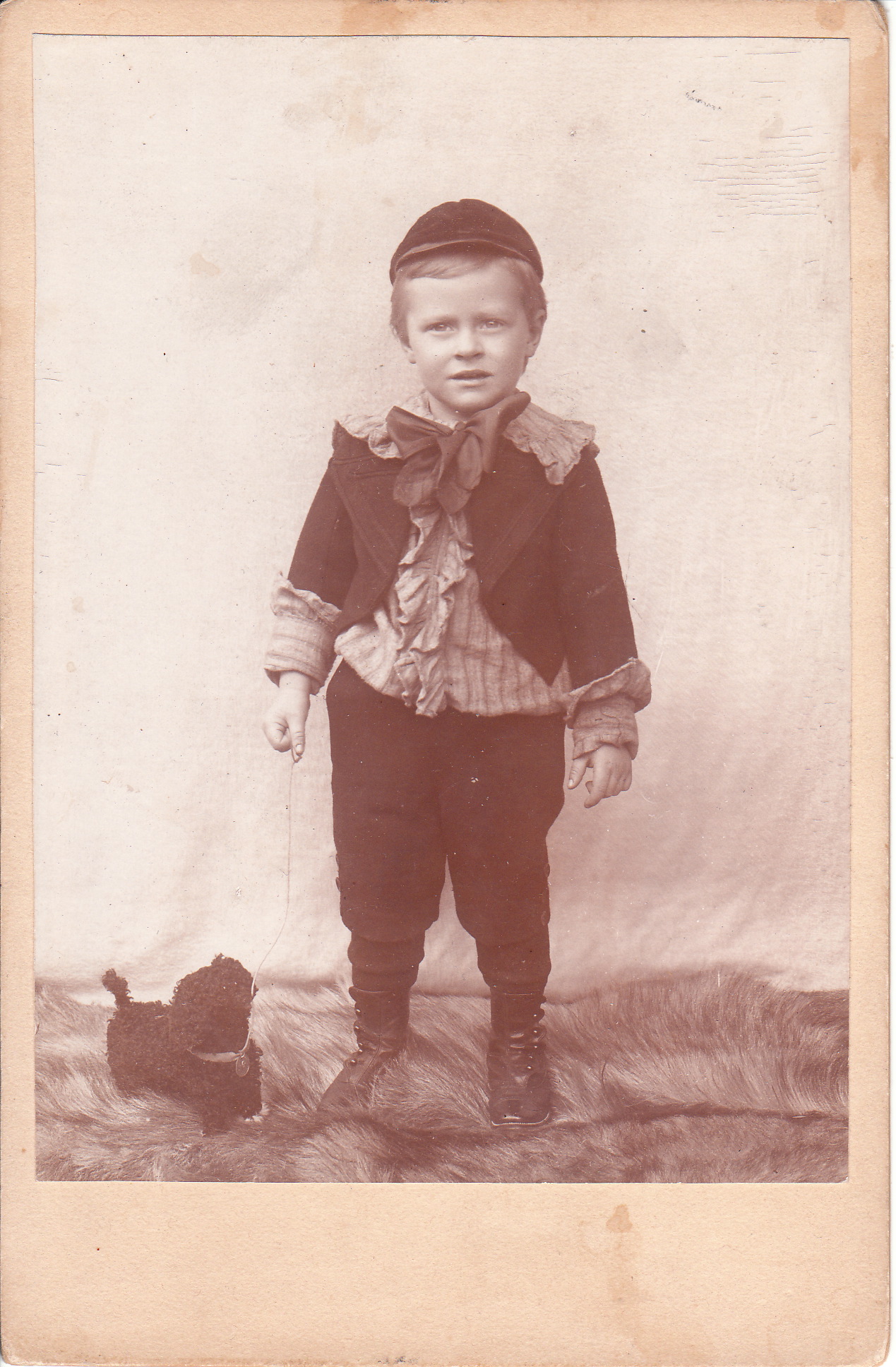 A cute little boy poses with his pull-toy dog. He is very dressed up for his portrait. Note his large bow tie and his cute cap. The photographer and the location of the photographic studio are unknown. The photographer’s creativity, in regard to his choice of background and props, is very uninspiring.
TWO SIBLINGS AND A FAKE DOG IN VIENNA, AUSTRIA
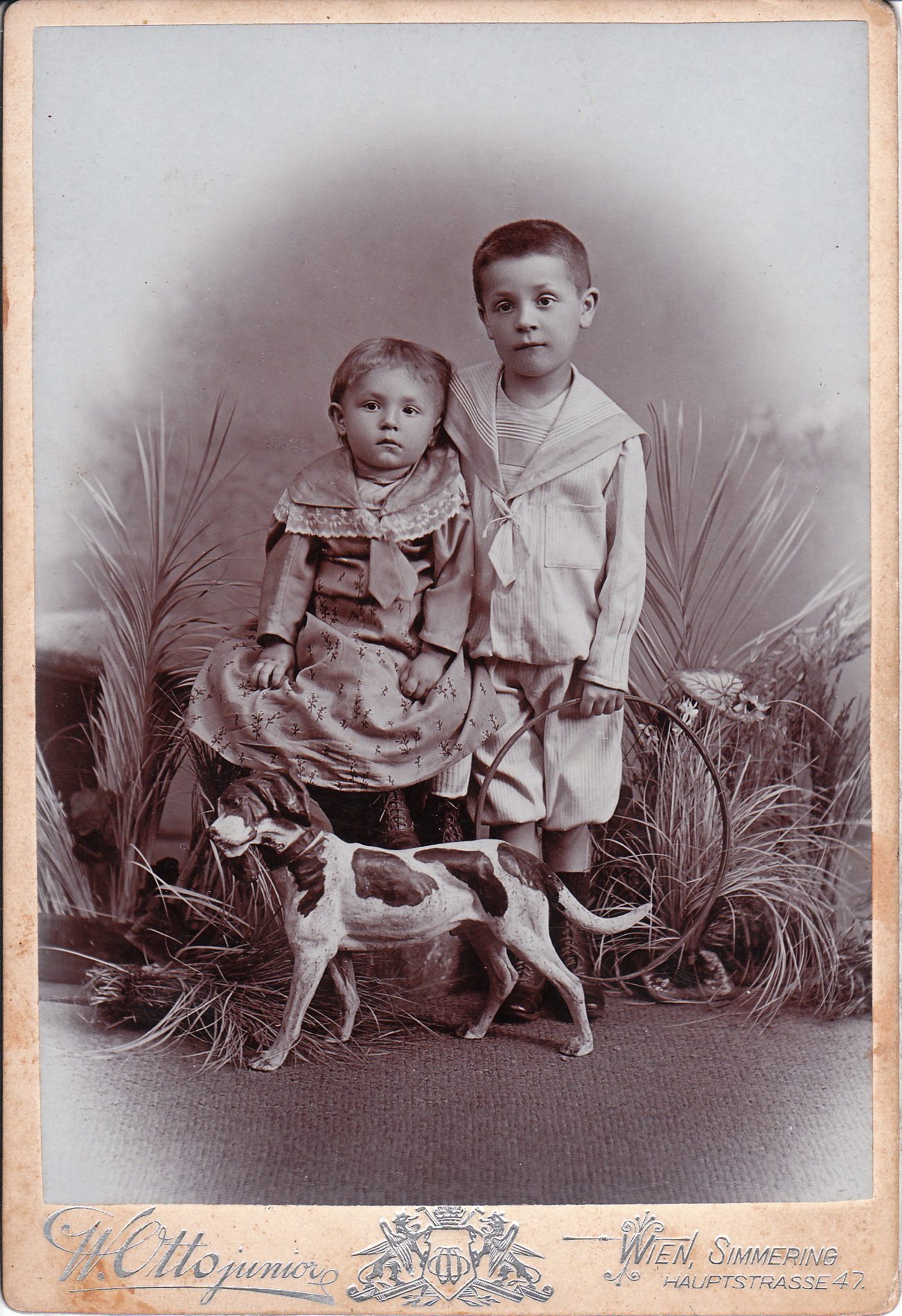 This cabinet card features two siblings posing with a fake dog. The dog, and perhaps the ring toy held by the older child, were provided by the photographer, Wilhelm Otto Jr. Otto’s photographic studio was located in Vienna, Austria. One can see the advantages of a fake dog versus a real dog from the perspective of the photographer. Children were difficult enough to photograph; dogs behaving like dogs were likely a photographers nightmare. Talking about nightmares, the children do not seem to be having too much fun having their portrait taken.
A GIRL AND HER DOG IN PHOENIX, NEW YORK
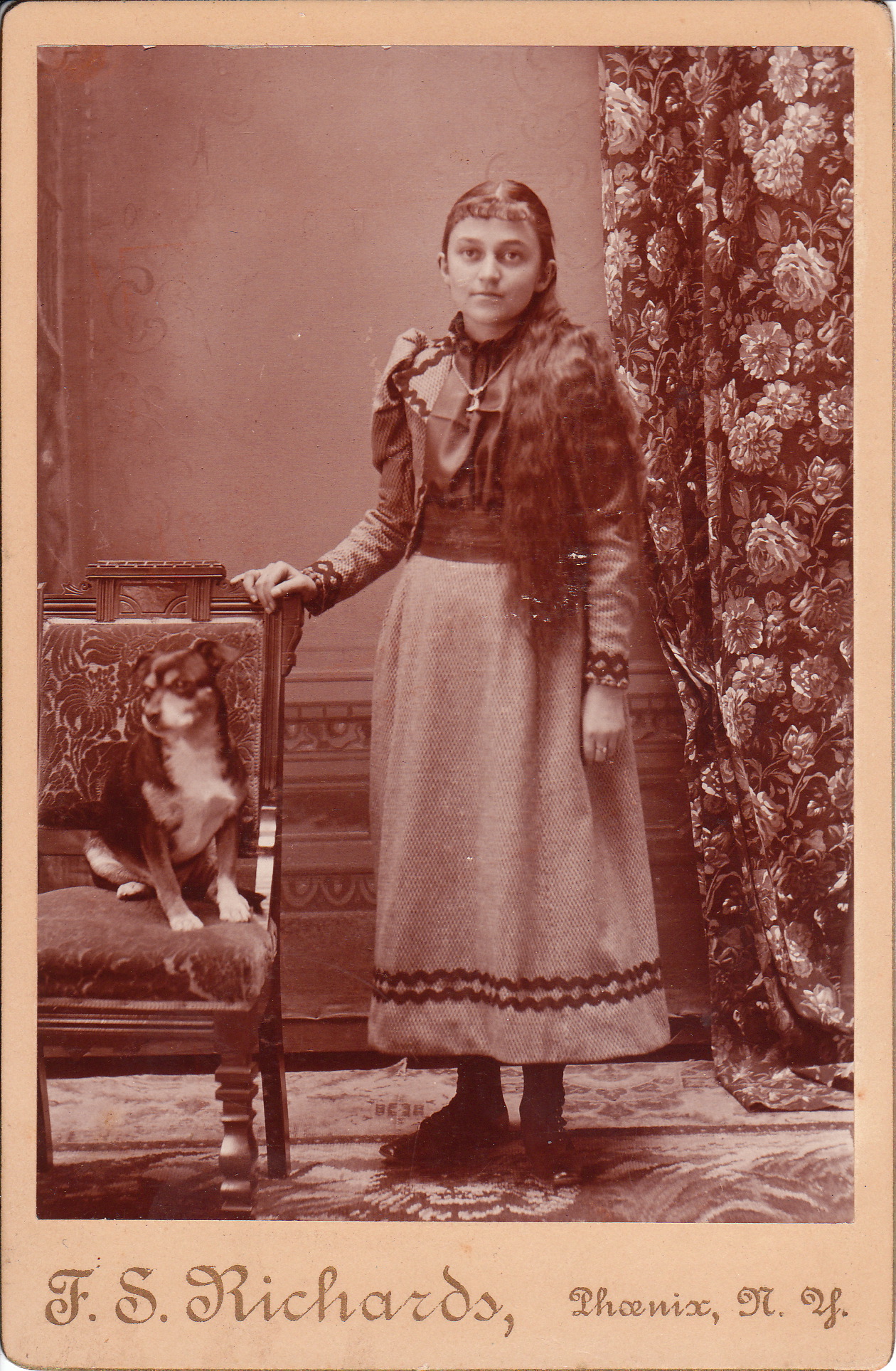 This cabinet card is a portrait of a young woman posing with her small dog. It appears that the dog was not the most cooperative subject, since the photographer found this image acceptable even though the mongrel was looking away from the camera. The quality of the photographers work is also lowered by his choice of backdrop (a wall and curtain); as well as his not including the entire chair in the image. The girl, who looks as if, she is in her teenage years, is rather plain looking. She is wearing a ring and a necklace. She has very long hair with curly bangs. The photographer is F. S. Richards and the studio was located in Phoenix, New York. Phoenix is a village located in Oswego County. It is 15 miles north of Syracuse. In 1916, Phoenix was nearly destroyed by a devastating fire.


