 This cabinet card features a young girl holding and posing her large doll. The doll is quite beautiful and detailed. The child is posed in a room with what appears to be wicker furniture and a backdrop of curtains. The photographer is Samuel Ardron and his studio was located in Poughkeepsie, New York. He is listed in the Poughkeepsie Business Directory (1896). (SOLD)
A GIRL AND HER DOLL IN POUGHKEEPSIE, NEW YORK

TWO ADORABLE LITTLE GIRLS RIDING TO MARKET IN HORSE DRAWN WAGON (GERMANY)
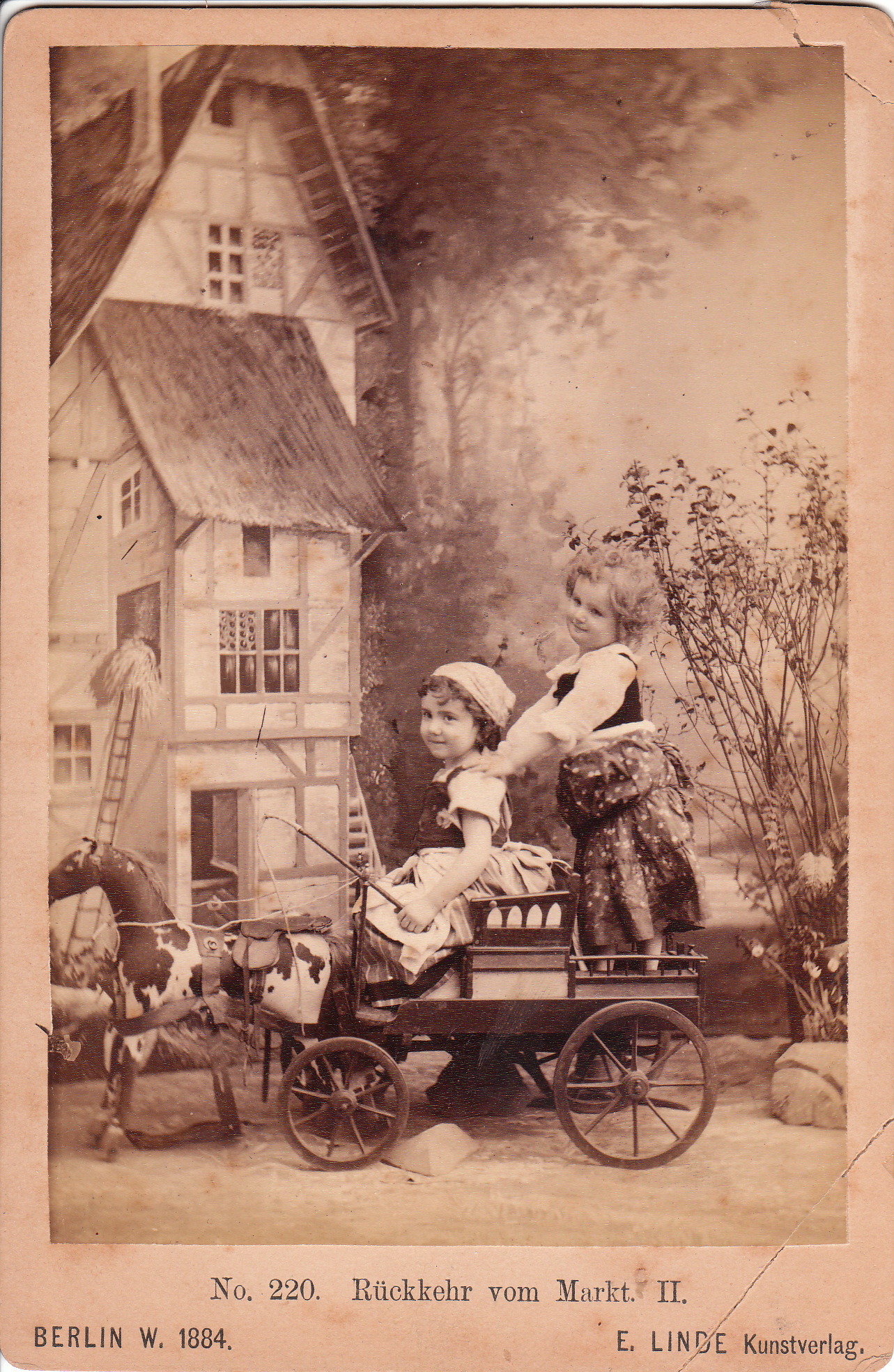
This cabinet card captures two precious little girls riding a toy horse drawn wagon to market. Note the terrific detail of both the toy horse, and the backdrop. The horse appears to be covered with fabric and has leather saddle bags and a tail made from hair. The printed German title below the photograph, “Ruckkehr vom Markt.”, translates to “smooth traffic from the market”. The card is dated 1884 and was photographed in Germany. The publisher of this photograph was E. Linde, who was located in Berlin, Germany. SOLD
ADORABLE AND BEAUTIFULLY DRESSED LITTLE GIRL IN CHICAGO, ILLINOIS
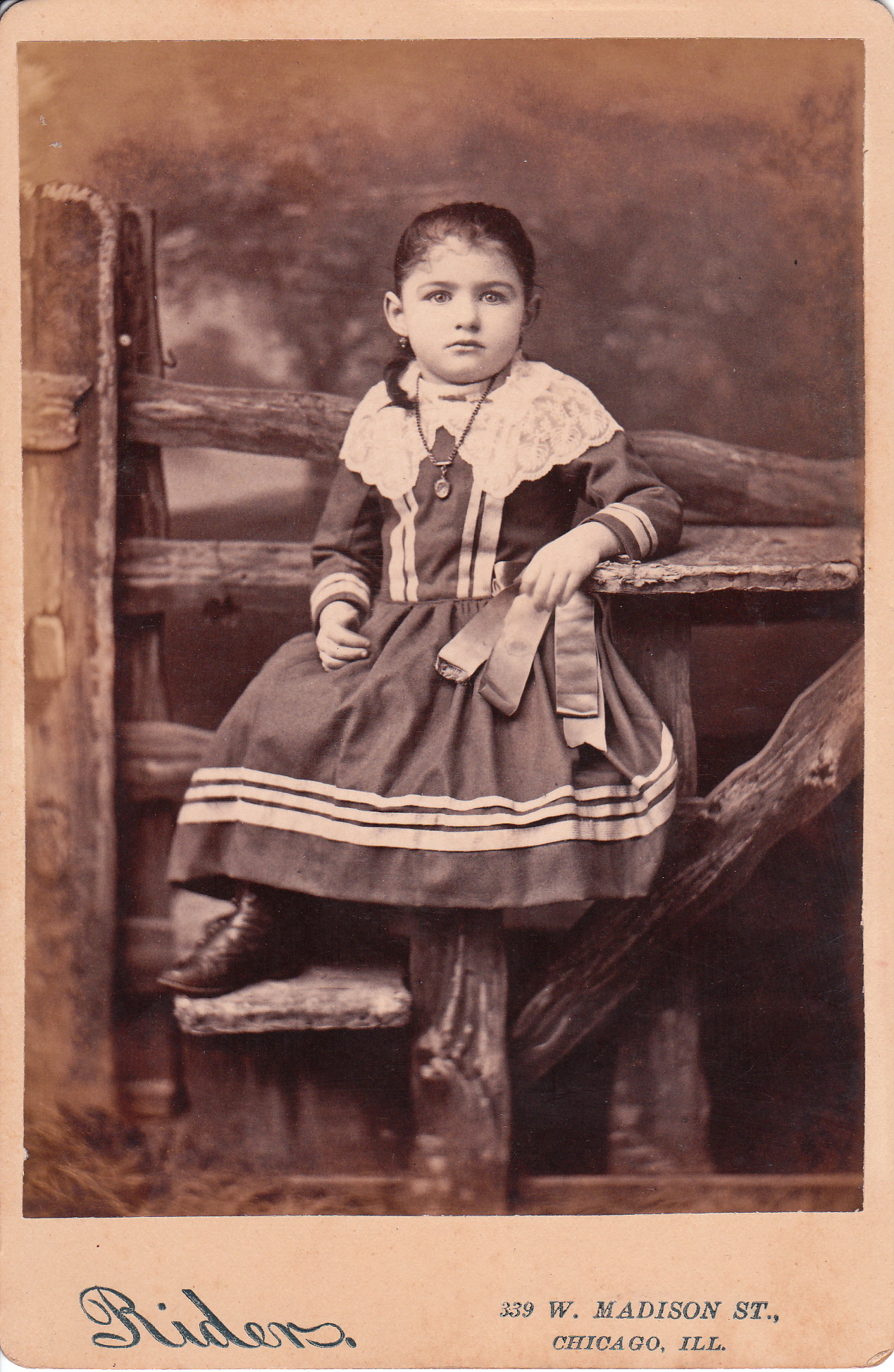 A cute little girl poses for her portrait at the studio of Briggs L. Rider, of Chicago, Illinois. The child is wearing a very cute outfit that includes lace and ribbons. The photographer, Rider, was active in Tipton, Iowa (1855), Des Moines, Iowa (1856-1860), and Chicago, Illinois (1864-1896?). During part of his tenure in Chicago, Rider was partners with photographer, Joseph Gehrig. Rider was a daguerreoist and cabinet card photographer. He also copied paintings, drawings and daguerreotypes; and taught daguerreotype art. The address listed on this cabinet card indicates that it was produced sometime between 1878 and 1890.
CUTE BOY IS POORLY POSED IN ROCHESTER, NEW YORK
 A cute long haired boy poses for his portrait at the studio of J. Heberger, in Rochester, New York. The boy is wearing his sunday finest. He is wearing a striped blouse with a big bow. The blouse is almost screaming “notice me”! In addition, he is wearing short pants and high black shoes and stockings. The photographer did a poor job of posing the young boy. The child is standing beside a wicker chair, and due to poor staging, there is an illusion that part of the chair is protruding from the top of the child’s head. The photographer’s lack of experience, or carelessness, significantly detracts from the quality of this portrait. This photograph is not apparently, an adequate reflection of the skills of the photographer. John Heberger is cited in a number of photography journals of his time for his skills and innovations. One article, from 1909, describes his development of a new process for putting pictures on fabrics. Another article appearing in The Photographic Journal of America (1919) describes an exhibit presented by Heberger. He displayed a number of photographs of subjects with obvious physical deformities. He then demonstrated how using modeling and etching techniques, he was able change the subjects appearance, in the photograph, to show them without their defects. One of his examples was a man with a goiter whose eyes appeared to “pop out of his head”. After Heberger applied his photographic magic, the man’s eyes looked perfectly normal on the resulting photograph.
TWO YOUNG SISTERS WEARING EXQUISITE DRESSES IN GOSHEN, NEW YORK
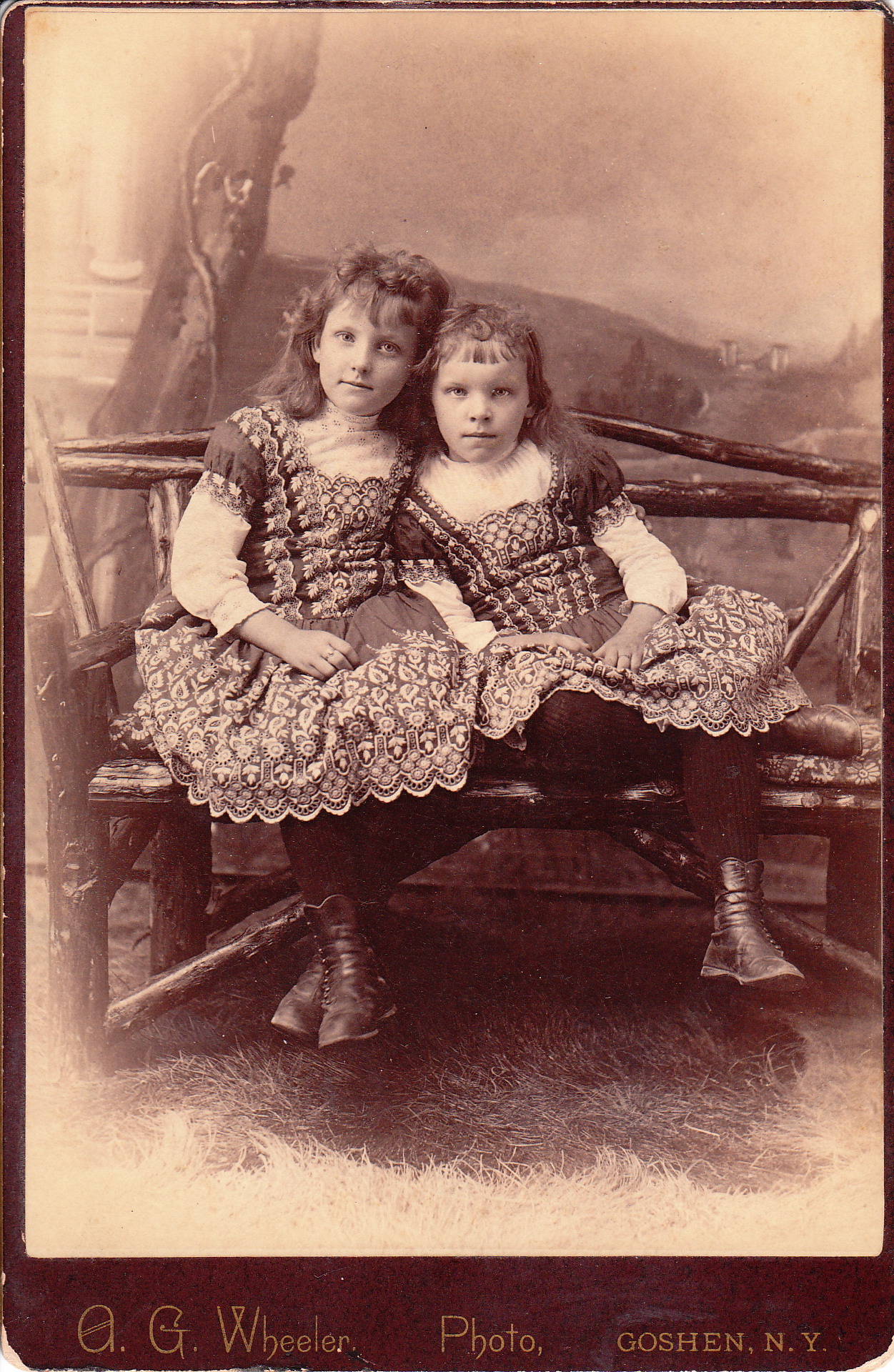 These Goshen girls are likely sisters, and they are wearing identical exquisite dresses as they pose for photographer A. G. Wheeler, in Goshen, New York. Wheeler is mentioned in the book,The Empire State: Its Industries and Wealth (1888). He is described as a native New Yorker who established his Goshen gallery in 1885. The brief biographical sketch adds that, earlier in time, he had a photographic studio in Hempstead, New York.
THE OTHER BOOGIE WOOGIE BUGLE BOY OF COMPANY B……… IN ALBERT LEA, MINNESOTA
 This cabinet card features a uniformed bugle boy, posed holding his instrument, and wearing a satchel bag strapped over his shoulder. The boy’s cap has a badge indicating that he was in company B of the “ALC”. “ALC” likely stands for Albert Lea C……”. Perhaps a visitor to the Cabinet Card Gallery can leave a comment identifying the “C” word. The bugle boy, judging by his uniform, was a member of a band. Albert Lea is the name of the Minnesota town where the photographic studio that produced this cabinet card was located. Albert Lea is ninety miles south of Minneapolis, Minnesota; and was named after a topographer with the US Dragoons who surveyed the area in 1835. The photographer of this cabinet card was Joseph A. Fuller (1851-?). Fuller was born in Walworth County, Wisconsin. He worked as a photographer in Decorah, Iowa and Chatfield, Minnesota; before moving to Albert Lea in 1873. At the time of this photograph, Fuller’s studio was on the corner of Williams and Broadway Streets, “over Brown & Cos Bank”. His later studios in Albert Lea included 202 South Broadway (1914-1922) and 204 South Broadway (1924). He worked in Minnesota from the 1870’s through part of the 1920’s.
TWO GIRLS AND A DOLL IN CHICAGO HEIGHTS (OR POSSIBLY FRANKFORT STATION) , ILLINOIS
 Two bright-eyed young girls sit for their portrait at the studio of Fred Heising in either Chicago Heights, or Frankfort Station, Illinois. The youngest child, sitting in a wicker chair, has her arm firmly around the shoulders of her toy doll. The older girl stands behind her little sister, with a physical position and a facial expression that can best be described as “big sisterish”. An advertisement in the Bulletin of Photography (1912) lists Heising’s studio for sale at the price of eleven thousand dollars. The ad states that the studio had been in existence for twenty years. A little simple math reveals that this photograph was produced sometime after 1892.
TWO CUTE YOUNG SISTERS IN SOFIA, BULGARIA
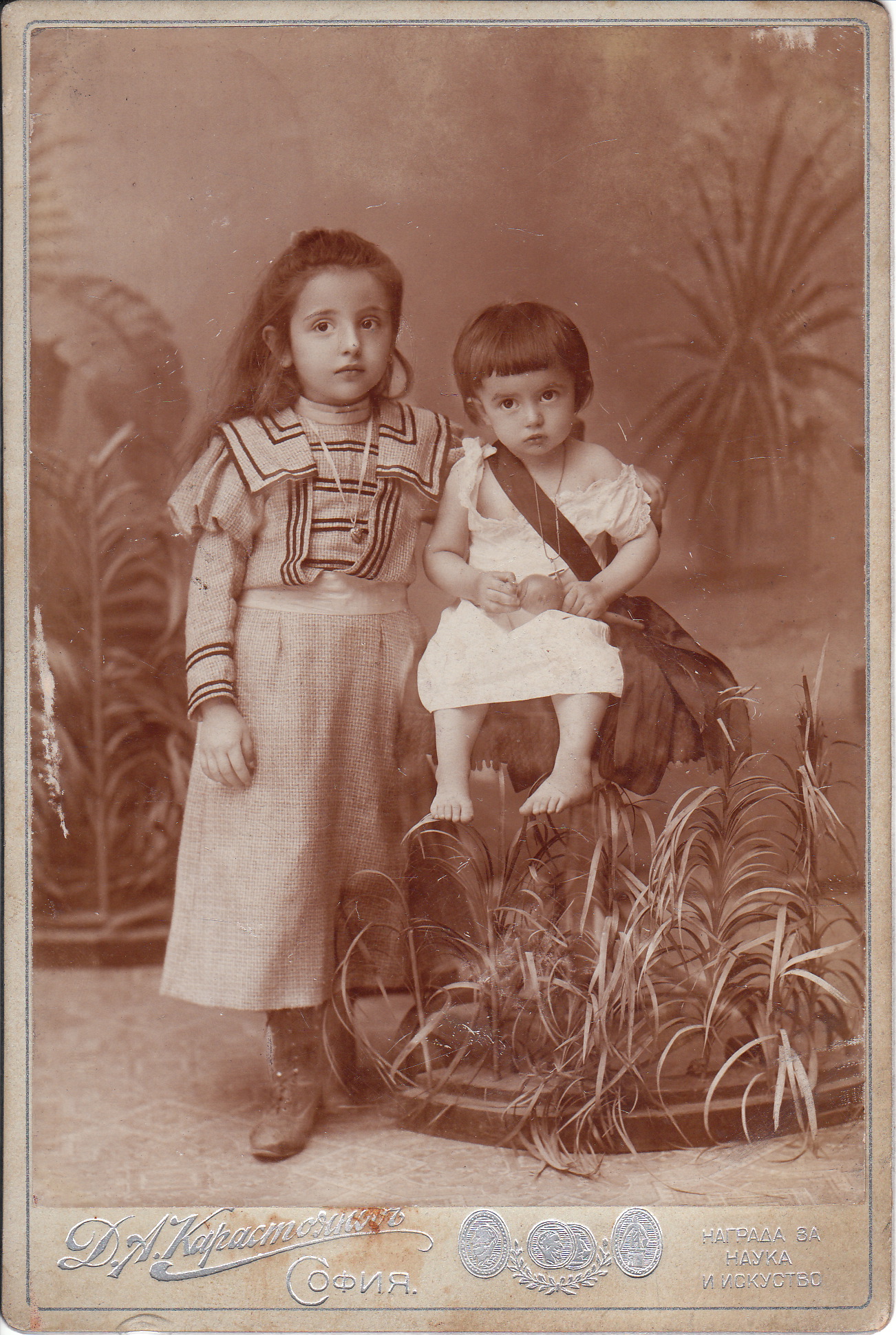 This cabinet card features two young girls posing for their portrait at a photographer’s studio. The girls are most probably sisters, and they are very cute. Note their large dark expressive eyes. The older girl is wearing a necklace with a locket or charm, while her little sister is wearing a necklace with a cross and holding a toy that could be a spinning top. The youngest child also has a strap over her shoulder which appears to be a bag of some kind. A previous owner of this cabinet card states that the photograph was produced by a studio in Sofia, Bulgaria. The name of the photographer is difficult to decipher and hopefully a Bulgaria savvy visitor to the Cabinet Card Gallery, will be able to provide the name of the producer of this image.
CUTE YOUNG GIRL IN NASHUA NEW HAMPSHIRE
 A young girl poses for her portrait in the studio of Charles Henry Lindsay in Nashua, New Hampshire. Note her lace collar and her cute curls. She has a great half smile and is very focused on the photographer and camera. The photographer of this image had quite a journeyman career. The Granite State Monthly (1916) wrote a glowing article about his skills and described his career experiences. Lindsay learned his profession in the studio of Frank O. Everett, in Nashua. He began working for Everett around 1872 and stayed in his employ for about three years. He then moved to Concord, New Hampshire to become an operator for Benjamin Carr. He ultimately purchased Carr’s business and conducted it successfully until it was destroyed in a fire. He then worked with Stephen Piper in Manchester until 1879, when he moved to Nashua and opened his own studio. In 1889 he went to Boston and worked for some well known photographers. From 1894 until at least 1915, he operated a studio in Manchester, New Hampshire. At some point, his son, Ira Frank Lindsay, joined him in operating the Manchester studio. Lindsay’s career certainly was one that had many starts and stops, and forced him to make many relocations. This cabinet card was produced during Lindsay’s Nashua tenure between 1879 and 1889.
BUNDLED UP FOR THE COLD: ADORABLE LITTLE GIRL IN FOSCANI, ROMANIA
 Although this image is a studio portrait, this bundled up little girl looks seriously cold. Her long and heavy coat appears to be made out of fur or possibly wool. Her hands are kept warm in a muff and her wide brimmed hat protects her face from the falling snow. If the wind is blowing the snow toward her; she is out of luck. Are those flowers that she is wearing in her hair? Flowers, in the winter? Perhaps its because of that famous song, “If you go to Foscani, be sure to wear, flowers in your hair”. Oops! Wrong city and wrong era! The photographer of this image is Franz X. Koroschetz of the aforementioned, Foscani, Romania.


 THE CABINET CARD GALLERY