 Although this image is a studio portrait, this bundled up little girl looks seriously cold. Her long and heavy coat appears to be made out of fur or possibly wool. Her hands are kept warm in a muff and her wide brimmed hat protects her face from the falling snow. If the wind is blowing the snow toward her; she is out of luck. Are those flowers that she is wearing in her hair? Flowers, in the winter? Perhaps its because of that famous song, “If you go to Foscani, be sure to wear, flowers in your hair”. Oops! Wrong city and wrong era! The photographer of this image is Franz X. Koroschetz of the aforementioned, Foscani, Romania.
BUNDLED UP FOR THE COLD: ADORABLE LITTLE GIRL IN FOSCANI, ROMANIA

CLASS PHOTO IN FRONT OF RURAL SCHOOLHOUSE IN PRAGUE, NEBRASKA
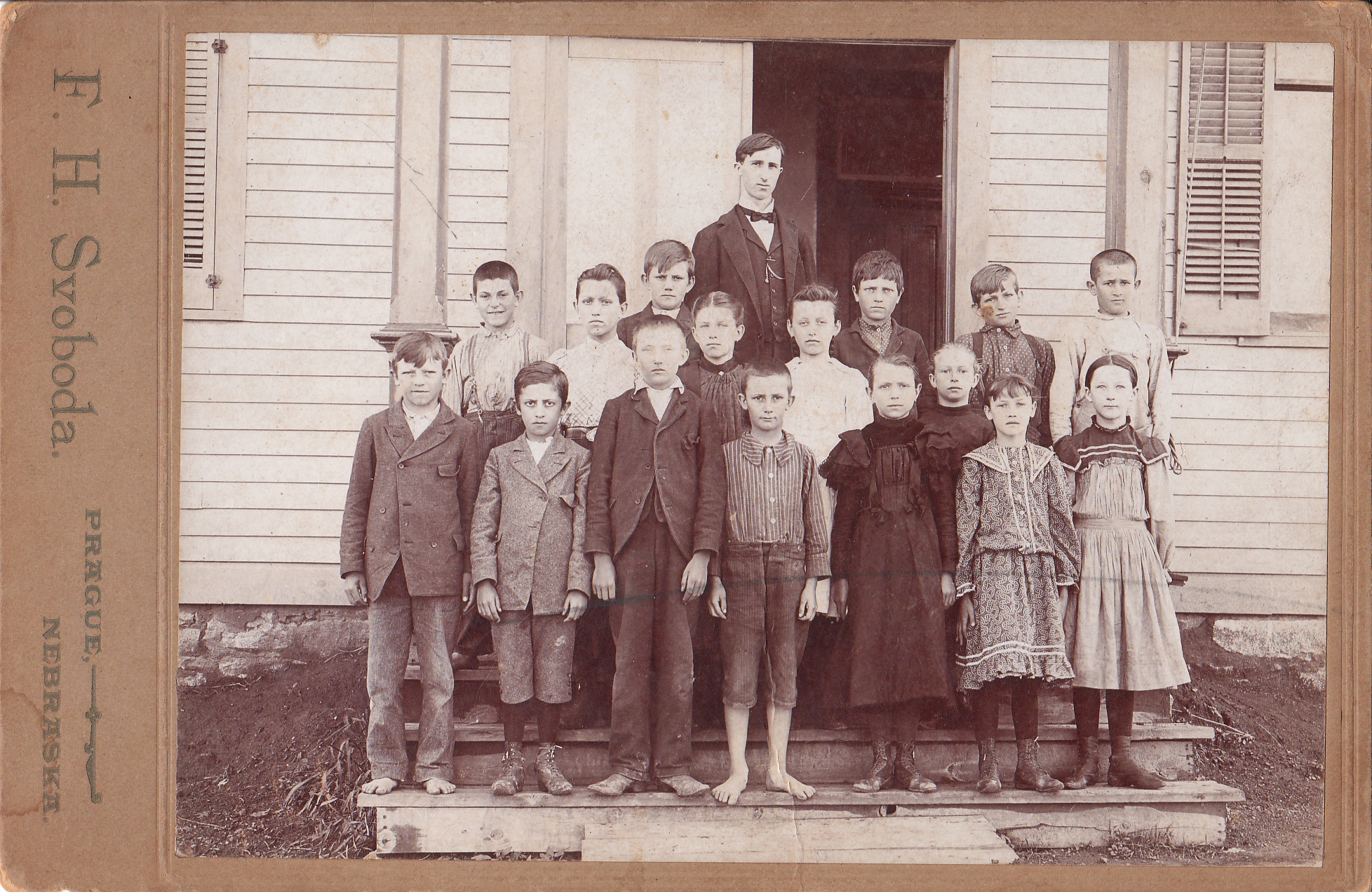 This cabinet card offers a glimpse back into historical times of the American education system. This image dates back before “teaching for the test” was standard policy for many school districts. Sixteen children are posed in front of their schoolhouse. Their young teacher stands behind his class. The children seem to have dressed nicely for “picture day”, but at least a couple of the boys are barefoot. F. H.Svoboda was the photographer of this image and his studio was located in Prague, Nebraska. At one time, Svoboda published the first, and only, Czech juvenile magazine in Nebraska. He was a school teacher and later engaged in photography. In 1909, he began to publish the Schuyler Messenger, which existed until 1920. The Messenger was a weekly newspaper in Schuyler, Nebraska. The town of Prague has an interesting history. Its early inhabitants included many Czech settlers who arrived in America seeking prosperity during the 1880’s. In 1887, the town was built to support a newly established railroad station. The town was built by the Lincoln Land Company and became a thriving community catering to the agricultural economy of the area. The largest business in the town was a lumberyard. The town’s name, Prague, is named after the capital city of Czechoslovakia.
FIVE PRETTY LITTLE GIRLS IN ARLINGTON, SOUTH DAKOTA
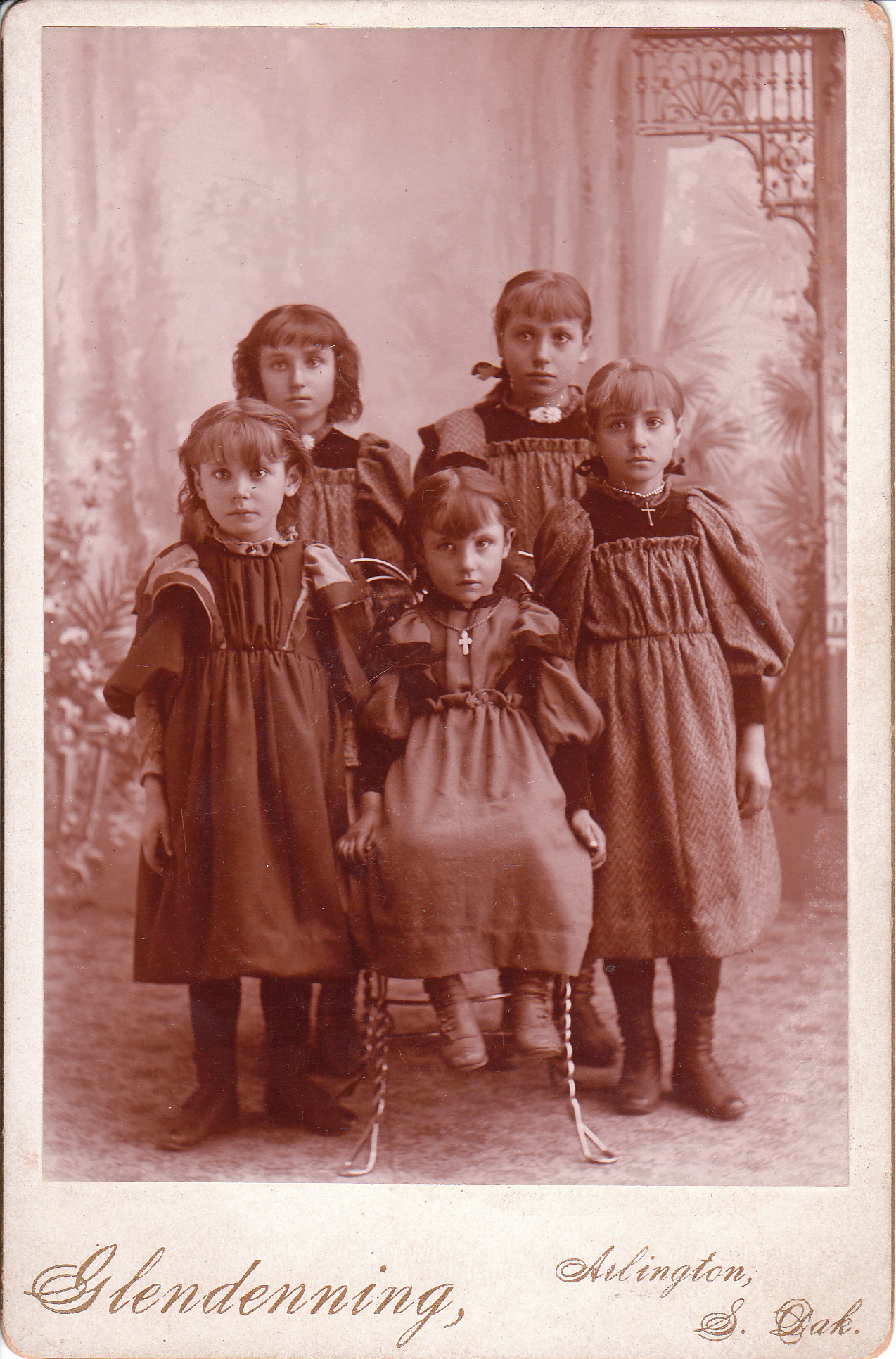 This cabinet card is a portrait of five pretty little girls in Arlington, South Dakota. The photographer, Glendenning, demonstrated talent, in the way he posed the children in this photograph. The girls are dressed in similar dark dresses and two are wearing necklaces with crosses. South Dakota became a state in 1889; therefore this cabinet card was photographed after 1889.
ADORABLE LITTLE GIRL IN WAUBEEK, IOWA
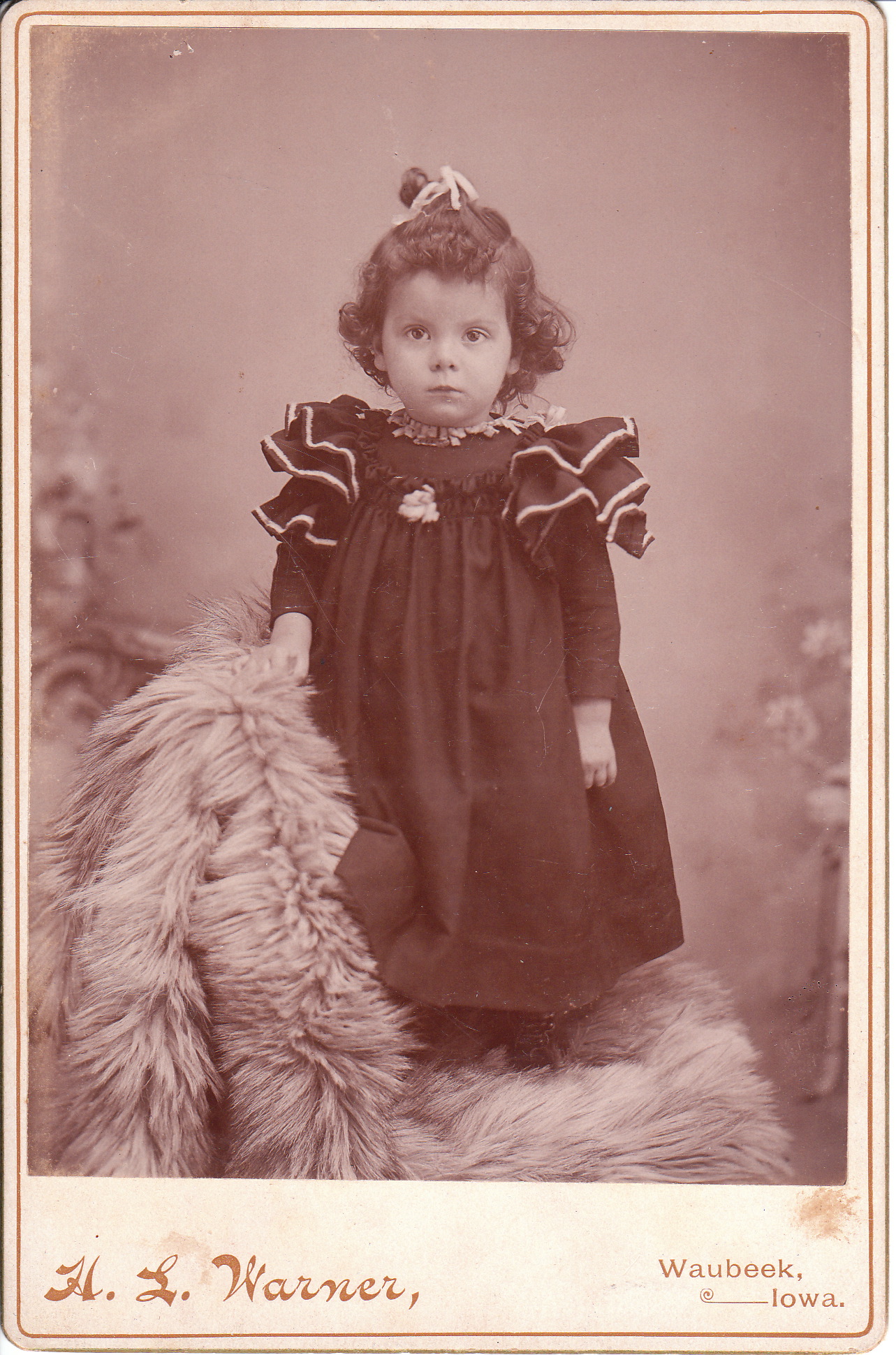 This cabinet card features a very adorable young girl. She is standing on a fur draped chair and wearing a fancy dress. A hair ribbon decorates her hair and adds to her “cutie pie” appearance. Handwriting on the reverse of the photograph identifies the child as “Elva Hemenway”. The 1900 Federal Census identifies a seven year-old named Elva L.Hemenway, who resided in Linn County, Iowa. Waubeek is in Linn County. The photographer is H. L. Warner of Waubeek, Iowa.
TWO YOUNG CHILDREN AND A TRICYCLE IN ST. JOSEPH, MISSOURI
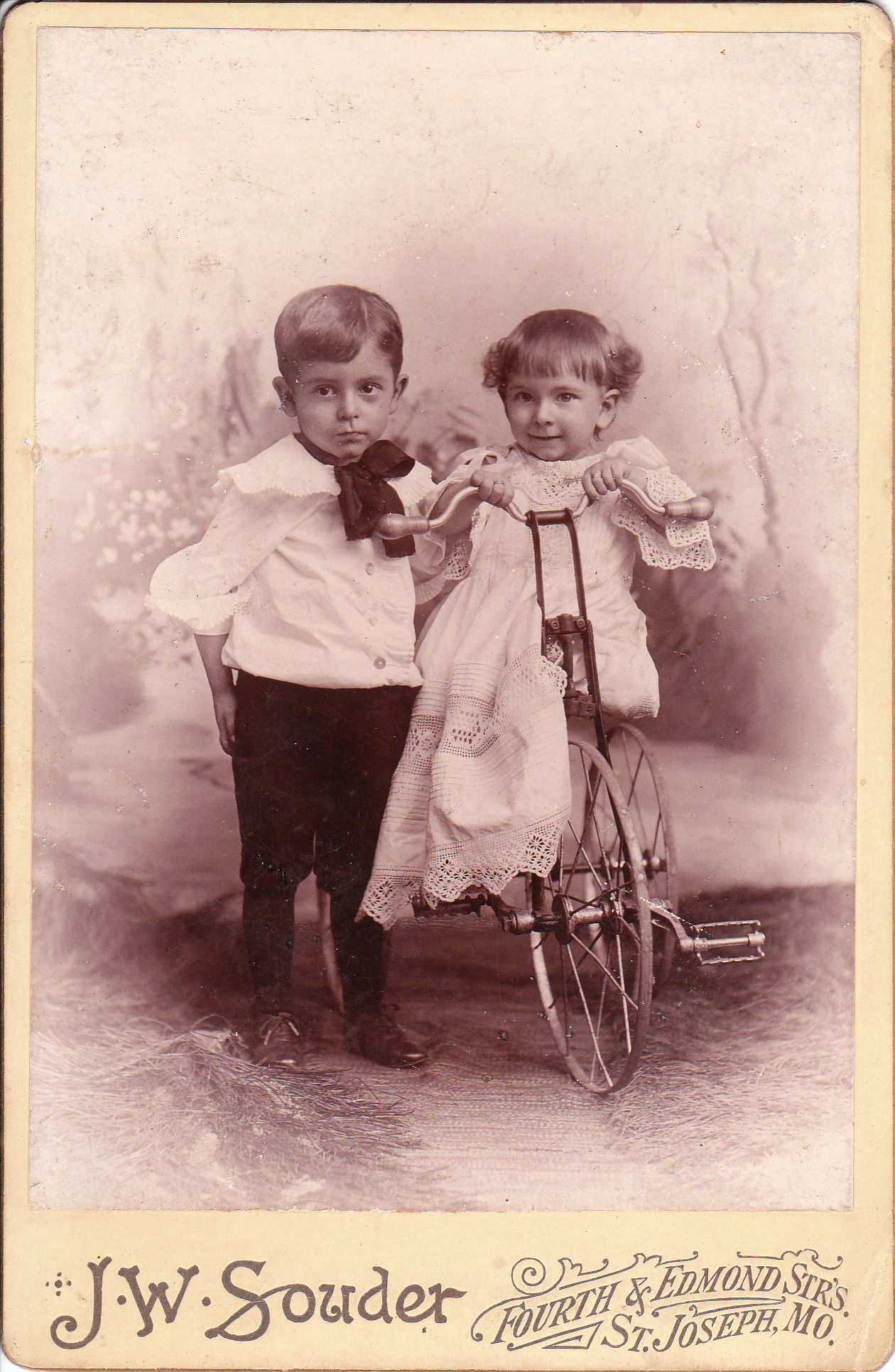 This cabinet card captures two young children posing for photographer, J. W. Souder, of St. Joseph, Missouri. The children are adorable and they are most probably, siblings. The boy is wearing a bow tie and the girl is riding a tricycle. John W. Souder’s photography business was listed in St. Joseph directories between 1887 and 1896. It is unknown whether he was there during other years.
A GIRL AND HER DOLL IN NEW MILFORD, CONNECTICUT
 This cabinet card presents a very cute young girl holding one of her dolls. The child is nicely dressed. Note her high button shoes. Her hairstyle seems a bit unusual for the time. Her hair appears to be shorter than one might expect based on other photographs of similar aged girls of that era. However, her hair may be pulled back, and not really short. This photograph also presents a clear view of the child’s doll. The photographer of this image is John J. Walklet of New Milford, Connecticut. Wilson’s Photographic Magazine (1899) announces the sale of Walklet’s studio to W. M. Miller. Walklet’s studio was located at 27 Bank Street, according to a New Milford business directory (1891).
YOUNG TENNIS PLAYER AND HIS TWO SISTERS
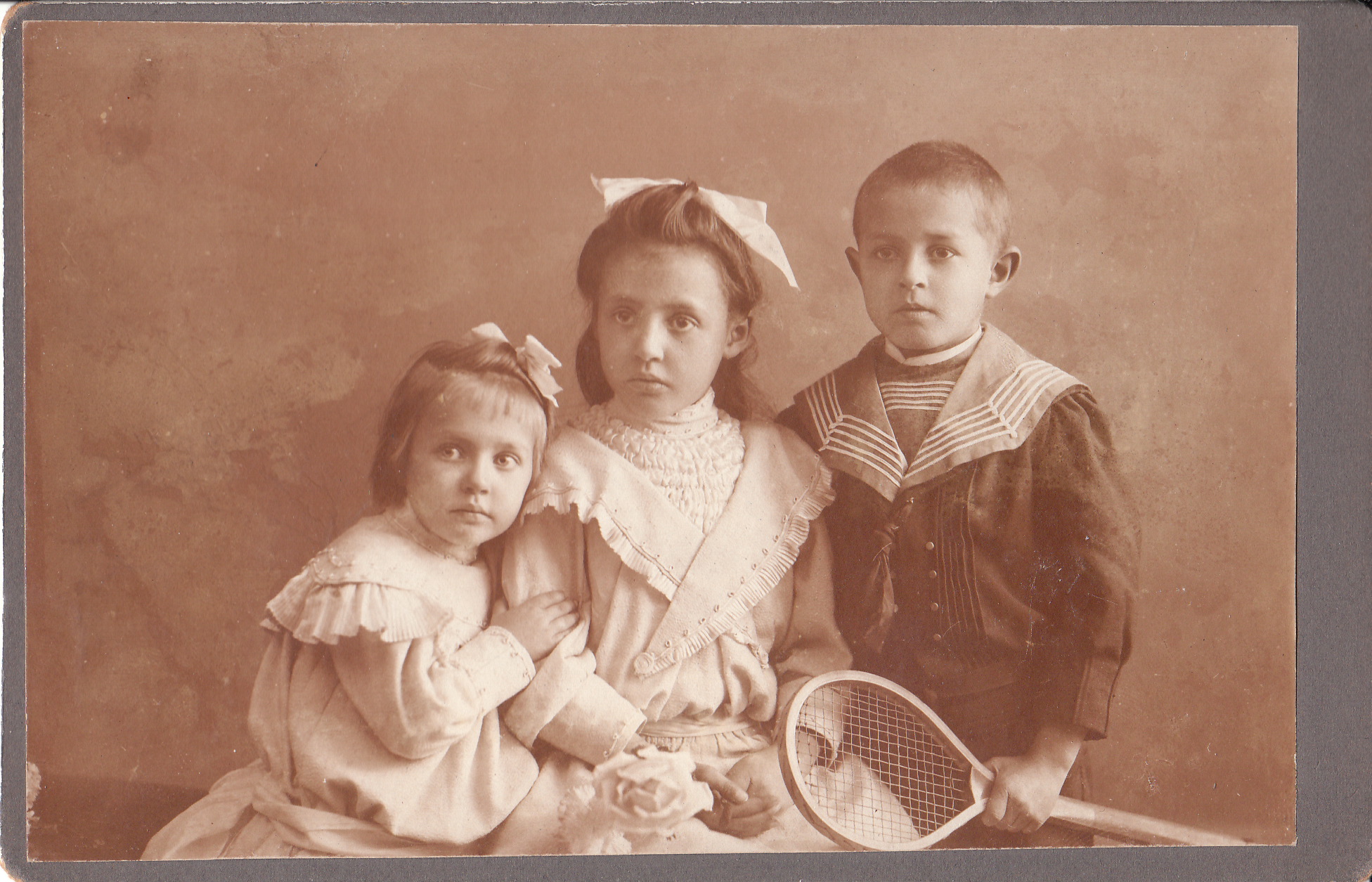 This cabinet card features a young boy holding a tennis racquet as he stands along side his two sisters. The children are adorable, but the youngest girl appears absolutely terrified. The boy is wearing a sailor suit outfit. The name of the photographer and the location of the studio is unknown.
A VERY STERN LOOKING YOUNG BOY FROM CANTON, OHIO
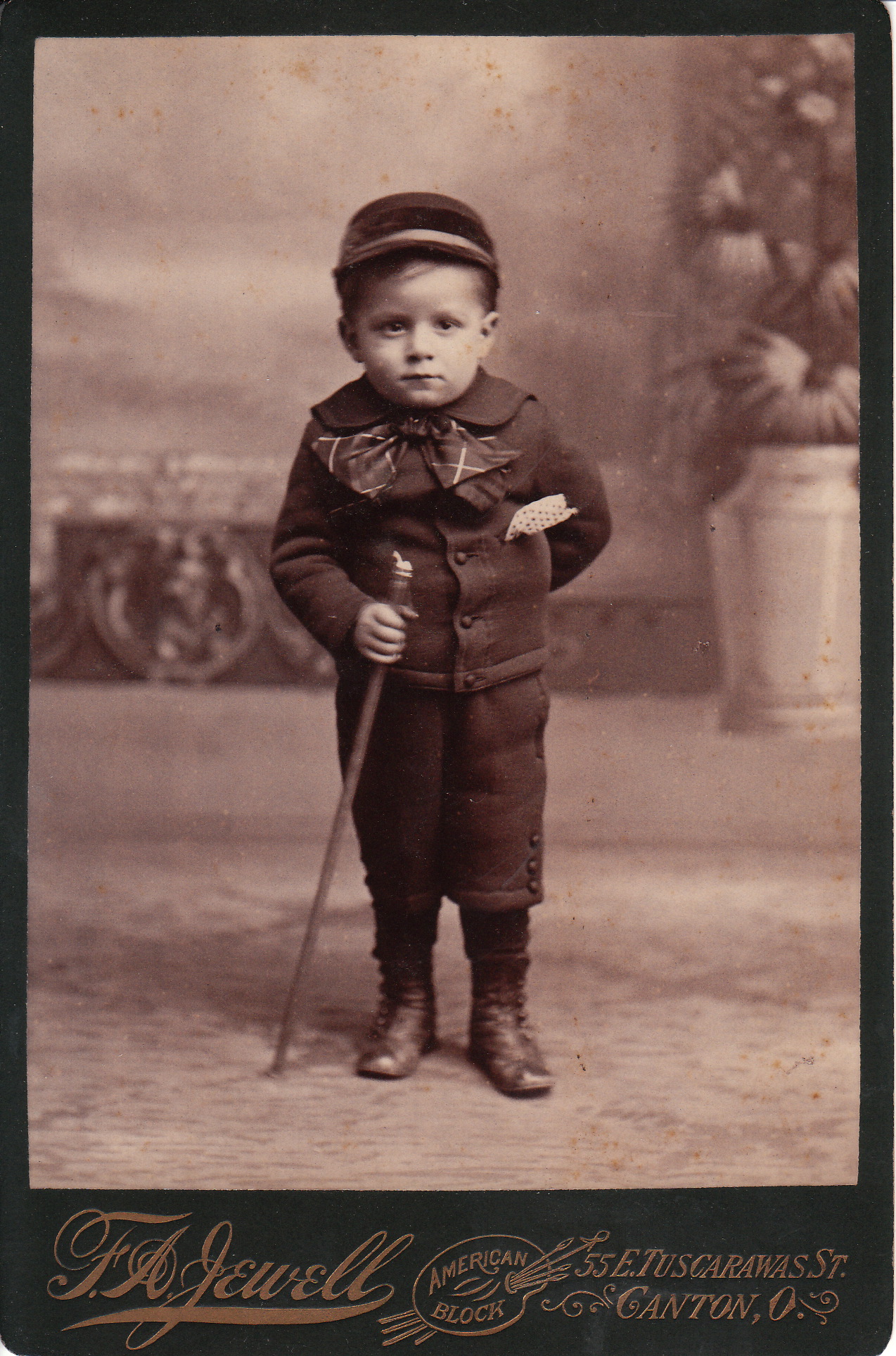 This cabinet card features a young boy who is very fashionably dressed and is carrying a walking stick. Note his cap, large bow, and pocket handkerchief. Also look at his short suit. His very stern look and his outfit makes him look much older than his actual age. The photographer of this image is F. A. Jewell of Canton, Ohio. He was active in Canton during the early 1890’s. He specialized in portraits and photographs of large family groups.
COSTUMED GIRLS IN SCHOOL PLAY (1883)
 This cabinet card appears to be an image of a group of girls who are members of a cast of a school play. The girls are dressed in ethnic costumes. The girl sitting closest to the photographer is dressed beautifully in gypsy garb. Two individuals in this image appear to be adults and one may surmise that they are the teachers who are directing the show. Two of the girls are holding flowered hoops. A sign made up of leaves or vines indicate that this photograph was taken in 1883. Next to the date, two letters are hanging. The letters are either “MC” or “HC”, which may be an abbreviation of the school or group that is putting on the production. The name and location of the photographer is unknown since a prior owner of this cabinet card trimmed the edges to fit into an album or frame.
YOUNG BOY PULLING HIS TODDLER SISTER IN A WAGON (FEMALE PHOTOGRAPHER IN COUNCIL GROVE, KANSAS)
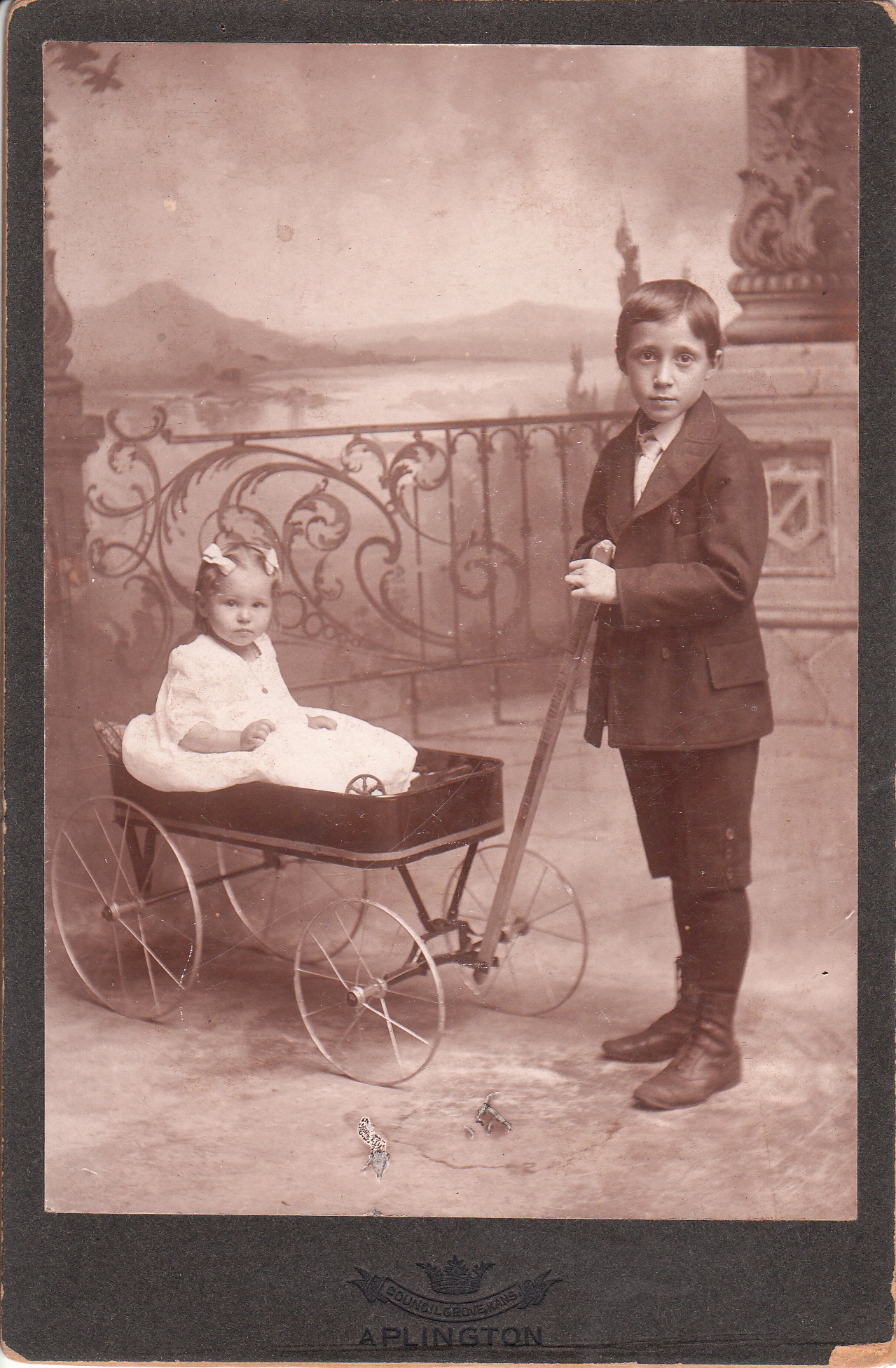 This is the likely scenario. The boys parents, at the photographers suggestion, said, “Go stand over there and pretend that you are pulling your sister in the wagon”. The boy followed his parents suggestion, but, he wasn’t too happy about it. He certainly wasn’t going to smile for the photographer. This day at the photographer’s gallery was certainly not the fun he had hoped it would be. In contrast, little sister was interested in her surroundings and she sits in the wagon taking it all in. Examination of the wagon reveals that she appears to have a pillow behind her and that there may be a toy , perhaps a spinning top, directly in front of her. The photographer of this image is Kate Adele Aplington (1859-?). Her studio was in Council Grove, Kansas. Kate Aplington was an author and an artist. She was a professional photographer between 1886 and 1900. She held office in the state suffrage association and gave lectures about suffrage issues. A photography journal indicates that she sold her photography gallery to Emma Harvey (1900). In 1901 she donated a small set of photogravures which became the nucleus of a state art study collection which was basically a travelling art gallery. It became known as the “Aplington Art Gallery”. The purpose of the traveling exhibit was to cultivate the appreciation of art in Kansas. Aplington wrote the lectures accompanying the exhibit. In 1912, she published a novel about the pioneering times. Aplington was a truely accomplished woman. As an aside, it is interesting to note that Council Grove is named after an agreement between European Americans and the Osage Nation that allowed settler’s wagon trains to pass through the area on their way out west. Council Grove was one of the last stops on the Santa Fe Trail heading southwest.


